
MA-JTATO: Multi-Agent Joint Task Association and Trajectory Optimization in UAV-Assisted Edge Computing System


Highlights
- We propose an original multi-agent collaborative intelligent optimization framework for UAV-assisted edge computing, and construct a multi-agent joint task association and trajectory optimization (MA-JTATO) algorithm to jointly optimize task association, trajectory planning, and resource allocation in UAV-assisted edge computing system.
- An original decoupling and collaboration optimization strategy is adopted to decompose the complex coupled non-convex problem into solvable subproblems, including a UAVserver task association model, a UAV flight trajectory control model, and an edge server computing resource allocation algorithm, which significantly improves system quality of service (QoS) and robustness in dynamic scenarios.
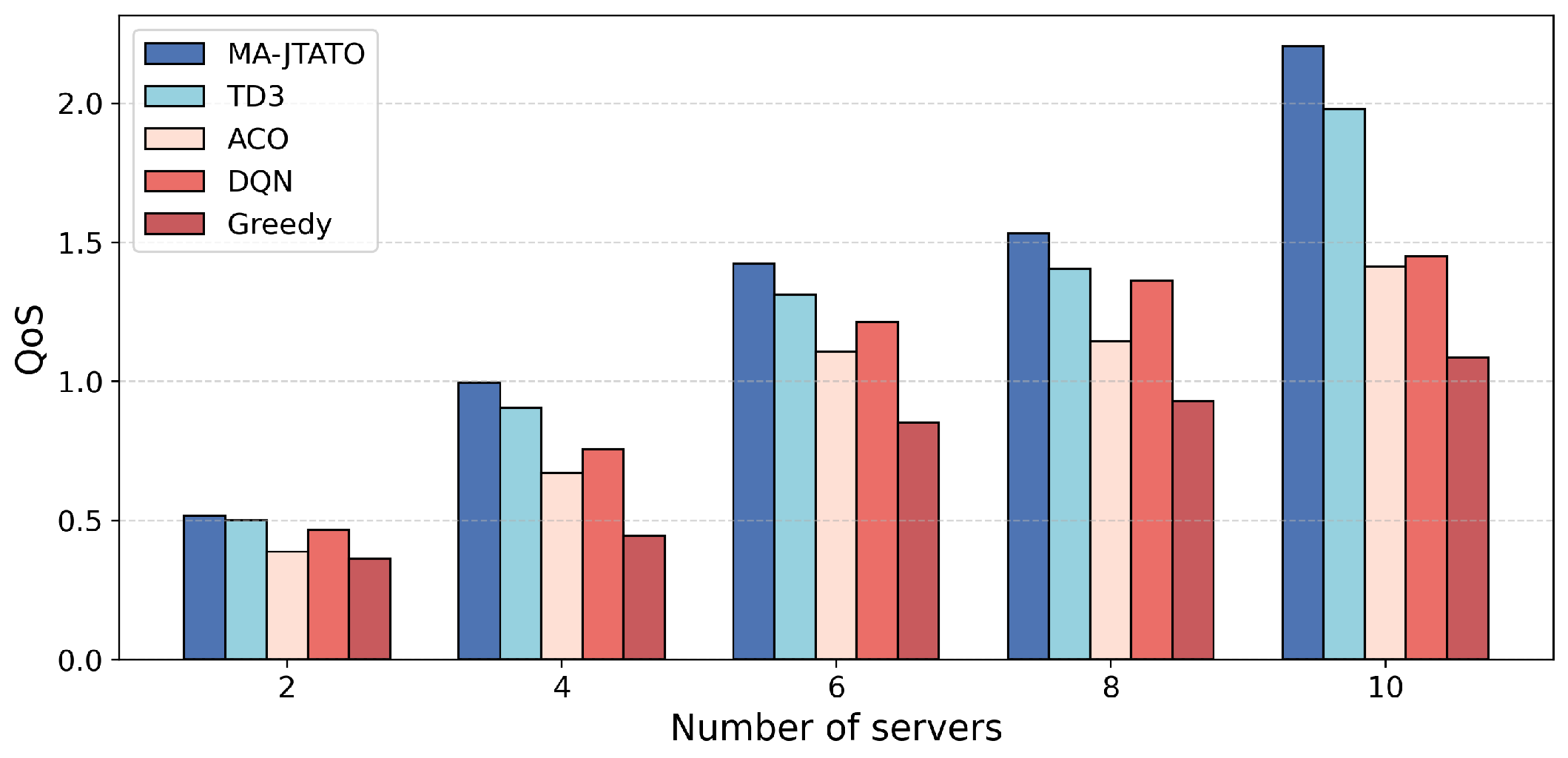
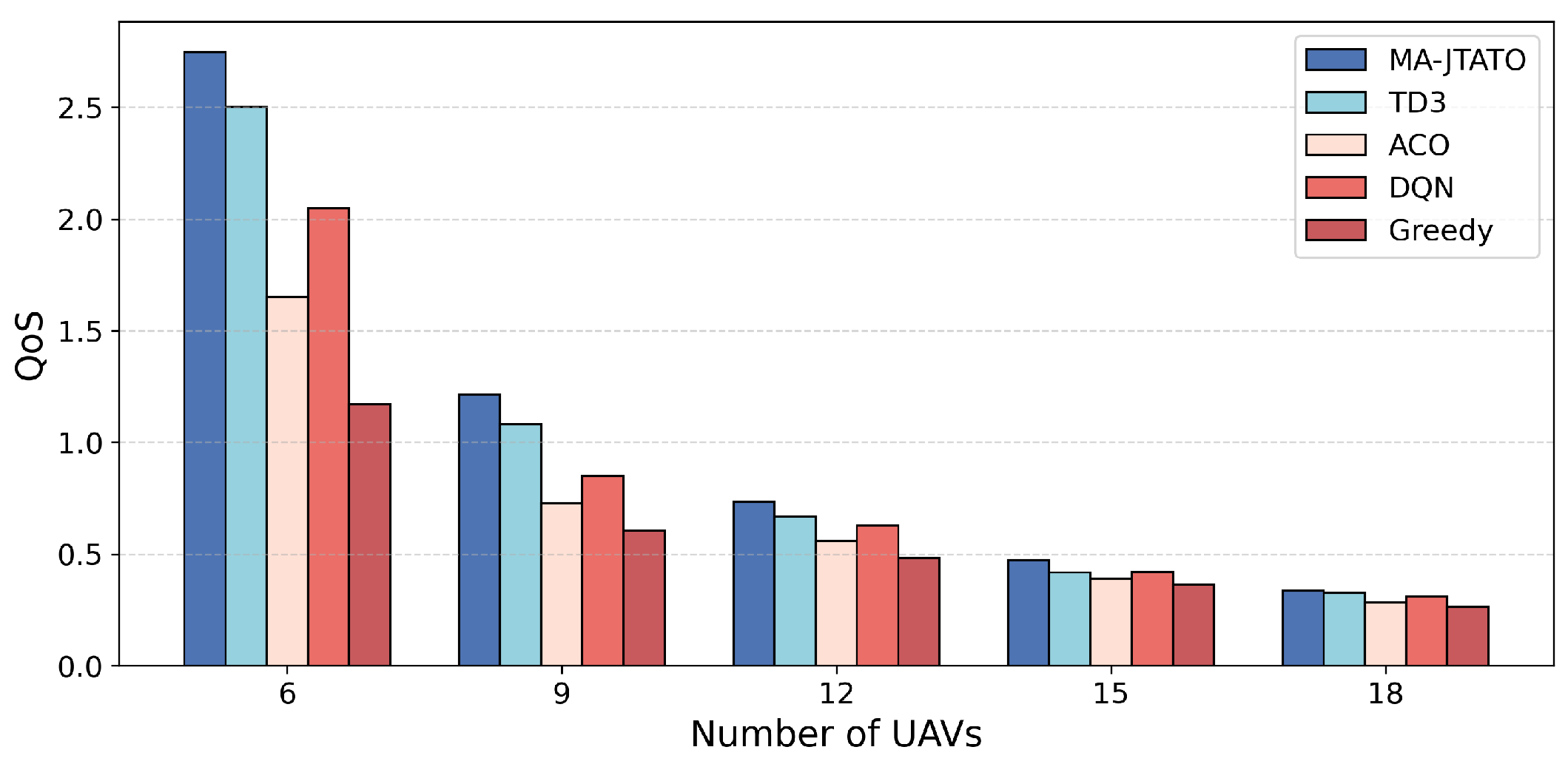
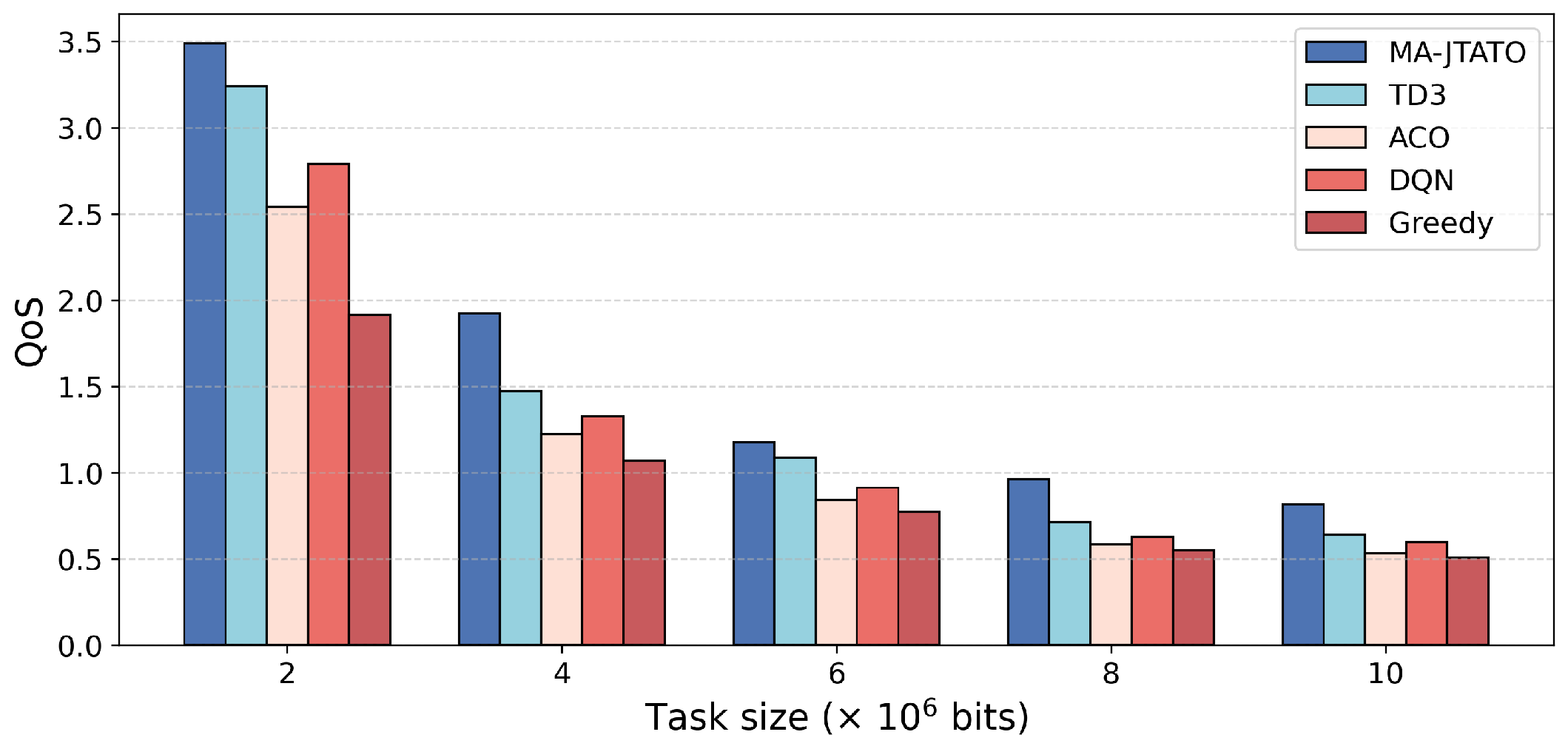
- The results demonstrate that the proposed MA-JTATO algorithm significantly outperforms baseline algorithms in system QoS performance, validating its effectiveness and robustness in UAV-assisted edge computing systems.
- These findings provide a scalable framework for future UAV-assisted edge computing, enabling efficient multi-agent coordination in dynamic environments for real-world applications requiring low latency and high QoS.
Abstract
1. Introduction
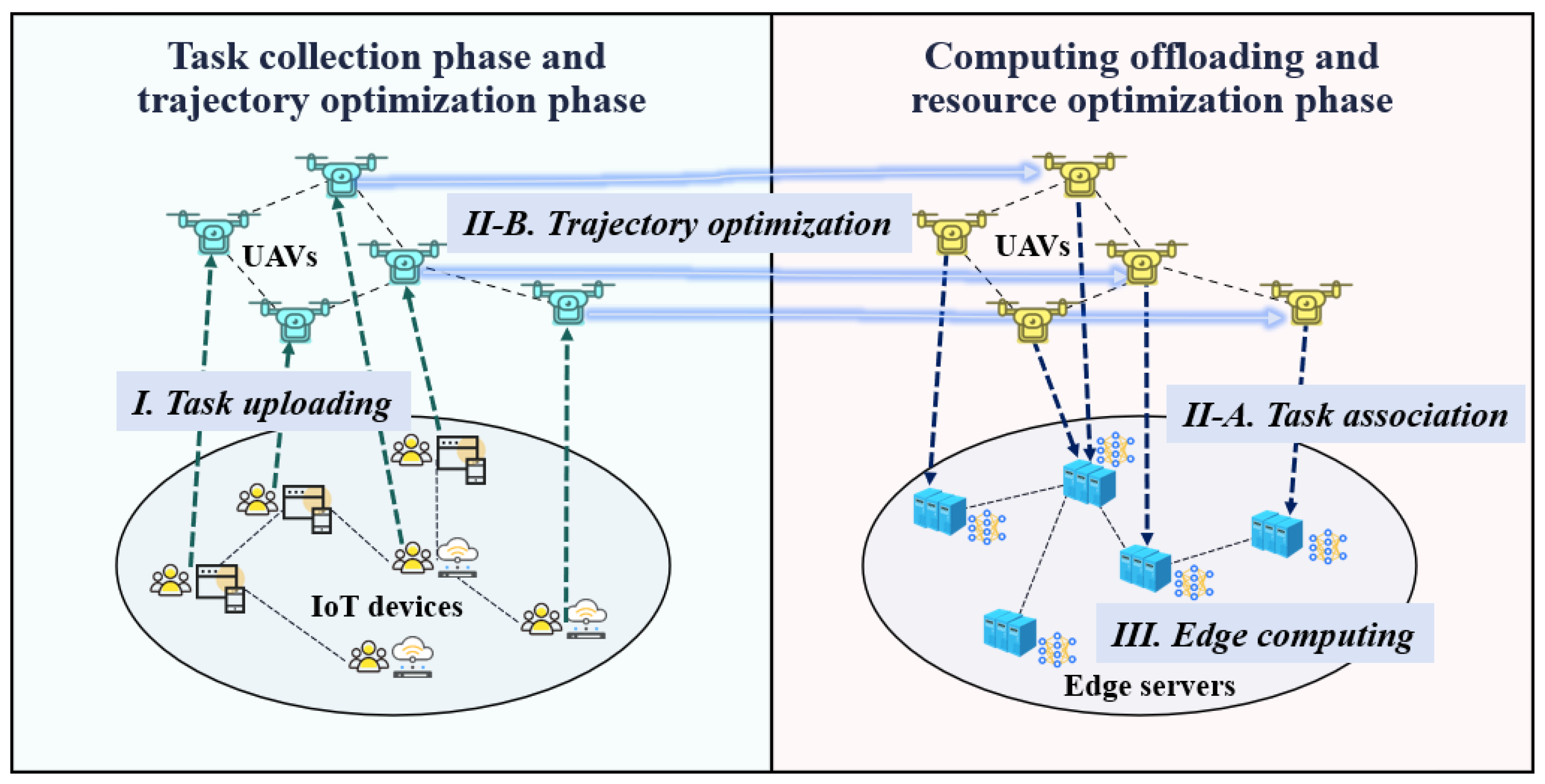
- To address large-scale computation-intensive tasks, this paper constructs a UAV-assisted edge computing system architecture tailored for multi-objective performance optimization and formulates the system QoS optimization goal as a mixed-integer non-convex programming problem with the objectives of jointly minimizing end-to-end task latency and global system energy consumption. Building upon this, an innovative intelligent collaborative optimization framework is proposed, which integrates task association, UAV trajectory control, and edge server computational resource allocation into a unified optimization paradigm. This framework realizes a systematic solution to the complex coupled optimization problem in UAV-assisted edge computing systems.
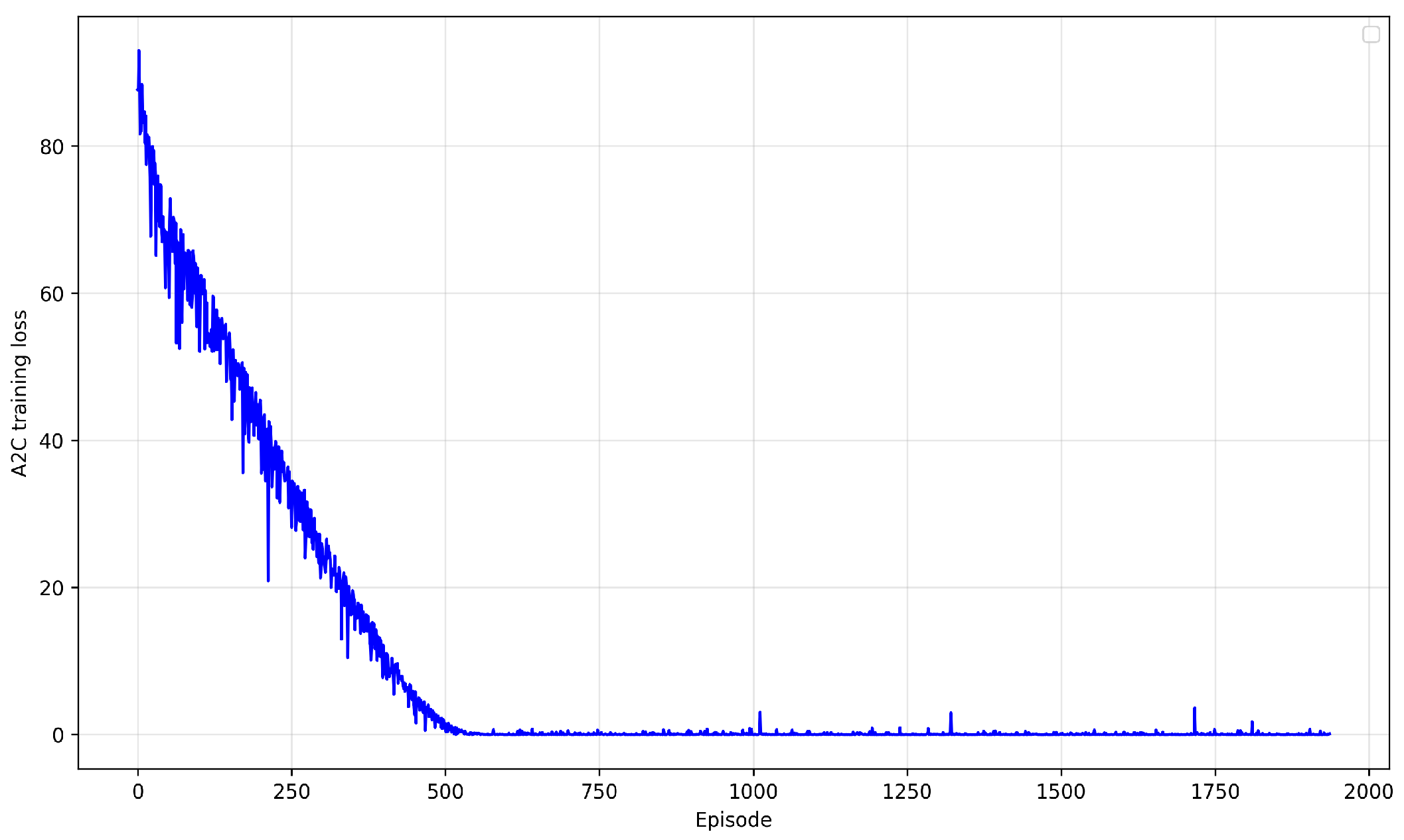
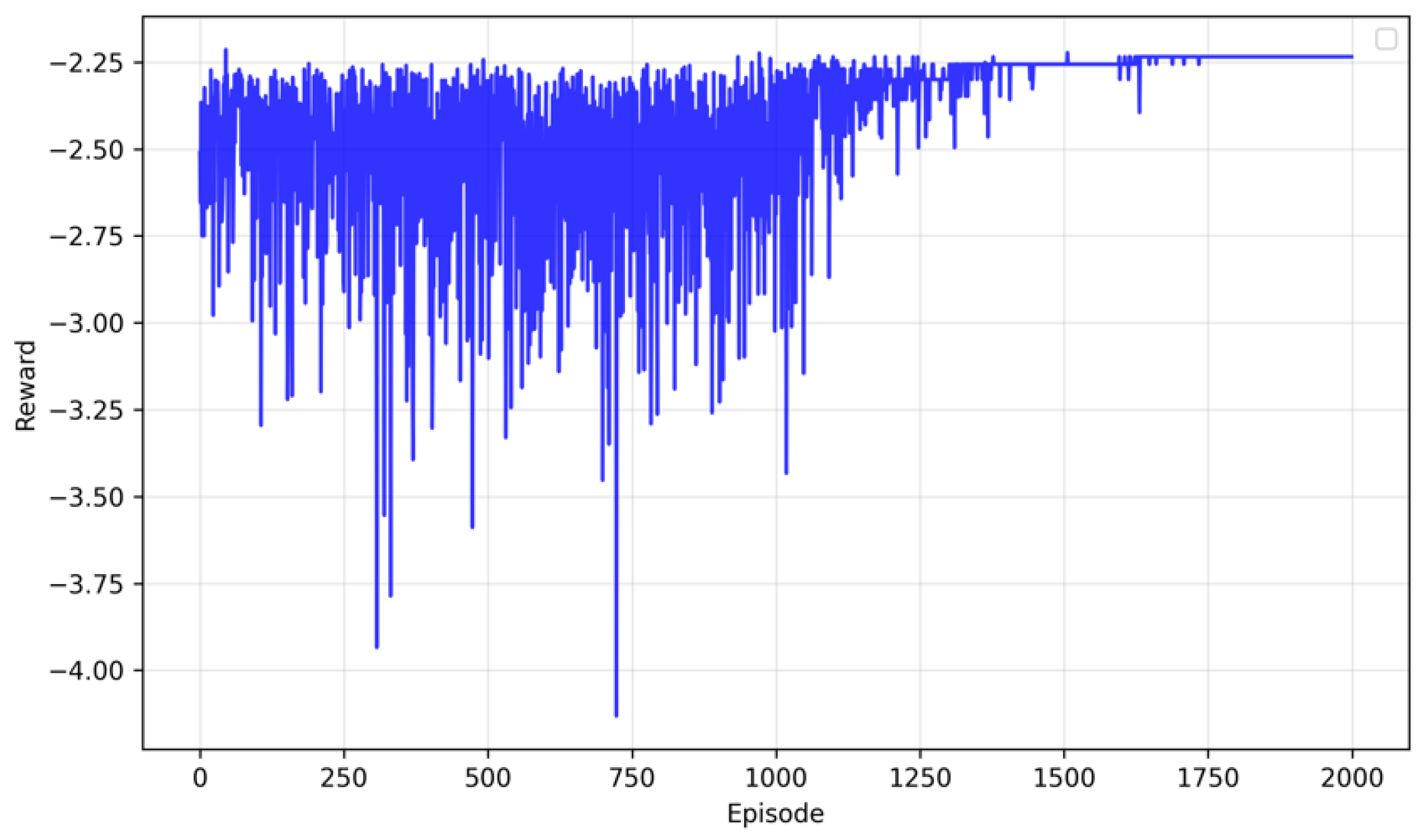
- For this highly intricate coupled joint optimization problem, this paper innovatively adopts a decoupling-and-collaboration optimization strategy and designs the multi-agent joint task association and trajectory optimization (MA-JTATO) algorithm, which decomposes the original intractable coupled problem into three subproblems: UAV-server task association, UAV flight trajectory control, and edge server computing resource allocation. Specifically, the task association subproblem employs the A2C algorithm to establish matching; the trajectory control subproblem introduces the MADDPG method to achieve energy-efficient and collaborative path planning for multiple UAVs; and the resource allocation subproblem leverages optimization theory to achieve efficient and optimal configuration of computing resources.
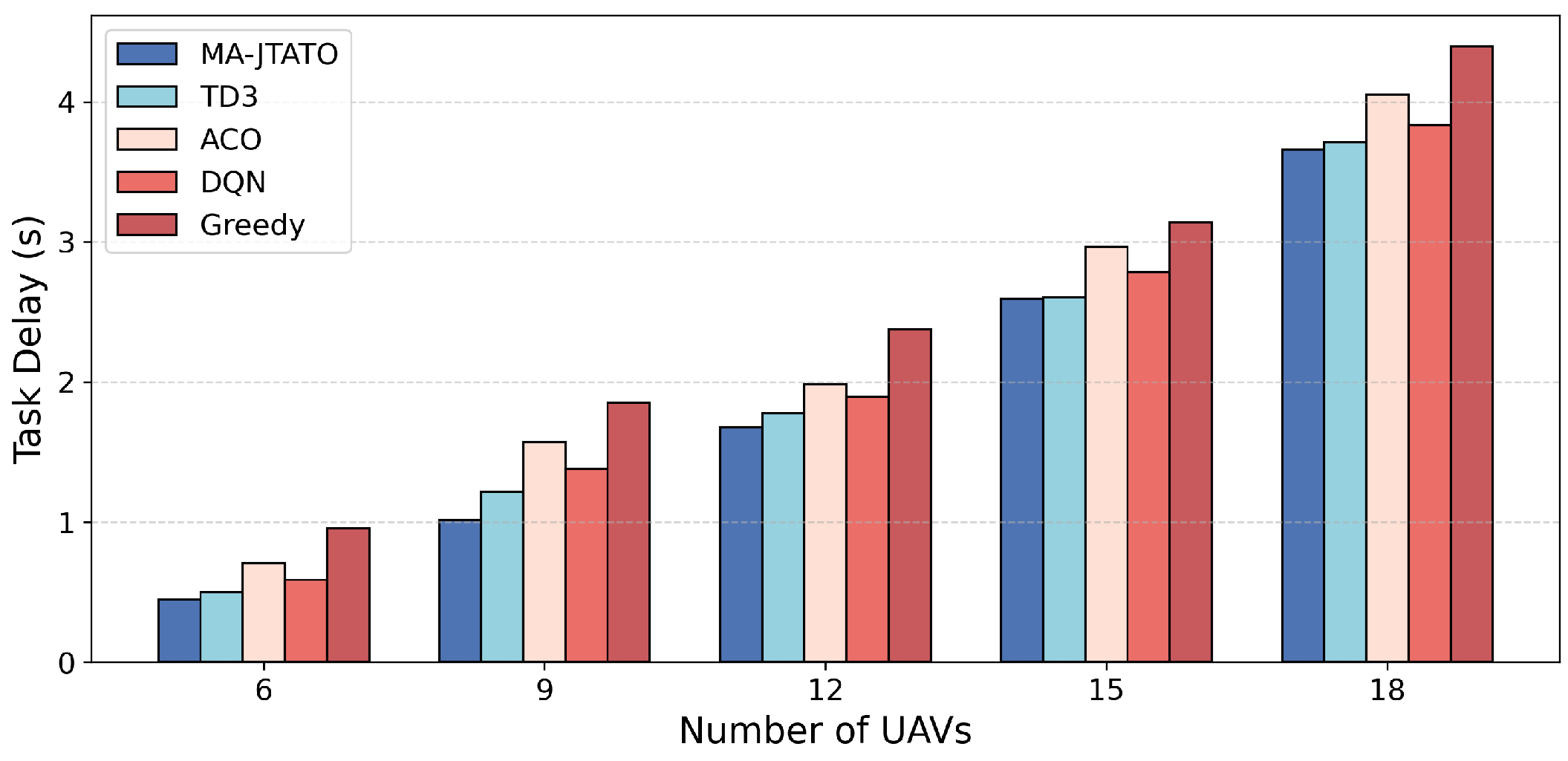
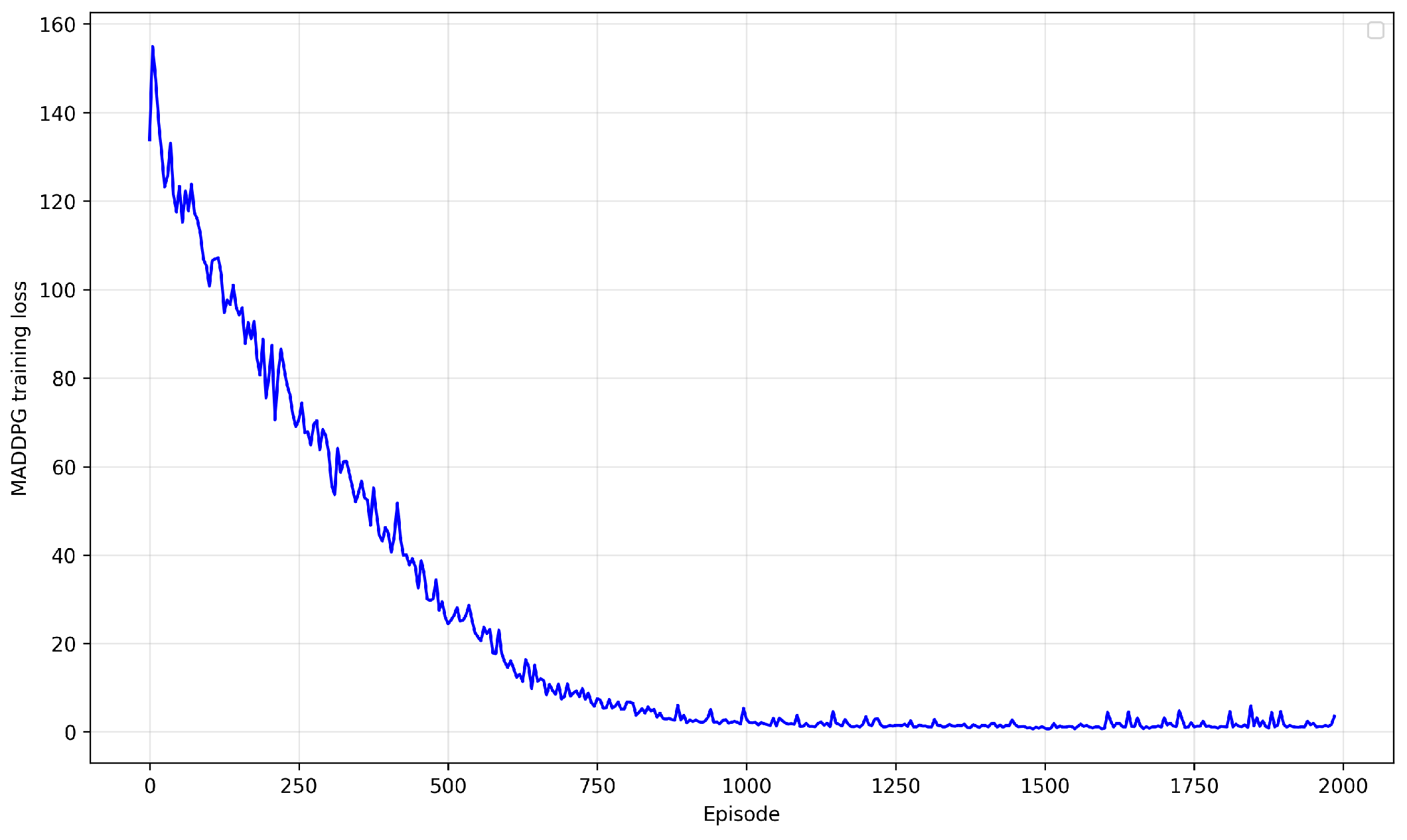
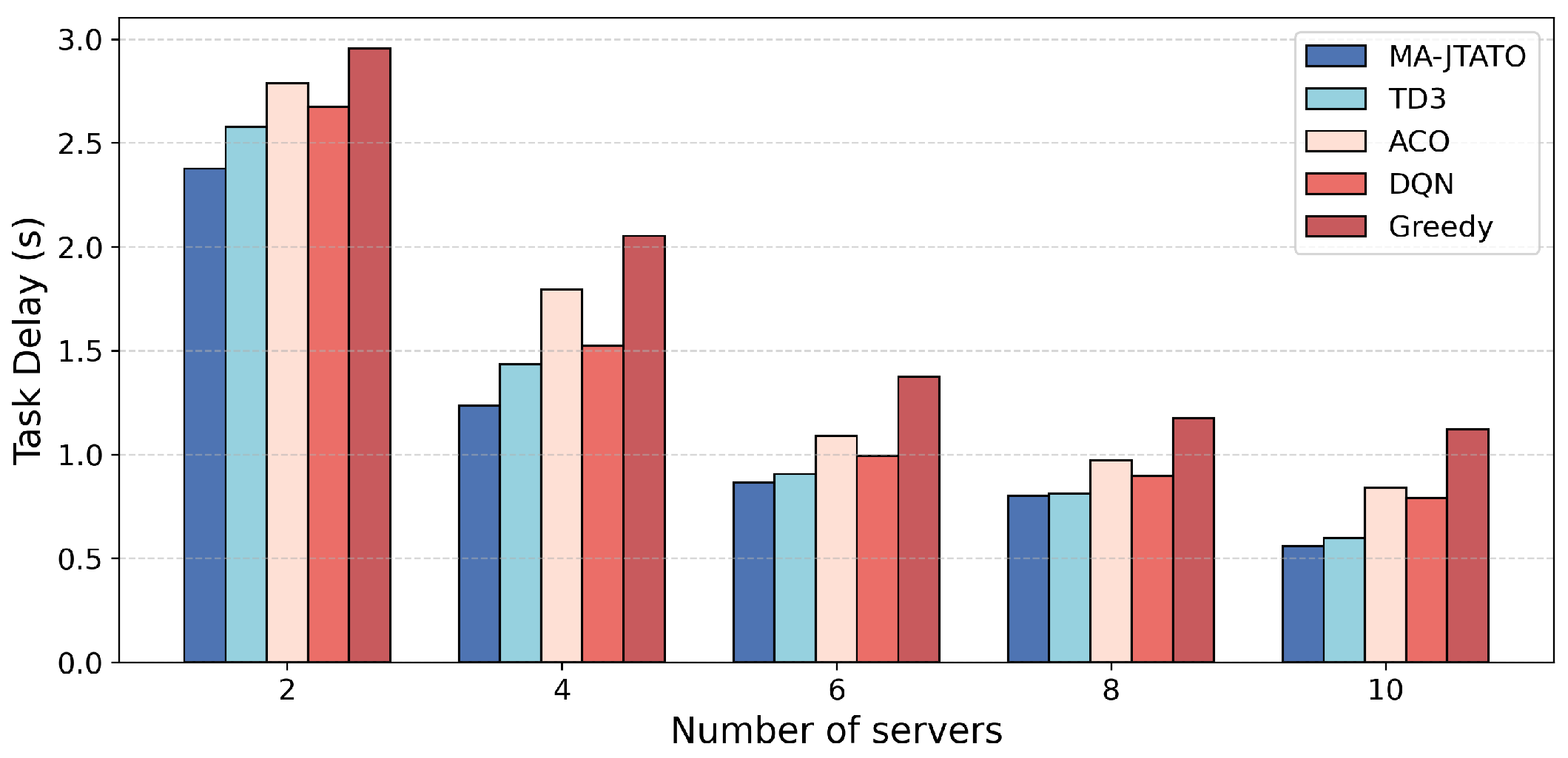
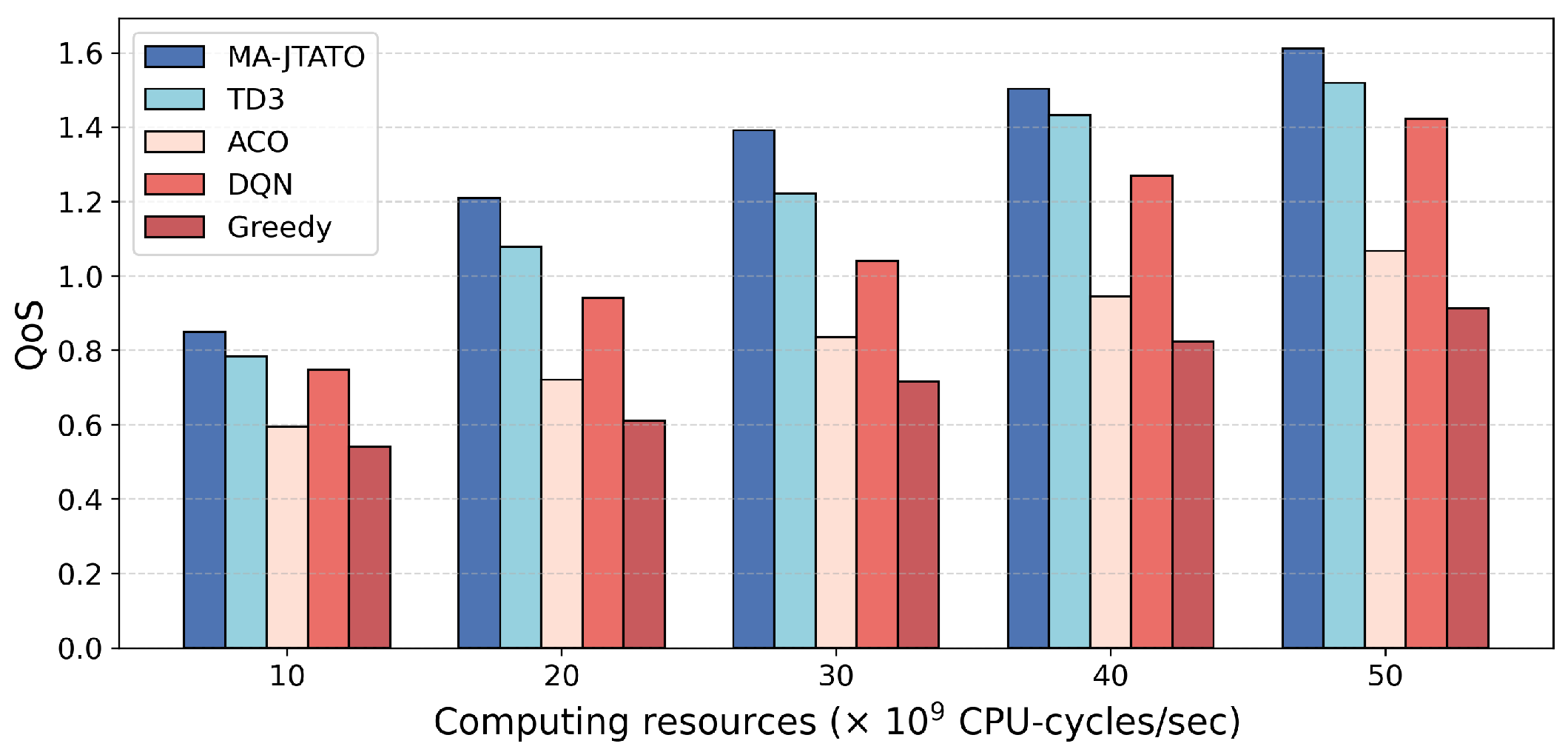
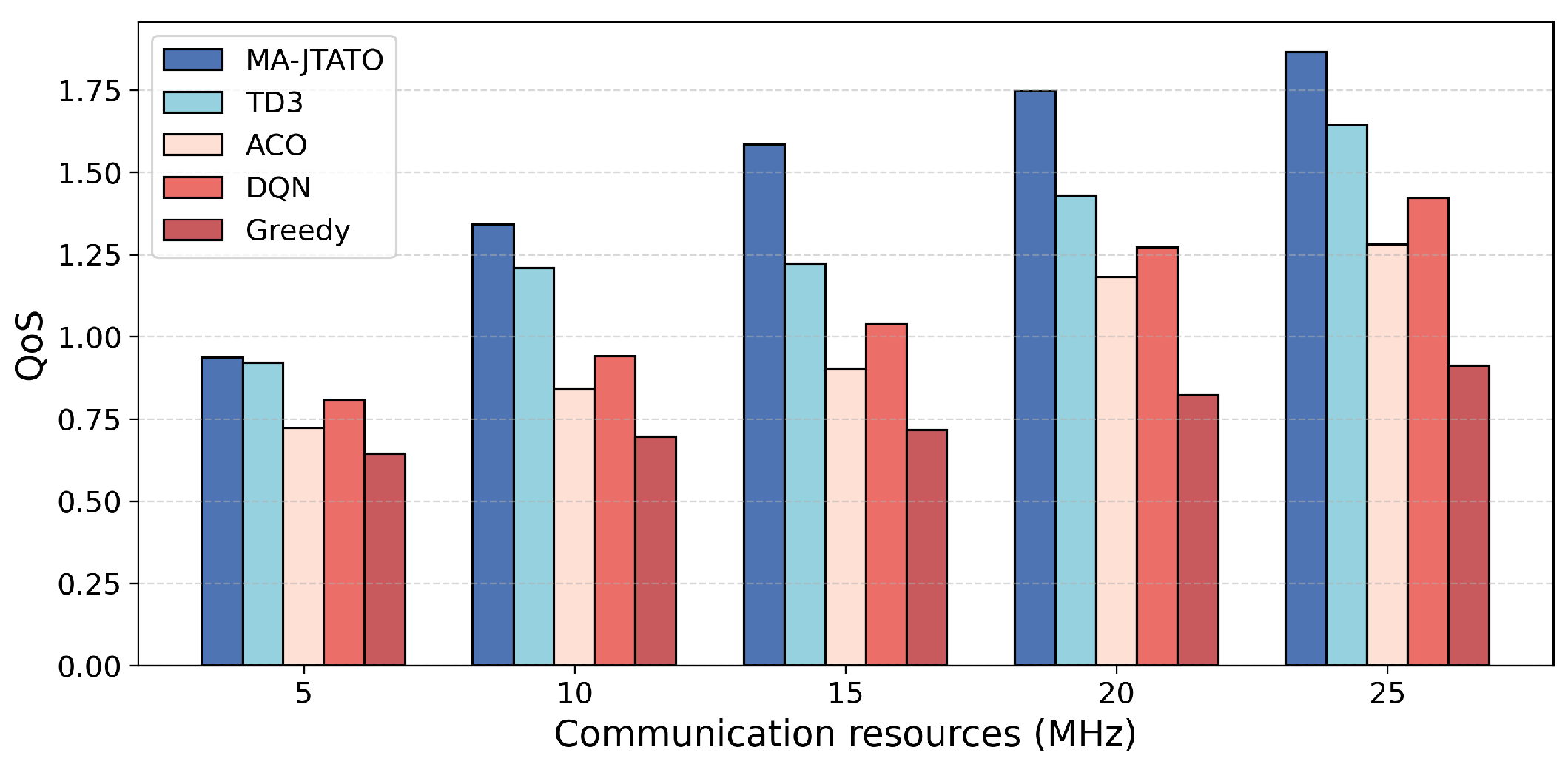
- Extensive simulation experiments demonstrate that the proposed MA-JTATO algorithm significantly outperforms baseline algorithms in terms of system QoS performance. This validates the effectiveness and robustness of the proposed framework in dynamic and complex scenarios, ultimately achieving performance optimization in dynamic UAV-assisted edge computing systems.
2. Related Work
2.1. Joint Optimization for UAV-Assisted Edge Computing
2.2. Reinforcement Learning for UAV Networks
3. System Model
3.1. UAV-Assisted Edge Computing System
3.2. Communication Model
3.3. Service Delay and Energy Consumption
3.3.1. UAV Flight Phase
3.3.2. Task Offloading Phase
3.3.3. Server Computation Phase
4. Problem Formulation
5. Proposed Solution
5.1. Task Offloading Decision
5.2. UAV Trajectory Control
| Algorithm 1: Multi-Agent UAV Trajectory Control |
 |
5.3. Computational Resource Allocation
5.4. MA-JTATO Optimization Algorithm
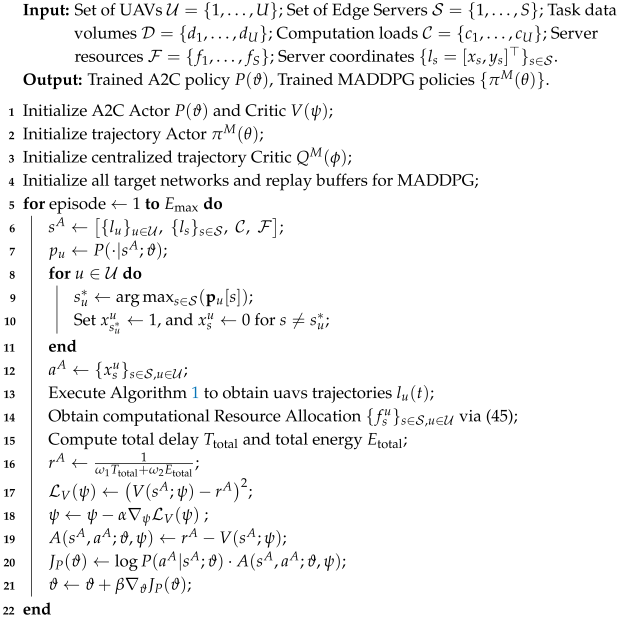
| Algorithm 2: Multi-agent Task Association and Trajectory Optimization (MA-JTATO) |
 |
6. Simulation and Discussion
6.1. Parameter Settings and Baseline Algorithms
6.2. Convergence Analysis
6.3. Performance Analysis
7. Conclusions and Future Work
Author Contributions
Funding
Data Availability Statement
Conflicts of Interest
References
- Tao, F.; Cheng, Y.; Da Xu, L.; Zhang, L.; Li, B.H. CCIoT-CMfg: Cloud computing and internet of things-based cloud manufacturing service system. IEEE Trans. Ind. Inform. 2014, 10, 1435–1442. [Google Scholar]
- Qin, P.; Li, J.; Zhang, J.; Fu, Y. Joint task allocation and trajectory optimization for multi-UAV collaborative air-ground edge computing. IEEE Trans. Netw. Sci. Eng. 2024, 11, 6231–6243. [Google Scholar] [CrossRef]
- Huang, Y.; Li, R.; Chen, M.; Zhao, F.; Zhang, D.; Tu, W. Securing UAV Communications by Fusing Cross-Layer Fingerprints. IEEE Internet Things J. 2025, 13, 2462–2475. [Google Scholar] [CrossRef]
- Cordill, B.; Fang, D.; Xu, S. A Comprehensive Survey of Security and Privacy in UAV Systems. IEEE Access 2025, 13, 117843–117866. [Google Scholar] [CrossRef]
- Liu, B.; Zhang, W.; Chen, W.; Huang, H.; Guo, S. Online computation offloading and traffic routing for UAV swarms in edge-cloud computing. IEEE Trans. Veh. Technol. 2020, 69, 8777–8791. [Google Scholar] [CrossRef]
- Dai, X.; Xiao, Z.; Jiang, H.; Lui, J.C. UAV-assisted task offloading in vehicular edge computing networks. IEEE Trans. Mob. Comput. 2023, 23, 2520–2534. [Google Scholar] [CrossRef]
- Seid, A.M.; Boateng, G.O.; Mareri, B.; Sun, G.; Jiang, W. Multi-agent DRL for task offloading and resource allocation in multi-UAV enabled IoT edge network. IEEE Trans. Netw. Serv. Manag. 2021, 18, 4531–4547. [Google Scholar] [CrossRef]
- Deng, C.; Fang, X.; Wang, X. UAV-enabled mobile-edge computing for AI applications: Joint model decision, resource allocation, and trajectory optimization. IEEE Internet Things J. 2022, 10, 5662–5675. [Google Scholar] [CrossRef]
- Liu, J.; Xu, Z.; Wen, Z. Joint data transmission and trajectory optimization in UAV-enabled wireless powered mobile edge learning systems. IEEE Trans. Veh. Technol. 2023, 72, 11617–11630. [Google Scholar] [CrossRef]
- Wang, Y.; Ru, Z.Y.; Wang, K.; Huang, P.Q. Joint deployment and task scheduling optimization for large-scale mobile users in multi-UAV-enabled mobile edge computing. IEEE Trans. Cybern. 2019, 50, 3984–3997. [Google Scholar] [CrossRef]
- Chen, J.; Cao, X.; Yang, P.; Xiao, M.; Ren, S.; Zhao, Z.; Wu, D.O. Deep reinforcement learning based resource allocation in multi-UAV-aided MEC networks. IEEE Trans. Commun. 2022, 71, 296–309. [Google Scholar] [CrossRef]
- Zhu, B.; Zhang, R.; Ma, F.; Yang, X. A Trajectory Planning and Task Offloading Collaborative Optimization Method for Multi-UAV Assisted MEC. In Proceedings of the 2025 IEEE International Conference on Unmanned Systems (ICUS); IEEE: New York, NY, USA, 2025; pp. 425–432. [Google Scholar]
- Peng, B.; Li, X.; Gao, J.; Liu, J.; Chen, Y.N.; Wong, K.F. Adversarial advantage actor-critic model for task-completion dialogue policy learning. In Proceedings of the 2018 IEEE International Conference on Acoustics, Speech and Signal Processing (ICASSP); IEEE: New York, NY, USA, 2018; pp. 6149–6153. [Google Scholar]
- Zheng, S.; Liu, H. Improved multi-agent deep deterministic policy gradient for path planning-based crowd simulation. IEEE Access 2019, 7, 147755–147770. [Google Scholar] [CrossRef]
- Akter, S.; Duong, D.V.A.; Yoon, S. Joint Optimization of UAV Trajectory, Task Offloading, and Resource Allocation in UAV-Aided Emergency Response Operations. IEEE Internet Things J. 2025, 12, 21944–21959. [Google Scholar] [CrossRef]
- Chen, Y.; Yang, Y.; Wu, Y.; Huang, J.; Zhao, L. Joint trajectory optimization and resource allocation in UAV-MEC systems: A Lyapunov-assisted DRL approach. IEEE Trans. Serv. Comput. 2025, 18, 854–867. [Google Scholar] [CrossRef]
- Zhao, K.; Peng, L.; Tak, B. Joint DRL-based UAV trajectory planning and TEG-based task offloading. IEEE Trans. Consum. Electron. 2025, 71, 3779–3789. [Google Scholar] [CrossRef]
- Ahmed, M.; Fatima, N.; Raza, S.; Ali, H.; Qayum, A.; Khan, W.U.; Sheraz, M.; Chuah, T.C. Optimizing resource allocation and task offloading in multi-UAV mec networks. IEEE Access 2025, 13, 68710–68725. [Google Scholar] [CrossRef]
- Zeng, Y.; Zhang, R. Energy-efficient UAV communication with trajectory optimization. IEEE Trans. Wirel. Commun. 2017, 16, 3747–3760. [Google Scholar] [CrossRef]
- Tu, W. Resource-efficient seamless transitions for high-performance multi-hop UAV multicasting. Comput. Networks 2022, 213, 109051. [Google Scholar] [CrossRef]
- Tarekegn, G.B.; Tesfaw, B.A.; Juang, R.T.; Saha, D.; Tarekegn, R.B.; Lin, H.P.; Tai, L.C. Trajectory control and fair communications for multi-UAV networks: A federated multi-agent deep reinforcement learning approach. IEEE Trans. Wirel. Commun. 2025, 24, 7598–7611. [Google Scholar] [CrossRef]
- Alwarafy, A.; Melhem, S.B.; Abou Chahine, R.; Said, B.; Alharethi, M.; Almazrouei, L.; Alblooshi, S. Deep Reinforcement Learning-Based Joint Trajectory Design and Resource Allocation for Secure and Energy-Efficient UAV Networks. IEEE Open J. Commun. Soc. 2025, 6, 6491–6505. [Google Scholar] [CrossRef]
- Li, K.; Fan, H.; Yang, Y.; Wang, C.; Gao, Q. Multi-agent reinforcement learning-based UAV path and resource allocation for ground-to-air communication network. IEEE Internet Things J. 2025, 12, 44243–44254. [Google Scholar] [CrossRef]
- Yuan, Z.; Bi, Y.; Fan, Y.; Liu, Y.; Ma, L.; Zhao, L.; He, Q. Trajectory optimization and power allocation for multi-UAV wireless networks: A communication-based multi-agent deep reinforcement learning approach. IEEE Trans. Comput. 2025, 74, 3404–3418. [Google Scholar] [CrossRef]
- Liu, Z.; Zhang, J.; Zeng, Y.; Ai, B. Energy-efficient multi-agent reinforcement learning for UAV trajectory optimization in cell-free massive MIMO networks. IEEE Trans. Wirel. Commun. 2025, 24, 5917–5930. [Google Scholar] [CrossRef]
- Mondal, A.; Mishra, D.; Alexandropoulos, G.C.; Al-Nahari, A.; Jäntti, R. Multi-agent reinforcement learning for offloading cellular communications with cooperating uavs. IEEE Trans. Aerosp. Electron. Syst. 2025, 61, 9344–9358. [Google Scholar] [CrossRef]
- Sun, G.; He, L.; Sun, Z.; Wu, Q.; Liang, S.; Li, J.; Niyato, D.; Leung, V.C. Joint task offloading and resource allocation in aerial-terrestrial UAV networks with edge and fog computing for post-disaster rescue. IEEE Trans. Mob. Comput. 2024, 23, 8582–8600. [Google Scholar] [CrossRef]
- Xu, J.; Yao, H.; Zhang, R.; Mai, T.; Guizani, M. Low latency and accuracy-guaranteed dnn inference for uav-assisted iot networks. IEEE Trans. Cogn. Commun. Netw. 2025, 11, 4050–4061. [Google Scholar] [CrossRef]
- Liu, B.; Ni, W.; Liu, R.P.; Guo, Y.J.; Zhu, H. Decentralized, privacy-preserving routing of cellular-connected unmanned aerial vehicles for joint goods delivery and sensing. IEEE Trans. Intell. Transp. Syst. 2023, 24, 9627–9641. [Google Scholar] [CrossRef]
- Wang, L.; Wang, K.; Pan, C.; Xu, W.; Aslam, N.; Nallanathan, A. Deep reinforcement learning based dynamic trajectory control for UAV-assisted mobile edge computing. IEEE Trans. Mob. Comput. 2021, 21, 3536–3550. [Google Scholar] [CrossRef]
- Zhang, Y.; Zhang, Y.; Yu, Z.; Li, J.; Qin, Q.; Gao, C. A twin-delayed deep deterministic policy gradient approach for UAV formation control. In Proceedings of the 2024 American Control Conference (ACC); IEEE: New York, NY, USA, 2024; pp. 2393–2398. [Google Scholar]
- Zhang, L.; Zhou, W.; Xia, J.; Gao, C.; Zhu, F.; Fan, C.; Ou, J. DQN-based mobile edge computing for smart Internet of vehicle. EURASIP J. Adv. Signal Process. 2022, 2022, 45. [Google Scholar] [CrossRef]
- Feng, J.; Liu, Z.; Wu, C.; Ji, Y. AVE: Autonomous vehicular edge computing framework with ACO-based scheduling. IEEE Trans. Veh. Technol. 2017, 66, 10660–10675. [Google Scholar] [CrossRef]
- Wei, F.; Chen, S.; Zou, W. A greedy algorithm for task offloading in mobile edge computing system. China Commun. 2018, 15, 149–157. [Google Scholar] [CrossRef]







| Parameter | Value |
|---|---|
| The altitude of UAVs, H | 100 m |
| Each slot duration, | 1 s |
| Computation resources of servers, | CPU-cycles/s |
| Task size, | bits |
| Task computation density, | cycles |
| The channel gain, | |
| Transmit power, p | 0.1 W |
| Bandwidth, B | |
| Noise power spectral density, | |
| Weighting coefficient, | 0.8 |
| Weighting coefficient, | 0.2 |
| Weighting coefficient, | 0.9 |
| Weighting coefficient, | 0.1 |
Disclaimer/Publisher’s Note: The statements, opinions and data contained in all publications are solely those of the individual author(s) and contributor(s) and not of MDPI and/or the editor(s). MDPI and/or the editor(s) disclaim responsibility for any injury to people or property resulting from any ideas, methods, instructions or products referred to in the content. |
© 2026 by the authors. Licensee MDPI, Basel, Switzerland. This article is an open access article distributed under the terms and conditions of the Creative Commons Attribution (CC BY) license.
Share and Cite
Zhang, Y.; Wen, Z. MA-JTATO: Multi-Agent Joint Task Association and Trajectory Optimization in UAV-Assisted Edge Computing System. Drones 2026, 10, 267. https://doi.org/10.3390/drones10040267
Zhang Y, Wen Z. MA-JTATO: Multi-Agent Joint Task Association and Trajectory Optimization in UAV-Assisted Edge Computing System. Drones. 2026; 10(4):267. https://doi.org/10.3390/drones10040267
Chicago/Turabian StyleZhang, Yunxi, and Zhigang Wen. 2026. "MA-JTATO: Multi-Agent Joint Task Association and Trajectory Optimization in UAV-Assisted Edge Computing System" Drones 10, no. 4: 267. https://doi.org/10.3390/drones10040267
APA StyleZhang, Y., & Wen, Z. (2026). MA-JTATO: Multi-Agent Joint Task Association and Trajectory Optimization in UAV-Assisted Edge Computing System. Drones, 10(4), 267. https://doi.org/10.3390/drones10040267