
Spectral Responses to Larval and Artificial Defoliation in Eucalyptus dunnii: Implications for UAV-Based Detection of Gonipterus Damage


Highlights
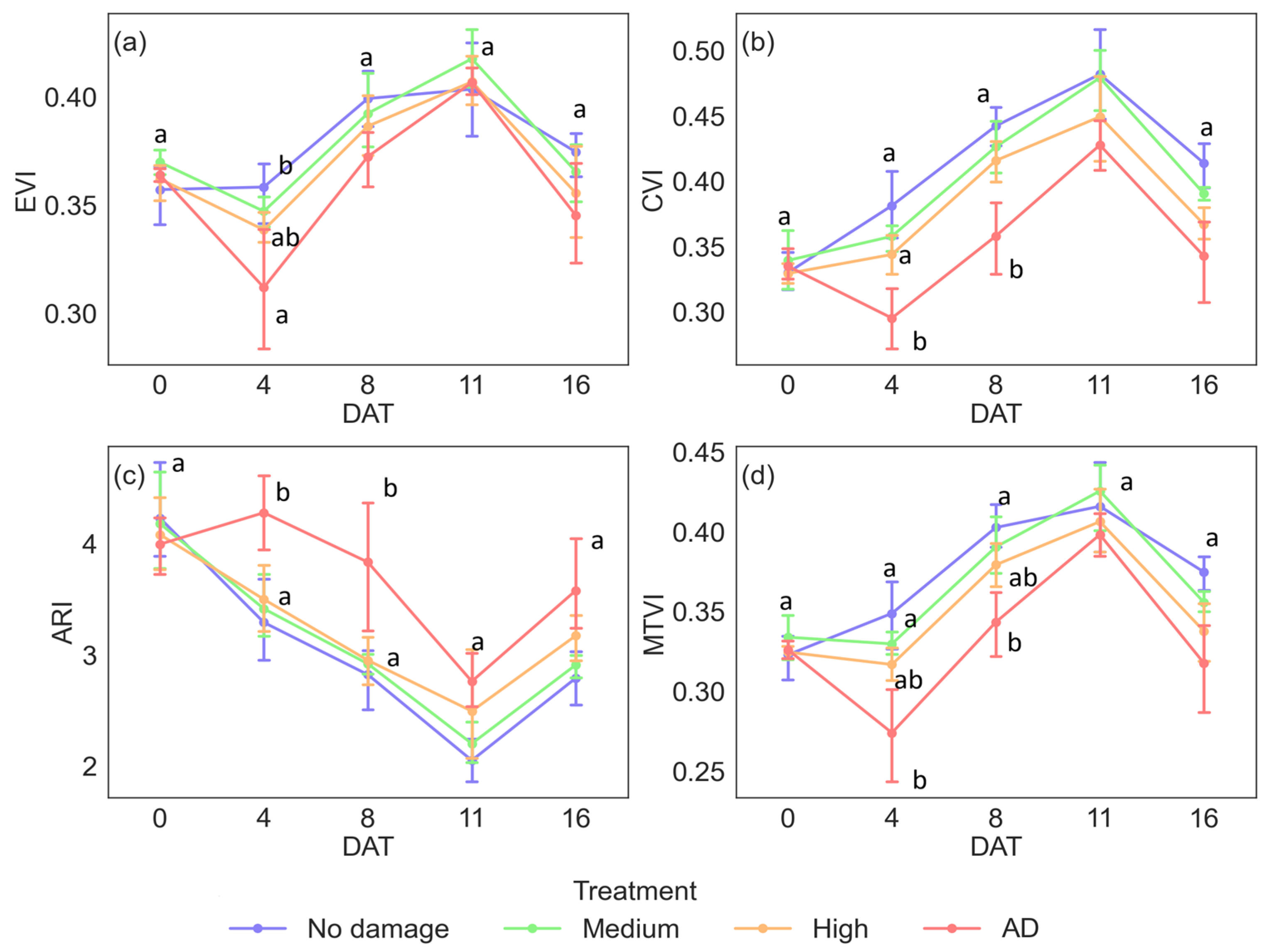
- Larval feeding by Gonipterus sp. n. 2 and artificial defoliation significantly altered multispectral reflectance and pigment-related vegetation indices in Eucalyptus dunnii, reducing visible and NIR reflectance and chlorophyll, anthocyanin, and carotenoid indices due to exposure of older leaves.
- Artificial defoliation produced stronger and earlier spectral responses than insect feeding but followed similar temporal patterns, indicating that canopy defoliation dominates the spectral signal and that artificial defoliation is a suitable proxy for insect-induced damage.
- UAV-based multispectral imagery can reliably detect defoliation related canopy and physiological changes, supporting its application for finescale, timely monitoring of forest health and pest impacts.
- Similar spectral responses from insect feeding and artificial defoliation indicate limited capacity of current multispectral methods to distinguish causes of damage, highlighting the value of artificial defoliation as an experimental proxy and the need for improved approaches for cause-specific pest detection.
Abstract
1. Introduction
- -
- H1 (Structural Impact): Both larval feeding and AD will cause significant decreases in VIs primarily sensitive to canopy structure and biomass (EVI, NDVI). This prediction is based on the direct removal of photosynthetic tissue by both treatments, which reduces overall leaf area and consequently lowers near-infrared reflectance [22,23].
- -
- H2 (Chlorophyll Dynamics): Larval feeding, involving sustained tissue removal and the introduction of herbivore-associated molecular patterns, will trigger a significant decrease in chlorophyll content, detectable through chlorophyll-sensitive indices (NDRE, CI). We expect that AD will have a weaker or delayed effect on these indices, as the biochemical signaling cascades leading to chlorophyll degradation are less strongly activated by mechanical wounding alone [24].
- -
- H3 (Photoprotective Pigment Induction): Larval feeding will increase photoprotective pigment concentrations, detectable as a rise in anthocyanin-sensitive indices (ARI, mARI) and indices related to the carotenoid: chlorophyll ratio. This response is expected as a downstream consequence of herbivore-induced chlorophyll degradation and sustained biotic stress, which triggers the upregulation of these pigments to dissipate excess energy and mitigate oxidative damage [18,19]. We expect that AD will not elicit a comparable increase in these indices, as the systemic biochemical signals required for their accumulation are largely absent.
- -
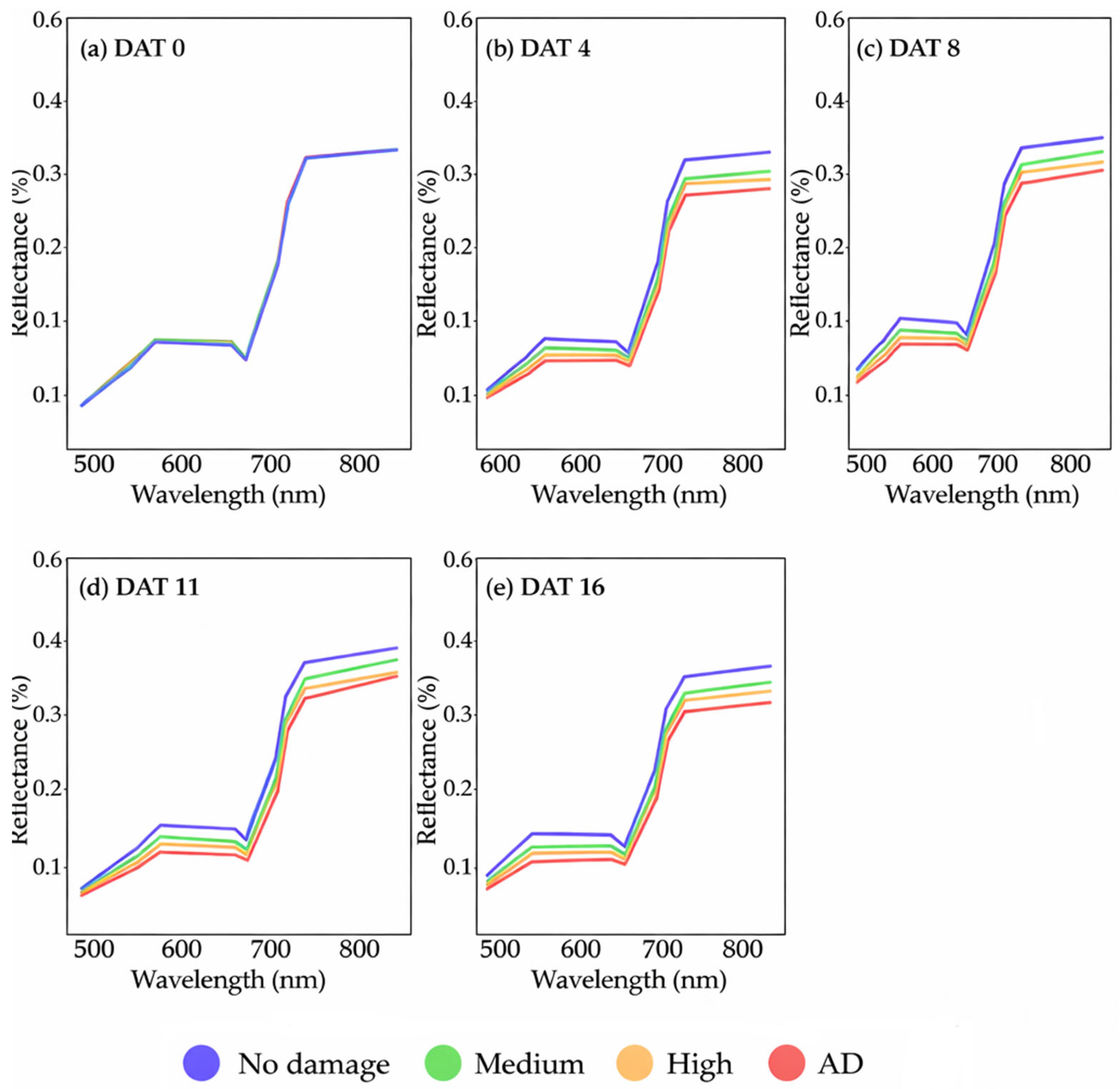
- H4 (Comparative Spectral Pathways): Collectively, we expect that larval damage will result in a compound spectral response: increased reflectance in the visible spectrum (400–700 nm) due to reduced chlorophyll absorption, coupled with a decreased reflectance in the near-infrared (NIR) due to reduced biomass. We hypothesize that the spectral impact of AD will be dominated by the NIR decrease from tissue loss, with minimal accompanying changes in the visible spectrum. A significant divergence in the visible-spectrum response between the two treatments would indicate that Gonipterus sp. n. 2 damage cannot be attributed to defoliation alone, and that herbivore-specific biochemical processes are a key driver of stress-induced spectral changes.
2. Materials and Methods
2.1. Study Area
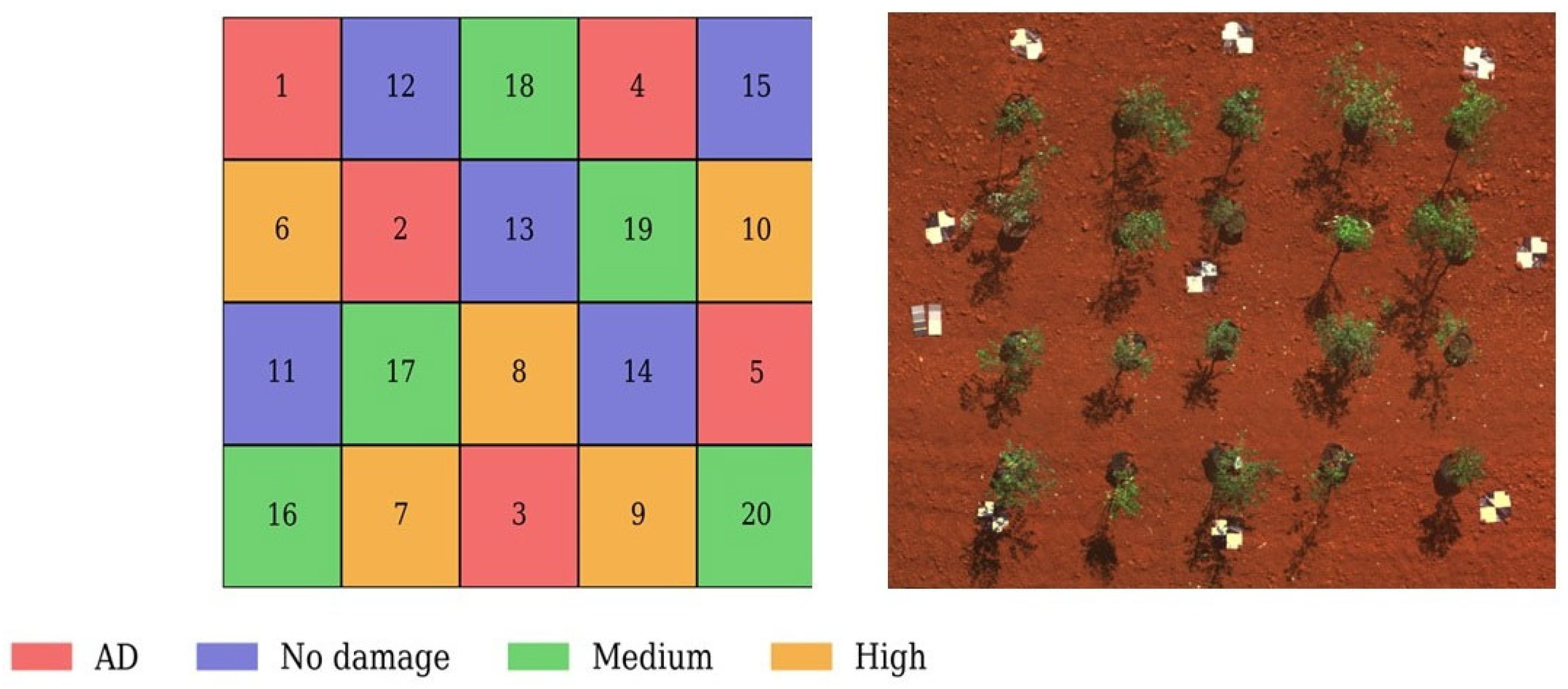
2.2. Experimental Design
2.3. UAV Flights
2.4. Image Processing, Vegetation Index Retrieval, Statistical Analysis and Leaf Counts

| Target Property | Vegetation Index | Formula | References |
|---|---|---|---|
| Biomass | Enhanced Vegetation Index (EVI) | [29] | |
| Biomass | Normalized Difference Vegetation Index (NDVI) | [30] | |
| Chlorophyll | Normalized Difference Red Edge (NDRE) | [31] | |
| Chlorophyll | Chlorophyll Vegetation Index (CVI) | [32] | |
| Anthocyanin | Anthocyanin Reflectance Index (ARI) | [33] | |
| Anthocyanin | Modified Anthocyanin Reflectance Index (MARI) | [34] | |
| Carotene/Chlorophyll | Modified Transformed Vegetation Index (MTVI) | [35] | |
| Carotene/Chlorophyll | Carotenoid Triangular Ratio Index/Chlorophyll Red-Edge Index (CTRI/RE) | [28] |
2.5. Statistical Processing
3. Results
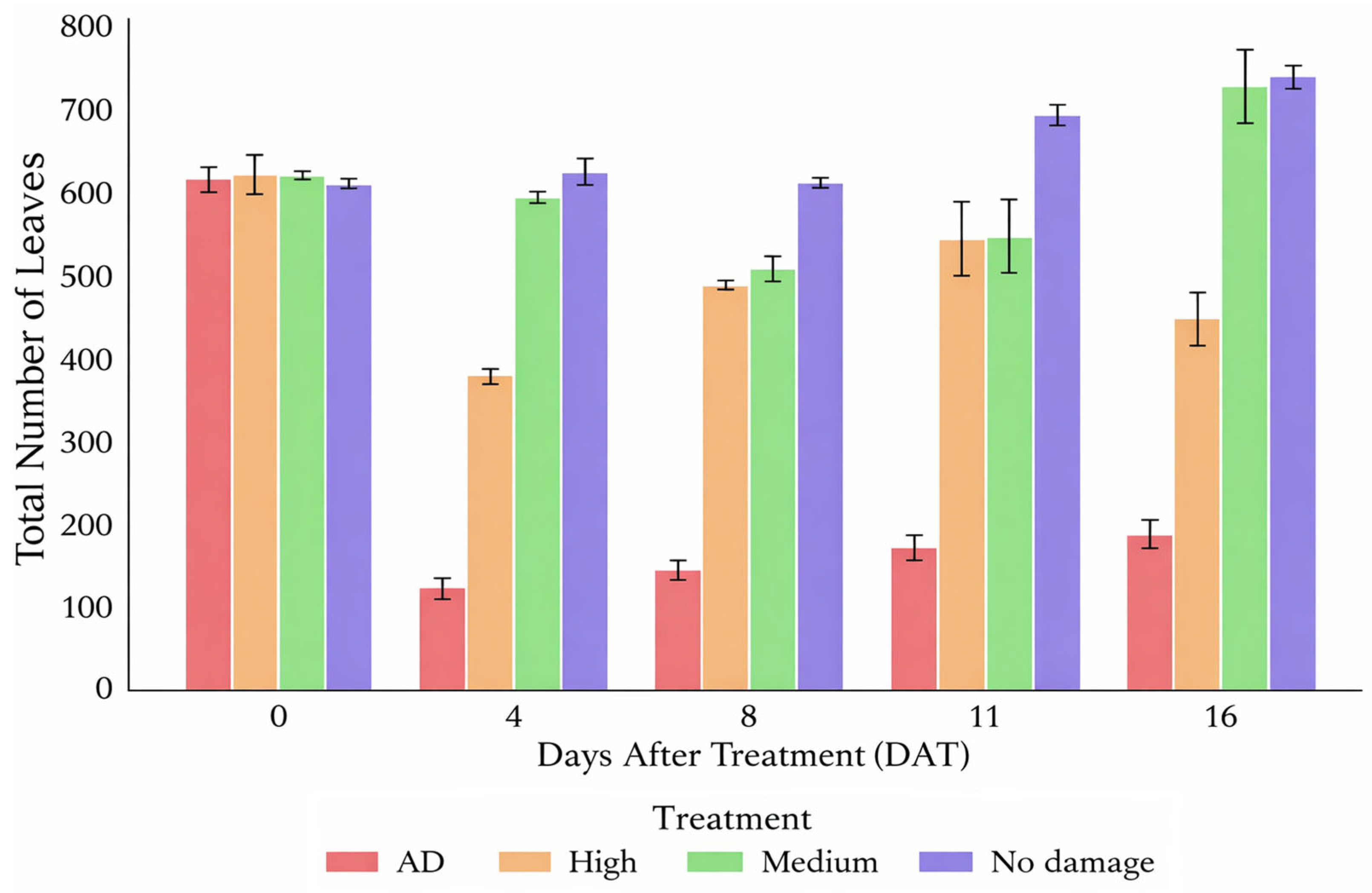
3.1. Number of New Flush Leaves
3.2. Spectral Response to Gonipterus Feeding
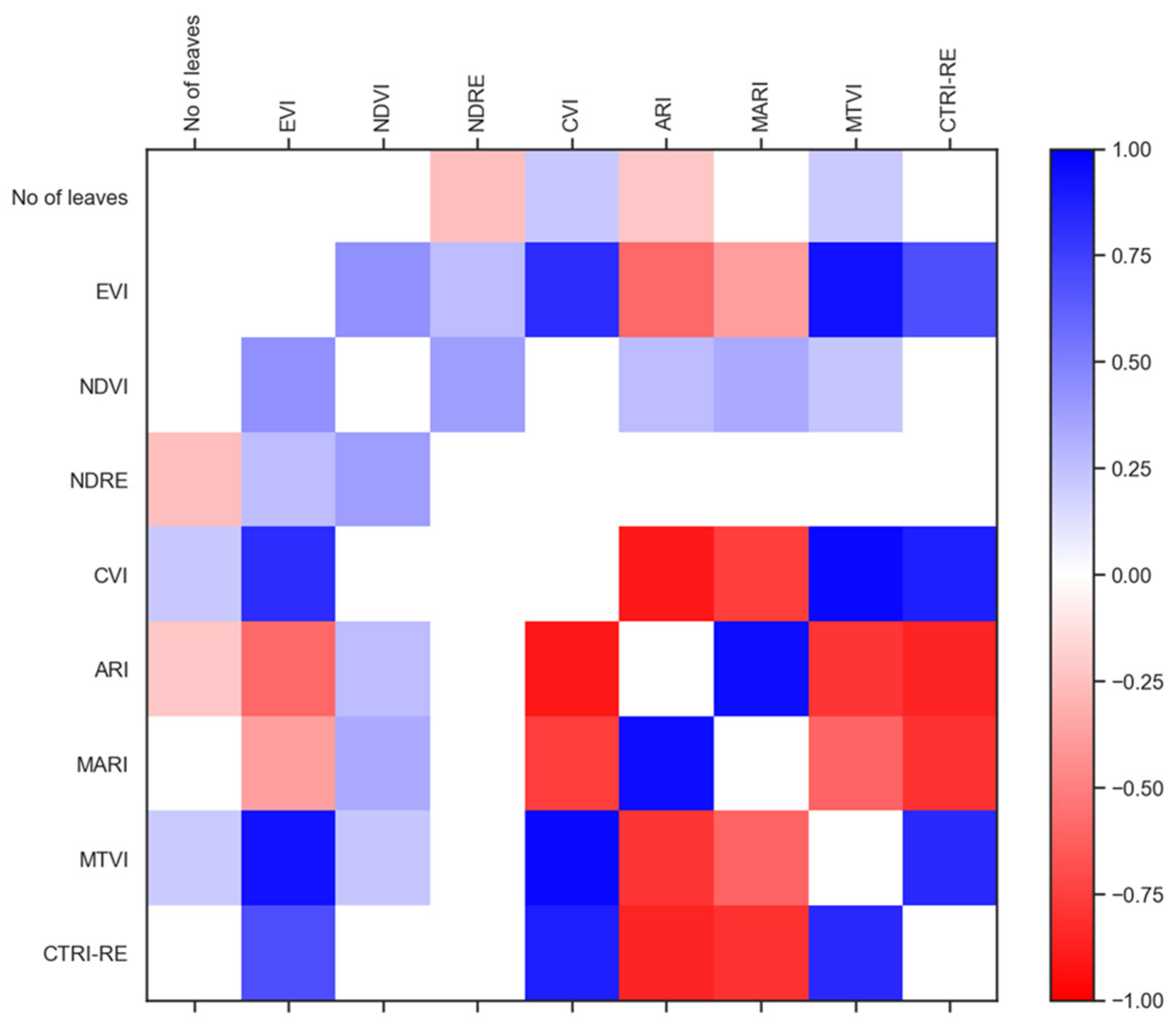
3.3. Vegetation Index Response to Gonipterus Feeding
4. Discussion
5. Conclusions
Author Contributions
Funding
Data Availability Statement
Acknowledgments
Conflicts of Interest
References
- Holmes, T.P.; Aukema, J.E.; Von Holle, B.; Liebhold, A.; Sills, E. Economic Impacts of Invasive Species in Forests. Ann. N. Y. Acad. Sci. 2009, 1162, 18–38. [Google Scholar] [CrossRef] [PubMed]
- Panzavolta, T.; Bracalini, M.; Benigno, A.; Moricca, S. Alien Invasive Pathogens and Pests Harming Trees, Forests, and Plantations: Pathways, Global Consequences and Management. Forests 2021, 12, 1364. [Google Scholar] [CrossRef]
- Williams, G.M.; Ginzel, M.D.; Ma, Z.; Adams, D.C.; Campbell, F.; Lovett, G.M.; Pildain, M.B.; Raffa, K.F.; Gandhi, K.J.K.; Santini, A.; et al. The Global Forest Health Crisis: A Public-Good Social Dilemma in Need of International Collective Action. Annu. Rev. Phytopathol. 2023, 61, 377–401. [Google Scholar] [CrossRef] [PubMed]
- Schröder, M.L.; Slippers, B.; Wingfield, M.J.; Hurley, B.P. Invasion History and Management of Eucalyptus Snout Beetles in the Gonipterus scutellatus Species Complex. J. Pest. Sci. 2020, 93, 11–25. [Google Scholar] [CrossRef]
- Mapondera, T.S.; Burgess, T.; Matsuki, M.; Oberprieler, R.G. Identification and Molecular Phylogenetics of the Cryptic Species of the Gonipterus scutellatus Complex (Coleoptera: Curculionidae: Gonipterini): Resolving the Gonipterus scutellatus Complex. Aust. J. Entomol. 2012, 51, 175–188. [Google Scholar] [CrossRef]
- Tooke, F.G.C. The Eucalyptus Snout-Beetle, Gonipterus scutellatus Gyll. A Study of Its Ecology and Control by Biological Means; Department of Agriculture and Forestry, Union of South Africa: Pretoria, South Africa, 1955.
- Joubert, J.; Sivparsad, B.; Schröder, M.; Germishuizen, I.; Chen, J.; Hurley, B.; Allison, J.D.; Hammerbacher, A. Susceptibility of Eucalyptus Trees to Defoliation by the Eucalyptus Snout Beetle, Gonipterus sp. n. 2, Is Enhanced by High Foliar Contents of 1,8-Cineole, Oxalic Acid and Sucrose and Low Contents of Palmitic and Shikimic Acid. Plant Cell Environ. 2023, 46, 3481–3500. [Google Scholar] [CrossRef]
- Mally, C.W. The Eucalyptus Snout-Beetle. J. Dep. Agric. 1924, 9, 415–442. Available online: https://journals.co.za/doi/pdf/10.10520/AJA0000020_683 (accessed on 25 March 2026).
- Morris, A.R. Changing Use of Species and Hybrids in South African Forest Plantations. South For. J. For. Sci. 2022, 84, 193–205. [Google Scholar] [CrossRef]
- Schröder, M.L.; Hurley, B.P.; Wingfield, M.J.; Slippers, B.; Garnas, J.R. Thermal Limitations to the Biological Control of Gonipterus sp. n. 2 (Coleoptera: Curculionidae) in South African Eucalyptus Plantations. Agric. For. Entomol. 2025, 28, 27–37. [Google Scholar] [CrossRef]
- Tribe, G.D. The Present Status of Anaphes nitens (Hymenoptera: Mymaridae), an Egg Parasitoid of the Eucalyptus Snout Beetle Gonipterus scutellatus, in the Western Cape Province of South Africa. South. Afr. For. J. 2005, 203, 49–54. [Google Scholar] [CrossRef]
- Keetse, H. Tree Growth Losses from Gonipterus sp. 2 Feeding Damage on Eucalyptus Plantations and Quantified Economic Impact; University of Pretoria: Pretoria, South Africa, 2024. [Google Scholar]
- Reis, A.R.; Ferreira, L.; Tomé, M.; Araujo, C.; Branco, M. Efficiency of Biological Control of Gonipterus platensis (Coleoptera: Curculionidae) by Anaphes nitens (Hymenoptera: Mymaridae) in Cold Areas of the Iberian Peninsula: Implications for Defoliation and Wood Production in Eucalyptus globulus. For. Ecol. Manag. 2012, 270, 216–222. [Google Scholar] [CrossRef]
- Mngadi, M.; Germishuizen, I.; Mutanga, O.; Naicker, R.; Maes, W.H.; Odebiri, O.; Schroder, M. A Systematic Review of the Application of Remote Sensing Technologies in Mapping Forest Insect Pests and Diseases at a Tree-Level. Remote Sens. Appl. Soc. Environ. 2024, 36, 101341. [Google Scholar] [CrossRef]
- Dainelli, R.; Toscano, P.; Di Gennaro, S.F.; Matese, A. Recent Advances in Unmanned Aerial Vehicles Forest Remote Sensing—A Systematic Review. Part II: Research Applications. Forests 2021, 12, 397. [Google Scholar] [CrossRef]
- Guimarães, N.; Pádua, L.; Marques, P.; Silva, N.; Peres, E.; Sousa, J.J. Forestry Remote Sensing from Unmanned Aerial Vehicles: A Review Focusing on the Data, Processing and Potentialities. Remote Sens. 2020, 12, 1046. [Google Scholar] [CrossRef]
- Barry, K.M.; Stone, C.; Mohammed, C.L. Crown-scale Evaluation of Spectral Indices for Defoliated and Discoloured Eucalypts. Int. J. Remote Sens. 2008, 29, 47–69. [Google Scholar] [CrossRef]
- Ollinger, S.V. Sources of Variability in Canopy Reflectance and the Convergent Properties of Plants. New Phytol. 2011, 189, 375–394. [Google Scholar] [CrossRef]
- Sims, D.A.; Gamon, J.A. Relationships between Leaf Pigment Content and Spectral Reflectance across a Wide Range of Species, Leaf Structures and Developmental Stages. Remote Sens. Environ. 2002, 81, 337–354. [Google Scholar] [CrossRef]
- Nzuza, P.; Schröder, M.L.; Heim, R.J.; Daniels, L.; Slippers, B.; Hurley, B.P.; Germishuizen, I.; Sivparsad, B.; Roux, J.; Maes, H. Assessing Gonipterus Defoliation Levels Using Multispectral Unmanned Aerial Vehicle (UAV) Data in Eucalyptus Plantations. Ecol. Inform. 2025, 90, 103301. [Google Scholar] [CrossRef]
- Lottering, R.; Mutanga, O.; Peerbhay, K.; Lottering, S. Spatially Optimizing Vegetation Indices Integrated with Sparse Partial Least Squares Regression to Detect and Map the Effects of Gonipterus scutellatus on the Chlorophyll Content of Eucalyptus Plantations. Int. J. Remote Sens. 2020, 41, 6444–6459. [Google Scholar] [CrossRef]
- Eyles, A.; Barry, K.M.; Quentin, A.; Pinkard, E.A. Impact of Defoliation in Temperate Eucalypt Plantations: Physiological Perspectives and Management Implications. For. Ecol. Manag. 2013, 304, 49–64. [Google Scholar] [CrossRef]
- Barry, K.M.; Pinkard, E.A. Growth and Photosynthetic Responses Following Defoliation and Bud Removal in Eucalypts. For. Ecol. Manag. 2013, 293, 9–16. [Google Scholar] [CrossRef]
- Hjältén, J. Simulating Herbivory: Problems and Possibilities. In Insects and Ecosystem Function; Weisser, W.W., Siemann, E., Eds.; Springer: Berlin/Heidelberg, Germany, 2008; pp. 243–255. [Google Scholar]
- Kottek, M.; Grieser, J.; Beck, C.; Rudolf, B.; Rubel, F. World Map of the Köppen-Geiger Climate Classification Updated. Meteorol. Z. 2006, 15, 259–263. [Google Scholar] [CrossRef] [PubMed]
- Maes, W.H. Practical Guidelines for Performing UAV Mapping Flights with Snapshot Sensors. Remote Sens. 2025, 17, 606. [Google Scholar] [CrossRef]
- Daniels, L.; Eeckhout, E.; Wieme, J.; Dejaegher, Y.; Audenaert, K.; Maes, W.H. Identifying the Optimal Radiometric Calibration Method for UAV-Based Multispectral Imaging. Remote Sens. 2023, 15, 2909. [Google Scholar] [CrossRef]
- He, C.; Sun, J.; Chen, Y.; Wang, L.; Shi, S.; Qiu, F.; Wang, S.; Tagesson, T. A New Vegetation Index Combination for Leaf Carotenoid-to-Chlorophyll Ratio: Minimizing the Effect of Their Correlation. Int. J. Digit. Earth 2023, 16, 272–288. [Google Scholar] [CrossRef]
- Huete, A.R. A Soil-Adjusted Vegetation Index (SAVI). Remote Sens. Environ. 1988, 25, 295–309. [Google Scholar] [CrossRef]
- Pettorelli, N.; Vik, J.O.; Mysterud, A.; Gaillard, J.-M.; Tucker, C.J.; Stenseth, N.C. Using the Satellite-Derived NDVI to Assess Ecological Responses to Environmental Change. Trends Ecol. Evol. 2005, 20, 503–510. [Google Scholar] [CrossRef]
- Peng, Y.; Gitelson, A.A. Remote Estimation of Gross Primary Productivity in Soybean and Maize Based on Total Crop Chlorophyll Content. Remote Sens. Environ. 2012, 117, 440–448. [Google Scholar] [CrossRef]
- Gao, S.; Yan, K.; Liu, J.; Pu, J.; Zou, D.; Qi, J.; Mu, X.; Yan, G. Assessment of Remote-Sensed Vegetation Indices for Estimating Forest Chlorophyll Concentration. Ecol. Indic. 2024, 162, 112001. [Google Scholar] [CrossRef]
- Merzlyak, M.N.; Gitelson, A.A.; Chivkunova, O.B.; Solovchenko, A.E.; Pogosyan, S.I. Application of Reflectance Spectroscopy for Analysis of Higher Plant Pigments. Russ. J. Plant Physiol. 2003, 50, 704–710. [Google Scholar] [CrossRef]
- Gitelson, A.A.; Keydan, G.P.; Merzlyak, M.N. Three-Band Model for Noninvasive Estimation of Chlorophyll, Carotenoids, and Anthocyanin Contents in Higher Plant Leaves. Geophys. Res. Lett. 2006, 33, L11402. [Google Scholar] [CrossRef]
- Broge, N.H.; Leblanc, E. Comparing Prediction Power and Stability of Broadband and Hyperspectral Vegetation Indices for Estimation of Green Leaf Area Index and Canopy Chlorophyll Density. Remote Sens. Environ. 2001, 76, 156–172. [Google Scholar] [CrossRef]
- Richardson, A.D.; Aubrecht, D.M.; Basler, D.; Hufkens, K.; Muir, C.D.; Hanssen, L. Developmental Changes in the Reflectance Spectra of Temperate Deciduous Tree Leaves and Implications for Thermal Emissivity and Leaf Temperature. New Phytol. 2021, 229, 791–804. [Google Scholar] [CrossRef] [PubMed]
- Stone, C.; Chisholm, L.; McDonald, S. Effects of Leaf Age and Psyllid Damage on the Spectral Reflectance Properties of Eucalyptus Saligna Foliage. Aust. J. Bot. 2005, 53, 45–54. [Google Scholar] [CrossRef]
- Steyn, W.J.; Wand, S.J.E.; Holcroft, D.M.; Jacobs, G. Anthocyanins in Vegetative Tissues: A Proposed Unified Function in Photoprotection. New Phytol. 2002, 155, 349–361. [Google Scholar] [CrossRef]
- Zhou, X.; Huang, W.; Zhang, J.; Kong, W.; Casa, R.; Huang, Y. A Novel Combined Spectral Index for Estimating the Ratio of Carotenoid to Chlorophyll Content to Monitor Crop Physiological and Phenological Status. Int. J. Appl. Earth Obs. Geoinf. 2019, 76, 128–142. [Google Scholar] [CrossRef]
- Jones, H.G.; Sirault, X.R.R. Scaling of Thermal Images at Different Spatial Resolution: The Mixed Pixel Problem. Agronomy 2014, 4, 380–396. [Google Scholar] [CrossRef]


| Date | Days After Treatment | Time | Flight Conditions |
|---|---|---|---|
| 2 September 2024 | 0 | 11:00 | Sunny |
| 6 September 2024 | 4 | 11:30 | Sunny |
| 10 September 2024 | 8 | 12:30 | Cloudy |
| 13 September 2024 | 11 | 11:10 | Sunny |
| 18 September 2024 | 16 | 11:30 | Sunny |
| Target Property | Vegetation Indices | Treatment | Date | Treatment × Date |
|---|---|---|---|---|
| Biomass | EVI | <0.001 | <0.001 | 0.17 |
| NDVI | <0.05 | <0.001 | 0.09 | |
| Chlorophyll | NDRE | <0.05 | <0.05 | 0.11 |
| CVI | <0.001 | <0.001 | <0.05 | |
| Anthocyanin | ARI | <0.001 | <0.001 | <0.05 |
| mARI | <0.001 | <0.001 | 0.23 | |
| Carotene/Chlorophyll | MTVI | <0.001 | <0.001 | 0.07 |
| CTRI/CIRed-edge | <0.05 | <0.001 | 0.46 |
Disclaimer/Publisher’s Note: The statements, opinions and data contained in all publications are solely those of the individual author(s) and contributor(s) and not of MDPI and/or the editor(s). MDPI and/or the editor(s) disclaim responsibility for any injury to people or property resulting from any ideas, methods, instructions or products referred to in the content. |
© 2026 by the authors. Licensee MDPI, Basel, Switzerland. This article is an open access article distributed under the terms and conditions of the Creative Commons Attribution (CC BY) license.
Share and Cite
Nzuza, P.; Schröder, M.L.; Slippers, B.; Maes, W.H. Spectral Responses to Larval and Artificial Defoliation in Eucalyptus dunnii: Implications for UAV-Based Detection of Gonipterus Damage. Drones 2026, 10, 250. https://doi.org/10.3390/drones10040250
Nzuza P, Schröder ML, Slippers B, Maes WH. Spectral Responses to Larval and Artificial Defoliation in Eucalyptus dunnii: Implications for UAV-Based Detection of Gonipterus Damage. Drones. 2026; 10(4):250. https://doi.org/10.3390/drones10040250
Chicago/Turabian StyleNzuza, Phumlani, Michelle L. Schröder, Bernard Slippers, and Wouter H. Maes. 2026. "Spectral Responses to Larval and Artificial Defoliation in Eucalyptus dunnii: Implications for UAV-Based Detection of Gonipterus Damage" Drones 10, no. 4: 250. https://doi.org/10.3390/drones10040250
APA StyleNzuza, P., Schröder, M. L., Slippers, B., & Maes, W. H. (2026). Spectral Responses to Larval and Artificial Defoliation in Eucalyptus dunnii: Implications for UAV-Based Detection of Gonipterus Damage. Drones, 10(4), 250. https://doi.org/10.3390/drones10040250