
A Multi-Modal Benchmark Dataset for UAV Wireless Communication Research



Highlights
- We present a large-scale, geometry-aware UAV communication dataset spanning rural, suburban, and urban regions, with static and mobile scenarios across Sub-6 GHz, MMWave, and NB-IoT bands, generated using standardized 3GPP and ITU-R channel models.
- The dataset integrates multi-modal information, including node-level metadata, link-level statistics, fine-grained multipath parameters, encoded ray–interaction sequences, and multi-format 3D geometries, with validated cross-source alignment in a representative urban region, showing sub-meter mean centroid agreement.
- The structured combination of communication and environment modalities enables reproducible benchmarking for channel modeling, ML-based propagation prediction, and LOS/NLOS analysis in UAV networks.
- By providing open-access, geometry-aligned, and ML-compatible data without requiring proprietary simulation tools, the dataset lowers entry barriers and establishes a standardized foundation for transparent and extensible UAV communication research.
Abstract
1. Introduction
- Provide a geometry-aware benchmark dataset that jointly exposes aligned environment modalities and communication modalities at node, link, path, and interaction levels.
- Cover static and mobile UAV communication scenarios across rural, suburban, and urban regions, and across 2 GHz, 3.5 GHz, and 28 GHz configurations designed in accordance with 3GPP and ITU-R guidance.
- Structure the dataset in an ML-ready and openly accessible format that preserves explicit correspondences between geometry sources, node metadata, and propagation outputs.
- Enable controlled benchmark tasks such as path-loss prediction, LOS/NLOS/Blocked classification, delay-related regression, and trajectory-conditioned link-quality analysis.
- Document the scope and limitations of the current release, including its simulation-based nature, omnidirectional antenna baseline, and the absence of interference and network-level dynamics, while outlining clear directions for future extensions.
2. Available Datasets
3. Simulation Setup
- Deployment Details:
- -
- UAV Nodes: Deployed in either a grid or random layout, with altitudes sampled from discrete values (30, 60, 90, 120 m) or continuously in the 40–110 m range. Grid deployments were used in suburban and rural scenes, while random layouts were applied in complex urban environments.
- -
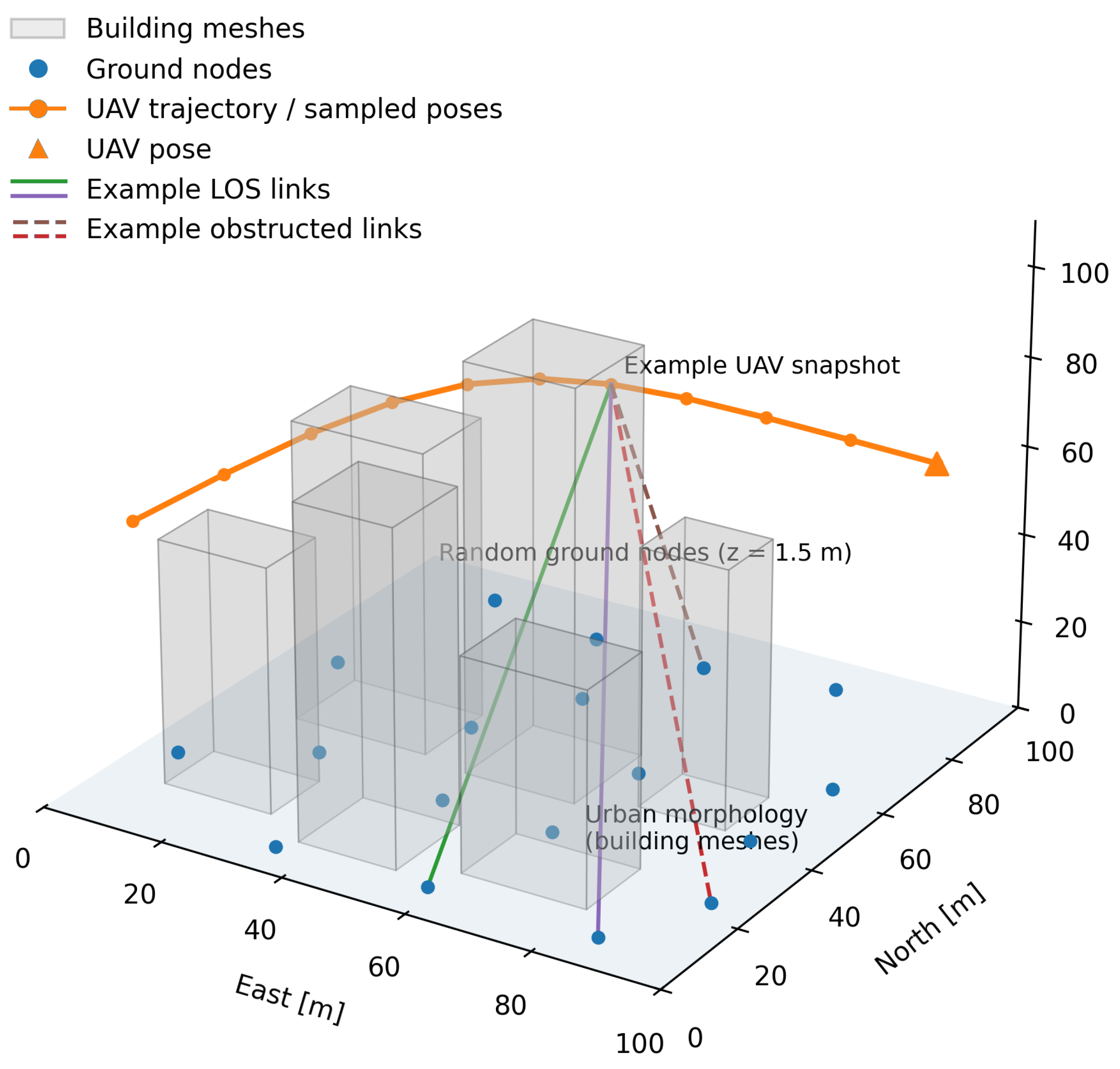
- Ground Nodes: In most regions, a grid layout was used, representing structured deployments. Ground nodes are primarily placed at pedestrian height (1.5 m). In urban areas with irregular topography or building density, 30–40 nodes were randomly placed at heights of 0.5–10 m to reflect handheld, vehicular, or low-mounted sensors.
- -
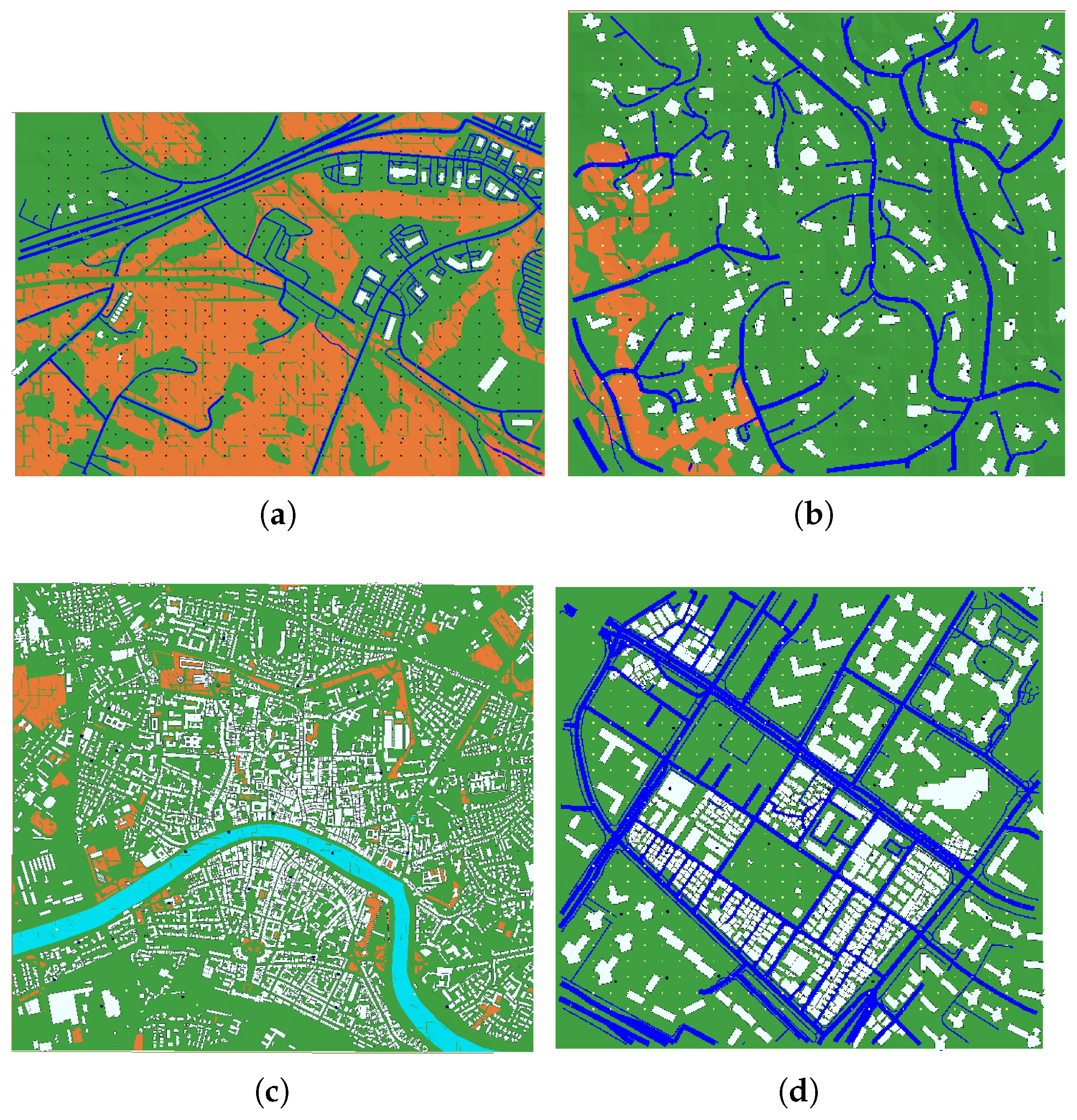
- Scene Sizes and UAV Counts: UAV counts were scaled proportionally to the area while ensuring a manageable simulation footprint. Smaller areas used 20–30 UAVs, while larger areas used up to 80. These values maintain consistent spatial density in line with 3GPP guidelines, while supporting vertical and geometric diversity. The node layouts were selected as controlled spatial sampling strategies rather than as exact replicas of a single operational deployment. For ground nodes, the standard layout uniformly samples the scene’s horizontal extent and provides dense coverage for geometry-aware analysis. For a scene with width W and height H, the nominal grid spacing is given by and . As a result, the spacing adapts to the scene size while preserving the same sampling structure across environments. For example, the nominal spacing is approximately m in Manhattan, m in Palo Alto, and m in Tennessee.
Scope and Limitations of the Current Release
4. Dataset Description
- the first two files contain spatial metadata for aerial and ground nodes. For UAVs and ground users, each entry includes a unique identifier, geographic coordinates (latitude, longitude), and corresponding local Cartesian coordinates (x, y, z).
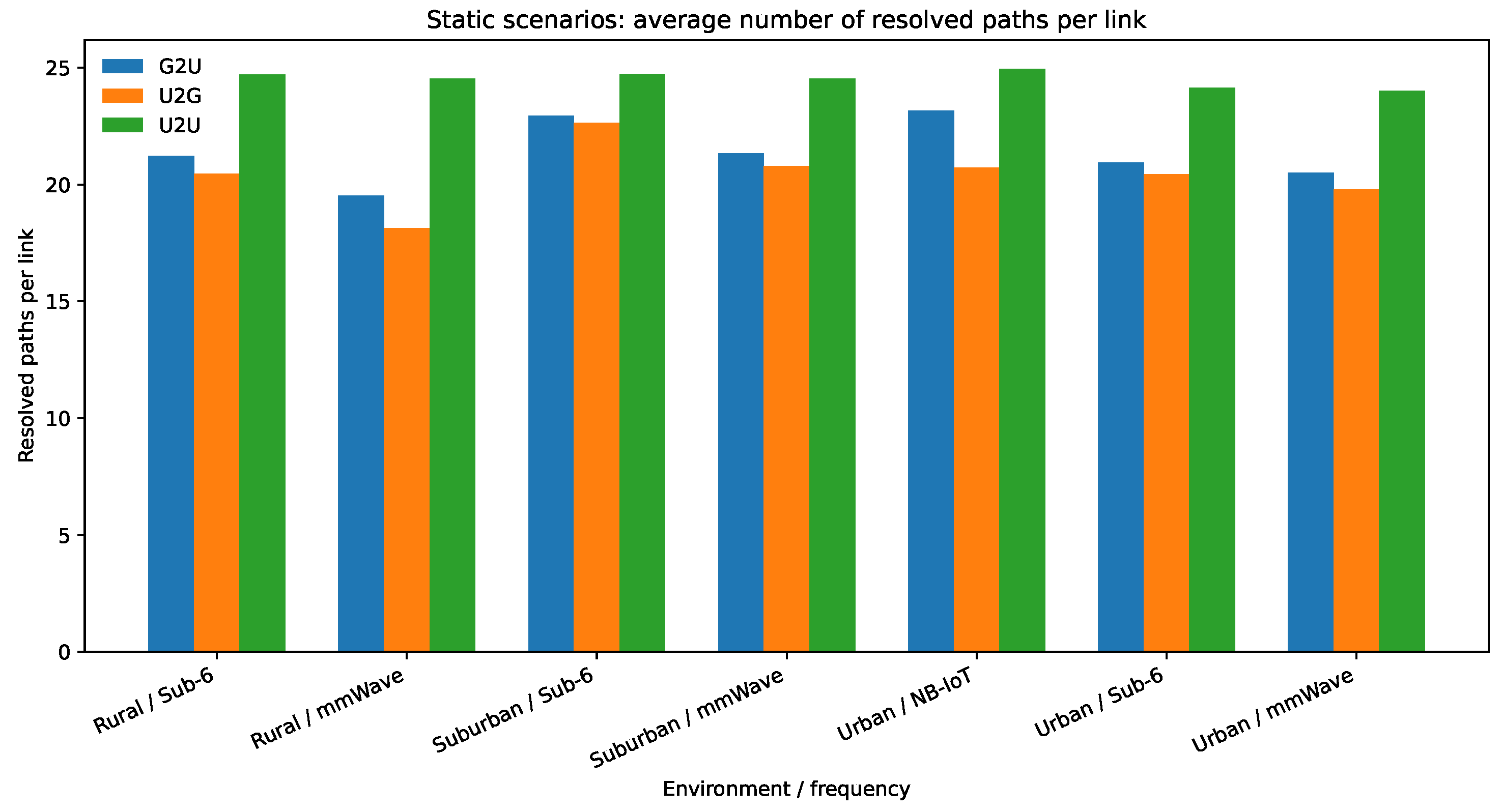
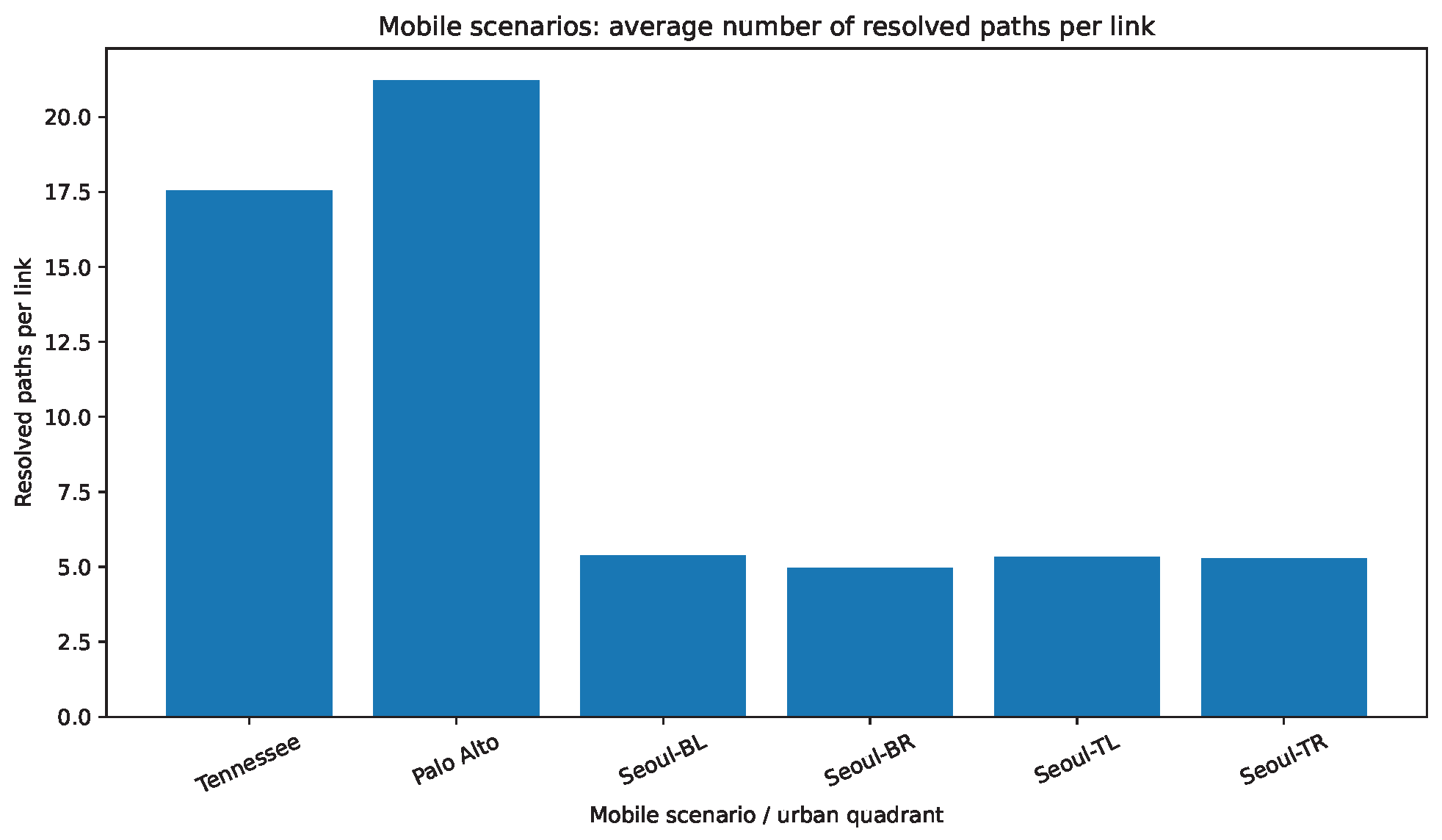
- The third file provides link-level propagation characteristics between each TX–RX pair. The recorded parameters include the total number of resolved paths, the received signal power in dBm, the mean time of arrival (ToA), the delay spread, and the status (LOS, NLOS, and Blocked), all of which are key descriptors in channel modeling.
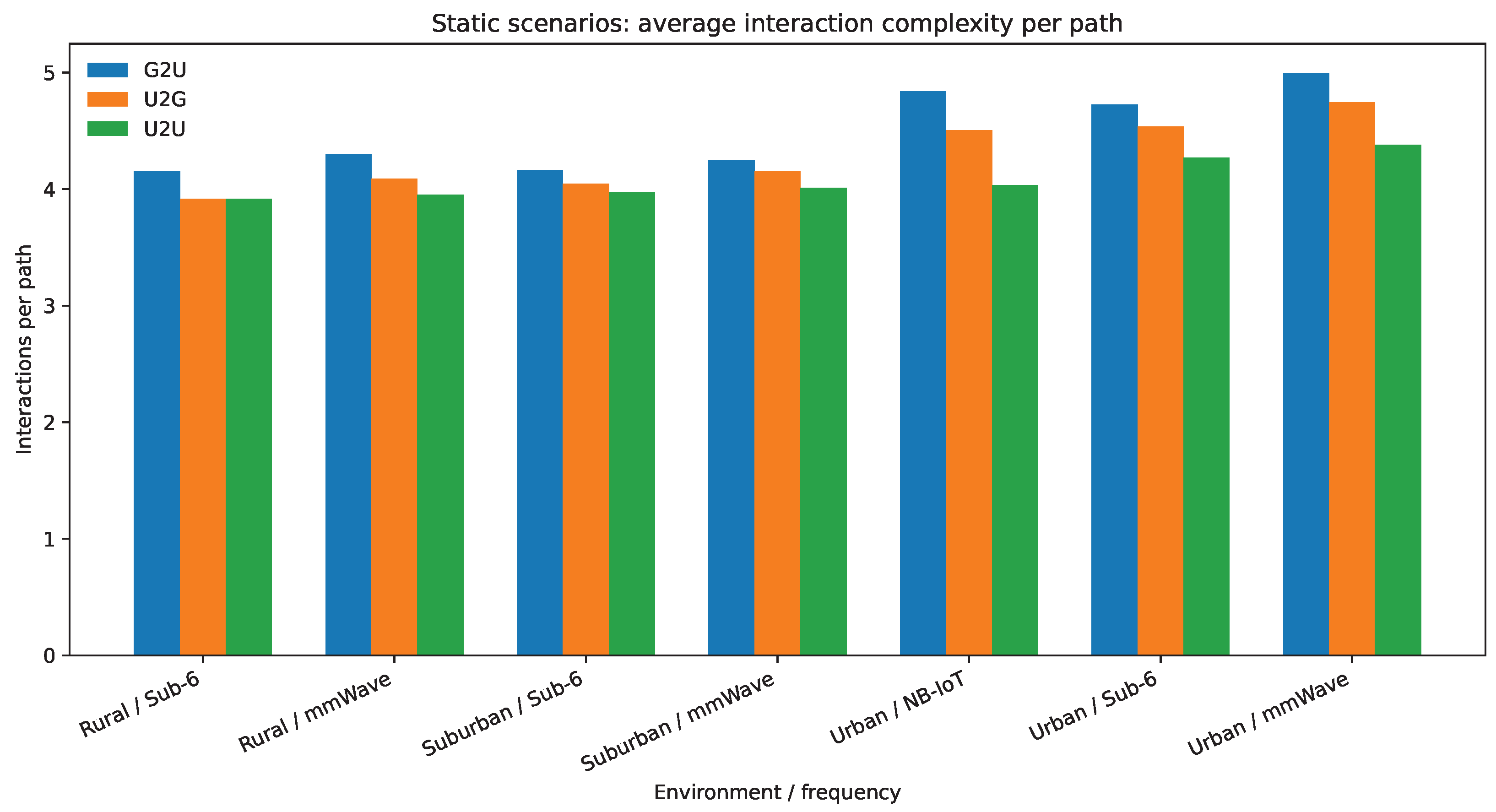
- The fourth file offers fine-grained path-level data for each link, listing each resolved multipath component separately. Features include the number of interactions (excluding transmitter and receiver), received power, signal phase, exact ToA, and angular properties, including arrival and departure angles in both the azimuth and elevation planes. Additionally, each path is tagged with an encoded interaction pattern that describes the physical phenomena encountered.
- Finally, the fifth file lists 3D ray interaction points for each propagation path. Each path is expressed as a sequence of discrete interaction events, such as reflections, diffractions, or foliage penetration, each represented by a unique integer code. These codes follow the scheme shown in Table 8. For instance, an interaction pattern of 1429 denotes a path that begins at the transmitter, proceeds through diffraction (4), reflection (2), and ends at the receiver (9). Code 3 is maintained in the generic interaction-encoding schema for future extensibility and compatibility. It is not included in the current release because object transmission was disabled in the ray-tracing configuration.
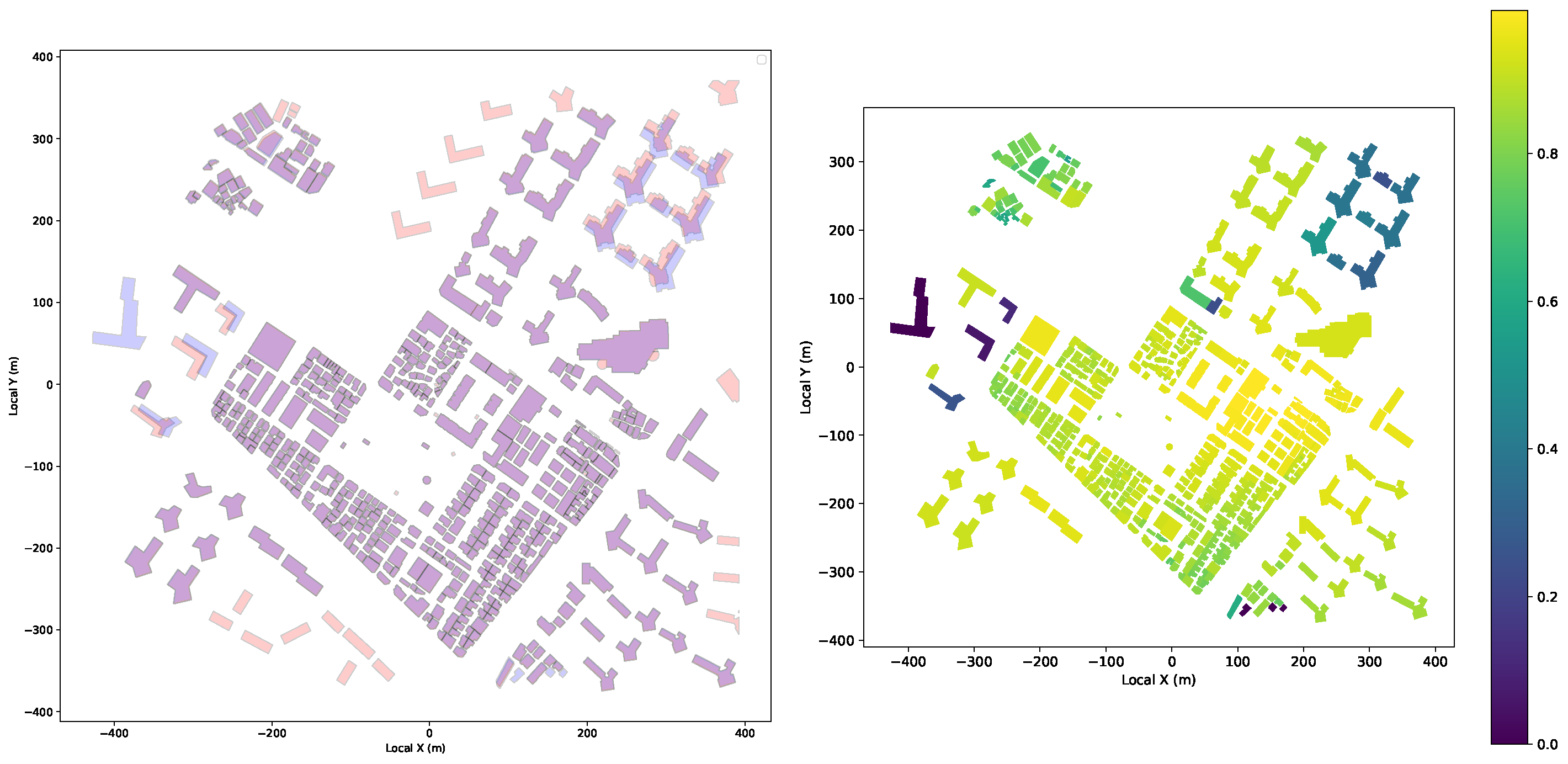
Cross-Source Geometry Alignment and Validation
- (a)
- Communication Modal
- i
- Static
- A
- SUB-6
- Scenarios
- 1
- U2G / G2U / U2U
- 2
- TX-RX metadata
- B
- NB-IoT
- Scenarios
- 1
- U2G / G2U / U2U
- 2
- TX-RX metadata
- C
- mmWave
- Scenarios
- 1
- U2G / G2U / U2U
- 2
- TX-RX metadata
- ii
- Mobile
- A
- Scenarios
- 1
- U2G
- 2
- TX-RX metadata
- (b)
- Environment Modal
- i
- Scenarios
- Geometry-rich files
5. Benchmark Tasks Enabled by the Dataset
6. Conclusions
Author Contributions
Funding
Data Availability Statement
Acknowledgments
Conflicts of Interest
Abbreviations
| UAV | Unmanned Aerial Vehicle |
| G2A | Ground-to-air |
| A2G | Air-to-ground |
| A2A | Air-to-air |
| ML | Machine learning |
| IQ | In-phase and quadrature |
| GPS | Global Positioning System |
| RSS | Received signal strength |
| LOS | Line-of-sight |
| CIR | Channel impulse response |
| CSI | Channel state information |
| MMWave | Millimeter-wave |
| SNR | Signal-to-noise ratio |
| 3GPP | 3rd Generation Partnership Project |
| DXF | Drawing Exchange Format |
| OSM | OpenStreetMap |
| ToA | Time of arrival |
References
- Asadzadeh, S.; de Oliveira, W.J.; de Souza Filho, C.R. UAV-based remote sensing for the petroleum industry and environmental monitoring: State-of-the-art and perspectives. J. Pet. Sci. Eng. 2022, 208, 109633. [Google Scholar] [CrossRef]
- Grzybowski, J.; Latos, K.; Czyba, R. Low-cost autonomous UAV-based solutions to package delivery logistics. In Advanced, Contemporary Control, Proceedings of the KKA 2020—The 20th Polish Control Conference, Łódź, Poland, 7–9 October 2020; Springer: Berlin/Heidelberg, Germany, 2020; pp. 500–507. [Google Scholar]
- Xiao, N.; Wen, W.; Hu, J.; Yang, P.; Zhao, J.; Wu, C.; Bai, S. SUG-UAV Multirotor Dataset with Multi-sensor Integration in Indoor and Urban Areas. In Proceedings of the 2024 14th International Conference on Indoor Positioning and Indoor Navigation (IPIN), Kowloon, Hong Kong, 25–27 September 2024; pp. 1–5. [Google Scholar] [CrossRef]
- Raouf, A.H.F.; Lee, D.; Rahman, M.; Masrur, S.; Reddy, G.; Dickerson, C.; Hossen, M.S.; Villar, S.V.; Gürses, A.; Singh, S.; et al. Wireless Datasets for Aerial Networks. arXiv 2025, arXiv:2510.08752. [Google Scholar] [CrossRef]
- Khuwaja, A.A.; Chen, Y.; Zhao, N.; Alouini, M.S.; Dobbins, P. A Survey of Channel Modeling for UAV Communications. IEEE Commun. Surv. Tutor. 2018, 20, 2804–2821. [Google Scholar] [CrossRef]
- Zhang, Y.; Doshi, A.; Liston, R.; Tan, W.; Zhu, X.; Andrews, J.; Heath, R. DeepWiPHY: Synthetic and Real-World IEEE 802.11ax OFDM Symbol Dataset. IEEE Dataport. 2020. Available online: https://ieee-dataport.org/open-access/deepwiphy-synthetic-and-real-world-ieee-80211ax-ofdm-symbol-dataset (accessed on 22 March 2026).
- Hussain, S.; Bacha, S.F.; Cheema, A.A.; Canberk, B.; Duong, T.Q. Geometrical Features based mmWave UAV Path Loss Prediction using Machine Learning for 5G and Beyond. IEEE Open J. Commun. Soc. 2024, 5, 5667–5679. [Google Scholar] [CrossRef]
- Roy, S.; Majumdar, S.; Swetnam, T. Samapriya/Awesome-Gee-Community-Datasets: Community Catalog (3.9.0). 2025. Available online: https://zenodo.org/records/17641528 (accessed on 22 March 2026).
- Gill, J.S.; Velashani, M.S.; Wolf, J.; Kenney, J.; Manesh, M.R.; Kaabouch, N. Simulation Testbeds and Frameworks for UAV Performance Evaluation. In Proceedings of the 2021 IEEE International Conference on Electro Information Technology (EIT), Mt. Pleasant, MI, USA, 14–15 May 2021; pp. 335–341. [Google Scholar] [CrossRef]
- Mozny, R.; Masek, P.; Stusek, M.; Molnar, K.; Palenska, M.; Moltchanov, D.; Hosek, J. Experimental Quality Assessment of Cellular Networks and Their Utilization for UAV Services. In Proceedings of the IEEE Vehicular Technology Conference (VTC), Florence, Italy, 20–23 June 2023; pp. 1–6. [Google Scholar]
- Braunfelds, J.; Jakovels, G.; Murans, I.; Litvinenko, A.; Senkans, U.; Rumba, R.; Onzuls, A.; Valters, G.; Lidere, E.; Plone, E. Experimental Study on LTE Mobile Network Performance Parameters for Controlled Drone Flights. Sensors 2024, 24, 6615. [Google Scholar] [CrossRef] [PubMed]
- Ruseno, N.; Ongkowijoyo, H.V.; Lin, C.Y. Analysis of 4G Signal Quality in the UAS Network Remote ID Using Machine Learning Methods. J. Aeronaut. Astronaut. Aviat. 2024, 56, 555–568. [Google Scholar]
- Wang, S.; Li, S.; Zhang, Y.; Yu, S.; Yuan, S.; She, R.; Guo, Q.; Zheng, J.; Howe, O.K.; Chandra, L.; et al. UAVScenes: A Multi-Modal Dataset for UAVs. arXiv 2025, arXiv:2507.22412. [Google Scholar] [CrossRef]
- Dickerson, C.; Raouf, A.H.F.; Ozdemir, O.; Guvenc, I.; Sichitiu, M. AERPAW UAV-Based Signal Data Collected at Varying Altitudes and Sampling Rates for Wireless Communication Studies. 2025. Available online: https://datadryad.org/dataset/doi:10.5061/dryad.2z34tmpvv?public=true (accessed on 22 March 2026).
- Gürses, A.; Sichitiu, M.L. Air-to-Ground Channel Modeling for UAVs in Rural Areas. In Proceedings of the 2024 IEEE 100th Vehicular Technology Conference (VTC2024-Fall), Washington, DC, USA, 7–10 October 2024; pp. 1–6. [Google Scholar] [CrossRef]
- Colpaert, A.; Thys, C.; Cui, Z.; Pollin, S. MaMIMO-UAV 3D Channel State Information Dataset. 2023. Available online: https://rdr.kuleuven.be/dataset.xhtml?persistentId=doi:10.48804/0IMQDF (accessed on 22 March 2026).
- Polese, M.; Bertizzolo, L.; Bonati, L.; Gosain, A.; Melodia, T. An Experimental mmWave Channel Model for UAV-to-UAV Communications. In Proceedings of the ACM Workshop on Millimeter-Wave Networks and Sensing Systems (mmNets), London, UK, 25 September 2020. [Google Scholar]
- Catak, F.O.; Kuzlu, M.; Catak, E.; Cali, U.; Guler, O. Defensive Distillation-Based Adversarial Attack Mitigation Method for Channel Estimation Using Deep Learning Models in Next-Generation Wireless Networks. IEEE Access 2022, 10, 98191–98203. [Google Scholar] [CrossRef]
- Suo, J.; Wang, T.; Zhang, X.; Chen, H.; Zhou, W.; Shi, W. HIT-UAV: A High-Altitude Infrared Thermal Dataset for Unmanned Aerial Vehicle-Based Object Detection. Sci. Data 2023, 10, 227. [Google Scholar] [CrossRef] [PubMed]
- Colpaert, A. 3D Massive MIMO Air-to-Ground UAV CSI Dataset in Campus Environment. 2025. Available online: https://rdr.kuleuven.be/dataset.xhtml?persistentId=doi:10.48804/MTNAEG (accessed on 22 March 2026).
- 3GPP. Study on Enhanced LTE Support for Aerial Vehicles; Technical Report TR 36.777 V15.0.0; Release 15; 3rd Generation Partnership Project (3GPP): Sophia Antipolis, France, 2017. [Google Scholar]
- 3GPP. Study on Channel Model for Frequencies from 0.5 to 100 GHz; Technical Report TR 38.901 V16.1.0; Release 16; 3rd Generation Partnership Project (3GPP): Sophia Antipolis, France, 2020. [Google Scholar]
- ITU-R. Propagation Data and Prediction Methods for the Planning of Short-Range Outdoor Radiocommunication Systems and Radio Local Area Networks in the Frequency Range 300 MHz to 100 GHz; Technical Report P.1410-5; International Telecommunication Union: Geneva, Switzerland, 2012. [Google Scholar]




| Dataset | Real/ Synthetic | 3D Geometry | Mobility | Multi Frequency | ML-Ready Structure | Public Access |
|---|---|---|---|---|---|---|
| [14] | Real | Partial (GPS, altitude) | Yes | No | Medium (raw IQ) | Yes |
| [15] | Real | Partial (position + CIR) | Yes | No | Medium | Limited |
| [16] | Real | Yes (3D trajectory) | Yes | No | High (structured CSI) | Yes |
| [17] | Real | Limited | Limited | No | Medium | Limited |
| [20] | Real | Yes (aerial corridor geometry) | Yes | No | High | Yes |
| [18] | Synthetic | No explicit geometry | No | Yes | High (labeled) | Limited |
| Proposed | Synthetic | Yes | Yes | Yes | High | Yes |
| ID | Location | Latitude | Longitude | Approx. Size | Environment Type |
|---|---|---|---|---|---|
| 1 | Manhattan, Kansas | Urban | |||
| 2 | Seoul, South Korea | Urban | |||
| 3 | Boston, Massachusetts | Urban | |||
| 4 | London, UK | Urban | |||
| 5 | Pisa-West, Italy | Urban | |||
| 6 | Pisa-East, Italy | Urban | |||
| 7 | Palo Alto, California | Suburban | |||
| 8 | Lewistown, Montana | Suburban | |||
| 9 | Black Hills, South Dakota | Suburban | |||
| 10 | Tennessee, USA | Rural | |||
| 11 | Texas, Plains | Rural |
| Parameter | Standard Value/Range | Reference |
|---|---|---|
| UAV Altitude (urban) | 15–120 m (typical urban), up to 300 m | 3GPP TR 36.777 |
| UAV Altitude (general max) | Up to 300 m | 3GPP TR 36.777 |
| Ground Node Altitude | 1.5 m (outdoor UE height) | 3GPP TR 38.901 |
| Deployment Environments | UMi (Urban Micro), UMa (Urban Macro), RMa (Rural Macro) | 3GPP TR 38.901 |
| Simulation Area Size | 250 m–5 km side length depending on scenario | 3GPP TR 38.901 |
| Node Layouts | Hexagonal grid, random drop, 3-sector BSs | 3GPP TR 36.777 |
| UAV Density | 10 UAVs/200 km2 (typical) to 5 UAVs / 400 × 400 m2 (dense) | 3GPP TR 36.777 |
| LOS/NLOS Path Loss Modeling | Height- and environment-dependent LOS/NLOS models | 3GPP TR 38.901 |
| UAV-Specific Propagation Modeling | Line-of-sight, diffraction, and clutter loss over irregular terrain | ITU-R P.1410-5 |
| ID(s) | GN Layout | GN Nodes | GN Alt. (m) | UAV Layout | UAV Nodes | UAV Alt. (m) |
|---|---|---|---|---|---|---|
| 1 | Grid | 625 | 1.5 | Grid | 20 | {30, 60, 90, 120} |
| 2 | Grid | 625 | 1.5 | Grid | 48 | {30, 60, 90, 120} |
| 3 | Random | 30 | [0.5–10] | Random | 30 | [40–110] |
| 4 | Random | 40 | [0.5–10] | Random | 30 | [90–110] |
| 5, 6 | Random | 40 | [0.5–10] | Random | 30 | [40–110] |
| 7, 10, 11 | Grid | 625 | 1.5 | Grid | 80 | {30, 60, 90, 120} |
| 8, 9 | Grid | 625 | 1.5 | Grid | 48 | {30, 60, 90, 120} |
| Geometry | Material Type | Parameter’s Value |
|---|---|---|
| Terrain | Dielectric half-space (Dry earth) | Roughness (m) = 0 Conductivity (S/m) = 0.001 Permittivity = 4 |
| City | One-layer dielectric (Concrete) | Thickness (m) = 0.3 Conductivity (S/m) = 0.015 Permittivity = 7 |
| Foliage (Vegetation, Forest) | One-layer dielectric (Wood) | Thickness (m) = 0.03 Roughness (m) = 0 Conductivity (S/m) = 0 Permittivity = 5 |
| Asphalt | Dielectric half-space | Roughness (m) = 0 Conductivity (S/m) = 0.0005 Permittivity = 5.72 |
| Parameter | Value |
|---|---|
| Propagation model | X3D |
| Ray spacing | 0.25 Degree |
| Number of reflections | 6 |
| Number of transmissions | 0 |
| Number of diffractions | 1 |
| Foliage Model | Weissberger Model |
| Atmosphere—Temperature (°C) | 22 |
| Atmosphere—Pressure (mbar) | 1013 |
| Atmosphere—Humidity (%) | 50 |
| Parameter | Palo Alto | Tennessee | Seoul |
|---|---|---|---|
| Waypoint and Movement Strategy | Constant Speed | ||
| Speed (m/s) | 20 | 20 | 20 |
| Acceleration/ Deceleration | No | No | No |
| Distance per Increment (m) | 20 | 20 | 20 |
| Elevation in the Route (AGL) (m) | 90 | 60 | 100 |
| Total Timesteps | 609 | 1068 | 301 |
| Ground Node Mobility | Static | Static | Static |
| Interaction with the Environment | Signal propagation influenced by environmental geometries (e.g., buildings, terrain) | ||
| UAV Movement Patterns | Grid-based: the UAV moves in a fixed grid pattern over the area. | ||
| Code | Event Type | Code | Event Type |
|---|---|---|---|
| 1 | Transmitter | 5 | Foliage Entry/Exit |
| 2 | Reflection/Ground Bounce | 6 | Diffuse Scattering |
| 3 | Transmission | 9 | Receiver |
| 4 | Diffraction |
| Format/ File Type | Modal | Information Represented | Typical Downstream Use |
|---|---|---|---|
| CSV (node metadata) | Communication Modal | UAV and GN identifiers, ENU coordinates, altitude and node role. | Node feature construction, spatial indexing, geometry-aware learning. |
| CSV (link-level statistics) | Communication Modal | Link descriptors: received power, path loss, delay metrics, LOS/NLOS/Blocked state. | Path-loss prediction, link-state classification, channel modeling. |
| CSV (path-level descriptors) | Communication Modal | Per-path delay, power, phase and AoA/AoD angles. | Multipath analysis delay regression, ML feature extraction. |
| CSV (interaction points) | Communication Modal | Ray interaction sequence and 3D interaction points. | Propagation mechanism analysis and explainable modeling. |
| OSM/ GeoJSON | Environment Modal | Map-level geographic data: roads, terrain, building footprints. | Scene context extraction, map-based features, spatial alignment. |
| DXF | Environment Modal | CAD geometry and structured scene elements. | Geometry parsing and scene reconstruction. |
| OBJ/STL | Environment Modal | 3D mesh representation of buildings and objects. | Mesh analysis, visibility and obstruction modeling. |
| Environment | Mobility Model | Frequency | Scenario | Samples | ||||
|---|---|---|---|---|---|---|---|---|
| TX-RX | G2U | U2G | U2U | |||||
| Rural | Static | Sub-6 GHz | Tennessee | 80 + 625 | L:50000 P:980400 I:4245995 | L:50000 P:907180 I:3733890 | L:6400 P:157095 I:625400 | |
| Texas Plains | 80 + 625 | L:50000 P:1141564 I:4560975 | L:50000 P:1139256 I:4279950 | L:6400 P:159193 I:613391 | ||||
| mmWave | Tennessee | 80 + 625 | L:50000 P:976436 I:4198453 | L:50000 P:906285 I:3706887 | L:6400 P:156999 I:620159 | |||
| Mobile | Sub-6 GHz | Tennessee | 1 + 625 | – | L:667500 P:11714080 I:47644849 | – | ||
| Suburban | Static | Sub-6 GHz | Black Hills (South Dakota) | 48 + 625 | L:30000 P:717437 I:2923089 | L:30000 P:714217 I:2812816 | L:2304 P:57578 I:233585 | |
| Lewistown (Montana) | 48 + 625 | L:30000 P:739235 I:3040440 | L:30000 P:738135 I:2939422 | L:2304 P:57600 I:217048 | ||||
| Palo Alto | 80 + 625 | L:50000 P:1066784 I:4544912 | L:50000 P:1039047 I:4328734 | L:6400 P:157066 I:632026 | ||||
| mmWave | Palo Alto | 80 + 625 | L:50000 P:1066650 I:4530886 | L:50000 P:1038980 I:4314615 | L:6400 P:157063 I:629725 | |||
| Mobile | Sub-6 GHz | Palo Alto | 1 + 625 | – | L:380625 P:8079314 I:33451151 | – | ||
| Urban | Static | Sub-6 GHz | Manhattan | 20 + 625 | L:12500 P:275523 I:1136059 | L:12500 P:274071 I:1108362 | L:400 P:10000 I:38277 | |
| Seoul (South Korea) | 48 + 625 | L:30000 P:614941 I:3072982 | L:30000 P:594546 I:2833081 | L:2304 P:55307 I:240496 | ||||
| NB-IoT | Boston | 30 + 30 | L:900 P:19456 I:88123 | L:900 P:19091 I:83073 | L:900 P:22500 I:92290 | |||
| Pisa East | 30 + 40 | L:1200 P:29087 I:142053 | L:1200 P:27383 I:125173 | L:900 P:22480 I:95536 | ||||
| Pisa West | 30 + 40 | L:1200 P:26874 I:141049 | L:1200 P:21008 I:99918 | L:900 P:22307 I:86596 | ||||
| London | 30 + 40 | L:1200 P:28788 I:133085 | L:1200 P:25823 I:112276 | L:900 P:22500 I:87914 | ||||
| mmWave | Seoul (South Korea) | 48 + 625 | L:30000 P:614909 I:3073038 | L:30000 P:594528 I:2820082 | L:2304 P:55305 I:242270 | |||
| Mobile | Sub-6 GHz | Seoul (South Korea) | 1 + 156 1 + 169 1 + 144 1 + 156 | U2G | ||||
| BL | BR | TL | TR | |||||
|
L:168125 P:904183 I:4102178 |
L:167500 P:832557 I:3626844 |
L:175000 P:931798 I:3690006 |
L:175000 P:922397 I:4447626 | |||||
| Metric/Match Type | Value |
|---|---|
| Strong Matches | 520/97% |
| Shifted Matches | 7/1.3% |
| No Match | 9/1.6% |
| Mean IoU | 0.86 (median 0.89) |
| Mean centroid displacement | 0.74 m |
| Mean footprint area ratio | 0.997 |
Disclaimer/Publisher’s Note: The statements, opinions and data contained in all publications are solely those of the individual author(s) and contributor(s) and not of MDPI and/or the editor(s). MDPI and/or the editor(s) disclaim responsibility for any injury to people or property resulting from any ideas, methods, instructions or products referred to in the content. |
© 2026 by the authors. Licensee MDPI, Basel, Switzerland. This article is an open access article distributed under the terms and conditions of the Creative Commons Attribution (CC BY) license.
Share and Cite
Alibabaie, N.; Calabrò, A.; Marchetti, E. A Multi-Modal Benchmark Dataset for UAV Wireless Communication Research. Drones 2026, 10, 244. https://doi.org/10.3390/drones10040244
Alibabaie N, Calabrò A, Marchetti E. A Multi-Modal Benchmark Dataset for UAV Wireless Communication Research. Drones. 2026; 10(4):244. https://doi.org/10.3390/drones10040244
Chicago/Turabian StyleAlibabaie, Najmeh, Antonello Calabrò, and Eda Marchetti. 2026. "A Multi-Modal Benchmark Dataset for UAV Wireless Communication Research" Drones 10, no. 4: 244. https://doi.org/10.3390/drones10040244
APA StyleAlibabaie, N., Calabrò, A., & Marchetti, E. (2026). A Multi-Modal Benchmark Dataset for UAV Wireless Communication Research. Drones, 10(4), 244. https://doi.org/10.3390/drones10040244