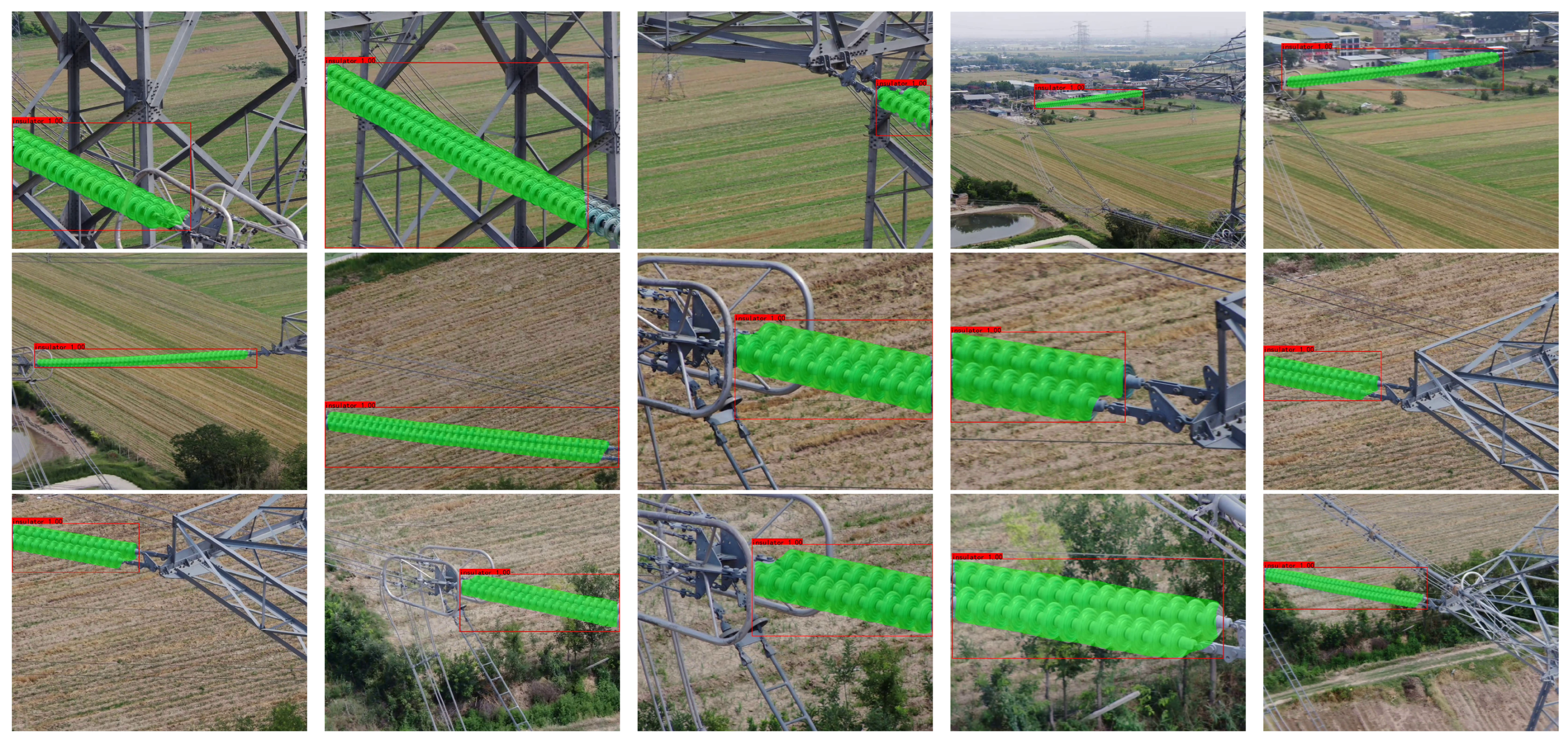

Article

Detection of Missing Insulators in High-Voltage Transmission Lines Using UAV Images

1
Shaanxi Key Laboratory of Complex System Control and Intelligent Information Processing, Xi’an University of Technology, Xi’an 710048, China
2
Department of Mechanical, Industrial and Aerospace Engineering, Concordia University, Montreal, QC H3G 1M8, Canada
*
Author to whom correspondence should be addressed.
Drones 2026, 10(3), 213; https://doi.org/10.3390/drones10030213
Submission received: 5 January 2026 / Revised: 15 March 2026 / Accepted: 16 March 2026 / Published: 18 March 2026

Highlights

What are the main findings?
  • A two-stage UAV-based missing insulator detection framework is proposed, where an improved Faster R-CNN first detects and localizes insulator strings, and an improved U-Net + adaptive-threshold binarization + curve distribution analysis is then used to identify missing defects while suppressing complex background interference.
  • A transfer-learning-based training strategy and a defect-oriented post-processing pipeline (alignment, slicing, and curve-based decision) are introduced to improve generalization under limited labeled samples; on a DJI M300 + H20T dataset collected along a 330 kV transmission line, the proposed method achieves AP@0.5 = 99.85% and Average IoU = 88.56% for insulator localization, and improves segmentation to mIoU = 89.73% and mPA = 94.03%.
What is the implication of the main finding?
  • The proposed method supports autonomous and accurate missing insulator inspection from UAV imagery in outdoor transmission line scenarios, facilitating practical deployment in engineering applications.
  • It offers a safer and more efficient alternative to the conventional manual inspection of power grid infrastructure, with the potential to reduce operational risks and maintenance costs.

Abstract

Insulators are essential components in high-voltage transmission lines and require regular inspection to ensure reliable power delivery. Traditional manual inspection methods are inefficient and labor intensive, highlighting the need for intelligent and automated solutions. In this study, we propose a missing insulator detection method that integrates Unmanned Aerial Vehicle (UAV) imaging with deep learning techniques. Firstly, an improved Faster Region-based Convolutional Neural Network (Faster R-CNN) is employed to detect and localize insulators in aerial images. Secondly, the localized insulators are segmented using an improved U-Net to reduce background interference. A bounding box regression approach is adopted to obtain the minimum enclosing rectangles, and the insulators are aligned vertically. Adaptive thresholding is then applied to extract binary images of the insulators. These binary images are further transformed into defect curves, from which missing insulators are identified based on curve distribution. To address the limited availability of labeled samples, a transfer learning-based strategy is adopted to improve model generalization. A dataset of glass insulators was collected using a DJI M300 UAV equipped with an H20T camera along a 330 kV overhead transmission line. On the collected UAV insulator dataset, the proposed method achieved an AP@0.5 of 99.85% and an average IoU of 88.56% for insulator string detection, while the improved U-Net achieved an mIoU of 89.73% for insulator string segmentation. Outdoor flight experiments further verified performance under varying backgrounds and illumination conditions in our UAV inspection scenarios.

1. Introduction

Electric power is one of the most essential resources for sustaining both daily life and industrial production. Over the past decades, a large number of high-voltage transmission lines (TLs) and towers have been constructed to meet the continuously growing demand for electricity. As a result, the length of TLs and the quantity of power equipment have expanded dramatically. Among them, insulators represent one of the most critical components in TLs [1]. Their primary function is to provide insulation by mechanically supporting and holding current-carrying conductors. Structurally, an insulator is a sheet-like component that can be assembled into an insulator string, and multiple insulators strung together can achieve enhanced insulation performance. In general, the higher the voltage level of the transmission line, the greater the number of insulators required.
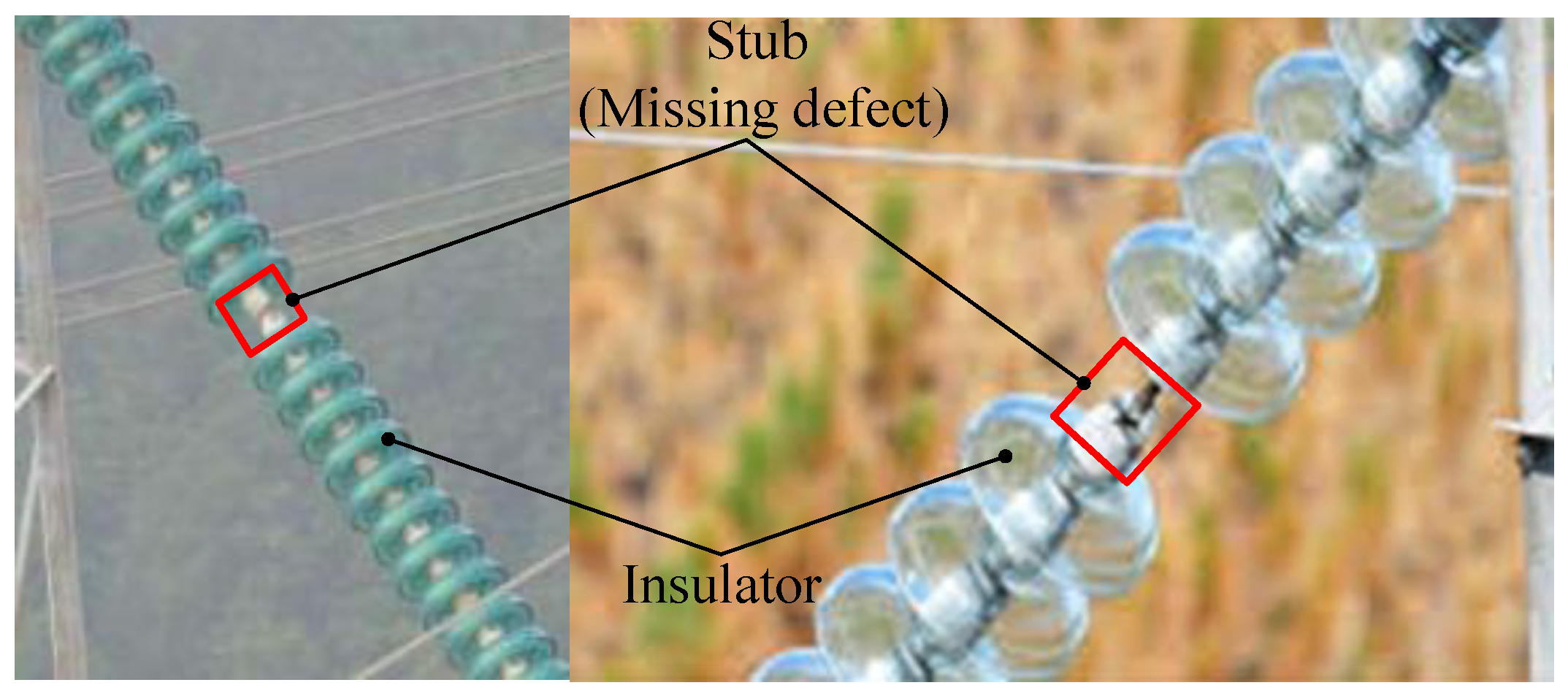
Insulators not only provide mechanical support for conductors and line hardware but are also designed to withstand environmental loads such as wind, snow, and ice, as well as dynamic loads caused by conductor galloping. In addition, they must endure electrical stresses from lightning and long-term environmental degradation, including corrosion induced by acid rain and contamination from dust and pollution [2,3,4,5]. Under such harsh operating conditions, the insulating performance of insulators is significantly reduced over time. When a flashover occurs due to a voltage surge, it can generate localized overheating, leading to insulator breakage and the formation of missing defects [6]. These missing defects directly deteriorate the insulation performance of the entire insulator, thereby threatening the stability and safety of the whole transmission line [7]. As illustrated in Figure 1, when an insulator is missing, a distinct gap, referred to as a stub, is formed at the defect location [8]. Since insulators are prone to damage, they require regular inspection to ensure safe operation. However, defect detection still faces significant challenges. Traditionally, inspections relied on manual patrols or helicopter-assisted surveys. Manual inspection is highly inefficient, particularly as many TLs are located in mountainous or remote areas. Although helicopter-based inspection improves transportation efficiency, it still depends heavily on experienced personnel to identify defects.
Unmanned Aerial Vehicles (UAVs) and deep learning technologies have developed rapidly in recent years [9,10]. Benefiting from their flexibility, mobility, and sensing capability, UAVs have found broad applications in infrastructure inspection, emergency response, agriculture, surveying and mapping, and logistics [11,12,13]. As a representative application scenario within the emerging low-altitude economy, UAV-enabled inspection of power grid infrastructure has attracted increasing attention because it provides a safer and more efficient alternative to conventional manual inspection, with the potential to reduce operational risks and maintenance costs. In this context, deep learning-based methods for detecting missing insulator defects from UAV aerial images have gradually emerged as a mainstream solution [14,15]. Typically, UAVs equipped with high-resolution cameras can capture insulator images from different distances and viewing angles. Object detection techniques are first used to localize insulators in the images, and then the detected regions are further analyzed to determine whether missing defects are present. Compared with traditional image processing-based methods, deep learning-based approaches can automatically learn the visual characteristics and distribution patterns of insulators from large numbers of samples [16]. Moreover, such methods generally exhibit stronger robustness and generalization capability, while achieving higher detection accuracy [17,18].
The remaining sections of this paper are organized as follows. In Section 2, the related work is reviewed. In Section 3, the proposed insulator missing defect detection method is described in detail. Section 4 presents the experimental setup and results, and compares the proposed algorithm with several existing methods. In Section 5, outdoor flight experiments using a DJI M300 UAV are conducted to evaluate the proposed method under real-world conditions, followed by a brief discussion of remaining challenges and limitations. In Section 6, the results are discussed and the limitations of the proposed method are analyzed. Finally, Section 7 concludes the paper and outlines directions for future work.

2. Related Work

In recent years, a variety of methods have been proposed for insulator and insulator defect detection. A common line of research is to formulate the task as an object detection problem. For example, Zhang et al. [19] proposed a YOLOv3-based method that treats insulator strings and missing cap defects as two categories within the same detection framework. Although the reported accuracy for missing cap defects is high, the detection accuracy for insulator strings is much lower, which implies that some insulator strings may not be detected at all. Since defect detection is inherently conditioned on the successful localization of the corresponding insulator string, such a setting may lead to overly optimistic defect detection results at the instance level. Similarly, Hao et al. [16] developed an improved YOLOv4-based model with a new backbone and a bidirectional feature pyramid network to enhance feature extraction and small target recognition in aerial images, while Yang et al. [20] proposed a YOLO-based method using Complete Intersection over Union (CIoU) loss to improve bounding box regression. However, these methods still rely heavily on sufficient defect samples, and their recognition accuracy and generalization ability remain limited in the presence of small defects and complex aerial backgrounds. Wang et al. [21] further explored few-shot object detection for insulator defects, but the reported detection speed is insufficient for real-time deployment.
Another group of studies combines localization with subsequent segmentation or geometric analysis. Tao et al. [22] constructed the Chinese Power Line Insulator Dataset (CPLID) and proposed a two-stage method in which insulators are segmented from aerial images and then merged into newly generated scenes for defect detection. Although good accuracy and recall were reported, the generated segmentation boundaries differ from real insulator appearances, which raises concerns about practical generalization. Zhao et al. [23] used an improved Faster R-CNN to detect insulators and then segmented the cropped regions in the Hue–Saturation–Value (HSV) color space. However, because insulator strings are often tilted, the cropped bounding boxes usually contain considerable background clutter, making direct segmentation less reliable in complex environments. Song et al. [24] proposed a coarse-to-fine strategy for UAV-based inspection and highlighted the influence of insulator aspect ratio on detection accuracy, but the use of traditional segmentation methods still limits robustness in complex scenes.
In addition to visible light approaches, thermal and infrared imaging have also been explored to reduce background interference. Zheng et al. [25] proposed an insulator detection algorithm based on thermal imaging, which can suppress some background clutter, but the method focuses only on insulator detection rather than defect analysis. He et al. [26] investigated contamination-level detection to identify potential fault locations before insulator burst, but this approach cannot detect already burst or missing insulator defects. Zheng et al. [27] proposed an infrared-image-based insulator detection framework using an improved Faster R-CNN with ResNet and Feature Pyramid Networks (FPN), achieving promising detection accuracy for tilted insulators; however, defect identification was not further addressed.
Some recent studies have attempted to improve structural representation or reduce the dependence on large annotated datasets. Liu et al. [28] proposed a box-point detector that predicts both regions and endpoints within a unified end-to-end network. Zhang et al. [29] explored a small-sample defect detection strategy by constructing a synthetic foggy insulator dataset. In addition, Rusyn et al. [30] investigated multi-threshold binarization for feature extraction from multi-spectral remote sensing images, showing that such methods can reduce computational cost and perform effectively on small datasets. Although such methods are meaningful attempts, their generalization from synthetic, remote sensing, or limited-sample settings to real UAV inspection scenarios still requires further validation.
At present, deep learning-based detection techniques can detect insulators well. However, the detection performance of missing defects is not ideal for the following reasons:
  • Although the insulators can be photographed very large by adjusting the distance and angle of UAV relative to the insulators, the size of the missing defect is generally very small and more difficult to detect.
  • Missing defect samples are very small, so the samples are extremely unbalanced. It is hard to train a very stable detection model and it is easy to produce a missed detection. When the samples are unbalanced, it is easy to produce some problems, such as overfitting.
  • There are many types of missing defects. For example, one, two, or even many are missing, so it is hard to label the defect samples well.
In summary, if the missing defect of the insulator is also labeled as a class to detect, the effect will not be ideal. In order to solve the problems of existing missing defect detection technology, a method based on a combination of deep learning and traditional image processing technology is proposed. First, the insulators are detected by the improved Faster R-CNN object detection algorithm, and the bounding boxes of the insulators are obtained. The insulators are segmented from the boxes by the U-Net to filter out most of the complex background. Finally, the segmented insulators are detected for missing defects. The innovations and main contributions of this paper can be outlined as follows:
  • A two-stage insulator missing defect detection framework is proposed. The insulator region is first localized by the improved Faster R-CNN and then refined by a U-Net-based segmentation model, which helps suppress complex background interference before the defect analysis.
  • Transfer learning is introduced into both the detection and segmentation stages to improve the localization and foreground extraction capabilities of the corresponding models.
  • Instead of directly treating missing defects as an independent detection class, the segmented insulator region is further processed by traditional image analysis to construct a defect curve for missing defect determination. This strategy reduces the dependence on large-scale missing defect samples and improves the practicality of the proposed method.

3. Insulator Missing Defect Detection Scheme

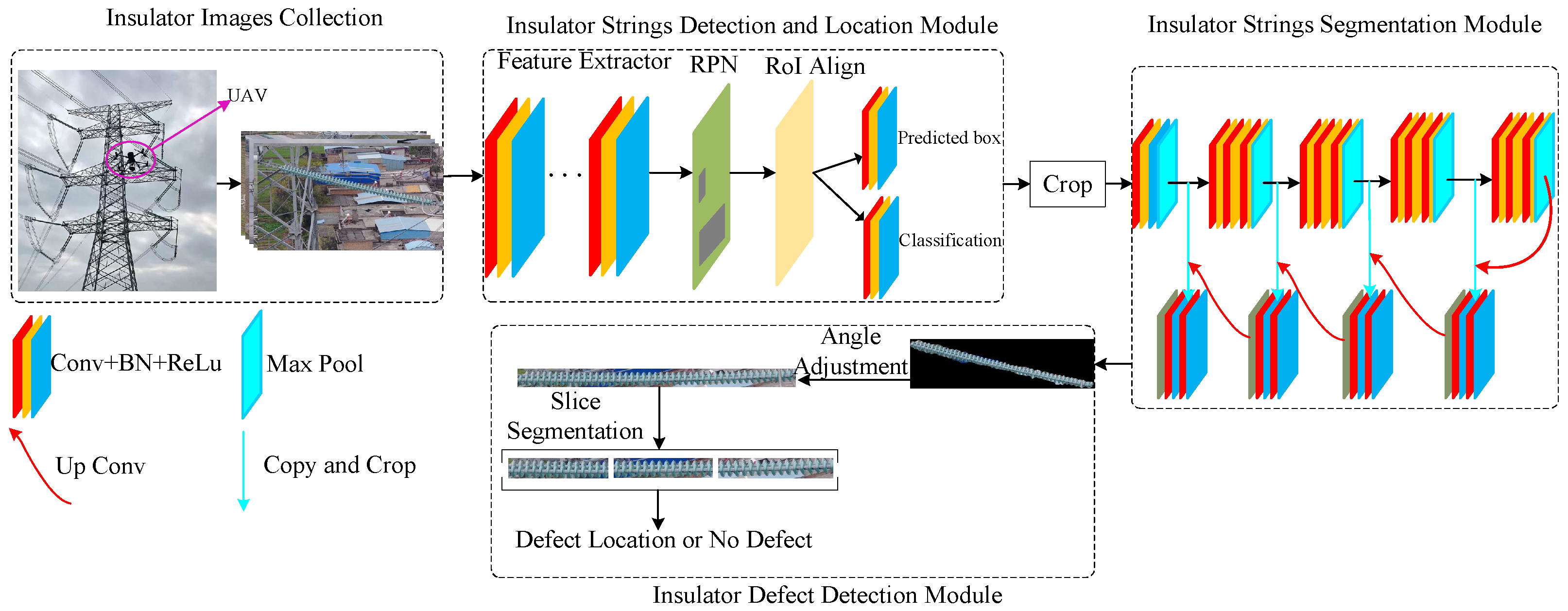
The overall structure of the proposed insulator missing defect detection scheme is shown in Figure 2.
The proposed scheme contains three main modules. (1) The Insulator String Detection and Location module (ISDL), whose primary function is to identify and localize all insulator strings in the aerial images. Thus, the filter of the most complex background is realized. (2) The Insulator Strings’ Segmentation module (ISS), whose primary function is to further segment the insulator strings from the background. Then, the insulator strings are adjusted to the vertical direction for fine segmentation of the insulators. (3) The Insulator Defect Detection module (IDD), the main function of which is to segment the insulators from the background completely. After detecting missing defects, the localization and quantity of missing insulators are determined. A large number of insulator images are collected by taking pictures near the towers of high-voltage transmission lines by UAV. Then, clear images are selected, and insulator strings in the images are labeled. These aerial images are used to train the ISDL. The detected insulator strings are cropped to train ISS. A transfer learning-based approach is used for training to improve ISDL and ISS detection capability. The process of detecting insulator defects is carried out in sequence according to the above network sequence.

3.1. Insulator Strings’ Detection and Location

The insulator strings’ detection and localization network is built by deep learning-based object detection techniques. This is the first step of the proposed scheme, which aims to accurately identify all the insulator strings in the aerial images to reduce omissions. The Faster R-CNN is a two-stage object detection method with high accuracy [31]. It comprises a feature extractor, Region Proposal Network (RPN), Region of Interest (RoI) resize, and fully connected R-CNN modules. The Faster R-CNN can detect the insulator strings in the image well. The improved Faster R-CNN further enhances the recognition and localization of insulator strings.

3.1.1. Deep Convolutional Neural Network

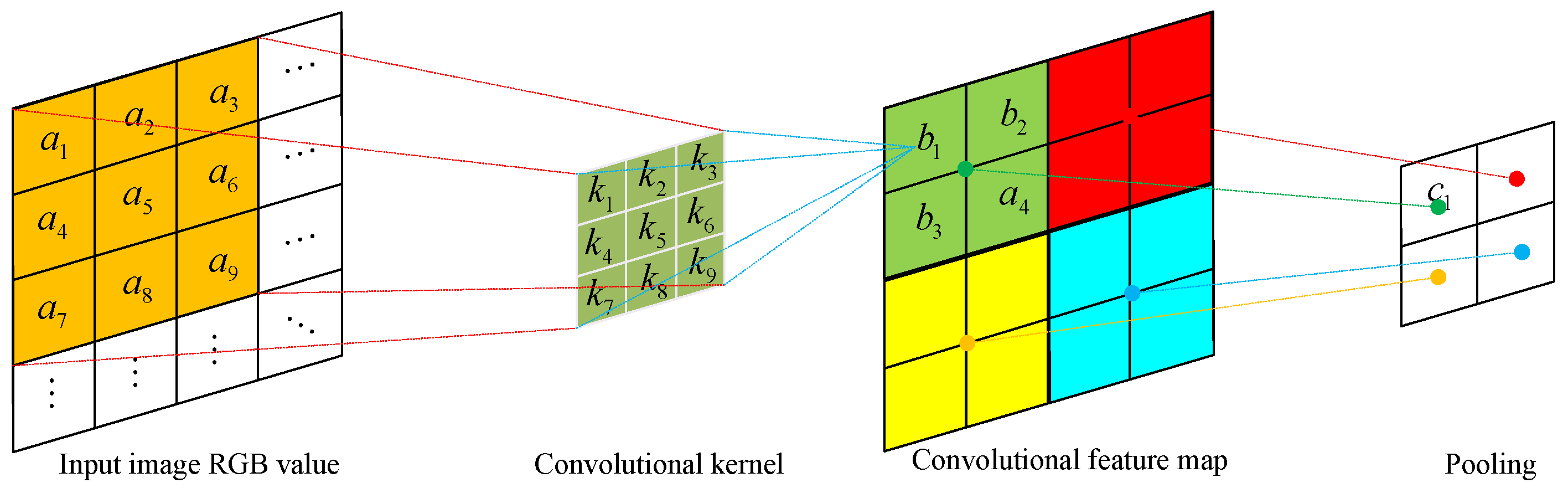
A Deep Convolutional Neural Network (DCNN) extracts image features by performing convolution operations to obtain a high-level semantic feature map and complete the detection task. Generally, a convolution process includes a convolutional computation layer and a downsampling layer, as shown in Figure 3. The convolutional computation process is as follows:
b 1 = i = 1 9 a i k i .
After the convolution computation, the image features are extracted and then pooled by a pooling window of size 2 × 2 to reduce the size of the feature map as follows:
c 1 = max { b 1 , b 2 , b 3 , b 4 } .
In the feature extraction process by convolutional computation, the size of the feature map is gradually compressed, and the number of feature map channels is deepened. The high-level semantic information of the images is transformed into the feature map. Finally, the loss function is set according to the specific task, and the parameters of the convolution kernel are updated. There is also some new research to improve the ability of convolution to extract features, such as adding new activation functions and Batch Normalization (BN) layers.
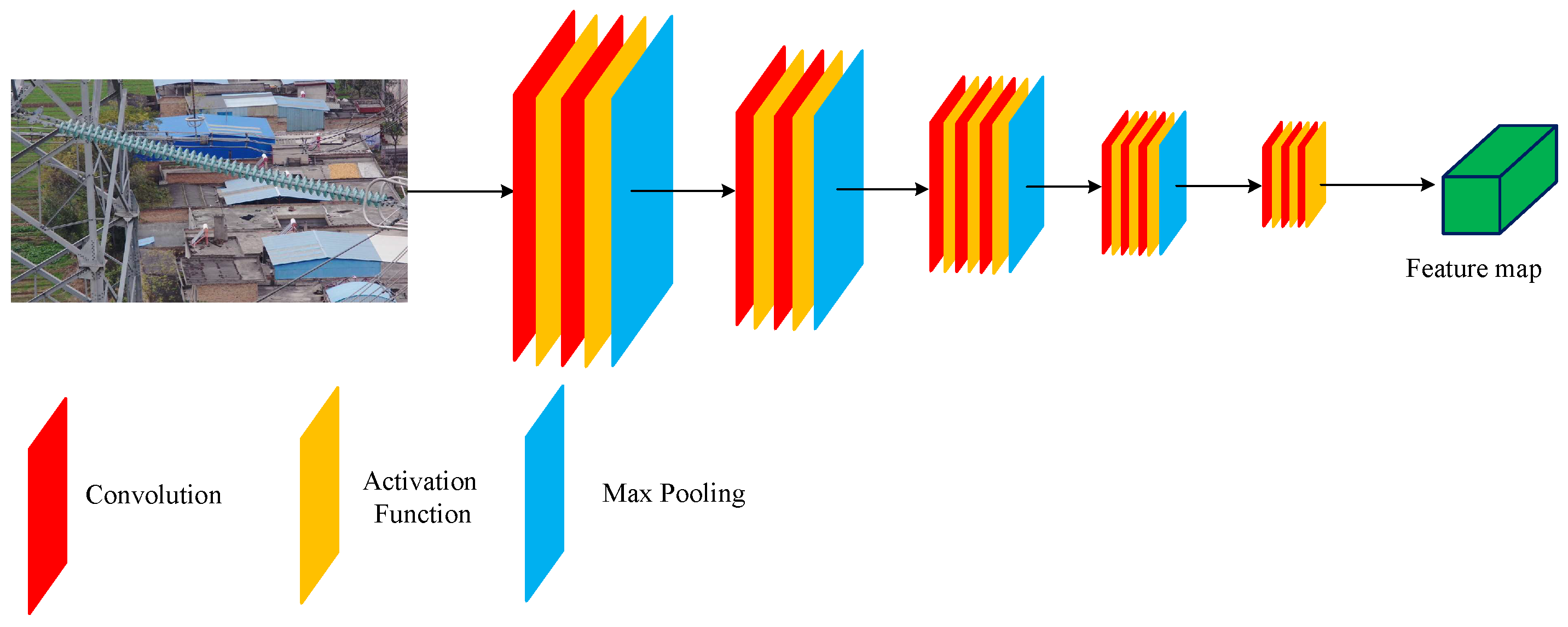
In the field of image recognition, Deep Convolutional Neural Networks (DCNNs) typically consist of four to five convolutional blocks. The number of convolutional blocks is generally limited to five in order to prevent the excessive loss of image information and to preserve small object details. Each convolutional block is composed of several convolutional layers, BN layers, and activation layers. In addition, each block contains one downsampling layer, which reduces the number of convolutional kernel parameters and facilitates computation in the subsequent stage. The Visual Geometry Group 16 (VGG16) [32] uses multiple convolutional kernels of smaller size ( 3 × 3 ) instead of one convolutional kernel of larger size ( 7 × 7 ). On the one hand, the parameters of the network can be reduced. On the other hand, it is equivalent to performing more nonlinear mapping, which can increase the fitting ability of the network and maintain the size of the original receptive field. All the convolution layers in VGG16 are convolution kernels of 3 × 3 with a step equal to one. The downsampling layer uses maximum pooling with a pooling kernel of 2 × 2 . The first four convolutional blocks have a max pooling layer, and the pooling layer in the last convolutional block of VGG16 is removed. The depth of the feature map obtained by VGG16 is 512, and the size is 1/16 of the input images. The overall convolutional network architecture of VGG16 is illustrated in Figure 4.

3.1.2. Transfer Learning

Deep learning-based object detection and segmentation networks typically require tens of thousands of labeled image samples for effective training. However, in practical engineering applications, the number of available labeled samples is often very limited, usually only a few hundred or at most a few thousand, which is far from sufficient. Such a scarcity of samples makes it challenging to train a stable network model with strong generalization capability. To address this problem, many mainstream studies adopt data augmentation strategies, such as brightness adjustment, noise injection, rotation, and image flipping, in order to artificially increase the dataset size. Through these operations, the original dataset can be expanded several-fold or even by an order of magnitude before training. Nevertheless, this approach has significant limitations. Since the augmented data are still generated from the original small dataset, they remain highly similar to the original samples. Training on such redundant data easily leads to overfitting, as the model essentially learns repeated patterns. Furthermore, data augmentation does not always guarantee improved detection performance and may even fail to enhance the results in some cases.
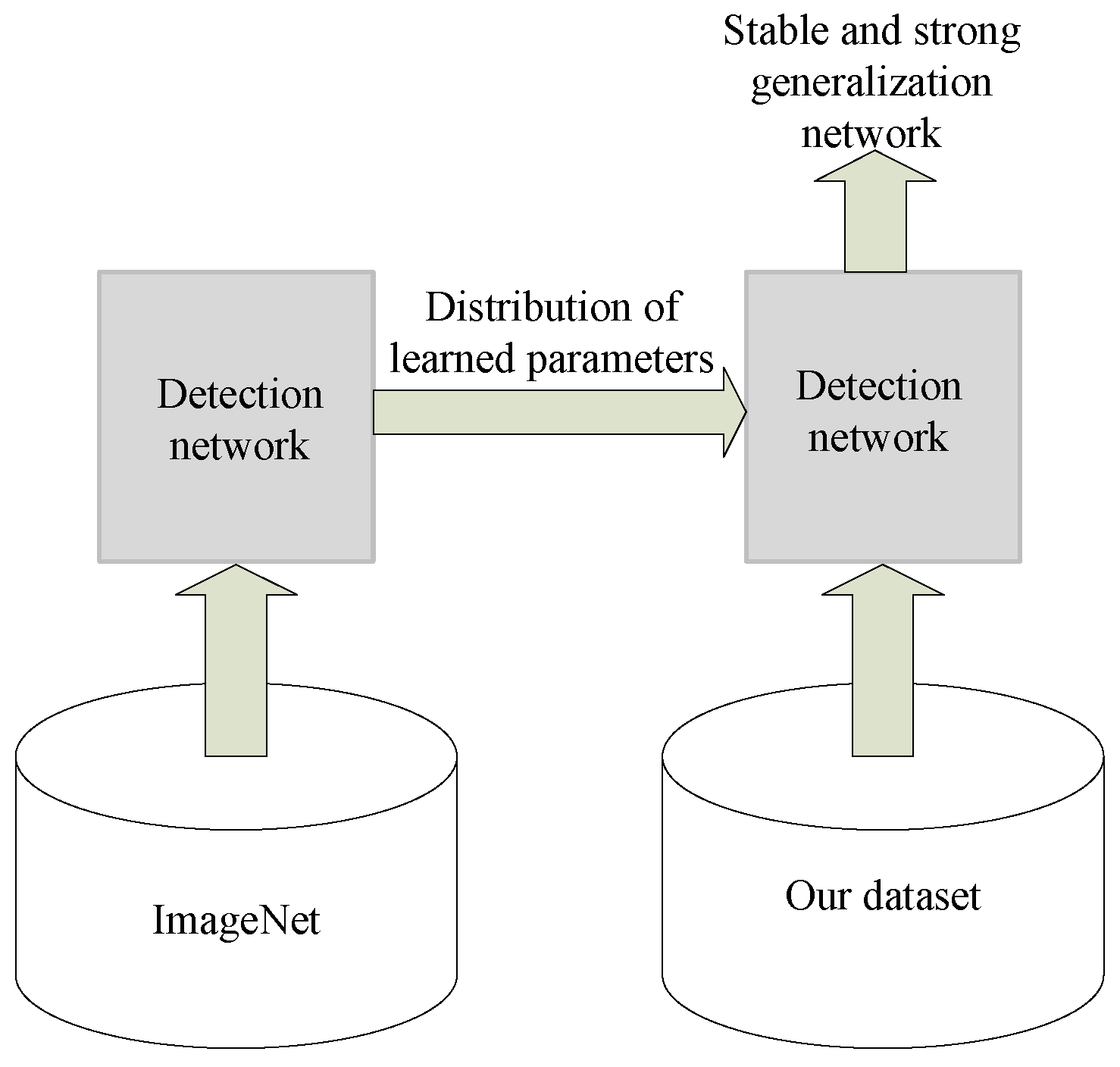
Another solution is to use the idea of transfer learning to enhance the feature extraction and detection ability of the network [33]. The reason for not being able to train a model with high generalization ability due to sample scarcity is that the initial parameters of the network are randomly uncertain. It will lead to the inability of the network to update favorable parameters using so little data. Transfer learning solves new problems by exploiting the similarities between data, tasks, or models and applying models learned in the old domain to the new field. As shown in Figure 5, first, the detection model is trained on a relatively large dataset to obtain the weight parameters of the model. It provides the model with a relatively strong feature extraction and detection capability. Then, based on the learned weight parameters, the training is continued on the dataset of the target task, which can improve the detection effect on the target task.
ImageNet [34] is a huge dataset of computer image recognition technology containing most of the image categories that will be seen in life. Over ten million images have been in the ImageNet dataset, and each image has been manually labeled with a class. The model can learn better distribution parameters by first training the detection model on the ImageNet dataset. Both the ISDL and ISS are now pre-trained on the ImageNet dataset, which enhances the localization and segmentation of insulator strings and helps in subsequent defect detection.

3.1.3. Faster R-CNN

Faster R-CNN is the best version of the R-CNN family of algorithms. In Faster R-CNN, the VGG16 network is used as an image feature extractor. The VGG16 based on the DCNN has a robust feature extraction capability and can obtain semantically rich feature maps. The RPN calculates proposals using the feature map, object labels, and pre-generated anchors. Proposals are regions generated by RPN that may have detection objects. These proposals are subjected to detailed classification and box regression.
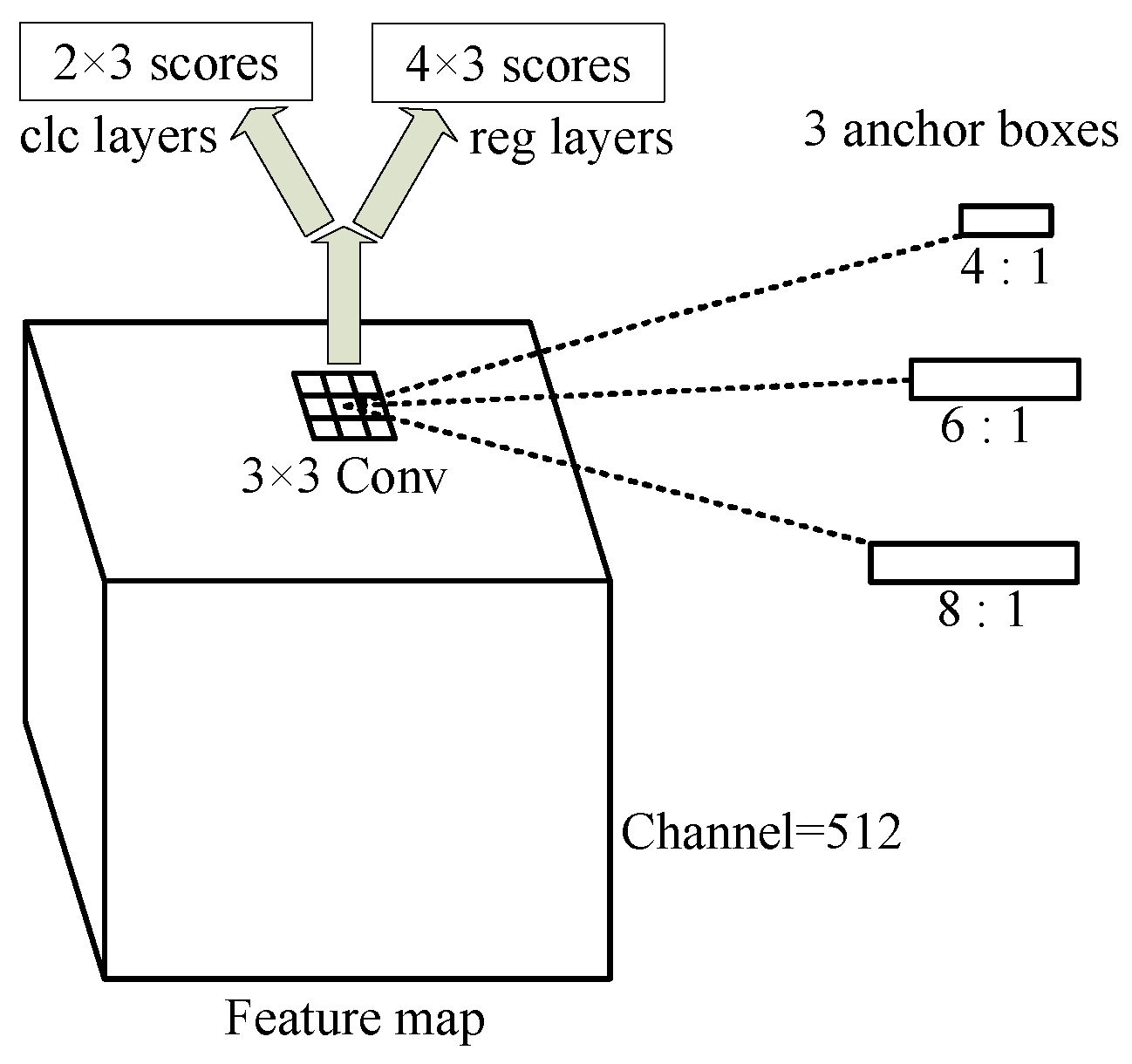
The anchors’ selection is different from the original Faster R-CNN. In the proposed method, fewer anchors are generated because, in the insulator strings’ detection task, the size of the insulators is relatively large, and the insulators have a large width-to-height ratio. In the original anchor scales, using anchors with aspect ratios of 8:1, 6:1, and 4:1 on the large, medium, and small scales, respectively, is more conducive to the regression of boxes. Only three anchors with larger aspect ratios are retained for each pixel point on the feature map instead of the original nine anchors. In the model, the six anchors are omitted, which reduces the computation and helps to improve the detection speed.
The RPN is a fully Convolutional Neural Network for extracting candidate proposals. As shown in Figure 6, in RPN, a 3 × 3 convolutional kernel is used to compute sliding on the feature map, and a 512-dimensional feature vector is obtained for each sliding position. Then two side-by-side 1 × 1 convolutional layers are used to compute the category scores and offset parameters of the three anchors of the current position, respectively. The relative positions of the proposals are calculated by combining the positions of the anchors and the offset parameters.
During the training process, the offset of the anchors from ground truth needs to be calculated as follows:
t x = x x a / w a t y = y y a / h a t w = log w / w a t h = log h / h a ,
where ( x a , y a , w a , h a ) is the anchors’ center coordinates, width and height, ( x , y , w , h ) are the center coordinates, and the width and height of the ground truth of the label. t i = t x , t y , t w , t h is the anchors’ offset relative to the ground truth. Moreover, the center position offset t x , t y is normalized using width and height. In contrast, the width and height offset t w , t h is logarithmically processed to restrict the range of the offset to facilitate prediction.
The RPN needs to predict the probability of each anchor belonging to the foreground versus the background (or the score of the foreground) and the offset of the real object relative to the anchors. The predicted offset is applied to the corresponding anchors using the following formula to obtain the actual position of the box predicted by the RPN:
t x * = x * x a / w a t y * = y * y a / h a t w * = log w * / w a t h * = log h * / h a ,
where t i * = t x * , t y * , t w * , t h * is the offset of the predicted real objects relative to the anchors. ( x * , y * , w * , h * ) are the center coordinates, width and height of the predicted proposals.
The RPN is a key component of Faster R-CNN and is used to generate candidate object regions. In this study, the detector is trained using the standard Faster R-CNN multi-task loss, which includes a classification term and a bounding box regression term for proposal refinement. Because this loss formulation is standard and is not modified in the proposed method, its detailed mathematical expression is omitted here.
The loss function of the bounding box regression uses the s m o o t h L 1 function, denoted as S L 1 . The S L 1 function combines the first-order and second-order loss functions. It can prevent the problem of the derivative of the second-order loss function being too large and the model not converging quickly as follows:
L reg t i , t i * = i S L 1 t i t i * .
S L 1 ( x ) = 0.5 x 2 if | x | < 1 | x | 0.5 otherwise .
The use of the s m o o t h L 1 function helps improve both the training stability and regression robustness, which is beneficial for the defect localization task considered in this work.
After obtaining proposals, they must be transformed to a fixed size ( 7 × 7 ) to pass the fully connected R-CNN layer later. The RoI Pooling method is used in the original Faster R-CNN, and the maximum pooling is performed directly on the RoI. However, the process of RoI Pooling will quantize and round the feature map twice, which loses the accuracy of the feature map, and the accuracy of the detected category and the accuracy of the bounding box is greatly reduced. Therefore, the RoI Align method replaces the RoI Pooling. The idea of the RoI Align approach is to use the bilinear difference to obtain the value of the point whose coordinates are floating point numbers, which reduces the loss of the accuracy of the border in the pooling process. Thus, it improves the regression accuracy of the bounding box of the insulator strings.
During the training process, many proposals that contained background information were still extracted by RPN. The 256 proposals are filtered out and used as the loss calculation of the fully connected R-CNN module. Among them, 128 positive and negative samples and those with an Intersection over Union (IoU) greater than 0.5 with the label are noted as positive samples. In the inference stage, the RPN selects proposals that are more likely to correspond to real insulators. These RoIs are then processed by the fully connected layers, which conduct detailed classification and boundary regression. Through this process, the exact localization of the insulator string is obtained.
The loss function of the R-CNN part is calculated in the same way as the RPN part, but the number of categories is two (insulators and background). Only up to 64 positive samples are involved in the regression calculation, and negative examples are not involved in the calculation.

3.1.4. Insulator String Filtering

In high-voltage transmission lines, multiple insulator strings are around the towers. So, in one aerial image, multiple insulators may be detected at the same time. Not all of these insulator strings are suitable for missing defect detection. This is because the insulator strings may have different sizes and orientations in the image. Additionally, there is mutual occlusion. Smaller and mutually occluded insulators are not well detected, and the error detection rate is high. Therefore, it is necessary to filter out these mutually occluded and small insulator strings first. According to the ratio of the area of the insulator bounding box to the area of the whole image, the filtering rule function L ( w i , h i ) is defined as follows:
L ( w i , h i ) = H × W w i × h i T c r o p ,
where w i , h i denote the width and height of the bounding box of the ith insulator strings in the images. H and W are the width and height of the whole image. T c r o p denotes the threshold value of the crop.
Finally, the decision to keep or filter this insulator string is based on the positive or negative score of L ( w i , h i ) . And a flag bit C is set for each detected insulator strings to retain the cropping and filtering as follows:
C ( w i , h i ) = Crop if L ( w i , h i ) 0 Filt otherwise .
Choosing a suitable cropping threshold T c r o p allows for the filtering of small-sized insulator strings with hard-to-detect defects. Generally, it is decided based on the actual distribution of insulator strings in the real task. Also, depending on the possible angles of the marginal strings in the absolute image, using the area relationship alone is insufficient to ensure that all small-sized insulator strings are filtered out. For example, when the insulator strings have a significant tilt, the area of the bounding box is also significant. In this case, it is necessary to make a limit according to the height-to-width ratio of the box. As a rule of thumb, it is also essential to ensure that the aspect ratio of the box is greater than 4:1 to retain a good view of the insulator strings. The filtering and clipping process speeds up the following insulators’ segmentation process and avoids the segmentation of insulators unsuitable for defect detection. These small-sized insulator strings are not discarded permanently; instead, they are deferred for subsequent inspection when the UAV moves closer and acquires images with sufficient resolution for reliable defect detection.

3.2. Insulator Strings Segmentation Framework

The insulator strings are precisely located by the improved Faster R-CNN, and the insulator strings with smaller sizes are filtered out. However, during the flight of the UAV, the relative position and attitude of the UAV and the insulator strings affect the insulator strings’ angle, resulting in a certain tilt angle of the insulator strings in the images. The area of the insulator strings’ bounding box is often much larger than the area of the insulator strings. The bounding box of insulator strings contains a lot of very complex backgrounds. If the threshold-based segmentation algorithm is used now, it is difficult to separate the insulator strings from the environment. It can seriously interfere with the defect detection process and reduce the accuracy of defect detection. In order to reduce the interference of the background on defect detection, we modify the original U-Net [35] segmentation network so that it can accurately segment insulator strings from the input images. In the proposed segmentation network, ResNet50 [36] is used as the backbone to extract deep feature representations.
ResNet50 was selected as the backbone because it provides a good balance between feature extraction capability and computational complexity. Compared with shallower variants such as ResNet18 and ResNet34, it offers stronger representational power, while compared with deeper variants such as ResNet101 and ResNet152 it remains more efficient and lightweight, making it suitable for our application.
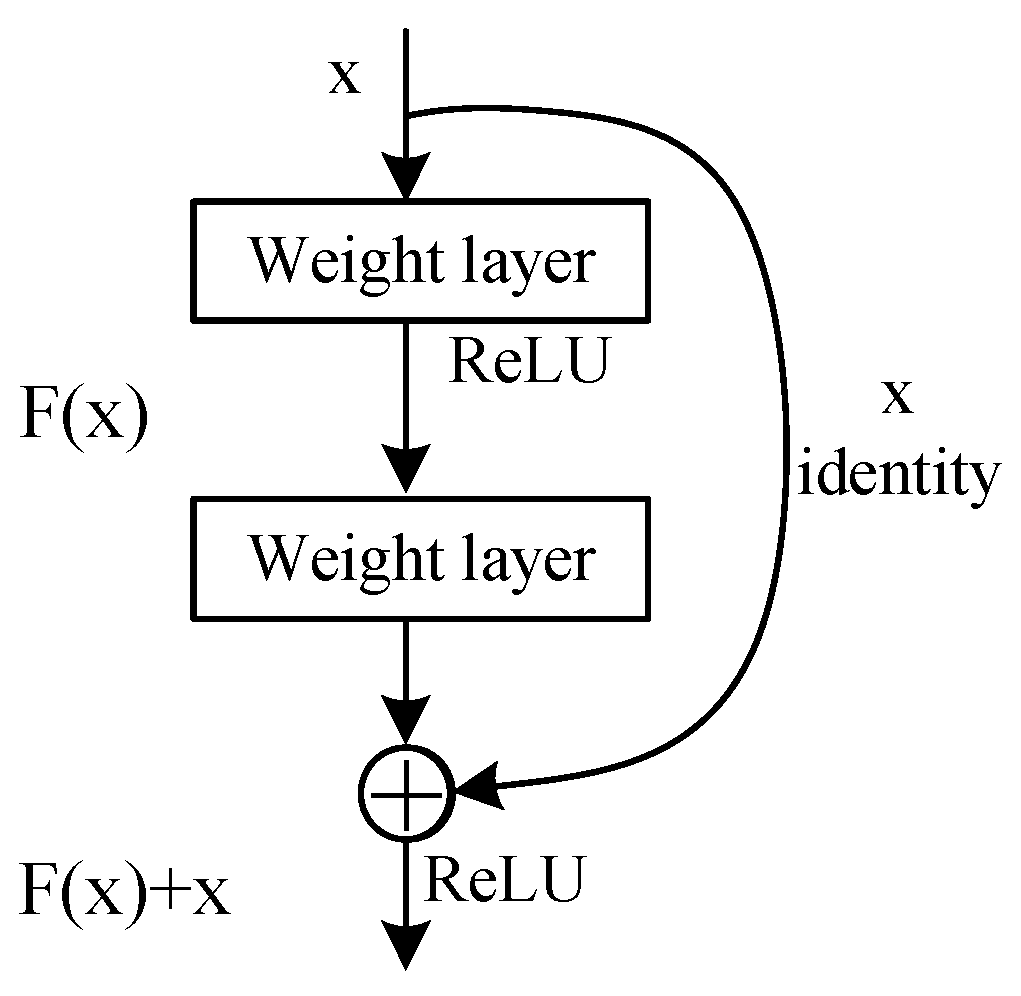
The ResNet50 has a robust feature extraction capability and segmentation speed. Moreover, the residual structure in ResNet50 can avoid the problem of gradient disappearance and accelerate the convergence of the model, as shown in Figure 7. The insulator strings are segmented from the locating box to obtain the tilted insulator strings polygon. The Minimum Bounding Rectangle (MBR) algorithm is then applied to obtain the enclosing rectangle of the insulator strings. The burrs protruding from the segmented edges must be smoothed first to obtain a more accurate minimum enclosing rectangle. The morphology of the segmented insulator strings is processed based on the open operation, and the bumps and burrs around the strings are disconnected. Then, the coordinates of the center point, width, and height of the minimum enclosing rectangle and the inclination angle are calculated. Finally, the insulator strings are adjusted straightly for easy segmentation and inspection. Segmenting the insulator strings from the locating box and obtaining the rectangular box containing the insulator strings filters out the complex background and removes the parts unrelated to the insulator. It improves the detection accuracy of the defects and accelerates their detection speed.
The U-Net-based segmentation method can effectively suppress background clutter and improve the extraction of insulator strings from complex backgrounds. Since all insulators have the same shape and color in an insulator string, the insulator strings can be extracted entirely from the background using the appropriate segmentation method. The insulator strings are completely stripped from the environment, which, in turn, allows for more accurate defect detection.
The Otsu thresholding method is an excellent adaptive threshold segmentation method. Otsu segmentation divides the image into two parts for a given image, target F and background B, according to the threshold T. The optimal threshold T * is determined by traversing the whole gray interval so that the variance of the gray value δ ( T ) 2 between the two parts F , B is maximized as follows:
δ ( T ) 2 = ω F ( T ) u F ( T ) u 2 + ω B ( T ) u B ( T ) u 2 T * = arg 1 < T < L max δ 2 ( T ) ,
where u F and u B denote the average grayscale values of foreground and background. ω F and ω B are the proportion of foreground and background areas to the whole image, respectively. u is the average gray value of the whole image. L is the number of gray levels, and the gray-level range is [ 0 , L 1 ] .
Noise in the images may degrade the segmentation performance. Therefore, before applying Otsu’s method, a standard two-dimensional Gaussian filter is used to smooth the image and suppress local noise, thereby improving the robustness of the subsequent threshold-based segmentation. The smoothing scale is controlled by the parameter σ .

3.3. Insulator Defect Detection

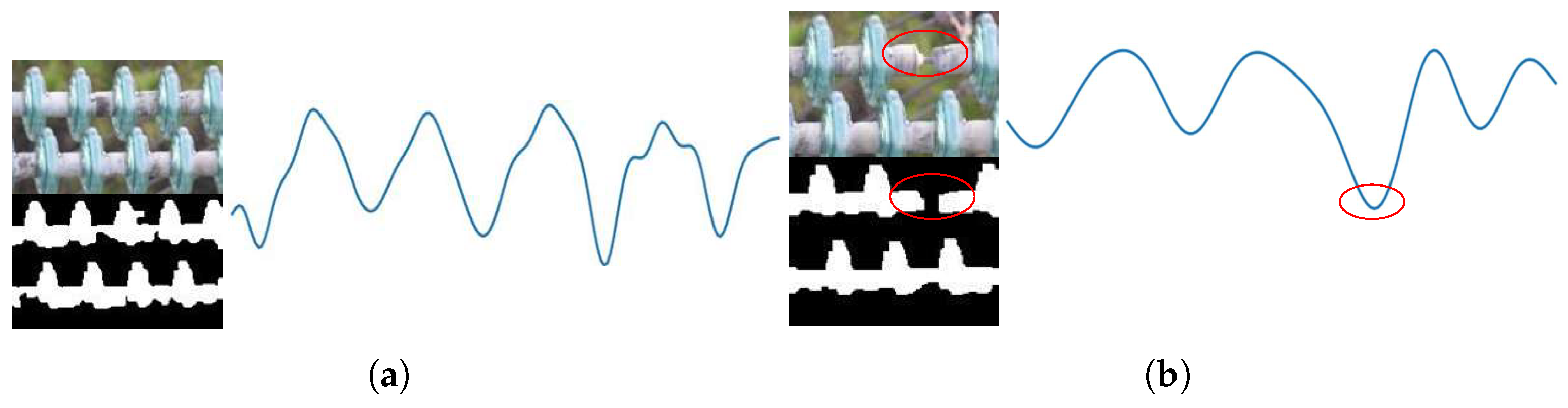
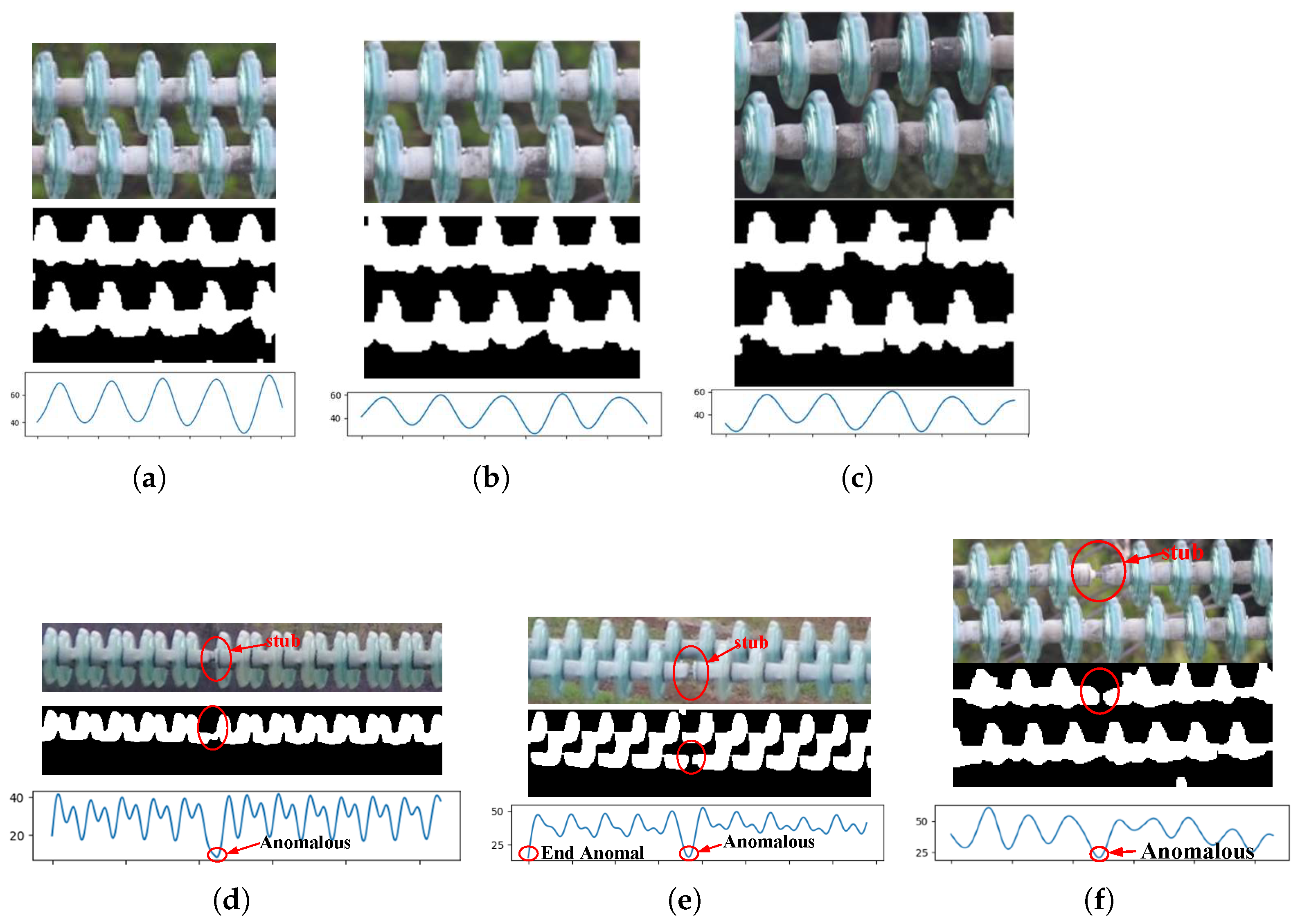
The proposed method aims to automatically detect insulators’ missing defects in complex aerial images. After locating and segmenting the insulator strings, the missing insulator strings are detected. Because missing insulator defect data is very scarce, it is difficult to train the model using supervised learning-based methods. All insulator strings have the same appearance in the insulator strings and are arranged in a regular pattern. There will be a stub in the missing defect position so there will also be a corresponding gap in the segmented binary image. The pixel points outside the insulator region in the middle are removed using open and closed operations. Further, the pixel values in the binary image are converted into defect curves. This is performed by using the width in the binary image as the horizontal axis. The number of black pixels in each column of the binary image is counted, and the distribution of the data is displayed in the image as a defect curve. Considering that the curve still has numerous non-smooth burr points, it is first filtered and smoothed using a first-order low-pass filter. The defect curves are shown in Figure 8.
The areas without missing insulators correspond to the same distribution of the number of pixels in the image with a uniform distribution and no abnormal peaks and troughs. In the defect curve of an insulator string with missing insulators, anomalous peaks and troughs will appear. The adjacent peaks’ and troughs’ distance of the gap is significantly larger than the other peaks and troughs, and there is an abnormal value. This method can not only detect whether there is indeed a defect but also locate the defect point and missing number.
The key to the proposed method is to identify all peaks, troughs, and outliers in the insulator defect curve. The accurate localization of peaks and troughs is a crucial step for determining whether a missing defect has occurred. Specifically, the extracted defect curve is represented as an ordered vertical coordinate sequence. By traversing this sequence point by point, local maxima are identified as the peaks and local minima are identified as the troughs according to the variation trend of neighboring points. After the all peaks and troughs are localized, the distances between adjacent peaks and adjacent troughs are calculated, respectively. Based on these distances, an adaptive anomaly score is defined to quantitatively evaluate the missing condition of the insulator as follows:
s p i = d p i median d p 1 , d p 2 , , d p N ,
where median d p 1 , d p 2 , , d p N denotes the median of d p 1 , d p 2 , , d p N , N denotes the number of peaks, and d p i denotes the distance between the ith peak and the i + 1 th peak. Similarly, the anomaly scores s t i of the troughs can be calculated using the above equation. Then, during the operation, the anomaly score for each peak p i and trough t i is calculated. When s p i or s t i exceeds a predefined threshold T a , the peaks or troughs are considered to be anomalous. This corresponds to the fact that if a peak with an indicator falls outside the d p 1 , d p 2 , , d p N median, the peak is considered anomalous, and an insulator piece is missing. As a rule, T a is typically set around 1.3.
In addition, the detectability of missing defects is related to defect severity. In general, when more insulator units are missing, the corresponding gap in the segmented binary image becomes larger, and the abnormal peak/trough spacing in the defect curve becomes more pronounced. Therefore, larger missing defects are easier to identify. In contrast, single-unit missing defects produce relatively weaker anomalies and are more difficult to detect reliably.

4. Experiments and Analysis

4.1. Insulator Datasets with Experimental Platform

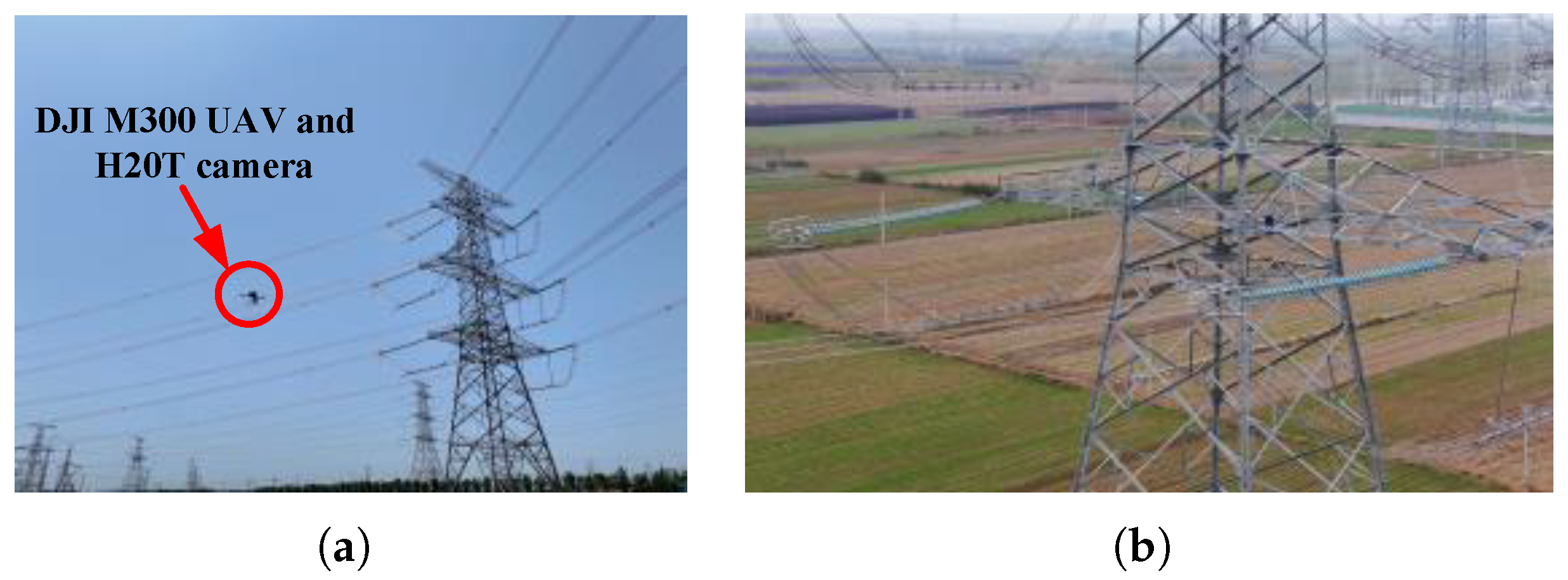
As shown in Figure 9, glass insulator images were collected along a 330 kV high-voltage transmission line by a DJI M300 UAV and an onboard H20T camera. The UAV flew around the power towers and took pictures at different distances and angles to enhance the diversity of the samples. A total of 6500 aerial images of insulator strings were collected. Some blurred and too-small samples were removed, and 2160 images of good quality were obtained. These aerial images are used as a dataset to train and test the proposed detection algorithm. There are 2100 samples of normal insulator strings and 60 samples with burst insulator strings. All the samples are labeled as insulator strings without distinguishing between the good and the defects. The dataset already contains a certain degree of real-world variability, including viewpoint changes, background complexity, and illumination variation.
Because the detection model is pre-trained based on the transfer learning idea, better weighting parameters have been obtained. It is sufficient to train a robust model using the collected data. Therefore, expanding the dataset is unnecessary, and all images acquired in natural environments are used for training and testing. In the dataset, 70% is used as a training set to train the insulator strings’ localization and segmentation models. The remaining 30% is used as the test set to verify the models’ localization and segmentation performance. During the labeling process of the dataset, only the insulator strings are labeled, and no defect parts need to be labeled.
The training platform’s CPU is i7-9700K, with 3.60 GHz. The GPU used was an NVIDIA GeForce RTX 2080 (NVIDIA Corporation, Santa Clara, CA, USA) with 12 GB of memory. All the off-line training and benchmarking experiments in this paper were conducted on this workstation. The on-board real-time deployment and flight validation are reported in Section 5.
All input images with the native resolution of 1920 × 1080 were uniformly resized to 640 × 640 for both training and off-line inference. To comprehensively evaluate the detection performance of the proposed method on insulator strings, comparative experiments were conducted with several representative mainstream detectors, including SSD, YOLOv3, YOLOv5, YOLOv8, YOLOv11, and the original Faster R-CNN. For fairness, all methods were trained and tested under the same experimental setting. Specifically, the same data split (70%/30%), input resolution, training schedule, optimizer, and hyperparameters were adopted for all compared detectors. All networks were trained for 300 epochs with a batch size of eight. Stochastic gradient descent was used as the optimizer, with the momentum and weight decay set to 0.9 and 0.0005, respectively. The learning rate was set to 0.001 for the first 100 epochs and 0.0005 for the middle 100 epochs.

4.2. Evaluation Protocol

We consider a single detection category (insulator string). We report the Average Precision (AP) at an IoU threshold of 0.5; for a single class, this equals mAP@0.5. A prediction is counted as a true positive if IoU 0.5 . We additionally report the F1-score and the average IoU of true positives as auxiliary indicators of the precision–recall trade-off and localization quality, respectively.
The F1-score metric is introduced to evaluate the model’s performance further. The F1-score measures the classification problem, often used as the final metric for multi-classification problems, which is a summed average of precision and recall. For a single category, the F1-score can be calculated as follows:
F 1 = 2 · TP 2 · TP + FN + FP ,
where TP is the number of insulator strings correctly identified as insulator strings, FP is the number of backgrounds incorrectly identified as insulator strings, and FN is the number of insulator strings incorrectly identified.

4.3. Insulator Strings’ Detection Experiment

4.3.1. Insulator Detection and Analysis

To keep the comparison table concise while retaining representative information, we report the AP@0.5 and F1-score as the main detection metrics. AP@0.5 reflects the overall detection accuracy, whereas F1 provides a compact summary of the precision–recall trade-off. In addition, the Average IoU is reported to evaluate localization quality, and FLOPs are used as a hardware-independent indicator of computational complexity. FLOP values are reported according to commonly used official model references and may vary with backbone choice and input resolution.
We adopt the mean AP@0.5 as the primary detection metric. As reported in Table 1, the proposed method achieves the highest AP@0.5 of 99.85%, exceeding Faster R-CNN (97.45%) by 2.40 percentage points, SSD (96.53%) by 3.32 percentage points, and YOLOv3 (94.27%) by 5.58 percentage points.
Moreover, compared with YOLOv5, YOLOv8, and YOLOv11, the proposed method improves the AP@0.5 by 3.62, 1.53, and 1.84 percentage points, respectively, showing consistent superiority over recent one-stage detectors.
Among one-stage methods, SSD outperforms YOLOv3 by 2.26 percentage points, consistent with its multi-scale prediction design. These gains are attributed to replacing RoI Pooling with RoI Align and adopting elongated anchors (8:1/6:1/4:1) tailored to string-like targets, together with a strong VGG (VGG16) backbone, which jointly improve proposal quality and bounding box regression.
Besides the AP@0.5, the proposed method also increases the F1-score from 93.67% to 95.34% and the average IoU of true positives from 87.78% to 88.56%, indicating a better precision–recall trade-off and slightly more accurate localization.
In particular, although YOLOv8 and YOLOv11 achieve competitive AP@0.5 values (98.32% and 98.01%), their Average IoU values are notably lower (83.87% and 84.97%) than that of the proposed method (88.56%), suggesting less accurate bounding box localization on elongated insulator strings.
The absolute AP@0.5 values are high across methods because insulator strings in our dataset are relatively large, visually distinctive, and exhibit limited rotation.
From Table 1, it can be seen that the proposed algorithm has a higher F1-score than the other algorithms. A good balance of precision and recall is obtained, reducing missed detection and improving the precision. This is more helpful for insulator strings’ localization. In summary, the proposed algorithm outperforms other algorithms regarding the detection AP and F1-score, and can detect insulator strings well in complex aerial images.

4.3.2. Insulator Localization and Analysis

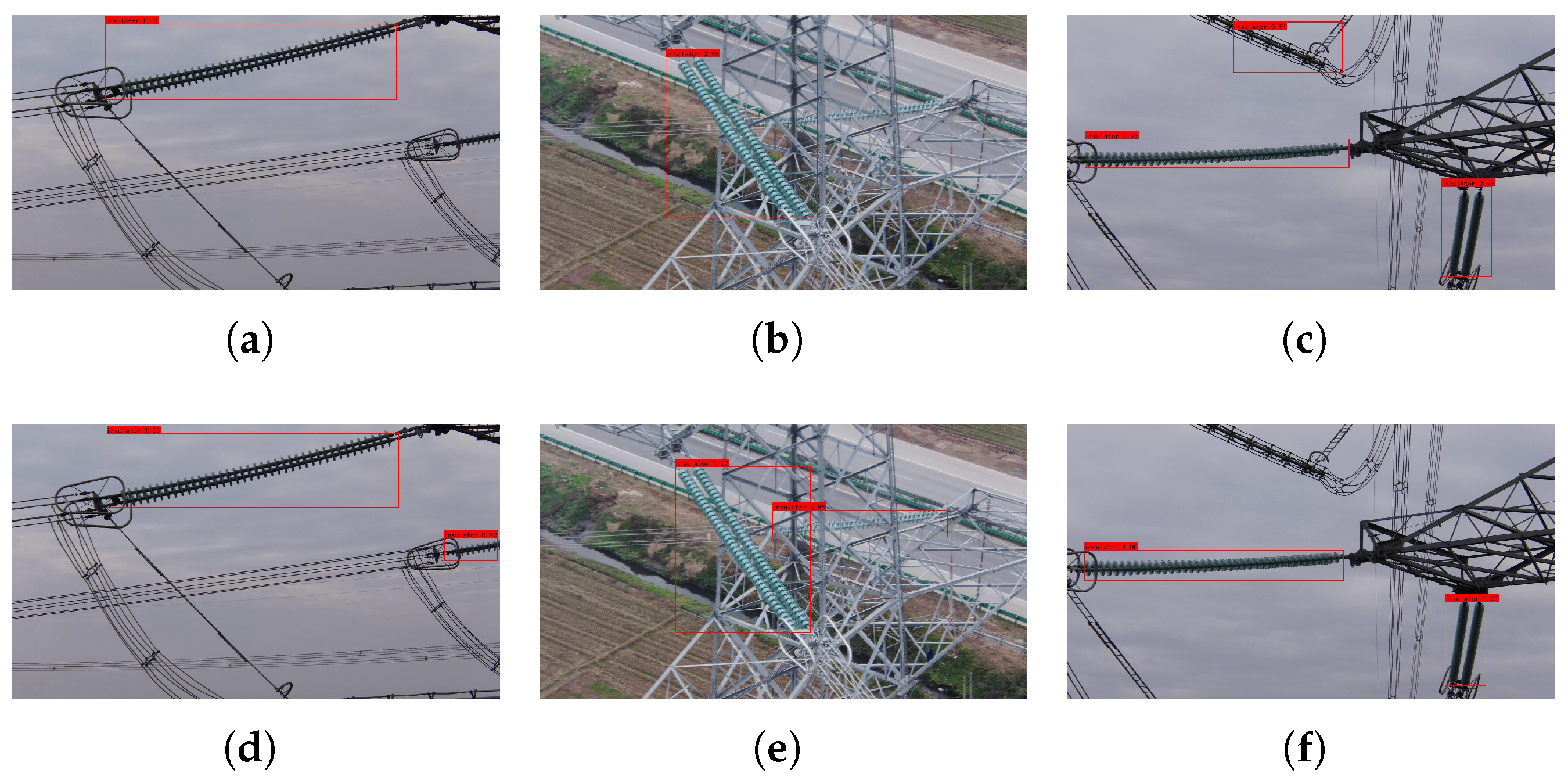
The AP and F1-score only measure the ability to detect the presence of the insulator to be detected in the images of the detection algorithm. The localization accuracy of the detection algorithm is also a significant measure. It is also essential to recognize the presence of an insulator in an image and to be able to pinpoint the localization of the insulator. Being able to locate the insulator strings accurately can significantly reduce the interference of the background on the segmentation process. The average of the localization results of the algorithm on the test set and the IoU of the ground truth of the labels of the test set are used as evaluation metrics. The test results are shown in Table 1. It can be seen that the localization accuracies of the current mainstream insulator detection algorithms do not differ much, and they are all between 87.5% to 88.5%. The difference in the localization accuracy of these algorithms is no more than 1%. However, the proposed improved Faster R-CNN has a slightly higher localization accuracy than other mainstream algorithms, thanks to the RoI Align method. Test samples are shown in Figure 10, and missing defects do not affect the insulator strings’ overall localization accuracy. The improved algorithm can provide relatively accurate insulator strings’ localization information, significantly reducing the background interference caused by localization errors. Compared with the original Faster R-CNN, the proposed algorithm produces fewer missed detections and false positives.

4.4. Insulator Strings’ Segmentation Experiment

4.4.1. Insulator Strings’ Segmentation

The cropped insulator images are fed into the U-Net-based segmentation network to further segment the insulator strings. A polygon region containing the insulator strings is obtained. In this process, it is equivalent to filtering out the background around the insulator strings and keeping only the insulator strings. Then, the minimum rectangular box regression is performed for the insulator strings region to obtain the minimum rectangular box containing the insulator strings. The rectangular box is then adjusted to the longitudinal direction and used for defect detection.
To further evaluate the segmentation performance of the proposed method, comparative experiments were conducted using DeepLab V3, the original U-Net, and U-Net variants with different backbone networks, including ResNet18 and ResNet34. In our method, ResNet50 was adopted as the backbone to achieve a better balance between feature representation capability and computational cost. The segmentation performance is evaluated using the mean Intersection over Union (mIoU), mean Pixel Accuracy (mPA), recall, and precision.
The results of the segmentation experiments are listed in Table 2. It can be seen that the proposed method achieves the best performance among all the compared methods, with an mIoU of 89.73%, an mPA of 94.03%, a precision of 94.60%, and a recall of 94.03%. Compared with DeepLab V3, the original U-Net, and U-Net variants with ResNet18 and ResNet34 backbones, the proposed method with a ResNet50 backbone yields superior segmentation performance. This indicates that ResNet50 provides a more suitable balance between feature representation capability and computational complexity for the insulator string segmentation task. These results further demonstrate that the proposed method can effectively suppress background clutter and accurately extract the insulator strings from complex aerial images, thereby providing reliable inputs for the subsequent missing defect detection stage.

4.4.2. Insulator String Slicing

As shown in Figure 11, after segmenting the insulator strings, the segmentation effect will be poor if the adaptive threshold is applied to the whole insulator strings. The segmentation performance is poor for insulators at both ends of the insulator string. There are drastic fluctuations in the pixel values in the defect curve, which makes it difficult to determine the defect localization. The reason for this problem is that there are equalizing rings at the insulator ends that will form an overlapping visual area with the insulator strings. Therefore, each insulator string image is partitioned along the string direction into four partially overlapping patches. Each patch covers approximately 30% of the string length, and the overlaps between adjacent patches account for about 20% of the total length. This design ensures that insulator units near the patch boundaries are fully contained in at least one patch, and avoids the misclassification of incomplete units at the two ends of the string. In addition, to further reduce false positives caused by boundary artifacts, the outermost 5% of pixels at both ends of each patch are excluded from the subsequent analysis. It should be noted that the currently available defect samples in this study only contain single-unit missing cases, since real UAV inspection data with consecutive multi-unit missing defects are extremely difficult to obtain in practice. Nevertheless, from the perspective of the proposed curve-based analysis, if a longer insulator string is cropped and analyzed, consecutive missing units are expected to produce a wider abnormal interval in the defect curve. Therefore, the proposed method may also be applicable to the localization of consecutive missing regions.

4.5. Missing Defect Detection

The proposed threshold segmentation is applied to each insulator string (divided into four overlapping parts) to obtain the corresponding binary images, from which defect curves are computed. For each binary image, the number of black pixels in each column is counted along the string direction, and the resulting one-dimensional sequence forms the defect curve used to localize missing insulators.
A sensitivity analysis of the anomaly threshold T a was carried out to determine an appropriate value for missing insulator detection, as shown in Table 3. The results indicate that the threshold setting has a significant influence on the balance between precision and recall. For smaller values of T a , the anomaly decision is more conservative, resulting in higher precision but lower recall. In contrast, larger values of T a make the detector more permissive, which improves recall but causes a noticeable decrease in precision. According to Table 3, the highest F1-score of 92.44% is achieved when T a = 1.3 , demonstrating that this value provides the most favorable trade-off between false positives and missed detections. Therefore, T a = 1.3 is adopted in this work.
It should be noted that the optimal value of T a may vary slightly with imaging conditions, such as UAV-to-target distance, target scale, and resolution, which can also differ across transmission line scenes with different voltage levels. Nevertheless, Table 3 shows that the performance remains relatively stable around T a = 1.2 1.4 , indicating a certain degree of robustness to moderate threshold variations. Therefore, the selected threshold can generalize reasonably well within similar inspection settings, while further calibration may be beneficial when the imaging distance or insulator scale changes significantly.
Figure 12 illustrates typical examples of the proposed procedure. Figure 12a–c show three different insulator strings without missing defects, captured under different viewpoints and background conditions. In all three cases, the corresponding defect curves exhibit a regular, quasi-periodic pattern: the distances between adjacent peaks and troughs are nearly constant, and no outliers are observed. Consequently, the anomaly scores of all intervals remain below the threshold T a , and these strings are correctly classified as defect free.
Figure 12d–f present the detection results for insulators with missing units under different conditions. In Figure 12d, the insulator segmentation is complete and the defect curve contains a clear gap, resulting in a prominent abnormal interval that is correctly identified as a missing insulator. In Figure 12e, a false anomaly appears at the left endpoint of the string, while a true missing defect is present near the middle. The endpoint irregularity is not accompanied by large peaks on both sides and is therefore treated as a spurious artifact, whereas the prominent abnormal interval in the central region is correctly identified as a missing insulator. In Figure 12f, the segmentation is degraded by adverse weather and illumination, yet the main gap in the curve is still sufficiently pronounced to be detected. These examples demonstrate that the proposed defect-curve-based method can reliably distinguish between normal and defect insulator strings and remains effective across different viewpoints, backgrounds, and segmentation qualities.
When two consecutive insulators are missing, the proposed method can still detect the defect reliably. However, its detection performance tends to degrade when three or more insulators are missing consecutively. In practice, such multi-consecutive missing insulator cases are rare and difficult to collect in our UAV inspection scenarios, resulting in limited representative samples for a thorough evaluation.

5. Outdoor Flight Detection Experiment Based on DJI M300 UAV and H20T Camera

The proposed algorithm demonstrates excellent detection performance on the glass insulator dataset as well as on our own collected insulator image dataset. In Section 4, we analyze its performance and detection results in detail. However, real-world environments are more complex, which may degrade the performance of the algorithm. Therefore, we further evaluate the proposed method in outdoor UAV flight tests.

5.1. Details of Flight Experiment Implementation

As described in Section 4, the DJI M300 UAV (SZ DJI Technology Co., Ltd., Shenzhen, China) equipped with an H20T camera (SZ DJI Technology Co., Ltd., Shenzhen, China) was used to collect aerial images for dataset construction, and the corresponding model training and off-line evaluations were performed on a workstation. In this section, we further validate the proposed method in an on-site flight experiment with real-time on-board inference.
The flight tests were conducted on a 330 kV overhead transmission line using the DJI M300 UAV with the H20T camera. The trained model was deployed on an iCrest miniature computer equipped with an NVIDIA Jetson Xavier NX Core, and TensorRT was used to accelerate inference. With this on-board setup, the proposed method runs at 14 Frames Per Second (FPS).
During flight, images captured by the H20T are streamed to the iCrest through the Robot Operating System (ROS) interface of the DJI M300 platform, enabling real-time processing. For the flight’s safety, the UAV trajectory was manually controlled via remote control, while the proposed algorithm was configured to start automatically for on-board defect identification.
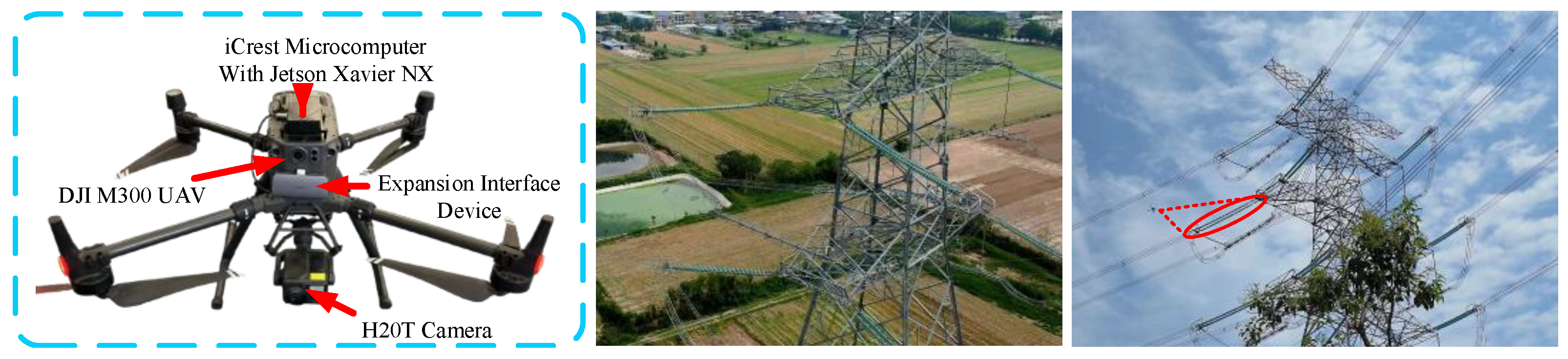
During the experiment, we completely recorded the flight process of the DJI M300 UAV and the detection process of the algorithm. In Figure 13 the structure of the used DJI M300 UAV is displayed. In this figure, the ground view and aerial view during the flight experiment are also presented.

5.2. Results of Flight Test Detection

Flight tests were conducted at a tower base of a 330 kV overhead transmission line. In Figure 14, an example of the detection results by the DJI M300 UAV during the flight is presented. The complete experimental records, including ground perspective recordings and detection result logs, can be viewed at https://github.com/UnmannedIntelligence/Drones_Insu_Det_seg (accessed on 15 March 2026).
The experimental results demonstrate that the proposed method performs reliably in real flight scenes. For insulator string localization, we deploy the improved Faster R-CNN equipped with RoI Align and elongated anchors tailored to string-like targets, which yields stable bounding boxes under varying viewpoints and backgrounds. For fine segmentation, the cropped regions are processed by the improved U-Net with a ResNet50 backbone and transfer learning, which further suppresses background interference and benefits subsequent defect analysis. Finally, missing insulators are identified by the proposed defect-curve-based strategy, avoiding the need for large-scale missing defect annotations. Overall, the cascaded detection–segmentation–curve analysis pipeline improves robustness and reduces false alarms in complex outdoor conditions.
The experimental results indicate that the two-stage integration of detection and segmentation not only effectively reduces the task complexity but also achieves complementary advantages between the two processes, providing a reliable technical solution for the automated inspection of insulators in transmission lines.
It should be noted that no real missing insulator defect was observed in the outdoor flight videos. Therefore, the field experiments were mainly used to validate the practical applicability of the proposed framework in real aerial inspection environments, including insulator string localization, segmentation quality, and overall system feasibility under complex backgrounds, illumination changes, and viewpoint variations. The performance of missing defect detection was evaluated separately using the collected defect sample dataset.

6. Discussion

6.1. Comparison with Previous Studies

Traditional image processing methods, such as threshold segmentation and texture recognition, were used in earlier research on insulator defect detection. However, the accuracy of the above methods is often relatively low [37]. The reason is that the background of the aerial images of insulators is quite complex, which may include mountains, rivers, trees, and buildings. Meanwhile, in the scenarios of overhead power lines, the illumination conditions in UAV images may change drastically. The above factors have led to the low detection accuracy of traditional methods for segmenting and identifying insulator failures. The method proposed in this paper adopts deep learning technology to learn the pixel distribution characteristics of insulators through a large amount of insulator images. It has higher accuracy and more stable detection performance in terms of detection precision by optimizing the model. Deep Convolutional Neural Networks have excellent performance with regard to identifying insulator defect. In the final comparative experiment, it was also verified that the proposed method maintains a high detection accuracy and speed compared to other schemes.

6.2. Advantages of the Cascaded Detection Framework

In practical scenarios, the scarcity of insulator defect samples prevents deep learning algorithms from fully learning the distribution characteristics of insulator defects. Therefore, this paper proposes a cascaded two-stage insulator defect detection scheme. The first step is to locate the insulator in the image, and the second step is to use the defect-curve-based method to identify the defects. The proposed method is theoretically more reasonable, and the experimental results further validate the effectiveness of the design. Compared with one-stage detection methods that simply treat insulator defects as categorical labels, such as the method in [38], the proposed approach exhibits clear advantages.

6.3. Practical Applicability and Dataset Considerations

In practical applications, it is very important to collect more insulator data, which helps to train more stable models. However, the current open-source insulator dataset has very few insulator samples. In [22], a dataset containing 848 insulator sheets has been open sourced. In this dataset, there are a large number of algorithm-synthesized samples that do not belong to real samples. Although these synthesized samples can be used to train stable models, the accuracy of the models in actual detection scenarios is difficult to guarantee. Based on these reasons, we have used the DJI M300 UAV and H20T camera to collect a large number of insulator samples in a real 330 kV transmission line for creating a dataset. In this dataset, insulator images from different seasons, weather conditions, and lighting conditions are included. The good performance of the algorithm in this paper is attributed to its dataset.
However, it is worth noting that in any deep learning task, more data is always welcome. Therefore, we will collect more insulator data in the future. Once a sufficient number of insulator samples has been collected and the dataset becomes stable, we plan to release it as an open-source resource so that researchers can better utilize it to study insulator defect detection.

6.4. Limitations and Future Work

Although the proposed method achieved a good performance in missing insulator detection, several limitations still exist. First, the current dataset is relatively limited, only 60 missing defect samples are included, and more diverse inspection scenarios are still needed to further verify the robustness and generalization ability of the method. Second, the anomaly threshold T a is selected empirically, and its adaptive determination under different conditions requires further study. Third, the present work mainly focuses on missing insulator defects, while other defect types have not yet been fully considered. In addition, the current dataset mainly covers the insulator types and environmental conditions available in our field inspections. Although the proposed method is expected to be applicable to insulators with similar geometric characteristics, its performance on other material types, especially composite insulators with different structural appearances, has not yet been systematically validated. Moreover, under extreme weather conditions such as heavy fog or snow, image degradation, reduced contrast, and partial occlusion may further affect detection accuracy. Future work will concentrate on enlarging the dataset, including more missing defect samples, more insulator material types, and more adverse weather scenarios, improving the adaptability of the method in complex aerial environments, and extending the framework to more defect categories. These issues will be important directions for our future research toward practical engineering applications.

7. Conclusions

This study proposed a UAV-based insulator defect detection method that effectively identifies missing insulators in high-voltage transmission lines. By combining improved Faster R-CNN with U-Net, insulator images with reduced background interference were obtained. To address the scarcity of missing defect samples, traditional image processing was employed to construct defect curves, enabling the accurate identification of defect localization and quantities. The experimental results on the collected UAV insulator dataset show that the proposed method achieved an AP@0.5 of 99.85%, an F1-score of 95.34%, and an average IoU of 88.56% for insulator string detection. For insulator string segmentation, the improved U-Net achieved an mIoU of 89.73%, an mPA of 94.03%, a precision of 94.60%, and a recall of 95.15%. The missing insulator detection experiment further demonstrated that the proposed defect-curve-based strategy can effectively distinguish normal strings from defective ones under different viewpoints and background conditions. The F1-score for missing insulator detection reached 92.44% The results confirm that the proposed approach achieves reliable detection and localization performance. Outdoor flight experiments based on a DJI M300 UAV further verified the practical feasibility of the proposed framework under complex outdoor conditions, and the deployed system achieved 14 FPS on an NVIDIA Jetson Xavier NX platform.
In our future work, we will investigate advanced learning-based approaches for more accurate missing insulator detection and will validate their effectiveness in practical engineering tests. In addition, to enhance the detection accuracy under different seasons and weather conditions, we will collect more aerial insulator images, especially cases with missing insulators captured in diverse environments.

Author Contributions

Conceptualization, Y.Z. (Yulong Zhang) and Y.Z. (Youmin Zhang); data curation, Y.Y.; formal analysis, Y.Z. (Yulong Zhang), L.M., X.X. and J.X.; funding acquisition, Y.Z. (Youmin Zhang); methodology, Y.Z. (Yulong Zhang); project administration, Y.Z. (Youmin Zhang); software, Y.Z. (Yulong Zhang) and Y.Y.; supervision, Y.Z. (Youmin Zhang); validation, Y.Z. (Yulong Zhang), L.M. and Y.Y.; writing—original draft, Y.Z. (Yulong Zhang); and writing—review and editing, Y.Z. (Yulong Zhang) and Y.Z. (Youmin Zhang). All authors have read and agreed to the published version of the manuscript.

Funding

This research was funded by the National Natural Science Foundation of China (No. 61833013, No. 61903297, No. 62103326), China Postdoctoral Science Foundation (No. 2022MD723834), Key R&D Program of Shaanxi Province (No. 2024GX-YBXM-093), and the Aeronautical Science Foundation of China (No. 2024Z0340T6001).

Data Availability Statement

This dataset is designed to validate the feasibility of algorithms in the initial stage of the project. The dataset will be made public upon completion of the project.

Conflicts of Interest

The authors declare no conflicts of interest.

References

  1. She, L.C.; Fan, Y.D.; Xu, M.X.; Wang, J.G.; Xue, J.; Ou, J.H. Insulator Breakage Detection Utilizing a Convolutional Neural Network Ensemble Implemented with Small Sample Data Augmentation and Transfer Learning. IEEE Trans. Power Deliv. 2022, 37, 2787–2796. [Google Scholar] [CrossRef]
  2. Yang, Q.; Yin, L.; Liu, H.W.; Wang, K.; Huang, J.S. Measurement of Lightning-Induced Overvoltage in Power Distribution Lines Using Ceramic-Capacitor Insulator. IEEE Trans. Electromagn. Compat. 2019, 61, 788–795. [Google Scholar] [CrossRef]
  3. Ilomuanya, C.; Farokhi, S.; Nekahi, A. Performance Evaluation of Outdoor High Voltage Glass Insulators in High Pollution Industrial Areas Using Simulated Acid Rain Contamination. IEEE Access 2022, 10, 80600–80608. [Google Scholar] [CrossRef]
  4. Lv, Z.B.; Liu, X.H.; Zhang, B.; Tao, Y.G.; Li, F.Y.; Li, Q.; Yan, B. Dynamic Characteristic of Conductor after Ice-Shedding and Simulation Analysis of the Tension Insulator String. IEEE Access 2022, 10, 118484–118497. [Google Scholar] [CrossRef]
  5. Rajamani, P.; Aravind, K.A.; Rao, K.R.; Krishna, B.; Urukundu, K.; Rao, K.D. Development of Laboratory Test Method to Perform Artificial Pollution Test on Composite Insulators Intended for HVDC Applications by Solid Layer Method. IEEE Trans. Dielectr. Electr. Insul. 2024, 31, 439–447. [Google Scholar] [CrossRef]
  6. Thomas, A.J.; Iyyappan, C.; Reddy, C. On the Measurement of Surface Voltage of Insulators and Bushings. IEEE Trans. Power Deliv. 2022, 37, 464–471. [Google Scholar] [CrossRef]
  7. Nguyen, V.N.; Jenssen, R.; Roverso, D. Automatic Autonomous Vision-Based Power Line Inspection: A Review of Current Status and the Potential Role of Deep Learning. Int. J. Electr. Power Energy Syst. 2018, 99, 107–120. [Google Scholar] [CrossRef]
  8. Santos, H.; Sanz-Bobi, M. Novel Approaches to Assess the Mechanical Reliability of Toughened Glass Insulators Used in Transmission Lines. IEEE Trans. Power Deliv. 2022, 37, 2083–2089. [Google Scholar] [CrossRef]
  9. Li, S.; Qiao, L.H.; Zhang, Y.M.; Yan, J. An Early Forest Fire Detection System Based on DJI M300 Drone and H20T Camera. In Proceedings of the 2022 International Conference on Unmanned Aircraft Systems (ICUAS), Dubrovnik, Croatia, 21–24 June 2022; pp. 932–937. [Google Scholar]
  10. Qiao, L.; Li, S.; Zhang, Y.M.; Yan, J. Early Wildfire Detection and Distance Estimation Using Aerial Visible-Infrared Images. IEEE Trans. Ind. Electron. 2024, 71, 16695–16705. [Google Scholar] [CrossRef]
  11. Yang, P.; Wang, H.; Huang, X.; Gu, J.; Deng, T.; Yuan, Z. A Novel Telescopic Aerial Manipulator for Installing and Grasping the Insulator Inspection Robot on Power Lines: Design, Control, and Experiment. Drones 2025, 9, 741. [Google Scholar] [CrossRef]
  12. Pamula, G.; Ramachandran, A. Thermal Management for Unmanned Aerial Vehicle Payloads: Mechanisms, Systems, and Applications. Drones 2025, 9, 350. [Google Scholar] [CrossRef]
  13. Grabowski, M.R.; Morgan, G.; McGarvey, J.; Roberts, S.; Squire, R.; Ibanez, S.; Bringsjord, S.; Rowen, A. Human Machine Autonomy in Medical and Humanitarian Logistics in Remote and Infrastructure-Poor Settings. Drones 2025, 9, 841. [Google Scholar] [CrossRef]
  14. Yin, L.; Hu, J.; Wang, W.B.; Zou, J.C.; He, L.X.; Xiong, Z. Parameters Optimization of UAV for Insulator Inspection on Power Transmission Line. IEEE Access 2022, 10, 97022–97029. [Google Scholar] [CrossRef]
  15. Waleed, D.; Mukhopadhyay, S.; Tariq, U.; El-Hag, A.H. Drone-Based Ceramic Insulators Condition Monitoring. IEEE Trans. Instrum. Meas. 2021, 70, 6007312. [Google Scholar] [CrossRef]
  16. Hao, K.; Chen, G.K.; Zhao, L.; Li, Z.S.; Liu, Y.L.; Wang, C.Q. An Insulator Defect Detection Model in Aerial Images Based on Multiscale Feature Pyramid Network. IEEE Trans. Instrum. Meas. 2022, 71, 3522412. [Google Scholar] [CrossRef]
  17. Shakiba, F.M.; Azizi, S.M.; Zhou, M.C. A Transfer Learning-Based Method to Detect Insulator Faults of High-Voltage Transmission Lines via Aerial Images: Distinguishing Intact and Broken Insulator Images. IEEE Syst. Man Cybern. Mag. 2022, 8, 15–25. [Google Scholar]
  18. Wang, S.Q.; Liu, Y.F.; Qing, Y.; Wang, C.X.; Lan, T.Z.; Yao, R.T. Detection of Insulator Defects with Improved ResNeSt and Region Proposal Network. IEEE Access 2020, 8, 184841–184850. [Google Scholar]
  19. Zhang, X.T.; Zhang, Y.Y.; Liu, J.F.; Zhang, C.H.; Xue, X.Y.; Zhang, H.; Zhang, W. InsuDet: A Fault Detection Method for Insulators of Overhead Transmission Lines Using Convolutional Neural Networks. IEEE Trans. Instrum. Meas. 2021, 70, 5018512. [Google Scholar] [CrossRef]
  20. Yang, Z.S.; Xu, Z.; Wang, Y.H. Bidirection-Fusion-YOLOv3: An Improved Method for Insulator Defect Detection Using UAV Image. IEEE Trans. Instrum. Meas. 2022, 71, 3521408. [Google Scholar]
  21. Wang, Z.Y.; Gao, Q.; Li, D.; Liu, J.J.; Wang, H.W.; Yu, X.; Wang, Y. Insulator Anomaly Detection Method Based on Few-Shot Learning. IEEE Access 2021, 9, 94970–94980. [Google Scholar] [CrossRef]
  22. Tao, X.; Zhang, D.P.; Wang, Z.H.; Liu, X.L.; Zhang, H.Y.; Xu, D. Detection of Power Line Insulator Defects Using Aerial Images Analyzed with Convolutional Neural Networks. IEEE Trans. Syst. Man Cybern. Syst. 2018, 50, 1486–1498. [Google Scholar] [CrossRef]
  23. Zhao, W.Q.; Xu, M.F.; Cheng, X.F.; Zhao, Z.B. An Insulator in Transmission Lines Recognition and Fault Detection Model Based on Improved Faster R-CNN. IEEE Trans. Instrum. Meas. 2021, 70, 5016408. [Google Scholar] [CrossRef]
  24. Song, C.H.; Xu, W.X.; Han, G.J.; Zeng, P.; Wang, Z.F.; Yu, S.M. A Cloud Edge Collaborative Intelligence Method of Insulator String Defect Detection for Power IIoT. IEEE Internet Things J. 2021, 8, 7510–7520. [Google Scholar] [CrossRef]
  25. Zheng, H.B.; Sun, Y.H.; Liu, X.H.; Djike, C.L.T.; Li, J.H.; Liu, Y. Infrared Image Detection of Substation Insulators Using an Improved Fusion Single Shot Multibox Detector. IEEE Trans. Power Deliv. 2021, 36, 3351–3359. [Google Scholar] [CrossRef]
  26. He, H.Y.; Zhang, Z.Y.; Lee, W.J.; Cao, Y.J.; Lu, T.G. A Contactless Insulator Contamination Levels Detecting Method Based on Infrared Images Features and RBFNN. IEEE Trans. Ind. Appl. 2019, 55, 2455–2463. [Google Scholar] [CrossRef]
  27. Zheng, H.B.; Liu, Y.; Sun, Y.H.; Li, J.H.; Shi, Z.; Zhang, C.H.; Lai, C.S.; Lai, L.L. Arbitrary-Oriented Detection of Insulators in Thermal Imagery via Rotation Region Network. IEEE Trans. Ind. Inform. 2022, 18, 5242–5252. [Google Scholar]
  28. Liu, X.Y.; Miao, X.R.; Jiang, H.; Chen, J. Box-Point Detector: A Diagnosis Method for Insulator Faults in Power Lines Using Aerial Images and Convolutional Neural Networks. IEEE Trans. Power Deliv. 2021, 36, 3765–3773. [Google Scholar] [CrossRef]
  29. Zhang, Z.D.; Zhang, B.; Lan, Z.C.; Liu, H.C.; Li, D.Y.; Pei, L.; Yu, W. FINet: An Insulator Dataset and Detection Benchmark Based on Synthetic Fog and Improved YOLOv5. IEEE Trans. Instrum. Meas. 2022, 71, 6006508. [Google Scholar] [CrossRef]
  30. Rusyn, B.; Lutsyk, O.; Kosarevych, R.; Maksymyuk, T.; Gazda, J. Features Extraction From Multi-Spectral Remote Sensing Images Based on Multi-Threshold Binarization. Sci. Rep. 2023, 13, 19655–19665. [Google Scholar] [CrossRef]
  31. Ren, S.Q.; He, K.M.; Girshick, R.; Sun, J. Faster R-CNN: Towards Real-Time Object Detection with Region Proposal Networks. IEEE Trans. Pattern Anal. Mach. Intell. 2017, 39, 1137–1149. [Google Scholar] [CrossRef]
  32. Simonyan, K.; Zisserman, A. Very Deep Convolutional Networks for Large-Scale Image Recognition. In Proceedings of the 3rd International Conference on Learning Representations, San Diego, CA, USA, 7–9 May 2015; pp. 1–14. [Google Scholar]
  33. Long, M.S.; Cao, Y.; Wang, J.M.; Jordan, M.I. Learning Transferable Features with Deep Adaptation Networks. In Proceedings of the 2015 International Conference on Machine Learning, Lille, France, 6–11 July 2015; pp. 97–105. [Google Scholar]
  34. Deng, J.; Dong, W.; Socher, R.; Li, L.J.; Li, K.; Li, F.F. ImageNet: A Large-Scale Hierarchical Image Database. In Proceedings of the IEEE Conference on Computer Vision and Pattern Recognition (CVPR), Miami, FL, USA, 20–25 June 2009; IEEE: Piscataway, NJ, USA, 2019; pp. 248–255. [Google Scholar]
  35. Ronneberger, O.; Fischer, P.; Brox, T. U-Net: Convolutional Networks for Biomedical Image Segmentation. In Proceedings of the International Conference on Medical Image Computing and Computer-Assisted Intervention (MICCAI), Munich, Germany, 5–9 October 2015; pp. 234–241. [Google Scholar]
  36. He, K.M.; Zhang, X.Y.; Ren, S.Q.; Sun, J. Deep Residual Learning for Image Recognition. In Proceedings of the 2016 IEEE Conference on Computer Vision and Pattern Recognition, Las Vegas, NV, USA, 27–30 June 2016; IEEE: Piscataway, NJ, USA, 2016; pp. 770–778. [Google Scholar]
  37. Jabid, T.; Ahsan, T. Insulator Detection and Defect Classification Using Rotation Invariant Local Directional Pattern. Int. J. Adv. Comput. Sci. Appl. 2018, 9, 265–272. [Google Scholar] [CrossRef]
  38. Zhang, Q.; Zhang, J.N.; Li, Y.; Zhu, C.Z.; Wang, G.F. IL-YOLO: An Efficient Detection Algorithm for Insulator Defects in Complex Backgrounds of Transmission Lines. IEEE Access 2024, 12, 14532–14546. [Google Scholar] [CrossRef]
Figure 1. Missing defect caused by insulator bursting.
Drones 10 00213 g001
Figure 2. The proposed insulator missing defect detection framework. The detection of insulators’ defects is divided into two stages: first detecting the insulators, and then detecting the defects.
Drones 10 00213 g002
Figure 3. A convolution process.
Drones 10 00213 g003
Figure 4. The VGG16 structure diagram.
Drones 10 00213 g004
Figure 5. Transfer learning process.
Drones 10 00213 g005
Figure 6. The RPN structure diagram.
Drones 10 00213 g006
Figure 7. Residual block.
Drones 10 00213 g007
Figure 8. Comparison of defect curves. The red circle indicates the missing insulator position. (a) Without missing defect, the curves are periodically distributed, and there are no outliers. (b) With a missing defect sample, the curve shows a periodic distribution, but there are outliers, and the peaks on both sides of the outliers are larger.
Drones 10 00213 g008
Figure 9. DJI M300 UAV and H20T camera used to collect a dataset of glass insulators along 330 kV high-voltage overhead transmission lines. (a) Ground perspective shooting of DJI M300 using H20T camera. (b) H20T camera perspective in collecting glass insulator dataset.
Drones 10 00213 g009
Figure 10. The detection results of insulator strings using the original Faster R-CNN and the proposed method. (a) Missed detection by Faster R-CNN. (b) Missed detection by Faster R-CNN. (c) False positive by Faster R-CNN. (d) No missed detection by the proposed method. (e) No missed detection by the proposed method. (f) No false positive by the proposed method.
Drones 10 00213 g010
Figure 11. Slicing process of insulator string.
Drones 10 00213 g011
Figure 12. Examples of insulator missing defect detection using the proposed defect-curve-based method. (a) Normal insulator string without missing defects; the defect curve is regular and quasi-periodic. (b) Normal string under a different viewpoint; the defect curve remains regular with no outliers. (c) Normal string in a more complex background; peak and trough intervals are still nearly constant. (d) String with a missing insulator; a clear gap in the defect curve yields a prominent abnormal interval. (e) String with a missing insulator; although a spurious anomaly appears at the string end, the central gap in the defect curve is correctly identified as a missing defect. (f) String with a missing insulator under adverse weather and illumination; despite degraded segmentation, the main gap remains detectable.
Drones 10 00213 g012
Figure 13. Configuration of the DJI M300 UAV and its inspection flight along overhead transmission lines for insulator inspection.
Drones 10 00213 g013
Figure 14. Image samples captured by the H20T camera on the DJI M300 UAV during the flight test and the corresponding detection results of the proposed algorithm.
Drones 10 00213 g014
Table 1. Detection performance on insulator strings.
Model NameAP@0.5 (%)F1 (%)Average IoU (%)FLOPs (B)
SSD96.5391.8987.3834.86
YOLOv394.2791.2287.51156.4
YOLOv596.2392.0485.72246.4
YOLOv898.3291.5683.87257.8
YOLOv1198.0193.4584.97194.9
Faster R-CNN97.4593.6787.78271.7
The proposed99.8595.3488.56288.3
Table 2. Segmentation experimental results.
Indicators (%)DeepLab V3U-NetU-Net (ResNet18)U-Net (ResNet34)Ours
mIoU82.1887.3585.7686.7889.73
mPA90.7791.2492.4593.0994.03
Precision90.1394.4392.2192.7194.60
Recall90.7791.2492.4593.0994.03
Table 3. Sensitivity analysis of the anomaly threshold T a for missing insulator detection.
T a Precision (%)Recall (%)F1-Score (%)
1.195.1265.0077.23
1.293.7575.0083.33
1.393.2291.6792.44
1.488.8993.3391.06
1.580.2895.0087.02
1.674.3696.6784.06
1.770.7396.6781.69
Disclaimer/Publisher’s Note: The statements, opinions and data contained in all publications are solely those of the individual author(s) and contributor(s) and not of MDPI and/or the editor(s). MDPI and/or the editor(s) disclaim responsibility for any injury to people or property resulting from any ideas, methods, instructions or products referred to in the content.