Review

Mid-Air Collision Risk for Urban Air Mobility: A Review

1
School of Instrumentation and Optoelectronic Engineering, Beihang University, Beijing 100191, China
2
Tianmushan Laboratory, Beihang University, Hangzhou 311115, China
3
School of Physics, Beihang University, Beijing 100191, China
4
School of Traffic and Transportation, Beijing Jiaotong University, Beijing 100044, China
5
Tianjin Key Laboratory of Intelligent Control of Electrical Equipment, Tiangong University, Tianjin 300387, China
6
School of Electronics and Information Engineering, Beihang University, Beijing 100191, China
7
State Key Laboratory of Communication, Navigation, Surveillance/Air Traffic Management, Beijing 100191, China
8
School of Automation Science and Electrical Engineering, Beihang University, Beijing 100191, China
*
Author to whom correspondence should be addressed.
Drones 2026, 10(3), 211; https://doi.org/10.3390/drones10030211
Submission received: 12 September 2025 / Revised: 12 March 2026 / Accepted: 13 March 2026 / Published: 17 March 2026
(This article belongs to the Special Issue Urban Air Mobility Solutions: UAVs for Smarter Cities)

Highlights

What are the main findings?
  • This review summarizes the international research conducted on mid-air collision risk and safety modeling for Urban Air Mobility (UAM), covering airspace structuring, enabling technologies, and collision-avoidance frameworks.
  • It identifies common patterns and limitations across existing approaches, and clarifies how the current risk models, airspace designs, and operational technologies interact within the emerging UAM systems.
What are the implications of the main findings?
  • This analysis provides a consolidated reference for researchers, method developers, and regulators seeking to understand the state of safety research and remaining challenges in urban low-altitude operations.
  • The outlined research gaps and trends can help guide future studies toward more integrated, data-driven, and safety-oriented frameworks for UAM management.

Abstract

Urban Air Mobility (UAM) introduces new safety challenges as small unmanned aircrafts begin to operate at high density in complex urban environments. Traditional air traffic management (ATM) systems developed for manned aviation are unable to accommodate the autonomy, mission diversity, and dynamic obstacle conditions typical of low-altitude operations. This review examines recent research on mid-air collision risk and airspace safety modeling for UAM and identifies key challenges in adapting existing safety concepts to small-scale and autonomous flight. The study compares international management frameworks of the United States, Europe, and China. Then analyzes representative airspace structures such as Free, Layered, Zoned, and Pipeline configurations. It further reviews deterministic and probabilistic separation models, geometric and optimization-based avoidance strategies, and structured airspace approaches such as the virtual-tube concept for coordinated swarm navigation. The findings highlight the lack of integrated models that couple human, energy, and communication factors into quantitative risk assessment. The paper concludes by outlining future research needs in uncertainty modeling, digital-twin simulation, and interoperability to support safe and scalable UAM development.

1. Introduction

1.1. Backgrounds

Low-altitude airspace generally refers to the near-surface flight region, although its specific altitude limits vary by country and regulatory framework. It is currently undergoing region-specific classification and gradual policy-driven opening procedures. With the rapid advancement of global unmanned aerial vehicle (UAV) technologies, low-altitude airspace has become a central topic in aviation research, smart-city planning, and national airspace governance. The demand for quantitative airspace risk assessment and safety assurance frameworks is rising rapidly [1]. Recent improvements in the durability and cost-effectiveness of civil UAVs have accelerated their adoption. They are now widely used in logistics, environmental monitoring, infrastructure inspection, and emergency response scenarios [2]. As regulatory mechanisms mature and the industry becomes more standardized, UAVs are expected to remain among the most dynamic and economically influential segments of the global aerospace sector.
The rapid increase in the volume of low-altitude drone operations has created major challenges for the traditional ATM systems. These systems were designed for manned aviation tasks with centralized control schemes and predictable traffic flow, and they cannot easily handle the scale, autonomy, and variability of UAV operations. Although both the United States and the European Union are working to incorporate drones into their existing airspace systems [3], current ATM infrastructure still struggles to handle the rapid growth exhibited by drone traffic, particularly in densely populated urban areas [4,5]. When drones are assigned complex missions, operate beyond the visual line of sight, or fly over densely populated areas, their safe integration becomes even more difficult to achieve. In such scenarios, UAVs are required to dynamically interface with real-time national airspace systems and remain under continuous traffic control throughout the entire flight process. However, this capability is not yet fully supported by the existing ATM frameworks [6,7]. Furthermore, the need for autonomous detect-and-avoid (DAA) mechanisms and air-to-air coordination increases sharply as flight densities increase, especially in shared or nonsegregated airspace [8]. Therefore, advancing UAV-specific ATM architectures and policies is urgent and essential for ensuring both operational safety and efficient low-altitude traffic flow.
The Federal Aviation Administration (FAA) of the United States divides the national airspace into six classes. Classes B, C, and D cover transportation and general-aviation airports of different sizes, and they do not intersect with Class A airspace. For the E/G regions with low airspace, unmanned aerial vehicles flying in this region do not fall within the scope of transportation aviation-based air traffic control. They are considered the main area for urban air traffic flights [9]. On this basis, considering the impact factors of high-rise buildings on the ground, no-fly zones, and other geographical fences, the airspace boundaries of urban air traffic exhibit certain variability and relative flexibility.
Under this classification, most urban air traffic operates in Class E and G airspace. In these regions, the typical vehicles are small UAVs and electric vertical take-off and landing (eVTOL) aircraft weighing less than 24.9 kg and flying below 44.8 m/s, with a maximum kinetic energy of 24,988 J [10].
Barr et al. [10] classified UAVs into three categories based on the basis of their weights: micro, mini, and small unmanned aircraft systems (UASs) (see Table 1). Building on this classification, Melnyk et al. [11] expanded the framework to a total of seven categories by adding four additional types: tactical, medium, large, and heavy UAVs (see Table 2). The weight of tactical UAVs ranges from 56 lb to 351 lb (25.4–159.2 kg), and the weights of medium-sized UAVs range from 352 lb to 1320 lb (160–599 kg). With respect to urban air traffic, unmanned aerial vehicles with weights of less than 351 lb (159.2 kg) are dominant; their flight durations are usually less than 5 h, with a maximum of 24 h, and their flight range is between 100 km and hundreds of kilometers.
Urban air traffic operates over areas with complex buildings, uneven population density, and mixed traffic modes. These factors make flight paths highly random and unpredictable. The contradiction between the airspace capacity of urban air traffic and flight requirements will not immediately become prominent in the near future. However, advances in communication, navigation, and surveillance (CNS) technologies, together with smarter traffic-management systems, are expected to increase the capacity of urban airspace by providing improved environmental awareness and conflict resolution capabilities. Therefore, establishing free-flight, layered-limit airspace capacity models for different airspace structures, such as regional and pipeline flights, is necessary. Currently, there are several typical airspace division schemes available for UAM. With respect to the national airspace classification system in the United States, UAM aircraft generally fly in uncontrolled class G airspace, but they can also navigate in other controlled airspace with regulations. In Europe, U-space ConOps has been introduced for drone flights in very low-level (VLL) airspace. The U-space ConOps system categorizes the VLL airspace into three distinct volumes: X, Y, and Z. The European project “Air Mobility Urban—Large Experimental Demonstrations” further elaborates on the Zu and Za volumes within U-space, which is dedicated to drone performance tiers. Chinese airspace is divided into seven classes, among which Classes A, B, C, D, and E are controlled, while Classes G and W are uncontrolled. UAM aircraft primarily operate within uncontrolled airspace, specifically classes G and W, at altitudes below approximately 1000 feet (300 m) outside of controlled regions.
These differences highlight the fact that the existing ATM and safety-assessment frameworks cannot be directly applied to the complex and heterogeneous nature of urban low-altitude operations. This limitation motivates the need for a unified framework that integrates airspace structuring, enabling technologies, and quantitative risk modeling for UAM.

1.2. Motivation and Contributions

As shown in Table 3, the operational characteristics of small UASs differ significantly from those of traditional manned aviation systems in terms of their situational awareness, communication reliability, airspace structure, and legal clarity. These disparities underscore the complexity and uncertainty of low-altitude UAM operations, particularly in uncontrolled environments. The goal of urban ATM is to solve the contradiction between dense airspace flow and flight safety [12], thereby improving the airspace capacity level. Therefore, it is necessary to establish a flight risk assessment mechanism for highly uncontrolled low airspace with heterogeneous drones. Some of the critical factors involved, such as flying risk categories, risk evaluation tools, and midair collision-avoidance models, are addressed in the following sections [13,14,15].
The comparison in Table 3 highlights a gap between the operational characteristics of traditional ATM and those of small UASs operating in urban low-altitude environments. In the UAM scenarios, building occlusions and multipath effects can make surveillance coverage intermittent, while link outages and latency reduce the reliability of conflict detection and resolution. Under dense urban environments, these conditions undermine the continuous tracking assumptions that conventional ATM relies on, which can lead to biased safety assessments and weaker separation assurance.
Previous studies were fragmented and often lacked a consistent descriptive framework for several key interfaces. Management architectures propose services such as information exchange, registration, authorization, tracking, and conflict management, but many quantitative risk models represent these capabilities in an idealized or implicit way, making it difficult to understand how changes in availability, latency, and integrity propagate into risk metrics. Research on airspace structuring and capacity frequently emphasizes efficiency, but the encounter-process assumptions used in probabilistic risk assessment are not always aligned with structured operations. Evaluations of DAA and collision-avoidance methods are commonly conducted under ideal assumptions, whereas their applicability under realistic UAM environments is not yet consistently summarized.
Existing review studies have addressed several important but largely separate aspects of UAS and UAM operations. Aposporis [5] examined global and regional frameworks for integrating UAS into ATM, with an emphasis on governance and regulatory implementation. Bauranov and Rakas [17] reviewed major UAM airspace design concepts, while Panov and Ul Haq [18] focused on information provision for U-space traffic autonomous guidance. Guan et al. [19] surveyed safety separation management and collision-avoidance approaches for civil UASs in integrated airspace, and Du et al. [20] further reviewed safety risk modeling for civil UAS operations across SRMP, causal, collision, and ground risk models. In contrast to these prior works, the present review is specifically centered on mid-air collision risk and mitigation in UAM and integrates governance frameworks, information-service assumptions, enabling operational constraints, and probabilistic safety assessment into a unified analytical narrative.
This review is therefore aimed at providing a comprehensive and structured synthesis of international research progress regarding mid-air collision risk and its mitigation for UAM. The main objectives are threefold:
  • To construct a comparative framework for UAM airspace management by analyzing the representative structuring models and reviewing the regulatory and operational practices in the United States (UTM ConOps v2.0), the European Union (U-space), and China (UOM).
  • To investigate the enabling technologies and operational factors that affect collision risk, including the reliability of CNS systems under Global Navigation Satellite System (GNSS)-degraded conditions, the safety and endurance limits of battery systems, and the role of human supervision in UAM operations.
  • To review and assess the existing risk evaluation and collision-avoidance methodologies, including deterministic and probabilistic separation models, geometric and optimization-based approaches, and structured airspace frameworks such as the virtual-tube concept for large-scale swarm operations.
Guided by these objectives, this review is organized around the following research questions (RQs):
  • RQ1: How do different governance architectures differ in terms of service provisioning and operational accountability, and what do these differences imply for structured UAM airspace management?
  • RQ2: Under realistic urban conditions, how do CNS reliability in GNSS-degraded environments, energy constraints, and human supervision shape the uncertainty and assumptions underlying mid-air collision risk assessment?
  • RQ3: Given the above information regimes and operational constraints, what are the strengths, limitations, and applicability conditions of existing risk evaluation and collision-avoidance methodologies, including deterministic and probabilistic separation, geometric and optimization-based approaches, and structured airspace frameworks such as virtual tubes?
Answering these questions yields three main insights: (i) governance and service architectures constrain the information conditions under which risk models and separation standards remain valid; (ii) safety-relevant uncertainties in CNS performance, energy limits, and human oversight jointly determine the credibility of quantitative safety metrics; and (iii) structured airspace concepts, particularly virtual tubes, provide a promising pathway for scalable operations, but require explicit alignment between information availability, uncertainty modeling, and assurance objectives.
Details of the literature search strategy and study selection criteria are provided in Appendix A. The overall organization of this review is illustrated in Figure 1, which summarizes the logical flow from background knowledge (Section 1, Section 2 and Section 3) to the core methodological framework (Section 4 and Section 5), and finally to the conclusions and outlook (Section 6).

2. The Current UAM Framework

Under the leadership of the FAA, the United States is progressing UAM development through its Urban Air Mobility Concept of Operations (ConOps v2.0) [21] and the Innovate28 initiative [22], aiming for scalable commercial operations by 2028. This evolution process leverages existing ATM infrastructure and introduces gradual automation, and it is supported by NASA’s Advanced Air Mobility National Campaign for validation and integration purposes [23].
In Europe, the EASA has laid a regulatory foundation through its Special Conditions for Vertical Take-Off/Landing aircraft certification standards [24] and the U-space regulatory package (2021) [25]. These schemes enable layered and automated drone and UAM traffic management systems. Strategic coordination is further supported by Single European Sky ATM Research Joint Undertaking (SESAR JU) and the European UAM Initiative Cities program.
China is pursuing a centralized, government-led strategy. The Civil Aviation Administration of China (CAAC) has issued the “Guidelines for Urban Air Mobility Development” and launched large-scale demonstration projects. Provincial and municipal governments are actively advancing their infrastructure, targeting commercial UAM operations by 2025 with strict regulatory oversight [26,27].
While the United States focuses on incremental integration via existing systems, Europe promotes a digital-first U-space architecture, and China emphasizes rapid deployment through coordinated pilot projects. Despite differing approaches, all face shared challenges in certification, airspace access, and public acceptance.

2.1. Concept of Structured Airspace for UAM

The concept of structured airspace provides the foundational rationale for organizing high-density urban air traffic within the limited vertical range below 400 feet above ground level. With the diversification and increasing intensity of urban air traffic operations, major industrial stakeholders such as Airbus and Amazon Prime Air have proposed vertically stratified and dynamically managed airspace models to accommodate dense UAM operations, introducing new challenges for integration and conflict management challenges [28,29].
In terms of its airspace structure, urban air traffic can have the characteristics of both structured airspace and free flight [17]. Within the UAM Maturity Level (UML) framework [30], the National Aeronautics and Space Administration (NASA) Ames Research Group envisioned that the UML-2 phase formally introduces structured corridors, while UML-5 plans to envision thousands of concurrent eVTOL aircraft flights that are coordinated through distributed traffic management systems. Compared with traditional transportation aviation airspace, urban environments are characterized by high topological complexity levels, obstacle constraints, and high stochastic encounter frequencies, all of which exacerbate separation assurance and safety modeling [31,32,33,34].
Therefore, the rational division of the airspace structure is the primary issue associated with urban ATM. Currently, the representative research work comes from the Air Traffic Management Institute of Nanyang Technological University in Singapore [35] and the Metropolis project team of Delft Technological University in the Netherlands [36,37]. The Delft group proposed a structured airspace framework that evolves through hierarchical, zonal, and tubular configurations, and quantitatively examined how the airspace topology and traffic randomness jointly constrain capacity. The contradiction between the randomness of traffic flows and the complexity of airspace operations in urban air traffic was revealed to be the main factor restricting airspace capacity. On this basis, establishing a directionally selective vertical separation scheme for multiple flight layers is an effective way to solve this problem. Given that eVTOL aircraft constitute the majority of urban operations, airspace structures must account for heterogeneous performance envelopes and dynamic altitude constraints rather than static separation minima. Based on a study of Singapore’s urban airspace, Ref. [38] proposed a dynamic route design method using grid-based airspace to address the growing high-altitude airspace capacity and throughput demands of UAM operations. However, this approach imposes higher requirements on the centralized command and control systems of urban ATM systems and presents significant challenges for existing low-altitude CNS systems and other emerging air traffic infrastructure technologies.
As part of their airspace structuring concept, the Metropolis project team proposed segmenting the airspace into vertical layers every 300 feet (approximately 100 m), each of which was assigned a 45-degree heading range [36]. This design was aimed at reducing the relative velocities among aircraft operating within the same altitude band, thereby decreasing the probability of conflict and enhancing the efficiency of direct routing in high-density urban airspace scenarios. Through a simulation analysis, it was found that the narrower the heading range within an altitude layer was, the smaller the probability of conflict. However, for urban air traffic dominated by eVTOL, the safety altitude separation level of 300 feet does not consider the effects of factors such as the eVTOL aircraft collision model, the altitude sensor error model, navigation accuracy, or urban meteorological conditions. Therefore, great exploration potential remains with respect to the minimum flight separation altitude for urban air traffic [39]. In [40], the vertical separation altitude for urban air traffic flights was reduced. Specifically, the height for multirotor unmanned aerial vehicles was set from approximately 160 feet to 400 feet (50 m to 120 m), and for composite wing unmanned aerial vehicles, it was set from approximately 490 feet to 690 feet (150 m to 210 m). The two flight zones retained a transition area of approximately 100 feet (30 m), thereby ensuring flight safety and reducing the flight risk faced by heterogeneous multipower unmanned aerial vehicles in mixed airspace.
Such a stratified allocation scheme demonstrates how airspace geometry and vehicle heterogeneity jointly affect collision-risk modeling, providing an empirical basis for probabilistic safety assessments.

2.2. The US UTM ConOps v2.0

The FAA UTM Concept of Operations v2.0 treats corridor-based airspace organization as an important means to support dense urban low altitude operations, reflecting a shift from ad hoc route planning towards structured and performance-oriented airspace management [5,21]. Compared with the 2020 version, ConOps v2.0 places greater emphasis on corridor-oriented integration for urban environments. It introduces tiered interoperability through the technical capability level framework and describes progressive coordination across UAS service suppliers, supplemental data service providers, and the FAA system integration layer [5]. In corridor operation, the aircraft must comply with standard flight rules and performance requirements for separation minimum, communication delay, and trajectory predictability [41]. Outside corridors, the ATM and UAV traffic management rules under the national airspace framework are followed, and the flights are subjected to various airspace constraints. The framework aims to balance the integrity and security assurance of the national airspace system with the flexibility required for diversified urban operations, reflecting performance-based planning rather than normative regulatory concepts [42].
The ConOps outlined three operational service constructs: (1) federally controlled operations, which are directly supervised and certified by the FAA; (2) federated operations, which are initiated by private operators under FAA-approved regulatory frameworks; and (3) industry-managed operations, which are governed by consensus standards and subject to FAA oversight rather than direct certification. The different authentication models and responsibility boundaries inherent in these structures will affect the credibility, consistency, and auditability of information services.

2.3. The European U-Space

The European Union has developed a comprehensive framework for integrating UAVs into airspace through its U-space concept, led by the EASA and SESAR JU. The goal of U-space is to ensure the safe, efficient, and scalable integration of a high volume of drones in both urban and rural airspace environments [43,44].
U-space is structured through standardized digital services designed to enhance navigation accuracy, fault tolerance, and DAA performance, and it supports strategic and tactical conflict detection as well as obstacle-aware routing to improve situational awareness and operational efficiency [18,45].
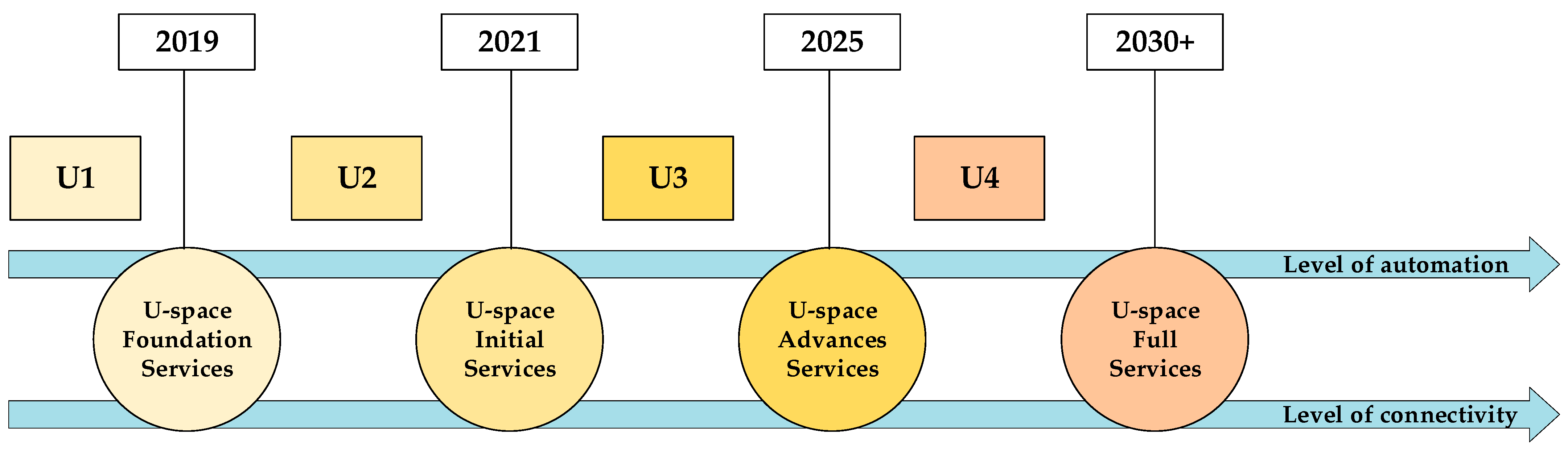
U-space is being progressively deployed in four development stages, each increasing in automation and connectivity levels, as shown in Table 4 and Figure 2.
Figure 2. The implementation roadmap for the U-space initiative [46].
Drones 10 00211 g002
These stages are aligned with European regulatory milestones, most notably European Union Regulation 2021/664 [25], which established the legal foundation for safely and uniformly deploying U-space services across member states. To support these services, U-space adopts a layered architecture where air navigation service providers and U-space service providers interact through standardized digital interfaces.
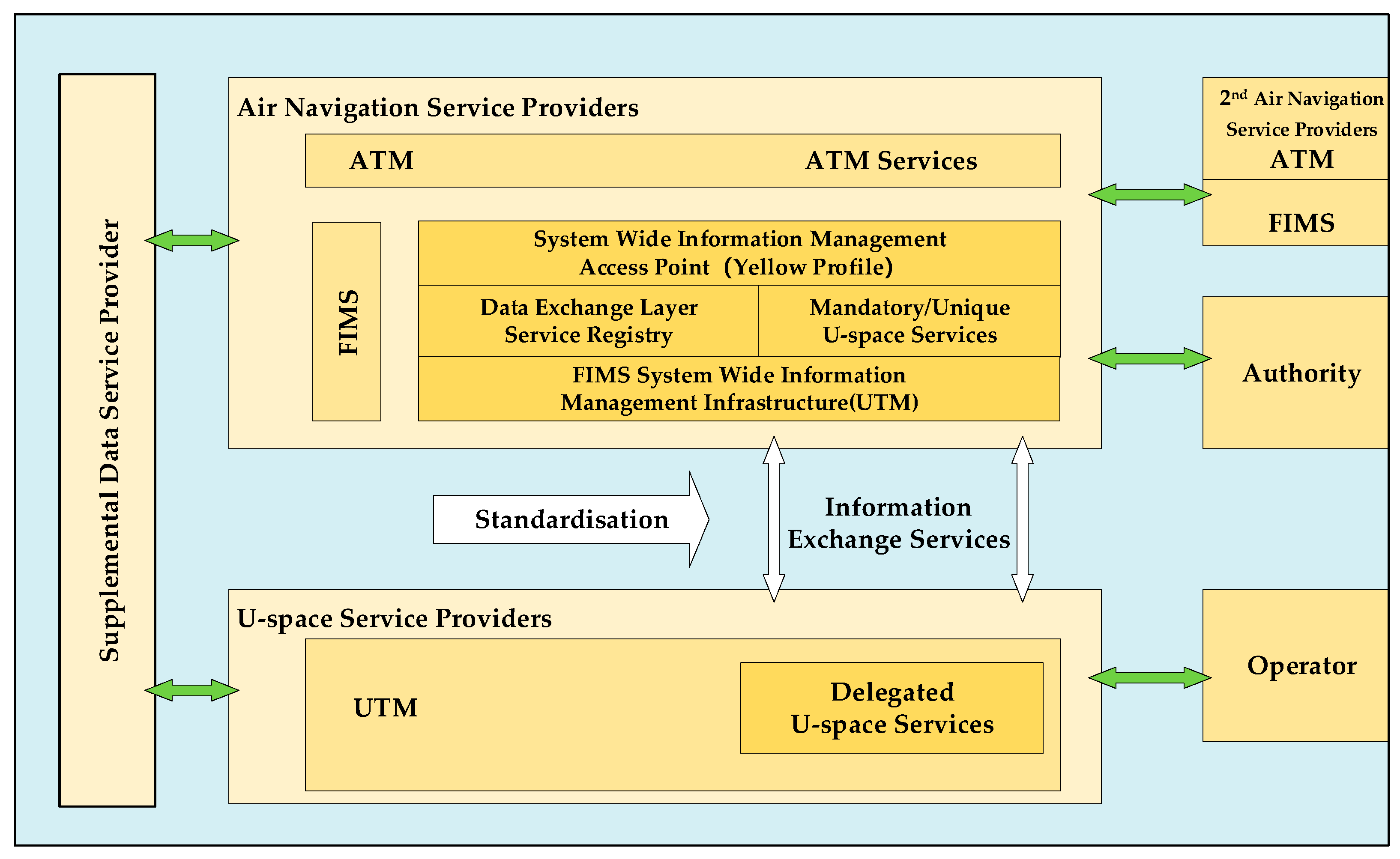
As shown in Figure 3, the Flight Information Management System (FIMS) serves as the central intermediary, enabling secure data exchanges, service standardization, and coordination across actors such as authorities, operators, and supplemental data providers. Although this architecture provides a technical path for information sharing, it also relies on high-quality, continuous data flow; once the data delay increases significantly or is interrupted, the risk model based on these services may need to revise its assumptions, otherwise it will underestimate the probability and consequences of conflicts.
In addition, U-space adopts risk-based safety logic to deal with hazards such as midair encounters with manned aviation systems, ground-impact risks, and threats to critical infrastructure. These elements are integrated into probabilistic-based separation management and AI-based safety validation mechanisms, which are particularly emphasized in high-density operations performed at the U3 and U4 levels [18,47].
Figure 3. High-level architecture of U-space services, illustrating the standardized interaction between air navigation service providers and U-space service providers via the FIMS [48].
Drones 10 00211 g003

2.4. The UAM Framework of China

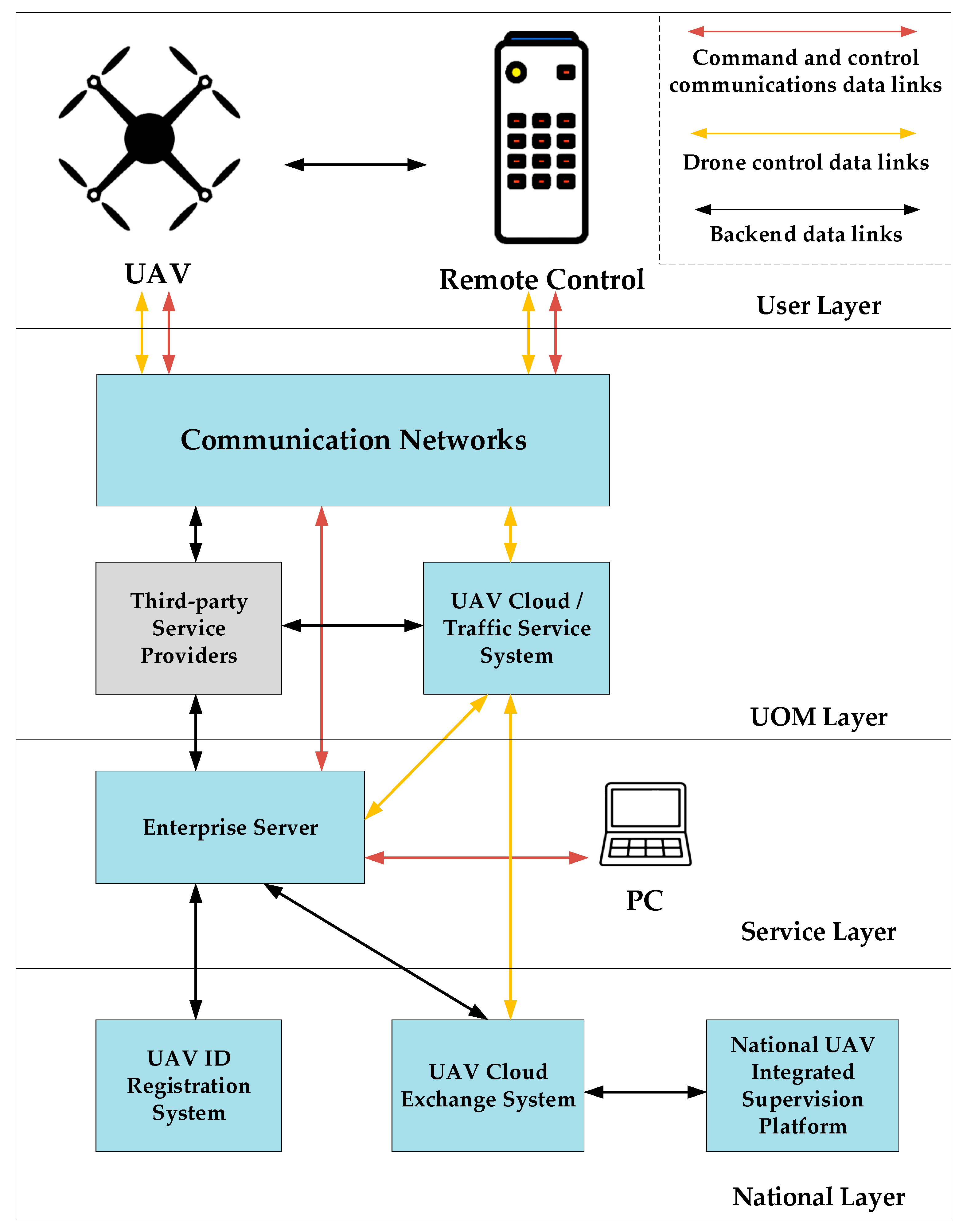
China introduced the Unmanned Operation Management System (UOM) in 2019 under the guidance of the “General Plan for the Construction of the Low-Altitude Flight Service and Support System” issued by CAAC [49]. Designed as the country’s first national-level UTM-equivalent platform, UOM is aimed at achieving centralized governance and information sharing for low-altitude operations.
The management framework of the UOM is structured into four functional layers: a national layer, a UOM layer, a service layer, and a user layer. The multilayered system architecture and the data flow relationships of the management framework are illustrated in Figure 4.
The UOM centralizes the real-name registration, flight plan submission, dynamic data reporting, and airspace access process within a single national platform. It follows the MH/T 4053-2022 protocol [50], promoting standardized integration across different UAV manufacturers and service providers. In addition, the security benefits of the platform design depend on whether the information service can maintain continuous availability, time-controllability, and data consistency at different levels in high-density operation, and whether the regulatory department has the ability to continuously supervise. For collision risk research, the above conditions directly determine whether the risk model can reasonably assume the availability, update frequency, and completeness of the intended information.

2.5. Comparative Analysis

Table 5 summarizes the key differences between the UAM governance frameworks in the United States, the European Union, and China. In the research of collision risks, the key difference between different regulatory architectures does not lie in whether management is centralized or distributed, but in how they define the information conditions upon which conflict management depends.
The UAM Concept of Operations v2.0 of the FAA adopts a federal model with operators and service providers as the core. Its advantages are flexible systems and strong regional adaptability, which are conducive to the rapid evolution of technology and business models. However, under high-density operating conditions, the model puts forward higher requirements for the consistency of service capabilities and the reliability of cross-subject data sharing. In contrast, the EU U-space ensures cross-regional interoperability through a graded service system and unified rules. Its main challenge is the cost of infrastructure and system construction, especially in ultra-high-density operation scenarios, which need to maintain end-to-end information in real-time between multiple member states. China’s UOM places more emphasis on the consistency of platform management and supervision at the national level. It has advantages in the unification of data interfaces and information standards. Centralized supervision also helps to improve implementation. However, in the context of the rapid development of the industry, it is necessary to continuously weigh the relationship between the cost and flexibility brought about by centralized management.
The differences in these governance models show that when carrying out collision risk modeling and method comparison, researchers should not regard information service conditions as a fixed premise that has nothing to do with the governance system. On the contrary, the actual capabilities of information services under different regulatory frameworks should be clarified, and the scope and limitations of relevant risk indicators and conclusions under different governance paths should be explained on the basis of considering data quality constraints.

3. Enabling Technologies and Operational Factors for UAM

3.1. Communication, Navigation, and Sensing Under GNSS Constraints

Compared with traditional transportation aviation, the CNS technologies and facilities for low-altitude urban air traffic are still in the research and development, validation, and application exploration stages, which makes the risks existing in urban air traffic operations more complex and difficult to model; therefore, these processes face numerous challenges [51]. Therefore, what collision risk modeling needs to face most is the instability of information conditions: GNSS degradation, link delay, packet loss, and intermittent surveillance coverage will jointly change the error structure of track prediction and conflict detection, and affect the alarm conclusion [52,53,54].
Unlike the continuous monitoring and strict performance standards of traditional ATM dependence, the occlusion, multipath, and high-density access of low-altitude urban environments make communication and navigation performance more prone to regional failure and time fluctuations, so the error and delay assumptions in ATM scenarios are directly migrated to UAM research. It will underestimate the risks.
To address the GNSS degradation encountered in dense urban areas, UAM adopts a multi-sensor, multi-source navigation strategy that tightly fuses satellite positioning with inertial and exteroceptive sensing. While RTK/PPP achieves centimeter-level accuracy in open environments, its performance decreases in urban canyons; the tightly coupled INS + vision/LiDAR method maintains continuity during short GNSS outages and has been validated with field experiments showing decimeter-level precision in dense urban settings [55]. Beyond camera/LiDAR aides, terrestrial opportunity signals integrated with INS provide an alternative PNT to bridge GNSS-denied segments over long trajectories [56]. Robust fusion depends on time synchronization and extrinsic calibration across different modalities, which recent calibration studies identified as prerequisites for achieving stable early-fusion performance [57]. Because navigation uncertainty propagates into tracking and alerting, these errors should be quantified and integrated into safety assessments, as the recently developed probabilistic frameworks explicitly link conflict-detection effectiveness to navigation and tracking performance [58].
Recent studies identified 5G and future 6G networks as key enablers of dense UAM operations, providing ultrareliable low-latency communication that supports real-time command, control, and cooperative functions in complex urban airspace. However, urban propagation, high mobility, and high traffic density still present major challenges for attaining link stability and certification [59]. To complement cellular coverage, drone-to-drone (D2D) ad hoc links such as the DroneCAST prototype offer a redundant and low-latency safety layer for time-critical collision-avoidance tasks within multilink architectures [60]. Mixed-reality swarm experiments conducted over 5G have further demonstrated that the coordination performance of this strategy is constrained primarily by computational resources rather than radio transmission, confirming the practical feasibility of 5G in combination with edge computing for addressing cooperative UAV behaviors [61]. Building on these advances, the 5G Integrated Communications, Navigation, and Surveillance framework envisions the provision of unified C, N, and S services through coordinated terrestrial and non-terrestrial networks, which will enhance spectrum efficiency and enable alternative positioning, navigation, and timing functions such as multilateration in GNSS-degraded environments [62]. He et al. proposed PP-RCR, a probability-aware cooperative routing algorithm for air-to-ground integrated mobile ad hoc networks that leverages position prediction to improve delivery ratio and reduce end-to-end delay in dynamic low-altitude scenarios [63].
At present, some urban UAM pilots already include vertiport operations as part of their demonstration envelope, and have integrated them with ground communication and operational management systems [64,65]. From a mechanistic perspective, a vertiport can also be viewed as a localized CNS enhancement node, providing link relay, assisted positioning, and supplementary surveillance in the terminal area. However, whether it can improve the risk level depends on the quantifiable improvements it provides in terms of latency, coverage probability, and positioning error.
From a risk-modeling perspective, the effects of link outages, packet errors, and latency on DAA can be summarized through an end-to-end timely delivery success probability, rather than being treated as separate communication impairments. In the URLLC literature, reliability is commonly interpreted as the probability that a data unit is successfully delivered within a prescribed time bound [66]. For UAV control links, short-packet studies further show that packet error behavior depends on channel quality, block length, and coding design [67]. For UAV network links, link availability can likewise be represented by an outage-based term derived from communication-link models under interference and mobility [68]. Building on these ingredients, a convenient abstraction is to use P t x ( τ ) to denote the probability that a time-critical DAA message, such as a cooperative state update or an alert, is received correctly before a deadline τ . One convenient decomposition can be written as follows:
P t x ( τ ) = A l i n k ( 1 P E R ) P r ( D τ )
where A l i n k represents outage-based link availability, P E R denotes the packet error rate under the adopted link design, and P r ( D τ ) is the probability that the end-to-end delay satisfies the deadline. This decomposition is introduced here as a compact modeling abstraction, rather than a universal communication-law identity. Reliability improvements from multi-connectivity and packet duplication can then be incorporated as mechanisms that increase P t x by reducing simultaneous loss and excessive delay across independent paths [69,70]. Under this abstraction, DAA effectiveness can be coupled to collision risk by conditioning the residual NMAC probability on whether alerting or coordination is achieved in time, which makes explicit how communication degradation propagates into safety outcomes in dense UAM operations.

3.2. Advances in Battery Technologies

Battery technology represents one of the core factors constraining the development and large-scale deployment of eVTOL aircraft. In the context of UAM, where intercity distances are relatively short, takeoffs and landings are frequent, and the passenger-carrying demand is high, eVTOLs are typically designed for point-to-point missions spanning 10–50 km. Considering round-trip routes and reserve energy redundancy, endurance requirements of 60–100 km are typically adopted in UAV system designs. Under these conditions, the specific energy, power density, cycle life, and gravimetric efficiency of the utilized battery system ultimately determine whether the aircraft can achieve operational practicality. A high battery-to-airframe mass ratio significantly reduces the payload capacity, whereas an insufficient energy capacity restricts range and limits the reliability of missions in urban shuttling scenarios.
Reported cell-level specific energy figures for candidate battery pathways are summarized in Table 6. As the energy density of batteries increases, thermal management and safety become more challenging to achieve. During eVTOL takeoff and high-speed cruising operations, large current discharge causes rapid heating inside the cells. Without proper temperature control, this can lead to thermal runaway or accelerated degradation. Previous studies have reviewed the mechanisms, initiation triggers, propagation schemes, and mitigation mechanisms for thermal runaway in lithium-ion systems [71,72]. However, most of these studies focused on ground vehicles and did not fully capture the high-power, fast-dynamic conditions of electric aviation.
Table 6. Indicative cell-level specific energy for candidate eVTOL battery pathways.
PathwayCell-Level EnergyEvidence LevelRefs.
Target level~500 Wh/kg Requirement estimate[45,73,74,75]
Lithium-ion (aviation-grade)~200–300 Wh/kgMature/deployed[76]
Solid-state lithium-metal>400 Wh/kg Laboratory prototype[77]
Lithium–sulfur~441 Wh/kgAdvanced demonstration[78]
Therefore, eVTOL battery systems require multilayer safety designs. A battery management system must monitor the voltage and temperature of each cell in real time and take derating or bypassing actions when abnormalities occur. The battery pack structure should include thermal barriers and venting channels to prevent the propagation of heat. Battery thermal management systems play a central role, and liquid cooling has been proposed as an effective solution to balance thermal efficiency and weight [79]. Notably, BTMS hardware adds extra mass and consumes more power. In the overall UAM safety framework, battery thermal failure should be considered a potential risk factor to ensure a more comprehensive assessment of operational safety.
Hybrid propulsion provides an effective approach for extending the endurance of eVTOL systems [80]. Saif et al. further provide a mission-driven hybrid power unit evaluation framework and report a quantitative power-to-weight threshold for achieving ≥1 h sustained endurance in a representative eVTOL sizing envelope [81]. However, hybrid systems bring a simultaneous increase in system complexity, hydrogen storage safety concerns, and thermal management burdens. Their risk-benefit tradeoffs need to be evaluated against mission and operational environment constraints.
From an operational and safety perspective, the dominant battery constraint for UAM is often not only the energy capacity but also the peak power capability required for vertical takeoff/landing and other high-demand transients [82], making discharge-rate limitations a first-order determinant of feasible flight envelopes. Experimental and electrochemical assessments further show that eVTOL-representative high-rate pulses can accelerate degradation and may not be sustainable over extended cycling, highlighting the relevance of power fade limitations for safety-critical transients [83]. Because emergency avoidance maneuvers can require thrust margins comparable to or exceeding nominal profiles, limited discharge capability at low state-of-charge (SoC) and degraded state-of-health (SoH) can directly reduce achievable acceleration and turning authority, thereby increasing the probability of avoidance failure.
To incorporate this mechanism into probabilistic risk modeling, battery state can be mapped to maneuver authority through measurable parameters. Let the available propulsion power be P m a x = P m a x S o C , S o H , T , where SoH-related resistance growth and aging-driven power fade reduce P m a x over the service life. Power-capability-oriented testing and modeling approaches can be used to identify the minimum SoC at which a required constant-power pulse (representative of landing or emergency transients) can be completed, providing an empirically anchored lower bound for safe operation and maneuver feasibility. Battery thermal conditions further constrain P m a x because high-power loads increase heat generation, and thermal protection strategies may be triggered to prevent thermal runaway under off-nominal conditions [84]. Under this mapping, avoidance success can be expressed as a probabilistic feasibility event, for example:
P s u c c = P r a r e q a m a x P m a x
where a req is induced by encounter geometry and chosen avoidance logic. Therefore, battery failure rates, derating-trigger rates, and SoC/SoH-dependent power margins can be incorporated as stochastic inputs to clarify how battery technology routes and operating strategies bound the applicability of collision-risk conclusions in UAM.
Existing risk assessment frameworks still have limited explicit modeling of battery-related failures. In the future, battery failure rates, derating trigger rates, and range margin distributions can be incorporated into probabilistic risk models to clarify the applicability boundaries of conclusions under different battery technology routes and operating strategies.

3.3. Human-in-the-Loop and Societal Acceptance

As UAM operations progress towards greater autonomy, their large-scale viability still hinges on people: how supervisors interact with automation in real time and how communities perceive safety, noise, privacy, and fairness. Recent evidence of human factors shows that operators remain decisive in supervision and off-nominal recovery tasks even when automation is mature. A decade-long analysis of UAV incidents attributes causal contributions not only to technology and the environment but also to operator actions, supervisory practices, and organizational factors, indicating that human performance is a major determinant of system safety rather than a residual effect [85]. Experimental studies have subsequently shown that the imposed workload, trust calibration, and self-confidence significantly influence the task allocation schemes and decision quality levels in human–UAS collaboration scenarios [86]. In parallel, an experimental framework integrating real-time physiological monitoring with analytic hierarchy methods demonstrates how adaptive assistance can be tailored to the cognitive state and mission context of the operator [87]. A comprehensive framework for measuring operator cognition and automation across varying task loads and autonomy levels was presented by Alharasees et al., who provided concrete metrics for calibrating supervision and supporting adaptive-autonomy decisions [88]. Evidence derived from flight operations research also highlights the fact that limited or degraded connectivity can amplify workloads and erode situational awareness, reinforcing the case for an adaptive autonomy strategy that reallocates authority as the uncertainty, link quality, and operator state evolve [89].
These human-in-the-loop mechanisms map directly to collision risks. Well-designed supervisory control schemes improve the degree of route adherence and reduce conflict exposures under traffic and weather variability; timely handovers shorten detection-to-action delays once well-clear is jeopardized; and poorly calibrated trust or task saturation increases blunder rates and weakens the separation assurance in dense urban corridors. To reflect this, probabilistic air-risk models should parameterize empirically grounded human-performance factors such as vigilance decay, takeover latency, and compliance behaviors, drawing on recent human-in-the-loop experiments and comprehensive analyses of autonomous UAV operations [90].
Human factors evidence supporting DAA standardization also indicates that remote-pilot performance limits and display/alerting design affect the effectiveness of conflict detection and resolution in operationally relevant encounter conditions [91]. To make this linkage explicit in risk assessment, remote pilot response behavior, including response delays and control actions, has been modeled as stochastic elements in simulation-based evaluations of DAA systems, demonstrating that the assumed response characteristics can materially alter safety outcomes [92]. In addition, mixed-initiative DAA studies that explicitly account for delayed remote control show that latency can increase collision risk when pilot commands arrive late, motivating the parameterization of supervisory response delays and authority allocation logic in probabilistic evaluations [93].
Accordingly, probabilistic air-risk models can introduce a small set of measurable human-performance parameters. Let T t o denote takeover latency and treat it as a random variable informed by remote-pilot modeling practice. Given an alert lead time T a l e r t and the minimum time required for maneuver execution T e x e c , the probability of late intervention can be expressed as follows:
P l a t e = Pr T t o > T a l e r t T e x e c
Furthermore, vigilance decrement during prolonged monitoring can be modeled as a time-on-task effect that reduces monitoring effectiveness. Within a signal-detection framework, this degradation may appear as both reduced sensitivity and a shift in response criterion [94]. In addition, trust miscalibration and workload-related blunders may be represented by a conditional non-compliance probability given an alert. This term captures the likelihood that an operator responds too late, misses the alert, or intervenes incorrectly, thereby increasing residual collision risk.
Public acceptance evolves with the same aspects of transparency, accountability, and perceived benefit. Recent European survey research conducted across six countries has shown that attitudes towards drones and UAM hinge on their perceived safety, acceptable flight areas and altitudes, and use-case framing, with demographics and prior exposure also shaping acceptance levels [95]. These results support community engagement and clear governance as early stabilizers of acceptance baselines. Complementary evidence acquired from the United States indicates that willingness to fly on eVTOL services increases when respondents perceive individual and societal value, reinforcing the role of credible operation and impact information [96]. In China, a 2025 study conducted in the Greater Bay Area reported that behavioral intentions towards AAM are strongly mediated by perceived usefulness and trust constructs, suggesting that local benefit narratives and transparent oversight can materially shift the propensity for adoption [97]. Emerging acoustics-related work has linked acceptance not only to noise magnitude but also to noise characteristics: attitudinal factors and sound quality influence annoyance responses to eVTOL and drone operations, implying that vehicle configuration, procedures, and corridor placement schemes should be codesigned with community constraints [98]. These social–behavioral insights should therefore inform separation policies and traffic-flow design, since corridor siting, vertiport scheduling, and quiet hours feed back into density, encounter geometry, and the tails of conflict probabilities.
Three design implications follow for near-term UAM deployments. First, the design process should aim for graceful degradation by assuming partial automation and intermittent connectivity, with a bounded workload and clear alerting so that supervisors can rapidly reorient under time pressure. Second, adaptive autonomy and operator state-aware interfaces, supported by physiological sensing and structured decision aids, should be implemented to keep trust calibrated and handovers timely. Third, behavioral evidence should be coupled with traffic-safety modeling so that separation standards and conflict resolution logic reflect measured human performance envelopes rather than idealized automation alone.
Two gaps remain regarding research that links acceptance, human-in-the-loop techniques, and collision risks. Quantitatively, many air-risk frameworks still omit validated human-performance distributions under realistic workload and link constraints, despite the availability of methods and datasets. Institutionally, acceptance-to-operations feedback is under-modeled: community constraints imposed on noise windows and corridor placement reshape traffic densities and conflict geometries, but are rarely endogenized in safety assessments. Addressing these gaps would align collision-avoidance strategies with realistic human performance and strengthen the social license that is required for scalable, low-altitude UAM operations.

4. Flight Risks for UAM: Categories and an Evaluation Framework

As UAM operations expand into increasingly complex low-altitude environments, ensuring flight safety becomes a critical challenge. Unlike traditional aviation, UAM must navigate densely populated areas filled with physical obstacles and sensor-degraded conditions. These operational constraints amplify the inherent risks and call for the development of a comprehensive, adaptive risk assessment framework.
UAM-related risks can be broadly categorized into four key domains, as shown in Table 7. These risks not only challenge the current management paradigms but also show the urgent need for formalized assessment frameworks. Strategies such as runtime assurance architectures, AI-driven dynamic risk-mapping schemes, and digitalized airspace optimization methods are emerging to support risk-informed operations.

4.1. UAM Flight Risk Categories

UAM introduces a multifaceted risk landscape that demands comprehensive safety frameworks. These risks fall into four broad categories: technical, operational, regulatory, and systemic risks.
Technical risks arise from navigation, command-and-control data links, situational awareness and decision-making algorithms, and energy-storage or propulsion systems. Externally, UAVs are exposed to collision hazards with other aircraft, urban infrastructure, and surface traffic participants. Their operational uncertainty is higher than that observed in conventional aviation; as the traffic density and airspace complexity level increase, modeling and assessing UAV flight risks become markedly more challenging [99,100]. Recent studies have described the specific risk factors faced by small UAVs in urban airspace, such as loss of control, fly-away events, communication outages, and navigation malfunctions, among others [101,102]. Table 8 summarizes the principal hazards identified for UAM scenarios, including loss of control, command-and-control link failures, navigation degradations, insufficient take-off or landing incapacities, aborted missions, midair and ground collisions, malicious interference, cascading faults, and swarm-induced conflicts [101].
To characterize the interdependence among potential hazards, a Bayesian belief network has been introduced to map the correlation topology of UAM risk factors and to simulate complex scenarios [102,103]. Within this framework, UAV flight risks arise from internal system failures such as airframe configuration issues, powertrain integrity problems, and weaknesses in command-and-control robustness, as well as from external influences, including the reliance on ground-based infrastructure and the presence of dense obstacle environments. Ground-collision risk has likewise been modeled in depth, with probabilistic impact energy and trajectory dispersion analyses [104]. Researchers have also proposed casualty-estimation models for densely populated urban settings, quantifying the potential fatalities and injuries resulting from abnormal UAV operations [105].
UAM ConOps v1.0 emphasizes the fact that drones must be seamlessly integrated with terrestrial traffic networks and conventional airspace users, reinforcing the need for holistic risk-mitigation strategies [106]. Central to these strategies is a flight-health assessment system that is capable of providing real-time diagnostics and prognostics. To enable quantitative UAV reliability analyses under fault conditions, simulation platforms and fault datasets have become essential components in UAM risk assessment research. Several widely used platforms support closed-loop UAV simulations and can be extended to inject actuator, sensor, or communication faults for quantitative reliability analysis, fault detection, and isolation algorithm evaluation purposes. On the basis of AirSim [107], UUFOSim [108] enables the in-flight injection of actuator faults and the synchronized collection of multimodal data, facilitating the development of visual-based fault detection and isolation frameworks. In Gazebo or RotorS, fault scenarios can be simulated by injecting abnormal sensor data or communication disturbances via Robot Operating System topics, with PX4 providing a built-in failure injection interface for conducting system-level testing. Among them, RflySim offers a rapid development environment for multirotor UAVs with software support and hardware-in-the-loop simulations, facilitating testing under various failure scenarios within realistic control loops [109]. Complementing this, the RflyMAD dataset provides more than 5600 labeled flight cases across 11 fault types, including actuator degradation, sensor anomalies, and signal losses, captured from both real-world experiments and simulations [110]. These resources have been widely adopted to support the development of data-driven fault detection algorithms, reliability modeling schemes, and runtime health monitoring frameworks in complex UAM scenarios.

4.2. UAM Flight Risk Evaluation Framework

The Joint Authorities for Rulemaking on Unmanned Systems has proposed the Specific Operations Risk Assessment (SORA) framework for managing the risks of urban air traffic over the horizon flight operations [111]. SORA evaluates operational risks by separately analyzing air and ground risks. Only when both risk types fall within acceptable limits is flight authorization granted; otherwise, the flight trajectories must be replanned to comply with the imposed safety requirements.
A recent study analyzed UAV air collision risk using probabilistic encounter models, estimated the likelihood of loss of separation, and quantified midair collision rates as key safety indicators [112]. Zhong et al. also considered the coupling with ground risk, where in-air incidents may lead to secondary damage on the ground [113].
To manage air risks in real time, UAVs must rely on DAA capabilities for detecting and resolving conflicts in a timely manner. This process is typically handled by CNS and traffic collision-avoidance system (TCAS) technologies in manned aviation scenarios. However, UAVs operating in low-altitude airspace generally lack access to such a mature infrastructure. Table 9 compares the key characteristics of various detection systems, including their detection ranges, the types of information that they provide, and their typical operational constraints. This comparison highlights the challenges inherent in achieving reliable DAA functionality for small UAVs operating under visual line of sight conditions and beyond visual line of sight conditions.
Beyond nominal detection range and the availability of target-state information, the operational effectiveness of DAA in dense urban environments depends critically on three additional dimensions: detection probability, false-alarm burden, and the ability to maintain stable tracks for multiple concurrent targets. Because published results across sensing modalities are obtained under different target classes, encounter geometries, clutter conditions, urban layouts, and sensor configurations, these metrics are not directly normalized in Table 9 and are instead summarized here as representative evidence. For cooperative DAA, representative performance guidance emphasizes the ability to maintain concurrent tracks, establish unique tracks reliably, and limit false-track and false-alarm burden. In particular, representative early performance guidance for collision avoidance requires the system to maintain tracks on at least 35 cooperative aircraft within the surveillance volume, to establish unique tracks on at least 95% of cooperative traffic, to limit the false-track ratio to no more than 1.2% of established tracks, and to keep the overall false-alarm rate below 2% [114].
For non-cooperative sensing, recent studies report representative yet modality-specific performance. Electro-optical and infrared fusion-based sense-and-avoid has achieved 94.6% detection accuracy with a 2.1% false alarm rate [115]; LiDAR-based DAA in UAM corridors reports nominal ranges of 190–320 m depending on target reflectivity, with execution times on the order of 50 ms [116]. Dense urban operations further amplify the effects of multipath, signal blockage, occlusion, and clutter on both surveillance and tracking. These factors increase false-track burden and complicate reliable multi-target identification and tracking in obstacle-rich environments. Accordingly, the values summarized here should be interpreted as representative, scenario-dependent evidence rather than as directly comparable universal baselines.

4.3. Mid-Air Collision Models

Mid-air collision modeling constitutes a critical foundation for assessing operational safety and enabling scalable low-altitude airspace integration. As UAV density increases in urban environments, encounter frequency rises sharply. This trend necessitates quantitative models that link the encounter frequency, conditional collision probability, and expected severity of consequences. Earlier work on risk-based UAS self-separation had already linked separation-threshold design to acceptable collision-risk targets and event-based safety reasoning [117]. A probabilistic framework was proposed in [118] to evaluate the likelihood of midair collisions between general aviation and unmanned aircraft by decomposing the overall collision risk into flight encounter rates and conditional collision probabilities. Milano et al. [119] extended the methodology to generate air risk maps for urban settings, integrating the air-traffic density, encounter geometry, and expected severity of outcomes.
Building upon these foundations, the logic of mid-air collision risk modeling can be summarized in a compact probabilistic form that distinguishes encounter frequency, conditional collision probability, and consequence severity. A generic expression for collision frequency is as follows:
λ c o l l = λ e n c P c o l l i s i o n e n c o u n t e r
where λ e n c denotes the encounter frequency (encounters per flight hour), P c o l l i s i o n e n c o u n t e r is the conditional probability that an encounter escalates into a collision, and λ c o l l is the resulting collision frequency (collisions per flight hour). Therefore, Equation (4) links how often potentially hazardous encounters occur with how likely they are to develop into actual collisions.
To account for consequence severity, the collision-frequency term can be combined with the expected harm per collision. A generic fatality-risk expression is:
R f a t a l = λ c o l l E [ F c o l l i s i o n ]
where F is the random variable representing the number of fatalities caused by a collision, and E [ F c o l l i s i o n ] denotes the expected number of fatalities conditional on a collision event. Equation (5) extends the collision-frequency formulation from occurrence alone to safety-consequence assessment.
For UAM operations, this decomposition is applicable to both manned–unmanned and UAV–UAV encounters. In mixed airspace, the encounter frequency λ e n c is shaped mainly by traffic density, route overlap, airspace structure, and the spatial distribution of operations, whereas the conditional collision probability P c o l l i s i o n e n c o u n t e r depends more directly on surveillance quality, communication performance, detect-and-avoid capability, alerting timeliness, and maneuver feasibility. The same logic can be applied separately to different encounter classes and then aggregated across route segments, corridors, or airspace cells to construct air-risk maps and network-level safety indicators.
The detailed stochastic assumptions used for encounter occurrence, collision escalation, and consequence severity are study-dependent and vary with the operational scenario, traffic mix, and modeling resolution. From a mitigation perspective, Equation (4) suggests that collision risk can be reduced either by lowering encounter frequency through airspace structuring, flow control, and route planning, or by lowering the conditional collision probability through more reliable sensing, communication, and avoidance performance. Equation (5) further shows that safety assessment should also consider consequence severity, especially in mixed operations involving manned aircraft, where the same collision frequency may correspond to very different expected outcomes.

5. Collision-Avoidance Modeling Frameworks for UAM

5.1. Deterministic and Probabilistic Separation Models

5.1.1. Separation Threshold

For UAM, the randomness and intensity of UAV services pose challenges for the topology of limited and complex low-altitude airspace. A separation standard is not only a geometric buffer; it is a design choice that couples the information regime, the uncertainty model, and the acceptable risk target. Separation modeling can be seen as a threshold-design problem: given an information regime, design a boundary whose violation triggers tactical deconfliction while keeping residual collision risk within an agreed budget.
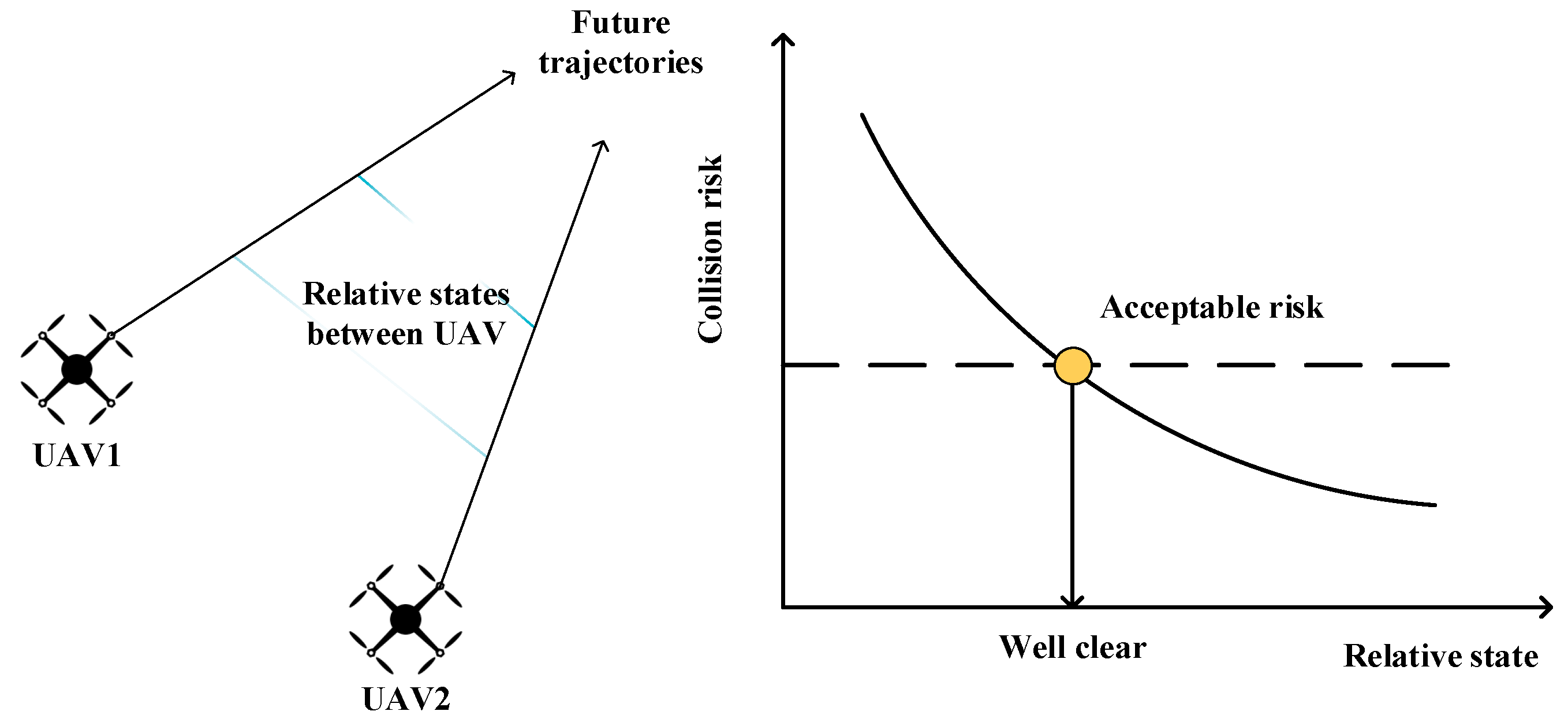
On the basis of how uncertainty and operational variability are addressed, flight safety separation of UAM is defined using two primary mathematical approaches: the deterministic models and the probabilistic models. Deterministic models are usually used in nonsegregated airspace, where the concept of “well clear”, as defined by ICAO and shown in Figure 5, serves as the minimum required displacement between an aircraft and a hazardous object to maintain an acceptable level of collision risk.
Existing separation standards are commonly established through two calibration routes. The first approach establishes separation standards by comparing the proposed system with a reference system that represents the performance of existing, operationally accepted systems [117]. The second approach evaluates estimated collision risk against a predefined Target Level of Safety (TLS) by quantifying the individual contributions of navigation and system errors to the overall risk budget [120]. These two routes imply different transferability: equivalence-based thresholds inherit the baseline’s operating assumptions, while TLS-based thresholds inherit the risk model’s encounter and uncertainty assumptions.

5.1.2. Deterministic Separation

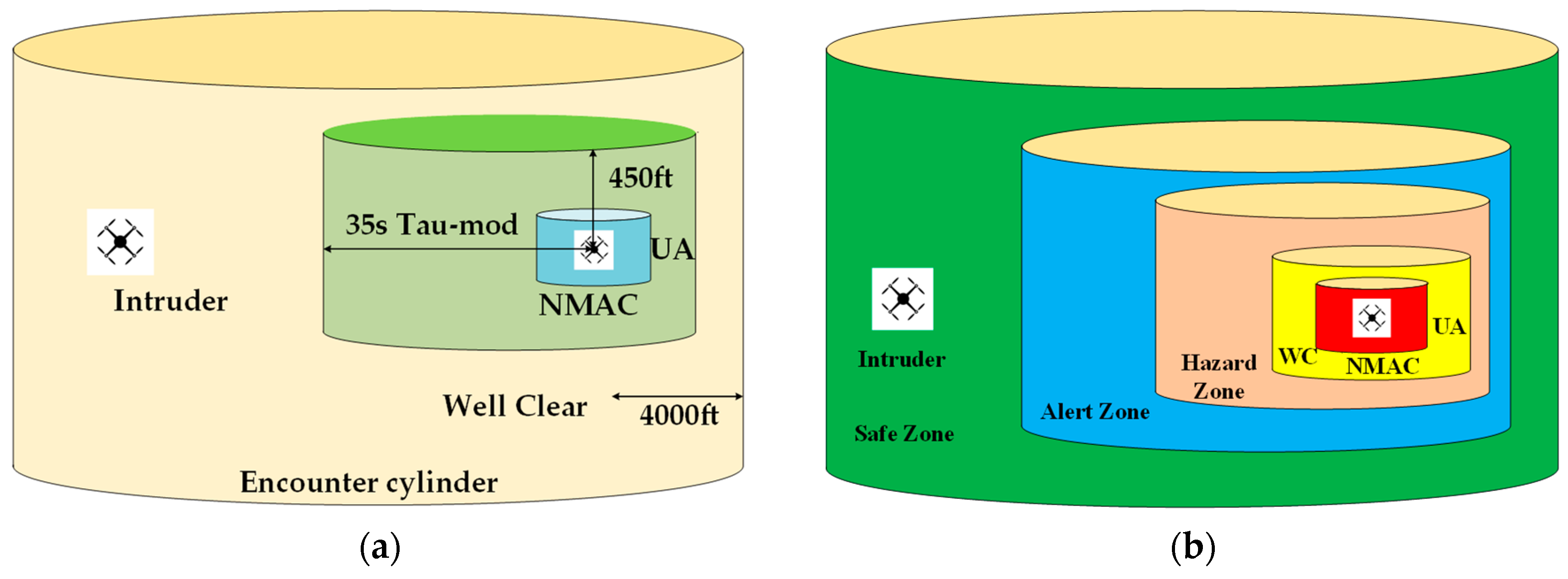
Deterministic separation in non-segregated operations is commonly implemented via a well-defined boundary that triggers alerts and tactical maneuvers. The DAA well clear (DWC) depends on the relative positions and speeds of the two aircraft, rather than being a single fixed distance. The DWC area is determined by three parameters: a horizontal distance threshold, a   v e r t i c a l   s e p a r a t i o n   t h r e s h o l d , and the time difference τ represents the time required for the two aircraft to approach each other. A widely used baseline configuration for these three parameters is 4000   ft ,   450   ft ,   and   35   s , respectively [121].
These parameter thresholds are embedded into a spatial definition of well-clear, as illustrated in Figure 6a. The cylinder geometry of the encounter, originally introduced in [122], shows the concentric layering of the near midair collision (NMAC) region and the well-clear boundary. To further support risk-informed maneuvering logic, these geometrical boundaries are mapped to the DAA alert zones in Figure 6b, where the safe, alert, hazard, and NMAC zones are progressively nested around the unmanned aircraft.
Deterministic well-clear thresholds are attractive because they can be monitored in real time from relative state estimates. But this practical benefit rests on some stringent operational assumptions: surveillance is sufficiently continuous; system latency and sensor update rates are negligible relative to the critical alert timeline; state estimation errors remain bounded and exhibit approximate statistical stationarity over the decision horizon; and the vehicle possesses both sufficient maneuver authority and unobstructed spatial margin to reliably execute the prescribed avoidance maneuver. UAM scenarios push these assumptions to their breaking point. The combined weight of signal dropouts, GNSS multipath, and non-trivial latency is playing out within the rigid confines of urban canyons, which makes traditional deterministic logic hard to justify.

5.1.3. Probabilistic Separation

Within the framework, the loss of the “well-clear” condition can be quantitatively linked to the likelihood of an unavoidable collision event, which is expressed as a conditional probability. The probability of an unavoidable mid-air collision, denoted as P , is defined as the conditional probability of an NMAC occurring given a loss of DAA well clear (LoDWC):
P = P N M A C | L o D W C
Equation (6) clarifies that probabilistic separation is a risk-calibrated rule that maps uncertain relative motion and information quality into a safety target that can be compared against a threshold.
Probabilistic separation should be compared by two questions: What separation artifact is produced, and what risk constraint family is enforced? Table 10 summarizes the dominant paradigms, their minimum information regime, and typical urban VLL failure modes.
In urban VLL, a probabilistic separation output is defensible only when its risk constraint remains robust under the realized information regime and operational structure. The dominant failure mode is not a lack of mathematical machinery, but a mismatch between modeling assumptions and operating conditions that distorts the mapping from separation output to residual risk.
The method of trigger calibration is audit-friendly but fragile to corridor-correlated encounters and non-stationary tracking errors, which can bias alert timing and reduce maneuver feasibility. Risk-based minima assessment supports planning-level trade studies, yet global aggregation can mask local hotspots, and merging bottlenecks can induce density-driven phase transitions where local risk dominates system safety. Performance conditioned minima directly target the urban mismatch by making information quality explicit, but it shifts the critical dependency to trusted monitoring and stable service governance, requiring verifiable performance metrics, integrity monitoring, and enforceable service rules. This motivates a shift from proposing new risk indices to building auditable datasets, aligned risk constraint definitions, and dynamic minima consistent with surveillance performance and corridor topology.

5.2. Tactical Collision-Avoidance Methods

Tactical mid-air deconfliction addresses the short-horizon decision problem that follows conflict detection: given an emerging loss of well clear, the system must generate a maneuver that restores separation while respecting vehicle dynamics and operational constraints. Existing approaches can be grouped into a small number of method families with distinct information requirements, time scales, and failure modes in dense urban VLL settings. Table 11 summarizes these families using a consistent set of evaluation axes, which we then use to discuss when each family is appropriate and where its assumptions break down.

5.2.1. Reactive Geometry Methods

Geometric reactive methods constitute widely used baselines for decentralized deconfliction under short-horizon kinematic assumptions. VO-type formalisms characterize collision-inducing relative velocities under constant-velocity extrapolation, while reciprocal variants (RVO/ORCA) distribute avoidance responsibility across agents to reduce reciprocal oscillations in interactive settings. ORCA further introduces a bounded look-ahead horizon and solves a small linear program by approximating each intruder constraint as a half-plane, enabling real-time execution. These formulations offer efficient, millisecond-scale reactivity and serve as widely used reference points in simulation studies [141]. Rule-based decentralized deconfliction inspired by conventional aviation encounter logic may be regarded as a practical case of short-horizon reactive or structured tactical conflict resolution under sufficient state-sharing conditions.
The efficacy of these methods is predicated on stringent assumptions regarding encounter classes, look-ahead horizons, and implicit reciprocity. These prerequisites are often compromised in congested urban airspace; consequently, they may manifest as oscillatory maneuvers or system deadlocks. Furthermore, such geometric frameworks lack an inherent mechanism to encode exogenous constraints such as geofences and operational rules.

5.2.2. Optimization-Based Deconfliction

To incorporate hard constraints such as geofences, structured corridors, and mission objectives, VO-derived separation conditions are often lifted into mixed-integer optimization as disjunctive constraints, enabling joint reasoning over safety, dynamics proxies, and operational rules. This family provides a systematic way to encode rules in urban requirements and can directly optimize multi-objective trade-offs. Its practical bottleneck is not expressiveness but scalability: solution latency grows rapidly with traffic density, and rolling re-optimization can produce unstable command sequences when predictions shift. Consequently, optimization-based deconfliction is most effective when paired with hierarchical designs rather than as a standalone reactive controller.

5.2.3. Receding-Horizon Control

Receding-horizon controllers represent a middle ground between geometric reactivity and combinatorial optimization. By embedding vehicle dynamics and actuator limits directly in the prediction model, MPC-style methods can generate smoother, dynamically feasible maneuvers under constraints. Their main failure mode in urban VLL is feasibility under uncertainty: communication delay, state-estimation errors, or model mismatch can collapse the feasible set and trigger abrupt behavior unless robustification or fallback logic is provided.

5.2.4. Safety Filters

Safety-filtering methods enforce safety constraints by minimally modifying a nominal command, making them well-suited as onboard safeguards that wrap around planners or learned policies. In dense urban operations, their limitation is feasibility: conflicting constraints like multiple intruders or geofence boundaries can yield empty feasible sets, and sensing noise can degrade constraint reliability. Therefore, practical designs require prioritization, relaxation, or backup behaviors.

5.2.5. Learning-Based Methods

Learning-augmented safety methods aim to retain safety-constraint structure while improving scalability and perception integration, often through local observations and distributed execution. Their primary open issue is assurance: out-of-distribution generalization and congestion handling remain difficult to certify at the system level.
Deep reinforcement end-to-end learning can produce context-adaptive behaviors and exploit high-dimensional observations, but their failure modes are harder to interpret and bound. In safety-critical urban VLL, their deployment typically requires additional safeguards and careful sim-to-real validation.

5.3. Collision Avoidance for Specific Structured Airspace

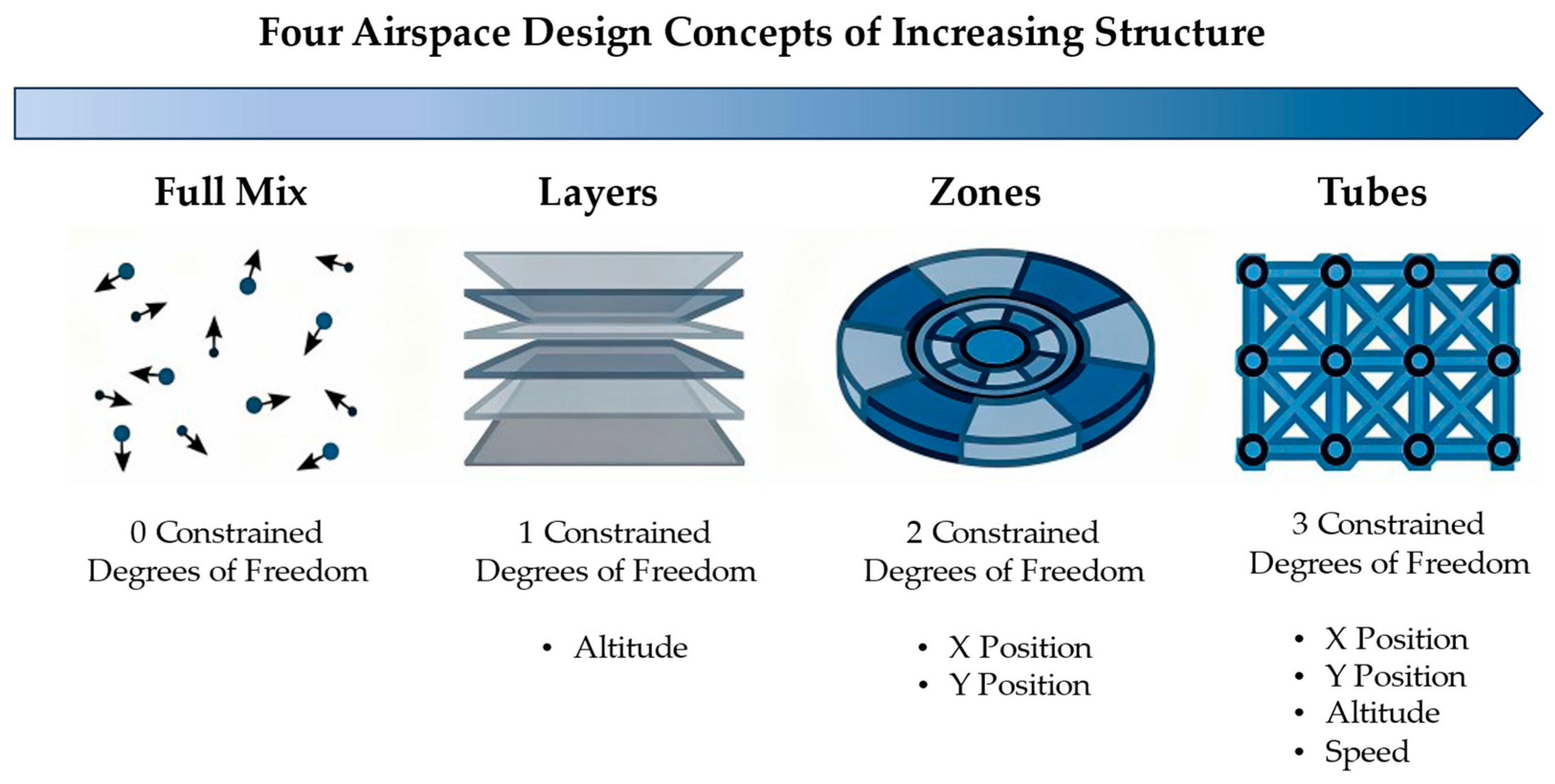
Urban low-altitude collision risks are closely linked to how airspace is structured. A widely adopted framework proposed by TU Delft categorizes airspace into four types: free (full mix), layered, zoned (area), and tubular (pipeline) structures, each with different implications for traffic predictability and separation assurances [142]. As shown in Figure 7, these structures represent a continuum of increasing organization, from decentralized free-flight operations to fully constrained tube-based management schemes. Since different airspace types involve distinct flight rules and traffic management requirements, a uniform collision-avoidance approach would be neither practical nor adequate. A more effective solution is to tailor avoidance strategies to the specific operational characteristics of each structure.
In free-structure airspace, autonomy is high, but predictability is lowest; risk is driven primarily by onboard DAA coverage and by whether state information can be made reliably available through UTM or U-space services [17,143,144]. Layered structures reduce the relative speed and conflict probability of the same layer through vertical domain segmentation and direction organization, but the security benefits often depend on whether the rule constraints of cross-layer switching and abnormal mobility can be stably implemented. Zoned airspace enables tailored rules within designated regions, and the key to controlling risks lies in the consistent coordination of boundary management and cross-district tasks. Tubular (pipeline) structures enforce strong within-corridor consistency in speed and spacing, improving predictability and capacity potential, but conflicts tend to concentrate at entries, merges, and junctions, where scheduling and coordination become more decisive than purely local geometric resolution.
As summarized in Table 12, the four airspace configurations demonstrate a gradual transition from flexibility-oriented to safety-oriented traffic organization. But, if monitoring coverage and link timeliness capabilities are insufficient, structured airspace rules may not translate into stable, predictable encounter processes, leading to discrepancies in risk model and method assessments. The choice of collision-avoidance methods should be consistent with the temporal and constraint characteristics of the airspace structure: free airspace relies more on short-term mitigation capabilities under uncertainty, while pipeline and partitioned scenarios require scheduling, capacity, and boundary conflicts to be the primary control objects.
In dense urban environments, different levels of airspace structuring can be vertically assigned according to their altitudes. The lower layers, which are situated closer to ground obstacles and urban infrastructure, may adopt tube-based management schemes to support safe and high-density logistics or emergency operations. The middle layers can employ zoned or layered configurations to accommodate mixed-mission routing and tactical coordination. The upper layers, where airspace density is lower and the separation margins are greater, can support free or full-mix operations for inspection, mapping, or exploratory tasks. Such an altitude-dependent structuring provides a hierarchical framework for balancing safety and flexibility across operational domains, offering a natural conceptual transition to the virtual tube method discussed in Section 5.4.

5.4. Virtual Tube Path Planning for UAV Swarms in Structured Airspace

Within structured UAM concepts such as tubular or pipeline airspace, ensuring predictable and safe navigation in dense urban environments is critical. However, pipeline corridors, while offering a static form of structuring, suffer from limited flexibility, low scalability under high-density demand, and poor adaptability to heterogeneous vehicle types. These constraints make them insufficient for the dynamic and diverse nature of urban air traffic. At a more conceptual level, the sky highway [145] has been proposed as a systematic framework for structuring dense low-altitude traffic.
Virtual tube planning can be regarded as a tool for realizing sky highways, and its role runs through the two levels of trajectory generation and control execution. This method uses curves to form the range of motion of the aircraft and maintains safe separation and formation order through horizontal constraints and interval constraints along the trajectory direction. Therefore, it is especially suitable for high-density UAM operation scenarios with consistency and throughput capacity as the main goals. In recent years, the virtual tube paradigm has witnessed systematic progress in terms of its theoretical modeling process, control strategies, and practical implementation [146,147,148,149,150,151,152,153,154,155,156,157,158].
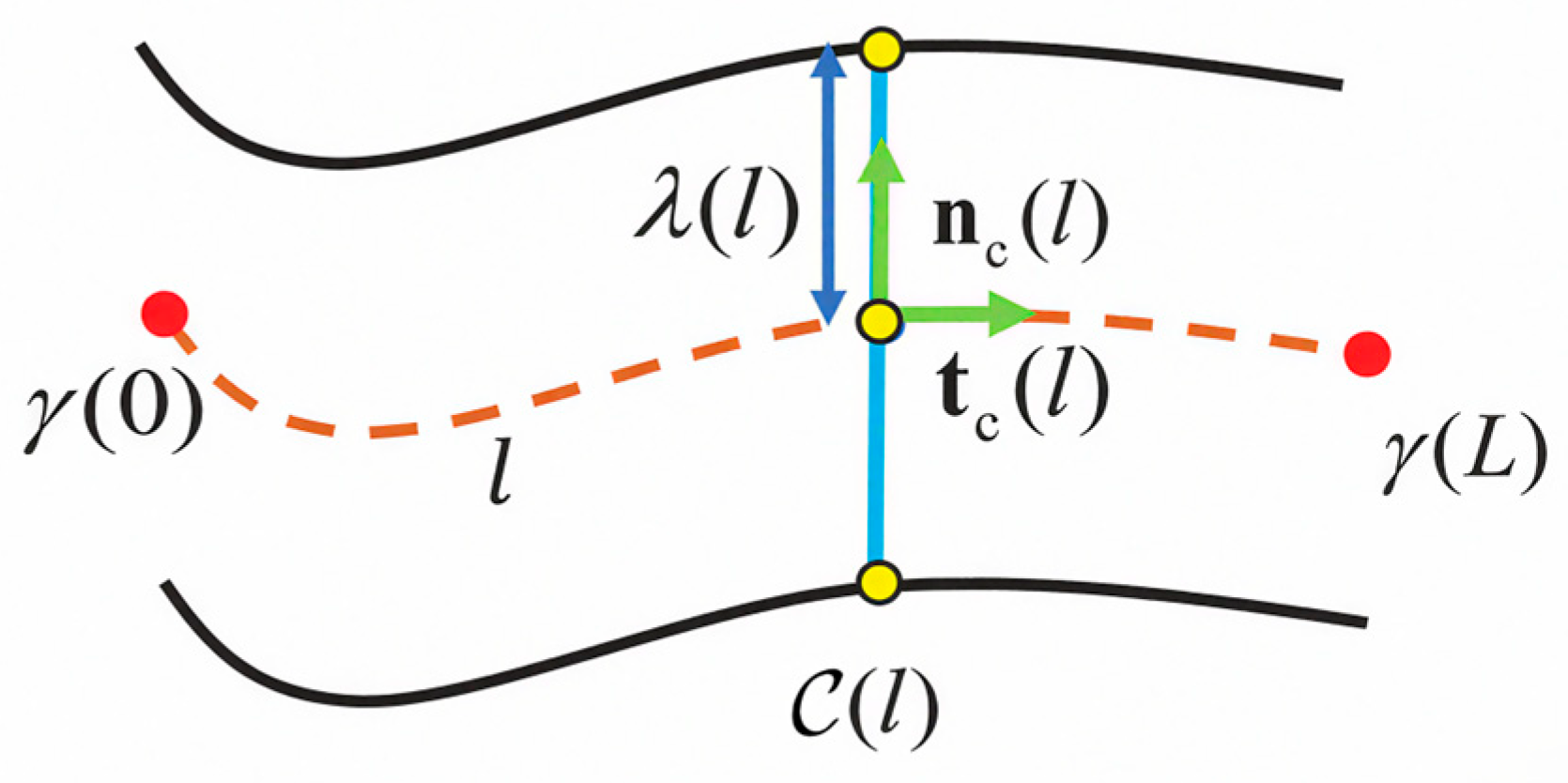
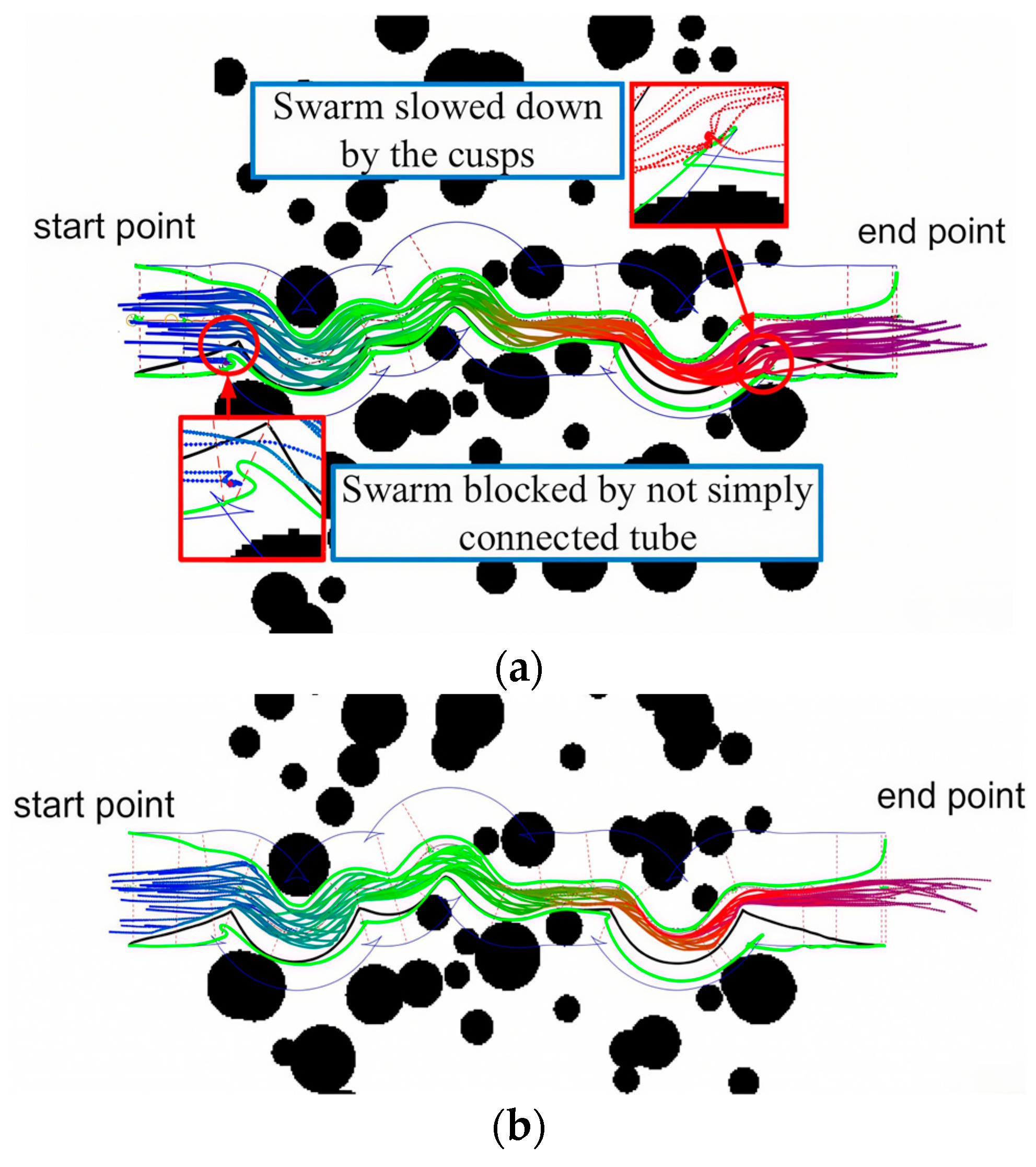
As illustrated in Figure 8, a virtual tube is a geometrically defined curved corridor constructed within a two-dimensional horizontal plane. Although this two-dimensional formulation does not account for vertical maneuvers or altitude variations, it provides a useful abstraction for structuring and managing low-altitude UAV operations in constrained urban environments. It can be mathematically formulated as follows [146]:
T l , θ , μ = γ l + μ λ l n c ( l ) c o s θ
Here, γ l denotes the generating curve parameterized by an arc length l 0 , L , which traces the path from the starting point γ 0 to the endpoint γ L . The unit tangent vector t c l and unit normal vector n c l   define the local orientation and lateral direction of the curve, respectively. The continuous function λ ( l ) specifies the tube’s radius at each location, thus controlling the cross-sectional width along the path. The parameter θ { 0 , π }   indicates whether a point lies to the left or right side of the generating curve, whereas μ [ 0,1 ] represents a normalized radial factor indicating the relative distance from the curve to a point inside the tube. The total length of the generating curve is denoted by L > 0 . The outer boundary of the tube is given by T = T ( l , θ , 1 ) .
At each arc length l , a cross-section C ( l ) is constructed perpendicular to the tangent direction, with the tube formed by stacking such sections continuously:
T = l 0 , L C ( l )
The concept of a virtual tube has also been demonstrated in simulation studies, where swarm trajectories are constrained within a geometrically defined corridor to maintain smooth and collision-free motion. Representative examples of drone-swarm trajectories guided by different virtual-tube configurations are shown in Figure 9, whereas typical quantitative metrics such as the run time, minimum inter-drone distance, and arrival rate are summarized in Table 13 [146]. These examples visually convey how the virtual-tube framework can be applied to structure swarm motion and evaluate its collective performance under obstacle-dense conditions.
This modeling framework provides a structured and obstacle-free corridor for UAM operations, enabling the design of collision-aware and separation-compliant traffic management strategies in high-density, constrained airspace. Through a predictable and regulated “sky highway”, the virtual tube directly enables collision-aware and separation-compliant traffic management, ensuring safe, efficient, and scalable multi-UAV operations in dense urban airspace. Beyond providing a structured foundation for traffic management, virtual tubes also serve as computationally tractable abstractions for achieving trajectory planning in large-scale UAV swarms, where real-time feasibility is a critical requirement.
In structured UAM environments, trajectory planning for large-scale UAV swarms must simultaneously satisfy multiple constraints such as energy efficiency, obstacle avoidance, and formation maintenance, while ensuring real-time feasibility to sustain dense traffic flow without gridlock. Directly optimizing the trajectory of each individual UAV leads to a computational complexity level that increases exponentially with the system scale. To address this issue, Quan et al. proposed the concept of an optimal virtual tube [147], which represents each UAV’s trajectory as a convex combination of a finite set of basis trajectories under constraints. This significantly reduces the complexity of planning from O k n t 2 to O n t , enabling real-time applicability in dense urban traffic scenarios.
A fundamental challenge in UAM is achieving safe coordination among dense UAV swarms, especially in environments where centralized control is limited, and the local airspace boundaries are dynamic or difficult to enforce. Virtual tubes provide structured sky highways, but their effectiveness depends on scalable and robust control schemes, especially at intersections and transitions, or under sensing and communication uncertainty. To support such operations, a variety of distributed control strategies have been proposed for dense air traffic scenarios, many of which can be naturally extended to virtual tube environments. These include decentralized controllers for achieving position convergence and cooperative collision avoidance in structured free-flight scenarios, which were designed to enable large-scale UAV coordination without centralized control and are applicable to unbounded intersections of virtual tubes [159]; safety distance design frameworks that quantify separation requirements under sensing and communication uncertainty, reducing redundancy and increasing airspace capacity [160]; reactive, force-field-based obstacle avoidance methods that allow UAVs to respond to non-cooperative moving obstacles using only local sensing [161]; and a control method based on a non-conservative vector field, which enhances traffic efficiency by increasing corridor throughput and reducing traversal time while maintaining tube-keeping and separation requirements [148].
To match an urban topology, the tube cross-sections and curvature may vary along the path. Controllers have been extended from straight tubes [148] to a connected quadrangle [152,153] and curved tube networks [149,150,151] that handle merges, obstacle bypass operations, and width transitions while maintaining inter-agent separation and boundary invariance in distributed form. Virtual tubes can also be composed of 3D roundabout structures to enable distributed coordination in volumetric intersection spaces [154].
Beyond geometry, regulating the swarm flow within a tube is critical. When the corridor width, allowable speed, and swarm density spatially vary, density–velocity coupled schemes regulate the flow along the tube to maintain safe spacing and prevent congestion [155]. Mean-field-based methods have also been proposed to regulate the swarm density along the tube in a decentralized manner, providing improved flow scalability and congestion resilience under dynamic conditions [156,157]. The complementary degree-of-flowability metrics evaluate whether a candidate tube can sustain the required throughput under safety and kinematic limits, supporting data-driven airspace designs [158].
The core value of the virtual tube method lies in its organization of low-altitude traffic into parameterizable corridor constraints, enabling path planning, separation constraints, and capacity assessment to be consistently characterized within the same geometric framework. However, existing research on this method primarily derives evidence from simulations or controlled experimental environments. Real-world urban scenarios may change the feasibility and flowability of tube constraints. This approach is more suitable as a methodological roadmap for future UAM: it provides a computable parameterized tool for structured airspace, but its engineering implementation still depends on empirical verification under three-dimensional expansion, intersection mechanisms, and uncertainty conditions.

6. Future Directions and Conclusions

6.1. Limitations and Future Directions

Although this review provides a comprehensive overview of the existing airspace structuring, risk assessment, and collision-avoidance models for UAM, several limitations remain in both the current research and practical implementation.
First, most existing probabilistic and deterministic risk models are derived from simplified assumptions about traffic behaviors, sensor performance, and environmental conditions. These assumptions limit their applicability in complex urban environments where GNSS degradation, communication delays, and obstacle interference are common. Future work should focus on refining these models using real operational data and uncertainty quantification techniques to improve their reliability in dense low-altitude airspace.
Second, the current risk-assessment frameworks do not yet provide an integrated approach for capturing the combined influence of human, technical, and infrastructural factors on UAM safety. Most existing studies treat these aspects independently, focusing on either human-in-the-loop supervision, battery reliability, or CNS availability, without linking them within a unified probabilistic model. In reality, flight risks in dense urban airspace emerge from the joint effects of operator behaviors, energy-system stability, and the communication or navigation performance at vertiport and ground-based CNS nodes. Future work should therefore extend collision-risk modeling to incorporate these interdependent factors, particularly for small UAVs, by coupling human, battery, and CNS reliability parameters into quantitative mid-air collision models. Such an integration scheme would allow for more realistic estimates of air-risk levels and better support safety assurances in practical UAM operations.
Third, while the virtual-tube concept and other structured airspace paradigms offer promising mechanisms for scalable traffic organization, their performance under heterogeneous fleet conditions and dynamic mission scenarios has not yet been fully validated. Additional simulation and field experiments are needed to assess how such methods can interact with existing UTM or U-space systems and to determine their operational boundaries.
The integration of digital twin simulation platforms, real-time data sharing, and multisource sensing fusion is still at an early stage. These technologies are essential for achieving adaptive and data-driven airspace management. Future research should focus on developing standardized data interfaces and interoperability frameworks to support real-time risk monitoring and coordination tasks across multiple stakeholders.
Future work should move towards a unified, experimentally validated framework that couples airspace structuring, enabling technologies, and probabilistic safety modeling. Such an integration scheme is essential for achieving safe, efficient, and scalable UAM operations in complex urban environments.

6.2. Conclusions

The risk of mid-air collisions in UAM can be considered from the combined constraints of information conditions and governance structures. The governance framework defines the extent to which critical information, such as flight intentions, status, and warnings, can be shared, as well as the corresponding information provision and accountability mechanisms. Meanwhile, CNS capabilities, energy system performance, and human monitoring or takeover mechanisms further influence the reliability of this information in actual operation. In this context, collision risk models and conflict resolution strategies can only form a feasible safety assurance chain if they are consistent with the specific airspace topology characteristics and the quality of available information.
The traditional well-clear criteria and separation standards derived from manned aviation are shown to be insufficient for the high-density, obstacle-rich, and GNSS-vulnerable operating environment in urban low-altitude airspace. As a structured airspace concept, the virtual tube method offers a more operational path to improve predictability and system scalability. However, its effectiveness in real-world scenarios still relies on the systematic resolution of a series of key issues, including the expansion methods of three-dimensional airspace, the design of intersections, and quantitative verification methods for addressing uncertainties. Looking ahead, building a unified, data-driven, and interoperable digital twin framework to coordinate airspace structure design, information service assumptions, and probabilistic safety modeling within the same system will be a key direction for supporting the safe operation of large-scale UAM.

Author Contributions

Conceptualization, Y.L.; methodology, J.L. and Q.Q.; writing—original draft preparation, J.L. and R.J.; writing—review and editing, R.F., Y.G., Y.L., K.C. and Q.Q.; visualization, J.L. and R.J. All authors have read and agreed to the published version of the manuscript.

Funding

This work was supported by the National Natural Science Foundation of China under Grant 62573021, the Fundamental Research Funds for the Central Universities, and was supported in part by the National Natural Science Foundation of China under Grant 62503359, and the Natural Science Foundation of Tianjin City under Grant 25JCQNJC00610.

Data Availability Statement

Data will be made available upon request to the corresponding author.

Acknowledgments

The authors are grateful to the editor and all the reviewers for their constructive comments and valuable suggestions to improve the quality of the article. During the preparation of this manuscript, the authors used ChatGPT 5.2 for the purposes of language polishing. The authors have reviewed and edited the output and take full responsibility for the content of this publication.

Conflicts of Interest

The authors declare no conflicts of interest.

Abbreviations

The following abbreviations are used in this manuscript:
ATMAir Traffic Management
ATCAir Traffic Control
ADS-BAutomatic Dependent Surveillance–Broadcast
CAACCivil Aviation Administration of China
CBFControl Barrier Function
CNSCommunication, Navigation, and Surveillance
DAADetect-and-Avoid
DRLDeep Reinforcement Learning
DWCDAA Well Clear
eVTOLElectric Vertical Take-Off and Landing
EASAEuropean Union Aviation Safety Agency
FAAFederal Aviation Administration
FIMSFlight Information Management System
GCBFGraph Control Barrier Function
GNSSGlobal Navigation Satellite System
ICAOInternational Civil Aviation Organization
LoDWCLoss of DAA Well Clear
MPCModel Predictive Control
MVPModified Voltage Potential
NASANational Aeronautics and Space Administration
NMACNear Midair Collision
ORCAOptimal Reciprocal Collision Avoidance
RVOReciprocal Velocity Obstacle
SAILSafety Assurance and Integrity Level
SESAR JUSingle European Sky ATM Research Joint Undertaking
SoCState of Charge
SoHState of Health
SORASpecific Operations Risk Assessment
TCASTraffic Collision-Avoidance System
TLSTarget Level of Safety
UAVUnmanned Aerial Vehicle
UASUnmanned Aircraft System
UOMUnmanned Operation Management System
UTMUnmanned Aircraft Systems Traffic Management
UAMUrban Air Mobility
UMLUAM Maturity Level
VOVelocity Obstacle
VLLVery Low Level

Appendix A

The literature search was conducted in IEEE Xplore, Scopus, Web of Science, and Google Scholar, with the primary search window covering publications from 2015 to 2025. Records were de-duplicated, followed by title, abstract, and full-text assessment. The inclusion criteria focused on studies addressing UAM airspace management, mid-air collision risk, separation, and collision-avoidance methods, virtual-tube concepts, and safety assessment in low-altitude airspace. Because this manuscript is a narrative review intended to synthesize the recent UAM-specific research landscape, the 2015–2025 period was used to capture the most active phase of development in the field. Earlier seminal studies, standards, and foundational works were additionally incorporated through targeted backward or forward tracing and supplementary searches when they were necessary to establish the conceptual or methodological background of collision-risk modeling. To capture emerging sub-fields and rapidly evolving standards, supplemental targeted searches were performed using keywords such as eVTOL battery, human-in-the-loop, and public acceptance, and relevant regulatory or standards documents were also included when directly informing operational assumptions or safety modeling. We excluded non-English publications and studies not directly related to UAM or not contributing to airspace management and collision-risk modeling.

References

  1. Zhang, J.; Xu, Y.; Cai, K.; Gordo, V.; Inalhan, G. Quantitative Assessment of Mid-Air Collision Probability in Urban Air Mobility: A Safety Barrier-Based Framework for Integrated Operations. Commun. Transp. Res. 2025, 5, 100230. [Google Scholar] [CrossRef]
  2. Wandelt, S.; Wang, S.; Zheng, C.; Sun, X. AERIAL: A Meta Review and Discussion of Challenges toward Unmanned Aerial Vehicle Operations in Logistics, Mobility, and Monitoring. IEEE Trans. Intell. Transp. Syst. 2023, 25, 6276–6289. [Google Scholar] [CrossRef]
  3. Decker, C.; Chiambaretto, P. Economic Policy Choices and Trade-Offs for Unmanned Aircraft Systems Traffic Management (UTM): Insights from Europe and the United States. Transp. Res. Part A Policy Pract. 2022, 157, 40–58. [Google Scholar] [CrossRef]
  4. Fasano, G.; Crespillo, O.G.; Sabatini, R.; Roy, A.; Ogan, R. From the Editors of the Special Issue on Urban Air Mobility and UAS Airspace Integration: Vision, Challenges, and Enabling Avionics Technologies. IEEE Aerosp. Electron. Syst. Mag. 2023, 38, 4–5. [Google Scholar] [CrossRef]
  5. Aposporis, P. A Review of Global and Regional Frameworks for the Integration of an Unmanned Aircraft System in Air Traffic Management. Transp. Res. Interdiscip. Perspect. 2024, 24, 101064. [Google Scholar] [CrossRef]
  6. Scott, D.; Radmanesh, M.; Sarim, M.; Deshpande, A.; Ku-mar, M.; Pragada, R. Distributed Bidding-Based Detect-and-Avoid for Multiple Unmanned Aerial Vehicles in National Airspace. In Proceedings of the 2019 International Conference on Unmanned Aircraft Systems (ICUAS); IEEE: New York, NY, USA, 2019; pp. 930–936. [Google Scholar]
  7. Labib, N.S.; Danoy, G.; Musial, J.; Brust, M.R.; Bouvry, P. A Multilayer Low-Altitude Airspace Model for UAV Traffic Management. In Proceedings of the 9th ACM Symposium on Design and Analysis of Intelligent Vehicular Networks and Applications, Miami Beach, FL, USA, 25–29 November 2019; pp. 57–63. [Google Scholar]
  8. Sarim, M.; Radmanesh, M.; Dechering, M.; Kumar, M.; Pragada, R.; Cohen, K. Distributed Detect-and-Avoid for Multiple Unmanned Aerial Vehicles in National Air Space. J. Dyn. Syst. Meas. Control 2019, 141, 071014. [Google Scholar] [CrossRef]
  9. Ali, B.S. Traffic Management for Drones Flying in the City. Int. J. Crit. Infrastruct. Prot. 2019, 26, 100310. [Google Scholar] [CrossRef]
  10. Barr, L.C.; Newman, R.; Ancel, E.; Belcastro, C.M.; Foster, J.V.; Evans, J.; Klyde, D.H. Preliminary Risk Assessment for Small Unmanned Aircraft Systems. In Proceedings of the 17th AIAA Aviation Technology, Integration, and Operations Conference, Denver, CO, USA, 5–9 June 2017; p. 3272. [Google Scholar]
  11. Melnyk, R.; Schrage, D.; Volovoi, V.; Jimenez, H. Sense and Avoid Requirements for Unmanned Aircraft Systems Using a Target Level of Safety Approach. Risk Anal. 2014, 34, 1894–1906. [Google Scholar] [CrossRef]
  12. Jiang, T.; Geller, J.; Ni, D.; Collura, J. Unmanned Aircraft System Traffic Management: Concept of Operation and System Architecture. Int. J. Transp. Sci. Technol. 2016, 5, 123–135. [Google Scholar] [CrossRef]
  13. Mondoloni, S.; Rozen, N. Aircraft Trajectory Prediction and Synchronization for Air Traffic Management Applications. Prog. Aerosp. Sci. 2020, 119, 100640. [Google Scholar] [CrossRef]
  14. Alam, M.S.; Oluoch, J. A Survey of Safe Landing Zone Detection Techniques for Autonomous Unmanned Aerial Vehicles (UAVs). Expert Syst. Appl. 2021, 179, 115091. [Google Scholar] [CrossRef]
  15. Yu, X.; Zhang, Y. Sense and Avoid Technologies with Applications to Unmanned Aircraft Systems: Review and Prospects. Prog. Aerosp. Sci. 2015, 74, 152–166. [Google Scholar] [CrossRef]
  16. Hunter, G.; Wei, P. Service-Oriented Separation Assurance for Small UAS Traffic Management. In Proceedings of the 2019 Integrated Communications, Navigation and Surveillance Conference (ICNS); IEEE: New York, NY, USA, 2019; pp. 1–11. [Google Scholar]
  17. Bauranov, A.; Rakas, J. Designing Airspace for Urban Air Mobility: A Review of Concepts and Approaches. Prog. Aerosp. Sci. 2021, 125, 100726. [Google Scholar] [CrossRef]
  18. Panov, I.; Ul Haq, A. A Critical Review of Information Provision for U-Space Traffic Autonomous Guidance. Aerospace 2024, 11, 471. [Google Scholar] [CrossRef]
  19. Guan, X.; Lyu, R.; Shi, H.; Chen, J. A Survey of Safety Separation Management and Collision Avoidance Approaches of Civil UAS Operating in Integration National Airspace System. Chin. J. Aeronaut. 2020, 33, 2851–2863. [Google Scholar] [CrossRef]
  20. Du, S.; Zhong, G.; Wang, F.; Pang, B.; Zhang, H.; Jiao, Q. Safety Risk Modelling and Assessment of Civil Unmanned Aircraft System Operations: A Comprehensive Review. Drones 2024, 8, 354. [Google Scholar] [CrossRef]
  21. Federal Aviation Administration Urban Air Mobility (UAM) Concept of Operations v2.0. Available online: https://www.faa.gov/sites/faa.gov/files/Urban%20Air%20Mobility%20%28UAM%29%20Concept%20of%20Operations%202.0_1.pdf (accessed on 17 August 2025).
  22. Advanced Air Mobility (AAM) Implementation Plan. Available online: https://www.faa.gov/sites/faa.gov/files/AAM-I28-Implementation-Plan.pdf (accessed on 17 August 2025).
  23. Vempati, L.; Geffard, M.; Anderegg, A. Assessing Human-Automation Role Challenges for Urban Air Mobility (UAM) Operations. In Proceedings of the 2021 IEEE/AIAA 40th Digital Avionics Systems Conference (DASC); IEEE: New York, NY, USA, 2021; pp. 1–6. [Google Scholar]
  24. Special Condition for VTOL and Means of Compliance. Available online: https://www.easa.europa.eu/en/document-library/product-certification-consultations/special-condition-vtol (accessed on 17 August 2025).
  25. Commission Implementing Regulation (EU) 2021/664 of 22 April 2021 on a Regulatory Framework for the U-Space. Available online: https://eur-lex.europa.eu/eli/reg_impl/2021/664/oj/eng (accessed on 17 August 2025).
  26. Lv, D.; Zhang, W.; Wang, K.; Hao, H.; Yang, Y. Urban Aerial Mobility for Airport Shuttle Service. Transp. Res. Part A Policy Pract. 2024, 188, 104202. [Google Scholar] [CrossRef]
  27. Yao, E.; Guo, D.; Liu, S.; Zhang, J. The Role of Technology Belief, Perceived Risk and Initial Trust in Users’ Acceptance of Urban Air Mobility: An Empirical Case in China. Multimodal Transp. 2024, 3, 100169. [Google Scholar] [CrossRef]
  28. Scheff, S.; Friedman-berg, F.; Shively, J.; Carter, A. Human Factors Challenges in Urban Air Mobility. Proc. Hum. Factors Ergon. Soc. Annu. Meet. 2020, 64, 179–182. [Google Scholar] [CrossRef]
  29. Shihab, S.A.M.; Wei, P.; Ramirez, D.S.J.; Mesa-Arango, R.; Bloebaum, C. By Schedule or on Demand?-A Hybrid Operation Concept for Urban Air Mobility. In Proceedings of the AIAA Aviation 2019 Forum, Dallas, TX, USA, 17–21 June 2019; p. 3522. [Google Scholar]
  30. Goodrich, K.H.; Theodore, C.R. Description of the NASA Urban Air Mobility Maturity Level (UML) Scale. In Proceedings of the AIAA Scitech 2021 Forum, virtually, 11–15 January 2021; p. 1627. [Google Scholar]
  31. Tang, H.; Zhang, Y.; Mohmoodian, V.; Charkhgard, H. Automated Flight Planning of High-Density Urban Air Mobility. Transp. Res. Part C Emerg. Technol. 2021, 131, 103324. [Google Scholar] [CrossRef]
  32. Dai, W.; Pang, B.; Low, K.H. Conflict-Free Four-Dimensional Path Planning for Urban Air Mobility Considering Airspace Occupancy. Aerosp. Sci. Technol. 2021, 119, 107154. [Google Scholar] [CrossRef]
  33. Wu, Y.; Low, K.H.; Hu, X. Trajectory-Based Flight Scheduling for AirMetro in Urban Environments by Conflict Resolution. Transp. Res. Part C Emerg. Technol. 2021, 131, 103355. [Google Scholar] [CrossRef]
  34. Truong, D.; Choi, W. Using Machine Learning Algorithms to Predict the Risk of Small Unmanned Aircraft System Violations in the National Airspace System. J. Air Transp. Manag. 2020, 86, 101822. [Google Scholar] [CrossRef]
  35. Mohamed Salleh, M.F.B.; Low, K.H. Concept of Operations (ConOps) for Traffic Management of Unmanned Aircraft Systems (TM-UAS) in Urban Environment. In Proceedings of the AIAA Information Systems–AIAA Infotech@Aerospace, Grapevine, TX, USA, 9–13 January 2017; p. 0223. [Google Scholar]
  36. Sunil, E.; Hoekstra, J.; Ellerbroek, J.; Bussink, F.; Nieuwenhuisen, D.; Vidosavljevic, A.; Kern, S. Metropolis: Relating Airspace Structure and Capacity for Extreme Traffic Densities. In Proceedings of the ATM Seminar 2015, 11th USA/EUROPE Air Traffic Management R&D Seminar, Lisbon, Portugal, 23–26 June 2015. [Google Scholar]
  37. Patrinopoulou, N.; Daramouskas, I.; Lappas, V.; Kostopoulos, V.; Veytia, A.M.; Badea, C.A.; Ellerbroek, J.; Hoekstra, J.; de Vries, V.; van Ham, J.; et al. Metropolis II: Investigating the Future Shape of Air Traffic Control in Highly Dense Urban Airspace. In Proceedings of the 2022 30th Mediterranean Conference on Control and Automation (MED), Athens, Greece, 28 June–1 July 2022; pp. 649–655. [Google Scholar]
  38. Wang, Z.; Delahaye, D.; Farges, J.-L.; Alam, S. Route Network Design in Low-Altitude Airspace for Future Urban Air Mobility Operations: A Case Study of Urban Airspace of Singapore. In Proceedings of the International Conference on Research in Air Transportation (ICRAT 2020), Tampa, FL, USA, 23–26 June 2022. [Google Scholar]
  39. Bijjahalli, S.; Sabatini, R.; Gardi, A. Advances in Intelligent and Autonomous Navigation Systems for Small UAS. Prog. Aerosp. Sci. 2020, 115, 100617. [Google Scholar] [CrossRef]
  40. Quan, Q.; Li, G.; Bai, Y.Q.; Fu, R.; Li, M.; Ke, C.; Cai, K. Low Altitude UAV Traffic Management: An Introductory Overview and Proposal. Acta Aeronaut. Astronaut. Sin. 2020, 41, 6–34. [Google Scholar]
  41. Abdellaoui, R.; Naser, F.; Velieva, A.; Peinecke, N.; Moolchandani, K.; Lee, C.H.; Chu, F.-S.; Lee, H. Applying a Comparative Performance Assessment Framework to Different Airspace Management Concepts for Urban Air Mobility. CEAS Aeronaut. J. 2025, 16, 827–847. [Google Scholar] [CrossRef]
  42. Wiedemann, M.; Liang, M.; Keremane, G.; Quigley, K. Advanced Air Mobility: A Comparative Review of Policies from around the World—Lessons for Australia. Transp. Res. Interdiscip. Perspect. 2024, 24, 100988. [Google Scholar] [CrossRef]
  43. Geister, R.; Peinecke, N.; Sundqvist, B.-G.; Del Core, G.; Timmerman, B.; Boer, J.-F.; Zimra, D.; Steinbuch, Y.; Batzdorfer, S.; Grevtsov, N.; et al. On-Board System Concept for Drones in the European u-Space. In Proceedings of the 2019 IEEE/AIAA 38th Digital Avionics Systems Conference (DASC); IEEE: New York, NY, USA, 2019; pp. 1–6. [Google Scholar]
  44. Barrado, C.; Boyero, M.; Brucculeri, L.; Ferrara, G.; Hately, A.; Hullah, P.; Martin-Marrero, D.; Pastor, E.; Rushton, A.P.; Volkert, A. U-Space Concept of Operations: A Key Enabler for Opening Airspace to Emerging Low-Altitude Operations. Aerospace 2020, 7, 24. [Google Scholar] [CrossRef]
  45. Pak, H.; Asmer, L.; Kokus, P.; Schuchardt, B.I.; End, A.; Meller, F.; Schweiger, K.; Torens, C.; Barzantny, C.; Becker, D.; et al. Can Urban Air Mobility Become Reality? Opportunities and Challenges of UAM as Innovative Mode of Transport and DLR Contribution to Ongoing Research. CEAS Aeronaut. J. 2024, 16, 665–695. [Google Scholar] [CrossRef]
  46. Capitán, C.; Capitán, J.; Castaño, Á.R.; Ollero, A. Threat Management Methodology for Unmanned Aerial Systems Operating in the U-Space. IEEE Access 2022, 10, 70476–70490. [Google Scholar] [CrossRef]
  47. Babetto, L.; Kirste, A.; Deng, J.; Husemann, M.; Stumpf, E. Adoption of the Urban Air Mobility System: Analysis of Technical, Legal and Social Aspects from a European Perspective. J. Air Transp. Res. Soc. 2023, 1, 152–174. [Google Scholar] [CrossRef]
  48. SESAR Joint Undertaking SESAR 2020 GOF USPACE—Summary: FIMS Design and Architecture. Available online: https://www.sesarju.eu/sites/default/files/documents/projects/SESAR%202020%20GOF%20USPACE%20-%20Summary%20-%20Design%20And%20Architecture.pdf (accessed on 17 August 2025).
  49. Notice on Issuing the General Plan for the Construction of the Low-Altitude Flight Service and Support System. Available online: https://www.caac.gov.cn/XXGK/XXGK/ZCFB/201810/t20181012_192112.html (accessed on 17 August 2025).
  50. Interface Specification of Civil Unmanned Aircraft Traffic Management Information Service System. Available online: https://www.caac.gov.cn/XXGK/XXGK/BZGF/HYBZ/202207/P020240719348326218103.pdf (accessed on 17 August 2025).
  51. Liu, Z.; Cai, K.; Zhu, Y. Civil Unmanned Aircraft System Operation in National Airspace: A Survey from Air Navigation Service Provider Perspective. Chin. J. Aeronaut. 2021, 34, 200–224. [Google Scholar] [CrossRef]
  52. Ancel, E.; Helsel, T.; Heinich, C.M. Ground Risk Assessment Service Provider (GRASP) Development Effort as a Supplemental Data Service Provider (SDSP) for Urban Unmanned Aircraft System (UAS) Operations. In Proceedings of the 2019 IEEE/AIAA 38th Digital Avionics Systems Conference (DASC); IEEE: New York, NY, USA, 2019; pp. 1–8. [Google Scholar] [CrossRef]
  53. Panchal, I.; Armanini, S.F.; Metz, I.C. Evaluation of Collision Detection and Avoidance Methods for Urban Air Mobility through Simulation. CEAS Aeronaut. J. 2024, 16, 905–920. [Google Scholar] [CrossRef]
  54. Yahi, N.; Matute, J.; Karimoddini, A. Risk Assessment of Loss of Control In-Flight Trajectories for Urban Air Mobility Safety. In Proceedings of the 2024 Integrated Communications, Navigation and Surveillance Conference (ICNS); IEEE: New York, NY, USA, 2024; pp. 1–9. [Google Scholar] [CrossRef]
  55. Wang, F.; Geng, J. GNSS PPP-RTK Tightly Coupled with Low-Cost Visual-Inertial Odometry Aiming at Urban Canyons. J. Geod. 2023, 97, 66. [Google Scholar] [CrossRef]
  56. Kassas, Z.M.; Khairallah, N.; Khalife, J.J.; Lee, C.; Jurado, J.; Wachtel, S.; Duede, J.; Hoeffner, Z.; Hulsey, T.; Quirarte, R.; et al. Aircraft Navigation in GNSS-Denied Environments via Radio SLAM with Terrestrial Signals of Opportunity. IEEE Trans. Intell. Transp. Syst. 2024, 25, 14164–14182. [Google Scholar] [CrossRef]
  57. Qiu, Z.; Martínez-Sánchez, J.; Arias-Sánchez, P.; Rashdi, R. External Multi-Modal Imaging Sensor Calibration for Sensor Fusion: A Review. Inf. Fusion 2023, 97, 101806. [Google Scholar] [CrossRef]
  58. Dai, W.; Quek, Z.H.; Low, K.H. Probabilistic Modeling and Reasoning of Conflict Detection Effectiveness by Tracking Systems towards Safe Urban Air Mobility Operations. Reliab. Eng. Syst. Saf. 2024, 244, 109908. [Google Scholar] [CrossRef]
  59. Arafat, M.Y.; Pan, S. Urban Air Mobility Communications and Networking: Recent Advances, Techniques, and Challenges. Drones 2024, 8, 702. [Google Scholar] [CrossRef]
  60. Becker, D.; Schalk, L.M. Toward Robust and Efficient Communications for Urban Air Mobility. CEAS Aeronaut. J. 2024, 16, 1009–1036. [Google Scholar] [CrossRef]
  61. Sende, M.; Raffelsberger, C.; Bettstetter, C. Bridging the Reality Gap in Drone Swarm Development through Mixed Reality. Auton. Robot. 2024, 48, 19. [Google Scholar] [CrossRef]
  62. Ullah, M.A.; Kramar, V.; Kaariaho, V.-A.; Semkin, V.; Brilhante, D.; Alshaer, H.; Cleary, C.; Geraci, G. 5G Integrated Communications, Navigation, and Surveillance: A Vision and Future Research Perspectives. In Proceedings of the 2025 Integrated Communications, Navigation and Surveillance Conference (ICNS); IEEE: New York, NY, USA, 2025; pp. 1–13. [Google Scholar]
  63. He, Y.; Huang, F.; Wang, D. PP-RCR: A Position-Probability-Resource Cooperative Routing Algorithm for Air-to-Ground Integrated Mobile Ad Hoc Networks in Emergency Rescue Scenarios. IEEE Wirel. Commun. Lett. 2026, 15, 1906–1910. [Google Scholar] [CrossRef]
  64. Volocopter Runs Test Flights During Olympics 2024. Available online: https://www.aerospacetestinginternational.com/news/volocopter-runs-test-flights-during-olympics-2024.html (accessed on 18 October 2025).
  65. EHang Launches 5G Intelligent Air Mobility Experience Center as AAV Operation Spot in Guangzhou. Available online: https://www.ehang.com/news/844.html (accessed on 18 October 2025).
  66. López, O.L.; Mahmood, N.H.; Shehab, M.; Alves, H.; Rosabal, O.M.; Marata, L.; Latva-Aho, M. Statistical Tools and Methodologies for Ultrareliable Low-Latency Communication—A Tutorial. Proc. IEEE 2023, 111, 1502–1543. [Google Scholar] [CrossRef]
  67. Wang, K.; Pan, C.; Ren, H.; Xu, W.; Zhang, L.; Nallanathan, A. Packet Error Probability and Effective Throughput for Ultra-Reliable and Low-Latency UAV Communications. IEEE Trans. Commun. 2020, 69, 73–84. [Google Scholar] [CrossRef]
  68. Lau, W.J.; Lim, J.M.-Y.; Chong, C.Y.; Ho, N.S.; Ooi, T.W.M. General Outage Probability Model for UAV-to-UAV Links in Multi-UAV Networks. Comput. Netw. 2023, 229, 109752. [Google Scholar] [CrossRef]
  69. Suer, M.-T.; Thein, C.; Tchouankem, H.; Wolf, L. Multi-Connectivity as an Enabler for Reliable Low Latency Communications—An Overview. IEEE Commun. Surv. Tutor. 2019, 22, 156–169. [Google Scholar] [CrossRef]
  70. Lee, W. Enabling Reliable UAV Control by Utilizing Multiple Protocols and Paths for Transmitting Duplicated Control Packets. Sensors 2021, 21, 3295. [Google Scholar] [CrossRef]
  71. Dai, Y.; Panahi, A. Thermal Runaway Process in Lithium-Ion Batteries: A Review. Next Energy 2025, 6, 100186. [Google Scholar] [CrossRef]
  72. Shahid, S.; Agelin-Chaab, M. A Review of Thermal Runaway Prevention and Mitigation Strategies for Lithium-Ion Batteries. Energy Convers. Manag. X 2022, 16, 100310. [Google Scholar] [CrossRef]
  73. Qiao, X.; Chen, G.; Lin, W.; Zhou, J. The Impact of Battery Performance on Urban Air Mobility Operations. Aerospace 2023, 10, 631. [Google Scholar] [CrossRef]
  74. Wu, D.; Wu, F. Toward Better Batteries: Solid-State Battery Roadmap 2035+. Etransportation 2023, 16, 100224. [Google Scholar] [CrossRef]
  75. Wang, B.; Xu, T.; Zheng, B.; Kai, Y.; Zhang, K. Predicting Battery Degradation for Electric Vertical Take-off and Landing (eVTOL) Aircraft: A Comprehensive Review of Methods, Challenges, and Future Trends. eTransportation 2025, 26, 100477. [Google Scholar] [CrossRef]
  76. Pattanayak, T.; Mavris, D. Battery Technology for Sustainable Aviation: A Review of Current Trends and Future Prospects. Appl. Energy 2025, 397, 126356. [Google Scholar] [CrossRef]
  77. Antony Jose, S.; Gallant, A.; Gomez, P.L.; Jaggers, Z.; Johansson, E.; LaPierre, Z.; Menezes, P.L. Solid-State Lithium Batteries: Advances, Challenges, and Future Perspectives. Batteries 2025, 11, 90. [Google Scholar] [CrossRef]
  78. Yari, S.; Conde Reis, A.; Pang, Q.; Safari, M. Performance Benchmarking and Analysis of Lithium-Sulfur Batteries for next-Generation Cell Design. Nat. Commun. 2025, 16, 5473. [Google Scholar] [CrossRef] [PubMed]
  79. Zhao, C.; Mazo, J.R.; Verstraete, D. Optimisation of a Liquid Cooling System for eVTOL Aircraft: Impact of Sizing Mission and Battery Size. Appl. Therm. Eng. 2024, 246, 122988. [Google Scholar] [CrossRef]
  80. Yu, F.; Chen, J.; Gao, P.; Kong, Y.; Sun, X.; Wang, J.; Chen, X. A Review of Hybrid-Electric Propulsion in Aviation: Modeling Methods, Energy Management Strategies, and Future Prospects. Aerospace 2025, 12, 895. [Google Scholar] [CrossRef]
  81. Saif, E.; Çelik, M.S.; Keskin, B.; Eminoğlu, İ. Hybrid Power Units (HPUs) for eVTOL Urban Air Mobility (UAM) Vehicles: A Conceptual Analysis and Future Research Directions. IEEE Trans. Transp. Electrif. 2025, 11, 13150–13165. [Google Scholar] [CrossRef]
  82. Yang, X.-G.; Liu, T.; Ge, S.; Rountree, E.; Wang, C.-Y. Challenges and Key Requirements of Batteries for Electric Vertical Takeoff and Landing Aircraft. Joule 2021, 5, 1644–1659. [Google Scholar] [CrossRef]
  83. Dixit, M.; Bisht, A.; Essehli, R.; Amin, R.; Kweon, C.-B.M.; Belharouak, I. Lithium-Ion Battery Power Performance Assessment for the Climb Step of an Electric Vertical Takeoff and Landing (eVTOL) Application. ACS Energy Lett. 2024, 9, 934–940. [Google Scholar] [CrossRef]
  84. Wu, Z.; Lian, W.; Chen, B.; Zheng, C. Research on Battery Heat Generation Characteristics and Thermal Management System Applied to a Typical eVTOL. Appl. Therm. Eng. 2024, 257, 124187. [Google Scholar] [CrossRef]
  85. Grindley, B.; Phillips, K.; Parnell, K.J.; Cherrett, T.; Scanlan, J.; Plant, K.L. Over a Decade of UAV Incidents: A Human Factors Analysis of Causal Factors. Appl. Ergon. 2024, 121, 104355. [Google Scholar] [CrossRef]
  86. Zhang, Y.E.; Chen, J.; Sun, L.; Hu, B.; Politowicz, M.S.; Chancey, E.T. Task-Allocation Decisions of Human-UAS Collaboration: Effects of Workload, Trust, and Self-Confidence. Proc. Hum. Factors Ergon. Soc. Annu. Meet. 2024, 68, 841–842. [Google Scholar] [CrossRef]
  87. Alharasees, O.; Kale, U. Human Factors and AI in UAV Systems: Enhancing Operational Efficiency Through AHP and Real-Time Physiological Monitoring. J. Intell. Robot Syst. 2024, 111, 5. [Google Scholar] [CrossRef]
  88. Alharasees, O.; Adali, O.H.; Kale, U. UAV Operators’ Cognition and Automation: Comprehensive Measurements. In Proceedings of the 2023 New Trends in Aviation Development (NTAD); IEEE: Stary Smokovec, Slovakia, 23 November 2023; pp. 15–20. [Google Scholar]
  89. Karvonen, H.; Kramar, V.; Anttonen, A.; Höyhtyä, M.; Järvenpää, M. Human Factors Issues of Limited Connectivity in Advanced UAS Operations: Insights and Prospects. In Proceedings of the 2024 International Conference on Unmanned Aircraft Systems (ICUAS); IEEE: Chania, Greece, 4 June 2024; pp. 1010–1017. [Google Scholar]
  90. Alharasees, O.; Adali, O.H.; Kale, U. Human Factors in the Age of Autonomous UAVs: Impact of Artificial Intelligence on Operator Performance and Safety. In Proceedings of the 2023 International Conference on Unmanned Aircraft Systems (ICUAS); IEEE: Warsaw, Poland, 6 June 2023; pp. 798–805. [Google Scholar]
  91. Vu, K.-P.L.; Rorie, R.C.; Fern, L.; Shively, R.J. Human Factors Contributions to the Development of Standards for Displays of Unmanned Aircraft Systems in Support of Detect-and-Avoid. Hum. Factors 2020, 62, 505–515. [Google Scholar] [CrossRef] [PubMed]
  92. Stroeve, S.; Villanueva-Cañizares, C.-J.; Dean, G. The Critical Impact of Remote Pilot Modelling in Evaluation of Detect-and-Avoid Systems Explained for ACAS Xu. Eur. J. Transp. Infrastruct. Res. 2024, 24, 1–17. [Google Scholar] [CrossRef]
  93. Tabassum, A.; Bai, H. Dynamic Control Allocation between Onboard and Delayed Remote Control for Unmanned Aircraft System Detect-and-Avoid. Aerosp. Sci. Technol. 2022, 121, 107323. [Google Scholar] [CrossRef]
  94. Martínez-Pérez, V.; Andreu, A.; Sandoval-Lentisco, A.; Tortajada, M.; Palmero, L.B.; Castillo, A.; Campoy, G.; Fuentes, L.J. Vigilance Decrement and Mind-Wandering in Sustained Attention Tasks: Two Sides of the Same Coin? Front. Neurosci. 2023, 17, 1122406. [Google Scholar] [CrossRef] [PubMed]
  95. Stolz, M.; Papenfuß, A.; Dunkel, F.; Linhuber, E. Harmonized Skies: A Survey on Drone Acceptance across Europe. Drones 2024, 8, 107. [Google Scholar] [CrossRef]
  96. Ison, D. Consumer Willingness to Fly on Advanced Air Mobility (AAM) Electric Vertical Takeoff and Landing (eVTOL) Aircraft. Coll. Aviat. Rev. Int. 2024, 42, 29–56. [Google Scholar] [CrossRef]
  97. Chan, E.T.; Li, T.E.; Schwanen, T. Societal Acceptance of Advanced Aerial Mobility in China’s Greater Bay Area among Young-and Middle-Aged Adults. Transp. Res. Part F Traffic Psychol. Behav. 2025, 110, 88–103. [Google Scholar] [CrossRef]
  98. Woodcock, J.; Thomas, A.; Maldonado, A.L.; McLeod, L.; Sharp, C.; Hiller, D.; Smith, F. Human Response to eVTOL Drone Sound: An Online Listening Experiment Exploring the Effects of Operational and Contextual Factors. Front. Acoust. 2025, 3, 1624669. [Google Scholar] [CrossRef]
  99. Ramalingam, K.; Kalawsky, R.; Noonan, C. Integration of Unmanned Aircraft System (UAS) in Non-Segregated Airspace: A Complex System of Systems Problem. In Proceedings of the 2011 IEEE International Systems Conference; IEEE: New York, NY, USA, 2011; pp. 448–455. [Google Scholar]
  100. Woolley-Meza, O.; Thiemann, C.; Grady, D.; Lee, J.J.; Seebens, H.; Blasius, B.; Brockmann, D. Complexity in Human Transportation Networks: A Comparative Analysis of Worldwide Air Transportation and Global Cargo-Ship Movements. Eur. Phys. J. B 2011, 84, 589–600. [Google Scholar] [CrossRef]
  101. Belcastro, C.M.; Newman, R.L.; Evans, J.; Klyde, D.H.; Barr, L.C.; Ancel, E. Hazards Identification and Analysis for Unmanned Aircraft System Operations. In Proceedings of the 17th AIAA Aviation Technology, Integration, and Operations Conference, Denver, CO, USA, 5–9 June 2017; p. 3269. [Google Scholar]
  102. Ancel, E.; Capristan, F.M.; Foster, J.V.; Condotta, R.C. Real-Time Risk Assessment Framework for Unmanned Aircraft System (UAS) Traffic Management (UTM). In Proceedings of the 17th AIAA Aviation Technology, Integration, and Operations Conference, Denver, CO, USA, 5–9 June 2017; p. 3273. [Google Scholar]
  103. Ancel, E.; Young, S.D.; Quach, C.C.; Haq, R.F.; Darafsheh, K.; Smalling, K.M.; Vazquez, S.L.; Dill, E.T.; Condotta, R.C.; Ethridge, B.E.; et al. Design and Testing of an Approach to Automated In-Flight Safety Risk Management for sUAS Operations. In Proceedings of the AIAA Aviation 2022 Forum, Chicago, IL, USA, 27 June–1 July 2022; p. 3459. [Google Scholar]
  104. Washington, A.; Clothier, R.A.; Silva, J. A Review of Unmanned Aircraft System Ground Risk Models. Prog. Aerosp. Sci. 2017, 95, 24–44. [Google Scholar] [CrossRef]
  105. Wang, C.H.J.; Low, K.H.; bin Che Man, M.H.; Dai, W.; Ng, E.M. Safety-Focused Framework for Enabling UAS Traffic Management in Urban Environment. In Proceedings of the AIAA AVIATION 2022 Forum, Chicago, IL, USA, 27 June–1 July 2022; p. 3618. [Google Scholar]
  106. Urban Air Mobility (UAM) Concept of Operations v1.0. Available online: https://nari.arc.nasa.gov/sites/default/files/attachments/UAM_ConOps_v1.0.pdf (accessed on 17 August 2025).
  107. Shah, S.; Dey, D.; Lovett, C.; Kapoor, A. Airsim: High-Fidelity Visual and Physical Simulation for Autonomous Vehicles. In Proceedings of the Field and Service Robotics: Results of the 11th International Conference; Springer: Berlin/Heidelberg, Germany, 2017; pp. 621–635. [Google Scholar]
  108. de Alvear Cárdenas, J.I.; de Visser, C.C. Unreal Success: Vision-Based UAV Fault Detection and Diagnosis Framework. In Proceedings of the AIAA SCITECH 2024 Forum, Orlando, FL, USA, 8–12 January 2024; p. 0760. [Google Scholar]
  109. Dai, X.; Ke, C.; Quan, Q.; Cai, K.-Y. RFlySim: Automatic Test Platform for UAV Autopilot Systems with FPGA-Based Hardware-in-the-Loop Simulations. Aerosp. Sci. Technol. 2021, 114, 106727. [Google Scholar] [CrossRef]
  110. Le, X.; Jin, B.; Cui, G.; Dai, X.; Quan, Q. RflyMAD: A Dataset for Multicopter Fault Detection and Health Assessment. Int. J. Robot. Res. 2023, 44, 1081–1092. [Google Scholar] [CrossRef]
  111. Denney, E.; Pai, G.; Johnson, M. Towards a Rigorous Basis for Specific Operations Risk Assessment of UAS. In Proceedings of the 2018 IEEE/AIAA 37th Digital Avionics Systems Conference (DASC); IEEE: New York, NY, USA, 2018; pp. 1–10. [Google Scholar]
  112. Bijjahalli, S.; Gardi, A.; Pongsakornsathien, N.; Sabatini, R. A Unified Collision Risk Model for Unmanned Aircraft Systems. In Proceedings of the 2021 IEEE/AIAA 40th Digital Avionics Systems Conference (DASC); IEEE: New York, NY, USA, 2021; pp. 1–10. [Google Scholar]
  113. Zhong, G.; Du, S.; Zhang, H.; Zhou, J.; Liu, H. Demarcation Method of Safety Separations for sUAV Based on Collision Risk Estimation. Reliab. Eng. Syst. Saf. 2024, 242, 109738. [Google Scholar] [CrossRef]
  114. NASA ACCESS 5 Work Package 2, CA Team. Collision Avoidance Functional Requirements for Step 1; NASA Dryden Flight Research Center: Edwards, CA, USA, 2006. [Google Scholar]
  115. Zhang, Z.; He, C.; Cai, Y.; Chen, L.; Wang, H.; Zhong, C.; Zhang, Y. Electro-Optical and Infrared Multi-Sensor Fusion Based Airborne Target Perception: A Unified Framework. Eng. Appl. Artif. Intell. 2026, 164, 113226. [Google Scholar] [CrossRef]
  116. Aldao, E.; González-de Santos, L.M.; González-Jorge, H. LiDAR Based Detect and Avoid System for UAV Navigation in UAM Corridors. Drones 2022, 6, 185. [Google Scholar] [CrossRef]
  117. Weibel, R.; Edwards, M.; Fernandes, C. Establishing a Risk-Based Separation Standard for Unmanned Aircraft Self Separation. In Proceedings of the 11th AIAA Aviation Technology, Integration, and Operations (ATIO) Conference, Virginia Beach, VA, USA, 20–22 September 2011; p. 6921. [Google Scholar]
  118. Cour-Harbo, A.L.; Schiøler, H. Probability of Low-Altitude Midair Collision Between General Aviation and Unmanned Aircraft. Risk Anal. 2018, 39, 2499–2513. [Google Scholar] [CrossRef]
  119. Milano, M.; Primatesta, S.; Guglieri, G. Air Risk Maps for Unmanned Aircraft in Urban Environments. In Proceedings of the 2022 International Conference on Unmanned Aircraft Systems (ICUAS), Dubrovnik, Croatia, 21–24 June 2022; pp. 1073–1082. [Google Scholar]
  120. Weibel, R.E. Assuring Safety through Operational Approval: Challenges in Assessing and Approving the Safety of Systems-Level Changes in Air Transportation. Ph.D. Thesis, Massachusetts Institute of Technology, Cambridge, MA, USA, 2009. [Google Scholar]
  121. Wu, M.G.; Lee, S.; Serres, C.C.; Gill, B.; Edwards, M.W.; Smearcheck, S.; Adami, T.; Calhoun, S. Detect-and-Avoid Closed-Loop Evaluation of Noncooperative Well Clear Definitions. J. Air Transp. 2020, 28, 195–206. [Google Scholar] [CrossRef]
  122. Fang, S.X.; O’Young, S.; Rolland, L. Online Risk-Based Supervisory Maneuvering Guidance for Small Unmanned Aircraft Systems. J. Guid. Control Dyn. 2018, 41, 2588–2603. [Google Scholar] [CrossRef]
  123. Chen, C.; Edwards, M.W.; Gill, B.; Smearcheck, S.; Adami, T.; Calhoun, S.; Wu, M.G.; Cone, A.; Lee, S.M. Defining Well Clear Separation for Unmanned Aircraft Systems Operating with Noncooperative Aircraft. In Proceedings of the AIAA Aviation 2019 Forum, Dallas, TX, USA, 17–19 June 2019; p. 3512. [Google Scholar]
  124. Lee, S.; Abramson, M.; Phillips, J.D.; Tang, H. Preliminary Analysis of Separation Standards for Urban Air Mobility Using Unmitigated Fast-Time Simulation. In Proceedings of the 2022 IEEE/AIAA 41st Digital Avionics Systems Conference (DASC); IEEE: New York, NY, USA, 2022; pp. 1–10. [Google Scholar]
  125. Narkawicz, A.; Muñoz, C.; Dutle, A. Sensor Uncertainty Mitigation and Dynamic Well Clear Volumes in DAIDALUS. In Proceedings of the 2018 IEEE/AIAA 37th Digital Avionics Systems Conference (DASC); IEEE: New York, NY, USA, 2018; pp. 1–8. [Google Scholar]
  126. Eby, M.S. A Self-Organizational Approach for Resolving Air Traffic Conflicts. Linc. Lab. J. 1994, 7, 239–253. [Google Scholar]
  127. Maas, J.; Sunil, E.; Ellerbroek, J.; Hoekstra, J. The Effect of Swarming on a Voltage Potential-Based Conflict Resolution Algorithm. In Proceedings of the 7th International Conference on Research in Air Transportation, Philadelphia, PA, USA, 20–24 June 2016. [Google Scholar]
  128. Fiorini, P.; Shiller, Z. Motion Planning in Dynamic Environments Using Velocity Obstacles. Int. J. Robot. Res. 1998, 17, 760–772. [Google Scholar] [CrossRef]
  129. Van den Berg, J.; Lin, M.; Manocha, D. Reciprocal Velocity Obstacles for Real-Time Multi-Agent Navigation. In Proceedings of the 2008 IEEE International Conference on Robotics and Automation; IEEE: New York, NY, USA, 2008; pp. 1928–1935. [Google Scholar]
  130. Van Den Berg, J.; Guy, S.J.; Lin, M.; Manocha, D. Reciprocal N-Body Collision Avoidance. In Proceedings of the Robotics Research: The 14th International Symposium ISRR; Springer: Berlin/Heidelberg, Germany, 2011; pp. 3–19. [Google Scholar]
  131. Alonso-Ayuso, A.; Escudero, L.F.; Martín-Campo, F.J. Collision Avoidance in Air Traffic Management: A Mixed-Integer Linear Optimization Approach. IEEE Trans. Intell. Transp. Syst. 2010, 12, 47–57. [Google Scholar] [CrossRef]
  132. Pallottino, L.; Feron, E.M.; Bicchi, A. Conflict Resolution Problems for Air Traffic Management Systems Solved with Mixed Integer Programming. IEEE Trans. Intell. Transp. Syst. 2002, 3, 3–11. [Google Scholar] [CrossRef]
  133. Li, L.; Wang, F.; Qi, G.; Gao, Y.; Yan, H. Multi-Objective Distributed MPC Optimization for UAV Swarm in Low-Altitude Traffic Environments. Unmanned Syst. 2025, 1–16. [Google Scholar] [CrossRef]
  134. Tang, J.; Wan, Y.; Lao, S.; Zhao, Z. A Distributed Autonomous System for Multi-UAVs With Limited Visualization: Employing Dual-Horizon NMPC Controller. IEEE Trans. Aerosp. Electron. Syst. 2024, 60, 6910–6924. [Google Scholar] [CrossRef]
  135. Lv, X.; Peng, C.; Ma, J. Control Barrier Function-Based Collision Avoidance Guidance Strategy for Multi-Fixed-Wing Uav Pursuit-Evasion Environment. Drones 2024, 8, 415. [Google Scholar] [CrossRef]
  136. Wang, Z.; Hu, T.; Long, L. Multi-UAV Safe Collaborative Transportation Based on Adaptive Control Barrier Function. IEEE Trans. Syst. Man Cybern. Syst. 2023, 53, 6975–6983. [Google Scholar] [CrossRef]
  137. Wang, L.; Yang, H.; Han, Y.; Yin, S.; Wu, Y. Taming Deep Reinforcement Learning-Based Conflict Resolution in Air Traffic Control Using Geometric Technique. Expert Syst. Appl. 2025, 281, 127579. [Google Scholar] [CrossRef]
  138. Zhong, G.; Liu, Y.; Du, S.; Wang, F.; Zhou, J.; Zhang, H. 3D RVO-Enhanced Multi-Agent Deep Reinforcement Learning for Collision Avoidance in Urban Structured Airspace. Aerosp. Sci. Technol. 2025, 164, 110378. [Google Scholar] [CrossRef]
  139. Zhang, S.; Garg, K.; Fan, C. Neural Graph Control Barrier Functions Guided Distributed Collision-Avoidance Multi-Agent Control. In Proceedings of the Conference on Robot Learning; PMLR: Cambridge, MA, USA, 2023; pp. 2373–2392. [Google Scholar]
  140. Zhang, S.; So, O.; Garg, K.; Fan, C. Gcbf+: A Neural Graph Control Barrier Function Framework for Distributed Safe Multi-Agent Control. IEEE Trans. Robot. 2025, 41, 1533–1552. [Google Scholar] [CrossRef]
  141. Hoekstra, J.M.; Ellerbroek, J. Bluesky ATC Simulator Project: An Open Data and Open Source Approach. In Proceedings of the 7th International Conference on Research in Air Transportation; FAA/Eurocontrol: Washington, DC, USA, 2016; Volume 131, p. 132. [Google Scholar]
  142. Sunil, E.; Ellerbroek, J.; Hoekstra, J.; Vidosavljevic, A.; Arntzen, M.; Bussink, F.; Nieuwenhuisen, D. Analysis of Airspace Structure and Capacity for Decentralized Separation Using Fast-Time Simulations. J. Guid. Control Dyn. 2017, 40, 38–51. [Google Scholar] [CrossRef]
  143. Hoekstra, J.M.; Ellerbroek, J.; Sunil, E.; Maas, J. Geovectoring: Reducing Traffic Complexity to Increase the Capacity of UAV Airspace. In Proceedings of the International Conference for Research in Air Transportation, Barcelona, Spain, 26–29 June 2018. [Google Scholar]
  144. Prevot, T.; Rios, J.; Kopardekar, P.; Robinson, J.E., III; Johnson, M.; Jung, J. UAS Traffic Management (UTM) Concept of Operations to Safely Enable Low Altitude Flight Operations. In Proceedings of the 16th AIAA Aviation Technology, Integration, and Operations Conference, Washington, DC, USA, 13–17 June 2016; p. 3292. [Google Scholar]
  145. Quan, Q.; Li, M.; Fu, R. Sky Highway Design for Dense Traffic. IFAC-PapersOnLine 2021, 54, 140–145. [Google Scholar] [CrossRef]
  146. Mao, P.; Quan, Q. Making Robotics Swarm Flow More Smoothly: A Regular Virtual Tube Model. In Proceedings of the 2022 IEEE/RSJ International Conference on Intelligent Robots and Systems (IROS); IEEE: New York, NY, USA, 2022; pp. 4498–4504. [Google Scholar]
  147. Mao, P.; Fu, R.; Quan, Q. Optimal Virtual Tube Planning and Control for Swarm Robotics. Int. J. Robot. Res. 2024, 43, 602–627. [Google Scholar] [CrossRef]
  148. Quan, Q.; Fu, R.; Li, M.; Wei, D.; Gao, Y.; Cai, K.-Y. Practical Distributed Control for VTOL UAVs to Pass a Virtual Tube. IEEE Trans. Intell. Veh. 2021, 7, 342–353. [Google Scholar] [CrossRef]
  149. Quan, Q.; Gao, Y.; Bai, C. Distributed Control for a Robotic Swarm to Pass through a Curve Virtual Tube. Robot. Auton. Syst. 2023, 162, 104368. [Google Scholar] [CrossRef]
  150. Gao, Y.; Bai, C.; Quan, Q. Robust Distributed Control within a Curve Virtual Tube for a Robotic Swarm under Self-Localization Drift and Precise Relative Navigation. Int. J. Robust Nonlinear Control 2023, 33, 9489–9513. [Google Scholar] [CrossRef]
  151. Gao, Y.; Bai, C.; Quan, Q. Distributed and Differentiable Vector Field Control within a Curved Virtual Tube for a Robotic Swarm under Field-of-View Constraints. IEEE Trans. Autom. Control 2025, 70, 5190–5205. [Google Scholar] [CrossRef]
  152. Gao, Y.; Bai, C.; Quan, Q. Distributed Control for a Multiagent System to Pass Through a Connected Quadrangle Virtual Tube. IEEE Trans. Control Netw. Syst. 2023, 10, 693–705. [Google Scholar] [CrossRef]
  153. Gao, Y.; Bai, C.; Quan, Q. Distributed Control Within a Trapezoid Virtual Tube Containing Obstacles for Robotic Swarms Subject to Speed Constraints. IEEE Trans. Control Netw. Syst. 2025, 12, 287–299. [Google Scholar] [CrossRef]
  154. Fu, R.; Mao, P.; Lei, Y.; Cai, K.-Y.; Quan, Q. Practical Distributed Control for Cooperative VTOL UAVs Within a 3-D Roundabout. IEEE Trans. Intell. Transp. Syst. 2025, 26, 9341–9357. [Google Scholar] [CrossRef]
  155. Song, W.; Gao, Y.; Quan, Q. Speed and Density Planning for a Speed-Constrained Robot Swarm Through a Virtual Tube. IEEE Robot. Autom. Lett. 2023, 9, 10628–10635. [Google Scholar] [CrossRef]
  156. Lei, Y.; Quan, Q.; She, Z. Mean-Field-Based Density Control for Swarm Robotics Passing-Through a Virtual Tube. IEEE Control Syst. Lett. 2024, 8, 3500–3505. [Google Scholar] [CrossRef]
  157. Lv, S.; Mao, P.; Quan, Q. Mean-Field Based Time-Optimal Spatial Iterative Learning Within a Virtual Tube. IEEE Control Syst. Lett. 2024, 8, 2021–2026. [Google Scholar] [CrossRef]
  158. Quan, Q.; Huang, S.; Cai, K.-Y. A Degree of Flowability for Virtual Tubes. Robot. Auton. Syst. 2025, 193, 105108. [Google Scholar] [CrossRef]
  159. Fu, R.; Quan, Q.; Li, M.; Cai, K.-Y. Practical Distributed Control for Cooperative Multicopters in Structured Free Flight Concepts. IEEE Trans. Intell. Transport. Syst. 2023, 24, 4203–4216. [Google Scholar] [CrossRef]
  160. Quan, Q.; Fu, R.; Cai, K.-Y. How Far Two UAVs Should Be Subject to Communication Uncertainties. IEEE Trans. Intell. Transp. Syst. 2022, 24, 429–445. [Google Scholar] [CrossRef]
  161. Quan, Q.; Fu, R.; Cai, K.-Y. Practical Control for Multicopters to Avoid Non-Cooperative Moving Obstacles. IEEE Trans. Intell. Transp. Syst. 2021, 23, 10839–10857. [Google Scholar] [CrossRef]
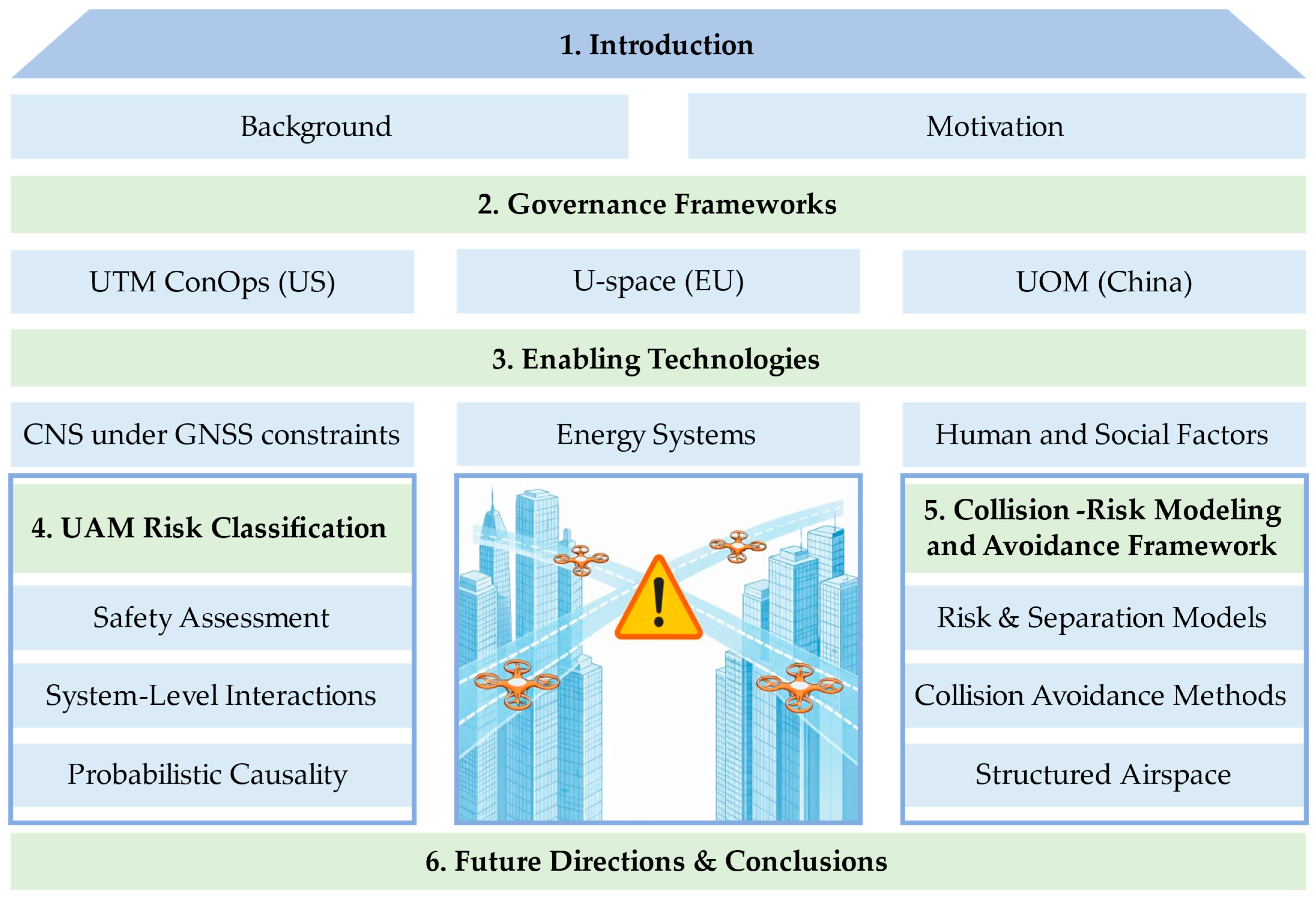
Figure 1. Structure of this review. The figure illustrates the main topics covered in the article, including governance frameworks, enabling technologies, risk classification, and collision-risk modeling for UAM operations.
Drones 10 00211 g001
Figure 4. Framework of the UOM system [40].
Drones 10 00211 g004
Figure 5. Schematic representation of the “well clear” criterion [120]. The yellow dot marks the acceptable risk threshold and the dashed line indicates the corresponding risk boundary.
Drones 10 00211 g005
Figure 6. WC cylinder and safe zone [122]: (a) Layered spatial model of the encounter cylinder around the unmanned aircraft, illustrating the parameterized well-clear volume and embedded NMAC zone; (b) DAA alert logic zones mapped to the encounter space.
Drones 10 00211 g006
Figure 7. Conceptual framework of four structured airspace types [142].
Drones 10 00211 g007
Figure 8. Schematic diagram of a two-dimensional virtual tube [157].
Drones 10 00211 g008
Figure 9. Simulation of swarm trajectory planning. The colored lines are trajectories, and the colors indicate moments. The black circles represent obstacles in the environment, the black line represents the border of the regular virtual tube, the blue line represents the border with the maximum radius, and the green line represents the non-regular virtual tube [146]. (a) Swarm trajectories within a regular virtual tube; (b) swarm trajectories within a non-regular virtual tube.
Drones 10 00211 g009
Table 1. Classification of micro-, mini-, and small UASs [10].
UAV ClassMaximum Mass (kg)Maximum Speed (m/s)Maximum Kinetic Energy (J)
A: Micro-UASs2.030.9954
B: Mini-UASs9.144.89132
C: Small UASs24.944.824,988
Table 2. Seven-group weight-based categorization framework for UASs [11].
GroupWeight Class (lb; kg Equivalent)Source
Group 1 (micro)<1 lb (<0.45 kg)N/A *
Group 2 (mini)1.1–4.4 lb (0.5–2.0 kg)FAA Law
Group 3 (small)4.5–55 lb (2.0–24.9 kg)FAA Law, Department of Defense, European Union Aviation Safety Agency (EASA), drafts
Group 4 (tactical)56–351 lb (25.4–159.2 kg)Integrated Capability Assessment Tool study, EASA, drafts
Group 5 (medium)352–1320 lb (160–599 kg)Department of Defense
Group 6 (large)1321–10,000 lb (600–4536 kg)Based on Predator C
Group 7 (heavy)10,001–25,000 lb (4536–11,340 kg)Based on Global Hawk
* N/A indicates that no specific regulatory or literature source is available for this category.
Table 3. Comparative challenges of small UASs relative to traditional aviation [16].
Traditional Manned AviationSmall UASs Challenges
Consistent vehicle performanceDiverse vehicle performance
Good maneuvering capabilityLimited maneuvering capability
Performance robust in weatherPerformance poor in the weather
High situational awarenessLimited situational awareness
In situ decision makingHigh levels of autonomy
Highly reliable communicationsComm link failures common
Emerging, Automatic Dependent Surveillance–Broadcast (ADS-B), surveillanceADS-B not scalable to dense ops
Air data and weather radar in situLittle or no in situ weather data
Ground-based surveillance radarsNo independent surveillance
Ground-based navigational aidsNo navigational aids
Structured routes and airspaceLittle airspace structure
High-altitude flight, good line of sightVLL, often blocked line of sight, clutter
National airspace system-wide
Air traffic control (ATC) services
No ATC services
Homogeneous origin–destination missionsDiverse mission types
Ops is segregated from the publicOps integrated with the public
Scheduled predictable opsUnscheduled, unpredictable ops
Sense-and-avoid is time-tested and matureDAA can fail in high-density ops
Simple separation criteriaComplex separation assurance
Clear lines of legal responsibilityLegal responsibility unclear
Table 4. The development stages for the U-space.
StageKey Features
U1Electronic registration, remote identification, and geofencing
U2Flight planning, flight approval, real-time tracking, preliminary ATM interface
U3Advanced tactical conflict detection, dynamic rerouting, and high-density UAV operations
U4Full ATM/ATC integration, dynamic airspace reconfiguration
Table 5. Comparison of UAM regulatory frameworks.
DimensionFAA UTM ConOpsEASA U-SpaceCAAC UOM
System
Architecture
Federated and decentralizedAuthority-supervised and service-basedHierarchical and nationally unified
Governance PhilosophyPerformance-basedService-basedGovernment-led, supervision-oriented
Key
Mechanism
Federated service-provider model with cooperative intent sharingPhased U-space services (U1–U4) via service providersUnified UOM services on a national platform
AdvantagesHigh operational flexibility and innovation adaptabilityCross-border interoperability and legal clarityStrong enforcement and system-wide consistency
ChallengesConsistency in certification and airspace accountabilityHigh infrastructure demands and coordination costsBalancing centralized control with innovative flexibility
Table 7. Risk categories for UAM operations.
Risk TypesTypical HazardsCollision-Risk LinkageMain Mitigations
Technicalbattery degradation; propulsion faults; control software faultsloss of control; emergency landingredundancy; health monitoring; fail-safe modes
Operationalwind shear; obstacle proximity; GNSS degradationdelayed conflict resolution; uncertaintyprocedures; CNS augmentation; robust DAA
Regulatoryintent-sharing scope; certification gaps; enforcement limitsmismatched assumptionsbetter governance design; service certification
Systemiccyber attacks; data incidents; CNS node failedcascading disruptions; surveillance blind zonesresilience design; broken-chain mitigation
Table 8. Flight risk factors of UAVs in UAM scenarios [101].
Hazard No.Hazard
VH-1Aircraft Loss of Control
VH-2Aircraft Fly-Away/Geofence Non-Conformance
VH-3Lost Communication/Control Link
VH-4Loss of Navigation Capability
VH-5Unsuccessful Landing
VH-6Unintentional/Unsuccessful Flight Termination
VH-7Failure/Inability to Avoid Collision with Terrain and/or Fixed/Moving Obstacles
VH-8Hostile Remote Takeover and Control of UAS
VH-9Rogue/Noncompliant UAS
VH-10Rogue/Noncompliant UAS (Weaponized)
VH-11Hostile Ground-based Attack of UAS (e.g., Using High-powered Rifle, UAS Counter Measure Devices, etc.)
VH-12Unintentional/Erroneous Discharge of Weapons, Explosives, Chemicals, etc.
VH-13Erroneous/Autonomous Decisions/Actions by UAS Compromise Vehicle/Operational Safety
VH-14Cascading Failures in Multi-UAS and Collaborative Missions
Table 9. Comparison of different UAV detection and avoidance systems [19].
SystemDetection TypeDetection Range (km)Location InformationComparison
ADS-BCollaborative240Location altitude; SpeedHaving both the capabilities of surveillance and communication
TCAS/ACAS-XuCollaborative160Distance; AltitudeHeavy in weight; Difficult to be equipped onto UAS
Optoelectronics
(Electro-Optical system)
Non-collaborative20Relative bearing; ElevationSusceptible to weather; Lacking in guidance range
Synthetic Aperture RadarNon-collaborative35Distance; Relative bearingLow accuracy
LIDARNon-collaborative3DistanceSmall view
Infrared systemNon-collaborative4.4Relative bearing; ElevationNot applicable to instrument meteorological conditions
Acoustic systemNon-collaborative10Relative bearing; ElevationTime delays
Visionary systemNon-collaborative1.9Position; SpeedSmall range; Affected by the performance of the camera
Table 10. Probabilistic separation paradigms.
LayerSeparation
Output
Risk ConstraintInformation NeededUrban VLL
Failure Modes
Ref.
Standards calibration (WC/LoDWC)Calibrated WC trigger; LoDWC parametersEvent probabilityEncounter model; relative state time series;Encounter mismatch; corridor correlation; latency-shifted triggers[123]
Risk-based assessment Candidate minima ranking; separation minima selectionExpected loss (TLS, ELoS)Demand; route structure; hazard definition; aggregation horizonHotspot masking; merge bottlenecks; density phase-change[124]
Performance condition Dynamic minima from CNS performancePerformance-conditionedSurveillance age; latency; integrity; trusted monitoring; service rulesBiased quality metrics; metric manipulation; oscillatory minima[125]
Table 11. Comparison of tactical mid-air deconfliction methods for urban VLL airspace.
Method
Category
Representative
Algorithms
Required
Information
Time
Scale
Urban VLL
Suitability
Typical Failure Modes
Reactive
Geometry
MVP [126,127], VO [128], RVO [129], ORCA [130]Relative state (pos/vel); reciprocal compliancems–sLow: Best for open spaceOscillation; deadlock; overly conservative in crowds
OptimizationMixed-integer programming [131,132]Global intent; constraint set; centralized coordinations–minHigh: Rule-rich environmentScalability limits; compute latency; rollout instability
Receding HorizonMPC-based methods [133,134]State estimate; dynamics model; online optimizationsHigh: Constraint-awareInfeasibility under delay; tuning sensitivity
Safety FilterCBF-based methods [135,136]Local state (neighbors); barrier functionsmsMedium: Safeguard layerEmpty-set infeasibility; sensing-noise sensitivity
Learning-basedDRL [137,138], GCBF [139,140]Training environments; reward design; sim-to-real supportmsHigh: Context-adaptiveCorner cases; sim-to-real gap
Note: MVP, Modified Voltage Potential; VO, Velocity Obstacle; RVO, Reciprocal Velocity Obstacle; ORCA, Optimal Reciprocal Collision Avoidance; MPC, Model Predictive Control; CBF, Control Barrier Function; DRL, Deep Reinforcement Learning; GCBF, Graph Control Barrier Function.
Table 12. Comparison of Free, Layered, Zoned, and Pipeline airspace structures.
Structure TypeFlexibilitySafetyCoordination
Requirement
Typical Application
FreeVery highLowMinimalSparse or exploratory flights
LayeredMedium–highMediumLowDirection-segregated operations
ZonedMediumHighHigh (within zones)Geo-fenced mission areas
PipelineLowVery highVery highHigh-density logistics corridors
Table 13. Comparison of the virtual tubes in the obstacle-dense environment [146]. (Tr: run time (s), Dd: minimum distance between drones (m), Ds: minimum distance from tube surface (m), Ar: arrival rate).
Drone Velocity4 m/s8 m/s16 m/s
TrDdDsArTrDdDsArTrDdDsAr
The non-regular virtual tube221.30.210.3090%218.10.210.2980%72.40.210.2875%
The regular virtual tube216.10.320.30100%163.00.60.30100%66.10.200.28100%
Disclaimer/Publisher’s Note: The statements, opinions and data contained in all publications are solely those of the individual author(s) and contributor(s) and not of MDPI and/or the editor(s). MDPI and/or the editor(s) disclaim responsibility for any injury to people or property resulting from any ideas, methods, instructions or products referred to in the content.