Article

Robust Attitude Tracking for Fixed-Wing Unmanned Aerial Vehicles Using Improved Active Disturbance Rejection Control with Parameter Optimization


1
AVIC The First Aircraft Design Institute, Xi’an 710089, China
2
School of Automation, Northwestern Polytechnical University, Xi’an 710129, China
*
Author to whom correspondence should be addressed.
Drones 2026, 10(3), 210; https://doi.org/10.3390/drones10030210
Submission received: 24 January 2026 / Revised: 6 March 2026 / Accepted: 16 March 2026 / Published: 17 March 2026
(This article belongs to the Section Drone Design and Development)

Highlights

What are the main findings?
  • A soft-sign function-based active disturbance rejection control (SSADRC) method is developed for designing a robust attitude controller. SSADRC utilizes a continuously differentiable nonlinear function with saturation constraints to design the controller and observer, ensuring smooth and stable control output.
  • A hybrid grey wolf optimizer with balanced exploration–exploitation mechanisms (HGWO) is introduced for intelligent parameter tuning. The HGWO combines the good point set-based population initialization strategy with several adaptive mechanisms, enhancing global search capabilities while preventing premature convergence.
What are the implications of the main findings?
  • Compared with the classical ADRC method, SSADRC exhibits superior command tracking performance and state estimation accuracy under turbulence and noise, providing enhanced robustness and reliability for controller design.
  • Compared with seven other swarm intelligence optimization algorithms, HGWO stands out for its exceptional convergence accuracy, offering significant advantages for tackling large-scale constrained optimization problems.

Abstract

Fixed-wing unmanned aerial vehicles, with their advantages of long endurance and substantial payload capacity, are poised to be a key platform for the future low-altitude economy. However, the challenge of achieving precise attitude tracking control under unknown time-varying disturbances persists. To tackle this difficulty, this article introduces a soft-sign function-based active disturbance rejection control (SSADRC) method, and develops a hybrid grey wolf optimizer (HGWO) with balanced exploration–exploitation mechanisms for intelligent parameter tuning. Specifically, SSADRC utilizes a novel smooth nonlinear function with saturation constraints to reconstruct the nonlinear feedback controller and the extended state observer, ensuring smooth and stable control output. Subsequently, HGWO integrates the good point set-based initialization strategy, the fitness-based dynamic-weight strategy, the diversity-based adaptive-mutation strategy, and the logistic chaotic map-based survival-of-the-fittest strategy, addressing the tuning of multiple coupled parameters in SSADRC. Additionally, the SSADRC-based pitch attitude controller is designed for a fixed-wing unmanned aerial vehicle, and an HGWO and seven other swarm optimization algorithms are employed to tune the parameters. The results demonstrate that the HGWO exhibits the best convergence accuracy in the SSADRC parameter optimization task, and SSADRC illustrates better command tracking performance and state estimation accuracy than typical ADRC.

1. Introduction

Fixed-wing unmanned aerial vehicles (FWUAVs), renowned for their long endurance, high cruise efficiency, and substantial payload capacity, have established themselves as pivotal platforms within the burgeoning low-altitude economy [1,2]. They are increasingly deployed across a wide spectrum of applications, including logistics and transportation [3], agricultural monitoring [4], and surveillance [5], demonstrating significant economic and societal value.
The flight control system, often termed the intelligent core of an FWUAV, is paramount to its ability to perform these missions reliably and effectively [6]. The performance of this system directly dictates the vehicle’s safety, operational reliability, and overall economic viability. From a control architecture perspective, the flight control system of a fixed-wing UAV is typically hierarchically structured into two primary loops: the inner-loop attitude control and the outer-loop trajectory control. The attitude control loop is responsible for stabilizing the aircraft’s orientation and achieving precise, agile tracking of roll, pitch, and yaw angle commands [7,8]. The trajectory control loop, building upon a stable attitude foundation, governs the UAV’s navigation by regulating its flight path, airspeed, and altitude to follow a predefined three-dimensional trajectory [9,10].
As the inner loop of the entire flight control system, the performance of the attitude controller is fundamental. Its robustness and accuracy critically influence the stability of the outer loop and the overall flight quality [11,12]. Consequently, significant research efforts have been devoted to designing more-robust attitude controllers with superior tracking capabilities. This has led to the development and application of a variety of advanced control methodologies, including sliding mode control [13], adaptive control [14], backstepping control [15], and active disturbance rejection control (ADRC) [16].
Among these advanced control techniques, ADRC has garnered considerable attention for its distinctive merits [17,18,19]. Compared to other advanced control methods, ADRC has several distinct advantages. One of the key advantages of ADRC is its ability to handle uncertainties and disturbances without relying on an explicit model of the system. This makes it particularly useful in situations where accurate system modeling is challenging or impractical. Another advantage of ADRC is its simplicity and ease of implementation. Unlike some advanced control methods that require complex mathematical models, ADRC can be implemented with relatively straightforward algorithms. This simplicity not only reduces the computational burden but also makes it more accessible for practical applications.
However, it is important to acknowledge that ADRC does have certain limitations. The biggest challenge in designing controllers using the ADRC method lies in the careful adjustment of its parameters to achieve optimal performance. Fine-tuning the coupling parameters in ADRC through trial-and-error can be a time-consuming and challenging task [20,21,22]. The selection of appropriate parameters is crucial to attain the desired control performance and stability. However, identifying the optimal parameters is not always straightforward, as they may vary depending on specific systems and operating conditions. Therefore, numerous scholars have proposed a series of ADRC-based controller parameter-tuning methods using swarm intelligence optimization algorithms. For example, He et al. propose a multi-strategy pigeon-inspired optimization for tuning an ADRC applied to a vertical take-off and landing FWUAV [23]. Srikanth et al. investigate a multi-objective quasi-oppositional Jaya algorithm for optimizing ADRC parameters for a class of time-delay systems [24]. Yang et al. combine the particle swarm optimization algorithm and the genetic algorithm to determine the parameters for an ADRC-based motor controller [25]. Ren et al. utilize the grey wolf optimizer to tune the parameters of the ADRC-based ship course controller [26]. While swarm intelligence algorithms have proven effective for ADRC tuning and superior to manual calibration, it must be noted that their inherent limitations, like premature convergence and low solution accuracy, fundamentally cap the controller’s performance.
Motivated by the above discussion, this article presents an optimization-based active disturbance rejection control framework, including a hybrid grey wolf optimizer and a soft-sign function-based active disturbance rejection controller. Extensive numerical simulations and comparisons are conducted to validate the proposed algorithms. The major contributions are summarized as follows:
(1)
A soft-sign function-based modified active disturbance rejection control (SSADRC) method is introduced, enhancing robust command tracking and precise state estimation under time-varying unknown disturbances. Compared with classical ADRC, SSADRC employs a continuously differentiable nonlinear function with saturation constraints for both the nonlinear feedback controller and the extended state observer. This design ensures smooth and stable control output, addressing the chattering issue commonly encountered in traditional ADRC.
(2)
A novel hybrid grey wolf optimizer (HGWO), featuring balanced exploration–exploitation mechanisms, is developed for optimizing the SSADRC-based controller parameters. Compared with classical GWO, the HGWO combines the good point set-based initialization strategy, the fitness-based dynamic-weight strategy, the diversity-based adaptive-mutation strategy, and the logistic chaotic map-based survival-of-the-fittest strategy. These enhancements enable the HGWO to achieve a balanced exploration–exploitation trade-off, offering significant advantages for tackling constrained optimization problems.
(3)
To illustrate the availability of the proposed algorithms, the SSADRC-based pitch attitude controller is designed for a fixed-wing unmanned aerial vehicle, and it is evaluated in the presence of sensor measurement noise and atmospheric turbulence. Moreover, the HGWO is employed to determine the SSADRC parameters, and it is compared with seven other swarm intelligence optimization algorithms.
Structural overview: Section 2 presents the nonlinear attitude dynamics of FWUAVs. Section 3 details the SSADRC method and the hybrid grey wolf optimizer, along with a stability analysis of the soft-sign function-based extended state observer. Section 4 provides some simulations and comparisons, and Section 5 concludes this article.

2. Problem Description

2.1. Nonlinear Attitude Motion Dynamics of FWUAVs

The nonlinear attitude dynamics of FWUAVs are given by the following:
p ˙ = ( c 1 r + c 2 p ) q + c 3 M r o l l + c 4 M y a w q ˙ = c 5 p r c 6 ( p 2 r 2 ) + c 7 M p i t c h r ˙ = ( c 8 p c 2 r ) q + c 4 M r o l l + c 9 M y a w ϕ ˙ = p + tan θ r cos ϕ + q sin ϕ θ ˙ = q cos ϕ r sin ϕ ψ ˙ = r cos ϕ + q sin ϕ / cos θ
where p , q , and r are aircraft roll rate, pitch rate, and yaw rate, respectively; ϕ , θ , and ψ are aircraft roll angle, pitch angle, and yaw angle, respectively; c i i = 1 9 represents the coefficient calculated using the moment of inertia and the product of inertia; and M r o l l , M p i t c h , and M y a w are the rolling, pitching, and yawing moments acting on the aircraft, respectively.
Additionally, the moments can each be decomposed into two components: one due to control surface deflection, and the other due to the aircraft’s inherent aerodynamic state. Thus, the nonlinear attitude dynamics of FWUAVs are collectively described by three independent second-order systems, expressed as follows:
ϕ ¨ = b ϕ a δ a + b ψ a δ r + F ϕ s θ ¨ = b θ δ e + F θ s ψ ¨ = b ψ a δ a + b ϕ a δ r + F ψ s
where δ a , δ e , and δ r represent the deflection angles of the aileron, elevator, and rudder, respectively.

2.2. Classical Active Disturbance Rejection Control

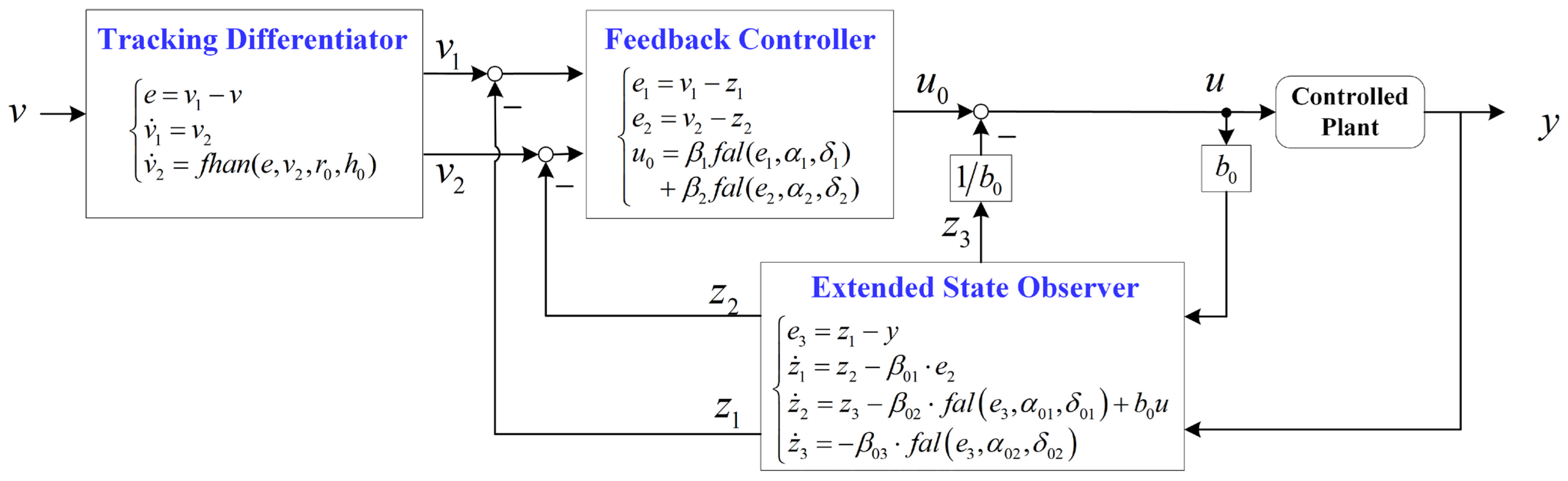
As illustrated in Figure 1, a classical second-order active disturbance rejection controller consists of a tracking differentiator, a feedback controller, and an extended state observer.
Working in concert, the tracking differentiator generates a smooth reference trajectory and provides its first-order derivative. Simultaneously, the extended state observer dynamically estimates the system’s total disturbance, which includes unmodeled dynamics and external perturbations, and compensates for it in real-time. Leveraging these inputs, the feedback controller then generates a final control action that robustly drives the plant to accurately track the smoothed reference.
In the ADRC framework, two key functions are used, denoted as f h a n ( ) and f a l ( ) . Here, f h a n ( ) is an optimal control synthesis function designed according to discrete optimization theory, given by Equation (3). The nonlinear f a l ( ) function is pivotal to ADRC, as it directly influences the performance of both the extended state observer and the feedback controller, as given in Equation (4).
d = r 0 h 0 d 0 = r 0 h 0 2 y = e + h 0 v 2 a 0 = d 2 + 8 r 0 y a = v 2 + a 0 d sgn ( y ) / 2 , y > d 0 v 2 + y / h 0 , y d 0 f h a n e , v 2 , r 0 , h 0 = r 0 sgn ( a ) , a > d r 0 a / d , a d
where sgn ( ) is the sign function, r 0 is the speed factor, and h 0 is the filtering factor.
f a l ( e , α , δ ) = e α sgn ( e ) ,   e > δ e / δ 1 α , e δ
where α determines the nonlinearity, and δ is a linear interval to prevent chattering.

2.3. Control Objective

The primary control objective is to design an attitude tracking controller using the active disturbance rejection control method, realizing robust and accurate command tracking performance in the presence of strong wind disturbances. Additionally, an innovative hybrid grey wolf optimizer is developed to optimize the controller parameters, ensuring optimal control performance under a given criterion.

3. Methodology

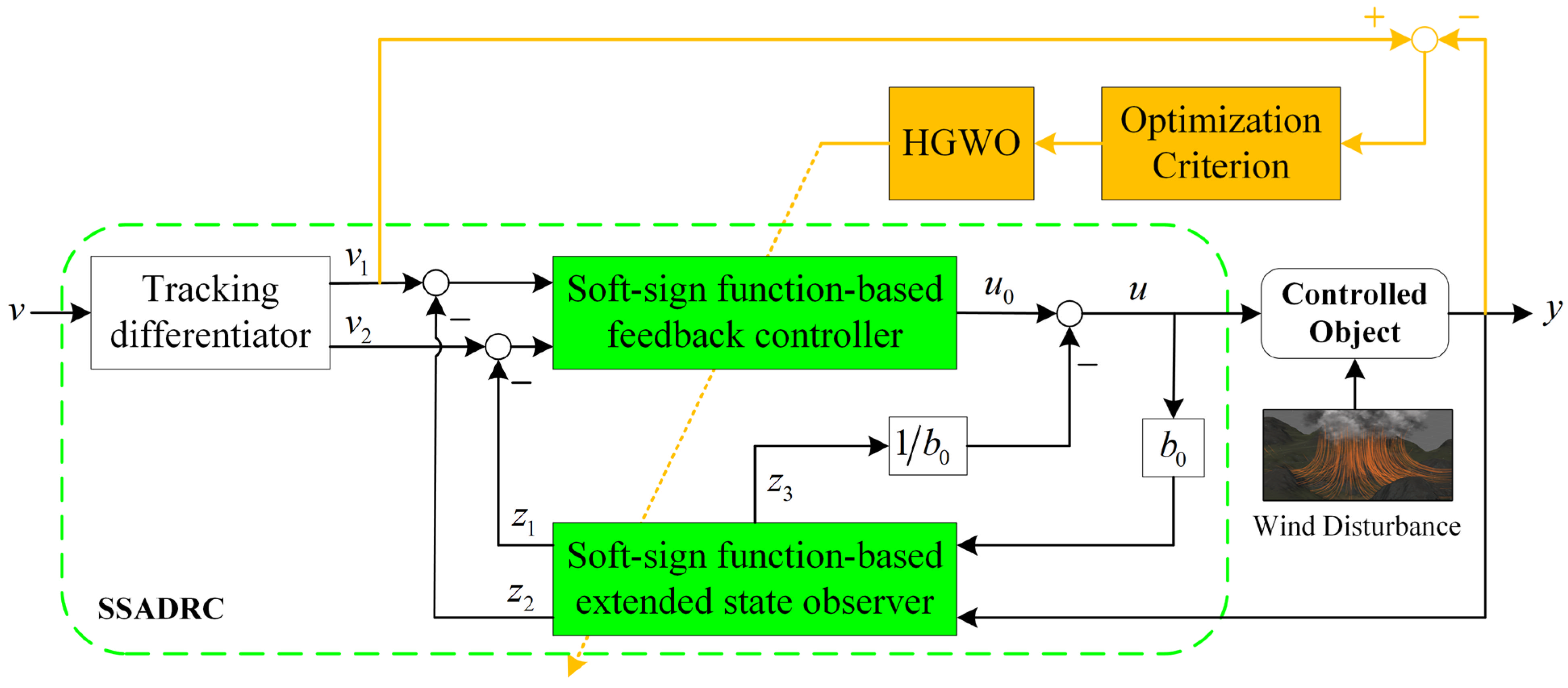
As depicted in Figure 2, the optimization-based active disturbance rejection control framework is established, including a soft-sign function-based improved active disturbance rejection controller and a hybrid grey wolf optimizer. The detailed implementation process is described as follows:

3.1. Soft-Sign Function-Based Active Disturbance Rejection Control

As defined in Equation (4), the classical f a l ( ) function is a piecewise function and is non-differentiable at its breakpoints. This lack of differentiability has been shown to induce control chattering in classical ADRC-based controllers under time-varying disturbances, resulting in performance deterioration [27].
To address this issue, the improved soft-sign function S S f a l ( e , α , δ ) is introduced, as given in Equation (5).
S S f a l ( e , α , δ ) = δ α e 1 + α e sgn ( e )
where α determines the nonlinearity, and δ determines the amplitude.
For e > 0 , the first-order derivative of Equation (5) is computed by
e S S f a l ( e , α , δ ) = e δ α e 1 + α e = δ α ( 1 + α e ) 2
For e < 0 , the first-order derivative of Equation (5) is computed by
e S S f a l ( e , α , δ ) = e δ α e 1 α e = δ α ( 1 α e ) 2
At the critical point e = 0 , the first-order derivative of Equation (5) is evaluated via the following definition.
e S S f a l ( e , α , δ ) | e = 0 = lim e 0 S S f a l ( e , α , δ ) S S f a l ( 0 , α , δ ) e 0
Since S S f a l ( 0 , α , δ ) = 0 , the right-hand limit ( e 0 + ) and the left-hand limit ( e 0 ) are both equal to δ α , confirming e S S f a l ( e , α , δ ) | e = 0 = δ α . Remarkably, the first-order derivative of Equation (5) is obtained by
e S S f a l ( e , α , δ ) = δ α 1 + α e 2
Then, the improved soft-sign function is a monotonically increasing function, and its range is given as follows:
lim e S S f a l ( e , α , δ ) = lim e δ α 1 / e α = δ lim e S S f a l ( e , α , δ ) = lim e δ α α + 1 / e = δ
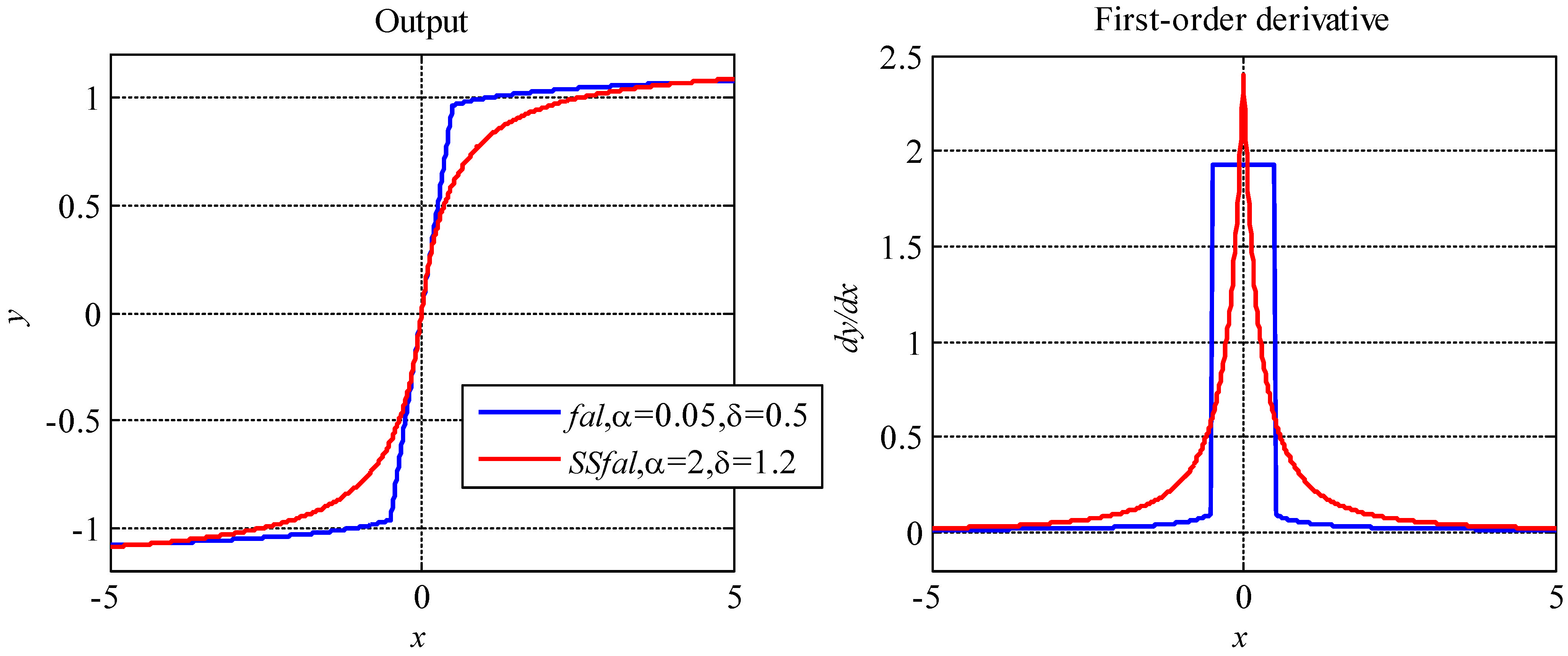
Consequently, the improved soft-sign function is characterized as an odd function that is continuously differentiable over the entire real domain, with inherent saturation limiting. Figure 3 shows the output and the first-order derivative of the improved soft-sign function, and it is observed that the results are consistent with the theoretical analysis.
Compared to classical ADRC, the proposed soft-sign function-based active disturbance rejection control (SSADRC) method achieves two key advantages without introducing additional parameters: (1) global smoothness, which eliminates non-smooth breakpoints and thereby mitigates chattering for improved steady-state performance; and (2) inherent boundedness, which acts as a soft saturation layer to enhance robustness against large disturbances.

3.2. Stability Analysis of the Soft-Sign Function-Based Extended State Observer

As the core of ADRC, the stability of the extended state observer is paramount to the overall controller. Therefore, the stability of the soft-sign function-based extended state observer (SSESO) is strictly proved. Specifically, the error equation of SSESO can be described as Equation (11).
e ˙ = A ( e ) e = β 01 1 0 β 02 S S f a l ( e , α , δ ) / e 0 1 β 03 S S f a l ( e , α , δ ) / e 0 0 e
where β 01 > 0 , β 02 > 0 , and β 03 > 0 .
Lemma 1.
If there exists a skew-symmetric matrix D with positive diagonal elements, such that D A ( e ) is symmetric positive definite, then the system is Lyapunov asymptotically stable [28].
The mathematical expression of is D given as follows:
D = d 11 d 12 d 13 d 12 d 22 d 23 d 13 d 23 d 33
where d 11 > 0 , d 22 > 0 , and d 33 > 0 .
Combining Equations (11) and (12), the expression of D A ( e ) is obtained as follows:
D A ( e ) = D 11 d 11 d 12 D 21 d 12 d 22 D 31 d 13 d 23 = d 11 β 01 + d 12 β 02 + d 13 β 03 S S f a l ( e , α , δ ) / e d 11 d 12 d 12 β 01 + d 22 β 02 + d 23 β 03 S S f a l ( e , α , δ ) / e d 12 d 22 d 13 β 01 + d 23 β 02 + d 33 β 03 S S f a l ( e , α , δ ) / e d 13 d 23
where
d 11 = D 21 = d 12 β 01 d 22 β 02 + d 23 β 03 S S f a l ( e , α , δ ) / e
d 12 = D 31 = d 13 β 01 d 23 β 02 + d 33 β 03 S S f a l ( e , α , δ ) / e
d 13 = d 22
If D A ( e ) is a symmetric positive definite matrix, the following conditions must be satisfied:
Δ 1 = D 11 = d 11 β 01 + d 12 β 02 + d 13 β 03 S S f a l ( e , α , δ ) / e > 0
Δ 2 = D 11 d 12 + d 11 D 21 > 0
Δ 3 = D 11 d 12 d 23 + d 22 d 13 + d 11 D 21 d 23 + d 22 D 31 d 12 D 21 d 13 d 12 D 31 > 0
For ease of proof, it is assumed that d 11 = 1 and d 22 = d 33 = ε . ε is a positive number close to 0. Then, the following relationship can be obtained.
Δ 1 = β 01 + d 12 β 2 + d 13 β 3 S S f a l ( e , α , δ ) / e Δ 2 = D 11 d 12 1 Δ 3 = D 11 d 12 d 23 ε 2 2 ε d 12 d 12 3 d 23
Substituting Equation (16) into Equation (20) yields the following:
Δ 1 = d 11 β 01 + d 12 β 02 + d 13 β 03 S S f a l ( e , α , δ ) / e   = β 01 + d 12 β 02 ε β 03 S S f a l ( e , α , δ ) / e   = β 01 + β 02 2 + ε β 02 3 S S f a l ( e , α , δ ) / e + β 02 β 03 2 S S f a l ( e , α , δ ) / e + β 02 2 β 01 β 02 β 03 S S f a l ( e , α , δ ) / e   >   β 01 + β 02 2 β 01 β 02 β 03 S S f a l ( e , α , δ ) / e   =   β 01 + β 02 2 β 01 β 02 β 03 δ α 1 + α e
Then, if β 01 β 02 β 03 > 0 , Equation (17) holds true.
Substituting Equation (14) into Equation (20) yields the following:
Δ 2 = D 11 d 12 + d   = Δ 1 d 12 1   = Δ 1 β 02 + ε β 01 β 03 + ε β 02 2 S S f a l ( e , α , δ ) / e + ε β 03 2 S S f a l ( e , α , δ ) / e β 01 β 02 β 03 1   >   β 01 + β 02 2 β 01 β 02 β 03 S S f a l ( e , α , δ ) / e β 02 β 01 β 02 β 03 1   = β 01 β 02 β 01 β 02 β 03 + β 02 3 β 01 β 0 2 β 03 2 δ α 1 + α e   >   β 01 β 02 β 01 β 02 β 03  
Then, if β 01 β 02 β 03 > 0 , Equation (18) holds true.
Substituting Equations (14) and (15) into Equation (20) yields the following:
Δ 3 = D 11 d 12 d 23 + d 22 d 13 + d 11 D 21 d 23 + d 22 D 31 d 12 D 21 d 13 d 12 D 31   = D 11 d 12 d 23 ε 2 2 ε d 12 d 12 3 d 23   D 11 d 12 d 23 d 12 3 d 23   = d 23 β 03 β 01 β 02 β 03 + β 02 3 S S f a l ( e , α , δ ) / e β 01 β 02 β 03 2 d 12 3   > β 03 β 02 β 01 β 02 β 03 S S f a l ( e , α , δ ) / e d 12   > β 03 β 02 β 01 β 02 β 03 β 02 β 01 β 02 β 03 1 + α e δ α
Then, if β 01 β 02 β 03 > 0 , Equation (19) holds true.
As a result, if β 01 β 02 β 03 > 0 , D A ( e ) is a symmetric positive definite matrix, and the system represented by Equation (11) is asymptotically stable. In other words, the proposed soft-sign function-based extended state observer is asymptotically stable in the Lyapunov sense at the equilibrium point.

3.3. Hybrid Grey Wolf Optimizer with Balanced Exploration–Exploitation Mechanisms

It is noticed that there are several parameters in SSADRC; these parameters play a crucial role in shaping the performance of the control system and need to be carefully tuned to achieve the desired control objectives. To tackle this difficulty, the problem of SSADRC parameter tuning is formulated as a finite-dimensional constrained optimization issue, and a hybrid grey wolf optimizer with balanced exploration–exploitation mechanisms is developed. The algorithm proceeds as follows:
Step 1: Generate the initial population based on the good point set strategy.
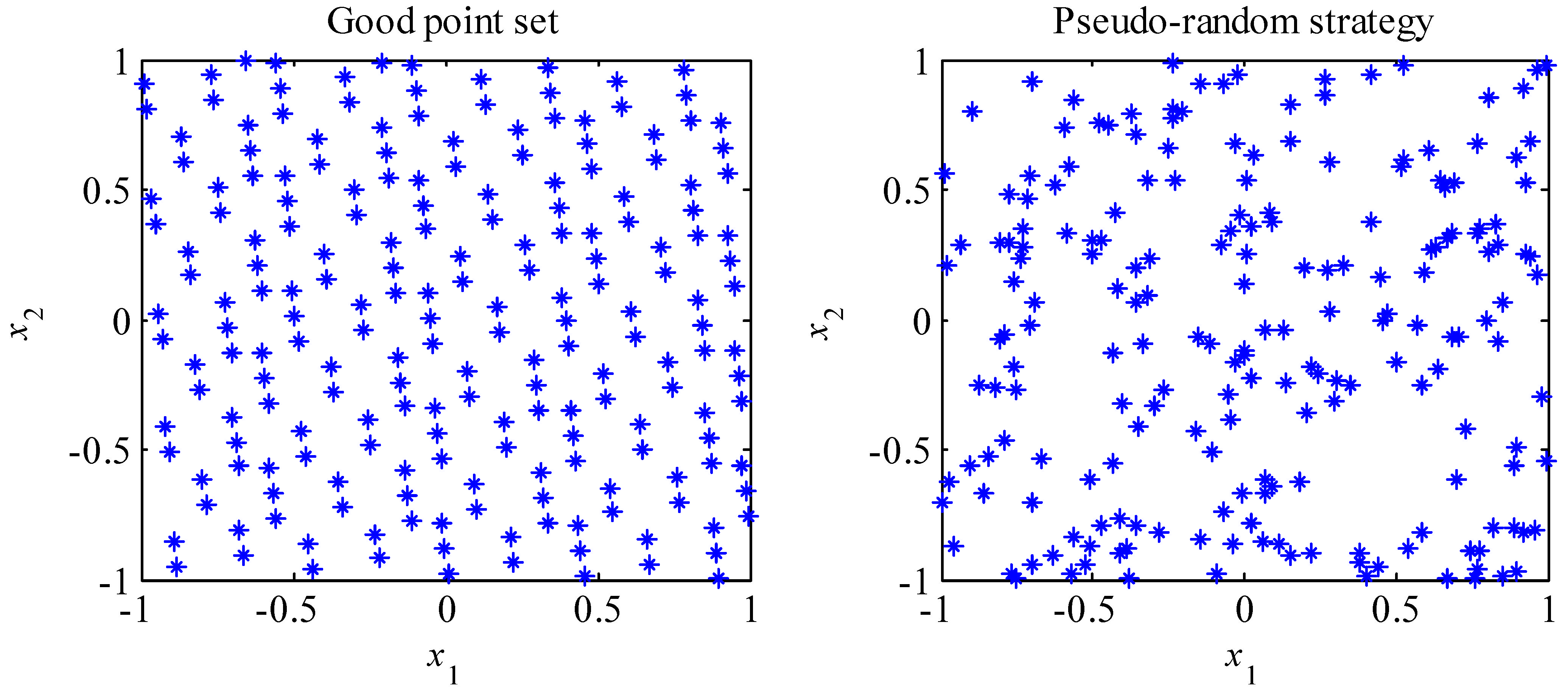
In general, the pseudo-random strategy is used as the population initialization method in bio-inspired algorithms. However, populations generated in this manner often display uneven distribution across the search space, resulting in a higher risk of getting trapped in local optima. To address this deficiency, the HGWO employs the good point set strategy to generate the initial population; that is,
x i , k = l b k + 2 i cos 2 π k p u b k l b k
where x i , k 0 is the kth-dimensional element of the ith individual; l b k and u b k are the lower limit and upper limit of the kth-dimensional element, respectively; and p is the minimum prime number that satisfies Equation (25).
p 3 2 d
where d is the dimension of the candidate solution.
Considering a population with 200 individuals, where the candidate solutions have values in the range of [−1, 1]2, the comparison between the initial populations generated based on the good point set method and pseudo-random strategy is shown in Figure 4.
Obviously, the population generated based on the good point set method shows more diversity and coverage of the solution space, which can potentially lead to a better exploration of the solution space and a higher likelihood of finding optimal solutions.
Step 2: Update the positions using the fitness-based dynamic-weight strategy.
The conventional GWO relies on a fixed, equal-weighting scheme for the alpha, beta, and delta wolves’ positions. This static approach fails to leverage fitness information, potentially hindering performance. In contrast, the HGWO adopts a fitness-based dynamic-weight strategy to guide the search in a more responsive and efficient manner, as shown in Equation (26), and the dynamic weights are computed by Equation (27).
x i , 0 j + 1 = ω α x α j A 1 D α + ω β x β j A 2 D β + ω δ x δ j A 3 D δ
ω α = e α f i t / e α f i t + e β f i t + e δ f i t ω β = e β f i t / e α f i t + e β f i t + e δ f i t ω δ = e δ f i t / e α f i t + e β f i t + e δ f i t
where x i , 0 j + 1 is the ith individual in the (j+1)th iteration after the hunting operation; x α j , x β j , and x δ j are the best individual (i.e., alpha wolf), the second-best individual (i.e., beta wolf), and the third-best individual (i.e., delta wolf) in the jth iteration, respectively; α f i t , β f i t , and δ f i t represent the fitness values of the alpha, beta, and delta wolves, respectively; A 1 , A 2 , and A 3 are coefficient factors; and D α , D β , and D δ are the distance vectors between x i j and x α j , x β j , and x δ j , respectively.
a = 2 1 j / G max A 1 = a 2 r 1 1 , A 2 = a 2 r 2 1 , A 3 = a 2 r 3 1 D α = 2 r 4 x α j x i j , D β = 2 r 5 x β j x i j , D δ = 2 r 6 x δ j x i j
where G max is the preset maximum iteration, and r 1 , r 2 , r 3 , r 4 , r 5 , r 6 are random values in [0, 1].
Step 3: Perform diversity-based adaptive-mutation strategy.
To avoid premature convergence, a diversity-based adaptive-mutation strategy is introduced, and the population diversity is defined as Equation (29). Here, c v 0 is the coefficient of variation in the individual fitness within the initial population, and c v j is the coefficient of variation in the individual fitness within the jth-generation population. f i 0 is the fitness of the ith individual in the initial population, and f i j is the fitness of the ith individual in the jth-generation population.
ς j = c v j c v 0 = i = 1 N s i z e f i 0 i = 1 N s i z e f i j i = 1 N s i z e f i j 1 N s i z e i = 1 N s i z e f i j 2 i = 1 N s i z e f i 0 1 N s i z e i = 1 N s i z e f i 0 2
As shown above, the coefficient of variation in the individual fitness is adopted to describe the population diversity. Given that the coefficient of variation is a statistical measure used to express the degree of dispersion within a dataset, it follows that the larger the coefficient of variation, the richer the population diversity. Thus, the adaptive-mutation operation can be described as
x i j + 1 = x i , 0 j + 1 + 1 ς r a n d x r 1 x r 2 , i f ς T ε   &   r a n d P m x i , 0 j + 1 , e l s e
where x i j + 1 is the ith individual after the mutation operation; T ε is the preset threshold, and P m is the mutation factor; and x r 1 and x r 2 are two randomly generated individuals in the search space.
Step 4: Perform logistic chaotic map-based survival-of-the-fittest strategy.
To maintain a rich population diversity in the later iterations, the survival-of-the-fittest strategy is adopted to dynamically adjust the population. Specifically, the last m individuals ranked are eliminated, and m new individuals are generated based on the best candidate solution (i.e., the alpha wolf) using the logistic chaotic map strategy. The position of a new individual is computed as follows:
x i , k n e w = l b k + a x i , k a l p h a l b k x i , k a l p h a + u b k / u b k l b k
where x i , k n e w is the kth-dimensional element of the new individual, and x i , k a l p h a is the kth-dimensional element of the alpha wolf. a is a factor to control the degree of chaos, with a value range of (0,4].
Step 5: Repeat Step 2, Step 3, and Step 4 iteratively until the termination condition is met.
Compared to the conventional GWO, the HGWO provides the following advantages: (1) superior initial exploration, as the good point set strategy ensures a well-distributed and high-quality initial population; (2) accelerated and refined convergence, fostered by the dynamic-weight strategy that intelligently balances the influence of the leader wolves based on their fitness; (3) robust search diversity, sustained through adaptive mutation that activates when population diversity drops, preventing stagnation; and (4) stronger escape from local optima, countered by the chaotic map-based strategy which introduces controlled randomness to replace underperforming individuals.

3.4. HGWO-Based SSADRC Parameter Optimization

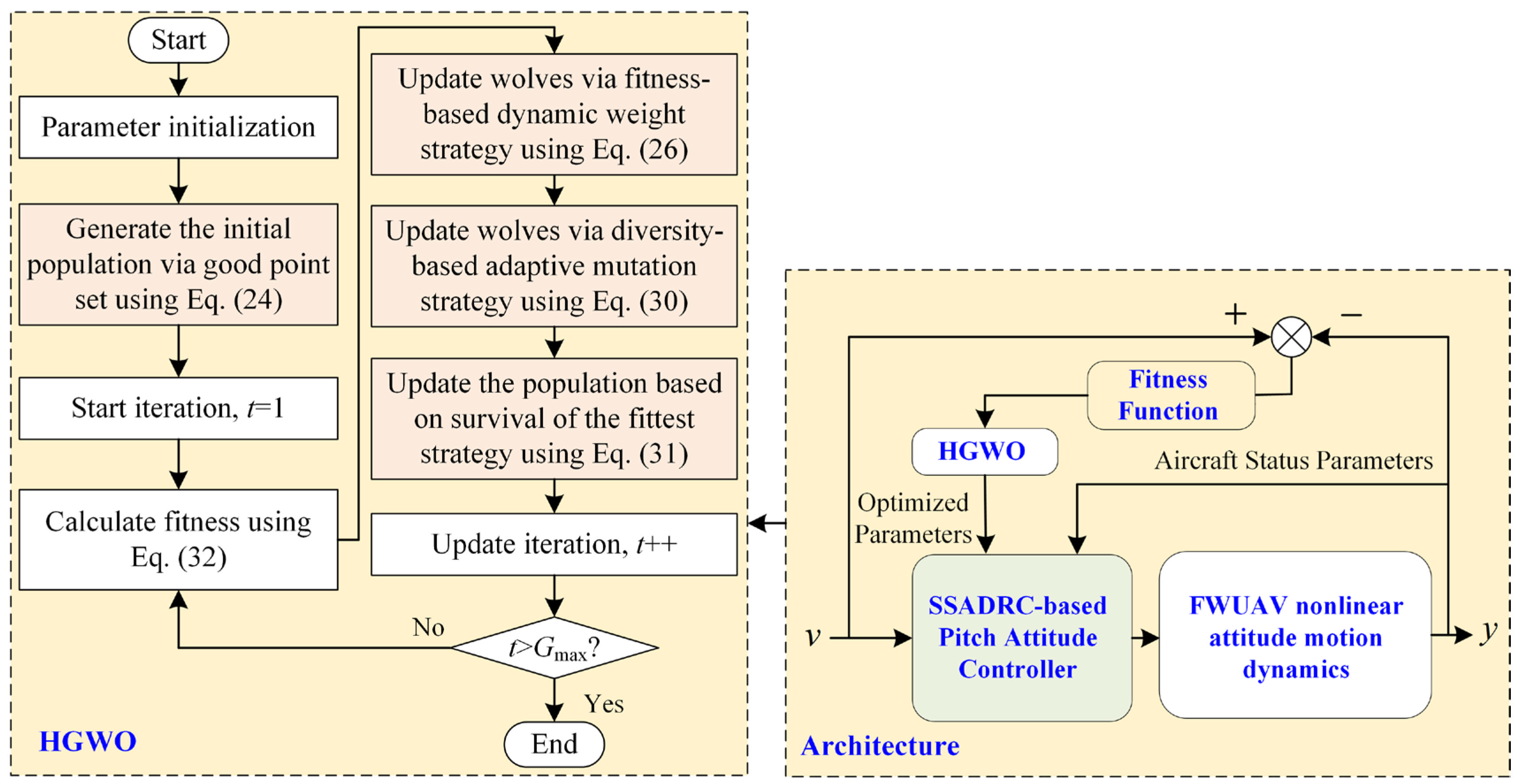
Consequently, the proposed hybrid grey wolf optimizer is employed to determine the SSADRC parameters, and the architecture is shown in Figure 5. Specifically, the real-number encoding strategy is employed, and the jth individual is encoded as x j = x j , 1 , , x j , N T . Here, N is the number of parameters to be optimized.
In addition, the integral of time multiplied by absolute error (ITAE) criterion is applied to construct the fitness function, and the fitness of each candidate solution can be calculated by
F i t n e s s = 0 T t v 1 y d t
where v 1 is the smoothed command generated by the tracking differentiator, and y is the system output.

4. Simulation Verification and Analysis

Two sets of simulations are provided to verify the proposed algorithms, including an HGWO performance evaluation based on the CEC 2022 benchmark suite and SSADRC-based controller performance verification.

4.1. HGWO Evaluation and Comparison

To evaluate the performance of the HGWO, multiple 10-dimensional functions from the CEC2022 benchmark suite are employed, and the detailed description of the CEC 2022 can be found in [29]. Moreover, the HGWO is compared with seven other algorithms, including the typical GWO [30], Harris hawk optimization (HHO) algorithm [31], PIO, competitive swarm optimizer (CSO) [32], Chernobyl disaster optimizer (CDO) [33], grasshopper optimization algorithm (GOA) [34], and beluga whale optimization (BWO) algorithm [35].
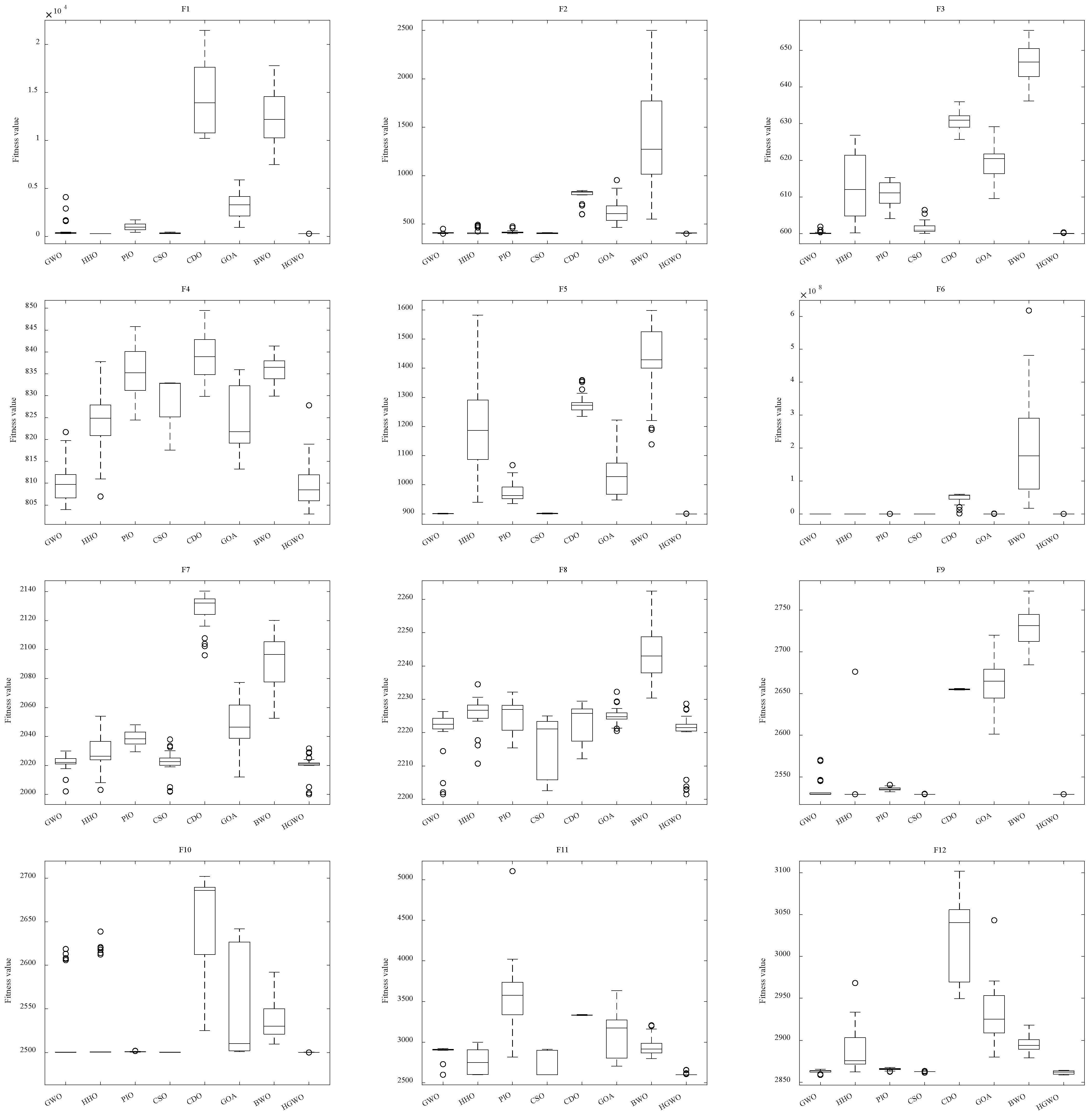
To ensure a rigorous evaluation, each algorithm is independently executed 30 times on each function, with a population size of 200 and a maximum of 2000 iterations. Table 1 presents the ranking of the algorithms according to their average fitness values, where a smaller rank indicates a smaller average fitness. The results clearly demonstrate that the HGWO achieves the best average fitness on the vast majority of functions, securing the top rank in ten out of twelve cases (F1, F3, F4, F5, F6, F7, F9, F10, F11, F12). In contrast, the conventional GWO, while occasionally ranking second or third, fails to match the performance of the HGWO, suggesting that the hybridization strategy integrated into the HGWO effectively enhances both exploration and exploitation. The CSO exhibits competitive behavior by ranking first on F2 and F8 and frequently appearing among the top three, indicating its suitability for specific function types. However, its overall inconsistency across other functions limits its general applicability. HHO and PIO occupy intermediate positions, with rankings typically ranging from third to sixth, reflecting moderate optimization accuracy but a lack of consistent superiority. On the lower end, the CDO, the GOA, and particularly BWO consistently rank near the bottom, with BWO being the worst performer in eight out of twelve functions. This persistent underperformance points to inherent weaknesses in their search mechanisms, such as poor population diversity or inadequate convergence precision, which hinder their ability to solve complex optimization problems effectively.
To provide a visual representation of the result distribution, Figure 6 displays the boxplots of the final fitness values achieved by each algorithm across the 30 independent runs. The boxplots reveal that the HGWO not only attains lower median fitness values but also exhibits narrower interquartile ranges on most functions, indicating enhanced stability and robustness.
Furthermore, to statistically validate the significance of the performance differences, the Wilcoxon rank-sum test is conducted at a significance level of 0.05. The pairwise comparison results from the Wilcoxon rank-sum test, as detailed in Table 2, confirm that the HGWO significantly outperforms the majority of the compared algorithms on most test functions, with p-values consistently below the 0.05 significance threshold. Specifically, against the HHO, PIO, CDO, GOA, and BWO, the HGWO achieves extremely low p-values (often on the order of 10−10 or lower) across nearly all functions, indicating overwhelmingly significant superiority. Against the CSO, the p-values are also below 0.05 on ten functions, with only F7 and F8 showing non-significant differences, suggesting that the CSO can occasionally compete with the HGWO on certain function landscapes but remains generally inferior. The comparison between the HGWO and the GWO is particularly insightful. The HGWO demonstrates significant superiority on F1, F2, F5, F6, F7, F9, F10, and F11, while the p-values on F3, F4, F8, and F12 exceed 0.05, indicating that the performance difference between the HGWO and its predecessor GWO is not statistically significant on these four functions.
To sum up, these results, derived from rigorous statistical testing and visualized through boxplot distributions, consistently demonstrate the superior optimization capability and robustness of the HGWO. The Wilcoxon rank-sum test further confirms that these performance gains are statistically significant, validating the effectiveness of the HGWO as a competitive and reliable optimizer for complex, high-dimensional problems.

4.2. SSADRC-Based Pitch Attitude Controller Performance Verification

Within the ADRC framework, the aircraft’s pitch attitude is controlled directly by the elevator, with all other factors treated as part of the system disturbance. Based on this premise, the SSADRC-based pitch attitude controller is designed. Subsequently, the above eight optimization algorithms are applied to optimize the related parameters.
The parameters to be optimized consist of the nonlinear factor α and the amplitude factor δ in the soft-sign function; the control gains β 1 and β 2 in the nonlinear feedback controller; the observer gains β 01 , β 02 , and β 03 in ESO; and the compensation factor b 0 . The optimization ranges for these parameters are set as follows: α 0.01 , 5 , δ 0.01 , 2 , β 1 , β 2 1 , 50 , β 01 , β 02 , β 03 10 , 500 , and b 0 3 , 0.1 .
The sample FWUAV adopts a conventional aerodynamic layout, with pitch controlled by the elevator, roll by the ailerons, and yaw by the rudder. It has a weight of 9 tons, a wingspan of 30 ft, a wing area of 300 ft2;, and a mean aerodynamic chord of 11.3 ft. Consider the UAV in steady, level flight at an altitude of 1000 m with a true airspeed of 80 m/s. The initial trim pitch angle is 2.535°, and the target pitch angle command is set to 5°. For the optimization algorithm, both the population size and the maximum iteration are set to 50.
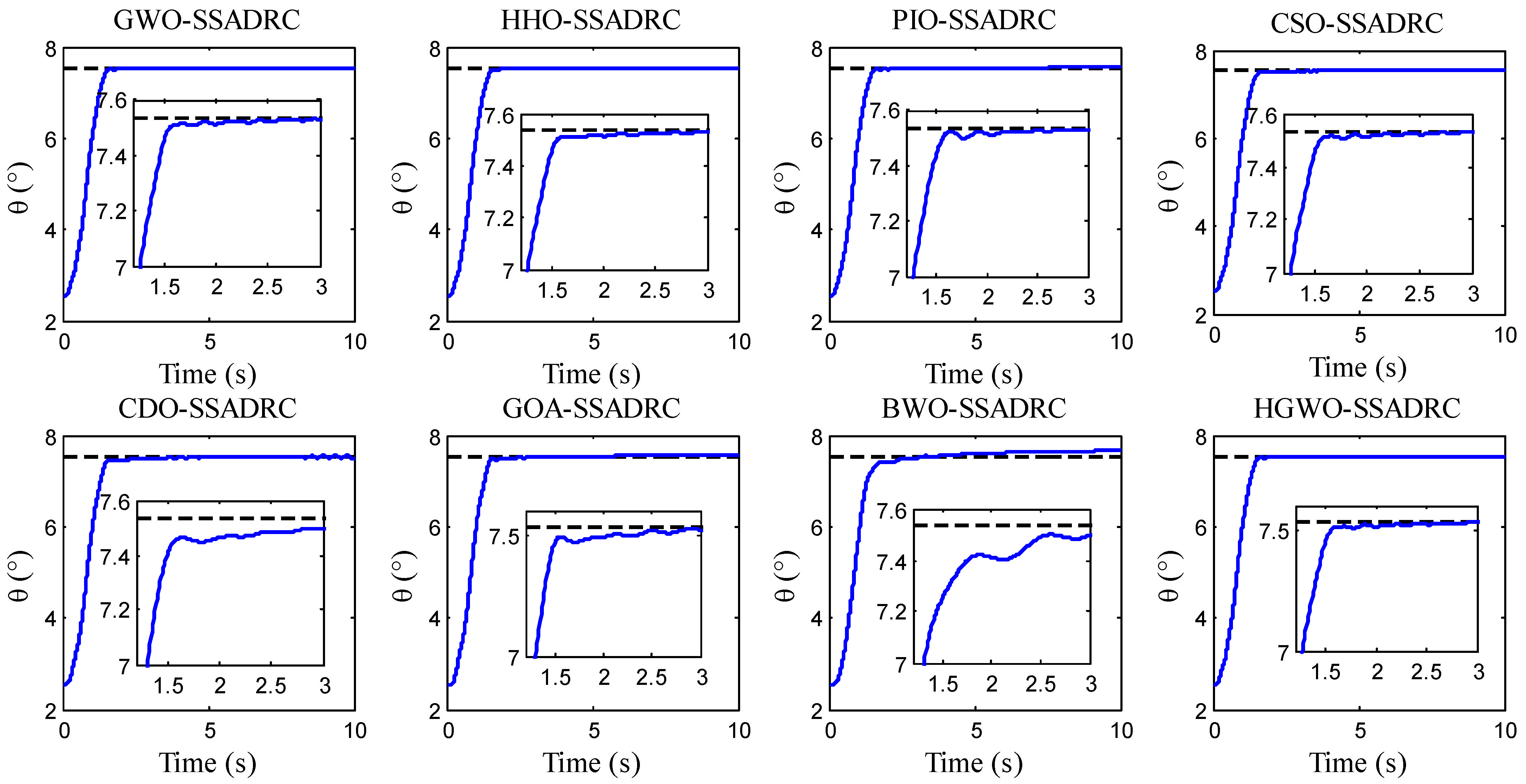
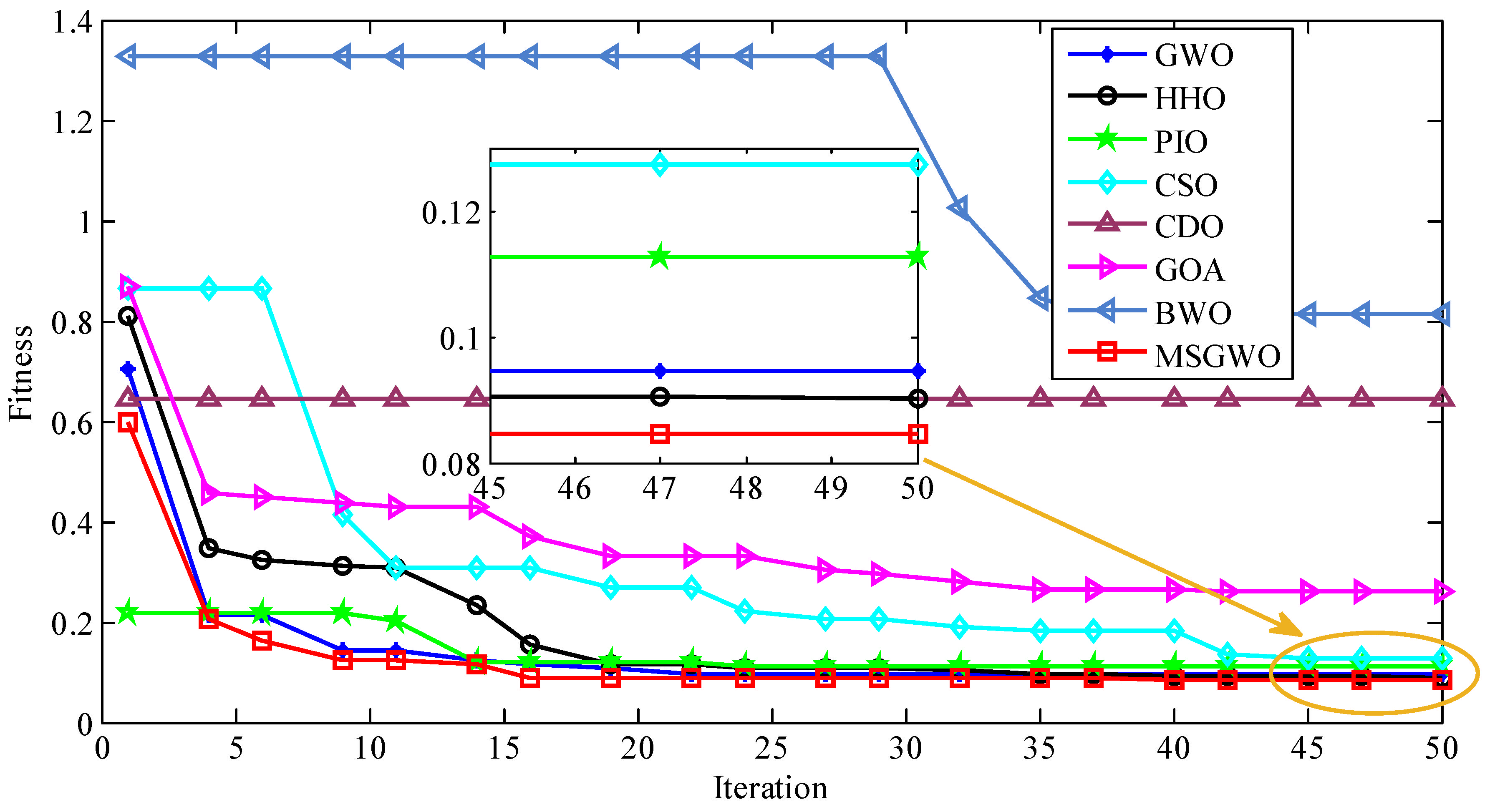
Figure 7 demonstrates that all eight SSADRC controllers exhibit comparable performance, with nearly identical settling times of approximately 1.4 s and virtually no steady-state error. Regarding optimization efficacy, Figure 8 indicates that the HGWO algorithm demonstrates superior convergence, while the BWO algorithm yields the least favorable results among the tested methods.
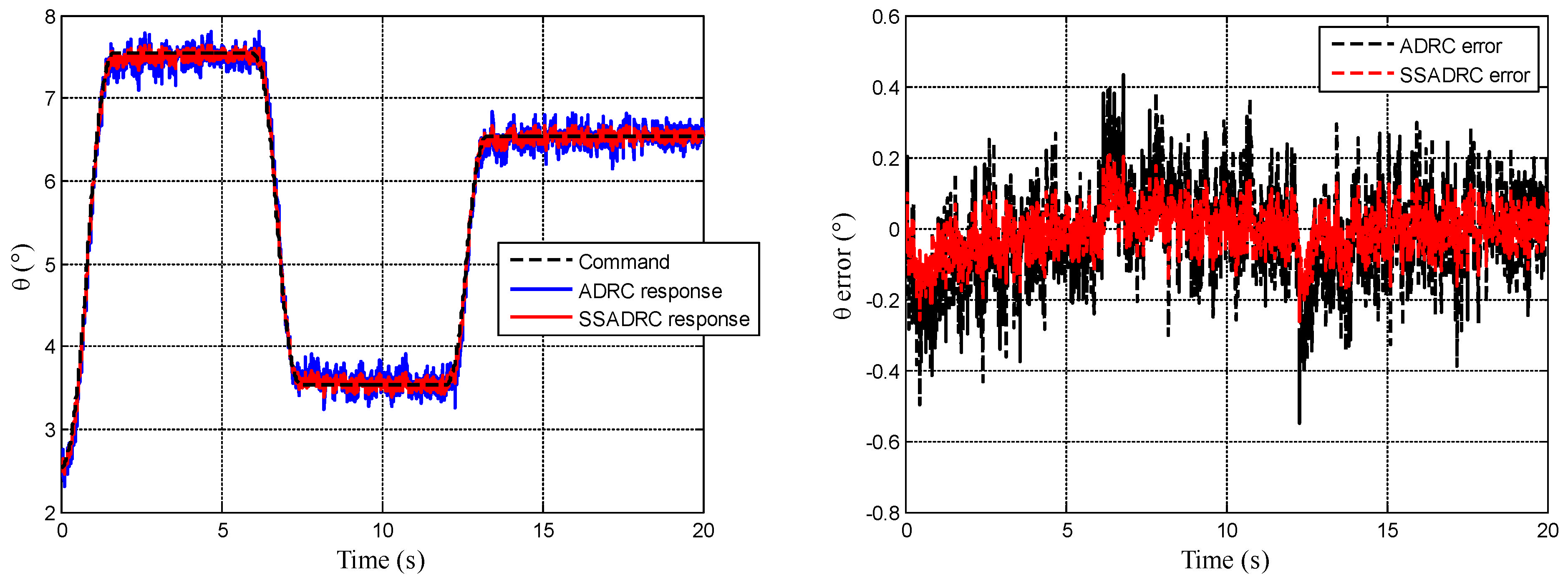
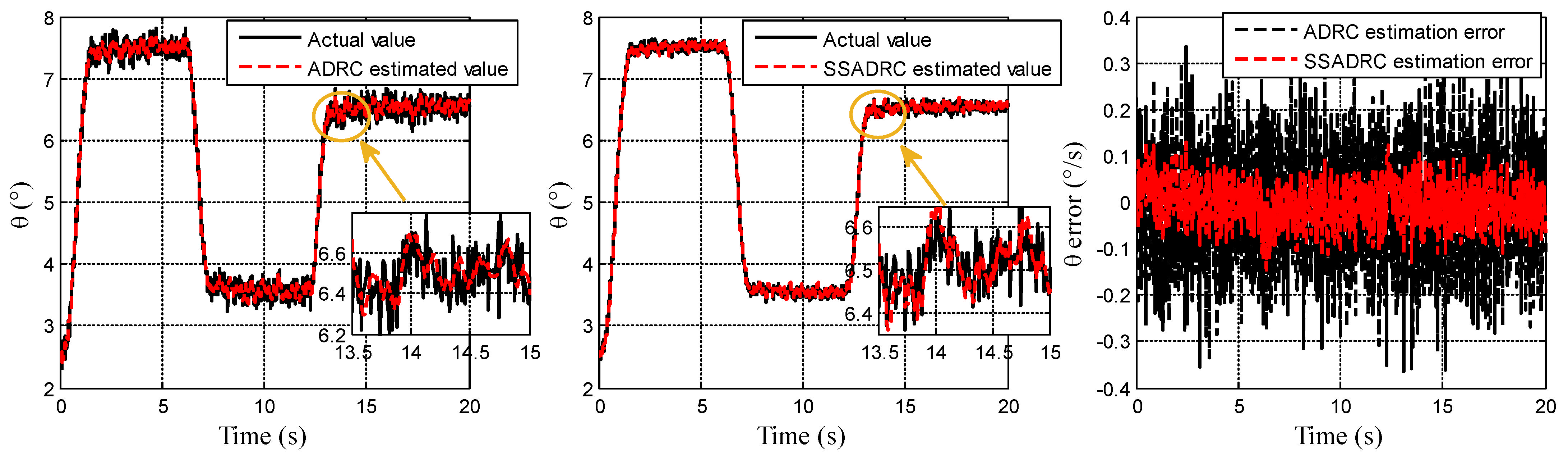
Subsequently, a comparative analysis is conducted between the pitch attitude controllers based on SSADRC and classical ADRC frameworks in the presence of sensor measurement noise. Here, the noise is modeled as Gaussian white noise with a mean of zero and a standard deviation of 0.1°. It should be emphasized that the parameters for both controllers are determined using HGWO under the ITAE criterion. As shown in Figure 9, the SSADRC controller exhibits superior command tracking performance. Specifically, the standard deviation of the tracking error for SSADRC is 0.0659°, compared to 0.1350° for the classical ADRC. Figure 10 shows the state estimation results. The estimation error for ADRC is within the range of [−0.3642°, 0.3358°], with a standard deviation of 0.1160°. In contrast, SSADRC achieved a much smaller estimation error range of [−0.1453°, 0.1286°] and a substantially lower standard deviation of 0.0415°.
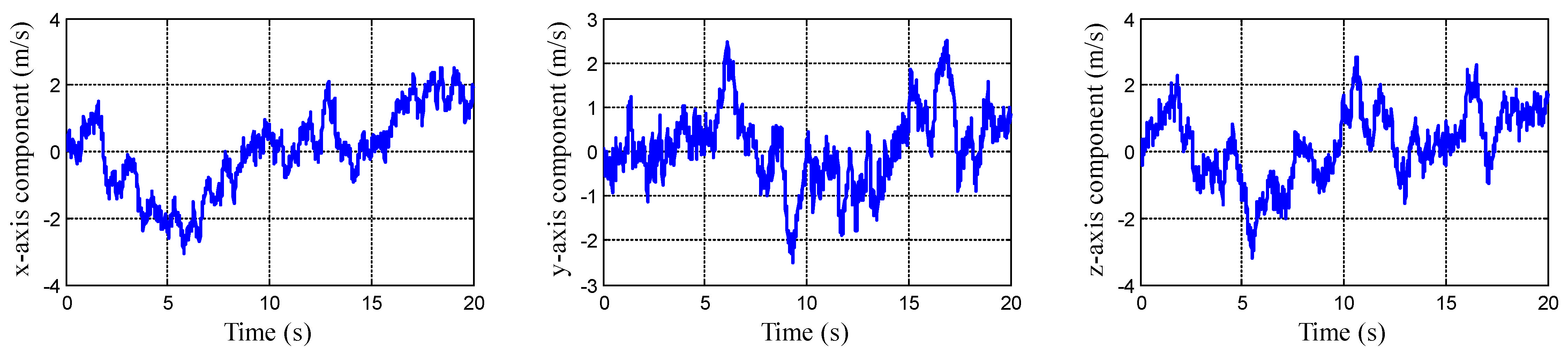
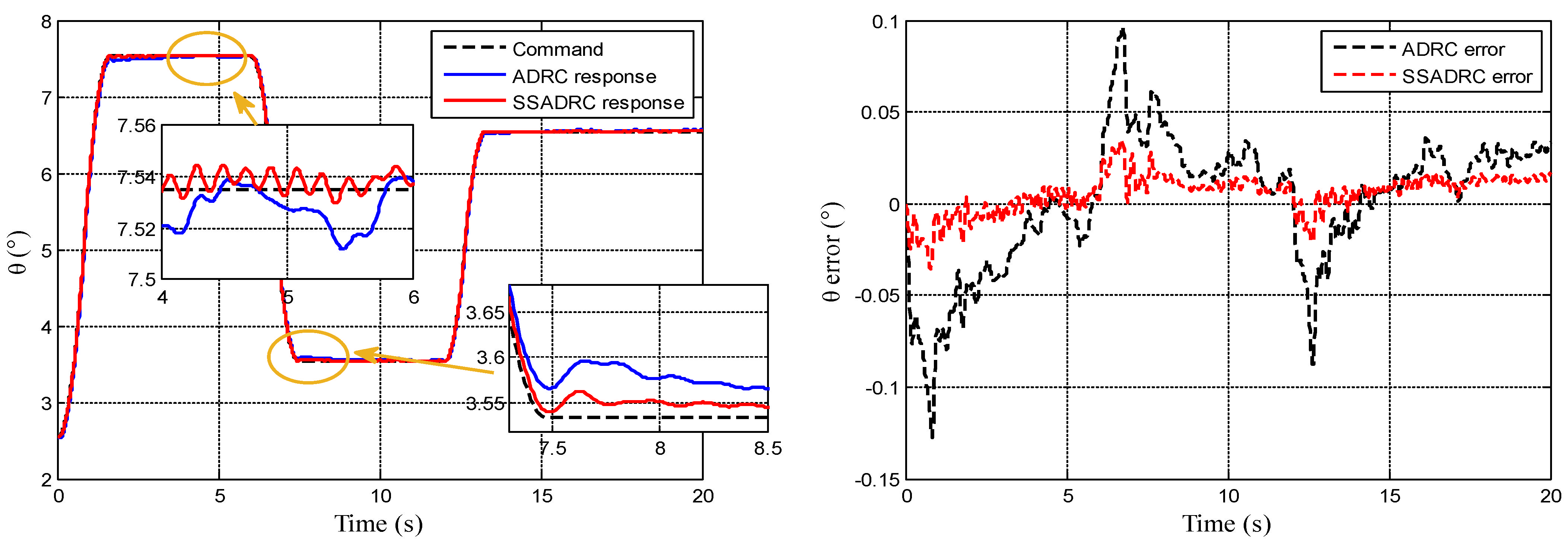
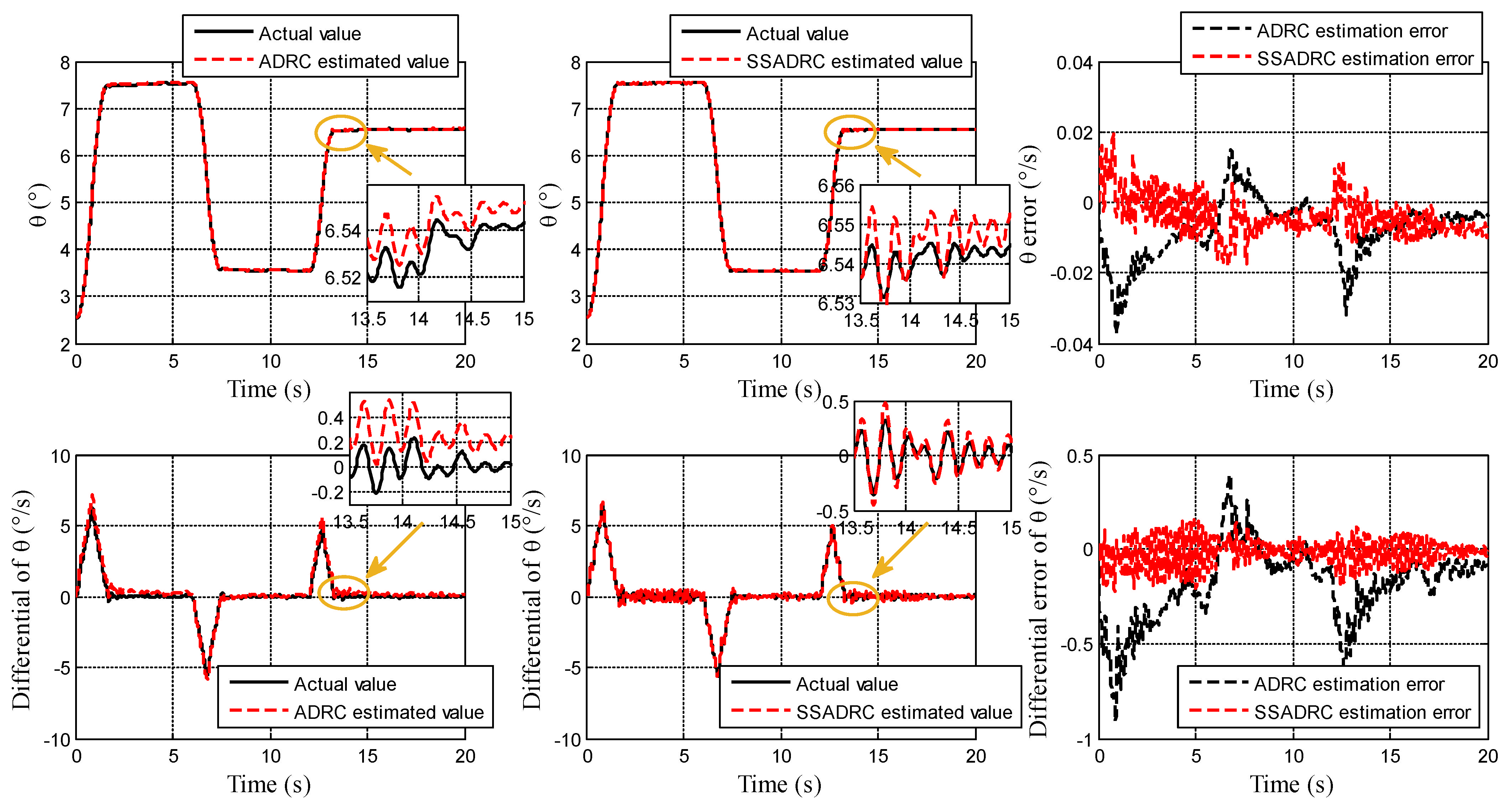
Moreover, a comparative study between SSADRC and classical ADRC is conducted under atmospheric turbulence conditions, and Figure 11 presents the components of atmospheric turbulence along the three axes of the aircraft-body coordinate system. Figure 12 shows that SSADRC has a better command tracking performance than typical ADRC under atmospheric turbulence. The tracking error of SSADRC is within ±0.05°, while the tracking error of typical ADRC is within ±0.15°. Figure 13 demonstrates that SSADRC outperforms ADRC in terms of estimation accuracy. Specifically, for aircraft pitch angle, the estimation error of SSADRC is within ±0.02°, compared to ±0.04° for ADRC. As for the differential of aircraft pitch angle, the maximum estimation error of SSADRC is approximately 0.2 °/s, whereas ADRC has a maximum estimation error of about 1 °/s. Additionally, during sudden changes in the command signal, the differential of pitch angle also undergoes abrupt changes. ADRC is prone to significant estimation errors in such scenarios, while SSADRC remains capable of providing precise estimation results.
The above comparative analysis confirms that SSADRC delivers markedly better command tracking and state estimation precision than classical ADRC when subjected to sensor noise and atmospheric turbulence. SSADRC exhibits smaller tracking errors, more-accurate state estimates, and notably robust performance even during sudden command signal changes, where ADRC is prone to significant estimation errors. This demonstrates the overall stronger disturbance rejection and robustness of the SSADRC controller.

5. Conclusions and Future Work

This article develops an improved active disturbance rejection control method based on the soft-sign function, designed for robust attitude tracking control of fixed-wing UAVs under time-varying unknown disturbances. Moreover, a hybrid grey wolf optimizer with balanced exploration–exploitation mechanisms is presented for intelligent parameter optimization, which integrates the good point set-based initialization strategy, the fitness-based dynamic-weight strategy, the diversity-based adaptive-mutation strategy, and the logistic chaotic map-based survival-of-the-fittest strategy. Extensive numerical simulation results demonstrate: (1) the HGWO stands out for its exceptional convergence speed and accuracy compared to seven other optimization algorithms, realizing the best optimization performance on the controller parameter tuning issue; and (2) SSADRC demonstrates a clear superiority over classical ADRC in the presence of both measurement noise and atmospheric turbulence, with reductions in command tracking error by roughly 30% and enhancements in state estimation accuracy by nearly 50%.
While the results are promising, it is important to note that they are currently based solely on simulation. Accordingly, future work will focus on hardware-in-the-loop (HIL) validation and flight experiments using real-world UAV platforms. Additionally, the HGWO-SSADRC framework could be enhanced by integrating online learning techniques to enable real-time parameter adaptation in fully uncertain environments.

Author Contributions

Conceptualization, H.L. and L.Z.; methodology, H.L., L.Z. and S.Z.; software, J.C. and Y.X.; validation, H.L., L.Z., J.C. and Y.X.; formal analysis, J.C., G.L. and S.Z.; investigation, H.L., L.Z. and Y.X.; resources, H.L. and L.Z.; data curation, H.L.; writing—original draft preparation, H.L. and L.Z.; writing—review and editing, H.L.; visualization, L.Z., J.C. and Y.X.; supervision, G.L. and S.Z.; funding acquisition, G.L. All authors have read and agreed to the published version of the manuscript.

Funding

This work is supported in part by the Aeronautical Science Foundation of China (No. 20240007053005), and in part by the Shaanxi Province Key Laboratory of Flight Control and Simulation Technology.

Data Availability Statement

The raw data supporting the conclusions of this article will be made available by the authors upon request.

Conflicts of Interest

The authors declare that they have no known competing financial interests or personal relationships that could have appeared to influence the work reported in this paper.

References

  1. Zhai, S.B.; Hou, M.S. Modified active disturbance rejection control for low-altitude logistics transport fixed-wing unmanned aerial vehicles. Appl. Math. Model. 2026, 151, 116584. [Google Scholar] [CrossRef] [Scilit]
  2. El Mobaraky, A.; Kouiss, K.; Chebak, A. Total energy control system-based interval type-3 fuzzy logic controller for fixed-wing unmanned aerial vehicle longitudinal flight dynamics. Aerosp. Sci. Technol. 2025, 162, 110253. [Google Scholar] [CrossRef] [Scilit]
  3. Gu, R.J.; Zhao, Y.F.; Ren, X.H. Integrating wind field analysis in UAV path planning: Enhancing safety and energy efficiency for urban logistics. Chin. J. Aeronaut. 2026, 39, 103605. [Google Scholar] [CrossRef] [Scilit]
  4. Rufino, G.; Conte, C.; Basso, P.; Tirri, A.E.; Donato, V. Mission Design and Validation of a Fixed-Wing Unmanned Aerial Vehicle for Environmental Monitoring. Drones 2024, 8, 641. [Google Scholar] [CrossRef] [Scilit]
  5. Liu, G.S.; Li, X.R.; Sun, S.; Zhao, X.; Li, B.L. Design of a multi-component system-based fixed-wing unmanned aerial vehicle maintenance policy and its case study. Comput. Ind. Eng. 2024, 198, 110701. [Google Scholar] [CrossRef] [Scilit]
  6. Shen, T.J.; Chen, C.L. Model-in-the-Loop Design and Flight Test Validation of Flight Control Laws for a Small Fixed-Wing UAV. Drones 2025, 9, 624. [Google Scholar] [CrossRef] [Scilit]
  7. Le-Phan, N.M.; Dinh, D.L.; Duc, A.N.D.; Van, N.P. Inverse Optimal-Based Attitude Control for Fixed-Wing Unmanned Aerial Vehicles. IEEE Access 2023, 11, 52996–53005. [Google Scholar] [CrossRef] [Scilit]
  8. Zhang, N.W.; Peng, C.C. Loop Shaping-Based Attitude Controller Design and Flight Validation for a Fixed-Wing UAV. Drones 2025, 9, 697. [Google Scholar] [CrossRef] [Scilit]
  9. Yang, Z.Y.; Luo, D.L.; Guo, Z.Y.; Xu, Y. Adaptive predefined-time path-following control for fixed-wing UAV formations with prescribed performance. Appl. Math. Model. 2025, 147, 116173. [Google Scholar] [CrossRef] [Scilit]
  10. Zhai, S.B.; Li, G.W.; Cheng, J.M.; Hou, M.S. GBAS-based high-precision automatic landing guidance for civil aircraft using improved active disturbance rejection control. Results Eng. 2025, 27, 105716. [Google Scholar] [CrossRef] [Scilit]
  11. Wu, Q.L.; Zhu, Q.D. Prescribed Performance Fault-Tolerant Attitude Tracking Control for UAV with Actuator Faults. Drones 2024, 8, 204. [Google Scholar] [CrossRef] [Scilit]
  12. Eren, U.; Prach, A.; Koçer, B.B.; Rakovic, S.V.; Kayacan, E.; Açikmese, B. Model Predictive Control in Aerospace Systems: Current State and Opportunities. J. Guid. Control Dyn. 2017, 40, 1541–1566. [Google Scholar] [CrossRef] [Scilit]
  13. Ebrahimpour, M.; Lungu, M.; Mobayen, S.; Wang, R. Adaptive finite-time second-order sliding mode attitude control for fixed-wing UAVs. Appl. Math. Model. 2026, 155, 116745. [Google Scholar] [CrossRef] [Scilit]
  14. Souanef, T. Adaptive Path-Following of Small Fixed-Wing Unmanned Aerial Vehicles in Wind. IEEE Trans. Aerosp. Electron. Syst. 2022, 58, 3708–3716. [Google Scholar] [CrossRef] [Scilit]
  15. Zhang, H.G.; Zhang, X.K.; Liu, Y.J.; Gao, S.H.; Ma, D.C. Event-triggered adaptive tracking control for USV based on enhanced optimized backstepping technique. ISA Trans. 2026, 168, 67–80. [Google Scholar] [CrossRef] [Scilit]
  16. Gao, Y.; Zhang, H.; Chen, X.; Lu, T.T.; Tan, S.Z.; Yang, H.; Gulliver, T. Tracking performance of the coaxial counter-paddle flight system using fractional active disturbance rejection controller. Appl. Math. Model. 2023, 121, 800–827. [Google Scholar] [CrossRef] [Scilit]
  17. Cao, M.Y.; Yang, J.; Li, S.H.; Madonski, R.; Xue, W.C. Cascaded Filter PID Paradigm for Error-Based Active Disturbance Rejection Control: Equivalence, Design, and Implementation Guidelines. IEEE T Ind. Electron. 2025, 72, 11714–11724. [Google Scholar] [CrossRef] [Scilit]
  18. Wang, B.H.; Yan, Y.H.; Xiong, X.Z.; Han, Q.; Li, Z.G. Attitude Control of Small Fixed-Wing UAV Based on Sliding Mode and Linear Active Disturbance Rejection Control. Drones 2024, 8, 318. [Google Scholar] [CrossRef] [Scilit]
  19. Khadraoui, S.; Fareh, R.; Baziyad, M.; Elbeltagy, M.B.; Bettayeb, M. A Comprehensive Review and Applications of Active Disturbance Rejection Control for Unmanned Aerial Vehicles. IEEE Access 2024, 12, 185851–185868. [Google Scholar] [CrossRef] [Scilit]
  20. Li, Y.R.; Jiang, Y.X.; Lu, J.Y.; Tan, C. Improved active disturbance rejection control for electro-hydrostatic actuators via actor-critic reinforcement learning. Eng. Appl. Artif. Intell. 2025, 158, 111485. [Google Scholar] [CrossRef] [Scilit]
  21. Sun, C.; Zhu, H.Q. Active Disturbance Rejection Control of Bearingless Permanent Magnet Slice Motor Based on RPROP Neural Network Optimized by Improved Differential Evolution Algorithm. IEEE Trans. Power Electr. 2024, 39, 3064–3074. [Google Scholar] [CrossRef] [Scilit]
  22. Huang, C.Z.; Zhuang, J.N. Error-Based Active Disturbance Rejection Control for Pitch Control of Wind Turbine by Improved Coyote Optimization Algorithm. IEEE Trans. Energy Convers. 2022, 37, 1394–1405. [Google Scholar] [CrossRef] [Scilit]
  23. He, H.X.; Duan, H.B. A multi-strategy pigeon-inspired optimization approach to active disturbance rejection control parameters tuning for vertical take-off and landing fixed-wing UAV. Chin. J. Aeronaut. 2022, 35, 19–30. [Google Scholar] [CrossRef] [Scilit]
  24. Srikanth, M.V.; Yadaiah, N. Optimal parameter tuning of Modified Active Disturbance Rejection Control for unstable time-delay systems using an AHP combined Multi-Objective Quasi-Oppositional Jaya Algorithm. Appl. Soft Comput. 2020, 86, 105881. [Google Scholar] [CrossRef] [Scilit]
  25. Yang, Z.B.; Lu, C.L.; Sun, X.D.; Ji, J.L.; Ding, Q.F. Study on Active Disturbance Rejection Control of a Bearingless Induction Motor Based on an Improved Particle Swarm Optimization-Genetic Algorithm. IEEE Trans. Transp. Electr. 2021, 7, 694–705. [Google Scholar] [CrossRef] [Scilit]
  26. Ren, J.; Chen, Z.Q.; Yang, Y.K.; Sun, M.W.; Sun, Q.L.; Wang, Z.H. Grey Wolf Optimization Based Active Disturbance Rejection Control Parameter Tuning for Ship Course. Int. J. Control Autom. 2022, 20, 842–856. [Google Scholar] [CrossRef] [Scilit]
  27. Zhai, S.B.; Li, G.W.; Cheng, J.M.; Hou, M.S. Anti-crosswind lateral landing guidance for civil aircraft using adaptive particle swarm optimization-based active disturbance rejection control. Appl. Math. Model. 2026, 154, 116667. [Google Scholar] [CrossRef] [Scilit]
  28. Lozgachev, G.I. On a method of construction of Lyapunov functions. Autom. Remote Control 1998, 59, 1365–1369. [Google Scholar]
  29. Zhai, S.B.; Li, G.W.; Du, X.Y.; Hou, M.S. Civil aircraft longitudinal center-of-gravity position estimation combining domain knowledge and simulation data. Results Eng. 2025, 26, 105594. [Google Scholar] [CrossRef] [Scilit]
  30. Yu, X.B.; Hu, Z.P. A multi-strategy driven reinforced hierarchical operator in the grey wolf optimizer for feature selection. Inform. Sci. 2024, 677, 120924. [Google Scholar] [CrossRef] [Scilit]
  31. Kang, H.L.; Liu, R.Y.; Yao, Y.F.; Yu, F.H. Improved Harris hawks optimization for non-convex function optimization and design optimization problems. Math. Comput. Simul. 2023, 204, 619–639. [Google Scholar] [CrossRef] [Scilit]
  32. Liu, S.B.; Lin, Q.Z.; Li, Q.; Tan, K.C. A Comprehensive Competitive Swarm Optimizer for Large-Scale Multiobjective Optimization. IEEE Trans. Syst. Man Cybern. Syst. 2022, 52, 5829–5842. [Google Scholar] [CrossRef] [Scilit]
  33. Shehadeh, H.A. Chernobyl disaster optimizer (CDO): A novel meta-heuristic method for global optimization. Neural Comput. Appl. 2023, 35, 10733–10749. [Google Scholar] [CrossRef] [Scilit]
  34. Ingle, K.K.; Jatoth, R.K. Non-linear Channel Equalization using Modified Grasshopper Optimization Algorithm. Appl. Soft Comput. 2024, 153, 110091. [Google Scholar] [CrossRef] [Scilit]
  35. Zhong, C.T.; Li, G.; Meng, Z. Beluga whale optimization: A novel nature-inspired metaheuristic algorithm. Knowl.-Based Syst. 2022, 251, 109215. [Google Scholar] [CrossRef] [Scilit]
Figure 1. Schematic diagram of a classical second-order active disturbance rejection controller.
Drones 10 00210 g001
Figure 2. The proposed optimization-based active disturbance rejection control framework.
Drones 10 00210 g002
Figure 3. Comparison between the classical f a l ( ) function and the improved soft-sign function.
Drones 10 00210 g003
Figure 4. Comparison between good point set method and pseudo-random strategy.
Drones 10 00210 g004
Figure 5. Architecture and flowchart of HGWO-based SSADRC parameter tuning.
Drones 10 00210 g005
Figure 6. Comparative boxplots of algorithm performance.
Drones 10 00210 g006
Figure 7. Aircraft pitch angle curves based on the parameters optimized by different algorithms.
Drones 10 00210 g007
Figure 8. Convergence curves of different algorithms.
Drones 10 00210 g008
Figure 9. The comparison of SSADRC and typical ADRC in the presence of measurement noise.
Drones 10 00210 g009
Figure 10. Estimation results of SSADRC and typical ADRC in the presence of measurement noise.
Drones 10 00210 g010
Figure 11. Components of turbulence along the three axes of the aircraft-body coordinate system.
Drones 10 00210 g011
Figure 12. Comparison of SSADRC and typical ADRC under turbulence conditions.
Drones 10 00210 g012
Figure 13. Estimation results of SSADRC and typical ADRC under turbulence conditions.
Drones 10 00210 g013
Table 1. Ranking the above eight algorithms based on the average fitness.
GWOHHOPIOCSOCDOGOABWOHGWO
F142538671
F234517682
F325437681
F423658471
F526437581
F634527681
F734528671
F837514682
F943526781
F1045328761
F1142837651
F1235428761
Table 2. Comparative significance results based on Wilcoxon rank-sum test.
HGWOvs. GWOvs. HHOvs. PIOvs. CSOvs. CDOvs. GOAvs. BWO
F13.02 × 10−115.99 × 10−13.02 × 10−114.97 × 10−113.02 × 10−113.02 × 10−113.02 × 10⁻¹¹
F26.09 × 10−32.92 × 10−26.76 × 10−55.87 × 10−43.02 × 10−113.02 × 10−113.02 × 10⁻¹¹
F31.004.08 × 10−113.02 × 10−113.16 × 10−103.02 × 10−113.02 × 10−113.02 × 10⁻¹¹
F46.41 × 10−11.31 × 10−84.50 × 10−111.09 × 10−103.02 × 10−111.54 × 10−93.02 × 10−11
F51.39 × 10−63.02 × 10−113.02 × 10−116.52 × 10−93.02 × 10−113.02 × 10−113.02 × 10⁻¹¹
F63.01 × 10−41.47 × 10−76.12 × 10−91.49 × 10−33.02 × 10−118.88 × 10−63.02 × 10−11
F73.03 × 10−29.53 × 10−74.50 × 10−111.05 × 10−13.02 × 10−111.07 × 10−93.02 × 10−11
F81.41 × 10−13.32 × 10−62.27 × 10−34.92 × 10−11.22 × 10−11.09 × 10−53.02 × 10−11
F91.03 × 10−65.97 × 10−93.02 × 10−118.89 × 10−103.02 × 10−113.02 × 10−113.02 × 10⁻¹¹
F105.56 × 10−43.33 × 10−113.02 × 10−111.08 × 10−23.02 × 10−113.02 × 10−113.02 × 10⁻¹¹
F113.47 × 10−101.86 × 10−93.02 × 10−112.96 × 10−53.02 × 10−113.02 × 10−113.02 × 10⁻¹¹
F125.08 × 10−29.92 × 10−112.44 × 10−93.24 × 10−13.02 × 10−113.02 × 10−113.02 × 10⁻¹¹
Disclaimer/Publisher’s Note: The statements, opinions and data contained in all publications are solely those of the individual author(s) and contributor(s) and not of MDPI and/or the editor(s). MDPI and/or the editor(s) disclaim responsibility for any injury to people or property resulting from any ideas, methods, instructions or products referred to in the content.