Mid-Air Collision Risk for Urban Air Mobility: A Review


 , , ,
, , ,
Highlights
- This review summarizes the international research conducted on mid-air collision risk and safety modeling for Urban Air Mobility (UAM), covering airspace structuring, enabling technologies, and collision-avoidance frameworks.
- It identifies common patterns and limitations across existing approaches, and clarifies how the current risk models, airspace designs, and operational technologies interact within the emerging UAM systems.
- This analysis provides a consolidated reference for researchers, method developers, and regulators seeking to understand the state of safety research and remaining challenges in urban low-altitude operations.
- The outlined research gaps and trends can help guide future studies toward more integrated, data-driven, and safety-oriented frameworks for UAM management.
Abstract
1. Introduction
1.1. Backgrounds
1.2. Motivation and Contributions
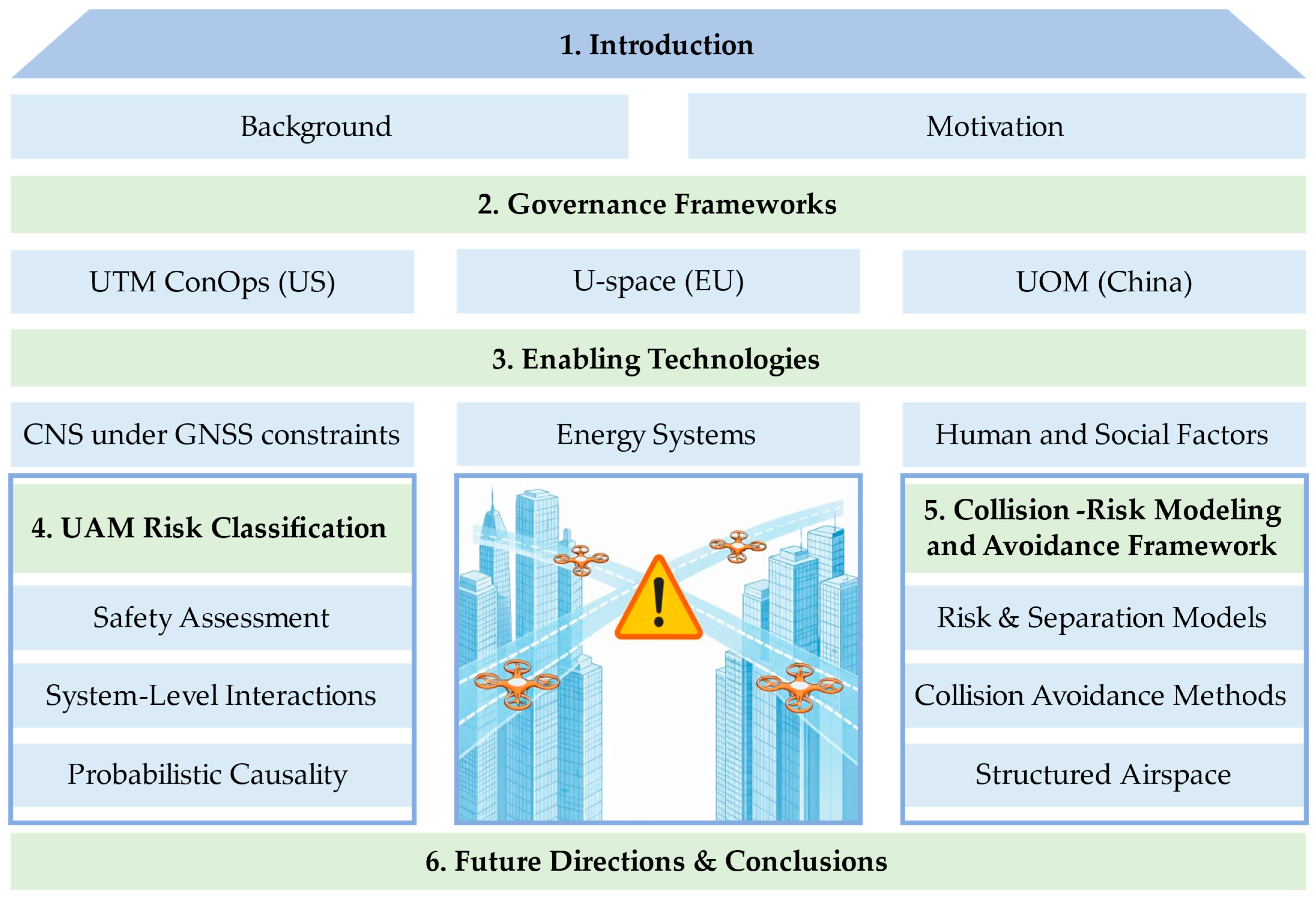
- To construct a comparative framework for UAM airspace management by analyzing the representative structuring models and reviewing the regulatory and operational practices in the United States (UTM ConOps v2.0), the European Union (U-space), and China (UOM).
- To investigate the enabling technologies and operational factors that affect collision risk, including the reliability of CNS systems under Global Navigation Satellite System (GNSS)-degraded conditions, the safety and endurance limits of battery systems, and the role of human supervision in UAM operations.
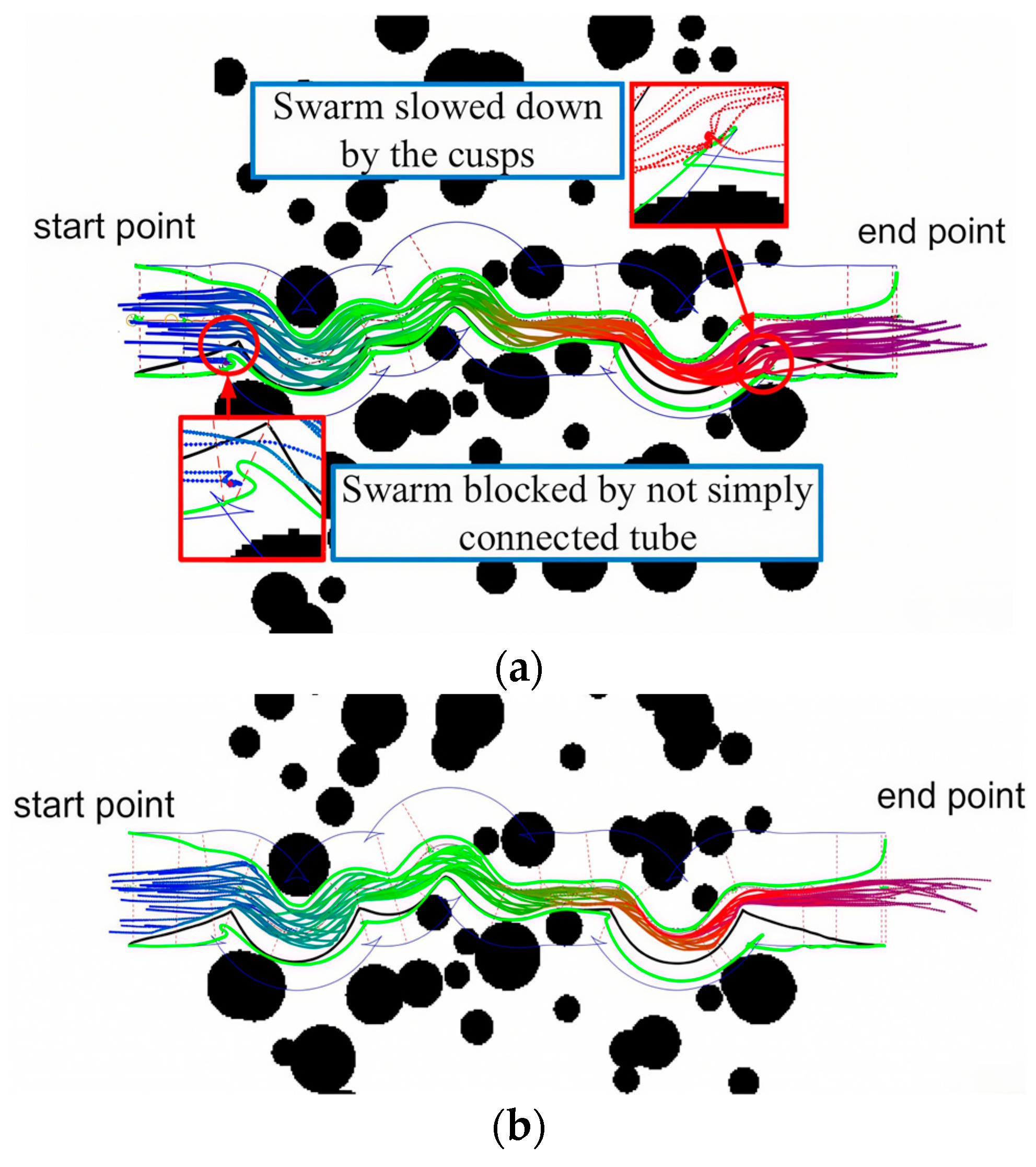
- To review and assess the existing risk evaluation and collision-avoidance methodologies, including deterministic and probabilistic separation models, geometric and optimization-based approaches, and structured airspace frameworks such as the virtual-tube concept for large-scale swarm operations.
- RQ1: How do different governance architectures differ in terms of service provisioning and operational accountability, and what do these differences imply for structured UAM airspace management?
- RQ2: Under realistic urban conditions, how do CNS reliability in GNSS-degraded environments, energy constraints, and human supervision shape the uncertainty and assumptions underlying mid-air collision risk assessment?
- RQ3: Given the above information regimes and operational constraints, what are the strengths, limitations, and applicability conditions of existing risk evaluation and collision-avoidance methodologies, including deterministic and probabilistic separation, geometric and optimization-based approaches, and structured airspace frameworks such as virtual tubes?
2. The Current UAM Framework
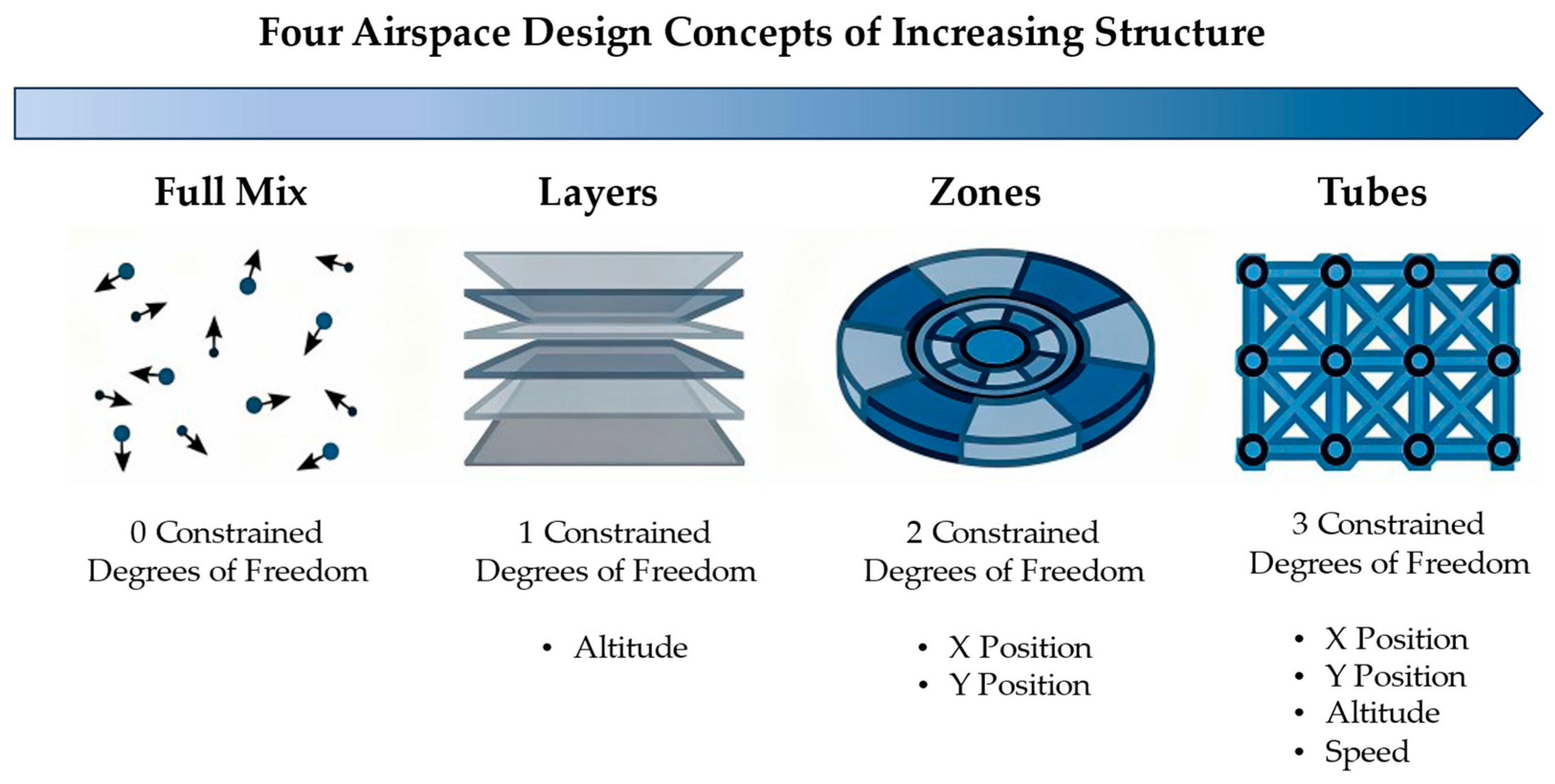
2.1. Concept of Structured Airspace for UAM
2.2. The US UTM ConOps v2.0
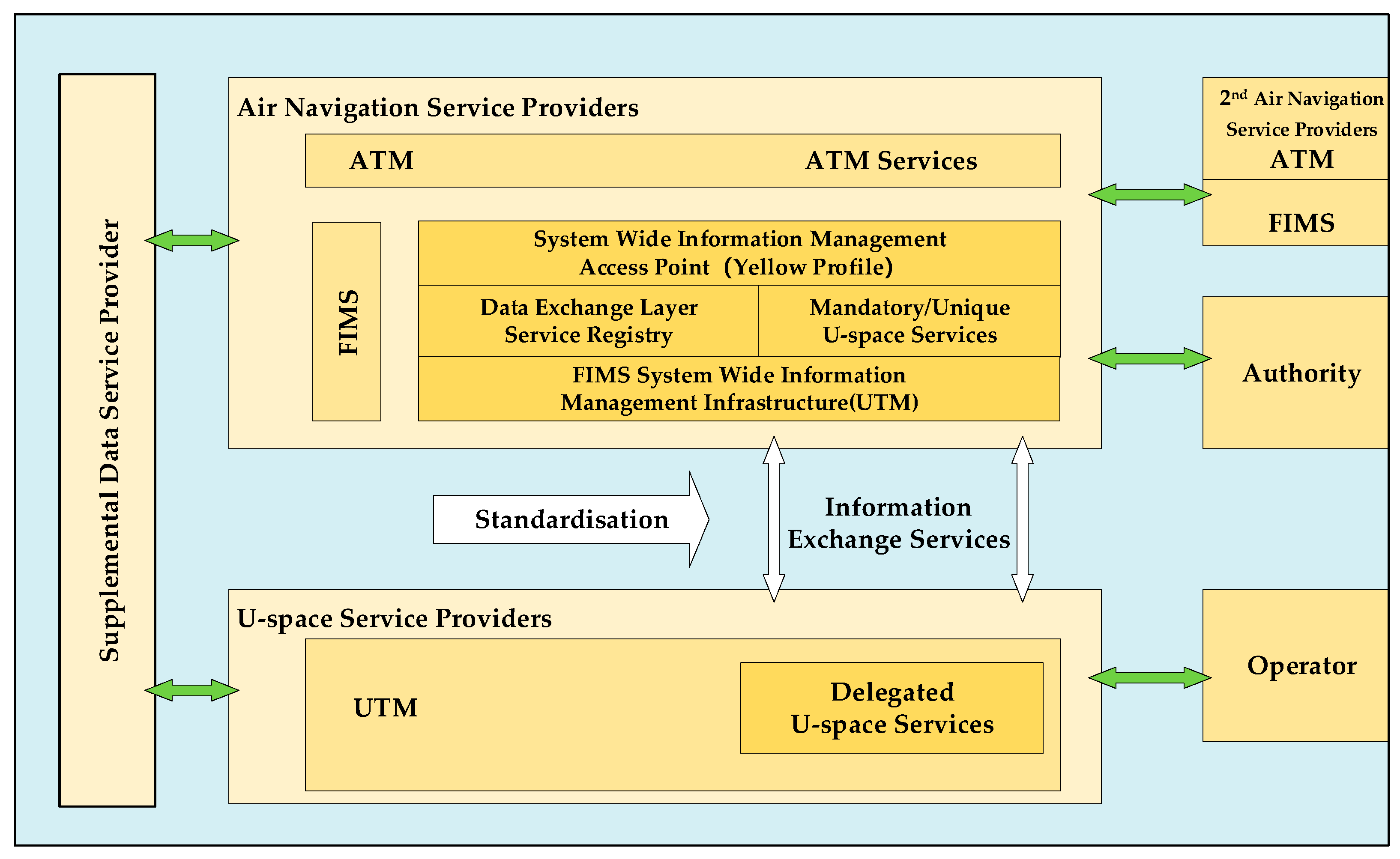
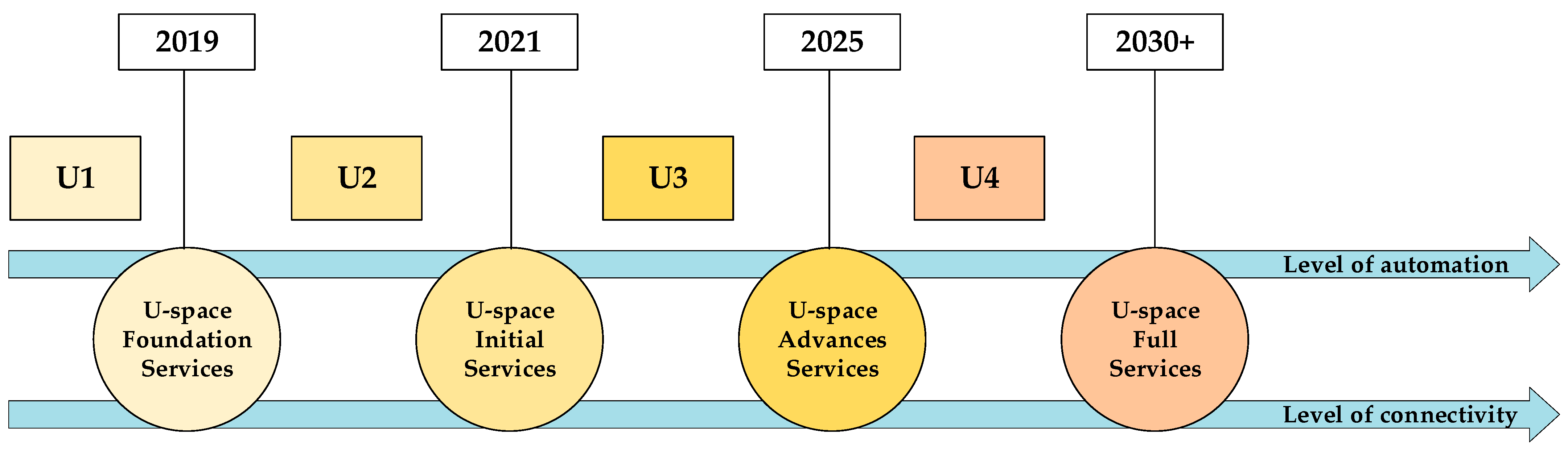
2.3. The European U-Space

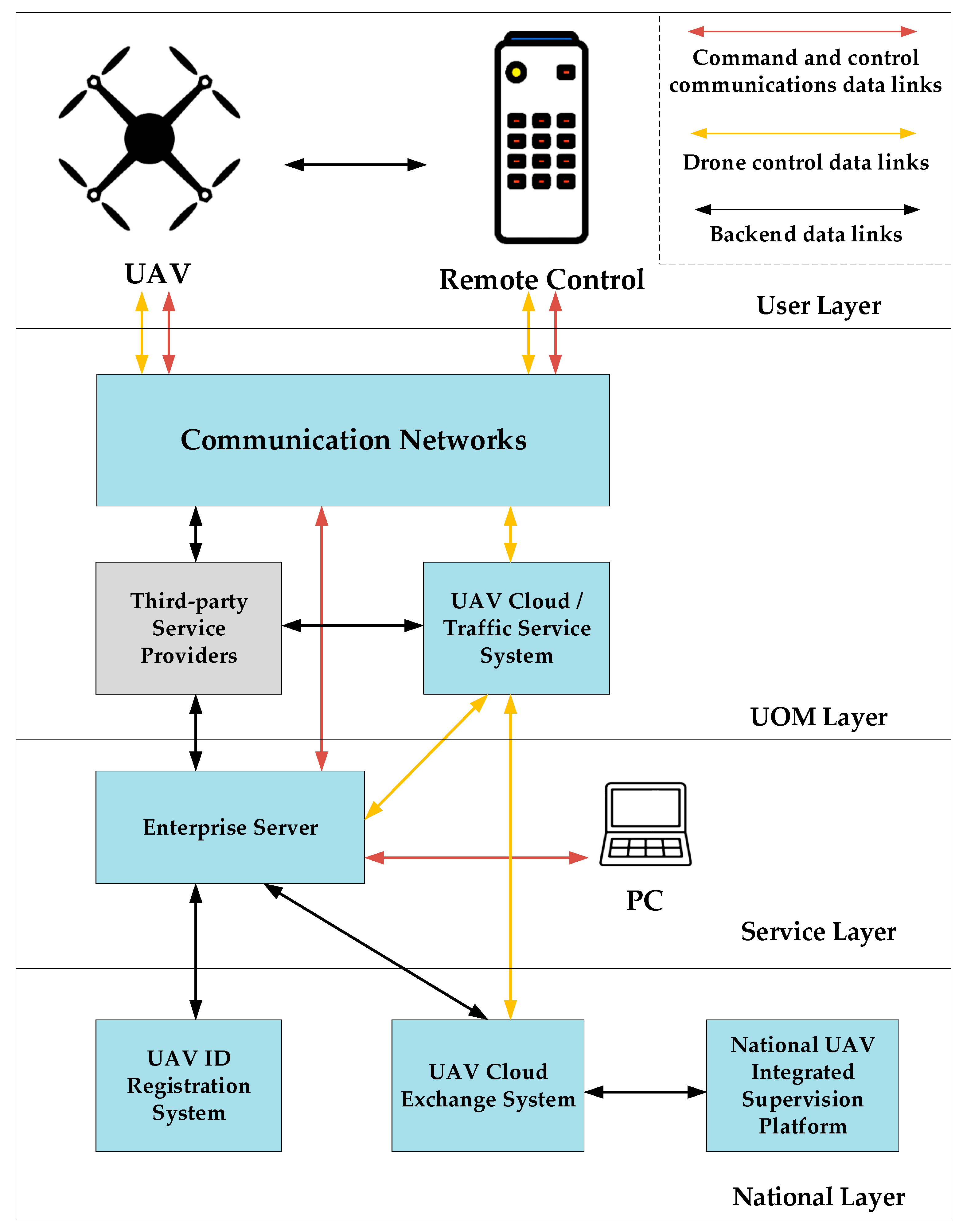
2.4. The UAM Framework of China
2.5. Comparative Analysis
3. Enabling Technologies and Operational Factors for UAM
3.1. Communication, Navigation, and Sensing Under GNSS Constraints
3.2. Advances in Battery Technologies

| Pathway | Cell-Level Energy | Evidence Level | Refs. |
|---|---|---|---|
| Target level | ~500 Wh/kg | Requirement estimate | [45,73,74,75] |
| Lithium-ion (aviation-grade) | ~200–300 Wh/kg | Mature/deployed | [76] |
| Solid-state lithium-metal | >400 Wh/kg | Laboratory prototype | [77] |
| Lithium–sulfur | ~441 Wh/kg | Advanced demonstration | [78] |
3.3. Human-in-the-Loop and Societal Acceptance
4. Flight Risks for UAM: Categories and an Evaluation Framework
4.1. UAM Flight Risk Categories
4.2. UAM Flight Risk Evaluation Framework
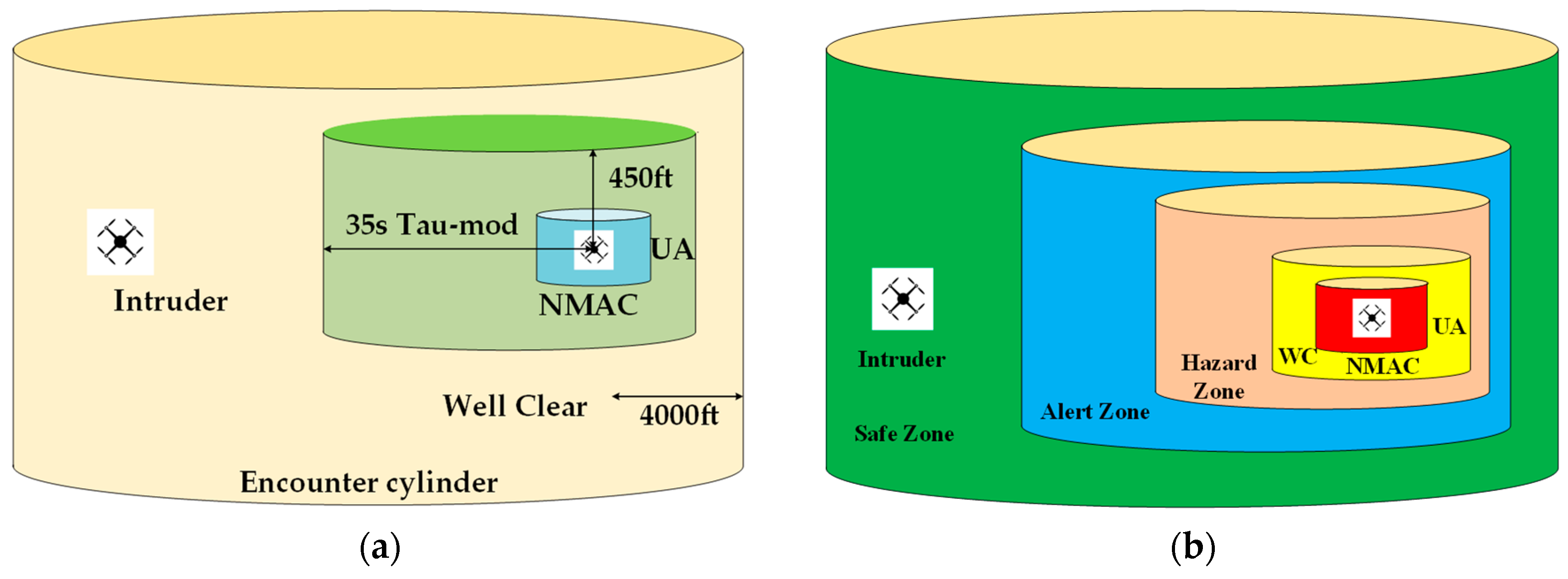
4.3. Mid-Air Collision Models
5. Collision-Avoidance Modeling Frameworks for UAM
5.1. Deterministic and Probabilistic Separation Models
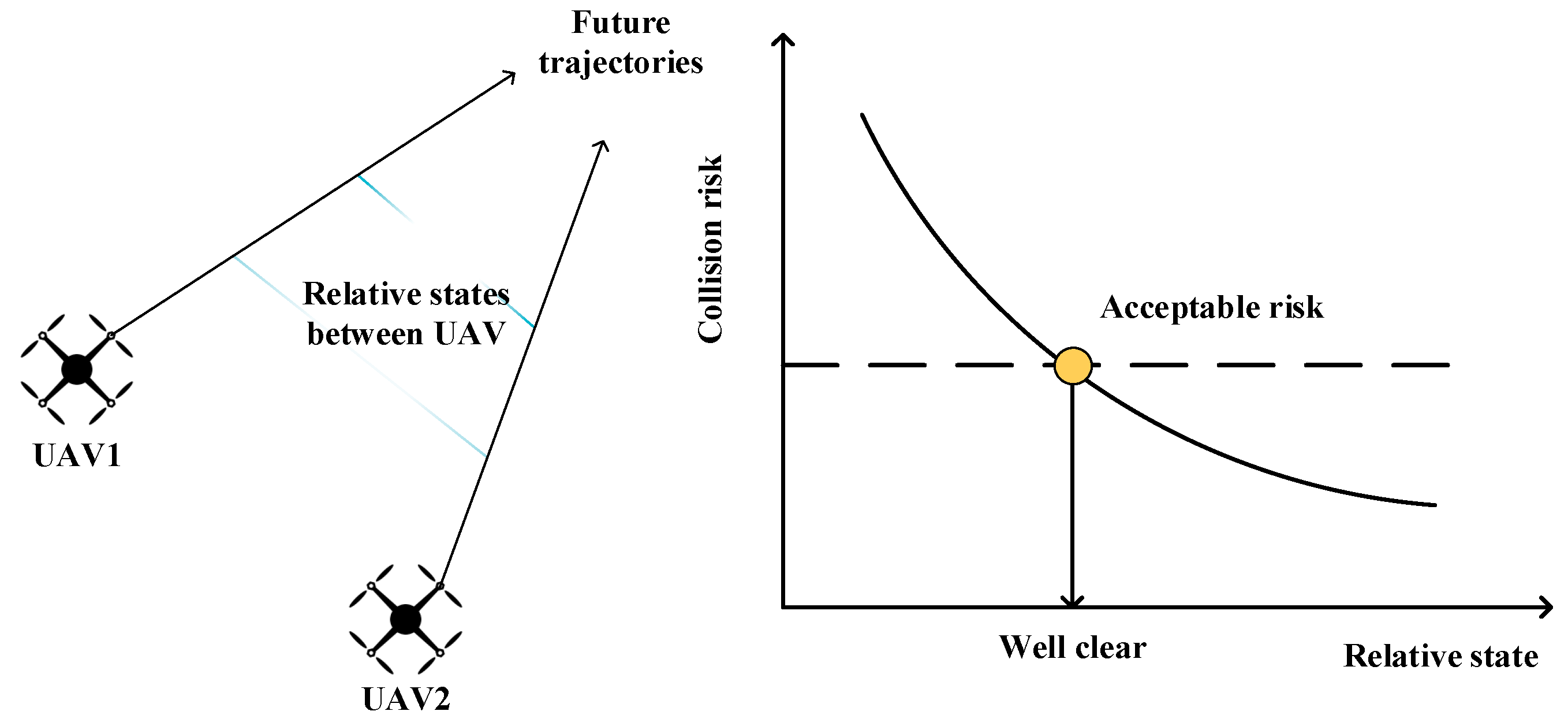
5.1.1. Separation Threshold
5.1.2. Deterministic Separation
5.1.3. Probabilistic Separation
5.2. Tactical Collision-Avoidance Methods
5.2.1. Reactive Geometry Methods
5.2.2. Optimization-Based Deconfliction
5.2.3. Receding-Horizon Control
5.2.4. Safety Filters
5.2.5. Learning-Based Methods
5.3. Collision Avoidance for Specific Structured Airspace
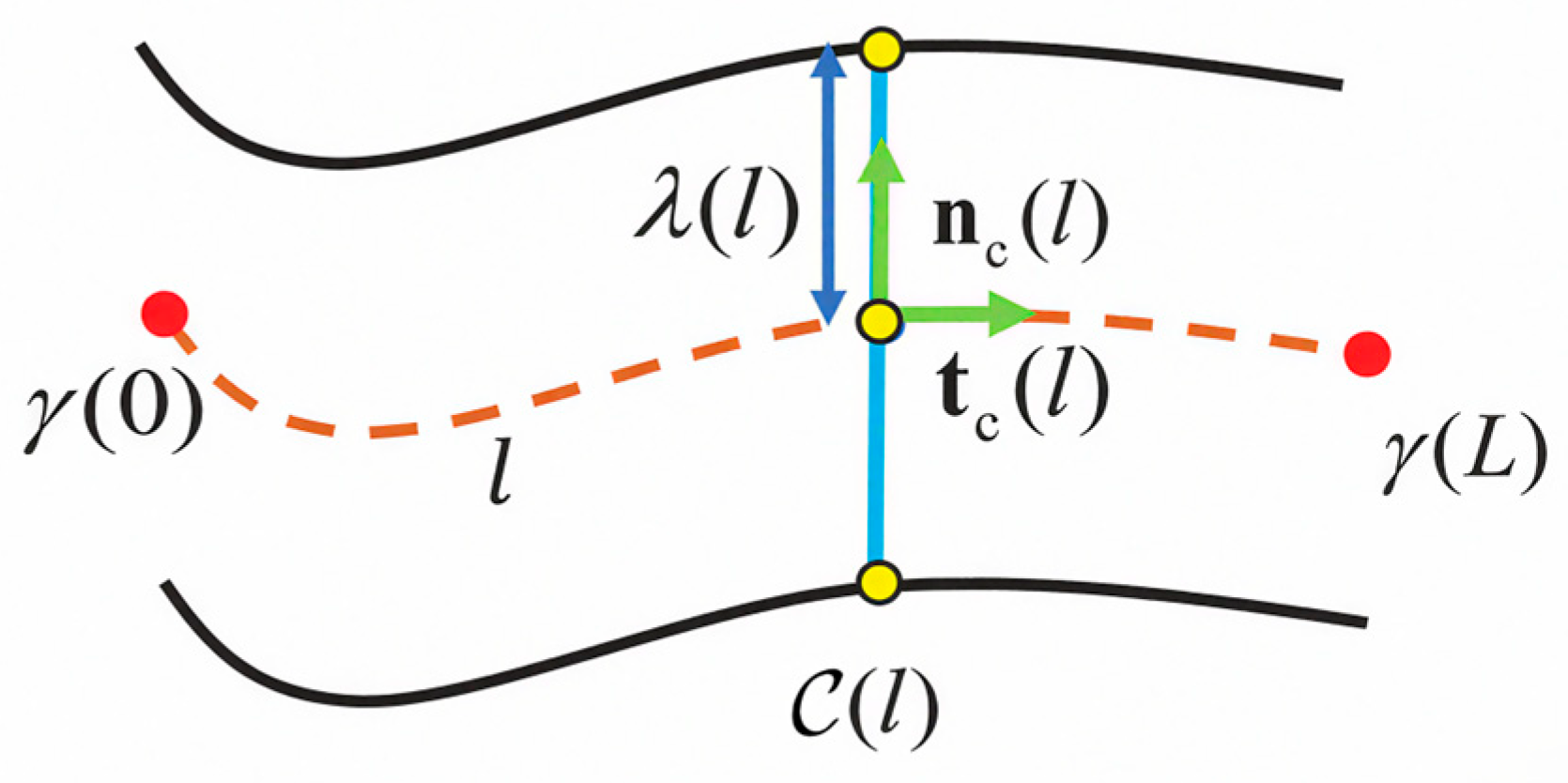
5.4. Virtual Tube Path Planning for UAV Swarms in Structured Airspace
6. Future Directions and Conclusions
6.1. Limitations and Future Directions
6.2. Conclusions
Author Contributions
Funding
Data Availability Statement
Acknowledgments
Conflicts of Interest
Abbreviations
| ATM | Air Traffic Management |
| ATC | Air Traffic Control |
| ADS-B | Automatic Dependent Surveillance–Broadcast |
| CAAC | Civil Aviation Administration of China |
| CBF | Control Barrier Function |
| CNS | Communication, Navigation, and Surveillance |
| DAA | Detect-and-Avoid |
| DRL | Deep Reinforcement Learning |
| DWC | DAA Well Clear |
| eVTOL | Electric Vertical Take-Off and Landing |
| EASA | European Union Aviation Safety Agency |
| FAA | Federal Aviation Administration |
| FIMS | Flight Information Management System |
| GCBF | Graph Control Barrier Function |
| GNSS | Global Navigation Satellite System |
| ICAO | International Civil Aviation Organization |
| LoDWC | Loss of DAA Well Clear |
| MPC | Model Predictive Control |
| MVP | Modified Voltage Potential |
| NASA | National Aeronautics and Space Administration |
| NMAC | Near Midair Collision |
| ORCA | Optimal Reciprocal Collision Avoidance |
| RVO | Reciprocal Velocity Obstacle |
| SAIL | Safety Assurance and Integrity Level |
| SESAR JU | Single European Sky ATM Research Joint Undertaking |
| SoC | State of Charge |
| SoH | State of Health |
| SORA | Specific Operations Risk Assessment |
| TCAS | Traffic Collision-Avoidance System |
| TLS | Target Level of Safety |
| UAV | Unmanned Aerial Vehicle |
| UAS | Unmanned Aircraft System |
| UOM | Unmanned Operation Management System |
| UTM | Unmanned Aircraft Systems Traffic Management |
| UAM | Urban Air Mobility |
| UML | UAM Maturity Level |
| VO | Velocity Obstacle |
| VLL | Very Low Level |
Appendix A
References
- Zhang, J.; Xu, Y.; Cai, K.; Gordo, V.; Inalhan, G. Quantitative Assessment of Mid-Air Collision Probability in Urban Air Mobility: A Safety Barrier-Based Framework for Integrated Operations. Commun. Transp. Res. 2025, 5, 100230. [Google Scholar] [CrossRef]
- Wandelt, S.; Wang, S.; Zheng, C.; Sun, X. AERIAL: A Meta Review and Discussion of Challenges toward Unmanned Aerial Vehicle Operations in Logistics, Mobility, and Monitoring. IEEE Trans. Intell. Transp. Syst. 2023, 25, 6276–6289. [Google Scholar] [CrossRef]
- Decker, C.; Chiambaretto, P. Economic Policy Choices and Trade-Offs for Unmanned Aircraft Systems Traffic Management (UTM): Insights from Europe and the United States. Transp. Res. Part A Policy Pract. 2022, 157, 40–58. [Google Scholar] [CrossRef]
- Fasano, G.; Crespillo, O.G.; Sabatini, R.; Roy, A.; Ogan, R. From the Editors of the Special Issue on Urban Air Mobility and UAS Airspace Integration: Vision, Challenges, and Enabling Avionics Technologies. IEEE Aerosp. Electron. Syst. Mag. 2023, 38, 4–5. [Google Scholar] [CrossRef]
- Aposporis, P. A Review of Global and Regional Frameworks for the Integration of an Unmanned Aircraft System in Air Traffic Management. Transp. Res. Interdiscip. Perspect. 2024, 24, 101064. [Google Scholar] [CrossRef]
- Scott, D.; Radmanesh, M.; Sarim, M.; Deshpande, A.; Ku-mar, M.; Pragada, R. Distributed Bidding-Based Detect-and-Avoid for Multiple Unmanned Aerial Vehicles in National Airspace. In Proceedings of the 2019 International Conference on Unmanned Aircraft Systems (ICUAS); IEEE: New York, NY, USA, 2019; pp. 930–936. [Google Scholar]
- Labib, N.S.; Danoy, G.; Musial, J.; Brust, M.R.; Bouvry, P. A Multilayer Low-Altitude Airspace Model for UAV Traffic Management. In Proceedings of the 9th ACM Symposium on Design and Analysis of Intelligent Vehicular Networks and Applications, Miami Beach, FL, USA, 25–29 November 2019; pp. 57–63. [Google Scholar]
- Sarim, M.; Radmanesh, M.; Dechering, M.; Kumar, M.; Pragada, R.; Cohen, K. Distributed Detect-and-Avoid for Multiple Unmanned Aerial Vehicles in National Air Space. J. Dyn. Syst. Meas. Control 2019, 141, 071014. [Google Scholar] [CrossRef]
- Ali, B.S. Traffic Management for Drones Flying in the City. Int. J. Crit. Infrastruct. Prot. 2019, 26, 100310. [Google Scholar] [CrossRef]
- Barr, L.C.; Newman, R.; Ancel, E.; Belcastro, C.M.; Foster, J.V.; Evans, J.; Klyde, D.H. Preliminary Risk Assessment for Small Unmanned Aircraft Systems. In Proceedings of the 17th AIAA Aviation Technology, Integration, and Operations Conference, Denver, CO, USA, 5–9 June 2017; p. 3272. [Google Scholar]
- Melnyk, R.; Schrage, D.; Volovoi, V.; Jimenez, H. Sense and Avoid Requirements for Unmanned Aircraft Systems Using a Target Level of Safety Approach. Risk Anal. 2014, 34, 1894–1906. [Google Scholar] [CrossRef]
- Jiang, T.; Geller, J.; Ni, D.; Collura, J. Unmanned Aircraft System Traffic Management: Concept of Operation and System Architecture. Int. J. Transp. Sci. Technol. 2016, 5, 123–135. [Google Scholar] [CrossRef]
- Mondoloni, S.; Rozen, N. Aircraft Trajectory Prediction and Synchronization for Air Traffic Management Applications. Prog. Aerosp. Sci. 2020, 119, 100640. [Google Scholar] [CrossRef]
- Alam, M.S.; Oluoch, J. A Survey of Safe Landing Zone Detection Techniques for Autonomous Unmanned Aerial Vehicles (UAVs). Expert Syst. Appl. 2021, 179, 115091. [Google Scholar] [CrossRef]
- Yu, X.; Zhang, Y. Sense and Avoid Technologies with Applications to Unmanned Aircraft Systems: Review and Prospects. Prog. Aerosp. Sci. 2015, 74, 152–166. [Google Scholar] [CrossRef]
- Hunter, G.; Wei, P. Service-Oriented Separation Assurance for Small UAS Traffic Management. In Proceedings of the 2019 Integrated Communications, Navigation and Surveillance Conference (ICNS); IEEE: New York, NY, USA, 2019; pp. 1–11. [Google Scholar]
- Bauranov, A.; Rakas, J. Designing Airspace for Urban Air Mobility: A Review of Concepts and Approaches. Prog. Aerosp. Sci. 2021, 125, 100726. [Google Scholar] [CrossRef]
- Panov, I.; Ul Haq, A. A Critical Review of Information Provision for U-Space Traffic Autonomous Guidance. Aerospace 2024, 11, 471. [Google Scholar] [CrossRef]
- Guan, X.; Lyu, R.; Shi, H.; Chen, J. A Survey of Safety Separation Management and Collision Avoidance Approaches of Civil UAS Operating in Integration National Airspace System. Chin. J. Aeronaut. 2020, 33, 2851–2863. [Google Scholar] [CrossRef]
- Du, S.; Zhong, G.; Wang, F.; Pang, B.; Zhang, H.; Jiao, Q. Safety Risk Modelling and Assessment of Civil Unmanned Aircraft System Operations: A Comprehensive Review. Drones 2024, 8, 354. [Google Scholar] [CrossRef]
- Federal Aviation Administration Urban Air Mobility (UAM) Concept of Operations v2.0. Available online: https://www.faa.gov/sites/faa.gov/files/Urban%20Air%20Mobility%20%28UAM%29%20Concept%20of%20Operations%202.0_1.pdf (accessed on 17 August 2025).
- Advanced Air Mobility (AAM) Implementation Plan. Available online: https://www.faa.gov/sites/faa.gov/files/AAM-I28-Implementation-Plan.pdf (accessed on 17 August 2025).
- Vempati, L.; Geffard, M.; Anderegg, A. Assessing Human-Automation Role Challenges for Urban Air Mobility (UAM) Operations. In Proceedings of the 2021 IEEE/AIAA 40th Digital Avionics Systems Conference (DASC); IEEE: New York, NY, USA, 2021; pp. 1–6. [Google Scholar]
- Special Condition for VTOL and Means of Compliance. Available online: https://www.easa.europa.eu/en/document-library/product-certification-consultations/special-condition-vtol (accessed on 17 August 2025).
- Commission Implementing Regulation (EU) 2021/664 of 22 April 2021 on a Regulatory Framework for the U-Space. Available online: https://eur-lex.europa.eu/eli/reg_impl/2021/664/oj/eng (accessed on 17 August 2025).
- Lv, D.; Zhang, W.; Wang, K.; Hao, H.; Yang, Y. Urban Aerial Mobility for Airport Shuttle Service. Transp. Res. Part A Policy Pract. 2024, 188, 104202. [Google Scholar] [CrossRef]
- Yao, E.; Guo, D.; Liu, S.; Zhang, J. The Role of Technology Belief, Perceived Risk and Initial Trust in Users’ Acceptance of Urban Air Mobility: An Empirical Case in China. Multimodal Transp. 2024, 3, 100169. [Google Scholar] [CrossRef]
- Scheff, S.; Friedman-berg, F.; Shively, J.; Carter, A. Human Factors Challenges in Urban Air Mobility. Proc. Hum. Factors Ergon. Soc. Annu. Meet. 2020, 64, 179–182. [Google Scholar] [CrossRef]
- Shihab, S.A.M.; Wei, P.; Ramirez, D.S.J.; Mesa-Arango, R.; Bloebaum, C. By Schedule or on Demand?-A Hybrid Operation Concept for Urban Air Mobility. In Proceedings of the AIAA Aviation 2019 Forum, Dallas, TX, USA, 17–21 June 2019; p. 3522. [Google Scholar]
- Goodrich, K.H.; Theodore, C.R. Description of the NASA Urban Air Mobility Maturity Level (UML) Scale. In Proceedings of the AIAA Scitech 2021 Forum, virtually, 11–15 January 2021; p. 1627. [Google Scholar]
- Tang, H.; Zhang, Y.; Mohmoodian, V.; Charkhgard, H. Automated Flight Planning of High-Density Urban Air Mobility. Transp. Res. Part C Emerg. Technol. 2021, 131, 103324. [Google Scholar] [CrossRef]
- Dai, W.; Pang, B.; Low, K.H. Conflict-Free Four-Dimensional Path Planning for Urban Air Mobility Considering Airspace Occupancy. Aerosp. Sci. Technol. 2021, 119, 107154. [Google Scholar] [CrossRef]
- Wu, Y.; Low, K.H.; Hu, X. Trajectory-Based Flight Scheduling for AirMetro in Urban Environments by Conflict Resolution. Transp. Res. Part C Emerg. Technol. 2021, 131, 103355. [Google Scholar] [CrossRef]
- Truong, D.; Choi, W. Using Machine Learning Algorithms to Predict the Risk of Small Unmanned Aircraft System Violations in the National Airspace System. J. Air Transp. Manag. 2020, 86, 101822. [Google Scholar] [CrossRef]
- Mohamed Salleh, M.F.B.; Low, K.H. Concept of Operations (ConOps) for Traffic Management of Unmanned Aircraft Systems (TM-UAS) in Urban Environment. In Proceedings of the AIAA Information Systems–AIAA Infotech@Aerospace, Grapevine, TX, USA, 9–13 January 2017; p. 0223. [Google Scholar]
- Sunil, E.; Hoekstra, J.; Ellerbroek, J.; Bussink, F.; Nieuwenhuisen, D.; Vidosavljevic, A.; Kern, S. Metropolis: Relating Airspace Structure and Capacity for Extreme Traffic Densities. In Proceedings of the ATM Seminar 2015, 11th USA/EUROPE Air Traffic Management R&D Seminar, Lisbon, Portugal, 23–26 June 2015. [Google Scholar]
- Patrinopoulou, N.; Daramouskas, I.; Lappas, V.; Kostopoulos, V.; Veytia, A.M.; Badea, C.A.; Ellerbroek, J.; Hoekstra, J.; de Vries, V.; van Ham, J.; et al. Metropolis II: Investigating the Future Shape of Air Traffic Control in Highly Dense Urban Airspace. In Proceedings of the 2022 30th Mediterranean Conference on Control and Automation (MED), Athens, Greece, 28 June–1 July 2022; pp. 649–655. [Google Scholar]
- Wang, Z.; Delahaye, D.; Farges, J.-L.; Alam, S. Route Network Design in Low-Altitude Airspace for Future Urban Air Mobility Operations: A Case Study of Urban Airspace of Singapore. In Proceedings of the International Conference on Research in Air Transportation (ICRAT 2020), Tampa, FL, USA, 23–26 June 2022. [Google Scholar]
- Bijjahalli, S.; Sabatini, R.; Gardi, A. Advances in Intelligent and Autonomous Navigation Systems for Small UAS. Prog. Aerosp. Sci. 2020, 115, 100617. [Google Scholar] [CrossRef]
- Quan, Q.; Li, G.; Bai, Y.Q.; Fu, R.; Li, M.; Ke, C.; Cai, K. Low Altitude UAV Traffic Management: An Introductory Overview and Proposal. Acta Aeronaut. Astronaut. Sin. 2020, 41, 6–34. [Google Scholar]
- Abdellaoui, R.; Naser, F.; Velieva, A.; Peinecke, N.; Moolchandani, K.; Lee, C.H.; Chu, F.-S.; Lee, H. Applying a Comparative Performance Assessment Framework to Different Airspace Management Concepts for Urban Air Mobility. CEAS Aeronaut. J. 2025, 16, 827–847. [Google Scholar] [CrossRef]
- Wiedemann, M.; Liang, M.; Keremane, G.; Quigley, K. Advanced Air Mobility: A Comparative Review of Policies from around the World—Lessons for Australia. Transp. Res. Interdiscip. Perspect. 2024, 24, 100988. [Google Scholar] [CrossRef]
- Geister, R.; Peinecke, N.; Sundqvist, B.-G.; Del Core, G.; Timmerman, B.; Boer, J.-F.; Zimra, D.; Steinbuch, Y.; Batzdorfer, S.; Grevtsov, N.; et al. On-Board System Concept for Drones in the European u-Space. In Proceedings of the 2019 IEEE/AIAA 38th Digital Avionics Systems Conference (DASC); IEEE: New York, NY, USA, 2019; pp. 1–6. [Google Scholar]
- Barrado, C.; Boyero, M.; Brucculeri, L.; Ferrara, G.; Hately, A.; Hullah, P.; Martin-Marrero, D.; Pastor, E.; Rushton, A.P.; Volkert, A. U-Space Concept of Operations: A Key Enabler for Opening Airspace to Emerging Low-Altitude Operations. Aerospace 2020, 7, 24. [Google Scholar] [CrossRef]
- Pak, H.; Asmer, L.; Kokus, P.; Schuchardt, B.I.; End, A.; Meller, F.; Schweiger, K.; Torens, C.; Barzantny, C.; Becker, D.; et al. Can Urban Air Mobility Become Reality? Opportunities and Challenges of UAM as Innovative Mode of Transport and DLR Contribution to Ongoing Research. CEAS Aeronaut. J. 2024, 16, 665–695. [Google Scholar] [CrossRef]
- Capitán, C.; Capitán, J.; Castaño, Á.R.; Ollero, A. Threat Management Methodology for Unmanned Aerial Systems Operating in the U-Space. IEEE Access 2022, 10, 70476–70490. [Google Scholar] [CrossRef]
- Babetto, L.; Kirste, A.; Deng, J.; Husemann, M.; Stumpf, E. Adoption of the Urban Air Mobility System: Analysis of Technical, Legal and Social Aspects from a European Perspective. J. Air Transp. Res. Soc. 2023, 1, 152–174. [Google Scholar] [CrossRef]
- SESAR Joint Undertaking SESAR 2020 GOF USPACE—Summary: FIMS Design and Architecture. Available online: https://www.sesarju.eu/sites/default/files/documents/projects/SESAR%202020%20GOF%20USPACE%20-%20Summary%20-%20Design%20And%20Architecture.pdf (accessed on 17 August 2025).
- Notice on Issuing the General Plan for the Construction of the Low-Altitude Flight Service and Support System. Available online: https://www.caac.gov.cn/XXGK/XXGK/ZCFB/201810/t20181012_192112.html (accessed on 17 August 2025).
- Interface Specification of Civil Unmanned Aircraft Traffic Management Information Service System. Available online: https://www.caac.gov.cn/XXGK/XXGK/BZGF/HYBZ/202207/P020240719348326218103.pdf (accessed on 17 August 2025).
- Liu, Z.; Cai, K.; Zhu, Y. Civil Unmanned Aircraft System Operation in National Airspace: A Survey from Air Navigation Service Provider Perspective. Chin. J. Aeronaut. 2021, 34, 200–224. [Google Scholar] [CrossRef]
- Ancel, E.; Helsel, T.; Heinich, C.M. Ground Risk Assessment Service Provider (GRASP) Development Effort as a Supplemental Data Service Provider (SDSP) for Urban Unmanned Aircraft System (UAS) Operations. In Proceedings of the 2019 IEEE/AIAA 38th Digital Avionics Systems Conference (DASC); IEEE: New York, NY, USA, 2019; pp. 1–8. [Google Scholar] [CrossRef]
- Panchal, I.; Armanini, S.F.; Metz, I.C. Evaluation of Collision Detection and Avoidance Methods for Urban Air Mobility through Simulation. CEAS Aeronaut. J. 2024, 16, 905–920. [Google Scholar] [CrossRef]
- Yahi, N.; Matute, J.; Karimoddini, A. Risk Assessment of Loss of Control In-Flight Trajectories for Urban Air Mobility Safety. In Proceedings of the 2024 Integrated Communications, Navigation and Surveillance Conference (ICNS); IEEE: New York, NY, USA, 2024; pp. 1–9. [Google Scholar] [CrossRef]
- Wang, F.; Geng, J. GNSS PPP-RTK Tightly Coupled with Low-Cost Visual-Inertial Odometry Aiming at Urban Canyons. J. Geod. 2023, 97, 66. [Google Scholar] [CrossRef]
- Kassas, Z.M.; Khairallah, N.; Khalife, J.J.; Lee, C.; Jurado, J.; Wachtel, S.; Duede, J.; Hoeffner, Z.; Hulsey, T.; Quirarte, R.; et al. Aircraft Navigation in GNSS-Denied Environments via Radio SLAM with Terrestrial Signals of Opportunity. IEEE Trans. Intell. Transp. Syst. 2024, 25, 14164–14182. [Google Scholar] [CrossRef]
- Qiu, Z.; Martínez-Sánchez, J.; Arias-Sánchez, P.; Rashdi, R. External Multi-Modal Imaging Sensor Calibration for Sensor Fusion: A Review. Inf. Fusion 2023, 97, 101806. [Google Scholar] [CrossRef]
- Dai, W.; Quek, Z.H.; Low, K.H. Probabilistic Modeling and Reasoning of Conflict Detection Effectiveness by Tracking Systems towards Safe Urban Air Mobility Operations. Reliab. Eng. Syst. Saf. 2024, 244, 109908. [Google Scholar] [CrossRef]
- Arafat, M.Y.; Pan, S. Urban Air Mobility Communications and Networking: Recent Advances, Techniques, and Challenges. Drones 2024, 8, 702. [Google Scholar] [CrossRef]
- Becker, D.; Schalk, L.M. Toward Robust and Efficient Communications for Urban Air Mobility. CEAS Aeronaut. J. 2024, 16, 1009–1036. [Google Scholar] [CrossRef]
- Sende, M.; Raffelsberger, C.; Bettstetter, C. Bridging the Reality Gap in Drone Swarm Development through Mixed Reality. Auton. Robot. 2024, 48, 19. [Google Scholar] [CrossRef]
- Ullah, M.A.; Kramar, V.; Kaariaho, V.-A.; Semkin, V.; Brilhante, D.; Alshaer, H.; Cleary, C.; Geraci, G. 5G Integrated Communications, Navigation, and Surveillance: A Vision and Future Research Perspectives. In Proceedings of the 2025 Integrated Communications, Navigation and Surveillance Conference (ICNS); IEEE: New York, NY, USA, 2025; pp. 1–13. [Google Scholar]
- He, Y.; Huang, F.; Wang, D. PP-RCR: A Position-Probability-Resource Cooperative Routing Algorithm for Air-to-Ground Integrated Mobile Ad Hoc Networks in Emergency Rescue Scenarios. IEEE Wirel. Commun. Lett. 2026, 15, 1906–1910. [Google Scholar] [CrossRef]
- Volocopter Runs Test Flights During Olympics 2024. Available online: https://www.aerospacetestinginternational.com/news/volocopter-runs-test-flights-during-olympics-2024.html (accessed on 18 October 2025).
- EHang Launches 5G Intelligent Air Mobility Experience Center as AAV Operation Spot in Guangzhou. Available online: https://www.ehang.com/news/844.html (accessed on 18 October 2025).
- López, O.L.; Mahmood, N.H.; Shehab, M.; Alves, H.; Rosabal, O.M.; Marata, L.; Latva-Aho, M. Statistical Tools and Methodologies for Ultrareliable Low-Latency Communication—A Tutorial. Proc. IEEE 2023, 111, 1502–1543. [Google Scholar] [CrossRef]
- Wang, K.; Pan, C.; Ren, H.; Xu, W.; Zhang, L.; Nallanathan, A. Packet Error Probability and Effective Throughput for Ultra-Reliable and Low-Latency UAV Communications. IEEE Trans. Commun. 2020, 69, 73–84. [Google Scholar] [CrossRef]
- Lau, W.J.; Lim, J.M.-Y.; Chong, C.Y.; Ho, N.S.; Ooi, T.W.M. General Outage Probability Model for UAV-to-UAV Links in Multi-UAV Networks. Comput. Netw. 2023, 229, 109752. [Google Scholar] [CrossRef]
- Suer, M.-T.; Thein, C.; Tchouankem, H.; Wolf, L. Multi-Connectivity as an Enabler for Reliable Low Latency Communications—An Overview. IEEE Commun. Surv. Tutor. 2019, 22, 156–169. [Google Scholar] [CrossRef]
- Lee, W. Enabling Reliable UAV Control by Utilizing Multiple Protocols and Paths for Transmitting Duplicated Control Packets. Sensors 2021, 21, 3295. [Google Scholar] [CrossRef]
- Dai, Y.; Panahi, A. Thermal Runaway Process in Lithium-Ion Batteries: A Review. Next Energy 2025, 6, 100186. [Google Scholar] [CrossRef]
- Shahid, S.; Agelin-Chaab, M. A Review of Thermal Runaway Prevention and Mitigation Strategies for Lithium-Ion Batteries. Energy Convers. Manag. X 2022, 16, 100310. [Google Scholar] [CrossRef]
- Qiao, X.; Chen, G.; Lin, W.; Zhou, J. The Impact of Battery Performance on Urban Air Mobility Operations. Aerospace 2023, 10, 631. [Google Scholar] [CrossRef]
- Wu, D.; Wu, F. Toward Better Batteries: Solid-State Battery Roadmap 2035+. Etransportation 2023, 16, 100224. [Google Scholar] [CrossRef]
- Wang, B.; Xu, T.; Zheng, B.; Kai, Y.; Zhang, K. Predicting Battery Degradation for Electric Vertical Take-off and Landing (eVTOL) Aircraft: A Comprehensive Review of Methods, Challenges, and Future Trends. eTransportation 2025, 26, 100477. [Google Scholar] [CrossRef]
- Pattanayak, T.; Mavris, D. Battery Technology for Sustainable Aviation: A Review of Current Trends and Future Prospects. Appl. Energy 2025, 397, 126356. [Google Scholar] [CrossRef]
- Antony Jose, S.; Gallant, A.; Gomez, P.L.; Jaggers, Z.; Johansson, E.; LaPierre, Z.; Menezes, P.L. Solid-State Lithium Batteries: Advances, Challenges, and Future Perspectives. Batteries 2025, 11, 90. [Google Scholar] [CrossRef]
- Yari, S.; Conde Reis, A.; Pang, Q.; Safari, M. Performance Benchmarking and Analysis of Lithium-Sulfur Batteries for next-Generation Cell Design. Nat. Commun. 2025, 16, 5473. [Google Scholar] [CrossRef] [PubMed]
- Zhao, C.; Mazo, J.R.; Verstraete, D. Optimisation of a Liquid Cooling System for eVTOL Aircraft: Impact of Sizing Mission and Battery Size. Appl. Therm. Eng. 2024, 246, 122988. [Google Scholar] [CrossRef]
- Yu, F.; Chen, J.; Gao, P.; Kong, Y.; Sun, X.; Wang, J.; Chen, X. A Review of Hybrid-Electric Propulsion in Aviation: Modeling Methods, Energy Management Strategies, and Future Prospects. Aerospace 2025, 12, 895. [Google Scholar] [CrossRef]
- Saif, E.; Çelik, M.S.; Keskin, B.; Eminoğlu, İ. Hybrid Power Units (HPUs) for eVTOL Urban Air Mobility (UAM) Vehicles: A Conceptual Analysis and Future Research Directions. IEEE Trans. Transp. Electrif. 2025, 11, 13150–13165. [Google Scholar] [CrossRef]
- Yang, X.-G.; Liu, T.; Ge, S.; Rountree, E.; Wang, C.-Y. Challenges and Key Requirements of Batteries for Electric Vertical Takeoff and Landing Aircraft. Joule 2021, 5, 1644–1659. [Google Scholar] [CrossRef]
- Dixit, M.; Bisht, A.; Essehli, R.; Amin, R.; Kweon, C.-B.M.; Belharouak, I. Lithium-Ion Battery Power Performance Assessment for the Climb Step of an Electric Vertical Takeoff and Landing (eVTOL) Application. ACS Energy Lett. 2024, 9, 934–940. [Google Scholar] [CrossRef]
- Wu, Z.; Lian, W.; Chen, B.; Zheng, C. Research on Battery Heat Generation Characteristics and Thermal Management System Applied to a Typical eVTOL. Appl. Therm. Eng. 2024, 257, 124187. [Google Scholar] [CrossRef]
- Grindley, B.; Phillips, K.; Parnell, K.J.; Cherrett, T.; Scanlan, J.; Plant, K.L. Over a Decade of UAV Incidents: A Human Factors Analysis of Causal Factors. Appl. Ergon. 2024, 121, 104355. [Google Scholar] [CrossRef]
- Zhang, Y.E.; Chen, J.; Sun, L.; Hu, B.; Politowicz, M.S.; Chancey, E.T. Task-Allocation Decisions of Human-UAS Collaboration: Effects of Workload, Trust, and Self-Confidence. Proc. Hum. Factors Ergon. Soc. Annu. Meet. 2024, 68, 841–842. [Google Scholar] [CrossRef]
- Alharasees, O.; Kale, U. Human Factors and AI in UAV Systems: Enhancing Operational Efficiency Through AHP and Real-Time Physiological Monitoring. J. Intell. Robot Syst. 2024, 111, 5. [Google Scholar] [CrossRef]
- Alharasees, O.; Adali, O.H.; Kale, U. UAV Operators’ Cognition and Automation: Comprehensive Measurements. In Proceedings of the 2023 New Trends in Aviation Development (NTAD); IEEE: Stary Smokovec, Slovakia, 23 November 2023; pp. 15–20. [Google Scholar]
- Karvonen, H.; Kramar, V.; Anttonen, A.; Höyhtyä, M.; Järvenpää, M. Human Factors Issues of Limited Connectivity in Advanced UAS Operations: Insights and Prospects. In Proceedings of the 2024 International Conference on Unmanned Aircraft Systems (ICUAS); IEEE: Chania, Greece, 4 June 2024; pp. 1010–1017. [Google Scholar]
- Alharasees, O.; Adali, O.H.; Kale, U. Human Factors in the Age of Autonomous UAVs: Impact of Artificial Intelligence on Operator Performance and Safety. In Proceedings of the 2023 International Conference on Unmanned Aircraft Systems (ICUAS); IEEE: Warsaw, Poland, 6 June 2023; pp. 798–805. [Google Scholar]
- Vu, K.-P.L.; Rorie, R.C.; Fern, L.; Shively, R.J. Human Factors Contributions to the Development of Standards for Displays of Unmanned Aircraft Systems in Support of Detect-and-Avoid. Hum. Factors 2020, 62, 505–515. [Google Scholar] [CrossRef] [PubMed]
- Stroeve, S.; Villanueva-Cañizares, C.-J.; Dean, G. The Critical Impact of Remote Pilot Modelling in Evaluation of Detect-and-Avoid Systems Explained for ACAS Xu. Eur. J. Transp. Infrastruct. Res. 2024, 24, 1–17. [Google Scholar] [CrossRef]
- Tabassum, A.; Bai, H. Dynamic Control Allocation between Onboard and Delayed Remote Control for Unmanned Aircraft System Detect-and-Avoid. Aerosp. Sci. Technol. 2022, 121, 107323. [Google Scholar] [CrossRef]
- Martínez-Pérez, V.; Andreu, A.; Sandoval-Lentisco, A.; Tortajada, M.; Palmero, L.B.; Castillo, A.; Campoy, G.; Fuentes, L.J. Vigilance Decrement and Mind-Wandering in Sustained Attention Tasks: Two Sides of the Same Coin? Front. Neurosci. 2023, 17, 1122406. [Google Scholar] [CrossRef] [PubMed]
- Stolz, M.; Papenfuß, A.; Dunkel, F.; Linhuber, E. Harmonized Skies: A Survey on Drone Acceptance across Europe. Drones 2024, 8, 107. [Google Scholar] [CrossRef]
- Ison, D. Consumer Willingness to Fly on Advanced Air Mobility (AAM) Electric Vertical Takeoff and Landing (eVTOL) Aircraft. Coll. Aviat. Rev. Int. 2024, 42, 29–56. [Google Scholar] [CrossRef]
- Chan, E.T.; Li, T.E.; Schwanen, T. Societal Acceptance of Advanced Aerial Mobility in China’s Greater Bay Area among Young-and Middle-Aged Adults. Transp. Res. Part F Traffic Psychol. Behav. 2025, 110, 88–103. [Google Scholar] [CrossRef]
- Woodcock, J.; Thomas, A.; Maldonado, A.L.; McLeod, L.; Sharp, C.; Hiller, D.; Smith, F. Human Response to eVTOL Drone Sound: An Online Listening Experiment Exploring the Effects of Operational and Contextual Factors. Front. Acoust. 2025, 3, 1624669. [Google Scholar] [CrossRef]
- Ramalingam, K.; Kalawsky, R.; Noonan, C. Integration of Unmanned Aircraft System (UAS) in Non-Segregated Airspace: A Complex System of Systems Problem. In Proceedings of the 2011 IEEE International Systems Conference; IEEE: New York, NY, USA, 2011; pp. 448–455. [Google Scholar]
- Woolley-Meza, O.; Thiemann, C.; Grady, D.; Lee, J.J.; Seebens, H.; Blasius, B.; Brockmann, D. Complexity in Human Transportation Networks: A Comparative Analysis of Worldwide Air Transportation and Global Cargo-Ship Movements. Eur. Phys. J. B 2011, 84, 589–600. [Google Scholar] [CrossRef]
- Belcastro, C.M.; Newman, R.L.; Evans, J.; Klyde, D.H.; Barr, L.C.; Ancel, E. Hazards Identification and Analysis for Unmanned Aircraft System Operations. In Proceedings of the 17th AIAA Aviation Technology, Integration, and Operations Conference, Denver, CO, USA, 5–9 June 2017; p. 3269. [Google Scholar]
- Ancel, E.; Capristan, F.M.; Foster, J.V.; Condotta, R.C. Real-Time Risk Assessment Framework for Unmanned Aircraft System (UAS) Traffic Management (UTM). In Proceedings of the 17th AIAA Aviation Technology, Integration, and Operations Conference, Denver, CO, USA, 5–9 June 2017; p. 3273. [Google Scholar]
- Ancel, E.; Young, S.D.; Quach, C.C.; Haq, R.F.; Darafsheh, K.; Smalling, K.M.; Vazquez, S.L.; Dill, E.T.; Condotta, R.C.; Ethridge, B.E.; et al. Design and Testing of an Approach to Automated In-Flight Safety Risk Management for sUAS Operations. In Proceedings of the AIAA Aviation 2022 Forum, Chicago, IL, USA, 27 June–1 July 2022; p. 3459. [Google Scholar]
- Washington, A.; Clothier, R.A.; Silva, J. A Review of Unmanned Aircraft System Ground Risk Models. Prog. Aerosp. Sci. 2017, 95, 24–44. [Google Scholar] [CrossRef]
- Wang, C.H.J.; Low, K.H.; bin Che Man, M.H.; Dai, W.; Ng, E.M. Safety-Focused Framework for Enabling UAS Traffic Management in Urban Environment. In Proceedings of the AIAA AVIATION 2022 Forum, Chicago, IL, USA, 27 June–1 July 2022; p. 3618. [Google Scholar]
- Urban Air Mobility (UAM) Concept of Operations v1.0. Available online: https://nari.arc.nasa.gov/sites/default/files/attachments/UAM_ConOps_v1.0.pdf (accessed on 17 August 2025).
- Shah, S.; Dey, D.; Lovett, C.; Kapoor, A. Airsim: High-Fidelity Visual and Physical Simulation for Autonomous Vehicles. In Proceedings of the Field and Service Robotics: Results of the 11th International Conference; Springer: Berlin/Heidelberg, Germany, 2017; pp. 621–635. [Google Scholar]
- de Alvear Cárdenas, J.I.; de Visser, C.C. Unreal Success: Vision-Based UAV Fault Detection and Diagnosis Framework. In Proceedings of the AIAA SCITECH 2024 Forum, Orlando, FL, USA, 8–12 January 2024; p. 0760. [Google Scholar]
- Dai, X.; Ke, C.; Quan, Q.; Cai, K.-Y. RFlySim: Automatic Test Platform for UAV Autopilot Systems with FPGA-Based Hardware-in-the-Loop Simulations. Aerosp. Sci. Technol. 2021, 114, 106727. [Google Scholar] [CrossRef]
- Le, X.; Jin, B.; Cui, G.; Dai, X.; Quan, Q. RflyMAD: A Dataset for Multicopter Fault Detection and Health Assessment. Int. J. Robot. Res. 2023, 44, 1081–1092. [Google Scholar] [CrossRef]
- Denney, E.; Pai, G.; Johnson, M. Towards a Rigorous Basis for Specific Operations Risk Assessment of UAS. In Proceedings of the 2018 IEEE/AIAA 37th Digital Avionics Systems Conference (DASC); IEEE: New York, NY, USA, 2018; pp. 1–10. [Google Scholar]
- Bijjahalli, S.; Gardi, A.; Pongsakornsathien, N.; Sabatini, R. A Unified Collision Risk Model for Unmanned Aircraft Systems. In Proceedings of the 2021 IEEE/AIAA 40th Digital Avionics Systems Conference (DASC); IEEE: New York, NY, USA, 2021; pp. 1–10. [Google Scholar]
- Zhong, G.; Du, S.; Zhang, H.; Zhou, J.; Liu, H. Demarcation Method of Safety Separations for sUAV Based on Collision Risk Estimation. Reliab. Eng. Syst. Saf. 2024, 242, 109738. [Google Scholar] [CrossRef]
- NASA ACCESS 5 Work Package 2, CA Team. Collision Avoidance Functional Requirements for Step 1; NASA Dryden Flight Research Center: Edwards, CA, USA, 2006. [Google Scholar]
- Zhang, Z.; He, C.; Cai, Y.; Chen, L.; Wang, H.; Zhong, C.; Zhang, Y. Electro-Optical and Infrared Multi-Sensor Fusion Based Airborne Target Perception: A Unified Framework. Eng. Appl. Artif. Intell. 2026, 164, 113226. [Google Scholar] [CrossRef]
- Aldao, E.; González-de Santos, L.M.; González-Jorge, H. LiDAR Based Detect and Avoid System for UAV Navigation in UAM Corridors. Drones 2022, 6, 185. [Google Scholar] [CrossRef]
- Weibel, R.; Edwards, M.; Fernandes, C. Establishing a Risk-Based Separation Standard for Unmanned Aircraft Self Separation. In Proceedings of the 11th AIAA Aviation Technology, Integration, and Operations (ATIO) Conference, Virginia Beach, VA, USA, 20–22 September 2011; p. 6921. [Google Scholar]
- Cour-Harbo, A.L.; Schiøler, H. Probability of Low-Altitude Midair Collision Between General Aviation and Unmanned Aircraft. Risk Anal. 2018, 39, 2499–2513. [Google Scholar] [CrossRef]
- Milano, M.; Primatesta, S.; Guglieri, G. Air Risk Maps for Unmanned Aircraft in Urban Environments. In Proceedings of the 2022 International Conference on Unmanned Aircraft Systems (ICUAS), Dubrovnik, Croatia, 21–24 June 2022; pp. 1073–1082. [Google Scholar]
- Weibel, R.E. Assuring Safety through Operational Approval: Challenges in Assessing and Approving the Safety of Systems-Level Changes in Air Transportation. Ph.D. Thesis, Massachusetts Institute of Technology, Cambridge, MA, USA, 2009. [Google Scholar]
- Wu, M.G.; Lee, S.; Serres, C.C.; Gill, B.; Edwards, M.W.; Smearcheck, S.; Adami, T.; Calhoun, S. Detect-and-Avoid Closed-Loop Evaluation of Noncooperative Well Clear Definitions. J. Air Transp. 2020, 28, 195–206. [Google Scholar] [CrossRef]
- Fang, S.X.; O’Young, S.; Rolland, L. Online Risk-Based Supervisory Maneuvering Guidance for Small Unmanned Aircraft Systems. J. Guid. Control Dyn. 2018, 41, 2588–2603. [Google Scholar] [CrossRef]
- Chen, C.; Edwards, M.W.; Gill, B.; Smearcheck, S.; Adami, T.; Calhoun, S.; Wu, M.G.; Cone, A.; Lee, S.M. Defining Well Clear Separation for Unmanned Aircraft Systems Operating with Noncooperative Aircraft. In Proceedings of the AIAA Aviation 2019 Forum, Dallas, TX, USA, 17–19 June 2019; p. 3512. [Google Scholar]
- Lee, S.; Abramson, M.; Phillips, J.D.; Tang, H. Preliminary Analysis of Separation Standards for Urban Air Mobility Using Unmitigated Fast-Time Simulation. In Proceedings of the 2022 IEEE/AIAA 41st Digital Avionics Systems Conference (DASC); IEEE: New York, NY, USA, 2022; pp. 1–10. [Google Scholar]
- Narkawicz, A.; Muñoz, C.; Dutle, A. Sensor Uncertainty Mitigation and Dynamic Well Clear Volumes in DAIDALUS. In Proceedings of the 2018 IEEE/AIAA 37th Digital Avionics Systems Conference (DASC); IEEE: New York, NY, USA, 2018; pp. 1–8. [Google Scholar]
- Eby, M.S. A Self-Organizational Approach for Resolving Air Traffic Conflicts. Linc. Lab. J. 1994, 7, 239–253. [Google Scholar]
- Maas, J.; Sunil, E.; Ellerbroek, J.; Hoekstra, J. The Effect of Swarming on a Voltage Potential-Based Conflict Resolution Algorithm. In Proceedings of the 7th International Conference on Research in Air Transportation, Philadelphia, PA, USA, 20–24 June 2016. [Google Scholar]
- Fiorini, P.; Shiller, Z. Motion Planning in Dynamic Environments Using Velocity Obstacles. Int. J. Robot. Res. 1998, 17, 760–772. [Google Scholar] [CrossRef]
- Van den Berg, J.; Lin, M.; Manocha, D. Reciprocal Velocity Obstacles for Real-Time Multi-Agent Navigation. In Proceedings of the 2008 IEEE International Conference on Robotics and Automation; IEEE: New York, NY, USA, 2008; pp. 1928–1935. [Google Scholar]
- Van Den Berg, J.; Guy, S.J.; Lin, M.; Manocha, D. Reciprocal N-Body Collision Avoidance. In Proceedings of the Robotics Research: The 14th International Symposium ISRR; Springer: Berlin/Heidelberg, Germany, 2011; pp. 3–19. [Google Scholar]
- Alonso-Ayuso, A.; Escudero, L.F.; Martín-Campo, F.J. Collision Avoidance in Air Traffic Management: A Mixed-Integer Linear Optimization Approach. IEEE Trans. Intell. Transp. Syst. 2010, 12, 47–57. [Google Scholar] [CrossRef]
- Pallottino, L.; Feron, E.M.; Bicchi, A. Conflict Resolution Problems for Air Traffic Management Systems Solved with Mixed Integer Programming. IEEE Trans. Intell. Transp. Syst. 2002, 3, 3–11. [Google Scholar] [CrossRef]
- Li, L.; Wang, F.; Qi, G.; Gao, Y.; Yan, H. Multi-Objective Distributed MPC Optimization for UAV Swarm in Low-Altitude Traffic Environments. Unmanned Syst. 2025, 1–16. [Google Scholar] [CrossRef]
- Tang, J.; Wan, Y.; Lao, S.; Zhao, Z. A Distributed Autonomous System for Multi-UAVs With Limited Visualization: Employing Dual-Horizon NMPC Controller. IEEE Trans. Aerosp. Electron. Syst. 2024, 60, 6910–6924. [Google Scholar] [CrossRef]
- Lv, X.; Peng, C.; Ma, J. Control Barrier Function-Based Collision Avoidance Guidance Strategy for Multi-Fixed-Wing Uav Pursuit-Evasion Environment. Drones 2024, 8, 415. [Google Scholar] [CrossRef]
- Wang, Z.; Hu, T.; Long, L. Multi-UAV Safe Collaborative Transportation Based on Adaptive Control Barrier Function. IEEE Trans. Syst. Man Cybern. Syst. 2023, 53, 6975–6983. [Google Scholar] [CrossRef]
- Wang, L.; Yang, H.; Han, Y.; Yin, S.; Wu, Y. Taming Deep Reinforcement Learning-Based Conflict Resolution in Air Traffic Control Using Geometric Technique. Expert Syst. Appl. 2025, 281, 127579. [Google Scholar] [CrossRef]
- Zhong, G.; Liu, Y.; Du, S.; Wang, F.; Zhou, J.; Zhang, H. 3D RVO-Enhanced Multi-Agent Deep Reinforcement Learning for Collision Avoidance in Urban Structured Airspace. Aerosp. Sci. Technol. 2025, 164, 110378. [Google Scholar] [CrossRef]
- Zhang, S.; Garg, K.; Fan, C. Neural Graph Control Barrier Functions Guided Distributed Collision-Avoidance Multi-Agent Control. In Proceedings of the Conference on Robot Learning; PMLR: Cambridge, MA, USA, 2023; pp. 2373–2392. [Google Scholar]
- Zhang, S.; So, O.; Garg, K.; Fan, C. Gcbf+: A Neural Graph Control Barrier Function Framework for Distributed Safe Multi-Agent Control. IEEE Trans. Robot. 2025, 41, 1533–1552. [Google Scholar] [CrossRef]
- Hoekstra, J.M.; Ellerbroek, J. Bluesky ATC Simulator Project: An Open Data and Open Source Approach. In Proceedings of the 7th International Conference on Research in Air Transportation; FAA/Eurocontrol: Washington, DC, USA, 2016; Volume 131, p. 132. [Google Scholar]
- Sunil, E.; Ellerbroek, J.; Hoekstra, J.; Vidosavljevic, A.; Arntzen, M.; Bussink, F.; Nieuwenhuisen, D. Analysis of Airspace Structure and Capacity for Decentralized Separation Using Fast-Time Simulations. J. Guid. Control Dyn. 2017, 40, 38–51. [Google Scholar] [CrossRef]
- Hoekstra, J.M.; Ellerbroek, J.; Sunil, E.; Maas, J. Geovectoring: Reducing Traffic Complexity to Increase the Capacity of UAV Airspace. In Proceedings of the International Conference for Research in Air Transportation, Barcelona, Spain, 26–29 June 2018. [Google Scholar]
- Prevot, T.; Rios, J.; Kopardekar, P.; Robinson, J.E., III; Johnson, M.; Jung, J. UAS Traffic Management (UTM) Concept of Operations to Safely Enable Low Altitude Flight Operations. In Proceedings of the 16th AIAA Aviation Technology, Integration, and Operations Conference, Washington, DC, USA, 13–17 June 2016; p. 3292. [Google Scholar]
- Quan, Q.; Li, M.; Fu, R. Sky Highway Design for Dense Traffic. IFAC-PapersOnLine 2021, 54, 140–145. [Google Scholar] [CrossRef]
- Mao, P.; Quan, Q. Making Robotics Swarm Flow More Smoothly: A Regular Virtual Tube Model. In Proceedings of the 2022 IEEE/RSJ International Conference on Intelligent Robots and Systems (IROS); IEEE: New York, NY, USA, 2022; pp. 4498–4504. [Google Scholar]
- Mao, P.; Fu, R.; Quan, Q. Optimal Virtual Tube Planning and Control for Swarm Robotics. Int. J. Robot. Res. 2024, 43, 602–627. [Google Scholar] [CrossRef]
- Quan, Q.; Fu, R.; Li, M.; Wei, D.; Gao, Y.; Cai, K.-Y. Practical Distributed Control for VTOL UAVs to Pass a Virtual Tube. IEEE Trans. Intell. Veh. 2021, 7, 342–353. [Google Scholar] [CrossRef]
- Quan, Q.; Gao, Y.; Bai, C. Distributed Control for a Robotic Swarm to Pass through a Curve Virtual Tube. Robot. Auton. Syst. 2023, 162, 104368. [Google Scholar] [CrossRef]
- Gao, Y.; Bai, C.; Quan, Q. Robust Distributed Control within a Curve Virtual Tube for a Robotic Swarm under Self-Localization Drift and Precise Relative Navigation. Int. J. Robust Nonlinear Control 2023, 33, 9489–9513. [Google Scholar] [CrossRef]
- Gao, Y.; Bai, C.; Quan, Q. Distributed and Differentiable Vector Field Control within a Curved Virtual Tube for a Robotic Swarm under Field-of-View Constraints. IEEE Trans. Autom. Control 2025, 70, 5190–5205. [Google Scholar] [CrossRef]
- Gao, Y.; Bai, C.; Quan, Q. Distributed Control for a Multiagent System to Pass Through a Connected Quadrangle Virtual Tube. IEEE Trans. Control Netw. Syst. 2023, 10, 693–705. [Google Scholar] [CrossRef]
- Gao, Y.; Bai, C.; Quan, Q. Distributed Control Within a Trapezoid Virtual Tube Containing Obstacles for Robotic Swarms Subject to Speed Constraints. IEEE Trans. Control Netw. Syst. 2025, 12, 287–299. [Google Scholar] [CrossRef]
- Fu, R.; Mao, P.; Lei, Y.; Cai, K.-Y.; Quan, Q. Practical Distributed Control for Cooperative VTOL UAVs Within a 3-D Roundabout. IEEE Trans. Intell. Transp. Syst. 2025, 26, 9341–9357. [Google Scholar] [CrossRef]
- Song, W.; Gao, Y.; Quan, Q. Speed and Density Planning for a Speed-Constrained Robot Swarm Through a Virtual Tube. IEEE Robot. Autom. Lett. 2023, 9, 10628–10635. [Google Scholar] [CrossRef]
- Lei, Y.; Quan, Q.; She, Z. Mean-Field-Based Density Control for Swarm Robotics Passing-Through a Virtual Tube. IEEE Control Syst. Lett. 2024, 8, 3500–3505. [Google Scholar] [CrossRef]
- Lv, S.; Mao, P.; Quan, Q. Mean-Field Based Time-Optimal Spatial Iterative Learning Within a Virtual Tube. IEEE Control Syst. Lett. 2024, 8, 2021–2026. [Google Scholar] [CrossRef]
- Quan, Q.; Huang, S.; Cai, K.-Y. A Degree of Flowability for Virtual Tubes. Robot. Auton. Syst. 2025, 193, 105108. [Google Scholar] [CrossRef]
- Fu, R.; Quan, Q.; Li, M.; Cai, K.-Y. Practical Distributed Control for Cooperative Multicopters in Structured Free Flight Concepts. IEEE Trans. Intell. Transport. Syst. 2023, 24, 4203–4216. [Google Scholar] [CrossRef]
- Quan, Q.; Fu, R.; Cai, K.-Y. How Far Two UAVs Should Be Subject to Communication Uncertainties. IEEE Trans. Intell. Transp. Syst. 2022, 24, 429–445. [Google Scholar] [CrossRef]
- Quan, Q.; Fu, R.; Cai, K.-Y. Practical Control for Multicopters to Avoid Non-Cooperative Moving Obstacles. IEEE Trans. Intell. Transp. Syst. 2021, 23, 10839–10857. [Google Scholar] [CrossRef]



| UAV Class | Maximum Mass (kg) | Maximum Speed (m/s) | Maximum Kinetic Energy (J) |
|---|---|---|---|
| A: Micro-UASs | 2.0 | 30.9 | 954 |
| B: Mini-UASs | 9.1 | 44.8 | 9132 |
| C: Small UASs | 24.9 | 44.8 | 24,988 |
| Group | Weight Class (lb; kg Equivalent) | Source |
|---|---|---|
| Group 1 (micro) | <1 lb (<0.45 kg) | N/A * |
| Group 2 (mini) | 1.1–4.4 lb (0.5–2.0 kg) | FAA Law |
| Group 3 (small) | 4.5–55 lb (2.0–24.9 kg) | FAA Law, Department of Defense, European Union Aviation Safety Agency (EASA), drafts |
| Group 4 (tactical) | 56–351 lb (25.4–159.2 kg) | Integrated Capability Assessment Tool study, EASA, drafts |
| Group 5 (medium) | 352–1320 lb (160–599 kg) | Department of Defense |
| Group 6 (large) | 1321–10,000 lb (600–4536 kg) | Based on Predator C |
| Group 7 (heavy) | 10,001–25,000 lb (4536–11,340 kg) | Based on Global Hawk |
| Traditional Manned Aviation | Small UASs Challenges |
|---|---|
| Consistent vehicle performance | Diverse vehicle performance |
| Good maneuvering capability | Limited maneuvering capability |
| Performance robust in weather | Performance poor in the weather |
| High situational awareness | Limited situational awareness |
| In situ decision making | High levels of autonomy |
| Highly reliable communications | Comm link failures common |
| Emerging, Automatic Dependent Surveillance–Broadcast (ADS-B), surveillance | ADS-B not scalable to dense ops |
| Air data and weather radar in situ | Little or no in situ weather data |
| Ground-based surveillance radars | No independent surveillance |
| Ground-based navigational aids | No navigational aids |
| Structured routes and airspace | Little airspace structure |
| High-altitude flight, good line of sight | VLL, often blocked line of sight, clutter |
| National airspace system-wide Air traffic control (ATC) services | No ATC services |
| Homogeneous origin–destination missions | Diverse mission types |
| Ops is segregated from the public | Ops integrated with the public |
| Scheduled predictable ops | Unscheduled, unpredictable ops |
| Sense-and-avoid is time-tested and mature | DAA can fail in high-density ops |
| Simple separation criteria | Complex separation assurance |
| Clear lines of legal responsibility | Legal responsibility unclear |
| Stage | Key Features |
|---|---|
| U1 | Electronic registration, remote identification, and geofencing |
| U2 | Flight planning, flight approval, real-time tracking, preliminary ATM interface |
| U3 | Advanced tactical conflict detection, dynamic rerouting, and high-density UAV operations |
| U4 | Full ATM/ATC integration, dynamic airspace reconfiguration |
| Dimension | FAA UTM ConOps | EASA U-Space | CAAC UOM |
|---|---|---|---|
| System Architecture | Federated and decentralized | Authority-supervised and service-based | Hierarchical and nationally unified |
| Governance Philosophy | Performance-based | Service-based | Government-led, supervision-oriented |
| Key Mechanism | Federated service-provider model with cooperative intent sharing | Phased U-space services (U1–U4) via service providers | Unified UOM services on a national platform |
| Advantages | High operational flexibility and innovation adaptability | Cross-border interoperability and legal clarity | Strong enforcement and system-wide consistency |
| Challenges | Consistency in certification and airspace accountability | High infrastructure demands and coordination costs | Balancing centralized control with innovative flexibility |
| Risk Types | Typical Hazards | Collision-Risk Linkage | Main Mitigations |
|---|---|---|---|
| Technical | battery degradation; propulsion faults; control software faults | loss of control; emergency landing | redundancy; health monitoring; fail-safe modes |
| Operational | wind shear; obstacle proximity; GNSS degradation | delayed conflict resolution; uncertainty | procedures; CNS augmentation; robust DAA |
| Regulatory | intent-sharing scope; certification gaps; enforcement limits | mismatched assumptions | better governance design; service certification |
| Systemic | cyber attacks; data incidents; CNS node failed | cascading disruptions; surveillance blind zones | resilience design; broken-chain mitigation |
| Hazard No. | Hazard |
|---|---|
| VH-1 | Aircraft Loss of Control |
| VH-2 | Aircraft Fly-Away/Geofence Non-Conformance |
| VH-3 | Lost Communication/Control Link |
| VH-4 | Loss of Navigation Capability |
| VH-5 | Unsuccessful Landing |
| VH-6 | Unintentional/Unsuccessful Flight Termination |
| VH-7 | Failure/Inability to Avoid Collision with Terrain and/or Fixed/Moving Obstacles |
| VH-8 | Hostile Remote Takeover and Control of UAS |
| VH-9 | Rogue/Noncompliant UAS |
| VH-10 | Rogue/Noncompliant UAS (Weaponized) |
| VH-11 | Hostile Ground-based Attack of UAS (e.g., Using High-powered Rifle, UAS Counter Measure Devices, etc.) |
| VH-12 | Unintentional/Erroneous Discharge of Weapons, Explosives, Chemicals, etc. |
| VH-13 | Erroneous/Autonomous Decisions/Actions by UAS Compromise Vehicle/Operational Safety |
| VH-14 | Cascading Failures in Multi-UAS and Collaborative Missions |
| System | Detection Type | Detection Range (km) | Location Information | Comparison |
|---|---|---|---|---|
| ADS-B | Collaborative | 240 | Location altitude; Speed | Having both the capabilities of surveillance and communication |
| TCAS/ACAS-Xu | Collaborative | 160 | Distance; Altitude | Heavy in weight; Difficult to be equipped onto UAS |
| Optoelectronics (Electro-Optical system) | Non-collaborative | 20 | Relative bearing; Elevation | Susceptible to weather; Lacking in guidance range |
| Synthetic Aperture Radar | Non-collaborative | 35 | Distance; Relative bearing | Low accuracy |
| LIDAR | Non-collaborative | 3 | Distance | Small view |
| Infrared system | Non-collaborative | 4.4 | Relative bearing; Elevation | Not applicable to instrument meteorological conditions |
| Acoustic system | Non-collaborative | 10 | Relative bearing; Elevation | Time delays |
| Visionary system | Non-collaborative | 1.9 | Position; Speed | Small range; Affected by the performance of the camera |
| Layer | Separation Output | Risk Constraint | Information Needed | Urban VLL Failure Modes | Ref. |
|---|---|---|---|---|---|
| Standards calibration (WC/LoDWC) | Calibrated WC trigger; LoDWC parameters | Event probability | Encounter model; relative state time series; | Encounter mismatch; corridor correlation; latency-shifted triggers | [123] |
| Risk-based assessment | Candidate minima ranking; separation minima selection | Expected loss (TLS, ELoS) | Demand; route structure; hazard definition; aggregation horizon | Hotspot masking; merge bottlenecks; density phase-change | [124] |
| Performance condition | Dynamic minima from CNS performance | Performance-conditioned | Surveillance age; latency; integrity; trusted monitoring; service rules | Biased quality metrics; metric manipulation; oscillatory minima | [125] |
| Method Category | Representative Algorithms | Required Information | Time Scale | Urban VLL Suitability | Typical Failure Modes |
|---|---|---|---|---|---|
| Reactive Geometry | MVP [126,127], VO [128], RVO [129], ORCA [130] | Relative state (pos/vel); reciprocal compliance | ms–s | Low: Best for open space | Oscillation; deadlock; overly conservative in crowds |
| Optimization | Mixed-integer programming [131,132] | Global intent; constraint set; centralized coordination | s–min | High: Rule-rich environment | Scalability limits; compute latency; rollout instability |
| Receding Horizon | MPC-based methods [133,134] | State estimate; dynamics model; online optimization | s | High: Constraint-aware | Infeasibility under delay; tuning sensitivity |
| Safety Filter | CBF-based methods [135,136] | Local state (neighbors); barrier functions | ms | Medium: Safeguard layer | Empty-set infeasibility; sensing-noise sensitivity |
| Learning-based | DRL [137,138], GCBF [139,140] | Training environments; reward design; sim-to-real support | ms | High: Context-adaptive | Corner cases; sim-to-real gap |
| Structure Type | Flexibility | Safety | Coordination Requirement | Typical Application |
|---|---|---|---|---|
| Free | Very high | Low | Minimal | Sparse or exploratory flights |
| Layered | Medium–high | Medium | Low | Direction-segregated operations |
| Zoned | Medium | High | High (within zones) | Geo-fenced mission areas |
| Pipeline | Low | Very high | Very high | High-density logistics corridors |
| Drone Velocity | 4 m/s | 8 m/s | 16 m/s | |||||||||
|---|---|---|---|---|---|---|---|---|---|---|---|---|
| Tr | Dd | Ds | Ar | Tr | Dd | Ds | Ar | Tr | Dd | Ds | Ar | |
| The non-regular virtual tube | 221.3 | 0.21 | 0.30 | 90% | 218.1 | 0.21 | 0.29 | 80% | 72.4 | 0.21 | 0.28 | 75% |
| The regular virtual tube | 216.1 | 0.32 | 0.30 | 100% | 163.0 | 0.6 | 0.30 | 100% | 66.1 | 0.20 | 0.28 | 100% |
Disclaimer/Publisher’s Note: The statements, opinions and data contained in all publications are solely those of the individual author(s) and contributor(s) and not of MDPI and/or the editor(s). MDPI and/or the editor(s) disclaim responsibility for any injury to people or property resulting from any ideas, methods, instructions or products referred to in the content. |
© 2026 by the authors. Licensee MDPI, Basel, Switzerland. This article is an open access article distributed under the terms and conditions of the Creative Commons Attribution (CC BY) license.
Share and Cite
Li, J.; Jiang, R.; Fu, R.; Gao, Y.; Liu, Y.; Cai, K.; Quan, Q. Mid-Air Collision Risk for Urban Air Mobility: A Review. Drones 2026, 10, 211. https://doi.org/10.3390/drones10030211
Li J, Jiang R, Fu R, Gao Y, Liu Y, Cai K, Quan Q. Mid-Air Collision Risk for Urban Air Mobility: A Review. Drones. 2026; 10(3):211. https://doi.org/10.3390/drones10030211
Chicago/Turabian StyleLi, Jun, Rongkun Jiang, Rao Fu, Yan Gao, Yang Liu, Kaiquan Cai, and Quan Quan. 2026. "Mid-Air Collision Risk for Urban Air Mobility: A Review" Drones 10, no. 3: 211. https://doi.org/10.3390/drones10030211
APA StyleLi, J., Jiang, R., Fu, R., Gao, Y., Liu, Y., Cai, K., & Quan, Q. (2026). Mid-Air Collision Risk for Urban Air Mobility: A Review. Drones, 10(3), 211. https://doi.org/10.3390/drones10030211