
Physics-Informed Convolutional Neural Network for Localizing and Identifying Rotor Unbalance in the Long-Endurance UAV Turbine Engine



Highlights
- The frequency response function (FRF) can achieve robust unbalance localization without requiring a high-fidelity simulation model.
- Compared to pure data-driven or model-based benchmarks, the proposed PICNN achieves higher precision, as demonstrated on an experimental setup representative of the engine installation status on the UAV platform.
- Facing the rotor–stator coupling vibration in most UAV turbine engines, the FRF-based method exhibits its broad engineering practicality because of its flexible requirements for model precision.
- The efficient and physically interpretable method proposed in this paper provides a better tool for UAV turbine engine rotor health monitoring.
Abstract
1. Introduction
2. The Framework of PICNN
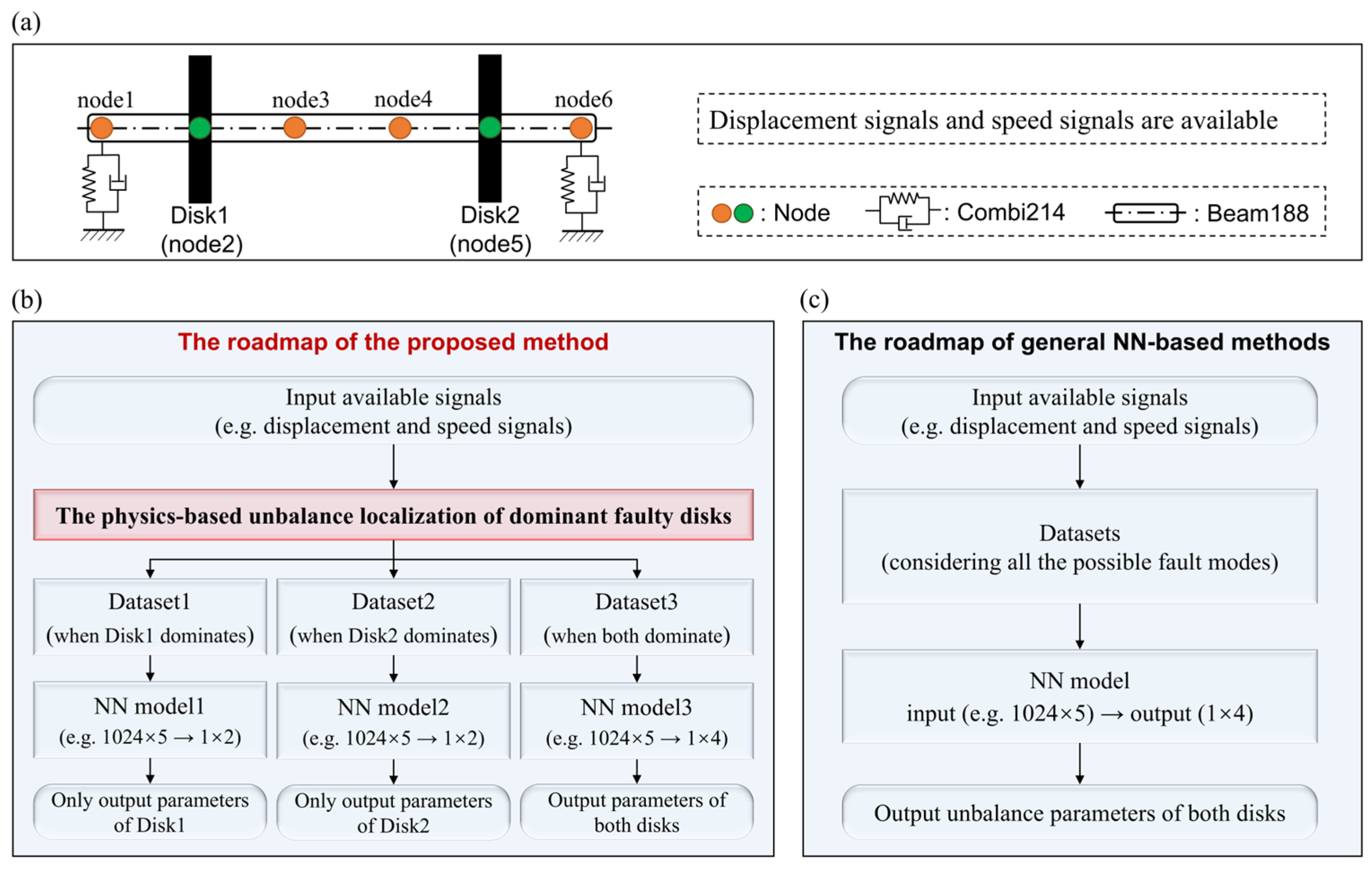
2.1. The Roadmap of the Proposed Method
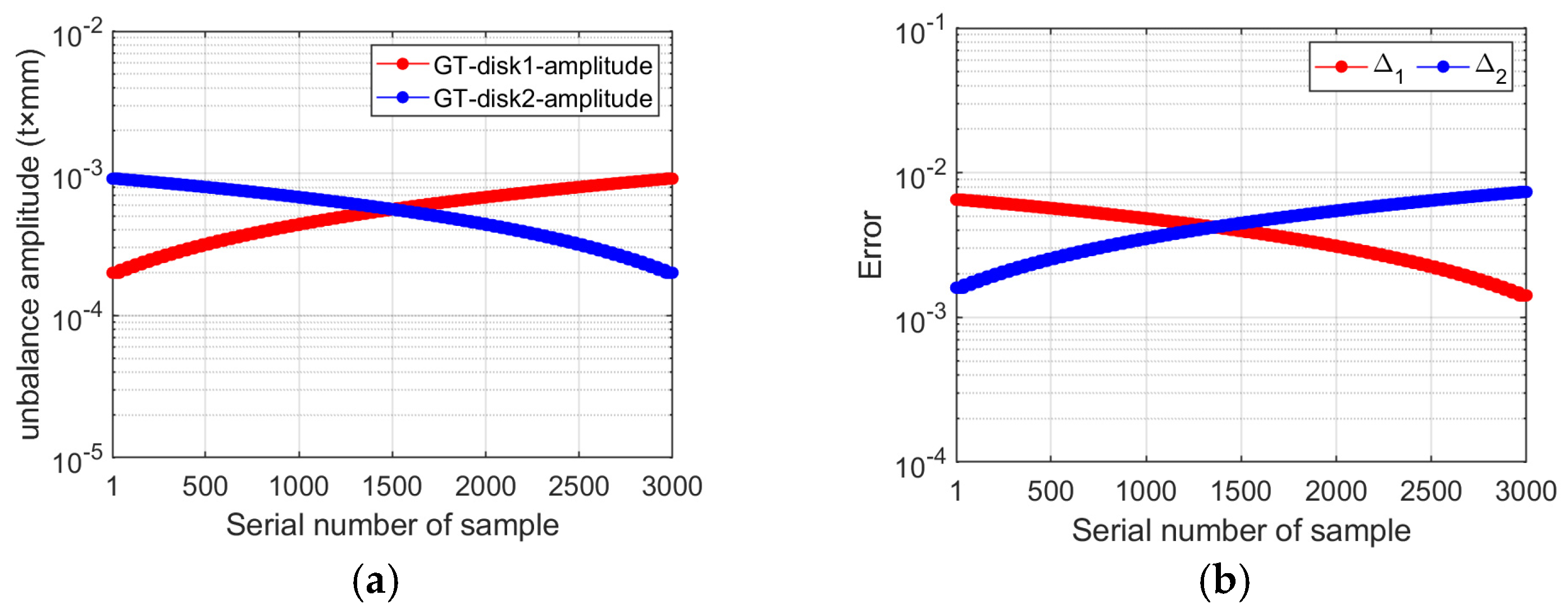
- Datasets. According to the outputs from the localization procedure, roadmap A divides the datasets and allocates them to different sub-networks trained for different tasks. Roadmap B gathers all the datasets under various fault modes to nurture an all-round neural network that can handle the unbalance identification of all possible components.
- Outputs. Roadmap A only focuses on the dominant parameters, while the outputs of roadmap B consist of the unbalance parameters of all disks.
- Precision and efficiency. Based on the same datasets and network structures, the precision achieved by roadmap A is higher, and that will be detailed in the following sections. Additionally, because the network models involved in the roadmap A and B are totally the same except for the output dimension, the hyperparameters involved in the roadmap A are consequently fewer, which means better training efficiency.
2.2. The Structure of the Unbalance Localization Layer
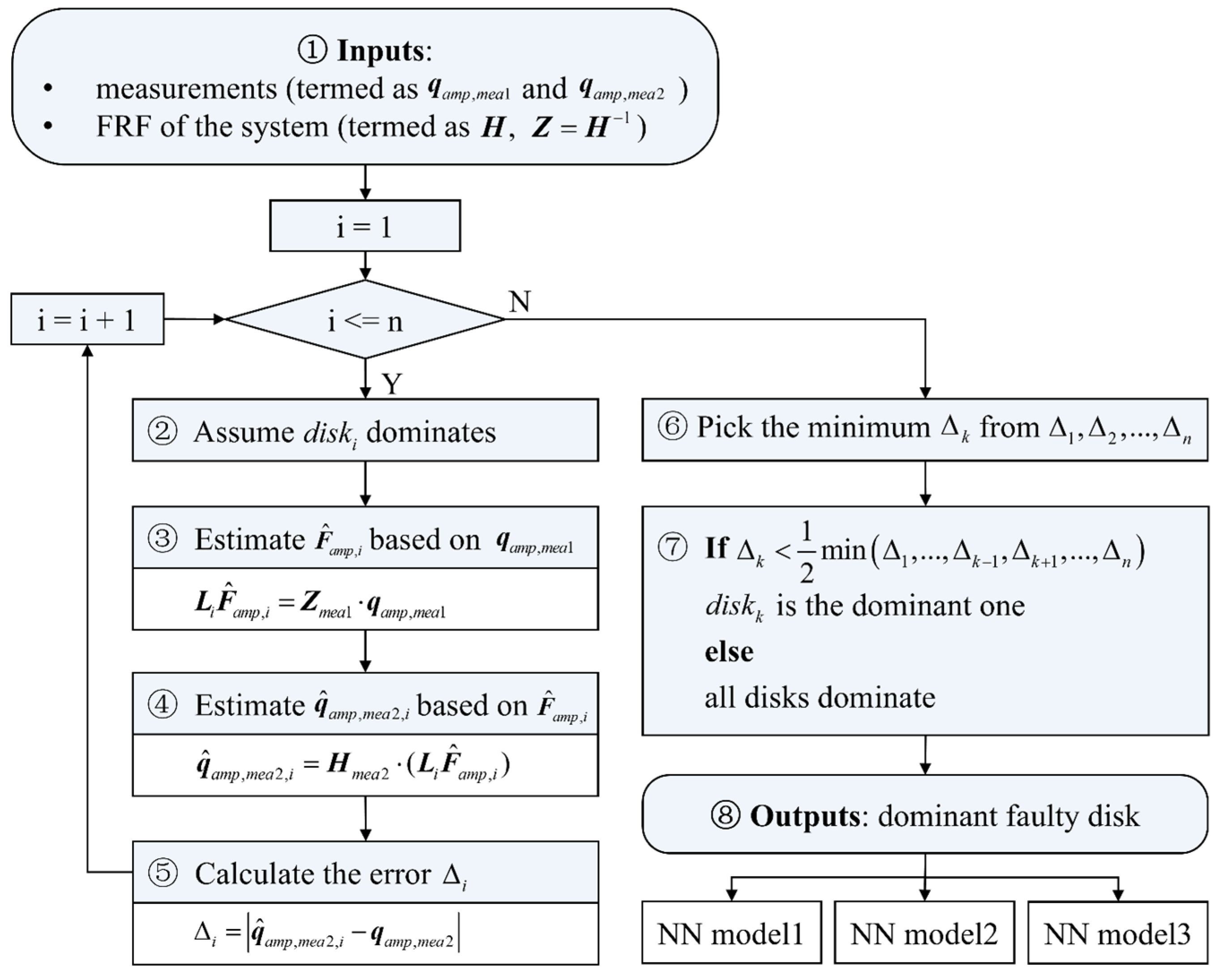
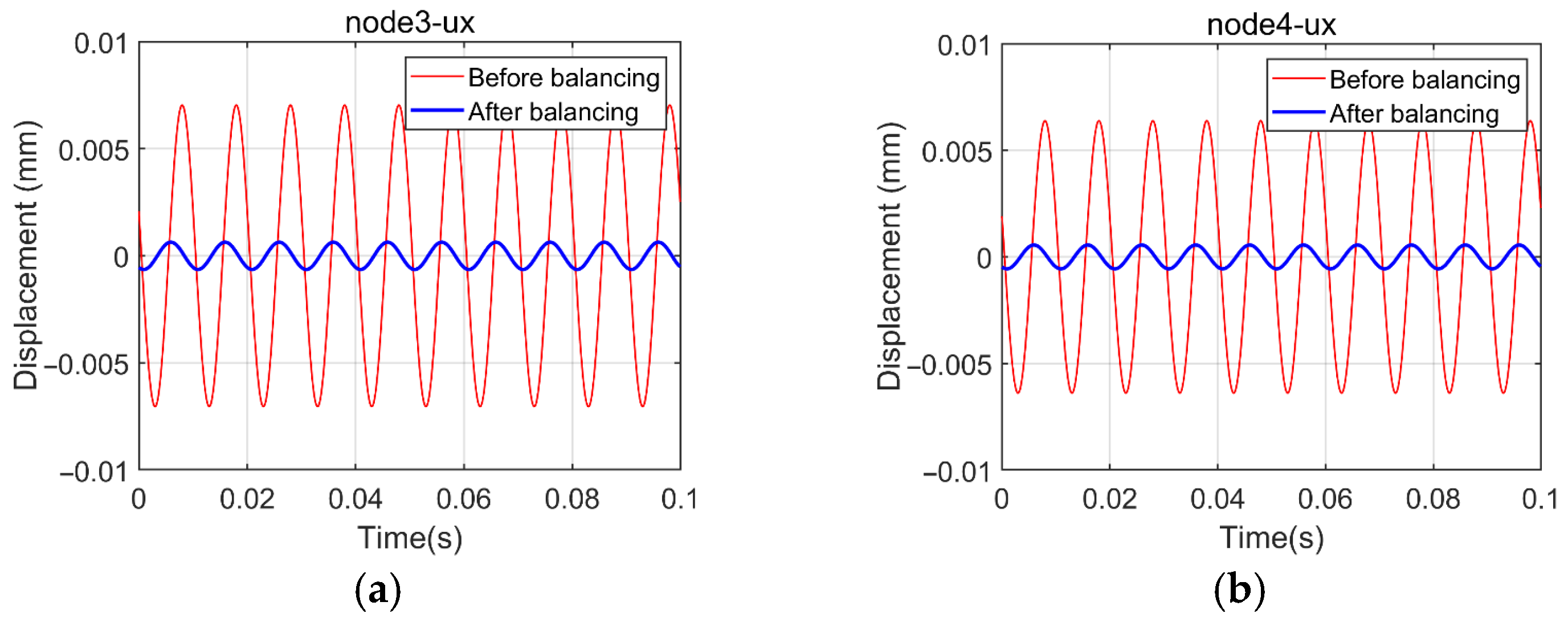
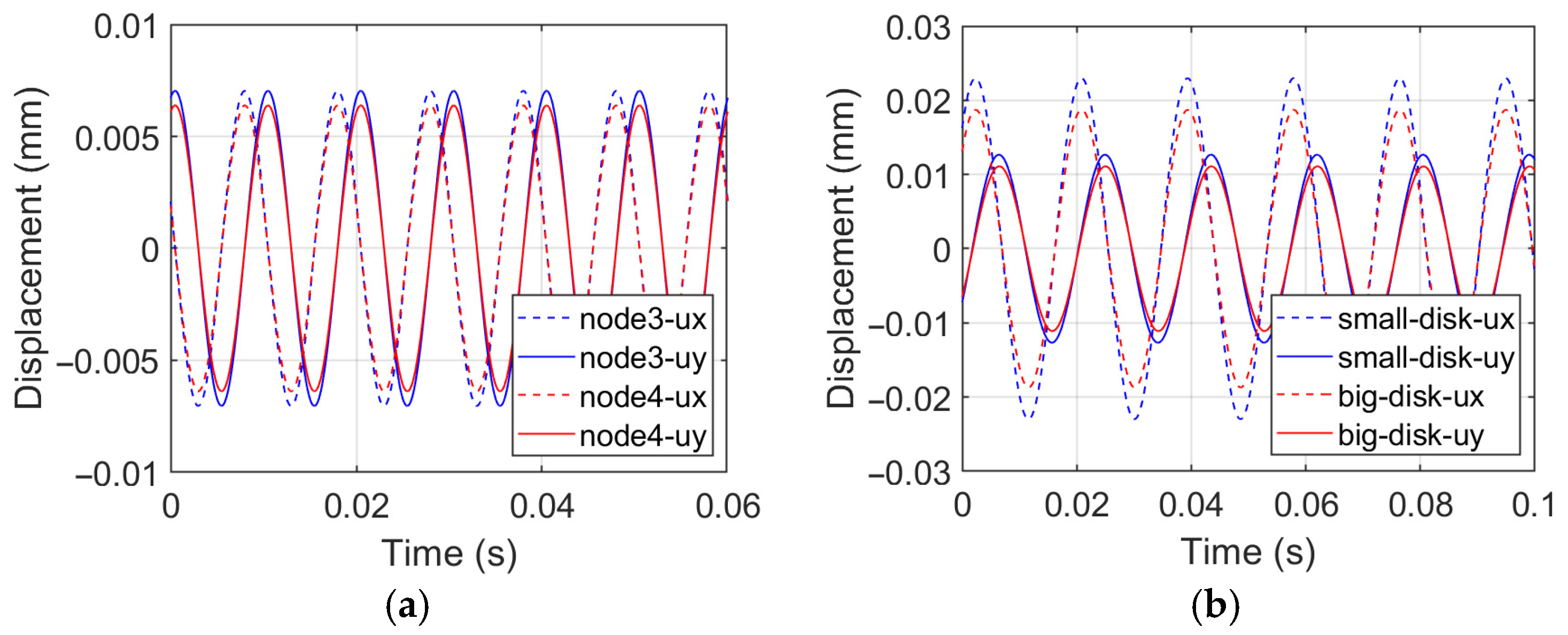
- Step ①: Inputs. What is needed includes the responses from two different positions (like node3-ux and node4-ux) and the FRF of the system.
- Step ②: Make assumptions. The parameter n (in the previous decision box) is equal to the number of disks.
- Steps ③–⑤: Calculate a criterion. An estimation error is finally obtained to represent the precision of the assumption.
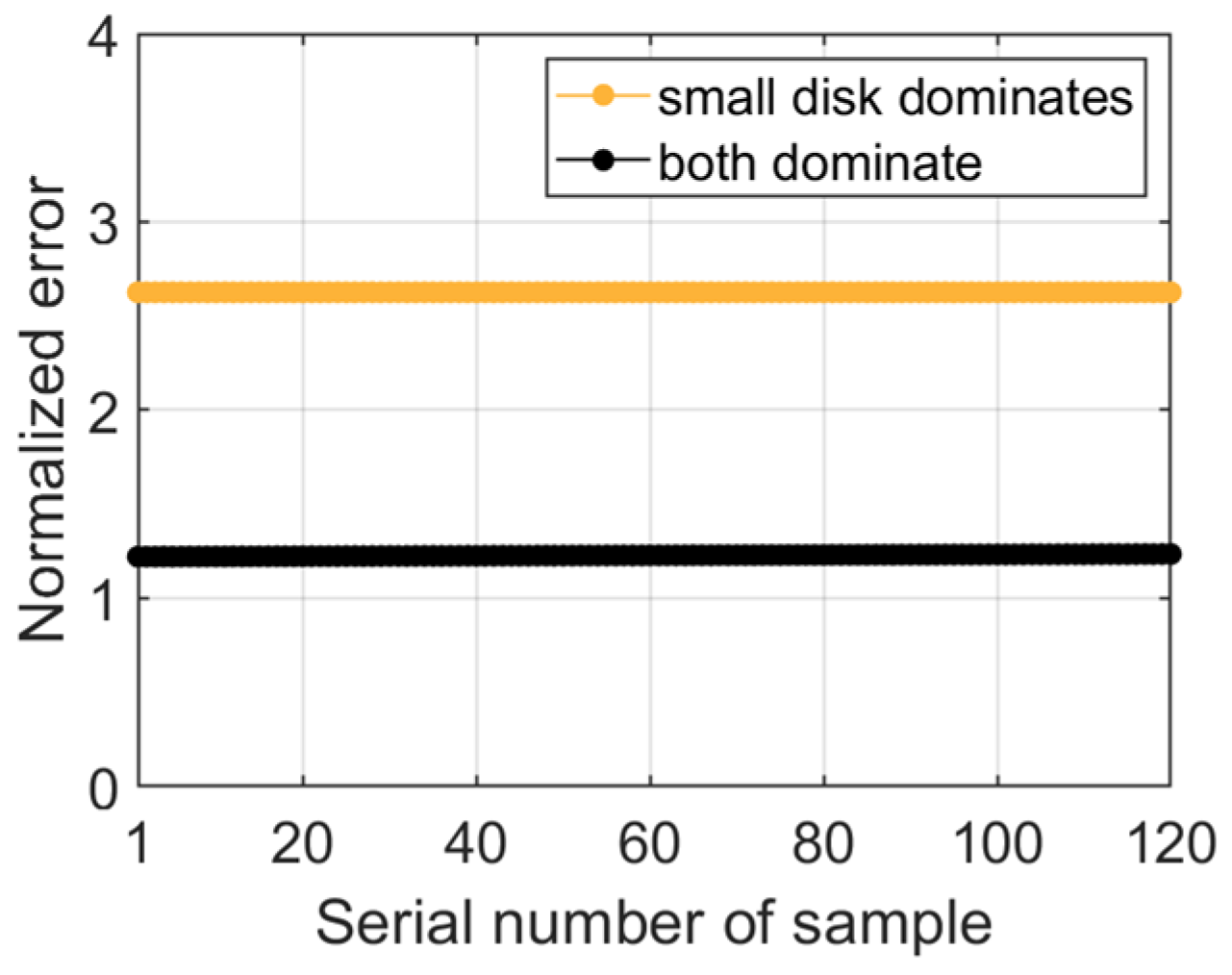
- Steps ⑥–⑧: Choose the best assumption and output the dominant faulty disk. The assumption whose error is smaller than half of the minimum of the others is determined as the best one.
2.3. The Structure of the Unbalance Identification Layer
2.4. The Arrangement of the Datasets
3. Numerical Cases
3.1. A Twin-Disk Rotor-Bearing System
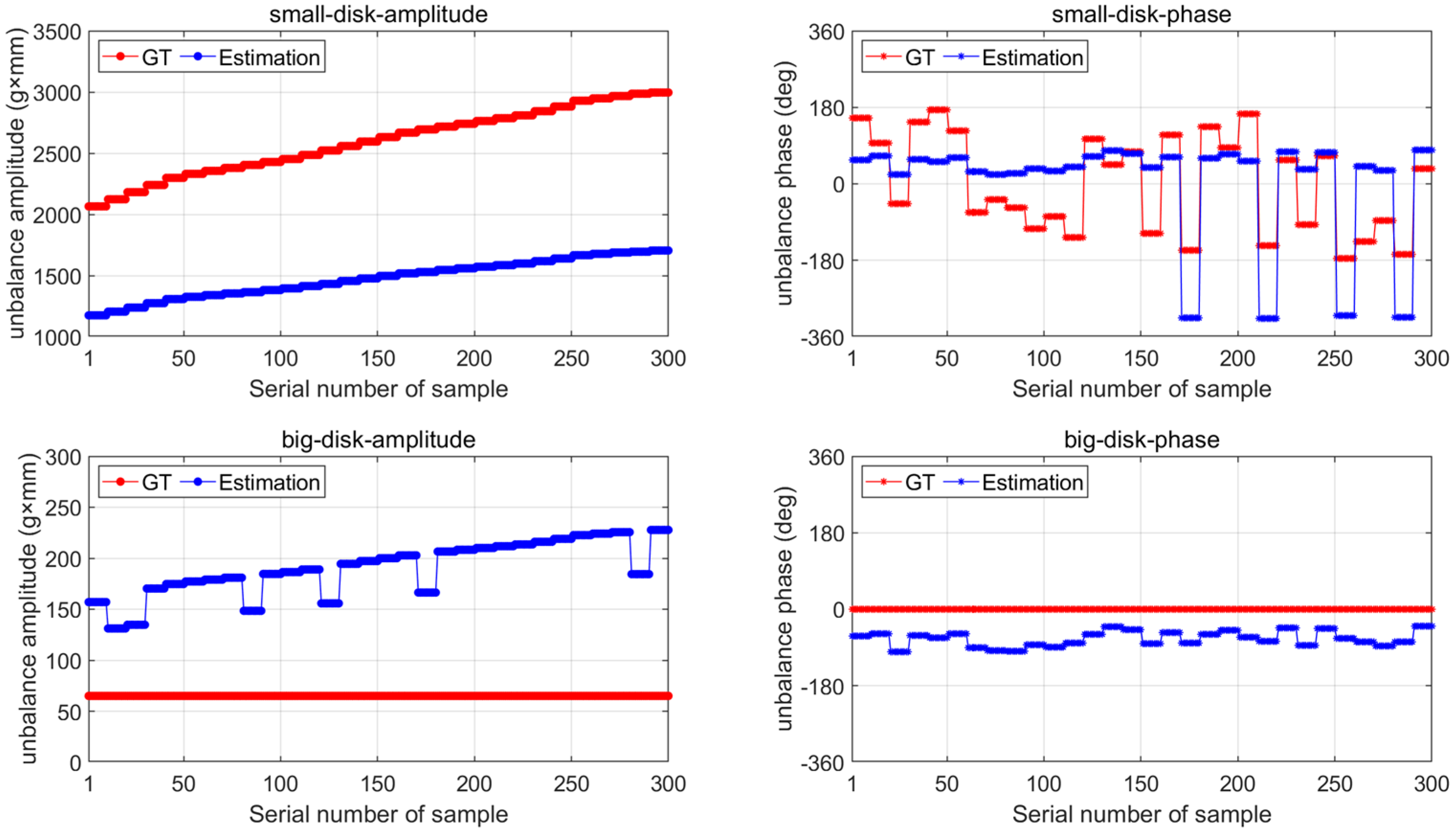
3.2. A Rotor-Bearing-Casing System
4. Experimental Case
4.1. Test Rig and Data Collection
4.2. Experimental Results
5. Discussion
5.1. Effect of the Model Precision on the PI Layer
5.2. Effect of Different Levels of Noise
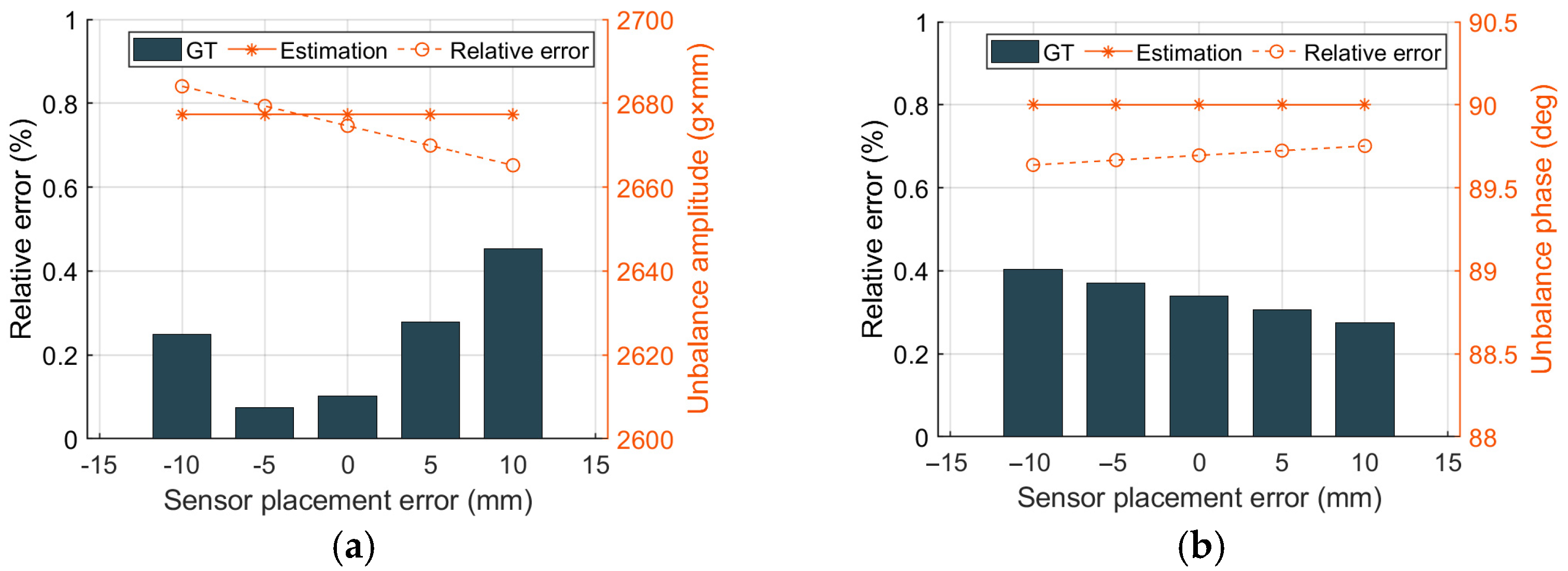
5.3. Effect of Sensor Placement Errors
5.4. Comparison with the Model-Based Method
5.5. Performance Under Different Rotating Speeds
6. Conclusions
- (1)
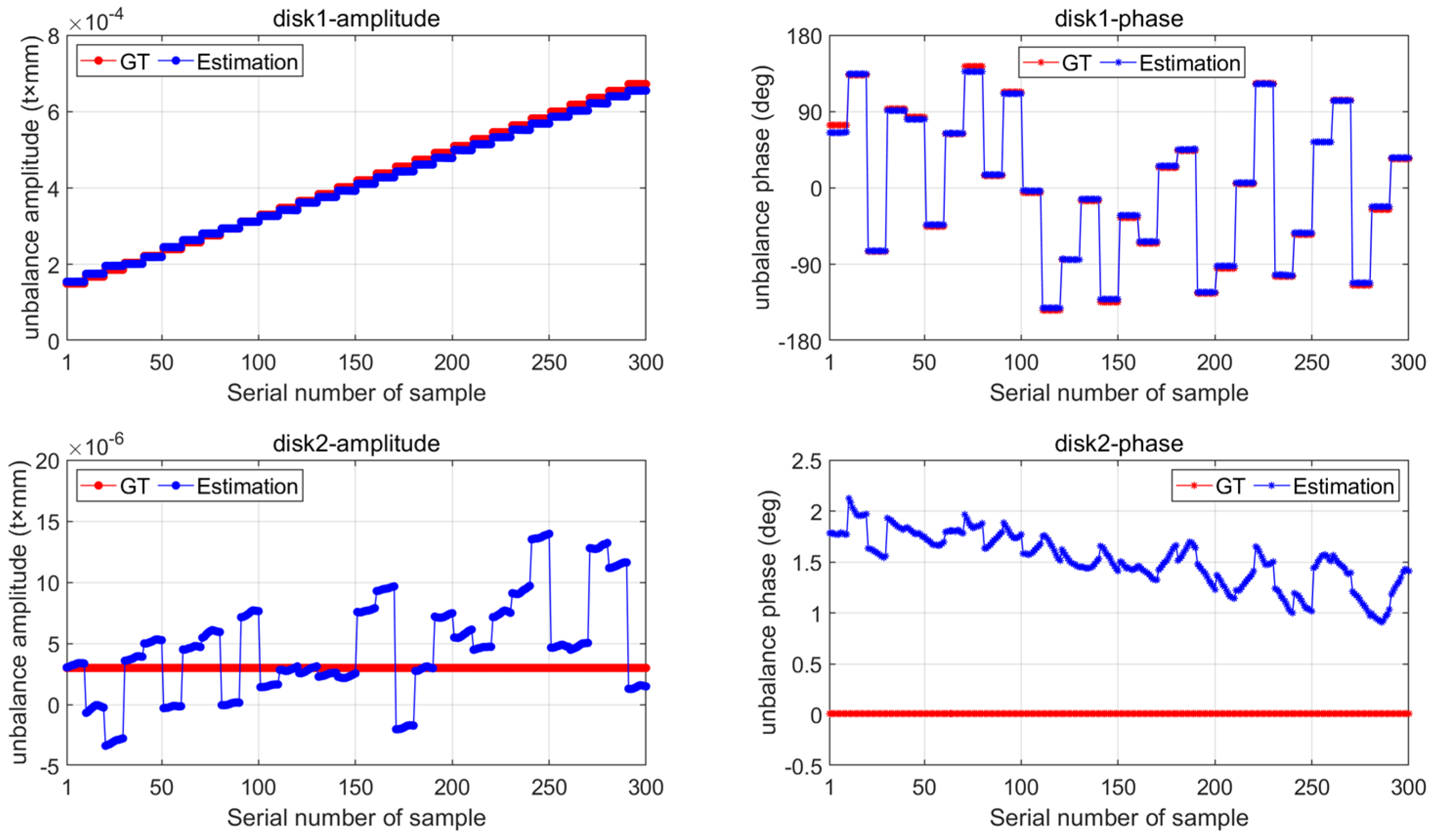
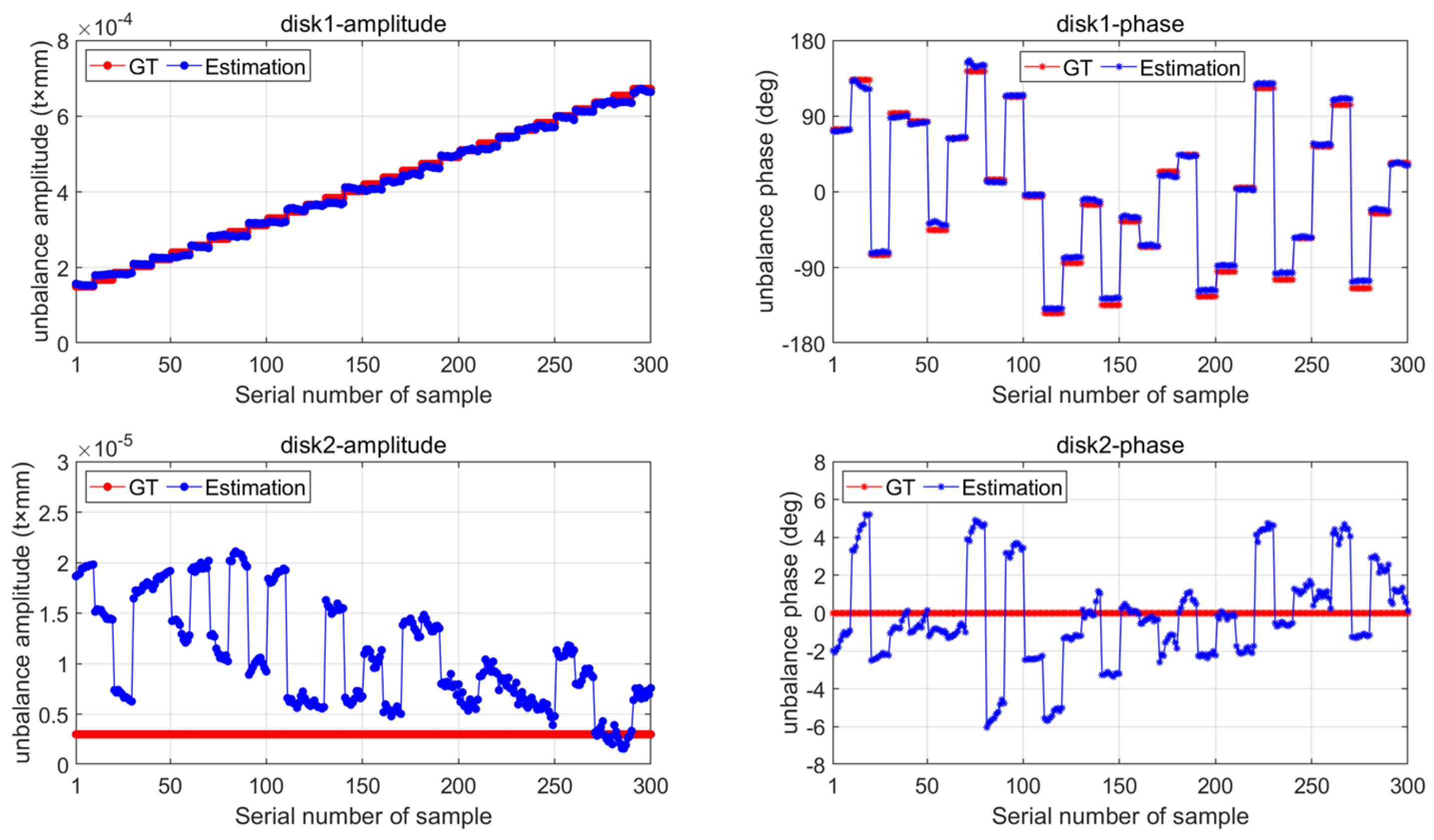
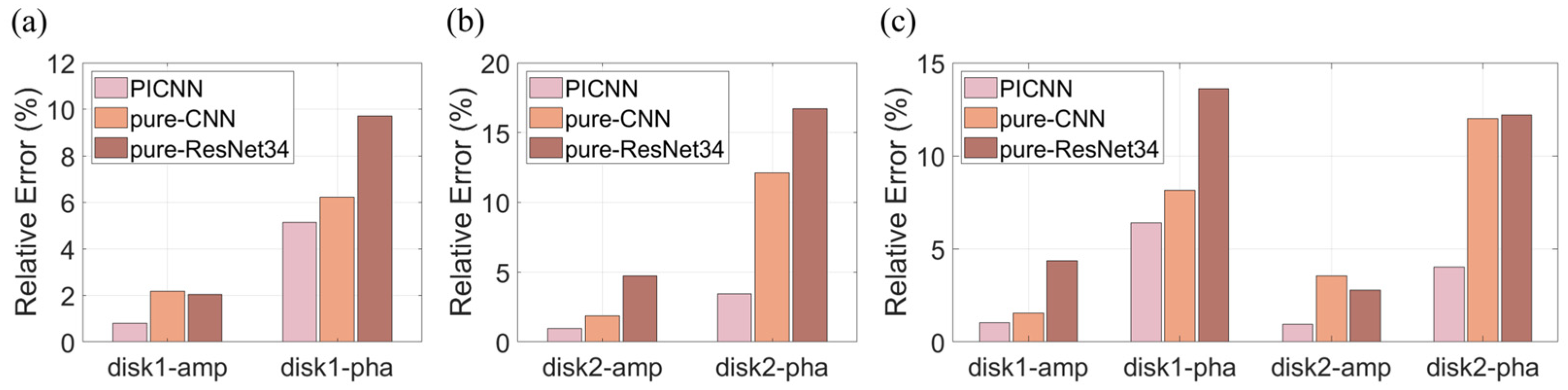
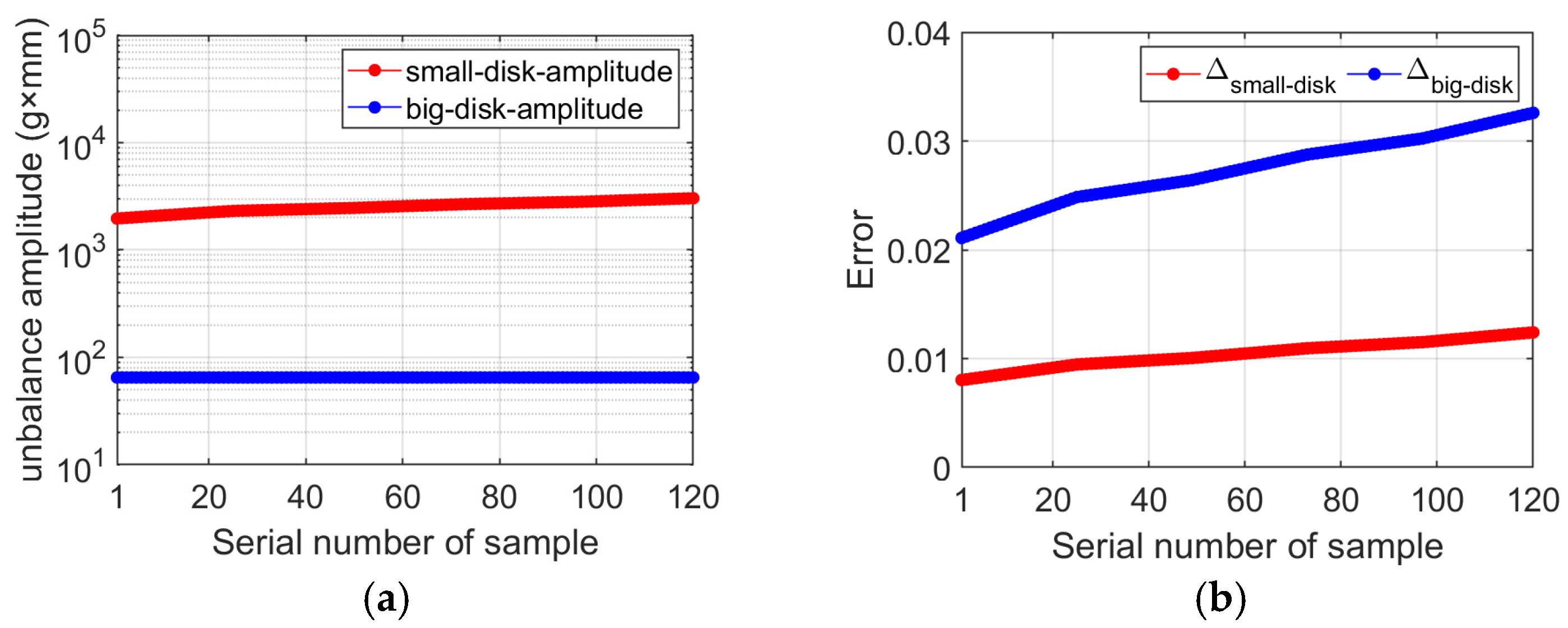
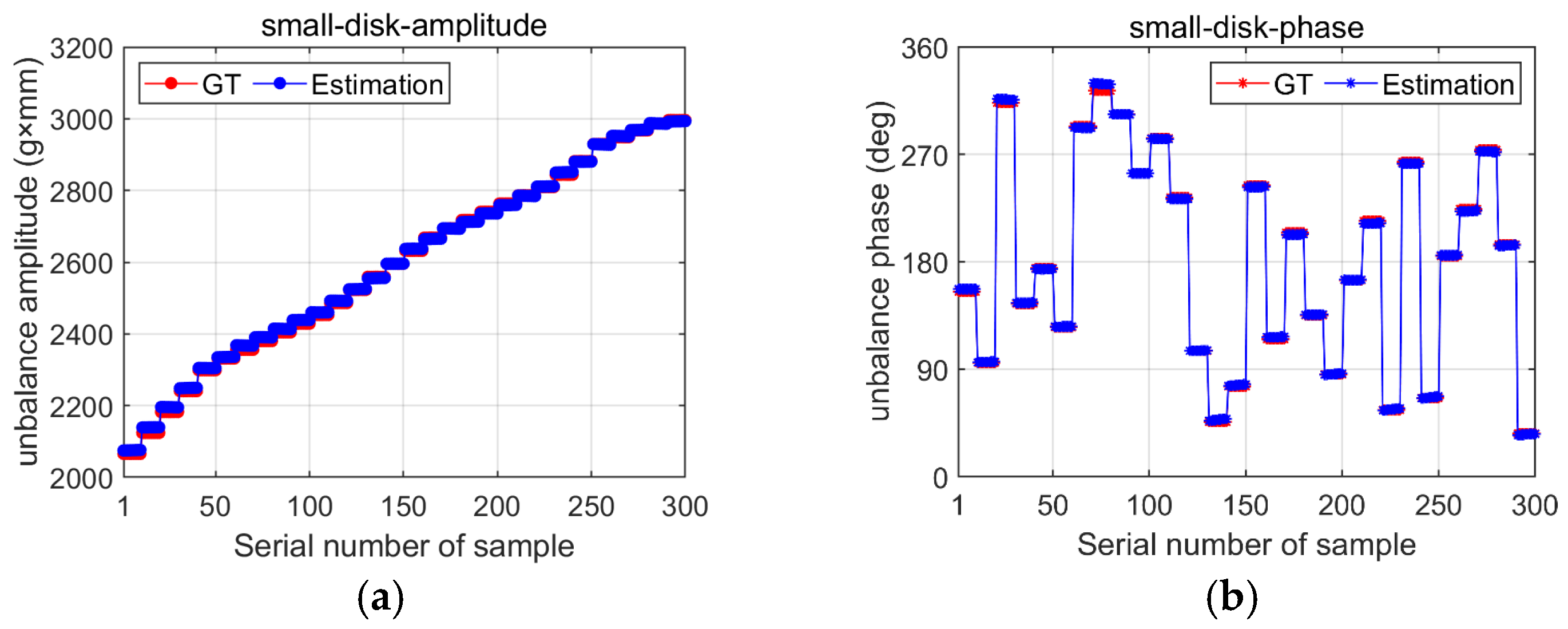
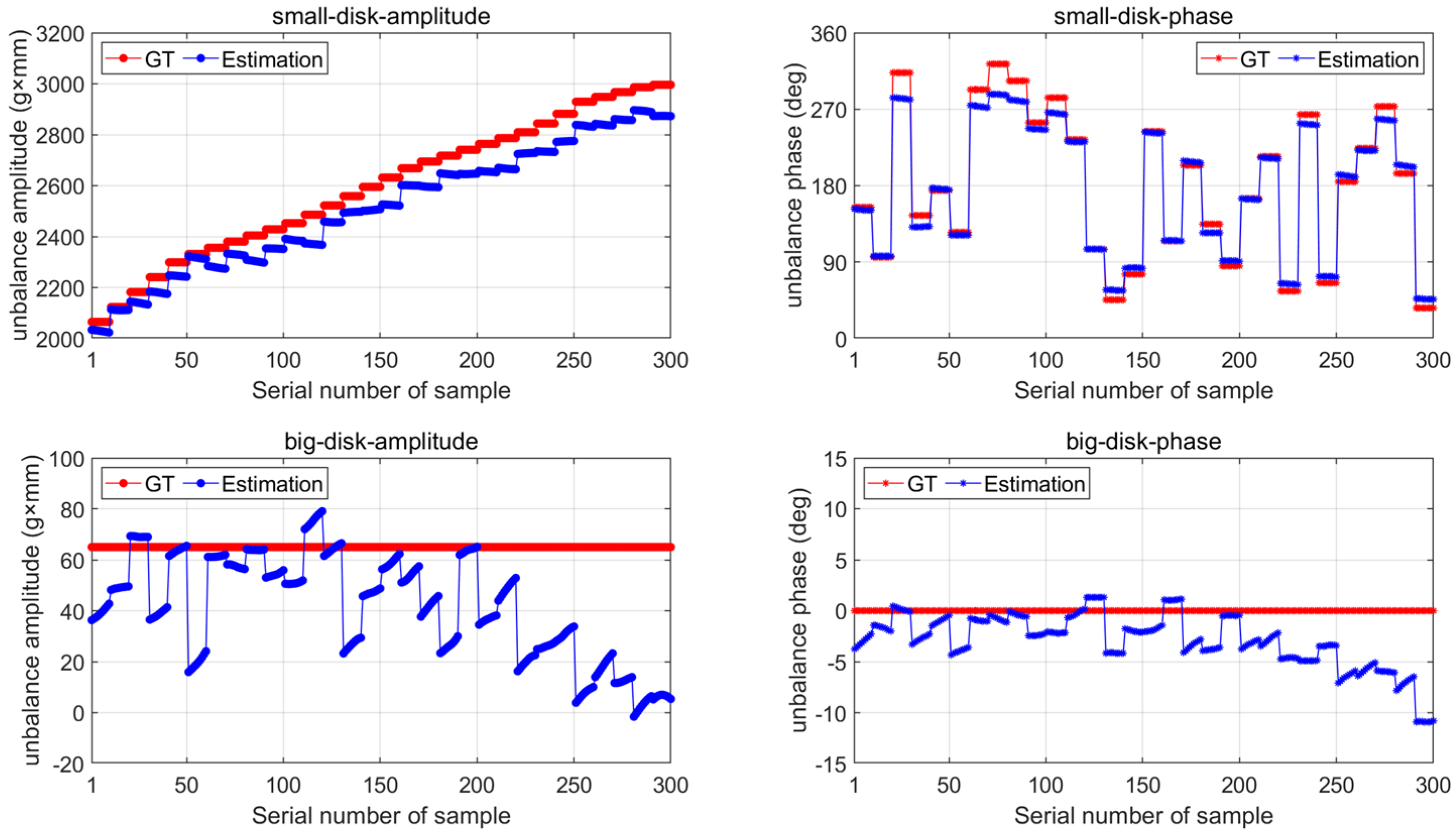
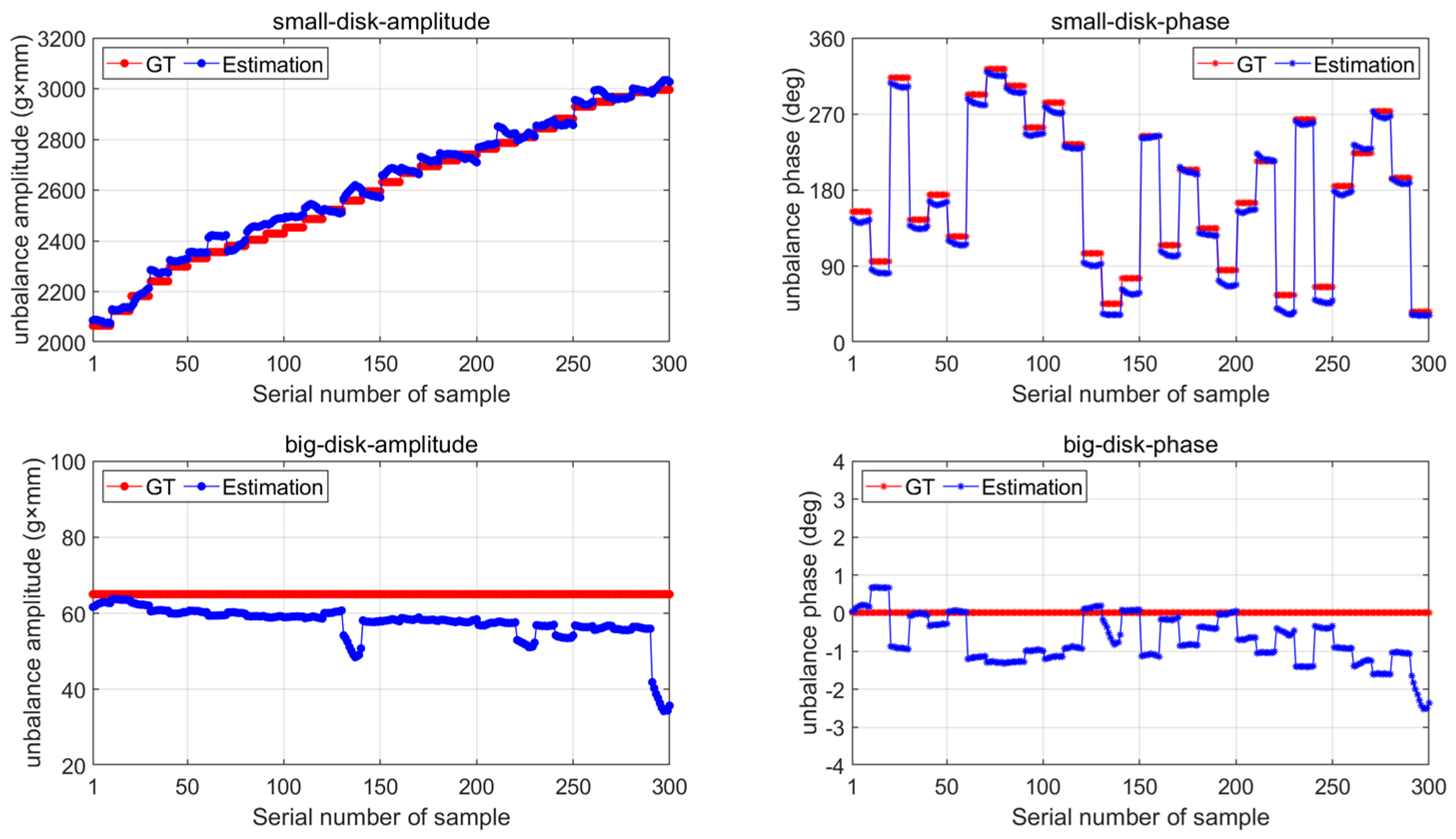
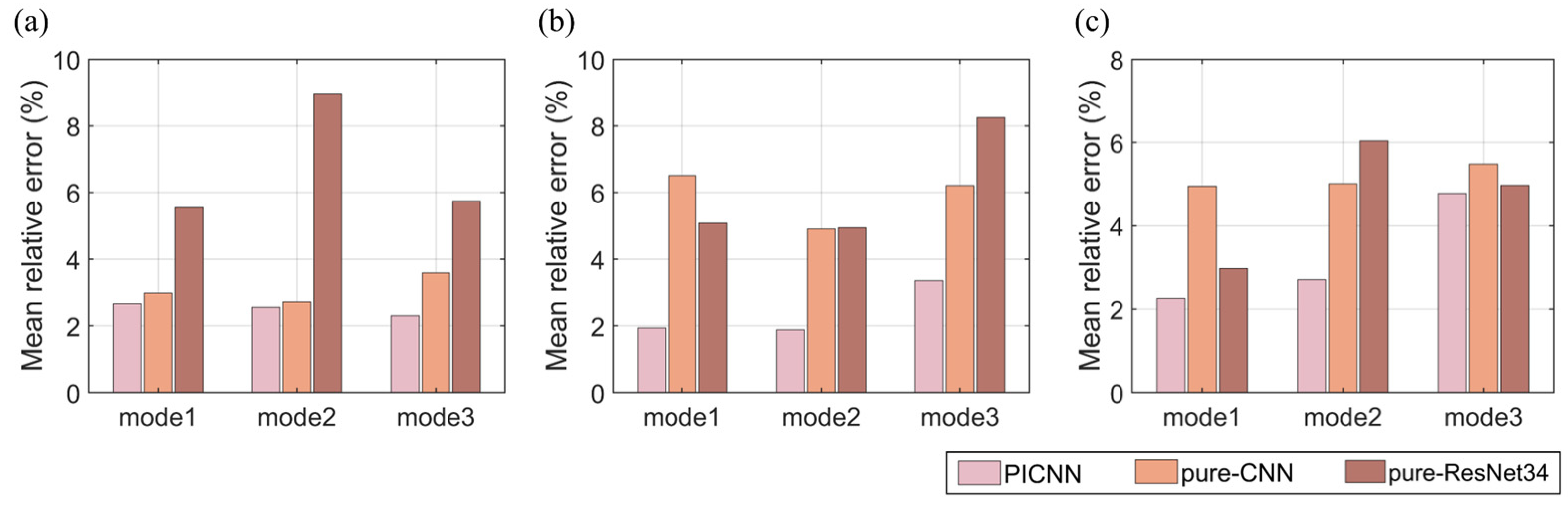
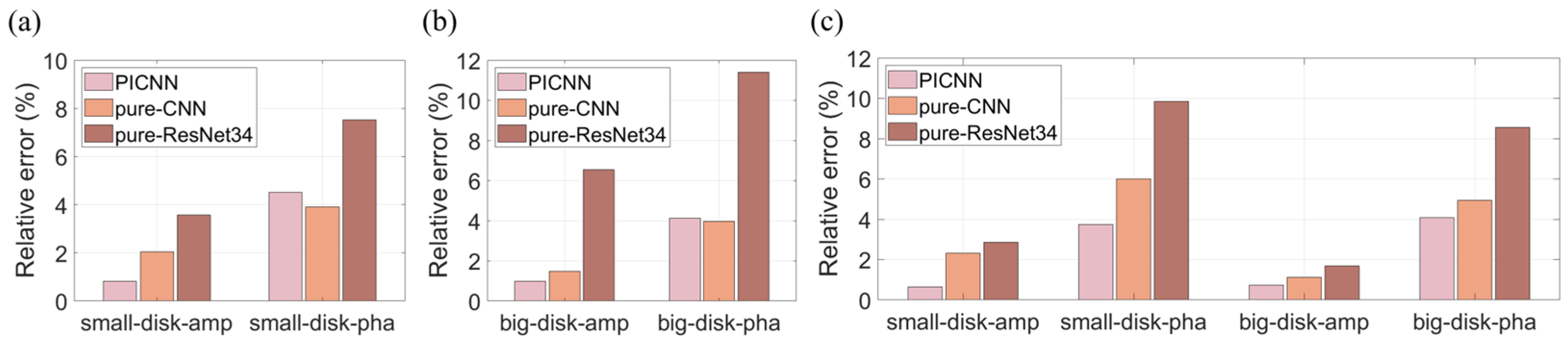
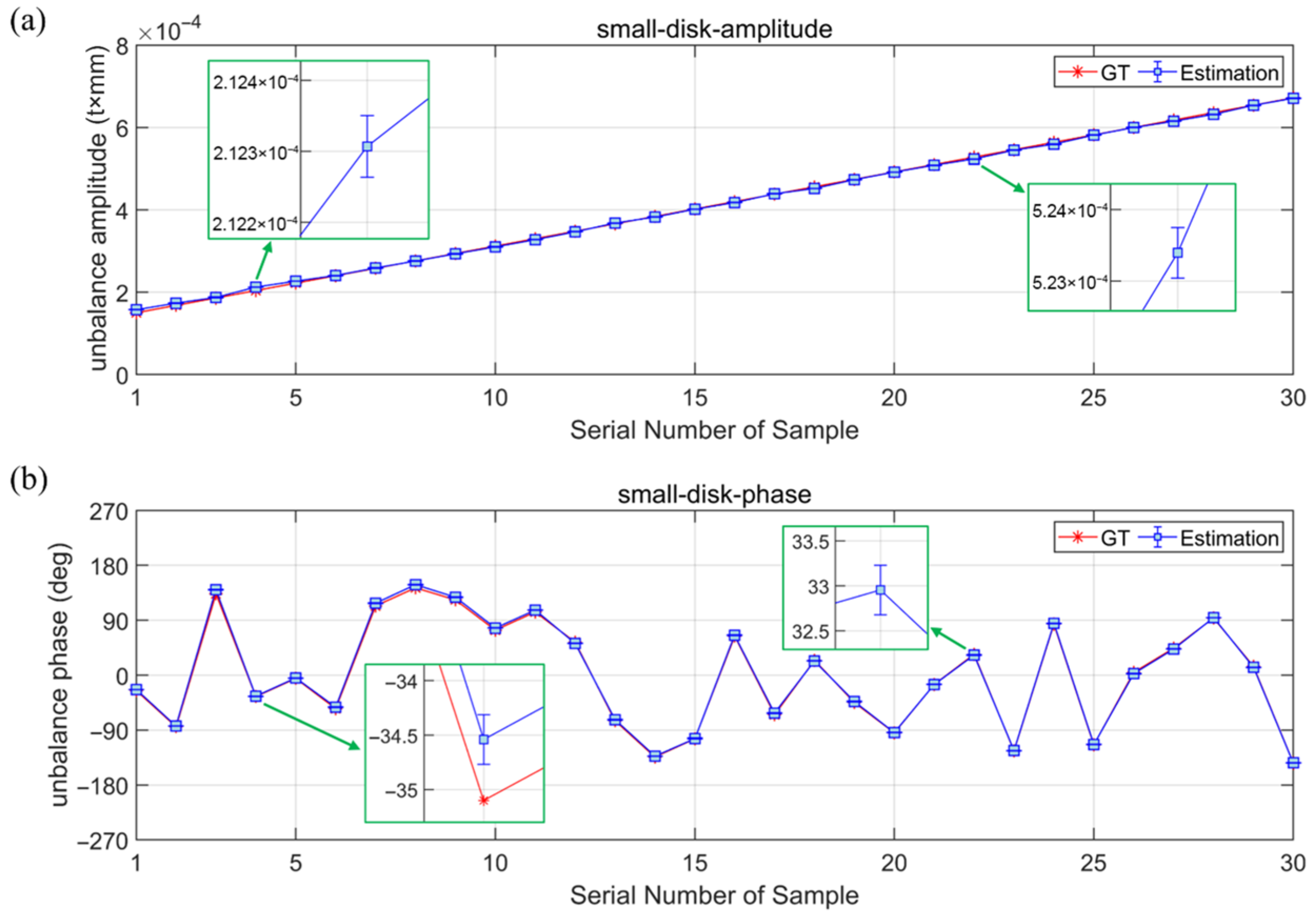
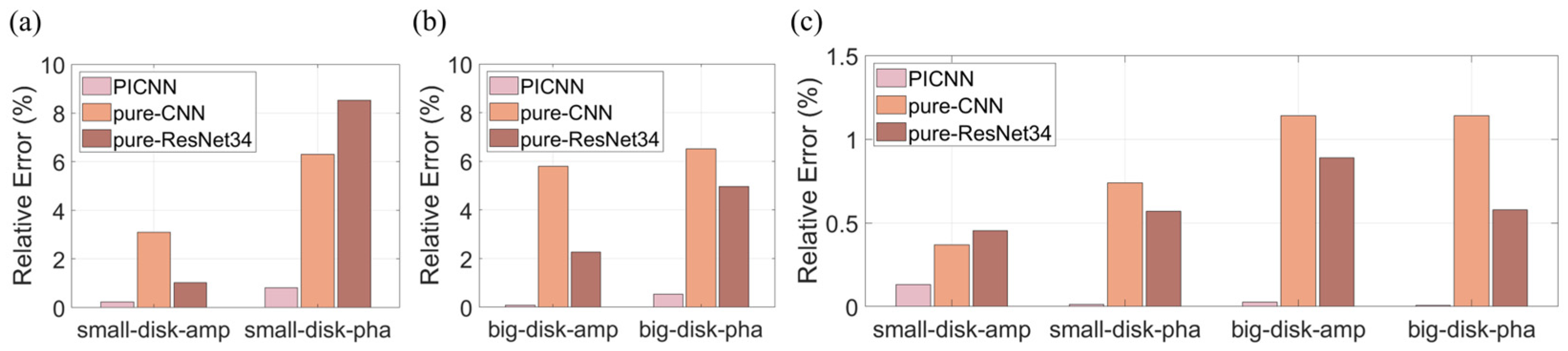
- Compared to the pure-CNN methods, the proposed PICNN features in providing identification with higher precision, whose relative errors are all below 1.5% under various experimental datasets, and possesses physical interpretability.
- (2)
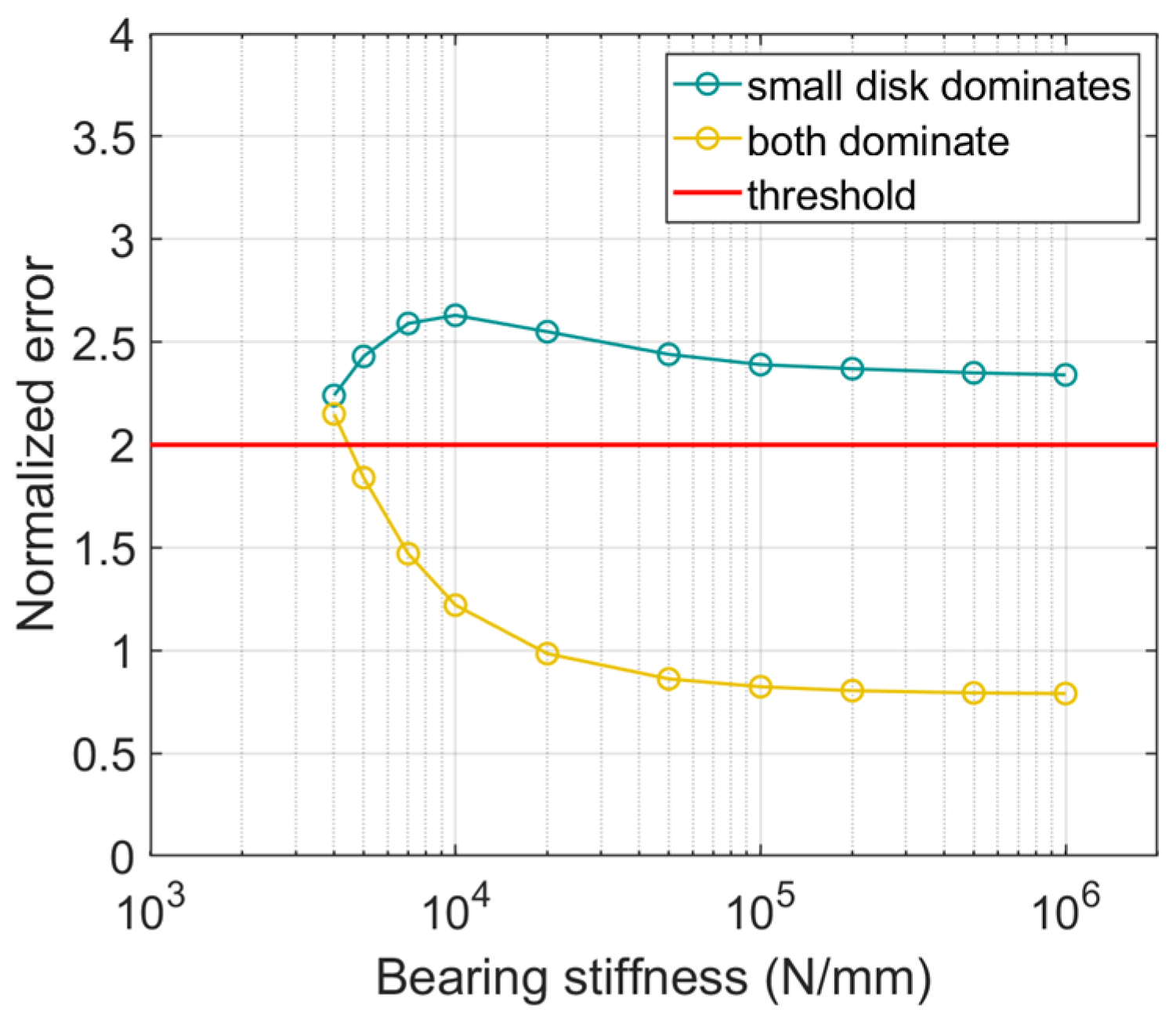
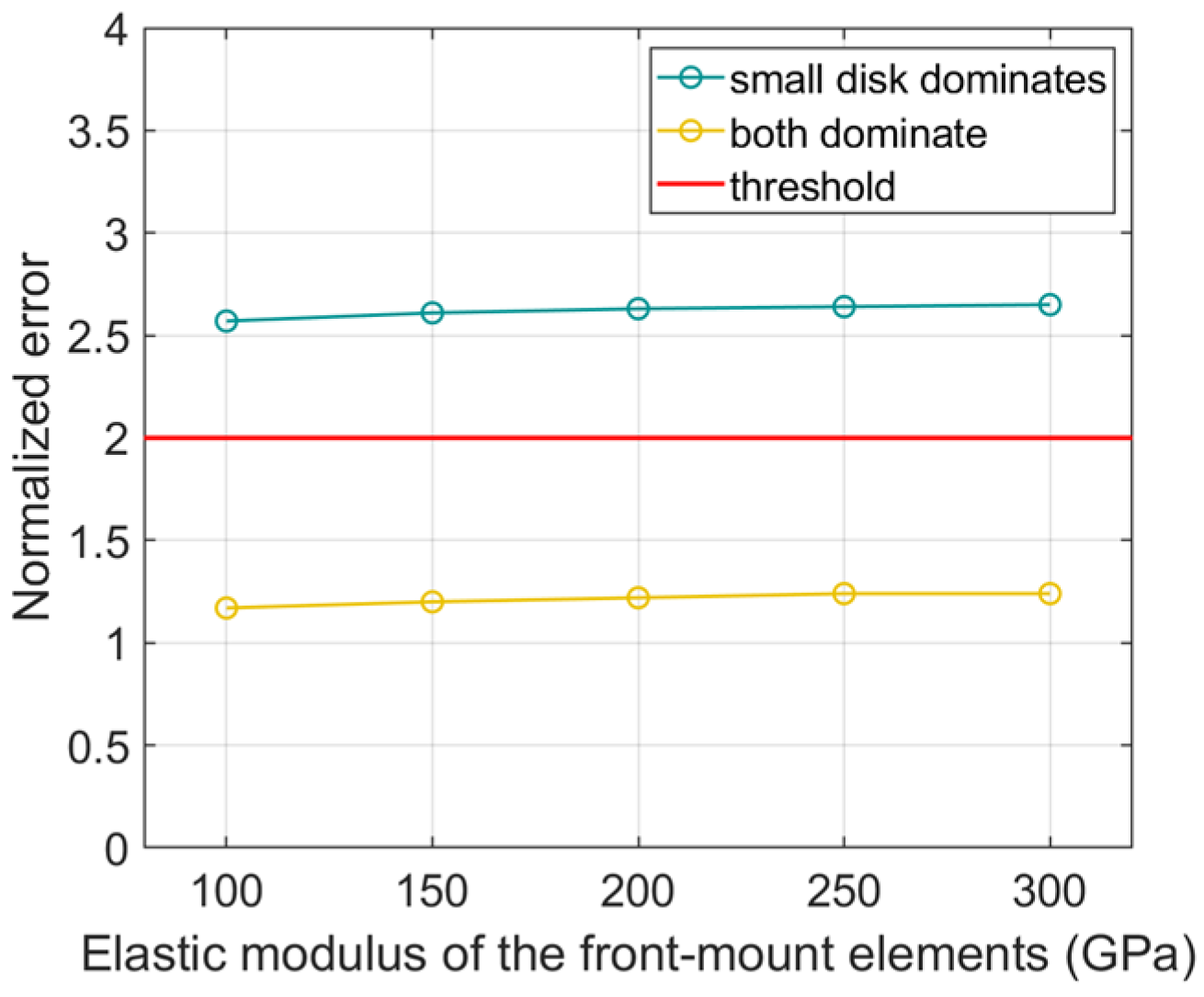
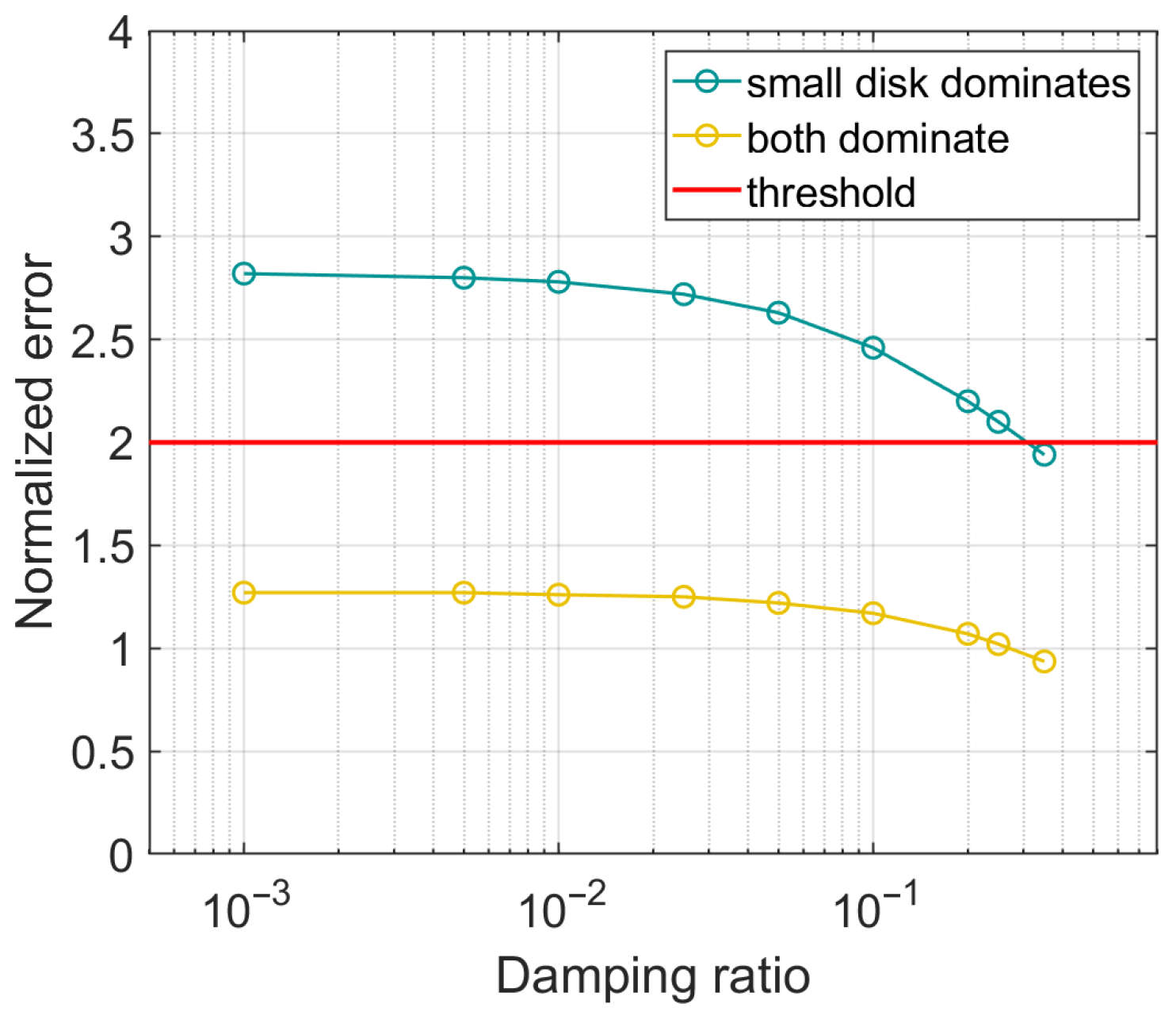
- The PI layer is based on the FRF of the simulation model. It does not require a high-fidelity model that generates responses identical to the actual ones. The robustness against modeling errors in bearing stiffness, mounting stiffness, and damping ratios is demonstrated. This greatly ensures the practicality of the proposed method.
- (3)
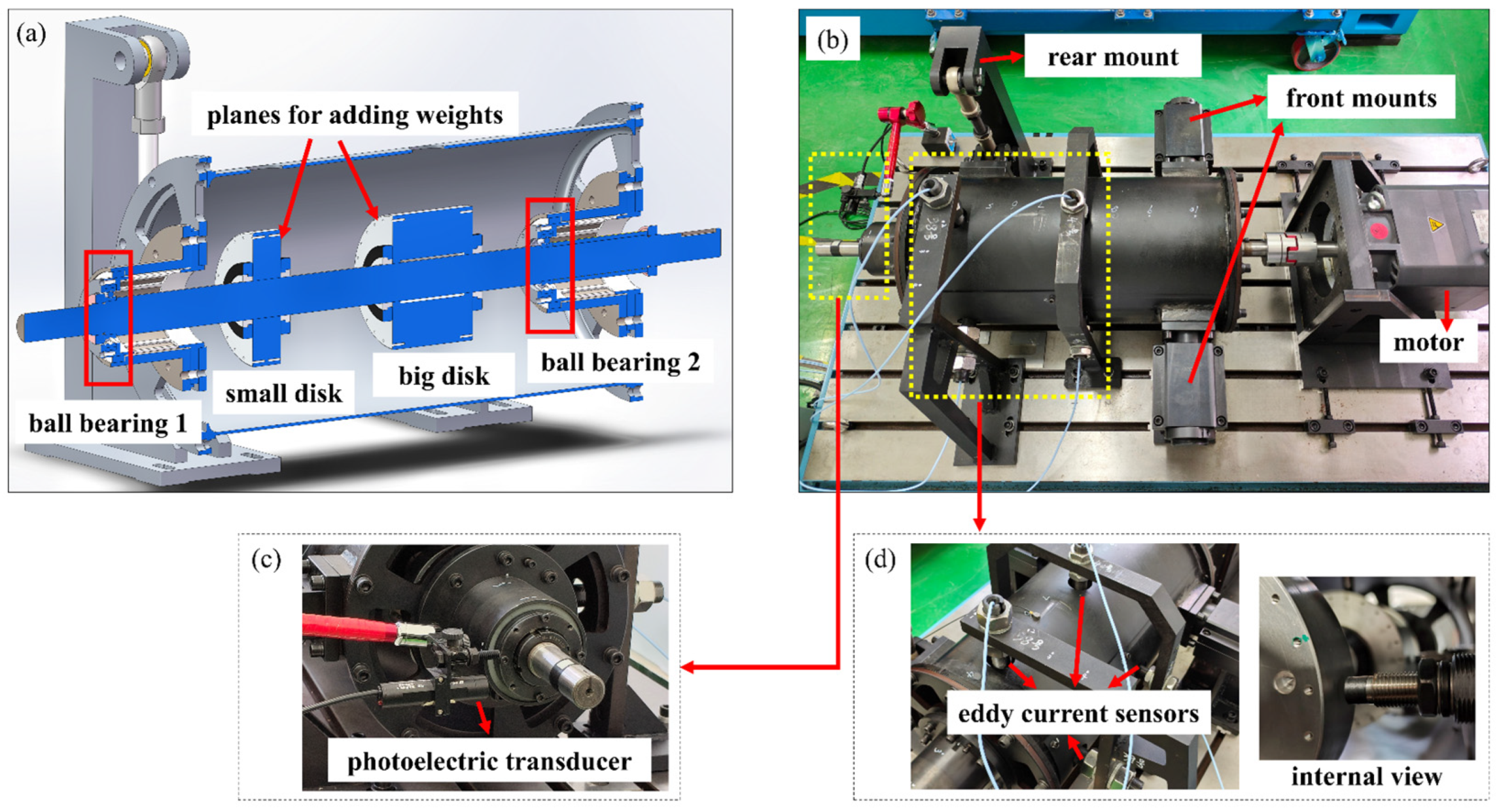
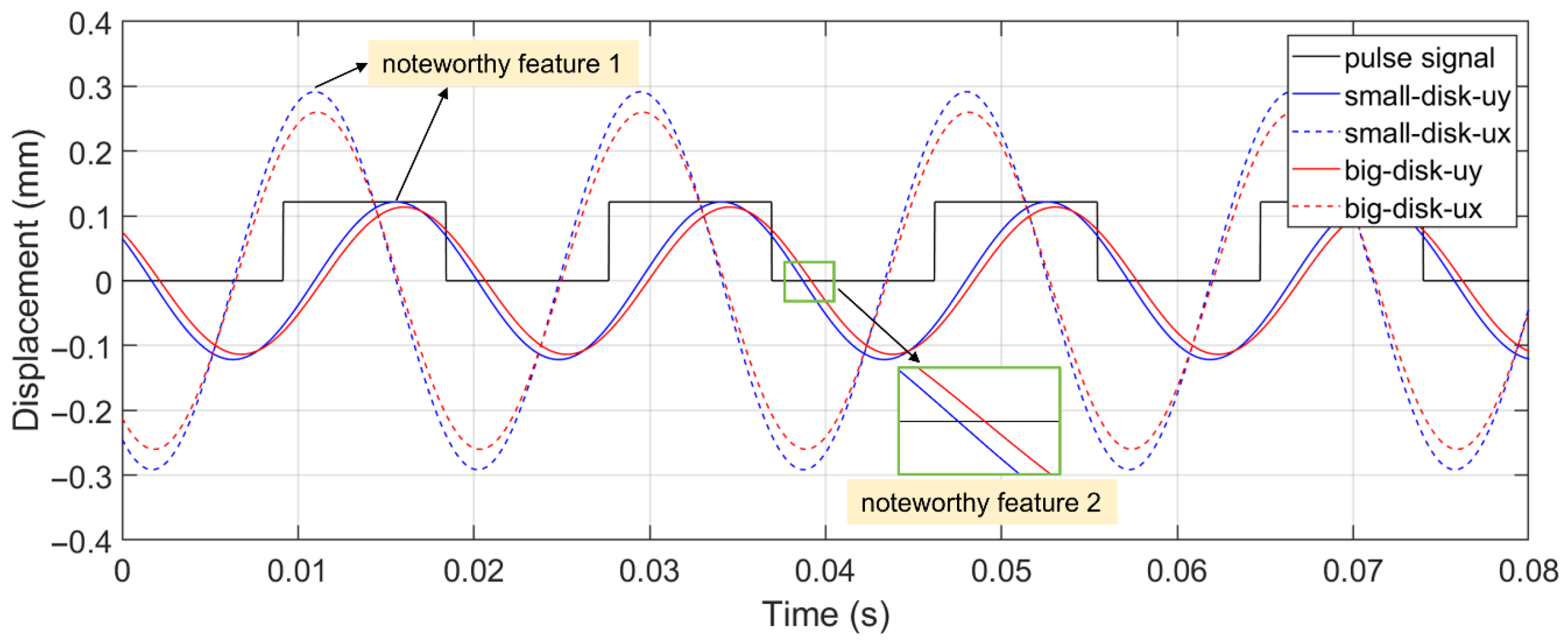
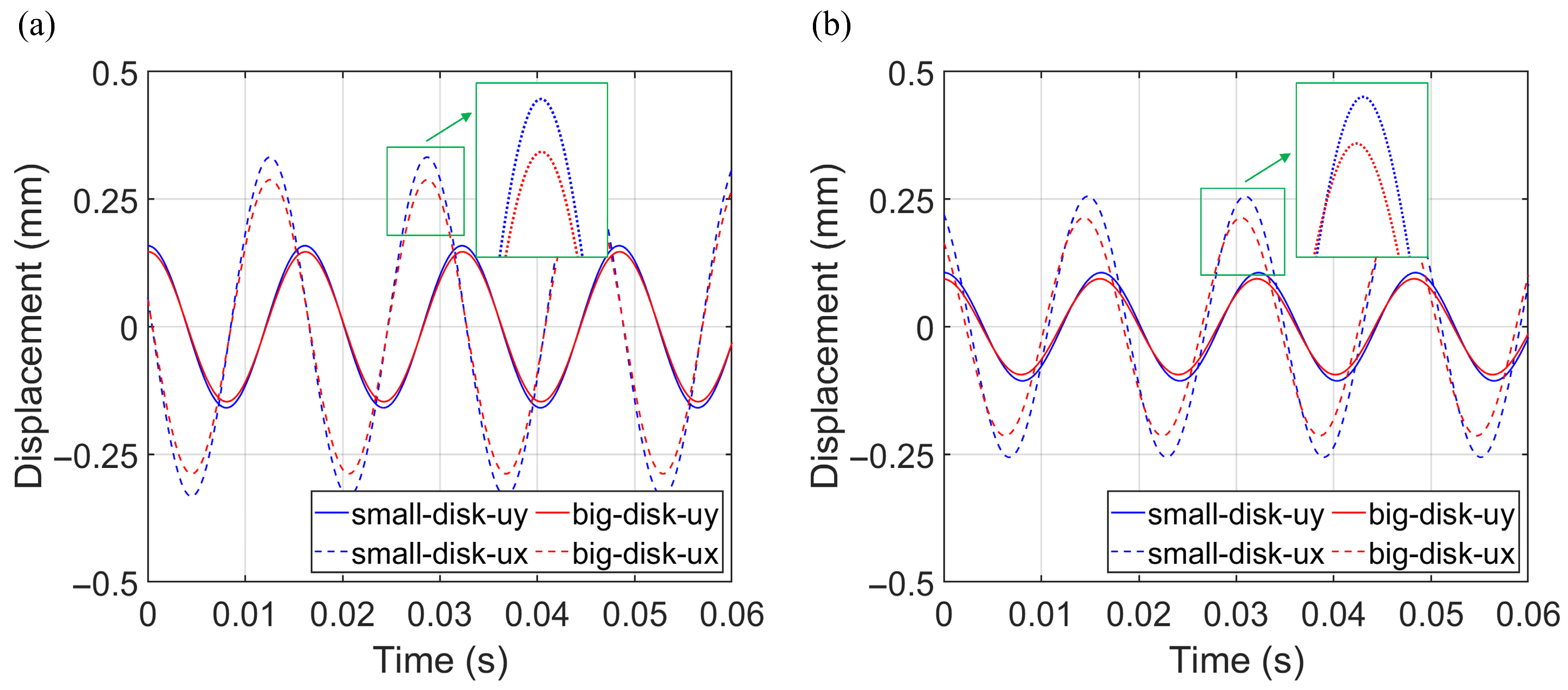
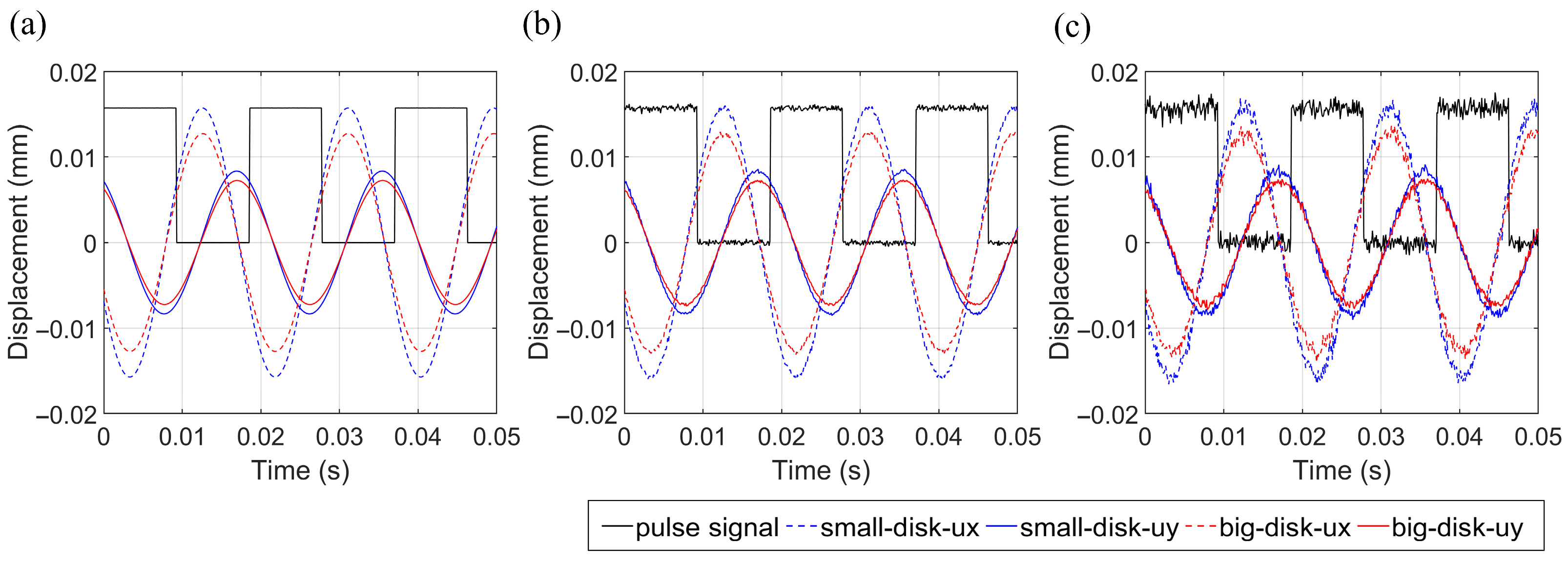
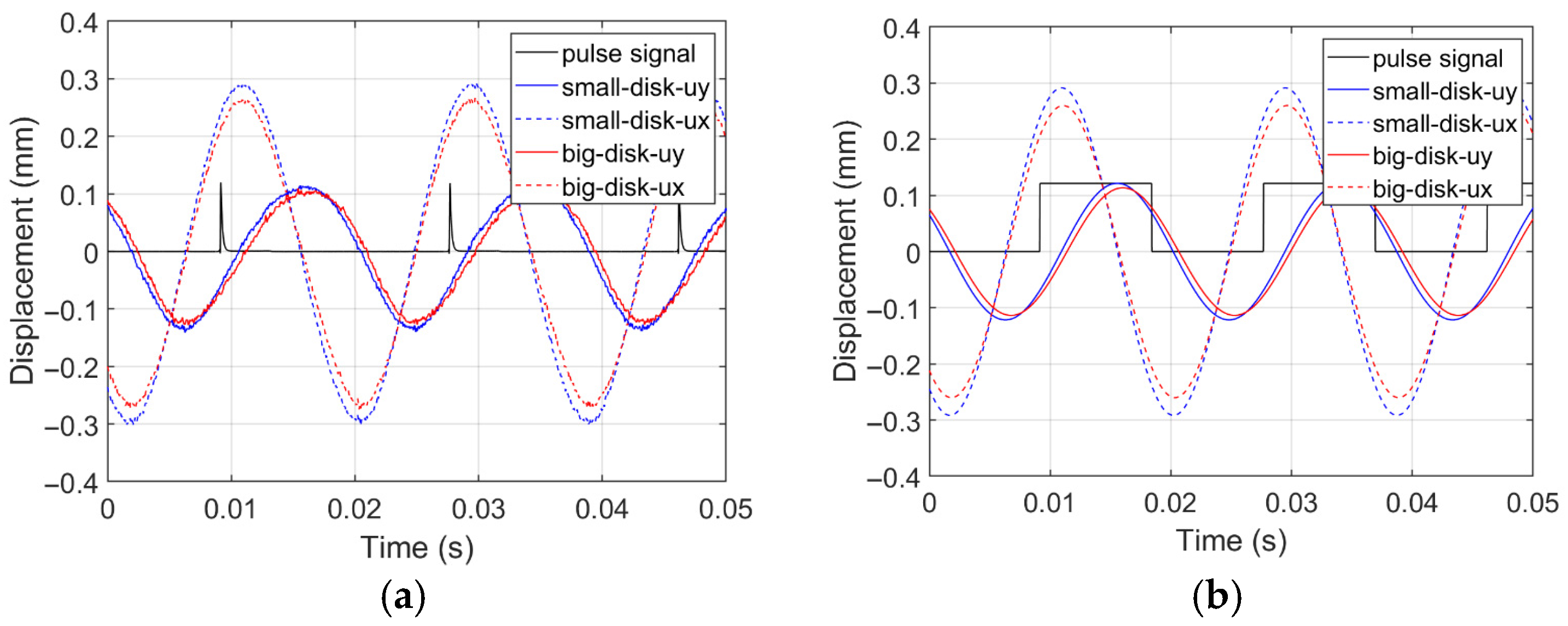
- Different from the rotor-bearing test bench in most of the literature, a twin-disk rotor-bearing-casing experimental setup with anisotropic supporting stiffness is established to get closer to the actual on-wing status. The horizontal response amplitude is more than twice that of the vertical one, which can be addressed in the proposed method.
Supplementary Materials
Author Contributions
Funding
Data Availability Statement
Conflicts of Interest
Appendix A

| Datasets | Unbalance Parameters | Training | Validating | Testing |
|---|---|---|---|---|
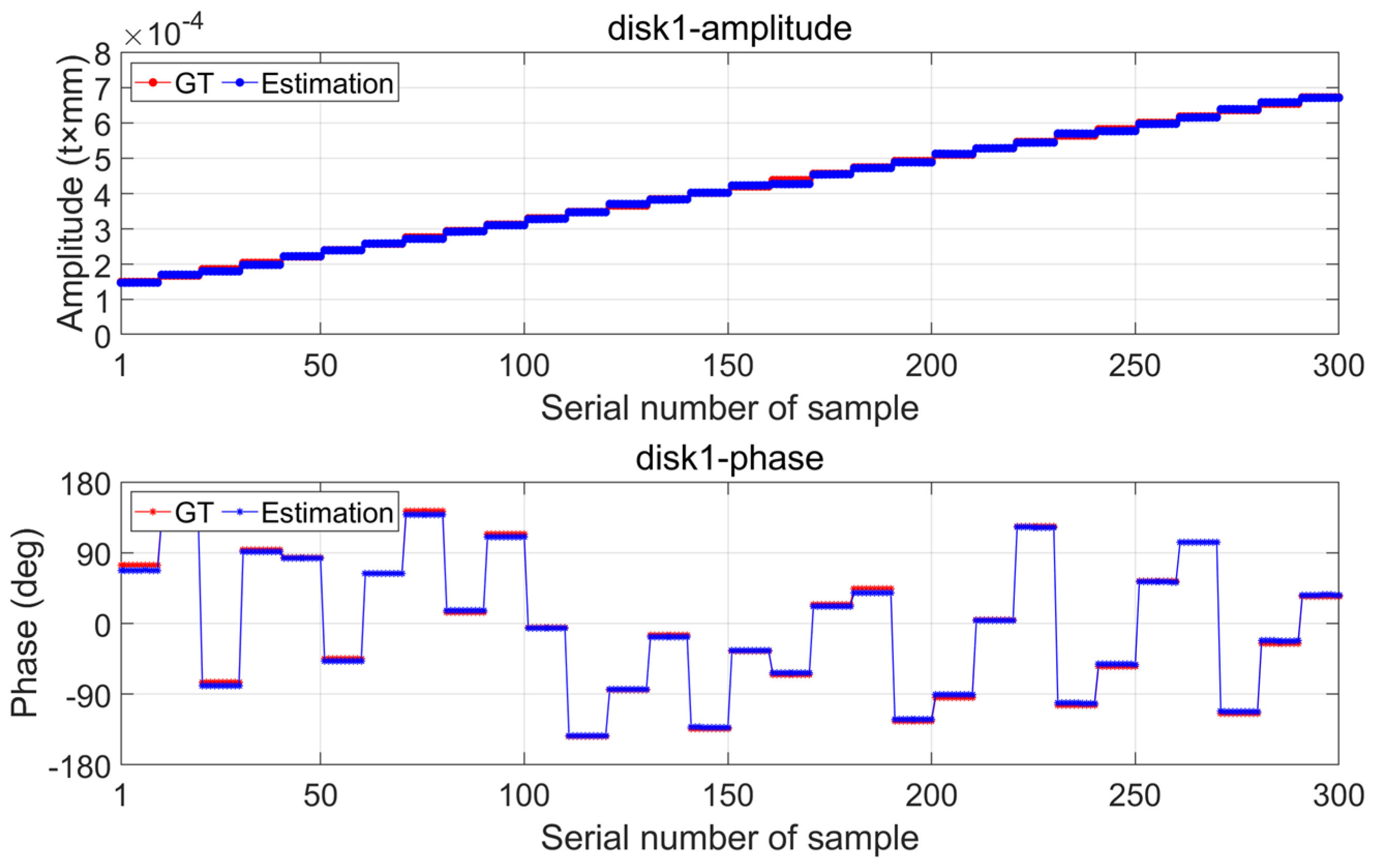
| dataset 1 | disk1-amplitude (t × mm) | 1.0 × 10⁻⁴ ~ 8.375 × 10⁻⁴ | 1.3 × 10⁻⁴ ~ 7.10 × 10⁻⁴ | 1.5 × 10⁻⁴ ~ 6.72 × 10⁻⁴ |
| disk1-phase (rad) | −0.9 × ~ 0.998 × | −0.85 × ~ 0.89 × | −0.80 × ~ 0.795 × | |
| disk2-amplitude (t × mm) | 3 × 10⁻⁶ | 3 × 10⁻⁶ | 3 × 10⁻⁶ | |
| disk2-phase (rad) | 0 | 0 | 0 | |
| number of samples under the same unbalance mode | 40 | 10 | 10 | |
| number of unbalance modes | 60 | 30 | 30 | |
| number of samples | 2400 | 300 | 300 | |
| dataset 2 | disk1-amplitude (t × mm) | 3 × 10⁻⁶ | 3 × 10⁻⁶ | 3 × 10⁻⁶ |
| disk1-phase (rad) | 0 | 0 | 0 | |
| disk2-amplitude (t × mm) | 1.0 × 10⁻⁴ ~ 8.375 × 10⁻⁴ | 1.3 × 10⁻⁴ ~ 7.10 × 10⁻⁴ | 1.5 × 10⁻⁴ ~ 6.72 × 10⁻⁴ | |
| disk2-phase (rad) | −0.9 × ~ 0.998 × | −0.85 × ~ 0.89 × | −0.80 × ~ 0.795 × | |
| number of samples under the same unbalance mode | 40 | 10 | 10 | |
| number of unbalance modes | 60 | 30 | 30 | |
| number of samples | 2400 | 300 | 300 | |
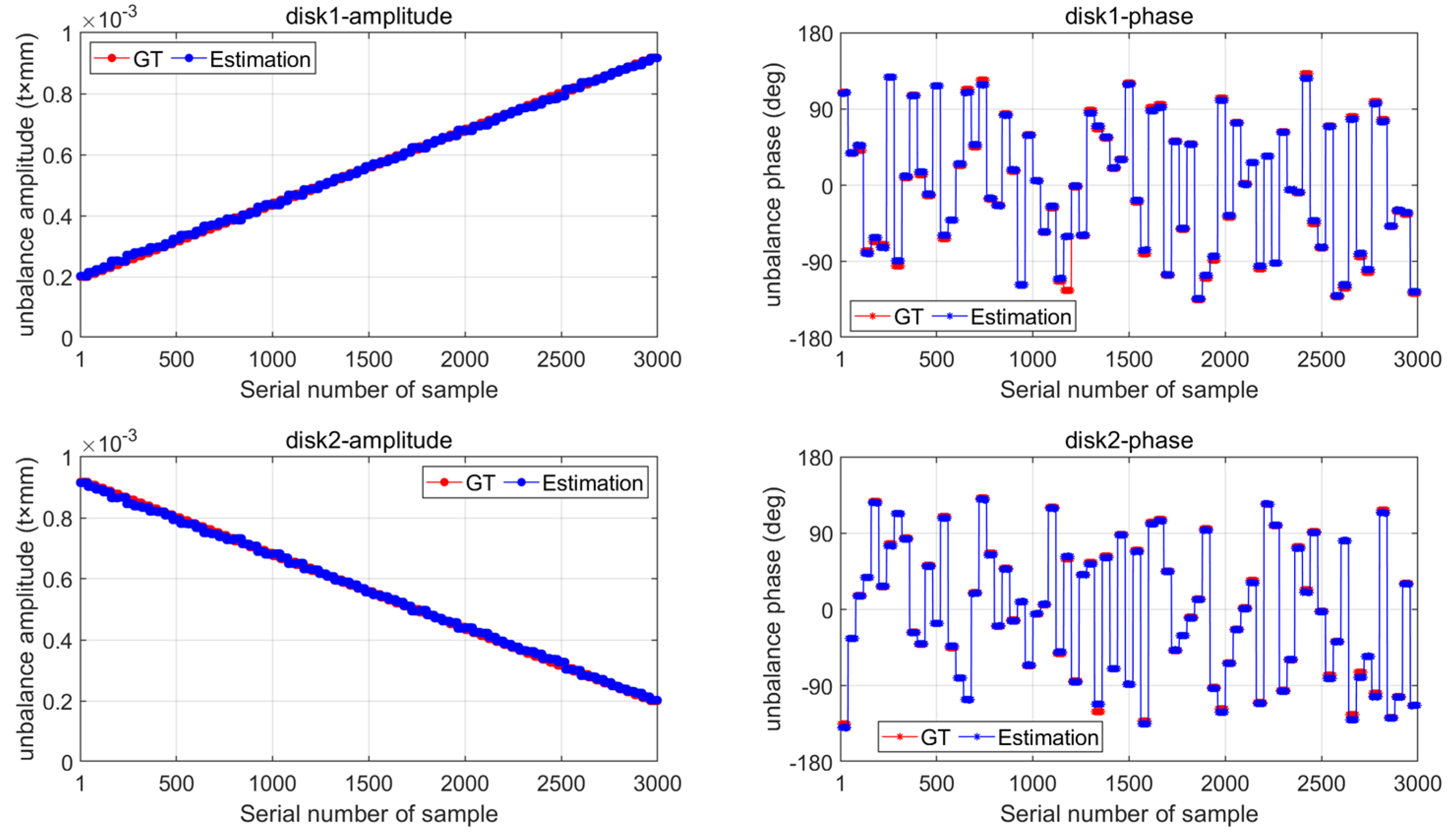
| dataset 3 | disk1-amplitude (t × mm) | 1.7 × 10⁻⁴ ~ 9.487 × 10⁻⁴ | 1.9 × 10⁻⁴ ~ 9.30 × 10⁻⁴ | 2.0 × 10⁻⁴ ~ 9.178 × 10⁻⁴ |
| disk1-phase (rad) | −0.9 × ~ 0.897 × | −0.80 × ~ 0.828 × | −0.75 × ~ 0.73 × | |
| disk2-amplitude (t × mm) | 1.7 × 10⁻⁴ ~ 9.487 × 10⁻⁴ | 1.9 × 10⁻⁴ ~ 9.30 × 10⁻⁴ | 2.0 × 10⁻⁴ ~ 9.178 × 10⁻⁴ | |
| disk2-phase (rad) | −0.9 × ~ 0.897 × | −0.80 × ~ 0.828 × | −0.75 × ~ 0.73 × | |
| number of samples under the same unbalance mode | 40 | 40 | 40 | |
| number of unbalance modes | 600 | 75 | 75 | |
| number of samples | 24,000 | 3000 | 3000 |
References
- Kurt, E.; Arabul, A.Y.; Keskin Arabul, F.; Senol, I. Parallel hybrid propulsion system with integration of designed electric machine for medium altitude long endurance UAV. Heliyon 2025, 11, e42871. [Google Scholar] [CrossRef] [Scilit] [PubMed]
- Hung, J.Y.; Gonzalez, L.F. On parallel hybrid-electric propulsion system for unmanned aerial vehicles. Prog. Aerosp. Sci. 2012, 51, 1–17. [Google Scholar] [CrossRef] [Scilit]
- Ismail, N.; Norhashim, N.; Hamid, S.A.; Mohd Kamal, N.L.; Sahwee, Z.; Shah, S.A.; Yusoff, W.Y.W. Utilizing solar energy for UAVs: Advancements, challenges and future perspectives in defense and military applications—A review. Sol. Energy Mater. Sol. Cells 2026, 296, 114075. [Google Scholar] [CrossRef] [Scilit]
- Xiao, C.; Wang, B.; Zhao, D.; Wang, C. Comprehensive investigation on Lithium batteries for electric and hybrid-electric unmanned aerial vehicle applications. Therm. Sci. Eng. Prog. 2023, 38, 101677. [Google Scholar] [CrossRef] [Scilit]
- Zountouridou, E.; Kiokes, G.; Dimeas, A.; Prousalidis, J.; Hatziargyriou, N. A guide to unmanned aerial vehicles performance analysis—The MQ-9 unmanned air vehicle case study. J. Eng. 2023, 2023, e12270. [Google Scholar] [CrossRef] [Scilit]
- Chen, Y.; Wang, W.; Yang, C.; Liang, B.; Qin, H.; Liu, W. An efficient energy management strategy for hybrid electric unmanned aerial vehicles considering exhaust gas temperature of the turboshaft engine. Energy Convers. Manag. 2026, 348, 120753. [Google Scholar] [CrossRef] [Scilit]
- Yan, Y.; Wang, B.; Wang, C.; Xiao, C.; Zhao, D. Adaptive maximum available energy evaluation for lithium battery in hydrogen-electric hybrid unmanned aerial vehicle applications considering dynamic ambient temperature and aging level. Energy Convers. Manag. 2024, 314, 118685. [Google Scholar] [CrossRef] [Scilit]
- Chen, Y.; Wang, W.; Yang, C.; Liang, B.; Liu, W. An efficient energy management strategy of a hybrid electric unmanned aerial vehicle considering turboshaft engine speed regulation: A deep reinforcement learning approach. Appl. Energy 2025, 390, 125837. [Google Scholar] [CrossRef] [Scilit]
- Ntib, A.; Manias, D.M.; Shami, A. Real-time scalable UAV condition monitoring framework with hardware-level acceleration for IoT applications. Internet Things 2026, 36, 101865. [Google Scholar] [CrossRef] [Scilit]
- Yang, P.; Geng, H.; Wen, C.; Liu, P. An Intelligent Quadrotor Fault Diagnosis Method Based on Novel Deep Residual Shrinkage Network. Drones 2021, 5, 133. [Google Scholar] [CrossRef] [Scilit]
- Charnsethikul, C.; Huo, S.; Ruan, D.; Verhagen, W.; Das, R.; Silva, J.M. Damage severity evaluation of UAM rotor blades towards impact events. Aerosp. Sci. Technol. 2026, 173, 111555. [Google Scholar] [CrossRef] [Scilit]
- Witek, L. Numerical stress and crack initiation analysis of the compressor blades after foreign object damage subjected to high-cycle fatigue. Eng. Fail. Anal. 2011, 18, 2111–2125. [Google Scholar] [CrossRef] [Scilit]
- Song, Z.; Hong, J.; Yang, Z.; Cao, Y.; Ma, Y. Dynamical analysis of propeller rotors whirl flutter considering complex blade geometries and induced velocities. Mech. Syst. Signal Proc. 2025, 230, 112621. [Google Scholar] [CrossRef] [Scilit]
- Zhang, H.; Hu, D.; Ye, X.; Chen, X.; He, Y.; Ma, X. Prediction on aeroengine blade foreign object damage validated by air gun tests. Eng. Fail. Anal. 2023, 143, 106919. [Google Scholar] [CrossRef] [Scilit]
- Jiang, W.; Liu, K.; Yuan, X.; Cao, H.; Shi, J.; Qin, Q. Nonlinear dynamics of rotor-support-casing system with support looseness fault. Int. J. Mech. Sci. 2025, 300, 110482. [Google Scholar] [CrossRef] [Scilit]
- Wu, Z.; Hao, L.; Zhao, W.; Ma, Y.; Bai, S.; Zhao, Q. Modeling and vibration analysis of an aero-engine dual-rotor-support-casing system with inter-shaft rub-impact. Int. J. Non-Linear Mech. 2024, 165, 104757. [Google Scholar] [CrossRef] [Scilit]
- Li, Z.; Wu, J.; Zhang, P.; Wang, L.; Chen, L.; Zou, Z.; Lin, H. Layout and Rotation Effect on Aerodynamic Performance of Multi-Rotor Ducted Propellers. Drones 2025, 9, 561. [Google Scholar] [CrossRef] [Scilit]
- Sonmezocak, T. Intelligent UAV health monitoring: Detecting propeller and structural faults with MEMS-based vibration. Eng. Sci. Technol. Int. J. 2025, 69, 102130. [Google Scholar] [CrossRef] [Scilit]
- Zou, Y.; Xia, H.; Yang, X.; Li, P.; Yi, Y. Dynamics Model of a Multi-Rotor UAV Propeller and Its Fault Detection. Drones 2025, 9, 176. [Google Scholar] [CrossRef] [Scilit]
- Abdullah Salem, B.T.S.; Abdullah, M.N.i.; Mustapha, F.; Kanirai, N.S.A.; Mustapha, M. Vibration Analysis Using Multi-Layer Perceptron Neural Networks for Rotor Imbalance Detection in Quadrotor UAV. Drones 2025, 9, 102. [Google Scholar] [CrossRef] [Scilit]
- Chen, Y.; Wang, J.; Zhou, R.; Chen, C.; Yan, Q.; Zhang, Z. Research on vibration isolation optimization design technology for the articulated link mount of turbofan engine. J. Phys. Conf. Ser. 2024, 2736, 012040. [Google Scholar] [CrossRef] [Scilit]
- Chen, G. Vibration modelling and verifications for whole aero-engine. J. Sound Vib. 2015, 349, 163–176. [Google Scholar] [CrossRef] [Scilit]
- Zhang, D.; Pan, Y.; Bin, G.; Zou, B.; Chen, A.; Li, C.; Yang, J. Effect of carrier landing impact loads on the damping performance of turboprop engine vibration isolation systems. Aerosp. Sci. Technol. 2025, 165, 110503. [Google Scholar] [CrossRef] [Scilit]
- Muszynska, A. Forward and Backward Precession of a Vertical Anisotropically Supported Rotor. J. Sound Vib. 1996, 192, 207–222. [Google Scholar] [CrossRef] [Scilit]
- Chen, H.; Lou, S.; Lv, C. Hybrid physics-data-driven online modelling: Framework, methodology and application to electric vehicles. Mech. Syst. Signal Proc. 2023, 185, 109791. [Google Scholar] [CrossRef] [Scilit]
- Xia, Y.; Ren, X.; Qin, W.; Yang, Y.; Lu, K.; Fu, C. Investigation on the transient response of a speed-varying rotor with sudden unbalance and its application in the unbalance identification. J. Low Freq. Noise Vib. Act. Control 2020, 39, 1065–1086. [Google Scholar] [CrossRef] [Scilit]
- Zhou, L.; Zhang, D.; He, T.; Wang, H. Unbalance identification for a practical turbofan engine using augmented Kalman filter improved with the convergence criterion. J. Vib. Control 2023, 30, 1566–1579. [Google Scholar] [CrossRef] [Scilit]
- Garoli, G.Y.; Alves, D.S.; Machado, T.H.; Cavalca, K.L.; de Castro, H.F. Fault parameter identification in rotating system: Comparison between deterministic and stochastic approaches. Struct. Health Monit. 2021, 20, 3182–3200. [Google Scholar] [CrossRef] [Scilit]
- Wang, J.; Song, Y.; He, T. A novel adaptive monitoring framework for detecting the abnormal states of aero-engines with maneuvering flight data. Reliab. Eng. Syst. Saf. 2025, 258, 110910. [Google Scholar] [CrossRef] [Scilit]
- Fu, J.; He, T.; Guo, C.; Bao, Y.; Li, X.; Liu, X. An additional structure with power-law thickness for weak acoustic emission signal enhancement. Thin-Walled Struct. 2025, 211, 113071. [Google Scholar] [CrossRef] [Scilit]
- Zhu, X.; Hou, D.; Zhou, P.; Han, Z.; Yuan, Y.; Zhou, W.; Yin, Q. Rotor fault diagnosis using a convolutional neural network with symmetrized dot pattern images. Measurement 2019, 138, 526–535. [Google Scholar] [CrossRef] [Scilit]
- Cirigliano, D.; Frisch, A.M.; Liu, F.; Sirignano, W.A. Diesel, spark-ignition, and turboprop engines for long-duration unmanned air flights. J. Propuls. Power 2018, 34, 878–892. [Google Scholar] [CrossRef] [Scilit]
- Hu, C.; Goebel, K.; Howey, D.; Peng, Z.; Wang, D.; Wang, P.; Youn, B.D. Editorial: Special issue on Physics-informed machine learning enabling fault feature extraction and robust failure prognosis. Mech. Syst. Signal Proc. 2023, 192, 110219. [Google Scholar] [CrossRef] [Scilit]
- Qin, Y.; Liu, H.; Wang, Y.; Mao, Y. Inverse physics–informed neural networks for digital twin–based bearing fault diagnosis under imbalanced samples. Knowl. -Based Syst. 2024, 292, 111641. [Google Scholar] [CrossRef] [Scilit]
- Tama, B.A.; Vania, M.; Lee, S.; Lim, S. Recent advances in the application of deep learning for fault diagnosis of rotating machinery using vibration signals. Artif. Intell. Rev. 2023, 56, 4667–4709. [Google Scholar] [CrossRef] [Scilit]
- Amin, A.A.; Mubarak, A.; Waseem, S. Application of physics-informed neural networks in fault diagnosis and fault-tolerant control design for electric vehicles: A review. Measurement 2025, 246, 116728. [Google Scholar] [CrossRef] [Scilit]
- Weikun, D.; Nguyen, K.T.; Medjaher, K.; Christian, G.; Morio, J. Physics-informed machine learning in prognostics and health management: State of the art and challenges. Appl. Math. Model. 2023, 124, 325–352. [Google Scholar] [CrossRef] [Scilit]
- Freeman, B.; Tang, Y.; Huang, Y.; VanZwieten, J. Physics-informed turbulence intensity infusion: A new hybrid approach for marine current turbine rotor blade fault detection. Ocean Eng. 2022, 254, 111299. [Google Scholar] [CrossRef] [Scilit]
- Liu, X.; Cheng, W.; Xing, J.; Chen, X.; Zhao, Z.; Gao, L.; Zhang, R.; Huang, Q.; Zhou, H.; Zheng, W.X.; et al. Hierarchical Physics-Informed Neural Network for Rotor System Health Assessment. IEEE Trans. Autom. Sci. Eng. 2025, 22, 10392–10405. [Google Scholar] [CrossRef] [Scilit]
- Garpelli, L.N.; Alves, D.S.; Cavalca, K.L.; de Castro, H.F. Physics-guided neural networks applied in rotor unbalance problems. Struct. Health Monit. 2023, 22, 4117–4130. [Google Scholar] [CrossRef] [Scilit]
- Silveira, E.; Atxaga, G.; Irisarri, A.M. Failure analysis of a set of compressor blades. Eng. Fail. Anal. 2008, 15, 666–674. [Google Scholar] [CrossRef] [Scilit]
- Sun, C.; Wang, Y.; Lu, Q.; Liu, Y.; Tan, J. Research on balancing method of single-stage rotor blade mass moment based on pointer network. J. Comput. Sci. 2023, 67, 101957. [Google Scholar] [CrossRef] [Scilit]
- Zhang, M.; Liu, D.; Liu, Y. Recent progress in precision measurement and assembly optimization methods of the aero-engine multistage rotor: A comprehensive review. Measurement 2024, 235, 114990. [Google Scholar] [CrossRef] [Scilit]
- Dietterich, T.G. Ensemble Methods in Machine Learning. In Multiple Classifier Systems; Springer: Berlin/Heidelberg, Germany, 2000; pp. 1–15. [Google Scholar]
- Walker, R.B.; Vayanat, R.; Perinpanayagam, S.; Jennions, I.K. Unbalance localization through machine nonlinearities using an artificial neural network approach. Mech. Mach. Theory 2014, 75, 54–66. [Google Scholar] [CrossRef] [Scilit]
- Han, S.; Yang, T.; Zhu, Q.; Zhao, Y.; Han, Q. Unbalance position of aeroengine flexible rotor analysis and identification based on dynamic model and deep learning. Proc. Inst. Mech. Eng. Part C J. Mech. Eng. Sci. 2023, 237, 4410–4429. [Google Scholar] [CrossRef] [Scilit]
- He, K.; Zhang, X.; Ren, S.; Sun, J. Deep residual learning for image recognition. In 2016 IEEE Conference on Computer Vision and Pattern Recognition; IEEE: New York, NY, USA, 2016; pp. 770–778. [Google Scholar]
- Zaparoli Cunha, B.; Droz, C.; Zine, A.-M.; Foulard, S.; Ichchou, M. A review of machine learning methods applied to structural dynamics and vibroacoustic. Mech. Syst. Signal Proc. 2023, 200, 110535. [Google Scholar] [CrossRef] [Scilit]
- Zou, D.; Zhao, H.; Liu, G.; Ta, N.; Rao, Z. Application of augmented Kalman filter to identify unbalance load of rotor-bearing system: Theory and experiment. J. Sound Vib. 2019, 463, 114972. [Google Scholar] [CrossRef] [Scilit]
- Ranjan, G.; Tiwari, R. On-site high-speed balancing of flexible rotor-bearing system using virtual trial unbalances at slow run. Int. J. Mech. Sci. 2020, 183, 105786. [Google Scholar] [CrossRef] [Scilit]
- Ye, R.; Wang, L.; Hou, X.; Luo, Z.; Han, Q. Balancing method without trial weights for rotor systems based on similitude scale model. Front. Mech. Eng. 2018, 13, 571–580. [Google Scholar] [CrossRef] [Scilit]
- Wang, Y.; Fang, J.; Zheng, S. A Field Balancing Technique Based on Virtual Trial-Weights Method for a Magnetically Levitated Flexible Rotor. J. Eng. Gas Turbines Power 2014, 136, 092502. [Google Scholar] [CrossRef] [Scilit]





















| Item | Setting |
|---|---|
| Optimizer | Adam |
| LR schedule | Keep 0.01 |
| Epochs | 2000 |
| Batch size | 40 |
| Early stopping | Yes |
| Loss function | Mean absolute error |
| The criterion for selecting the best epoch | The one that achieves the minimum validating loss |
| Operating System | Processor | RAM | Execution Environment | GPU | Execution Mode |
|---|---|---|---|---|---|
| Microsoft Windows 10 Enterprise (Build 19045) | Intel Core i7-10700 (8 cores, 16 threads, 2.90 GHz) | 64 GB (63.8 GB usable) | PyCharm (Community Edition 2023.3.4) (Python 3.11.8, with PyTorch 2.2.1.) | NVIDIA GeForce GTX 1660 SUPER | GPU |
| Shaft | Disk | Bearing |
|---|---|---|
| Density: 7.8 × 10⁻⁹ t/mm3 | Disk1-mass: 1 × 10⁻² t | Stiffness: 2.5 × 10⁶ N/mm |
| Elastic modulus: 2.1 × 10⁵ MPa | Disk2-mass: 4 × 10⁻³ t | Damping: 1 × 10³ Ns/mm |
| Poisson’s ratio: 0.3 | Disk1 polar moment of inertia: 100 t∙mm2 | |
| Length: 500 mm | Disk2 polar moment of inertia: 70 t∙mm2 | |
| Diameter: 36 mm | Disk1 diametric moment of inertia: 50 t∙mm2 | |
| Disk2 diametric moment of inertia: 35 t∙mm2 |
| Method | Fault Mode | Total Samples | Number of Trainable Parameters | Time Cost |
|---|---|---|---|---|
| PICNN | mode 1 | 2400 | 5.31 × 10⁴ | 1.39 h |
| mode 2 | 2400 | 5.31 × 10⁴ | 1.39 h | |
| mode 3 | 24,000 | 7.65 × 10⁴ | 15.6 h | |
| pure-CNN | cannot distinguish | 28,800 | 7.65 × 10⁴ | 18.7 h |
| pure-ResNet34 | cannot distinguish | 28,800 | 4.02 × 10⁶ | 19.4 h |
| Order | Simulation Result (rpm) | Experiment Result (rpm) | Relative Error |
|---|---|---|---|
| 1st | 4092 | 4020 | 1.79% |
| 2nd | 4512 | 4740 | 4.81% |
| Kernel Size | Unbalance Amplitude | Unbalance Phase | ||
|---|---|---|---|---|
| Relative Error (%) | 95% Confidential Interval | Relative Error (%) | 95% Confidential Interval | |
| 50 × 5 | 0.228 | [0.225, 0.231] | 0.824 | [0.814, 0.834] |
| 60 × 5 | 0.262 | [0.255, 0.269] | 0.872 | [0.848, 0.896] |
| 70 × 5 | 0.253 | [0.246, 0.260] | 0.856 | [0.833, 0.879] |
| Stiffness (N/mm) | 1st-Order (Hz) | 2nd-Order (Hz) | Err-1st-Order (%) | Err-2nd-Order (%) | Err-Mean (%) |
|---|---|---|---|---|---|
| 7 × 10³ | 66.6 | 72.6 | 0.60% | 8.1% | 4.4% |
| 1 × 10⁴ | 68.2 | 75.2 | 1.8% | 4.8% | 3.3% |
| 1 × 10⁵ | 71.7 | 81.4 | 7.0% | 3.0% | 5.0% |
| Stiffness (N/mm) | Mode Shape ux (Small Disk:Big Disk) | Mode Shape uy (Small Disk:Big Disk) | Err-ux (%) | Err-uy (%) |
|---|---|---|---|---|
| 7 × 10³ | 1.179:1 | 1.121:1 | 1.8% | 3.4% |
| 1 × 10⁴ | 1.204:1 | 1.145:1 | 4.0% | 1.3% |
| 1 × 10⁵ | 1.257:1 | 1.193:1 | 8.5% | 2.8% |
| Elastic Modulus (GPa) | 1st-Order (Hz) | 2nd-Order (Hz) | Small-Disk Response Anisotropy (uy:ux) | Big-Disk Response Anisotropy (uy:ux) |
|---|---|---|---|---|
| 100 | 65.2 | 74.9 | 1:1.82 | 1:1.68 |
| 150 | 67.1 | 75.1 | 1:1.61 | 1:1.51 |
| 200 | 68.2 | 75.2 | 1:1.51 | 1:1.43 |
| 250 | 68.9 | 75.2 | 1:1.44 | 1:1.38 |
| 300 | 69.4 | 75.3 | 1:1.40 | 1:1.35 |
Disclaimer/Publisher’s Note: The statements, opinions and data contained in all publications are solely those of the individual author(s) and contributor(s) and not of MDPI and/or the editor(s). MDPI and/or the editor(s) disclaim responsibility for any injury to people or property resulting from any ideas, methods, instructions or products referred to in the content. |
© 2026 by the authors. Licensee MDPI, Basel, Switzerland. This article is an open access article distributed under the terms and conditions of the Creative Commons Attribution (CC BY) license.
Share and Cite
Zhou, L.; Zhang, D.; Zhang, Q.; Zhang, J.; Wang, C. Physics-Informed Convolutional Neural Network for Localizing and Identifying Rotor Unbalance in the Long-Endurance UAV Turbine Engine. Drones 2026, 10, 208. https://doi.org/10.3390/drones10030208
Zhou L, Zhang D, Zhang Q, Zhang J, Wang C. Physics-Informed Convolutional Neural Network for Localizing and Identifying Rotor Unbalance in the Long-Endurance UAV Turbine Engine. Drones. 2026; 10(3):208. https://doi.org/10.3390/drones10030208
Chicago/Turabian StyleZhou, Liang, Dayi Zhang, Qicheng Zhang, Jingxuan Zhang, and Cun Wang. 2026. "Physics-Informed Convolutional Neural Network for Localizing and Identifying Rotor Unbalance in the Long-Endurance UAV Turbine Engine" Drones 10, no. 3: 208. https://doi.org/10.3390/drones10030208
APA StyleZhou, L., Zhang, D., Zhang, Q., Zhang, J., & Wang, C. (2026). Physics-Informed Convolutional Neural Network for Localizing and Identifying Rotor Unbalance in the Long-Endurance UAV Turbine Engine. Drones, 10(3), 208. https://doi.org/10.3390/drones10030208