1. Introduction
Autonomous aerial transportation has attracted considerable attention as a means of enabling the delivery of goods in environments where ground transportation is difficult. UAVs, with their vertical takeoff and landing capability and high maneuverability, are well suited for such tasks and have been actively studied in recent years [
1]. In recent years, the cooperative transportation of a single suspended payload by multiple UAVs has been gaining attention. This has many advantages over a single UAV, such as improved payload capacity, vibration suppression, reduced risk of failure, and an expanded operating range due to formation transformation [
2]. Cable-based transportation is considered to enable stable and agile transport because it is less affected by increased inertia or reduced responsiveness compared with grasping with a gripper fixed to the vehicle body. On the other hand, cooperative UAVs transporting a payload with cables is challenging because of the complex dynamic interactions between the vehicles and the load [
3]. Nevertheless, the benefits of cable-based transportation are significant, and while many theoretical studies have been verified through simulations, actual multi-vehicle experimental demonstrations, such as [
4], have recently begun to be realized too.
To the best of my knowledge, in most existing studies, the yaw command of the quadrotor is designed to be fixed at a constant value. This design choice is primarily motivated by the need to maintain stable cooperative transportation performance. Even without considering cable twisting induced by the yaw motion of the quadrotor, yaw control can interfere with roll and pitch control. Consequently, this interference can degrade the stability of the payload. However, by changing the heading direction of a quadrotor, it is possible to extend the operational capabilities of aerial transportation systems. One such extension is collision avoidance with external obstacles. It has been shown that acquiring environmental information using an onboard camera is effective for collision avoidance in [
5]. In such scenarios, active yaw control becomes important to acquire sufficient environmental information. While the present study does not implement collision avoidance itself, enabling yaw maneuverability provides a structural capability that could support such extensions in future developments.
In conventional geometric attitude control frameworks and other common attitude controllers, yaw-angle errors are coupled with roll and pitch errors. As discussed in [
6], yaw moments are generated through relatively weak reactive torques. To produce a yaw moment, two rotors must be accelerated while the other two are decelerated at matching rates, implying that yaw control inherently relies on differential thrust. Consequently, yaw dynamics tend to be more sensitive to actuator dynamics and modeling uncertainties than roll/pitch control, and such sensitivity may introduce undesirable effects on thrust-direction control. In cooperative suspended-load transportation systems, these effects can further influence payload stabilization performance.
To address this issue, the geometric yaw-decoupled control proposed in [
6] decomposes the three-dimensional attitude into a thrust direction and a yaw direction, allowing roll/pitch and yaw errors to be treated independently. Building on this concept, we propose an integrated control framework that incorporates yaw-decoupled geometric attitude control into cooperative cable-suspended payload transportation.
The adopted controller is based on geometric control, which explicitly accounts for the dynamic coupling between the quadrotor and the payload and enables a globally consistent control design on the underlying configuration manifold without local coordinate parameterization. The resulting control structure naturally exhibits a cascade hierarchy in which the payload states, cable directions, and quadrotor states are stabilized in sequence. In this study, we focus on the attitude control of the quadrotors at the lower control layer and address the dynamic coupling between yaw and roll/pitch motions that arises in conventional geometric attitude control frameworks. This integration preserves the global manifold coordinate structure of the payload, cable, and quadrotor while preventing yaw-induced coupling from affecting the cooperative stabilization layer. Such an integration has not been proposed in previous studies. This structural separation mitigates undesirable coupling between cooperative transportation control and yaw dynamics. As a result, the controller design is simplified, the tuning burden is reduced, and greater flexibility in yaw maneuvering can be achieved without compromising payload stabilization.
In this paper, we propose an integrated control framework that combines geometric control for cooperative cable-suspended load transportation with decoupled yaw attitude control for quadrotors.
For clarity, the conventional geometric control approach is referred to as GC, while the proposed decoupled yaw geometric control approach is referred to as DYGC.
The main contributions of this paper can be summarized as follows.
First, we propose an integrated control framework that combines geometric cooperative load transportation control with yaw-decoupled attitude control, prioritizing payload stabilization while enabling additional yaw maneuverability without modifying the cooperative payload stabilization structure.
Second, we conduct comparative simulations using a highly nonlinear cooperative transportation model that incorporates elastic and damping effects of the cables and the coupled dynamics on the manifold.
Third, we evaluate the proposed method through comparative simulations involving quadrotor viewpoint-direction tracking during trajectory following, including aggressive maneuvers that excite payload oscillations. The results indicate that the proposed approach maintains cooperative transportation performance even under yaw maneuvers. Roll/pitch behavior, yaw tracking errors, and payload position tracking errors remain within bounded ranges.
2. Related Work
In early works, a control method was used that only considered the forces acting on the quadrotor without considering the dynamic coupling between the payload and the quadrotor. As a result, a trajectory calculated in advance was required to limit payload swing, and only static transportation was possible [
7]. In the geometric control framework, dynamic transportation became feasible by explicitly accounting for the dynamic coupling among the payload, cables, and quadrotors on the configuration space. Lee et al. proposed a nonlinear control law for quadrotors based on a global representation on manifolds and conducted a rigorous stability analysis [
8]. Subsequently, for transportation using three or more quadrotors with cables, they proposed and validated a control approach that models the payload assuming a point mass [
9], and further demonstrated through simulations that the proposed geometric control method for extending a rigid-body payload model enables effective control of the payload’s position and attitude [
10]. In particular, the dynamic model proposed in [
10] is derived on a nonlinear configuration manifold, providing a global and compact representation of the system without any local approximation or coordinate dependency, which constitutes a major contribution of their work. In addition, ref. [
11] demonstrated its effectiveness by introducing an error estimation term and validating the method under the assumption of periodic disturbances.
Consequently, the geometric control approach proposed by Lee et al. has been extensively studied as a fundamental control framework for multi-quadrotor cooperative transportation. In [
12], a fully decentralized system based on geometric control was established, achieving transportation in real-world experiments without external sensing. Furthermore, ref. [
13] introduced NMPC for trajectory planning of the payload state on the SE(3) manifold, demonstrating the effectiveness of combining geometric control with optimal control. In [
14], the existing geometric control is extended with multiple neural networks and adaptive laws, demonstrating robustness against model uncertainties and external disturbances. Thus, geometric control continues to evolve as a robust and extensible nonlinear control framework that avoids model approximations and coordinate dependencies and has been increasingly integrated with optimal and learning-based control techniques.
In recent studies, hierarchical control frameworks based on INDI, which take a different approach from geometric control by emphasizing agility and robustness, have become increasingly popular. For example, ref. [
15] integrates a high-level trajectory optimization using MPC with a low-level INDI controller for cooperative transportation, while ref. [
16] combines a high-level multi-agent reinforcement learning policy with a low-level INDI controller for cooperative load manipulation. In these studies, the quadrotor heading is not explicitly commanded; instead, the yaw rate is set to zero to stabilize the attitude. Focusing on the INDI control, although control schemes that explicitly consider the yaw angle, such as [
17], have been proposed, their design does not achieve a complete decoupling between the roll/pitch and yaw dynamics. Therefore, when applying INDI control or other nonlinear control methods to cooperative suspended-load transportation systems, it is not straightforward to eliminate yaw-related coupling effects while maintaining a globally consistent and stable control structure. Therefore, this study exploits the global structural properties in geometric control, aiming to extend geometric control to address not only payload dynamics but also the yaw dynamics of the quadrotors.
Ref. [
18] presents a theoretical framework that globally decomposes the thrust vector and the rotation about its axis of a quadrotor on
. However, the contribution is mainly theoretical in nature, and a complete controller design for practical quadrotor applications is not provided. In [
6], based on the theoretical framework of global attitude decomposition on
, a practical controller was developed in which the roll/pitch and yaw controls are clearly separated. Its superiority over conventional geometric control was demonstrated through simulation validations under large initial yaw attitude errors. Furthermore, ref. [
19] introduced an additional adaptive control term and demonstrated the effectiveness of the yaw-decoupled design through both indoor and outdoor flight experiments. Building on these studies, recent research has applied this concept to modular reinforcement learning by dividing the translational and yaw subsystems, thus improving both training efficiency and trajectory-tracking performance [
20]. As such, recent studies have continued to explore quadrotor control schemes based on globally decoupled yaw design, demonstrating their usefulness particularly when the yaw error is large or the yaw angle varies over time. However, to the best of our knowledge, no prior work has verified the effectiveness of applying such a global decoupled yaw design to the cooperative transportation system of a cable-suspended payload. In this study, we demonstrate its advantages through tasks in which yaw angle errors arise under cooperative aerial transportation conditions.
Furthermore, while existing suspended-load models such as [
10] assume the cables to be rigid links, ref. [
21] demonstrates that neglecting cable elasticity and damping can compromise the validity of force estimation. The simulation model employed in this study is based on [
22], which allows the incorporation of cable elasticity and damping while preserving the global representation on the manifold. This approach avoids the modeling complexity associated with hybrid tension-switching systems [
23] and multi-link configurations [
24], while maintaining a reasonable level of model complexity without excessive reliance on simplified formulations such as [
25].
The positioning and novelty of this study are summarized in
Table 1.
As shown in
Table 1, existing cooperative payload transportation studies typically assume fixed or non-varying yaw angles. In contrast, yaw-varying and yaw-decoupled control strategies have mainly been investigated for single-UAV systems. The integration of explicit yaw command into cooperative cable-suspended payload transportation has not been sufficiently explored. This study addresses this gap by proposing a control framework that enables yaw-varying operation within cooperative transportation.
3. System Formulation
3.1. System Definition
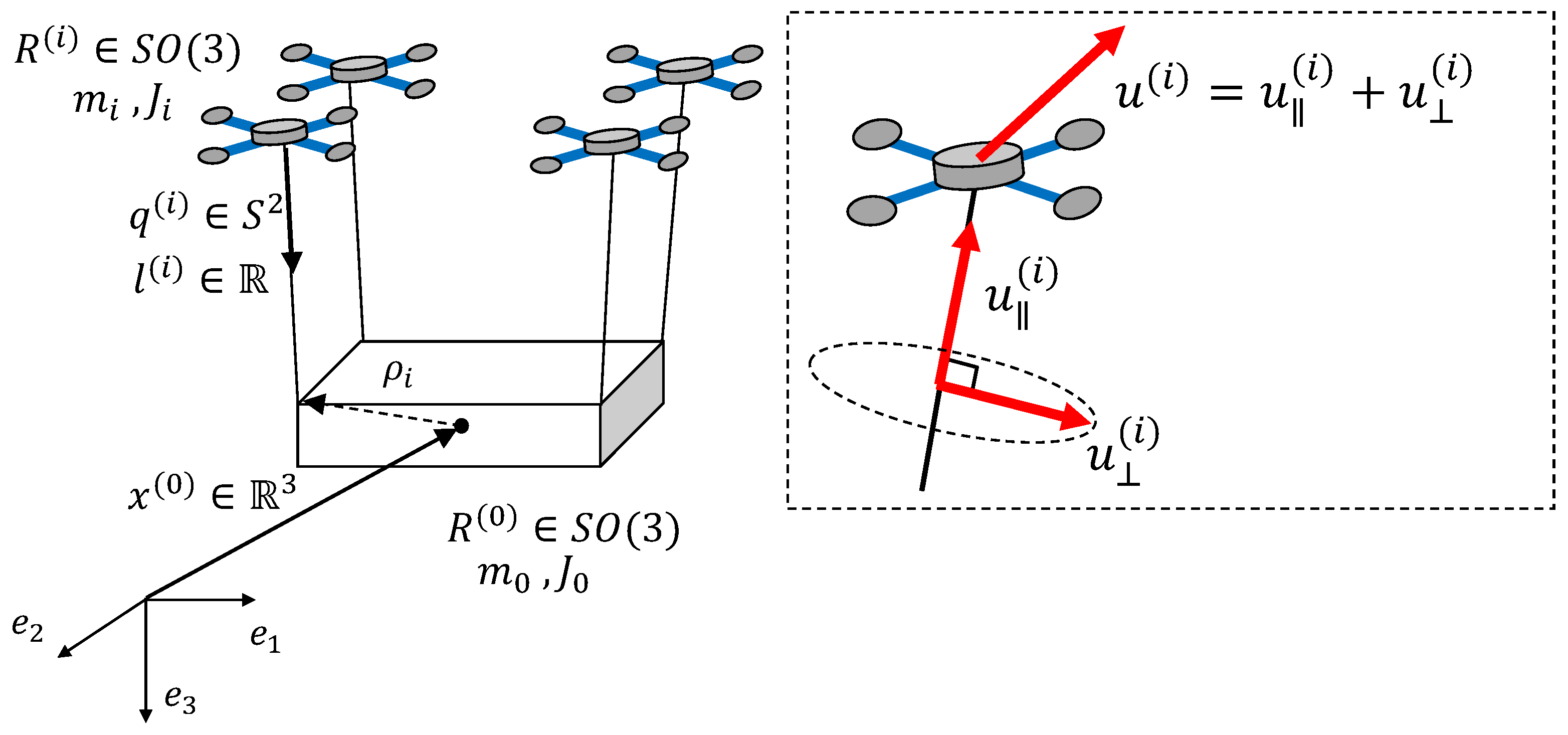
This study focuses on a cooperative transportation system in which multiple quadrotors carry a rigid payload via cables, as illustrated in
Figure 1. In this section, the state variables and configuration space of the system are first defined, and then the equations of motion are derived based on the Lagrangian mechanics framework.
The dynamic model of the cooperative transportation system considered in this study is based on the formulation presented in [
11]. The state parameters and physical parameters used in this study are shown in
Table 2. Let
n denote the number of quadrotors. Throughout this paper, variables related to the payload are denoted by the subscript 0, while variables related to the
i-th quadrotor and the
i-th cable connected to the payload are denoted by the subscript
i.
In this paper, the cable length is assumed to be variable, and the length of the i-th cable is treated as a state variable denoted by . The vector represents the position of the i-th cable attachment point on the payload, expressed in the body-fixed coordinate frame measured from the payload’s center. The acceleration input of the i-th quadrotor, , can be orthogonally decomposed into a component parallel to the cable and a component perpendicular to it with the unit vector .
In this study, the cable direction and its angular velocity are assumed to be available through state estimation. Practical estimation methods based on onboard IMU and vision sensors have been demonstrated in prior works [
12]. Although the cable length
is included in the dynamic model, the controller does not require direct measurement of
. The natural cable length l0 is used in the control law.
The component of
parallel to the cable is given by
and the component perpendicular to the cable is defined as
Thus, the quadrotor input
can be written as
Similarly, the disturbance at the
i-th quadrotor is decomposed as
The axes of the inertial frame are defined as , and those of the body-fixed frame are defined as . In this study, a right-handed coordinate system is adopted, and the downward direction is taken as positive; therefore, points in the direction of gravity (downward).
The attitude matrices of the payload and the
i-th quadrotor are denoted by
and
, respectively, and their sets belong to the special orthogonal group
The set of unit vectors representing the direction of the
i-th cable is defined on the two-dimensional sphere
The overall configuration manifold of the system is then defined as
Based on this manifold, the dynamic modeling, control design, and Lyapunov stability analysis are conducted directly on the manifold, which provides a coordinate-free representation free from singularities and avoids analytical complexity.
The position of the
i-th quadrotor is given by
which is uniquely determined by the payload attitude and the cable states, and therefore does not explicitly appear in the configuration manifold.
3.2. Dynamic Model
Rotational equations of motion of the payload and quadrotor are given by
Let
be a skew-symmetric matrix defined such that, for
, the cross product can be represented as
Here, for
, the matrix
is given by
The operator
maps a vector in
to its corresponding
skew-symmetric matrix representation. The inverse mapping
converts a skew-symmetric matrix to the corresponding vector, defined as
The equations of motion for the direction of the
i-th cable are given by
The rotation matrices and the unit vectors are updated using the exponential map, which provides numerically stable attitude updates compared with conventional integration methods. In this section, the equations of motion for the cooperative transportation system composed of a payload and multiple quadrotors are derived as a nonlinear model based on Lagrangian mechanics.
Let
denote the position of the
i-th quadrotor. The total kinetic energy of the system is given by
The potential energy is given by
Accordingly, the Lagrangian is defined as
By applying Hamilton’s principle of variation in a coordinate-free formulation on
and
, the equations of motion can be derived. The detailed derivation is presented in [
10]. From the variation with respect to the payload velocity
, the following equation is obtained:
Here, the total mass matrix
is defined as
From the variation with respect to the payload angular velocity
expressed in the body-fixed frame, the following equation is obtained:
By simultaneously solving the above equations for
and
, the translational and rotational equations of motion of the payload are obtained. Furthermore, from the variation with respect to the time derivative of the cable direction
, the equation of motion for the rotational acceleration of the cable is given by
Finally, from the variation with respect to the angular velocity
of the
i-th quadrotor, the attitude dynamics are obtained as
Each quadrotor generates thrust only along the
z-axis (downward) in the body-fixed frame. Accordingly, the relationship between the force generated by the
i-th quadrotor in the inertial frame,
, and its thrust magnitude
is given by
Furthermore, the relationship between the attitude control moment of the
i-th quadrotor,
, and the individual rotor thrusts
corresponding to the total thrust
is expressed as
Here, d denotes the arm length from the vehicle center to each rotor, and represents the torque coefficient, which is assumed to be less than or equal to one. This implies that the yaw response to the rotor thrust inputs is slower than the roll and pitch responses.
3.3. Incorporation of Elastic Cable Dynamics
In the previous study [
11], rigid links were used in the model. In this work, to avoid model mismatch at the phenomenological level, the elasticity and damping of the cables are taken into account. Let
denote the length of the
i-th cable. The elongation from the natural length
is modeled as an elastic force, and the rate of change of the cable length is modeled as a damping force. To describe the time-varying cable length
, the following equation of motion is given:
By incorporating the cable elasticity and damping, unexpected impact forces caused by abrupt control variations and persistent oscillations of the cable can be suppressed. The cable elasticity itself may induce oscillations and act as a source of disturbance.
4. Control Design
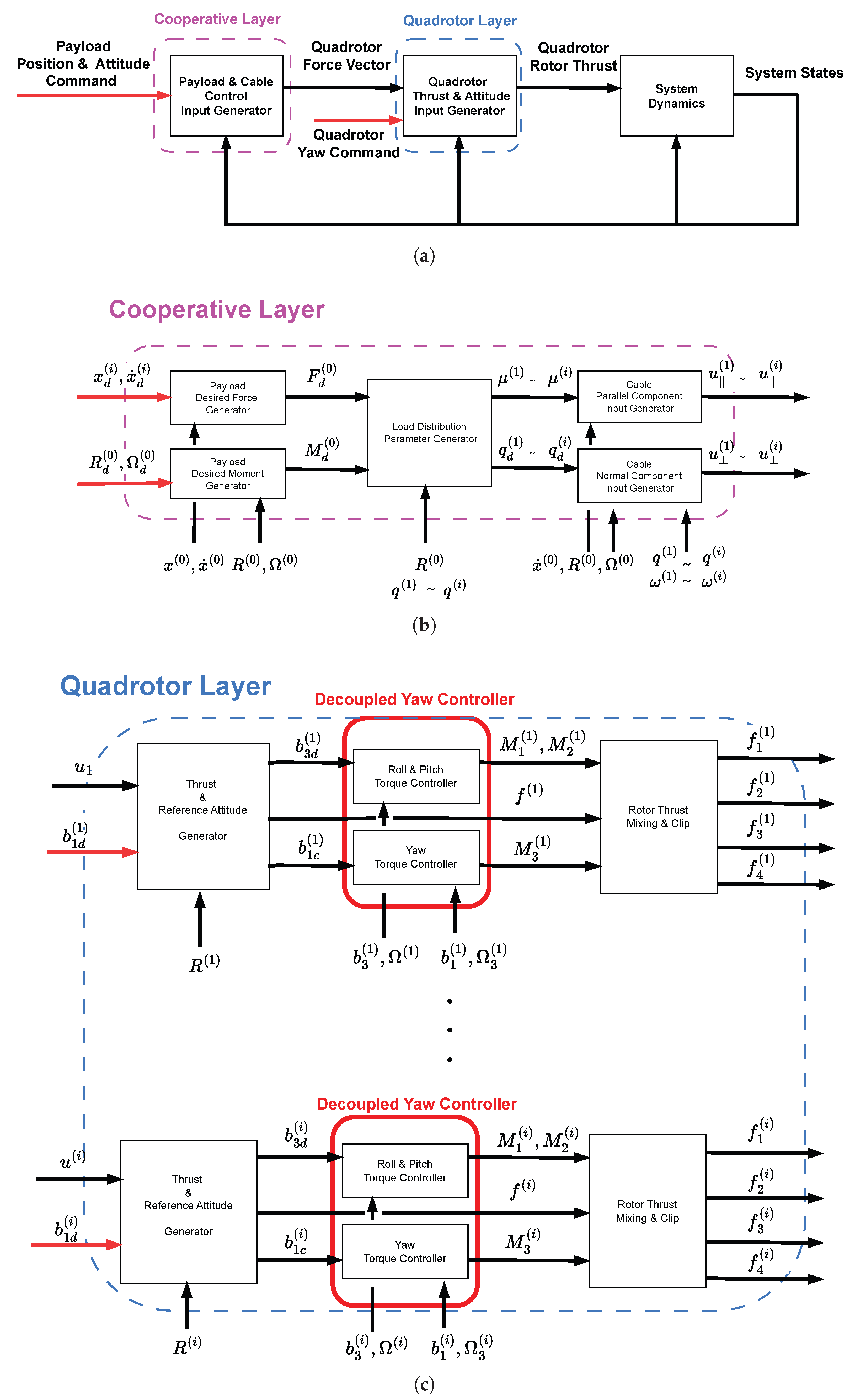
Figure 2 illustrates the overall hierarchical control architecture of the proposed cooperative transportation system. The control system is composed of two main layers: a cooperative layer and a quadrotor layer.
At the cooperative layer shown in
Figure 2b, the desired force vector for each quadrotor is determined by taking into account the states of the payload and the individual cables. The generated desired payload position and attitude commands are transformed into virtual control inputs for the payload, namely the desired force and desired moment. These virtual inputs are allocated to each cable through the load distribution parameters generator, resulting in desired cable tensions and cable directions. Furthermore, these inputs are decomposed into components parallel and normal to the cable directions, which define the desired force vectors for the individual quadrotors. Up to this point, the control structure in the cooperative layer follows conventional geometric cooperative control approaches.
At the quadrotor layer shown in
Figure 2c, each vehicle performs attitude control and thrust generation to realize the assigned desired force vector. In this work, DYGC (decoupled yaw geometric attitude controller) is employed for the generation of the body torque inputs. Specifically, the thrust magnitude and the reference attitude are generated, and the roll/pitch torque controller and the yaw torque controller are designed independently. The resulting thrust and torque commands are finally mapped to the individual rotor thrusts through a mixing and saturation block.
As illustrated in
Figure 2a, the system dynamics feed back the payload and quadrotor states to both control layers, thereby closing the overall control loop. This modular structure enables the integration of the DYGC into the cooperative transportation framework without significantly altering the overall stability properties.
The geometric control laws employed in this study are primarily based on the geometric control frameworks developed in [
6,
11]. In this work, we reformulate the cooperative transportation controller in [
11] and integrate the decoupled-yaw geometric controller (DYGC) in [
6] into the cooperative transportation framework for a cable-suspended payload.
The overall control structure is designed to remain consistent with the Lyapunov-based geometric control frameworks established in [
6,
11]. Although the finite-time attitude convergence employed in [
11] is not adopted in the present work and the closed-loop system does not strictly satisfy the same theoretical assumptions as in [
11], the proposed controller preserves the cascade structure underlying the original stability analysis.
From the viewpoint of structural consistency with the existing cascade-stable framework, the stability properties of the integrated system can be interpreted as follows. The DYGC guarantees Lyapunov stability of the yaw subsystem and bounded yaw-rate dynamics, as established in [
6]. Under the bounded-disturbance assumptions adopted in [
11], the residual attitude tracking errors induced by the decoupled yaw dynamics can therefore be regarded as bounded perturbations acting on the cooperative transportation subsystem.
Although the roll/pitch control law includes the yaw rate
, this term originates from the gyroscopic coupling term
in the rigid-body rotational dynamics and does not arise from the yaw attitude error. The yaw controller is designed independently, and its stability has been established in [
6], which guarantees that
remains bounded in closed loop. The coupling terms
and
therefore act as bounded higher-order terms in the roll/pitch dynamics. Consequently, they do not fundamentally modify the local stability structure of the thrust-direction control derived on
.
Accordingly, the present work does not provide new sufficient gain conditions nor a complete closed-loop stability proof for the integrated system. Instead, the focus is placed on the structural integration of DYGC into the cooperative geometric control architecture and on demonstrating its effectiveness through numerical validation.
Section 4.1 presents the cooperative control law for the virtual payload inputs
and
, the cable tension distribution, and the quadrotor inputs for cable direction and cable tension control
Section 4.2 presents the quadrotor attitude controller with decoupled yaw control on
that realizes the desired thrust vectors and yaw angles.
4.1. Control Design for Cooperative Transportation System
4.1.1. Design of Virtual Control Inputs for the Payload
In this study, the control objective is to make the payload track its desired position and attitude. Therefore, the payload control is designed as the upper-level control. In other words, the control does not aim to maintain a specific quadrotor formation, but rather to determine the load distribution and the individual quadrotor inputs according to the motion of the payload.
First, to determine the cable tensions that make the payload reach the desired position and attitude, we design virtual control inputs
for the payload in the form of ideal total force and moment. Let the desired position of the payload be denoted by
. The position error in the Euclidean space
is defined as
Using the payload position error defined in (
25), the desired total force acting on the payload is designed as
where
are positive control gains.
Next, the desired total moment
acting on the payload is designed. Let
denote the desired attitude of the payload. The attitude error and angular velocity error on the tangent space of
are defined as
Using the payload attitude error defined in (
27), the desired total moment for the payload is designed as
where
are positive control gains.
This control law is based on a geometric PID control framework on the Lie group representation, and it enables stable control of both the position and attitude of the payload.
The terms
and
, which appear in the force input (
26) and the moment input (
28), denote estimation terms for compensating external disturbances and model uncertainties, as further explained in
Section 4.1.5.
4.1.2. Design of Cable Tension Distribution
After the desired payload inputs
in (
26) and
in (
28) are determined, the desired cable tension vectors for each cable connected to the payload are designed. Let
denote the index of each cable, and let
follow the definitions given in the previous subsection. Let
denote the desired tension vector of the
i-th cable acting on the payload. The relationship between the desired total force
and moment
acting on the payload is given by
Here,
represents the position vector from the payload’s center of mass to the
i-th cable attachment point in the payload-fixed frame. Using this, we define the following matrix
:
Using the matrix
defined in (
30), an equivalent matrix expression is obtained as
Based on the equivalent matrix expression in (
31), the desired cable tension vectors
can be obtained through matrix manipulation.
The solution
to this equation is not unique. To obtain the solution that minimizes the norm of each
, we employ the minimum-norm generalized inverse:
In practice, only the cable-directional component of the tension can be effectively applied to the payload. Thus, the desired tension can be realized only when the desired direction coincides with the actual cable direction. Accordingly, the design simultaneously controls both the cable direction and the cable tension.
From the desired tension
, the desired cable direction vector
and the tension component along the cable direction
are separated. The desired cable direction is obtained as
The load distribution parameter corresponds to the quadrotor input .
The projection of the desired tension vector
onto the actual cable direction
yields the effective tension component:
The load distribution parameter corresponds to the quadrotor input .
4.1.3. Design of Quadrotor Control Inputs
Next, the control input
for each quadrotor is designed. As described in
Section 3.1, the acceleration input
of the
i-th quadrotor can be decomposed into the component parallel to the cable direction,
, and the component perpendicular to the cable direction,
. Based on the desired cable direction in (
33) and the desired cable tension in (
34) derived in
Section 4.1.2, the components
and
are designed accordingly.
The component parallel to the cable direction is designed as
where the acceleration of the payload attachment point is given by
Note that the input contributes only to the generation of the cable tension.
The perpendicular component is designed as
where the error variables
and
are defined as geometric error representations on the unit two-sphere
The component
is used exclusively for controlling the cable direction. Finally,
4.1.4. Derivation of the Desired Quadrotor Attitude
A rotation matrix
is defined as
, where each column represents a body-fixed axis expressed in the inertial frame. Following the convention in [
26], the third body axis
corresponds to the thrust direction of the quadrotor, the first body axis
represents the heading direction associated with the thrust axis, and
completes the right-handed orthonormal basis.
For each quadrotor, the desired direction of the third body axis, which corresponds to the thrust direction, is determined from the control input
as
Therefore, the third column must coincide with the desired thrust direction . Once is fixed, one degree of freedom remains. This corresponds to a rotation about , i.e., the yaw motion.
This yaw degree of freedom is specified by assigning a desired first body axis
that is not parallel to
. For example, to specify a heading angle
in the horizontal plane, one may choose
. Note that
denotes the desired yaw angle. To ensure orthogonality with
, the corrected first axis is obtained via projection onto the plane orthogonal to
:
Finally, the desired attitude is constructed as
where the ordering of the columns follows the definition
. The second column is obtained from the right-handed orthonormal basis condition.
which forms an orthonormal rotation matrix.
4.1.5. Design of Disturbance Estimation Terms
In the proposed control system, a disturbance estimation term based on the integration of state errors is introduced. This observer aims to maintain the estimation errors uniformly bounded even in the presence of bounded disturbances, while driving the position and attitude tracking errors to asymptotically converge to zero.
The estimated disturbance terms
,
, and
, which are incorporated into the control laws in (
26), (
28), (
35), and (
37), are updated as follows. Here,
and
are chosen as positive design parameters.
It has been demonstrated in [
11] that such disturbance estimation terms are effective for periodically varying disturbances. In this study, the proposed observer is also expected to mitigate the effects of vibrations caused by cable elasticity in addition to external disturbances.
4.2. Attitude Control of a Quadrotor with Decoupled Yaw Control
In previous geometric control studies, it has been common to directly track the full desired rotation matrix
on
. However, as discussed in [
6], the attitude error defined with respect to the entire
may couple the yaw error with the roll and pitch dynamics. Since the yaw dynamics are generated through comparatively weaker reactive torques, such coupling can adversely influence the thrust-direction control that directly affects translational tracking performance.
Furthermore, in conventional Euler-angle-based control designs, the dependency on the rotation sequence leads to coupling effects in which the yaw control influences the roll and pitch motions.
To address these issues, this study applies a geometric control approach on and adopts a control structure that decouples the thrust-direction motion and the yaw-direction motion. By designing them separately, the interference of yaw-angle errors on roll and pitch control is mitigated.
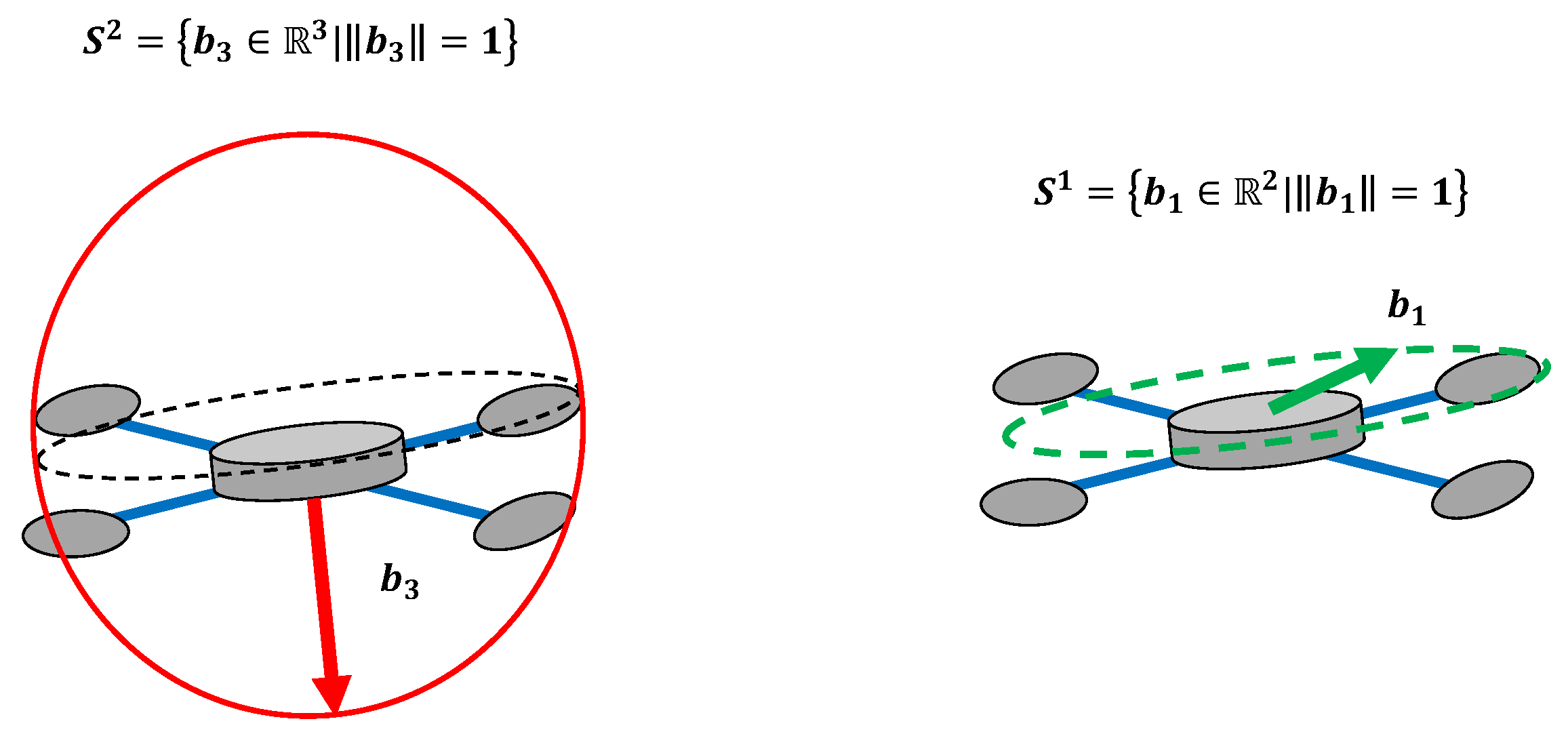
Decoupled yaw geometric control (DYGC) geometrically achieves an approximate separation between the roll/pitch control on the unit two-sphere and the yaw control on the unit circle, as illustrated in
Figure 3.
The set of rotation matrices that differ only in the third body axis of R can be regarded as the two-sphere manifold , which represents the space of possible thrust direction vectors. Accordingly, we first design the control input moments and , which generate the thrust-direction vector and exclude the yaw component. The yaw input moment is then designed separately, such that it does not dynamically couple with the roll/pitch control. The total body moment is defined as . Here, the subscript i representing the i-th quadrotor is omitted for simplicity, as the same control law applies to each vehicle.
4.2.1. Roll/Pitch Control on
Given the current attitude
and the current body-fixed angular velocity
, the combined roll/pitch angular velocity in the inertial frame
is defined as
The control design on
is performed in the inertial frame. From the desired thrust direction
, the desired combined roll/pitch angular velocity
is given by
Then, the errors on
that are independent of the yaw motion are defined as
The integral terms for disturbance compensation are designed as
Accordingly, the torque component
excluding the yaw direction is given by
where
are positive control gains. The inertia terms
are also considered in the inertial frame. Using in (
50), this torque vector can be decomposed into the input moments along the first and second body axes as
Thus, the torque components necessary for position control are obtained.
4.2.2. Yaw Control on
Next, the yaw control law is designed independently to avoid interference with the position control. For the desired angular velocity vector
, the desired yaw angular velocity component in the inertial frame
is obtained as
By desired yaw direction
, the attitude errors on the one-dimensional circle
are defined as
The integral error is given by
and the yaw torque component
is designed as
where
are positive control gains.
5. Simulations
This section presents a performance comparison between the proposed method (DYGC) and a conventional method (GC) through simulations of cooperative transportation with time-varying yaw angles of the quadrotors. In these simulations, the payload is transported by four quadrotors.
The simulation was conducted in MATLAB (R2023a, MathWorks, Natick, MA, USA) using a fourth-order Runge–Kutta integration with a step size of 500 Hz, and the controller was updated at 100 Hz. The plant dynamics are formulated in continuous time. However, a fixed-step scheme was employed to maintain synchronization with the discrete-time controller and to ensure temporal consistency with the disturbance observer, cable elasticity dynamics, and actuator models implemented in discrete form. The attitude and cable-direction states are updated using exponential-map-based integration on
and
, thereby preserving the manifold structure during numerical integration. The cooperative transportation model adopted in this study follows the geometric formulation in [
11], which describes the system dynamics on a configuration manifold. In the present work, the model is extended to incorporate time-varying cable lengths as well as cable elasticity and damping effects, following [
22], while preserving the manifold-based representation.
In this work, the conventional geometric attitude controller in [
26] for each quadrotor is replaced by the proposed decoupled yaw geometric controller (DYGC) presented in [
6]. All other cooperative payload–cable control laws, including load distribution and cable-direction control, remain unchanged.
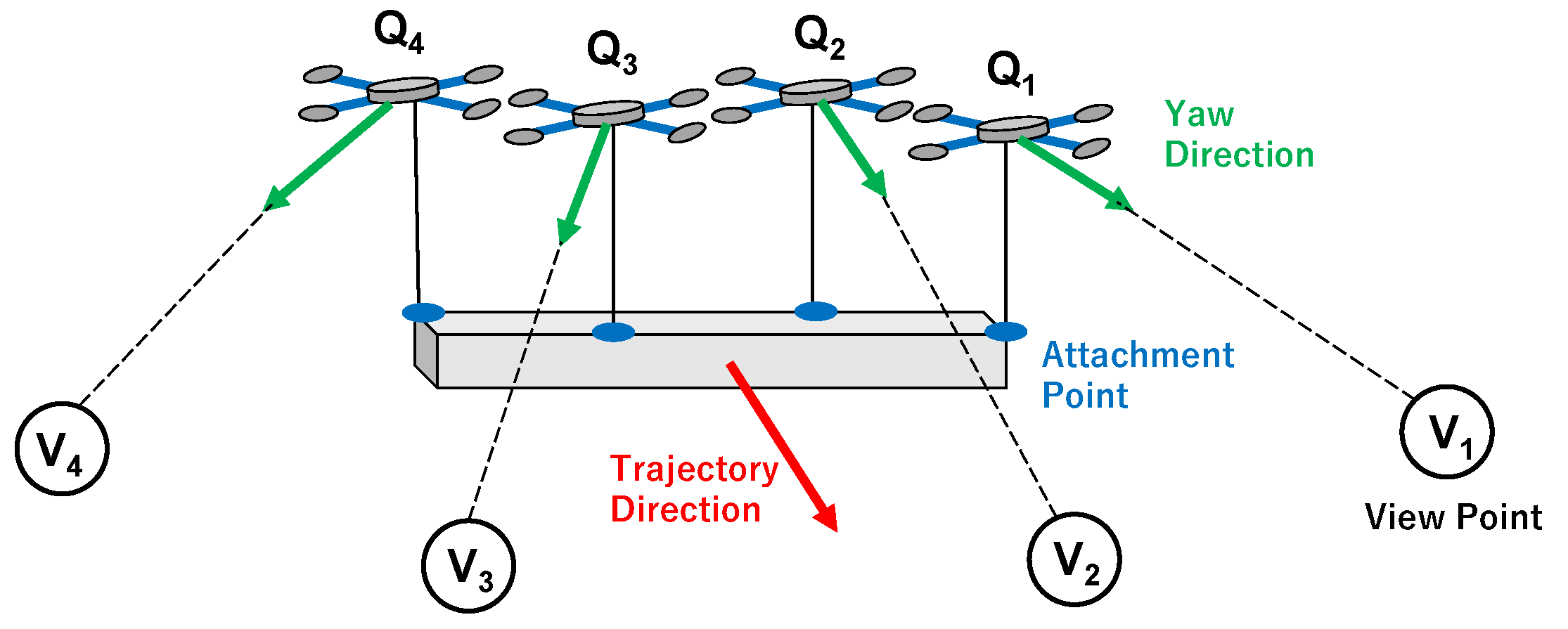
The scenario assumed cooperative transportation along a figure-eight trajectory. During trajectory tracking, four quadrotors are assumed to continuously maintain visual contact with their respective visual targets. The payload geometry, cable attachment points, and the directions of motion of the payload and the quadrotors during the transportation scenario are schematically illustrated in
Figure 4.
The cooperative transportation system consists of four quadrotors, labeled as –. The corresponding viewpoints which indicate the target yaw directions of the quadrotors are denoted as –. These viewpoints are placed at the same altitude as the corresponding quadrotors.
To emphasize the coupled motion between the yaw motions of the payload and the quadrotors, a rod rigid payload is employed in the simulation. Although a cuboid-shaped payload is defined in
Section 3.1, the cable attachment points are arranged for load distribution. This simulation setup preserves the definitions of the inertia matrix
and the attachment positions
, and the dynamic model is identical to that in
Section 3.1.
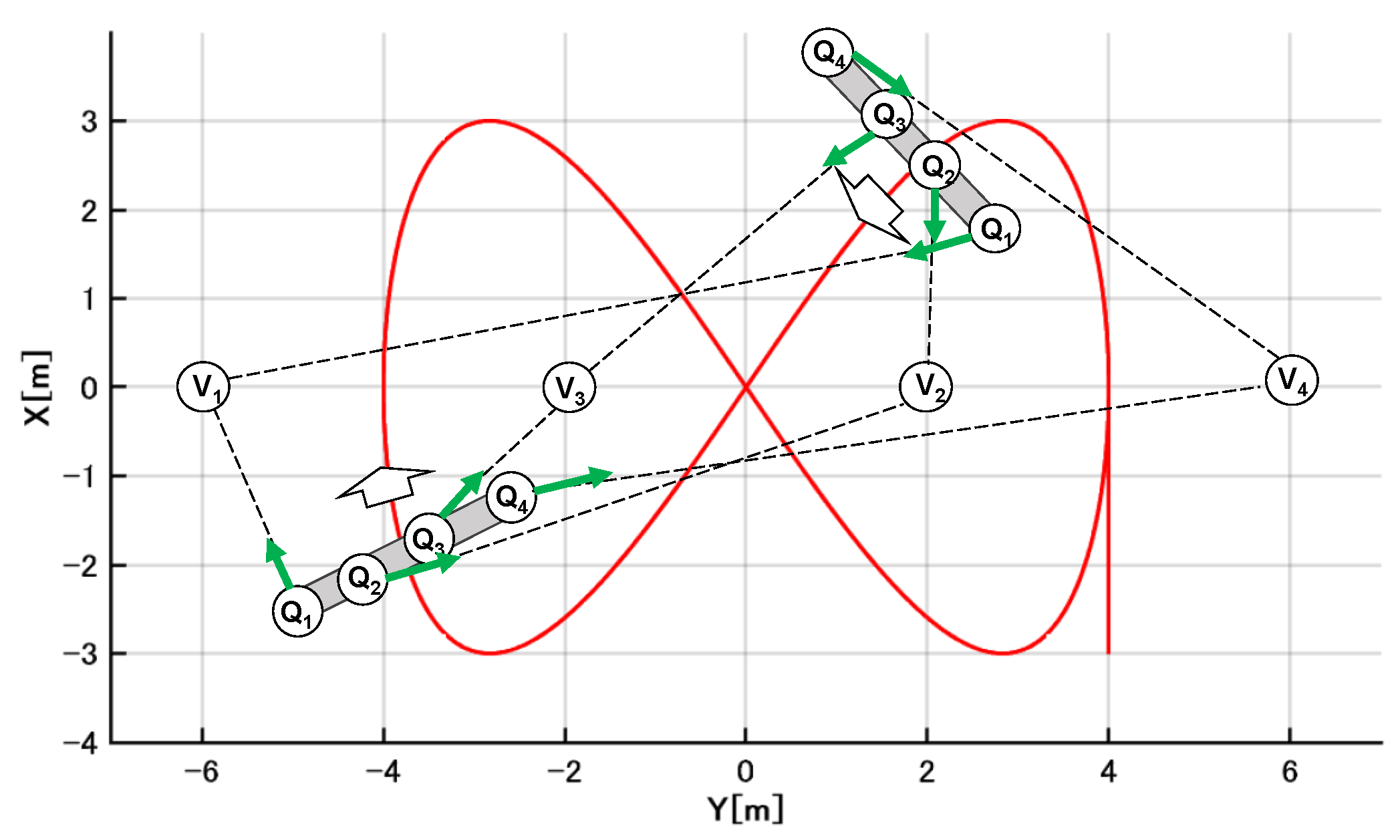
The viewpoint configuration with respect to the target figure-eight trajectory of the payload is illustrated in
Figure 5.
Before entering the figure-eight trajectory, a preparatory phase is introduced to mimic realistic flight conditions. First, during the initial 10 s, the quadrotors ascend and hover to reach the target altitude. Then, for approximately 12 s, the system performs straight-line acceleration to reach the initial velocity of the figure-eight trajectory. After this transition phasethe, first lap of the figure-eight trajectory, the desired yaw angle of the quadrotor is aligned with the direction of motion along the trajectory. From the second lap onward, the desired yaw angles are commanded toward the directions shown in
Figure 5. In this study, the time is defined as
at the beginning of the second lap.
This scenario is designed to reflect realistic flight operations, where the system does not immediately enter the figure-eight trajectory at the beginning of the simulation, but instead transitions through takeoff and acceleration phases before trajectory tracking.
5.1. Simulation Setting
To reproduce realistic physical conditions in simulation, the simulation setup in this study is designed to be close to the physical scale reported in the real-world experiments in [
15]. The figure-eight trajectory spans approximately 6 m × 8 m in the horizontal plane. This is comparable to the experimental workspace in [
15] and sufficiently large to accommodate the payload size and viewpoint configuration.
In this study, two trajectory-tracking scenarios are considered. Two reference trajectories with identical geometric shapes but different temporal periods are employed:
- (i)
Slow (long-period) reference trajectory
- (ii)
Fast (short-period) reference trajectory
In verification scenario (i), the slow reference trajectory which corresponds to a slowly traversed motion is defined as
In verification scenario (ii), the fast reference trajectory which corresponds to a faster traversal of the same geometric path is defined as
From (
57), the maximum translational speed and acceleration are approximately 4.5 m/s and 5.0 m/s
2, respectively, which are somewhat lower than those reported in the figure-eight flight experiments in [
15], providing a moderately aggressive yet physically realistic reference for evaluation.
The periods of the two trajectories defined in (
56) and (
57) are set to
and
, respectively. The slow reference trajectory is used to examine whether the tracking errors remain bounded for both the proposed and conventional methods. In contrast, the fast reference trajectory is used to evaluate the performance and robustness of each method under more demanding tracking conditions.
After hovering, the payload first accelerates linearly with uniform acceleration until it reaches the initial velocity corresponding to the beginning of the figure-eight motion, and then it follows the trajectory defined above.
The desired attitude of the payload during this motion is defined as
Let . The payload attitude is maintained horizontal, and its yaw direction is aligned with the desired payload velocity vector.
In the disturbance terms defined in
Section 3.1, the disturbances acting on the payload and each quadrotor were set as in (
59). Let
denote the simulation time measured from the start of the takeoff phase. The disturbances are activated after
.
The disturbance profiles were based on those in [
11], and their amplitudes were rescaled according to the physical parameters used in this study so that the resulting periodic disturbances remain within realistic ranges. Note that disturbance is not to reproduce a specific real-world disturbance, but to evaluate the relative robustness of the proposed controller under representative non-ideal conditions. According to [
27], the yaw angle is estimated using only a magnetometer, whereas the roll and pitch angles are estimated based on both accelerometer and magnetometer data. As a result, the yaw estimation is known to be more susceptible to measurement errors. Considering this characteristic, the amplitude of the yaw-direction disturbance for each quadrotor was set larger than that for the other axes.
To account for more realistic behavior, the rotor thrust response to the commanded thrust
is modeled with a first-order lag as
where
denotes the actual rotor thrust and
is the thrust time constant. In addition, the thrust generated by each rotor is limited to a maximum value of
.
The physical parameters used in the simulations are listed in
Table 3.
All quadrotor physical parameters used in this study are adopted from [
28]. Specifically, the mass, inertia matrix, arm length, thrust coefficient, torque coefficient, and maximum thrust are chosen to match those of the agile quadrotor platform reported in [
28], which corresponds to the high-agility Agilicious framework. This ensures that the UAV model employed in this study faithfully reflects the dynamic characteristics of the experimentally validated platform in [
28].
The payload mass is determined so that the per-UAV load ratio is consistent with the three-UAV cooperative transportation experiment reported in [
15], where a 1.4 kg payload was transported by three quadrotors. In that experiment, the equivalent payload per UAV was
kg. To maintain the same per-UAV payload burden in the four-UAV configuration considered in this study, the total payload mass is set to
This choice preserves the payload-to-UAV mass ratio used in [
15], enabling a fair comparison in terms of cooperative load-sharing conditions. The payload inertia is computed from the payload geometry and dimensions.
The cable stiffness and damping parameters are selected to ensure physically reasonable elastic behavior without excessive elongation under nominal loading.
5.2. Comparison of the Proposed and Conventional Controllers
The conventional geometric PID attitude control (GC) follows the control law given in [
26], and the attitude control input for each quadrotor is expressed as follows:
The attitude and angular velocity errors are defined as
As discussed in
Section 4.2, this error formulation is defined on
, in which the roll, pitch, and yaw errors are handled in a coupled manner for attitude control.
In the conventional controller, unlike the formulation in Ref. [
26], the gains
, and
are not treated as scalar values in
. Instead, in order to match the separated design of the proposed method, the roll/pitch and yaw axes are scaled independently using diagonal matrices as follows:
The controller gains were set as shown in
Table 4. In this study, the gain
corresponding to the yaw component is set to half its nominal value to account for the characteristics of the payload.
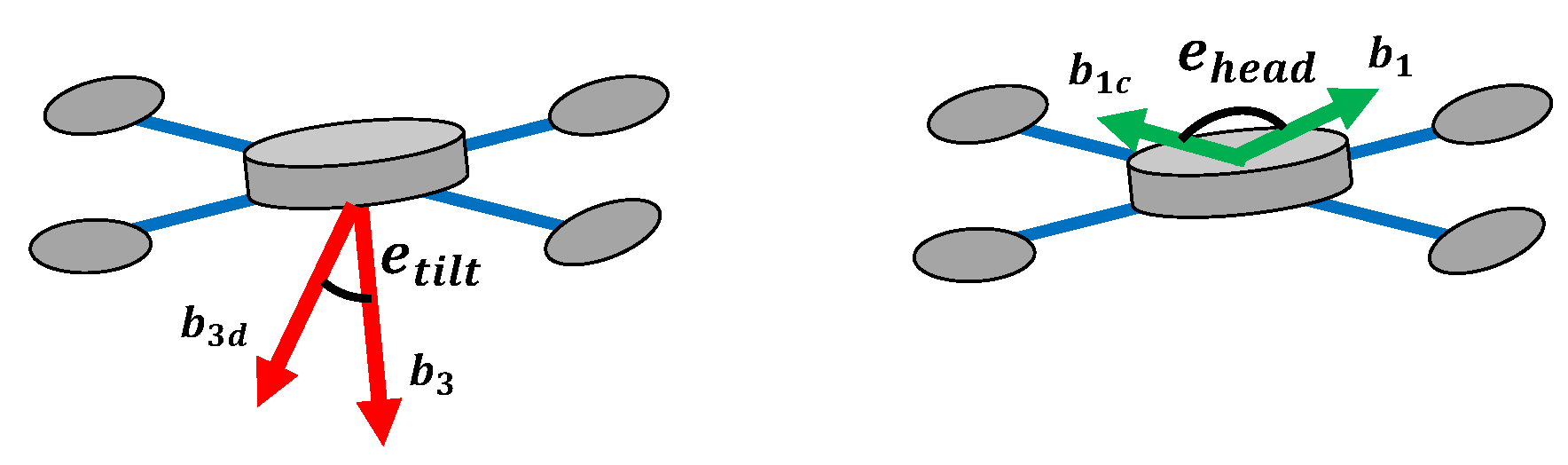
We evaluate the attitude errors based on the angles between the corresponding body-fixed axes, as defined in (
64) and illustrated in
Figure 6.
For the evaluation of the payload attitude, the angle between the third-axis vectors of the quadrotor/payload attitude
and the desired attitude vectors
in (
40) is defined as the tilt error, and the angle between the first-axis vectors
and
in (
41) is defined as the heading error. Here,
denotes the first body axis orthogonal to the desired thrust direction
.
5.3. Simulation Results
5.3.1. Results for the Slow Reference Trajectory
First, the simulation results for scenario (i) are presented.
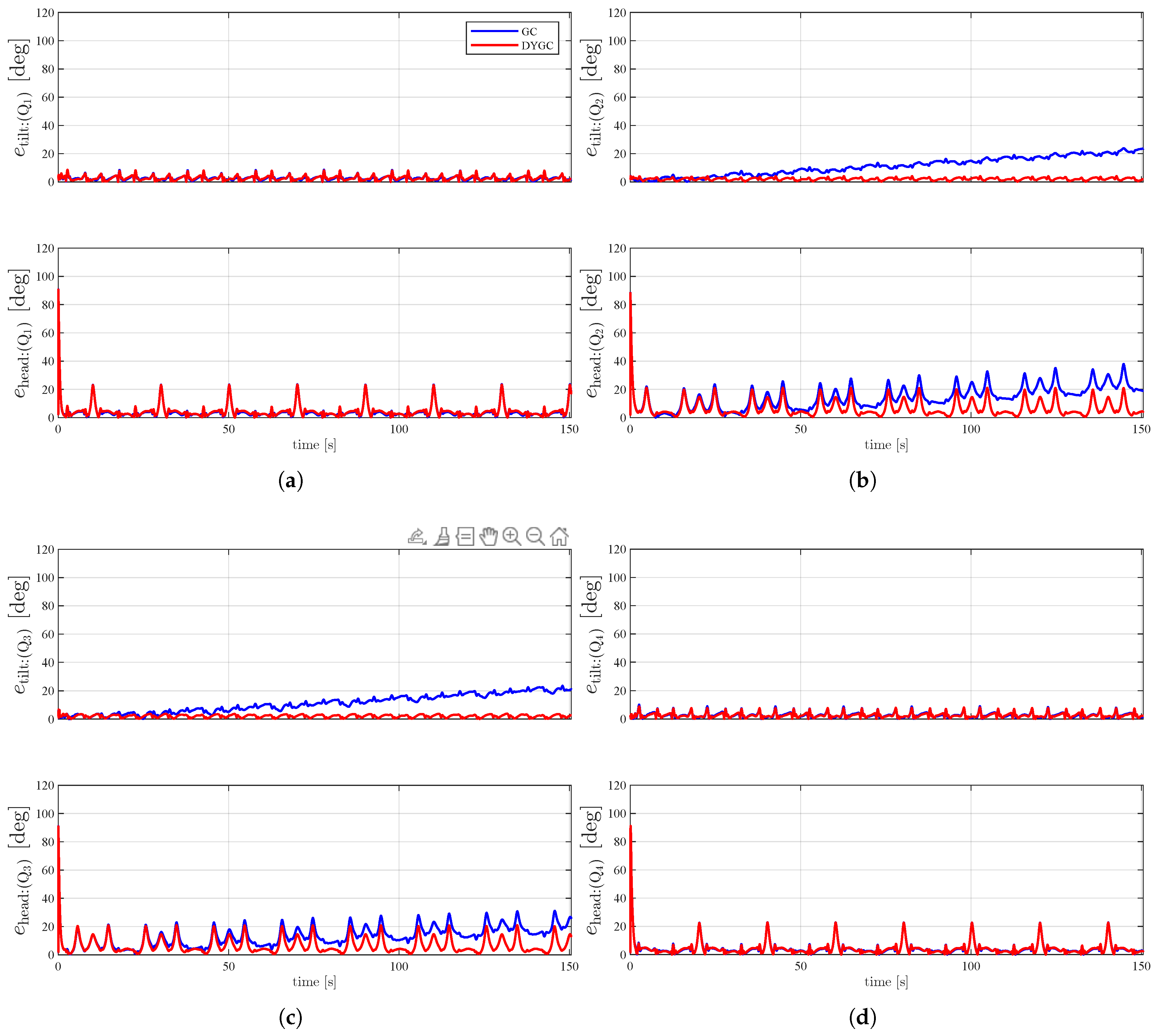
Figure 7 shows the attitude errors defined in (
64) for each of the four quadrotors.
For the GC (Geometric Control) method, the tilt errors of and , which track the outer viewpoints of the figure-eight trajectory, remain bounded. These quadrotors experience relatively small variations in the commanded heading direction. In contrast, for and , which track the inner viewpoints and are subject to larger variations in the desired heading direction, both the tilt and heading errors exhibit a gradual increasing tendency over time.
These results suggest that the persistence of residual heading errors induces coupling effects that influence the roll and pitch dynamics. In other words, under the GC method, heading errors tend to affect the tilt errors through rotational coupling. This observation is consistent with the findings reported in [
6], where coupling effects of heading errors in rotation-matrix-based control were shown to degrade roll/pitch control performance.
In contrast, under the proposed DYGC (Decoupled Yaw Geometric Control) method, both tilt and heading errors remain bounded for all quadrotors. It should be noted, however, that strict asymptotic convergence of the attitude errors to 0° is not observed. This is primarily due to the modeled actuator dynamics (first-order thrust lag), nonlinear system behavior, and the intentionally conservative yaw gain setting adopted to prioritize overall system stability. As a result, small residual errors remain, particularly in and , where larger commanded heading variations amplify phase lag effects. Nevertheless, all errors remain within a small bounded range, indicating that yaw-induced coupling does not destabilize the roll/pitch dynamics under the proposed control structure.
This difference is considered to be caused by an amplification of the quadrotor tilt induced by decoupling in the GC method, which prevented the quadrotors from generating the expected thrust.
Table 5 summarizes the RMS values over the evaluation interval (corresponding to the time range shown in the figures). The RMS tracking errors of the payload position, payload attitude, and quadrotor attitudes with respect to their desired trajectories, together with the cable swing angles, are summarized in
Table 5.
In addition, as shown in
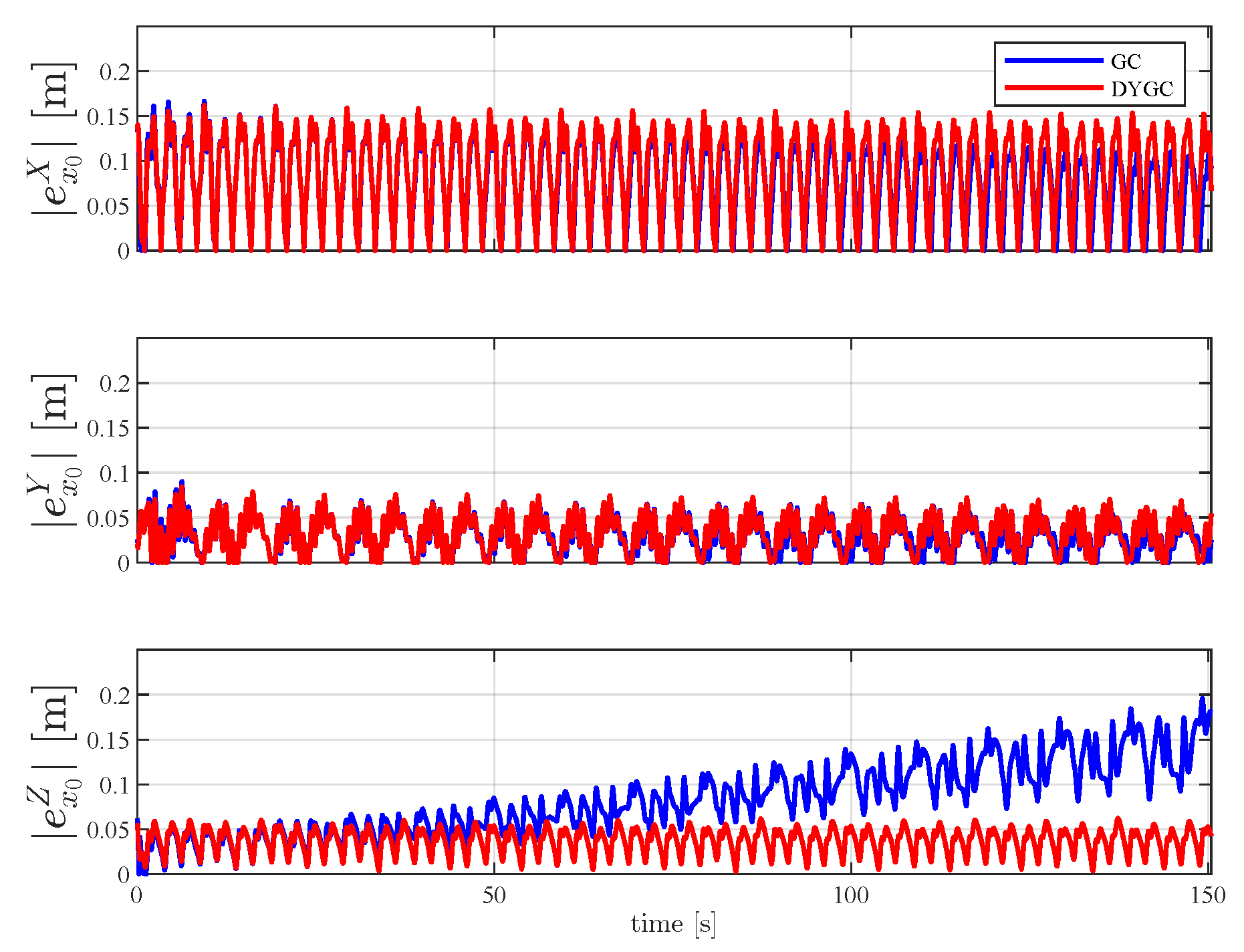
Figure 8, a difference between the two methods was also observed in the payload height control.
Figure 8 shows the payload position error
presented in
Section 4.1 (
25).
Payload position and Quadrotor Atiitude RMSE are computed from the tracking errors shown in
Figure 7 and
Figure 8 over the evaluation interval. The payload attitude RMSE values correspond to the RMS of the tilt and heading errors defined in (
64). The cable swing angle is defined as the deviation from the vertical direction. For each cable direction unit vector
, the swing angle is computed as
where
denotes the unit vector in the vertical direction. In the table, the maximum RMS value among the four cables and the maximum instantaneous swing angle are reported.
The RMSE of the payload tilt and heading errors are approximately and , respectively. The RMS cable swing angle is also limited to approximately , indicating that no significant oscillatory behavior is observed in the overall transportation dynamics.
The proposed method maintains performance comparable to the conventional approach for the outer quadrotors ( and ), while achieving substantial improvements for the inner quadrotors ( and ). In particular, the tilt error RMSE is reduced by approximately and for and , respectively, while the heading error RMSE is reduced by approximately and . These quantitative results confirm the effectiveness of the proposed method in suppressing yaw-induced coupling effects.
5.3.2. Results of Fast Reference Trajectory
Second, the simulation results for scenario (ii) are presented.
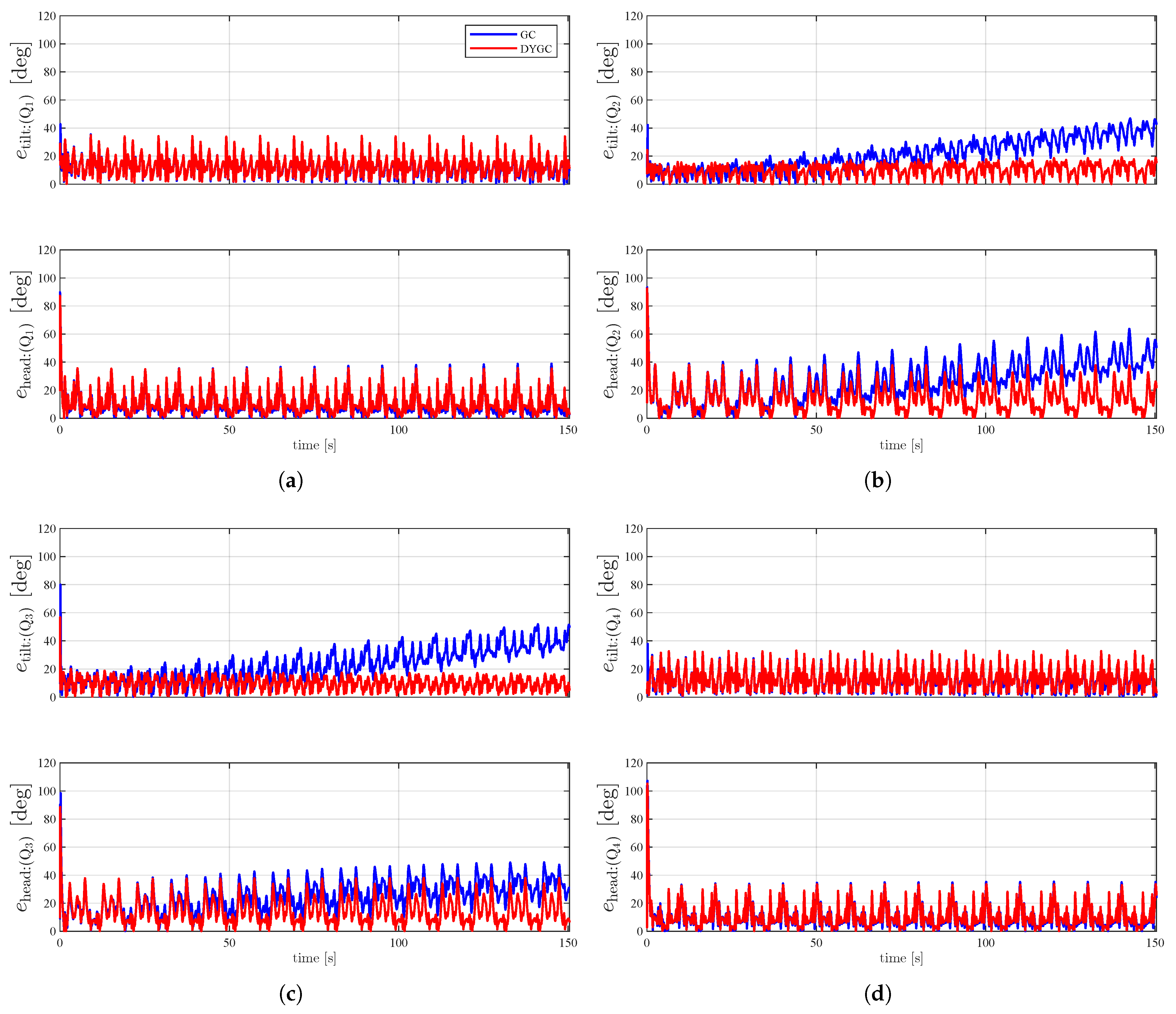
Figure 9 shows the attitude errors defined in (
64) for each of the four quadrotors.
In this evaluation, a more agile reference trajectory is considered, in which the rod-shaped payload exhibits pronounced oscillations, particularly in the curved segments of the figure-eight path. Even under such severe conditions, the DYGC method maintains the stability of all quadrotors the transportation scenario. Although the heading errors of and do not fully converge to , the residual errors remain bounded within approximately . In contrast, the GC method exhibits more pronounced divergence behavior compared with the results obtained for the slow reference trajectory. For and as well, the state errors are observed to gradually increase over time.
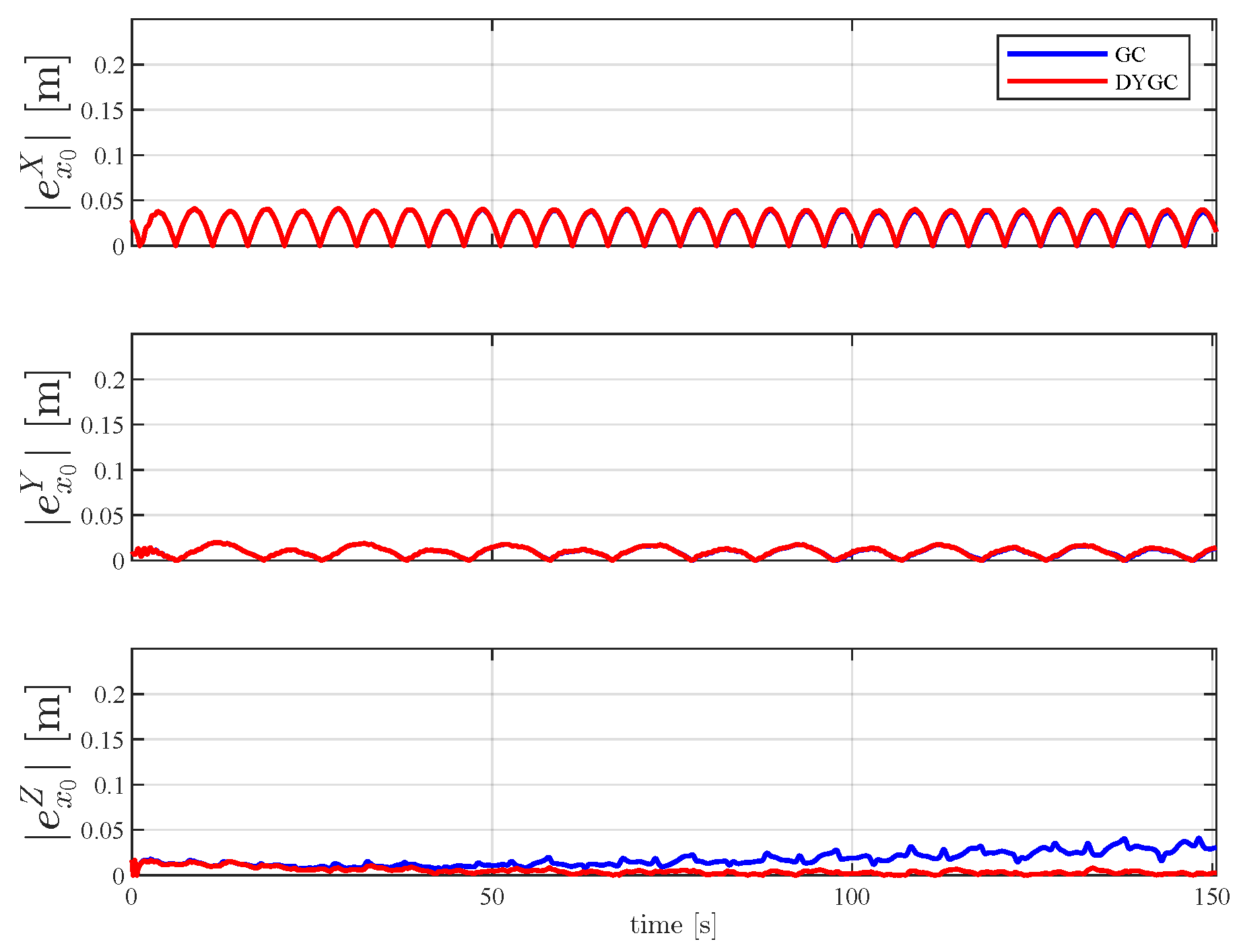
Furthermore, as shown in
Figure 10, similar to the case of the slow reference trajectory, a continuous decrease in the payload altitude is observed. In addition, the horizontal position error of the payload also increases, indicating that, for the fast reference trajectory, maintaining cooperative transportation becomes difficult with the GC method.
These results suggest that quadrotor yaw control for visual monitoring can be maintained not only under static transportation constraints, but also under more dynamic transportation conditions where oscillations persist throughout the suspended payload system.
Table 6 presents the RMS values over the evaluation interval for the fast trajectory case.
As shown in
Table 6, several components exhibit a slight degradation of approximately 5–10% in the proposed method. However, as observed in
Figure 9, the tilt errors of the GC method gradually decrease over time in some cases. This reduction is considered to be associated with the altitude drop of the payload observed under GC during the fast trajectory. The resulting change in the outer roll/pitch motion may lead to a reduction in the apparent tilt tracking error, rather than reflecting an intrinsic improvement in attitude tracking performance.
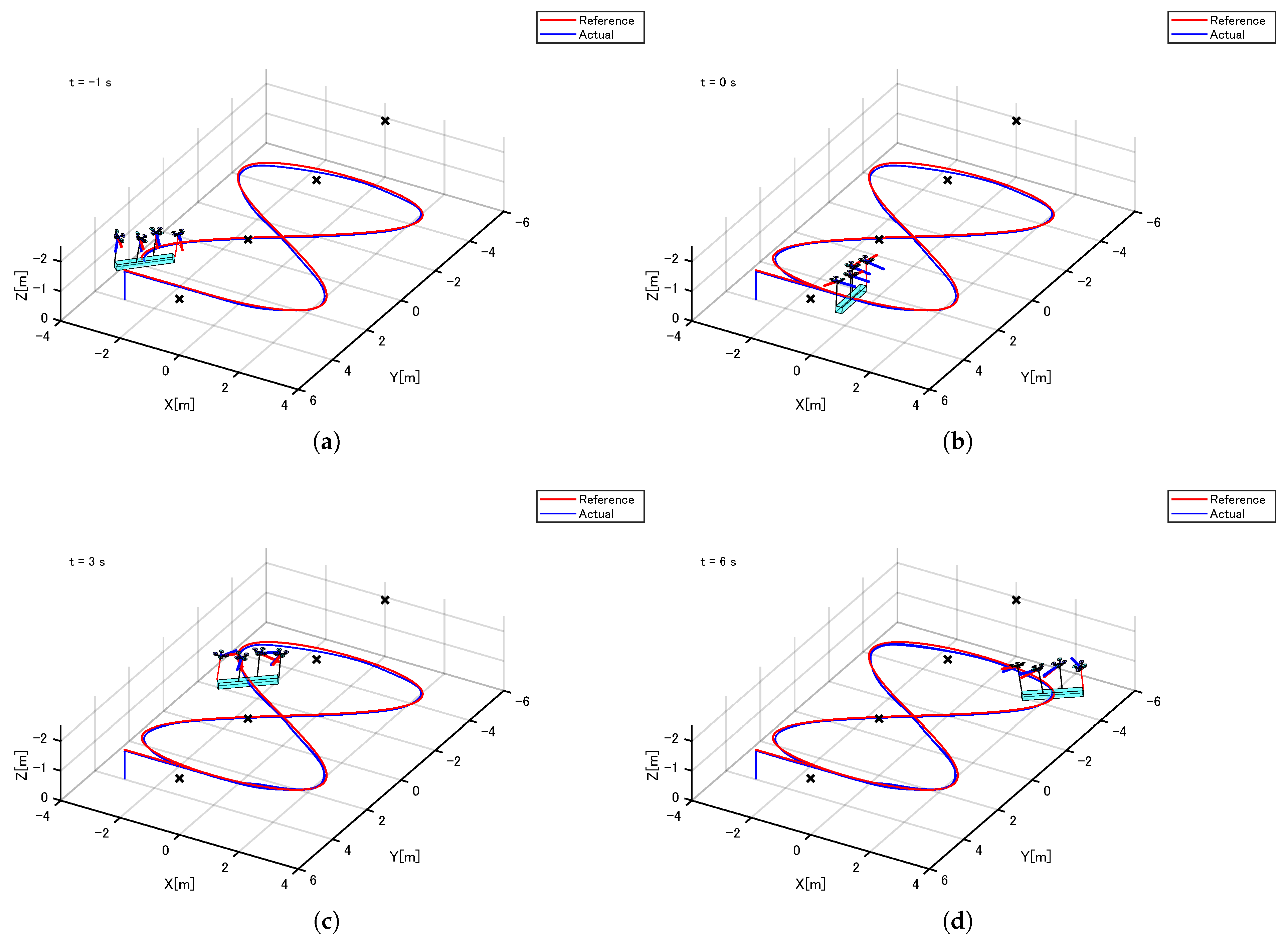
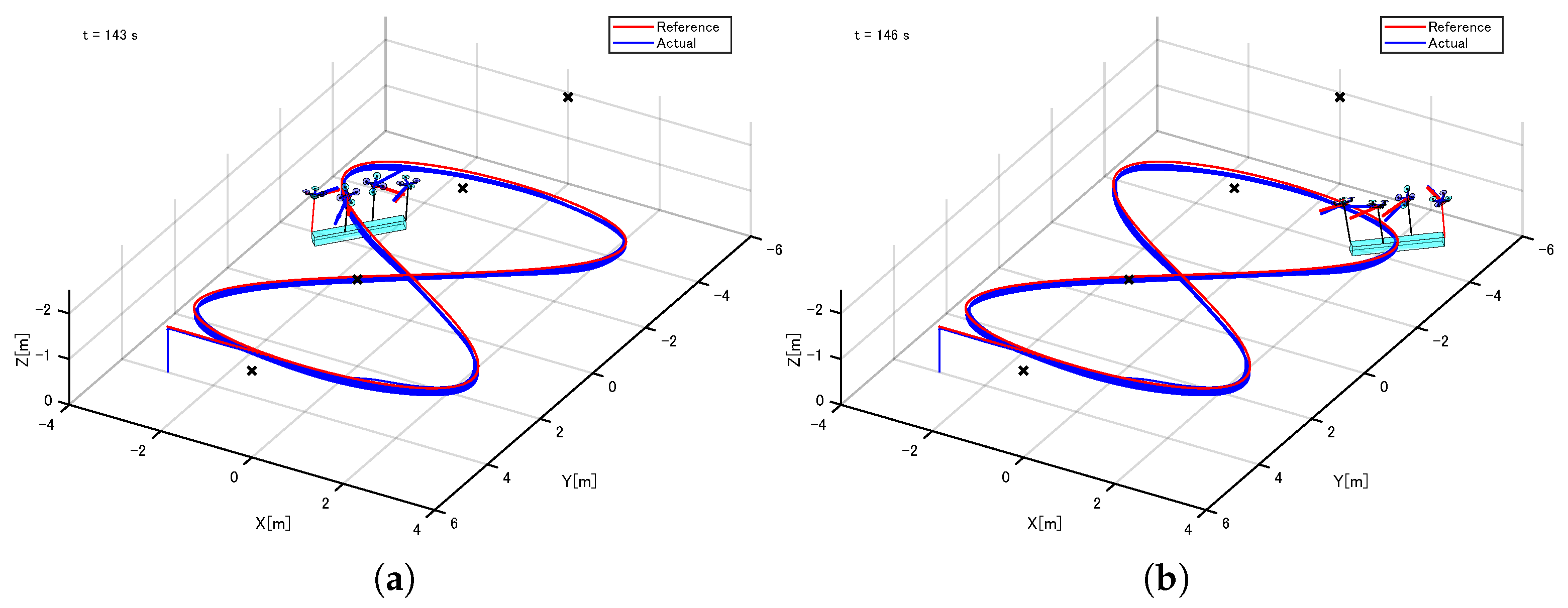
Figure 11 shows snapshots of an animation of the proposed DYGC method for the fast figure-eight trajectory. As shown in
Figure 11b, a yaw error is temporarily generated immediately after the yaw command is applied, however, it subsequently decreases and the quadrotor continues to track the desired yaw direction.
Furthermore, Figuer
Figure 11c,d illustrate that the quadrotor successfully tracks the desired attitude.
As shown in
Figure 12, under the GC method, the quadrotor exhibits an increasing tendency of attitude tilt as time progresses, and the yaw angle is not sufficiently regulated. In addition, a degradation in the payload tracking performance in altitude can be observed. An animation of the fast reference trajectory is provided in
Video S1 in the
Supplementary Materials.
6. Discussion
In the present simulations, the yaw gain was intentionally set to a conservative value in order to mitigate interference from yaw-rate generation to roll/pitch control. As a result, the yaw response exhibited reduced bandwidth rather than aggressive heading tracking. Under the GC method, persistent heading errors led to a continuous increase in tilt errors, ultimately resulting in payload instability. This phenomenon can be attributed to the coupled nature of the attitude dynamics. In cooperative suspended-load systems, the quadrotor inputs are constrained by cable tension conditions, which may reduce stability margins. Consequently, the effective roll/pitch control authority becomes limited, and the system becomes more sensitive to yaw-induced coupling effects and residual heading errors. In contrast, the DYGC method maintained roll/pitch performance even when heading errors were present. Within the tested range of gain settings for the conventional GC controller, retuning did not remove this phenomenon. During the simulations, tilt-error growth was consistently observed under multiple gain configurations. This indicates that the behavior is unlikely to be solely attributable to a particular gain choice, but is associated with the yaw–thrust coupling inherent in the -based attitude error formulation under cooperative suspended-load constraints. This suggests that the structural decoupling of yaw dynamics prevents variations in yaw control performance from propagating to the payload stabilization layer. From a design perspective, this approach reduces interdependence between cooperative load stabilization and heading control, potentially expanding the usable yaw maneuvering range without degrading payload stability.
As discussed in the Introduction, yaw control in quadrotors is inherently sensitive due to the relatively small reactive torque coefficients and the need for differential rotor speed actuation. In practical hardware systems, additional factors such as actuator dynamics, parameter uncertainties, and estimation errors may further exacerbate yaw control limitations. Therefore, the structural robustness provided by yaw decoupling may become even more important in real-world implementations.
However, the present study is limited to numerical simulations and does not consider communication delays, aerodynamic interactions between vehicles, or external disturbances. These factors may influence cooperative system stability and should be investigated in future work. Experimental validation and robustness analysis under more realistic conditions will be necessary to fully assess the practical applicability of the proposed framework.
Therefore, the present results should be interpreted as demonstrating the control-structural feasibility of yaw decoupling within cooperative suspended-load transportation, rather than as a validation of a deployment-ready autonomous transportation system.
7. Conclusions
In this paper, we proposed an integrated geometric control framework that combines cooperative cable-suspended payload transportation control with decoupled yaw attitude control for quadrotors.
Comparative simulations showed that the conventional geometric control approach is susceptible to yaw-induced coupling, which degrades roll/pitch performance and adversely affects payload stability. In contrast, the proposed DYGC (decoupled yaw geometric control) approach maintained bounded roll/pitch behavior even in the presence of yaw errors, indicating that structural separation of yaw dynamics mitigates undesired coupling effects.
These findings suggest that decoupling yaw dynamics reduces design interdependence between cooperative load stabilization and viewpoint control, thereby expanding the structurally available yaw maneuvering flexibility within the control framework without degrading payload stability in simulation.
Future work will include further validation under more realistic operating conditions through high-fidelity simulations that account for communication delays, aerodynamic interactions, and external disturbances, as well as experimental verification.