
Research on Integrated Decision-Control Cooperative Target Assignment for Cross-Domain Unmanned Systems Based on a Bi-Level Optimization Framework

 ,
,
Highlights
- A bi-level optimization framework is proposed that tightly integrates task assignment with optimal control, ensuring kinematic feasibility and smooth trajectory generation for heterogeneous unmanned platforms.
- The proposed method significantly reduces the maximum mission completion time compared to traditional Euclidean-distance-based assignment approaches, as validated through simulations.
- This study provides an integrated “decision-control” paradigm that bridges the gap between high-level planning and low-level execution, enhancing the practicality and performance of cross-domain unmanned swarm operations.
- The framework supports future research in dynamic task reassignment, robust multi-objective optimization, and distributed solving architectures for large-scale unmanned systems.
Abstract
1. Introduction
1.1. Motivation
1.2. Literature Review
1.3. Proposed Approach
- (1)
- A tightly integrated bi-level optimization framework combining task assignment with optimal control is developed.
- (2)
- Effective solution methodologies for the proposed bi-level model are developed.
- (3)
- The effectiveness and superiority of the proposed approach are validated through systematic simulation experiments.
2. Integrated Decision-Control Target Assignment Model for Cross-Domain Unmanned Swarms
2.1. Problem Formulation
2.1.1. Targets
2.1.2. Unmanned Systems
2.2. Objective Function and Constraints
2.2.1. Upper-Level Target Assignment Model
- (1)
- Decision Variables and Objective Function
- (2)
- Constraints
- (a)
- Capability Matching Constraint
- (b)
- Engagement Capacity Constraint
- (c)
- Target Completion Constraint
- (d)
- Constraint on Maximum Operating Duration
2.2.2. Lower-Level Optimal Control Model
- (1)
- System Model and Performance Metrics
- (2)
- Constraints
- (a)
- System Dynamics Constraint
- (b)
- Initial and Terminal Conditions
- (c)
- Waypoint Constraints
- (d)
- Constraints on Motion Performance
2.2.3. Integrated Decision-Control Bi-Level Target Assignment Model
3. Transformation of the Optimal Control Model
3.1. Reformulation of Kinematic Equations via Differential Flatness
3.2. Formulation of the Optimal Control Problem Using the Pseudospectral Method
3.2.1. Time Domain Normalization
3.2.2. Approximation of State and Control Variables
3.2.3. Transformation of the State Equation
3.2.4. Formulation of Boundary and Interior Point Conditions
3.2.5. Discretization of Unmanned System Performance Constraints
3.2.6. Formulation of the Nonlinear Programming Problem
4. Algorithm Design and Effectiveness Analysis
4.1. Algorithm Design
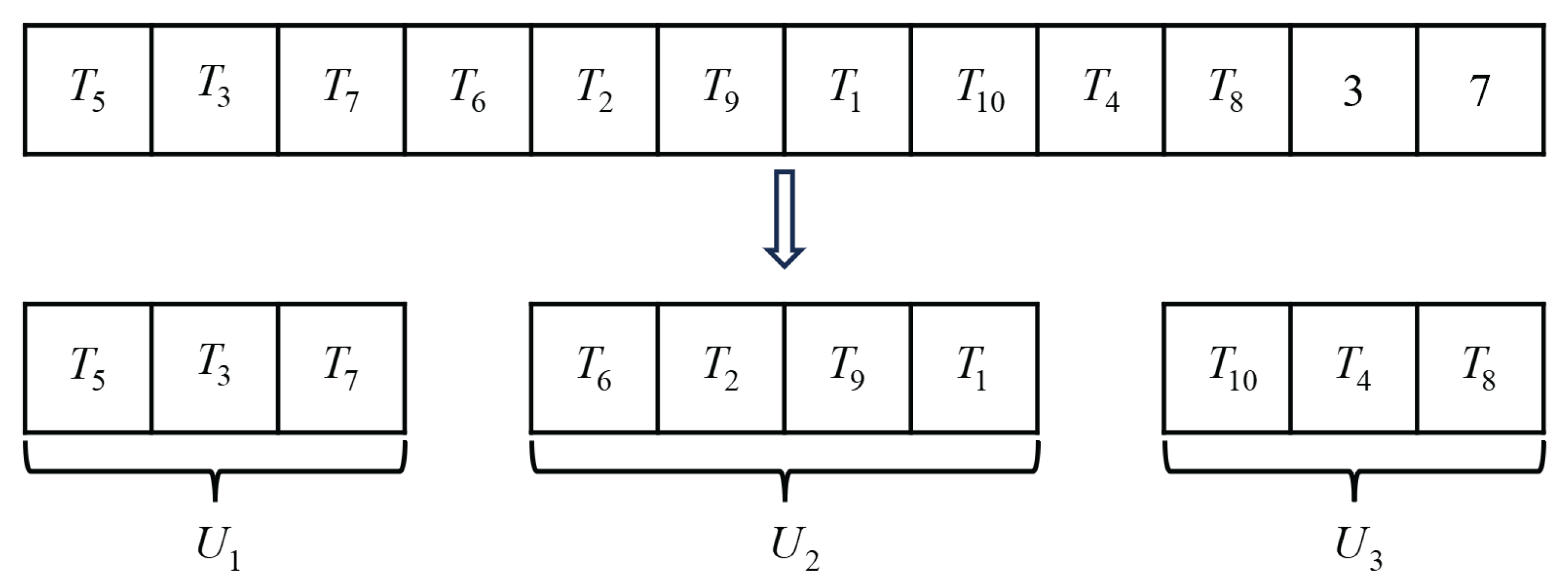
4.1.1. Encoding Design
4.1.2. Initial Population Generation
- Step 1:
- Randomly generate a permutation of the target visiting sequence, ensuring each target appears exactly once.
- Step 2:
- Randomly generate distinct integers from the interval as delimiters. These delimiters are arranged in ascending order to form the delimiter sequence. Here, the delimiter indicates the end position of the target subsequence assigned to the m-th unmanned system.
- Step 3:
- For each initial individual, verify whether it satisfies the target-type matching constraints. If an individual violates any constraint, a repair operation is performed. This operation adjusts the positions of the delimiters or swaps targets within the sequence to ensure that all type-matching constraints are satisfied. This repair mechanism ensures that the majority of individuals in the initial population comply with the capability matching constraints, thereby effectively reducing ineffective searches during the evolutionary process.
4.1.3. Feasible and Infeasible Reserve Sets
- (1)
- Update Mechanism for the Feasible Reserve Set
- Step 1:
- Combine the current feasible reserve set with the newly generated feasible solution set to form a candidate pool .
- Step 2:
- Remove duplicate assignment schemes within . Specifically, for all solution pairs satisfying , retain only one instance of each identical scheme and discard the redundancies.
- Step 3:
- Employ tournament selection on to choose individuals with the best fitness values . Add these selected individuals to the new reserve set .
- Step 4:
- From the remaining individuals in , select individuals with the highest comprehensive quality score using roulette wheel selection. The selection probability for each individual is proportional to a composite quality score, calculated asAdd the individuals to . The resulting then becomes the updated feasible reserve set.
- (2)
- Update Mechanism for the Infeasible Reserve Set
- Step 1:
- Merge the current infeasible reserve set with the newly obtained set to form a candidate pool .
- Step 2:
- Within , identify and remove duplicate assignment schemes. Specifically, for any pair of schemes satisfying , retain only one copy and discard the rest.
- Step 3:
- Filter the assignment schemes in by keeping only those whose fitness is better than the average fitness of the assignment schemes currently stored in the feasible reserve set . If the number of remaining assignment schemes exceeds the capacity of the infeasible reserve set, select the individuals with the smallest constraint violation to form the updated infeasible reserve set .
4.1.4. Hybrid Crossover Operation
- (1)
- Crossover for the Target Sequence
- (2)
- Crossover for the Delimiter Sequence
4.1.5. Adaptive Mutation Strategy
- (1)
- Mutation for the Target Sequence
- Swap Mutation: Randomly select two distinct positions in the sequence and exchange the targets located at these positions.
- Inversion Mutation: Randomly select a contiguous subsequence and reverse the order of targets within it.
- Insertion Mutation: Randomly select a target, remove it from its current position, and insert it into another randomly chosen position in the sequence.
- Scramble Mutation: Randomly choose a contiguous subsequence and randomly permute the order of targets inside it.
- (2)
- Mutation for the Delimiter Sequence
4.1.6. Elitism and Local Search
- (1)
- Elitism Strategy
- (2)
- Periodic Local Search
- Step 1:
- Choose several top-ranked assignment schemes from the population based on fitness as initial solutions for the local search.
- Step 2:
- For each selected individual, randomly pick two distinct positions i and j () and reverse the subsequence between them in the target visiting sequence.
- Step 3:
- Compute the fitness of the newly generated sequence. If an improvement is observed, accept the change by replacing the original sequence; otherwise, retain the original.
- Step 4:
- Repeat Steps 2 and 3 until a predefined maximum number of local-search iterations is reached.
4.1.7. Adaptive Parameter Control and Restart Strategy
- (1)
- Stalled Convergence and Low Diversity: If and , the search is likely stagnating in a local optimum with reduced diversity. In this case, the mutation probability is increased and the crossover probability is decreased to encourage broader exploration.
- (2)
- Satisfactory Convergence Progress: If , it indicates that the population is of good quality and refinement is ongoing. Here, the mutation probability is decreased and the crossover probability is increased to promote the exploitation and recombination of promising solution structures, preventing excessive disruption from mutation.
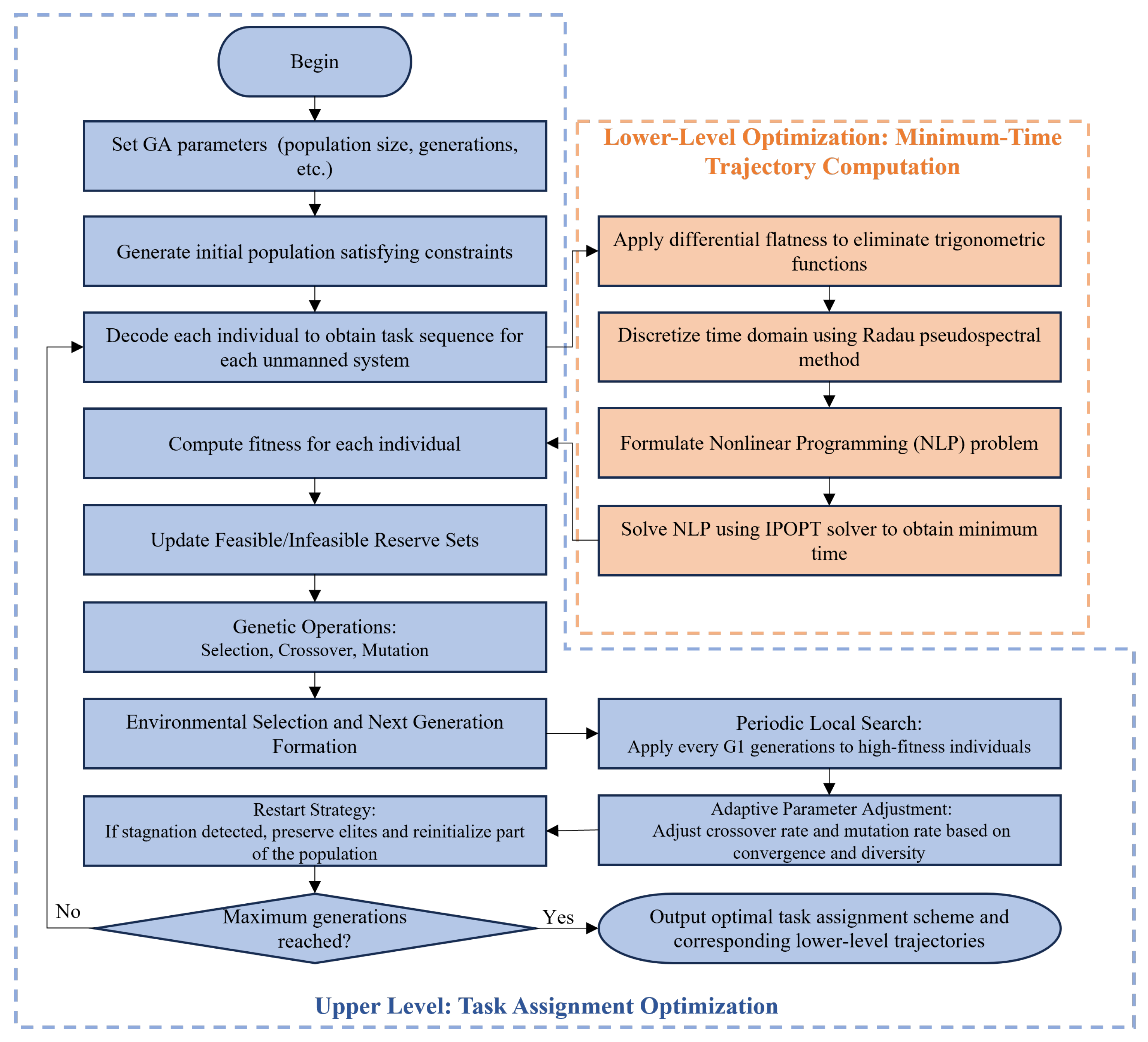
4.1.8. Algorithm Flow
- Step 1:
- Initialization. Set the algorithm parameters: population size , maximum generations , crossover probability , and mutation probability . Generate an initial population that satisfies the target-type matching constraints.
- Step 2:
- Evaluation and Reserve Set Construction. Compute the fitness and constraint violation for all individuals in the current population. Following the update mechanisms designed in this paper, construct and maintain the feasible reserve set and the infeasible reserve set .
- Step 3:
- Crossover Operation. Select individuals from the parent population and perform crossover: apply order crossover to the target sequence and arithmetic crossover to the delimiter sequence, thereby generating new offspring.
- Step 4:
- Mutation Operation. For each offspring, apply mutation with probability : on the target sequence, randomly execute one operator among swap, inversion, insertion, and scramble; on the delimiter sequence, apply a small perturbation mutation.
- Step 5:
- Environmental Selection and Next-Generation Formation. Combine the parent and offspring individuals, evaluate their fitness, and form the next-generation population through elitism and fitness-based selection.
- Step 6:
- Periodic Local Search. Every generations, perform a two-opt local search on the higher-fitness individuals in the population to refine their target sequences.
- Step 7:
- Adaptive Parameter Adjustment. Every generations, dynamically adjust the crossover probability and mutation probability according to the recent convergence measure and the population diversity .
- Step 8:
- Restart Strategy. Every generations, check whether the algorithm is stagnating in a local optimum. If so, preserve the elite individuals and reinitialize a portion of the remaining population to introduce new search directions.
- Step 9:
- Termination Check. If the current generation count reaches , terminate the algorithm and output the best solution from the feasible reserve set as the final assignment scheme; otherwise, return to Step 2 and continue.
4.2. Algorithm Effectiveness Analysis
- The average fitness obtained by the improved genetic algorithm over 300 independent runs is 446.76, notably superior to the 539.12 achieved by the standard GA, indicating higher overall solution quality.
- The best fitness found by the improved genetic algorithm (413.02) outperforms that of the standard genetic algorithm (437.36).
- The worst fitness recorded for the improved genetic algorithm (457.52) is also considerably lower than the worst-case value for the standard genetic algorithm (654.12).
- Critically, the variance of the improved genetic algorithm’s fitness is 7.91, compared to a significantly higher variance of 39.18 for the standard genetic algorithm. This indicates that the performance of the improved algorithm is stable and exhibits low fluctuation across multiple runs, confirming its strong robustness.
5. Simulation Verification
5.1. Analysis of Method Innovation
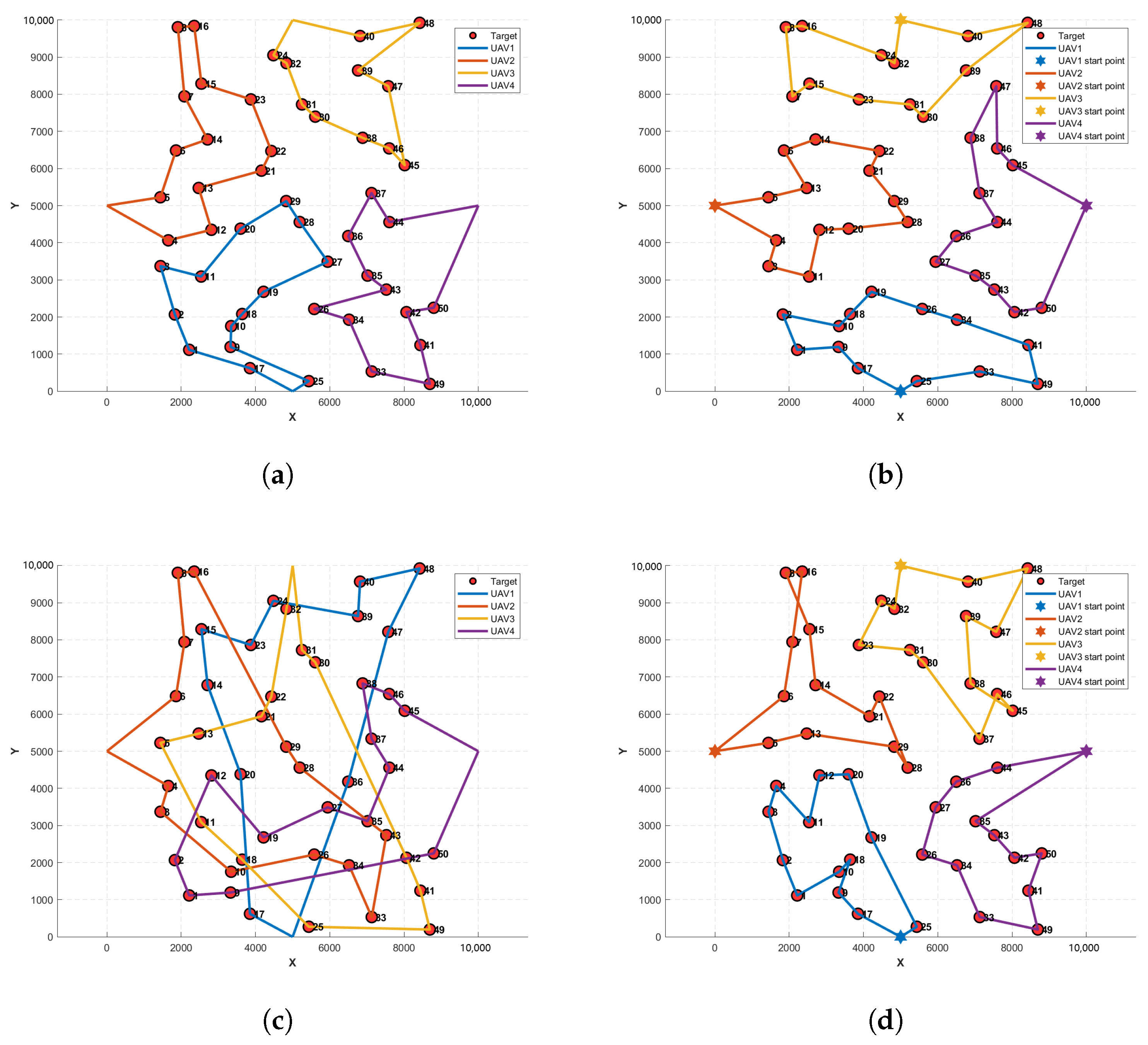
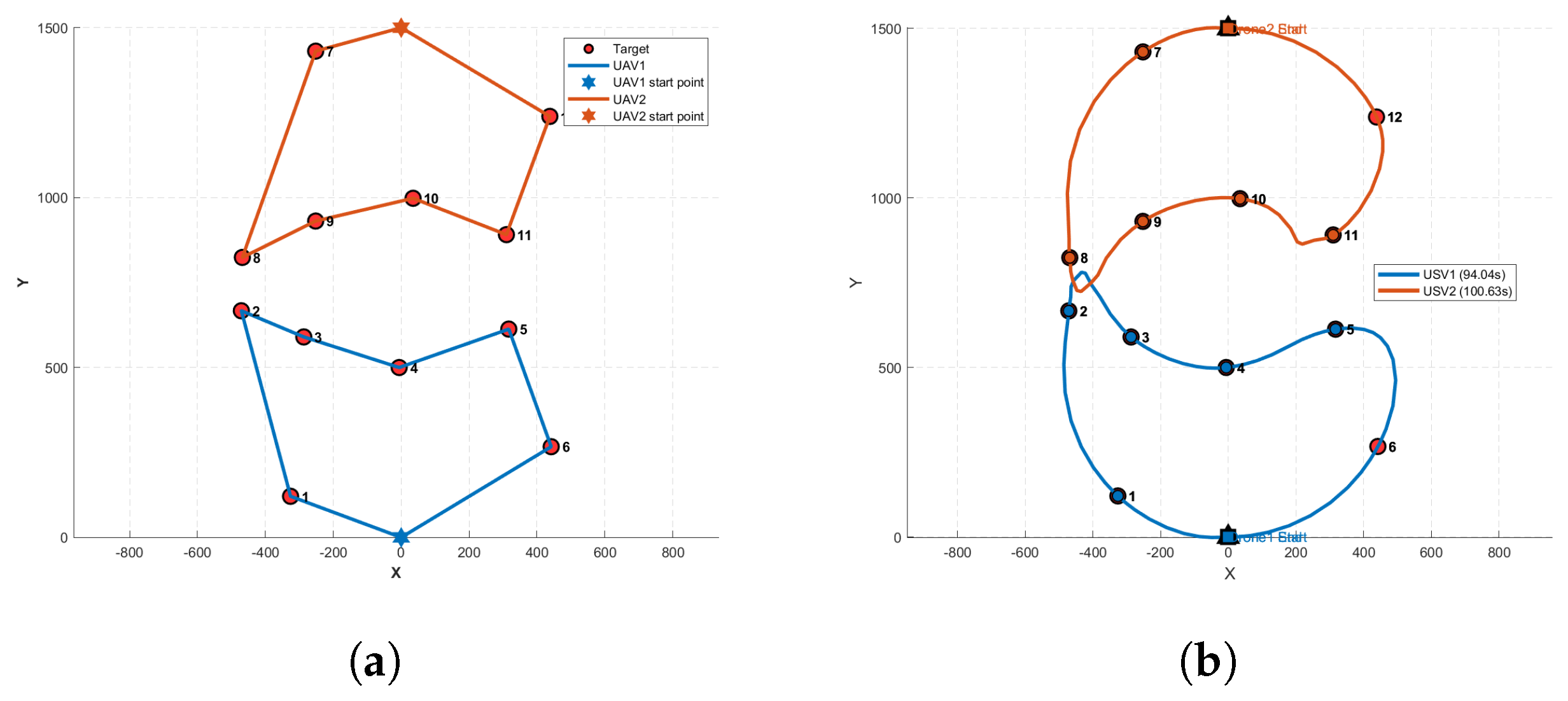
5.1.1. Results of the Traditional Task Assignment Method
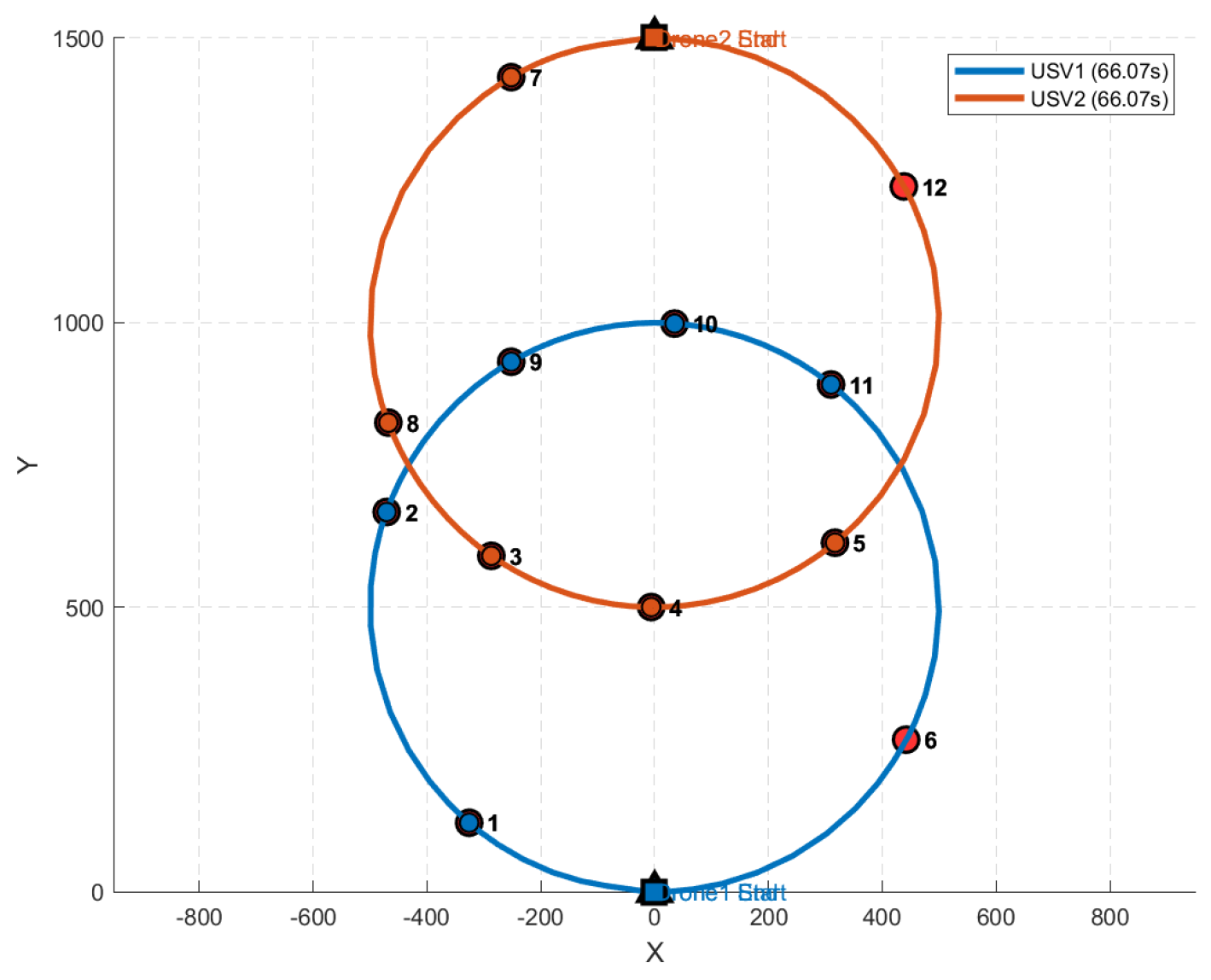
5.1.2. Results of the Integrated “Decision-Control” Method
5.1.3. Comparative Analysis of Results
5.2. Statistical Validation Under Multiple Random Scenarios
5.3. Practicality Analysis of the Method
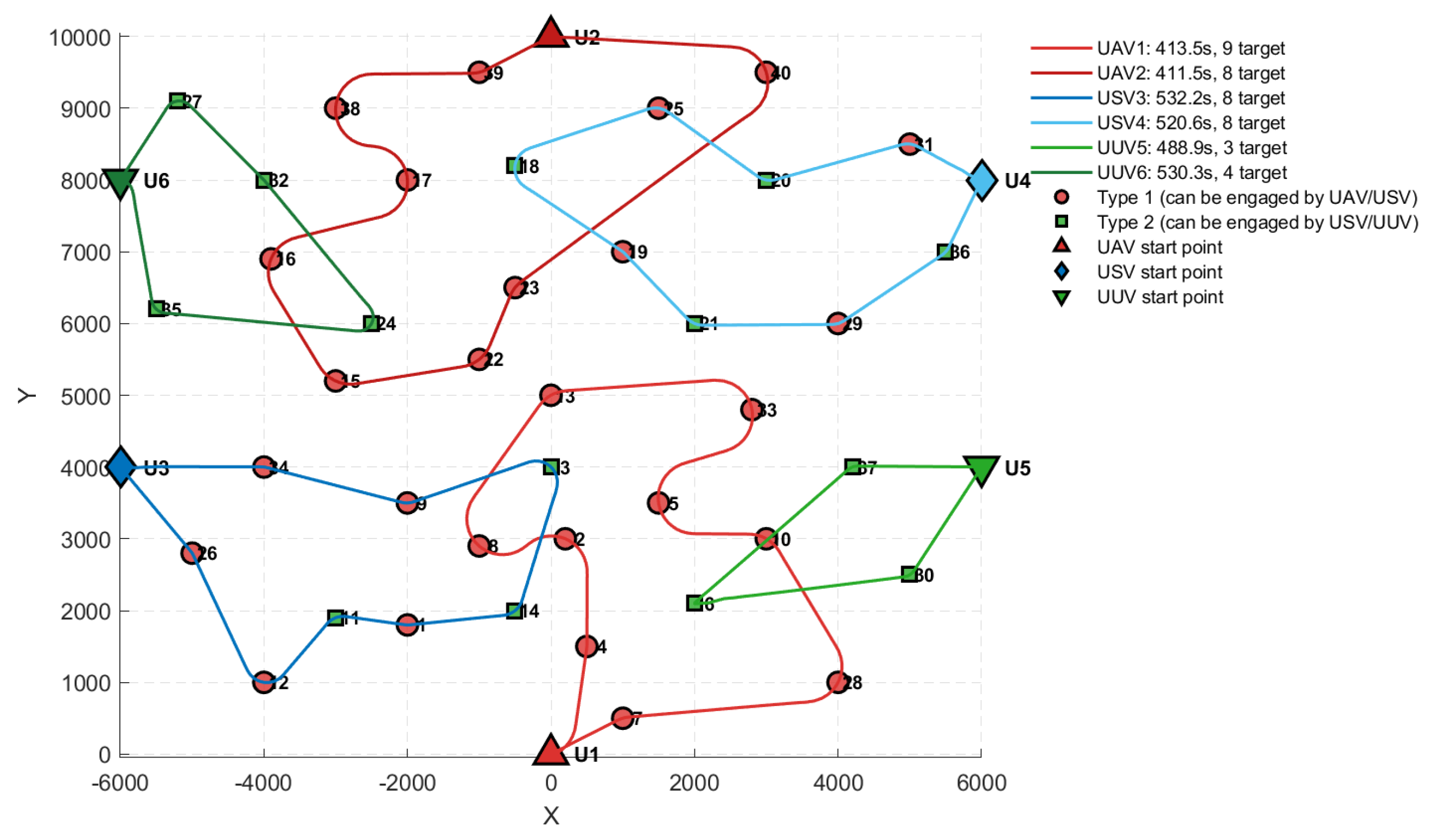
5.3.1. Analysis of Task Assignment Results
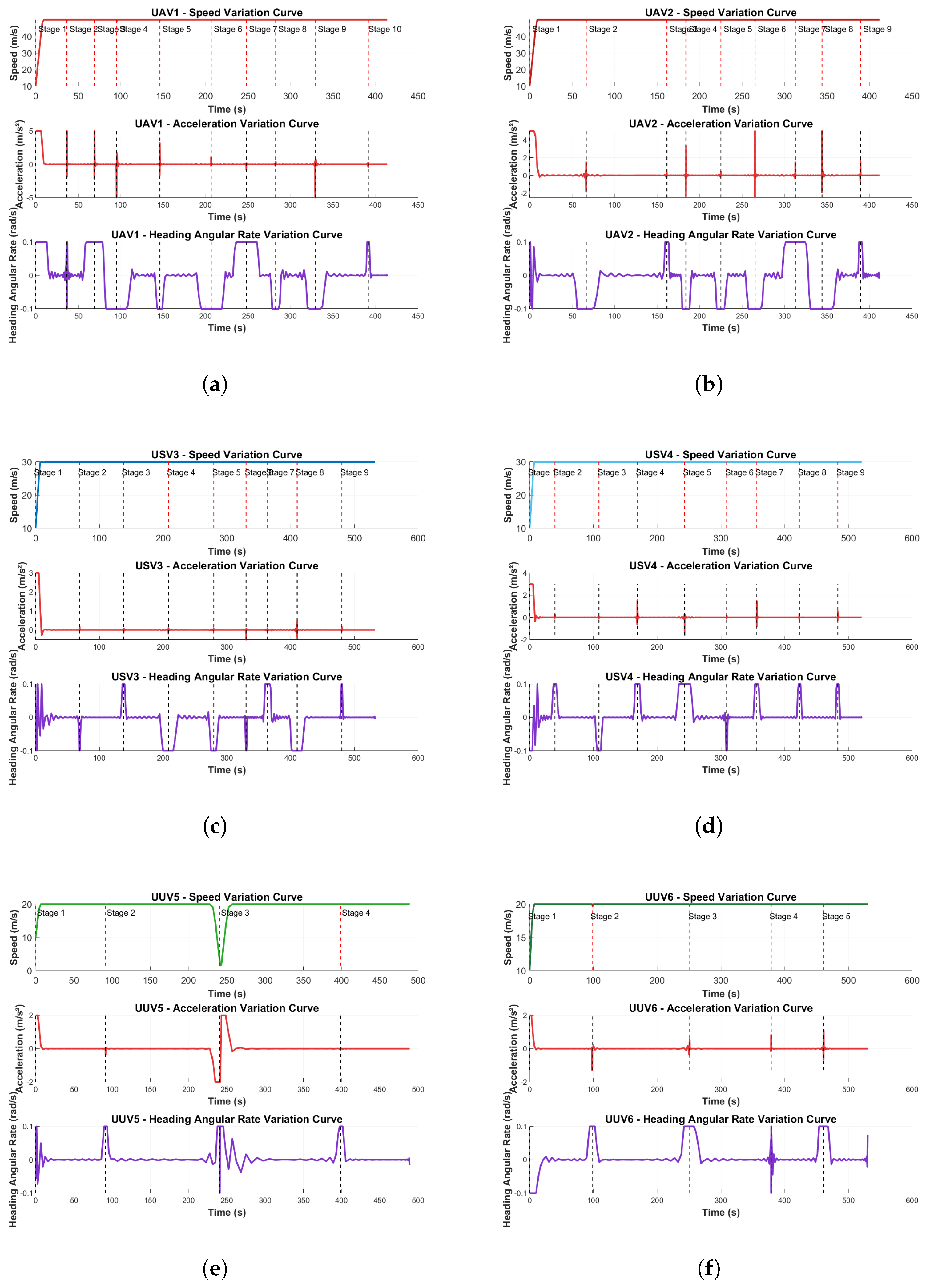
5.3.2. Analysis of Unmanned System Motion States
6. Conclusions
6.1. Contributions
- (1)
- “Decision-Control” Integrated Modeling Paradigm: A tightly coupled bi-level programming model is established, wherein the upper-level task assignment optimizes based on the time cost fed back from the lower-level optimal control solution. This paradigm ensures the inherent executability of the assignment schemes, achieving closed-loop optimization between decision-making and execution.
- (2)
- Bi-Level Optimization Solution Framework: A dedicated solution framework is developed for the proposed complex model. At the lower level, differential flatness theory and the Radau pseudospectral method are synergistically employed to transform the continuous-time optimal control problem into a tractable nonlinear programming problem. At the upper level, an enhanced genetic algorithm is designed, integrating hybrid encoding, a dual-archive elitism preservation strategy, adaptive operators, and periodic local search to efficiently solve the combinatorial optimization problem, balancing global exploration and local refinement.
- (3)
- Heterogeneous Platform Cooperative Validation: Simulation results rigorously validate the effectiveness of the proposed method. Comparative studies demonstrate a significant reduction in mission makespan compared to traditional Euclidean-distance-based approaches. Furthermore, in a complex heterogeneous scenario involving UAVs, USVs, and UUVs, the method autonomously generates smooth, kinematically feasible trajectories for each platform type while achieving a balanced task load, substantiating its practicality and superiority.
6.2. Future Work
- (1)
- Dynamic Online Re-planning: Investigate incremental replanning strategies that adjust only the portions of the assignment and trajectories affected by environmental changes. This will be combined with surrogate models (e.g., neural networks) to rapidly approximate the lower-level time-optimal control cost and parallel computing techniques to accelerate individual evaluations within the genetic algorithm, thereby enhancing responsiveness to unforeseen events.
- (2)
- Distributed Solving Architecture: Design a distributed architecture based on consensus-based auction algorithms and the Alternating Direction Method of Multipliers (ADMM). This will enable individual platforms to solve their own subproblems independently and achieve global coordination through limited communication, thereby overcoming the computational bottlenecks of centralized methods and supporting cooperative mission planning for ultra-large-scale swarms.
- (3)
- Robust Multi-Objective Optimization: Develop a multi-objective bi-level optimization model that considers performance criteria beyond mission time, such as energy consumption and operational risk. Surrogate models will be leveraged to aid multi-objective evolutionary search, while uncertainty quantification methods will be incorporated to enhance the robustness of solutions against parameter perturbations in dynamic environments.
Author Contributions
Funding
Data Availability Statement
Conflicts of Interest
References
- Li, X.; Lu, X.; Chen, W.; Ge, D.; Zhu, J. Research on UAVs reconnaissance task allocation method based on communication preservation. IEEE Trans. Consum. Electron. 2024, 70, 684–695. [Google Scholar] [CrossRef]
- He, C.; Dong, Y.; Wang, Z.J. Radio map assisted multi-UAV target searching. IEEE Trans. Wirel. Commun. 2022, 22, 4698–4711. [Google Scholar] [CrossRef]
- Lei, T.; Luo, C.; Sellers, T.; Wang, Y.; Liu, L. Multitask allocation framework with spatial dislocation collision avoidance for multiple aerial robots. IEEE Trans. Aerosp. Electron. Syst. 2022, 58, 5129–5140. [Google Scholar] [CrossRef]
- Sun, L.; Wang, J.; Wang, J.; Lin, L.; Gen, M. Efficient joint deployment of multi-UAVs for target tracking in traffic big data. IEEE Trans. Intell. Transp. Syst. 2024, 25, 7780–7791. [Google Scholar] [CrossRef]
- Chang, Z.; Deng, H.; You, L.; Min, G.; Garg, S.; Kaddoum, G. Trajectory design and resource allocation for multi-UAV networks: Deep reinforcement learning approaches. IEEE Trans. Netw. Sci. Eng. 2022, 10, 2940–2951. [Google Scholar] [CrossRef]
- Jiang, B.; Wen, G.; Zhou, J.; Zheng, D. Cross-domain cooperative technology of intelligent unmanned swarm systems: Current status and prospects. Strateg. Study Chin. Acad. Eng. 2024, 26, 117–126. [Google Scholar] [CrossRef]
- Chakraborty, N.; Akella, S.; Wen, J.T. Coverage of a Planar Point Set with Multiple Robots Subject to Geometric Constraints. IEEE Trans. Autom. Sci. Eng. 2010, 7, 111–122. [Google Scholar] [CrossRef]
- Liao, Y.; Chen, X.; Xia, S.; Ai, Q.; Liu, Q. Energy Minimization for UAV Swarm-Enabled Wireless Inland Ship MEC Network with Time Windows. IEEE Trans. Green Commun. Netw. 2023, 7, 594–608. [Google Scholar] [CrossRef]
- Han, B.; Leblet, J.; Simon, G. Hard multidimensional multiple choice knapsack problems, an empirical study. Comput. Oper. Res. 2010, 37, 172–181. [Google Scholar] [CrossRef]
- Pavone, M.; Frazzoli, E.; Bullo, F. Adaptive and Distributed Algorithms for Vehicle Routing in a Stochastic and Dynamic Environment. IEEE Trans. Autom. Control 2011, 56, 1259–1274. [Google Scholar] [CrossRef]
- Ma, T.; Lu, P.; Deng, F.; Geng, K. Air–Ground Collaborative Multi-Target Detection Task Assignment and Path Planning Optimization. Drones 2024, 8, 110. [Google Scholar] [CrossRef]
- Jia, K.; Yang, D.; Wang, Y.; Shui, T.; Liu, C. Energy Efficient and Balanced Task Assignment Strategy for Multi-AAV Patrol Inspection System in Mobile Edge Computing Network. IEEE Trans. Netw. Sci. Eng. 2025, 12, 210–222. [Google Scholar] [CrossRef]
- Hua, X.; Wang, Z.; Yao, H.; Li, B.; Shi, C.; Zuo, J. Research on many-to-many target assignment for unmanned aerial vehicle swarm in three-dimensional scenarios. Comput. Electr. Eng. 2021, 91, 107067. [Google Scholar] [CrossRef]
- Wang, G.; Wang, F.; Wang, J.; Li, M.; Gai, L.; Xu, D. Collaborative target assignment problem for large-scale UAV swarm based on two-stage greedy auction algorithm. Aerosp. Sci. Technol. 2024, 149, 109146. [Google Scholar] [CrossRef]
- Wang, F.; Huang, Z.L.; Han, M.C.; Xing, L.; Wang, L. A knee point based coevolution multi-objective particle swarm optimization algorithm for heterogeneous UAV cooperative multi-task allocation. Acta Autom. Sin. 2023, 49, 399–414. [Google Scholar]
- Ruipeng, Z.; Yanxiang, F.; Yikang, Y. Hybrid particle swarm algorithm for multi-UAV cooperative task allocation. Acta Aeronaut. Astronaut. Sin. 2022, 43, 326011. [Google Scholar]
- Huang, Y.; Li, W.; Ning, J.; Li, Z. Formation control for UAV-USVs heterogeneous system with collision avoidance performance. J. Mar. Sci. Eng. 2023, 11, 2332. [Google Scholar] [CrossRef]
- Yan, M.; Yuan, H.; Xu, J.; Yu, Y.; Jin, L. Task allocation and route planning of multiple UAVs in a marine environment based on an improved particle swarm optimization algorithm. EURASIP J. Adv. Signal Process. 2021, 1, 94. [Google Scholar]
- Peng, J.; Viswanath, H.; Bera, A. Graph-Based Decentralized Task Allocation for Multi-Robot Target Localization. IEEE Robot. Autom. Lett. 2024, 9, 10676–10683. [Google Scholar] [CrossRef]
- Liu, H.; Chen, Q.; Pan, N.; Sun, Y.; Yang, Y. Three-Dimensional Mountain Complex Terrain and Heterogeneous Multi-UAV Cooperative Combat Mission Planning. IEEE Access 2020, 8, 197407–197419. [Google Scholar] [CrossRef]
- Jian, D.; Fei, X.; Qifeng, C. Multi-UAV cooperative search on region division and path planning. Acta Aeronaut. Astronaut. Sin. 2020, 41, 723770. [Google Scholar]
- Xiao, P.; Xie, F.; Ni, H.; Zhang, M.; Tang, Z.; Li, N. Research on Collaborative Optimization Method of Multi-UAV Task Allocation and Path Planning. J. Syst. Simul. 2024, 36, 1141–1151. [Google Scholar]
- Wu, W.; Zhang, L.; Le, J.; Lu, Z. Integrated method for multi-UAV task assignment and trajectory planning with deadlock based on Three-dimensional dubins path. Sci. Rep. 2025, 15, 24152. [Google Scholar]





| Improved Genetic Algorithm | Standard Genetic Algorithm | |
|---|---|---|
| Best fitness | 448.87 450.81 425.58 438.01 413.02 425.58 428.07 435.84 436.81 438.80 440.35 442.95 444.14 439.16 443.34 441.11 451.28 439.68 438.01 … | 437.36 444.33 458.63 476.17 492.87 498.58 545.66 481.49 518.87 502.36 561.19 497.63 499.49 515.01 542.91 561.28 532.19 547.17 578.17 … |
| Average | 446.76 | 539.12 |
| Worst | 457.52 | 654.12 |
| Best | 413.02 | 437.36 |
| Variance | 7.91 | 39.18 |
| Target | x | y | Target | x | y |
|---|---|---|---|---|---|
| Target 1 | −326.00 | 121.00 | Target 7 | −252.00 | 1431.00 |
| Target 2 | −471.00 | 667.00 | Target 8 | −468.00 | 824.00 |
| Target 3 | −287.00 | 590.00 | Target 9 | −252.00 | 931.00 |
| Target 4 | −6.00 | 500.00 | Target 10 | 35.00 | 998.00 |
| Target 5 | 317.00 | 613.00 | Target 11 | 310.00 | 891.00 |
| Target 6 | 442.00 | 267.00 | Target 12 | 438.00 | 1239.00 |
| Comparison Item | Unmanned System 1 | Unmanned System 2 | |
|---|---|---|---|
| Traditional Task Assignment Method | Assignment Scheme | ||
| Mission Execution Time | 94.03 s | 100.63 s | |
| Total Euclidean Path Length | 2633.65 | 2617.07 | |
| Integrated Decision-Control Method | Assignment Scheme | ||
| Mission Execution Time | 66.07 s | 66.07 s | |
| Total Euclidean Path Length | 2999.16 | 2986.10 |
| Traditional Task Assignment Method | Integrated Decision-Control Method | Difference (s) | ||||
|---|---|---|---|---|---|---|
| System 1 | System 2 | System 1 | System 2 | |||
| Scenario 1 | Sequence | 1, 2, 3, 4, 5, 6 | 7, 8, 9, 10, 11, 12 | 1, 2, 9, 10, 11, 6 | 7, 8, 3, 4, 5, 12 | 34.56 |
| Time (s) | 100.63 | 66.07 | ||||
| Scenario 2 | Sequence | 1, 3, 4, 11, 5, 6 | 7, 8, 2, 9, 10, 12 | 1, 2, 9, 10, 11, 6 | 7, 8, 3, 4, 5, 12 | 39.41 |
| Time (s) | 113.26 | 73.85 | ||||
| Scenario 3 | Sequence | 1, 2, 3, 4, 5, 6 | 7, 8, 9, 10, 11, 12 | 1, 2, 9, 10, 11, 6 | 7, 8, 3, 4, 5, 12 | 19.90 |
| Time (s) | 91.24 | 71.34 | ||||
| Scenario 4 | Sequence | 1, 2, 3, 4, 10, 5 | 6, 7, 8, 9, 11, 12 | 1, 2, 7, 8, 9, 11, 5 | 6, 3, 4, 10, 12 | 19.91 |
| Time (s) | 91.66 | 71.75 | ||||
| Scenario 5 | Sequence | 6, 7, 8, 9, 10, 12, 11 | 3, 2, 1, 4, 5 | 6, 7, 8, 9, 10, 12, 11 | 3, 2, 1, 4, 5 | 0.00 |
| Time (s) | 105.54 | 105.54 | ||||
| Scenario 6 | Sequence | 10, 12, 11, 9, 8 | 6, 3, 1, 2, 4, 5, 7 | 2, 1, 5, 9, 12, 10 | 6, 7, 11, 8, 4, 3 | 30.05 |
| Time (s) | 150.5 | 120.45 | ||||
| Scenario 7 | Sequence | 4, 1, 2, 3, 7, 8 | 10, 12, 11, 9, 6, 5 | 3, 10, 12, 11, 9, 8 | 5, 6, 7, 4, 1, 2 | 52.89 |
| Time (s) | 159.87 | 106.98 | ||||
| Scenario 8 | Sequence | 3, 1, 2, 5, 11, 9 | 8, 10, 12, 7, 4, 6 | 5, 8, 10, 12, 11, 9 | 4, 2, 1, 3, 7, 6 | 69.98 |
| Time (s) | 170.36 | 100.38 | ||||
| Scenario 9 | Sequence | 2, 3, 1, 4, 5, 6 | 8, 7, 9, 10, 12, 11 | 2, 3, 8, 11, 12, 10 | 4, 1, 6, 9, 7, 5 | 56.32 |
| Time (s) | 167.55 | 111.23 | ||||
| Scenario 10 | Sequence | 5, 4, 2, 7, 9, 10, 11 | 12, 8, 6, 3, 1 | 5, 4, 2, 6, 8, 10, 11 | 1, 3, 7, 9, 12 | 35.94 |
| Time (s) | 147.35 | 111.41 | ||||
| Scenario 11 | Sequence | 9, 10, 12, 11, 7, 8 | 3, 1, 2, 5, 4, 6 | 2, 1, 3, 4, 5, 9 | 6, 7, 8, 10, 12, 11 | 66.54 |
| Time (s) | 183.11 | 116.57 | ||||
| Scenario 12 | Sequence | 5, 7, 8, 10, 11, 12, 9 | 3, 2, 1, 4, 6 | 5, 7, 8, 10, 11, 12, 9 | 3, 2, 1, 4, 6 | 0.00 |
| Time (s) | 95.63 | 95.63 | ||||
| Scenario 13 | Sequence | 2, 1, 4, 3, 5 | 6, 8, 7, 9, 10, 12, 11 | 2, 4, 8, 6, 3, 5 | 1, 7, 9, 10, 12, 11 | 21.67 |
| Time (s) | 124.75 | 103.08 | ||||
| Scenario 14 | Sequence | 3, 2, 1, 4, 5, 6 | 9, 11, 12, 10, 8, 7 | 3, 2, 5, 7, 9, 10 | 1, 4, 6, 8, 12, 11 | 46.34 |
| Time (s) | 156.09 | 109.75 | ||||
| Scenario 15 | Sequence | 6, 5, 4, 3, 1, 2 | 7, 8, 12, 11, 10, 9 | 2, 3, 5, 7, 11, 12 | 1, 4, 6, 8, 10, 9 | 74.02 |
| Time (s) | 185.87 | 111.85 | ||||
| Scenario 16 | Sequence | 1, 2, 3, 4, 6, 7 | 8, 9, 5, 10, 12, 11 | 1, 4, 8, 9, 10, 5 | 2, 3, 6, 7, 12, 11 | 72.90 |
| Time (s) | 173.67 | 100.77 | ||||
| Scenario 17 | Sequence | 1, 2, 3, 5, 6, 7, 9 | 4, 8, 12, 10, 11 | 1, 2, 5, 8, 10, 9 | 4, 3, 6, 7, 13, 11 | 23.58 |
| Time (s) | 129.45 | 105.87 | ||||
| Scenario 18 | Sequence | 1, 2, 3, 4, 6, 7 | 8, 9, 5, 10, 12, 11 | 1, 4, 8, 9, 10, 5 | 2, 3, 6, 7, 12, 11 | 72.90 |
| Time (s) | 173.67 | 100.77 | ||||
| Scenario 19 | Sequence | 1, 2, 3, 5, 6, 7, 9 | 4, 8, 12, 10, 11 | 1, 2, 5, 8, 10, 9 | 4, 3, 6, 7, 13, 11 | 23.57 |
| Time (s) | 129.44 | 105.87 | ||||
| Scenario 20 | Sequence | 3, 5, 6, 7, 10, 11, 12 | 1, 2, 4, 8, 9 | 3, 4, 7, 10, 11, 12 | 1, 2, 5, 6, 8, 9 | 7.41 |
| Time (s) | 117.77 | 110.36 | ||||
| Scenario 21 | Sequence | 1, 2, 3, 5, 4, 6, 8 | 7, 9, 10, 11, 12 | 1, 2, 5, 7, 9, 11, 8 | 3, 4, 6, 10, 12 | 14.88 |
| Time (s) | 116.32 | 101.44 | ||||
| Scenario 22 | Sequence | 6, 8, 9, 11, 12, 10 | 2, 1, 3, 7, 5, 4 | 6, 3, 1, 4, 9, 12 | 2, 5, 7, 8, 10, 11 | 1.22 |
| Time (s) | 113.38 | 112.16 | ||||
| Scenario 23 | Sequence | 9, 7, 8, 10, 11, 12 | 1, 2, 4, 5, 3, 6 | 7, 5, 3, 6, 8, 12 | 1, 2, 4, 9, 11, 10 | 9.90 |
| Time (s) | 118.64 | 108.74 | ||||
| Scenario 24 | Sequence | 2, 1, 3, 4, 5, 6 | 9, 7, 8, 10, 11, 12 | 2, 1, 3, 6, 9, 8 | 5, 4, 7, 10, 11, 12 | 18.43 |
| Time (s) | 127.02 | 108.59 | ||||
| Scenario 25 | Sequence | 3, 2, 1, 4, 6, 7, 5 | 8, 9, 12, 10, 11 | 6, 4, 1, 3, 9, 10, 11 | 2, 5, 7, 8, 12 | 71.33 |
| Time (s) | 197.6 | 126.27 | ||||
| Scenario 26 | Sequence | 2, 1, 3, 4, 6, 5 | 7, 8, 9, 10, 11, 12 | 2, 1, 3, 6, 8, 9 | 7, 4, 5, 10, 11, 12 | 1.97 |
| Time (s) | 103.25 | 101.28 | ||||
| Scenario 27 | Sequence | 7, 9, 8, 12, 10, 11 | 2, 1, 3, 4, 5, 6 | 5, 4, 3, 8, 9, 10, 11 | 2, 1, 6, 7, 12 | 24.76 |
| Time (s) | 140.91 | 116.15 | ||||
| Scenario 28 | Sequence | 1, 2, 3, 5, 4, 6 | 7, 9, 8, 11, 12, 10 | 1, 2, 3, 9, 10, 11 | 7, 5, 4, 6, 8, 12, 6 | 16.71 |
| Time (s) | 123.13 | 106.42 | ||||
| Scenario 29 | Sequence | 10, 9, 7, 8, 12, 11 | 1, 2, 3, 6, 5, 4 | 2, 1, 4, 5, 9, 11 | 3, 6, 10, 12, 8, 7 | 24.33 |
| Time (s) | 130.81 | 106.48 | ||||
| Scenario 30 | Sequence | 4, 1, 2, 3, 5, 6 | 7, 8, 11, 12, 10, 9 | 4, 1, 2, 3, 5, 6 | 7, 8, 11, 12, 10, 9 | 0.00 |
| Time (s) | 114.45 | 114.45 | ||||
| Unmanned System | Type | Speed (m/s) | Acceleration (m/s2) | Heading Angle Rate (rad/s) | Max Number of Engagements |
|---|---|---|---|---|---|
| Unmanned system 1 | UAV | 10 | |||
| Unmanned system 2 | UAV | 10 | |||
| Unmanned system 3 | USV | 10 | |||
| Unmanned system 4 | USV | 10 | |||
| Unmanned system 5 | UUV | 10 | |||
| Unmanned system 6 | UUV | 10 |
| Target | Type | x | y | Target | Type | x | y |
|---|---|---|---|---|---|---|---|
| Target 1 | 1 | −2000 | 1800 | Target 21 | 2 | 2000 | 6000 |
| Target 2 | 1 | 200 | 3000 | Target 22 | 1 | −1000 | 5500 |
| Target 3 | 2 | 0 | 4000 | Target 23 | 1 | −500 | 6500 |
| Target 4 | 1 | 500 | 1500 | Target 24 | 2 | −2500 | 6000 |
| Target 5 | 1 | 1500 | 3500 | Target 25 | 1 | 1500 | 9000 |
| Target 6 | 2 | 2000 | 2100 | Target 26 | 1 | −5000 | 2800 |
| Target 7 | 1 | 1000 | 500 | Target 27 | 2 | −5200 | 9100 |
| Target 8 | 1 | −1000 | 2900 | Target 28 | 1 | 4000 | 1000 |
| Target 9 | 1 | −2000 | 3500 | Target 29 | 1 | 4000 | 6000 |
| Target 10 | 1 | 3000 | 3000 | Target 30 | 2 | 5000 | 2500 |
| Target 11 | 2 | −3000 | 1900 | Target 31 | 1 | 5000 | 8500 |
| Target 12 | 1 | −4000 | 1000 | Target 32 | 2 | −4000 | 8000 |
| Target 13 | 1 | 0 | 5000 | Target 33 | 1 | 2800 | 4800 |
| Target 14 | 2 | −500 | 2000 | Target 34 | 1 | −4000 | 4000 |
| Target 15 | 1 | −3000 | 5200 | Target 35 | 2 | −5500 | 6200 |
| Target 16 | 1 | −3900 | 6900 | Target 36 | 2 | 5500 | 7000 |
| Target 17 | 1 | −2000 | 8000 | Target 37 | 2 | 4200 | 4000 |
| Target 18 | 2 | −500 | 8200 | Target 38 | 1 | 4000 | 9000 |
| Target 19 | 1 | 1000 | 7000 | Target 39 | 1 | −3000 | 9500 |
| Target 20 | 2 | 3000 | 8000 | Target 40 | 1 | 9000 | 9500 |
| Unmanned System | Type | Engagement Sequence | Targets Number | Total Time |
|---|---|---|---|---|
| Unmanned System 1 | UAV | 9 | 413.536 s | |
| Unmanned System 2 | UAV | 8 | 411.524 s | |
| Unmanned System 3 | USV | 8 | 532.179 s | |
| Unmanned System 4 | USV | 8 | 520.561 s | |
| Unmanned System 5 | UUV | 3 | 488.942 s | |
| Unmanned System 6 | UUV | 4 | 530.251 s |
Disclaimer/Publisher’s Note: The statements, opinions and data contained in all publications are solely those of the individual author(s) and contributor(s) and not of MDPI and/or the editor(s). MDPI and/or the editor(s) disclaim responsibility for any injury to people or property resulting from any ideas, methods, instructions or products referred to in the content. |
© 2026 by the authors. Licensee MDPI, Basel, Switzerland. This article is an open access article distributed under the terms and conditions of the Creative Commons Attribution (CC BY) license.
Share and Cite
Zheng, A.; Liang, X.; Zhang, Z.; Xiao, Y.; Zhang, J. Research on Integrated Decision-Control Cooperative Target Assignment for Cross-Domain Unmanned Systems Based on a Bi-Level Optimization Framework. Drones 2026, 10, 193. https://doi.org/10.3390/drones10030193
Zheng A, Liang X, Zhang Z, Xiao Y, Zhang J. Research on Integrated Decision-Control Cooperative Target Assignment for Cross-Domain Unmanned Systems Based on a Bi-Level Optimization Framework. Drones. 2026; 10(3):193. https://doi.org/10.3390/drones10030193
Chicago/Turabian StyleZheng, Aoyu, Xiaolong Liang, Zhiyang Zhang, Yuyan Xiao, and Jiaqiang Zhang. 2026. "Research on Integrated Decision-Control Cooperative Target Assignment for Cross-Domain Unmanned Systems Based on a Bi-Level Optimization Framework" Drones 10, no. 3: 193. https://doi.org/10.3390/drones10030193
APA StyleZheng, A., Liang, X., Zhang, Z., Xiao, Y., & Zhang, J. (2026). Research on Integrated Decision-Control Cooperative Target Assignment for Cross-Domain Unmanned Systems Based on a Bi-Level Optimization Framework. Drones, 10(3), 193. https://doi.org/10.3390/drones10030193