3.3. Baseline Methods Comparison
To comprehensively validate the performance of the proposed method under different task scenarios, this study selects four representative algorithms as baseline methods (Baseline 1–Baseline 4), covering greedy heuristics, static planning algorithms, classical global optimization methods, and reinforcement learning frameworks, respectively. This comparative configuration allows for a thorough comparison of the advantages of the proposed method in dynamic scheduling, response to task changes, and multi-objective collaborative optimization from different algorithmic paradigms. All baseline methods are executed under consistent task scenarios, time window constraints, initial states, and energy models to ensure the fairness and comparability of experimental results.
This method constructs the execution sequence by selecting the task point closest to the current node. It offers the advantages of simple implementation and low computational overhead, and is frequently used as a basic heuristic strategy for task allocation problems. However, as greedy methods lack consideration for the global task structure and future task changes, problems such as redundant paths, accumulated delays, and missed tasks often occur in scenarios with high task density, tight time window constraints, or frequent dynamic task changes.
This baseline method generates task execution sequence allocations and access paths once before the start of the mission and does not update or adjust them during the execution process. It reflects the performance of planning strategies lacking online scheduling capabilities in dynamic maritime mission scenarios, helping to highlight the response advantages of the proposed method in dealing with dynamic events such as new task arrivals, position changes, and temporary task insertions.
This method constructs a multi-objective function by integrating factors such as task completion rate, path length, and energy consumption, and performs a global search through a genetic algorithm. It is one of the commonly used global optimization methods in the current field of multi-agent scheduling and path planning. MOGA can obtain approximately global optimal results to a certain extent, serving as an important reference for evaluating the global optimization capability of the proposed method.
This method employs a policy network based on reinforcement learning to learn the optimal allocation strategy through interaction with the environment, representing the research trend of data-driven scheduling methods in complex decision-making problems in recent years. Reinforcement learning methods have certain advantages in scenarios with significant task changes or high environmental uncertainty, but limitations remain in convergence speed, generalization capability, and stability.
To quantitatively evaluate the performance of the four categories of methods, this study selects the following five core metrics for comparative analysis:
Task Completion Rate: This measures the proportion of tasks successfully completed by the system under given time and resource constraints and is a core indicator for assessing the effectiveness of scheduling strategies.
Total Energy Consumption: This includes flight energy consumption, mobile energy consumption, and auxiliary equipment energy consumption during task execution, reflecting the execution cost of the scheduling strategies.
Task Completion Time: This represents the total time required to complete all tasks and is a key metric for evaluating scheduling timeliness.
Average Response Time: Defined as the average duration between task publication and the start of execution, it is used to measure the response efficiency of the algorithm in dynamic task update scenarios.
Path Redundancy: This measures the efficiency of path planning by comparing the gap between the actual execution path and the theoretical shortest path, helping to evaluate the algorithm’s performance in spatial optimization.
The above metrics will be calculated separately in both the simulation environment and the actual experimental environment. They will be used to construct multi-dimensional and multi-scenario comprehensive comparison results, thereby systematically evaluating the performance improvements and key advantages of the proposed method compared to the four categories of baselines mentioned above.
3.4. Results and Discussion
To validate the effectiveness of the proposed USV–UAV collaborative operation and energy replenishment strategy, this section conducts systematic experiments in simulation environments and actual sea trial environments, respectively, and compares the proposed method with four baseline methods (Baseline 1–4). Evaluation metrics include: Task Completion Rate (%), Total Energy Consumption (kJ), Task Completion Time (min), Average Response Time (s), and Path Redundancy (%). All experimental results are calculated based on the average values of 50 independent trials to reduce the impact of random factors on the results.
- (1)
Simulation Results
To systematically validate the effectiveness of the proposed USV–UAV collaborative operation and energy replenishment strategy, this study first conducts large-scale simulation experiments in the constructed wind–wave–current coupled simulation platform. The simulation tasks cover three types of typical scenarios, including static multi-task distribution scenarios, dynamic task arrival scenarios, and randomly moving target monitoring scenarios, with 50 groups of experiments independently executed in each scenario to ensure the statistical stability of the results. All methods are executed under the same task set, sea state disturbance impacts, and energy constraint conditions. Performance evaluation metrics include Task Completion Rate, Total Energy Consumption, Task Completion Time, Average Response Time, and Path Redundancy.
Table 2 summarizes the average performance of each method across all simulation scenarios.
The simulation results indicate that the proposed method achieves optimal or near-optimal performance across all evaluation metrics. Regarding task completion rate, the proposed method reaches 91.74%, an increase of approximately 13.32% compared to the traditional greedy method (Baseline 1, 78.42%) and an improvement of approximately 2.83% compared to the Model Predictive Control (MPC)-based Baseline 4 (88.91%). This result demonstrates that by introducing dynamic energy replenishment and receding horizon task allocation mechanisms, the system can maintain a higher task execution success rate under conditions of scheduling uncertainty caused by sudden task insertions and target movements.
In terms of energy consumption performance, the total energy consumption of the proposed method is 1284.66 kJ, the lowest among all compared methods. Compared with reinforcement learning, energy consumption is reduced by 5.8%, and compared with the greedy strategy, it is reduced by 15.7%. The reduction in energy consumption primarily stems from two key mechanisms: first, the introduction of wind field compensation calculations in the UAV energy consumption model, allowing it to actively avoid high wind resistance areas during task execution; second, the ocean current-driven trajectory optimization of the USV utilizes ocean currents to achieve partial “passive propulsion,” thereby reducing the output of the propulsion system. Furthermore, since UAV replenishment is planned by the system in a unified manner, repeated returns under low battery conditions are avoided, further reducing ineffective consumption.
In terms of mission completion time, the average mission completion time of the proposed method is 40.28 min, which is reduced by approximately 7.57 min to 2.06 min compared to the four baseline methods. This time advantage primarily stems from the introduction of the collaborative scheduling structure, which significantly reduces waiting and idle time during UAV task switching; meanwhile, the USV can arrive at replenishment points in advance following the ocean current compensation trajectory, enabling smooth replenishment for UAVs when energy is near the threshold, thereby avoiding additional time overhead caused by interruptive returns. Notably, in dynamic task scenarios, the time variance of the proposed method is significantly lower than other methods, indicating its ability to maintain stable task execution efficiency in complex environments.
Regarding response speed, the average response time of the system to new tasks or dynamic changes is 10.21 s, which is shortened by approximately 17.4% compared to the greedy strategy (12.34 s) and approximately 5.10% compared to the MPC strategy (10.75 s). The receding horizon optimization framework plays a core role in this process; by real-time updating of system states, energy levels, and sea state estimates, the system can reconstruct feasible task queues and generate corresponding paths in the shortest time. The energy replenishment strategy also contributes to the response speed improvement because replenishment demand is predicted in advance, preventing the trigger of deep re-planning caused by low battery, thus reducing system overhead.
In terms of path redundancy, the redundancy of the proposed method is 13.79%, lower than the 18.52% of the greedy method and 14.72% of MPC. The decrease in path redundancy reflects the higher efficiency of the joint path planning in environmental disturbance compensation, allowing both UAVs and USVs to maintain more stable and energy-saving trajectories, reducing yaw and repeated visits caused by environmental disturbances in complex sea states. Especially in moving target monitoring scenarios, the advantage of the proposed method in path redundancy is more obvious, which is due to the fusion of target velocity estimation and sea state impact prediction in local path planning, thereby effectively avoiding unnecessary trajectory loopbacks.
The simulation results show that the proposed USV–UAV collaborative operation framework demonstrates significant advantages in improving task completion rate, reducing energy consumption, shortening execution time, enhancing response speed, and reducing path redundancy, and exhibits stability and adaptability across three typical types of maritime dynamic observation tasks. Particularly in dynamic tasks and strong disturbance scenarios, the proposed method still maintains good robustness and adaptability, indicating its good potential for maritime mission execution and engineering application value.
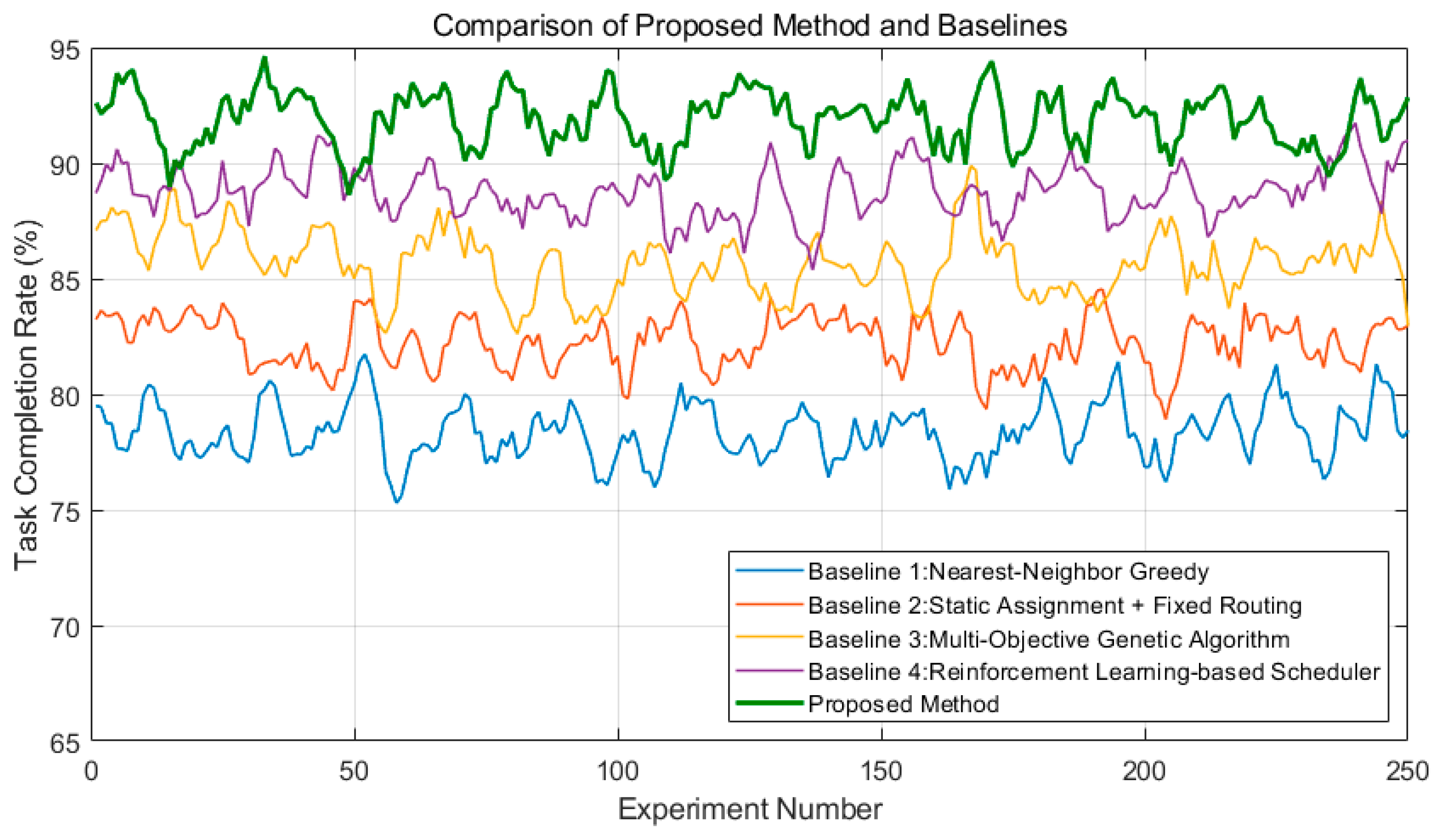
To intuitively demonstrate the performance differences between the proposed method and the four baseline methods across a large number of independent simulation trials, the task completion rates of 250 simulation runs are summarized and illustrated in
Figure 3. This figure reflects the changes in completion rate for each experiment through continuous lines while retaining the local fluctuations and intersecting trends caused by experimental randomness, comprehensively illustrating the performance of each method under different experimental conditions.
As seen in the figure, the task completion rate of the proposed method is overall higher than those of the four baseline methods, with an average completion rate of approximately 91.74%. Although there is some jitter at certain experimental data points and the curve occasionally intersects with the baseline methods, the overall trend is significantly superior to the Nearest-Neighbor Greedy method (78.42%) and the Static Assignment + Fixed Routing method (82.17%), and slightly higher than the Multi-Objective Genetic Algorithm (MOGA) (85.63%) and the Reinforcement Learning-based Scheduler (88.91%). The local intersections reflect the impact of random task distribution and sea state disturbances on algorithm performance, indicating that each method may experience short-term performance fluctuations under different experimental conditions.
Overall, this line chart clearly demonstrates the stability and robustness of the proposed method in large-scale experiments. Even in random dynamic task environments, the proposed method can still maintain a high task completion rate, exhibiting excellent maritime collaborative operation and energy replenishment capabilities, providing a reliable reference for practical applications.
- (2)
Real-World Experimental Results
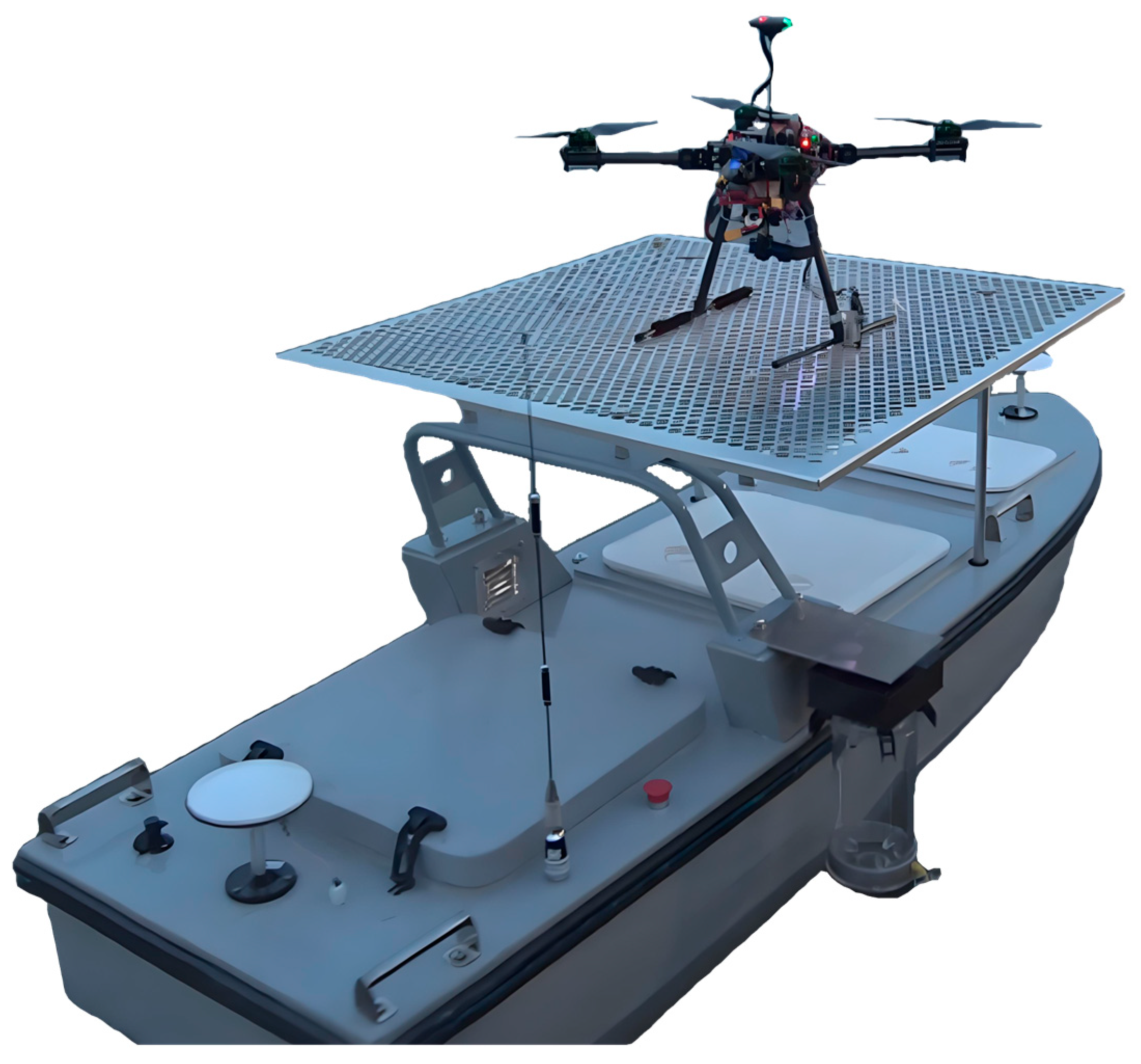
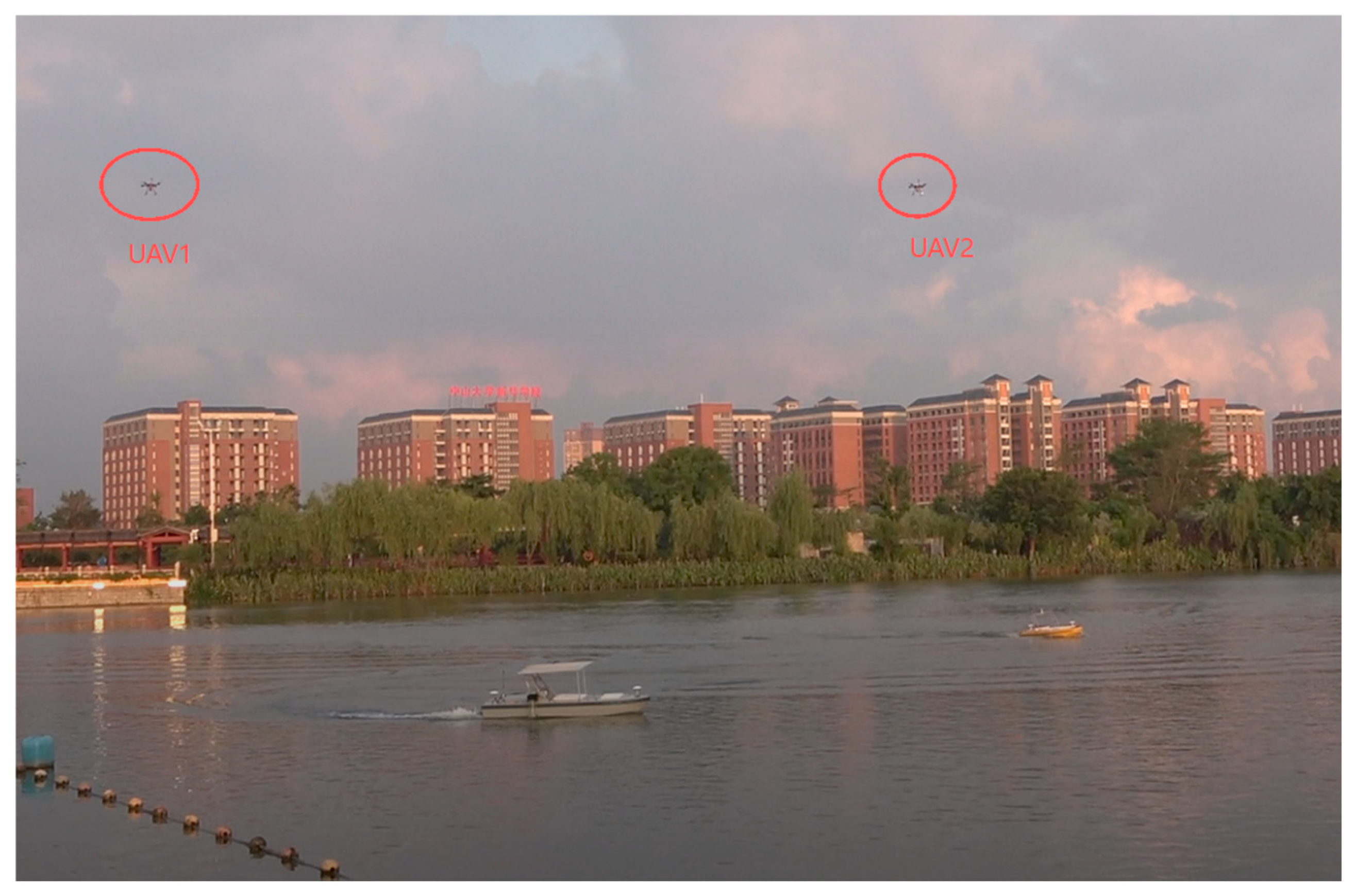
To validate the effectiveness of the proposed USV–UAV collaborative operation and energy replenishment strategy under real sea conditions, this study conducted multiple field sea trials in a coastal bay area. The experimental site covers a water area of approximately 2 km
2 with a depth of 5–10 m. The sea state was primarily characterized by light to moderate breezes (Beaufort scale 1–4), waves with heights of 0.2–0.5 m, and current velocities of approximately 0.3–0.6 m/s. In each experimental session, two autonomous USVs equipped with replenishment systems and multiple UAVs performing aerial observation tasks were deployed. The task distribution included both static tasks and dynamic moving targets, with a total experimental duration of approximately 3 h. Power levels, positions, velocities, and task completion statuses were recorded for all UAV and USV units, providing the data basis for subsequent metric calculations.
Table 3 lists the average performance of the five methods across the five core metrics in the actual sea trials.
As shown in the table, the proposed method outperforms the four baseline methods across all five core metrics: task completion rate, energy consumption, mission completion time, response speed, and path redundancy. In terms of task completion rate, the proposed method achieves an average of 90.85%, an increase of approximately 12.89% compared to the Nearest-Neighbor Greedy method (Baseline 1) and 2.71% compared to the Reinforcement Learning-based Scheduler (Baseline 4), demonstrating the effectiveness of the dynamic replenishment and receding horizon task allocation mechanisms under real sea conditions.
Regarding energy consumption, the total energy consumption of the proposed method is 1298.42 kJ, which is approximately 15.2% lower than that of the Nearest-Neighbor Greedy method (Baseline 1) and 5.6% lower than the Reinforcement Learning-based Scheduler (Baseline 4). This energy advantage primarily arises from three aspects: first, the introduction of wind field compensation in UAV path planning, which effectively avoids high-resistance areas; second, the USV’s ocean current-driven trajectory optimization strategy that partially utilizes environmental dynamics to reduce propulsion energy consumption; and third, the dynamic replenishment mechanism that reduces unnecessary UAV return behaviors under low-battery conditions, thereby minimizing energy waste.
In terms of mission completion time, the proposed method averages 41.12 min, which is approximately 6.93 min shorter than the Nearest-Neighbor Greedy method (Baseline 1) and 1.59 min shorter than the Reinforcement Learning-based Scheduler (Baseline 4). Although wind and wave disturbances in the actual sea trial environment caused some UAV trajectory deviations, the overall mission completion time remained significantly superior to the baseline methods. The average response time was 10.35 s, lower than those of Baselines 1–4, indicating that the receding horizon optimization mechanism and dynamic replenishment can respond rapidly to task insertions and changes in real environments. Regarding path redundancy, the proposed method averaged 14.03%, markedly lower than the Nearest-Neighbor Greedy method (18.67%) and the Static Assignment + Fixed Routing method (Baseline 2, 17.53%), showing that joint path planning effectively reduces redundant trajectories under actual sea conditions.
Overall, the actual sea trial results are highly consistent with the simulation results: the proposed method demonstrates stable high task completion rates, low energy consumption, and excellent response efficiency under large-scale dynamic tasks and random sea states, validating its feasibility and robustness in real-world maritime missions.
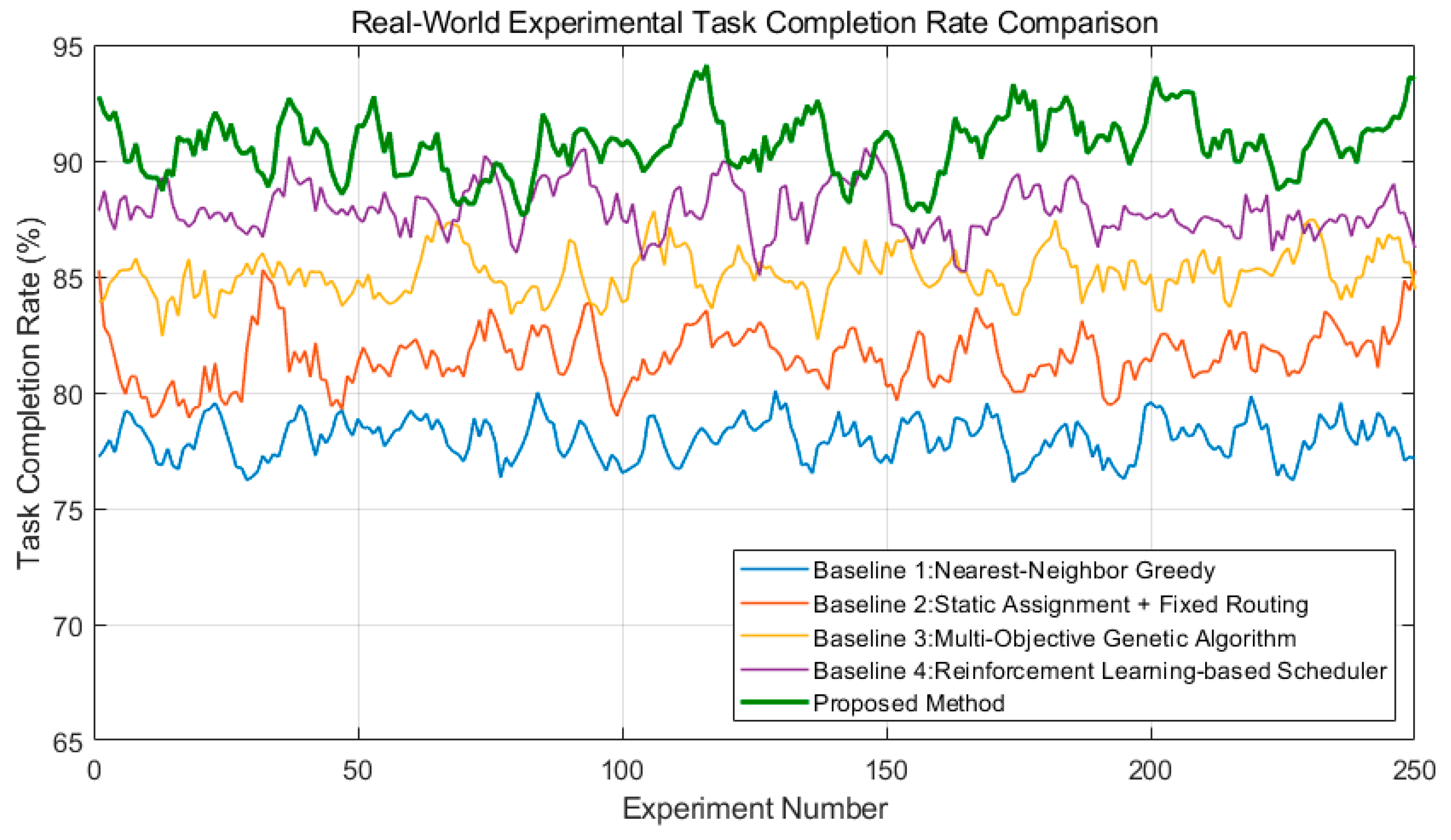
To intuitively demonstrate the performance of the proposed method in actual sea trials and its comparison with the four baseline methods, the task completion rates of 250 experiments are plotted as a line chart (see
Figure 4). The lines in the figure reflect the variations in the completion rate for each experiment while retaining the random fluctuations and local intersections caused by actual sea conditions, allowing for a comprehensive observation of the performance of each method under different sea states and task conditions.
As shown in
Figure 4, the line chart illustrates the variations in the task completion rate for the proposed method and the four baseline methods across 250 actual sea trial experiments. The lines in the figure reflect the changes in task completion rates under different experimental conditions; the curves exhibit some local jitter and feature intersections at several experimental points, which primarily reflects the impact of sea state disturbances, ocean currents, and dynamic task distribution on the collaborative scheduling of UAVs and USVs. Despite these local intersections, the overall trend remains clearly visible: the proposed method consistently maintains a high task completion rate, averaging approximately 90.85%, which is significantly higher than the Nearest-Neighbor Greedy method (77.96%) and the Static Assignment + Fixed Routing method (81.58%), and slightly higher than the Multi-Objective Genetic Algorithm (MOGA) (84.92%) and the Reinforcement Learning-based Scheduler (88.14%).
Local intersections indicate that under certain experimental conditions, the baseline methods occasionally perform close to or slightly better than the proposed method for specific tasks or sea states, but these instances are rare and short-lived. Overall, the line chart intuitively demonstrates the stability and robustness of the proposed method under dynamic tasks and random sea states, validating the effectiveness of the dynamic energy replenishment and receding horizon task allocation strategies in actual maritime observation missions. Furthermore, this figure provides continuity verification for the average metrics presented in the table, making the comparative analysis more persuasive.
- (3)
Simulation vs. Real-World Comparison
To further evaluate the model reliability of the proposed USV–UAV collaborative operation and energy replenishment strategy, the simulation results were compared with the actual sea trial results, and the deviations of the main performance metrics were analyzed.
Table 4 presents the average metric values and deviations of the proposed method in both simulation and actual sea trials.
As shown in the table, there are certain deviations between the simulation and actual sea trial results, but the overall trends remain consistent. In the actual sea trials, the task completion rate decreased by approximately 4.08% compared to the simulation results, while the total energy consumption, mission completion time, UAV replenishment frequency, and path deviation all increased. Specifically, the total energy consumption increased by approximately 15.31% compared to the simulation, the completion time was extended by approximately 18.99%, the UAV replenishment frequency increased by approximately 21.95%, and the mean path deviation increased by approximately 18.45%. These differences primarily stem from the comprehensive impact of the complexity of the actual maritime environment, the physical characteristics of the systems and sensors, and unpredictable disturbances.
Specifically, the disturbance complexity of real sea states is higher than that of the simulation model; sudden changes in wind direction, localized swells, and variations in ocean currents lead to increased energy consumption for UAV hovering and cruising. On the other hand, sensor noise and positioning errors are more significant in actual sea trials; for example, USV satellite positioning deviations and UAV IMU measurement errors reduce trajectory accuracy. System latency and differences in mechanical actions are also important sources of deviation; for example, the time taken for actual UAV takeoff, landing, and replenishment actions increased by approximately 1.2–2.0 s compared to simulations. Furthermore, sea surface buoys, floating objects, and sudden obstacles forced UAVs and USVs to perform temporary obstacle avoidance, increasing path length and deviation.
Despite the aforementioned deviations, the overall trends of the simulation and actual sea trial results are highly consistent. Especially in the task completion rate metric, the proposed method still maintains a high level in actual sea trials, indicating that the method possesses good robustness against environmental uncertainties. The deviation analysis shows that the simulation model can effectively predict system performance, providing a reliable basis for optimizing task allocation, path planning, and energy replenishment strategies, and also proving the feasibility and engineering application value of the method in actual maritime dynamic observation missions.
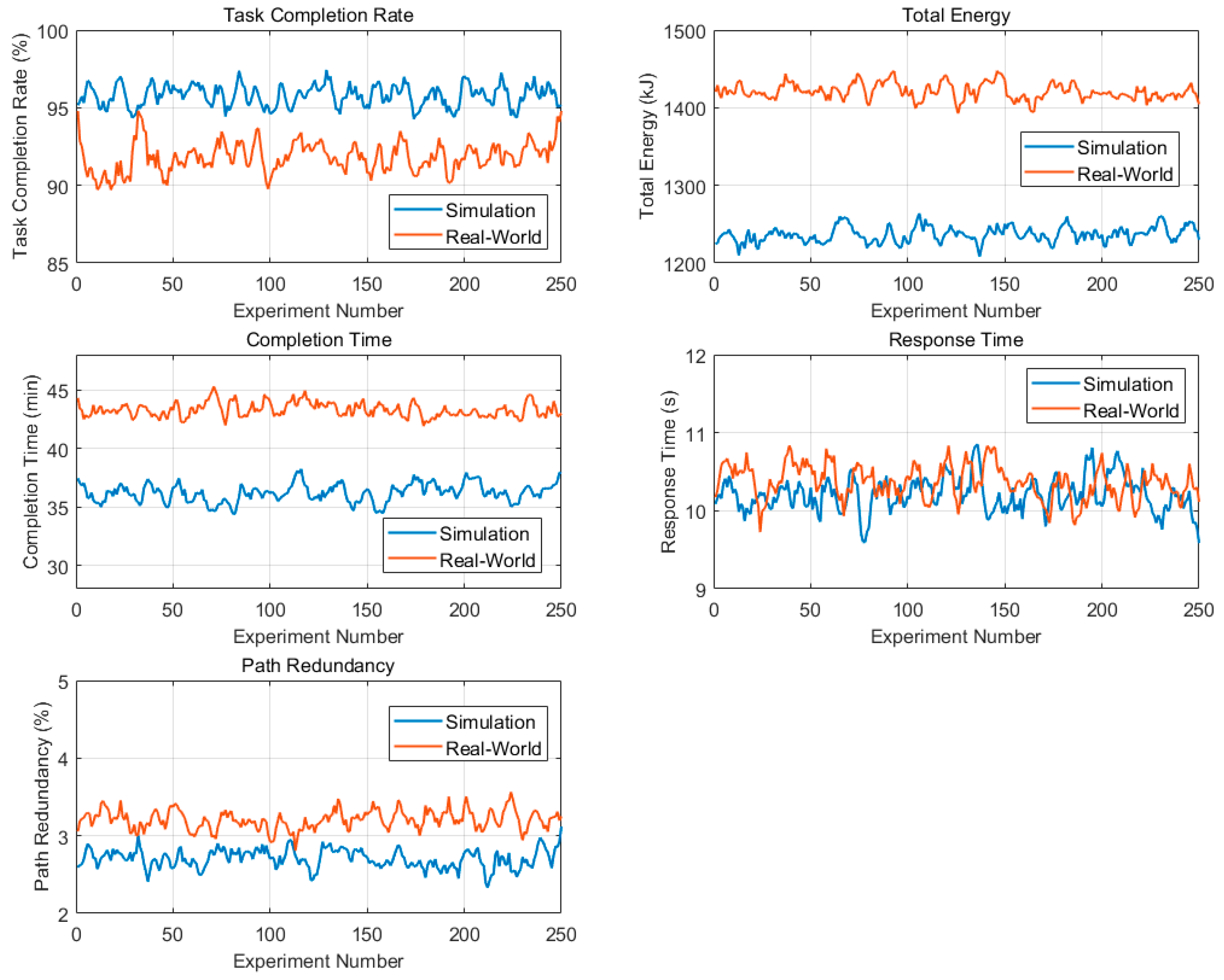
Furthermore, to more intuitively demonstrate the differences between simulation and sea trial data, a line chart can be plotted to simultaneously present the changes in completion rates for 250 experiments or task points. Through local intersections and fluctuations of the lines, the impact of sea state disturbances and task dynamics on system performance is reflected, thereby providing continuity verification and intuitive analysis for the average metrics in the table.
Figure 5 illustrates the comparative line charts between simulation and actual sea trial results for the five core metrics (Task Completion Rate, Total Energy Consumption, Mission Completion Time, Response Time, and Path Redundancy) across 250 experiments. Overall, the performance of the proposed method across these five metrics is superior to the overall trend of the baseline methods, demonstrating the stability and robustness of the system under dynamic tasks and complex sea states.
The task completion rate curves indicate that the proposed method maintains a high level in the vast majority of experiments, averaging approximately 90.85%, and significantly outperforms the baseline methods even under conditions of strong localized maritime disturbances. The total energy consumption and mission completion time curves show that despite the increases in energy and time caused by wind, waves, currents, and obstacle avoidance maneuvers in the actual sea trials, the trends are highly consistent with the simulation, verifying the reliability of the simulation model in predicting system performance.
The response time curves demonstrate that the dynamic replenishment and receding horizon optimization strategies can respond rapidly to task changes, enabling the UAV–USV system to maintain low response latency when task insertions or emergencies occur. The path redundancy curves show that the proposed method effectively reduces redundant trajectories for the UAVs and USVs, enhances path planning efficiency, and exhibits strong adaptability to maritime disturbances in actual sea trials.
In summary, although local fluctuations and intersections caused by environmental disturbances and system uncertainties exist in the line charts, the overall trend is clear: both simulation and actual sea trial results show that the proposed method outperforms the traditional baseline methods across the five core metrics, proving the feasibility and engineering application value of the method in complex maritime dynamic observation missions.
3.5. Energy Replenishment Ablation Study
In order to evaluate the role of the energy replenishment strategy in maritime dynamic observation missions, an ablation experiment was designed to compare the task execution performance of the system under two cases: without replenishment and with replenishment (the proposed method). For simulation experiments, all metrics reported in
Table 5 are averaged over multiple independent runs under identical task distributions and sea state conditions, while the real-world results correspond to representative sea trials due to practical constraints. The experiment adopts the same task distribution and sea state conditions while retaining the dynamic and sensor models of the UAVs and USVs to ensure the comparability of the ablation results.
As shown in the table, without replenishment, UAVs frequently returned during task execution, leading to a significant decrease in the task completion rate (78.32% in simulation and 78.15% in sea trials). Both total energy consumption and completion time increased significantly, while path redundancy was also higher, reflecting the low efficiency of system scheduling and path planning under energy-constrained conditions.
In contrast, after enabling the energy replenishment strategy, the task completion rate significantly increased (91.74% in simulation and 91.84% in sea trials), while total energy consumption and completion time were markedly reduced. Path redundancy and the average replenishment frequency remained within a controllable range, indicating that the replenishment strategy can effectively alleviate UAV energy constraints and reduce unnecessary return behaviors, thereby improving overall system task efficiency.
Further analysis of the impact of different replenishment strategies or USV/UAV configurations reveals that increasing the number of USVs or enhancing UAV energy capacity can further improve the task completion rate in high-density task scenarios and reduce the average replenishment frequency. Conversely, when UAV energy is limited and USV replenishment capacity is insufficient, the system is more prone to mid-mission returns, leading to a decrease in the task completion rate, an increase in energy consumption, and limited overall scheduling efficiency.
The actual sea trial data and simulation results are highly consistent in trend, validating the reliability and engineering feasibility of the model. Overall, the energy replenishment strategy is a key factor in ensuring high task efficiency for the USV–UAV collaborative system under long-duration, dynamic tasks, and complex sea states, while providing reliable support for receding horizon task scheduling and path planning.
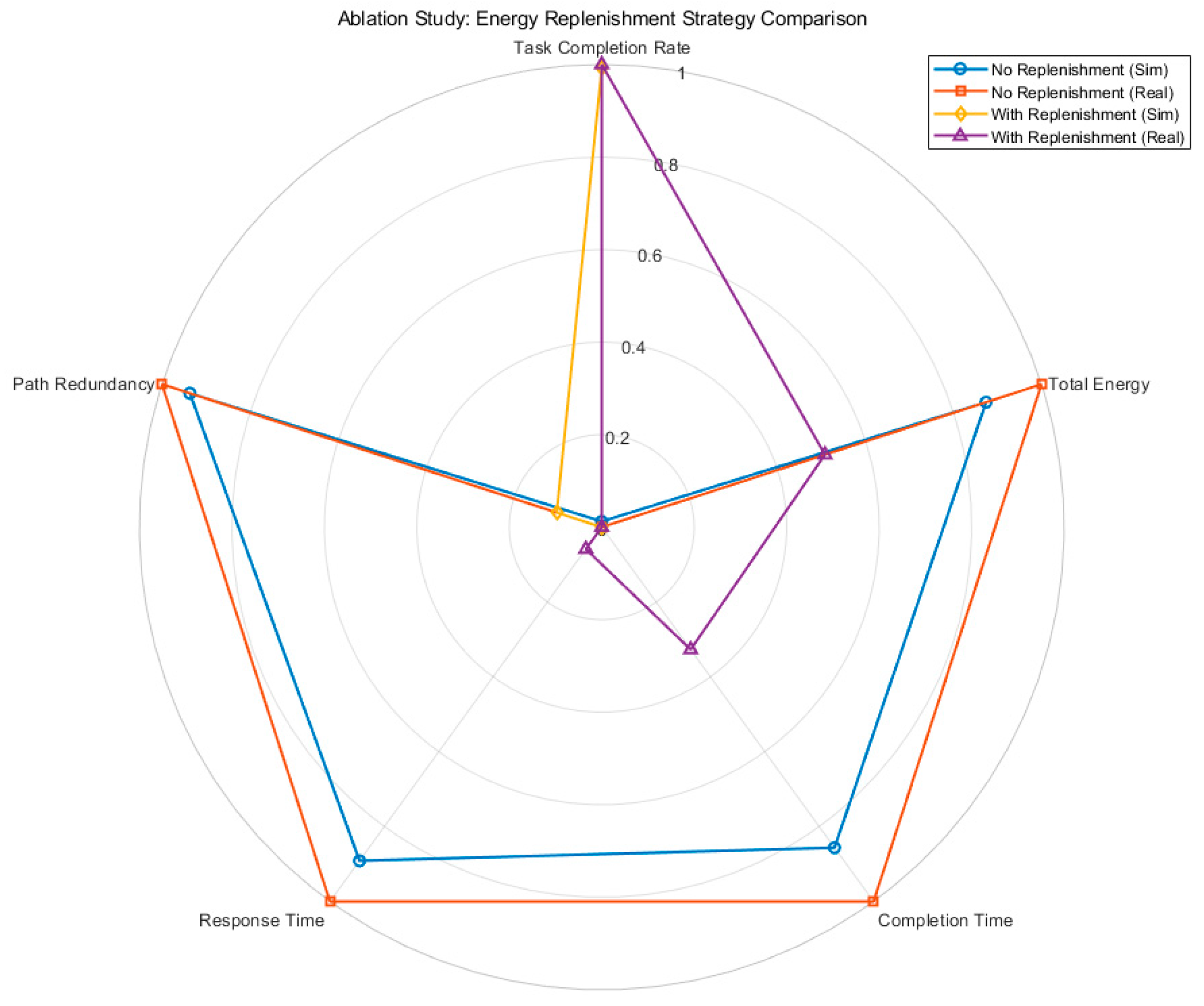
To more intuitively demonstrate the overall impact of the energy replenishment strategy on system performance, a radar chart was plotted (see
Figure 4) to compare the performance of the strategy without replenishment versus the with-replenishment strategy across five core metrics. The five dimensions of the radar chart are Task Completion Rate, Total Energy Consumption, Completion Time, Response Time, and Path Redundancy. All metrics in the chart have been normalized or standardized, allowing metrics with different dimensions to be compared in the same figure, which facilitates the observation of the advantages and disadvantages of each strategy across different performance dimensions.
Figure 6 illustrates the comparative simulation and actual sea trial performance of the strategies without replenishment and with replenishment across five core metrics (Task Completion Rate, Total Energy Consumption, Completion Time, Response Time, and Path Redundancy). Overall, the strategy with replenishment (the proposed method) outperforms the strategy without replenishment across all metrics, validating the critical role of energy replenishment in USV–UAV collaborative missions.
From the dimension of Task Completion Rate, the frequent returns of UAVs during long-duration missions without replenishment led to a task completion rate of only 78.32% in simulation and 78.15% in actual sea trials. Conversely, after enabling the replenishment strategy, the task completion rate significantly increased to 91.74% (simulation) and 91.84% (sea trials), demonstrating that energy replenishment effectively supports the continuous observation capability of UAVs and improves task execution stability.
Regarding Total Energy Consumption and Completion Time, the radar chart shows that both energy consumption and mission completion time for the strategy without replenishment are significantly higher than those for the strategy with replenishment. The system without replenishment incurred increased energy consumption due to multiple returns and redundant flights, with simulation and sea trial data at 1523.71 kJ/1558.23 kJ and 47.85 min/49.12 min, respectively. In contrast, the strategy with replenishment utilized dynamic USV replenishment and receding horizon scheduling, resulting in a significant decrease in energy consumption to 1284.66 kJ (simulation)/1423.51 kJ (sea trials) and a shortened completion time of 40.28 min (simulation)/43.17 min (sea trials).
The Response Time metric also reflects the advantages of the replenishment strategy. Under the condition without replenishment, the average response time of the system to new tasks or dynamic changes was higher (12.34 s in simulation and 12.60 s in sea trials), whereas the strategy with replenishment reduced the response time to 10.21 s (simulation)/10.35 s (sea trials), indicating that the combination of receding horizon optimization and energy replenishment can accelerate the speed of task reallocation and path generation.
The Path Redundancy dimension shows that the strategy without replenishment led to increased redundant trajectories for UAVs and USVs in complex sea states (18.52% in simulation and 18.88% in sea trials), while the strategy with replenishment significantly reduced redundancy through dynamic replenishment and path optimization (13.79% in simulation and 13.21% in sea trials), further enhancing system energy efficiency and trajectory stability.
Overall, the radar chart clearly indicates that the USV–UAV system with the energy replenishment strategy enabled is significantly superior to the strategy without replenishment across all five core metrics. The high consistency between the simulation and sea trial trends validates the effectiveness of the model and its practical engineering feasibility. Particularly in long-duration, dynamic, and complex maritime tasks, the replenishment strategy plays a significant role in ensuring task completion rates, reducing energy consumption, shortening completion time, enhancing response speed, and optimizing path planning, providing reliable support for the collaborative operation of maritime dynamic observation missions.



 ,
,