1. Introduction
The use of autonomous aerial vehicles, hereinafter referred to as drones, has fundamentally changed many areas of work. In agriculture, drones enable high-resolution monitoring of crop health, facilitating early detection of nutrient deficiencies and pest infestations through multispectral imaging and automated surveillance [
1,
2]. The construction industry exploits aerial platforms for site inspection, three-dimensional topographical modeling, and remote safety assessment, thereby reducing human exposure to hazardous environments [
3]. Law enforcement and emergency response agencies deploy drones for real-time surveillance, thermal imaging during search-and-rescue missions, and rapid situational awareness in disaster scenarios [
4]. In logistics, drones are increasingly integrated into last-mile delivery networks and supply-chain optimization schemes, offering rapid point-to-point transport that circumvents conventional terrestrial bottlenecks [
5].
The wide range of applications and efficiency of drones have accelerated their use in densely populated city centres, confined industrial areas and other spatially limited environments. Such deployments necessitate safe coexistence of multiple drones within bounded three-dimensional airspace, where maneuverability, real-time data acquisition, and collision avoidance are paramount [
6,
7,
8]. Due to the increasing density of drones, the likelihood of collisions in the air is rising, endangering not only the aircraft themselves, but also people, property and critical infrastructure on the ground.
Robust obstacle detection and collision avoidance are therefore essential. Among the algorithmic frameworks proposed, Model Predictive Control (MPC) has emerged as a particularly promising approach for real-time trajectory optimization under dynamic constraints. MPC calculates control sequences that minimize a cost function over a finite prediction horizon, explicitly taking into account system dynamics, control limits and hard separation requirements [
9,
10,
11,
12]. By iteratively replanning at each decision epoch, MPC enables reactive collision avoidance without requiring pre-computed global paths. Nevertheless, as the number of drones sharing limited airspace grows, fundamental questions arise: How many drones can coexist safely in a bounded domain before motion becomes impossible? And under what conditions does MPC-based collision avoidance remain feasible?
Understanding these limits is critical for the design, evaluation, and regulation of dense autonomous swarms. However, the current literature predominantly addresses controller design, coordination protocols, and operational frameworks, with limited attention to the fundamental geometric and control-theoretic scalability limits. This work closes this gap by establishing strict mathematical limits for the maximum possible number of drones in limited airspace with MPC-based control.
Our approach integrates two different perspectives. First, we use classical findings from discrete geometry, in particular, Kepler’s conjecture on sphere packing theory, to demonstrate the absolute upper limit for drone density under the condition that each drone occupies a non-overlapping spherical safety zone [
13]. Below, we use an MPC to determine these limits, taking into account dynamic constraints such as the mobility of the drones and a finite prediction horizon. This results in limits that influence throughput and conflict resolution capacities.
The principal contributions of this work are as follows:
We introduce a simulation and control framework that models drone dynamics and implements spherical safety zones to avoid collisions, enabling systematic investigation of density limits [
14].
We apply sphere packing theory to derive mathematical upper bounds for the maximum number of drones per unit volume in a limited airspace and establish fundamental geometric constraints.
We extend these results to derive control-theoretic upper bounds for the maximum number of drones per unit volume under an MPC-based control policy and analyze its feasibility and the impact of the control horizon.
We present simulation results showing how MPC-based collision avoidance behaves under different density conditions and prediction horizons, thereby validating our theoretical framework in realistic scenarios.
Below, we present related work on the points just mentioned, followed by a description of the framework in
Section 3.
Section 4 presents the theoretical analysis, beginning with a strictly mathematical consideration of the upper capacity limit. Subsequently, the limits are restricted by the MPC-optimized dynamic. In the last sections, these limits are evaluated using the results of a representative scenario. Finally, we discuss the results and highlight possibilities for extended scenarios.
2. Related Work
The introduction of drones into many different areas of both leisure and, above all, professional environments has led to extensive research across collision avoidance algorithms, multi-agent coordination schemes, and airspace capacity frameworks. Previous studies have explored areas for securing drone operations, such as control-theoretic methods for evasion, procedural traffic management protocols, or sensor-based detection. However, there is no research that explicitly addresses scalability limits.
This section deals with literature from the following key areas: (A) safety zones and path planning, (B) model predictive control for collision avoidance, and (C) airspace capacity and management.
2.1. Safety Zones for Collision Avoidance and Path Planning
The notion of a protected spatial region surrounding each vehicle, commonly termed a safety zone, exclusion zone, or protected volume, is ubiquitous in the drone literature. Such zones serve to enforce minimum separation distances, thereby preventing collisions.
The concept of protected zones has applications in domains beyond kinematic collision avoidance. For example, Yapici et al. [
15] and Li et al. [
16] employ exclusion radii in the context of communication security. In this case, protected zones prevent eavesdropping by adversarial nodes rather than physical collisions. Although these studies do not address geometric or dynamic feasibility constraints, they demonstrate that spatial separation requirements exist in multiple layers of multi-agent UAV systems, ranging from physical safety to information security. In contrast, this paper’s geometric and control-theoretic analysis focuses exclusively on kinematic feasibility under hard separation constraints.
Zhang et al. [
14] introduce differentiated safety zones around obstacles, allowing drones to approach certain barriers more closely than others according to risk assessment. This concept is extended in Zhang et al. [
17], where a hybrid deep-learning architecture combining convolutional neural networks, long- and short-term memory units, and attention mechanisms enhances an informed Rapidly Exploring Random Tree (RRT) planner. The learned model dynamically adapts safety zone sizes based on sensor input and environmental context, illustrating the interplay between perception and geometric constraints.
Zhong et al. [
18] address three-dimensional protected zones for urban low-altitude drone swarms, proposing a dynamic optimization model that minimizes both the probability of boundary violation and spatial utilization in static conflict scenarios. Conflict resolution is achieved by integrating the protected zone model with an improved velocity-obstacle method. Jia et al. [
19] employ spherical safety zones for distributed leader–follower control in large-scale drone clusters, enforcing that no other agent or obstacle penetrates the sphere of radius
r centered on each vehicle. Altinses et al. [
5] introduce an adaptive scoring framework for drone logistics wherein the size of the safety zone is dynamically adjusted in real time based on velocity, communication quality, and payload, demonstrating that static radii are often insufficient under variable operational conditions.
Complementary to safety zone enforcement, trajectory planning algorithms compute collision-free paths that respect these protected regions. Schwung and Lunze [
20] develop a networked event-based collision avoidance system employing Bézier-curve-based trajectory planning, enabling smooth path generation while maintaining pairwise separations. For scenarios with unreliable communication, Schwung and Lunze [
21] propose cooperative control strategies that ensure safe drone operations even under degraded network conditions, emphasizing robustness in safety zone enforcement.
Together, these works establish that safety zones are a fundamental abstraction in drone coordination. However, they do not quantify the ultimate limit on how many such zones can coexist in a bounded airspace under a given control policy.
2.2. Collision Avoidance with Model Predictive Control
Model predictive control has emerged as a powerful framework for autonomous navigation and collision avoidance, enabling real-time trajectory optimization subject to dynamic constraints, obstacle avoidance requirements, and performance objectives.
Lindqvist et al. [
22] propose a Nonlinear MPC (NMPC) that integrates parametric representations of obstacle trajectories, predicting future positions via classification to enable stable real-time solutions in dynamic environments. Baca et al. [
23] combine linear MPC with nonlinear state feedback, achieving optimal trajectory tracking and collision-free execution in outdoor settings without requiring pre-planned global paths. Dentler et al. [
24] develop a real-time MPC for low-cost quadrotors (e.g., AR.Drone), employing a semi-linear model and sigmoid-based obstacle avoidance functions, demonstrating experimental feasibility on resource-constrained hardware.
Olcay et al. [
9] extend MPC by integrating Gaussian process regression to predict dynamic obstacle movements, generating safe high-level commands validated in real-world scenarios. Doukhi and Lee [
11] present a virtual-to-real NMPC using nonlinear dynamics and online optimization to navigate unstructured, unknown environments with collision avoidance. For multi-robot coordination, Tallamraju et al. [
12] address decentralized MPC for target tracking combined with obstacle avoidance, wherein each unit solves local quadratic programs to maintain safety in dynamic settings.
Beyond MPC, polynomial trajectory planning methods exploit differential flatness to avoid computationally intensive simulations. Richter et al. [
25] optimize polynomial path segments via unconstrained quadratic programs, achieving high-speed flight (up to
) indoors. Mellinger and Kumar [
26] generate minimum-snap trajectories through sequences of waypoints and yaw angles, respecting corridors and speed limits, supplemented by nonlinear controllers for precise tracking.
Hybrid approaches integrate reinforcement learning (RL) with MPC. Ramezani et al. [
10] employ an MPC-based deep deterministic policy gradient with LSTM networks to navigate complex 3D environments, demonstrating adaptability to environmental variations while maintaining collision avoidance.
Those studies implicitly assume that sufficient capacity exists if the controller is properly tuned, without establishing rigorous upper bounds on the number of agents that can coexist in a bounded airspace under hard separation and finite-horizon constraints. Our contribution fills this gap by deriving explicit population thresholds from geometric packing theory and control-theoretic viability arguments.
2.3. Airspace Capacity and Management
Airspace capacity management in manned aviation has been successfully addressed through established regulatory frameworks coordinated by organizations such as the Federal Aviation Administration (FAA), European Union Aviation Safety Agency (EASA), and International Civil Aviation Organization (ICAO) [
27]. However, the rapid proliferation of unmanned aerial vehicles brings with it fundamentally different challenges due to their number, heterogeneity and operational flexibility.
The German Aerospace Centre (DLR) has conducted extensive research on drone integration through projects such as City-ATM and HorizonUAM [
28,
29,
30]. Recent U-space frameworks recognize the necessity of traffic density management in very low-level urban airspace, proposing procedural coordination mechanisms for registration, authorization, and conflict resolution [
31,
32,
33]. Despite these advances, current UTM (Drone Traffic Management) research remains largely conceptual, focusing on procedural frameworks and coordination protocols while implicitly assuming that sufficient capacity exists if properly managed [
34].
Therefore, the question remains largely unexplored: What are the geometric and control-theoretic limits on drone density in a bounded airspace? No management framework can exceed the physical constraints imposed by geometry and dynamics. Before investing in complex UTM infrastructures, it is therefore essential to understand how many autonomous drones can physically coexist in a given volume while maintaining the required safety distances. How are the geometric constraints, i.e., the absolute upper limits for density, defined? How do control strategies and model predictive control with finite prediction horizons affect the achievable density, and under what conditions does high density inevitably lead to a deadlock?
The static solution to the capacity problem is closely related to Kepler’s conjecture on the densest packing of identical spheres, which was proved by Hales [
35]. Starting from the safety zone of a drone in the shape of a sphere, the problem of the densest packing of identical spheres can be applied here. Hales [
35] proved that the densest packing of identical spheres in
achieves a density of
. This geometric result provides an absolute upper bound: if each drone occupies a spherical safety zone of radius
r, then no more than approximately
drones can be placed in a bounded domain
, regardless of the control strategy.
However, sphere packing theory alone addresses only static placement. Dynamic operations under MPC-based control introduce additional constraints through finite prediction horizons, stopping distances, and conflict-resolution requirements. The interaction between geometric packing limits and control engineering restrictions remains an open research question with important implications for the design of UTM systems.
Our work addresses this research gap by establishing mathematical upper bounds on drone density that account for both geometric constraints and control-theoretic limitations. In contrast to existing UTM research, which assumes that sufficient capacity is available with proper management, we determine the fundamental limits that every management system must observe. We provide theoretical foundations for the development of realistic UTM systems with achievable density targets by identifying the limits beyond which fluid swarm movement becomes impossible.
3. Framework
This section details the core components of our simulation framework. We begin by describing the kinematic or dynamic models adopted for the drones and the parameterization of their motion trajectories. Following this, we define the critical safety zone, or protective boundary, established around each vehicle to ensure operational security. Finally, we present the model predictive control architecture, which is central to our approach and explain how its optimization process generates evasive maneuvers that avoid collisions.
3.1. Drone Simulation Environment
We consider a
simulation environment where autonomous drones navigate while avoiding collisions using Model Predictive Control (MPC). The simulation operates in discrete time with a fixed time step
s, which balances computational efficiency and motion accuracy. Each drone is modeled as a 6-degree-of-freedom (6-DoF) kinematic system, where its state evolves according to linear dynamics. The state vector
of a drone at time step
k is defined as
where
denotes the position in
Cartesian coordinates, and
denotes the velocity along each axis.
The control input
represents the acceleration applied at time
k:
The state transition equation for each drone follows linear time-invariant dynamics:
where
is the state transition matrix, and
is the control input matrix. These matrices are derived from Newtonian motion equations under constant acceleration:
where
is the identity matrix
, and
is the zero matrix
. This formulation ensures that positional updates integrate velocity and acceleration (Euler discretization), and velocity updates apply acceleration over
.
Each drone is surrounded by a spherical safety zone with radius
. At each time step, we compute the Euclidean distance
between two drones:
A penalty term with unit weight is added to the MPC cost function whenever .
This strongly discourages proximity violations while allowing smooth optimization.
3.2. Model Predictive Control Design
The safety zone introduced above and the kinematic model form the basis for the control architecture. We employ a model predictive control scheme that combines elements of distributed and centralized control. Each drone maintains its own cost function that penalizes deviations from its target position and control effort. However, a central coordinator aggregates these individual cost functions and solves the joint optimization problem using full state knowledge of all drones. The MPC generates collision-free trajectories by solving the combined optimization problem at each time step.
The trajectory planning problem for a swarm of
N drones is formulated as an optimal control problem with a sliding horizon. Each drone
has a state
that evolves according to the dynamics of a double integrator.
At each decision time, the controller solves the following optimization over a finite prediction horizon
H:
The first term penalizes deviations from the target position , weighted with the positive semidefinite matrix . The second term penalizes high velocities, weighted with , which encourages smooth trajectories and prevents excessive speeds during the optimization horizon. The third term regularizes the control effort using the positive definite matrix R.
Note that the velocity penalty serves as a regularization term to improve trajectory smoothness and numerical stability of the optimization. It does not replace or relax the hard safety constraints defined below.
The optimization is subject to the following hard constraints:
Inter-drone separation: The pairwise distance between any two drones must be maintained at all times to avoid collisions:
where
denotes the sum of the safety zone radii of drones
k and
l.
Velocity limits: Each drone’s velocity is limited to a maximum speed:
Airspace boundaries: The safety zone of each drone must remain within the permitted airspace:
In accordance with the receding-horizon principle, only the first control input
is applied at each decision time, after which the optimization is re-solved with updated state measurements.
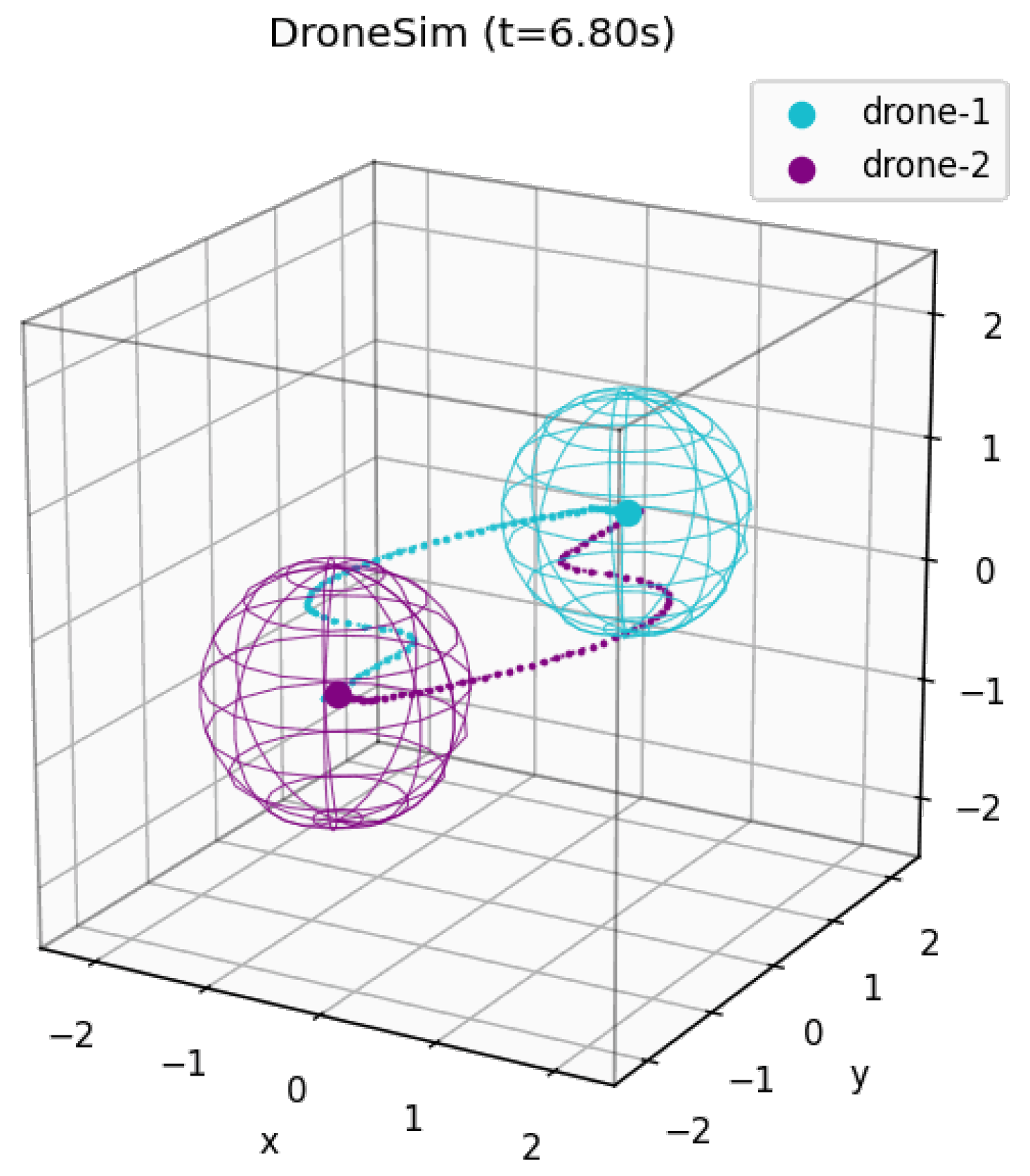
Figure 1 illustrates this process for our implementation (Find the complete code as well as the presented animations on GitHub:
https://github.com/linda78/TLCAmpc (Release v1.1.0)), accessed on 13 February 2026.
4. Geometric Feasibility Limits for Dense Drone Swarms
In this section, we examine a fundamental scalability limit for autonomous swarms by asking how many identical controlled drones can be deployed in a limited airspace before the density of the agents makes any further movement impossible. We deliberately limit ourselves to a homogeneous swarm model in which all drones have identical dynamics and limits, and each drone is surrounded by a fixed, isotropic, spherical safety zone with radius that does not adapt to the local context. We further idealize the environment by modeling the airspace as an obstacle-free limited area with static geometry, assuming perfect state knowledge and dynamics without exogenous disturbances, and considering a centralized or distributed but information-equivalent MPC controller with complete information. We formalize a complete blockade as the loss of any non-trivial possible movement under the hard separation restrictions and control limits. These assumptions are deliberate idealizations, as this paper is primarily concerned with the geometric limitations of a drone swarm. The resulting limitations should therefore be interpreted as fundamental limitations under idealized conditions.
4.1. Problem Definition
In the following, we adopt the MPC formulation presented in
Section 3.2 and extend it to analyze the fundamental scalability limits of collision-free drone swarms. Let us consider a bounded, connected airspace
with Lipschitz boundary, populated by
N identical drones indexed by
.
As previously defined, each drone has the state and evolves under double integrator dynamics, taking into account the hard constraints on thrust, velocity, pairwise separation, and working range restriction. Each drone is assigned a target position .
At each decision time
, the MPC solves the optimization problem defined in Equation (
2), applying only the first control input before solving again with updated measurements. This recursive strategy generates trajectories that balance target-seeking behavior with collision avoidance.
However, as the number of drones increases, the feasibility of this optimization becomes uncertain. We distinguish between two error modes:
A configuration is kinematically blocked if there exists a such that the only admissible control signals on that satisfy all constraints are those for which and for all k. In this state, no drone in the system can move without violating safety.
A configuration is MPC-impossible if the optimization problem does not allow a feasible solution at a given decision time, apart from the trivial zero movement in the blocked case.
4.2. Geometric Extremes Independent of Control
Before incorporating dynamics or control constraints, it is instructive to study purely geometric limits on the population of drones in a bounded airspace. These limits arise from the two complementary perspectives of sphere packing and sphere covering. Sphere packing quantifies how many drones can be safely placed without violating minimum separation, and sphere covering determines how many drones are sufficient to immobilize all possible motion by filling the domain with exclusion zones. In this subsection, we formalize these notions, derive sharp asymptotic estimates, and show how they delimit the spectrum between maximum safe density and worst-case static jamming.
We model the airspace as a bounded domain , and represent each drone by safety spheres of radius r centered at its position . The key geometric objects are the packing and covering numbers, which capture the two extreme limits just described.
Definition 1. LetandThe first counts how many safety spheres can be placed without overlap, and the second counts how many radius-ρ spheres are needed to cover the airspace. The packing number defines the ultimate geometric limit. It represents the maximum number of drones whose safety spheres can coexist without overlap and leave no gap large enough to accommodate an additional drone. Regardless of the control law employed, it is impossible to place more than drones inside without violating the safety radius. Classical results in discrete geometry, particularly the Kepler conjecture as resolved by Hales, provide asymptotically sharp bounds.
Theorem 1. For any safe configuration, . Moreover, for large domains,where denotes the three-dimensional volume and the corresponding surface area, and is the densest packing density in . Proof. Non-overlap of the safety spheres is exactly packing, so the first claim is tautological. The asymptotic bound with density
follows from Kepler’s theorem, and the standard boundary layer estimates that at most
spheres are lost to the boundary [
13,
36]. □
While packing bounds the maximum feasible density, covering arguments reveal how few drones are needed to paralyze the system. The idea is that if the enlarged exclusion zones (radius ) already cover the entire domain, then no drone can initiate motion without violating safety. This yields the following criterion for kinematic jam.
Theorem 2. Suppose that the union of closed spheres of radius centered on drones covers the airspace,Then the configuration is kinematically jammed: for some , any admissible motion must satisfy and on for all i. Proof. Fix any drone i. Its admissible positions at time t must avoid all , . At , these spheres already cover . By continuity, there exists such that for all , the complement of in remains empty in a neighborhood of . Any nonzero displacement of immediately enters some , violating the separation. Thus, only zero motion is feasible for each i, hence jam. □
From this coverage condition, one obtains explicit upper bounds on the minimal number of drones required to force a jam. This is captured in the following corollary.
Corollary 1. Let be the smallest integer such that there exist points with and (safety in ). Then any configuration obtained by placing drones in those is safe but still kinematically jammed. In particular,and, asymptotically,where is the optimal coverage density in . Remark 1. Packing yields an absolute limit on how many drones can fit. Covering yields a constructive floor on how many drones suffice to freeze all motion. In large domains, these scale asThus, a fraction on the order of of the packing-limit population already suffices to create worst-case gridlock. 4.3. MPC with Dynamics: Viability, Dynamic Inflation, and Infeasibility
The purely geometric picture of packing and covering establishes absolute limits, but it ignores the role of dynamics. Real drones cannot change their velocity instantaneously. They are bounded in both speed and acceleration . This limitation fundamentally alters the notion of exclusion zones. A drone must not only maintain a hard separation distance but also allow extra clearance to brake or maneuver if another agent approaches. As a result, the effective forbidden neighborhood around each drone is inflated compared to the static case. This inflation reflects the dynamic viability kernel of the pairwise collision-avoidance constraint. Intuitively, the situation is analogous to vehicles on a collision course because even if they are not yet touching, insufficient headway means that a collision is unavoidable once finite deceleration is taken into account. The same logic extends to drones. Safety requires not only geometric separation but also dynamic slack proportional to velocity and inversely proportional to acceleration.
Lemma 1. Consider two drones on a collision course along a line, with a relative speed of at most and each bounded by the acceleration magnitude . If their center distance is ρ, the minimum additional separation needed to ensure that a pairwise hard separation can be preserved by admissible controls is bounded below by the relative stopping distanceHence, a conservative dynamic exclusion radius is Proof. In the worst case, both drones brake maximally to avoid violating the constraint. Transform to the relative coordinate with relative speed and relative deceleration bound . The minimum distance required to come to rest without penetration is the standard kinematic stopping distance , delivering the stated bound. □
The lemma shows that the safety spheres are effectively enlarged by a term , which is precisely the one-dimensional stopping distance at maximum speed. This has an intuitive interpretation: even if the drones are not touching, if their centers are within , then no control inputs can prevent a future violation of the constraint. Thus, plays the same role for dynamics as did in static theory—it defines the dynamically viable separation radius.
This dynamic inflation has profound consequences for the feasibility of model predictive control. In particular, if the dynamically inflated neighborhoods cover the entire domain, then no non-trivial trajectory exists: every drone is stuck in place.
Theorem 3. If at some decision time the union of spheres covers Ω, then the configuration is kinematically jammed and, in particular, the MPC problem has no nontrivial feasible solution at that time.
Proof. Replace in Theorem 2 by . Any attempted displacement of any drone would inevitably enter some , from which even maximal braking cannot prevent a future violation of the hard separation. Thus, only zero motion is viable; the feasible MPC set contains only the trivial stationary plan. □
This result highlights a subtle but important point: infeasibility in MPC does not necessarily indicate an artefact of the solver or horizon, but may reflect a genuine geometric-dynamic impossibility. Once the inflated covering condition is met, there is no admissible control sequence other than freezing all drones.
It is therefore natural to define a dynamic jamming number, which is the smallest number of drones that can cover the domain using -spheres while still maintaining pairwise geometric safety at time zero.
Definition 2. Define as the minimal number for which a -cover exists with pairwise distances . Then Compared to the static covering number, this bound is more conservative: the covering spheres are larger, so fewer of them suffice to immobilize the space. In fact, increasing the maximum speed without increasing dramatically increases , meaning that dynamic infeasibility can arise at much lower population levels than static geometry alone would suggest. In contrast, larger accelerations shrink the inflated radius, improving viability. Thus, the tradeoff between speed and maneuverability directly translates into the fraction of airspace that can remain dynamically navigable under high densities. In summary, the introduction of dynamics transforms the static covering argument into a viability constraint: it shows that even well below the geometric packing limit, the system can enter configurations where motion is impossible, and MPC has no feasible continuation. This interpretation reframes the MPC infeasibility not as a computational failure but as a structural property of the underlying physics and geometry.
4.4. Throughput and CutSet Limitations for Goal-Seeking MPC
Even if dynamic covering does not yet occur, infeasibility in model predictive control can arise due to local congestion. Specifically, when too many agents must cross a geometrically narrow bottleneck, the flow across that region is fundamentally limited. This introduces a cutset obstruction analogous to the max-flow/min-cut theorem in network theory, but here in a continuous geometric and dynamical setting. Let
be a smooth, orientable surface that separates a set of source locations from a set of goal locations. The maximum instantaneous cross-sectional capacity of
S is constrained by the number of non-overlapping radius safety discs
r that can be inscribed on
S. This yields the geometric bound
This term reflects the purely spatial packing limit: at most one drone may occupy each disjoint
r-disk without violating the hard safety constraint. Temporal separation further constrains feasible flows. Even if multiple disjoint lanes exist, drones following each other along the same local lane must maintain a finite headway to guarantee dynamic safety under bounded velocities and accelerations.
Lemma 2. For longitudinal motion along a common lane with velocity bounded by and acceleration bounded by , a sufficient time headway that ensures isConsequently, the per-lane flow capacity is upper bounded by . Proof. The term enforces the spatial clearance of at maximum velocity, while guaranties a sufficient reaction distance for an upstream drone to brake without colliding if its predecessor decelerates maximally. This is a direct analog of the relative stopping distance argument in Lemma 1. □
Combining geometric and temporal restrictions yields the following continuous min-cut capacity bound.
Theorem 4. Let S separate the sources from the goals in Ω. Any feasible MPC trajectory ensemble transporting Φ drones per unit time across S must satisfyIf the induced demand across every admissible separating surface exceeds this bound (i.e., the continuous analog of a saturated min-cut), then the MPC problem has no feasible solution regardless of horizon length or cost design. Proof. Partition S into disjoint r-disks. By geometric safety, at most one drone can concurrently traverse each disk. Along each such lane, Lemma 2 bounds the admissible flow rate to . Aggregating over at most lanes produces the stated inequality. If every possible separating surface is saturated, then there exists no admissible schedule that satisfies safety and dynamics simultaneously, establishing infeasibility. □
Remark 2. This result highlights that infeasibility may arise even well below the global jamming threshold defined by covering. In particular, local bottlenecks act as capacity constraints: if a critical surface S does not admit sufficient safe throughput, then the assignment of goals cannot be realized by any MPC strategy. Conversely, if there exists at least one separating surface with demand strictly below its capacity, feasibility is not guaranteed, since coordination, scheduling, and timing remain necessary, but a fundamental obstruction is absent. Thus, the cutset capacity provides a necessary condition for safe flow, playing a role for continuous multi-agent motion planning analogous to the max-flow/min-cut theorem in networks.
4.5. MPC Feasibility, Horizon Effects, and Conflict Graphs
Even if global congestion effects (covering jams or cutset bottlenecks) do not occur, model predictive control can still fail due to the limited lookahead imposed by its finite horizon. The key limitation is that, with a bounded prediction window, each drone can only resolve a finite number of conflicts in sequence. If too many conflicts are concentrated around a single agent, there is no feasible scheduling, regardless of the optimization cost weights. To capture this effect, it is useful to introduce a combinatorial abstraction. Define the conflict graph G with the set of vertex and edges whenever the straight tubes of radius r between the current position and the goal intersect within the time window . Intuitively, an edge represents a potential collision corridor that must be scheduled to avoid violation of the separation. Let denote the maximum degree of G, i.e., the maximum number of conflicts incident to a single drone. This graph encodes the sequencing burden on each agent. The duration of the horizon provides a finite temporal budget, and each conflict requires a minimum clearance time to resolve.
Lemma 3. Let be the conservative time needed to resolve one conflict by sequencing (i.e., one agent yields while another passes along a shared corridor). Then, on a finite horizon , any agent can resolve at mostindependent conflicts without violating safety. Proof. Sequencing a single conflict consumes at least of temporal slack for the yielding agent, enforced by the headway condition of Lemma 2. If multiple conflicts must be resolved, these costs accumulate additively in the worst case. Thus, the finite horizon provides a hard budget, limiting the number of resolvable conflicts to . □
This result formalizes the idea of a conflict resolution budget: the horizon provides only seconds, and each conflict consumes at least . Once the budget is exceeded, additional conflicts cannot be safely scheduled.
Theorem 5. If , then the MPC problem does not admit a feasible solution that respects the hard separation constraint, irrespective of the cost weights of the horizon.
Proof. By the pigeonhole principle, there exists at least one agent incident to more than conflicts in G. According to Lemma 3, it cannot schedule all these conflicts within the horizon while maintaining safety, which implies the infeasibility of the MPC optimization problem. □
The proof is essentially a pigeonhole argument: if one agent faces more conflicts than it can resolve within the horizon, then infeasibility is unavoidable. Importantly, this obstruction is purely combinatorial—it does not depend on the global geometry of or on the specific trajectories, only on the local conflict density relative to the time budget.
Corollary 2 (Statistical overload threshold).
For uniformly distributed initial and target positions of the i.i.d., the expected degree of G scales aswhere c is a constant determined by the distribution of goal assignments. Consequently, wheneverdegree overload occurs with high probability, and typical MPC infeasibility follows. This constitutes a statistical phase transition distinct from the geometric covering jam: here, infeasibility arises not from global congestion but from local combinatorial overload of conflicts per horizon. This corollary identifies a density-driven phase transition: once the number of agents grows beyond the above threshold, most random instances will produce a conflict graph with degrees too large for the given horizon to handle. Unlike the cover-based jam, which reflects global congestion, this is a local and statistical obstruction that emerges from the probabilistic distribution of conflicts.
Remark 3. This analysis highlights the role of the length of the horizon as a resource: longer horizons increase and thus allow more conflicts to be resolved sequentially, delaying the onset of infeasibility. However, horizon growth is limited in practice by computational cost and modeling accuracy. Thus, conflict graph degree provides a sharp and scalable diagnostic for identifying feasibility breakdown in dense multi-agent MPC.
4.6. Discussion and Practical Guidance
The feasibility of multi-agent MPC in dense settings is not determined by a single bottleneck, but by the interplay of geometric packing, dynamic stopping, bottleneck throughput, and horizon-limited sequencing. Each of these introduces a different class of constraints, which can be organized into a small set of bounding principles. The constants enter in distinct ways, and their interpretation is crucial both for theoretical analysis and for practical controller design. The key ideas may be summarized as follows.
- (i)
Absolute packing limit: No controller can accommodate more than drones, because disjoint safety spheres of radius r cannot be packed more densely. This bound is purely geometric and controller-independent.
- (ii)
Conservative jam guaranty: If one can arrange N drones such that their inflated exclusion spheres of radius for the static case and for the dynamic case cover the domain , then every admissible controller is forced into stasis. This is a sufficient condition for total immobilization, obtained by worst-case stopping arguments.
- (iii)
Typical-case thresholds: Long before covering-based jam, infeasibility can arise in more realistic scenarios. Two mechanisms dominate:
- (a)
Cutset capacity (Theorem 4): bottlenecks limit throughput, as only disjoint lanes can cross a separating surface S, with additional restrictions from time headway .
- (b)
Conflict-degree overload (Theorem 5): with horizon , a drone can resolve at most conflicts. If the local conflict graph has a degree larger than this budget, MPC infeasibility is immediate.
These are statistical thresholds: they depend on geometry (e.g., bottlenecks), dynamics (), and horizon length.
- (iv)
Tightness and scaling laws: Packing and covering are both asymptotically tight in order as . The unavoidable gap between the absolute packing limit and the conservative jam floor reflects two extremes: benign configurations can allow safe operation at densities approaching the packing limit, while adversarial arrangements can immobilize traffic already at the covering threshold.
From these principles emerge several design insights. The choice of constants r, , and strongly shapes the feasible density: increasing r reduces both the packing limit (scaling as ) and the cutset capacity (scaling as ), while a larger improves dynamic capacity by shortening the stopping distance and reducing the required time advance. Speed limits have mixed consequences: raising them boosts geometric throughput (proportional to ) but simultaneously increases the stopping radius (proportional to ) and the progress requirement (proportional to ). Horizon length H plays a different role: extending it increases the conflict budget and thus allows more conflicts to be scheduled, but it does not relax cutset or cover constraints and comes at the expense of higher computational burden and model uncertainty. The question that needs to be answered is at what point the system becomes unsolvable or freezes. In the case of opposing worst-case placements, a complete freeze can already be achieved at or its dynamic analogue with replaced by . However, in more typical deployments with balanced objectives and no severe bottlenecks, the impossibility is instead determined by the capacity of the intersection set and horizon-limited conflict overload, which are less restrictive than the coverage-based jam floor limit but still far stricter than the absolute packing limit.
5. Evaluation
We examine the problem using the geometric and dynamic evidence developed earlier in this paper. We apply the packing, covering, and stopping-distance results as stated and proved above and plug in the realistic numbers below to produce explicit counts for a representative 3D example. To this end, we use a setup with the bounded cubic airspace with its Lebesgue volume and the fixed spherical safety radius m around each drone. For the drone dynamics, we define a maximum admissible drone speed m/s and a maximum admissible acceleration . In the following, we instantiate the theoretical bounds with these numerical values to obtain concrete density limits for this specific scenario.
5.1. Absolute Geometric Limit
For dimension
d with the densest packing density
,
Here,
N denotes the maximum admissible number of drones in the domain,
is the optimal packing density in dimension
d, and
is the volume of a safety sphere of radius
r, given by
for
m. Specializing to three dimensions with
and
yields
so that the geometric upper bound becomes
. These are asymptotic packing limits from Theorem 1.
5.2. Dynamic Inflation and Dynamic Jam
We now instantiate the dynamic exclusion radii from
Section 4.3 with the parameters of our scenario. Lemma 1 establishes that the pairwise dynamic exclusion radius is
which assumes that both drones brake maximally in relative coordinates (relative speed
, relative deceleration
). With
m,
m/s, and
, this yields
Since
for the domain
, even a single pair of drones on a head-on collision course cannot be guaranteed dynamically safe. This conservative bound reflects the worst case in which both drones approach at maximum speed.
However, in our simulation framework, all drones cooperatively avoid collisions. Under symmetric braking, each drone is individually responsible for its own stopping distance
. The per-drone dynamic exclusion radius then becomes
where the factor
arises because each drone covers half the relative stopping distance (
) and the single-drone stopping formula contributes another factor
. With our parameters,
Applying the covering argument of Theorem 3 with this radius yields a dynamic jamming number of . At this population level, the dynamic safety zones of more than six drones already block the entire domain, forcing the controller to freeze.
5.3. Simulation Results
To confirm the analytical limits derived in the previous sections, we now examine the behavior of the MPC controller in simulation using the parameter values above. The convergence of the MPC solver depends on the choice of prediction horizon H, which we analyze systematically below. We therefore structure the empirical evaluation in two stages.
First, we perform a horizon analysis on two domains: a cubic domain with volume , specifically the cubic domain and a spherical domain with radius m. We use safety radii m and various combinations of velocity and acceleration limits. This analysis determines the range of prediction horizons that yield feasible solutions and smooth trajectories within acceptable computation times. Note that for these configurations, the analytical jamming number lies between six and seven drones.
Second, we use the best-performing horizon from this analysis in validation scenarios within larger domains, specifically and , to determine if the MPC controller adheres to the analytically derived population limits across a broader range of configurations.
5.3.1. Horizon Analysis
We begin with a comprehensive parameter sweep to identify the optimal prediction horizon.
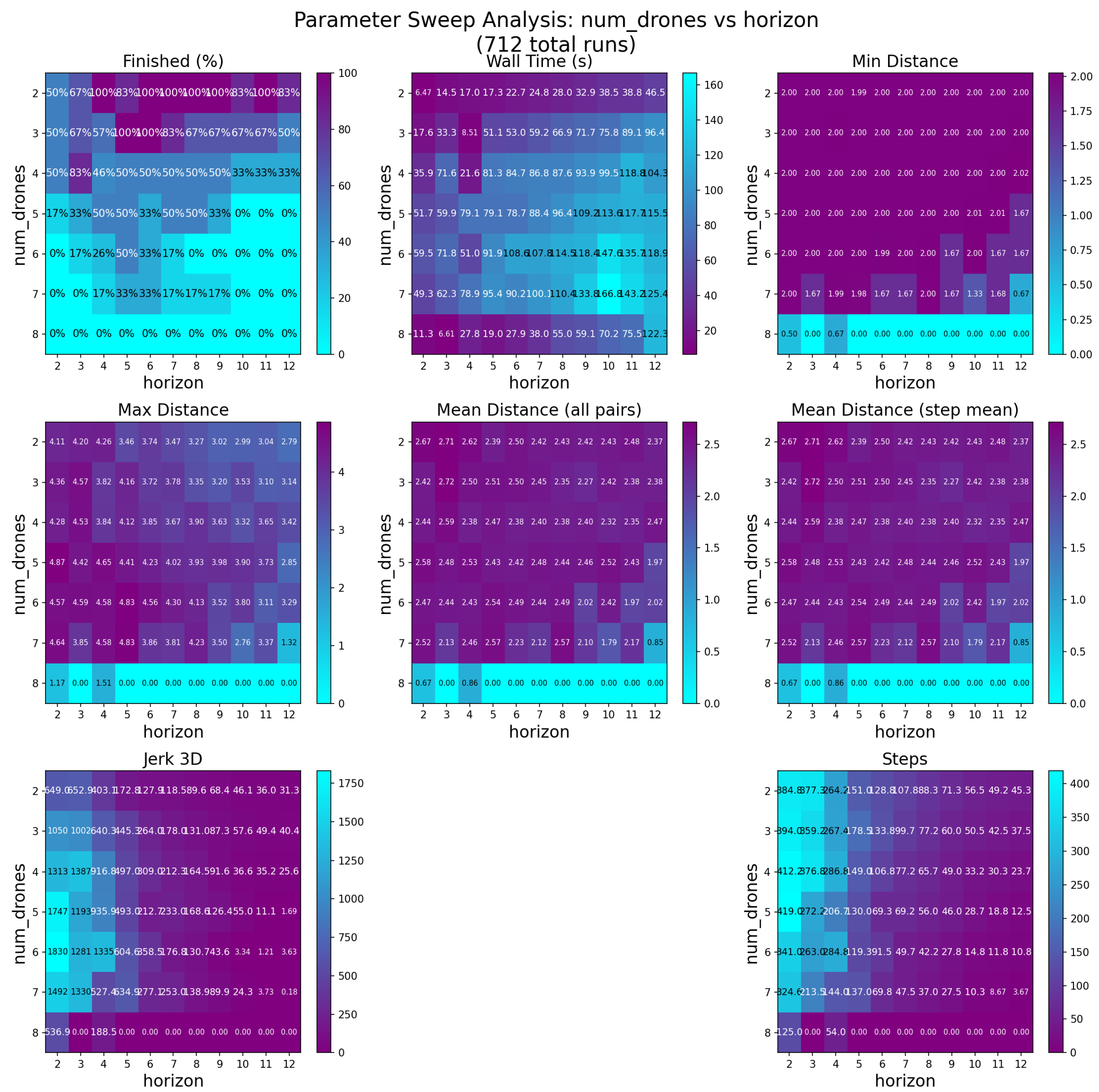
Figure 2 summarizes the results of 712 simulation runs covering the cubic domain
and a spherical domain with radius
m, both tested with safety radii
m and all combinations of maximum velocity
and acceleration
.
The top row of
Figure 2 shows that the success rate remains high for up to four drones across most horizons but drops noticeably beyond five drones. With eight drones, no configuration succeeds, regardless of the chosen horizon. Wall time increases with horizon length and drone count, while the minimum inter-drone distance consistently stays at or above the required
safety threshold. The middle row confirms that maximum and mean distances remain stable, indicating that the controller maintains adequate separation even under load. The bottom row reveals the characteristic jerk pattern: very short horizons produce erratic trajectories with jerk values exceeding 1500, whereas horizons between four and seven yield substantially smoother paths. The steps panel shows the expected inverse relationship between horizon length and iteration count.
Notably, the data confirm that for the domains, the controller can reliably handle up to seven drones with appropriate horizon selection. This aligns well with the analytical jamming limit of approximately six to seven drones derived earlier for these configurations. Scenarios with eight drones consistently fail across all horizon values, exactly as predicted by the jamming analysis.
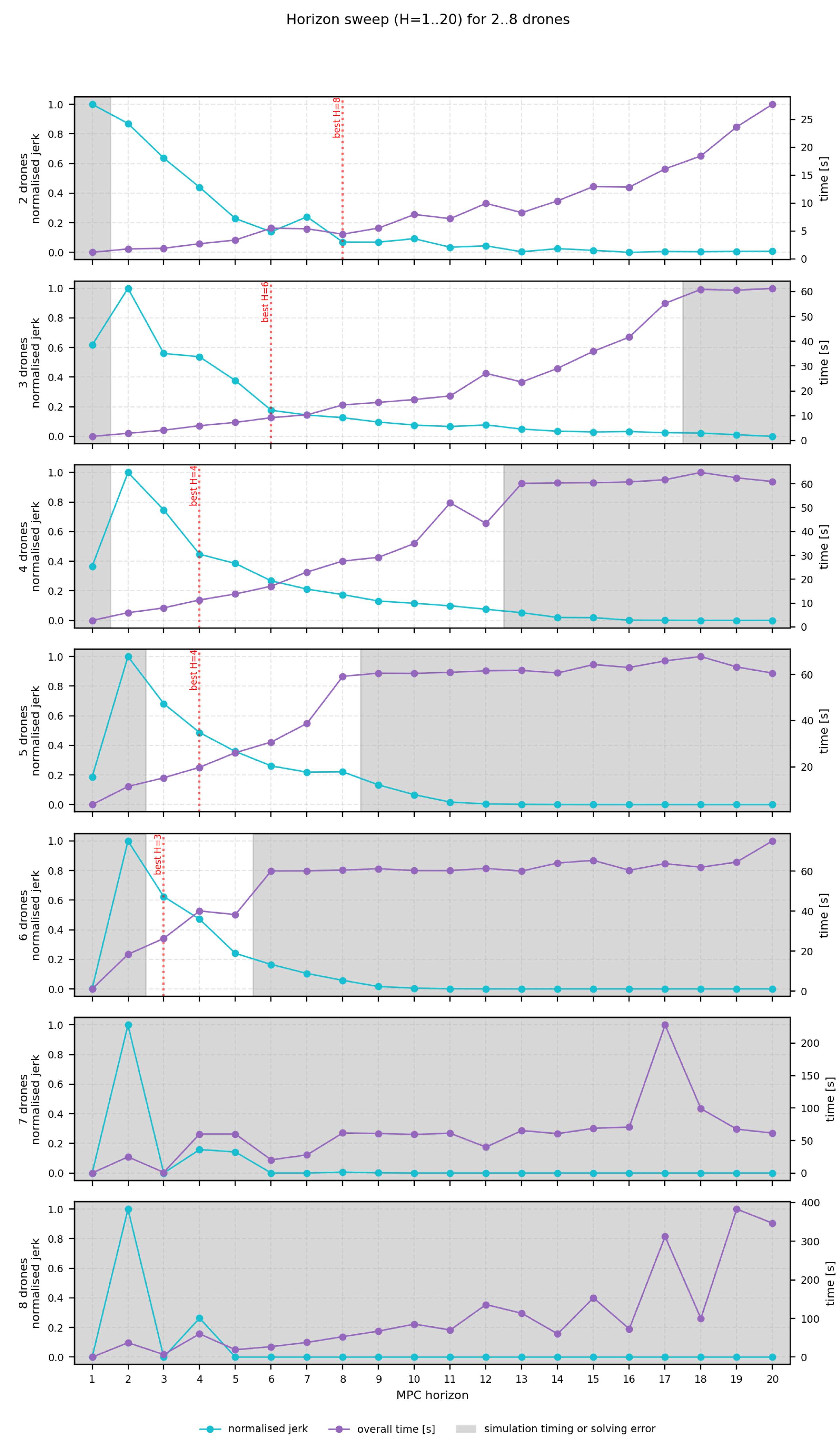
In
Figure 3, the computing time, as well as the drones jerk, indicating how smooth the trajectories found are plotted. For this purpose, fixed scenarios were carried out for two to eight drones, each with a horizon
H ranging from one to twenty. In each scenario, the drone’s start and end points are a randomized but fixed set for this drone count. The aim was to determine the range of the horizon that avoids overloading the system’s computing power while still producing forward-looking, collision-free trajectories. The investigation also shows that the resulting trajectories indicate that very small horizons tend to generate more jerky paths, while very large horizons tend to require higher computational effort. The larger the selected horizon, the longer the computation time. Furthermore, the experiment shows that as the number of drones increases, the window of a selectable horizon for a solvable system (represented in the diagram by a white background) becomes smaller and smaller. The more drones there are, the smaller
H must be selected. Horizons between four and five time steps appear to be a good compromise.
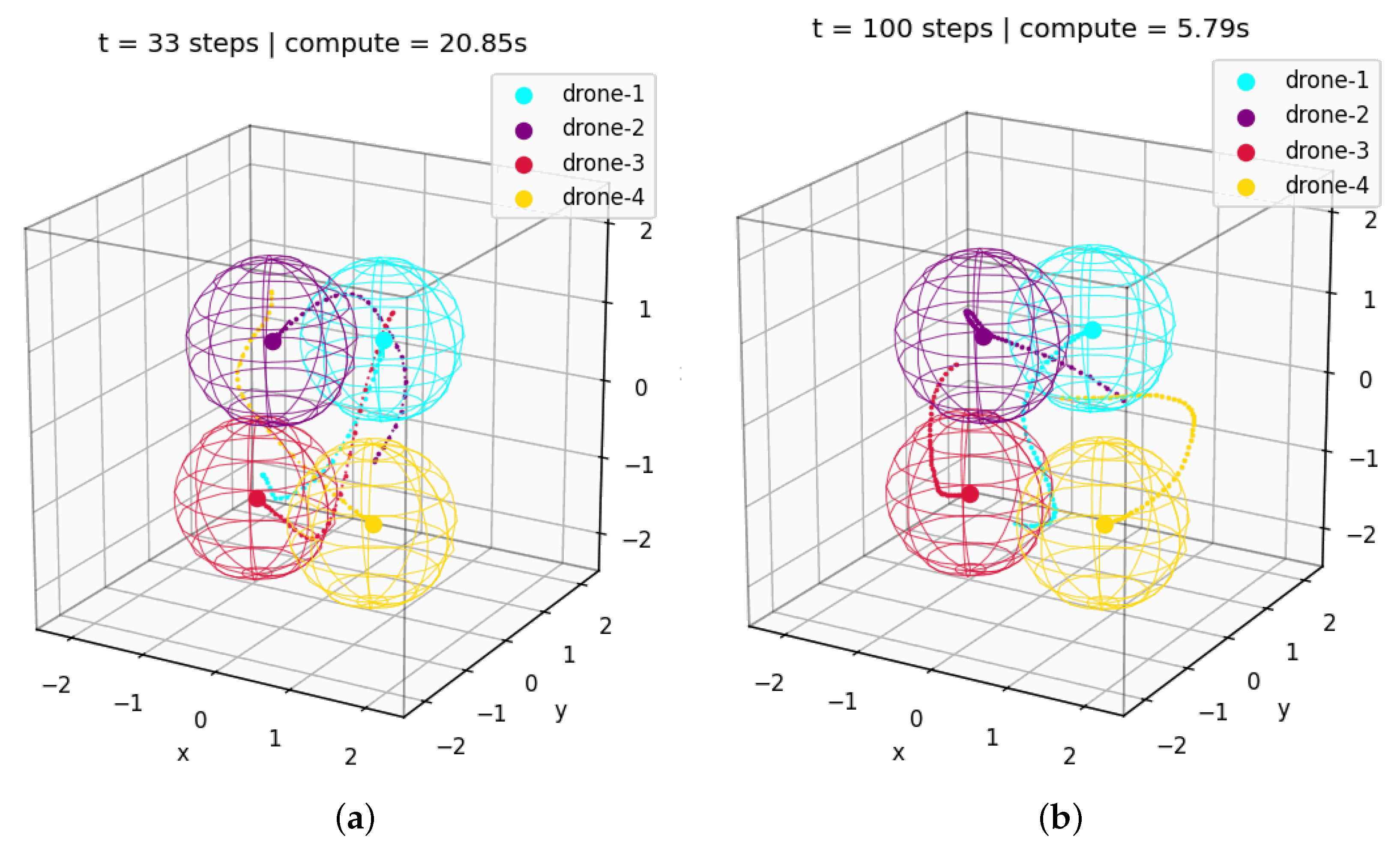
The following examples illustrate how the choice of horizon influences both the number of MPC iterations required and the quality of the resulting trajectories. The final state of the simulation with four, six, and seven drones is shown in
Figure 4,
Figure 5 and
Figure 6, respectively. It is clear that the choice of horizon also influences how often the MPC has to recalculate and how long the recalculation takes.
With four drones and a horizon of four, the MPC requires 100 calculation-steps and solves the problem in five seconds (
Figure 4b), which is nearly four times faster than with a horizon of eleven. Although the time for this run is longer, the number of calculated steps is, with only 33 steps, significantly fewer (
Figure 4a).
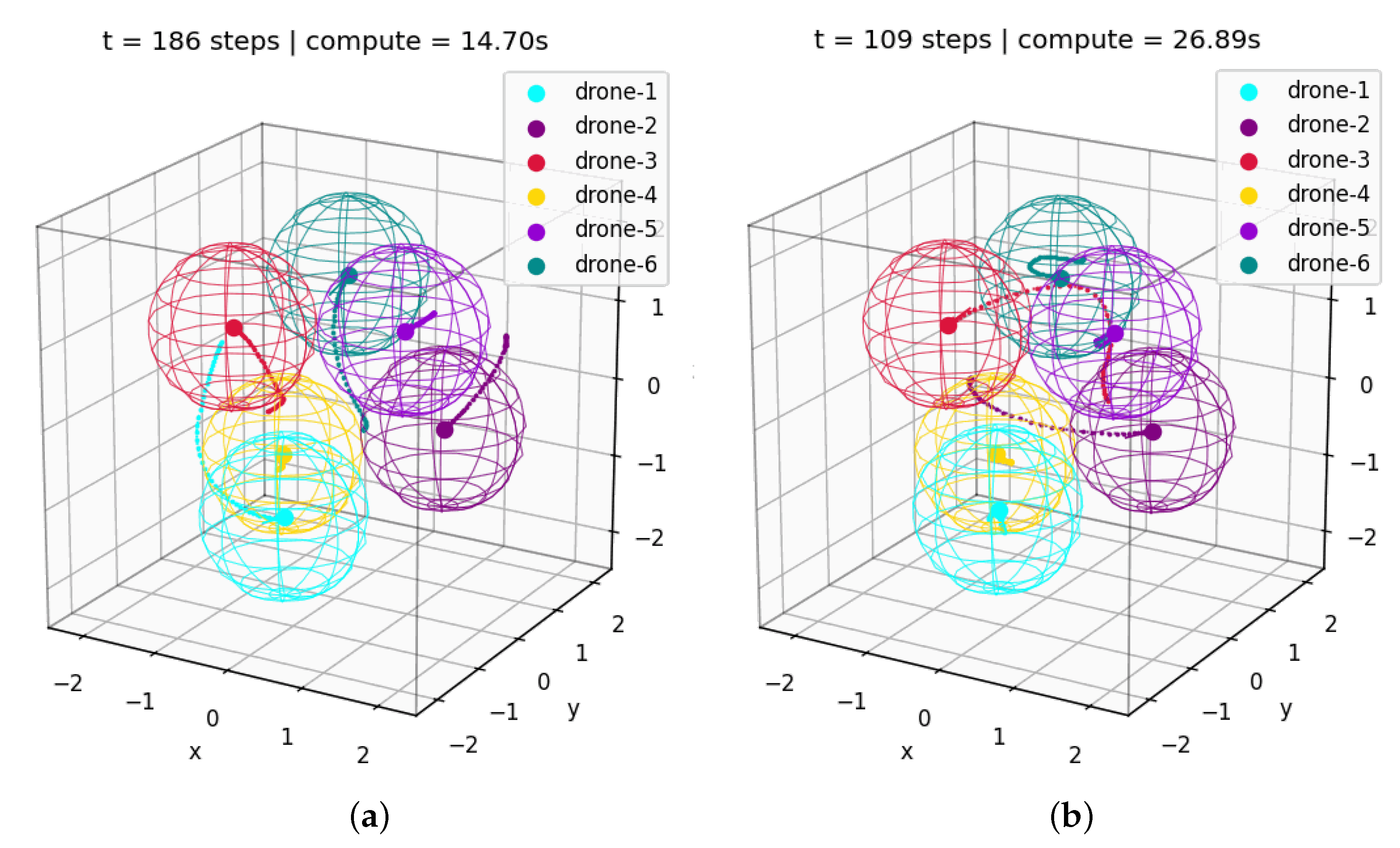
In the example of six drones, the MPC requires 186 calculation steps with an optimally selected horizon (
) (
Figure 5a). The system is solved after 15 s. A less well-chosen horizon of ten requires fewer calculation steps, but at 27 s, it is relatively slow (
Figure 5b).
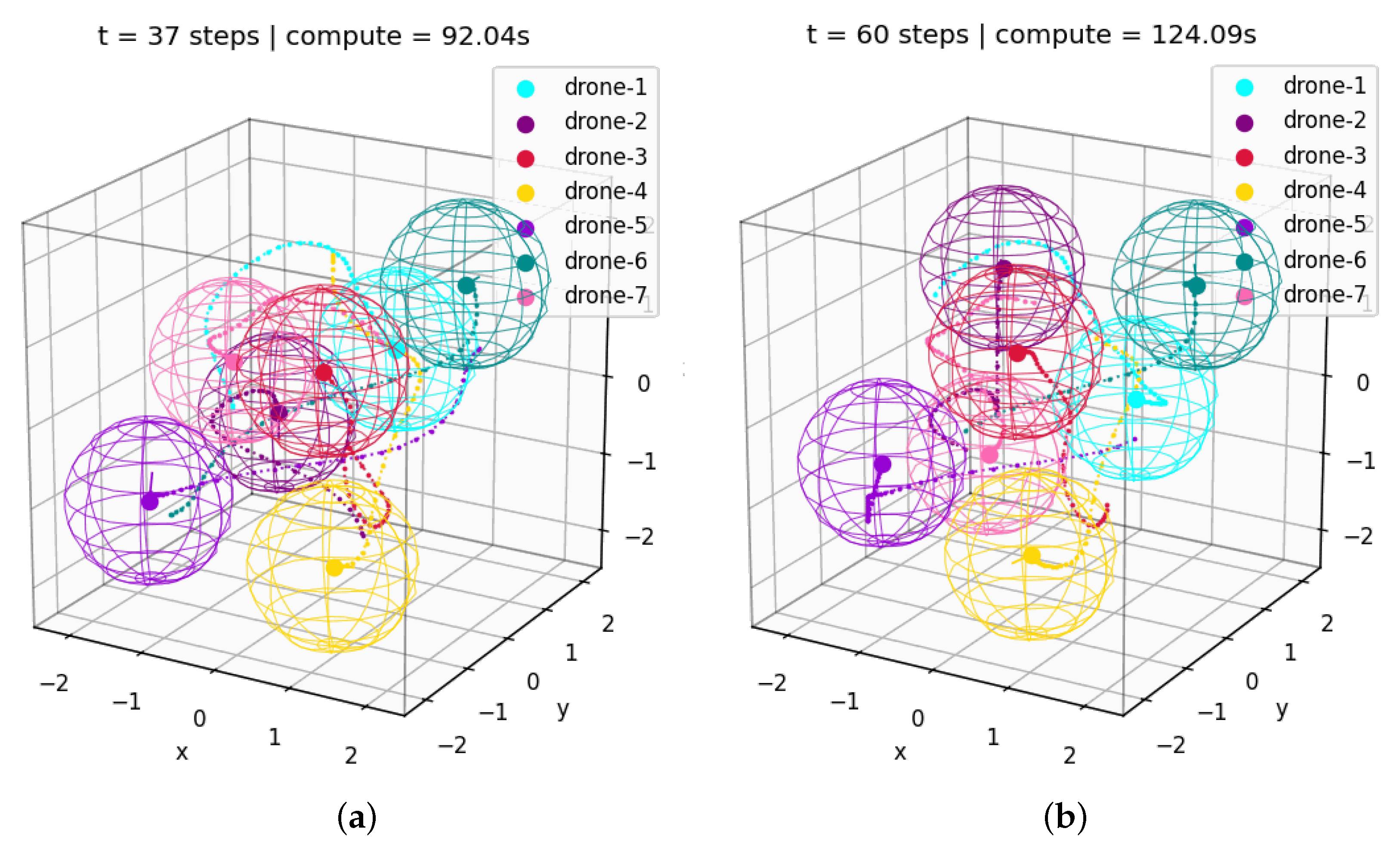
With seven drones, the MPC was unable to resolve the system within 120 s. The deadlock is clearly visible in the simulation after about 90 s (
Figure 6a). Thirty seconds later, the drones are unable to move the middle drone out of the jam (
Figure 6b).
In summary, empirical evidence shows that the choice of horizon does not influence the maximum number of drones that can be successfully coordinated. However, it does affect computation time and trajectory quality. A horizon of four or five is a robust choice across all tested scenarios. These results preliminarily confirm the analytical bounds: up to six drones can be coordinated, but seven drones consistently fail across all horizon values, except when other maximum velocity or acceleration values are used, as seen in
Figure 2. This outcome aligns with the predictions of the jamming analysis. To test whether this holds true more broadly, we will now turn to larger domains with higher expected drone capacities.
5.3.2. Verification of the Analytical Bounds
With the prediction horizon fixed at , we are now in a position to verify the analytical population limits derived earlier in this paper against the actual behavior of the MPC controller. We conduct validation experiments in two cubic domains: with volume 512 and with volume 729 . For the larger domain, we additionally vary the safety radius, testing m to examine how increased safety margins affect both the theoretical limits and the controller’s ability to reach them.
Recall that the geometric packing bound is given by
and that the dynamic jamming number under symmetric braking is
Table 1 and
Table 2 list the resulting dynamic exclusion radii and jamming numbers for both domains across a range of acceleration and velocity combinations.
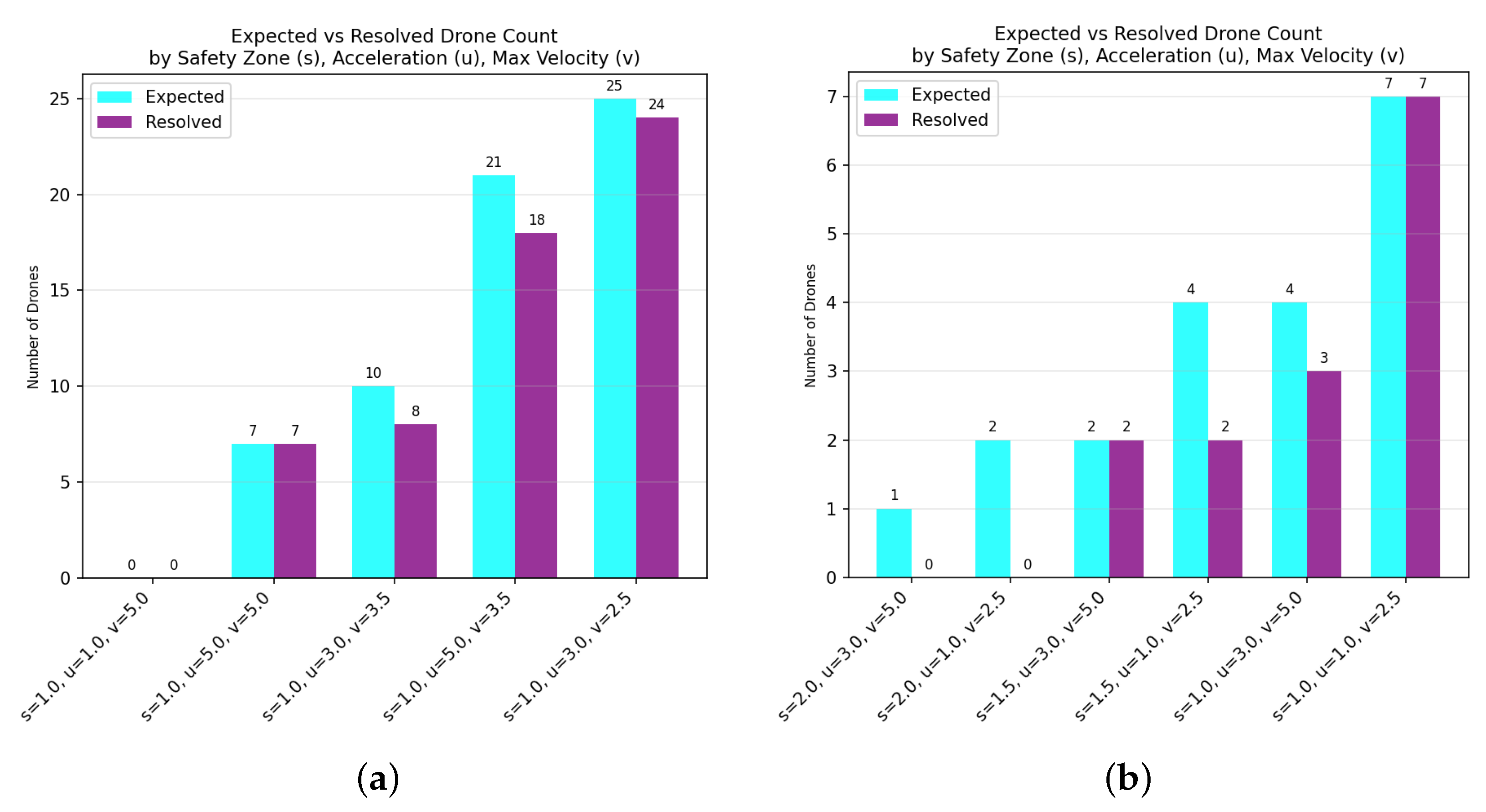
From these tables, we select representative configurations for the simulation experiments. For the
domain (
Figure 7a), the selection includes: the configuration
m/
,
m/s, which is analytically infeasible even for a single drone and serves as a sanity check; the moderate configurations
m/
,
m/s with
and
m/
,
m/s with
; and the high-capacity configurations
m/
,
m/s and
m/
,
m/s with jamming numbers of 21 and 25, respectively. For the
domain (
Figure 7b), we select seven configurations spanning all three safety radii to probe the effect of increased safety margins.
Figure 7 compares the analytically expected jamming numbers with the drone counts that the MPC controller was actually able to resolve in simulation. Through these experiments, we saw that the mathematical limits for the selected speeds and accelerations were not exceeded. However, the solver could not reach these limits for all combinations. The solver seems to experience particular difficulty when the acceleration is very high or the safety radii are very large. Conversely, it can be seen that the ratio of expected to resolved is comparably high for large spheres. Therefore, this behavior may be due to the solver and does not violate the presented mathematical proof.
While these findings are peripheral to the main contribution of this paper, they offer practical guidance for system designers. The analytical bounds remain valid under all tested conditions. However, achieving these bounds in practice depends on selecting velocity and acceleration limits that allow for sufficient maneuvering margins for the controller. Similarly, the choice of prediction horizon does not affect the maximum number of drones that can be coordinated; however, it influences computation time and trajectory quality. In summary, the simulations confirm that the MPC controller successfully resolves scenarios up to the analytically predicted drone count across all tested configurations. Beyond that limit, deadlock situations consistently emerge and cannot be resolved. Consequently, the simulation results clearly validate the calculated limits.
The simulation and some animations can be found in our GitHub repository.
6. Conclusions
We have provided a mathematically precise framework for determining the maximum admissible drone population under hard separation constraints and MPC control. This framework separates universal, geometry-driven limits, obtained from packing and covering arguments in the airspace domain , from limits that depend on dynamics, mission layout, and control design, such as dynamic inflation of safety zones, cutset capacity at bottlenecks, and the finite conflict-resolution capability of a horizon-limited MPC.
This analysis yields three classes of formulas that can be implemented in practice. First, absolute safety limits of the form quantify how many drones can be accommodated while maintaining a fixed spherical safety radius, independent of a specific controller. Second, congestion states based on static coverage with spheres of radius and dynamically inflated spheres of radius provide conservative population levels at which any permissible controller is forced into stasis. Above the corresponding static or dynamic congestion numbers, there is no non-trivial collision-free motion. Third, throughput and horizon limits connect feasibility with geometry and time by combining a cutset capacity estimate, which limits how many disjoint safety discs per unit of time can cross a separation surface, with a bound on the number of conflicts that a single agent can resolve within a finite horizon, derived from the conflict graph and the minimum safety distance.
Together, these results provide compact design rules for dense multi-drone systems. Radius r and volume determine the absolute packing density and blocking scales, the dynamic limits and define how far safety zones must be enlarged and the time intervals selected, and the prediction horizon H determines how many consecutive conflicts each agent can resolve. Increasing speed without simultaneously improving maneuverability reduces the range of achievable density, whereas greater acceleration or moderately longer prediction horizons can partially restore feasibility by reducing dynamic enlargement or increasing the budget for conflict resolution.
Our empirical study illustrates these principles in a concrete three-dimensional scenario with a limited cubic area, a fixed safety radius, and realistic limits for speed and acceleration. In this scenario, the system can be operated safely and reliably with up to six drones, which is consistent with conservative dynamic congestion estimates. With seven drones, however, persistent blockages often occur. The experiments also show that the length of the MPC horizon does not change the fundamental density limits but has a significant impact on computation time and trajectory quality. Very short horizons lead to frequent recalculations, while very long horizons significantly slow down the controller without improving feasibility.
Future research could explore strategies for relaxing or adapting these limits in practice. One approach is to replace the fixed safety radius with an adaptive, speed-dependent safety margin using barrier functions. This allows slower drones to fly closer together, while faster drones automatically maintain a greater distance to account for longer braking distances. Another approach is to extend local model predictive control (MPC) with semi-global coordination mechanisms, for example, by modeling neighbor interactions as a potential game and designing payoffs so that equilibria promote cooperative movements in which outer drones proactively make room for inner drones. Both approaches aim to maintain the strict safety guarantees of the current framework while leveraging the structure of typical missions to operate closer to theoretical density limits.
Additionally, the propagation of disturbances in dense drone traffic is an important avenue for future research. In high-density scenarios, local perturbations can cascade through the system as drones react to their neighbors’ evasive maneuvers, which can cause system-wide congestion. While our conflict-graph analysis captures related effects at the combinatorial level, a thorough examination of wave-like delay spreading and stability analysis under stochastic perturbations is beyond the scope of this study. This topic constitutes a promising direction for future work, particularly in scenarios involving imperfect state estimation.