Article

Pre-Programming Thermal Sensors Improves Detection During Drone-Based Nocturnal Wildlife Surveys in Warm Weather


by
Lori Massey
1,2,
Aaron M. Foley
1,*,
Jeremy Baumgardt
1,3,
Randy W. DeYoung
1 and
Humberto L. Perotto-Baldivieso
1,4
1
Caesar Kleberg Wildlife Research Institute, Texas A&M University—Kingsville, Kingsville, TX 78363, USA
2
Texas Parks and Wildlife Department, Chaparral Wildlife Management Area, Cotulla, TX 78014, USA
3
Idaho Department of Fish and Game, Boise, ID 83712, USA
4
Department of Rangeland, Wildlife, and Fisheries Management, Texas A&M University, College Station, TX 77843, USA
*
Author to whom correspondence should be addressed.
Drones 2026, 10(2), 127; https://doi.org/10.3390/drones10020127
Submission received: 9 January 2026 / Revised: 8 February 2026 / Accepted: 9 February 2026 / Published: 11 February 2026

Highlights

What are the main findings?
  • Night-time drone surveys of white-tailed deer using pre-programmed thermal sensors generated ideal thermal contrast during both summer and winter.
  • Despite a lower raw count during summer, correcting for visibility bias via distance sampling methods generated similar population estimates of white-tailed deer during both seasons.
What is the implication of the main findings?
  • The capability to generate ideal thermal contrasts during warm seasons, which overlap with peak parturition and antlerogenesis, indicate that drones may be used to generate recruitment rates and adult sex ratios which are vital parameters for management programs.
  • The use of distance sampling methods will generate more accurate population estimates than raw counts because raw counts can be affected by canopy cover.

Abstract

Improvements in thermal infrared imaging provide new opportunities for drone-based wildlife surveys. The use of thermal sensors can be limited by ambient temperatures and vegetation cover, which can limit opportunities to survey during optimal biological seasons. Pre-programming isotherm settings in thermal cameras has the potential to allow surveys during warmer environmental conditions. We evaluated night-time surveys of white-tailed deer (Odocoileus virginianus) using isotherm settings in a 102 ha enclosed property in South Texas during February (winter) and July (summer) 2022. Detection probabilities were 0.84 and 0.65 during winter and summer, respectively. Percent woody cover was 48.1% and 60.7% during these seasons, respectively. The seasonal pattern in detection probabilities met expectations in terms of visibility bias caused by canopy cover. Despite different detection probabilities among seasons, population estimates were similar because distance sampling accounted for visibility bias. The use of isotherm settings allowed us to survey during temperatures previously thought to be too warm for ideal contrast (~21 °C vs. 30 °C), which provides more opportunities to survey during biologically important seasons typically associated with warm temperatures (i.e., fawning and antlerogenesis). We recommend the use of distance sampling methods to evaluate and correct for visibility bias during thermal-based drone surveys because detections of focal species may vary with vegetation.

1. Introduction

Reliable population estimates are requisite for the sustainable management of renewable natural resources [1,2]. Recent technical advances and improved availability of drones have opened the potential of using safe, low-impact technology to generate more consistent population estimates for wildlife [3]. Because of difficulties detecting wildlife with red, green, blue (RGB) imagery [4], many studies complement drone surveys with, or simply rely on, thermal imagery [5,6,7]. With thermal imagery, warm-blooded wildlife can be detected by the thermal contrast between the focal species and the environment. However, thermal signatures of wildlife become weaker as environmental conditions worsen [8], most often attributed to increases in ambient temperature [9], vegetation obstruction [4], or solar radiation [10]. Additionally, sensors that display a range of temperature differentials, rather than exact temperatures, can suffer from thermal cluttering because different thermal loads among inanimate objects such as canopy cover, rocks, and water can obscure detections of focal species [11]. Some thermal sensors can be programmed or calibrated to search for a specific range of temperatures [9,12], which can reduce noise in the thermal image while simultaneously increasing thermal contrast of focal species from the background, but more research is needed.
The white-tailed deer (Odocoileus virginianus) is an economically important, keystone species in the United States [13]. With the popularity of white-tailed deer as a renewable resource, several studies have evaluated the use of drones to generate population estimates [5,10,11,14,15,16]. White-tailed deer populations are generally managed more intensively in Southern U.S. states [17], which pose issues relating to the ability to detect animals during thermal-based drone surveys in warm environments [18]. Consequently, most, if not all, drone studies for white-tailed deer occurred during winter–spring seasons when temperatures and canopy cover were at a minimum [5,10,11,14,15,16]. There is value in focusing on surveying during seasons when detectability of focal species is high; however, there is also value in evaluating whether focal species can be detected during other seasons [19]. For instance, late summer and early autumn can be ideal times to survey for productivity rates (i.e., juvenile:adult female ratios) because of the obvious differences in body sizes. Additionally, antlers are in velvet stage during this time and can be detected with thermal sensors, which allows identification of males and estimates of adult sex ratios [20,21]. Recruitment rates and adult sex ratios are critical components of population monitoring for white-tailed deer and other game species [22,23].
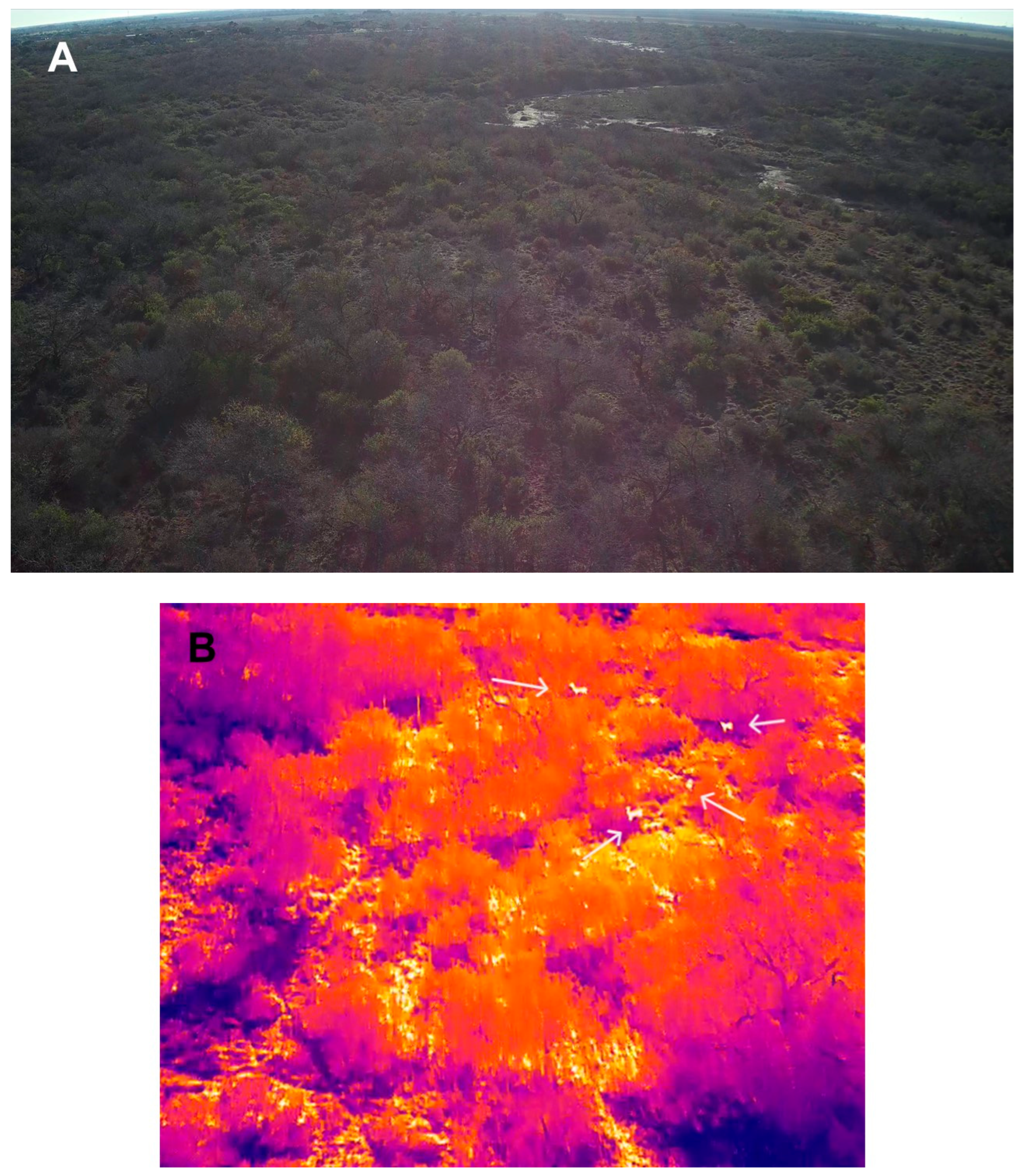
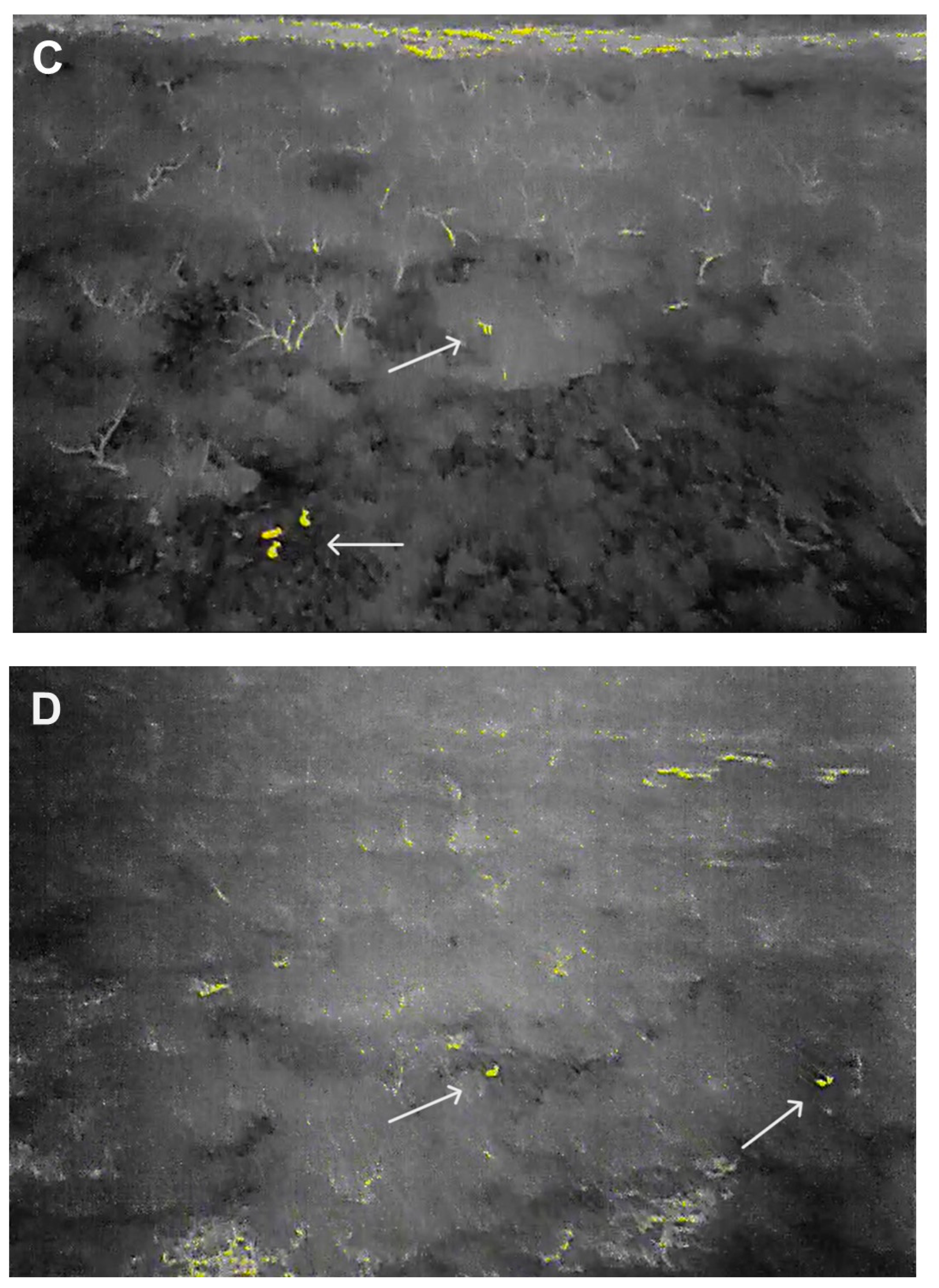
In Southern U.S. environments, summer–autumn seasons have warm temperatures and dense vegetation canopy cover, which can inhibit ideal thermal contrast of focal species. Isotherm is a setting that allows a designated range of temperatures to be represented by different color schemes [24]. Use of isotherms, and specifically custom temperature settings, in thermal cameras during wildlife surveys (Figure 1) was suggested by several researchers but has yet to be thoroughly evaluated [11,15,21]. For instance, ref. [9] used human body temperatures ad locum to calibrate isotherms prior to surveying monkeys. We were unable to locate any other publications regarding application of pre-programmed isotherms for the purpose of surveying wildlife. We examined whether custom pre-programmed isotherm settings allow sufficient detections of animals to generate robust population estimates in contrasting ambient temperatures and canopy cover. We conducted drone surveys during winter and summer under a distance sampling framework. Distance sampling is a method that quantifies detection probabilities based on distribution of measured perpendicular distances of detected focal species [25]. Simply put, if the distribution of perpendicular distances were uniform, then one can infer that all available focal species were detectable. Conversely, if there was a decline in the distribution of perpendicular distances as distance from the transect increased, then one can infer that visibility declined. Distance sampling has frequently been used to quantify detection probabilities of surveys for a variety of flora and fauna [25]. We predicted that detection probabilities would be higher during winter when ambient temperatures and canopy cover are minimal and lower in summer as ambient temperatures and canopy cover were maximal. Because distance sampling corrects for visibility bias, we predicted estimated deer population sizes would be comparable during both seasons.

2. Materials and Methods

2.1. Study Area

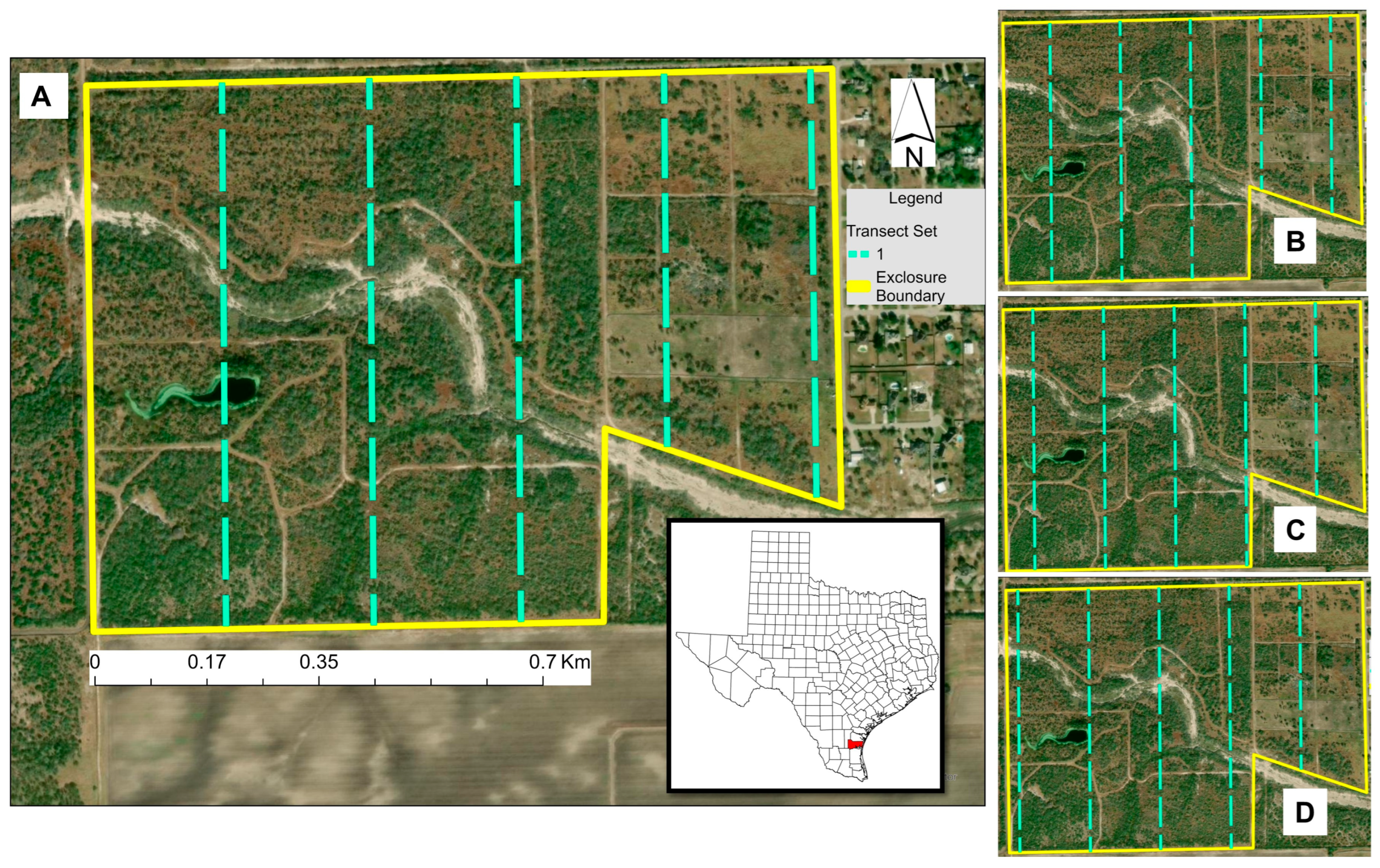
We conducted surveys on the 102 ha South Pasture Research Facility (27°28′20.5′′ N, 97°53′12.4′′ W) maintained by Texas A&M University-Kingsville located southwest of Kingsville, Texas, USA (Figure 2). The property was surrounded by 2.5 m woven wire fence on all sides; at the time of the study, the deer population was considered to be closed. We did not know the true population size; repeated drone surveys conducted in spring 2020 indicated ~85 deer/km2 [10]. Vegetation was dominated by mesquite (Prosopis glandulosa) thornscrub brushland with an open grassland area in the northeastern corner. The average annual rainfall for this area is 736 mm, with an annual temperature ranging from 15 °C to 28 °C [26]. Elevation at the site is 18 m above sea level, and the topography is relatively flat. The South Pasture Research Facility contains a two-acre ephemeral pond on the southwest side of the property, and an ephemeral creek runs diagonally through the property from the northwest to the southeast; both provide wildlife with an intermittent water source year-round. There were no livestock or other large herbivores present in the research facility. No recreational hunting or supplemental feeding occurred during this study.

2.2. Drone Data Collection

The use of line transects is common in distance sampling [27]. We created 4 independent sets of non-overlapping (i.e., no sidelap) fixed-width transects 228 m apart, each amounting to 25% coverage of the property (Figure 2). Each set transect was created in ArcGIS Pro (2.9, ESRI, Redlands, CA, USA) as a line shapefile and exported as a KMZ file. The KMZ file was uploaded into Google Earth and saved as a KML file. The KML file was uploaded to DJI Go [24] and autonomous flights were conducted. We opted to use 25% coverage to minimize the probability of double-counting deer which was unlikely to occur because deer generally have reduced movement rates during non-crepuscular hours [28]. Further, the observer (L. M.) kept track of detection positions relative to drone location during post-processing to ensure that double-counting did not occur. Another reason why we chose to survey 25% coverage was to eliminate the need to change batteries during a survey which would have given deer an opportunity to relocate during a survey. We continuously recorded a video for a set of transects then commanded the drone to return home to swap batteries before initiating another set of transects. Specifically, we surveyed transect set 1, followed by set 2, then set 3, and ending with transect set 4 (Figure 2). Search effort and detections from when the drone was traveling between transects were excluded. Survey flights were flown with a DJI Matrice 210 V2 RTK with a DJI Zenmuse XT2 thermal sensor (SZ DJI Technology Co., Nanshan, Shenzhen, China). The thermal sensor is a dual 4K/FLIR uncooled Vox Microbolometer with a 640 × 512 resolution. Each set of transects took 14 min and each complete survey took about 1 h. The drone was programmed to fly at 36 m above ground level at 6.7 m/s with a camera angle of −20° based on protocols established by [10]. Our protocols did not result in any noticeable reactions by deer, which meets one of the key assumptions of distance sampling [25]. We flew surveys on 19 February 2022 (winter) and 23 July 2022 (summer). Dates were selected to obtain maximal contrast in ambient temperature and vegetation canopy cover. Peak parturition in white-tailed deer occurs during mid-July [29], but we did not anticipate being able to detect neonates due to their small body size.
Before each mission, we pre-programmed the isotherm thresholds using captive deer housed at the Albert and Margaret Alkek Ungulate Research Facility at the Caesar Kleberg Wildlife Research Institute—Texas A&M University—Kingsville. Pre-programming was conducted the same night of each survey by holding the drone while outside of the captive white-tailed deer pens and scanning the environment while adjusting the lower, middle, and upper thresholds observed in deer until the maximum contrast between the deer and the background was reached. Captive deer were 10–80 m from the sensor. We specifically used the MidRangeBHIso color scheme to enhance visibility; the selected range of temperatures were displayed on a yellow to orange gradient and every other temperature on a gray scale (Figure 1) [24].
Surveys were initiated 1–2 h after sunset on nights with no chance of precipitation and winds < 7 m/s. Following FAA regulations, the drone was fitted with anti-collision lights that are visible for at least 4.8 km and have a flash rate sufficient to avoid a collision with other aircraft. The FAA-licensed pilot in command was placed in the center of the property for optimal drone operation. We placed 2 visual observers at the northeast and southwest corners of the property to monitor airspace during the flights. All flights were approved by the Texas A&M University-Kingsville Office of Risk Management. Animal use approval was not required because no animals were handled or disturbed during this study.

2.3. Drone Data Analysis

After each survey, we downloaded the video and GPS log files from the drone. The video data was then georeferenced with the GPS log file using LineVision-Ultimate (Remote GeoSystems, Inc., Fort Collins, CO, USA). From LineVision, we exported an ESRI Video Multiplexer CSV file (ESRI, Redlands, CA, USA) and imported it into ArcGIS Pro 2.9 Video Multiplexer tool (ESRI, Redlands, CA, USA) for further analysis. For each deer detected, we measured perpendicular distances between the corresponding fixed-width transect and the deer location. Deer detected while flying to the next transect were not included in analyses.
For our distance sampling analyses, we used Program Distance version 8.0 [27]. A text file containing survey identifier, transect ID, transect length, area of study site, and perpendicular distance of each deer [10] was uploaded into Program Distance. Perpendicular distances of detected deer were binned into 5 m intervals; data was right-truncated to exclude detections > 25 m from the transect because the viewshed becomes wider ahead of the drone which causes an inflated swath width [10]. Because total number of detections generated per 25% coverage mission was less than the 40–60 detections ideal for distance sampling analyses as suggested by [25], we post-stratified our data and treated each set of transects as replicates for each survey. We used Akaike’s Information Criteria corrected for sample size (AICc) to determine whether the data for each survey best fit commonly used half-normal or hazard-rate key functions [25]. We generated population estimates and associated measures of confidence.

2.4. Vegetation Cover Analysis

We conducted an unsupervised image classification using a similar approach by [30]. We acquired Planet (Planet Labs PBC, San Francisco, CA, USA) imagery on 19 February 2022 (winter) and 18 July 2022 (summer). Planet imagery is daily, 3 m pixel length resolution with 8 bands, Orthorectified, scaled Top of Atmosphere Radiance (Level 3B). We selected images within a 2-week range from the drone flights, with 0% cloud cover. Images were classified into woody cover (shrubs and trees), non-woody cover (herbaceous and bare ground), and water.

3. Results

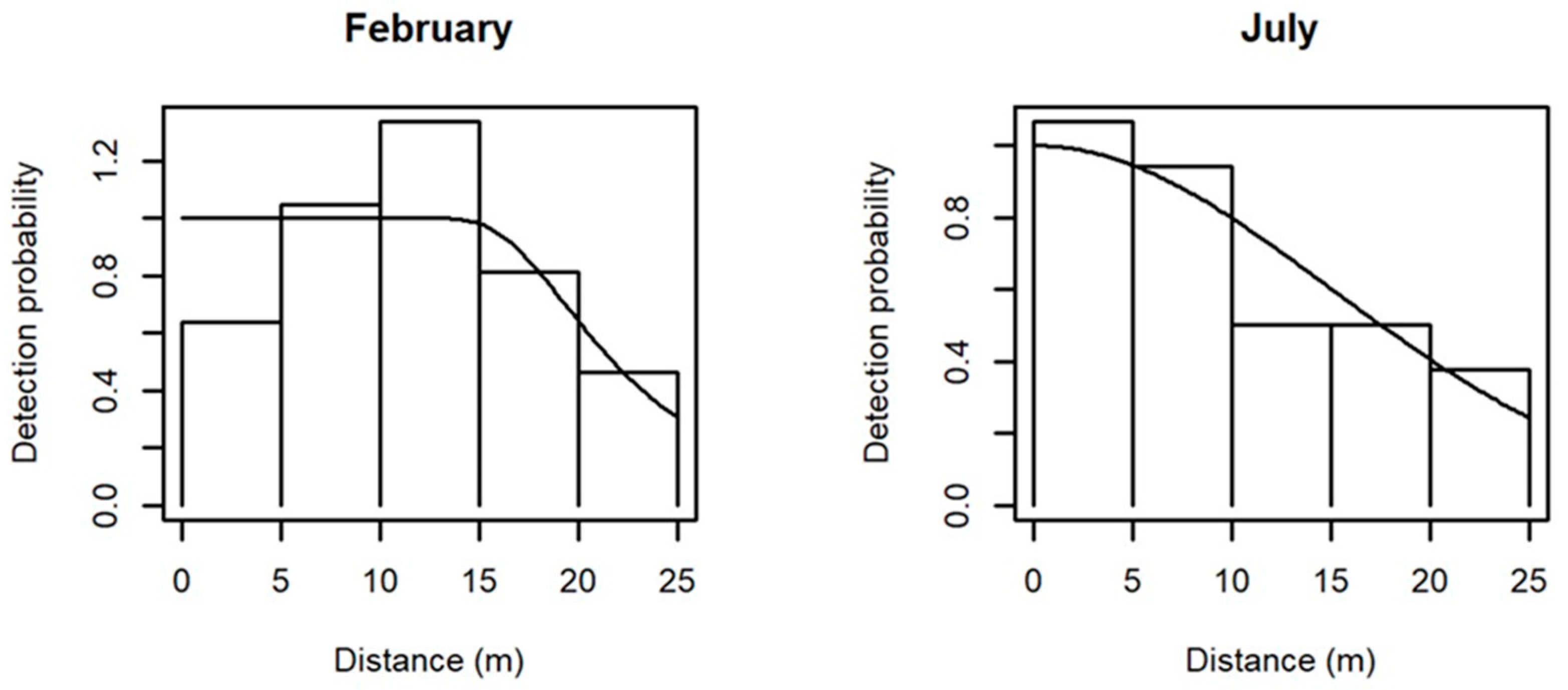
The isotherm thresholds for the winter flight were 10 °C, 15 °C, and 26 °C for the lower, middle, and upper thresholds, respectively; ambient temperature during the study was 10 °C (Table 1). We detected 74 deer: 18, 21, 17, and 18 deer for each set of transects, respectively. The data best fits a hazard rate distribution, generating a detection probability of 0.86 (SE = 0.07; Figure 3). The winter population estimate was 101 deer (95% CI = 83–123).
The isotherm thresholds for the summer survey were 30 °C, 35 °C, and 44 °C for the lower, middle, and upper thresholds, respectively; ambient temperature during the survey was 30 °C. We detected 54 deer: 13, 10, 17, and 14 deer for transects 1–4. The data best fits a half-normal distribution with a detection probability of 0.68 (SE = 0.08; Figure 3). The summer population estimate was 91 (95% CI = 66–116). Both surveys yielded acceptable precision (coefficient of variation [CV] < 20%, Table 1, [23]).
Overall image classification accuracy for vegetation cover on our study site was above 85% for both time periods. The winter classification estimated 48.1% woody cover, 51.2% non-woody cover, and 0.4% water. The summer classification estimated 60.7% woody cover, 39.1% non-woody cover, and 0.2% water.

4. Discussion

We conducted surveys under a distance sampling framework during winter and summer to evaluate the effect of ambient temperature and canopy cover on detectability of white-tailed deer during nocturnal drone surveys. These times represented seasons of relative extremes in temperature and canopy cover for the region. As predicted, detection probability was lower during summer presumably because of the increased canopy cover. Despite the lower detection probability during summer, both population estimates were comparable after correcting for visibility bias, which is most often attributed to reduced detection distances due to vegetation obstruction [25,31]. In addition, both surveys yielded a CV of <20% indicating acceptable precision [25,27]. Detection probabilities from this study were comparable with repeated daytime traditional thermal drone surveys on the same study site (mean = 0.77, [10]), indicating robustness. Traditionally, aerial surveys of large mammals from crewed platforms, such as helicopters, rely on animal movement for detection. This introduces availability bias that is difficult to correct for, resulting in an underestimate of varying and unknown magnitude [31,32] because the proportion of focal animals that do flee and are detected (or vice versa) is variable. The ability to detect animals using drones equipped with thermal sensors eliminates much of the unmodeled variation in detections due to relaxed animal behavior, resulting in more accurate and consistent aerial counts [10]. We did not notice an obvious effect from temperature on detection probabilities probably because we pre-programmed thermal sensors based on current environmental conditions, but one cannot rule out how different temperatures could affect thermoregulation characteristics of focal species [14]. Our use of pre-programmed isotherm settings also had an obvious effect on reducing “noise” from inanimate objects which made it easier to detect focal species during post-processing. The reduction in noise via pre-programmed isotherm settings could also improve accuracy of image recognition programs [4].
An advantage of using distance sampling to analyze transect-based drone surveys is the ease of meeting most of the key assumptions [25]. Two of the key assumptions are that focal species should not move as a response to the platform and perpendicular distance measurements are exact, both of which were met by flying the drone at specifications where focal species do not respond and by using mapping software to accurately measure perpendicular distances, respectively. One other key assumption that we did not quantify was whether all focal species that were on the transect were detected; this would require additional research with larger number of detections. Another advantage of using distance sampling is the ability to examine histograms of perpendicular distances to make inferences regarding availability of focal species [10,25]. By quantifying detection probability via distance sampling, making erroneous inferences is reduced. For instance, if raw counts were used as a metric of deer abundance in our study, then one may assume that population size was lower during the summer flight which was not the case in our closed population.
The use of calibrated isotherm settings allowed for improved thermal contrast and similar detection probabilities compared to repeated daytime surveys and generated consistent population estimates. We were able to discern thermal signatures of deer in 30 °C, which was higher than the reported maximum of ~21 °C degrees using traditional uncalibrated thermal sensors during daytime flights [18]. Ref. [9] reported that ideal thermal contrast declined at >30 °C when surveying for arboreal mammals. The ability to detect thermal signatures during warm ambient temperatures during biologically significant periods (i.e., fawning and antler growth), which occur in summer, should provide the ability to evaluate whether accurate sex and age ratios can be generated [20]. More research will be needed to identify ideal drone flight specifications that generate optimum identification of juveniles and antlered males. The ability to generate sex and age ratios via thermal drone surveys would be an advantage for implementing management plans [33]. While obtaining population estimates during the traditional surveying period (late-autumn to winter) has value, opportunities to generate sex and age ratios would be limited because juveniles would be difficult to classify due to their larger body size [34] and male cervids will have hardened antlers which cannot emit thermal signatures. Summer surveys could target dates when juveniles are likely to be at heel (accompanying the dam, ~16 weeks after birth, [35]), which should allow for direct comparison of body sizes. Shedding of velvet typically starts around mid-August [36]; thus, drone surveys could be conducted prior to that period. While we had the advantage of using a nearby captive deer facility for calibration, surveyors could pre-program thermal sensors by locating focal species prior to the formal survey and making adjustments to enhance detectability while hovering above the focal species [12].

5. Conclusions

Thermal sensors via drones are widely used to monitor wildlife populations. We explored the utility of pre-programmed isotherm settings to extend survey windows into the warmer seasons. Our isotherm-based detection probabilities were comparable with detection probabilities from traditional thermal sensors, followed the expected trend according to changes in vegetation phenology, and generated comparable population size estimates. We recommend that users pre-program sensors according to environmental conditions and evaluate wildlife surveys under a distance sampling framework or a similar approach because it cannot be assumed that visibility bias is consistent across seasons. Finally, we encourage researchers to examine whether thermal contrast is attainable during periods of biological importance rather than focusing on periods when thermal contrast is assumed to be high.

Author Contributions

Conceptualization, L.M., H.L.P.-B., A.M.F., J.B. and R.W.D.; formal analysis, H.L.P.-B., A.M.F., J.B. and R.W.D.; writing—original draft preparation, L.M.; writing—review and editing, all authors, supervision, H.L.P.-B. and A.M.F., funding acquisition, H.L.P.-B. and A.M.F. All authors have read and agreed to the published version of the manuscript.

Funding

This research received no external funding.

Data Availability Statement

The raw data supporting the conclusions of this article will be made available by the authors on request.

Acknowledgments

This is publication #25-118 of Caesar Kleberg Wildlife Research Institute. We thank Zach Pearson for his assistance with programming drones. We thank E. Brookover and A. Singh for reviewing earlier versions of this manuscript.

Conflicts of Interest

Authors declare no conflicts of interest.

References

  1. Leopold, A. Game Management; Charles Scribner’s Sons: New York, NY, USA, 1933. [Google Scholar]
  2. Roberts, C.W.; Pierce, B.L.; Braden, A.W.; Lopez, R.R.; Silvy, N.J.; Frank, P.A.; Ransom, D., Jr. Comparison of camera and road survey estimates for white-tailed deer. J. Wildl. Manag. 2006, 70, 263–267. [Google Scholar] [CrossRef]
  3. Witczuk, J.; Pagacz, S.; Zmarz, A.; Cypel, M. Exploring the feasibility of unmanned aerial vehicles and thermal imaging for ungulate surveys in forests—Preliminary results. Int. J. Remote Sens. 2018, 39, 5504–5521. [Google Scholar] [CrossRef]
  4. Corcoran, E.; Winsen, M.; Sudholz, A.; Hamilton, G. Automated detection of wildlife using drones: Synthesis, opportunities and constraints. Methods Ecol. Evol. 2021, 12, 1103–1114. [Google Scholar] [CrossRef]
  5. McMahon, M.C.; Ditmer, M.A.; Forester, J.D. Comparing unmanned aerial systems with conventional methodology for surveying a wild white-tailed deer population. Wildl. Res. 2021, 49, 54–65. [Google Scholar] [CrossRef]
  6. Rahman, D.A.; Putro, H.R.; Mufawwaz, T.A.; Rinaldi, D.; Yudiarti, Y.; Prabowo, E.D.; Arief, H.; Sihite, J.; Priantara, F.R.N. Developing a new method using thermal drones for population surveys of the world’s rarest great ape species, Pongo tapanuliensis. Glob. Ecol. Conserv. 2025, 58, e03463. [Google Scholar] [CrossRef]
  7. Zabel, F.; Findlay, M.A.; White, P.J.C. Assessment of the accuracy of counting large ungulate species (red deer Cervus elaphus) with UAV-mounted thermal infrared cameras during night flights. Wildl. Biol. 2023, 2023, e01071. [Google Scholar] [CrossRef]
  8. Burke, C.; Rashman, M.; Wich, S.; Symons, A.; Theron, C.; Longmore, S. Optimizing observing strategies for monitoring animals using drone-mounted thermal infrared cameras. Int. J. Remote Sens. 2019, 40, 439–467. [Google Scholar] [CrossRef]
  9. Kays, R.; Sheppard, J.; Mclean, K.; Welch, C.; Paunescu, C.; Wang, V.; Kravit, G.; Crofoot, M. Hot monkey, cold reality: Surveying rainforest canopy mammals using drone-mounted thermal infrared sensors. Int. J. Remote Sens. 2019, 40, 407–419. [Google Scholar] [CrossRef]
  10. Blum, J.; Foley, A.M.; DeYoung, R.W.; Hewitt, D.G.; Baumgardt, J.; Hellickson, M.W.; Perotto-Baldivieso, H.L. Evaluation of drone surveys for ungulates in southwestern rangelands. Wildl. Soc. Bull. 2024, 48, e1515. [Google Scholar] [CrossRef]
  11. Beaver, J.T.; Baldwin, R.W.; Messinger, M.; Newbolt, C.H.; Ditchkoff, S.S.; Silman, M.R. Evaluating the use of drones equipped with thermal sensors as an effective method for estimating wildlife. Wildl. Soc. Bull. 2020, 44, 434–443. [Google Scholar] [CrossRef]
  12. Cukor, J.; Bartoška, J.; Rohla, J.; Sova, J.; Machálek, A. Use of aerial thermography to reduce mortality of roe deer fawns before harvest. PeerJ 2019, 7, e6923. [Google Scholar] [CrossRef]
  13. Hewitt, D.G. Biology and Management of White-Tailed Deer; CRC Press: Boca Raton, FL, USA, 2011; ISBN 13:978-1439806517. [Google Scholar]
  14. Chrétien, L.P.; Théau, J.; Ménard, P. Visible and thermal infrared remote sensing for the detection of white-tailed deer using an unmanned aerial system. Wildl. Soc. Bull. 2016, 40, 181–191. [Google Scholar] [CrossRef]
  15. Preston, T.M.; Wildhaber, M.L.; Green, N.S.; Albers, J.L.; Debenedetto, G.P. Enumerating white-tailed deer using unmanned aerial vehicles. Wildl. Soc. Bull. 2021, 45, 97–108. [Google Scholar] [CrossRef]
  16. Pfeffer, D.G.; Foster, J.A.; Kinsey, J.C. Using unmanned aerial vehicles equipped with thermal cameras to survey a known population of white-tailed deer. J. Fish Wildl. Manag. 2024, 15, 283–288. [Google Scholar] [CrossRef]
  17. Jacobson, H.A.; DeYoung, C.A.; DeYoung, R.W.; Fulbright, T.E.; Hewitt, D.E. Management on Private Property. In Biology and Management of White-Tailed Deer; Hewitt, D.G., Ed.; CRC Press: Boca Raton, FL, USA, 2011; pp. 466–493. ISBN 13:978-1439806517. [Google Scholar]
  18. Camacho, A.M.; Perotto-Baldivieso, H.L.; Tanner, E.P.; Montemayor, A.L.; Gless, W.A.; Exum, J.; Yamashita, T.J.; Foley, A.M.; DeYoung, R.W.; Nelson, S.D. The broad scale impact of climate change on planning aerial wildlife surveys with drone-based thermal cameras. Sci. Rep. 2023, 13, 4455. [Google Scholar] [CrossRef]
  19. McMahon, M.C.; Ditmer, M.A.; Isaac, E.J.; Moore, S.A.; Forester, J.D. Evaluating unmanned aerial systems for the detection and monitoring of moose in northeastern Minnesota. Wildl. Soc. Bull. 2021, 45, 312–324. [Google Scholar] [CrossRef]
  20. Ito, T.Y.; Miyazaki, A.; Koyama, L.A.; Kamada, K.; Nagamatsu, D. Antler detection from the sky: Deer sex ratio monitoring using drone-mounted thermal infrared sensors. Wildl. Biol. 2022, 2022, e01034. [Google Scholar] [CrossRef]
  21. Larsen, H.L.; Moeller-Lassesen, K.; Enevoldsen, E.M.E.; Madsen, S.B.; Obsen, M.T.; Povlsen, P.; Bruhn, D.; Pertoldi, C.; Pagh, S. Drone with mounted thermal infrared cameras for monitoring terrestrial mammals. Drones 2023, 7, 680. [Google Scholar] [CrossRef]
  22. Gaillard, J.M.; Festa-Bianchet, M.; Yoccoz, N.G. Population dynamics of large herbivores: Variable recruitment with constant adult survival. Trends Ecol. Evol. 1998, 13, 58–63. [Google Scholar] [CrossRef]
  23. Bender, L.C. Uses of herd composition and age ratios in ungulate management. Wildl. Soc. Bull. 2006, 34, 1225–1230. [Google Scholar] [CrossRef]
  24. Zenmuse XT 2 User Manual. Available online: https://dl.djicdn.com/downloads/Zenmuse%20XT%202/Zenmuse_XT_2_User_Manual_v1.0_en_.pdf (accessed on 29 October 2025).
  25. Buckland, S.T.; Rexstad, E.A.; Marques, T.A.; Oedekoven, C.S. Distance Sampling: Methods and Applications; Springer: New York, NY, USA, 2015. [Google Scholar]
  26. U.S. Climate Normals Quick Access. Available online: https://www.ncei.noaa.gov/access/us-climate-normals/#dataset=normals-monthly&timeframe=30&station=USC00414810 (accessed on 18 September 2025).
  27. Thomas, L.; Buckland, S.T.; Rexstad, E.A.; Laake, J.L.; Strindberg, S.; Hedley, S.L.; Bishop, J.R.; Marques, T.A.; Burnham, K.P. Distance software: Design and analysis of distance sampling surveys for estimating population size. J. Appl. Ecol. 2010, 47, 5–14. [Google Scholar] [CrossRef]
  28. Singh, N.K.; Goolsby, J.A.; Ortega-S, A., Jr.; Hewitt, D.G.; Campbell, T.A.; de Leon, A.P. Comparative daily activity patterns of nilgai, Boselaphus tragocamelus and white-tailed deer, Odocoileus virginianus in South Texas. Agric. Environ. 2017, 68, 7–12. [Google Scholar]
  29. The Rut in White-Tailed Deer. Available online: https://tpwd.texas.gov/huntwild/hunt/planning/rut_whitetailed_deer/#E11E8 (accessed on 3 September 2025).
  30. Mata, J.M.; Perotto-Baldivieso, H.L.; Hernandez, F.; Grahmann, E.D.; Rideout-Hanzak, S.; Edwards, J.T.; Page, M.T.; Shedd, T.M. Quantifying the spatial and temporal distribution of tanglehead (Heteropogon contortus) on South Texas rangelands. Ecol. Process. 2018, 7, 2. [Google Scholar] [CrossRef]
  31. Peterson, M.K.; Foley, A.M.; Tri, A.N.; Hewitt, D.G.; DeYoung, R.W.; DeYoung, C.A.; Campbell, T.A. Mark-recapture distance sampling for aerial surveys of ungulates on rangelands. Wildl. Soc. Bull. 2020, 44, 713–723. [Google Scholar] [CrossRef]
  32. Zabransky, C.J.; Hewitt, D.G.; DeYoung, R.W.; Gray, S.S.; Richardson, C.; Litt, A.R.; DeYoung, C.A. A detection probability model for aerial surveys of mule deer. J. Wildl. Manag. 2016, 80, 1379–1389. [Google Scholar] [CrossRef]
  33. Finnegan, S.P.; Hinojo, A.; Monod, S.; Wall, W.A.; Olsen, P.; Allen, M.L. A comparison of thermal drones and camera trap population estimates for Sitka black-tailed deer in Alaska. Wildl. Biol. 2024, 2024, e01360. [Google Scholar] [CrossRef]
  34. Inman, V.L.; Kingsford, R.T.; Chase, M.J.; Leggett, K.E. Drone-based effective counting and ageing of hippopotamus (Hippopotamus amphibius) in the Okavango Delta in Botswana. PLoS ONE 2019, 14, e0219652. [Google Scholar] [CrossRef]
  35. Schwede, G.; Hendrichs, H.; Wemmer, C. Early mother-young relations in white-tailed deer. J. Mammal. 1994, 75, 438–445. [Google Scholar] [CrossRef]
  36. Wilson, B.B.; Dietrich, L.D.; Peterson, B.C. Phenology of antler velvet shedding in white-tailed deer (Odocoileus virginianus) from central Nebraska. West. N. Am. Nat. 2023, 83, 435–444. [Google Scholar] [CrossRef]
Figure 1. Example images using RGB, traditional thermal technology, and isothermal technology from our study site in South Texas. Panel (A,B) were from a morning survey on 1 February 2020 with RGB and traditional thermal technology, respectively. Panels (C,D) were obtained with isothermal technology during February and July 2022 nocturnal surveys, respectively. White-tailed deer are pointed out with arrows, except in the RGB image. The use of pre-programmed isotherm thresholds can reduce “noise” in thermal imagery and improve detection of focal species.
Drones 10 00127 g001aDrones 10 00127 g001b
Figure 2. Study site for white-tailed deer drone surveys was the 102 ha South Pasture Research Facility owned by Texas A&M University-Kingsville in Kleberg County (solid red polygon), Texas, USA. Four sets of non-overlapping transects, each representing 25% coverage, were flown during February (winter) and July (summer) of 2022, conditions with maximal contrast in vegetation obstruction and ambient temperature. Panels (AD) indicate transect sets 1–4, respectively.
Drones 10 00127 g002
Figure 3. Detection probabilities for white-tailed deer from a night-time thermal drone survey conducted on the 102 ha South Pasture Research Facility in Kleberg County, TX, USA during 19 February 2022 and 23 July 2022. The y-axes are not scaled equally.
Drones 10 00127 g003
Table 1. Details of drone surveys conducted for white-tailed deer during 2022 in South Texas, USA. Isotherm thresholds indicate temperature ranges for the thermal sensor to highlight. P indicates probability of detection, N indicates estimated population size, CV indicates coefficient of variation in the population estimate. Each survey began 1–2 h after sunset and was completed in about 1 h.
MonthAmbient Temp (°C)Isotherm Thresholds (°C)N Deer DetectedP (SE)N (95% CI)CV
February1010, 15, 26740.86 (0.07)101 (83–123) 10
July3030, 35, 44540.68 (0.08) 91 (66–116) 16
Disclaimer/Publisher’s Note: The statements, opinions and data contained in all publications are solely those of the individual author(s) and contributor(s) and not of MDPI and/or the editor(s). MDPI and/or the editor(s) disclaim responsibility for any injury to people or property resulting from any ideas, methods, instructions or products referred to in the content.