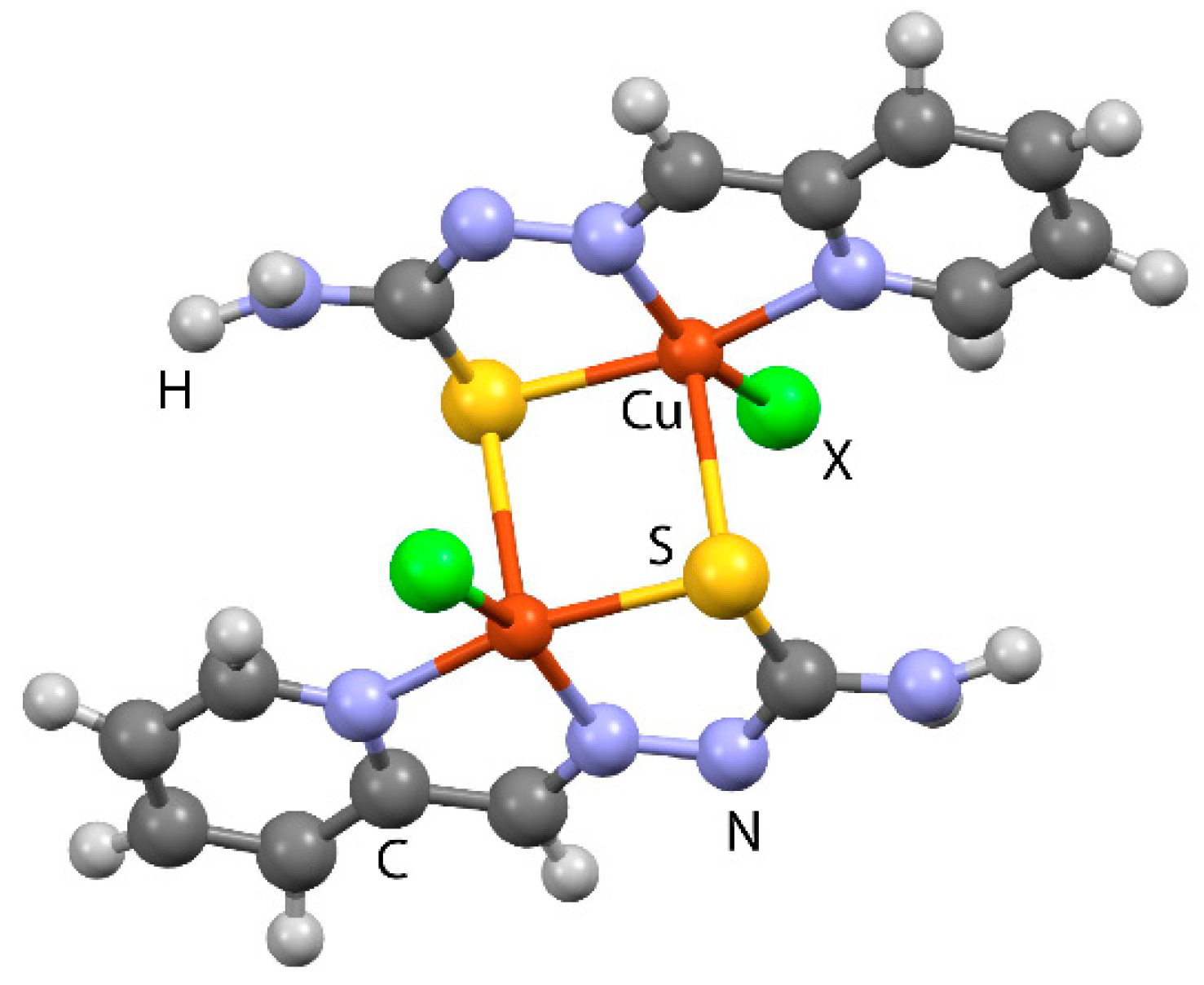
Magnetic Ordering of Three Thiosemicarbazonecopper(II) Complexes †


References
- García-Tojal, J.; Gil-García, R.; Gómez-Saiz, P.; Ugalde, M. Pyridine-2-Carbaldehyde Thiosemicarbazonecopper System: Extending Some Findings to Other Thiosemicarbazone and Coordination Compounds. Curr. Inorg. Chem. 2011, 1, 189–201. [Google Scholar] [CrossRef]
- Lobana, T.S.; Sharma, R.; Bawa, G.; Khanna, S. Bonding and Structure Trends of Thiosemicarbazone Derivatives of Metals—An Overview. Coord. Chem. Rev. 2009, 253, 977–1055. [Google Scholar] [CrossRef]
- Gómez-Saiz, P.; García-Tojal, J.; Maestro, M.A.; Mahía, J.; Arnaiz, F.J.; Lezama, L.; Rojo, T. New 1,3,4-Oxadiazolecopper(II) Derivatives Obtained from Thiosemicarbazone Complexes. Eur. J. Inorg. Chem. 2003, 2003, 2639–2650. [Google Scholar] [CrossRef]
- García-Tojal, J.; Urtiaga, M.K.; Cortes, R.; Lezama, L.; Arriortua, M.I.; Rojo, T. Synthesis, structure, spectroscopic and magnetic properties of two copper(II) dimers containing pyridine-2-carbaldehyde thiosemicarbazonate (L), [{CuL(X)}2](X = Cl or Br). J. Chem. Soc. Dalton Trans. 1994, 2233–2238. [Google Scholar] [CrossRef]


© 2019 by the authors. Licensee MDPI, Basel, Switzerland. This article is an open access article distributed under the terms and conditions of the Creative Commons Attribution (CC BY) license (http://creativecommons.org/licenses/by/4.0/).
Share and Cite
Etxebarria, I.; Torres, M.B.; García-Tojal, J.; Cuevas, J.V.; Madariaga, G. Magnetic Ordering of Three Thiosemicarbazonecopper(II) Complexes. Proceedings 2019, 26, 53. https://doi.org/10.3390/proceedings2019026053
Etxebarria I, Torres MB, García-Tojal J, Cuevas JV, Madariaga G. Magnetic Ordering of Three Thiosemicarbazonecopper(II) Complexes. Proceedings. 2019; 26(1):53. https://doi.org/10.3390/proceedings2019026053
Chicago/Turabian StyleEtxebarria, Iñigo, M. Begoña Torres, Javier García-Tojal, José Vicente Cuevas, and Gotzon Madariaga. 2019. "Magnetic Ordering of Three Thiosemicarbazonecopper(II) Complexes" Proceedings 26, no. 1: 53. https://doi.org/10.3390/proceedings2019026053
APA StyleEtxebarria, I., Torres, M. B., García-Tojal, J., Cuevas, J. V., & Madariaga, G. (2019). Magnetic Ordering of Three Thiosemicarbazonecopper(II) Complexes. Proceedings, 26(1), 53. https://doi.org/10.3390/proceedings2019026053