Skip to Content
ProceedingsProceedings
  • Proceeding Paper
  • Open Access

4 December 2018

Comparative Studies of Chemoresistive Gas Sensors Based on Multiple Randomly Connected Wires and Arrays of Single-Wires †

,
,
,
,
,
and
1
Brno University of Technology, Department of Microelectronics, Technická 3058/10, 61600 Brno, Czech Republic
2
CEITEC—Central European Institute of Technology, Brno University of Technology, Purkyňova 123, 62100 Brno, Czech Republic
3
MIND-Dept. of Electronics and Biomedical Engineering, Universitat de Barcelona (UB), Martí i Franquès 1, 08028 Barcelona, Spain
4
Institute of Nanoscience and Nanotechnology (IN2UB), Universitat de Barcelona (UB), Diagonal 645, 08028 Barcelona, Spain
This article belongs to the Proceedings EUROSENSORS 2018

Abstract

Chemoresitive gas sensors based on multiple nanowires (M-NWs) randomly grown and electrically inter-connected on the top of interdigitated electrodes (IDEs) and arrays of single nanowires connected between faced nanoelectrodes (A-S-NWs) are developed in this work. These systems, consisting of gas sensitive tungsten oxide nanowires (NWs), are tested to NO2, and their performance regarding the response magnitude, sensitivity and response rate are evaluated here.

1. Introduction

Recent research on gas sensitive NWs demonstrated that these systems provide better detection efficiency and improved performance compared to bulk materials such as thin-films. These better properties in NW-based gas sensors are attributed to the lack of grain boundaries and thus more efficient transfer of charge with a lower probability of recombination. Currently, however, gas sensor devices based on NWs still depend on the wire to wire interfaces, due to the relatively simple technological steps to fabricate multiple (M-) NWs based gas sensors instead of single (S-) NWs. Also, because M-NWs usually provide higher magnitudes of response and broader exposed surface area that allow for a large number of gas molecules to impinge the surface, in turn, amplifying the electrical output signal, as opposed to S-NW systems [1].
Previously, we have developed a method to fabricate gas microsensors based on directly integrated M-NW films via Aerosol Assisted Chemical Vapor Deposition (AACVD). These sensors demonstrated improved gas sensing properties compared to sensors based on polycrystalline films [2]. Also, recently, we have advanced on the fabrication of arrays (A-) of S-NWs sensors with the aim to combine the efficiency of S-NWs and simultaneously enlarge the exposed surface area by integrating several S-NWs connected between faced nanoelectrodes arranged in parallel [3]. Thus, here we compare and evaluate the performance of sensors based on multiple and arrays of single tungsten oxide NWs towards nitrogen dioxide (NO2).

2. Materials and Methods

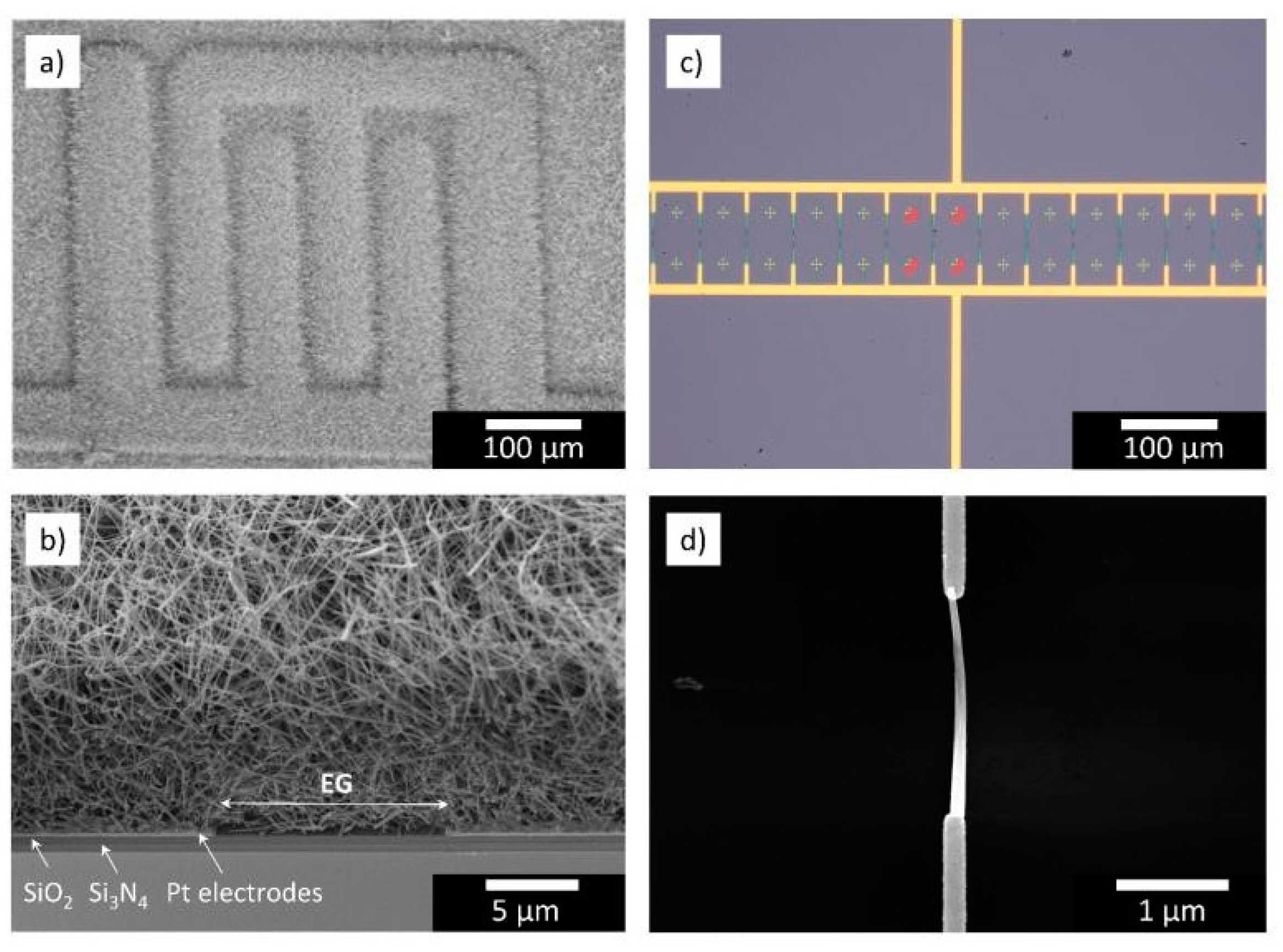
Gas sensors based on M-NW and A-S-NW were fabricated following the same procedure described before. [2,3] Each system was mounted on a TO-8 package and contains a heating element isolated from the electrodes (either IDEs for the M-NW sensors or faced nanoelectrodes for the A-SNW sensors), see Figure 1. The integration of the gas sensitive NWs onto the IDEs was performed directly in vapor-phase via AACVD, whereas the integration of the single NWs previously grown via AACVD was performed using dielectrophoresis technique (i.e., applying an electrical potential between the nanoelectrodes during the re-deposition of NWs via drop coating).
Figure 1. Top-view (a) and cross-sectional SEM images (b) of the M-NWs deposited on interdigitated electrodes. Top-view of the A-S-NWs (c) and SEM image of a S-NW connected between a pair of faced nanoelectrodes (d).
The surface examination was performed using scanning electron microscopy (SEM; Tescan FE Mira II LMU and Carl Zeiss, Auriga Series) equipped with EDX, and optical microscopy (Carl Zeiss Microscopy GmbH, Jenavert). Further material analysis of the NWs were carried out using scanning transmission electron microscopy (STEM; FEI Tecnai F20, 200 kV), and XPS (XPS; Phoibos 150 analyzer SPECS GmbH, Berlin, Germany in ultrahigh vacuum conditions (base pressure 1 × 10⁻¹⁰ mbar) and a monochromatic Kα X-ray source, 1486.74 eV).
Both types of sensors (i.e., based on M-NWs and A-S-NWs) were exposed towards various concentration of nitrogen dioxide (NO2) diluted in dry synthetic air using the continuous flow tests system described previously [3]. The total flow was adjusted to 200 sccm, and the sensors were exposed to the measured analyte for 10 min. Subsequently, the test chamber was purged with synthetic air until the initial baseline was recovered. The sensor response was defined as (ΔR/Rair), i.e., (Rgas-Rair/Rair) where Rair is the sensor resistance in air at the stationary state and Rgas the sensor resistance after ten minutes of gas exposure.

3. Results and Discussion

Figure 1 displays the two type of sensors tested in this work and the configuration of the interconnected wires. One can observe in Figure 1a, the M-NWs deposited uniformly on the IDEs forming a mat-like network of non-aligned tungsten oxide NWs interconnected across the IDEs. In contrast, Figure 1c shows the A-S-NWs formed by multiple parallel-connected S-NW sensors. Further, in Figure 1b is displayed the cross-section of the M-NW sensors and the NW to NW contacts, which are responsible for the electrical interconnection between IDEs, whereas in Figure 1d it can be observed how the S-NW are interconnected across the nanoelectrodes in the array.
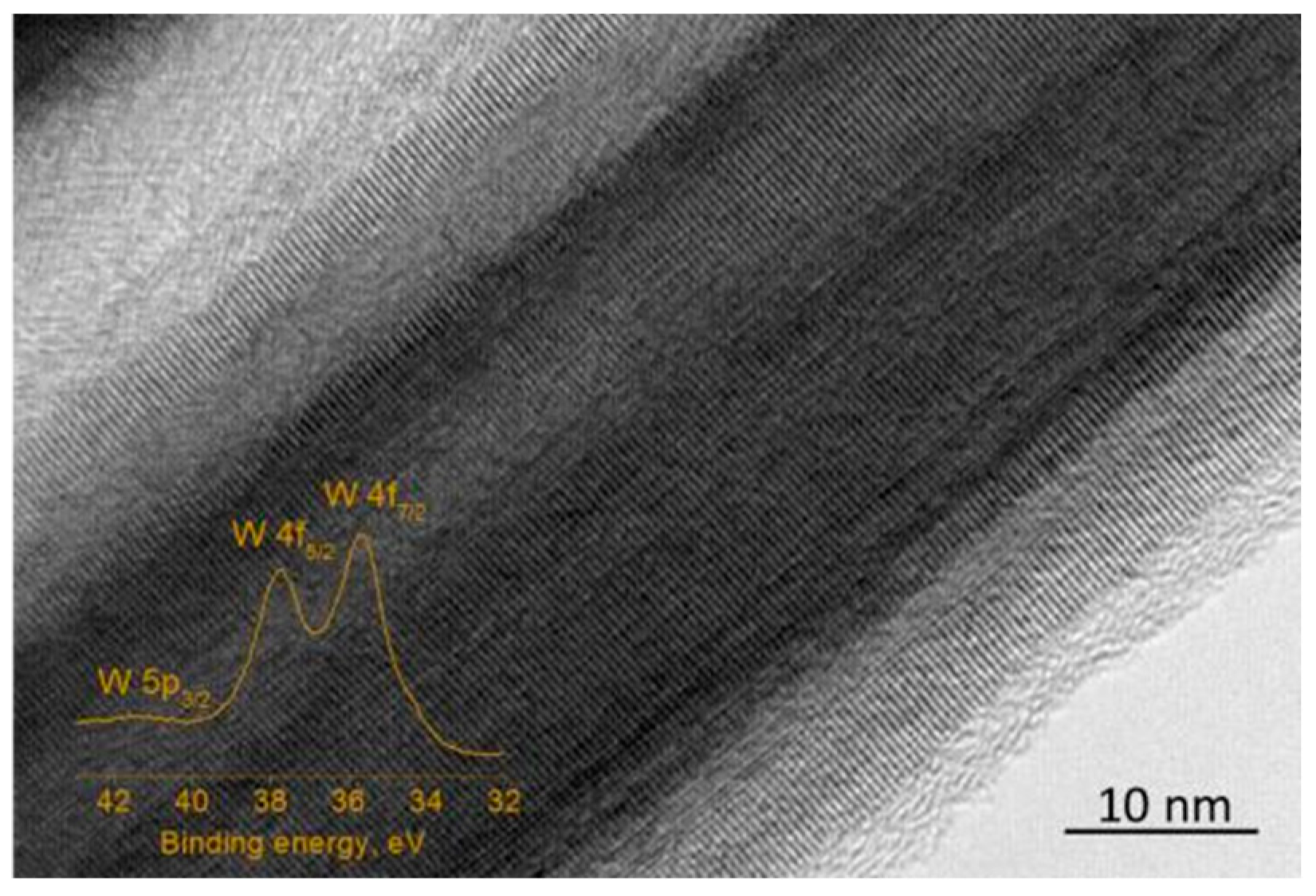
HRTEM analysis of the tungsten oxide NW employed in this work (Figure 2) revealed that the NWs are highly crystalline with a marked planar spacing of 3.6 Å along the NW, consistent with the unit cell of the monoclinic phase WO3 (ICCD card no. 72-0677) identified in our previous works [2,3]. The typical W4f core level XPS spectrum recorded on the tungsten oxide NWs is also shown in Figure 2 (inset).
Figure 2. HRTEM imaging of a single tungsten oxide NW. The inset displays the W 4f XPS core level spectrum recorded for the tungsten oxide wires.
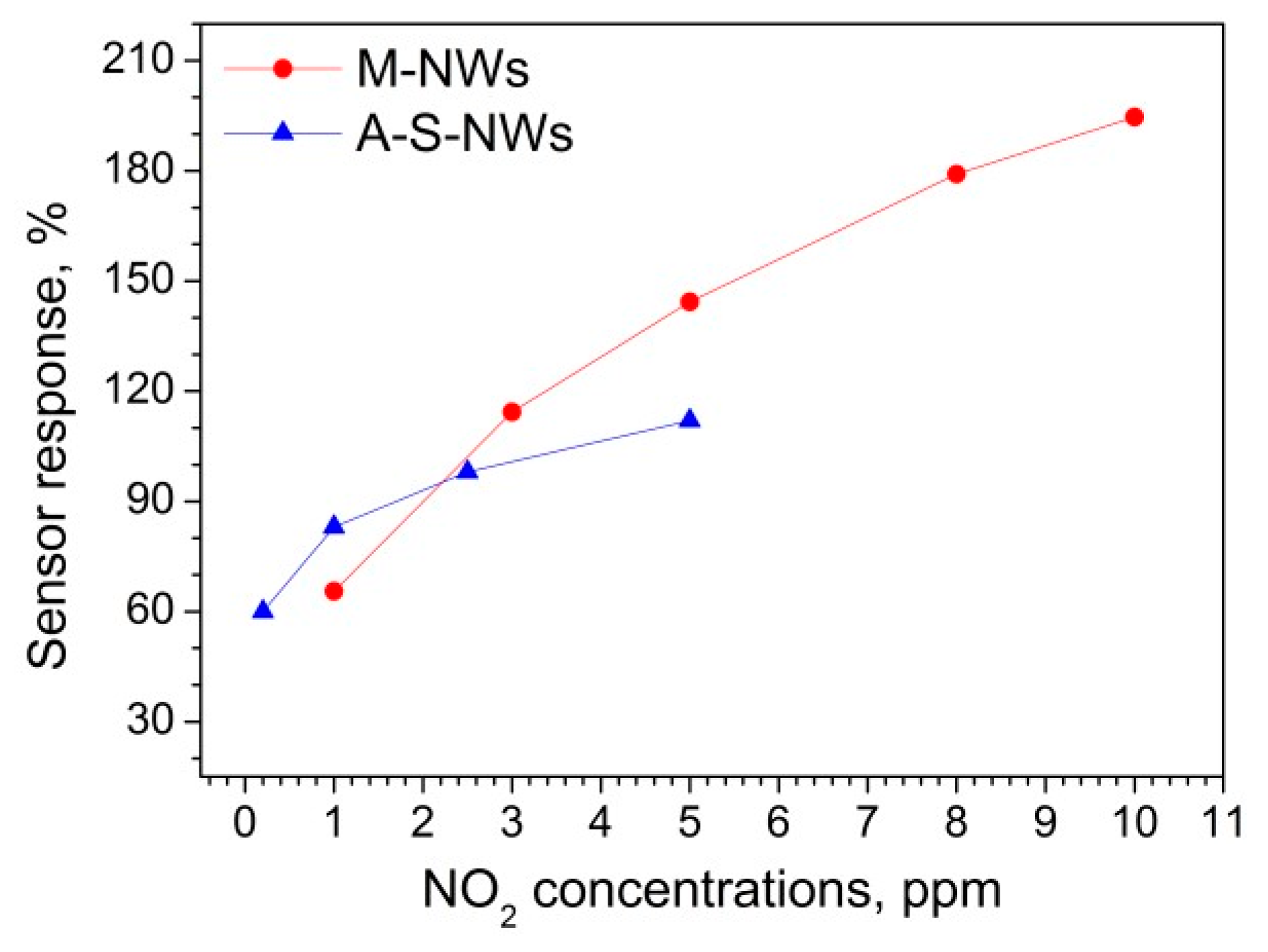
Gas sensing measurements for both types of sensors were carried out at 250 °C towards various concentrations of NO2 (from 1 to 10 ppm for the M-NW sensors and from 0.2 to 5 ppm for the A-SNWs). Figure 3 shows the concentration dependence of the sensor response recorded for the M-NW and A-S-NW sensors. Results show that the M-NW sensors respond with higher magnitudes for NO2 concentrations above 3 ppm, whereas responses for the A-S-NW are higher for NO2 concentrations below 2.5 ppm.
Figure 3. Sensor response for the M-NW and A-S-NW sensors to various concentrations of NO2 diluted in the dry synthetic air at 250 °C.
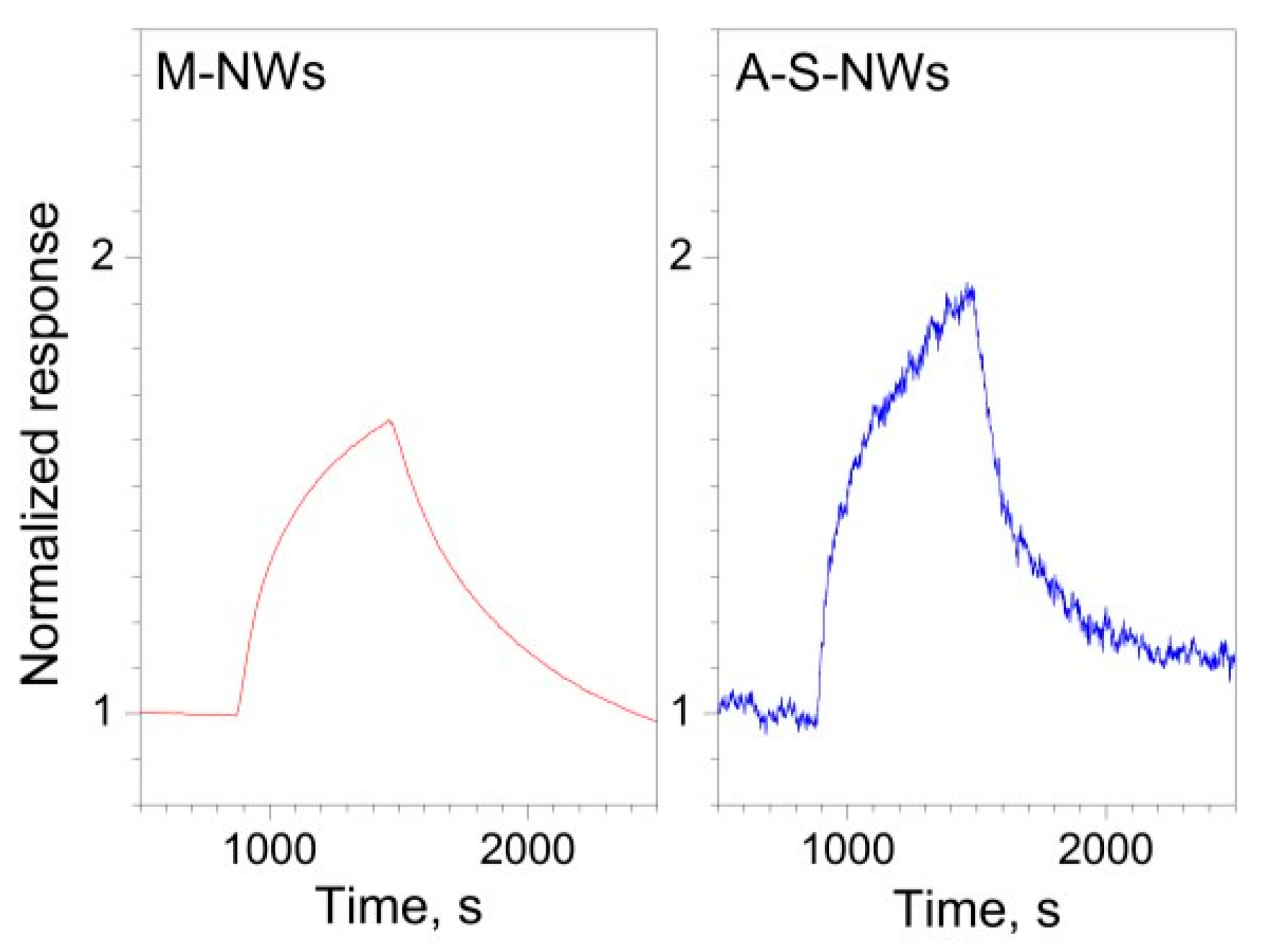
On the other hand, the sensitivity, defined as the prefactor of the power law that describes the calibration curves of both systems (Table 1), is higher for the A-S-NW sensors (1.84) compared to the M-NW sensors (1.63). Also, the response and recovery times of the A-S-NW (i.e., response rate) is faster compared to the M-NW sensors. The typical normalized response to 1 ppm concentration registered for each sensor is displayed in Figure 4. During the gas exposition cycle, both sensors exhibited similar behavior of the response, thus increasing its electrical resistance during NO2 exposure, as observed previously for tungsten oxide when exposed to NO2.
Table 1. Comparative table of the sensing parameters of the M-NW-based sensors and the A-S-NWs to NO2.
Figure 4. Normalized sensor response to 1 ppm of NO2 for the M-NWs and the A-S-NWs.

4. Conclusions

Two chemoresistive gas sensors based on multiple tungsten oxide NWs or arrays of single NWs were compared in this work. This comparative study showed that both the sensors based on IDEs with randomly distributed M-NWs and the array of faced nanoelectrodes with S-NW have suitable responses to nitrogen dioxide. However, the sensitivity for the A-S-NW sensors was higher as compared to the M-NW sensors, with higher response magnitudes and faster response rates for NO2 concentrations below 2.5 ppm.

Author Contributions

All authors conceived and designed the experiments; O.C., J.S., I.G., and S.V. fabricated the sensor device and/or analyzed the gas sensitive material. O.C., G.D.-G., A.R.-R., J.H., S.V. perform and/or analyzed the gas sensing test; O.C. and S.V. wrote the paper.

Acknowledgments

This work has been supported by the Czech Science Foundation (GAČR) via Grant no. 17-16531S. We acknowledge the support of the National Sustainability Program under grant LO1401 and the access to the infrastructures of CEITEC Nano Research (ID LM2015041, MEYS CR, 2016–2019) and SIX Research Centre. The support of the Spanish Ministry of Economy and Competitiveness via the Ramón y Cajal programme and projects TEC2015-74329-JIN (AEI/FEDER, EU) and TEC2016-79898-C6-1-R (AEI/FEDER, EU) are also acknowledged.

Conflicts of Interest

The authors declare no conflict of interest.

References

  1. Brunet, E.; Maier, T.; Mutinati, G.C.; Steinhauer, S.; Köck, A.; Gspan, C.; Grogger, W. Comparison of the gas sensing performance of SnO2 thin film and SnO2 nanowire sensors. Sens. Actuators B 2012, 165, 110118. [Google Scholar] [CrossRef]
  2. Vallejos, S.; Grácia, I.; Chmela, O.; Figueras, E.; Hubálek, J.; Cané, C. Chemoresistive micromachined gas sensors based on functionalized metal oxide nanowires: Performance and reliability. Sens. Actuators B 2016, 235, 525–534. [Google Scholar] [CrossRef]
  3. Chmela, O.; Sadilek, J.; Domenech-Gil, G.; Sama, J.; Somer, J.; Mohan, R.; Romano-Rodriguez, A.; Hubalek, J.; Vallejos, S. Selectively arranged single-wire based nanosensor array systems for gas monitoring. Nanoscale 2018, 10, 9087–9096. [Google Scholar] [CrossRef] [PubMed]
Publisher’s Note: MDPI stays neutral with regard to jurisdictional claims in published maps and institutional affiliations.

Article Metrics

Citations

Article Access Statistics

Multiple requests from the same IP address are counted as one view.