1. Introduction
The optimal type of a spillway is one of the most complex issues in water management including fuzziness due to the existence of qualitative criteria and the uncertainty in evaluating them. Every spillway presents some advantages and disadvantages, technical, financial, environmental etc. which set a group of constraints. Therefore a comparative evaluation is needed to reach a scientific and sufficiently justified solution.
Multiple criteria decision-making (MCDM) is considered as a sophisticated decision-making tool involving both quantitative and qualitative factors. In recent years, several MCDM techniques and approaches have been suggested in order to choose the probable optimal options. An extension to the fuzzy multiple criteria decision making (MCDM) model is suggested in this work, where the ratings of alternatives versus criteria, and the importance weights of all criteria, are assessed in linguistic values represented by fuzzy numbers.
Specifically, an extension of the TOPSIS method in a fuzzy environment is adopted. Many researchers have developed the model of similarity to ideal solution to the fuzzy environment and have utilized it in various fields. Chen [
1] expanded the TOPSIS method for decision-making problems to the fuzzy environment. According to this theory, the attributes are expressed in TFNs (Triangular Fuzzy Numbers), the normalization method is linear and vertex method is proposed for the calculation of the distance measurements for the final ranking. In parallel, a second normalization technique is utilized from the article of Jahanshahloo et al. [
2].
This paper is one of the first applications of the fuzzy TOPSIS method in solving water management or hydraulic problems.
2. Methods
2.1. TOPSIS (Technique for Order Preference by Similarity to Ideal Solution)
The TOPSIS method was first developed in 1981 by Yoon and Hwang [
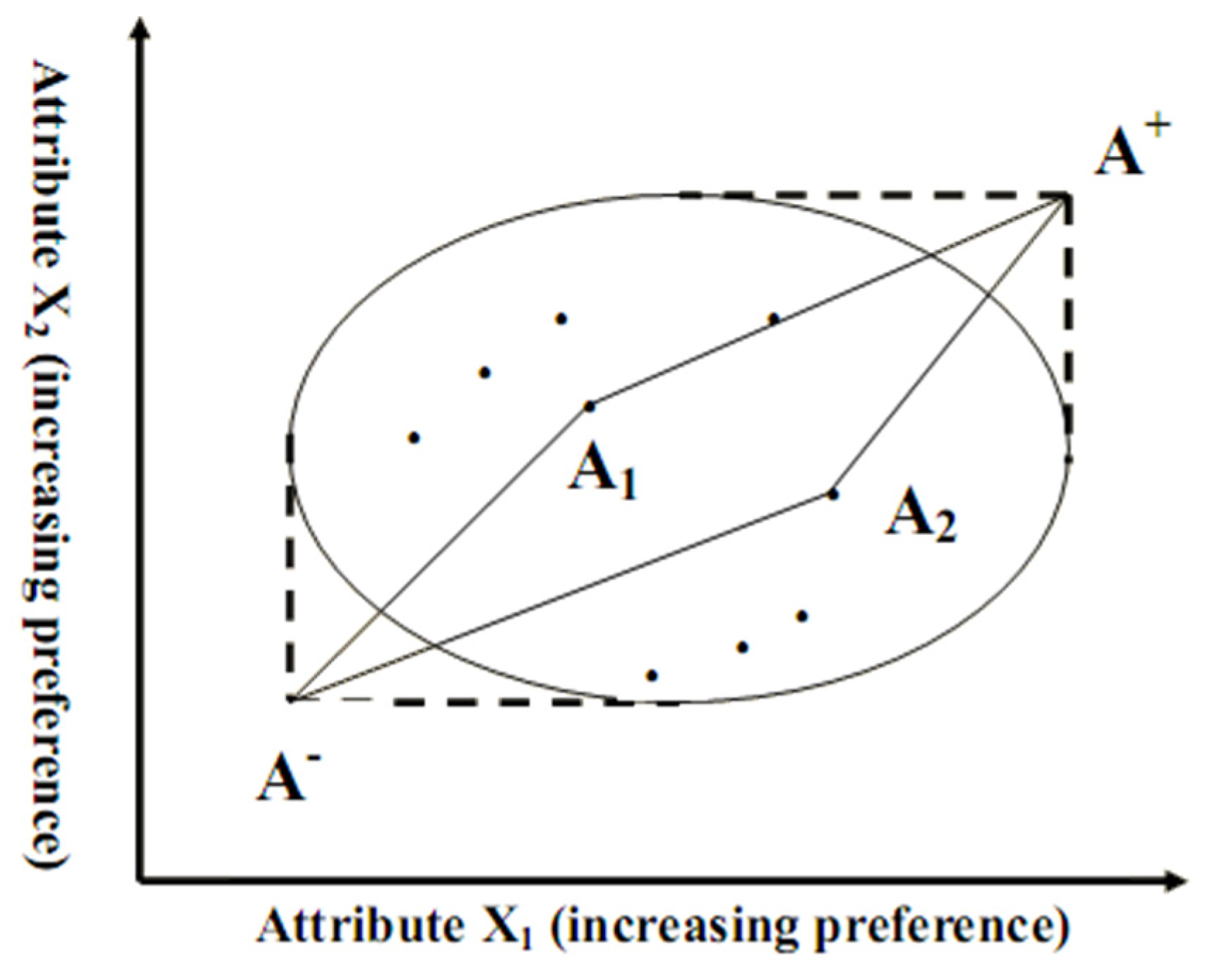
3]. Its basic concept is that the chosen alternative should have the shortest distance from the ideal solution and the farthest from the negative-ideal solution (
Figure 1) [
3,
4].
According to Chen’s approach [
1], the procedure of fuzzy TOPSIS is similar to the classic one and can be expressed in a series of steps:
In the fuzzy environment, in order to avoid the complicated normalization formula used in classical TOPSIS, simpler formulas are used to transform the various criteria scales into a comparable scale.
The linear scale transformation [
1] is:
Jahanshahloo et al. formula [
2] is:
where
are the elements of the decision matrix.
- 2.
Construct the weighted normalized decision matrix.
- 3.
Determine the fuzzy ideal and fuzzy negative-ideal solutions.
where
= (1,1,1) and
= (0,0,0), j = 1, 2, … m.
- 4.
Calculate the separation measure:
where
and
are distance measurements calculated with the vertex method:
- 5.
Calculate the relative closeness to the Ideal Solution.
= 1 if Ai = A+
= 0 if Ai = A−
- 6.
Rank the preference order.
A set of alternatives can now be preference ranked according to the descending order of
[
3,
4].
The method presupposes that [
3,
4]:
Each criterion in the decision matrix takes either monotonically increasing or monotonically decreasing utility.
A decision matrix of n alternatives and m criteria and a set of weights for the criteria are required.
Any outcome which is expressed in a non-numerical way should be quantified through the appropriate scaling technique.
2.2. AHP (Analytic Hierarchy Process)
The analytic hierarchy process (AHP) [
5] is based on decomposing a complex MCDM problem into a system of hierarchies. There is a fundamental 1–9 scale of absolute numbers shown in
Table 1, in order to design the hierarchy.
When we use judgment to estimate dominance in making comparisons, and in particular when the criterion of the comparisons is intangible, instead of using two numbers w
i and w
j from a scale (rather than interpreting the significance of their ratio w
i/w
j) we assign a single number drawn from the fundamental 1–9 scale of absolute numbers shown in
Table 1 to represent the ratio (w
i/w
j)/1. It is the nearest integer approximation to the ratio w
i/w
j. The derived scale will reveal what the w
i and w
j are. This is a central fact about the relative measurement approach and the need for a fundamental scale.
2.3. Linguistic Variables
The extension of the TOPSIS method in the fuzzy environment can be achieved by expressing the weights of the criteria and the ratings as linguistic variables. A linguistic variable is a variable whose values are linguistic terms. The concept of linguistic variable is very useful in dealing with situations which are too complex or too ill-defined to be reasonably described in conventional quantitative expressions [
6]. According to Chen, the linguistic variables can be expressed in positive triangular fuzzy numbers as shown in
Table 2 and
Table 3 [
1].
3. Illustrative application
3.1. General Information
The dam which was chosen for this application is “Pigi Dam” on the “Kotza-Dere” river and it is located in the north of Greece. The dam is considered as a large dam and was constructed in 1999. It is a rockfill dam constructed for irrigation. There are five alternative types of the spillway, based on their technical efficiency for the dam which was selected; (a) X1 = ogee or overfall spillway, (b) X2 = shaft or morning glory spillway, (c) X3 = side channel spillway, (d) X4 = siphon spillway and (e) X5 = gated spillway.
3.2. Criteria
The main criteria were determined using extensive library studies and experts’ opinion. The institutes that were found to give special recommendations for the selection of the type of the spillway are the Indian Standards Institute [
7] and U.S. Bureau of Reclamation [
8]. Finally, nine criteria have been chosen: (a) C
1 = construction costs, (b) C
2 = maintenance costs, (c) C
3 = foundation, (d) C
4 = reservoir capacity, (e) C
5 = static/construction difficulty, (f) C
6 = discharge capacity, (g) C
7 = physical space, (h) C
8 = conveyance feature (costs and construction difficulty) and (i) C
9 = aesthetic.
Firstly, the decision maker constructs the pair-wise comparison matrix of the criteria (
Table 4). Since the consistency ratio (C.R.) is less than 0.1 or close, the judgments are acceptable. Finally, in order to calculate the weights of the criteria, according to Saaty, the eigenvector is calculated (
Table 5). In
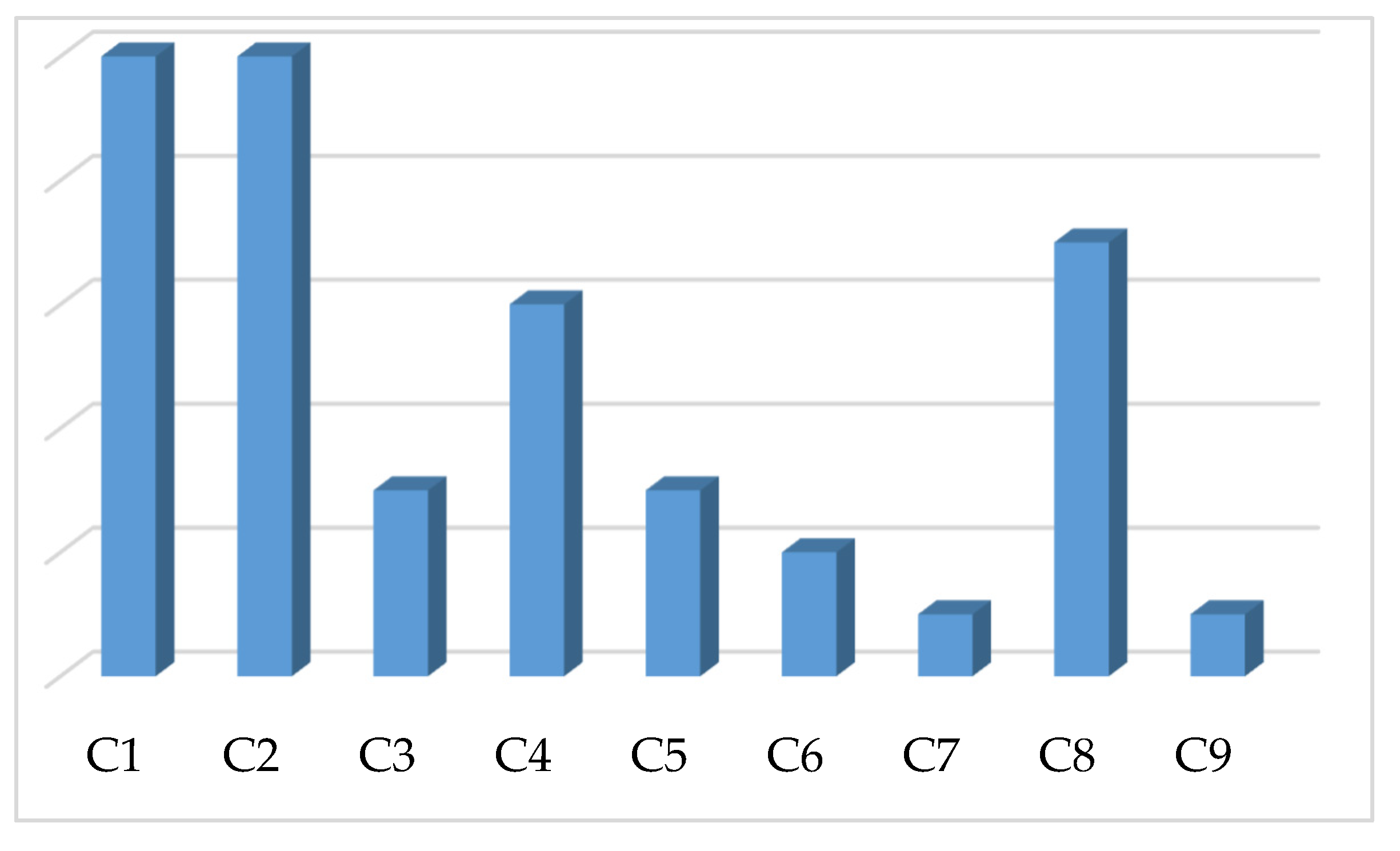
Figure 2 the column chart, whose values derive from
Table 5, shows the weights’ comparison across the criteria.
Subsequently, fuzziness is introduced to the process so as to confront the uncertainties of judgments or calculations of the previous step. The decision maker in
Table 6 reconstructs
Table 5 using linguistic variables and corresponds them to the TFNs proposed by Chen in
Table 2 and
Table 3.
3.3. Decision Matrix
Initially, the alternatives are compared with pair-wise comparisons for each criterion. The eigenvectors, which are calculated for each criterion, form the columns of the decision matrix (
Table 7). The process of determining the decision matrix expressed in linguistic terms (
Table 8) and the fuzzy decision matrix (
Table 9) is similar to determining the matrix of fuzzy weights, described above.
3.4. Results
The optimal type of spillway is obtained by completing the TOPSIS’ calculations (Equations (1)–(9)). For the calculations needed, two programs were utilized in Visual Fortran [
9]. The ranking with the two normalization approaches are:
The linear scale transformation [
1]:
X1(0.313) > X5(0.261) > X3(0.246) > X2(0.243) > X4(0.224)
X1 = ogee spillway > X5 = gated spillway > X3 = side channel spillway > X2 = shaft spillway > X4 = siphon spillway
Jahanshahloo et al. formula [
2]:
X1(0.171) > X2(0.139) > X5(0.137) > X3(0.130) > X4(0.111)
X1 = ogee spillway > X2 = shaft spillway > X5 = gated spillway > X3 = side channel spillway > X4 = siphon spillway.
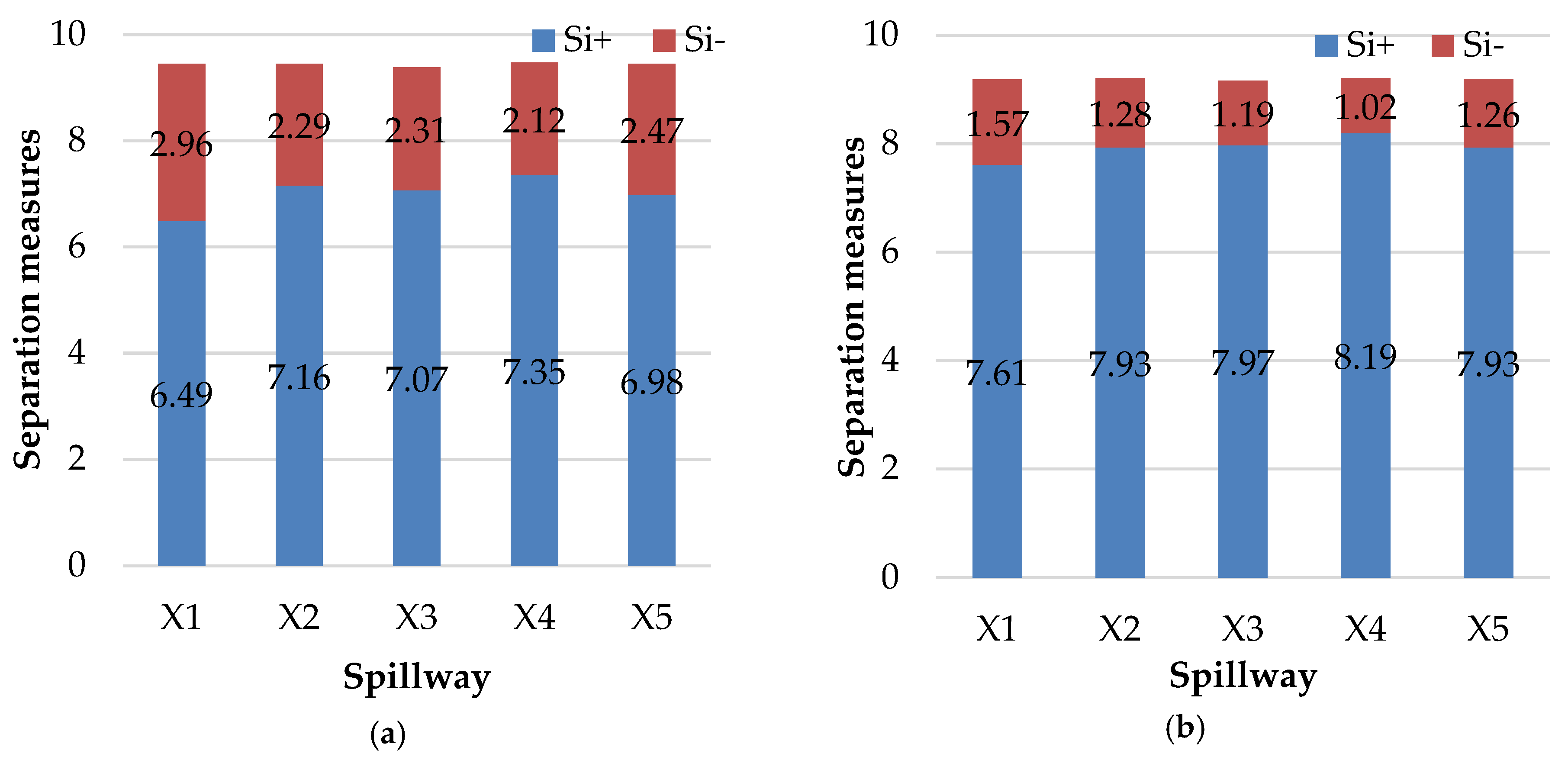
In
Figure 3, the charts present the results of calculating the separation measures, S
i+ and S
i− (Equations (6) and (7)) with each of the two approaches.
4. Discussion and Conclusions
This paper presents the first application of the combination of the proposed MCDM methods with fuzzy logic to solve the problem of selecting the optimal type of a spillway.
Although a spillway is a significant structure, little guidelines can be found for this selection. As a result, in most cases, the selection derives from a techno-economic feasibility and analysis. Our investigation proves that the result should take into consideration more parameters than technical feasibility and low construction costs. X
2 (shaft or morning glory spillway) spillway has the highest evaluation for C
1 (construction costs) criterion (
Table 8), which means that it is the most cost-efficient alternative. Nevertheless, in the presented approaches, X
2 would be the fourth or the second choice out of the five depending on the normalization technique.
Although the two approaches do not lead to the same ranking, the optimal choice is Χ1, the ogee spillway and the worst is X4, the siphon spillway. The difference in ranking could be justified as the values of the relative closeness for the alternatives Χ2, X3 and X5 are very close to the second approach and no clear order could be obtained.
It is also notable that the separation measures, ideal and negative-ideal separations, have the same ranking as the final one of the relative closeness.
Finally, it is suggested that engineering problems involving decision making be dealt with MCDM methods and fuzzy logic. The aforementioned process, with either approach, could also be implemented in various multi-criteria engineering problems.