1. Theoretical Framework
Over the past few decades, the pervasiveness of technology in educational systems has progressively redefined teaching and learning processes and practices. This ongoing process of revisiting and adapting educational strategies [
1] has sought to address diverse learning styles and Special Educational Needs by employing individualization, personalization [
2], and flexibility [
3]. Instructional design is thus required to be a reflective [
4] and iterative practice, capable not only of integrating and hybridizing pedagogical approaches but also of effectively responding to student needs from a systemic, accessible, and inclusive perspective [
5].
Teaching approaches and strategies are conceptualized as dynamic processes oriented toward sustainability—in terms of cognitive load—as well as modularity and differentiation. The need to design personalized, and therefore multimodal and multisensory, learning experiences [
5] paves the way for new possibilities linked to experimental approaches and the leveraging of multiple communicative and cognitive channels. Chief among these is visual literacy. Understood in its broadest sense, it encompasses the reading, interpretation, and production of visual content to promote awareness in the use of images and to open up new teaching opportunities [
6].
An educational context oriented toward these new perspectives requires enhancing teacher professionalism, enabling educators to support meaningful, differentiated, and personalized learning processes through the intentional integration of Visual Education [
6]. While the teacher-centered approach has been largely superseded [
7], it remains necessary to redefine teaching approaches and strategies [
8]. The teacher is called upon to perform a complex and significant act of instructional mediation [
9,
10]. In response to the cultural and social changes influencing education [
9], this mediation must shift toward multimedia and multisensoriality to value diverse forms of expression and address a plurality of educational needs.
In alignment with the TPACK model [
11], UNESCO guidelines (2008), and DIGCOMP 2.0 framework, alongside the reflective and design capabilities of the teacher (DIGCOMPEDU [
12]), teacher training must necessarily include the development of specific competencies for inclusive education and the recognition of cognitive, sensory, linguistic, and cultural characteristics. This paper, therefore, aims to connect teacher training with visual literacy—as defined above—and with the principles of Universal Design for Learning to ensure the democratization and usability of instructional materials. The rethinking of materials and learning settings is a common element between Visual Education and Universal Design for Learning. Building upon this connection, this study seeks to explore the future potential of this relationship to ascertain whether the use of Artificial Intelligence—AI [
13,
14]—can enhance accessibility for students with sensory disabilities.
2. Methodology
This study was conducted in 2025 and involves 137 pre-service teachers enrolled in the specialization course for support activities (Tirocinio Formativo Attivo—TFA) at the University of Foggia and attending the course “Special Didactics and Learning for Sensory Disabilities”. The sample is predominantly female, with 102 participants (74.5%) compared to 35 male participants (25.5%). The age distribution is concentrated in the central brackets, with 37.2% of participants (n = 51) aged between 31 and 40 years and 36.5% (n = 50) between 41 and 50 years. The majority of the sample (69.3%, n = 95) holds a master’s degree as their highest educational qualification. This is a group with limited prior teaching experience, as 111 participants (81.0%) report having never taught. Regarding the training background on the research topics, a heterogeneous picture emerges. Although almost the entire sample (95.6%, n = 131) is familiar with digital tools that integrate Artificial Intelligence, only a qualified minority (64.2%, n = 88) report having received specific training on AI in the educational field. Similarly, knowledge of the Universal Design for Learning (UDL) framework is polarized: 43.1% of the sample (n = 59) claims to know it in-depth, while a similar share (46.7%, n = 64) has only a superficial knowledge of it, and 10.2% (n = 14) state they do not know it at all. Data collection relied on two main instruments. Initially, a CAWI (Computer-Assisted Web Interviewing) questionnaire was administered, designed to collect both socio-demographic data and participants’ perceptions through 10-point Likert scales (related to the effectiveness of Visual Education, the utility of AI, and perceived self-efficacy) and open-ended questions. Subsequently, participants were assigned the task of designing an inclusive teaching activity focused on the integration of Visual Education, UDL, and the use of AI as a design partner. Specifically, participants utilized ChatGPT-4o, leveraging its multimodal capabilities to assist in generating alternative text, simplifying instructional language, and brainstorming multisensory adaptations.
Although 137 participants were initially involved, the qualitative analysis focused on a finalized corpus of 90 instructional designs (n = 90). This difference is due to the exclusion of non-submitted tasks or files provided in formats incompatible with automated text extraction (e.g., non-searchable image-based PDFs). The data were analyzed following a two-phase approach. The quantitative data collected through the questionnaire were analyzed using descriptive (mean, mode, standard deviation) and correlational (Pearson’s r) statistics to examine the relationships between the perceptual variables. The qualitative data, consisting of the open-ended responses and the textual corpus of the 137 instructional designs, were subjected to a text mining analysis conducted in the R environment using RStudio 4.5.1. The source files were imported and aggregated into a corpus object using the readtext package. The pre-processing procedure, managed with the quanteda package, included tokenization, conversion to lowercase, and the removal of punctuation, numbers, and Italian stop-words. The lexical frequencies of unigrams and bigrams were then extracted by constructing a Document-Feature Matrix (DFM). To ensure that the clustering was driven by semantic distinctiveness rather than simple word repetition, the DFM was weighted using the Term Frequency-Inverse Document Frequency (Tf-idf) model. This approach was preferred over raw frequency counts to prioritize terms with higher discriminative power; by down-weighting ubiquitous terms and highlighting keywords specific to smaller subsets of documents, the model more accurately captured the technical and operational nuances that distinguish different design profiles. A preliminary silhouette analysis revealed an isolated outlier (s > 0.80) constituting a single-case cluster. This artifact was characterized by an idiosyncratic lexicon and abnormal term repetitions that disproportionately skewed the global variance. To prevent this statistical noise from obscuring the underlying patterns of the main corpus, the outlier was excluded. This data cleaning step ensured the stability of the cluster centroids and allowed for the identification of two distinct profiles within the remaining 89 designs (n = 89). The selection of the optimal number of clusters (k = 2) was confirmed by the Silhouette method, which evaluates partition quality by measuring how similar each design is to its own cluster relative to others. The K-means clustering analysis (k = 2) confirmed the presence of the ‘Multimodal Access’ (n = 43) and ‘Narrative-Linguistic’ (n = 46) profiles. The consistency of this classification is supported by an Average Silhouette Score of 0.40; in the context of high-dimensional textual data, this value provides mathematical validation for the partition, indicating a robust internal cohesion and a significant separation between the two identified design approaches. The stability of the k = 2 partition was further confirmed by the absence of negative silhouette values among the remaining 89 artifacts, ensuring that each design was uniquely and appropriately assigned to its respective profile.
3. Results
The results indicate that even when provided with state-of-the-art multimodal models like ChatGPT-4o, the transition from pedagogical intent to technical accessibility remains non-trivial. This reinforces the argument that high-performing AI tools cannot substitute for specific teacher expertise in accessibility standards. The analysis of the responses to the CAWI questionnaire (n = 137) reveals a generally very positive attitude towards the tools under investigation, albeit with a clear distinction between confidence in the tools and the perception of personal competence. On a scale from 1 to 10, the effectiveness attributed to Visual Education for inclusion (
M = 8.17;
SD = 1.61) and the perceived utility of Artificial Intelligence for creating accessible content (
M = 8.17;
SD = 1.50) record identical and high mean values. In contrast, the sense of personal preparedness to integrate such tools into teaching practice stands at a significantly lower level (
M = 6.13;
SD = 1.90), as summarized in
Table 1.
How effective do you consider Visual Education for fostering school inclusion? How useful do you consider the use of Artificial Intelligence for creating accessible educational content? How prepared do you feel to integrate AI and Visual Education into your future teaching practice?
Correlational analysis (Pearson’s
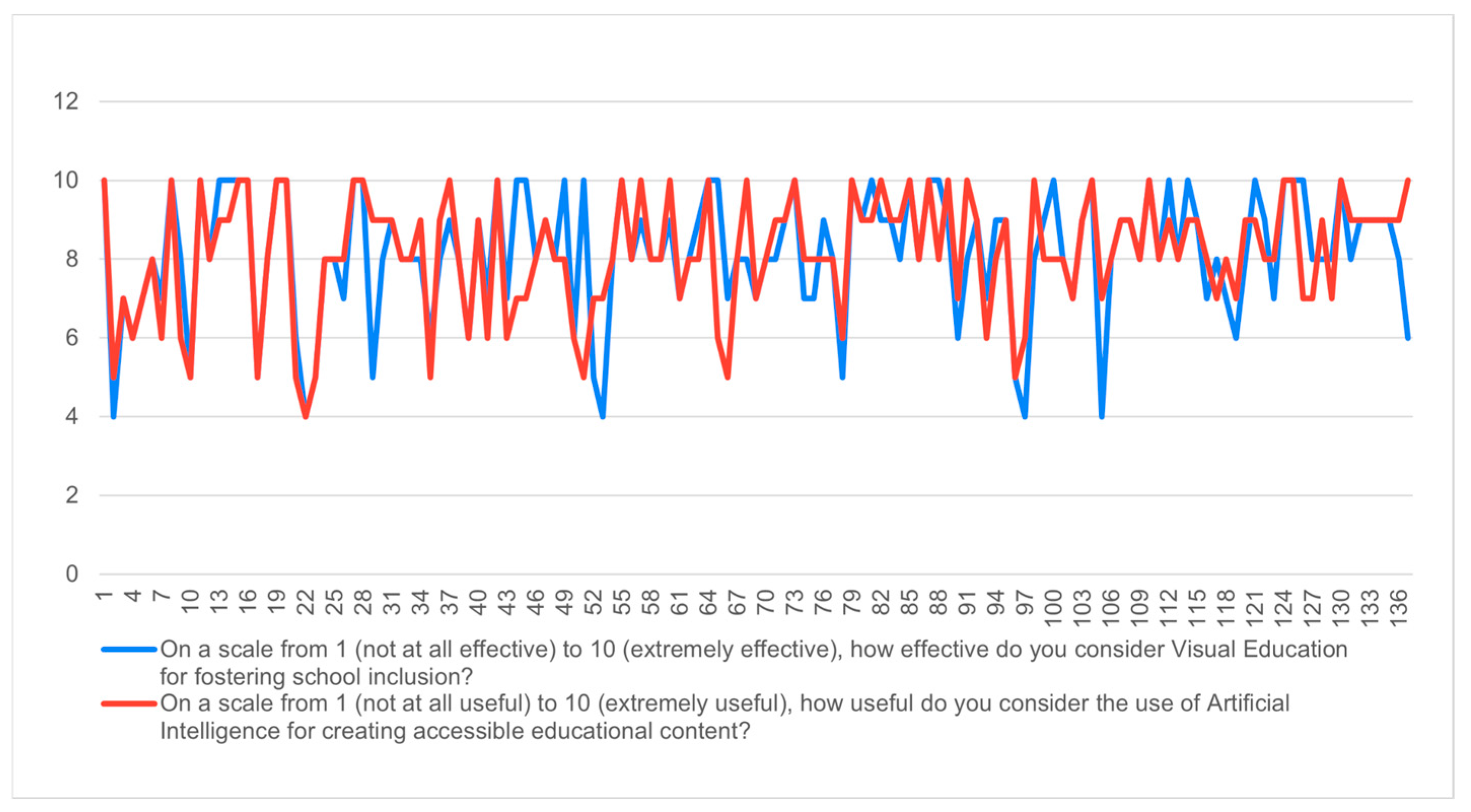
r) confirms the robust interrelationship between these variables. A strong, positive correlation emerges between the perceived effectiveness of Visual Education and that of AI (
r = 0.70,
p < 0.001) as visually represented in
Figure 1 by the overlapping trends of individual responses. Perceived self-efficacy is also significantly correlated, albeit to a lesser extent, with confidence in Visual Education (
r = 0.38,
p < 0.001) and, to a greater degree, with confidence in AI (
r = 0.50,
p < 0.001). These data suggest that, at an attitudinal level, pre-service teachers who see value in Visual Education also tend to place similar trust in AI and, consequently, feel more competent in their integrated use.
The text mining analysis conducted on the corpus of the 90 instructional designs reveals a complex picture, highlighting a gap between conceptual–pedagogical language and technical–operational language. From the frequency analysis, the most recurrent terms (unigrams) belong to the pedagogical-inclusive and Visual Education lexicon. Indeed, among the top positions are words such as students (n = 484), content (n = 425), visual (n = 366), and sensory (n = 328), confirming the participants’ full adherence to the proposed themes. Specific tools such as maps (n = 257) are frequently mentioned. However, it is significant to note that technical terms related to digital accessibility standards, such as alt-text, color contrast, or PDF/UA, are marginal, not appearing among the top 30 occurrences. The analysis of bigrams reinforces this interpretation, highlighting the main conceptual associations used by the pre-service teachers. The most frequent word pairs are visual education (n = 223), concept map (n = 166), and artificial intelligence (n = 146). These lexical results provide the basis for the clustering analysis, aimed at identifying recurring design profiles. To identify these profiles, the Tf-idf matrix of the 89 valid designs (after outlier removal) was segmented using a K-means clustering algorithm (k = 2). The consistency of this classification is supported by an Average Silhouette Score of 0.40, indicating a robust internal cohesion. The analysis confirmed the presence of two distinct and statistically significant profiles, which we have termed “Multimodal Access” and “Narrative-Linguistic.”
“Multimodal Access” Profile (n = 43): This cluster groups designs characterized by an operational lexicon and a clear articulation of technical strategies. The teachers in this profile do not merely mention inclusion but detail concrete procedures for making content accessible. Emblematic examples are represented by projects that involve the creation of “an accessible statistical map that includes an audio version, alternative text for each image, and a Braille legend” or an illustrated e-book in which “all textual content is also provided in audio format [and] the images are described aloud.” In these cases, AI is conceptualized as an active partner to “simplify texts, generate accessible explanations, [and] create alternative descriptions.
“Narrative-Linguistic” Profile (n = 46): This second cluster aggregates designs in which the approach to inclusion and AI is more theoretical and generic. The lexicon is dominated by abstract pedagogical concepts, and although the inclusive intent is explicit, verifiable operational details are lacking. A representative case is a design that describes accessibility strategies in general terms such as “enhanced visualization” and “simplified texts,” without mentioning technical standards like alt-text, file formats, or assistive technologies. The emergence of these two contrasting profiles quantitatively confirms the gap between an approach to accessibility based on technical specification and one grounded in a more general pedagogical awareness.
4. Conclusions and Future Perspectives
The discrepancy between the high perceived utility of AI (M = 8.17) and the lower level of personal preparedness (M = 6.13) suggests a ‘technological enthusiasm gap’. While pre-service teachers recognize the ethical and inclusive value of these tools, they lack the ‘procedural’ knowledge required for implementation. This confirms that theoretical awareness is not enough; teacher training must move beyond general literacy toward laboratory-based ‘micro-modules’ that simulate real-world accessibility challenges (e.g., debugging alt-text or contrast ratios). Specifically, these micro-modules could be operationalized within teacher education curricula as task-based laboratory sessions. In these modules, pre-service teachers would be required to use AI as a design partner to perform specific accessibility audits on their own instructional materials. This includes practical exercises such as generating standards-compliant alt-text for complex diagrams, verifying color contrast ratios through automated tools, and ensuring the semantic structure of documents (e.g., PDF/UA compliance). Such a hands-on approach directly addresses the ‘technological enthusiasm gap’ by transforming theoretical awareness into the technical–operational skills observed in the ‘Multimodal Access’ profile. Although favourably received, the integration of AI–UDL–Visual Education in instructional design remains episodic and fragmented. This finding highlights the difficulty—declared by the participants themselves—of balancing the need for simplification, considered the first step toward accessibility, with coherence and requisite conceptual precision. Concurrently, an urgent need emerges to develop a training plan based on micro-modules, capable of combining flexibility and personalization with effective instruction that is attentive to the integration of Visual Education. When the hybridization of Artificial Intelligence is also considered, the focus must necessarily shift to the instructional adaptations linked to the use of educational technologies.
In light of the potential offered by AI, the necessary and central role of the teacher is reaffirmed, not only as an instructional mediator but also as a facilitator of a hybridization process capable of addressing the multiple means of representation, action and expression, and engagement [
15]. Within the framework of this study, the hybridization of Visual Education, UDL, and AI emerges as the most impactful factor for ensuring instructional accessibility. This underscores the need to integrate more structured and continuous pathways into teacher training, based on modules dedicated to specific competencies.
It is, therefore, a priority to direct research toward training models capable of integrating the principles of Visual Education, Universal Design for Learning, and the potential of AI. This opens up the possibility of designing scalable and modular pathways that can meet student needs and ensure pedagogical sustainability. After thoroughly considering the ethical and regulatory aspects, alongside an awareness of the critical use of these tools, the new professional stance requires teachers to manage and master the Visual Education-UDL-AI hybridization to achieve instructional accessibility, including for students with sensory disabilities. The support of AI as a design partner proves to be strategic for creating multisensory environments; generating visual and audiovisual materials; subtitling content; linguistic adaptation; and verifying contrasts according to recognized standards.
Despite the robustness of the clustering validation, this study has limitations. The sample is restricted to a single university (University of Foggia) and a specific TFA cycle, which limits the generalizability of the results to the entire national pre-service teacher population. Furthermore, the study provides a cross-sectional ‘snapshot’ of current perceptions; the absence of longitudinal data means that the long-term development of these skills and their actual application during the first years of teaching remains a subject for future investigation. Future research should involve multi-center studies to verify if these design profiles (Multimodal vs. Narrative) remain consistent across different geographical and educational contexts.