
Proceeding Paper

Profiling Winegrowers’ Attitudes Towards Organic and Sustainable Viticulture in Western Macedonia †
by
Effrosyni Sapardani
* and
Katerina Melfou
Department of Agriculture, School of Agricultural Sciences, University of Western Macedonia, 53100 Florina, Greece
*
Author to whom correspondence should be addressed.
Presented at the 18th International Conference of the Hellenic Association of Agricultural Economists, Florina, Greece, 10–11 October 2025.
Proceedings 2026, 134(1), 54; https://doi.org/10.3390/proceedings2026134054
Published: 19 January 2026

Abstract

Globalization, climate change and the energy crisis are having a negative impact on the agricultural sector. Moreover, in Greece, producers need to invest in modernizing their farms, introducing innovations, achieve digital transformation and increase productivity. Incentives are available for green investments, thus facilitating the adoption of innovations. This paper examines the attitudes and perceptions of winegrowers in Western Macedonia regarding environmental protection and organic farming. Specifically, with the help of the k-means algorithm, respondents are divided into two groups. The first group consists of producers who have a negative attitude towards environmental issues and have a lower level of education, while the second group consists of those who have a positive attitude. In the first group in particular, most respondents do not seem to have a good knowledge of environmental protection issues, believe that cross-compliance is very stringent and do not have a high level of education. This means that policy measures must be taken to adequately inform and educate farmers belonging to this group to achieve the goal of environmental protection. The results of the second group include producers with a positive attitude, who are expected to play an important role in the development of sustainable viticulture by creating conditions for a better future at an individual, regional and social level.

1. Introduction

The purpose of this study is to group the vineyards of Western Macedonia to investigate the views of winegrowers on environmental protection, organic farming and the use of pesticides during their activities [1,2]. Overall, Greece has seen a steady increase in vineyard area, from approximately 628,045 hectares in 2018 to approximately 640,206 hectares in 2022. The Region of Western Macedonia also shows an increase in vineyard areas during the same period of approximately 5.5% [3]. This shows that vine cultivation in Western Macedonia can play an important role for the region and be a starting point for the development of tourism and especially wine tourism. This form of alternative tourism is expected to increase farmers’ incomes and improve the standards of living in the region, sending a message of hope for the future amid the challenges posed during this period of decarbonization [4].

2. Methodology

The target population consisted of 487 winegrowers cultivating grape varieties for wine production in the Municipality of Amyntaio [5]. The population was stratified into two groups, (a) 69 producers who were members of cooperatives or producer groups and (b) 418 non- associated producers. For the group of members, a census approach was adopted, with a survey of all 69 members. For non-member producers, a stratified random sample was selected based on geographical distribution. Specifically, 39 respondents were selected from the Municipal Unit of Amyntaio and 20 from the other municipal units. Sample adequacy was confirmed through power analysis using G*Power software 3.1.9.4 [6]. A two-tailed t-test for independent samples was selected under the assumption of a medium effect size.
To explore patterns in the data, cluster analysis was conducted using the k-means algorithm. This method groups producers based on similarities across selected variables, while maximizing inter-cluster heterogeneity and intra-cluster homogeneity [7,8,9]. Although k-means is computationally efficient, its performance can be affected by high-dimensional data, which requires careful variable selection [10,11]. In this paper, the optimal number of clusters was determined using the Elbow method [12].
Data were collected via a structured questionnaire through face-to-face interviews conducted between 2022 and 2023. Statistical analysis was performed using SPSS Statistics 27 0.1. The final cluster solution grouped winegrowers into two distinct categories based on their attitudes toward environmental protection and organic farming.

3. Results and Discussion

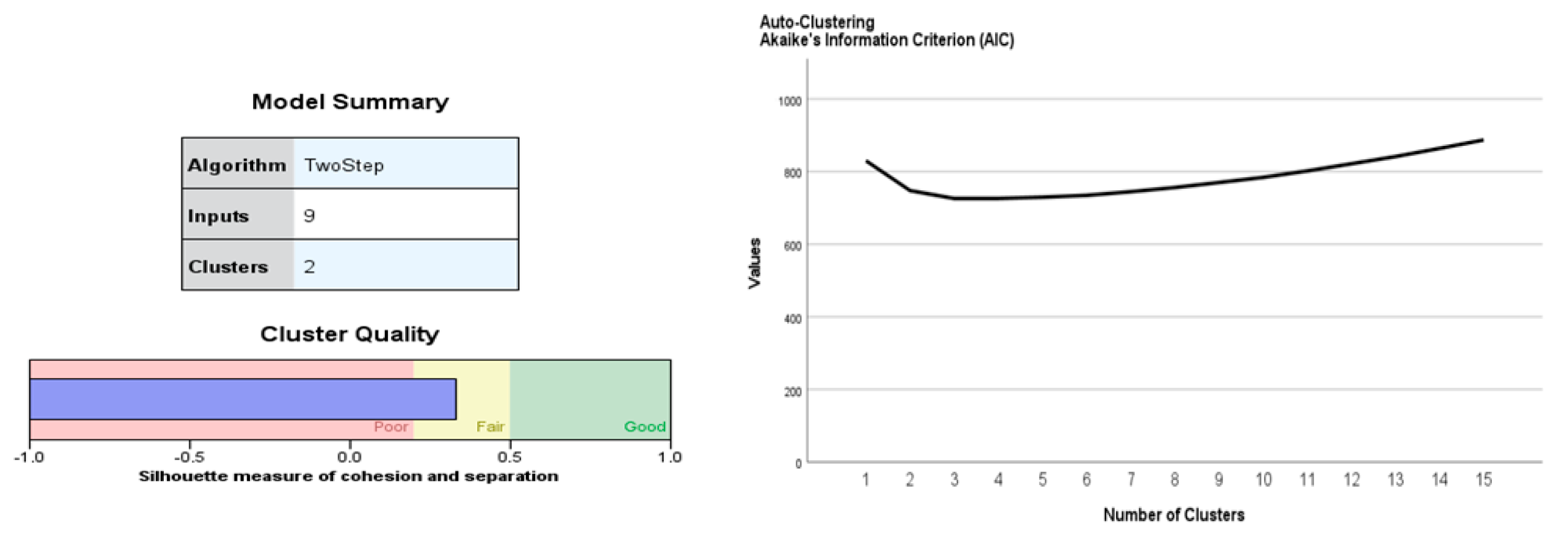
The number of clusters identified has the greatest impact on the clustering results. The Elbow method suggests the optimal number of clusters in the data [11]. Based on the following, the best number of clusters recommended is two, forming an angle between the clusters as shown in Figure 1 below.
After processing 128 questionnaires with questions about winegrowers’ attitudes toward environmental protection, two clusters emerged. The first cluster includes 71 respondents, while the second includes 57 respondents. Table 1 presents the statistically significant differences in the various characteristics of the groups. The results are statistically significant, and there are differences in the mean levels of the characteristics between the groups. All variables have low significance values, and the high F values reflect the fact that there are large differences between the groups for these variables. The results of the analysis of variance show that the differences between the mean values of the variables in the two groups are statistically significant.
The table below contains information about the two clusters. Cluster 1 comprises 71 producers and is characterized by a lower level of education and generally limited commitment to environmentally sustainable practices. Members of this group tend to place greater emphasis on quantity of production than quality, show little interest in organic farming and demonstrate limited awareness of the risks associated with excessive pesticide use. They are less likely to follow formal environmental protection procedures and express less support for practices such as the use of vineyard crop residues.
On the contrary, cluster 2, which includes 57 winegrowers, presents a more environmentally conscious profile. Respondents in this group demonstrate a stronger sense of environmental responsibility, express interest in organic farming, and are more knowledgeable about the risks associated with pesticides. They also prefer quality over quantity in production and are more receptive to environmental compliance requirements, including cross-compliance under the CAP. It is worth noting that the second group has higher levels of formal education. The descriptive statistics in Table 2 reinforce the difference between the clusters.
The heterogeneity observed among winegrowers in Western Macedonia suggests that a uniform approach to environmental policy may be ineffective. While some producers seem ready to adopt sustainable viticultural practices, the majority remain inadequately informed or resistant.

4. Conclusions

This paper identified two distinct profiles of winegrowers in Western Macedonia based on their environmental attitudes, awareness and level of education. The majority of respondents (55%) who form cluster 1, showed limited interest in environmental protection and had some awareness of sustainable practices. Producers in this cluster were more concerned with quantity than quality of production and also showed lower levels of formal education. On the contrary, 45% of the sample had a profile with stronger orientation towards sustainability and greater awareness of the risks of pesticides. Moreover they expressed an interest in organic farming and had a higher level of education.
The findings highlight the importance of education as a key factor in environmentally responsible behavior in viticulture. They also suggest that policy interventions need to be adjusted to reflect the diversity of attitudes and competencies among winegrowers. This underlines the importance of differentiated policy tools, targeted extension services and educational interventions that can reduce the difference between these groups.
Although geographically limited, the results offer relevant information for other wine-growing regions in Greece, as the structural characteristics of agricultural firms are largely comparable. Given the growing importance of viticulture for regional development and agrotourism in Western Macedonia, especially during the transitional economic period following the decline of lignite mining, these findings can be useful for both local and national strategies aimed at promoting sustainable rural development.

Author Contributions

Conceptualization, E.S. and K.M.; methodology, E.S.; software, E.S.; validation, E.S. and K.M.; formal analysis, K.M.; investigation, E.S.; resources, K.M.; data curation, E.S.; writing—original draft preparation, E.S.; writing—review and editing, K.M.; visualization, E.S.; supervision, K.M.; project administration, K.M.; funding acquisition. All authors have read and agreed to the published version of the manuscript.

Funding

This research received no external funding.

Institutional Review Board Statement

Ethical review and approval were not required for this study, as it involved anonymous questionnaire-based research and did not include any intervention or collection of sensitive personal data, in accordance with applicable institutional and national guidelines.

Informed Consent Statement

Informed consent was obtained from all subjects involved in the study.

Data Availability Statement

The data used in this study were collected by the authors through a structured questionnaire survey. Due to confidentiality and privacy considerations, the datasets are not publicly available but can be made available from the corresponding author upon reasonable request.

Conflicts of Interest

The authors declare no conflict of interest.

References

  1. European Commission. Document 52021DC0141R(01). 2025. Available online: https://eur-lex.europa.eu/legal-content/EN/TXT/?uri=CELEX:52021DC0141R(01) (accessed on 25 February 2025).
  2. European Commission. Economic Transformation on the Agricultural Sector. 2025. Available online: https://commission.europa.eu/projects/economic-transformation-agricultural-sector_en (accessed on 25 February 2025).
  3. Hellenic Statistical Authority. 4. Vines (Grapes and Raisins), Table 4a. Areas and Production by Region and Regional Unities. 2024. Available online: https://www.statistics.gr/ (accessed on 26 February 2024).
  4. Just Development Transition Plan. n.d. Available online: https://www.sdam.gr/node/142 (accessed on 22 May 2025).
  5. Hellenic Statistical Authority. Table 22, Holdings and Areas with Vineyards, by Type of Vineyards, Region, Regional Unit, Municipality and Municipal Unit, Hellenic Statistical Authority. 2020. Available online: https://www.statistics.gr (accessed on 20 December 2023).
  6. Faul, F.; Erdfelder, E.; Buchner, A.; Lang, A.-G. Statistical power analyses using G* Power 3.1 Tests for Correlation and regression analyses. Psychon. Soc. Behav. Res. Methods 2009, 41, 1149–1160. [Google Scholar] [CrossRef] [PubMed]
  7. Bhatia, S.K. Adaptive k-Means Clustering. In Proceedings of the Seventeenth International Florida Artificial Intelligence Research Society Conference (FLAIRS 2004), Miami Beach, FL, USA, 12–14 May 2004. [Google Scholar]
  8. Yadav, J.; Sharma, M. A review of k-means Algorithm. Int. J. Eng. Trends Technol. (IJETT) 2013, 4, 2972–2976. [Google Scholar]
  9. Stewart, J.; Stewart, R.; Kennedy, S. Dynamic IoT Management System Using K-means Machine Learning for Precision Agriculture Applications. In Proceedings of the Second International Conference on Internet of things, Data and Cloud Computing (ICC’17), Cambridge, UK, 22–23 March 2017; pp. 1–8. [Google Scholar] [CrossRef]
  10. Tan, P.-N.; Steinbach, M.; Kumar, V. Intoduction to Data Mining; Addison Wesley: Boston, MA, USA, 2006. [Google Scholar]
  11. Li, C.; Niu, B. Design of smart agriculture based on big data and Internet of things. Int. J. Distrib. Sens. Netw. 2020, 16, 155014772091706. [Google Scholar] [CrossRef]
  12. Umargono, E.; Endro Suseno, J.; Vincensius Gunawan, S.K. K-means clustering optimization using the Elbow Method and Early Centroid Determination Based-on Mean and Median. In Proceedings of the 2nd International Seminar on Science and Technology (ISSTEC 2019), Yogyakarta, Indonesia, 25 November 2019. [Google Scholar] [CrossRef]
Figure 1. Elbow Method.
Proceedings 134 00054 g001
Table 1. Analysis of Variance.
ClusterError
Mean SquaredfMean SquaredfFSig.
B1. Education level187.48711.118126167.683<0.001
B2. Farmers have an obligation to protect the environment11.24910.42612626.386<0.001
B3. Farmers place more emphasis on quantity of production than quality29.28711.17012625.025<0.001
B4. Farmers follow a special procedure to protect the environment2.26010.4841264.6710.033
B.5 Farmers show interest in organic farming5.83810.6791268.5940.004
Β.6 Farmers are aware of the effects of excessive pesticide use12.22010.60812620.087<0.001
Β.7 Farmers believe that cross-compliance should have been less strict4.32010.9931264.3490.039
Β.8 Farmers want to utilize crop residues from vineyards10.15010.84312612.033<0.001
Table 2. Report.
Table 2. Report.
Cluster 1:Cluster 2:Total:
MeanNSt. DeviationMeanNSt. DeviationMeanNSt. Deviation
B1. Education level1.99710.8194.42571.2953.071281.608
B2. Farmers have an obligation to protect the environment2.00710.7171.40570.5631.731280.715
B3. Farmers place more emphasis on quantity of production than quality2.70711.0743.67571.0913.131281.180
B4. Farmers follow a special procedure to protect the environment2.20710.6461.93570.7532.081280.706
B.5 Farmers show interest in organic farming2.46710.8592.04570.7782.271280.848
Β.6 Farmers are aware of the effects of excessive pesticide use2.18710.8501.56570.6821.911280.837
Β.7 Farmers believe that cross-compliance should have been less strict2.65710.8643.02571.1422.811281.010
Β.8 Farmers want to utilize crop residues from vineyards2.48710.9391.91570.8922.231280.957
Disclaimer/Publisher’s Note: The statements, opinions and data contained in all publications are solely those of the individual author(s) and contributor(s) and not of MDPI and/or the editor(s). MDPI and/or the editor(s) disclaim responsibility for any injury to people or property resulting from any ideas, methods, instructions or products referred to in the content.