1. Introduction
The European Union (EU) has set the ambitious goal of becoming climate-neutral—that is, achieving net-zero greenhouse gas emissions by 2050—in order to contribute to global efforts to combat climate change and reduce greenhouse gas emissions [
1]. To this end, climate change mitigation strategies have been implemented, referring to efforts aimed at reducing or mitigating greenhouse gas emissions. Mitigation can include actions such as introducing new technologies, implementing renewable energy sources, improving the energy efficiency of older equipment, or modifying management practices and consumer behavior [
2].
The circular economy plays a significant role in mitigating climate change, referring to a non-linear economic model that promotes practices such as reuse, repair, refurbishment, and recycling of existing materials and products, thereby keeping materials in the economy for as long as possible. The implementation of the circular economy means that waste itself will become a raw material for the production of other products, thereby minimizing the actual amount of waste [
3].
Given that the construction sector contributes significantly to CO
2 emissions, it is important to apply the principles of the circular economy in this sector. Such practices include the use of low-carbon materials, building renovation, and sharing practices, among others. However, it has been found that we are still far from successfully implementing the principles of the circular economy [
4].
Socioeconomic factors influence the adoption of circular economy principles. However, there are very few research studies that analyze the factors that influence citizens’ awareness, attitudes, and behavior regarding the adoption of circular economy principles. Actions for their active participation are considered necessary, but the strategies required to achieve this have not yet been adequately examined.
The European project CO2NSTRUCT: “Modeling the role of circular economy structure value chains for a carbon-neutral Europe” aims to fill the gap in empirical data on consumer behavior and preferences regarding the use of circular economy practices by developing a strategy to quantify citizens’ behavior in relation to the circular economy and climate change mitigation. The project is funded by the “Horizon Europe” framework; seven organizations from seven countries participate (Denmark, Greece, Italy, Spain, Portugal, Germany, and the UK) in the project.
This paper aims to present the results concerning attitudes towards the use and Willingness to Pay (WTP) for biobased materials in the context of construction material selection and residence renovation, as well as the similarities and differences between different European countries.
2. Materials and Methods
As part of the citizen behavior survey, a survey was designed and implemented using an interdisciplinary co-creation process that took into account the views and requirements of all CO2NSTRUCT project partners. The survey participants were asked about their socioeconomic and residence characteristics. Next, their level of knowledge about the circular economy and climate change was examined. The subsequent sections of the questionnaire included questions to understand citizens’ behavior regarding specific circular economy practices and the respondents’ WTP for some of them. Finally, the attitudes, intentions, and behaviors of respondents regarding the selection and use of circular economy building materials and components were examined.
The questionnaire (approximately 60 questions) was distributed in nine countries (Denmark, Germany, Greece, Italy, Poland, Portugal, Romania, Spain, the UK), with the participation of approximately 500 participants per country (4512 questionnaires in total). The sample was collected by the “Opinion Poll” survey company. The sample was representative in terms of gender, age, and region of residence for each of the countries. The collection of responses was carried out simultaneously for all participating countries and took place in December 2023.
Statistical analysis was performed using the SPSS 20 statistical program. The survey results were analyzed and presented using descriptive statistics for the total sample. Additionally, comparisons were made between the responses of the nine countries.
3. Results
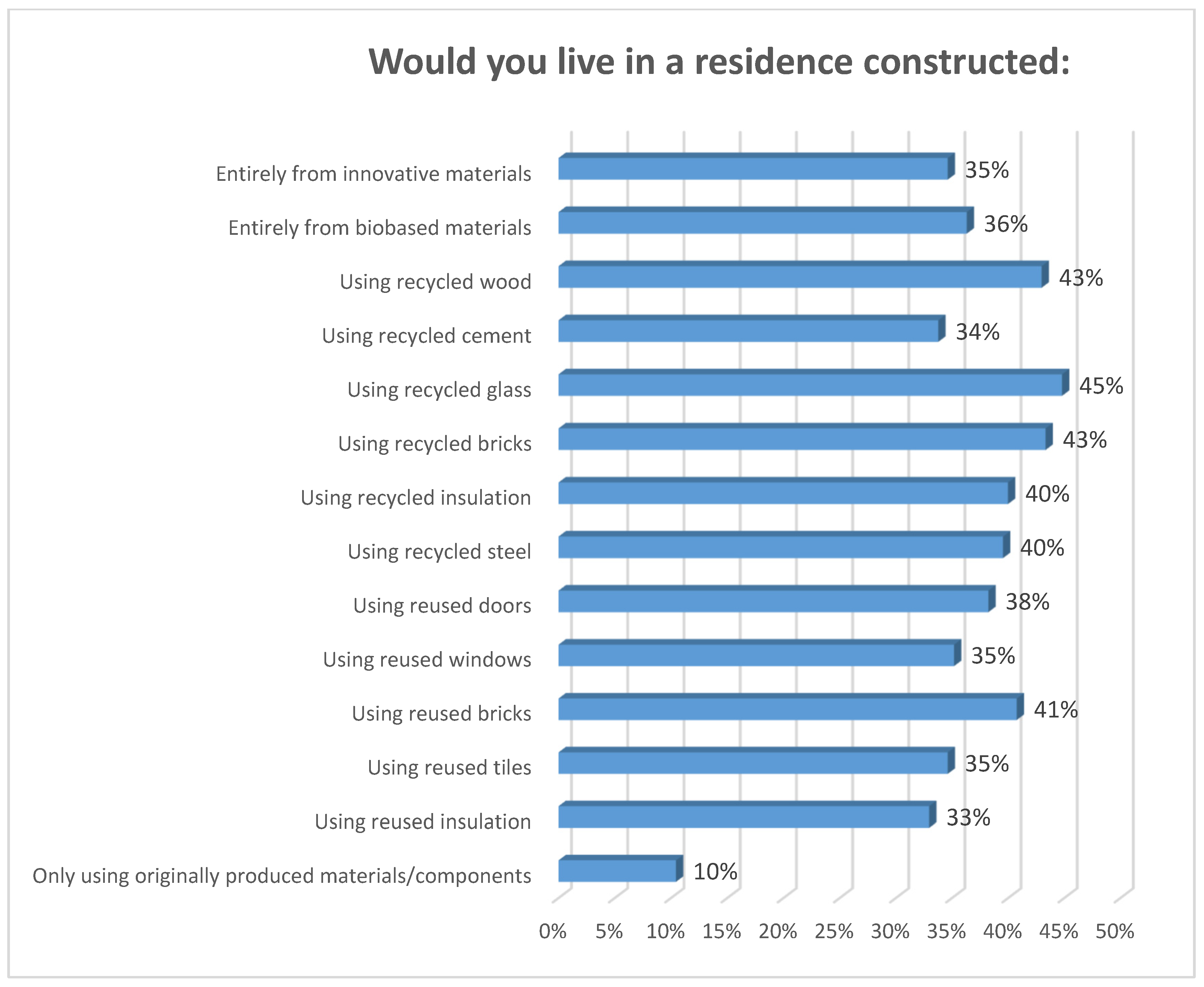
Survey participants were asked several questions to reveal their attitudes towards recycling, reuse and refuse practices in the construction sector. Firstly, they were asked if they would live in a residence constructed from different materials or components. In the overall sample, respondents were more positive about living in a house constructed “using recycled glass” (45%) and “using recycled wood” (43%). On the other hand, they seem to be more skeptical about living in a residence constructed “entirely from biobased materials” (36%) (
Figure 1).
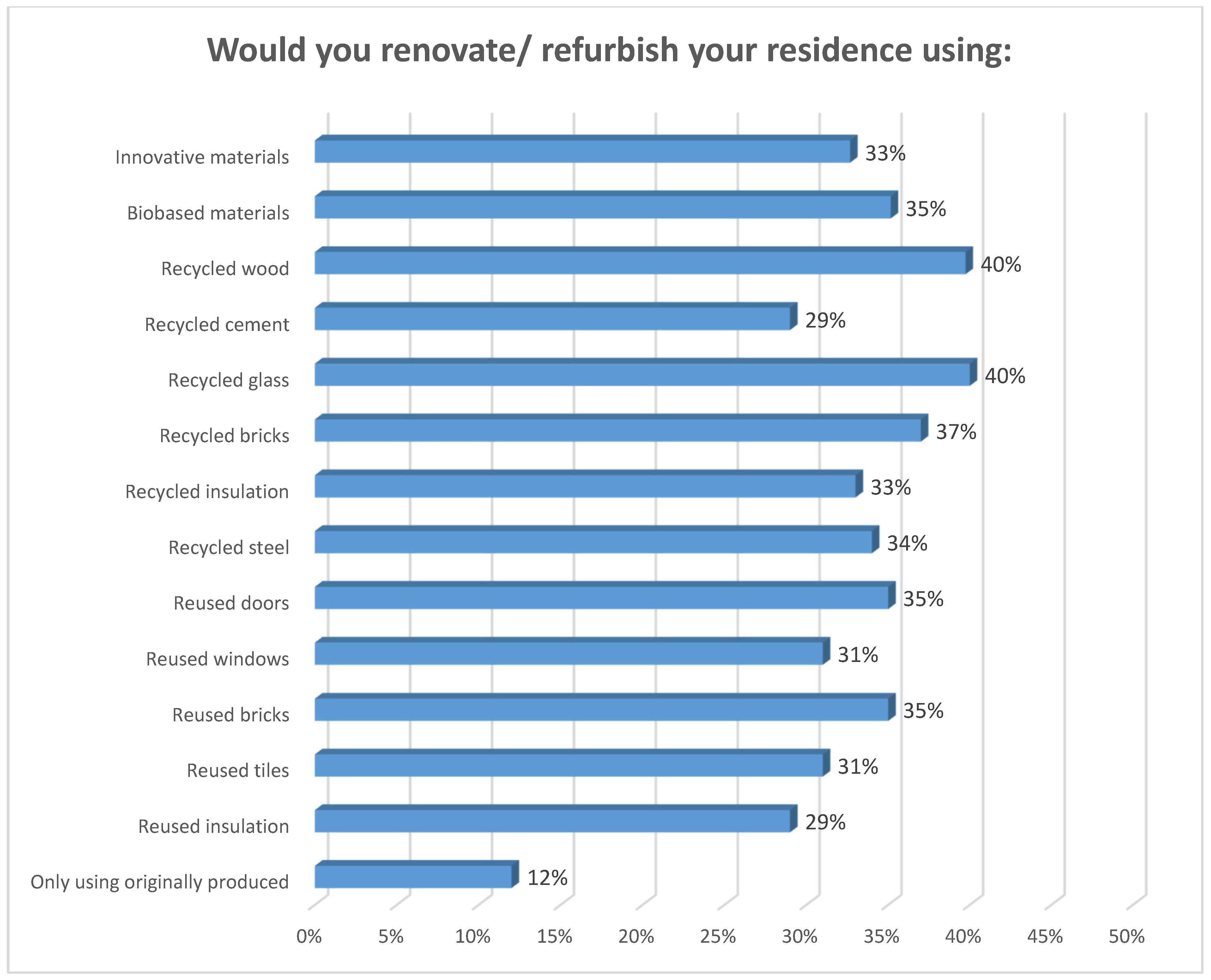
Participants were asked a similar question about the materials or components they would use when renovating their residence. The results of this question are quite similar to those of the previous question. Participants tended to be more willing to use recycled materials (other than recycled cement) than most categories of reused materials/components (except for reused bricks). Overall, the respondents answered more positively about renovating their house constructed using “recycled glass” and “recycled wood” (40% in both cases). On the other hand, they seem to be more skeptical about using “biobased materials” (35%) (
Figure 2).
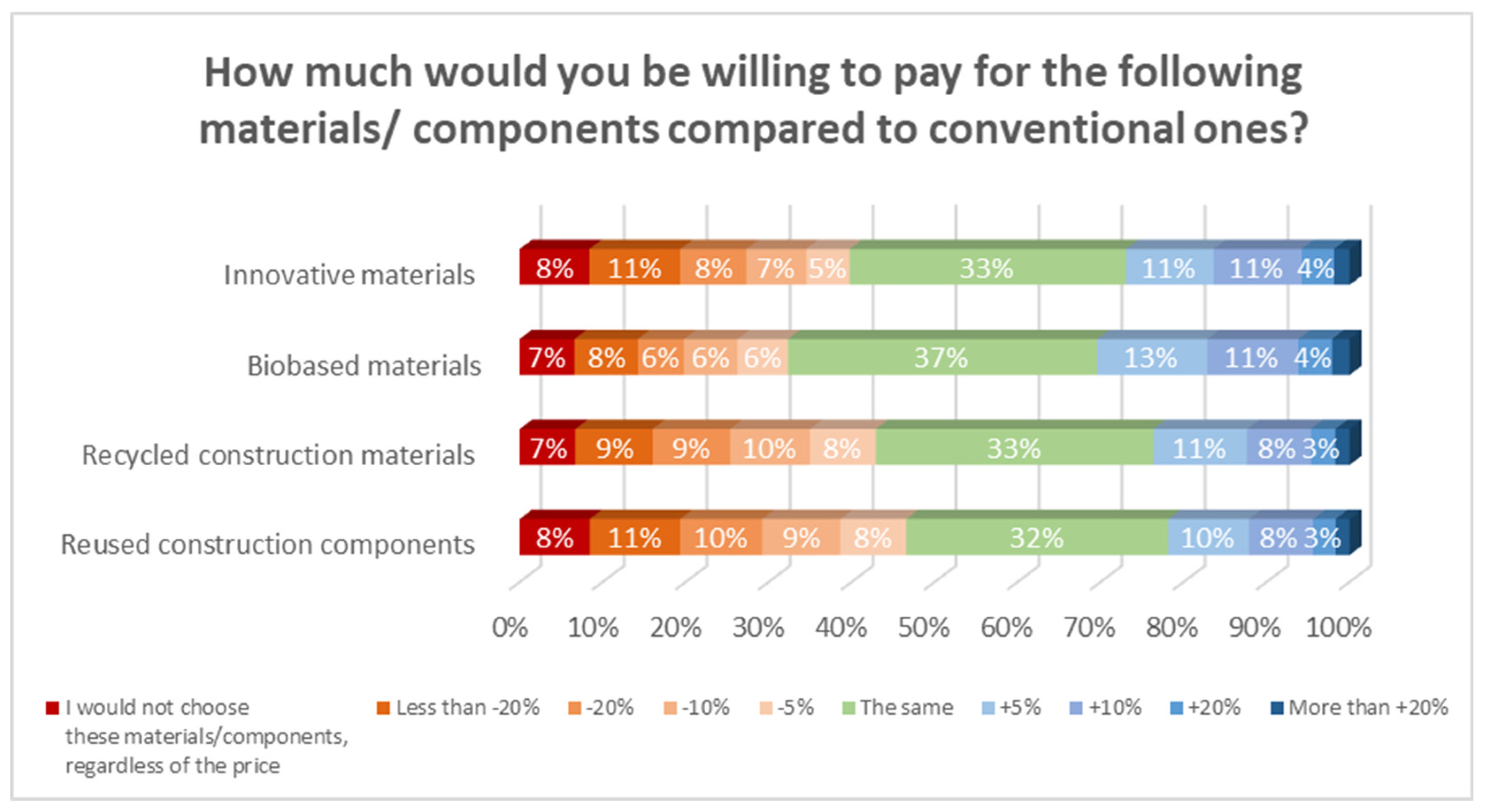
Survey respondents were questioned about their WTP for different unconventional materials and components. When referring to the overall sample, as illustrated in
Figure 3, 7–8% of respondents “would not choose these materials/components, regardless of the price”. Additionally, 32–37% would be willing to pay the same price for them as for conventional materials or components. Specifically, for “biobased materials”, 30% of the participants would pay more for them compared to conventional materials, while 26% would pay less. In the case of “innovative materials”, 27% of respondents would pay more for them compared to conventional materials, while 31% would pay less. For “recycled construction materials” and “reused construction components”, the percentage of respondents who would pay less is higher (30% and 38%, respectively).
Following the descriptive statistics analysis, a set of tests was performed to examine the existence of statistically significant differences between the nine countries. To do so, chi-square tests were performed in the case of the intention to use different materials/components, and Kruskal–Wallis H tests were applied in the case of the WTP for non-conventional materials. Additionally, post hoc tests were conducted to identify statistically significant differences between each pair of countries (i.e., 36 pairs). The results of the tests indicate that there are statistically significant differences in all variables under examination in at least one pair of countries.
4. Discussion
This paper aims to analyze attitudes toward the use and WTP for biobased materials in the context of construction material selection and residential renovation. To analyze citizens’ behavior, a behavioral survey was conducted among citizens of nine European countries in December 2023. The survey revealed that participants generally hold a positive attitude towards living in and renovating homes using recycled materials, such as glass and wood. However, they are more skeptical about biobased materials. When considering their willingness to pay, a significant portion would be willing to pay more for biobased and innovative materials. Still, a substantial percentage would be willing to pay less for recycled and reused components. In addition, differences between the nine countries were examined in terms of participants’ responses to all issues under investigation. The results showed statistically significant differences in all issues under consideration.
Author Contributions
Conceptualization, S.K. and T.I.O.; methodology, S.K. and T.I.O.; software, S.K. and T.I.O.; validation, S.K. and T.I.O.; formal analysis, S.K. and T.I.O.; investigation, S.K. and T.I.O.; resources, S.K. and T.I.O.; data curation, S.K. and T.I.O.; writing—original draft preparation, S.K.; writing—review and editing, S.K.; visualization, S.K. and T.I.O.; supervision, C.K.; project administration, C.K.; funding acquisition, C.K. All authors have read and agreed to the published version of the manuscript.
Funding
This research is supported by the European Union’s Horizon Europe research and innovation program under grant agreement No. 101056862, CO2NSTRUCT project.
Institutional Review Board Statement
Not applicable.
Informed Consent Statement
Informed consent was obtained from all subjects involved in the study.
Data Availability Statement
The raw data supporting the conclusions of this article will be made available by the authors on request.
Acknowledgments
This output reflects only the authors’ view, and the European Union cannot be held responsible for any use of the information contained herein.
Conflicts of Interest
The authors declare no conflicts of interest. The funders had no role in the design of the study; in the collection, analyses, or interpretation of data; in the writing of the manuscript; or in the decision to publish the results.
Abbreviations
The following abbreviations are used in this manuscript:
| EU | European Union |
| SPSS | Statistical Package for the Social Sciences |
| UK | United Kingdom |
| WTP | Willingness to Pay |
| Disclaimer/Publisher’s Note: The statements, opinions and data contained in all publications are solely those of the individual author(s) and contributor(s) and not of MDPI and/or the editor(s). MDPI and/or the editor(s) disclaim responsibility for any injury to people or property resulting from any ideas, methods, instructions or products referred to in the content. |