
Proceeding Paper

Consumer Attitudes and Behavior Towards International Food Standards Related to Viability and Sustainability †
by
Nikolaos Charitos
and
Georgia Koutouzidou
*
Department of Agriculture, University of Western Macedonia, Terma Kondopoulou, 53100 Florina, Greece
*
Author to whom correspondence should be addressed.
Presented at the 18th International Conference of the Hellenic Association of Agricultural Economists, Florina, Greece, 10–11 October 2025.
Proceedings 2026, 134(1), 36; https://doi.org/10.3390/proceedings2026134036
Published: 8 January 2026

Abstract

This study examines consumer opinions and behavior toward international food standards related to sustainability and environmental responsibility. For the data collection process, a structured questionnaire was distributed online and completed by 1064 participants. The study focuses on assessing consumer awareness of food standards, the extent to which these standards influence purchasing decisions, and the demographic factors affecting such choices. The findings reveal a growing interest in sustainable products, particularly among younger age groups. However, the study also identifies significant gaps in knowledge and understanding of international standards, which hinder the adoption of more responsible consumption practices. It concludes with recommendations to improve awareness, transparency, and food labeling, as well as to promote sustainable consumption through coordinated policies and educational initiatives.

1. Introduction

The need to shift toward more sustainable models of food production and consumption poses a significant challenge at present. The impacts of climate change, the depletion of natural resources, and the rise in social inequalities have highlighted the importance of the environmental and social dimensions of food systems. In this context, international food standards are gaining increasing importance, as they serve as guiding and assessment tools to ensure the quality, safety, and sustainability of food products [1].
This study focuses on consumer opinions toward these standards and investigates the extent to which the values they embody—such as environmental protection, social responsibility, and health—affect consumer behavior in food purchasing. Additionally, it explores the characteristics of consumers who are drawn to products with sustainable attributes, as well as the factors that either hinder or encourage the regular purchase of such products [2].

2. Methods

The research employed a quantitative methodology through the online distribution of a structured questionnaire. The questionnaire was developed following a bibliographic review and the adaptation of existing measurement tools. It included five-point Likert scale items and one open-ended question to collect qualitative data used in descriptive statistical analysis [3].
Data collection took place between 24 November and 24 December 2024, and the sample consisted of 1064 participants, selected through convenience sampling from the general population. Data were analyzed using IBM SPSS Statistics version 29, applying descriptive statistics and Pearson’s Chi-Square tests to explore associations between variables [4].

3. Results and Discussion

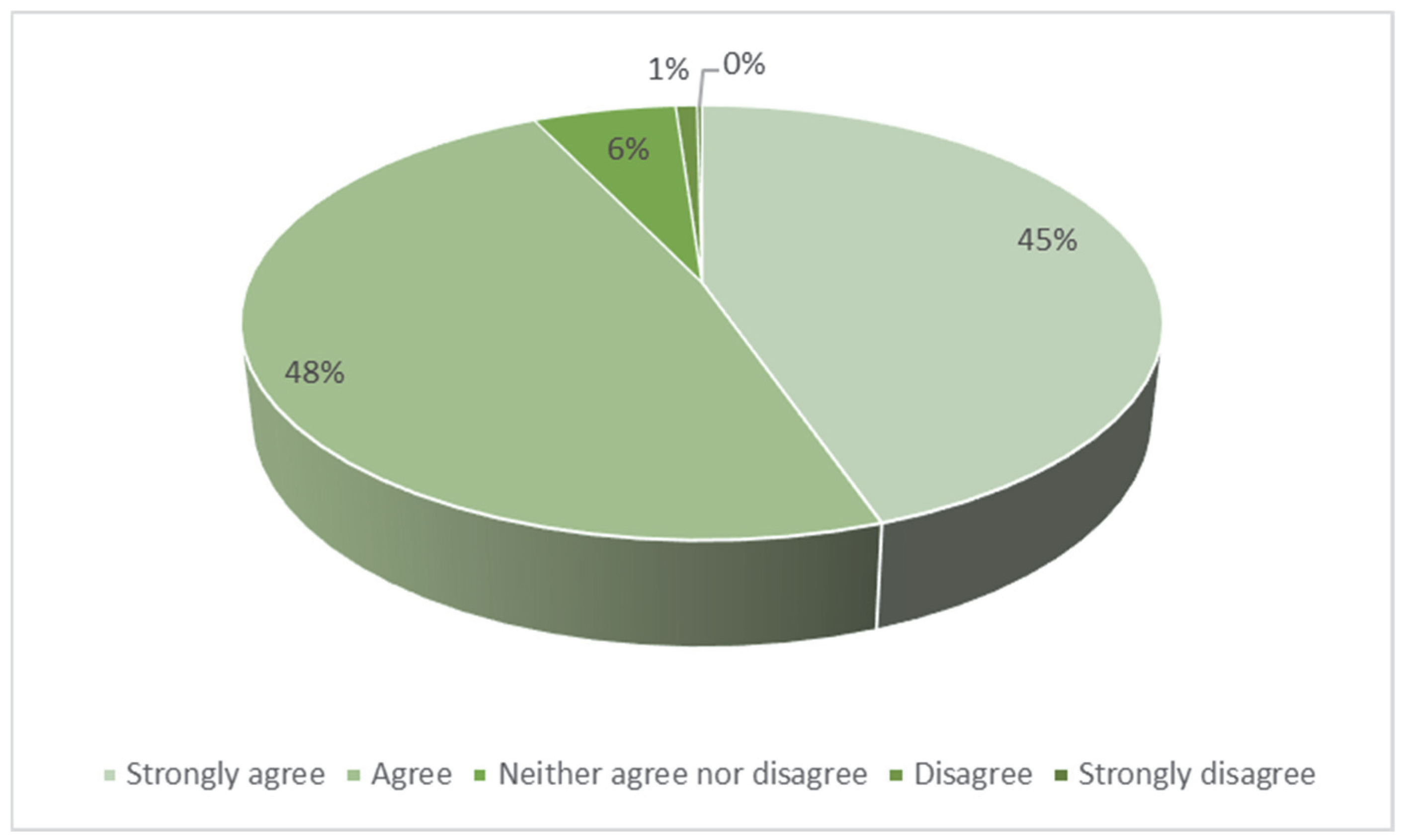
The findings highlight the need for greater transparency in corporate and governmental policies, alongside stronger certification and monitoring mechanisms (x2 = 33.757, p = 0.028), (cf. Figure 1). Results show that younger consumers and women demonstrate higher levels of environmental concern (x2 = 50.041, p = 0.000). Despite an increased interest in sustainable food products, there is a significant lack of knowledge regarding international food standards, leading to neutral or hesitant attitudes toward sustainable consumption (x2 =10.872, p = 0.028).
The results align with Raffard’s [5] macroeconomic perspective, which emphasizes national food self-sufficiency and the risks associated with the geopolitics of food markets. Although Raffard [5] addresses these concerns from a macro-level, the present study approaches them from a microeconomic consumer behavior perspective. Both studies underline the necessity of restructuring food systems to address environmental and social inequalities.

4. Conclusions

The study demonstrates that the consumption of sustainable food products is becoming more mainstream and accepted. Key strategies for promoting sustainable consumption include enhancing transparency, improving labeling systems, and investing in consumer education. Moreover, incorporating international food standards into everyday practices and sustainable policies could serve as catalysts for broader change.
Future research could compare perceptions across different social groups and track how consumer behavior evolves over time, particularly in response to external shocks such as economic crises or environmental disasters.

Author Contributions

Conceptualization, N.C.; methodology, N.C.; software, N.C.; validation, N.C.; formal analysis, N.C.; investigation, N.C.; data curation, N.C.; writing—original draft preparation, N.C.; writing—review and editing, G.K.; visualization, G.K.; supervision, G.K.; project administration, G.K. All authors have read and agreed to the published version of the manuscript.

Funding

This research received no external funding.

Institutional Review Board Statement

Not applicable.

Informed Consent Statement

Informed consent was obtained from all subjects involved in the study.

Data Availability Statement

The data that support the findings won’t be available.

Conflicts of Interest

The authors declare no conflict of interest.

References

  1. Willett, W.; Rockström, J.; Loken, B.; Springmann, M.; Lang, T.; Vermeulen, S.; Garnett, T.; Tilman, D.; DeClerck, F.; Wood, A.; et al. Food in the Anthropocene: The EAT-Lancet Commission on healthy diets from sustainable food systems. Lancet 2019, 393, 447–492. [Google Scholar] [CrossRef] [PubMed]
  2. Vermeir, I.; Weijters, B.; De Houwer, J.; Geuens, M.; Slabbinck, H.; Spruyt, A.; Van Kerckhove, A.; Van Lippevelde, W.; De Steur, H.; Verbeke, W. Environmentally Sustainable Food Consumption: A Review and Research Agenda from a Goal-Directed Perspective. Front. Psychol. 2020, 11, 1603. [Google Scholar] [CrossRef] [PubMed]
  3. Bryman, A. Social Research Methods, 5th ed.; Oxford University Press: Oxford, UK, 2016; Available online: https://books.google.gr/books?id=N2zQCgAAQBAJ (accessed on 28 March 2025).
  4. Field, A. Discovering Statistics Using IBM SPSS Statistics, 5th ed.; SAGE Publications: Thousand Oaks, CA, USA, 2018; Available online: https://books.google.gr/books?id=83L2EAAAQBAJ (accessed on 28 March 2025).
  5. Raffard, P. Géopolitique de l’alimentation et de la gastronomie: De la fourche à la Food Tech; Le Cavalier Bleu Editions: Paris, France, 2021. [Google Scholar] [CrossRef]
Figure 1. Research results for the question: “I believe that organizations and companies should be more transparent about their sustainable practices”.
Proceedings 134 00036 g001
Disclaimer/Publisher’s Note: The statements, opinions and data contained in all publications are solely those of the individual author(s) and contributor(s) and not of MDPI and/or the editor(s). MDPI and/or the editor(s) disclaim responsibility for any injury to people or property resulting from any ideas, methods, instructions or products referred to in the content.