1. Introduction
Global agriculture has faced several critical challenges in recent years. The most crucial challenge is climate change, which threatens significant disasters such as desertification, increased salinity, insect and animal infestation of crops, floods, and droughts. The impact of these disasters will be the abandonment of crops by many regions at a time when crops are essential as, according to Blakeney [
1], the world population will have a significant increase by 2050 and in many developing and less developed countries the primary source of income and livelihood of their population is agriculture. In addition, agriculture in these countries is an essential source of foreign exchange and a supplier of raw materials to many industries that significantly contribute to these countries’ economic development. For these reasons, agricultural sustainability is a topic that has been extensively studied for a long time by researchers from a variety of disciplines. Researchers are looking at this field’s various aspects and implications from different perspectives [
2].
The growth of the world population, the continuous changes in climate and ecosystems, and the harmful effects they have on society emphasize the need for sustainable innovation in agriculture to address those issues [
3]. To understand how the international research community has approached the concept of sustainable agriculture, it is deemed necessary to examine the research and thematic trends that have developed over the last five years.
This paper aims to highlight the global research trends and thematic evolution of the field of agricultural sustainable management through a bibliometric analysis, specifically by analyzing the authors’ keywords of all papers published from 2019 to 2024. Specifically, it maps the thematic axes and conceptual developments around sustainable agriculture to help understand the field’s thematic evolution and provide a tool for emerging research trends for the international research community.
To achieve this objective, this paper answers the following questions:
- -
Which are the dominant topics of interest in research on agricultural sustainable management in the international literature?
- -
What is the main thematic evolution in the international literature on sustainable agricultural management?
2. Methods
This paper is a bibliometric analysis based on the analysis of scientific publications retrieved from the Scopus database. The keywords used to search the papers were ‘agricultural sustainable management’ and ‘innovation.’ The keywords were searched in the article titles, abstracts, and keywords. The search of the documents covered the period from 2019 to 2024, and 1158 documents were obtained from the keywords from which the search results were derived. Scopus was chosen as the database for the document search; it includes open-access journals and publications from many disciplines [
4], which can make the bibliometric review more qualitative and evidence-based. The tool chosen to conduct the bibliometric analysis was VOSviewer (1.6.20), which was used to extract the results and construct and visualize the bibliometric maps. VOSviewer is a specialized tool for such analyses, can handle large amounts of data, visualizes bibliometric networks, and creates easy-to-use maps of collaborations, keywords, and bibliometric links [
5].
3. Results and Discussion
3.1. Global Research Trends of Agricultural Sustainable Management
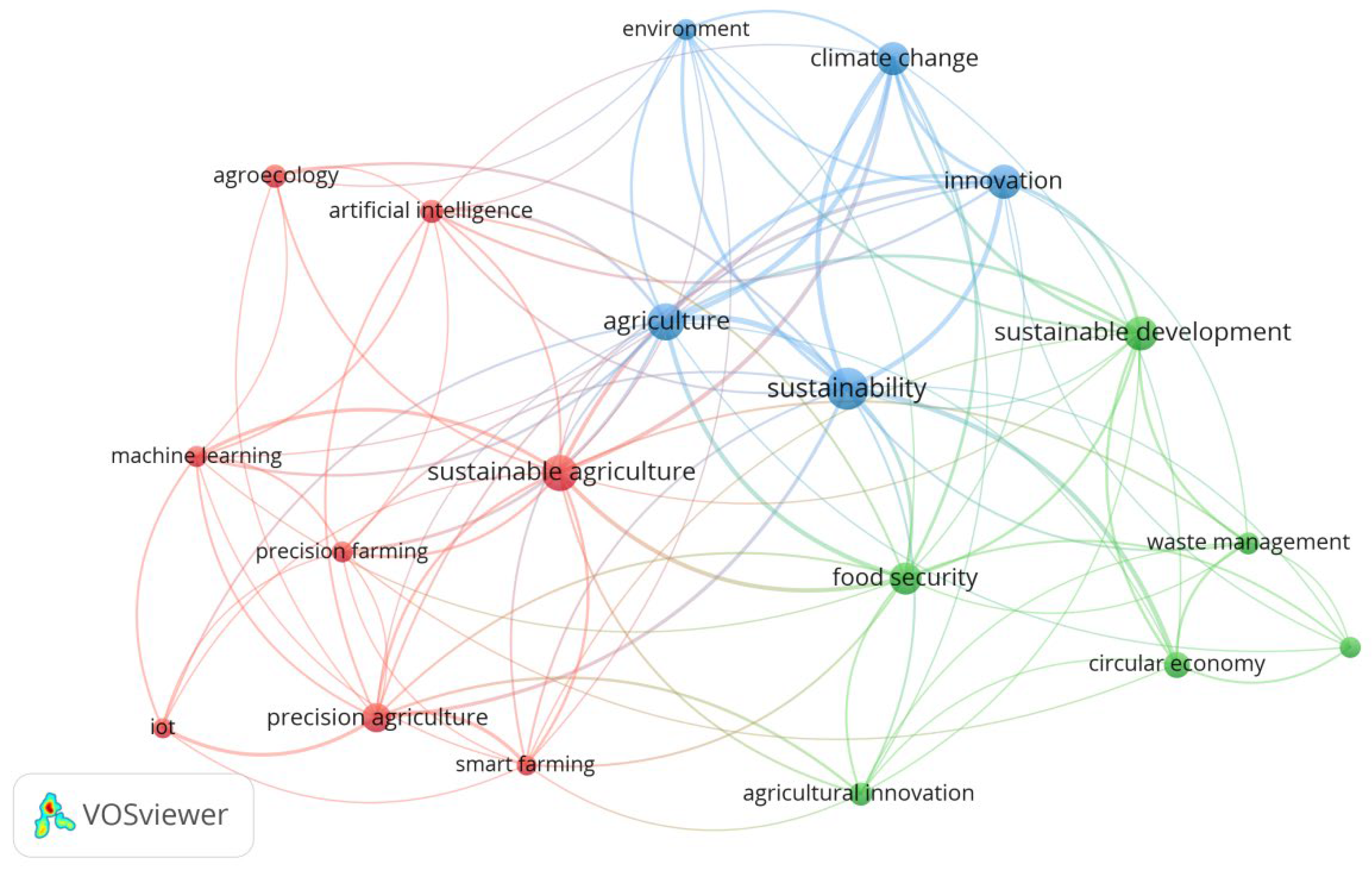
According to the results of the research, the terms that appear most frequently in the documents analyzed and reflect global research trends are, first of all, sustainability (102 occurrences), which is a generic term used by many fields. Next is sustainable agriculture (68 occurrences), which was one of the keywords used to search the articles (
Figure 1). This is followed by sustainable development (60 occurrences) and climate change (56 occurrences), considered among the most important challenges for sustainable agricultural management. Food security (52 occurrences) and waste management (20 occurrences) have significant occurrences.
3.2. Thematic Evolution of Agricultural Sustainable Management
As regards the terms indicating the thematic evolution of the field, the most frequently occurring terms (see
Figure 1) are precision agriculture (38 occurrences), circular economy (29 occurrences), agroecology (22 occurrences), artificial intelligence (21 occurrences), machine learning and precision farming (17 occurrences). Finally, agricultural innovation (21 occurrences) should also be mentioned, which could be considered both as a global research trend and as a term indicating the thematic evolution of the field, as it may indicate an innovative trend and a broader policy.
The present bibliometric analysis highlights the research trends and the thematic development of scientific research in agricultural sustainable management. Sustainability has a central role as a general concept, as many scientific fields use it. Still, the terms sustainable development, sustainable agriculture, and climate change also demonstrate the close connection of agricultural management with the global challenges that sustainable agriculture faces.
The thematic evolution shows the gradual integration of new and innovative technologies in sustainable agriculture, and this is evidenced by the terms that appeared in the results, such as agroecology, precision agriculture, precision farming, smart farming, Internet of things (IoT), Artificial Intelligence (AI), machine learning, agricultural innovation, and circular economy. These terms show the transformation of the theme, and which concepts and new technologies are coming to the fore, and they aim to increase efficiency and propose alternative production models, enhancing agricultural sustainability.
It should be noted that the terms precision agriculture and precision farming seem to be common, but the authors use them in different ways. Precision agriculture is a technological and scientific term, while precision farming is the practical application of technologies in the field.
4. Conclusions
As the results indicate, most of the terms in the documents refer to sustainability (sustainability, sustainable agriculture, and sustainable development), which confirms the term’s use by various fields and its interdisciplinary nature.
Food security, climate change, and waste management are research trends that are already of concern to the research community and are expected to continue to be of concern in the future of agriculture.
Artificial intelligence, machine learning, and agricultural innovation confirm that sustainable agriculture has started incorporating digital tools to promote smarter crops and management systems. Emerging terms such as precision agriculture, agroecology, and circular economy also demonstrate a direction of research towards more technological and environmentally innovative approaches.
Author Contributions
Conceptualization, I.T.; methodology, I.T.; data curation, C.K.; writing—original draft preparation, I.T. and C.K.; writing—review and editing, I.T., Z.P. and A.G.; supervision, C.K.; project administration, I.T. All authors have read and agreed to the published version of the manuscript.
Funding
This research received no external funding.
Institutional Review Board Statement
Not applicable.
Informed Consent Statement
Informed consent was obtained from all subjects involved in the study.
Data Availability Statement
The original contributions presented in this study are included in the article. Further inquiries can be directed to the corresponding author.
Conflicts of Interest
The authors declare no conflicts of interest.
References
- Blakeney, M. Agricultural Innovation and Sustainable Development. Sustainability 2022, 14, 2698. [Google Scholar] [CrossRef]
- Luca, A.I.D.; Molari, G.; Seddaiu, G.; Toscano, A.; Bombino, G.; Ledda, L.; Milani, M.; Vittuari, M. Multidisciplinary and Innovative Methodologies for Sustainable Management in Agricultural Systems. Environ. Eng. Manag. J. 2015, 14, 1571–1581. [Google Scholar] [CrossRef]
- Vrabcová, P.; Urbancová, H. Sustainable innovation in agriculture: Building competitiveness and business sustainability. Agric. Econ. (Zemědělská Ekon.) 2023, 69, 1–12. [Google Scholar] [CrossRef]
- Singh, V.K.; Singh, P.; Karmakar, M.; Leta, J.; Mayr, P. The Journal Coverage of Web of Science, Scopus and Dimensions: A Comparative Analysis. Scientometrics 2021, 126, 5113–5142. [Google Scholar] [CrossRef]
- Van Eck, N.J.; Waltman, L. VOS: A New Method for Visualizing Similarities Between Objects. In Studies in Classification, Data Analysis, And Knowledge Organization; Springer: Berlin/Heidelberg, Germany, 2007; pp. 299–306. [Google Scholar] [CrossRef]
| Disclaimer/Publisher’s Note: The statements, opinions and data contained in all publications are solely those of the individual author(s) and contributor(s) and not of MDPI and/or the editor(s). MDPI and/or the editor(s) disclaim responsibility for any injury to people or property resulting from any ideas, methods, instructions or products referred to in the content. |