1. Introduction
The genus
Sideritis, a member of a tribe of the Lamiaceae family, includes over 150 species. These species are found throughout temperate and tropical areas of the Northern Hemisphere, with their distribution stretching from the Bahamas to western China and from Germany down to Morocco [
1,
2]. The genus name
Sideritis L. is derived from the Greek term
sideros, meaning “iron,” alluding to the plant’s traditional use in antiquity for treating wounds inflicted by iron weaponry [
3].
Sideritis species have historically been utilized in the preparation of teas, as flavoring agents, and for various therapeutic purposes. While the majority of their medicinal uses are predominantly found within the realm of folk medicine, it is increasingly noteworthy that species are gaining prominence in the commercial herbal remedies market [
4,
5].
Sideritis species are resilient plants that bloom from July to August. They are commonly found in high-altitude mountainous regions, typically above 1000 m, on steep, sunlit slopes [
6]. These plants are drought-tolerant, require few nutrients, and thrive in soils with a pH ranging from 6.9 to 8. They grow at high elevations on rocky, slightly alkaline soils [
7]. The plants can endure low temperatures ranging from −5 °C to −10 °C [
8]. The ideal conditions for cultivating
Sideritis are fields with high sun exposure and relatively steep slopes that do not retain moisture, while in fields at higher altitudes, the plants bloom later.
Sideritis clandestina (Bory & Chaub.) Hayek is a variable hemicryptophyte species native to the mountains of the Peloponnese, thriving at elevations of 1600–2300 m. It can be classified into two subspecies:
S. clandestina subsp.
peloponnesiaca, which is exclusive to the central and northern Peloponnese mountains, and
S. clandestina subsp.
clandestina, which is found in the southern mountains, particularly around Taygetos and Parnon [
9].
The genetic diversity of medicinal plants worldwide is rapidly being threatened due to harmful harvesting practices and over-harvesting for medicinal production, often without consideration for long-term sustainability. Additionally, widespread destruction of plant-rich habitats caused by forest degradation, agricultural expansion, urbanization, and other factors further endanger their survival, making their continued existence increasingly difficult [
10]. While species conservation is most effectively carried out through the management of wild populations and natural habitats (in situ conservation), many medicinal plants either fail to produce seeds or produce seeds that are too small and do not germinate in soil. Even when plants are grown from seeds, they tend to be highly heterozygous, resulting in significant variations in growth, form, and yield. As a result, these plants may be discarded due to poor product quality, making them unsuitable for commercial use [
11].
Clone breeding refers to the process of propagating selected high-performing individual plants through vegetative methods. This method ensures the exact replication of the parent plant, which is especially valuable for allogamous (cross-pollinating) species, as it eliminates the lengthy process of breeding for genetic consistency [
12]. Vegetative propagation is a type of asexual reproduction in plants, where parts of the stem, leaf, or root are removed from a parent plant and treated with plant growth hormones. These plant tissues are then encouraged to develop new roots or shoots under controlled environmental conditions [
13].
Sideritiss spp. can be propagated either naturally from seeds or through cuttings [
14]. However, vegetative propagation is preferred, as while seeds germinate easily, seed propagation results in significant variability in plant growth, flowering time, and the number of flowering stems. When using cuttings, planting is carried out manually [
15]. For the successful vegetative propagation, it is essential to maintain mother plantations of vigorous growth, secured against potential alterations of the genetic material caused by cross-pollination.
2. Materials and Methods
2.1. Experimental Propagation Procedure and Rooting Efficiency
During the experimental procedure, vigorous cuttings were collected from the Sideritis clandestina subsp. clandestina mother plantation. Two separate nursery operations were conducted. The experiment of the first nursery treatment (Control—C) was carried out in 2024. In this case, the control treatment was applied, consisting of dipping the cuttings in IBA (indole-3-butyric acid, 1%) powder, resulting in a rooting efficiency of 50%. The experiment of the second nursery treatment (Ethanolic Solutions—EC) was conducted in 2025. In this case, the most effective treatment among all tested was applied: dipping cuttings for 1 min in a hydroalcoholic solution (ethanol and water in a 50/50 ratio) with an IBA (indole-3-butyric acid, 97%) concentration of 1000 ppm. Cuttings were then placed in a rooting substrate composed of peat and perlite in a 1:1 ratio. This treatment resulted in a rooting efficiency of 70%. The plants remained under mist propagation for 10 days. The conditions in the misting system were maintained at 95% relative humidity and a substrate temperature of 22 °C. The misting cycle was programmed to activate every 20 min, spraying for duration of 15 s.
2.2. Description of the Propagation Material Nurseries Under Study
The characteristics of both the first and second nursery operations were as follows: they were located on privately owned land with a total area of 0.3 hectares, of which 0.25 hectares were dedicated to mother plantations and 0.05 to greenhouses. The mother plantation expands each year by 0.05 hectare. The planting density is 30,000 plants per hectare. In the first year, the initial planting density was 1500 plants, with an additional 1500 plants added each subsequent year. Of the total number of cuttings taken, 1700 plants are retained annually to expand the mother plantation, while the remaining rooted cuttings are sold. The selling price is €0.80 per plant. Each nursery operation employs two family members as well as two hired workers to complete the necessary tasks. The study spanned five financial years, with four cutting cycles conducted per year. Cuttings taken from the plants increased progressively as the plant expanded. To determine rooted cuttings, the rooting percentage of the total number of cuttings was used (50% for C and 70% for ES).
Labor costs consisted of family and foreign labor. Each nursery employs two family members and two workers. The labor fee is set at 8 euro per hour. The required working hours increased over the years as the production of cuttings from the mother plantation increased. The main tasks that shape the labor cost are the preparation of cuttings, the creation of the substrate, their placement in the mist system, control and maintenance after extraction from it, the transplanting into pots to be sold and the mother plantation maintenance and expansion (fertilization, weed management, plant protection). The labor costs also included insurance contributions.
The cost of consumables was divided into two categories: the consumables of the mother plantation (fertilizers, plant protection products), which are constant in both studied cases, and the cuttings and solutions consumables, which differ depending on the propagation treatment. The consumables concerned the materials supply for the rooting substrate, the seed trays, the transplanting pots, alcoholic solutions substances, and the rooting hormones. The consumables differed between the two cases studied as regards the creation of rooting solutions and the supply of transplanting pots, as the greater effectiveness of ES required more pots due to the greater production of new plants. The consumables of cutting preparation were similar in both cases as their receipt from the mother plantation is considered constant in both cases. The cost of irrigation water and electricity as well as the rental of the weed management tractor in the mother plantation were also calculated.
Fixed capital included the greenhouse, the tools, the irrigation system, the misting equipment, and the fencing of the mother plant, as well as the mechanical equipment for creating the substrate and filling the trays. For each production year, the value of the mother plantation was calculated by determining the installation costs for each of its extensions.
2.3. Economic Assesment
A comparative economic and technical study was carried out for the two studied cases (control, ethanolic solution) according to the methodology for calculating the economics of agricultural businesses. The data were collected from nurseries that apply the corresponding propagation techniques, in combination with the data and results obtained from the experimental process at AUA. For the economic assessment, the mountain tea production cost per plant and the main economic results were formed as analyzed below:
The cost of producing one mountain tea plant is equal to the quotient of the total production expenses divided by total plant quantity produced.
Gross income* is the total value of sales made by the agricultural production sector in a specific period, including possible subsidies.
Net profit* is obtained if we subtract all production costs from gross income.
Gross profit* is calculated by subtracting variable expenses from gross income.
Agricultural family income* is the remainder of subtracting all apparent expenses (paid expenses + depreciation + self-insurance) from gross income [
16].
* Financial results are calculated similarly to those in the FADN database [
17].
3. Results
Owing to the higher rooting rate of ES, the nursery employing this method demonstrated greater production potential compared to the control over the five production years, with an increasing trend observed each year. It should be noted that the number of cuttings obtained from the mother plantation was the same in both cases, and the difference in production is attributable solely to rooting rate. The average invested capital was the same for both nurseries and calculated in the 1st year at 54,106.81 euro reaching 37,564.71 euro in the 5th year. The production expenses calculated for the first five production years showed that in the case of ES they were higher compared to the control. Indicatively, for the 1st year total expenses were calculated at 53,033.57 euro for C and 56,170.21 euro for ES.
Table 1 describes in detail the total production expenses for both cases studied.
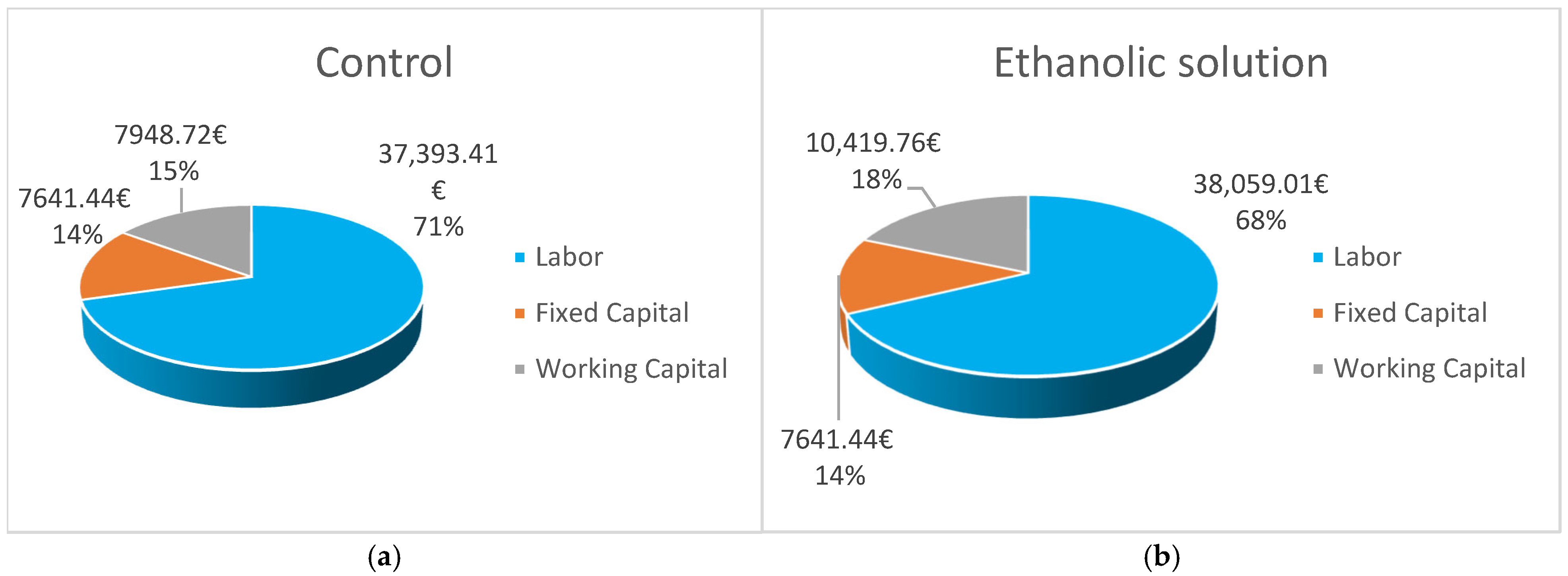
The land rent was calculated at 50 euro per 0.1 hectare and increased progressively due to the expansion of the mother plantation. Labor costs were slightly higher in the case of ES compared to the control for all production years and constituted the largest part of the total production costs of the nurseries (for the 1st year they were calculated at 37,393.41 euro for C and 38,059.01 euro for ES).
The total fixed capital costs did not differ between the two cases and for each year, and for the 1st production year they were 7641.44 euro. As far as the working capital costs, these were higher in the case of ES compared to the control. The largest portion of costs were associated with consumables for preparing cuttings, producing alcoholic solutions, and transplanting rooted plants for sale. In the first production year, expenditure on consumables for ES was 6688.00 euro and reached 110,885.50 euro in the 5th year. Correspondingly, for the control case, the expenditure was calculated at 4412.00 euro (1st year) and 78,050.50 euro (5th year). A similar trend can be seen in the case of other expenses (water, electricity), with a smaller difference between the two cases (4725.00 euro for C and 4825.00 euro for ES for the 5th production year). In
Figure 1, the proportional distribution of production factors within the total production system in the first year, for both cases studied, is illustrated.
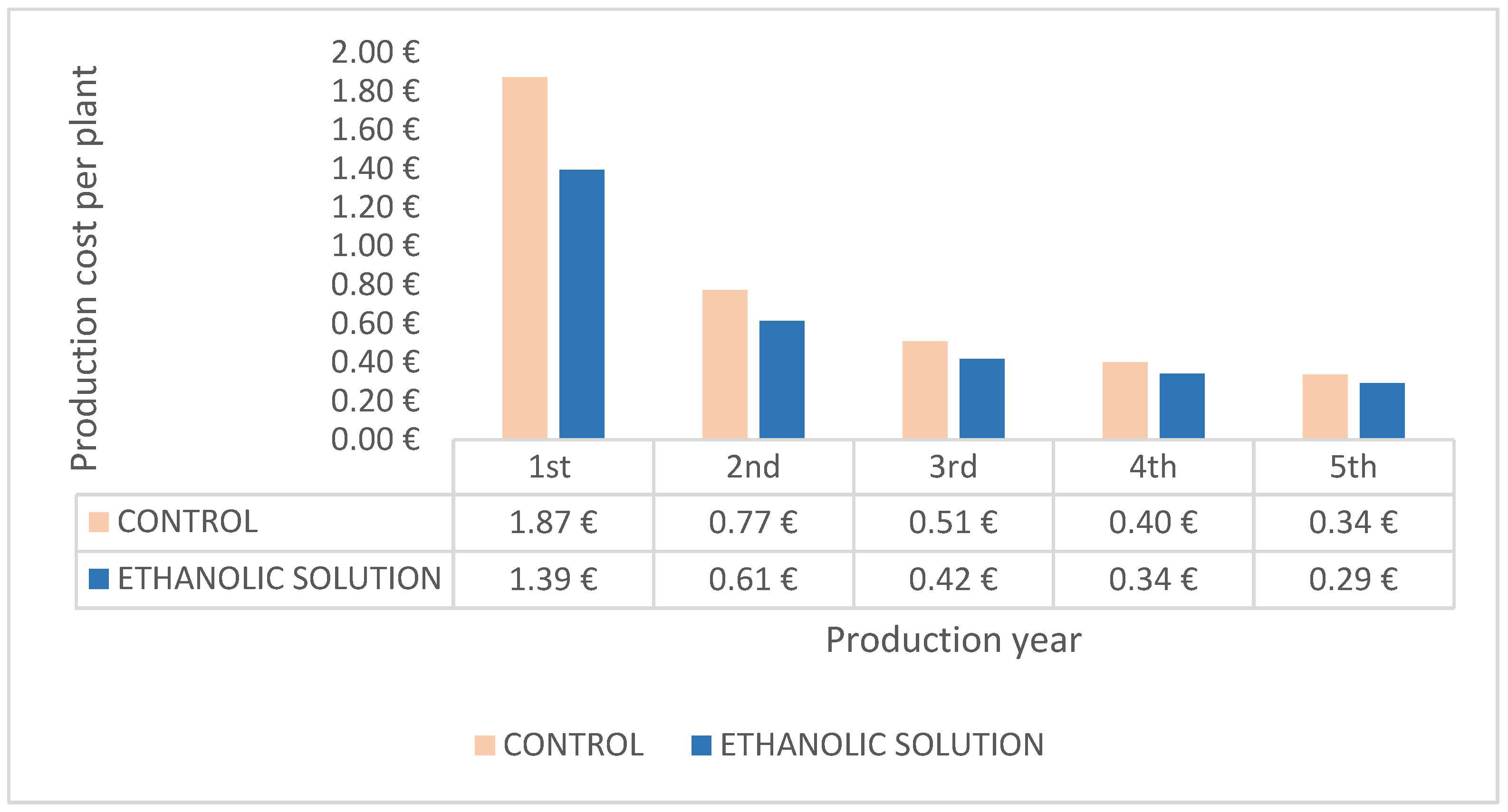
To assess the economic results, the production cost per plant was initially calculated for both treatments across each production year. As total production progressively increased annually in both cases, the corresponding production cost per plant decreased accordingly. Comparing the production cost for the two nurseries, we observe that in the case of the control (C) for all five production years, the per-plant production cost of tea exceeded that of the ethanolic solution method. Indicatively, the first year for case C was 1.87 euro while for ES it was 1.39 euro. In both treatments, increasing production over the years resulted in a progressive reduction in the per-plant production cost.
Figure 2 illustrates the evolution of the production cost for both nurseries.
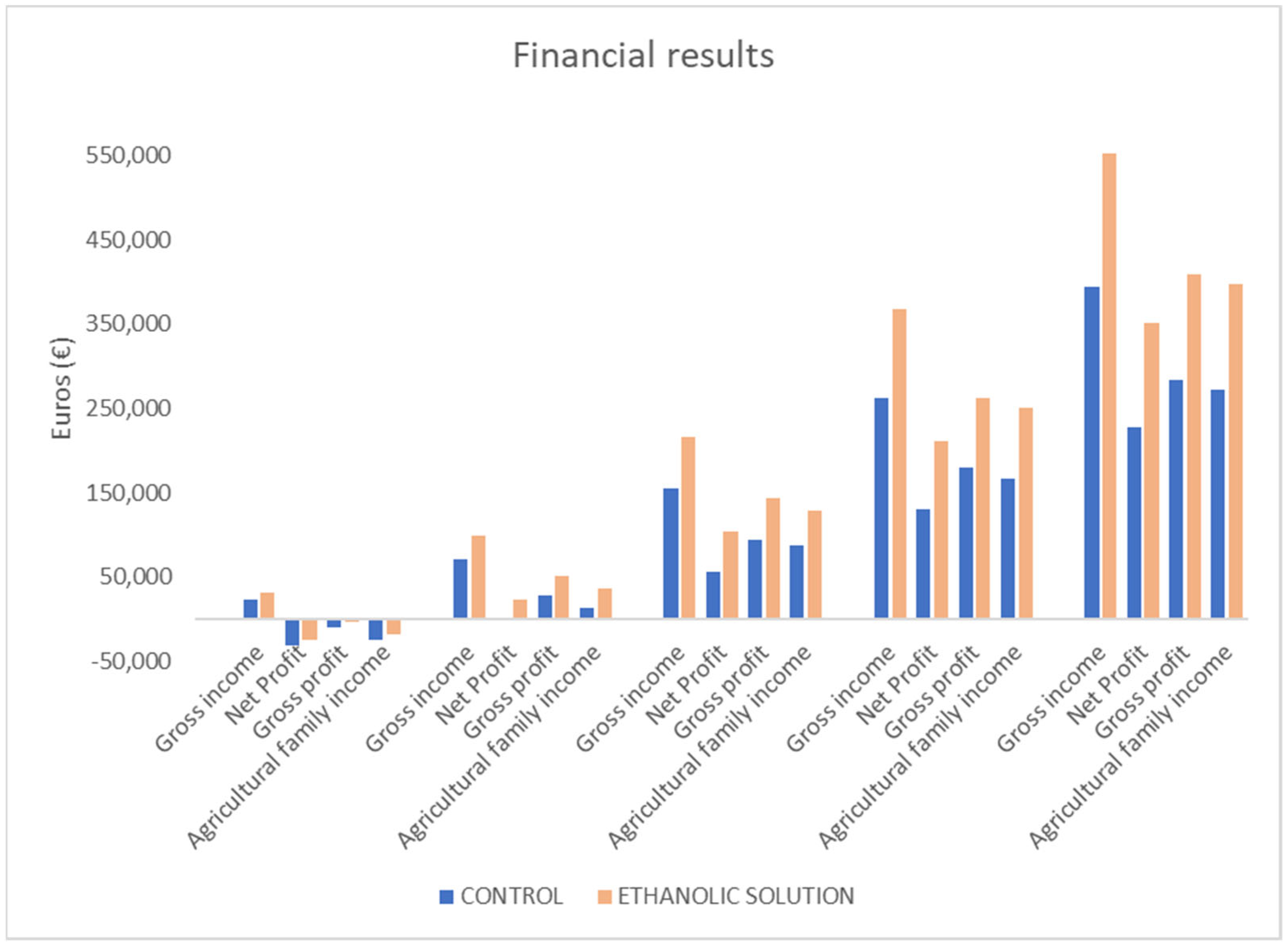
From the comparison of the financial results, a loss (negative net profit) for both nurseries is observed, as the gross income from the sale of the plants was less than the total production cost. From the second year onwards, the financial results are positive for both businesses, showing profitability. However, comparison of the values indicates that the ES treatment exhibited a more pronounced increase in gross income than the control, due to higher plant production. Thus, due to this configuration of the gross income, all the financial results of the exploitation of ethanolic solution (ES) appear higher compared to the control for all five years. It is worth mentioning that the difference in the financial results of all categories is particularly significant between the two cases. Indicatively, the profitability in the second year for the control treatment was only 2376.99 euro, while for ethanolic solution treatment it was 23,083.71 euro.
Figure 3 shows the financial results as they were formed for each nursery, illustrated per productive year.
4. Discussion
According to the study results, it was shown that the effect of vegetative propagation methods can increase rooting rates and accordingly the nursery’s productive potential. Due to these increases, ES showed improved economic performance compared to the control [
18]. From the results evaluation, it was observed that production costs were higher compared to the control, which is attributable to the rising cost of labor and the expenditure on consumable inputs. Production costs increased annually due to production for both cases. As the collection of cuttings from the mother plant increased annually, additional man-hours were required for the maintenance and transplantation of rooted plants, as well as for the preparation of ethanolic solutions. It should be noted that for both cases, the receipt of cuttings from the mother plant was the same and the difference resulted from the higher amount of plants that rooted in the case of ES. Similarly, due to the increased productivity, greater quantities of consumables were initially required for plant management, as well as for the preparation of ethanolic solutions, while the use of hormones further contributed to higher costs [
19].
The increase in plant production in the case of ES resulted in reduced production costs, although the total production expenses were higher [
20]. These costs were distributed across a larger number of plant units, resulting in a lower cost per plant compared to the control, where plant losses were higher and the success rate of rooting was lower. This pattern was consistent across all five production years examined, with a reduced production cost per plant observed in the case of ES.
From the financial results evaluation, it is observed that in the first year both nurseries showed a loss (negative net profit). The reason lies in the restricted growth of the mother plantation, with individual plants unable to yield many cuttings during the first year (no more than 10). This is a phenomenon that occurs in MAPs because perennial plants in the first year of their installation do not grow quickly, while from the second year onwards their growth rate increases, as shown in other studies [
20]. Thus, the gross income from the plants sold is less than the production costs in the first year [
21]. From the second year onwards both nurseries were profitable, with ES showing better financial results compared to the control. Its increased rooting rate led to greater plant production resulting in more plants being sold and therefore a greater gross income. Thus, the net profit was higher in the case of ES, along with the other financial indicators, as these are directly dependent on the amount of gross income.
5. Conclusions
The study and application of new effective methods of vegetative propagation for the reproduction of species (especially those that are endangered) is very important in combination with the preservation of mother plants for the protection and reproduction of their genetic material. In this study, it was shown that the propagation of Sideritis spp. plants can be profitable for nurseries from the second productive year onwards. Based on the methods examined in this study, we conclude that the effect of alternative propagation applications can increase the success rates and lead the agricultural business to high profitability and positive economic results as well as a reduction in production costs. However, the present study is exploratory, so more studies should be carried out both by increasing the sample size and by applying more alternative propagation methods that might further increase productivity, which seems to be the most important factor. Finally, judging by the current situation, policies and measures should be promoted so that both nurseries and producers become convinced of the vegetative propagation advantages and that the easy and low-cost production of seedlings, which can lead to reduced yields and unintended hybridization of species, should be controlled.