1. Introduction
Globally, the construction industry (CI) is deeply interconnected with other sectors of the economy. The sector plays a crucial role in environmental sustainability, economic development, and social well-being. The CI is a significant driver of economic growth, providing the physical foundation for a nation’s development and enhancing the quality of life for citizens [
1,
2]. Similarly, the sector impacts social well-being by providing essential infrastructure, living spaces, services and amenities, which are crucial for community development and quality of life [
2,
3]. The sector significantly influences productivity across various sectors of the economy, serving as a major source of employment for millions of people [
4]. Due to its capacity to generate substantial employment opportunities, there is a need to improve the quality of work and develop the construction labour force to maximise its contribution to national development [
5]. Several challenges are noted to be impeding the maximal contribution of the CI to global sustainability development. An example of such challenges is the high resource consumption and waste generation attributed to the sector. The CI is one of the most resource-intensive and energy-intensive sectors, consuming significant amounts of natural resources, generating substantial waste, and emitting huge amounts of CO
2, which contribute to climate change [
6,
7,
8,
9]. Therefore, there is a need to embrace and implement practices that aim to overcome the various categories of challenges hindering the transition of the CI to a sustainable state.
Achieving sustainability in construction involves addressing the environmental impacts of building materials, construction processes, and the lifecycle of buildings. Some of these solutions include adopting green building materials, reusing structural elements, and implementing eco-responsible and circular economy practices [
6,
8,
10]. Others include the adoption of technological and innovative solutions, the utilisation of green building materials, the implementation of policies and regulations, the introduction of incentives, and the adoption of comprehensive sustainability assessment tools and benchmarks [
10,
11,
12,
13,
14]. These practices are also referred to as sustainable construction practices (SCPs) with the sole aim of minimising and possibly eradicating the numerous adverse impacts of the CI on the natural and human environment.
Over the years, researchers and sustainability proponents have conceptualised various practices that address one or all three pillars of sustainability within the construction space. These practices related to sustainability in construction are often described using multiple terms such as the precautionary principle, biophilia, ecological economics, eco-efficiency, the Natural Step, ecological rucksack, ecological footprint, Factor 4 and Factor 10, and biomimicry [
15]. While these terms are not exhaustive of practices that enable sustainable construction, it is imperative to note that these practices are intentional steps towards minimising the various adverse impacts of the CI on the environment (human and natural). However, biomimicry stood out among the SCPs, as its proponents posit that the concept encapsulates the three pillars of sustainability holistically and comprehensively [
16,
17]. This new sustainability paradigm is revolutionising every sector, yielding innovative solutions to the challenges facing humanity. Considering the numerous potential applications of biomimicry in other sectors, such as agriculture, information and communication technology, healthcare, defence, and many more, it is essential to examine its influence within the architecture, engineering, and construction sphere. Hence, this study aims to examine the potential benefits of biomimicry for sustainable construction from an exploratory factor analysis perspective.
2. Biomimicry as a Sustainable Construction Practice
Biomimicry is an interdisciplinary approach that draws inspiration from living beings in nature to address human challenges efficiently and sustainably [
18,
19,
20]. It is also described as the practice of studying, emulating, mimicking and drawing inspiration from biological mechanisms and structures (nature) to innovate and create sustainable solutions to human problems [
21]. Biomimicry is increasingly known as a promising paradigm to enhance and optimise sustainability in the CI. Biomimicry can serve as an educational and communication tool, a problem-solving methodology, and an interdisciplinary approach to addressing various challenges facing humanity [
22,
23,
24,
25].
The adoption, practice and implementation of biomimicry in the CI have resulted in remarkable outcomes globally. For passive cooling strategies, termite mounds, which maintain stable internal temperatures despite external fluctuations, have inspired the design of buildings with natural ventilation systems that reduce the need for air conditioning [
26]. For building envelopes, human and snake skin have inspired the optimisation of thermal performance and comfort in office buildings, particularly in hot climates, as well as improved energy performance by optimising light and heat regulation, contributing to more sustainable urban landscapes [
19,
27,
28]. By leveraging advanced technologies such as 3D printing and numerical modelling, the lattice pattern of Venus’s flower basket has been utilised to reinforce concrete structures, significantly enhancing their compressive strength and load-carrying capacity [
29]. Contributing to sustainability by reducing the need for frequent repairs and replacements, biomimetic nanoparticles are also being developed for use in construction materials, offering enhanced properties such as self-healing and increased resilience [
30]. These examples illustrate the diverse applications of biomimicry for sustainable construction, highlighting its potential to create eco-conscious, resilient, and efficient built environments.
There are numerous benefits of biomimicry adoption and application for sustainable construction. A major positive contribution of biomimicry to the CI is environmental impact reduction. Biomimicry possesses the potential to significantly reduce the environmental footprint of construction projects by optimising resource use and minimising waste [
31]. The practice of biomimicry promotes the utilisation of nature-inspired materials that are more sustainable and efficient, such as self-healing concrete and energy-efficient building skins [
32]. The application of biomimicry can also enhance energy efficiency in buildings, reduce energy consumption, optimise thermal performance and improve indoor air quality [
27,
33]. Similarly, biomimicry encourages the use of materials and systems that are derived from or inspired by nature (often more sustainable and less harmful to the environment) and supports the conservation of natural resources and biodiversity by promoting designs and structures that work in harmony with the environment [
25,
34]. Therefore, biomimicry offers a transformative approach to sustainable construction by leveraging nature’s time-tested strategies to create innovative, efficient, and environmentally friendly solutions.
Table 1 presents a list of potential benefits of biomimicry for sustainable construction extracted from an extant review of the relevant literature on the subject. The adopted potential benefits for this study metamorphosed from an earlier study that provided a descriptive analysis of the variables [
25]. Hence, this study investigates the perceived benefits of integrating biomimicry principles into the CI to identify the key dimensions that drive its transformative potential.
3. Research Methodology
A quantitative research approach was adopted in this study to evaluate the potential benefits of promoting biomimicry in the South African construction industry. Data were gathered through a well-structured questionnaire survey administered to study participants who are practising and duly registered construction professionals in South Africa. The study was carried out in the Western Cape and Gauteng provinces of South Africa. These two provinces were considered the study area as they are home to significant green buildings, sustainability proponents and practitioners, and a high rate of construction projects. The two provinces are also uncontestably home to the highest number and concentration of green buildings (certified/rated, or unrated) in South Africa. From the 1184 certified projects in South Africa between 2009 and 2023, as reported by the Green Building South Africa (GBCSA), these two provinces account for the majority. The structured questionnaire survey was administered to 120 purposively sampled respondents. The 18 benefit indicators used in the questionnaire were developed through a targeted synthesis of the literature on biomimicry, sustainable construction, and nature-based solutions (NbSs). An initial pool of items was refined through consultation with five biomimicry and sustainability experts. Following this, a pilot test involving 11 biomimicry and sustainable construction professionals was conducted to ensure clarity, relevance, and reliability. All the items were measured on a five-point Likert scale (1 = strongly disagree; 5 = strongly agree). The final validated list of items is provided in
Table 1 to enhance transparency and reproducibility. The aim was to gauge the level at which the respondents agree with the eighteen (18) identified benefits of biomimicry towards driving the sustainable transformation of the CI. A total of 104 completed questionnaires were received and utilised for the analysis. One hundred and four (104) were received back, which represents an eighty-seven percent (87%) response rate. Exploratory factor analysis (EFA) was employed to analyse the collected data using the Statistical Package for Social Sciences (SPSS) software version 21. EFA is a widely used statistical technique that is preferable for its ability to reveal latent variables that can cause the manifest variables to covary [
35,
36]. The Cronbach’s alpha test was used to assess the internal consistency, reliability, and validity of the research instrument. The resulting alpha value of 0.898, obtained for the section on the benefits of biomimicry in sustainable construction in South Africa, demonstrates a high level of reliability and strong validity of the collected data.
4. Results and Discussions
This section presents the results and discussion of data obtained from the structured questionnaires administered to the research respondents/participants. The analysis of the data and interpretation of the results were based on the questionnaire study and served as the basis for this quantitative data collection.
4.1. Demographic Analysis of the Respondents
Regarding the demographic breakdown of the respondents, 53.8% were male, and 46.2% were female. The distribution of respondents according to their professional affiliation revealed that 24% were biomimicry professionals/specialists, 19.2% were quantity surveyors, 18.3% were architects, 15.4% were engineers, and 11.5% were construction managers or project managers, respectively. The distribution of the respondents according to their years of experience showed that 53.8% have 1–5 years of experience, 20.2% have 6–10 years of experience, 15.4% have 11–15 years of experience, 4.8% have 16–20 years of experience, and 5.8% have more than 20 years of experience. The majority (54.8%) of the respondents hold a master’s degree, 25% hold a bachelor’s degree, 11.5% hold a diploma, and 8.7% hold a doctorate degree.
4.2. Exploratory Factor Analysis of the Benefits of Biomimicry for Sustainable Construction
This section presents the results from the exploratory factor analysis (EFA) on the potential benefits of biomimicry for sustainable construction in South Africa.
Table 1 provides the results of the exploratory factor analysis (EFA) of the benefits of biomimicry for sustainable construction in South Africa. The table contains the factor loadings of the eighteen individual benefits across four identified components, reflecting the strength of association between each benefit and its corresponding factor. Higher loadings denote stronger relationships. Before performing the PCA, the suitability of the data for factor analysis was assessed. The final sample of 104 respondents produced a fit subject-to-item ratio, acceptable for EFA, where communalities exceed 0.50. Inspection of the correlation matrix revealed the presence of coefficients above 0.3. The Kaiser–Meyer–Olkin (KMO) measure of sampling adequacy achieved a high value of 0.756, exceeding the recommended minimum value of 0.6. Bartlett’s Test of Sphericity (
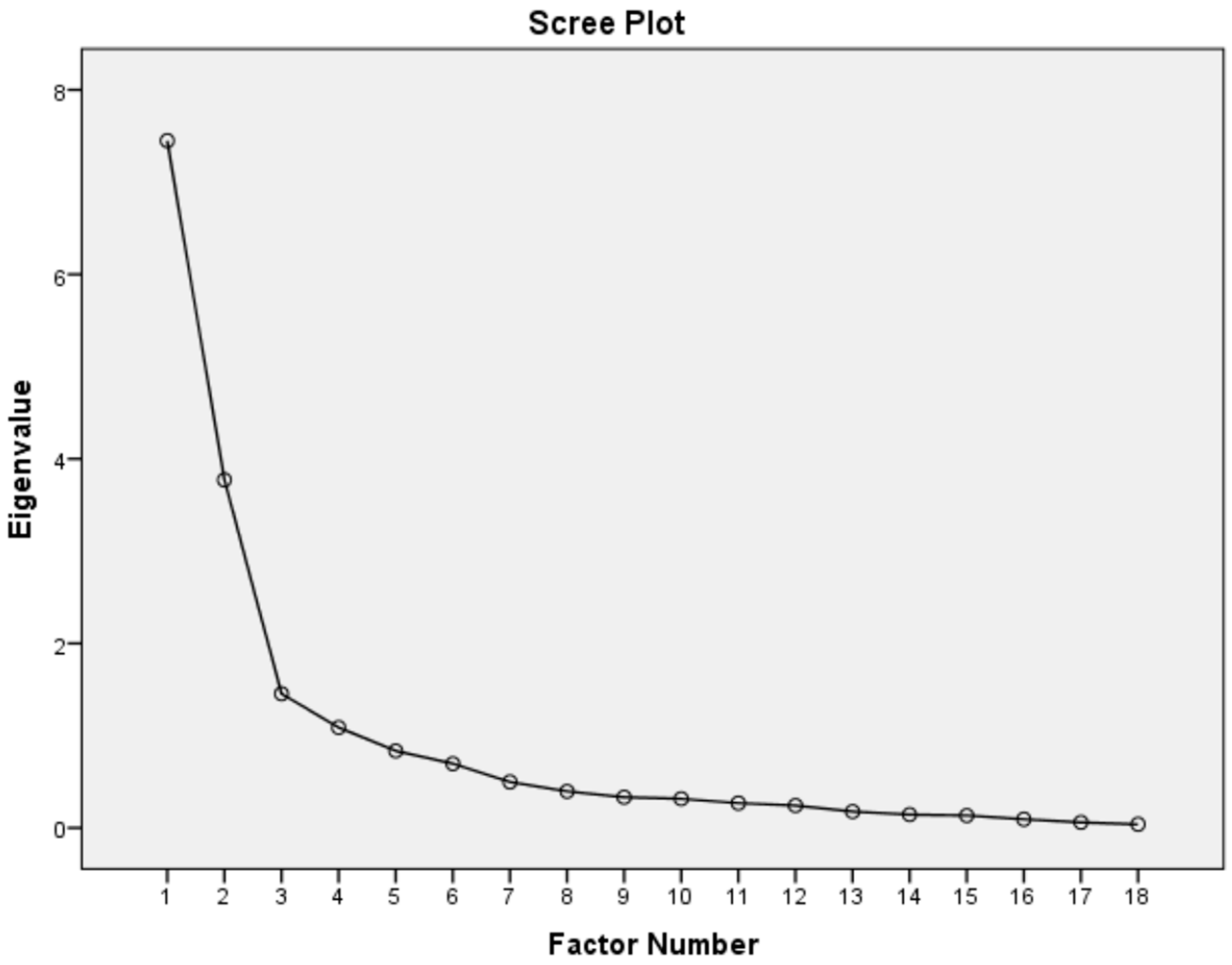
p < 0.05) confirms the suitability of the dataset for factor analysis, indicating a statistically significant level of intercorrelation among the variables. The data was subjected to PCA (with varimax rotation). The eigenvalue was set at conventional high values of 1.0. As shown in
Table 2, four (4) factors with eigenvalues exceeding 1.0 were extracted. The scree plot presented in
Figure 1 also revealed the excluded factors by indicating the cut-off point at which the eigenvalues levelled off. The total variance explained by each of the extracted factors is as follows: Factor 1 (41.383%), Factor 2 (20.955%), Factor 3 (8.083%), and Factor 4 (6.045%), as shown in
Table 3. Thus, the final statistics of the PCA and the extracted factors accounted for approximately 70 percent of the total cumulative variance. These factor loadings elucidate the benefits most strongly aligned with each component, thereby providing a clear understanding of the key domains through which biomimicry can advance sustainable construction practices.
Factor One (Improved Quality of Human Life): As presented in
Table 2, the seven (7) extracted benefits for Factor 1 were improve overall quality of life (88.3%), create employment opportunities (84.0%), create new business opportunities (83.8%), enhance occupant comfort and health (83.1%), minimise strain on local infrastructure (79.4%), heighten aesthetic qualities (69.9%), and optimise lifecycle economic performance (56.1%). The number in parentheses indicates the respective factor loadings, and the cluster accounted for 41.4 percent of the variance. Thus, Factor One affirms the socio-economic and human-wellbeing dimension of biomimicry. Incorporating biophilic and biomimetic elements into built environments has the potential to enhance both mental and physical health, as nature-inspired designs have been proven to reduce stress, improve mood, and promote overall well-being [
37]. Incorporating the principles of biomimicry also significantly minimises the susceptibility of occupants to sick building syndrome (SBS) and other health conditions associated with the CI. Biomimicry offers innovative solutions to enhance human health and quality of life by improving indoor air quality through natural filtration methods and better building designs, and reducing the prevalence of SBS by addressing its environmental and biological causes [
38,
39,
40]. By leveraging nature-inspired designs, biomimicry not only addresses immediate health concerns but also promotes sustainable living environments, ultimately leading to a higher quality of life.
Factor Two (Environmental Protection and Friendliness): The six (6) extracted benefits for Factor 2 were conserve natural resources (89.0%), reduce waste streams (83.9%), improve water quality (76.9%), protect biodiversity (73.0%), improve air quality (65.7%), and restore natural resources (53.9%) as presented in
Table 2. The number in parentheses indicates the respective factor loadings, and the cluster accounted for 21.0 percent of the variance. Thus, Factor Two confirms the environmental protection and ecological resilience dimension of biomimicry. By adopting biomimicry principles, the CI can achieve sustainable parameters, including optimised energy use, reduced carbon emissions, zero waste, material efficiency, creation of eco-friendly structures, reduced resource consumption, and lower pollution, among others. Achieving these indicators ensures the practice of biomimicry supports biodiversity, ecological health and environmental protection [
30,
41].
Factor Three (Improved Human Productivity): This cluster accounted for 8.1% of the variance. The three (3) extracted benefits for Factor 3 were: minimise occupant absenteeism (76.3%), improve occupant productivity (67.4%), and improve the image of the building (59.4%) as presented in
Table 2. The number in parentheses indicates the respective factor loadings. Thus, Factor Three highlights biomimicry’s contribution to productivity and organisational performance. The application of biomimicry has been shown to improve thermal comfort, optimise energy use, enhance emotional state, reduce stress, and increase the overall productivity of building occupants [
27,
42]. Biomimicry also fosters innovation and creativity by encouraging designers to draw inspiration from nature for sustainable solutions and products that can improve human productivity.
Factor Four (market for green products and services): As presented in
Table 2, only two (2) benefits were extracted for Factor 4, namely create markets for green products and services (81.4%) and expand markets for green products and services (53.8%). The number in parentheses also indicates the factor loadings, and the cluster accounted for 6.0 percent of the variance. Thus, Factor Four reflects the market and innovation dimension of biomimicry. Biomimicry significantly enhances the market for green products and services by driving innovation, improving sustainability, and appealing to consumer preferences. Products designed using biomimicry often have enhanced functional, structural and sustainable properties that appeal to consumers. These attributes potentially increase consumer willingness to pay a premium for green products, resulting in cost savings and faster product development, which makes green products more competitive in the market, as observed in various studies on bio-based products [
43,
44]. Similarly, biomimicry helps differentiate products in the market by offering unique, nature-inspired solutions that stand out from conventional products, thereby attracting consumers looking for innovative and sustainable options and ultimately expanding the market for green products [
45].
5. Conclusions and Recommendations
This study investigated the perceived benefits of applying biomimicry principles to the construction sector in South Africa and used exploratory factor analysis to uncover the underlying structure of those benefits. The EFA produced four clear factors: improved quality of human life, environmental protection and friendliness, improved human productivity, and market for green products and services, which together explain a large proportion of the variance in stakeholder perceptions. These results indicate a robust internal structure to how construction and biomimicry professionals perceive the value of biomimicry for sustainable construction. The first factor highlights that biomimicry is perceived as a means to enhance occupant comfort, health, social well-being, and local economic opportunities (employment and new businesses). The second factor demonstrates stakeholders’ belief that biomimicry can materially reduce resource consumption, waste streams, and pollution while supporting biodiversity and restoration of natural systems. The third factor highlights the role of biomimetic design in reducing absenteeism, enhancing occupant productivity, and increasing the social and reputational value of buildings. Lastly, the fourth factor suggests that biomimicry can stimulate markets for sustainable products and services, helping to expand commercial opportunities for green innovations. Altogether, these findings provide empirical support for the view that biomimicry is more than an aesthetic or technological curiosity but a multi-dimensional approach that can simultaneously advance sustainability objectives in the built environment. The study, therefore, positions biomimicry as a practicable pathway for moving the construction industry toward regenerative and circular practices that align with contemporary sustainability goals.
To accelerate its adoption, the study recommends that industry stakeholders, including architects, engineers, contractors, educators, and policymakers, should collaboratively develop frameworks, tools, and guidelines that integrate biomimicry principles into design, construction, and materials development. Similarly, governmental and professional bodies should establish supportive policies and incentive structures that encourage the use of biomimetic approaches in building codes, environmental assessment standards, and research funding priorities. Academic and research institutions should also expand interdisciplinary curricula and programmes that link the natural sciences and built environment disciplines to foster the next generation of biomimicry-informed professionals. Furthermore, continuous professional development (CPD) workshops, conferences, trade fairs/shows, and pilot demonstration projects are needed to showcase the practical and economic viability of biomimicry-inspired solutions. Future research should focus on quantifying the long-term environmental and economic performance of biomimetic designs through lifecycle assessment and post-occupancy evaluation, as well as exploring digital technologies such as artificial intelligence, parametric modelling, and additive manufacturing for translating biological strategies into scalable construction applications.
6. Future Research Directions
Although this study provides an empirically grounded understanding of the perceived benefits of biomimicry for sustainable construction in South Africa, several avenues warrant further investigation to deepen, validate, and extend the emerging evidence base. Future studies should undertake comparative analyses across international contexts to examine how biomimicry is applied in regions with different climatic, socio-economic, regulatory, and cultural conditions. Such studies would help determine the generalisability of the four-factor structure identified in this research and illuminate context-specific barriers or enablers of adopting biomimicry for sustainable construction. The current study employed an exploratory factor analysis (EFA). Therefore, future quantitative research should apply confirmatory factor analysis (CFA) and structural equation modelling to validate the factor structure and test the causal pathways through which biomimicry influences sustainability outcomes. Similarly, longitudinal studies would further clarify how perceptions, capabilities, and adoption patterns evolve within the construction industry.
Also, there is a need to operationalise biomimicry through performance-based evaluation frameworks that measure environmental, social, and economic outcomes. Developing a bio-inspired building performance model (integrating lifecycle assessment, post-occupancy evaluation, and ecological metrics) would provide robust evidence of long-term value, strengthen investment decisions, and support policy formulation. Advancements in digital and computational technologies also present opportunities to enhance the translation of biomimetic design. Research integrating artificial intelligence, machine learning, parametric modelling, and additive manufacturing can support the systematic extraction, simulation, and optimisation of natural strategies for construction industry applications. Investigating these tools may bridge the gap between biological inspiration and practical implementation. Lastly, further research is needed to understand the institutional, educational, and market dynamics that shape the adoption of biomimicry for sustainable construction. This includes examining organisational readiness, curriculum integration in built environment programmes, professional competencies, and market demand for bio-inspired products and services. Policy-oriented studies exploring incentives, regulatory frameworks, and procurement standards would also provide insights into how biomimicry can be mainstreamed at scale.
Author Contributions
Conceptualisation, O.A.O. and C.O.A.; methodology, O.A.O.; software, O.A.O.; validation, O.A.O. and C.O.A.; formal analysis, O.A.O. and C.O.A.; resources, C.O.A.; data curation, O.A.O.; writing—original draft preparation, O.A.O.; writing—review and editing, C.O.A.; supervision, C.O.A.; project administration, O.A.O. and C.O.A.; funding acquisition, O.A.O. and C.O.A. All authors have read and agreed to the published version of the manuscript.
Funding
This research received no external funding.
Institutional Review Board Statement
The study was conducted in accordance with the Declaration of Helsinki, and the protocol was reviewed and approved by the Faculty Ethics and Plagiarism Committee (FEPC) of the Faculty of Engineering and the Built Environment at the University of Johannesburg with approval number UJ_FEBE_FEPC_00019.
Informed Consent Statement
Informed consent for participation was obtained from all subjects involved in the study.
Data Availability Statement
The raw data supporting the conclusions of this article will be made available by the authors on request.
Acknowledgments
The researchers appreciate the valuable time and insight the respondents committed to the survey. The cidb Centre of Excellence at the University of Johannesburg, Department of Built Environment, Faculty of Engineering, Built Environment and Information Technology, Directorate of Research and Innovation, Walter Sisulu University and the National Research Foundation, South Africa, are all acknowledged.
Conflicts of Interest
The authors declare no conflicts of interest.
References
- Ofori, G. The built environment, construction, development and their implications for labour. In Routledge Handbook on Labour in Construction and Human Settlements; Routledge: London, UK, 2023; pp. 12–38. [Google Scholar]
- Chirisa, I.; Muneta, Z. The built environment as a value chain process. In New Urban Agenda in Zimbabwe: Built Environment Sciences and Practices; Springer Nature: Singapore, 2024; pp. 15–29. [Google Scholar]
- Bröchner, J. The changing nature of the built environment: An economic perspective. In Economics for the Modern Built Environment; Routledge: London, UK, 2008; pp. 31–53. [Google Scholar]
- Russell, J.S.; Hanna, A.; Bank, L.C.; Shapira, A. Education in construction engineering and management built on tradition: Blueprint for tomorrow. J. Constr. Eng. Manag. 2007, 133, 661–668. [Google Scholar] [CrossRef] [Scilit]
- Ofori, G.; Werna, E. Introducing the Routledge handbook on labour in construction and human settlements: The built environment at work. In Routledge Handbook on Labour in Construction and Human Settlements; Routledge: London, UK, 2023; pp. 1–11. [Google Scholar]
- Muntean, R.; Felseghi, R.A.; Cobirzan, N. Eco-responsibility and circular economy in the green (sustainable) built environment. In Circular Economy Implementation for Sustainability in the Built Environment; IGI Global: Hershey, PA, USA, 2023; pp. 57–83. [Google Scholar]
- Isopescu, D.N. The impact of green building principles in the sustainable development of the built environment. IOP Conf. Ser. Mater. Sci. Eng. 2018, 399, 012026. [Google Scholar] [CrossRef] [Scilit]
- Kanyilmaz, A.; Birhane, M.; Fishwick, R.; del Castillo, C. Reuse of steel in the construction industry: Challenges and opportunities. Int. J. Steel Struct. 2023, 23, 1399–1416. [Google Scholar] [CrossRef] [Scilit]
- Sesana, M.M.; Dell’Oro, P. Sustainability and resilience assessment methods: A literature review to support the decarbonisation target for the construction sector. Energies 2024, 17, 1440. [Google Scholar] [CrossRef] [Scilit]
- Jakhar, R.; Jain, S. Exploring green materials for building a sustainable future: Need, challenges, and strategies. In Eco-Materials and Green Energy for a Sustainable Future; CRC Press: Boca Raton, FL, USA, 2023; pp. 3–21. [Google Scholar]
- Kibert, C.J. The next generation of sustainable construction. Build. Res. Inf. 2007, 35, 595–601. [Google Scholar] [CrossRef] [Scilit]
- Hansen, K.L.; Vanegas, J. A guiding vision, road map, and principles for researching and teaching sustainable design and construction. In Proceedings of the 2006 Annual Conference & Exposition, Chicago, IL, USA, 18 June–21 June 2006; ASEE: Chicago, IL, USA, 2006; pp. 11–49. [Google Scholar]
- Mankata, L.M.; Antwi-Afari, P.; Frimpong, S.; Ng, S.T. Material passports in construction waste management: A systematic review of contexts, stakeholders, requirements, and challenges. Buildings 2025, 15, 1825. [Google Scholar] [CrossRef] [Scilit]
- Boz, M.A.; El-adaway, I.H. Creating a holistic systems framework for sustainability assessment of civil infrastructure projects. J. Constr. Eng. Manag. 2015, 141, 04014067. [Google Scholar] [CrossRef] [Scilit]
- Kibert, C.J. Sustainable Construction: Green Building Design and Delivery, 3rd ed.; John Wiley & Sons: Hoboken, NJ, USA, 2016. [Google Scholar]
- Oguntona, O.A.; Aigbavboa, C.O. Barriers hindering biomimicry adoption and application in the construction industry. Afr. J. Sci. Technol. Innov. Dev. 2019, 11, 289–297. [Google Scholar] [CrossRef] [Scilit]
- Oguntona, O.A.; Aigbavboa, C.O. Nature inspiration, imitation, and emulation: Biomimicry thinking path to sustainability in the construction industry. Front. Built Environ. 2023, 9, 1085979. [Google Scholar] [CrossRef] [Scilit]
- Yazıcı, A.M. Biomimicry and agile leadership in Industry 4.0. In Agile Business Leadership Methods for Industry 4.0; Emerald Publishing: Bingley, UK, 2020; pp. 155–170. [Google Scholar]
- Cuce, E.; Nachan, Z.; Cuce, P.M.; Sher, F.; Neighbour, G.B. Strategies for ideal indoor environments towards low/zero carbon buildings through a biomimetic approach. Int. J. Ambient Energy 2019, 40, 86–95. [Google Scholar] [CrossRef] [Scilit]
- Ilieva, L.; Ursano, I.; Traista, L.; Hoffmann, B.; Dahy, H. Biomimicry as a sustainable design methodology—Introducing the ‘biomimicry for sustainability’ framework. Biomimetics 2022, 7, 37. [Google Scholar] [CrossRef] [Scilit]
- Lurie-Luke, E. Product and technology innovation: What can biomimicry inspire? Biotechnol. Adv. 2014, 32, 1494–1505. [Google Scholar] [CrossRef] [Scilit]
- Yeter, I.H.; Tan, V.S.Q.; Le Ferrand, H. Conceptualization of biomimicry in engineering context among undergraduate and high school students: An international interdisciplinary exploration. Biomimetics 2023, 8, 125. [Google Scholar] [CrossRef] [Scilit]
- Singh, M.; Øvsthus, K.; Kampen, A.L.; Dhungana, H. Development of a biologically inspired condition management system for equipment. In International Congress and Workshop on Industrial AI; Springer Nature: Cham, Switzerland, 2023; pp. 319–331. [Google Scholar]
- McMahon, M.; Erolin, C. Biomimicry—Medical design concepts inspired by nature. J. Vis. Commun. Med. 2024, 47, 27–38. [Google Scholar] [CrossRef] [Scilit] [PubMed]
- Oguntona, O.A.; Aigbavboa, C.O. Benefits of biomimicry adoption and implementation in the construction industry. In Advances in Human Factors, Sustainable Urban Planning and Infrastructure, Proceedings of the International Conference on Applied Human Factors and Ergonomics, Orlando, FL, USA, 21–25 July 2018; Springer International Publishing: Cham, Switzerland, 2018; pp. 506–514. [Google Scholar]
- Chaudhary, S.; Singh, R.; Zore, A.S.; Upadhyay, A.; Lindenberger, C.; Vivekanand, V. Bioinspired technology in society: Ethical and architectural innovations for sustainable development. Technol. Soc. 2024, 78, 102688. [Google Scholar] [CrossRef] [Scilit]
- Elsakksa, A.; Marouf, O.; Madkour, M. Biomimetic approach for thermal performance optimisation in sustainable architecture: Case study of office buildings in hot climate countries. IOP Conf. Ser. Earth Environ. Sci. 2022, 1113, 012004. [Google Scholar] [CrossRef] [Scilit]
- Fernandes, M.C. Mechanics of Biologically Inspired Structures and Flexible Mechanical Metamaterials. Ph.D. Thesis, Harvard University, Cambridge, MA, USA, 2021. [Google Scholar]
- Nachiar, S.; Anandh, S.; Kowsalya, M. Numerical and experimental investigations on bio-inspired lattice forms as structural reinforcement. Bioinspired Biomim. Nanobiomater. 2025, 14, 32–45. [Google Scholar]
- Kumar, J.V.; Radhakrishnan, K.; Suriyaprakash, R. Nature’s blueprints: Biomimicry and the evolution of sustainable materials. In Breaking Boundaries: Pioneering Sustainable Solutions Through Materials and Technology; Springer Nature: Singapore, 2025; pp. 143–161. [Google Scholar]
- Silva, F.H.Y.D.; Perera, B.A.K.S.; Atapattu, A.M.D.S.; Wijewickrama, M.K.C.S. Adaptability of biomimicry applications in improving the sustainability in the construction industry. Environ. Dev. 2025, 55, 101197. [Google Scholar] [CrossRef] [Scilit]
- Li, F.; Fornasiero, P.; Xu, P.; Jia, H.; Xu, J.; Sun, H.; Müllen, K.; Zhang, X.; Novoselov, K.S. Nature-Inspired Living Materials for Health, Energy, and Sustainability. ACS Appl. Bio Mater. 2025, 8, 10483–10505. [Google Scholar] [CrossRef] [Scilit]
- Bankar, M.; Jogdand, V. Feasibility study of adaptation of biomimicry approach in green building. E3S Web Conf. 2020, 170, 06010. [Google Scholar] [CrossRef] [Scilit]
- Oguntona, O.A.; Aigbavboa, C.O. Promoting biomimetic materials for a sustainable construction industry. Bioinspired Biomim. Nanobiomater. 2017, 6, 122–130. [Google Scholar] [CrossRef] [Scilit]
- Ajmal, M.; Malik, M.; Saber, H. Factor analysing project management practices in the United Arab Emirates. Int. J. Manag. Proj. Bus. 2017, 10, 749–769. [Google Scholar] [CrossRef] [Scilit]
- Osborne, J.W.; Costello, A.B. Best practices in exploratory factor analysis: Four recommendations for getting the most from your analysis. Pan-Pac. Manag. Rev. 2009, 12, 131–146. [Google Scholar]
- Ratnasari, A.; Dwisusanto, Y.B. Biophilic design as a bridge for human–environment interaction to enhance users’ health and well-being. IOP Conf. Ser. Earth Environ. Sci. 2025, 1488, 012068. [Google Scholar] [CrossRef] [Scilit]
- Tkachenko, T.; Mileikovskyi, V. Solution of sick building syndrome problem using indoor plants. Procedia Environ. Sci. Eng. Manag. 2019, 6, 405–411. [Google Scholar]
- Menetrez, M.Y. Antimicrobial treatments of mold and bacteria. Environ. Res. J. 2011, 5, 775. [Google Scholar]
- Pardo, A.; Israeli, E. The sick building syndrome as a part of the autoimmune (autoinflammatory) syndrome induced by adjuvant. In Autoimmune Disorders: Adjuvants and Other Risk Factors in Pathogenesis; Springer: Berlin, Germany, 2024; pp. 155–166. [Google Scholar]
- Pedersen Zari, M.; Hecht, K. Biomimicry for regenerative built environments: Mapping design strategies for producing ecosystem services. Biomimetics 2020, 5, 18. [Google Scholar] [CrossRef] [Scilit] [PubMed]
- Souter-Brown, G. Urban greenery for health: Sensory gardens and improved well-being. In Designing Therapeutic Environments; Routledge: London, UK, 2024; pp. 219–236. [Google Scholar]
- Skouloudis, A.; Malesios, C.; Lekkas, D.F.; Panagiotopoulou, A. Consumer preferences in Greece for bio-based products: A short communication. Circ. Econ. Sustain. 2023, 3, 1065–1076. [Google Scholar] [CrossRef] [Scilit]
- Ruggeri, G.; Mazzocchi, C.; Bergamelli, C.; Tosca, A. Plant the pot! Understanding consumer willingness to pay for sustainability in garden shop products. J. Clean. Prod. 2024, 477, 143855. [Google Scholar] [CrossRef] [Scilit]
- Hull, C.E.; Russell, J.D.; Kukar-Kinney, M. Evaluating sustainability as a core competency: Consumer response to sustainable products. In Back to the Future: Using Marketing Basics to Provide Customer Value, Proceedings of the Academy of Marketing Science Annual Conference, Coronado, CA, USA, 24–26 May 2017; Springer International Publishing: Cham, Switzerland, 2017; pp. 529–530. [Google Scholar]
| Disclaimer/Publisher’s Note: The statements, opinions and data contained in all publications are solely those of the individual author(s) and contributor(s) and not of MDPI and/or the editor(s). MDPI and/or the editor(s) disclaim responsibility for any injury to people or property resulting from any ideas, methods, instructions or products referred to in the content. |
© 2025 by the authors. Licensee MDPI, Basel, Switzerland. This article is an open access article distributed under the terms and conditions of the Creative Commons Attribution (CC BY) license (https://creativecommons.org/licenses/by/4.0/).