Proceeding Paper

Enhancing Compressive Performance of Gyroid Structures Through Evolutionary Design †

by
Gaurab Sundar Dutta
*,
Fabian Hartkopf
and
Leif Steuernagel
Institute of Polymer Materials and Plastics Engineering, Clausthal University of Technology, Agricolastr. 6, 38678 Clausthal-Zellerfeld, Germany
*
Author to whom correspondence should be addressed.
Presented at the 2nd International Online Conference on Biomimetics (IOCB 2025), 16–18 September 2025; Available online: https://sciforum.net/event/IOCB2025.
Proceedings 2025, 132(1), 1; https://doi.org/10.3390/proceedings2025132001
Published: 19 November 2025
(This article belongs to the Proceedings of The 2nd International Online Conference on Biomimetics)

Abstract

Gyroids are fascinating natural structures characterized by their local minimum surface area with equal periodicity in all three spatial directions, making them continuous and isotropic. Such intricate patterns have led to various lightweight innovative constructions. This article proposes a novel approach to enhance their compressive performance via edge modification, taking inspiration from biomimicry, specifically following a plant-growth algorithm. Later, a patch surface was generated using these edges, while maintaining the same aspect ratio. The 3D-printed prototypes were tested under compressive load and further validated using FE analysis. The results provide good evidence for modified gyroids being superior, as compared to conventional gyroids.

1. Motivation

Gyroids belong to a fascinating family of structures known as triply periodic minimal surfaces (TPMSs) and are of significant interest to physical scientists, biologists, and mathematicians due to their unique properties. A minimal surface, such as a soap film, is characterized by its local minimum surface area. This means that any small section of the surface will have the smallest possible surface area among all surfaces with the same boundaries. Thus, a minimal surface will have a zero-mean curvature. The term ‘triply periodic’ refers to the equal periodicity in all three spatial directions, which makes these surfaces continuous and isotropic. Over the past century, numerous surfaces have been classified within the TPMS family, and they can be found in a wide range of systems, such as block copolymers, nanocomposites, micellar materials, lipid–water systems, cell membranes, etc. [1,2]. Gyroids, one of the family of TPMSs, exist in various biological structures, e.g., butterfly wing scales, bird feathers, etc., [3,4,5] where depending on the occurrence, the intricate patterns of gyroid structures provide characteristic colors, strength, flexibility, and necessary insulation.
Although the mathematical model of the gyroid structure was developed back in the 1970s [6], the complexity of the structure hindered its practical applications in engineering. However, with the recent developments in Additive Manufacturing (AM) technologies and design software, engineers are now able to design and manufacture such geometries up to intricate details [7]. As a result, numerous studies have demonstrated the viability of gyroid structures as a superior alternative for applications requiring high energy absorption, mechanical strength-to-weight ratio, permeability, etc. This has led to the development of innovative applications, including lattice structures in sandwich panels for automotive and aerospace industries, as well as various biomedical applications such as bone implants, intervertebral devices, etc. [8].
Here, the objective was to enhance the compressive performance of such structures while keeping the basic aspect ratio intact. This is achieved by decomposing the gyroid surface into its basic constituent surface element and then rebuilding the surface through edge modification following biomimicry, specifically following a plant-growth algorithm [9]. The modified gyroid was then reconstructed via reverse engineering, and subsequent tests were conducted to evaluate the performance of such a pseudo-gyroid geometry in contrast to a conventional gyroid structure generated under similar conditions.

2. Design Methodology

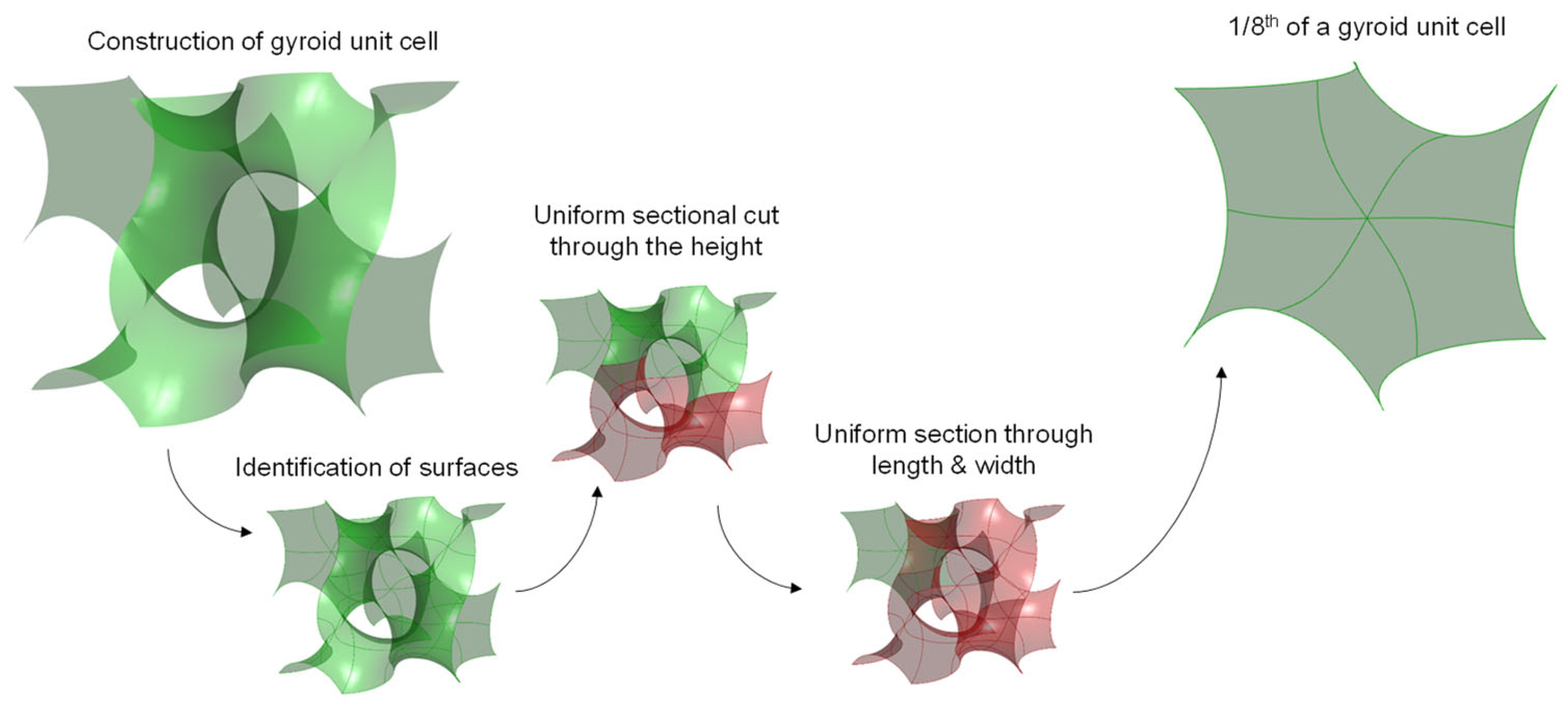
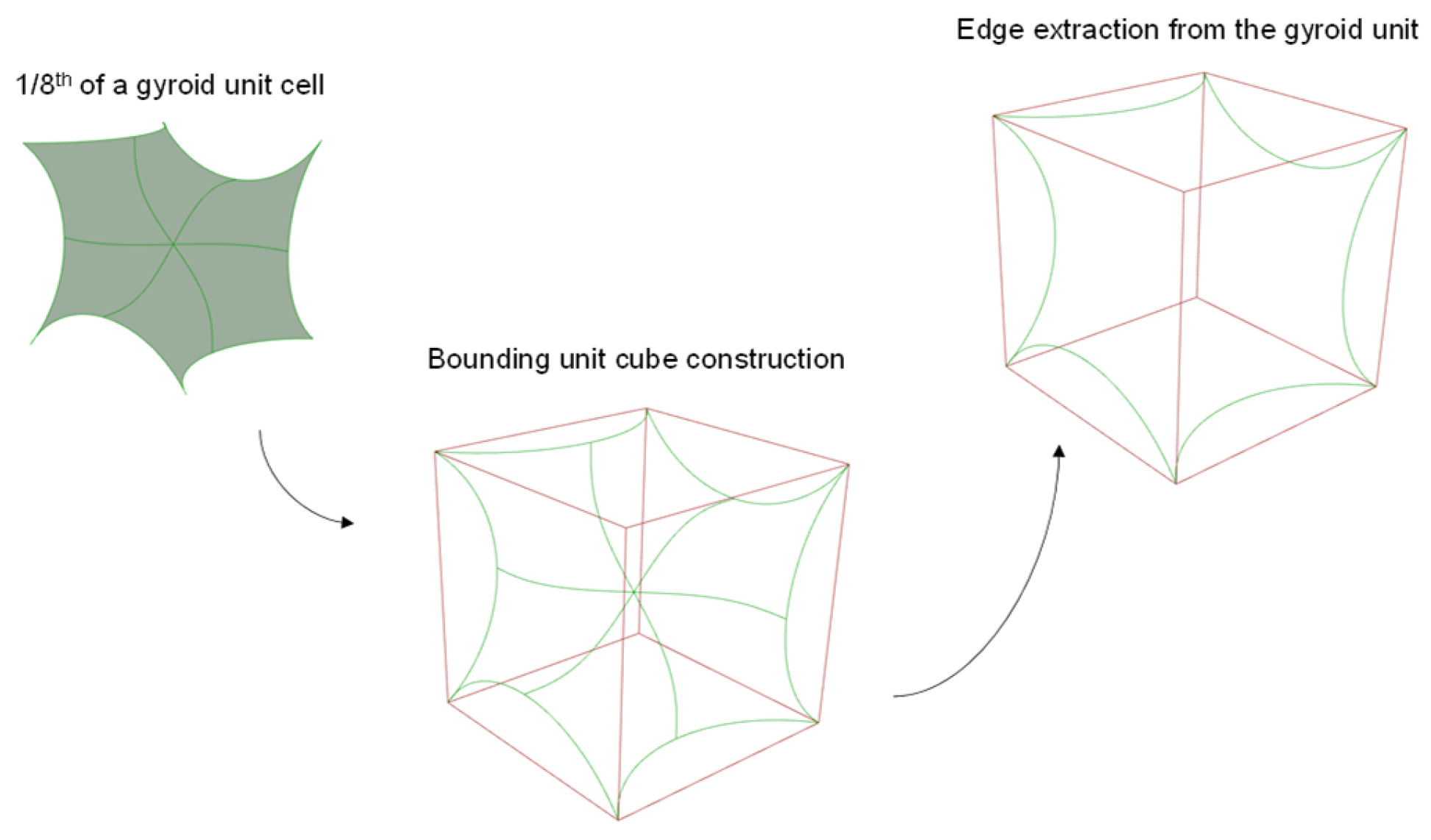
To extract the basic constituent surface of a gyroid unit cell, geometrical operations inside the Grasshopper 1.0.0008 parametric tool within the Rhino 5 solid modeling domain were conducted. Figure 1 and Figure 2 describe the step-by-step deconstruction process.
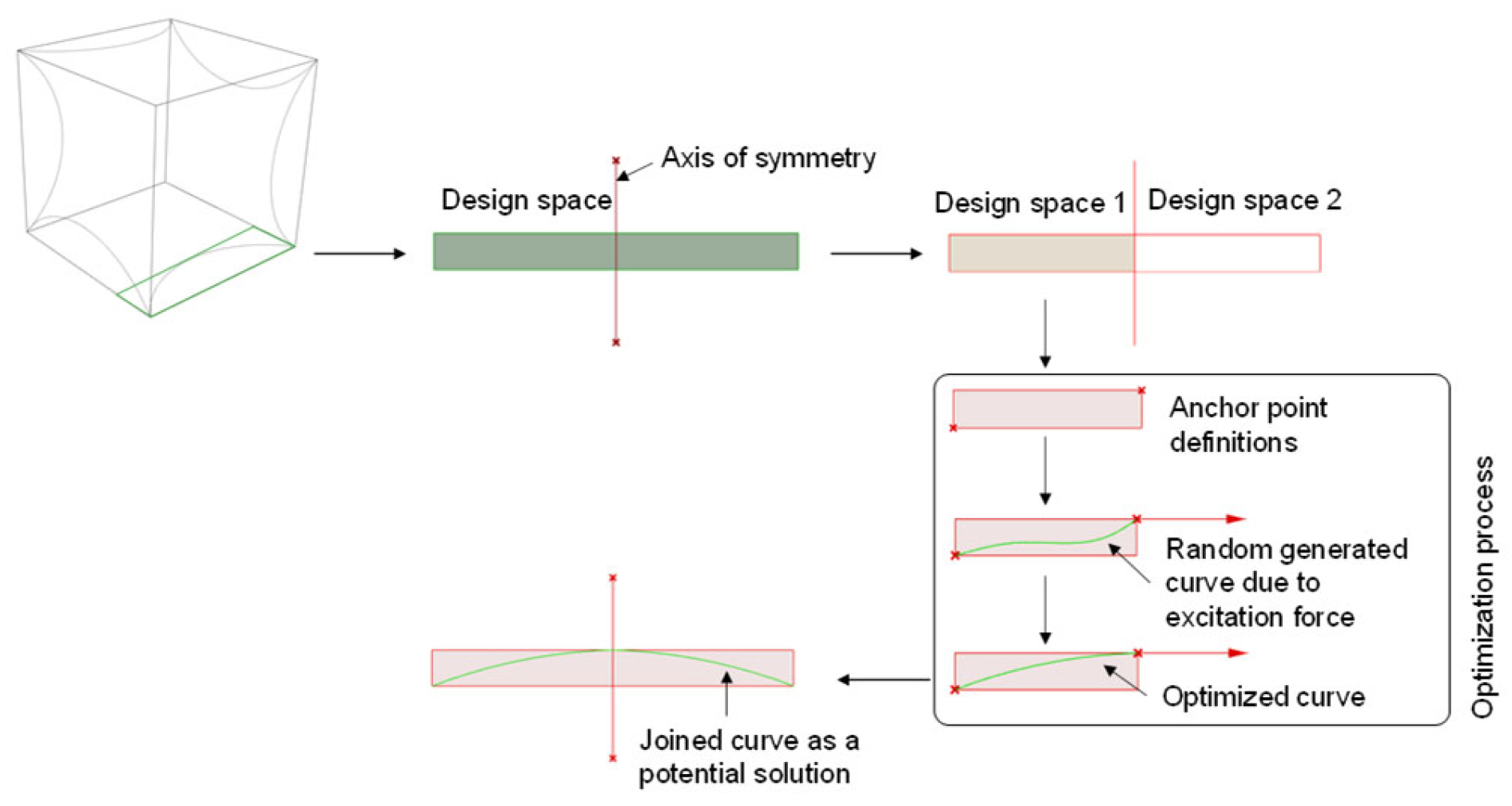
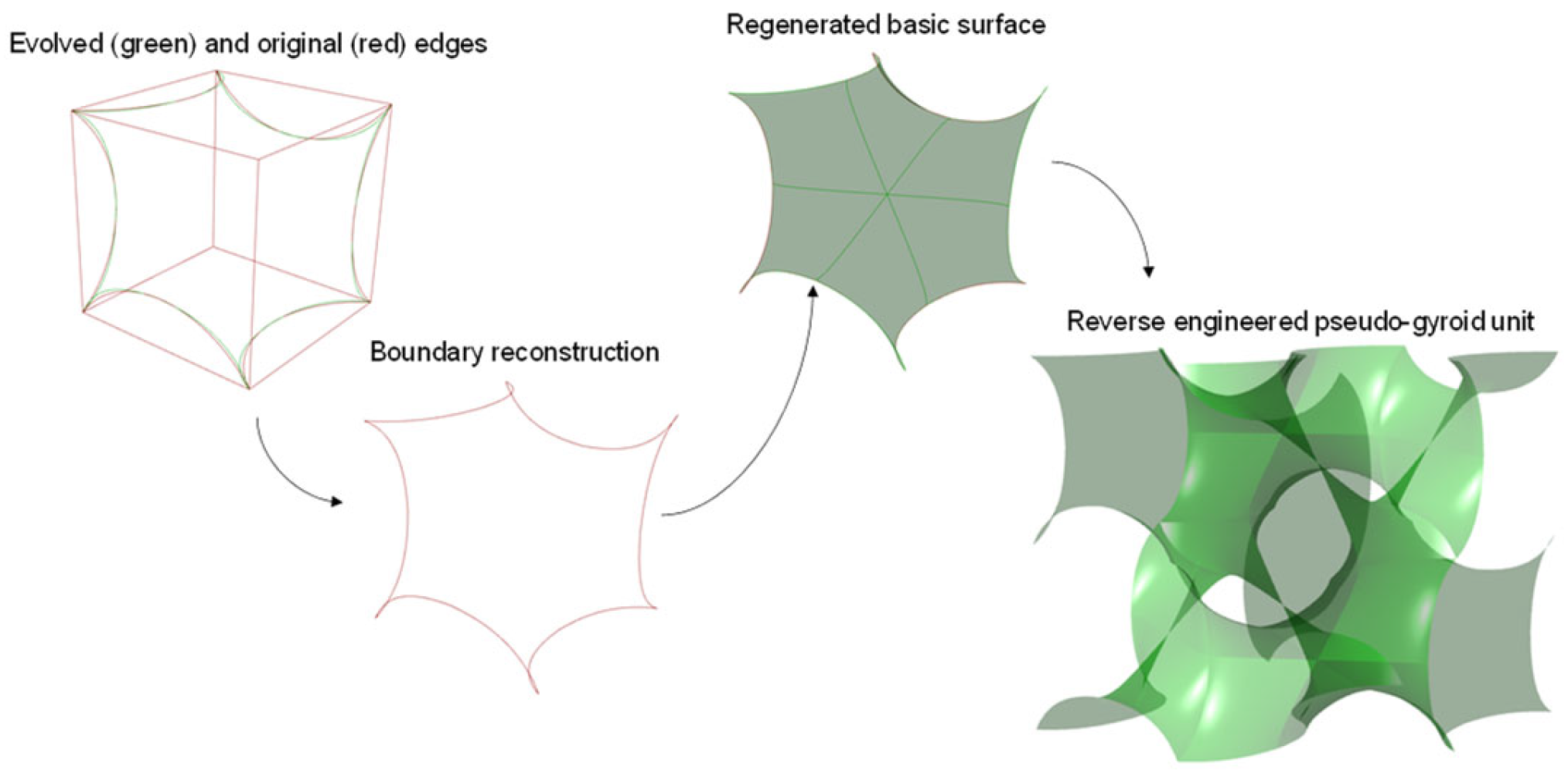
Once edges were extracted as different curves, the next step was to modify these curves. For this, an analogy between the auxin–light relationship and force–form relationship was evaluated and an evolutionary programming was assigned to find the optimal forms of the curves under planar loads. The methodology, briefly described in Figure 3, has been established in previous papers [9,10], and this work serves as an extension. Once all edges were redefined, a new patch surface was generated using reverse engineering, as shown in Figure 4.

3. Materials

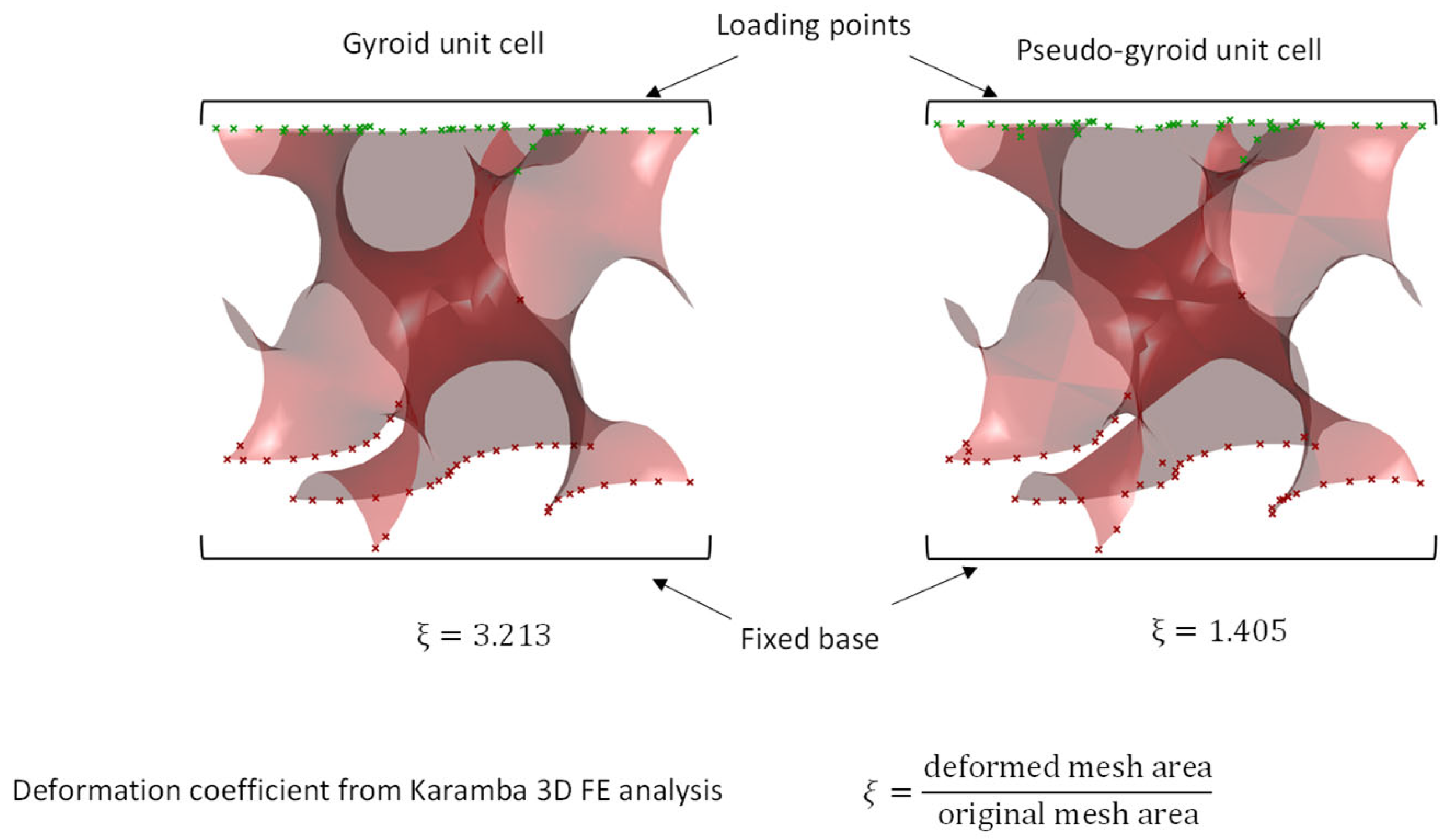
Once surfaces were generated, a computational FE analysis replicating a compressive loading scenario was performed using a Karamba 3D plug-in within the parametric modeling domain with identical isotropic material definition. The base of the surfaces was constrained in all directions, while representative compressive impact loads were applied on the top, and the corresponding scaled mesh deformation factor ξ [9] was calculated as illustrated in Figure 5.
Surface FE simulations, as shown above, revealed that the modified surface outperformed the standard gyroid surface under the specified boundary conditions. To confirm these findings, identical thicknesses were assigned to both surfaces, and various prototypes were generated via 3D printing. Two distinct printing processes were employed, utilizing different materials:
  • ▪ For FDM [11] printing, standard PLA [12] material was used.
  • ▪ For SLA [13] printing, Formlabs Rigid [14] resin was used.
The cube’s dimensions bounding the generated geometry were also varied, with different scales and infill percentages. In some test cases, printed plates were attached to the top and bottom of the geometries to ensure even load distribution. Additionally, the unit cells within the bounding volume were modified in certain instances. For simplicity, gyroid and modified gyroid geometries were coded as G and M, while each variation was assigned a unique number. The ranges of these variations are summarized in Table 1.

4. Results

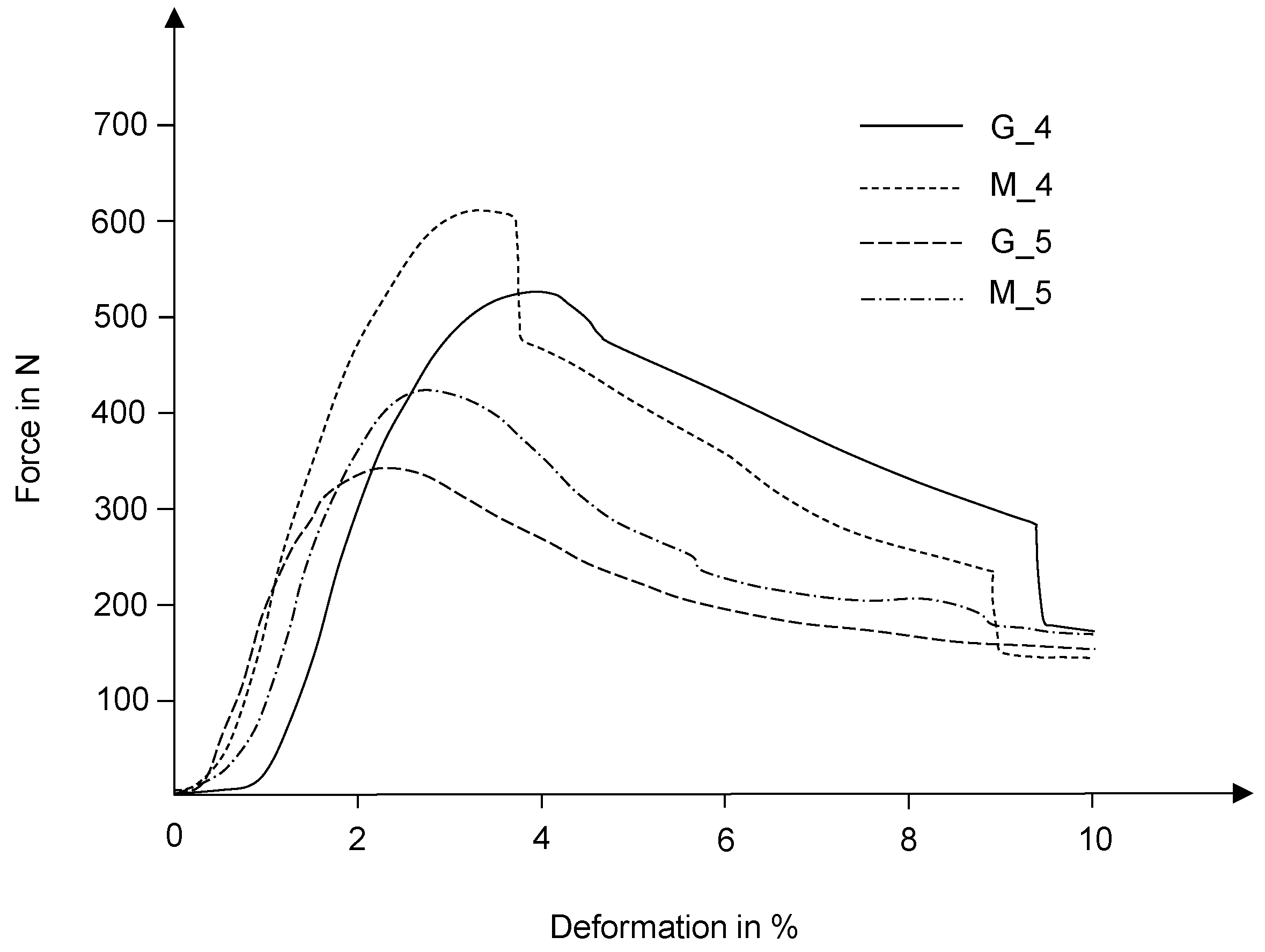
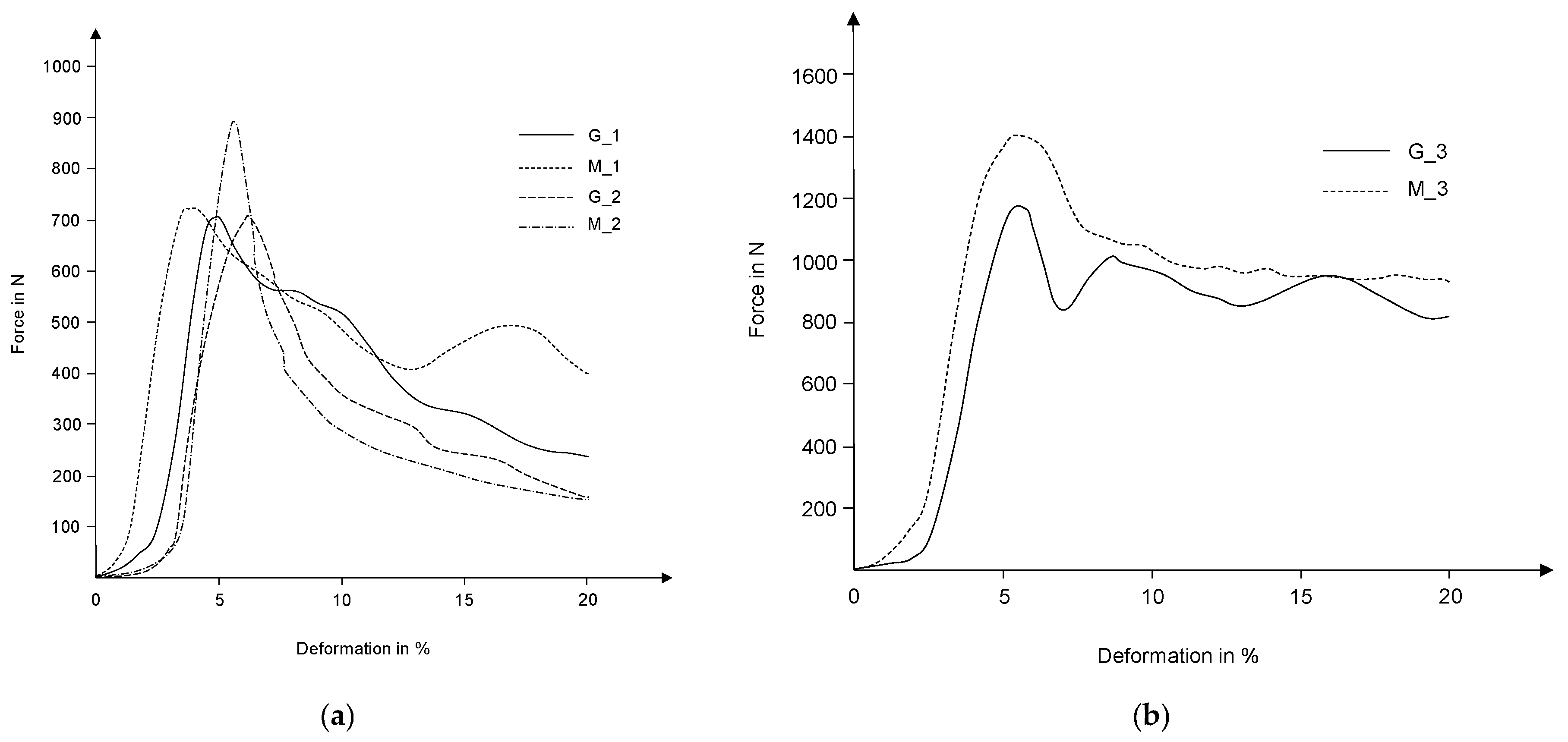
The results of the compression tests as documented in Figure 6 and Figure 7 below reveal that for each test case, the modified gyroid structures absorb higher load at failure compared to their conventional counterparts.

5. Summary

The results of the compression tests demonstrate that the modified pseudo-gyroid structure performs better than its conventional counterpart in all test scenarios. A closer examination of the results also confirms the assumption that the application of support plates improves the structure’s performance under compression loads. While the modification process yields an improved geometry for withstanding compression, it is essential to note that the resulting surface deviates from the continuous, smooth nature of a typical gyroid surface. Thus, it is suitable to refer to them as pseudo geometries, given that a discrete surface of this nature does not occur naturally. Nevertheless, the method described here can be a valuable tool for generating high-performance geometries tailored to specific applications and manufacturing methods, such as additive manufacturing.

Author Contributions

Conceptualization, G.S.D.; methodology, G.S.D.; software, G.S.D.; validation, G.S.D. and F.H.; formal analysis, G.S.D.; investigation, G.S.D.; resources, L.S.; data curation, G.S.D. and F.H.; writing—original draft preparation, G.S.D.; writing—review and editing, G.S.D. and L.S.; visualization, G.S.D.; supervision, L.S.; project administration, L.S.; funding acquisition, L.S. All authors have read and agreed to the published version of the manuscript.

Funding

This research received no external funding.

Institutional Review Board Statement

Not applicable.

Informed Consent Statement

Not applicable.

Data Availability Statement

The data presented in this study are available on request from the corresponding author.

Acknowledgments

The authors would like to acknowledge Carolina Fonseca Silame for her contribution to the work.

Conflicts of Interest

The authors declare no conflict of interest.

Abbreviations

The following abbreviations are used in this manuscript:
TPMSTriply periodic minimal surface
FDMFused deposition modeling
SLAStereolithography
PLAPolylactic acid

References

  1. Anderson, D.M.; Davis, H.T.; Nitsche, J.C.C.; Scriven, L.E. Periodic surfaces of prescribed mean curvature. In Physics of Amphiphilic Layers: Proceedings of the Workshop, Les Houches, France February 10–19; Springer: Berlin/Heidelberg, Germany, 1987; pp. 336–396. [Google Scholar] [CrossRef]
  2. Jung, Y.; Torquato, S. Fluid permeabilities of triply periodic minimal surfaces. Phys. Rev. E—Stat. Nonlinear Soft Matter Phys. 2005, 72, 056319. [Google Scholar] [CrossRef] [PubMed]
  3. Li, D.; Liao, W.; Dai, N.; Xie, Y.M. Comparison of mechanical properties and energy absorption of sheet-based and strut-based gyroid cellular structures with graded densities. Materials 2019, 12, 2183. [Google Scholar] [CrossRef] [PubMed]
  4. Michielsen, K.; Stavenga, D.G. Gyroid cuticular structures in butterfly wing scales: Biological photonic crystals. J. R. Soc. Interface 2008, 5, 85–94. [Google Scholar] [CrossRef] [PubMed]
  5. Wilts, B.D.; Apeleo Zubiri, B.; Klatt, M.A.; Butz, B.; Fischer, M.G.; Kelly, S.T.; Spiecker, E.; Steiner, U.; Schröder-Turk, G.E. Butterfly gyroid nanostructures as a time-frozen glimpse of intracellular membrane development. Sci. Adv. 2017, 3, e1603119. [Google Scholar] [CrossRef] [PubMed]
  6. Schoen, A.H. Honeycomb Core Structures of Minimal Surface Tubule Sections. U.S. Patent No. 3,663,346, 16 May 1972. [Google Scholar]
  7. Shinde, M.; Ramirez-Chavez, I.E.; Anderson, D.; Fait, J.; Jarrett, M.; Bhate, D. Towards an ideal energy absorber: Relating failure mechanisms and energy absorption metrics in additively manufactured AlSi10Mg cellular structures under quasistatic compression. J. Manuf. Mater. Process. 2022, 6, 140. [Google Scholar] [CrossRef]
  8. Ali, D. Mimicking Bone Anisotropic Structure with Modified Gyroid Scaffolds; A Finite Element Analysis. Politek. Derg. 2021, 24, 1637–1646. [Google Scholar] [CrossRef]
  9. Dutta, G.S.; Meiners, D.; Merkert, N. A Study of Free-Form Shape Rationalization Using Biomimicry as Inspiration. Polymers 2023, 15, 2466. [Google Scholar] [CrossRef] [PubMed]
  10. Dutta, G.S.; Meiners, D.; Ziegmann, G. A study of deployable structures based on nature inspired curved-crease folding. Polymers 2024, 16, 766. [Google Scholar] [CrossRef] [PubMed]
  11. Anycubic i3 Mega S. ANYCUBIC 3D Printing. Available online: https://www.anycubic.com/products/anycubic-i3-mega-s (accessed on 2 November 2025).
  12. Travieso-Rodriguez, J.A.; Jerez-Mesa, R.; Llumà, J.; Traver-Ramos, O.; Gomez-Gras, G.; Roa Rovira, J.J. Mechanical Properties of 3D-Printing Polylactic Acid Parts subjected to Bending Stress and Fatigue Testing. Materials 2019, 12, 3859. [Google Scholar] [CrossRef] [PubMed]
  13. Formlabs. Form 2: Affordable Desktop SLA 3D Printer. Available online: https://formlabs.com/3d-printers/form-2/ (accessed on 2 November 2025).
  14. Formlabs. Resin Family: Rigid. 2024. Available online: https://formlabs.com/materials/rigid/ (accessed on 2 November 2025).
Figure 1. Flowchart showing extraction of 1/8th of a unit gyroid cell surface.
Proceedings 132 00001 g001
Figure 2. Edge extraction for the constituent surface.
Proceedings 132 00001 g002
Figure 3. Generation of new curved edges.
Proceedings 132 00001 g003
Figure 4. Generation of modified gyroid unit cell using evolved curves as edges.
Proceedings 132 00001 g004
Figure 5. Karamba 3D FE analysis for compression loads.
Proceedings 132 00001 g005
Figure 6. Compression test results: (a) comparison between gyroid and modified gyroid unit cell with and without support plates printed using PLA; (b) comparison between multiple cell geometries printed using PLA.
Proceedings 132 00001 g006
Figure 7. Compression test results of gyroid and modified gyroid geometries printed with Formlabs Rigid resin.
Proceedings 132 00001 g007
Table 1. Detailed description of prototypes printed for compression testing with corresponding variations.
Variationsd% FillUnit Cell CombinationsSupport PlatesPrinting Method/Material
G_130 mm101 × 1 × 1NoFDM/PLA
M_130 mm101 × 1 × 1NoFDM/PLA
G_230 mm101 × 1 × 1YesFDM/PLA
M_230 mm101 × 1 × 1YesFDM/PLA
G_330 mm102 × 2 × 2NoFDM/PLA
M_330 mm102 × 2 × 2NoFDM/PLA
G_440 mm151 × 1 × 1YesSLA/Formlabs Rigid
M_440 mm151 × 1 × 1YesSLA/Formlabs Rigid
G_520 mm302 × 2 × 2YesSLA/Formlabs Rigid
M_520 mm302 × 2 × 2YesSLA/Formlabs Rigid
Disclaimer/Publisher’s Note: The statements, opinions and data contained in all publications are solely those of the individual author(s) and contributor(s) and not of MDPI and/or the editor(s). MDPI and/or the editor(s) disclaim responsibility for any injury to people or property resulting from any ideas, methods, instructions or products referred to in the content.