Self-Adaptive Smart Materials: A New Agent-Based Approach †



Abstract
1. Introduction
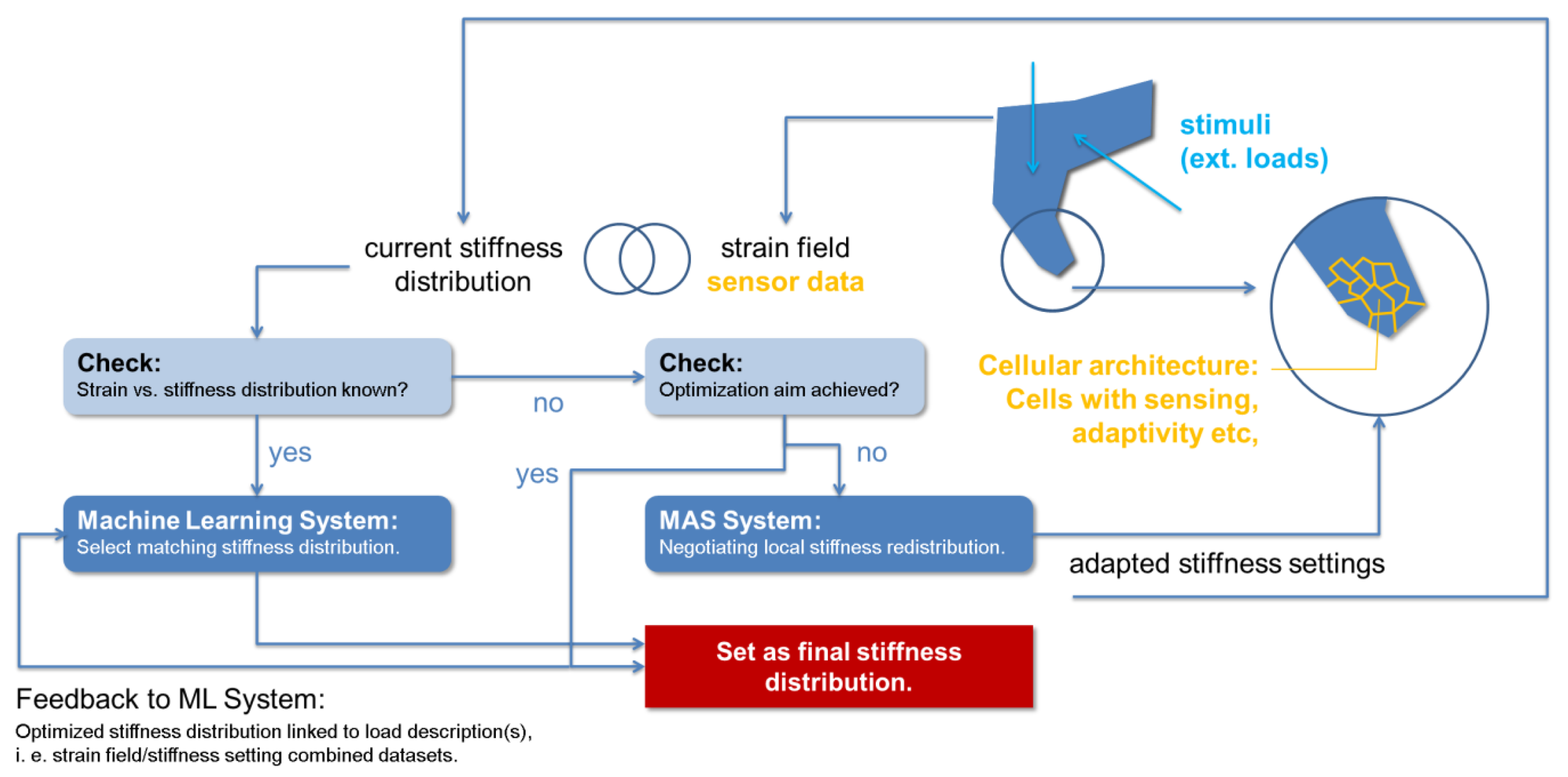
2. Control Concept Outline and Background
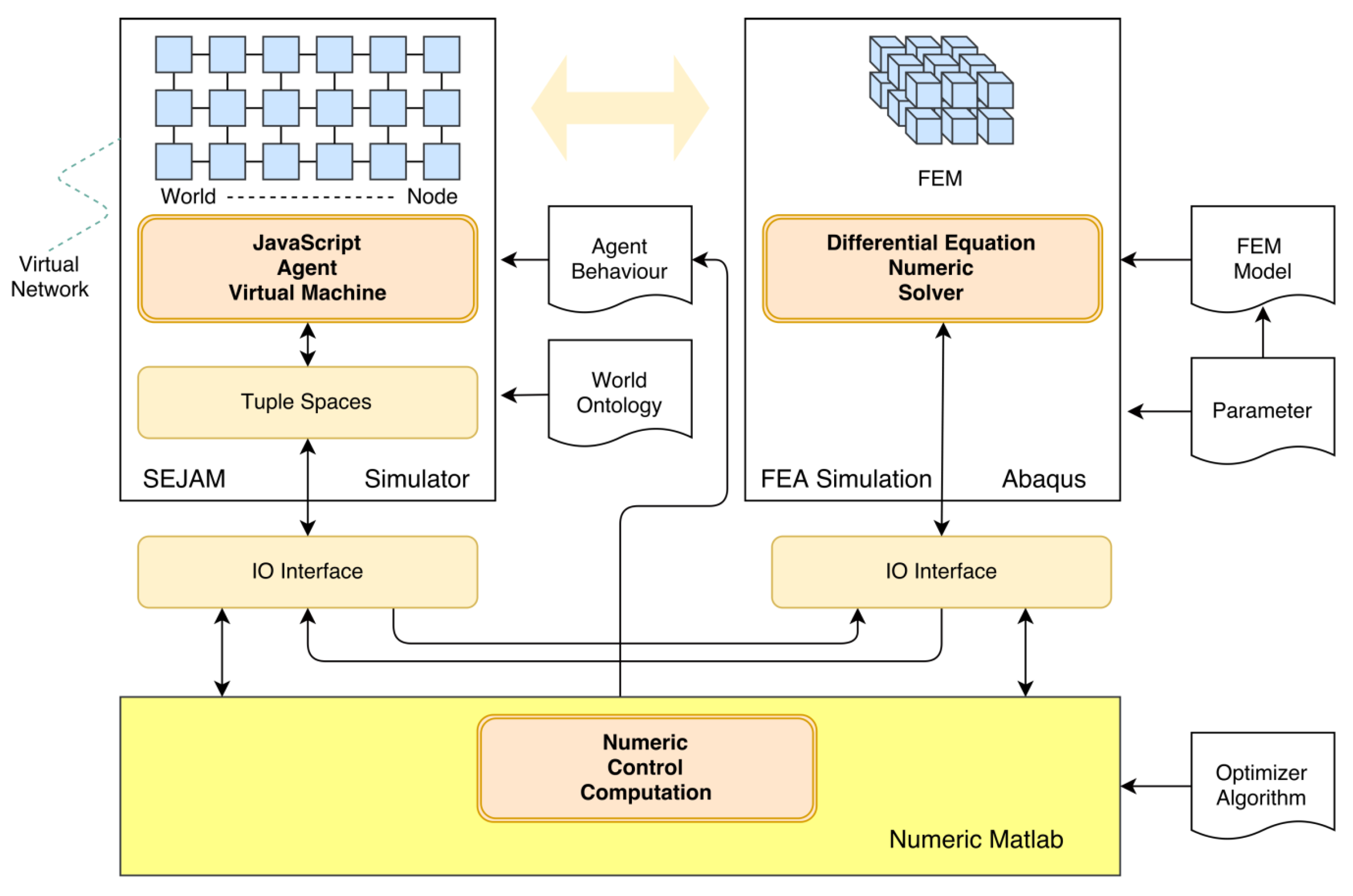
3. Virtual Test Environment
- change in moisture levels (e.g., found in wood cells)
- temperature change, effective e.g., via transgression of glass transition temperature (e.g., thermoplastic polymers, natural example spider silk)
- chemically induced change of nanofiber- and nanofiber-matrix interactions in nanocomposites (polymer-cellulose nanocompsites)
- sacrificial bonds in molecular cross links between polymer chains (proteins)
4. Conclusions
Author Contributions
Conflicts of Interest
Abbreviations
| MAS | Multi-agent systems |
| MPTO | Multi-Phase Topology Optimization |
| FEM | Finite element modeling/method |
References
- Weiser, M. The Computer for the 21st Century. Sci. Am. 1991, 265, 94–104. [Google Scholar] [CrossRef] [Scilit]
- Lang, W.; Lehmhus, D.; van der Zwaag, S.; Dorey, R. Sensorial materials—A vision about where progress in sensor integration may lead to. Sens. Actuators A Phys. 2011, 171, 1–2. [Google Scholar] [CrossRef] [Scilit]
- Lang, W.; Jakobs, F.; Tolstosheeva, E.; Sturm, H.; Ibragimov, A.; Kesel, A.; Lehmhus, D.; Dicke, U. From embedded sensors to sensorial materials—The road to function scale integration. Sens. Actuators A Phys. 2011, 171, 3–11. [Google Scholar] [CrossRef] [Scilit]
- Saheb, N.; Mekid, S. Fiber-Embedded Metallic Materials: From Sensing towards Nervous Behavior. Materials 2015, 8, 7938–7961. [Google Scholar] [CrossRef] [Scilit] [PubMed]
- Butt, A.M.; Mekid, S. Development smart/nervous material with novel sensor embedding techniques—A review. In Proceedings of the ASME 2015 Conference on Smart Materials, Adaptive Structures and Intelligent Systems (SMASIS2015), Denver, CO, USA, 21–23 September 2015. [Google Scholar]
- Mekid, S.; Saheb, N.; Khan, S.M.A.; Qureshi, K.K. Towards sensor array materials: can failure be delayed? Sci. Technol. Adv. Mater. 2015, 16, 034607. [Google Scholar] [CrossRef] [Scilit] [PubMed]
- Correll, N.; Önal, C.D.; Liang, H.; Schoenfeld, E.; Rus, D. Soft Autonomous Materials—Using Active Elasticity and Embedded Distributed Computation. Springer Tracts Adv. Robot. 2010, 79, 227–240. [Google Scholar]
- McEvoy, M.A.; Correll, N. Thermoplastic variable stiffness composites with embedded, networked sensing, actuation and control. J. Compos. Mater. 2015, 49, 1799–1808. [Google Scholar] [CrossRef] [Scilit]
- McEvoy, M.A.; Correll, N. Materials that combine sensing, actuation, computation and communication. Science 2015, 347, 1261689. [Google Scholar] [CrossRef] [Scilit] [PubMed]
- Lehmhus, D.; von Hehl, A.; Kayvantash, K.; Gradinger, R.; Becker, T.; Schimanski, K.; Avalle, M. Taking a downward turn on the weight spiral—Lightweight materials in transport applications. Mater. Des. 2015, 66, 385–389. [Google Scholar] [CrossRef] [Scilit]
- Burblies, A.; Busse, M. Computer Based Porosity Design by Multi Phase Topology Optimization. In Proceedings of the Multiscale & Functionally Graded Materials Conference (FGM2006), Honolulu, HI, USA, 15–18 October 2006. [Google Scholar]
- Bosse, S. Distributed Agent-based Computing in Material-Embedded Sensor Network Systems with the Agent-on-Chip Architecture. IEEE Sens. J. 2014, 14, 2159–2170. [Google Scholar] [CrossRef] [Scilit]
- Bosse, S. Structural Monitoring with Distributed-Regional and Event-based NN-Decision Tree Learning Using Mobile Multi-Agent Systems and Common Java Script Platforms. Procedia Technol. 2016, 26, 499–516. [Google Scholar] [CrossRef] [Scilit]
- Bosse, S.; Lechleiter, A. A hybrid approach for Structural Monitoring with self-organizing multi-agent systems and inverse numerical methods in material-embedded sensor networks. Mechatronics 2016, 34, 12–37. [Google Scholar] [CrossRef] [Scilit]
- Saavedra Flores, E.; Friswell, M.I.; Xia, Y. Variable stiffness biological and bio-inspired materials. J. Intell. Mater. Syst. Struct. 2012, 24, 529–540. [Google Scholar] [CrossRef] [Scilit]

Publisher’s Note: MDPI stays neutral with regard to jurisdictional claims in published maps and institutional affiliations. |
© 2016 by the authors. Licensee MDPI, Basel, Switzerland. This article is an open access article distributed under the terms and conditions of the Creative Commons Attribution (CC BY) license (https://creativecommons.org/licenses/by/4.0/).
Share and Cite
Lehmhus, D.; Bosse, S. Self-Adaptive Smart Materials: A New Agent-Based Approach. Proceedings 2017, 1, 35. https://doi.org/10.3390/ecsa-3-S2005
Lehmhus D, Bosse S. Self-Adaptive Smart Materials: A New Agent-Based Approach. Proceedings. 2017; 1(2):35. https://doi.org/10.3390/ecsa-3-S2005
Chicago/Turabian StyleLehmhus, Dirk, and Stefan Bosse. 2017. "Self-Adaptive Smart Materials: A New Agent-Based Approach" Proceedings 1, no. 2: 35. https://doi.org/10.3390/ecsa-3-S2005
APA StyleLehmhus, D., & Bosse, S. (2017). Self-Adaptive Smart Materials: A New Agent-Based Approach. Proceedings, 1(2), 35. https://doi.org/10.3390/ecsa-3-S2005