
Review

A Review on Compost-Based Biostimulants: Production, Functional Mechanisms, and Current Challenges

by
Aayushi Rambia
and
Malinda S. Thilakarathna
*
Department of Agricultural, Food and Nutritional Science, University of Alberta, Edmonton, AB T6G 2P5, Canada
*
Author to whom correspondence should be addressed.
Nitrogen 2026, 7(1), 30; https://doi.org/10.3390/nitrogen7010030
Submission received: 22 January 2026 / Revised: 4 March 2026 / Accepted: 16 March 2026 / Published: 18 March 2026

Abstract

Compost-based biostimulants (CBB) have emerged as a promising tool in sustainable agriculture, offering an eco-friendly approach to improving soil health, crop productivity, and environmental resilience. Derived from the controlled biodegradation of organic waste, CBB contains a diverse array of beneficial microorganisms, humic substances, and bioactive compounds that act synergistically to stimulate plant growth and soil biological activity. Mechanistically, CBB enhances nutrient acquisition by increasing plant-available nitrogen and phosphate solubility, promoting root development through phytohormone synthesis, and improving stress tolerance by modulating plant defense pathways and antioxidant activity. Additionally, their application enhances soil structure, microbial diversity, and carbon sequestration, making them integral to climate-smart agriculture. Despite their growing relevance, several challenges impede the widespread adoption of CBB. Variability in compost quality, lack of standardized production protocols, limited field-scale validation, and inconsistent regulatory frameworks hinder reproducibility and commercialization. Addressing these gaps requires interdisciplinary research that integrates microbiology, biochemistry, agronomy, and data science to better understand how microbial metabolites interact and optimize formulation strategies. Future research should prioritize the standardization of composting methods, long-term multi-crop field evaluations, and integration with precision agriculture tools for real-time soil monitoring. Policy harmonization, quality assurance frameworks, and farmer education are also vital for ensuring safe and effective use of CBB.

1. Introduction

Soil health is the cornerstone of sustainable agriculture, directly influencing crop productivity and environmental quality. Biostimulants, derived from organic waste materials, represent an innovative approach to improving soil health, enhancing crop productivity, and addressing pressing environmental concerns, such as nutrient leaching, soil degradation, loss of soil organic matter and biodiversity, and greenhouse gas emissions [1,2,3]. The European Regulation (EU) 2019/1009 defines biostimulants as “products that stimulate plant nutrition processes independently of their nutrient content with the sole aim of improving one or more of the following characteristics of the plant or the plant rhizosphere: (a) nutrient use efficiency; (b) tolerance to abiotic stress; (c) quality traits; or (d) availability of confined nutrients in the soil or rhizosphere” [4]. Several different types of biostimulants have been reported in the literature over the last two decades. They are primarily categorized into five types: microbial inoculants, humic acids and fulvic acids, protein hydrolysates and amino acids, compost tea, and seaweed extracts; each offers unique contributions to plant vitality and soil function. These substances can be multifunctional, influencing various biochemical and physiological pathways of plants that contribute to improved stress resilience, enhanced nutrient uptake, optimized metabolism, and more robust plant growth [5]. Historically, natural substances such as seaweed, animal manure, and compost have been pivotal in enhancing plant vitality and soil fertility. The empirical knowledge of early farmers, who recognized and harnessed the growth-promoting effects of these substances, laid the groundwork for the scientific exploration of biostimulants [6,7,8]. Many studies have demonstrated the benefits of biostimulants in improving nutrient use efficiency, enhancing plant stress tolerance, boosting plant growth, and increasing end-use quality traits [6,9,10,11].
Microbial inoculants have long been recognized for their capacity to enhance plant growth and resilience through targeted biological functions. Plant growth-promoting rhizobacteria (PGPR), mycorrhizal fungi, and endophytic microorganisms improve nutrient acquisition, stimulate phytohormone production, enhance stress tolerance, and suppress pathogens through mechanisms such as biological nitrogen fixation, phosphate solubilization, and induced systemic resistance [12,13,14]. These inoculants can deliver consistent, mechanism-specific benefits; however, their performance is often constrained under field conditions by poor microbial persistence, limited carbon availability, and sensitivity to soil physicochemical stresses [9,15]. Composts, in contrast, provide broad improvements to soil physical, chemical, and biological properties through the addition of organic matter and diverse biochemical compounds. Mature composts enhance soil aggregation, water-holding capacity, nutrient buffering, and microbial habitat formation while supplying humic substances, amino acids, phenolics, and enzymatic activities that stimulate root growth and plant metabolism [11,16]. While composts improve long-term soil fertility and ecosystem stability, their effects on plant growth are often variable, depending on feedstock composition, maturity, and environmental conditions [17,18].
Integrating microbial inoculants with composts in the form of compost-based biostimulants (CBB) represents an ecologically coherent strategy. In these systems, compost serves not only as a source of nutrients and organic matter but also as a protective carrier and metabolic substrate that enhances microbial survival, activity, and functional expression. The co-occurrence of beneficial microbes with humic substances, organic acids, and amino acids enables synergistic interactions that amplify plant responses beyond what either component can achieve alone [11,16]. These interactions regulate key processes, including phytohormone signaling, nutrient mobilization, stress mitigation, and pathogen suppression, at both the rhizosphere and whole-plant levels [19,20].
Growing evidence indicates that CBB outperform standalone microbial inoculants or compost amendments by promoting more stable microbial consortia, sustained bioactivity, and context-dependent adaptability across soils and cropping systems [10,11,21]. This is particularly important in addressing the pressing global challenges of food security and environmental sustainability. Integrating biostimulants into agricultural practices can significantly mitigate the ecological footprint of farming, thus contributing to a more sustainable and resilient agricultural system worldwide [11]. By leveraging these natural and multifunctional compounds, researchers and farmers alike are exploring new strategies to improve plant health and productivity in an ecologically sound manner, promising a future of agricultural practices that are not only more efficient but also environmentally friendly [9].
To fully appreciate the role of compost-based inoculants, it is essential to situate them within the broader framework of biostimulants and their growing potential to transform current agricultural systems. This review, therefore, examines the composition, mechanisms, and agronomic benefits of CBB, with particular attention to their interactions with soil microbial communities and their capacity to address persistent challenges such as nutrient inefficiency, soil degradation, and climate-related stress. Current research is hindered by the absence of standardized production and characterization protocols, a scarcity of long-term and multi-crop field evaluations, and an incomplete mechanistic understanding of how the microbial and biochemical constituents of compost-derived products influence plant physiology and soil functions [17,22]. Addressing these gaps through integrative, mechanistic, and large-scale research is critical for unlocking the full potential of CBB in advancing sustainable and resilient agricultural systems.

2. Compost-Based Biostimulants (CBB)

2.1. Research Evolution and Trends

CBB represent an emerging class of biologically active materials derived from organic waste streams, including crop residues, animal manure, and food waste. Unlike conventional composts, which are primarily used as organic fertilizers, CBB are specifically processed and applied to stimulate plant growth and soil biological activity through microbial and biochemical mechanisms rather than nutrient supply alone [10,11]. Although compost and compost tea have long been recognized as soil amendments, their explicit classification and study as biostimulants is relatively recent. Research interest in CBB began to increase markedly after 2015, coinciding with growing attention to circular bioeconomy strategies and regulatory definitions of biostimulants [4,10,23]. Early studies (2015–2018) focused mainly on characterizing compost teas and vermicompost extracts, examining their microbial composition, humic substances, and enzymatic activity [16,18]. From 2019 onwards, the literature expanded to include detailed evaluations of CBB effects on soil physicochemical and biological properties, such as microbial biomass, enzymatic activity, and nutrient availability [20,24]. More recent studies (2021–2025) have shifted toward multi-omics approaches to profile microbial and metabolic constituents of compost teas and to link these with plant performance and stress resilience [21,25].

2.2. Composition and Production

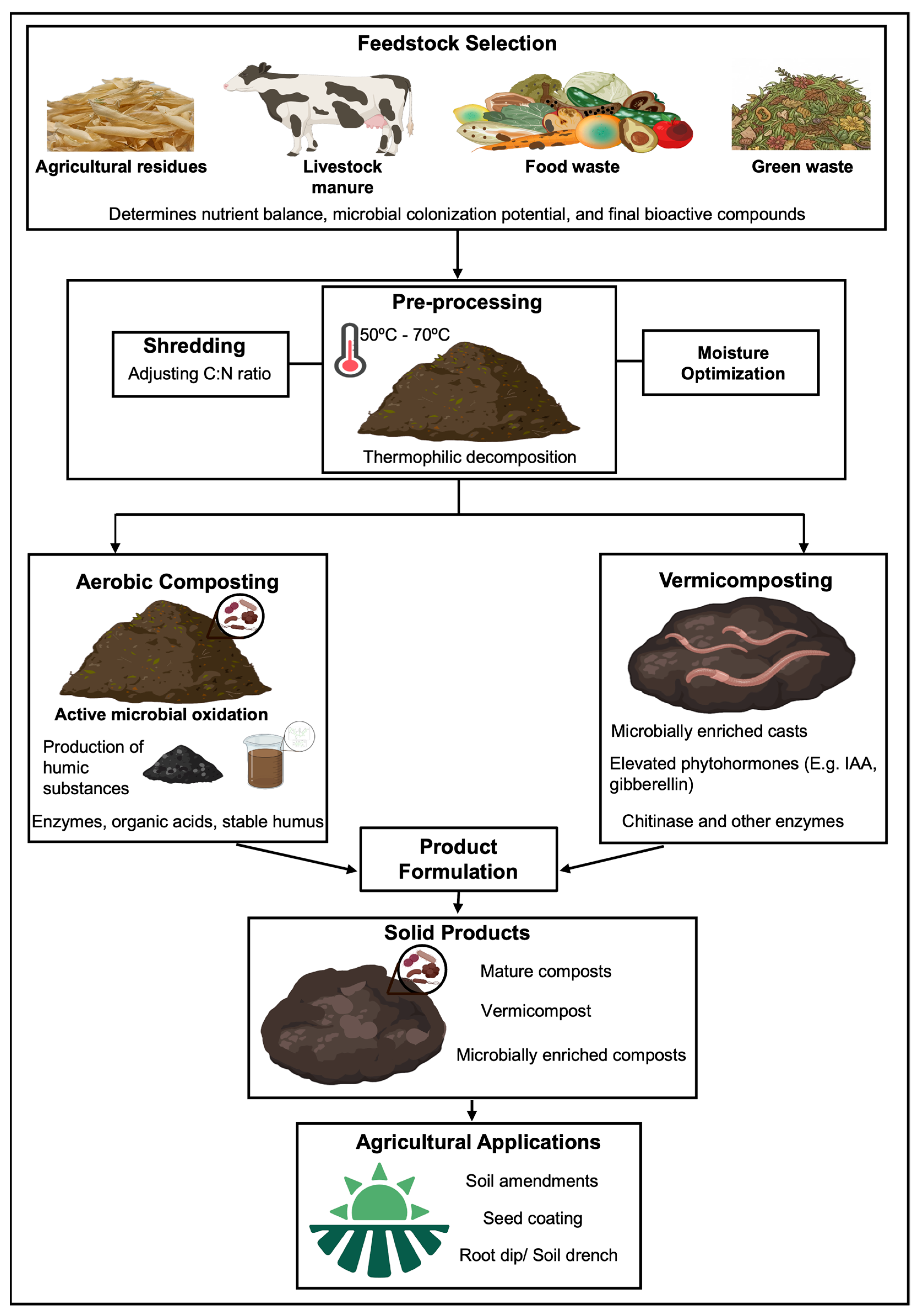
The composition and functionality of CBB are largely determined by the production process, in which feedstock type, composting parameters, and microbial inputs play central roles. The process typically involves feedstock selection, followed by pre-processing, composting, and product formulation that yield concentrated bioactive liquid or solid formulations. These processes enhance the availability of humic substances, plant growth-promoting enzymes, phytohormones, and beneficial microbes, all of which contribute to plant growth-promotion and enhanced soil functionality [16,17]. The most common CBB products include compost teas, vermicompost extracts, and microbially enriched composts. Figure 1 illustrates the production process of CBB.
Aerobic composting involves the controlled microbial oxidation of organic matter under thermophilic conditions (50–70 °C), producing stable humic material and diverse bioactive metabolites that improve soil structure, nutrient availability, and overall fertility [16,26]. Vermicomposting, in contrast, relies on earthworms and associated microbes to decompose organic residues at lower temperatures, resulting in end-products with higher microbial biomass, elevated enzymatic activity, and plant growth regulators such as indole-3-acetic acid (IAA) and gibberellins [18]. Compost teas represent another widely used category of CBB. These aqueous extracts brewed under aerated or non-aerated conditions contain soluble nutrients, microbial metabolites, and enzyme-rich fractions that can be applied as foliar sprays or soil drenches to stimulate plant growth and suppress diseases [21,26].
Across these production pathways, the choice of feedstock, composting temperature, aeration, pH, moisture, C:N ratio, and maturation time critically shape the structure and function of microbial communities, particularly those involving PGPR, actinomycetes, and mycorrhizal fungi [12,25]. Optimizing these parameters is therefore essential for maximizing biostimulant bioactivity. Typical composting conditions include temperatures of 50–70 °C, moisture content of 50–60%, a C:N ratio of 25–35:1, pH range of 6.5–8.0, and maturation periods of 8–16 weeks [27,28,29]. Upon maturation, solid compost is typically applied at 2–10 t ha−1, while compost teas are diluted at 1:10–1:20 (compost: water) and applied at 2–4 times per season to optimize nutrient and microbial delivery [30,31]. Recent advances further include microbial inoculation and co-fermentation strategies, in which strains such as Bacillus, Trichoderma, and Pseudomonas are introduced during pre-processing to enhance nutrient mineralization, promote plant growth, and increase pathogen suppression [22,24]. Table 1 provides a detailed description of various plant growth-promoting functions performed by microbes either native to the compost source or enriched in the CBB. Importantly, these production-stage microbial and biochemical transformations establish the mechanistic foundation for the nutrient mobilization, rhizosphere enzymatic activity, and plant physiological responses.

3. Functional Mechanisms of Compost-Based Biostimulants

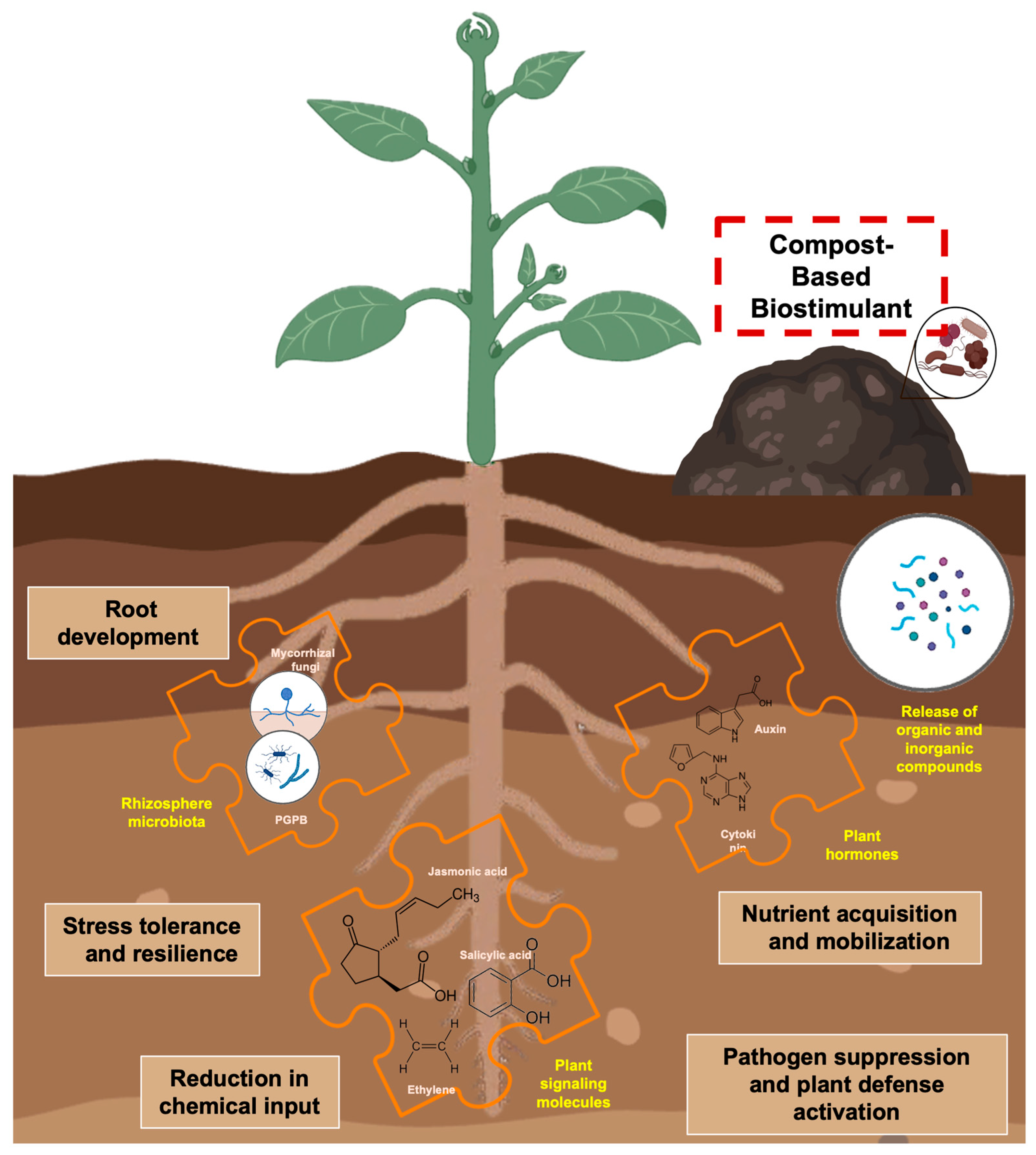
CBB exert their beneficial effects through the synergistic interactions between microbes, humic substances, and organic molecules, which foster a dynamic soil–plant ecosystem supporting sustainable agricultural productivity [14]. Figure 2 illustrates the major functional mechanisms by which CBB influences plant and soil systems: (i) nutrient acquisition and mobilization, (ii) root development, (iii) stress tolerance and resilience, (iv) pathogen suppression and plant defense activation, and (v) reduction in chemical input. These mechanisms are primarily mediated by the diverse microbial consortia and bioactive compounds present in composts and compost-derived extracts (Table 1).

3.1. Nutrient Acquisition and Mobilization

CBB play a significant role in nutrient cycling by enhancing the availability and uptake of macro- and micronutrients. Because composts naturally harbor diverse microbial consortia, CBB application introduces a wide range of PGPR, mycorrhizal fungi, actinomycetes, and nutrient-transforming bacteria that collectively improve nutrient availability and uptake (Table 1). Microorganisms within composts produce a range of hydrolytic enzymes, such as cellulases, proteases, and phosphatases, that decompose complex organic matter into simpler, bioavailable nutrients [34]. This enzymatic activity supports nutrient mineralization and organic carbon stabilization, ensuring a sustained nutrient supply to plants. Nitrogen-fixing bacteria such as Rhizobium, Azotobacter, and Azospirillum, as mentioned in Table 1, are frequently enriched in vermicompost and legume-residue composts, where their proliferation is supported by high organic nitrogen and enhanced microbial activity [12,32]. These microorganisms fix atmospheric nitrogen (N2) into ammonium (NH4+), increasing the pool of plant-available nitrogen for crops [35,36]. For instance, Azospirillum introduced through compost tea has been shown to enhance nitrogen uptake and root proliferation in cereals [12], while Azotobacter enriched in vermicompost improves nitrogen nutrition in maize and tomato (Table 1) [37]. In legumes, symbiotic nitrogen fixers such as Rhizobium further boost plant nitrogen status by forming nodules that increase biological nitrogen fixation efficiency [38]. Ammonifying bacteria, including Bacillus, Pseudomonas, and Clostridium, are abundant in mature compost and vermicompost [32]. These organisms decompose organic nitrogenous compounds into ammonium, facilitating a steady release of plant-available nitrogen [32]. In nutrient-poor soils, this ammonification pathway becomes essential for improving baseline soil fertility. Animal-manure composts often contain ammonia-oxidizing bacteria like Nitrosomonas and Nitrosococcus [33], which oxidize ammonium to nitrite (NO2). Mature composts also host nitrite-oxidizing bacteria such as Nitrobacter and Nitrospira, which convert nitrite into nitrate (NO3), facilitating plant uptake of available nitrogen [39]. Together, these sequential transformations maintain nitrogen continuity in the soil nitrogen cycle. Anaerobic composts may additionally support anammox bacteria (e.g., Brocadia, Kuenenia) [11], which convert ammonium and nitrite directly into nitrogen gas. Although slower, this pathway contributes to more stable nitrogen cycling under low-oxygen conditions [11]. Conversely, denitrifying bacteria such as Pseudomonas denitrificans and Paracoccus denitrificans commonly appear in well-matured composts with micro-anaerobic pockets. While denitrification can lead to nitrogen loss, controlled activity reduces nitrate accumulation and limits environmental risks such as nitrate leaching [12].
Phosphate-solubilizing bacteria (PSB) include species such as Pseudomonas fluorescens and Bacillus megaterium, which are commonly detected in compost teas and PSB-enriched composts. In contrast, certain fungi, such as Aspergillus niger, also exhibit strong phosphate-solubilizing capacity. These microorganisms enhance phosphorus availability by secreting organic acids (e.g., gluconic, citric, and oxalic acids) and phosphatases that mobilize phosphorus from insoluble mineral complexes [40,41,42]. Mycorrhizal fungi, commonly enriched in solid composts and mycorrhizal-inoculated compost products such as Glomus and Rhizophagus irregularis [43], extend hyphal networks into the soil, dramatically improving phosphorus acquisition and enhancing water and nutrient uptake under drought stress [33]. Potassium-solubilizing bacteria such as Bacillus mucilaginosus and Bacillus megaterium thrive in microbially active composts [44]. They release potassium ions from silicate minerals, improving plant osmotic regulation, enzyme activation, and photosynthetic performance [45]. Sulphur-oxidizing bacteria such as Thiobacillus and Acidithiobacillus [33] occur naturally in Sulphur-amended composts. They convert elemental Sulphur into sulphate (SO42−), improving Sulphur nutrition and acidifying alkaline soils to increase micronutrient solubility [33].
Composts, particularly those rich in actinomycetes like Streptomyces and Micromonospora, also accelerate the mineralization of micronutrients such as iron, zinc, and manganese by producing siderophores, organic acids, and enzymes [11,12]. Mature compost is dominated by decomposers such as Trichoderma and Aspergillus niger, which break down cellulose, lignin, and other complex polymers into simpler forms that plants and microbes can readily use [11]. This decomposition releases humic substances, organic acids, and enzymes that improve soil structure, water retention, and cation exchange capacity. Fermented compost extracts often contain lactic acid bacteria such as Lactobacillus plantarum, which reduce pH and inhibit spoilage microorganisms while enhancing nutrient solubility [11]. Composts are also rich in bioactive metabolites, including humic and fulvic acids, amino acids, organic acids, and phenolics, which directly enhance soil functionality [11,33]. Humification reactions, including polymerization and condensation of phenolic compounds, generate stable humic substances that strongly influence nutrient cycling and soil organic carbon dynamics. Humic substances improve soil cation exchange capacity and root membrane permeability, facilitating nutrient absorption and stimulating root morphogenesis [12,46]. By mobilizing nutrients from organic and mineral sources, CBB improves nutrient use efficiency, reduces dependence on synthetic fertilizers, and supports sustainable productivity [47,48]. Collectively, CBB-mediated nutrient mobilization ensures both short-term growth stimulation and long-term soil fertility restoration.
Figure 2. Schematic representation of the functional mechanisms underlying plant growth promotion by compost-based biostimulants (CBB). CBB enhance crop growth and production, improve root development and plant tolerance to abiotic stresses, by enhancing cation exchange, nitrogen fixation, and water-use efficiency. They also suppress soil-borne pathogens and induce plant defense responses through organic and inorganic compounds. At the soil level, CBB enhances nutrient acquisition and mobilization, microbial diversity, and enzymatic activity. Together, these mechanisms contribute to improved crop growth, yield stability, reduced reliance on synthetic inputs, and enhanced soil fertility.
Nitrogen 07 00030 g002

3.2. Root Development and Plant–Microbe Symbiosis

Root development is one of the primary pathways through which CBB enhances plant growth, owing largely to the diverse microbial communities and bioactive compounds they supply. Compost types such as vermicompost, compost teas, microbially enriched composts, and mature solid composts are especially rich in PGPR, mycorrhizal fungi, and endophytes that directly influence root architecture and symbiotic functioning [12,33]. PGPR, such as Azospirillum, Bacillus subtilis, and Pseudomonas fluorescens, are commonly found in solid composts and compost teas. They synthesize plant growth regulators, including auxins (especially IAA), gibberellins, and cytokinins [7,49]. Microbial production of gibberellins and cytokinins regulates cell elongation and division, promoting shoot and leaf development [50,51]. Auxin (IAA) produced by Bacillus, Pseudomonas, and Azospirillum stimulates root elongation, lateral root initiation, and root hair formation, increasing root surface area and enhancing soil exploration [49,52]. Vermicompost extracts, which are particularly rich in auxin-producing microbes, consistently improve early root establishment in cereals and vegetables [53]. Certain Azospirillum and Bacillus strains in compost teas produce gibberellins that enhance cell elongation, accelerating root and shoot expansion [50]. Cytokinin-producing microbes, including Pseudomonas species enriched in mature compost, promote cell division and shoot–root balance, contributing to vigorous seedling development [51]. AMF, including Glomus and Rhizophagus species, are commonly found in solid composts and mycorrhiza-enriched compost amendments [33]. These fungi establish mutualistic associations with plant roots, resulting in several key benefits. AMF hyphal networks not only extend the effective root surface area and enhance nutrient and water uptake, but also improve soil–root hydraulic conductivity, enabling plants to extract water from deeper or drier soil layers, an especially valuable trait under drought or water-limited conditions [54]. Studies show that dual application of compost and AMF increases plant hydraulic conductance and promotes better water status under stress, likely through enhanced root fungal uptake area and osmotic adjustment compared with compost alone or inorganic fertilizer application [54,55]. Beyond physical soil improvements, AMF and PGPR exert synergistic effects on root morphology and overall plant growth. In combined inoculation studies, both AMF and PGPR increased total root length, surface area, and branch number, while enhancing soil nutrient availability and soil enzyme activities associated with nutrient cycling, relative to uninoculated controls [56]. The interaction between PGPR and AMF can also affect secondary plant metabolites that influence root–microbe signaling. For instance, PGPR may promote AMF colonization by upregulating flavonoid biosynthesis in the rhizosphere, which acts as a molecular signal facilitating mycorrhiza establishment and improved root penetration into the soil [57]. Collectively, through hormone modulation, enhanced water and nutrient uptake, soil structural improvements, and synergistic plant–microbe interactions, CBB fosters the development of robust root systems that underpin greater plant performance and resilience.

3.3. Improvement in Soil Structure

Beyond biological activity, the agronomic performance of CBB is strongly influenced by its physical properties. Soil structure is characterized by a heterogeneous distribution of pore sizes categorized as macropores, mesopores, and micropores. Macroporosity facilitates aeration and gas exchange, supporting aerobic microbial processes and root growth, whereas micropores enhance water-holding capacity and nutrient retention, particularly the retention of carbon [58,59,60]. The type of compost incorporated can change the soil porosity. Mature compost amendments can substantially alter soil physical qualities by increasing total porosity and modifying pore size distribution, which in turn affects oxygen diffusion, water movement, and microbial habitat formation in amended soils [61,62,63]. For example, with increasing compost application rates, total porosity and the volume of water-retaining pore fractions increase significantly, resulting in improved soil structure and hydraulic characteristics [62]. Furthermore, compost application alters soil bulk density, where organic amendments generally decrease the bulk density, leading to reduced compaction and improved root penetration and gas exchange [64,65].
Particle size distribution and morphology further influence mass transfer dynamics. Finer particles tend to increase surface area and water retention but may reduce aeration if the fine fractions dominate the pore network, whereas coarser structural fractions improve macroporosity and gas exchange [62,65]. CBB derived from coarser feedstocks such as vermicomposts with larger structural particles (straw, wood chips) can increase mesopore volume of amended soils, enhancing overall porosity and aeration [66]. In contrast, finely sieved compost introduces fine organic fractions that increase total surface area and water retention in the soil matrix [62]. These structural attributes directly influence effective diffusion of oxygen and soluble nutrients, thereby affecting microbial activity, decomposition rates, and plant nutrient availability.
Moisture retention characteristics and hydraulic conductivity also play critical roles in regulating nutrient mobility and microbial metabolism in soil. Compost incorporation enhances water retention capacity and plant-available water content, reflecting shifts in pore size distribution toward fractions that retain water at less negative matric potentials [62]. Collectively, porosity, bulk density, particle geometry, and mass transfer parameters determine the efficiency of nutrient transformation processes and ultimately modulate the agronomic effectiveness of CBB.

3.4. Stress Tolerance and Resilience

CBB enhance plant resilience to abiotic stresses, including drought, salinity, and heavy metal toxicity, through a combination of microbial activity, compost-derived biochemical compounds, and improved soil physical properties. These mechanisms act synergistically to protect plants under adverse environmental conditions. Under drought stress, CBB improves plant water-use efficiency primarily by stimulating root system expansion and promoting osmotic adjustments. PGPR such as Azospirillum, Bacillus, and Pseudomonas spp. synthesize auxins and cytokinin-like compounds that intensify root branching and root hair formation, increasing the plant’s ability to access water under dry conditions [12]. AMF found in solid composts or mycorrhiza-enriched composts extend the effective root absorptive area through their hyphal networks, improving hydration and facilitating the accumulation of compatible osmolytes such as proline and glycine betaine that maintain cellular osmotic balance during water deficit [67]. These improvements are often more pronounced in mature composts rich in humic and fulvic acids, which act as signalling molecules influencing aquaporin expression and drought-responsive hormonal pathways [68].
Under salinity stress, PGPR-mediated regulation of plant ethylene levels represents a key protective mechanism. Solid composts and vermicomposts are rich in microbial strains such as Pseudomonas syringae, Pseudomonas fluorescens, and Rhizobium that produce aminocyclopropane-1-carboxylate (ACC) deaminase, which reduces stress-induced ethylene accumulation that would otherwise inhibit root elongation [32,42,69]. For example, ACC deaminase-producing PGPR enhanced primary and lateral root growth in salt-stressed mung bean plants [70]. AMF further support salinity tolerance by maintaining ionic homeostasis; their extraradical hyphae modulate nutrient uptake processes, helping plants sustain optimal K+/Na+ ratios that prevent sodium toxicity and protect metabolic functions [71,72,73].
CBB also improve plant tolerance to heavy metal stress, both through microbial transformations and sorption processes driven by compost organic matter. Compost-derived microbial communities, including Pseudomonas, Bacillus, and actinomycetes, immobilize or oxidize heavy metals, reducing their bioavailability and preventing translocation to shoots [74]. Fungal species like Trichoderma and AMF can sequester cadmium and lead within their cell walls, mitigating phytotoxicity and preserving photosynthetic performance [75,76]. Vermicompost and mature composts rich in humic substances further enhance metal chelation due to their high organic ligand content (Table 2). CBB application also strengthens plant antioxidant defences by upregulating enzymes such as catalase and peroxidase, thereby mitigating reactive oxygen species accumulation and protecting cellular integrity during stress exposure [17,77]. Collectively, CBB function as biological stress modulators, combining microbial activity, organic matter chemistry, and soil structural improvements to enhance plant adaptability and resilience across diverse environmental stressors.

3.5. Pathogen Suppression and Plant Defence Activation

A key function of CBB lies in their ability to suppress soil-borne pathogens and induce plant immune responses. A central mechanism of pathogen suppression involves beneficial microorganisms commonly enriched in mature composts, vermicomposts, and compost teas. Beneficial bacterial and fungal microbes, such as Bacillus, Pseudomonas, and Trichoderma species, respectively, inhibit pathogen proliferation through competitive exclusion, antibiosis, and resource depletion [13,82]. For instance, Bacillus subtilis, frequently isolated from solid and bioactive composts, produces lipopeptides (e.g., urfactins, iturins, fengycins) and antibiotics that disrupt fungal pathogen cell membranes and inhibit pathogen growth. Similarly, Pseudomonas fluorescens, commonly enriched in compost teas and aerated extracts, releases volatile organic compounds that inhibit the growth of pathogens such as Fusarium oxysporum [83,84]. Fungal biocontrol agents present in compost-based products, particularly Trichoderma species, further enhance disease suppression through mycoparasitism and enzymatic degradation of pathogen cell walls. These fungi secrete chitinases, glucanases, and proteases that weaken or lyse pathogenic fungi, while also rapidly colonizing root surfaces to prevent pathogen establishment. Vermicompost and fermented compost extracts are especially rich in Trichoderma and actinomycetes, which contribute to sustained pathogen suppression in soil systems. Beyond direct antagonism, CBB also promotes plant defense activation by stimulating induced systemic resistance and systemic acquired resistance in plants. Compost-associated microbes trigger plant immune pathways through the release of signalling molecules such as salicylic acid, jasmonic acid, ethylene, and microbe-associated molecular patterns, which prime plants for faster and stronger defense responses upon pathogen attack [15,80]. This dual action-pathogen suppression and immune activation reduce disease incidence while decreasing reliance on chemical pesticides, supporting more sustainable pest management.

3.6. Reduction in Chemical Inputs

In addition to improving soil physical, chemical, and biological properties, CBB can substantially reduce the need for synthetic fertilizers by enhancing nutrient use efficiency. Physically, compost applications enhance soil aggregation, porosity, water retention, aggregate stability, and pore continuity, which facilitate root growth, water infiltration, and gas exchange [24,85]. Chemically, they increase cation exchange capacity, nutrient buffering, and pH stability while reducing nutrient leaching losses [81]. Nutrient cycling facilitated by compost-derived microbes and organic matter increases the availability of nitrogen, phosphorus, and other essential elements, allowing crops to achieve similar or higher yields with reduced external inputs [86]. Quantitative studies have demonstrated that integrating compost with chemical fertilizers can significantly reduce fertilizer requirements while maintaining or even increasing crop productivity. For example, integrated nutrient management trials with vermicompost showed that yields were 12–140% higher when vermicompost was combined with chemical fertilizers compared to using 100% recommended doses of mineral fertilizer alone in various crops such as cowpea, wheat, pepper, tomato, lentil, and sunflower [87,88,89,90,91,92,93]. Incorporating organic amendments like compost into cropping systems can increase yields by 10–29% and simultaneously reduce fertilizer input, leading to higher profitability for farmers over multiple seasons [85]. These findings illustrate that CBB not only improves soil nutrient reservoirs but also allows substantial reductions in chemical fertilizer use (often 25–67% or more) without compromising, and frequently enhancing, crop yield and quality. Over time, these processes contribute to the accumulation of stable soil organic carbon, improved soil aggregation, and increased microbial biomass, thereby reinforcing long-term soil fertility [94].

4. Economic Feasibility of Compost-Based Biostimulants

The adoption of CBB is influenced not only by agronomic performance but also by techno-economic feasibility at both the production and application stages. CBB are typically produced from agricultural residues, municipal green waste, and agro-industrial by-products, converting low-value organic streams into marketable soil amendments. Production economics primarily involve feedstock collection and transportation, composting infrastructure (windrow or in-vessel systems), labour and energy inputs for turning and aeration, maturation time, post-processing (screening, extraction, filtration for liquid products), packaging, and quality control to meet regulatory standards. A recent assessment by Su et al. [95] reported that industrial-scale food waste composting facilities achieved positive net present value under multiple market scenarios, with compost selling prices ranging from USD 61-75/MT of compost and a 28–67% return on investment within a 4-year margin. Another study showed that decentralized composting systems reduce transport and disposal costs while achieving economic feasibility at the community scale [96]. When compared to synthetic plant growth regulators and commercial microbial inoculants, compost-derived products generally require low capital-intensive fermentation systems, sterilization, downstream purification, and cold-chain storage. A technoeconomic comparison of microbial inoculant production showed that fermentation-based inoculant production incurs substantially higher capital and operational expenditure due to bioreactor infrastructure and quality control requirements.
At the application stage, the economic advantage of CBB arises from improved yield performance, reduced synthetic fertilizer inputs, enhanced soil health, and long-term sustainability [85]. Economic modeling studies further indicate that partial fertilizer substitution combined with soil health improvements increases long-term profitability by reducing input costs and buffering against yield variability [97,98]. Tang et al. [99] reported that a comprehensive economic cost–benefit evaluation of substituting synthetic fertilizer with 50% pig manure increased economic benefit per unit area by 37–46%, and reduced agricultural inputs and environmental impacts per unit product by 22–44%. In certain cases, the partial substitution of mineral fertilizers with compost and biochar combinations has been shown to enhance monetary returns, with benefit–cost ratios exceeding 1.3 in several cropping systems [100]. Collectively, these findings demonstrate that CBB offers a technically viable and economically competitive strategy that integrates waste valorization, input cost reduction, and long-term soil health enhancement within sustainable agricultural systems.

5. Challenges and Limitations in Compost-Based Biostimulant Research

Despite their proven potential to improve soil health and crop productivity, CBB face several scientific, technical, and socioeconomic challenges that constrain their scalability and consistent performance in agricultural systems. These challenges are interconnected and span from methodological variability in production and composition to gaps in mechanistic understanding, field validation, and policy frameworks.

5.1. Lack of Standardization in Formulation, Production, and Regulation

The most significant barrier to CBB advancement is the absence of standardized methodologies for compost production, extraction, and microbial enrichment. Current research employs highly heterogeneous feedstocks ranging from green waste and manure to food residues processed under diverse composting durations, aeration regimes, and temperature conditions [16,22]. This variability results in wide fluctuations in the biochemical and microbial composition of compost, leading to inconsistent agronomic outcomes [17,18]. For example, thermophilic composts often yield higher humic and fulvic acid concentrations, whereas vermicomposts are richer in microbial biomass and phytohormones [101]. This compositional variability complicates the establishment of consistent quality benchmarks, underscoring the need for globally accepted standards for compost maturity indices, microbial load, nutrient profiles, and bioactive compound content. Without such benchmarks, meaningful comparisons across studies remain difficult, and farmer confidence in product performance is undermined. These technical challenges are further exacerbated by regulatory fragmentation, particularly in North America, where CBB lack clear and harmonized classification. Unlike the European Union, which has implemented a unified regulatory framework under Regulation (EU) 2019/1009, the United States and Canada currently classify CBB ambiguously across fertilizer, soil amendment, and microbial inoculant categories, creating uncertainty in product registration, labelling, and commercialization [4]. Establishing globally accepted benchmarks for compost maturity indices, microbial load, and nutrient composition is essential to ensure product consistency and quality assurance. This will allow for comparisons across studies to be conclusive and increase farmer confidence.

5.2. Incomplete Mechanistic Understanding

Although numerous studies have demonstrated the beneficial effects of CBB on plant growth and soil health, the mechanistic basis underlying these responses remains only partially understood. Much of the existing research examines either microbial inoculants or compost-derived organic compounds in isolation, often overlooking the complex and synergistic interactions among microbial metabolism, humic substances, amino acids, phenolics, and enzymatic activities that jointly regulate plant and soil responses [19,20]. Furthermore, the persistence, stability, and functional redundancy of compost-derived microbial consortia under field conditions remain poorly characterized, as do their dynamic interactions with plant roots and soil physicochemical properties. Furthermore, the influence of environmental variables such as temperature, pH, and moisture on microbial functionality during composting and after soil application remains underexplored, leading to variability in efficacy and reproducibility [102]. Advanced molecular tools such as metagenomics and metabolomics should be integrated into compost quality evaluation to identify the core functional microbiome and its associated metabolites that confer biostimulant activity [21,103].

5.3. Limited Crop- and Soil-Specific Field Validation

Evidence supporting CBB efficacy is primarily derived from short-term greenhouse trials on model crops like tomato, lettuce, wheat, or maize [24,25,104]. Such studies seldom capture the environmental variability inherent to real-world agricultural systems. Field-scale validation remains scarce, especially in diverse agroecological zones where soil type, climate, and management practices influence microbial survival and performance. To ensure reliability, multi-crop, multi-year, and multi-site field experiments are urgently needed. These trials should evaluate CBB performance across varying soil textures, organic matter levels, and climatic gradients, incorporating physiological, agronomic, and microbial parameters. Long-term datasets would allow assessment of CBB contributions to soil carbon sequestration, nutrient cycling, and yield stability [38].

5.4. Socioeconomic, Environmental, and Adoption Barriers

Despite their environmental benefits, the adoption of CBB is often hindered by limited farmer awareness, high production costs, and uncertain short-term returns [8]. Producing high-quality compost requires specialized infrastructure, controlled conditions, and microbial inoculation expertise, factors that increase costs compared with synthetic fertilizers. Additionally, over-application or improper use can cause nutrient imbalances, leaching, or greenhouse gas emissions, counteracting environmental goals [10,105]. Bridging this gap requires economic incentives, public–private partnerships, and farmer training programs. Participatory field demonstrations and cooperative composting initiatives could enhance farmer confidence and highlight long-term profitability through improved soil fertility and reduced chemical input dependency [3].

6. Future Perspectives and Research Directions

To fully exploit the potential of CBB, future research must adopt holistic and standardized frameworks that bridge laboratory innovation with field-scale application. A global priority is the development of unified guidelines for CBB production, including feedstock selection, microbial enrichment, extraction, and storage to ensure reproducibility, quality assurance, and consistency across regions. Advances in precision composting, aerobic fermentation, and biochar integration offer promising avenues to improve microbial stability and nutrient retention, while the establishment of compost maturity indices and microbial efficacy benchmarks would support both scientific comparability and commercial certification [11].
Critically, CBB should be investigated as integrated biological systems rather than as isolated components of compost chemistry or microbial inoculants. Traditional compost studies have largely focused on nutrient supply and soil organic matter dynamics, while PGPR research has emphasized strain-specific plant responses. In contrast, the efficacy of CBB emerges from synergistic interactions among diverse microbial consortia, organic substrates, and bioactive metabolites that collectively regulate nutrient mobilization, hormone signalling, stress tolerance, and disease resistance. These system-level effects cannot be fully captured through simple component-focused approaches, underscoring the need for experimental designs that explicitly account for microbial–organic matter–plant feedback.
Equally important is the implementation of coordinated multi-crop and multi-year field trials across diverse soil types and climates to validate agronomic, environmental, and economic outcomes. In parallel, the integration of multi-omics approaches with precision agriculture tools offers a transformative opportunity to elucidate CBB–plant–soil interactions and enable real-time monitoring of soil biological health and nutrient dynamics [32,106,107]. Climate resilience and carbon-smart agriculture should further guide future innovation, as CBB can enhance nutrient use efficiency, reduce reliance on synthetic fertilizers, and contribute to long-term soil carbon sequestration [81].
Finally, supportive policy frameworks, harmonized regulations, and stakeholder engagement, including farmer education and incentive programs, will be essential for translating scientific advances into widespread adoption [8]. By aligning mechanistic understanding with practical implementation and recognizing CBB as functionally distinct, systems-based inputs, CBB can move beyond experimental tools to become foundational components of resilient, productive, and sustainable agricultural systems.

Author Contributions

Conceptualization, A.R. and M.S.T.; writing—original draft preparation, A.R.; writing—review and editing, A.R. and M.S.T.; visualization, A.R.; supervision, M.S.T.; Funding acquisition, M.S.T. All authors have read and agreed to the published version of the manuscript.

Funding

This research was funded by Natural Sciences and Engineering Research Council (NSERC) Alliance grant number ALLRP 585101-23 and HumaTerra.

Data Availability Statement

No new data were created or analyzed in this study.

Conflicts of Interest

The authors declare no conflicts of interest. The funders had no role in the design of the study; in the writing of the manuscript; or in the decision to publish the results.

Abbreviations

The following abbreviations are used in this manuscript:
CBBCompost-based biostimulants
PGPRPlant growth-promoting rhizobacteria
IAAIndole-3-acetic acid
PSBPhosphate-solubilizing bacteria
AOBAmmonia-oxidizing bacteria
NOBNitrite-oxidizing bacteria
AMFArbuscular mycorrhizal fungi
ACCAminocyclopropane-1-carboxylate

References

  1. Alori, E.T.; Adekiya, A.O.; Adegbite, K.A. Impact of Agricultural Practices on Soil Health. In Soil Health; Giri, B., Varma, A., Eds.; Soil Biology; Springer International Publishing: Cham, Switzerland, 2020; Volume 59, pp. 89–98. ISBN 978-3-030-44363-4. [Google Scholar]
  2. Sible, C.N.; Seebauer, J.R.; Below, F.E. Plant Biostimulants: A Categorical Review, Their Implications for Row Crop Production, and Relation to Soil Health Indicators. Agronomy 2021, 11, 1297. [Google Scholar] [CrossRef]
  3. Skinner, C.; Gattinger, A.; Krauss, M.; Krause, H.-M.; Mayer, J.; Van Der Heijden, M.G.A.; Mäder, P. The Impact of Long-Term Organic Farming on Soil-Derived Greenhouse Gas Emissions. Sci. Rep. 2019, 9, 1702. [Google Scholar] [CrossRef]
  4. European Union. Regulation of the European Parliament and of the Council Laying down Rules on the Making Available on the Market of EU Fertilising Products and Amending Regulations (EC) No 1069/2009 and (EC) No 1107/2009 and Repealing Regulation (EC) No 2003/2003. J. Eur. Union 2019, 2019, 114. [Google Scholar]
  5. Nkebiwe, P.M.; Stevens Lekfeldt, J.D.; Symanczik, S.; Thonar, C.; Mäder, P.; Bar-Tal, A.; Halpern, M.; Biró, B.; Bradáčová, K.; Caniullan, P.C.; et al. Effectiveness of Bio-Effectors on Maize, Wheat and Tomato Performance and Phosphorus Acquisition from Greenhouse to Field Scales in Europe and Israel: A Meta-Analysis. Front. Plant Sci. 2024, 15, 1333249. [Google Scholar] [CrossRef]
  6. Craigie, J.S. Seaweed Extract Stimuli in Plant Science and Agriculture. J. Appl. Phycol. 2011, 23, 371–393. [Google Scholar] [CrossRef]
  7. Khan, M.S.; Zaidi, A.; Wani, P.A.; Oves, M. Role of Plant Growth Promoting Rhizobacteria in the Remediation of Metal Contaminated Soils. Environ. Chem. Lett. 2009, 7, 1–19. [Google Scholar] [CrossRef]
  8. Khoulati, A.; Ouahhoud, S.; Taibi, M.; Ezrari, S.; Mamri, S.; Merah, O.; Hakkou, A.; Addi, M.; Maleb, A.; Saalaoui, E. Harnessing Biostimulants for Sustainable Agriculture: Innovations, Challenges, and Future Prospects. Discov. Agric. 2025, 3, 56. [Google Scholar] [CrossRef]
  9. Berendsen, R.L.; Pieterse, C.M.J.; Bakker, P.A.H.M. The Rhizosphere Microbiome and Plant Health. Trends Plant Sci. 2012, 17, 478–486. [Google Scholar] [CrossRef]
  10. Du Jardin, P. Plant Biostimulants: Definition, Concept, Main Categories and Regulation. Sci. Hortic. 2015, 196, 3–14. [Google Scholar] [CrossRef]
  11. Halpern, M.; Bar-Tal, A.; Ofek, M.; Minz, D.; Muller, T.; Yermiyahu, U. The Use of Biostimulants for Enhancing Nutrient Uptake. In Advances in Agronomy; Academic Press: Cambridge, MA, USA, 2015; Volume 130, pp. 141–174. ISBN 978-0-128-02137-8. [Google Scholar]
  12. Calvo, P.; Nelson, L.; Kloepper, J.W. Agricultural Uses of Plant Biostimulants. Plant Soil 2014, 383, 3–41. [Google Scholar] [CrossRef]
  13. Compant, S.; Duffy, B.; Nowak, J.; Clément, C.; Barka, E.A. Use of Plant Growth-Promoting Bacteria for Biocontrol of Plant Diseases: Principles, Mechanisms of Action, and Future Prospects. Appl. Environ. Microbiol. 2005, 71, 4951–4959. [Google Scholar] [CrossRef]
  14. Pieterse, C.M.J.; Zamioudis, C.; Berendsen, R.L.; Weller, D.M.; Van Wees, S.C.M.; Bakker, P.A.H.M. Induced Systemic Resistance by Beneficial Microbes. Annu. Rev. Phytopathol. 2014, 52, 347–375. [Google Scholar] [CrossRef] [PubMed]
  15. Lugtenberg, B.J.J.; Malfanova, N.; Kamilova, F.; Berg, G. Plant Growth Promotion by Microbes. In Molecular Microbial Ecology of the Rhizosphere; De Bruijn, F.J., Ed.; John Wiley & Sons: Hoboken, NJ, USA, 2013; pp. 559–573. ISBN 978-1-118-29617-2. [Google Scholar]
  16. De Corato, U. Compost and Compost Tea from On-Farm Composted Agro-Wastes Improve the Sustainability of Horticultural Organic Cropping Systems. In Agri-Based Bioeconomy; CRC Press: Boca Raton, FL, USA, 2021; pp. 143–162. [Google Scholar]
  17. Li, J.; Van Gerrewey, T.; Geelen, D. A Meta-Analysis of Biostimulant Yield Effectiveness in Field Trials. Front. Plant Sci. 2022, 13, 836702. [Google Scholar] [CrossRef] [PubMed]
  18. Wong, W.S.; Zhong, H.T.; Cross, A.T.; Yong, J.W.H. Plant Biostimulants in Vermicomposts: Characteristics and Plausible Mechanisms. In The Chemical Biology of Plant Biostimulants; Geelen, D., Xu, L., Eds.; John Wiley & Sons: Hoboken, NJ, USA, 2020; pp. 155–180. ISBN 978-1-119-35719-3. [Google Scholar]
  19. Adedayo, A.A.; Babalola, O.O. The Potential of Biostimulants on Soil Microbial Community: A Review. Front. Ind. Microbiol. 2023, 1, 1308641. [Google Scholar] [CrossRef]
  20. Fuertes-Mendizábal, T.; Huérfano, X.; Ortega, U.; González-Murua, C.; Estavillo, J.M.; Salcedo, I.; Duñabeitia, M.K. Compost and PGP-Based Biostimulant as Alternative to Peat and NPK Fertilization in Chestnut (Castanea Sativa Mill.) Nursery Production. Forests 2021, 12, 850. [Google Scholar] [CrossRef]
  21. Dell’Olmo, E.; Semenzato, G.; Raio, A.; Zaccardelli, M.; Serratore, G.; Cuccurullo, A.; Sigillo, L. Microbial Metabolic Profile of Two Compost Teas and Their Biostimulant and Bioprotectant Effects on Chickpea and Pea Plants. Agronomy 2025, 15, 1378. [Google Scholar] [CrossRef]
  22. Curadelli, F.; Alberto, M.; Uliarte, E.M.; Combina, M.; Funes-Pinter, I. Meta-Analysis of Yields of Crops Fertilized with Compost Tea and Anaerobic Digestate. Sustainability 2023, 15, 1357. [Google Scholar] [CrossRef]
  23. Meena, D.C.; Birthal, P.S.; Kumara, T.M.K. Biostimulants for Sustainable Development of Agriculture: A Bibliometric Content Analysis. Discov. Agric. 2025, 3, 2. [Google Scholar] [CrossRef]
  24. Visconti, D.; Ventorino, V.; Fagnano, M.; Woo, S.L.; Pepe, O.; Adamo, P.; Caporale, A.G.; Carrino, L.; Fiorentino, N. Compost and Microbial Biostimulant Applications Improve Plant Growth and Soil Biological Fertility of a Grass-Based Phytostabilization System. Environ. Geochem. Health 2023, 45, 787–807. [Google Scholar] [CrossRef]
  25. Koskey, G.; Avio, L.; Turrini, A.; Sbrana, C.; Bàrberi, P. Biostimulatory Effect of Vermicompost Extract Enhances Soil Mycorrhizal Activity and Selectively Improves Crop Productivity. Plant Soil 2023, 484, 183–199. [Google Scholar] [CrossRef]
  26. Ingham, E.R. The Compost Tea Brewing Manual, 5th ed.; Soil Food Web Inc.: Corvallis, OR, USA, 2005. [Google Scholar]
  27. Huzir, N.M.; Asmadi, A.A.; Rosly, M.B.; Tamunaidu, P.; Amin, A.N.R. Composting as a Pathway for Organic Waste Valorization: Substrate Performance, Process Strategies, and Quality Benchmarks. J. Mater. Cycles Waste Manag. 2026, 28, 815–833. [Google Scholar] [CrossRef]
  28. Sossa, E.L.; Agbangba, C.E.; Koura, T.W.; Ayifimi, O.J.; Houssoukpèvi, I.A.; Bouko, N.D.B.; Yalinkpon, F.; Amadji, G.L. Dynamics of Co-Composting of Pineapple Harvest and Processing Residues with Poultry Litter and Compost Quality. Sci. Rep. 2024, 14, 17194. [Google Scholar] [CrossRef]
  29. Ho, T.T.K.; Tra, V.T.; Le, T.H.; Nguyen, N.-K.-Q.; Tran, C.-S.; Nguyen, P.-T.; Vo, T.-D.-H.; Thai, V.-N.; Bui, X.-T. Compost to Improve Sustainable Soil Cultivation and Crop Productivity. Case Stud. Chem. Environ. Eng. 2022, 6, 100211. [Google Scholar] [CrossRef]
  30. Yin, J.; Wang, J.; Zhao, L.; Cui, Z.; Yao, S.; Li, G.; Yuan, J. Compost Tea: Preparation, Utilization Mechanisms, and Agricultural Applications Potential—A Comprehensive Review. Environ. Technol. Innov. 2025, 38, 104137. [Google Scholar] [CrossRef]
  31. Oueld Lhaj, M.; Moussadek, R.; Mouhir, L.; Sanad, H.; Manhou, K.; Iben Halima, O.; Yachou, H.; Zouahri, A.; Mdarhri Alaoui, M. Application of Compost as an Organic Amendment for Enhancing Soil Quality and Sweet Basil (Ocimum basilicum L.) Growth: Agronomic and Ecotoxicological Evaluation. Agronomy 2025, 15, 1045. [Google Scholar] [CrossRef]
  32. Colla, G.; Rouphael, Y.; Canaguier, R.; Svecova, E.; Cardarelli, M. Biostimulant Action of a Plant-Derived Protein Hydrolysate Produced through Enzymatic Hydrolysis. Front. Plant Sci. 2014, 5, 448. [Google Scholar] [CrossRef] [PubMed]
  33. Rouphael, Y.; Colla, G. Editorial: Biostimulants in Agriculture. Front. Plant Sci. 2020, 11, 40. [Google Scholar] [CrossRef]
  34. Richardson, A.E.; Simpson, R.J. Soil Microorganisms Mediating Phosphorus Availability Update on Microbial Phosphorus. Plant Physiol. 2011, 156, 989–996. [Google Scholar] [CrossRef]
  35. Barbieri, P.; Starck, T.; Voisin, A.-S.; Nesme, T. Biological Nitrogen Fixation of Legumes Crops under Organic Farming as Driven by Cropping Management: A Review. Agric. Syst. 2023, 205, 103579. [Google Scholar] [CrossRef]
  36. Choudhury, A.T.M.A.; Kennedy, I.R. Prospects and Potentials for Systems of Biological Nitrogen Fixation in Sustainable Rice Production. Biol. Fertil. Soils 2004, 39, 219–227. [Google Scholar] [CrossRef]
  37. Li, S.; Wang, C.; Huang, H.; Zhao, L.; Cao, J.; Wang, B.; Ding, H. Vermicompost and Azotobacter chroococcum Increase Nitrogen Retention in Saline-Alkali Soil and Nitrogen Utilization of Maize. Appl. Soil Ecol. 2024, 201, 105512. [Google Scholar] [CrossRef]
  38. Goyal, R.K.; Mattoo, A.K.; Schmidt, M.A. Rhizobial–Host Interactions and Symbiotic Nitrogen Fixation in Legume Crops Toward Agriculture Sustainability. Front. Microbiol. 2021, 12, 669404. [Google Scholar] [CrossRef]
  39. Maeda, K.; Hanajima, D.; Toyoda, S.; Yoshida, N.; Morioka, R.; Osada, T. Microbiology of Nitrogen Cycle in Animal Manure Compost. Microb. Biotechnol. 2011, 4, 700–709. [Google Scholar] [CrossRef]
  40. Sharma, S.B.; Sayyed, R.Z.; Trivedi, M.H.; Gobi, T.A. Phosphate Solubilizing Microbes: Sustainable Approach for Managing Phosphorus Deficiency in Agricultural Soils. SpringerPlus 2013, 2, 587. [Google Scholar] [CrossRef]
  41. Silva, L.I.D.; Pereira, M.C.; Carvalho, A.M.X.D.; Buttrós, V.H.; Pasqual, M.; Dória, J. Phosphorus-Solubilizing Microorganisms: A Key to Sustainable Agriculture. Agriculture 2023, 13, 462. [Google Scholar] [CrossRef]
  42. Wickramatilake, A.R.P.; Munehiro, R.; Nagaoka, T.; Wasaki, J.; Kouno, K. Compost Amendment Enhances Population and Composition of Phosphate Solubilizing Bacteria and Improves Phosphorus Availability in Granitic Regosols. Soil Sci. Plant Nutr. 2011, 57, 529–540. [Google Scholar] [CrossRef]
  43. Wahab, A.; Muhammad, M.; Munir, A.; Abdi, G.; Zaman, W.; Ayaz, A.; Khizar, C.; Reddy, S.P.P. Role of Arbuscular Mycorrhizal Fungi in Regulating Growth, Enhancing Productivity, and Potentially Influencing Ecosystems under Abiotic and Biotic Stresses. Plants 2023, 12, 3102. [Google Scholar] [CrossRef]
  44. Teja, A.P.S.N.; Saharan, B.S. Endophytic Potassium-Solubilizing Microbes: A Sustainable Approach to Enhancing Crop Nutrition and Productivity. In Metabolic Sustainability of Endophytes; Meena, M., Zehra, A., Swapnil, P., Seth, C.S., Eds.; Microorganisms for Sustainability; Springer Nature: Singapore, 2025; Volume 52, pp. 37–53. ISBN 978-9-819-64003-4. [Google Scholar]
  45. Etesami, H.; Emami, S.; Alikhani, H.A. Potassium Solubilizing Bacteria (KSB): Mechanisms, Promotion of Plant Growth, and Future Prospects—A Review. J. Soil Sci. Plant Nutr. 2017, 17, 897–911. [Google Scholar] [CrossRef]
  46. Aouabe, A.; Boutasknit, A.; Lahbouki, S.; Errouh, F.; Oudra, B.; Chagiri, H.; Khalisse, H.; Meddich, A. Effect of Different Levels of Humic Substances from Horse Manure and Slag Composting on Growth, Yield and Fruit Quality of Radish. Waste Biomass Valorization 2025, 16, 5545–5560. [Google Scholar] [CrossRef]
  47. Nosheen, S.; Ajmal, I.; Song, Y. Microbes as Biofertilizers, a Potential Approach for Sustainable Crop Production. Sustainability 2021, 13, 1868. [Google Scholar] [CrossRef]
  48. Tabacchioni, S.; Passato, S.; Ambrosino, P.; Huang, L.; Caldara, M.; Cantale, C.; Hett, J.; Del Fiore, A.; Fiore, A.; Schlüter, A.; et al. Identification of Beneficial Microbial Consortia and Bioactive Compounds with Potential as Plant Biostimulants for a Sustainable Agriculture. Microorganisms 2021, 9, 426. [Google Scholar] [CrossRef]
  49. Spaepen, S.; Vanderleyden, J.; Okon, Y. Chapter 7 Plant Growth-Promoting Actions of Rhizobacteria. In Advances in Botanical Research; Academic Press: Cambridge, MA, USA, 2009; Volume 51, pp. 283–320. ISBN 978-0-123-74834-8. [Google Scholar]
  50. Bottini, R.; Cassán, F.; Piccoli, P. Gibberellin Production by Bacteria and Its Involvement in Plant Growth Promotion and Yield Increase. Appl. Microbiol. Biotechnol. 2004, 65, 497–503. [Google Scholar] [CrossRef]
  51. Sakakibara, H. Cytokinins: Activity, Biosynthesis, and Translocation. Annu. Rev. Plant Biol. 2006, 57, 431–449. [Google Scholar] [CrossRef]
  52. Khan, W.; Rayirath, U.P.; Subramanian, S.; Jithesh, M.N.; Rayorath, P.; Hodges, D.M.; Critchley, A.T.; Craigie, J.S.; Norrie, J.; Prithiviraj, B. Seaweed Extracts as Biostimulants of Plant Growth and Development. J. Plant Growth Regul. 2009, 28, 386–399. [Google Scholar] [CrossRef]
  53. Segura-Castruita, M.Á.; Valdivia-Dávila, M.Á.; Yescas-Coronado, P.; Gómez-Leyva, J.F.; Cueto-Medina, S. Influence of Vermicompost on the Concentration of Exogenous Indole-3-Acetic Acid and Its Effect on the Development of Tomato Plants (Lycopersicum esculentum L.). Agronomy 2024, 14, 1311. [Google Scholar] [CrossRef]
  54. Abdalla, M.; Ahmed, M.A. Arbuscular Mycorrhiza Symbiosis Enhances Water Status and Soil-Plant Hydraulic Conductance Under Drought. Front. Plant Sci. 2021, 12, 722954. [Google Scholar] [CrossRef]
  55. Soussani, F.E.; Boutasknit, A.; Ben-Laouane, R.; Benkirane, R.; Baslam, M.; Meddich, A. Arbuscular Mycorrhizal Fungi and Compost-Based Biostimulants Enhance Fitness, Physiological Responses, Yield, and Quality Traits of Drought-Stressed Tomato Plants. Plants 2023, 12, 1856. [Google Scholar] [CrossRef]
  56. Yu, L.; Zhang, H.; Zhang, W.; Liu, K.; Liu, M.; Shao, X. Cooperation between Arbuscular Mycorrhizal Fungi and Plant Growth-Promoting Bacteria and Their Effects on Plant Growth and Soil Quality. PeerJ 2022, 10, e13080. [Google Scholar] [CrossRef]
  57. Zeng, W.; Xiang, D.; Li, X.; Gao, Q.; Chen, Y.; Wang, K.; Qian, Y.; Wang, L.; Li, J.; Mi, Q.; et al. Effects of Combined Inoculation of Arbuscular Mycorrhizal Fungi and Plant Growth-Promoting Rhizosphere Bacteria on Seedling Growth and Rhizosphere Microecology. Front. Microbiol. 2025, 15, 1475485. [Google Scholar] [CrossRef]
  58. Ramezanzadeh, H.; Zarehaghi, D.; Baybordi, A.; Bouket, A.C.; Oszako, T.; Alenezi, F.N.; Belbahri, L. The Impacts of Biochar-Assisted Factors on the Hydrophysical Characteristics of Amended Soils: A Review. Sustainability 2023, 15, 8700. [Google Scholar] [CrossRef]
  59. Totsche, K.U.; Amelung, W.; Gerzabek, M.H.; Guggenberger, G.; Klumpp, E.; Knief, C.; Lehndorff, E.; Mikutta, R.; Peth, S.; Prechtel, A.; et al. Microaggregates in Soils. J. Plant Nutr. Soil Sci. 2018, 181, 104–136. [Google Scholar] [CrossRef]
  60. Lin, H.S.; McInnes, K.J.; Wilding, L.P.; Hallmark, C.T. Effective Porosity and Flow Rate with Infiltration at Low Tensions into a Well-Structured SubSoil. Trans. ASAE 1996, 39, 131–135. [Google Scholar] [CrossRef]
  61. Wallace, D.; Almond, P.; Carrick, S.; Thomas, S. Targeting Changes in Soil Porosity through Modification of Compost Size and Application Rate. Soil Res. 2020, 58, 268–276. [Google Scholar] [CrossRef]
  62. Bondì, C.; Castellini, M.; Iovino, M. Compost Amendment Impact on Soil Physical Quality Estimated from Hysteretic Water Retention Curve. Water 2022, 14, 1002. [Google Scholar] [CrossRef]
  63. Kelbesa, W.A. Effect of Compost in Improving Soil Properties and Its Consequent Effect on Crop Production—A Review. J. Nat. Sci. Res. 2021, 12, 15. [Google Scholar] [CrossRef]
  64. Kranz, C.N.; McLaughlin, R.A.; Johnson, A.; Miller, G.; Heitman, J.L. The Effects of Compost Incorporation on Soil Physical Properties in Urban Soils—A Concise Review. J. Environ. Manag. 2020, 261, 110209. [Google Scholar] [CrossRef]
  65. Mulatu, G.; Bayata, A. Vermicompost as Organic Amendment: Effects on Some Soil Physical, Biological Properties and Crops Performance on Acidic Soil: A Review. Front. Environ. Microbiol. 2024, 10, 66–73. [Google Scholar] [CrossRef]
  66. Głąb, T.; Gondek, K.; Mierzwa-Hersztek, M. Enhancing Soil Physical Quality with Compost Amendments: Effects of Particle Size and Additives. Agronomy 2025, 15, 458. [Google Scholar] [CrossRef]
  67. Ruiz-Lozano, J.; Porcel, R.; Bárzana, G.; Azcón, R.; Aroca, R. Contribution of Arbuscular Mycorrhizal Symbiosis to Plant Drought Tolerance: State of the Art. In Plant Responses to Drought Stress; Aroca, R., Ed.; Springer: Berlin/Heidelberg, Germany, 2012; pp. 335–362. ISBN 978-3-642-32652-3. [Google Scholar]
  68. Ahmad, S.; Ahmad, N.; Khan, M.N.; Doğan, H.; Iqbal, R. Organic Fertilizers as a Solution to Abiotic Stress Challenges in Oilseed Crops. In Oilseed Crops Under Abiotic Stress; Abdel Latef, A.A.H., Ed.; Sustainability Sciences in Asia and Africa; Springer Nature: Singapore, 2025; pp. 223–281. ISBN 978-9-819-68345-1. [Google Scholar]
  69. Albureikan, M.O.I. Rhizosphere Microorganisms with Different Strategies and Mechanisms to Enhance Plant Growth in the Occurrence of Different Environmental Stress Factors. J. Pure Appl. Microbiol. 2023, 17, 1341–1355. [Google Scholar] [CrossRef]
  70. Ahmad, M.; Zahir, Z.A.; Asghar, H.N.; Asghar, M. Inducing Salt Tolerance in Mung Bean through Coinoculation with Rhizobia and Plant-Growth-Promoting Rhizobacteria Containing 1-Aminocyclopropane-1-Carboxylate Deaminase. Can. J. Microbiol. 2011, 57, 578–589. [Google Scholar] [CrossRef]
  71. Boorboori, M.R.; Lackóová, L. Arbuscular Mycorrhizal Fungi and Salinity Stress Mitigation in Plants. Front. Plant Sci. 2025, 15, 1504970. [Google Scholar] [CrossRef]
  72. Pooja, P.; Tallapragada, S.; Lamba, A.; Punia, S. Correction to: Role Played by Arbuscular Mycorrhizal Fungi in Amelioration of Salinity Stress: A Review. Plant Soil 2025, 511, 43–44. [Google Scholar] [CrossRef]
  73. Sagar, A.; Rathore, P.; Ramteke, P.W.; Ramakrishna, W.; Reddy, M.S.; Pecoraro, L. Plant Growth Promoting Rhizobacteria, Arbuscular Mycorrhizal Fungi and Their Synergistic Interactions to Counteract the Negative Effects of Saline Soil on Agriculture: Key Macromolecules and Mechanisms. Microorganisms 2021, 9, 1491. [Google Scholar] [CrossRef]
  74. Di Sario, L.; Boeri, P.; Matus, J.T.; Pizzio, G.A. Plant Biostimulants to Enhance Abiotic Stress Resilience in Crops. Int. J. Mol. Sci. 2025, 26, 1129. [Google Scholar] [CrossRef]
  75. Boyno, G.; Rezaee Danesh, Y.; Çevik, R.; Teniz, N.; Demir, S.; Demirer Durak, E.; Farda, B.; Mignini, A.; Djebaili, R.; Pellegrini, M.; et al. Synergistic Benefits of AMF: Development of Sustainable Plant Defense System. Front. Microbiol. 2025, 16, 1551956. [Google Scholar] [CrossRef]
  76. Tariq, A.; Farhat, F. Insights into Microbe Assisted Remediation in Plants: A Brief Account on Mechanisms and Multi-Omic Strategies against Heavy Metal Toxicity. Stress Biol. 2025, 5, 4. [Google Scholar] [CrossRef]
  77. Asif, A.; Ali, M.; Qadir, M.; Karthikeyan, R.; Singh, Z.; Khangura, R.; Di Gioia, F.; Ahmed, Z.F.R. Enhancing Crop Resilience by Harnessing the Synergistic Effects of Biostimulants against Abiotic Stress. Front. Plant Sci. 2023, 14, 1276117. [Google Scholar] [CrossRef]
  78. Canellas, L.P.; Olivares, F.L.; Aguiar, N.O.; Jones, D.L.; Nebbioso, A.; Mazzei, P.; Piccolo, A. Humic and Fulvic Acids as Biostimulants in Horticulture. Sci. Hortic. 2015, 196, 15–27. [Google Scholar] [CrossRef]
  79. Miransari, M. Arbuscular Mycorrhizal Fungi and Heavy Metal Tolerance in Plants. In Arbuscular Mycorrhizas and Stress Tolerance of Plants; Wu, Q.-S., Ed.; Springer Singapore: Singapore, 2017; pp. 147–161. ISBN 978-981-10-4114-3. [Google Scholar]
  80. Pieterse, C.M.J.; Van Der Does, D.; Zamioudis, C.; Leon-Reyes, A.; Van Wees, S.C.M. Hormonal Modulation of Plant Immunity. Annu. Rev. Cell Dev. Biol. 2012, 28, 489–521. [Google Scholar] [CrossRef]
  81. Paustian, K.; Lehmann, J.; Ogle, S.; Reay, D.; Robertson, G.P.; Smith, P. Climate-Smart Soils. Nature 2016, 532, 49–57. [Google Scholar] [CrossRef]
  82. Yang, P.; Condrich, A.; Scranton, S.; Hebner, C.; Lu, L.; Ali, M.A. Utilizing Plant Growth-Promoting Rhizobacteria (PGPR) to Advance Sustainable Agriculture. Bacteria 2024, 3, 434–451. [Google Scholar] [CrossRef]
  83. Anckaert, A.; Arguelles Arias, A.; Hoff, G.; Calonne-Salmon, M.; Declerck, S.; Ongena, M. The Use of Bacillus spp. as Bacterial Biocontrol Agents to Control Plant Diseases. In Microbial Bioprotectants for Plant Disease Management; Burleigh Dodds Series in Agricultural Science; Ravensberg, W.J., Köhl, J., Eds.; Burleigh Dodds Science Publishing: Cambridge, UK, 2021; pp. 247–300. ISBN 978-1-786-76813-1. [Google Scholar]
  84. Shukla, V.; Kumar, S.; Tripathi, Y.N.; Upadhyay, R.S. Bacillus Subtilis- and Pseudomonas Fluorescens-Mediated Systemic Resistance in Tomato Against Sclerotium Rolfsii and Study of Physio-Chemical Alterations. Front. Fungal Biol. 2022, 3, 851002. [Google Scholar] [CrossRef]
  85. Agegnehu, G.; Bass, A.M.; Nelson, P.N.; Bird, M.I. Benefits of Biochar, Compost and Biochar–Compost for Soil Quality, Maize Yield and Greenhouse Gas Emissions in a Tropical Agricultural Soil. Sci. Total Environ. 2016, 543, 295–306. [Google Scholar] [CrossRef]
  86. Sande, T.J.; Tindwa, H.J.; Alovisi, A.M.T.; Shitindi, M.J.; Semoka, J.M. Enhancing Sustainable Crop Production through Integrated Nutrient Management: A Focus on Vermicompost, Bio-Enriched Rock Phosphate, and Inorganic Fertilisers—A Systematic Review. Front. Agron. 2024, 6, 1422876. [Google Scholar] [CrossRef]
  87. Aslam, Z.; Bashir, S.; Hassan, W.; Bellitürk, K.; Ahmad, N.; Niazi, N.K.; Khan, A.; Khan, M.I.; Chen, Z.; Maitah, M. Unveiling the Efficiency of Vermicompost Derived from Different Biowastes on Wheat (Triticum aestivum L.) Plant Growth and Soil Health. Agronomy 2019, 9, 791. [Google Scholar] [CrossRef]
  88. Atteya, A.K.G.; Albalawi, A.N.; El-Serafy, R.S.; Albalawi, K.N.; Bayomy, H.M.; Genaidy, E.A.E. Response of Moringa Oleifera Seeds and Fixed Oil Production to Vermicompost and NPK Fertilizers under Calcareous Soil Conditions. Plants 2021, 10, 1998. [Google Scholar] [CrossRef]
  89. González-Cortés, A.; Robledo-Torres, V.; Luna-García, L.R.; Mendoza-Villarreal, R.; Pérez-Rodríguez, M.Á. Yield and Antioxidant Quality of Habanero Chili Pepper by Supplementing Potassium with Organic Products. Horticulturae 2023, 9, 797. [Google Scholar] [CrossRef]
  90. Koireng, R.J.; Shamurailatpam, D.; Devi, T.S.; Singh, S.D.; Senjam, P.; Yumnam, S.; Karam, N.; Devi, L.S.; Mary, K. Impact of Mineral and Organic Fertilizer Management on the Performance of Oat-Chickpea Cropping Systems. Sustainability 2022, 14, 15431. [Google Scholar] [CrossRef]
  91. Kumar, A.; Pandita, V.K. Effect of Integrated Nutrient Management on Seed Yield and Quality in Cowpea. Legum. Res. 2015, 39, 448–452. [Google Scholar] [CrossRef]
  92. Qasim, M.; Ju, J.; Zhao, H.; Bhatti, S.M.; Saleem, G.; Memon, S.P.; Ali, S.; Younas, M.U.; Rajput, N.; Jamali, Z.H. Morphological and Physiological Response of Tomato to Sole and Combined Application of Vermicompost and Chemical Fertilizers. Agronomy 2023, 13, 1508. [Google Scholar] [CrossRef]
  93. Sefaoğlu, F. Effect of Organic and Inorganic Fertilizers or Their Combinations on Yield and Quality Components of Oil Seed Sunflower in a Semi-Arid Environment. Turk. J. Field Crops 2021, 26, 88–95. [Google Scholar] [CrossRef]
  94. Schmidt, M.W.I.; Torn, M.S.; Abiven, S.; Dittmar, T.; Guggenberger, G.; Janssens, I.A.; Kleber, M.; Kögel-Knabner, I.; Lehmann, J.; Manning, D.A.C.; et al. Persistence of Soil Organic Matter as an Ecosystem Property. Nature 2011, 478, 49–56. [Google Scholar] [CrossRef]
  95. Su, Y.; Zhou, S.; Tian, P.; Qi, C.; Xu, Z.; Zhang, Y.; Huh, S.-Y.; Luo, W.; Li, G.; Li, Y. Techno-Economic Assessment of Industrial Food Waste Composting Facility: Evaluating Bulking Agents, Processing Strategies, and Market Dynamics. Bioresour. Technol. 2024, 408, 131210. [Google Scholar] [CrossRef] [PubMed]
  96. Oviedo, A.; Mora, M.; Ponsa, S.; Colón, J. Techno-Economic Evaluation of Decentralized Community Composting as a Management Model to Valorize Organic Matter in Small and Medium-Sized Towns. J. Mater. Cycles Waste Manag. 2025, 27, 4234–4251. [Google Scholar] [CrossRef]
  97. Yu, Z.; Guo, B.; Sun, T.; Li, R.; Zhao, Z.; Yao, L. Effects of Organic Fertilizer Substitution for Mineral Fertilizer on Soil Fertility, Yield, and Quality of Muskmelons. Agronomy 2025, 15, 639. [Google Scholar] [CrossRef]
  98. Culas, R.J.; Anwar, M.R.; Maraseni, T.N. A Framework for Evaluating Benefits of Organic Fertilizer Use in Agriculture. J. Agric. Food Res. 2025, 19, 101576. [Google Scholar] [CrossRef]
  99. Tang, Q.; Cotton, A.; Wei, Z.; Xia, Y.; Daniell, T.; Yan, X. How Does Partial Substitution of Chemical Fertiliser with Organic Forms Increase Sustainability of Agricultural Production? Sci. Total Environ. 2022, 803, 149933. [Google Scholar] [CrossRef]
  100. Sharma, P.; Abrol, V.; Sharma, V.; Chaddha, S.; Rao, C.S.; Ganie, A.Q.; Ingo Hefft, D.; El-Sheikh, M.A.; Mansoor, S. Effectiveness of Biochar and Compost on Improving Soil Hydro-Physical Properties, Crop Yield and Monetary Returns in Inceptisol Subtropics. Saudi J. Biol. Sci. 2021, 28, 7539–7549. [Google Scholar] [CrossRef]
  101. Bellitürk, K.; Fang, L.; Görres, J.H. Effect of Post-Production Vermicompost and Thermophilic Compost Blending on Nutrient Availability. Waste Manag. 2023, 155, 146–152. [Google Scholar] [CrossRef]
  102. Wang, W.; Jiang, Y.; Cai, S.; Li, Y.; Sun, L.; Qu, J. Metagenomics Reveals the Effects of Organic Material Co-Application on Phosphorus Cycling Functional Genes and Bioavailable Phosphorus. Agronomy 2025, 15, 1187. [Google Scholar] [CrossRef]
  103. Chakraborty, A.; Saroja, M.K.; Garai, S.; Sarkar, S.; Bhattacharjee, A.; Roy, K.; Misra, S.; Goswami, R.; Tripathi, S.; Ravisankar, N.; et al. Deciphering the Microbiome Potential and Metabolic Profiling of Animal Waste Co-Composting Reveals the Co-Occurrence Network of Non-Microbial and Microbial Biostimulants to Strengthen Conservative Practices in Sustainable Agriculture. Chem. Biol. Technol. Agric. 2025, 12, 49. [Google Scholar] [CrossRef]
  104. Chernikova, O.; Mazhaysky, Y.; Buryak, S.; Seregina, T.; Ampleeva, L. Comparative Analysis of the Use of Biostimulants on the Main Types of Soil. Agron. Res. 2021, 19, 711–720. [Google Scholar] [CrossRef]
  105. Carillo, P.; Avice, J.-C.; Vasconcelos, M.W.; du Jardin, P.; Brown, P.H. Biostimulants in Agriculture: Editorial. Physiol. Plant. 2025, 177, e70046. [Google Scholar] [CrossRef] [PubMed]
  106. Roche, D.; Rickson, J.R.; Pawlett, M. Moving towards a Mechanistic Understanding of Biostimulant Impacts on Soil Properties and Processes: A Semi-Systematic Review. Front. Agron. 2024, 6, 1271672. [Google Scholar] [CrossRef]
  107. Vanlauwe, B.; Descheemaeker, K.; Giller, K.E.; Huising, J.; Merckx, R.; Nziguheba, G.; Wendt, J.; Zingore, S. Integrated Soil Fertility Management in Sub-Saharan Africa: Unravelling Local Adaptation. Soil 2015, 1, 491–508. [Google Scholar] [CrossRef]
Figure 1. Conceptual framework illustrating the diversity of raw materials and production methods used in compost-based biostimulant (CBB) development. Different raw materials and methods are involved in the composition and production of CBB. Organic feedstocks derived from agriculture, livestock manure, food waste, and green waste sources are transformed through different composting regimes (e.g., thermophilic composting, vermicomposting) followed by extraction or enrichment steps such as aerated compost tea preparation, filtration, and microbial activation. Variations in feedstock composition and processing conditions influence the microbial communities, organic fractions, and bioactive compounds that determine biostimulant functionality.
Nitrogen 07 00030 g001
Table 1. Plant growth-promoting functions performed by microbes present in compost-based biostimulants.
Microbial SourceMicrobial CategoryFunctionsRef.
Compost:
Solid compost/compost teaPlant growth-promoting
rhizobacteria
(e.g., Azospirillum, Bacillus subtilis)
Improves root architecture, nitrogen
fixation, and nutrient uptake.
[12]
Anaerobic compostAnammox bacteria
(e.g., Brocadia, Kuenenia)
Anaerobically oxidizes ammonium (NH4+) to nitrogen gas (N2) using nitrite as an electron acceptor, thereby reducing nitrous oxide (N2O) production.[11]
Solid compost/Bioactive compostActinomycetes
(e.g., Streptomyces, Micromonospora)
Produces antibiotics, suppresses pathogens, and decomposes complex organic materials.[11]
Legume-compost blends/VermicompostNitrogen-fixing bacteria
(e.g., Rhizobium leguminosarum,
Azotobacter)
Converts atmospheric nitrogen into
ammonium for plant absorption.
[32]
Mature compostDecomposing microbes
(e.g., Trichoderma, Aspergillus niger)
Breaks down organic matter into humus, releasing nutrients for plant use.[11]
Fermented compost extractAntagonistic fungi
(e.g., Trichoderma harzianum,
Gliocladium)
Competes with pathogens and produces enzymes that degrade cell walls of harmful microbes.[33]
Compost extract
 
Endophytic fungi and bacteria
(e.g., Piriformospora indica,
Bacillus amyloliquefaciens)
 
Enhances systemic resistance, produces phytohormones, and aids in stress
adaptation.
 
[12]
Fermented compostLactic acid bacteria
(e.g., Lactobacillus plantarum)
Contributes to the fermentation process, reduces pH, and inhibits the growth of spoilage microorganisms.[11]
Mature compost/
Vermicompost
Ammonifying bacteria
(e.g., Bacillus, Pseudomonas,
Clostridium)
Decomposes organic nitrogen
compounds into ammonia or
ammonium (NH4+).
[32]
Mature compostNitrite-oxidizing bacteria
(e.g., Nitrobacter, Nitrospira,
Nitrococcus)
Oxidizes nitrite (NO2) to nitrate (NO3), which plants can readily absorb.[4]
Microbially enriched
compost:
Sulfur-amended compostSulfur-oxidizing bacteria
(e.g., Thiobacillus, Acidithiobacillus)
Oxidizes sulfur compounds to sulfate, improving sulfur nutrition and
acidifying alkaline soils.
[33]
Compost tea/Phosphate-solubilizing bacteria-enriched compostPhosphate-solubilizing bacteria (e.g., Pseudomonas fluorescens,
Bacillus megaterium)
Solubilizes bound phosphate and mobilizes trace elements to enhance
bioavailability.
[4]
Solid compost/mycorrhizal-enriched compostEndophytic fungi and bacteria
(e.g., Glomus, Rhizophagus
Irregularis)
Enhances phosphorus uptake, drought tolerance, and soil aggregation.[33]
Table 2. Key functions of microbes and bioactive components present in compost-based biostimulants.
Functional CategoryMicrobes/Bioactive ComponentsSourceKey Functions and MechanismsRefs.
Nutrient acquisition & mobilizationN-fixers (Rhizobium, Azotobacter) Compost tea/legume–compost blends/mature compostBiological N fixation [32]
PSB (Pseudomonas,
Bacillus), decomposers
Legume–compost blends/mature compostP solubilization, enzymatic mineralization[4]
Root development and plant–microbe
symbiosis
Humic acids, fulvic
acids, auxin-like
compounds
Vermicompost/
Compost extract
Stimulates lateral root formation, root elongation, and root hair density via hormone-like activity and signaling modulation[11,78]
Azospirillum, Bacillus, Pseudomonas, ACC deaminase-producing bacteriaCompost + PGPR-enriched formulationsEnhances root architecture, root surface area, and rhizosphere competence through phytohormone production and ethylene regulation[12,79]
Arbuscular mycorrhizal fungiMycorrhizal-enriched compostPromotes root branching, increases absorptive surface area, and strengthens symbiotic nutrient exchange networks[33]
Stress tolerance and
resilience
Azospirillum,
Pseudomonas fluorescens,
Bacillus subtilis
Solid compost/
Vermicompost
Produces ACC deaminase, auxins, and osmolytes that reduce stress-induced ethylene, enhance root growth, and improve drought and salinity tolerance[12,67]
Glomus, Rhizophagus irregularisMycorrhizal-enriched compostImproves water uptake, osmotic adjustment, nutrient acquisition, and antioxidant activity under drought and salinity stress[33,67]
Humic substances, amino acids,
phenolics
Vermicompost/
Compost tea
Enhances antioxidant enzyme activity (catalase, peroxidase), regulates hormone signaling, and improves plant resilience to abiotic stress[37,77]
Pathogen suppression and plant defense
activation
Bacillus subtilis,
Pseudomonas fluorescens
Bioactive compost/Compost teaProduces antibiotics, lipopeptides, siderophores, and volatile organic compounds that suppress soil-borne pathogens and compete for nutrients and niches[12,13]
Trichoderma harzianum, GliocladiumFermented compost
extract
Mycoparasitism, production of cell-wall-degrading enzymes, and induction of systemic resistance[33,79]
Endophytic bacteria and fungi
(Bacillus amyloliquefaciens,
Piriformospora indica)
Compost extract/
Microbial consortia
Activates jasmonic acid, salicylic acid, and ethylene mediated defense signaling, primes immune responses, and enhances systemic resistance[15,80]
Reduction in chemical fertilizer inputsDiverse decomposers and nutrient-cycling microbesMature compostImproves soil structure, increases nutrient retention, and enhances mineralization, reducing the need for synthetic fertilizers[11,81]
Azotobacter, Rhizobium, Bacillus, PSBCompost + PGPR-enriched formulationsEnhances biological nitrogen fixation, phosphorus solubilization, and nutrient use efficiency, enabling partial replacement of mineral fertilizers[32]
Antagonistic microbes, phenolics, organic acidsCompost-based systemsSuppresses pathogens and strengthens plant immunity, reducing reliance on chemical pesticides[16,82]
PSB: phosphorus solubilizing bacteria; PGPR: plant growth-promoting rhizobacteria; ACC: aminocyclopropane-1-carboxylate, N: nitrogen; P: phosphorus.
Disclaimer/Publisher’s Note: The statements, opinions and data contained in all publications are solely those of the individual author(s) and contributor(s) and not of MDPI and/or the editor(s). MDPI and/or the editor(s) disclaim responsibility for any injury to people or property resulting from any ideas, methods, instructions or products referred to in the content.