
Article

Denatured Recognition of Biological Tissue Using Ultrasonic Phase Space Reconstruction and CBAM-EfficientNet-B0 During HIFU Therapy

1
College of Mathematics and Physics Science, Hunan University of Arts and Science, Changde 415000, China
2
School of Computer Science and Artificial Intelligence, Hunan University of Finance and Economics, Changsha 410205, China
*
Author to whom correspondence should be addressed.
Fractal Fract. 2025, 9(12), 819; https://doi.org/10.3390/fractalfract9120819 (registering DOI)
Submission received: 11 November 2025 / Revised: 7 December 2025 / Accepted: 10 December 2025 / Published: 15 December 2025

Abstract

This study proposes an automatic denatured recognition method of biological tissue during high-intensity focused ultrasound (HIFU) therapy. The technique integrates ultrasonic phase space reconstruction (PSR) with a convolutional block attention mechanism-enhanced EfficientNet-B0 model (CBAM-EfficientNet-B0). Ultrasonic echo signals are first transformed into high-dimensional phase space reconstruction trajectory diagrams using PSR, which reveal distinct fractal and chaotic characteristics to analyze tissue complexity. The CBAM module is incorporated into EfficientNet-B0 to enhance feature extraction from these nonlinear dynamic representations by focusing on critical channels and spatial regions. The network is further optimized with Dropout and Scaled Exponential Linear Units (SeLUs) to prevent overfitting, alongside a cosine annealing learning rate scheduler. Experimental results demonstrate the superior performance of the proposed CBAM-EfficientNet-B0 model, achieving a high recognition accuracy of 99.57% and outperforming five benchmark CNN models (EfficientNet-B0, ResNet101, DenseNet201, ResNet18, and VGG16). The method avoids the subjectivity and uncertainty inherent in traditional manual feature extraction, enabling effective identification of HIFU-induced tissue denaturation. This work confirms the significant potential of combining nonlinear dynamics, fractal analysis, and deep learning for accurate, real-time monitoring in HIFU therapy.

1. Introduction

High-intensity focused ultrasound (HIFU) is a non-invasive therapeutic modality that offers the advantages of high power, precise targeting, and deep tissue penetration [1,2]. By concentrating ultrasonic energy at a focal point, HIFU can rapidly elevate the local temperature of tumors to 65–90 °C, leading to tissue denaturation, coagulation, and necrosis, thereby achieving therapeutic effects while preserving surrounding tissues [3]. In clinical applications of HIFU, real-time and accurate identification of biological tissue changes within the treatment area is a key factor in safeguarding patient safety and treatment efficacy of the procedure and guiding clinicians in evaluating treatment outcomes [4,5]. Due to its high compatibility and cost-effectiveness, ultrasound is frequently employed for monitoring tissue changes during HIFU therapy [6]. Ultrasound monitoring refers to the use of ultrasound images or ultrasound signal characteristics of biological tissues during HIFU therapy to reflect in real time the denaturation status of biological tissues in the treatment area. However, HIFU treatment monitoring based on ultrasound images has drawbacks such as low sensitivity and limited accuracy. As a result, the use of ultrasound signals for identifying tissue denaturation during HIFU therapy has attracted considerable attention among ultrasound researchers.
To date, most methods for recognizing HIFU-induced tissue changes involve multi-step data processing to extract optimal feature combinations, followed by classification using supervised or unsupervised learning techniques. For instance, Karwat et al. characterized tissue temperature changes through sound speed measurements to detect tissue degeneration [7]. Dong et al. achieved real-time monitoring of target tissue damage by analyzing amplitude variations in ultrasonic signals [8]. Qian et al. utilized phase difference characteristics to monitor focal tissue damage [9]. However, these ultrasonic signal analysis methods are susceptible to environmental noise and fail to fully capture the information carried by the signals, resulting in low recognition rates during HIFU therapy [10,11]. Entropy-based methods, which exhibit strong noise resistance and high accuracy in measuring system nonlinearity and complexity, have garnered significant attention from researchers in ultrasound medicine [12,13,14]. Peng et al. applied multi-scale permutation entropy to identify denatured porcine muscle tissue following HIFU irradiation [10]. Liu et al. combined multi-scale permutation entropy and its variants with cluster algorithm and support vector machines to recognize tissue denaturation during HIFU treatment [11,12]. Yan et al. used multi-scale fuzzy entropy and its variants for similar purposes [13]. Song et al. investigated the entropy characteristics of ultrasonic RF signals for tracking tissue hyperthermia regions induced by HIFU [14]. Dong et al. monitored the temperature of the HIFU treatment area by using the ratio of harmonic amplitudes of different orders of ultrasonic echo signals [15]. In the literature [16,17,18,19], the rich harmonic information of ultrasound was also used for imaging to complete the monitoring of HIFU treatment. In addition to ultrasonic methods, optical imaging techniques such as diffuse reflectance spectroscopy, high-resolution optical coherence tomography, and deep-tissue imaging based on wavefront shaping also provide powerful tools for tissue characterization [20,21,22,23], which may offer complementary approaches for future multimodal monitoring in HIFU therapy. The above methods of denatured recognition have shown decent performance during HIFU treatment.
However, despite their potential, these methods still require manual selection of characteristic parameters, which limits their recognition accuracy and real-time performance, thereby presenting challenges in meeting the current clinical requirements for HIFU therapy. Therefore, there is a pressing need to develop an automatic and accurate method for recognizing tissue denaturation during HIFU therapy. Phase space reconstruction (PSR) is a nonlinear method for studying the chaotic characteristics of time series [24]. Compared with existing methods for ultrasonic signal feature extraction, the PSR approach is almost unaffected by noise, has low data length requirements, and can reconstruct system attractors from limited data to study the underlying dynamics of the original system with high precision [25]. It has been successfully applied in many fields such as atrial fibrillation diagnosis, EEG analysis, and mechanical bearing fault diagnosis [26,27,28]. In recent years, deep learning technology has undergone rapid development and been widely used in the medical field [29,30,31]. Convolutional neural networks (CNNs) have good generalization ability because of their unique convolution and pooling structure as an important branch of deep learning [32,33]. CNN is capable of autonomously learning high-level features that traditional extraction techniques can hardly capture, thereby enabling fast and robust follow-up detection while eliminating the subjectivity and uncertainty of artificial feature extraction [34]. They are very suitable for medical data analysis tasks and have become one of the most successful applications of deep learning in the field of medical diagnosis [35,36]. EfficientNet is an efficient CNN model. With its compound scaling and efficient architecture, it enables accurate yet low-cost automated assessment of HIFU efficacy, which makes it especially applicable to healthcare settings with limited resources [37,38]. Furthermore, the convolutional block attention mechanism (CBAM) is a lightweight attention mechanism, consisting of two sub-modules: channel attention and spatial attention. It focuses on important feature channels and key spatial regions, respectively, which can enhance the feature representation ability of CNNs. The low computational cost of CBAM perfectly matches the high efficiency of EfficientNet, allowing the model to stably extract discriminative features and achieve higher detection accuracy for minute changes in medical images. The CBAM-enhanced EfficientNet-B0 has the potential to assist in the precise evaluation of HIFU efficacy [39,40].
At present, the application of PSR and CBAM-EfficientNet-B0 in the recognition of HIFU-induced biological tissue denaturation has not been reported. Biological tissues are inherently complex systems, and their structural changes during ablation often manifest as alterations in nonlinear dynamics and fractal patterns at the microscopic scale. The phase space reconstruction technique serves as a powerful tool to unveil these underlying fractal and chaotic characteristics from one-dimensional ultrasonic echo signals. Therefore, leveraging the complementary advantages of PSR in nonlinear feature representation and CBAM-EfficientNet-B0 in automated high-dimensional feature extraction, this paper proposes a novel framework for denatured recognition of biological tissue based on ultrasonic PSR and CBAM-EfficientNet-B0 from the perspective of nonlinear dynamics. Initially, the PSR approach is utilized to analyze ultrasonic echo data collected from tissues before and after denaturation, and the high-dimensional PSR trajectory diagram is obtained. Subsequently, the model was optimized using Dropout with the SeLU activation function to prevent overfitting and accelerate convergence, and the cosine annealing schedule to adjust the learning rate. Next, the CBAM- EfficientNet-B0 model is used to extract effective denaturation information from the PSR trajectory diagram to achieve accurate denatured recognition of biological tissues. Finally, the advantages of the proposed method are illustrated by comparing various indicators between different models.
Note that the aim of this paper is to achieve an automatic and accurate method for recognizing tissue denaturation during HIFU therapy. The contributions of this paper are summarized as follows:
(1) The PSR technique is first used to process ultrasonic echo signals in HIFU treatment, and it is found that the PSR trajectory of ultrasonic echo signals before and after biological tissue degeneration is different. The chaotic property of ultrasonic echo signals is a potential and effective biomarker for characterizing thermal ablation, opening up new avenues for the application of fractal analysis in medical ultrasound.
(2) The combined application of PSR and CBAM-EfficientNet-B0 can automatically extract effective denaturation information from the PSR trajectory diagram, enhance the feature expression of critical regions, avoid the subjectivity and uncertainty problems existing in the traditional manual feature extraction methods, and can effectively identify the denaturation of biological tissues caused by HIFU. This innovative technology has enhanced the detection accuracy and automatic recognition capability.
(3) The proposed CBAM-EfficientNet-B0 model demonstrates superior performance in feature extraction capability, accuracy, and stability when compared with five benchmark models (EfficientNet-B0, ResNet101, DenseNet201, ResNet18, and VGG16). The CBAM-EfficientNet-B0 model may be more suitable for learning and identifying characteristic patterns in phase space trajectories derived from ultrasonic echo signals before and after the denaturation of biological tissues.
The remainder of this paper is organized as follows: Section 2 provides a detailed introduction to the proposed method, including the theory of phase space reconstruction, the architecture of the CBAM-EfficientNet-B0 model, and the workflow of the entire denatured identification system. Section 3 is the results and analysis, which presents the experimental results and discussion, covering data analysis, ablation studies, training processes, and recognition performance. Section 4 provides a comprehensive discussion of the findings and their implications. Finally, Section 5 concludes the paper with a summary of contributions and future research directions.

2. Materials and Methods

2.1. Phase Space Reconstruction

For one-dimensional ultrasonic echo signal x t ,   t = 1,2 , N , the one-dimensional signal constitutes an m -dimensional delay vector.
X t = x t , x t τ , x t + m 1 τ
In Equation (1), m represents the embedding dimension. τ represents the delay time and t 1 , N m 1 τ . X t defines the phase point of the multi-dimensional phase space. N m 1 τ phase points jointly constitute the phase space reconstruction trajectory. In this paper, m = 3 and τ = 1 are selected to complete the phase space reconstruction process, and the three-dimensional PSR trajectory diagrams are drawn to observe the geometric shape of the chaotic attractors, which are used as the input of the deep learning model.

2.2. Framework Overview

2.2.1. CBAM-EfficientNet-B0 Model

EfficientNet-B0 is an efficient and lightweight convolutional neural network architecture [41]. This model realizes balanced scaling across depth, width, and resolution dimensions, which effectively lowers parameter count and computational burden while preserving strong classification accuracy. Its fundamental unit is the mobile inverted bottleneck convolution (MBConv), which integrates the squeeze- and-excitation (SE) attention mechanism, which aggregates global spatial information through global average pooling aggregates spatial global information (Squeeze step). Then, through two fully connected layers and the Swish and Sigmoid activation functions (Excitation step), the adaptive calibration of channel weights is carried out to highlight important feature channels and suppress redundant information. This model has been pre-trained on large datasets such as ImageNet and has excellent feature representation capabilities. It is suitable for various visual tasks and performs particularly well in scenarios with limited computing resources.
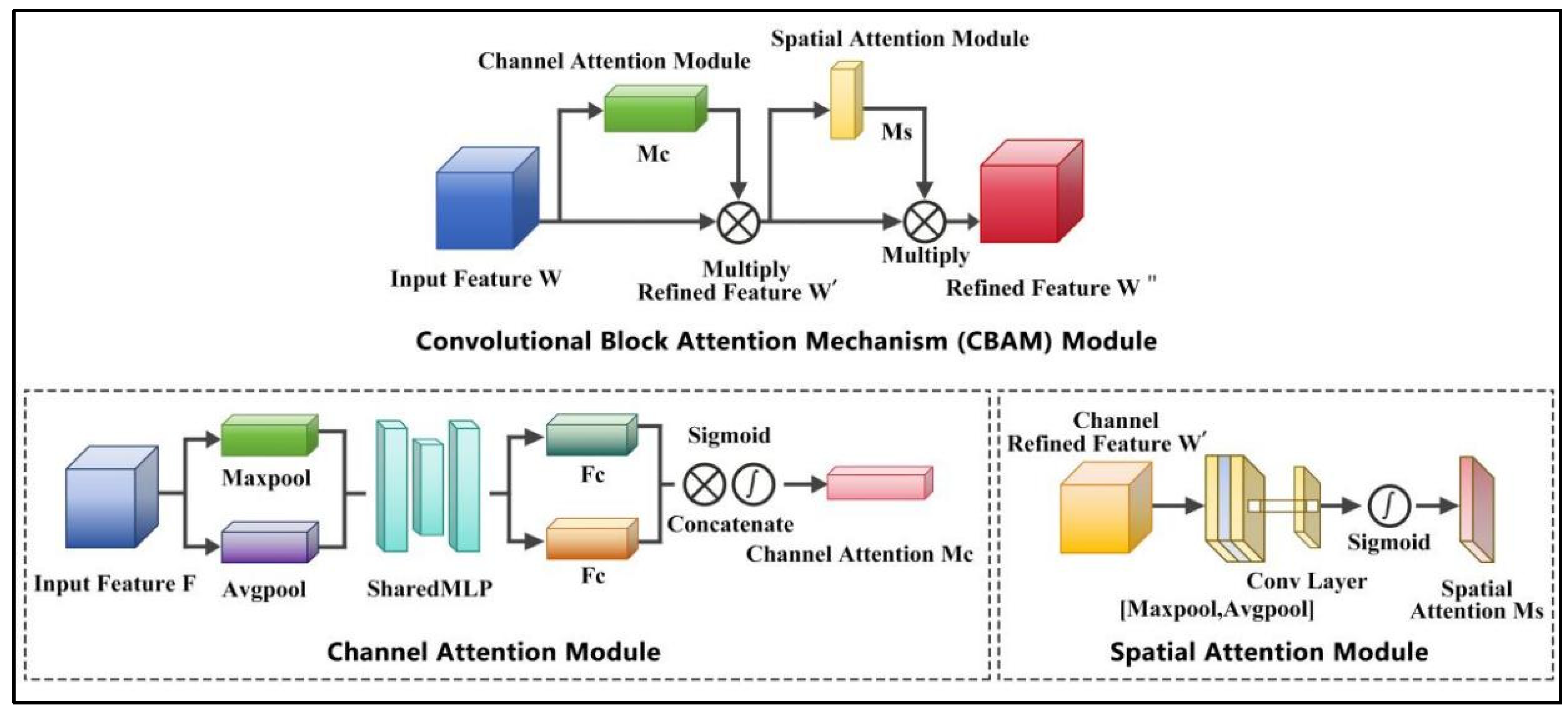
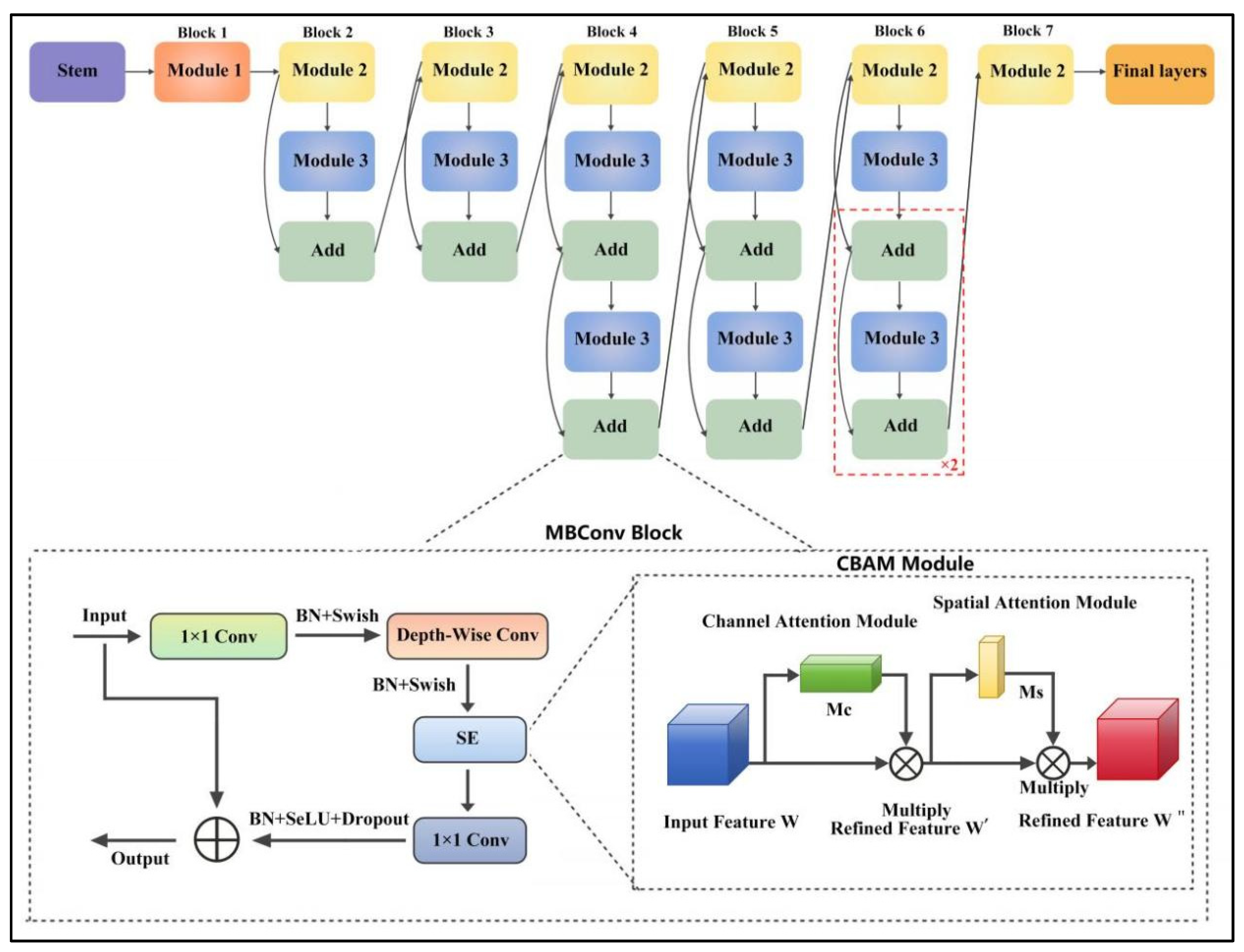
As shown in Figure 1, it is the architecture diagram of the CBAM-EfficientNet-B0 model. This figure shows the network structure of the deep learning model. The input is a PSR trajectory diagram. The model backbone is based on EfficientNet-B0. We replace the SE attention mechanism in its original MBConv module with the CBAM module. The data stream (as indicated by the arrow) passes through a series of convolutional layers, MBConv blocks and downsampling operations, and finally outputs the classification results through the global average pooling layer and the fully connected layer. The resolution changes at key stages are marked in the figure. Its core lies in embedding the convolutional block attention mechanism (CBAM) module in the backbone framework of EfficientNet-B0. To enhance the recognition ability of PSR trajectory map features of ultrasonic echo signals before and after HIFU-induced denaturation of biological tissues. This model retains the efficient compound scaling structure of EfficientNet-B0 and the MBConv module but replaces the original SE module with the CBAM module in each MBConv, thereby enhancing the focus on key features in both the channel and spatial dimensions. The CBAM module successively consists of the channel attention sub-module and the spatial attention sub-module: The former enhances the representation of important feature channels by combining global average pool (Avgpool) and max pool (Maxpool) with multi-layer perceptrons. The latter, by performing pooling operations on the channel dimension and processing them through convolution and activation functions, highlights the mutation features in the spatial region and enhances the discriminative power of feature expression. If the input feature map is set to W , then its processing procedure can be expressed as
W = M c W W
W = M s W W
The architecture of the CBAM module is shown in Figure 2. This module processes attention in both channel and spatial dimensions in sequence. M c W is the channel attention feature map. The input feature map aggregates spatial information through Avgpool and Maxpool operations and then generates the weights of each channel through the multi-layer perceptron (MLP) and the sigmoid function. M s ( W ) is a spatial attention feature map. By performing Avgpool and Maxpool in the channel dimension, the spatial weights are generated through the convolutional layer and the sigmoid function after concatenation. Finally, multiply by the input feature again. The symbol represents element-by-element multiplication. Both W and W are refined features obtained through element-by-element multiplication.

2.2.2. CNN Base Models

In other CNN models, as a typical implementation of a deep residual network, ResNet101 addresses the gradient disappearance issue during deep network training through the introduction of cross-layer jump connections and bottleneck structure [42]. DenseNet201 introduces dense connectivity to reuse features across all subsequent layers, effectively alleviating the vanishing-gradient problem and enhancing parameter efficiency [43]. ResNet18, a shallower variant of ResNet, balances speed and performance with 18 layers [44]. VGG16 employs a uniform 3 × 3 convolution stack, providing a high-parameter baseline (138 M parameters) [45].

2.3. The Proposed Denatured Recognition System Model

In order to realize accurate denatured recognition of biological tissue during HIFU therapy. In this section, we propose a new method of biological tissue denatured recognition based on PSR and CBAM-EfficientNet-B0. The flowchart shown in Figure 3 outlines the comprehensive procedure for the proposed PSR-CBAM-EfficientNet-B0 recognition system model. The detailed steps are as follows.
(1)
In total, 402 echo samples from non-denatured tissues and 1210 echo samples from denatured tissues are gathered. The one-dimensional ultrasonic echo signals are converted into high-dimensional PSR trajectory diagrams by PSR technology to form an ultrasonic echo signal dataset.
(2)
Transfer learning is adopted, in which the pre-trained EfficientNet-B0 architecture is utilized as the learning basis to train a new model aimed at identifying HIFU-induced denaturation of biological tissues. Enhance the feature extraction capability by using the CBAM module. The SeLU activation function combined with Dropout is adopted to effectively accelerate model convergence. The cosine annealing strategy is adopted to modulate the learning rate during training, helping the model escape the local optimal solution and achieve better performance.
(3)
The ultrasonic echo signals training set is trained using the CBAM-EfficientNet-B0 model. The test set is identified using the trained CBAM-EfficientNet-B0 and other comparison models (VGG16, ResNet18, ResNet101, DenseNet201, EfficientNet-B0). The t-distributed Stochastic Neighbor Embedding (t-SNE) technique is used to visualize the distribution of denaturation features of different models [46], and the accuracy, standard deviation, precision, recall, and F1-Score of different models are compared to illustrate the advantages of the proposed method.
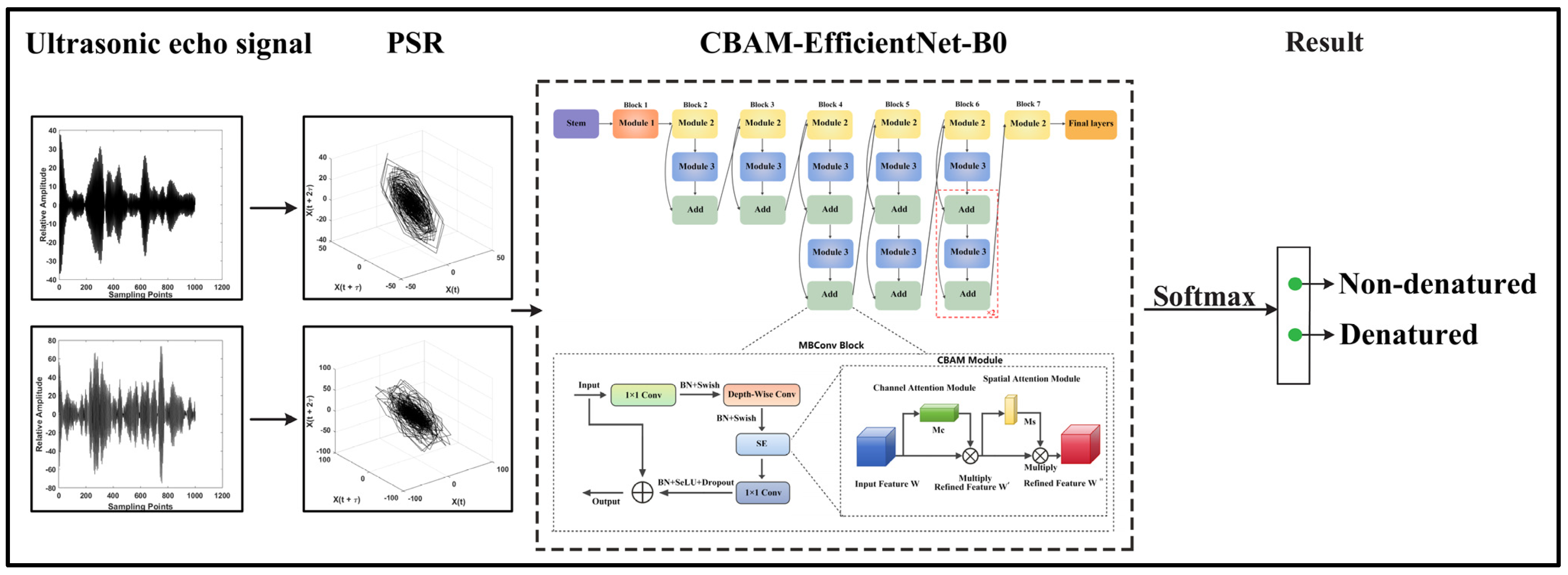
Figure 3. The comprehensive procedure for the proposed PSR−CBAM−EfficientNet−B0 recognition system model.
Fractalfract 09 00819 g003

3. Results and Analysis

3.1. Experimental Data and Analysis

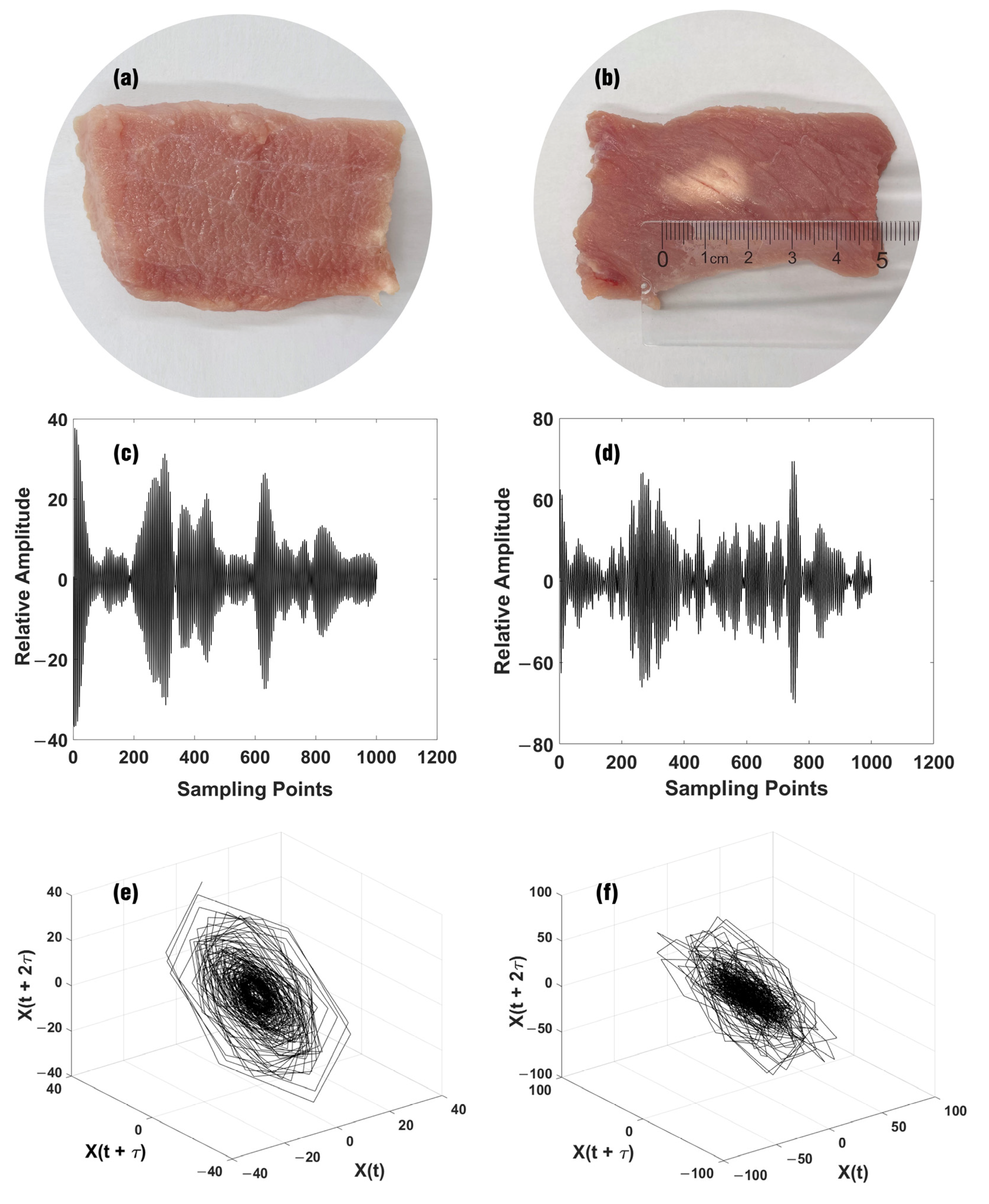
The experimental HIFU irradiation system from reference [12,13] was used to collect the actual ultrasonic echo signals from porcine muscle tissue before and after denaturation. The experimental parameters of the HIFU transducer are as follows. The model of the transducer is HIFU Pro2008, Shenzhen, China. Center frequency is 1.39 MHz. Geometric focal length is 13 cm. Aperture is 11 cm. Sound source pressure is 0.23 MPa. Average time power is 290 W. Single irradiation time is 10 ms. Irradiation interval is 10 ms. Figure 4a,b show a biological tissue section during HIFU treatment, where it is clearly visible that the denatured biological tissue exhibits a “water droplet”-like white spot focal region. Figure 4c,d displays the waveform diagrams of the ultrasonic echo signals before and after HIFU-induced denaturation. Figure 4e,f show the PSR trajectory diagrams of ultrasound echo signals from normal and denatured tissues, generated using the PSR technique. The coordinate axis labels represent the sampled values of the ultrasonic echo signal at different time points, respectively. Together, they form a three-dimensional state vector, which is used to reflect the complete state of the organization at a certain moment. It is clearly visible that there are significant differences in the phase space trajectories of the ultrasound echo signals between the two tissue types. When biological tissues undergo denaturation, the phase space trajectories of the ultrasound echo signals become divergent and chaotic, suggesting a change in the fractal properties of the attractor. This indicates a sudden change in the signal and higher signal complexity. From the perspective of chaotic characteristics, compared to denatured tissues, the PSR diagrams of ultrasound echo signals from normal tissues exhibit distinct attractors, with the phase space trajectories showing better convergence. To quantify the geometric and dynamic complexity of the phase space trajectory, we calculated the box-counting dimension and correlation dimension characteristics of the ultrasonic echo signal in the dataset [47,48]. The values of box-counting and correlation dimension in the non-denatured state were 1.094 ± 0.0523 and 1.227 ± 0.0409, respectively. The box-counting and correlation dimension values of the denatured state were 1.182 ± 0.0867 and 1.2465 ± 0.10487, respectively. The Mann–Whitney U test results showed that the box dimension and correlation dimension characteristic values of the ultrasonic echo signal of the denatured tissues were significantly higher than those of the non-denatured tissues (p < 0.001), indicating that the dynamic process corresponding to the acoustic scattering structure of the denatured tissue also demonstrated higher complexity and randomness. The dataset used in this experiment consists of a total of 1612 PSR trajectory diagrams, including 402 images of non-denatured tissues and 1210 images of denatured tissues. The size of each image is set to 224 × 224 to meet the input requirements of the CNN models. The distribution of denatured samples in the dataset is significantly greater than that of non-denatured samples, which makes the model training highly focused on learning the “denatured” feature patterns, thereby enabling it to sensitively determine whether HIFU treatment has caused tissue denaturation. This is conducive to solving the problem of monitoring the treatment endpoint and greatly enhancing the safety and effectiveness of the treatment.

3.2. Ablation Experiment

To investigate the performance improvement of combining CBAM with EfficientNet-B0 for recognizing HIFU-induced biological tissue denaturation, the differences between using Dropout with SeLU versus ReLU activation functions, and the impact of cosine annealing versus dynamic exponential decay learning rate scheduling strategies on model learning, three sets of ablation experiments were conducted.

3.2.1. The Influence of the Attention Mechanism Module on Model Performance

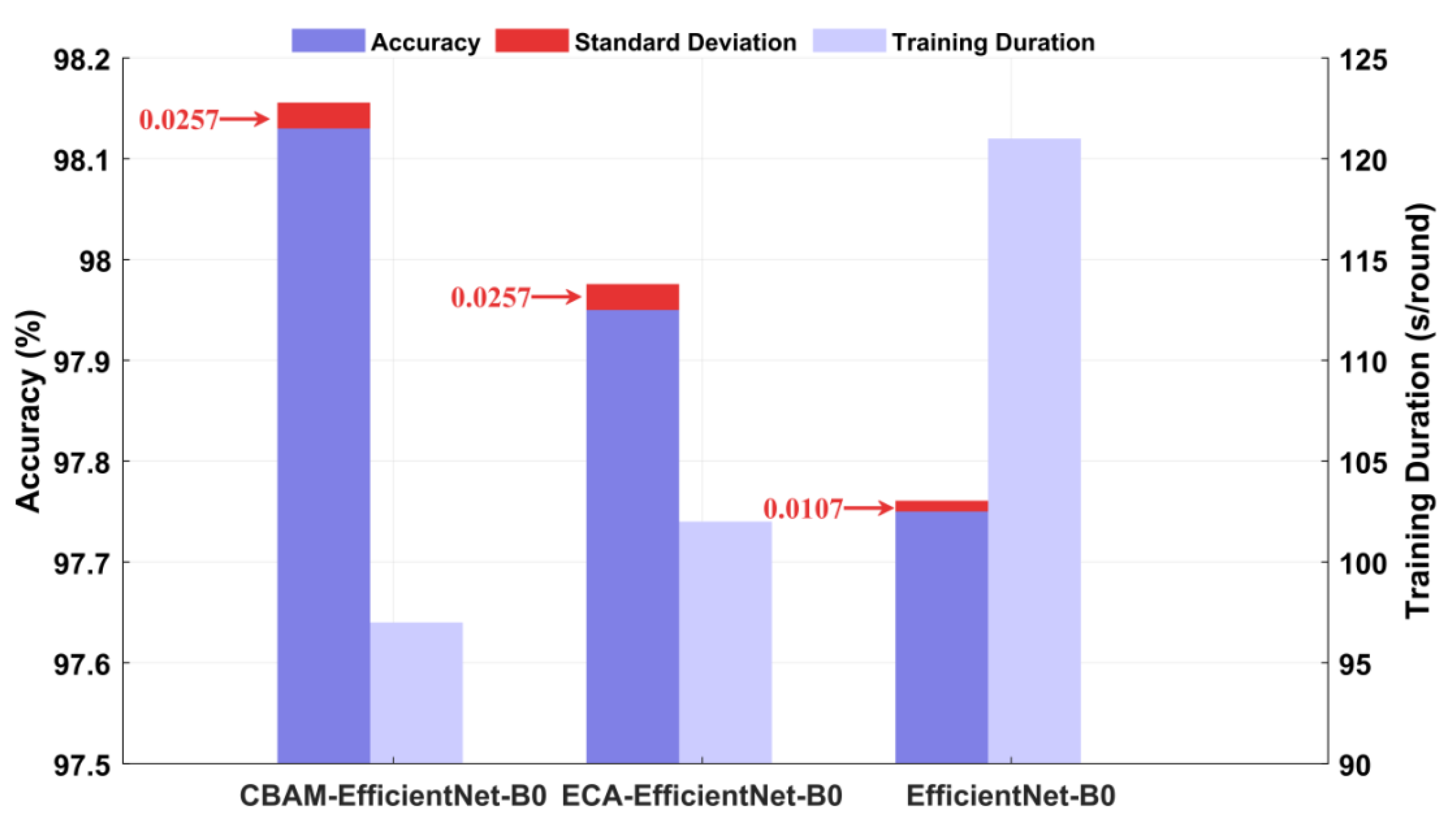
To investigate the impact of different attention mechanism modules on the EfficientNet-B0 network, training and testing were conducted on the same dataset with each model executed 10 times. Comparative analysis was performed on multiple performance metrics among CBAM-EfficientNet-B0, efficient channel attention- enhanced EfficientNet-B0 (ECA-EfficientNet-B0), and the baseline EfficientNet-B0 model, with results presented in Figure 5. The experimental results demonstrate that the incorporation of attention modules consistently improved model performance. The CBAM-EfficientNet-B0 achieved the highest average accuracy (98.13%), followed by ECA-EfficientNet-B0 (97.95%), both outperforming the baseline model (97.75%). Furthermore, both CBAM and ECA reduced training time (97 s/round and 102 s/round, respectively) compared to the baseline model (121 s/round), indicating that attention mechanisms enhance computational efficiency while improving accuracy. Notably, CBAM and ECA exhibited slightly higher standard deviations (0.0257) than the baseline model (0.0107), potentially reflecting their increased sensitivity to data variability. In conclusion, CBAM demonstrated optimal performance in both accuracy and efficiency, validating its effectiveness as a lightweight attention module.

3.2.2. The Influence of Activation Functions on Model Performance

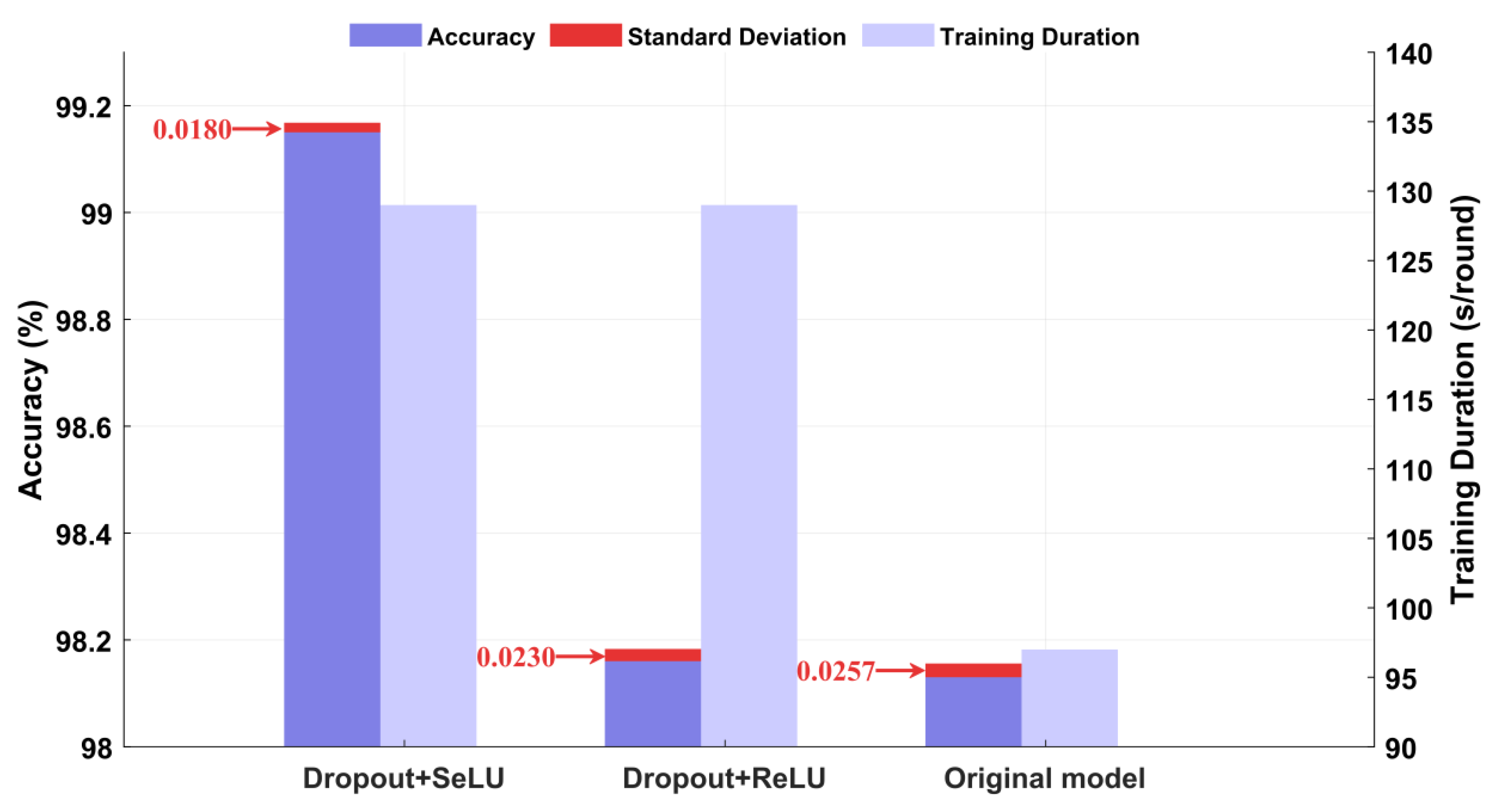
To evaluate the impact of Dropout combined with SeLU activation function on CBAM-EfficientNet-B0’s performance in recognizing HIFU-induced biological tissue denaturation, we conducted comparative experiments using three model variants on the same dataset: the original CBAM-EfficientNet-B0 model, Dropout+SeLU, and Dropout+ReLU. Each configuration was executed 10 times under identical conditions, with results presented in Figure 6. The Dropout+SeLU combination achieved the highest average accuracy (99.15%), demonstrating statistically significant improvements over both the baseline model (98.13%) and Dropout+ReLU (98.16%). Furthermore, Dropout+SeLU exhibited the lowest standard deviation (0.0180), indicating superior training stability compared to ReLU (0.0230) and the original model (0.0257). The performance improvement brought about by the combination of Dropout and SeLU may mainly stem from the inherent synergy between the two. The self-normalizing property of SeLU can stabilize the distribution of activation values, which provides a more stable basis for Dropout and makes its regularization effect more significant, thereby jointly enhancing the model’s generalization ability for the PSR trajectory images of ultrasonic echoes. In contrast, the improvement of the combination of Dropout and ReLU is limited. One possible reason is that ReLU itself lacks self-normalization characteristics, and its activation distribution in deep networks is prone to instability, such as neuron failure problems, which may not be as ideal as the combination effect of Dropout with SeLU. Furthermore, all the schemes that introduce Dropout incur additional computational overhead due to their mechanism of randomly shutting down neurons, resulting in an increase in training time. Based on a comprehensive performance evaluation, the combination of Dropout and SeLU was determined to be the best choice.

3.2.3. The Influence of Learning Rate Scheduling Strategies on Model Performance

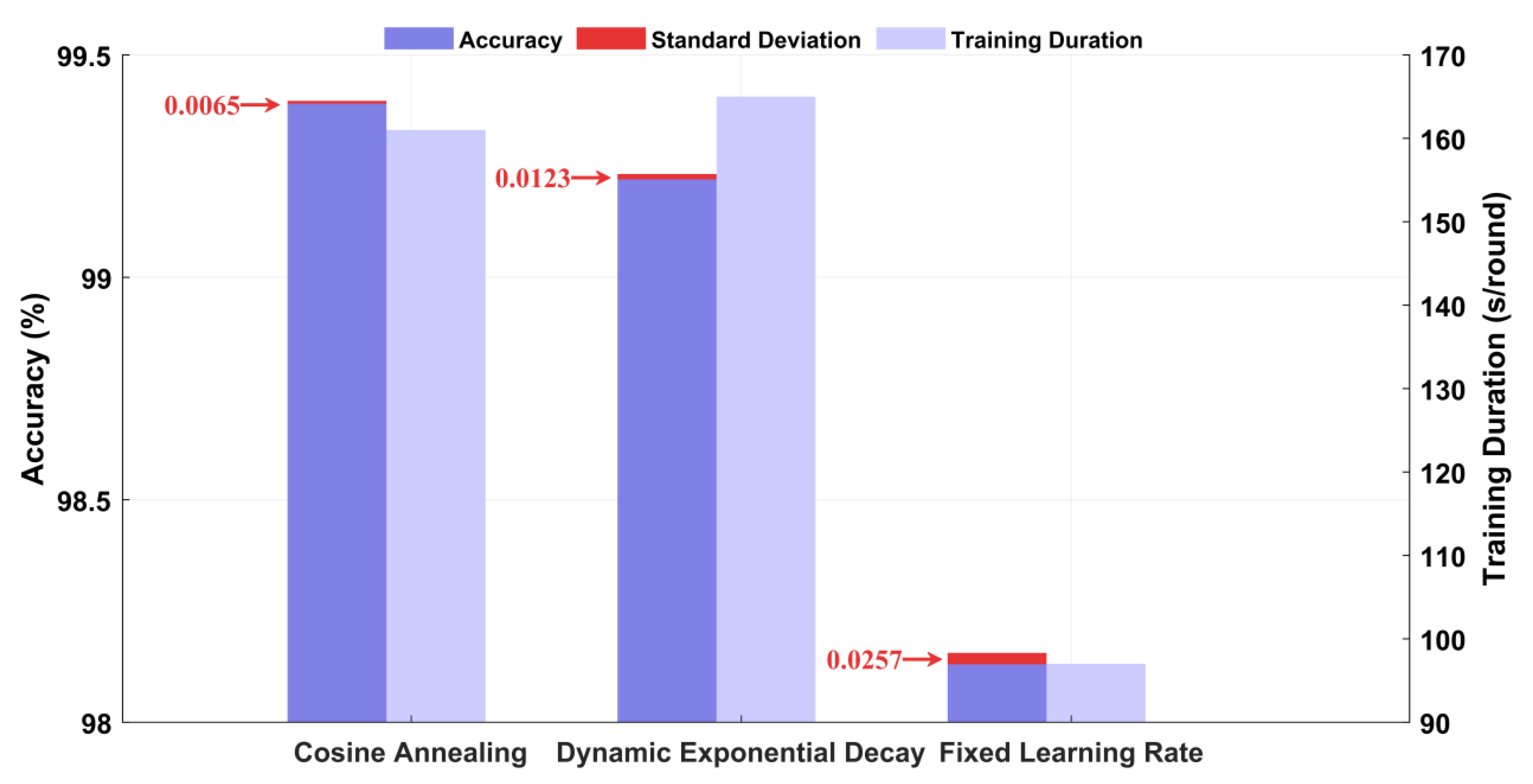
To investigate the impact of different learning rate scheduling strategies on model performance, we conducted comparative experiments evaluating three approaches on the same dataset: cosine annealing, dynamic exponential decay, and fixed learning rate. Each method was executed 10 times, with experimental results detailed in Figure 7. The results demonstrate that the cosine annealing strategy achieved the highest average accuracy (99.39%), followed by dynamic exponential decay (99.22%), both showing statistically significant improvements over the fixed learning rate baseline (98.13%). Notably, the cosine annealing approach not only delivered superior accuracy but also exhibited optimal stability (standard deviation: 0.0065), while maintaining a shorter training time (161 s/round) compared to dynamic exponential decay (165 s/round). While the scheduling strategies introduced additional computational complexity, the substantial performance gains justify this trade-off. These findings validate both the importance of adaptive learning rate scheduling strategies and the particular advantages of the cosine annealing method.

3.3. Training Learning Process

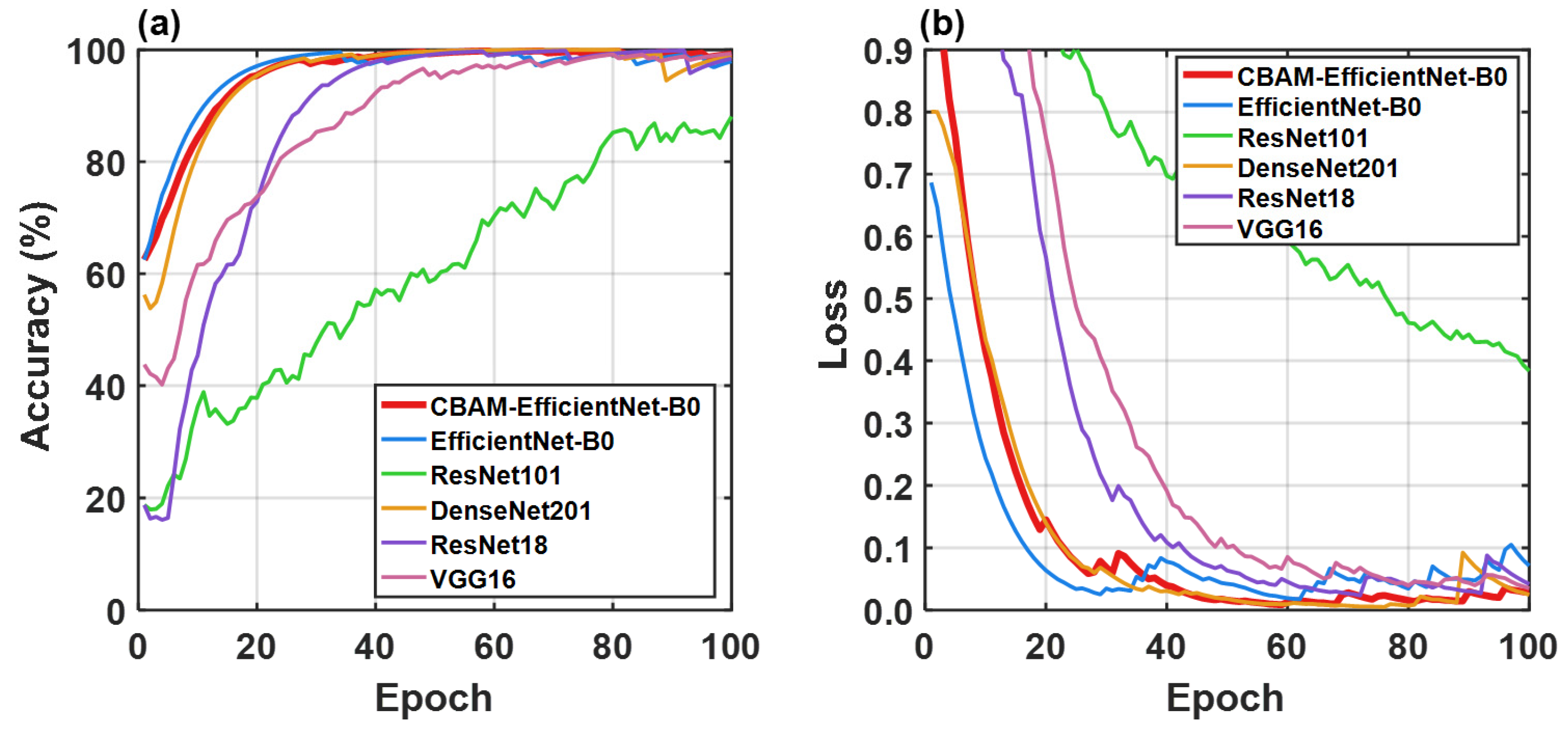
The entire dataset was randomly split into two equal parts: a training set and a test set, with 50% allocated for training and 50% for testing. Based on the pre-training of transfer learning for the EfficientNet-B0 model, we set the miniBatchsize to 16, the MaxEpochs to 3, the number of epochs to 150, the Dropout rate to 0.3 and the minimum learning rate to 10−5. According to the CBAM-EfficientNet-B0 model obtained from the ablation experiment, EfficientNet-B0, ResNet101, DenseNet201, ResNet18, VGG16, and CBAM-EfficientNet-B0 were trained and learned from the dataset under the same conditions. The experiments were conducted using MATLAB R2023a on a computer equipped with 16 GB of RAM and a Core i7 processor. All models uniformly use the SGDM optimizer. Figure 8 displays the training results of PSR trajectory diagram samples for ultrasonic echo signals from non-denatured and denatured tissues with various models. Figure 8 illustrates that as the number of training epochs increases, the accuracy of the six models tends to improve progressively throughout the training process, while the loss rate drops and oscillates within a relatively stable range. In terms of the performance of accuracy curves, the accuracy curve convergence performance of the EfficientNet-B0, DenseNet201, and CBAM-EfficientNet-B0 models is significantly better than that of VGG16, ResNet18, and ResNet101, with relatively faster convergence and accuracy values approaching 100%. However, we observed that the curves of the EfficientNet-B0 and DenseNet201 models showed more significant volatility than those of the CBAM-EfficientNet-B0 model. This implies that the generalization ability of the models EfficientNet-B0 and DenseNet201 is slightly weak. In contrast, the smooth and stable convergence trajectory of the CBAM-EfficientNet-B0 model indicates its stronger robustness and better training efficiency. In terms of the performance of loss curves, the loss curve convergence performance of the EfficientNet-B0, DenseNet201, and CBAM- EfficientNet-B0 is significantly better than that of VGG16, ResNet18, and ResNet101, with relatively faster convergence and loss values approaching 0. Similarly, the CBAM-EfficientNet-B0 model has smaller fluctuations and stronger robustness and generalization performance. In conclusion, the CBAM-EfficientNet-B0 model constructed in this paper demonstrates outstanding generalization ability on this dataset, with ideal training results and the potential to effectively identify HIFU-induced denaturation of biological tissues.

3.4. Recognition Result

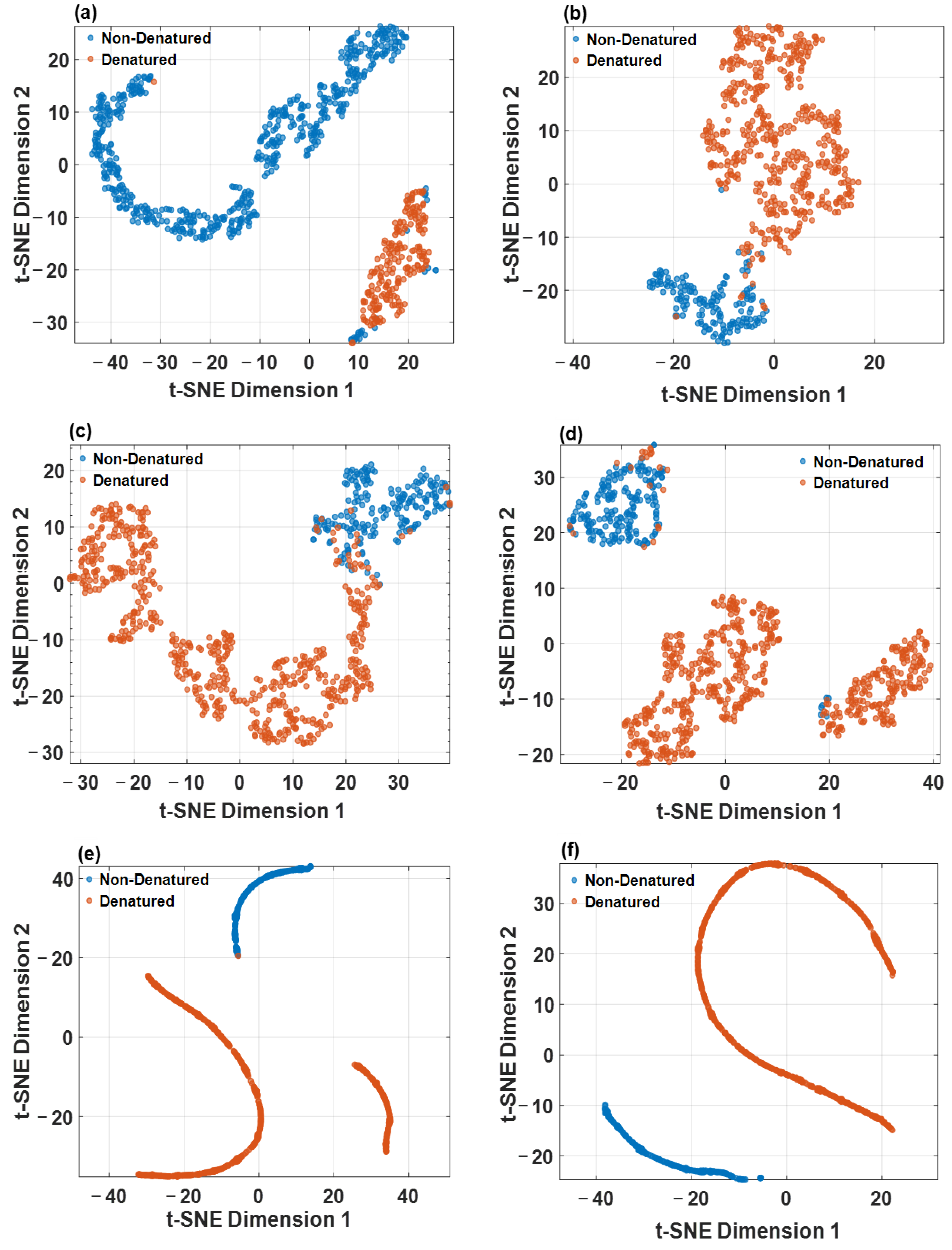
The t-SNE is a widely used technique for dimensionality reduction and data visualization. In the model evaluation phase, t-SNE is employed to visualize the features of test data across the different models with the aim of examining whether samples of different classes are separated. Figure 9 illustrates the visualization results of fully connected layer features for different recognition models. It is clearly observable that there are significant differences in the feature points of the denatured and non-denatured states in the fully connected layers of all models. Compared to the other models (EfficientNet-B0, ResNet101, DenseNet201, ResNet18, VGG16), the CBAM-EfficientNet-B0 model demonstrates the best classification performance at the fully connected layer, with denatured and non-denatured features showing well-separated category distributions with large inter-cluster distances. This indicates that the CBAM-EfficientNet-B0 model is capable of learning and extracting more distinctive and effective denaturation information from the PSR trajectory diagrams of ultrasonic echo signals. The significant difference between the two types of data in the feature space further validates the CBAM-EfficientNet-B0 model’s capability to effectively distinguish between these data types. Among the other models, the EfficientNet-B0 model also shows commendable visualization results at the fully connected layer, with some separation between denatured and non-denatured feature clusters. However, compared to the CBAM-EfficientNet-B0 model, a small number of denatured feature points are still included within the clusters of non-denatured feature points.
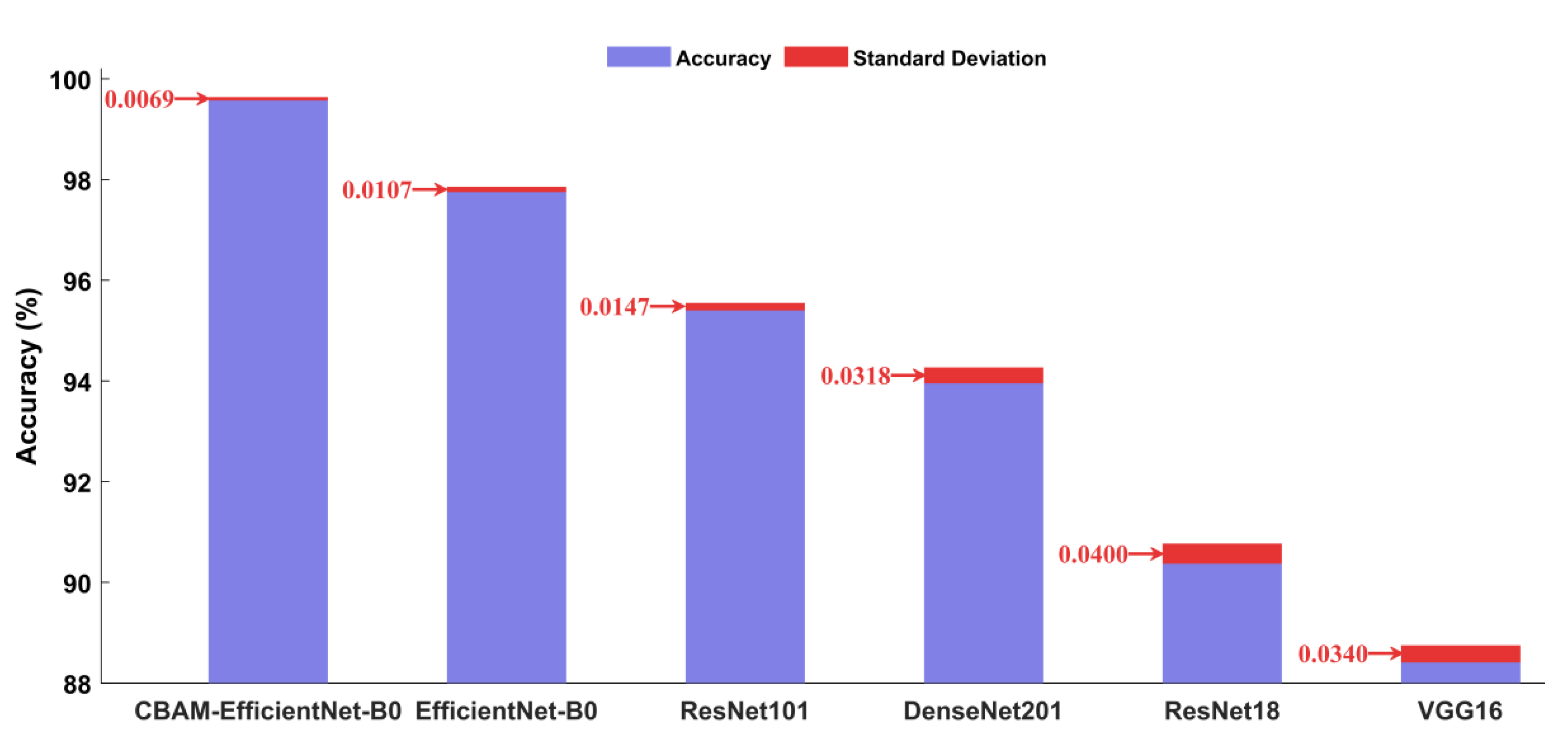
The various trained models were used to perform denatured and non-denatured pattern recognition on the test set. Each model was run 10 times, and the average values were taken. The comparative recognition results of the various models are shown in Figure 10. It is evident that, compared to the other models, the CBAM-EfficientNet-B0 model achieves the highest average accuracy, reaching 99.57%. The smallest standard deviation indicates that the CBAM-EfficientNet-B0 model provides a more stable and robust classification of PSR trajectory diagrams. Furthermore, the Mann–Whitney U test was conducted on the above recognition results. The results showed that the CBAM-EfficientNet-B0 model was significantly superior to the benchmark model in all comparisons (all p < 0.001), indicating that its performance advantage was highly statistically significant. The CBAM-EfficientNet-B0 model displays good potential in terms of feature extraction, recognition effect, and stability in the PSR trajectory diagram during the denatured recognition process of ultrasonic echo signals. These results further demonstrate the superiority of the PSR-CBAM-EfficientNet-B0 method in the recognition of denaturation in biological tissue ultrasonic echo signals.

4. Discussion

This work proposes an innovative method based on ultrasound phase space reconstruction (PSR) and CBAM-EfficientNet-B0 for the accurate identification of the denatured state of biological tissues during HIFU therapy. Its core contribution lies in the integration of nonlinear signal processing and deep learning technologies, achieving high-precision and automated denaturation recognition and avoiding the subjectivity and limitations of manual feature extraction in traditional methods. Through PSR technology, the chaotic features of ultrasonic echo signals were depicted, revealing that the trajectories of denatured tissues exhibited a change in the fractal properties (Figure 4), providing a clear physical basis for subsequent classification. The noise immunity and low data volume requirements of PSR further enhance the feasibility of the method. EfficientNet-B0 with CBAM demonstrated the best classification performance in Figure 9 and Figure 10 (Accuracy: 99.57%, standard deviation: 0.0069), indicating that it can effectively identify HIFU-induced biological tissue denaturation. The ablation experiment (Figure 5, Figure 6 and Figure 7) verified the synergistic optimization effect of CBAM, Dropout+SeLU, and cosine annealing learning rate scheduling strategies, significantly improving the model accuracy and stability. Compared with traditional literature methods (such as multi-scale permutation entropy, fuzzy entropy, etc., reported in references [10,11,12,13], whose accuracy rates are usually between 90% and 96%), the PSR-CBAM-EfficientNet-B0 recognition model avoids the cumbersome manual feature extraction and significantly improves the accuracy. In conclusion, this method does not require manual intervention and directly maps from signals to classification results, which is more in line with the requirements of clinical practice.
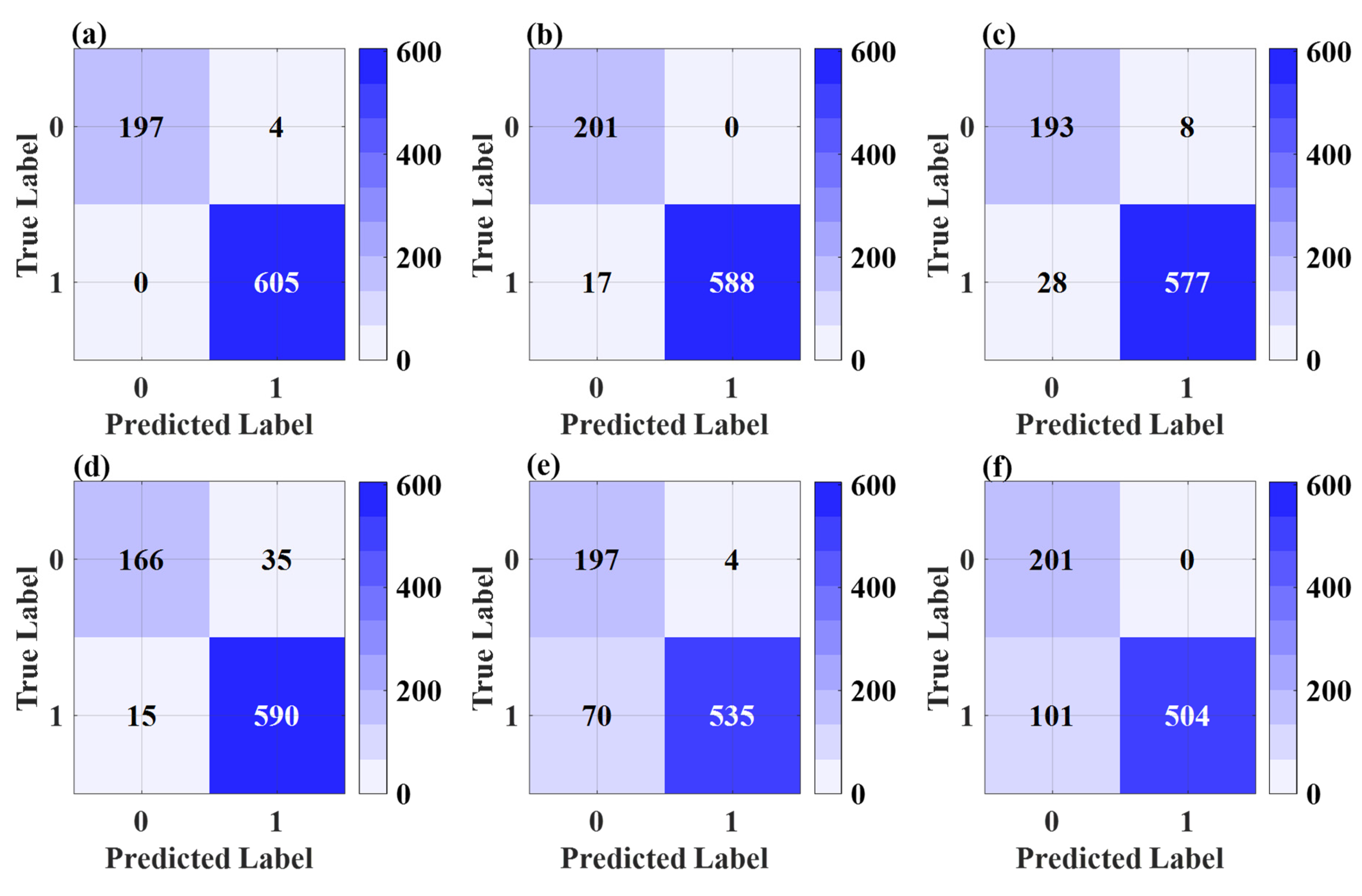
To further demonstrate the advantages of the PSR-CBAM-EfficientNet-B0 recognition model proposed in this paper, the recognition performance of HIFU-induced biological tissue denaturation in various models was evaluated using the confusion matrix. The confusion matrix is obtained as shown in Figure 11. In the horizontal and vertical coordinates of Figure 11, the number “0” represents the non-denatured state, and the number “1” represents the denatured state. It can be seen that the CBAM-EfficientNet-B0 model has fewer misidentifications and better recognition effects compared with the five control models (EfficientNet-B0, ResNet101, DenseNet201, ResNet18, and VGG16). In addition, according to the confusion matrix in Figure 11, the recognition results of precision, recall rate, and F1-score of different models are shown in Table 1. It can be seen from Table 1 that CBAM-EfficientNet-B0 performs the best in comprehensive performance. The F1-Score of its denatured and non-denatured categories reach 0.9967 and 0.9899, respectively, demonstrating extremely high classification balance. This model significantly enhances the feature extraction capability by integrating the CBAM attention mechanism. Most crucially, the CBAM-EfficientNet-B0 model achieved a 100% recall for the category of denatured tissues. In the context of HIFU treatment monitoring, it means that the model can accurately identify all tissue areas that have undergone denaturation. This effectively monitors the treatment endpoint and provides a crucial guarantee for the safety of HIFU treatment for patients. In contrast, although EfficientNet-B0 has a precision of 1.0000 in the denatured category, its recall in the non-denatured category is relatively low (0.9801), indicating a slight imbalance. Traditional models such as ResNet101 and DenseNet201 have relatively high recall in the non-denatured category, but their precision is significantly insufficient, which may lead to misjudgment. The precision of the non-denatured categories of VGG16 and ResNet18 is lower than 0.75, indicating their weak generalization ability. Overall, CBAM-EfficientNet-B0 achieves the best balance between accuracy and recall rate, making it suitable for high-precision classification tasks. The introduction of the attention mechanism could be the key to its advantage. In terms of computational efficiency and real-time feasibility analysis, we calculate that the average recognition time of the PSR-CBAM-EfficientNet-B0 recognition model for a single PSR trajectory diagram is 6.40 ms. Given that the typical frame rate of ultrasonic imaging is usually 10–30 Hz, the reasoning speed of the proposed model is at the millisecond level, which can fully meet the requirements of real-time monitoring.
The PSR-CBAM-EfficientNet-B0 method has achieved excellent performance on porcine muscle tissue, but its generalization capability requires further validation across a broader range of tissue types and larger experimental datasets. This limitation represents a critical constraint of the current study and constitutes the central focus of our future research. Our follow-up research plan has been clearly defined: First, to systematically verify the effectiveness of this method on isolated pig livers, kidneys, and adipose tissues. Second, cooperate with clinical institutions to obtain isolated human tumor tissue samples (such as uterine fibroids and liver tumors) and conduct preliminary feasibility studies. These efforts will crucially assess the universality of this method in tissues with different physiological structures and acoustic characteristics, and they are the cornerstone for its ultimate clinical application.

5. Conclusions

This study proposes an innovative method based on ultrasonic PSR and CBAM-EfficientNet-B0 for the accurate identification of the denatured state of biological tissues during HIFU therapy. By embedding ultrasonic echo signals into high-dimensional phase space and generating PSR trajectory diagrams, the chaotic and fractal characteristics of ultrasonic echo signals are effectively visualized. The differences in phase spatial trajectories before and after tissue denaturation provide a clear physical basis for classification. The EfficientNet-B0 model combined with the CBAM module performs outstandingly in feature extraction and classification tasks, achieving a recognition accuracy rate of 99.57%, which is significantly better than traditional CNN models (EfficientNet-B0, ResNet101, DenseNet201, ResNet18, VGG16). The ablation experiment further verified the synergistic optimization effect of the CBAM module, the Dropout+SeLU activation function, and the cosine annealing learning rate scheduling strategy, significantly improving the accuracy and stability of the model. This method does not require manual intervention and realizes end-to-end automated processing from signals to classification results, overcoming the limitations of insufficient subjectivity and real-time performance in feature extraction in traditional methods.
In future research, we will concentrate on enhancing the PSR-CBAM-EfficientNet-B0 framework by expanding the dataset to incorporate diverse tissue types and HIFU parameters, thereby improving the model’s generalization capability. Additionally, clinical validation through in vivo trials and collaboration with medical professionals will be conducted to assess the method’s practical applicability. These initiatives are designed to facilitate the translation of this algorithmic innovation into clinical practice for HIFU therapy.

Author Contributions

Conceptualization, B.L. and X.Z.; methodology, H.Z.; software, H.Z.; validation, B.L., H.Z. and X.Z.; formal analysis, X.Z.; investigation, B.L. and X.Z.; resources, B.L.; data curation, B.L. and X.Z.; writing—original draft preparation, B.L.; writing—review and editing, B.L., H.Z. and X.Z.; visualization, H.Z.; supervision, X.Z.; project administration, X.Z.; funding acquisition, B.L. All authors have read and agreed to the published version of the manuscript.

Funding

The research was funded by the Hunan Provincial Natural Science Foundation (No. 2023JJ40462), the Research Fund of Hunan Education Department (No. 22B0694, No. 24B0927), and the Key R&D Program of Hunan Province (No. 2024AQ2002).

Data Availability Statement

The source code is available for downloading on GitHub: https://github.com/sduas/CBAM_EfficientNetB0.git, accessed on 10 November 2025.

Conflicts of Interest

The authors declare no conflicts of interest.

References

  1. Yuldashev, P.V.; Karzova, M.M.; Kreider, W.; Rosnitskiy, P.B.; Sapozhnikov, O.A.; Khokhlova, V.A. “HIFU Beam:” A simulator for predicting axially symmetric nonlinear acoustic fields generated by focused transducers in a layered medium. IEEE Trans. Ultrason. Ferroelectr. Freq. Control 2021, 68, 2837–2852. [Google Scholar] [CrossRef]
  2. Yang, K.; Li, Q.; Liu, H.; Zeng, Q.; Cai, D.; Xu, J.; Zhou, Y.; Tsui, P.H.; Zhou, X. Suppressing HIFU interference in ultrasound images using 1D U-Net-based neural networks. Phys. Med. Biol. 2024, 69, 075006. [Google Scholar] [CrossRef]
  3. Sanchez, M.; Barrere, V.; Treilleux, I.; Chopin, N.; Melodelima, D. Development of a noninvasive HIFU treatment for breast adenocarcinomas using a toroidal transducer based on preliminary attenuation measurements. Ultrasonics 2021, 115, 106459. [Google Scholar] [CrossRef] [PubMed]
  4. Ning, G.; Zhang, X.; Zhang, Q.; Wang, Z.; Liao, H. Real-time and multimodality image-guided intelligent HIFU therapy for uterine fibroid. Theranostics 2020, 10, 4676–4691. [Google Scholar] [CrossRef] [PubMed]
  5. Sebeke, L.C.; Gómez, J.D.C.; Heijman, E.; Rademann, P.; Simon, A.C.; Ekdawi, S.; Grüll, H. Hyperthermia-induced doxorubicin delivery from thermosensitive liposomes via MR-HIFU in a pig model. J. Control. Release 2022, 343, 798–812. [Google Scholar] [CrossRef]
  6. Nguyen, M.; Agarwal, A.; Kumaradas, J.C.; Kolios, M.C.; Peyman, G.; Tavakkoli, J.J. Real-time non-invasive control of ultrasound hyperthermia using high-frequency ultrasonic backscattered energy in ex vivo tissue and in vivo animal studies. Phys. Med. Biol. 2024, 69, 215001. [Google Scholar] [CrossRef] [PubMed]
  7. Karwat, P.; Kujawska, T.; Lewin, P.A.; Secomski, W.; Gambin, B.; Litniewski, J. Determining temperature distribution in tissue in the focal plane of the high (>100 W/cm2) intensity focused ultrasound beam using phase shift of ultrasound echoes. Ultrasonics 2016, 65, 211–219. [Google Scholar] [CrossRef]
  8. Dong, H.; Qian, S.; Tan, Q.; Zou, X.; Liu, B. Temperature measurement using passive harmonics during high intensity focused ultrasound exposures in porcine tissue. Acta Phys. Pol. A 2018, 134, 524–528. [Google Scholar] [CrossRef]
  9. Qian, J.; Xie, W.; Zhou, X.; Tan, J.; Wang, Z.; Du, Y.; Li, Y. Real-time monitoring of high intensity focused ultrasound focal damage based on transducer driving signal. Acta Phys. Sin. 2022, 71, 037201. [Google Scholar] [CrossRef]
  10. Peng, Z.; Zhang, X.; Cao, J.; Liu, B. Recognition of biological tissue denaturation based on improved multiscale permutation entropy and GK fuzzy clustering. Information 2022, 13, 140. [Google Scholar] [CrossRef]
  11. Liu, B.; Hu, W.; Zou, X.; Ding, Y.; Qian, S. Recognition of denatured biological tissue based on variational mode decomposition and multi-scale permutation entropy. Acta Phys. Sin. 2019, 68, 028702. [Google Scholar] [CrossRef]
  12. Liu, B.; Qian, S.; Zhang, X. Denatured recognition of biological tissue based on multi-scale phase weighted-permutation entropy during HIFU treatment. Meas. Sci. Technol. 2023, 34, 095701. [Google Scholar] [CrossRef]
  13. Yan, S.Q.; Zhang, H.; Liu, B.; Tang, H.; Qian, S.Y. Identification of denatured and normal biological tissues based on compressed sensing and refined composite multi-scale fuzzy entropy during high intensity focused ultrasound treatment. Chin. Phys. B 2021, 30, 028704. [Google Scholar] [CrossRef]
  14. Song, R.J.; Yuan, Z.Y.; Zhang, Q.; Yu, J.; Xue, H.H.; Tu, J.; Zhang, D. Method of spatiotemporally monitoring acoustic cavitation based on radio frequency signal entropy analysis. Acta Phys. Sin. 2022, 71, 174301. [Google Scholar] [CrossRef]
  15. Dong, H.; Liu, G.; Qu, X. Comparing the Influence of Different-Order HIFU Harmonic Superposition on Focal Temperature of Biological Tissue. Iran. J. Med. Phys. 2025, 22, 279–289. [Google Scholar]
  16. Yang, K.; Li, Q.; Xu, J.; Tang, M.X.; Wang, Z.; Tsui, P.H.; Zhou, X. Frequency-Domain robust PCA for Real-Time Monitoring of HIFU Treatment. IEEE Trans. Med. Imaging 2024, 43, 3001–3012. [Google Scholar] [CrossRef]
  17. Song, M.; Sapozhnikov, O.A.; Khokhlova, V.A.; Son, H.; Totten, S.; Wang, Y.N.; Khokhlova, T.D. Dynamic Mode Decomposition Based Doppler Monitoring of De Novo Cavitation Induced by Pulsed HIFU: An In Vivo Feasibility Study. Sci. Rep. 2024, 14, 22295. [Google Scholar] [CrossRef]
  18. Ran, Y.; Xu, J.; Shi, X.; Liu, Y.; Cai, D.; Zhou, X. Study on Preoperative HIFU Focus Prediction Using Harmonic Motion Imaging. In Proceedings of the 2024 IEEE Ultrasonics, Ferroelectrics, and Frequency Control Joint Symposium (UFFC-JS), Montreal, QC, Canada, 1–4 September 2024; pp. 1–4. [Google Scholar]
  19. Payen, T.; Crouzet, S.; Guillen, N.; Chen, Y.; Chapelon, J.Y.; Lafon, C.; Catheline, S. Passive Elastography for Clinical HIFU Lesion Detection. IEEE Trans. Med. Imaging 2023, 43, 1594–1604. [Google Scholar] [CrossRef]
  20. Schroeder, A.B.; Karim, A.; Ocotl, E.; Dones, J.M.; Chacko, J.V.; Liu, A.; Eliceiri, K.W. Optical imaging of collagen fiber damage to assess thermally injured human skin. Wound Repair Regen. 2020, 28, 848–855. [Google Scholar] [CrossRef]
  21. Sun, Y.; Chen, W.L.; Lin, S.J.; Jee, S.H.; Chen, Y.F.; Lin, L.C.; Dong, C.Y. Investigating mechanisms of collagen thermal denaturation by high resolution second-harmonic generation imaging. Biophys. J. 2006, 91, 2620–2625. [Google Scholar] [CrossRef]
  22. Galaktionov, I.V.; Kudryashov, A.V.E.; Sheldakova, Y.V.; Byalko, A.A.; Borsoni, G. Measurement and correction of the wavefront of the laser light in a turbid medium. Quantum Electron. 2017, 47, 32. [Google Scholar] [CrossRef]
  23. Pfeiffer, N.; Chapman, G.H.; Kaminska, B. Optical Imaging of Structures within Highly Scattering Material Using an Incoherent Beam and a Spatial Filter. In Optical Interactions with Tissues and Cells XXI; SPIE: Bellingham, WA, USA, 2010; Volume 7562, pp. 33–43. [Google Scholar]
  24. Zhou, X.; Ling, B.W.K.; Ahmed, W.; Zhou, Y.; Lin, Y.; Zhang, H. Multivariate phase space reconstruction and Riemannian manifold for sleep stage classification. Biomed. Signal Process. Control 2024, 88, 105572. [Google Scholar] [CrossRef]
  25. Das, D.; Taralova, I.; Loiseau, J.J.; Slavov, T.; Pandey, M. Frequency Domain Identification of a 1-DoF and 3-DoF Fractional-Order Duffing System Using Grünwald–Letnikov Characterization. Fractal Fract. 2025, 9, 581. [Google Scholar] [CrossRef]
  26. Huerta, A.; Martinez-Rodrigo, A.; Bertomeu-Gonzalez, V.; Ayo-Martin, O.; Rieta, J.J.; Alcaraz, R. Single-lead electrocardiogram quality assessment in the context of paroxysmal atrial fibrillation through phase space plots. Biomed. Signal Process. Control 2024, 91, 105920. [Google Scholar] [CrossRef]
  27. Akbari, H.; Sadiq, M.T.; Rehman, A.U.; Ghazvini, M.; Naqvi, R.A.; Payan, M.; Bagheri, H. Depression recognition based on the reconstruction of phase space of EEG signals and geometrical features. Appl. Acoust. 2021, 179, 108078. [Google Scholar] [CrossRef]
  28. Wang, B.; Qiu, W.; Hu, X.; Wang, W. A rolling bearing fault diagnosis technique based on recurrence quantification analysis and Bayesian optimization SVM. Appl. Soft Comput. 2024, 156, 111506. [Google Scholar] [CrossRef]
  29. Li, B.; Zhou, J.; Gou, F.; Wu, J. TransRNetFuse: A highly accurate and precise boundary FCN-transformer feature integration for medical image segmentation. Complex Intell. Syst. 2025, 11, 213. [Google Scholar] [CrossRef]
  30. Jenecssha, P.; Balasubramanian, V.K.; Murugappan, M. WBC-KICNet: Knowledge-infused convolutional neural network for white blood cell classification. Mach. Learn. Sci. Technol. 2024, 5, 035086. [Google Scholar]
  31. Zhou, Z.; Xie, P.; Dai, Z.; Wu, J. Self-supervised tumor segmentation and prognosis prediction in osteosarcoma using multiparametric MRI and clinical characteristics. Comput. Methods Programs Biomed. 2024, 244, 107974. [Google Scholar] [CrossRef]
  32. Chen, F.; Li, S.; Han, J.; Ren, F.; Yang, Z. Review of Lightweight Deep Convolutional Neural Networks. Arch. Comput. Methods Eng. 2024, 31, 1915–1937. [Google Scholar] [CrossRef]
  33. Yu, H.; Yang, L.T.; Zhang, Q.; Armstrong, D.; Deen, M.J. Convolutional neural networks for medical image analysis: State-of-the-art, comparisons, improvement and perspectives. Neurocomputing 2021, 444, 92–110. [Google Scholar] [CrossRef]
  34. Wu, J.; Luo, T.; Zeng, J.; Gou, F. Continuous refinement-based digital pathology image assistance scheme in medical decision-making systems. IEEE J. Biomed. Health Inform. 2024, 28, 2091–2102. [Google Scholar] [CrossRef]
  35. Wang, B.; Miao, M.; Zhang, K.; Liu, W.; Sheng, Z.; Xu, B.; Hu, W. MSMGE-CNN: A multi-scale multi-graph embedding convolutional neural network for motor related EEG decoding. Mach. Learn. Sci. Technol. 2024, 5, 045047. [Google Scholar] [CrossRef]
  36. Guan, P.; Yu, K.; Wei, W.; Tan, Y.; Wu, J. Big data analytics on lung cancer diagnosis framework with deep learning. IEEE/ACM Trans. Comput. Biol. Bioinform. 2023, 21, 757–768. [Google Scholar] [CrossRef] [PubMed]
  37. Park, H.C.; Joo, Y.; Lee, O.J.; Lee, K.; Song, T.K.; Choi, C.; Yoon, C. Automated classification of liver fibrosis stages using ultrasound imaging. BMC Med. Imaging 2024, 24, 36. [Google Scholar] [CrossRef] [PubMed]
  38. Yang, T.; Yuan, L.; Li, P.; Liu, P. Real-time automatic assisted detection of uterine fibroid in ultrasound images using a deep learning detector. Ultrasound Med. Biol. 2023, 49, 1616–1626. [Google Scholar] [CrossRef]
  39. Lin, J.; Huang, L.; Ding, L.; Yan, S. Deep Brain Tumor Lesion Classification Network: A Hybrid Method Optimizing ResNet50 and EfficientNetB0 for Enhanced Feature Extraction. Fractal Fract. 2025, 9, 614. [Google Scholar] [CrossRef]
  40. Lakshminarasimha, K.; Priyeshkumar, A.T.; Karthikeyan, M.; Sakthivel, R. Enhancing Lung Cancer Diagnosis: An Optimization-Driven Deep Learning Approach with CT Imaging. Cancer Investig. 2025, 43, 515–534. [Google Scholar] [CrossRef]
  41. Ali, K.; Shaikh, Z.A.; Khan, A.A.; Laghari, A.A. Multiclass skin cancer classification using EfficientNets-a first step towards preventing skin cancer. Neurosci. Inform. 2022, 2, 100034. [Google Scholar] [CrossRef]
  42. Zhang, Q. A novel ResNet101 model based on dense dilated convolution for image classification. SN Appl. Sci. 2022, 4, 9. [Google Scholar] [CrossRef]
  43. Huang, G.; Liu, Z.; Van Der Maaten, L.; Weinberger, K.Q. Densely connected convolutional networks. In Proceedings of the IEEE Conference on Computer Vision and Pattern Recognition, Honolulu, HI, USA, 21–26 July 2017; pp. 4700–4708. [Google Scholar]
  44. He, K.; Zhang, X.; Ren, S.; Sun, J. Deep residual learning for image recognition. In Proceedings of the IEEE Conference on Computer Vision and Pattern Recognition, Las Vegas, NV, USA, 27–30 June 2016; pp. 770–778. [Google Scholar]
  45. Theckedath, D.; Sedamkar, R.R. Detecting affect states using VGG16, ResNet50 and SE-ResNet50 networks. SN Comput. Sci. 2020, 1, 79. [Google Scholar] [CrossRef]
  46. van der Maaten, L.; Hinton, G. Visualizing data using t-SNE. J. Mach. Learn. Res. 2008, 9, 2579–2605. [Google Scholar]
  47. Wang, J.; Yang, G.; Yuan, Y.; Sun, J.; Pu, G. Effects of Scale Parameters and Counting Origins on Box-Counting Fractal Dimension and Engineering Application in Concrete Beam Crack Analysis. Fractal Fract. 2025, 9, 549. [Google Scholar] [CrossRef]
  48. Liu, H.; Xie, H.; Wu, F.; Li, C.; Gao, R. A Novel Box-Counting Method for Quantitative Fractal Analysis of Three-Dimensional Pore Characteristics in Sandstone. Int. J. Min. Sci. Technol. 2024, 34, 479–489. [Google Scholar] [CrossRef]
Figure 1. The architecture diagram of CBAM-EfficientNet-B0 model.
Fractalfract 09 00819 g001
Figure 2. The architecture of CBAM module.
Fractalfract 09 00819 g002
Figure 4. Different types of biological tissue sections, ultrasonic echo signal waveforms and corresponding PSR trajectory diagrams during HIFU treatment. (a) Normal tissue sections; (b) Denatured tissue sections; (c) Waveform in the non-denatured state; (d) Waveform in the denatured state; (e) PSR trajectory diagram in the non-denatured state; (f) PSR trajectory diagram in the denatured state.
Fractalfract 09 00819 g004
Figure 5. Performance comparison of different attention modules on the EfficientNet-B0 model.
Fractalfract 09 00819 g005
Figure 6. Comparison of model performance with different activation functions.
Fractalfract 09 00819 g006
Figure 7. Comparison of model performance under different learning rate scheduling strategies.
Fractalfract 09 00819 g007
Figure 8. Training results of PSR trajectory diagram samples for ultrasonic echo signals using different models. (a) Accuracy curve; (b) Loss curve.
Fractalfract 09 00819 g008
Figure 9. The visualization results of fully connected layer features for different recognition models. (a) VGG16; (b) ResNet101; (c) ResNet18; (d) DenseNet201; (e) EfficientNet-B0; (f) CBAM-EfficientNet-B0.
Fractalfract 09 00819 g009
Figure 10. The comparative recognition results for different models.
Fractalfract 09 00819 g010
Figure 11. The confusion matrix of different recognition models. (a) CBAM-EfficientNet-B0; (b) EfficientNet-B0; (c) ResNet101; (d) DenseNet201; (e) ResNet18; (f) VGG16.
Fractalfract 09 00819 g011
Table 1. Experimental results of Precision, Recall rate and F1-Score of different recognition models.
ModelClassPrecisionRecallF1-Score
CBAM-EfficientNet-B0Denatured0.99341.00000.9967
Non-Denatured1.00000.98010.9899
EfficientNet-B0Denatured1.00000.97190.9858
Non-Denatured0.92201.00000.9594
ResNet101Denatured0.98630.95370.9698
Non-Denatured0.87330.96020.9146
DenseNet201Denatured0.94400.97520.9593
Non-Denatured0.91710.82590.8691
ResNet18Denatured0.99260.88430.9353
Non-Denatured0.73780.98010.8419
VGG16Denatured1.00000.83310.9089
Non-Denatured0.66561.00000.7992
Disclaimer/Publisher’s Note: The statements, opinions and data contained in all publications are solely those of the individual author(s) and contributor(s) and not of MDPI and/or the editor(s). MDPI and/or the editor(s) disclaim responsibility for any injury to people or property resulting from any ideas, methods, instructions or products referred to in the content.