Article

A Simple Method for Generating New Fractal-like Aggregates from Gravity-Based Simulation and Diffusion-Limited Aggregation


by
Sancho Salcedo-Sanz
1,*,
Pablo Álvarez-Couso
2,
Luis Castelo-Sardina
2 and
Jorge Pérez-Aracil
1
1
Department of Signal Processing and Communications, Universidad de Alcalá, 28805 Alcalá de Henares, Spain
2
Department of Design and Image, Universidad Complutense de Madrid, 28040 Madrid, Spain
*
Author to whom correspondence should be addressed.
Fractal Fract. 2025, 9(12), 791; https://doi.org/10.3390/fractalfract9120791 (registering DOI)
Submission received: 17 October 2025 / Revised: 18 November 2025 / Accepted: 28 November 2025 / Published: 2 December 2025
(This article belongs to the Section Geometry)

Abstract

This paper proposes a new simple method for generating fractal-like aggregates in 2D real spaces. The idea is to use an initial fractal aggregate and simulate a Gravity-based attraction from a distant point (using a gravity attractor with a large mass, but without volume). A Diffusion-Limited Aggregation (DLA) procedure is then applied by considering a single particle situated in the gravity attractor, with a minimum distance R a for deciding between aggregation or no aggregation. The final aggregates obtained are completely new fractal-like aggregates (images or structures). We analyze the fractal-like generated images obtained with the proposed method, considering different configurations and parameters in the simulations, including different initial fractals, different minimum distances R a , etc. We also analyze the fractal dimensions of some of the new aggregates constructed by the proposed Gravity-based DLA simulation method.

1. Introduction

Non-equilibrium growth models describe systems where growth processes are out of thermal equilibrium, found in fields like material science, physics, and ecology [1,2]. These systems have also been used and simulated to generate fractal-like structures and images, producing random structures that form over time, often characterized as fractals because of their self-similar properties and scale−invariant nature [3]. Specifically, a 2D fractal-like aggregate is a complex cluster of particles that exhibits a class of fractal geometry in two dimensions (it displays self-similarity across different scales). Non-equilibrium growth models for fractal aggregate construction, such as Diffusion-Limited Aggregation (DLA) [4,5], were proposed in the 80s as a way of generating self-organized fractal-like particle clusters. Iterated Function Systems (IFSs) [6,7] were also proposed for fractal image generation, and they have often been used in fractal art generation [8,9]. Strange Attractors (SAs) are the solutions of non-linear iterative equations, and they have been studied in statistical physics [10,11] and also for generating fractal images [12]. Lindenmayer Systems (L-Systems) [13] have also been used to construct fractal images, in many cases related to plant representation [14,15]. Alternative methods for fractal image generation have also been proposed in the literature for 2D fractals, such as p-circle inversion [16], as well as for 3D aggregates [17].
In addition to the different potential applications of fractal aggregates in materials science, statistical physics, or algorithm design [18], the applications in visual sciences, computer graphics, and art are also relevant. The first years of the 80s were witness to the raising of a new art, fractal art [19,20], a form of computer graphics or algorithmic art created by constructing fractal objects and representing the results as still images, animations, or even media [21,22,23]. Fractal art has had great impact in architecture, design, and visual modern art [24], including in computerized abstract painting [25]. Fractal art has also promoted the search for new fractal images with sufficient aesthetic value [26]. The first proposals of fractal art were based on mathematical developments in fractal geometry, initialized by mathematician Benoît Mandelbrot [27], who coined the term “fractal mathematics” [28]. Since these initial contributions, works on the generation of new fractal images from Mandelbrot sets and related fractals (fractals in a complex space, like Julia sets) have become common in the literature [29,30,31,32,33,34]. Mandelbrot and Julia sets are some of the best known illustrations of highly complicated chaotic systems generated by very simple mathematical processes [35,36].
In recent years, there have been different studies on hybrid approaches, which merge two of these basic fractal generation techniques to obtain new fractal images. For example, a hybrid system involving DLAs with Eden growth surface kinetics was proposed in [37]. One recent study also discussed an approach which allows the system to behave as a DLA or an Eden growth approach, depending on just one design parameter [38]. DLAs and L-System hybrids have been explored in [39] for generating alternative fractal structures which combine the properties of both methods. In [40], a hybrid approach for constructing multi-fractal images with multi-resolution was introduced. The approach combined DLA with SAs, in such a way that the particles in an initial DLA aggregate were substituted by SAs, obtaining multi-resolution fractal clusters. In [41], a growth model combined with DLAs and oriented attachment was developed for obtaining pine-needle-like images.
In this paper, we propose a new simple method for generating fractal aggregates in 2D real spaces. The proposed method starts from a given fractal aggregate (an SA in this case, but all other types of fractals are, of course, possible), and simulates a gravity attraction from a distant point (gravity attractor without volume). Then, a DLA process is carried out from a single particle situated in the gravity attractor, considering a minimum distance R a for deciding aggregation. The final DLA aggregate is a new fractal-like aggregate structure. We analyze the fractal images generated by the proposed method with different parameters and configurations. We also analyze the fractal dimensions of some of the new aggregates constructed by the proposed Gravity-based DLA simulation method.
The remainder of this paper is structured as follows: The next section describes some classical fractal image generation methods, such as DLA and SA construction. Section 3 presents the methodology introduced in this work for constructing new aggregates based on gravity simulation and DLA processes. Section 4 shows the results in terms of the different fractal aggregates obtained with the proposed methodology, and how to characterize them from their fractal dimensions. Section 5 closes the paper with some final remarks on the research carried out.

2. Classic Fractal-like Aggregate Construction Methods

This section summarizes some classic methods used to generate fractal 2D aggregates (fractal-like particle clusters in a 2D plane). We specifically focus on Diffusion-Limited Aggregation (DLA) and Strange Attractor fractals.

2.1. Diffusion-Limited Aggregation

Diffusion-Limited Aggregation (DLA) [4,42] is a simple algorithm which generates random fractal clusters or aggregates [43]. Aiming at illustrating the DLA method, we have considered the specific DLA model implementation described in [44]. This DLA model takes into account a unique seed at the beginning of the simulations, located at the center of a given discrete lattice, which will be the initial cluster to be grown. Then, particles are sequentially released at a circle distant from the cluster. The position of these particles are modified by means of a random walk. The distance between the center of the lattice and the launching circle is denoted as R l . The random walks are defined as follows:
x n + 1 y n + 1 = x n y n + cos ( φ + λ θ n ) sin ( φ + λ θ n ) ,
where x n and y n are the particle position at the nth step of the random walk, φ [ π , π ] is a random angle that defines the direction of the particle’s trajectory, λ [ 0 , 1 ] is a parameter that introduces the random component of the trajectories, and  θ n [ π , π ] is a random direction. Note that λ is defined at the beginning of the random walks, whereas θ n receives a random value for each walk step n. The random walk of a given particle ends if the particle visits a site neighboring the current cluster (it joins finally to this site). On the other hand, the random walk also ends if the distance between the particle and the cluster is larger than a killing radius R k . In this latter case, the particle is eliminated and a new one is released at the launching circle R l . Usually, the relationship between R l and R k is defined as
R l = R m a x + R 0 ,
where R m a x is the maximum distance from the center of the lattice of a particle belonging to the cluster, and  R 0 is a defined radius. The killing radius R k is then defined as
R k = 2 R m a x + R 0 = R m a x + R l ,
which gives the relationship between R l and R k .
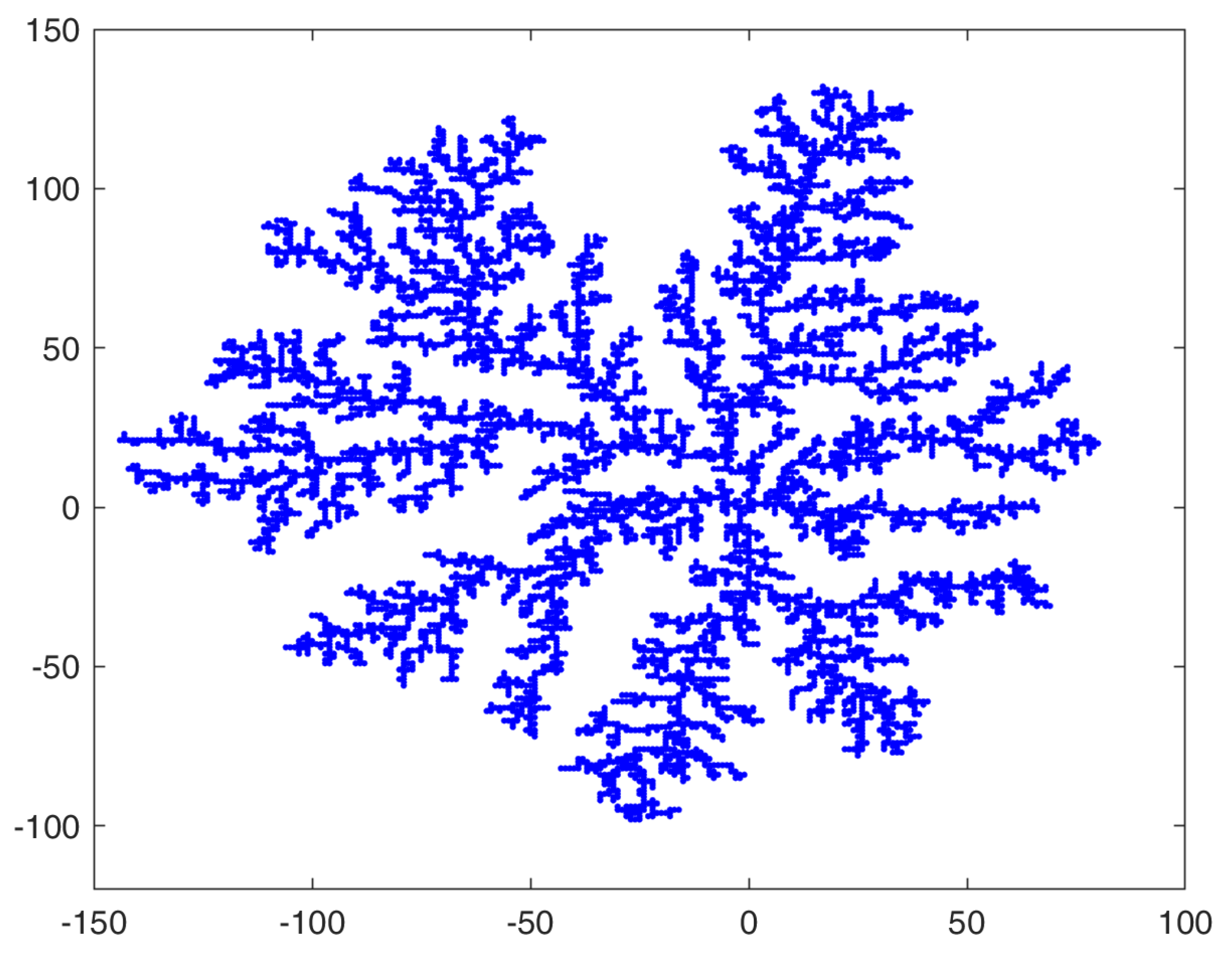
For the sake of clarity and illustrative purposes, Figure 1 represents an example of the simulation construction by means of circles of radii R m a x , R l , and R k . In this figure, we have represented two particles, labeled “a” and “b”, respectively, along with their random walk trajectories. Note that the random walk of particle “a” ends successfully by reaching the cluster (the particle in red aggregated to the cluster). On the contrary, particle “b” has an unsuccessful random walk (the particle trajectory is killed after reaching the circle with radius R k ). Figure 2 shows an example of a fractal structure generated by DLA simulation. Note that in this case, the DLA simulation only considers integer locations for particles, so the aggregate is being constructed by the direct attachment of particles to another particle already in the aggregate.
DLAs have attracted the attention of the statistical physics research community because of their capacity for generating self-organized fractal structures [45]. Specifically, DLAs have been traditionally applied to model different phenomena such as electro-deposition [46], bacterial colony growth [47], or neurite formation for neural shape studies [48], among many others.
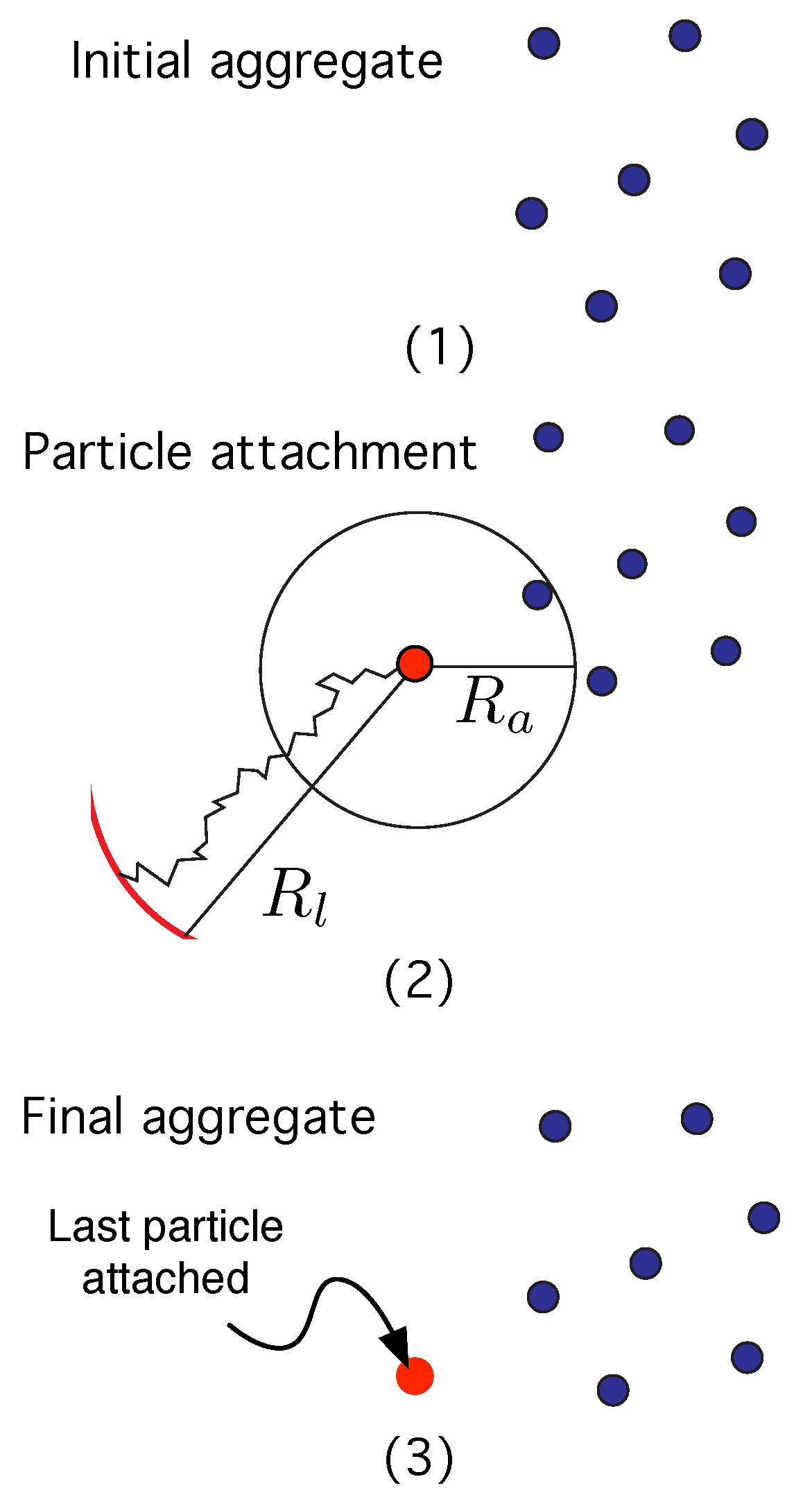
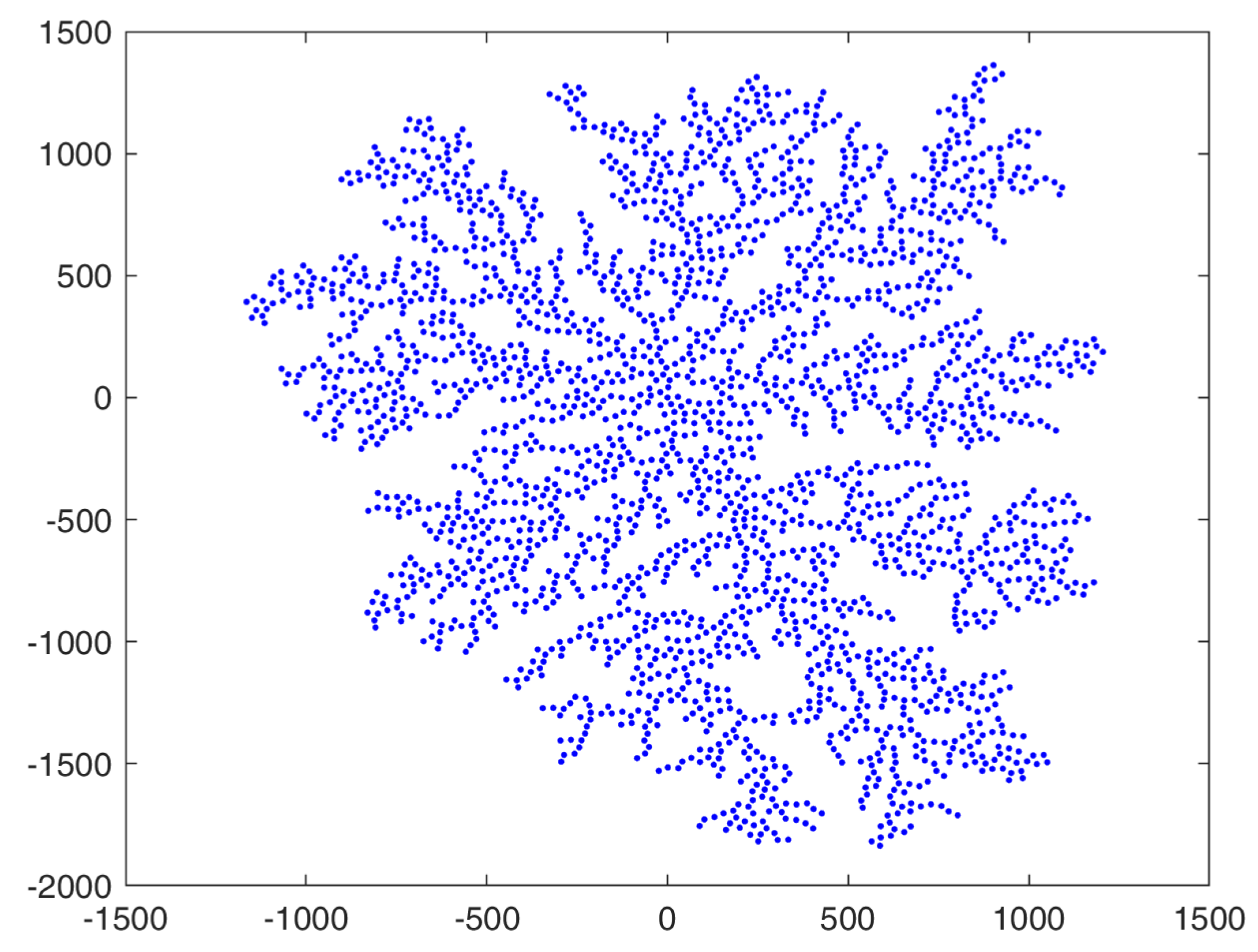
In refs. [40,49], alternative DLA aggregates are considered, defined using an attachment radius, R a , or distance d in such a way that a given particle is set into the DLA aggregate as soon as it finds an existing particle within a distance R a from it. Figure 3 shows an example of the attachment procedure for generating DLA aggregates in which the minimum distance between one particle and at least another one in the aggregate is smaller than R a . Figure 4 shows an example of a DLA aggregate with around N = 2600 particles, constructed using this model with R a < 30 .

2.2. Strange Attractors

Another method of obtaining fractal-like cluster structures is to consider Strange Attractors (SAs) of dynamical systems with chaotic behavior [10,11,50]. An SA can be seen as the solution to a non-linear dynamic system (usually chaotic), in such a way that the pattern generated in the phase space is fractal in nature. Usually, SAs are generated using iterated non-linear maps, which can be quadratic, cubic, etc. For instance, a general two-dimensional iterated quadratic map can be described as follows:
x n + 1 = a 1 + a 2 x n + a 3 x n 2 + a 4 x n y n + a 5 y n + a 6 y n 2 y n + 1 = a 7 + a 8 x n + a 9 x n 2 + a 10 x n y n + a 11 y n + a 12 y n 2
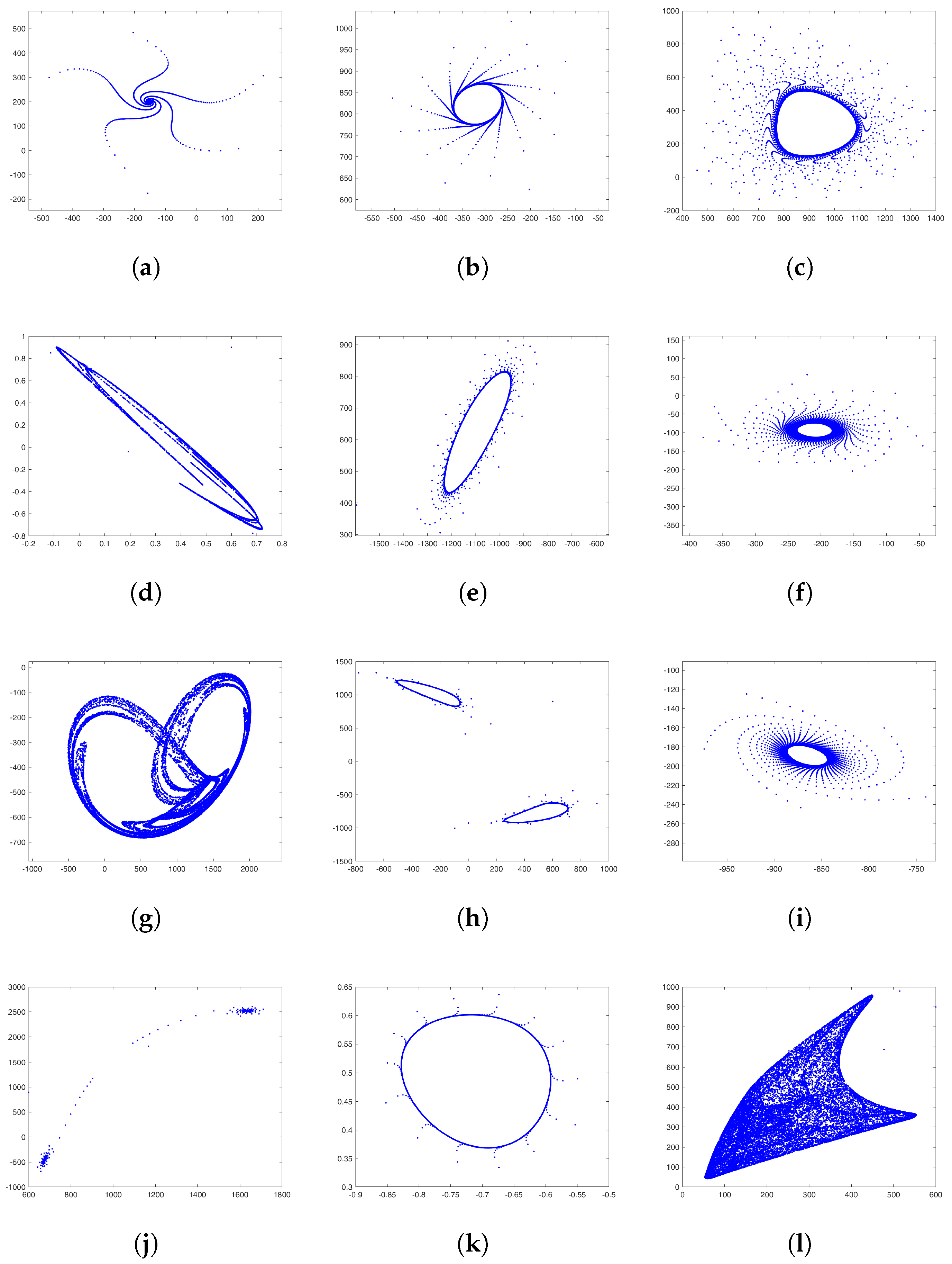
Note that, as reported in [12], a small percentage of the solutions from Equation (4) are SAs (depending on the parameters { a 1 , , a 12 } ) and in fact some of them are chaotic, but there are others intermittent or convergent to a periodic orbit. SA-based fractals have been suggested to have aesthetic value as artwork pieces or part of larger compositions [51]. Figure 5 shows some examples of SAs, obtained from Equation (4), initialized with ( x 0 , y 0 ) = ( 0.6 , 0.9 ) .
Note that each SA can be represented as a vector of M points in the phase space, described by Equation (4). It is also important to notice that an SA generated by Equation (4) is completely defined by the 12 parameters { a 1 , a 2 , , a 12 } , which are able to expand any set of M points in the phase space, given an initial point ( x 0 , y 0 ) .

3. Construction of New Fractal Aggregates from Gravity DLA Simulation

Let us consider two particles with masses M and m. The force that they induce upon each other due to gravity is given by
F = G M · m R 2 ,
where G is a gravity constant (ad hoc for the simulation), and R stands for the distance between the two masses. The force is in the direction of the line between the two masses. It is well known that the result of this gravity is an attraction force, in which the acceleration of a particle m is given by
a = F m = G M R 2 .
In this case, we consider an attractor point with mass M and a fractal aggregate located at a certain position of a 2D space, formed by particles of mass m, which will be attracted to M due to the simulated gravity. This gravity simulation is carried out by considering discrete time-steps t, where each particle is attracted by the attractor mass M, using Equation (6), in the direction of the attractor mass and the particle. We consider that the attractor M does not have volume, only attraction, so no collisions among masses are simulated. We then consider a DLA process [4,43] from a single seeded particle located at the largest mass M. In this DLA process, a particle joins to the aggregate if it passes at a distance equal to or less than a given threshold R a from the current aggregate—see Figure 3 for details on this process. This Gravity-based DLA process is simulated in discrete time-steps. In each time-step, we apply Equation (6) to each particle of the fractal aggregate, and we register all particles passing close enough to the current aggregate forming a new fractal structure, which is the final result of this process. Algorithm 1 shows a pseudocode of the proposed Gravity-based DLA procedure.
Algorithm 1 Pseudo-code of the Gravity-based DLA algorithm
Input: 
Initial aggregate, attractor point, R a , gravity parameters and mass of the attractor and initial aggregate particles.
Output: 
New fractal-like aggregate.
1:
Set t = 1 .
2:
Start the gravity simulation for each particle of the initial aggregate.
3:
Apply the gravity force F = G M · m R 2 to each particle, generating an acceleration a = F m = G M R 2 in the direction of the attractor.
4:
If the distance between the particle and any particle of the new aggregate in the attractor is lower than R a , then add the particle to the aggregate (DLA process). The particle is considered to continue in the gravity simulation.
5:
Set t = t + 1 .
6:
Repeat the process until t = t m a x
7:
return A new aggregate from the gravity DLA simulation.
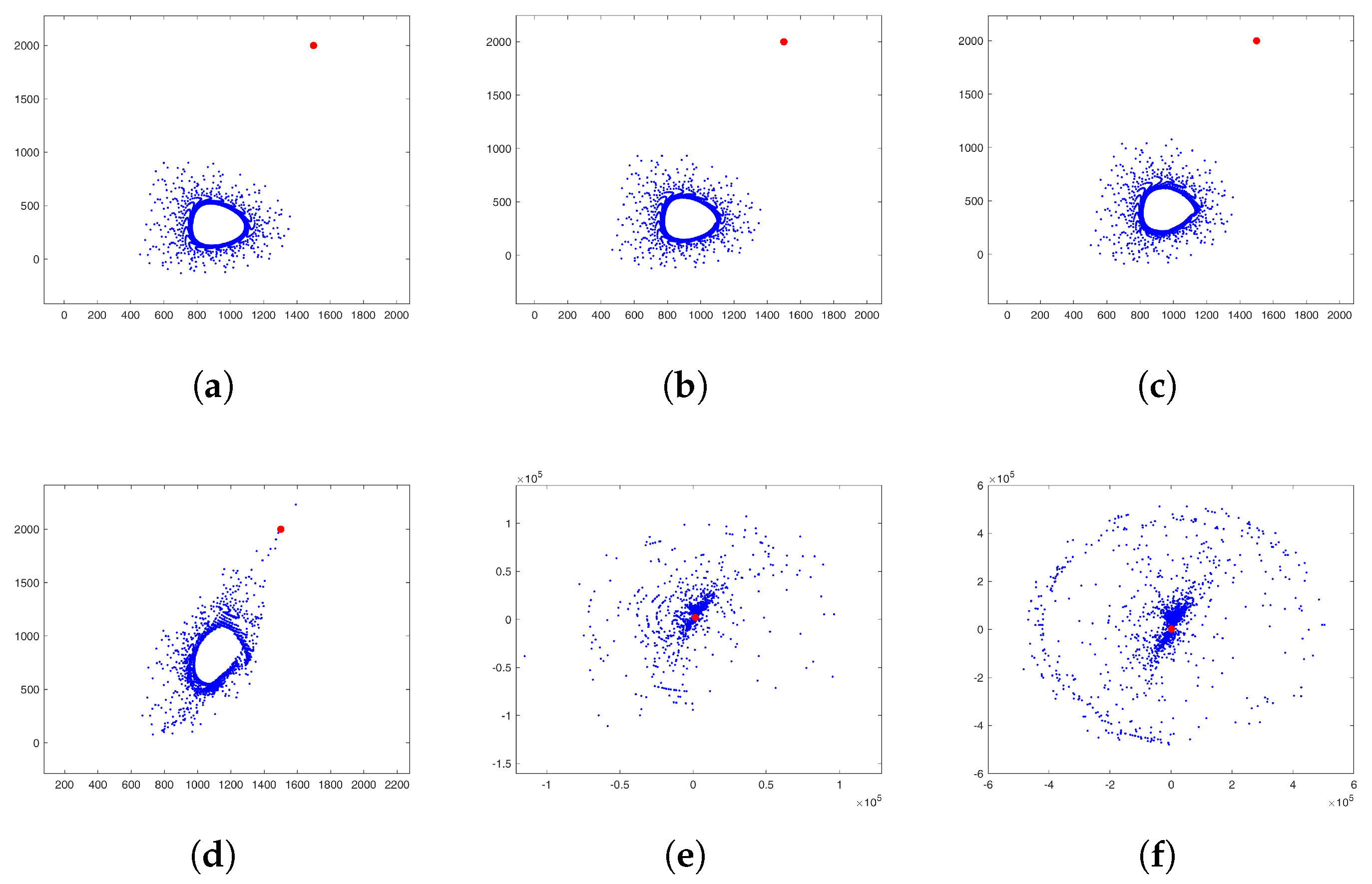
Let us illustrate the simple procedure proposed here based on Gravity-based simulation and DLA. For this, consider the gravity attraction simulation of an SA (Figure 5c). The Gravity-based simulation carried out has the following parameters: an attractor located at F = ( 1500 , 2000 ) (attraction point); M = 10 7 (mass of the attraction point); m = 100 (mass of each particle in the SA); G = 6.67 · 10 1 ; t m a x = 100 (maximum number of iterations (time-steps considered)). The parameters of the simulation are set in such a way that the initial fractal is attracted to the attractor mass, and it is possible to generate a DLA process during the simulation process (within a reasonable computation time). Note that any other set of parameters may affect the total simulation time, and also the Gravity-based DLA fractal that is formed. Figure 6 shows part of this process, with six time-steps of gravity attraction, where the red point is the attractor (without volume—remember that no collisions between masses are considered in this simulation).
As can be seen in Figure 6, the particles are attracted to the red point, with a given acceleration, but there is no collision simulated, so a final situation with circular orbits appears. Remember that in order to obtain the final fractal aggregate, we consider a DLA process with the attraction point as the initial particle, in such a way that any particle crossing at a distance smaller than a threshold R a will be captured and joined to the new aggregate.
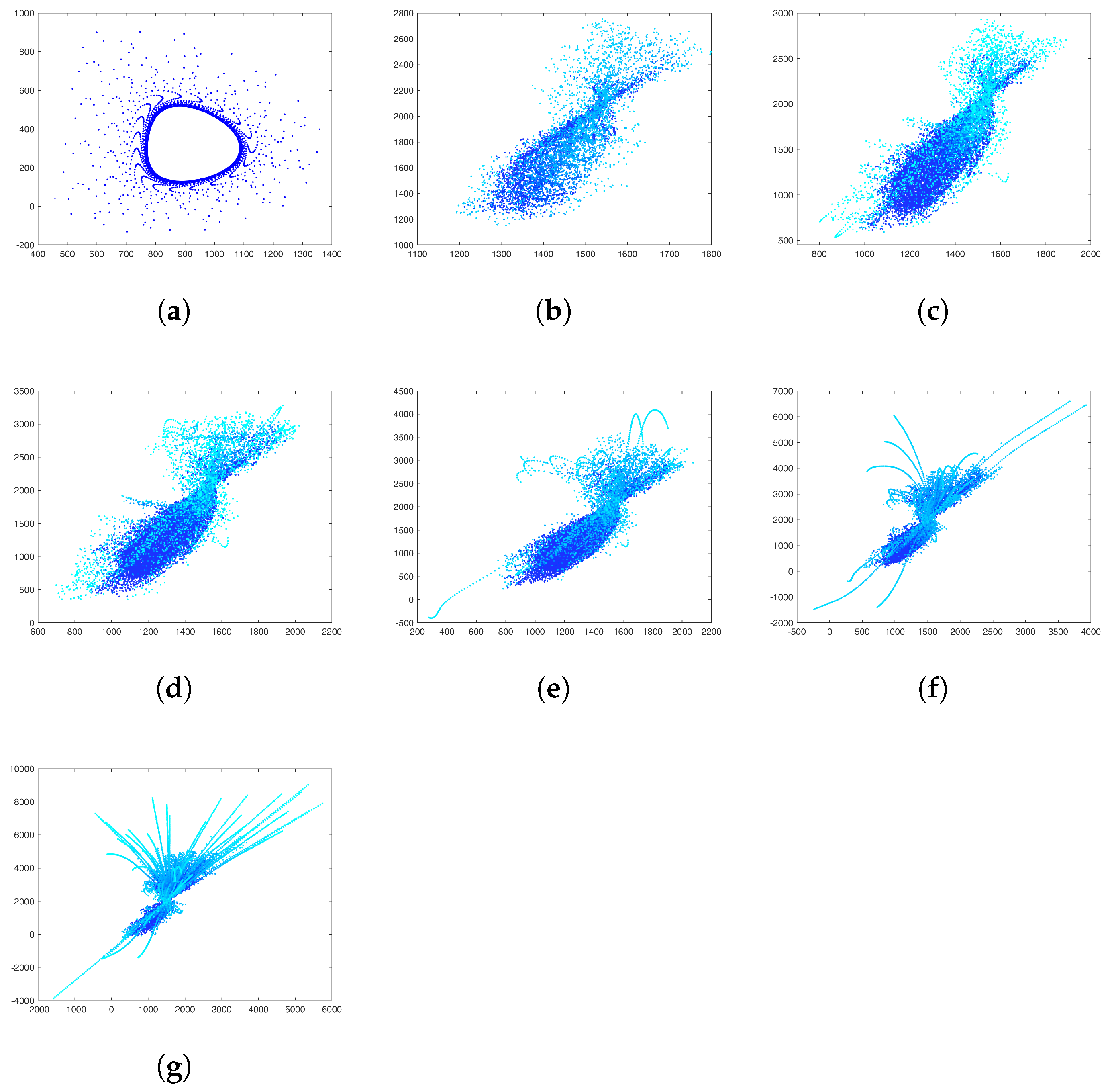
Figure 7 shows different fractal-like aggregates obtained from this experiment. Each of these aggregates has been obtained with a different value of R a (from 30 to 100). In all cases, aggregates with high aesthetic properties are obtained. Note that the process is deterministic, which means that we will obtain the same fractal aggregate if we repeat the simulation with the same conditions. All of the aggregates have been colored based on the time of particle aggregation, i.e., dark particles represent the particles which aggregated first to the fractal structure and light-blue particles represent the particles which were the last to be aggregated.
We can characterize the obtained fractal-like particle clusters by obtaining the fractal dimension of the aggregates obtained in Figure 7 for different values of R a . For this, we calculate their fractal dimensions using the well-known box-counting method [52,53,54,55]. Letting C be a fractal structure in 2D, the box counting method is a procedure to obtain the fractal dimension of C. To calculate this dimension for a fractal C, the box-counting algorithm works by counting how many boxes are required to cover the set. The box-counting dimension is obtained by calculating how this number changes as we make the grid finer. Let us suppose that n ( r ) is the number of boxes of size r required to cover the set. Then, the box-counting dimension is defined as follows:
α = lim r 0 l o g ( n ( r ) ) l o g ( r ) .
In other words, if C is a fractal set with fractal dimension α < 2 , then n ( r ) scales as r α . Note that α is also known as the Minkowski–Bouligand dimension, Kolmogorov dimension, or box-counting dimension.
In this paper, we have used the implementation of the box-counting method provided by Matlab®. It operates by counting the number n of two-dimensional boxes of size r needed to cover the non-zero elements of C, uploaded as a binary matrix. The box sizes are in this case considered as powers of two, i.e., r = 1 , 2 , 4 , , 2 P , where P is the smallest integer such that
max ( s i z e ( C ) ) 2 P .
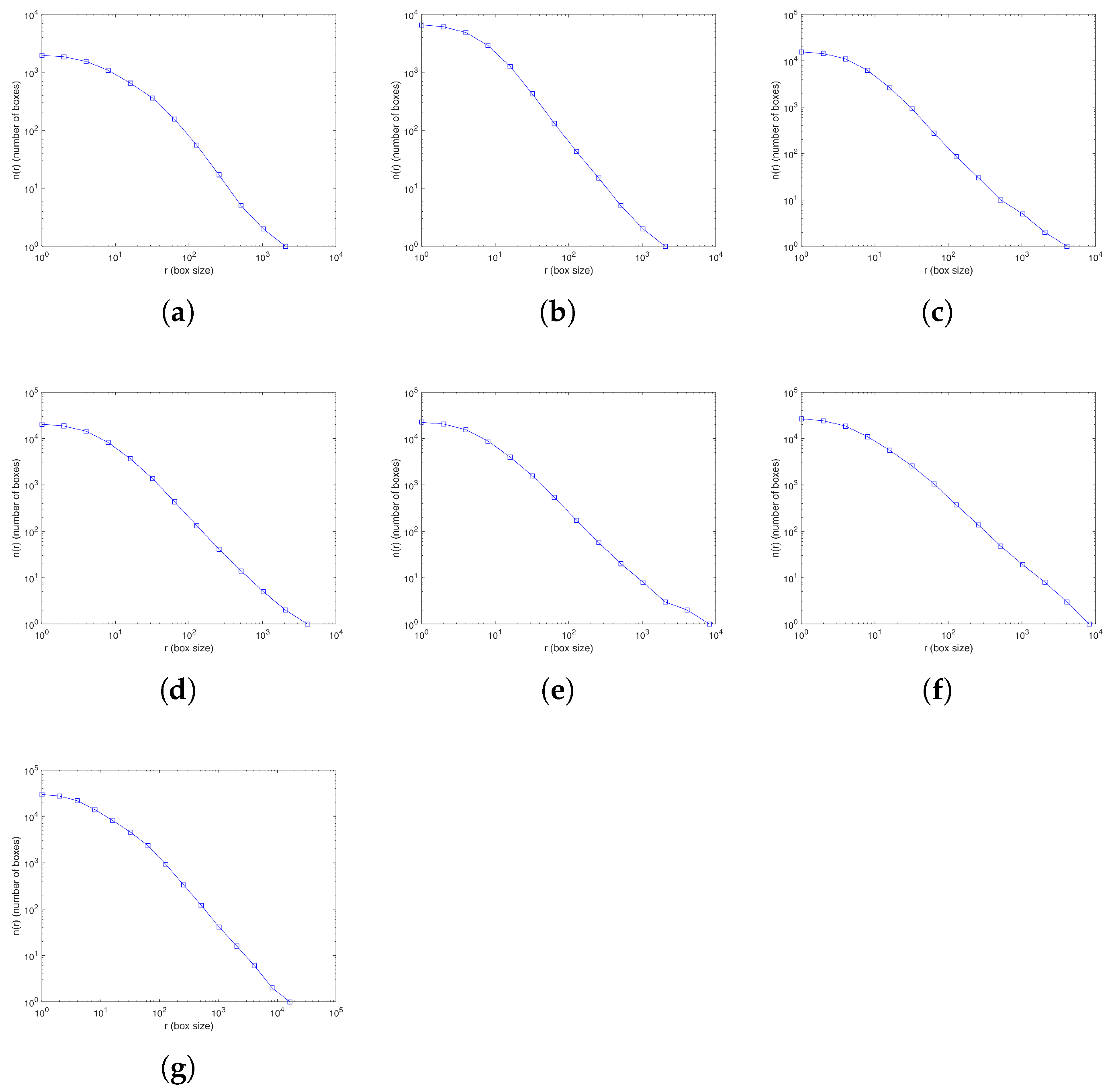
If the size of C over each dimension is smaller than 2 P , C is padded with zeros to size 2 P over each dimension (for instance, a 400 × 200 image is padded to 512 × 512 ). The output vectors n ( r ) and r are of size P + 1 . Equation (7) is then considered to obtain the fractal dimension α , as the slope of the log–log plot r vs. n ( r ) .
Figure 8 shows the log-log plot r vs. n ( r ) for each of the aggregates in Figure 7.
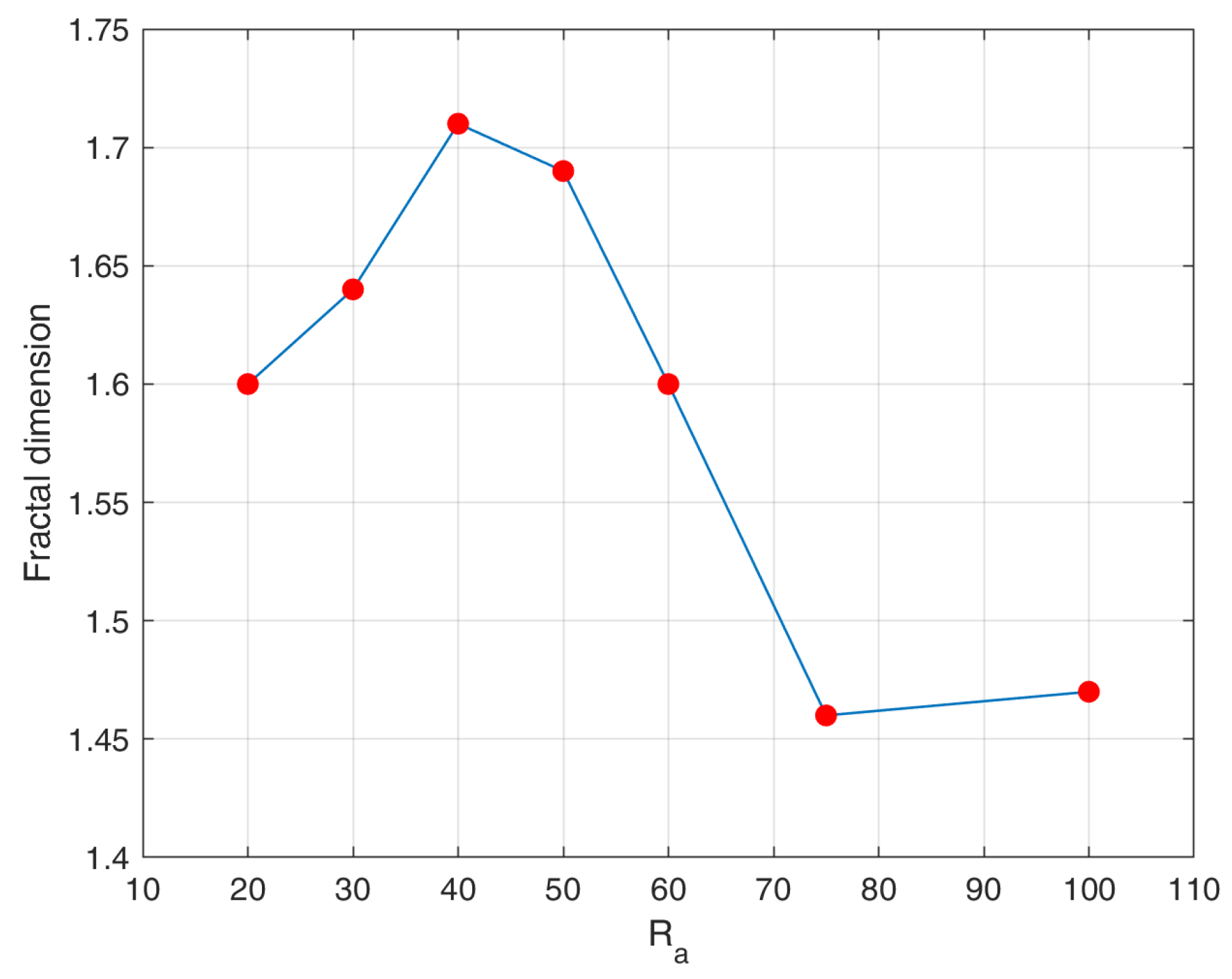
Figure 9 shows the fractal dimensions obtained for each of the aggregates (Figure 8), using the box-counting method shown above, from R a < 20 to R a < 100 . As can be seen below, the aggregates obtained with the gravity simulation plus DLA present fractal dimensions between 1.4 and 1.7 in this case, slightly different from the original SA (with a fractal dimension around 1.6 ).

4. New Fractal-like Aggregates from Gravity-Based Simulation and DLA

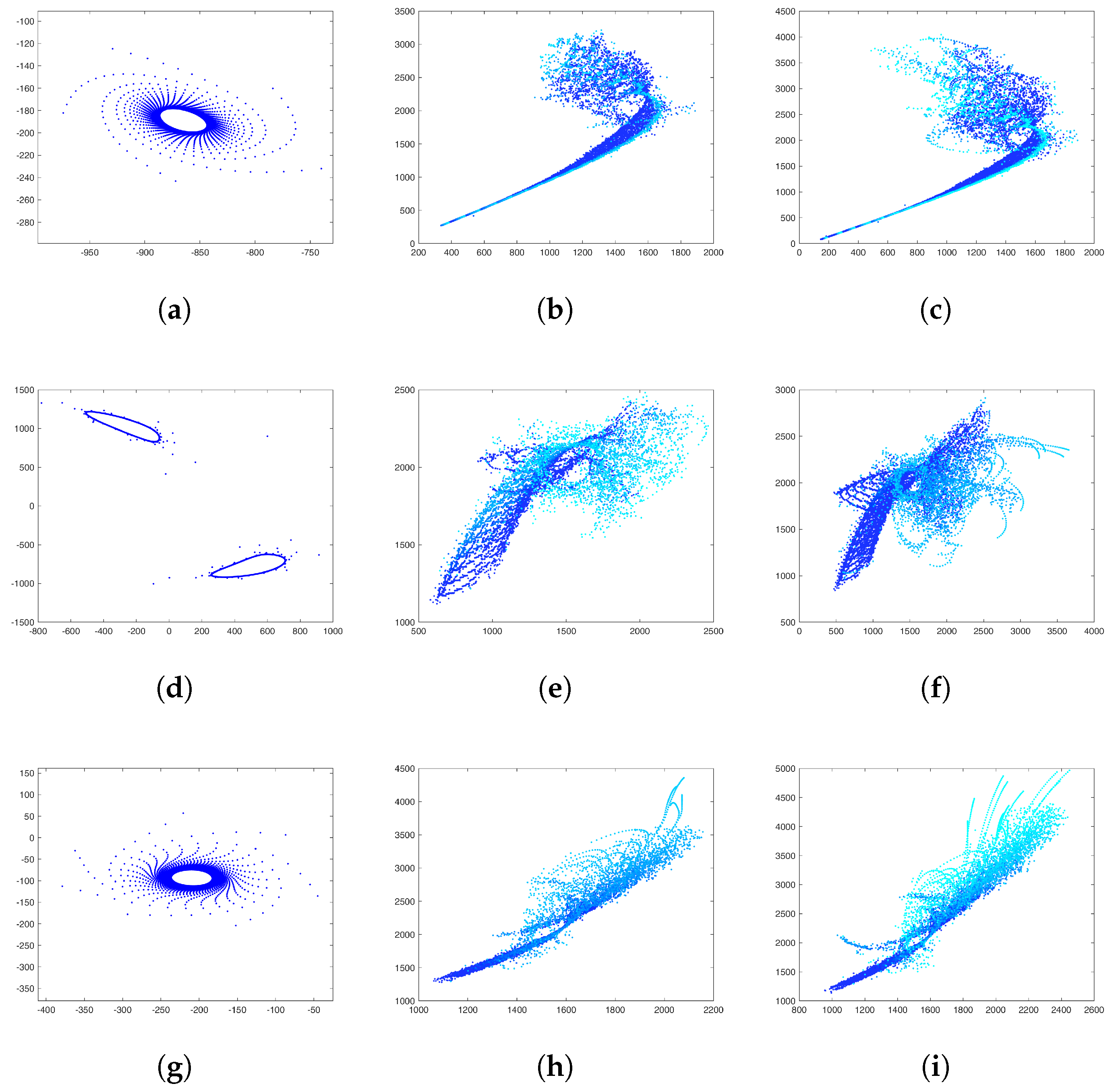
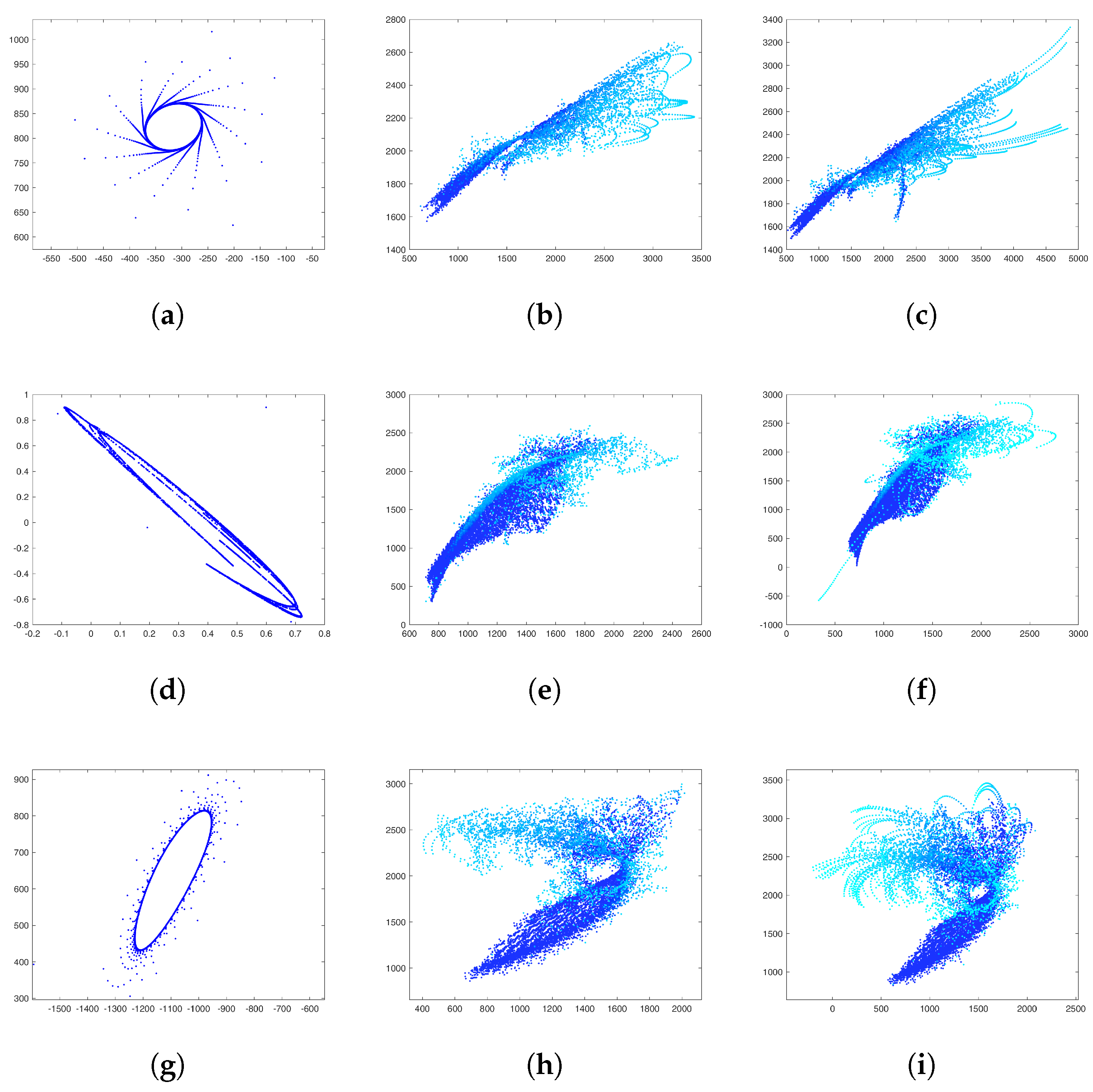
We show here a number of experiments with different SAs and the resulting fractal-like structures obtained with the Gravity-based DLA method. Figure 10 and Figure 11 show new, different fractal aggregates obtained from an SA. In these figures, we show two different final aggregates for two R a values (usually R a = 40 and R a = 50 ). All of the SAs and attractor masses are located in the same positions as in the previous section’s examples. It is easy to see how different the obtained fractal-like aggregates are depending on the initial SA considered. Note that the number of particles in the aggregates varies among cases; it fully depends on the initial SA and its relative position with respect to the mass M of the attractor. In this case, aggregates with a number of particles between 8000 and 15000 were commonly obtained. The aggregates obtained have high aesthetic properties, enhanced by the gradual coloring of the fractal based on the order of particle aggregation (as in the previous case, darker blue represents the first aggregated particles, and lighter blue represents the last particles to be aggregated).
In all of the cases shown in Figure 10 and Figure 11, the construction process to obtain the new aggregates is deterministic. We will always obtain the same final aggregates in the same simulation conditions.
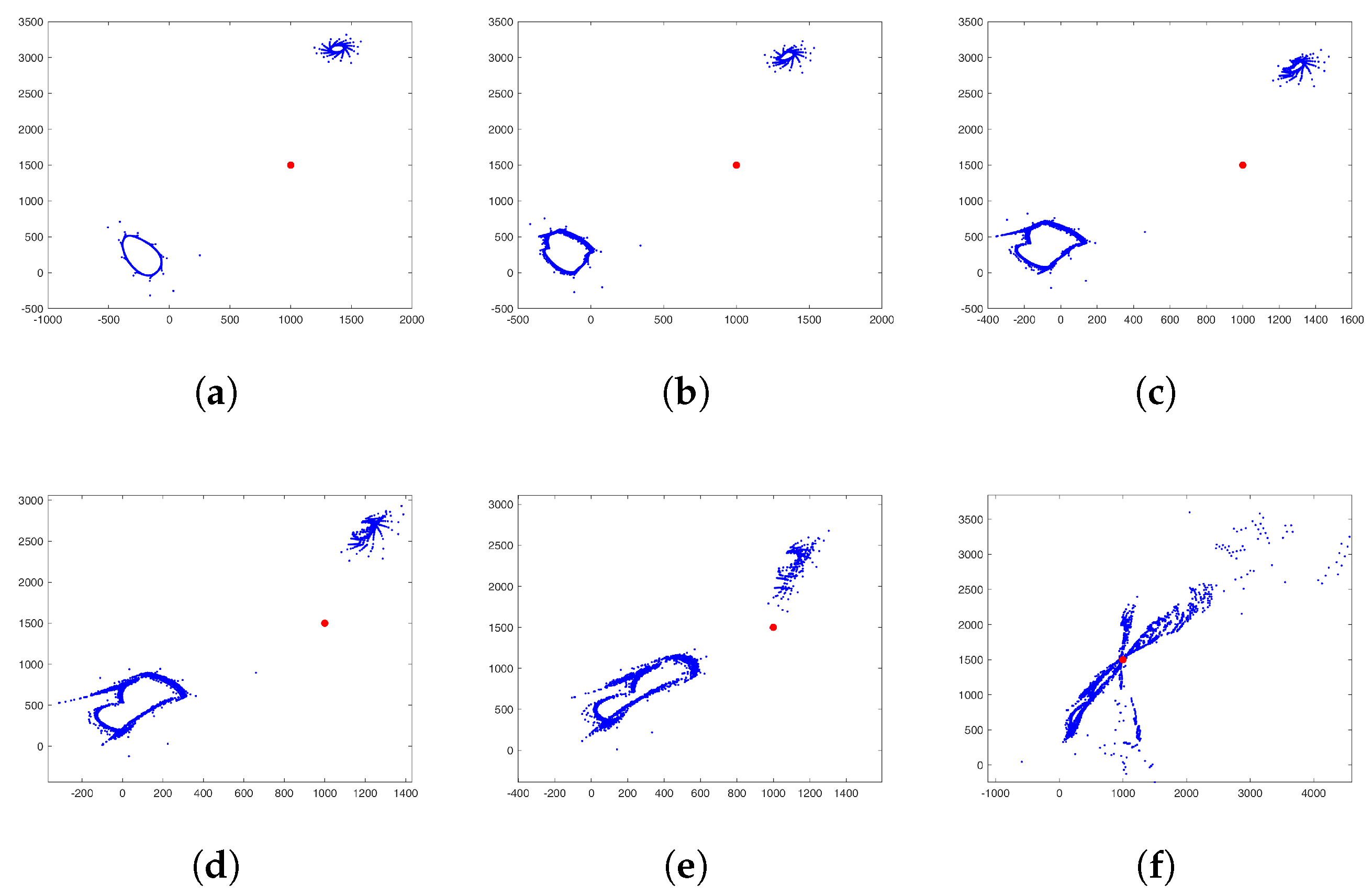
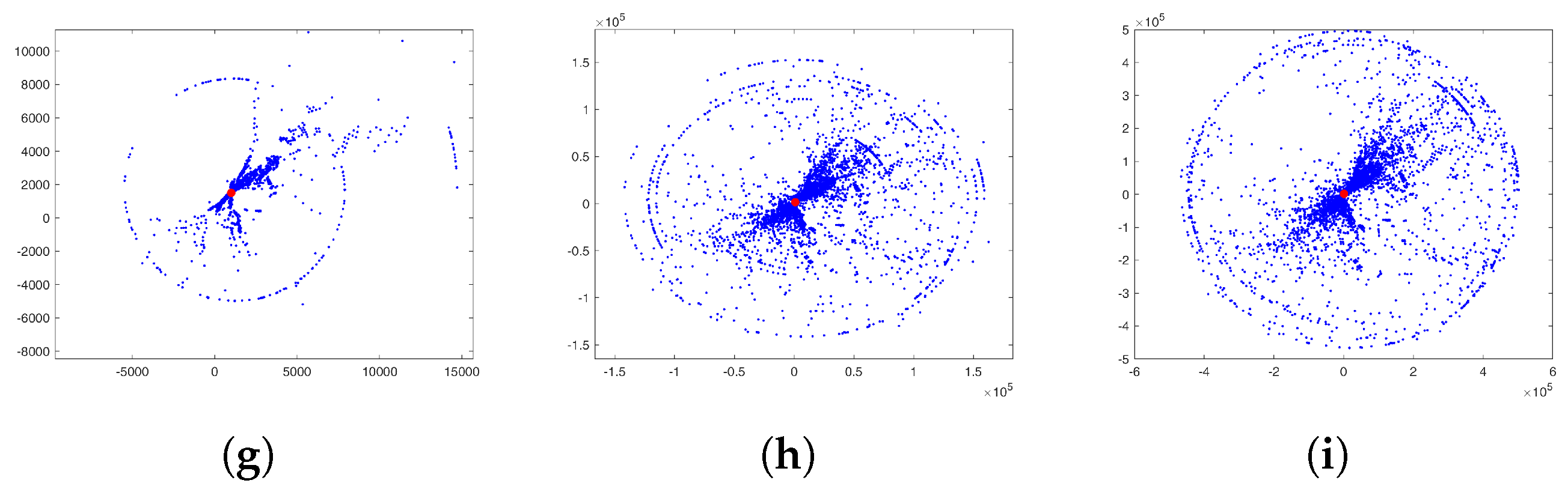
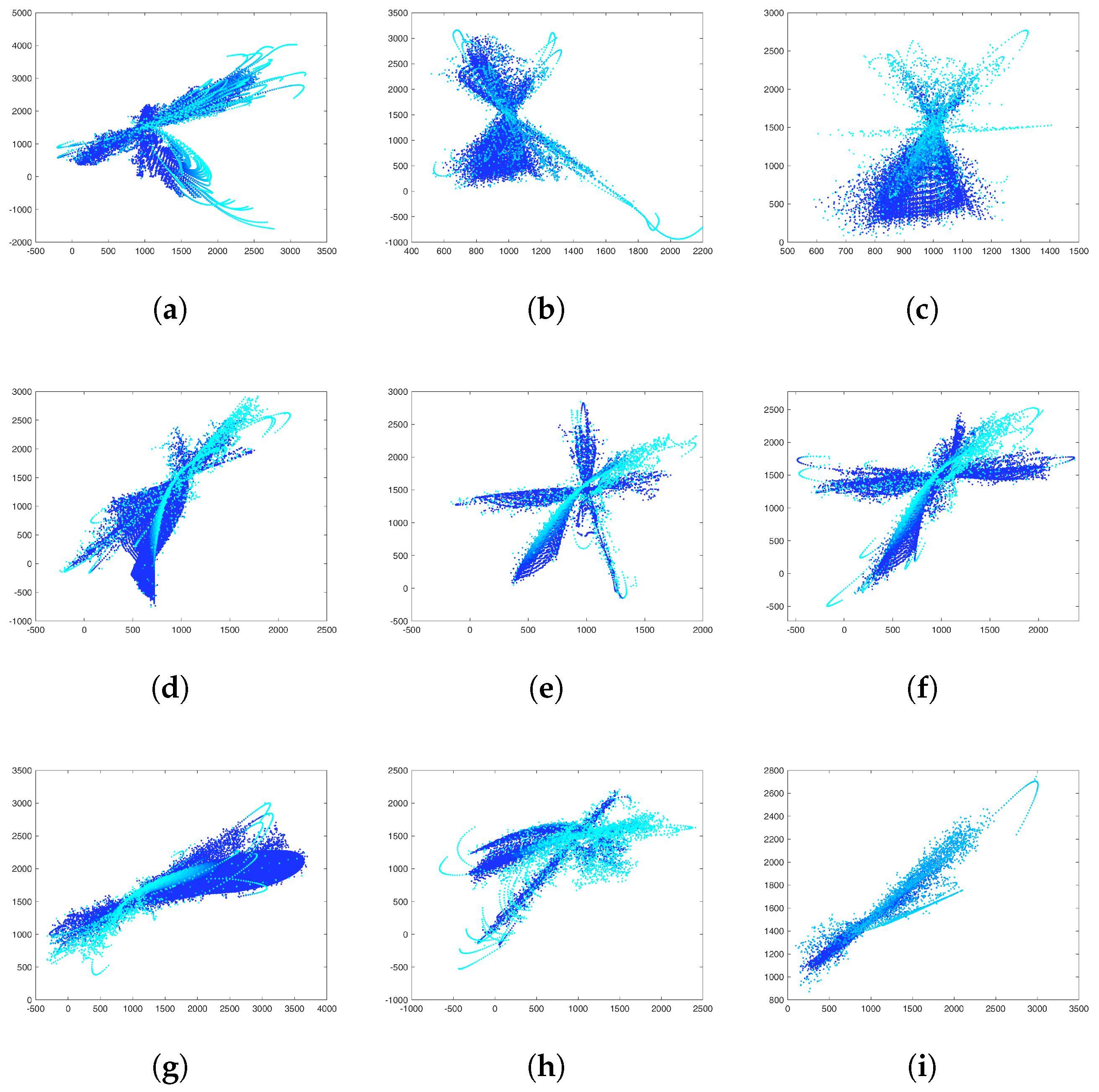
We can obtain different fractal aggregates by carrying out a Gravity-based diffusion of two initial SAs instead of one. This process is fairly similar to the original with one SA, but in this case, we consider two SAs and a single large-mass attractor. Figure 12 shows the Gravity-based simulation carried out in this case with two SAs, up to t = 100 . This process produces new fractal aggregates when a DLA is considered in the attractor point. Figure 13 shows some new aggregates obtained with the DLA process after the gravity diffusion of two different SAs (the specific SAs involved in these simulations are described in the caption of Figure 13). It is possible to see the high aesthetic properties of all of the aggregates obtained with this gravity diffusion plus DLA using two SAs in the simulations. Again, darker blue represents the first aggregated particles and lighter blue represents the last particles to be aggregated to the fractal structure.
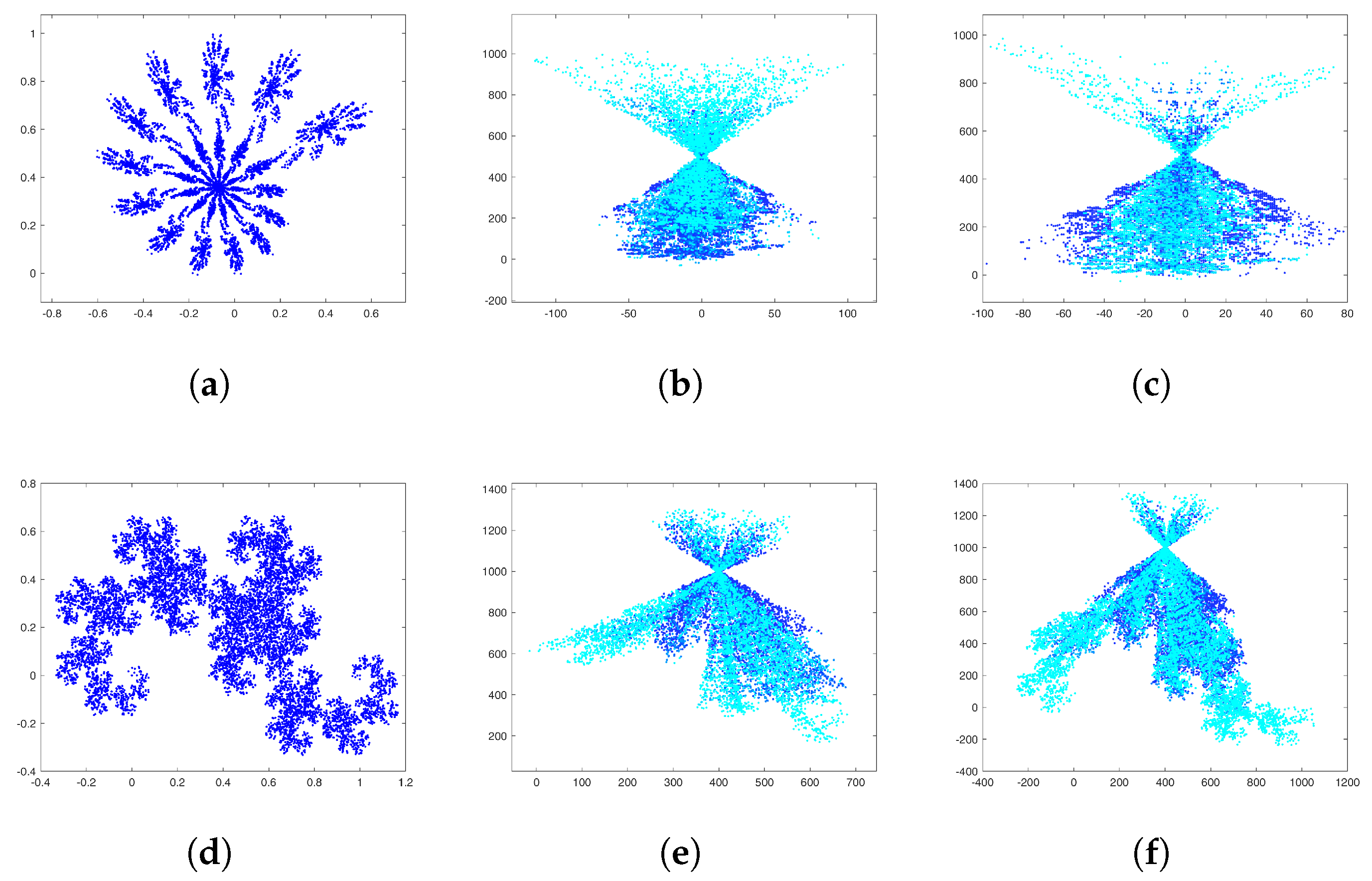
Finally, as previously mentioned, note that we can obtain gravity DLA fractals using any initial fractal aggregate (not only SAs, of course), such as IFS fractals or any other aggregate. Figure 14 shows the results obtained when the proposed gravity-diffusion-plus-DLA method has been applied with two initial well-known IFS fractals, in this case with the attractor located at F = ( 400 , 1000 ) , for two values of R a ( R a < 20 and R a < 30 ).

5. Conclusions

Fractal aggregates are fractal images usually generated in 2D real spaces using different techniques, such as non-equilibrium growth models, Iterated Function Systems, Lindenmayer Systems, or Strange Attractors, among others. In this paper, we propose a simple procedure for generating new fractal-like aggregates involving gravity simulation and Diffusion-Limited Aggregation (DLA). The constructing procedure starts from an initial structure (Strange Attractors have been considered in this work for initializing the procedure),and a gravity attractor point (large mass) without volume. Gravity forces are simulated between the initial structure and the attractor, and a DLA procedure is implemented at the attractor in such a way that any particle passing at below a given distance will be captured in the final aggregate structure. Given an initial structure (formed by particles at a specific location) and a gravity attractor (characterized by its mass and its location), the procedure for obtaining new aggregates is deterministic, i.e., the same final aggregate will be obtained if the simulation is repeated.

We have shown here how different fractal aggregates from alternative initial Strange Attractors can be generated by applying the Gravity-based DLA model, and we have evaluated the construction procedure by analyzing different parameters of the simulation, such as the distance for particle capturing in the DLA process or the final aggregates obtained when more than one initial structure is considered. The obtained aggregates have been characterized by their fractal dimension using the well-known box-counting method. The fractal aggregates obtained can be combined to form larger aggregates or images of fractal art, or even animations that mix gravity simulation with fractal formation procedures. Other applications of the obtained aggregates are possible, such as modeling different structures appearing in materials, fractures, etc.
Future work may include testing alternative physical processes or forces (Coulomb force, different diffusion or dissipation processes, etc.) together with DLA to form new 2D fractal-like aggregates.

Author Contributions

Conceptualization, S.S.-S.; methodology, S.S.-S. and J.P.-A.; formal analysis, S.S.-S.; software, S.S.-S.; investigation, S.S.-S., P.Á.-C., L.C.-S. and J.P.-A.; writing—original draft preparation, S.S.-S.; writing—review and editing, S.S.-S., P.Á.-C., L.C.-S. and J.P.-A.; supervision, P.Á.-C. and L.C.-S. All authors have read and agreed to the published version of the manuscript.

Funding

This research was partially supported by the project PID2023-150663NB-C21 of the Spanish Ministry of Science and Innovation (MICINN).

Data Availability Statement

All the data and parameters of the basic fractal needed to construct the new aggregates with the proposed gravity-based DLA method are given in the appendix of the paper.

Conflicts of Interest

The authors declare no conflicts of interest.

Appendix A

Appendix A.1. Strange Attractor Fractal Construction

Table A1. Parameters of the quadratic map to generate the SAs depicted in Figure 5 (initial point [ 0.6 , 0.9 ] ).
AttractorQuadratic Map Parameters ( a 1 a 12 ), Equation (4)
(a)( 0.1 , 0.8 , 0.7 , 0.5 , 1.1 , 1.1 , 0.4 , 0.6 , 0.3 , 0.2 , 0.5 , 0.6 )
(b)( 0.3 , 0.1 , 0.6 , 0.7 , 1.1 , 1.0 , 0.4 , 0.9 , 0.1 , 0.3 , 1.1 , 1.0 )
(c)( 1.1 , 0.7 , 0.7 , 0.5 , 1.2 , 0.0 , 0.3 , 0.6 , 0.3 , 0.1 , 0.8 , 0.8 )
(d)( 1.0 , 1.1 , 0.9 , 0.7 , 1.0 , 0.5 , 0.6 , 0.3 , 0.0 , 1.2 , 0.5 , 0.6 )
(e)( 1.0 , 0.6 , 0.2 , 1.1 , 1.2 , 0.8 , 0.9 , 0.7 , 1.0 , 0.7 , 0.9 , 0.1 )
(f)( 0.2 , 0.4 , 0.5 , 0.6 , 0.8 , 1.1 , 0.1 , 0.9 , 1.0 , 1.0 , 0.2 , 1.2 )
(g)( 1.39 , 0.49 , 0.51 , 0.33 , 0.55 , 0.02 , 0.8 , 1.73 , 0.75 , 2.0 , 0.88 , 0.01 )
(h)( 0.7 , 1.1 , 0.2 , 0.6 , 0.1 , 0.6 , 0.1 , 0.3 , 0.7 , 1.0 , 1.0 , 0.8 )
(i)( 0.6 , 0.8 , 0.9 , 1.0 , 0.5 , 0.3 , 0.5 , 0.0 , 0.2 , 0.2 , 0.8 , 1.2 )
(j)( 1.39 , 0.49 , 0.51 , 0.33 , 0.55 , 0.02 , 0.8 , 1.73 , 0.75 , 2.0 , 0.88 , 0.01 )
(k)( 0.5 , 0.5 , 1.1 , 0.7 , 0.4 , 0.1 , 0.3 , 1.1 , 0.9 , 1.2 , 0.9 , 0.6 )
(l)( 0.64 , 0.23 , 1.39 , 0 , 1.91 , 1.52 , 0.34 , 1.15 , 0.19 , 1.96 , 1.29 , 0.02 )

Appendix A.2. IFS Fractal Construction

T 4 = x n + 1 y n + 1 = 0.74545 0.459091 0.406061 0.887121 · x n y n + 0.1460279 0.0691072 p = 0.92 x n + 1 y n + 1 = 0.424242 0.065152 0.175758 0.218182 · x n y n + 0.3809567 0.6741476 p = 0.08
IFS to obtain the IFS Circular Palms curve.
T 5 = x n + 1 y n + 1 = 0.5 0.5 0.5 0.5 · x n y n + 0 0 p = 0.5 x n + 1 y n + 1 = 0.5 0.5 0.5 0.5 · x n y n + 1 0 p = 0.5
IFS to obtain the IFS Dragon curve.

References

  1. Sander, L.M. Fractal growth processes. Nature 1986, 322, 789–793. [Google Scholar] [CrossRef]
  2. Meakin, P. The growth of fractal aggregates. In Time-Dependent Effects in Disordered Materials; Springer: Berlin/Heidelberg, Germany, 1987; pp. 45–70. [Google Scholar]
  3. Meakin, P. Fractals, Scaling and Growth Far from Equilibrium; Cambridge University Press: Cambridge, UK, 1998; Volume 5. [Google Scholar]
  4. Witten, T.A.; Sander, L.M. Diffusion-limited aggregation. Phys. Rev. B 1983, 27, 5686. [Google Scholar] [CrossRef]
  5. Meakin, P. Formation of fractal clusters and networks by irreversible diffusion-limited aggregation. Phys. Rev. Lett. 1983, 51, 1119. [Google Scholar] [CrossRef]
  6. Sprott, J.C. Automatic generation of iterated function systems. Comput. Graph. 1994, 18, 417–425. [Google Scholar] [CrossRef]
  7. Barnsley, M.; Hutchinson, J.; Stenflo, Ö. A fractal valued random iteration algorithm and fractal hierarchy. Fractals 2005, 13, 111–146. [Google Scholar] [CrossRef]
  8. Zhang, L.L.; Chang, T.C.; Mao, Y.M. A kind of IFS fractal image generation method based on Markov random process. In Proceedings of the 2019 IEEE International Conference on Computation, Communication and Engineering (ICCCE), Nanping, China, 25–27 October 2019; IEEE: New York, NY, USA, 2019; pp. 1–4. [Google Scholar]
  9. Tao, X.; Bai, S.; Liu, C.; Chen, H.; Yan, Y. Algorithm of Controllable Fractal Image Based on IFS Code. In Proceedings of the 2021 IEEE International Conference on Power Electronics, Computer Applications (ICPECA), Shenyang, China, 22–24 January 2021; IEEE: New York, NY, USA, 2021; pp. 801–809. [Google Scholar]
  10. Grassberger, P.; Procaccia, I. Measuring the strangeness of strange attractors. Phys. D Nonlinear Phenom. 1983, 9, 189–208. [Google Scholar] [CrossRef]
  11. Grassberger, P.; Procaccia, I. Characterization of strange attractors. Phys. Rev. Lett. 1983, 50, 346. [Google Scholar] [CrossRef]
  12. Sprott, J.C. Strange Attractors: Creating Patterns in Chaos; M & T Books: New York, NY, USA, 1993; Volume 9. [Google Scholar]
  13. Lindenmayer, A. Mathematical models for cellular interactions in development I. Filaments with one-sided inputs. J. Theor. Biol. 1968, 18, 280–299. [Google Scholar] [CrossRef]
  14. Mishra, J.; Mishra, S. L-System Fractals; Elsevier: Amsterdam, The Netherlands, 2007; Volume 209. [Google Scholar]
  15. Prusinkiewicz, P.; Hanan, J. Lindenmayer Systems, Fractals, and Plants; Springer Science & Business Media: Berlin/Heidelberg, Germany, 2013; Volume 79. [Google Scholar]
  16. Ramirez, J.L.; Rubiano, G.N.; Zlobec, B.J. Generating fractal patterns by using p-circle inversion. Fractals 2015, 23, 1550047. [Google Scholar] [CrossRef]
  17. Ehrl, L.; Soos, M.; Lattuada, M. Generation and geometrical analysis of dense clusters with variable fractal dimension. J. Phys. Chem. B 2009, 113, 10587–10599. [Google Scholar] [CrossRef]
  18. Salcedo-Sanz, S. Modern meta-heuristics based on nonlinear physics processes: A review of models and design procedures. Phys. Rep. 2016, 655, 1–70. [Google Scholar] [CrossRef]
  19. Briggs, J. Fractals: The Patterns of Chaos: A New Aesthetic of Art, Science, and Nature; Simon and Schuster: New York, NY, USA, 1992. [Google Scholar]
  20. Scotto Rosato, G. Fractal art. J. Sci. Commun. 2010, 9, A01. [Google Scholar] [CrossRef]
  21. Day, N. Creating Celtic art using fractal image generation. In Proceedings of the 2016 IEEE International Conference on Multimedia & Expo Workshops (ICMEW), Seattle, WA, USA, 11–15 July 2016; IEEE: New York, NY, USA, 2016; pp. 1–6. [Google Scholar]
  22. Husain, A.; Nanda, M.N.; Chowdary, M.S.; Sajid, M. Fractals: An eclectic survey, part-I. Fractal Fract. 2022, 6, 89. [Google Scholar] [CrossRef]
  23. Husain, A.; Nanda, M.N.; Chowdary, M.S.; Sajid, M. Fractals: An eclectic survey, part-II. Fractal Fract. 2022, 6, 379. [Google Scholar] [CrossRef]
  24. Bovill, C. Fractal Geometry in Architecture and Design; Springer: Berlin/Heidelberg, Germany, 1996. [Google Scholar]
  25. Zhang, K.; Harrell, S.; Ji, X. Computational aesthetics: On the complexity of computer-generated paintings. Leonardo 2012, 45, 243–248. [Google Scholar] [CrossRef]
  26. Taylor, R. Fractal patterns in nature and art are aesthetically pleasing and stress reducing. Conversat. 2017, 31. [Google Scholar]
  27. Mandelbrot, B.B. Fractal geometry: What is it, and what does it do? Proc. R. Soc. London. A. Math. Phys. Sci. 1989, 423, 3–16. [Google Scholar]
  28. Mandelbrot, J. Benoit Mandelbrot and fractals in art, science and technology. Leonardo 2011, 44, 98. [Google Scholar] [CrossRef]
  29. Rama, B.; Mishra, J. Generation of 3D Fractal Images for Mandelbrot and Julia Sets. Int. J. Comput. Commun. Technol. 2010, 1, 178–182. [Google Scholar] [CrossRef]
  30. Li, M.; Ji, M. Research of fractal artistic graphics generation method. In Proceedings of the 2015 International Conference on Intelligent Transportation, Big Data and Smart City, Halong Bay, Vietnam, 19–20 December 2015; IEEE: New York, NY, USA, 2015; pp. 609–612. [Google Scholar]
  31. Liu, S.; Pan, Z.; Fu, W.; Cheng, X. Fractal generation method based on asymptote family of generalized Mandelbrot set and its application. J. Nonlinear Sci. Appl. 2017, 10, 1148–1161. [Google Scholar] [CrossRef]
  32. Kwun, Y.C.; Shahid, A.A.; Nazeer, W.; Abbas, M.; Kang, S.M. Fractal generation via CR iteration scheme with s-convexity. IEEE Access 2019, 7, 69986–69997. [Google Scholar] [CrossRef]
  33. Tassaddiq, A.; Tanveer, M.; Azhar, M.; Arshad, M.; Lakhani, F. Escape criteria for generating fractals of complex functions using DK-iterative scheme. Fractal Fract. 2023, 7, 76. [Google Scholar] [CrossRef]
  34. Rawat, S.; Prajapati, D.J.; Tomar, A.; Gdawiec, K. Generation of Mandelbrot and Julia sets for generalized rational maps using SP-iteration process equipped with s-convexity. Math. Comput. Simul. 2024, 220, 148–169. [Google Scholar] [CrossRef]
  35. Kwun, Y.C.; Tanveer, M.; Nazeer, W.; Abbas, M.; Kang, S.M. Fractal generation in modified Jungck–S orbit. IEEE Access 2019, 7, 35060–35071. [Google Scholar] [CrossRef]
  36. Tassaddiq, A.; Tanveer, M.; Zubair, M.; Arshad, M.; Cattani, C. On the Application of Mann-Iterative Scheme with h-Convexity in the Generation of Fractals. Fractal Fract. 2024, 8, 414. [Google Scholar] [CrossRef]
  37. Batchelor, M.; Henry, B. Diffusion-limited aggregation with Eden growth surface kinetics. Phys. A Stat. Mech. Its Appl. 1994, 203, 566–582. [Google Scholar] [CrossRef]
  38. Tian, X.; Xia, H. Crossover effects and dynamic scaling properties from Eden growth to diffusion-limited aggregation. Phys. Lett. A 2024, 508, 129494. [Google Scholar] [CrossRef]
  39. Salcedo-Sanz, S.; Cuadra, L. Hybrid L-systems–diffusion limited aggregation schemes. Phys. A: Stat. Mech. Its Appl. 2019, 514, 592–605. [Google Scholar] [CrossRef]
  40. Salcedo-Sanz, S.; Cuadra, L. Multi-fractal multi-resolution structures from DLA–Strange Attractors Hybrids. Commun. Nonlinear Sci. Numer. Simul. 2020, 83, 105092. [Google Scholar] [CrossRef]
  41. Xia, Z. The growth simulation of pine-needle like structure with diffusion-limited aggregation and oriented attachment. RSC Adv. 2022, 12, 22946–22950. [Google Scholar] [CrossRef]
  42. Halsey, T.C. Diffusion-limited aggregation: A model for pattern formation. Phys. Today 2000, 53, 36–41. [Google Scholar] [CrossRef]
  43. Stanley, H.; Coniglio, A.; Havlin, S.; Lee, J.; Schwarzer, S.; Wolf, M. Diffusion limited aggregation: A paradigm of disorderly cluster growth. Phys. A: Stat. Mech. Its Appl. 1994, 205, 254–271. [Google Scholar] [CrossRef]
  44. Ferreira, S., Jr.; Alves, S.; Brito, A.F.; Moreira, J. Morphological transition between diffusion-limited and ballistic aggregation growth patterns. Phys. Rev. E—Stat. Nonlinear Soft Matter Phys. 2005, 71, 051402. [Google Scholar] [CrossRef]
  45. Stanley, H.E.; Bunde, A.; Havlin, S.; Lee, J.; Roman, E.; Schwarzer, S. Recent approaches to understanding diffusion limited aggregation. Phys. A: Stat. Mech. Its Appl. 1990, 168, 23–48. [Google Scholar] [CrossRef]
  46. Matsushita, M.; Sano, M.; Hayakawa, Y.; Honjo, H.; Sawada, Y. Fractal structures of zinc metal leaves grown by electrodeposition. Phys. Rev. Lett. 1984, 53, 286. [Google Scholar] [CrossRef]
  47. Matsushita, M.; Fujikawa, H. Diffusion-limited growth in bacterial colony formation. Phys. A Stat. Mech. Its Appl. 1990, 168, 498–506. [Google Scholar] [CrossRef]
  48. Caserta, F.; Stanley, H.; Eldred, W.; Daccord, G.; Hausman, R.; Nittmann, J. Physical mechanisms underlying neurite outgrowth: A quantitative analysis of neuronal shape. Phys. Rev. Lett. 1990, 64, 95. [Google Scholar] [CrossRef] [PubMed]
  49. Salcedo-Sanz, S.; Cuadra, L. Quasi scale-free geographically embedded networks over DLA-generated aggregates. Phys. A Stat. Mech. Its Appl. 2019, 523, 1286–1305. [Google Scholar] [CrossRef]
  50. Ben-Mizrachi, A.; Procaccia, I.; Grassberger, P. Characterization of experimental (noisy) strange attractors. Phys. Rev. A 1984, 29, 975. [Google Scholar] [CrossRef]
  51. Barnsley, M.F. Fractals Everywhere; Academic Press: Cambridge, MA, USA, 2014. [Google Scholar]
  52. Voss, R.F. Random fractals: Characterization and measurement. In Scaling Phenomena in Disordered Systems; Springer: Berlin/Heidelberg, Germany, 1986; pp. 1–11. [Google Scholar]
  53. Block, A.; Von Bloh, W.; Schellnhuber, H. Efficient box-counting determination of generalized fractal dimensions. Phys. Rev. A 1990, 42, 1869. [Google Scholar] [CrossRef]
  54. Freiberg, U.; Kohl, S. Box dimension of fractal attractors and their numerical computation. Commun. Nonlinear Sci. Numer. Simul. 2021, 95, 105615. [Google Scholar] [CrossRef]
  55. Wang, R.; Singh, A.K.; Kolan, S.R.; Tsotsas, E. Investigation of the relationship between the 2D and 3D box-counting fractal properties and power law fractal properties of aggregates. Fractal Fract. 2022, 6, 728. [Google Scholar] [CrossRef]
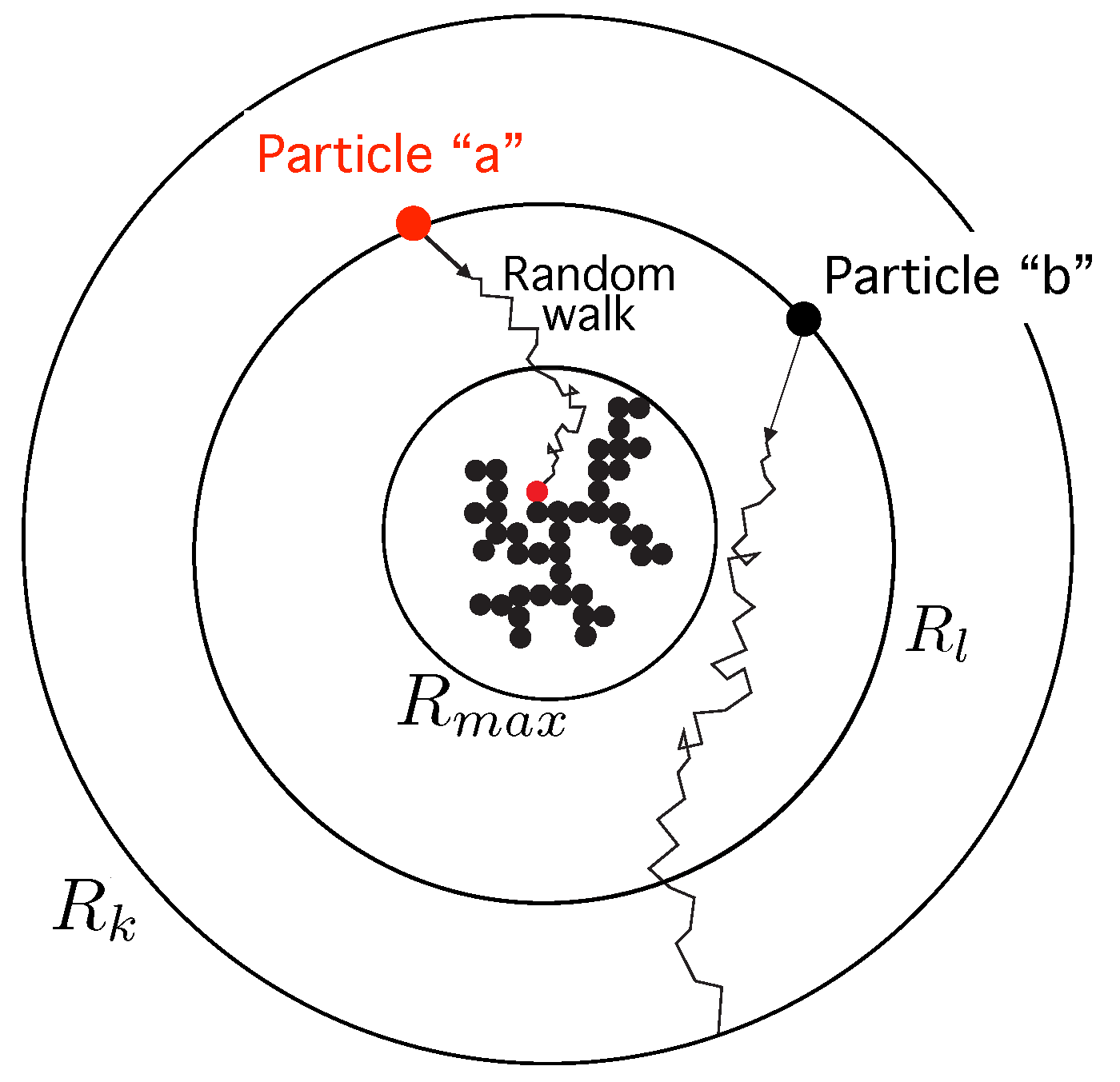
Figure 1. Example of a classic DLA simulation construction.
Fractalfract 09 00791 g001
Figure 2. Example of a fractal structure in the phase space (x vs. y), obtained by means of a classic DLA simulation (around 8000 particles).
Fractalfract 09 00791 g002
Figure 3. Example of particle attachment to the DLA aggregate considering an attachment radius R a . See the main text for further details on this process.
Fractalfract 09 00791 g003
Figure 4. Example of a DLA aggregate in the phase space (x vs. y) ( N = 2600 particles) obtained with Equation (1) and R a = 30 .
Fractalfract 09 00791 g004
Figure 5. Examples of SAs in the phase space (x vs. y), from Equation (4). The parameters ( a 1 , , a 12 ) needed to construct these aggregates can be found in Appendix A of this paper. Note that if a quadratic map is used to generate SAs, there are over 25 12 possible aggregate maps, and only a fraction of them are chaotic. Then, there are different types of SAs which can be generated (as shown in the subfigures (al)), and all them can be used as initial aggregates in the Gravity-based DLA procedure described in this paper.
Fractalfract 09 00791 g005
Figure 6. Gravity-based simulation of a Strange Attractor aggregate (Figure 5c) in the phase space (x vs. y), with the attraction point having mass M. (a) Original fractal aggregate and attraction point (in red). (b) Gravity-based diffusion t = 5 . (c) Gravity-based diffusion t = 10 . (d) Gravity-based diffusion t = 20 . (e) Gravity-based diffusion t = 50 . (f) Gravity-based diffusion t = 100 .
Fractalfract 09 00791 g006
Figure 7. Gravity-based diffusion plus DLA of an SA aggregate in the phase space (x vs. y). (a) Original aggregate (Figure 5c). (b) Gravity diffusion plus DLA d < 30 . (c) Gravity diffusion plus DLA d < 40 . (d) Gravity diffusion plus DLA d < 50 . (e) Gravity diffusion plus DLA d < 60 . (f) Gravity diffusion plus DLA d < 75 . (g) Gravity diffusion plus DLA d < 100 .
Fractalfract 09 00791 g007
Figure 8. Evaluation of the fractal dimension calculation for different gravity DLA aggregates using the box-counting algorithm. (a) Original aggregate (Figure 5c). (b) Log–log plot r vs. n ( r ) for the aggregate obtained with gravity DLA and R a < 30 . (c) Log–log plot r vs. n ( r ) for the aggregate obtained with gravity DLA R a < 40 . (d) Log–log plot r vs. n ( r ) for the aggregate obtained with gravity DLA R a < 50 . (e) Log–log plot r vs. n ( r ) for the aggregate obtained with gravity DLA R a < 60 . (f) Log–log plot r vs. n ( r ) for the aggregate obtained with gravity DLA R a < 75 . (g) Log–log plot r vs. n ( r ) for the aggregate obtained with gravity DLA R a < 100 .
Fractalfract 09 00791 g008
Figure 9. Fractal dimensions of some of the aggregates shown in Figure 7, obtained using the box-counting method [55].
Fractalfract 09 00791 g009
Figure 10. Gravity diffusion plus DLA from different SA aggregates in the phase space (x vs. y). (a) Original aggregate (Figure 5c). (b) Gravity diffusion plus DLA d < 40 . (c) Gravity diffusion plus DLA d < 50 . (d) Original aggregate (Figure 5h). (e) Gravity diffusion plus DLA d < 40 . (f) Gravity diffusion plus DLA d < 50 . (g) Original aggregate (Figure 5e). (h) Gravity diffusion plus DLA d < 40 . (i) Gravity diffusion plus DLA d < 50 .
Fractalfract 09 00791 g010
Figure 11. Gravity diffusion plus DLA from different SA aggregates in the phase space (x vs. y). (a) Original aggregate (Figure 5c). (b) Gravity diffusion plus DLA d < 40 . (c) Gravity diffusion plus DLA d < 50 . (d) Original aggregate (Figure 5h). (e) Gravity diffusion plus DLA d < 40 . (f) Gravity diffusion plus DLA d < 50 . (g) Original aggregate (Figure 5e). (h) Gravity diffusion plus DLA d < 40 . (i) Gravity diffusion plus DLA d < 50 .
Fractalfract 09 00791 g011
Figure 12. Gravity diffusion of two Strange Attractor aggregates in the phase space (x vs. y) (the attractor has been marked with a red point). (a) Original aggregates and attraction point. (b) Gravity-based diffusion t = 10 . (c) Gravity-based diffusion t = 15 . (d) Gravity-based diffusion t = 20 . (e) Gravity-based diffusion t = 25 . (f) Gravity-based diffusion t = 30 . (g) Gravity-based diffusion t = 35 . (h) Gravity-based diffusion t = 50 . (i) Gravity-based diffusion t = 100 .
Fractalfract 09 00791 g012aFractalfract 09 00791 g012b
Figure 13. Gravity diffusion plus DLA from different pairs of SA aggregates in the phase space (x vs. y). (a) Gravity diffusion plus DLA d < 50 from the SAs shown in Figure 5a,b. (b) Gravity diffusion plus DLA d < 50 from the SAs shown in Figure 5c,e. (c) Gravity diffusion plus DLA d < 50 from the SAs shown in Figure 5c,h. (d) Gravity diffusion plus DLA d < 50 from the SAs shown in Figure 5d,f. (e) Gravity diffusion plus DLA d < 50 from the SAs shown in Figure 5c,e. (f) Gravity diffusion plus DLA d < 50 from the SAs shown in Figure 5h,h (the same SA duplicated). (g) Gravity diffusion plus DLA d < 50 from the SAs shown in Figure 5b,g. (h) Gravity diffusion plus DLA d < 50 from the SAs shown in Figure 5e,f. (i) Gravity diffusion plus DLA d < 50 from the SAs shown in Figure 5b,j.
Fractalfract 09 00791 g013
Figure 14. Gravity DLA fractals from the IFS Circular Palms curve and IFS Dragon curve. (a) Original aggregate. (b) Gravity diffusion plus DLA aggregate with R a < 20 . (c) Gravity diffusion plus DLA aggregate with R a < 30 . (d) Original IFS Dragon curve. (e) Gravity diffusion plus DLA aggregate with R a < 20 . (f) Gravity diffusion plus DLA aggregate with R a < 30 .
Fractalfract 09 00791 g014
Disclaimer/Publisher’s Note: The statements, opinions and data contained in all publications are solely those of the individual author(s) and contributor(s) and not of MDPI and/or the editor(s). MDPI and/or the editor(s) disclaim responsibility for any injury to people or property resulting from any ideas, methods, instructions or products referred to in the content.