Abstract
We study the multifractal structure of irregular sets arising from Fibonacci-weighted sums of sequences of random variables. Focusing on Cantor-type subsets of the unit interval, we construct sequences of free and forced blocks, where the free blocks allow full binary branching and the forced blocks fix the digits, controlling the weighted averages. We prove that these sets can attain full Hausdorff and packing dimension while their Hausdorff measure can vanish. We prove that the packing measure of depends sensitively on the growth of the forced blocks. Our construction illustrates the mechanism by which Fibonacci-type weights induce irregularity, providing a probabilistic counterpart to classical multifractal phenomena in dynamical systems.
1. Introduction
The law of large numbers (LLNs) and central limit theorem (CLT) are long and have been widely known as two fundamental results in probability theory and mathematical statistics; several authors have studied extensively the extension of these theorems. Let be random variables defined on the probability space and let be a positive sequence and define the n-th partial sum
Given some positive sequences , it is natural to ask if, under some conditions, the weighted average converge in some sense. When , Etemadi in [1] proves that, if the averages of random variables converge in some sense, then their corresponding weighted averages also converge in the same sense. One can also cite the work of Shen in [2] in which he studies the strong law of large numbers for general weighted sums of negatively super-additive dependent random variables with non-identical distribution. When the variables are centered and independents (but not necessarily identically distributed), several results can be obtained under various conditions on the weights and boundedness conditions on the random variables . For example, as shown by Chow [3], Stout [4], Padgett and Taylor [5], and Budianu [6]. Several authors investigated the almost sure (a.s.) limiting behavior of weighted sums of independent and identically distributed (i.i.d.) random variables. In particular, if , we have the weighted law of large numbers. Assume that , then
Moreover, if and , the a.s convergence in (1) still holds. We refer the reader to Chow and Lai [7], Stout [8], Choi and Sung [9], Cuzick [10], Rosalsky and Sreehari [11], Wu [12], Bai and Cheng [13] and Bai et al. [14].
The LLNs for i.i.d. sequences and Birkhoff sums in dynamical systems are, by now, well understood [8,15,16]. Beyond classical convergence results, several studies have investigated the fractal structure of irregular sets where Birkhoff or weighted averages fail to converge. It has been shown [17,18,19] that such oscillation sets often possess a multifractal structure and can have a full (or nearly full) Hausdorff dimension. However, introducing Fibonacci weights brings new combinatorial and fractal aspects. In this setting, one encounters irregular sets I where the Fibonacci weighted averages do not converge. These sets display intricate fractal structures: they have full Hausdorff and packing dimension, yet their one-dimensional measures either vanish or diverge. This framework is closely related to studies of vector-valued Birkhoff sums and random walks [20], but the specific interplay of Fibonacci weighting, Cantor set constructions, and precise Hausdorff and packing measure analysis has not been thoroughly investigated. In this paper, we take to be a sequence of i.i.d. random variables, taking values in and with expectation . We consider a special weighted version of these sums, where the weights grow according to the Fibonacci sequence (see Section 2.2 for the definition):
Random walks with increments given by the Fibonacci sequence have been studied by several authors. In particular, refs. [21,22] investigate the probability of returning to the origin and compute the fractal dimension of the set of trajectories that return to zero infinitely often. Observe, using (7), that
where (see (7)). Hence, the assumptions leading to (1) fail, and one can expect that the sequence of random variables defined in (2) does not converge for some realizations , even in the simplest Bernoulli case. Indeed, let be i.i.d. Bernoulli random variables with parameter . Whenever the last m digits of the sequence form a block of ones, the ratio of Fibonacci sums satisfies
while for a block of m consecutive zeros, we have
Since such blocks occur infinitely, often almost surely (by the Borel–Cantelli lemma), it follows that
Hence, does not converge almost surely. This irregular behavior motivates the study of the sets
where the extremal values of lim inf and lim sup of are prescribed. It is therefore natural to study the size of the set of points for which convergence fails. We also define the irregular set associated with the Fibonacci-weighted averages as
The study of these sets is inspired by recent studies on branching random walks on supercritical Galton–Watson trees, where analogous random walks of have been analyzed [23,24]. Moreover, a related version of the oscillation set (see (5)) was considered in [25], where the asymptotic behavior of the normalized sums oscillates between two prescribed values a and b. In that context, the proofs rely on the construction of a Mandelbrot-type measure supported on the boundary of the tree, which provides a probabilistic control of the Hausdorff and packing dimensions [26,27]. However, such techniques crucially depend on independence and on homogeneous weights , and therefore cannot be extended to non-independent settings or to non-stationary weights such as the Fibonacci sequence. Moreover, the study of the global irregular set I is also motivated by previous works on multifractal analysis and ergodic theory. In the context of dynamical systems, one often studies Birkhoff averages and investigates exceptional points where convergence fails. These irregular points frequently form sets of zero measure but a large Hausdorff and packing dimension, denoted, respectively, and . Similarly, the Fibonacci-weighted irregular set I exhibits rich fractal structure. While almost every path does not have a limit in the classical sense of weighted averages, the set I is large in the sense of dimension theory. We prove in Theorem 3 that the set I has a full Hausdorff and packing dimension. Moreover, we illustrate the mechanism by which the Fibonacci weights induce irregularity. This phenomenon provides a probabilistic counterpart to multifractal phenomena in dynamical systems. Indeed, one studies Birkhoff averages which converge almost everywhere, but the set of points where convergence fails (the irregular set) can have zero measure while exhibiting full Hausdorff or packing dimensions. This result is restated as Theorem 3, whose proof is presented in Section 3.
The computation of the one-dimensional Hausdorff measure of the set I requires the construction of Cantor-type subsets that have full Hausdorff dimension but vanishing one-dimensional Hausdorff measure. This excludes the possibility of a finite positive value for . Regarding the one-dimensional packing measure, the situation is more subtle. While shows that I is “large” in terms of packing dimension, the actual one-dimensional packing measure may be either finite or infinite. This depends on the construction of Cantor-type subsets and the decay of the interval lengths at each stage. In our study, by carefully choosing the lengths of cylinders in the Cantor construction, one can provide sufficient conditions for either of the following cases:
demonstrating the wide flexibility of the packing measure even when the packing dimension is maximal.
It is straightforward to see that if is non-degenerate ( for every ), then the sequence exhibits non-trivial fluctuations almost surely, in the sense that
(see Theorem 2). This observation naturally motivates the study of the size and structure of the sets where the extremal values of the sequence are prescribed. Specifically, for , we consider
Our main result in this direction shows that these sets attain the maximal possible size in the sense of fractal geometry, having full Hausdorff and packing dimension. Consequently, the irregular behavior of the weighted averages is not merely possible but occurs on a set of maximal fractal size, reflecting the complexity and richness of the underlying probabilistic dynamics. This result is restated as Theorem 4, whose proof is presented in Section 4.
Our work can be seen as a natural extension of classical studies on weighted averages and ergodic sums. While the strong law of large numbers for i.i.d. sequences and Birkhoff sums for dynamical systems are well understood [8,15,28,29], the case of Fibonacci-weighted averages introduces new combinatorial and fractal properties. In particular, by associating the Fibonacci sequence with the weights, we obtain irregular sets I where the Fibonacci-weighted averages fail to converge, exhibiting rich fractal structures with full Hausdorff and packing dimension but vanishing or divergent one-dimensional measures. This connects naturally with the study of vector-valued Birkhoff sums and random walks with non-uniform step sizes [20].
2. Preliminary Results and Definitions
2.1. Fractal Dimensions
For a non-empty subset U of the Euclidean space , the diameter of U is defined as
Let I and F be, respectively, non-empty subsets of and (I may be either finite or countable). We say that is a -covering of F if
The s-dimensional Hausdorff measure of F is defined as
where the infimum is taken over all the countable -coverings of F. The Hausdorff dimension of F is defined as
with the convention and . The s-dimensional packing measure of F is defined as
where the supremum is taken over all the packings of F by balls centered on F and with diameter smaller than or equal to . The packing dimension of F is defined as
For more details, the reader can be referred, for example, to [30,31,32]. We refer the reader for more details to [30]. In particular, it is well known [30] that
Theorem 1
(Hausdorff dimension of general self-similar sets [30]). Let be a self-similar set constructed by a nested sequence of cylinder sets as follows:
- At stage J, each cylinder is subdivided into sub-cylinders (branches), each of diameter .
- The number of branches may vary with J, and the diameters may also vary with J.
Then, the Hausdorff dimension of K is given by
2.2. Fibonacci Sequence
The Fibonacci sequence, usually denoted by , is defined recursively by setting , , and for ,
In particular, the first few terms are
Introduced by Leonardo Fibonacci, this sequence has deep connections with the golden ratio . Its terms grow approximately exponentially, with growth rate determined by [33]. Over time, numerous studies have explored its mathematical properties and applications. A natural generalization is the k-bonacci () sequence defined by
We refer the reader to [34,35,36] for the case , and to [21,37] for the general case. A natural generalization also is the random Fibonacci sequence , studied in [38]. This stochastic variant exhibits intriguing probabilistic behaviors and has motivated further research in random recursions. The most important properties of the Fibonacci sequence are [22]:
and the Binet formula
where .
2.3. The Regular Set for Fibonacci-Weighted Averages
As mentioned in the introduction, the sequence of random variables fails to converge almost surely when the underlying variables are Bernoulli. In this section, we generalize this phenomenon and establish that the same non-convergence holds for any non-degenerate distribution of . Let be i.i.d. real-valued random variables with mean . In what follows, we focus on the regular set R, defined by
In contrast with the irregular set I, the structure of R is essentially trivial: when the underlying distribution of is non-degenerate, R reduces to a single deterministic point (the almost sure limit), while in the degenerate case R coincides with the entire space.
Theorem 2.
If the law of is non-degenerate, then does not converge almost surely. Equivalently, one has In addition, we have a.s.
Proof.
Let and write the normalized weights
They are non-negative and . Using and , we receive
Hence, there exists and such that for all . Fix and define the -algebra . Decompose
where is -measurable and . Since is independent of and non-degenerate, there exists and such that . On the event , we have
Given , the random variable is fixed, and so
However, and along a subsequence a.s. Hence, there exists and such that for all ,
By the conditional Borel–Cantelli lemma,
where i.o. means infinitely often. Thus, cannot converge a.s. unless is a.s. constant. In this case ( a.s. for some constant c), we have a.s. and .
Now, by (9), there exists such that
Moreover, the non-degeneracy implies there exists with
Repeating the conditional Borel–Cantelli argument used for but now applied separately to the events
we obtain almost surely that both
hold (for a suitable choice of depending on the constant weight fraction). Consequently, a.s.
and therefore
□
3. Dimension of the Irregular Set for Fibonacci-Weighted Averages
Consider a sequence of i.i.d. random variables defined on a probability space , and assume that . In this section, we investigate the geometric structure of the irregular sets I and , for all , defined, respectively, by (4) and (3). The Fibonacci weights introduce a strongly non-uniform growth in the partial sums , which leads to non-convergent behavior. Our goal is to describe the size of these exceptional sets in terms of their Hausdorff and packing dimensions.
Theorem 3.
Let I and be the irregular sets defined via the Fibonacci-weighted averages . Then, as follows:
- (1)
- The set I (resp. ) contains Cantor-type subsets of full Hausdorff dimension 1, each having vanishing one-dimensional Hausdorff measure; that is,
- (2)
- The set I (resp. ) also contains Cantor-type subsets of full packing dimension 1, so that
We begin by analyzing the set I, for which a standard Cantor-type construction provides precise estimates of the Hausdorff and packing dimensions. Specifically, for any , we construct a Cantor subset whose Hausdorff dimension is arbitrarily close to 1, that is, . Consequently, since , we obtain the full-dimensional result. Moreover, Proposition 1 shows that , while Lemmas 2 and 3 establish that the one-dimensional packing measure may be either finite or infinite, depending on the growth rate of the sequence . Together, these results complete the proof for I. Once these properties are obtained, the corresponding statements for follow with minor modifications (see Remark 2).
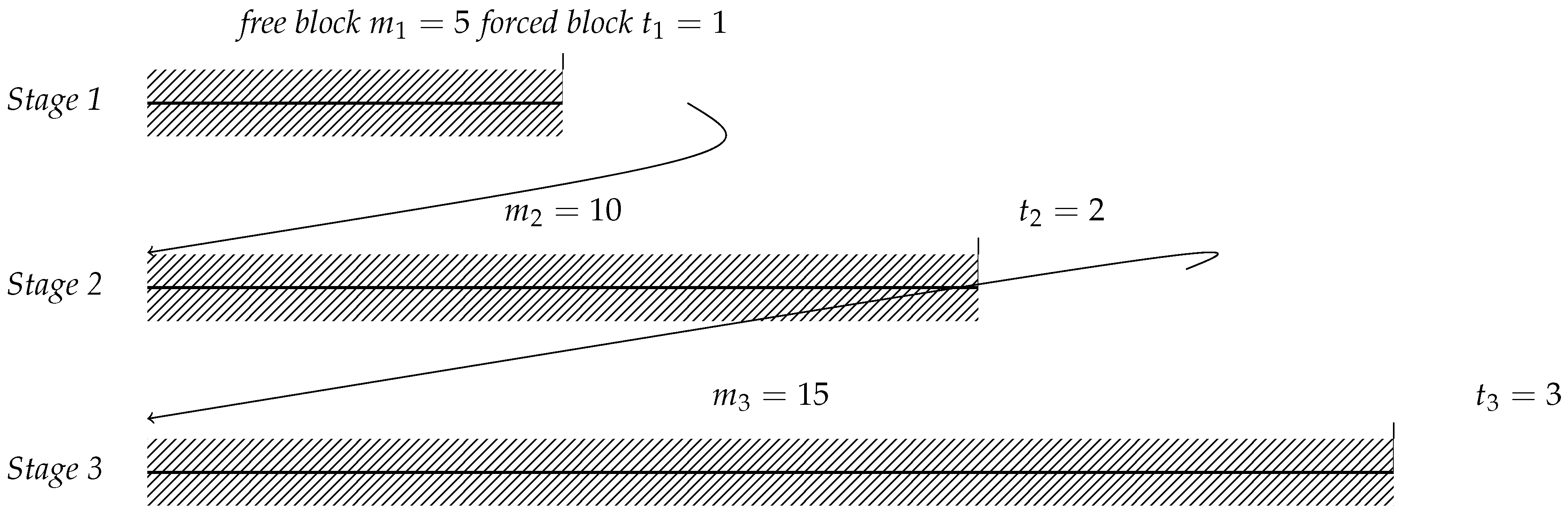
Consider sequences of integers and such that
where if (see Figure 1). The study of the size of the Cantor-type set is interesting in its own right. In some parts in this section, we will discuss certain properties of when the sequence does not tend to infinity (this will be mentioned each time). Otherwise, in the main part of our study, we assume , since the inclusion holds only under this condition (Remark 1). The construction of is defined as follows: at stage j, define a block of length in which can freely take values 0 or 1, followed by a forced block of length consisting entirely of 0s or 1s. Let
be the cumulative lengths of free and forced blocks after J stages, and let be the total length. In particular, each stage yields cylinders of length (we branch freely only on the free blocks) and diameter of each cylinder is .
Figure 1.
Cantor construction with and .
Throughout this section, we identify the symbolic space with the unit interval via the canonical binary expansion map
Under this identification, each cylinder set in corresponds to a dyadic subinterval of . Hence, we may view both as a symbolic Cantor subset of and as a compact subset of .
Example 1.
Fix ,
the ceiling of , for all . Thus, , and . Fix the at stage J and we have
(since . It follows that
Therefore, . Since was arbitrary, we obtain the full-dimensional conclusion in the limit.
Lemma 1.
Fix an integer and let . Suppose the final forced block and assume that for every , where . Then
In particular, if , then .
Proof.
Remark 1.
- (1)
- The conclusion of Lemma 1 is intuitive: the Fibonacci weights assign most of the mass to the tail of the sequence when is large. Thus, a final forced block consisting entirely of 1s drives the value of the Fibonacci-weighted average close to 1, while a block of 0s drives it close to 0. Quantitatively, the ratio shows that the contribution of earlier (free) digits becomes exponentially negligible compared with that of the last forced block.
- (2)
- In the construction of , we alternate infinitely many forced blocks of all-1s and all-0s. By Lemma 1 and its symmetric version, we haveSince the free blocks between two forced tails only introduce vanishing perturbations of order , they cannot alter these limiting behaviors. Hence, for every ,so each point of is irregular and .
Now, using Theorem 1, we can deduce that the Hausdorff dimension of is
By choosing appropriately, we ensure . Since is arbitrary, . The reverse inequality holds trivially, so using (6), we receive
Remark 2.
- (1)
- The only substantive change when passing from I to lies in the choice of the final forced tails. Concretely, for each generation, we choose integers and force the tail bits on so that the local Fibonacci-weighted average approximates a prescribed value in .
- (2)
- Using the same notation as in Lemma 1, assume that the digits on are chosen so thatThenHence
- (3)
- In particular, for and , one can choose the digits on (all 1’s, all 0’s, or a suitable mixed pattern) so that the corresponding local mean p satisfiesSince the prefix contribution is , this yieldsLetting , we conclude that and , so that all constructed points belong to .
Proposition 1
(Sufficient condition for ). If then
Proof.
For each J, the family of all stage-J cylinders forms a cover of by sets of diameter . Hence, for the one-dimensional Hausdorff pre-measure,
Passing to the limit along this specific sequence of scales, we obtain
since implies . This proves . □
Remark 3.
- (1)
- counts the total length of forced blocks up to stage J. While these blocks do not create new branches, they increase the depth of cylinders, and the total length of the stage-J cover is exactly . Thus, forces the total covering length to vanish, giving .
- (2)
- The one-dimensional Hausdorff measure of is given by the limit Consequently,Equivalently, if and only if .
- (3)
- Under the condition , the set I contains full-dimension Cantor subsets with vanishing one-dimensional Hausdorff measure. In particular, cannot be a finite positive number.
Lemma 2
(A sufficient condition for finite packing measure). Let be the Cantor-type set constructed as above. At stage J let and Assume that
then,
Proof.
Consider the stage-J cylinders of , denoted , which are disjoint intervals of length and number . By definition, the total length of these intervals is
Since, by the assumption, we have
Hence, for any disjoint family of intervals, the total sum of lengths is bounded above by this finite quantity. Therefore, the one-dimensional packing measure is finite:
□
Lemma 3
(Sufficient condition for ). Let be the Cantor-type set constructed as above. At stage J let , , and . Assume that there exists a subsequence such that
Then, the one-dimensional packing measure of satisfies
Proof.
We construct a countable family of disjoint open intervals contained in whose total length diverges. This will imply that the packing pre-measure , and hence .
- At each level , the set is contained in a family of pairwise disjoint closed dyadic intervals (cylinders) of length . Their total length is thereforeInside each cylinder , we choose its concentric open subinterval of length for some fixed constant . DefineThe intervals in are pairwise disjoint and satisfyLet . Hence
- The families for different indices n are not a priori disjoint, since intervals from later generations may intersect earlier ones. Since the intervals in have lengths and the total length of previously chosen intervals is finite, Vitali’s covering theorem ([39] Theorem 1.24) guarantees the existence of a disjoint subfamily satisfyingfor some constant independent of n. Moreover, since each family corresponds to a distinct generation of the Cantor construction, the families and () are then disjoint.
- DefineThen, is a countable family of pairwise disjoint open intervals contained in , and its total length satisfiesBy the assumption of the lemma, , henceWe have thus constructed a packing of pairwise disjoint open intervals contained in whose total length diverges. Therefore, the one-dimensional packing pre-measure , and consequentlyThis completes the proof.
□
Example 2.
- (1)
- Take and thenHencewhich decays super-exponentially in J. In particular, for any increasing sequence , we have for large n, so . Thus, in this case, the series always converges and then
- (2)
- Consider bounded forced lengths, for example, . In this case, and then decays exponentially. It follows thatand then no subsequence produces divergence and again
- (3)
- We consider a sequence of non-zero , for instanceFor , the cumulative sum of non-zero up to stage J iswhere denotes the largest integer less than or equal to . Hence, the corresponding satisfiesNow consider the natural subsequence (or any sequence satisfying and ). ThenTherefore, this sparse choice of produces divergence:and then
- (4)
- Let be an increasing function. In this example, we aim to construct a sequence such that the corresponding decays approximately like , so thatTo this end, choose an increasing sequence of indices with and definewith the convention . Let denote the cumulative sum. It follows thatIn particular,
- Taking recovers the harmonic series in the previous example (2).
- Taking producesfor a suitable sparse subsequence .
- Choose for some or . Then,This guarantees convergence of the series.
4. Level Sets of Weighted Averages and Their Fractal Dimensions
In this section, we study the Hausdorff and packing dimensions of the set . As in Section 3, we rely on the Cantor-type construction , adapting it to generate sequences whose Fibonacci-weighted averages oscillate between a and b. By modifying the pattern of forced blocks while keeping the same geometric framework, we preserve the control on Hausdorff and packing measures established earlier. This construction provides a direct proof of the following theorem.
Theorem 4.
Assume that is non-degenerate, and let . Then, the set is non-empty and satisfies
Proof.
We use the same block structure and notation as in Section 3. Let and be sequences of positive integers such that
and set
Thus, is the total number of free digits and the total number of forced digits among the first positions, and the proportion of forced digits tends to 0. For each we consider a block of total length of the form
where 🞰 denotes a free digit in and □ denotes a forced digit in whose value will be specified later. The j-th block occupies the indices
We prescribe a target value
On the forced tail (positions ), the digits are chosen in such a way that the Fibonacci-weighted average over the whole block is close to :
For each j, the existence of a choice of forced digits satisfying (11) follows from the ratio argument stated in Remark 4. Moreover, for each target value , the forced tail is selected from a single predetermined pattern depending only on ; in particular, the forced part introduces no branching at any level. We then define as the set of all sequences obtained by concatenating, for every , a block with arbitrary free digits and forced digits chosen to satisfy (11). This construction yields a non-empty compact Cantor-type subset of . Fix , and we decompose the global average as
where
is the Fibonacci-weighted average inside the J-th block. By construction (11), we have
Since for all , we have
for suitable constants . Combining the two estimates yields
with . Therefore,
In particular,
Conversely, using again that each block average lies in a neighbourhood of and that the contribution of the initial part of the trajectory is exponentially negligible compared to the weights in the last blocks, one checks that for every , there exists N such that for all ,
Together with the convergences along the subsequences and , this yields
Hence, and then Moreover, at level J, exactly
digits among the first positions are free, while the remaining are forced. Hence, the number of level-J cylinders is
and each cylinder has diameter in the dyadic metric. Therefore,
Since , we obtain and then
□
Remark 4.
Fix j. Consider the tail indices . For , let
Since is strictly increasing, increases from 0 to 1. Hence, for any and , there exists with , giving a tail pattern with m ones and zeros whose weighted average is within ε of p. Moreover, the contribution of the free part of the block is negligible as follows:
Thus, taking and yields (11) for all sufficiently large j.
5. Conclusions and Perspectives
In this work, we have investigated the probabilistic behavior of Fibonacci-type weighted averages and the Hausdorff measure properties of the associated irregular sets. Our analysis shows that the interplay between forced block constructions and Fibonacci weights leads to striking phenomena: the irregular set I admits Cantor subsets of a full Hausdorff dimension but vanishing one-dimensional measure, which in turn excludes the possibility of being finite and positive. We conclude by outlining several directions for further research, each of which poses both interesting opportunities and technical challenges.
- Define the k-step Fibonacci-type sequences defined bywith suitable initial conditions. Replacing the weights by in the averagesis expected to yield similar convergence behavior, since grows exponentially and thus dilutes the effect of single terms. However, the precise structure of the irregular sets may depend sensitively on k, and the construction of Cantor subsets with prescribed measure properties may require different combinatorial tools.
- In our study, the random variables were assumed to be i.i.d. It would be natural to replace them by random variables generated by a random environment or a stationary Markov chain. In such cases, one may still expect convergence of Fibonacci-type averages by ergodic theorems, provided the environment is ergodic. The main difficulty lies in describing the irregular sets: dependence between symbols typically reduces the frequency of long consecutive blocks, which were essential in the Cantor-type construction.
- In the present study, the variables are assumed i.i.d., so that considering sliding-window Fibonacci averageswhich is essentially equivalent to the global Fibonacci-weighted averages via a simple change of indices. Consequently, the irregular set defined from has the same fractal properties as I. However, studying non-i.i.d. sequences is of significant interest; in that case, sliding-window averages and global averages can behave very differently, leading to potentially new phenomena for the Hausdorff and packing measures of the corresponding irregular sets.
Author Contributions
Conceptualization, N.A. and T.M.; writing—original draft preparation, N.A. and T.M.; Writing—review and editing, N.A. and T.M. All authors have read and agreed to the published version of the manuscript.
Funding
The authors acknowledge the Deanship of Scientific Research, Vice Presidency for Graduate Studies and Scientific Research at King Faisal University, Saudi Arabia, for financial support under the annual funding track [KFU254338].
Data Availability Statement
The original contributions presented in this study are included in the article. Further inquiries can be directed to the corresponding author.
Conflicts of Interest
The authors declare no conflicts of interest.
References
- Etemadi, N. Convergence of weighted average of random variables revisited. Proc. Amer. Math. Soc. 2006, 134, 2739–2744. [Google Scholar] [CrossRef]
- Shen, A. On the strong law of large number for weighted sums of negatively superadditive dependent random variables. J. Korean Math. Soc. 2016, 53, 45–55. [Google Scholar] [CrossRef]
- Chow, Y.S. Some convergence theorems for independent random variables. Ann. Math. Statist. 1966, 37, 1482–1493. [Google Scholar] [CrossRef]
- Stout, F.W. Some results on the complete and almost sure convergence of linear combinations of independent random variables and martingale differences. Ann. Math. Statist. 1968, 39, 1549–1562. [Google Scholar] [CrossRef]
- Padgett, W.J.; Taylor, R.L. Convergence of weighted sums of independent random variable and extension to Banach space-valued random variables. Internat. J. Math. Math. Sci. 1979, 2, 309–323. [Google Scholar] [CrossRef]
- Budianu, G. A version of the Kronecker lemma. U.P.B. Sci. Bull. Ser. A Appl. Math. Phys. 2008, 70, 37–44. [Google Scholar]
- Chow, Y.S.; Lai, T.L. Limiting behavior of weighted sums of independent random variables. Ann. Probab. 1973, 1, 810–824. [Google Scholar] [CrossRef]
- Stout, W.F. Almost Sure Convergence, 2nd ed.; Academic Press: New York, NY, USA, 1974. [Google Scholar]
- Choi, B.D.; Sung, S.H. Almost sure convergence theorems of weighted sums of random variables. Stoch. Anal. Appl. 1987, 5, 365–377. [Google Scholar] [CrossRef]
- Cuzick, J. A strong law for weighted sums of i.i.d. random variables. J. Theor. Probab. 1995, 8, 625–641. [Google Scholar] [CrossRef]
- Rosalsky, A.; Sreehari, M. On the limiting behavior of randomly weighted partial sums. Stat. Probab. Lett. 1998, 40, 403–410. [Google Scholar] [CrossRef]
- Wu, W.B. On the strong convergence of a weighted sum. Stat. Probab. Lett. 1999, 44, 19–22. [Google Scholar] [CrossRef]
- Bai, Z.D.; Cheng, P.E. Marcinkiewicz strong laws for linear statistics. Stat. Probab. Lett. 2000, 46, 105–112. [Google Scholar] [CrossRef]
- Bai, Z.D.; Cheng, P.E.; Zhang, C.H. An extension of the Hardy-Littlewood strong law. Stat. Sin. 1997, 7, 923–928. [Google Scholar]
- Billingsley, P. Probability and Measure, 3rd ed.; Wiley-Interscience: New York, NY, USA, 1995. [Google Scholar]
- Chow, Y.S.; Lai, T.L. Limit Theorems for Delayed Sums. Ann. Probab. 1973, 2, 432–440. [Google Scholar]
- Käenmäki, A.; Reeve, H.W.J. Multifractal analysis of Birkhoff averages for typical infinitely generated self-affine sets. J. Fractal Geom. 2014, 34, 83–151. [Google Scholar] [CrossRef]
- Bomfim, T.; Varandas, P. Multifractal analysis for weak Gibbs measures: From large deviations to irregular sets. Ergod. Theory Dyn. Syst. 2017, 37, 79–102. [Google Scholar] [CrossRef]
- Attia, N.; Selmi, B. On the Billingsley dimension of Birkhoff average in the countable symbolic space. Comptes Rendus MathéMatique 2020, 358, 939. [Google Scholar] [CrossRef]
- Durrett, R. Probability: Theory and Examples, 4th ed.; Cambridge University Press: New York, NY, USA, 2010. [Google Scholar]
- Attia, N.; Saidi, N.; Souissi, C.; Ali, R. A Note on k-Bonacci Random Walks. Fractal Fract. 2023, 7, 280. [Google Scholar] [CrossRef]
- Neunhauserer, J. Return of Fibonacci random walks. Stat. Prob. Lett. 2017, 121, 51–53. [Google Scholar] [CrossRef]
- Attia, N. On the multifractal analysis of branching random walk on Galton-Watson tree with random metric. J. Theor. Probab. 2021, 34, 90–102. [Google Scholar] [CrossRef]
- Attia, N. On the multifractal analysis of covering number on the Galton-Watson tree. J. Appl. Probab. 2019, 56, 265–281. [Google Scholar] [CrossRef]
- Attia, N. On the multifractal analysis of a non-standard branching random walk. Acta Sci. Math. 2022, 88, 697–722. [Google Scholar] [CrossRef]
- Attia, N. On the exact dimension of Mandelbrot measure. Probab. Math. Stat. 2019, 39, 299–314. [Google Scholar] [CrossRef]
- Attia, N. Hausdorff and packing dimensions of Mandelbrot measure. Int. J. Math. 2020, 31, 2050068. [Google Scholar] [CrossRef]
- Bérány, B.; Rams, M.; Shi, R. Spectrum of Weighted Birkhoff Average. arXiv 2022, arXiv:2109.03898. [Google Scholar] [CrossRef]
- Podvigin, I.V. On Convergence Rates in the Birkhoff Ergodic Theorem. Sib. Math. J. 2024, 65, 1170–1186. [Google Scholar] [CrossRef]
- Falconer, J.K. Fractal Geometry: Mathematical Foundations and Applications; John Wiley & Sons: Hoboken, NJ, USA, 1990. [Google Scholar]
- Mattila, P. Geometry of Sets and Measures in Euclidean Spaces; Fractals and Rectifiability, Cambridges studies in advanced mathematics; Cambridge University Press: Cambridge, UK, 1995; Volume 44. [Google Scholar]
- Pesin, Y. Dimension Theory in Dynamical Systems—Contemporary Views and Applications; University of Chicago Press: Chicago, IL, USA, 1997. [Google Scholar]
- Makover, E.; McGowan, J. An elementary proof that random Fibonacci sequences grow exponentially. J. Number Theory 2006, 121, 40–44. [Google Scholar] [CrossRef]
- Hachicha, S.; Attia, N. Probabilistic approaches to exploring Binet’s type formula for the Tribonacci sequence. AIMS Math. 2025, 10, 11957–11975. [Google Scholar] [CrossRef]
- Sharma, K.K. Generalized Tribonacci function and Tribonacci numbers. Int. J. Recent Technol. Eng. 2020, 9, 1313–1316. [Google Scholar] [CrossRef]
- Taşyurdu, Y. On the sums of Tribonacci and Tribonacci-Lucas numbers. Appl. Math. Sci. 2019, 13, 1201–1208. [Google Scholar] [CrossRef]
- Attia, N. Some remarks on recursive sequence of Fibonacci type. AIMS Math. 2024, 9, 25834–25848. [Google Scholar] [CrossRef]
- Viswanath, D. Random Fibonacci sequences and the number 1: 13198824. Math. Comp. 2000, 69, 1131–1155. [Google Scholar] [CrossRef]
- Folland, G.B. Real Analysis: Modern Techniques and Their Applications, 2nd ed.; Wiley: Hoboken, NJ, USA, 1999. [Google Scholar]
Disclaimer/Publisher’s Note: The statements, opinions and data contained in all publications are solely those of the individual author(s) and contributor(s) and not of MDPI and/or the editor(s). MDPI and/or the editor(s) disclaim responsibility for any injury to people or property resulting from any ideas, methods, instructions or products referred to in the content. |
© 2025 by the authors. Licensee MDPI, Basel, Switzerland. This article is an open access article distributed under the terms and conditions of the Creative Commons Attribution (CC BY) license (https://creativecommons.org/licenses/by/4.0/).