Article

A High-Precision Numerical Method for the Fractional-in-Time Complex Ginzburg–Landau Equation with Periodic Boundary Condition


1
Institute of Economics and Management, Jining Normal University, Ulanqab 012000, China
2
Department of Mathematics, Inner Mongolia University of Technology, Hohhot 010051, China
*
Author to whom correspondence should be addressed.
Fractal Fract. 2025, 9(11), 738; https://doi.org/10.3390/fractalfract9110738
Submission received: 24 September 2025 / Revised: 28 October 2025 / Accepted: 13 November 2025 / Published: 14 November 2025

Abstract

This paper investigates the chaotic and pattern dynamics of the time-fractional Ginzburg–Landau equation. First, we propose a high-precision numerical method that combines finite difference schemes with an improved Grünwald–Letnikov fractional derivative approximation. Subsequently, the effectiveness of the proposed method is validated through systematic comparisons with classical numerical approaches. Finally, numerical simulations based on this method reveal rich dynamical phenomena in the fractional Ginzburg–Landau equation: the system exhibits complex behaviors including chaotic oscillations and novel two- and three-dimensional pattern structures. This study not only advances the theoretical development of numerical solutions for fractional GLE but also provides a reliable computational tool for deeper understanding of its complex dynamical mechanisms.

1. Introduction

The study of fractional differential equations (FDEs) spans rigorous theoretical foundations, advanced numerical methods, stability analysis, and diverse applications. Foundational texts by [1,2,3,4,5,6,7,8] established the core principles of fractional calculus and FDEs. A significant research focus is the development of efficient numerical schemes. Matrix-based approaches to discrete fractional calculus were pioneered by Refs. [9,10]. The work of Refs. [11,12,13,14] provides crucial insights into numerical accuracy, computational efficiency, and finite element implementations for FDEs. Finite difference methods for space and time-fractional PDEs were extensively developed by Refs. [15,16,17,18,19], while comprehensive overviews of numerical approximations are provided by Refs. [20,21,22]. Specific algorithms, such as the widely-used predictor-corrector method, were introduced by Ref. [23], and the reproducing kernel method was advanced in Refs. [24,25,26,27]. Stability and qualitative analysis of FDEs are addressed by Refs. [28,29,30,31,32], who investigate solution properties, derivative definitions, and the well-posedness of problems. The applicability of FDEs is vast. In control theory and system modeling, key contributions include Refs. [33,34,35,36]. In physics and engineering, FDEs model anomalous transport in hydrology [37,38,39] and turbulence. Recent applications extend to solving fractional-in-space equations [40,41], modeling ecological systems [42,43,44,45,46], analyzing financial systems [47], and studying pattern formation. Furthermore, stochastic perspectives and tempered fractional calculus significantly expand the field’s scope [48,49,50].
The complex Ginzburg–Landau equation (CGLE) was one of the most widely studied nonlinear equations, capable of qualitatively and quantitatively describing phenomena ranging from nonlinear waves to second-order phase transitions including superconductivity, superfluids, condensed matter, liquid crystals, and string theory [51,52,53]. The space-fractional CGLE for fractal media was first introduced by Tarasov and Zaslavsky [54,55], with subsequent widespread application to various physical phenomena [54,56]. Mathematically, its dissipative mechanism differed fundamentally from the integer-order case through its fractional Laplacian operator, creating significant theoretical challenges that motivated extensive numerical investigations. Researchers developed diverse numerical approaches: Fei et al. [57] formulated a linearized Galerkin–Legendre spectral method with third-order Crank–Nicolson time discretization (second-order time/spectral space accuracy) for 1D problems, while Ding et al. [58] employed a fourth-order scheme for Riesz derivatives in 2D cases. Wang and Huang [59] developed a fourth-order quasi-compact finite difference method for Riesz derivatives, and Zhang et al. [60] established unconditionally optimal error estimates using a linearized Crank–Nicolson Galerkin FEM. Mohebbi [61] created two methods for multidimensional problems: a fourth-order time-accurate spectral method for homogeneous cases and a Crank-Nicolson approach for non-homogeneous ones. Mvogo et al. [62] proposed semi-implicit and linear implicit Riesz fractional finite difference schemes, linking the continuous equation to discrete Hindmarsh–Rose models. Gao et al. [63] devised a fully linearized semi-implicit Galerkin-mixed FEM combining backward Euler time stepping with mixed FEM in space. Other contributions included the Galerkin FEM/implicit midpoint scheme with rigorous solution analysis, [64], a third-order linearized finite difference method for high-dimensional cases with fractional Laplacians [65], a unconditionally stable second-order linearized scheme [66], an efficient method for coupled systems [67]; an implicit midpoint scheme [68]; a structure-preserving ADI method for 2D problems [69]; a 3D Fourier spectral simulations [70]; and Ding and Li [71] created a high-order 2D algorithm. Gao et al. [72] constructed a second-order implicit scheme for the time–space fractional GLE. They employed fractional Sobolev norms to rigorously prove the stability and convergence of their difference scheme. For problems with non-smooth solutions, Heydari and Razzaghi [73] introduced piecewise fractional Chebyshev cardinal functions, which significantly enhance approximation accuracy. Regarding spatial discretization, Aboelenen and Alqawba [74] analyzed a local discontinuous Galerkin method for the nonlinear fractional GLE with the fractional Laplacian, establishing optimal error estimates. Liu et al. [75] developed a fully discrete space-time finite element method, combining a discontinuous Galerkin scheme in time with a standard Galerkin method in space. Furthermore, Raviola and De Leo [76] evaluated the performance of affine-splitting pseudo-spectral methods for fractional complex GLEs, providing a promising alternative for irreversible dissipative systems. For complex boundary conditions, Carreno-Diaz and Kaikina [77] investigated the Neumann problem for the fractional GLE on an upper-right quarter plane, extending well-posedness theory to non-local equations with such boundary data. Collectively, these studies significantly advance the numerical analysis of the fractional GLE and provide powerful tools for understanding its complex dynamical behavior.
In this paper, we present a high-precision numerical method for the fractional CGLE (2); some novel dynamic behaviors are shown.
More generally, we consider the following fractional-in-time CGLE:
t 0 D t α A = ( μ + i ω ) A + ( ν + i η ) 2 A ( κ + i ζ ) A 2 A .
Let A = u + i v , Equation (1) is transformed into the following equation:
t 0 D t α 1 u = μ u ω v + ν 2 u η 2 v κ ( u 2 + v 2 ) u + ζ ( u 2 + v 2 ) v , t 0 D t α 2 v = ω u + μ v + η 2 u + ν 2 v κ ( u 2 + v 2 ) v ζ ( u 2 + v 2 ) u ,
where α = [ α 1 , α 2 ] . D t α A denotes the Grünwald–Letnikov fractional derivative.

2. Numerical Scheme

Definition 1.
The α-th Grünwald–Letnikov fractional derivative for a function f ( t ) is given by
t 0 D t α f ( t ) = lim h 0 1 h α j = 0 t t 0 h ( 1 ) j α j f ( t j h ) , t [ t 0 , t ] ,
where [ · ] denotes the nearest integer function. ( 1 ) j α j is the binomial coefficient, and
c j = ( 1 ) j α j = ( 1 ) j Γ ( α + 1 ) Γ ( j + 1 ) Γ ( α j + 1 ) .
The numerical calculation of the α -th Grünwald–Letnikov fractional derivative can be directly computed by the following formula:
t 0 D t α f ( t ) 1 h α j = 0 t t 0 h c j f ( t j h ) .
For the numerical computation of the α -th Grünwald–Letnikov fractional derivative in Equation (5), direct implementation of the definition involves calculating Gamma function values for large numbers. However, terms including Γ ( 172 ) and subsequent values become infinite (Inf) under MATLAB ’s double-precision arithmetic. This leads to unavoidable computational errors when using the Gamma function to compute binomial coefficients. To address this issue, a more reliable approach for computing GL fractional derivatives is required. Specifically, we employ the following recursive algorithm to calculate binomial coefficients while avoiding the use of Gamma functions.
c 0 = 1 , c j = 1 α + 1 j c j 1 , j = 1 , 2 ,
Thus, by recursively computing the binomial coefficients w j using Equation (6), we can directly evaluate the fractional derivative of a given function via Equation (5). Since the recursive algorithm successfully avoids explicit computation of Gamma functions, it resolves the numerical issues inherent in the direct implementation of the definition. Moreover, it can be shown that this algorithm achieves an accuracy of o ( h ) .
To improve computational precision, one may replace the binomial expansion in the recursive formula for the Grünwald–Letnikov fractional derivative with a polynomial expansion. We explore the construction methods for such generating functions.
Definition 2.
An p-order polynomial generating function of first-order derivative is defined as [8,78]:
g p ( z ) = k = 1 p 1 k ( 1 z ) k .
Here, p is a positive integer. Calculation result is in Table 1.
The corresponding high-precision backward-difference scheme of the first-order derivative is shown in Table 2.
For example, if p = 4 , the calculation expression is
y k = 1 h 25 12 y k 4 y k 1 + 3 y k 2 4 3 y k 3 + 1 4 y k 4 + o ( h 4 )
For p-order generating functions, the following theorem holds:
Theorem 1.
The p-order generating function g p ( z ) can be expressed as a polynomial [8,78]:
g p ( z ) = k = 0 p η k z k ,
where the coefficients g k can be computed directly from the following matrix equation:
η 0 + η 1 + η 2 + + η p = 0 η 0 + 2 η 1 + 3 η 2 + + ( p + 1 ) η p = 1 η 0 + 2 2 η 1 + 3 2 η 2 + + ( p + 1 ) 2 η p = 2 η 0 + 2 p η 1 + 3 p η 2 + + ( p + 1 ) p η p = p    .
Proof. 
From (7) and (8), we have
k = 0 p η k z k = k = 1 p 1 k ( 1 z ) k .
Substituting z = 1 into (10), we have
k = 0 p η k = 0 .
Multiplying both sides of (10) by z and then taking the first derivative with respect to z, we have
k = 0 p ( k + 1 ) η k z k = k = 1 p 1 k ( 1 z ) k z k = 1 p ( 1 z ) k 1 .
Substituting z = 1 into (12), we have
k = 0 p ( k + 1 ) η k = 1
Multiplying both sides of (12) by z and taking the first derivative with respect to z again, we have
k = 0 p ( k + 1 ) 2 η k z k = k = 1 p 1 k ( 1 z ) k 3 z k = 1 p ( 1 z ) k 1 + z 2 k = 2 p 1 k 1 ( 1 z ) k 2 .
Substituting z = 1 into (13) leads to
k = 0 p ( k + 1 ) 2 η k = 2 .
Repeating this process, we can establish the following system of linear equations:
η 0 + η 1 + η 2 + + η p = 0 , η 0 + 2 η 1 + 3 η 2 + + ( p + 1 ) η p = 1 , η 0 + 2 2 η 1 + 3 2 η 2 + + ( p + 1 ) 2 η p = 2 , η 0 + 2 p η 1 + 3 p η 2 + + ( p + 1 ) p η p = p .
Definition 3.
The p-order generating function with fractional derivative α is defined as follows:
g p α ( z ) = ( η 0 + η 1 z + + η p z p ) α .
Theorem 2.
Taylor series expansion of the p-order generating function g p α ( z ) with fractional derivative α can be written as
g p α ( z ) = k = 0 c k ( α ) z k .
Here,
c 0 ( α ) = g 0 , c m ( α ) = 1 g 0 i = 1 m 1 g i 1 i 1 + α m c m i ( α ) , for m = 1 , 2 , , p 1 , c k ( α ) = 1 g 0 i = 1 p g i 1 i 1 + α k c k i ( α ) , for k = p , p + 1 , p + 2 , .
If α = 2 , some high-precision backward-difference scheme coefficients of second-order derivative are shown in Table 3.
If α = 3 , some high-precision backward-difference scheme coefficients of second-order derivative are shown in Table 4.
If the binomial coefficients here are replaced by high-precision polynomials of order o ( h p ) , we can define a high-precision algorithm. The high-precision numerical calculation of the Grünwald–Letnikov fractional derivative can be directly computed by the following formula:
t 0 D t α f ( t ) 1 h α j = 0 t t 0 h c j ( α ) f ( t j h ) .
where c k α is shown in (14).
Next, we present the numerical method for solving the fractional partial differential Equation (2).
Uniform spatial grid is as follows:
x i = i h , i = 0 , , N 1 , y j = j h , j = 0 , , N 1 , t k = k τ t , k = 0 , , M .
where u ( x i , y j , t k ) u i , j k , v ( x i , y j , t k ) v i , j k , τ is the time step size, and h is the spatial mesh size.
Initial conditions are discretized as follows:
u i , j 0 = v i , j 0 = 0.5 + 0.1 ξ i , j for 80 i , j n 80 0.1 ξ i , j otherwise , ξ i , j U [ 0.5 , 0.5 ] .
Periodic boundary conditions are implemented as follows:
u 0 , j = u N , j , u N + 1 , j = u 1 , j , u i , 0 = u i , N , u i , N + 1 = u i , 1 v 0 , j = v N , j , v N + 1 , j = v 1 , j , v i , 0 = v i , N , v i , N + 1 = v i , 1 ,
with special handling for corners:
u 0 , 0 = u N , N , u 0 , N = u N , 0 , u N , 0 = u 0 , N , u N , N = u 0 , 0 v 0 , 0 = v N , N , v 0 , N = v N , 0 , v N , 0 = v 0 , N , v N , N = v 0 , 0 .
For boundary points, the Laplacian is computed with periodic conditions:
Δ h u 1 , j k = u 2 , j k + u N , j k + u 1 , j + 1 k + u 1 , j 1 k 4 u 1 , j k , Δ h u N , j k = u 1 , j k + u N 1 , j k + u N , j + 1 k + u N , j 1 k 4 u N , j k , Δ h u i , 1 k = u i + 1 , 1 k + u i 1 , 1 k + u i , 2 k + u i , N k 4 u i , 1 k , Δ h u i , N k = u i + 1 , N k + u i 1 , N k + u i , 1 k + u i , N 1 k 4 u i , N k ,
Similarly for v.
At interior points ( i , j ) [ 2 , N 1 ] × [ 2 , N 1 ] , the calculation formula is as follows:
Δ h u i , j k = u i + 1 , j k + u i 1 , j k + u i , j + 1 k + u i , j 1 k 4 u i , j k , Δ h v i , j k = v i + 1 , j k + v i 1 , j k + v i , j + 1 k + v i , j 1 k 4 v i , j k .
Using (15), an high precision computational format of Equation (2) is as follows:
u i , j k + 1 m = 0 k c m ( α 1 ) u i , j k m τ α 1 = ν Δ h u i , j k η Δ h v i , j k + NL ( u i , j k , v i , j k ) v i , j k + 1 m = 0 k c m ( α 2 ) v i , j k m τ α 2 = η Δ h u i , j k + ν Δ h v i , j k + NL ( v i , j k , u i , j k )
where NL ( u , v ) = μ u ω v κ ( u 2 + v 2 ) u + ζ ( u 2 + v 2 ) v .
In general cases, if the computation step size h chosen is too small or the value [ t / h ] becomes too large, the number of points involved in the summation in Equation (15) can become extremely large, potentially leading to significantly increased computational load. When the computation becomes infeasible, we should consider reducing the number of computation points. In practical applications, computing fractional derivatives does not necessarily require using all historical information from [ t / h ] ; using only recent information from the time interval [ t L , t ] can reduce the computational load [58,79]:
t 0 D t α f ( t ) t L D t α f ( t ) .
This method is called the short-memory effect [8,20,21,78]. Using this approach, the Grünwald–Letnikov fractional derivative can be approximated as follows:
y ( t ) 1 h α j = 0 N ( t ) c j ( α ) f ( t j h ) ,
where N ( t ) = min t τ , L τ . ; L is called the memory length.
To improve computational efficiency for large-scale simulations, we can leverage the short-memory principle. Using (15), a high-precision computational format with the short-memory principle of Equation (2) is as follows:
u i , j k + 1 = τ α 1 ν Δ h u i , j k η Δ h v i , j k + NL ( u i , j k , v i , j k ) + Memo ( u , c , k ) , v i , j k + 1 = τ α 2 η Δ h u i , j k + ν Δ h v i , j k + NL ( v i , j k , u i , j k ) + Memo ( v , c , k ) ,
where NL ( u , v ) = μ u ω v κ ( u 2 + v 2 ) u + ζ ( u 2 + v 2 ) v .
Where, c k ( α ) is shown in (14). The memory term is as follows:
Memo ( u , c , k ) = m = 0 N ( t ) c m ( α 1 ) u i , j k m ,
and similarly for v.

3. Convergence Analysis

Proposition 1
(Spatial discretization error). Let u C 4 ( Ω ) , then the error of the central difference scheme satisfies the following:
2 u ( x i , y j ) Δ h u i , j h 2 12 x 4 u + y 4 u .
Proof. 
By Taylor expansion,
u ( x i + 1 , y j ) = u ( x i , y j ) + h x u + h 2 2 x 2 u + h 3 6 x 3 u + h 4 24 x 4 u ( ξ 1 , y j ) , u ( x i 1 , y j ) = u ( x i , y j ) h x u + h 2 2 x 2 u h 3 6 x 3 u + h 4 24 x 4 u ( ξ 2 , y j ) .
Adding (18), we can give the following:
u ( x i + 1 , y j ) 2 u ( x i , y j ) + u ( x i 1 , y j ) h 2 = x 2 u ( x i , y j ) + h 2 24 [ x 4 u ( ξ 1 , y j ) + x 4 u ( ξ 2 , y j ) ] .
The y-direction is treated similarly. Combining both directions completes the proof. □
So, the error of the discrete Laplacian satisfies the following:
2 u ( x i , y j ) Δ h u i , j C 2 h 2 ,
where C 2 is a constant independent of the spatial step size h. A similar expression holds for 2 v ( x i , y j ) Δ h v i , j .
Proposition 2
(Temporal discretization error). Let f C p + 1 [ 0 , T ] , then the local truncation error of the improved Grünwald-Letnikov scheme (15) satisfies the following:
t 0 D t α f ( t k ) 1 τ α j = 0 k c j ( α ) f ( t k j ) C 1 τ p ,
where the coefficients c j α are defined via the Taylor expansion of the generating function g p α ( z ) = ( η 0 + η 1 z + + η p z p ) α .
Proof. 
Based on generating function theory, the p-th order generating function satisfies the following:
g p α ( z ) = ( ln z ) α + O ( ( 1 z ) p + 1 ) .
In the frequency domain, this corresponds to the following:
( i ω ) α = τ α g p α ( e i ω τ ) + O ( τ p ) .
Transforming back to the time domain via inverse Fourier transform yields the desired error estimate. □
Let U i , j k and V i , j k denote the exact solutions of Equation (2) at grid point ( x i , y j , t k ) , and let u i , j k , v i , j k be the numerical approximations. Now, we define the local truncation error T i , j k = ( T i , j k , u , T i , j k , v ) T for the fully discrete scheme (16). For Equation (2), it is given as follows:
T i , j k , u : = U i , j k + 1 m = 0 k c m ( α 1 ) U i , j k m τ α 1 [ ν Δ h U i , j k η Δ h V i , j k + μ U i , j k ω V i , j k κ ( U i , j k ) 2 + ( V i , j k ) 2 U i , j k + ζ ( U i , j k ) 2 + ( V i , j k ) 2 V i , j k ] . T i , j k , v : = V i , j k + 1 m = 0 k c m ( α 2 ) V i , j k m τ α 2 [ η Δ h U i , j k + ν Δ h V i , j k + ω U i , j k + μ V i , j k κ ( U i , j k ) 2 + ( V i , j k ) 2 V i , j k ζ ( U i , j k ) 2 + ( V i , j k ) 2 U i , j k ] .
Assuming the exact solutions U , V are sufficiently smooth, and combining the temporal and spatial error estimates, we obtain the bound for the local truncation error:
T i , j k C ( τ p + h 2 ) ,
where C is a constant that depends on the smoothness of the exact solutions and the parameters of the equation, but is independent of τ and h. Here, · denotes a suitable vector norm.
Theorem 3.
Let U k , V k be the exact solutions of Equation (2) with sufficient regularity, and u k , v k be the numerical solutions obtained by the scheme (16). Assume the stability condition is satisfied. Then, there exists a constant C ˜ > 0 , independent of τ and h, such that the following global error estimate holds as follows:
max 0 k M U k u k L h 2 + V k v k L h 2 C ˜ ( τ p + h 2 ) ,
where · denotes the discrete L 2 -norm over the spatial grid.
Proof. 
Let E k = U k u k denote the global error, where U k = ( U k , V k ) T , u k = ( u k , v k ) T , C m ( α ) = [ c m ( α 1 ) , c m ( α 2 ) ] T ..
The error equation can be written as follows:
E k + 1 m = 0 k C m ( α ) E k m τ α = L h E k + N k + T k .
where T k is the local truncation error, and N k is the nonlinear error term satisfying the Lipschitz condition:
N k L N E k
Rewriting the error equation:
E k + 1 = m = 0 k C m ( α ) E k m + τ α L h E k + τ α ( N k + T k ) .
Taking norms and applying the triangle inequality:
E k + 1 m = 0 k C m ( α ) E k m + τ α L h E k + τ α ( L N E k + T k ) .
Since the Grünwald-Letnikov coefficients satisfy m = 0 | c m α | < and c m α m α 1 , there exists a constant M α such that m = 0 k C m M α .
Define E m = max 0 j m E j , then
E k + 1 M α E k + τ α ( L h + L N ) E k + τ α C ( τ p + h 2 ) .
Therefore,
E k + 1 [ M α + τ α ( L h + L N ) ] E k + τ α C ( τ p + h 2 ) .
Applying the discrete Gronwall lemma, there exists a constant C ˜ , such that
E M C ˜ ( τ p + h 2 ) for all M with M τ T .
When the short-memory principle is applied, as in scheme (17), the summation in the fractional derivative is truncated to the most recent N ( t ) = min { t / τ , L / τ } steps. This introduces a memory truncation error. It is known that this error is bounded by O ( L α ) for sufficiently smooth functions [33]. Consequently, the overall error bound for the scheme with short memory becomes the following:
max 0 k M U k u k + V k v k C ˜ ( τ p + h 2 + L α ) .
This implies that by choosing the memory length L to be sufficiently large, the memory truncation error can be controlled without compromising the overall convergence rate in τ and h.

4. Numerical Simulation

Next, we first validate the effectiveness of the proposed method through numerical comparisons; then, we explore the dynamic behavior of Equation (2).
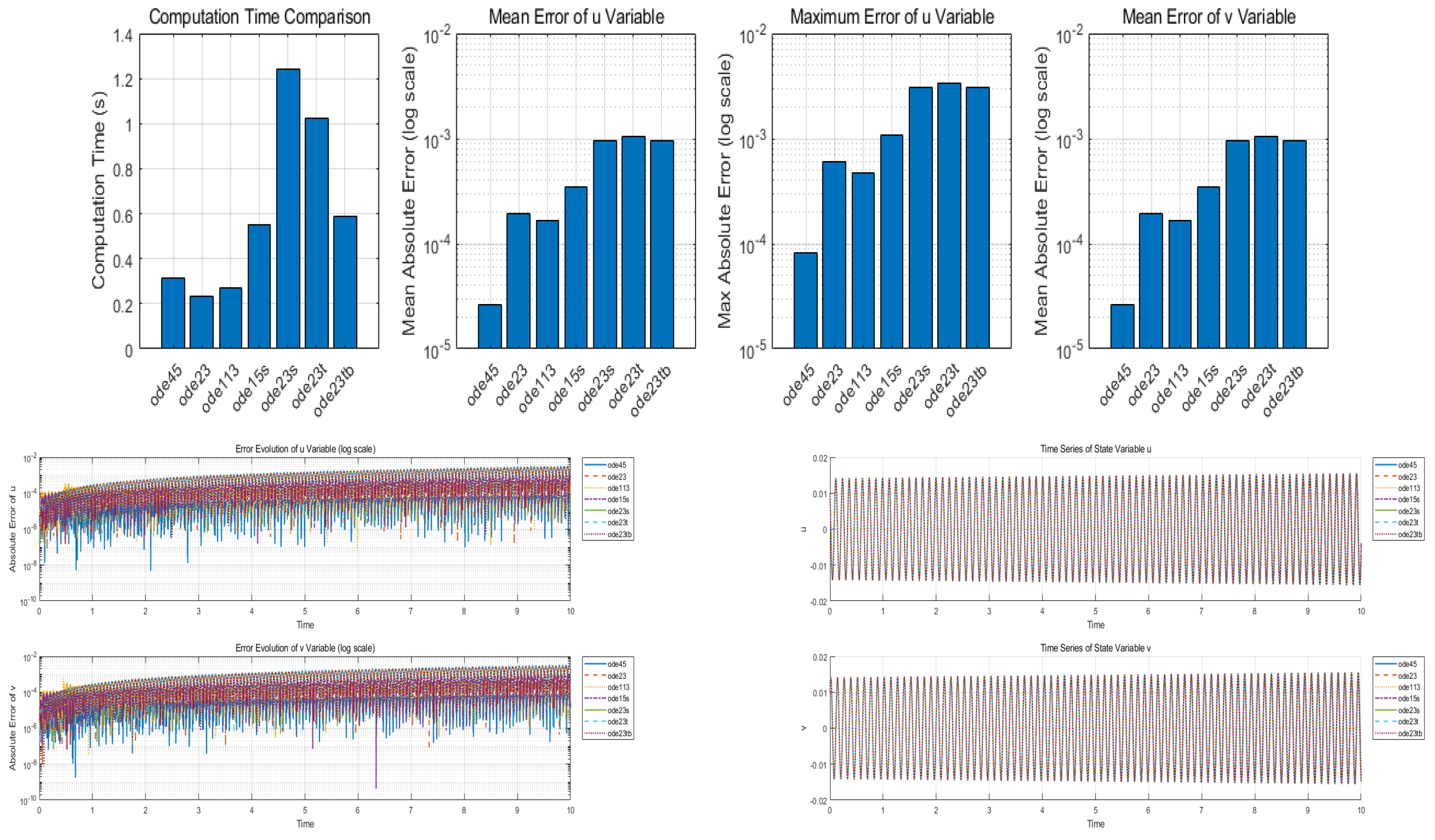
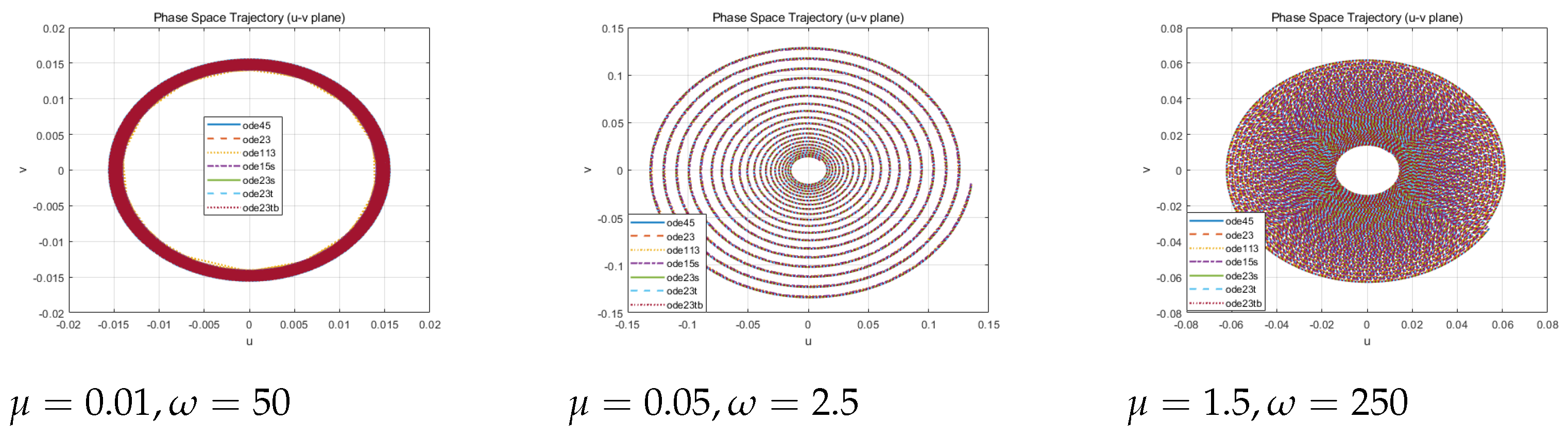
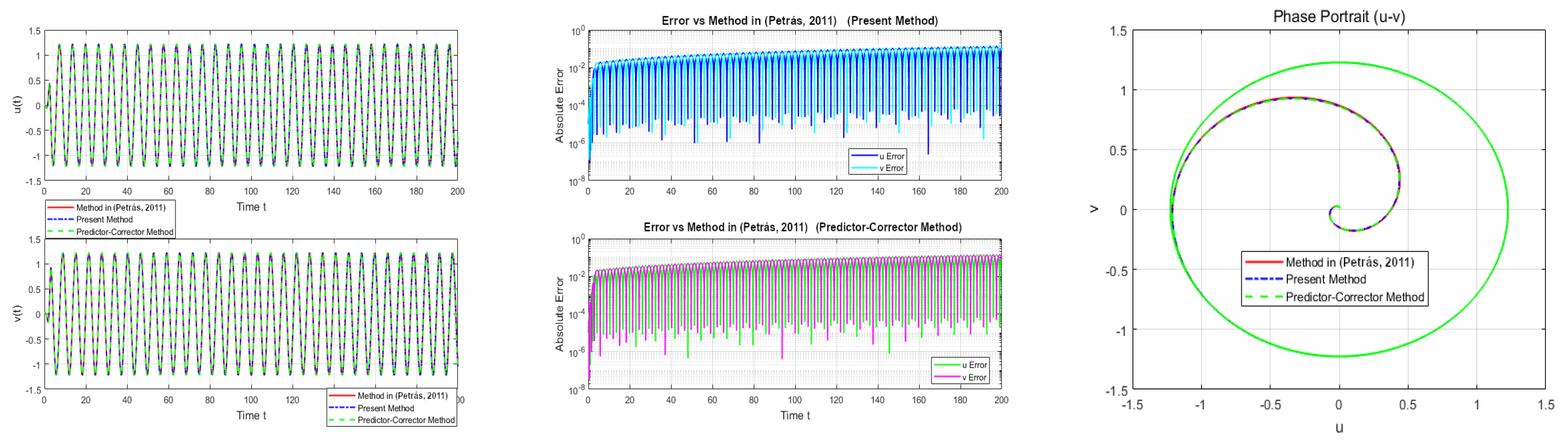
When α 1 = α 2 = 1 , ν = 0 , η = 0 , Equation (2) reduces to an ordinary differential equation. We employ multiple MATLAB ODE solvers (ode45, ode23, ode113, ode15s, ode23s, ode23t, ode23tb) for numerical solution. Comparative results in Figure 1 and Figure 2 confirm the consistency and reliability of the proposed method. Further validation is provided by a three-way comparison among Ref. [5], the present method, and the predictor-corrector method in Figure 3, which demonstrates the superior performance of our approach. Additional verification through simulations at different fractional orders ( α = [ 1 , 1 ] , [ 0.8 , 0.8 ] , [ 1.4 , 1.4 ] ) with parameters μ = 0.98 , ω = 1.66 , ν = 0 , η = 0 , κ = 1.0 , ζ = 0.3 , as shown in Figure 1, confirms the robustness and accuracy of the proposed method across varying fractional orders.
In Figure 1, a comparison is presented of numerical results using different methods at μ = 0.01 , ω = 50 , κ = 1.0 , ζ = 1.0 , α = [ 1 , 1 ] , x 0 = [ 0.1 , 0.1 ] . This figure validates the effectiveness and consistency of various MATLAB ODE solvers (including ode45, ode23, ode113, ode15s, ode23s, ode23t, and ode23tb) for integer-order ( α = 1 ) ordinary differential equations, establishing a benchmark for subsequent comparisons with fractional-order methods. Although these solvers are effective, they cannot explore the dynamic behavior of fractional-order systems. Next, the dynamic behavior of the fractional-order system (2) will be explored.
As a supplement or continuation of Figure 1, Figure 2 likely further presents the solution trajectories, phase portraits, or error analyses of different numerical methods under identical or similar parameter conditions. Its purpose is to provide a more comprehensive visual comparison, thoroughly confirming the reliability, accuracy, and mutual consistency of the selected numerical methods when simulating integer-order systems, offering readers a more complete picture of method performance.
Figure 3 shows comparison of numerical results using three different methods: the method from Ref. [5], our method, and the predictor-corrector method. This figure visually highlights the significant advantages of the proposed method in terms of solution accuracy, computational efficiency, or numerical stability, thereby demonstrating the innovation and practical value of this research.
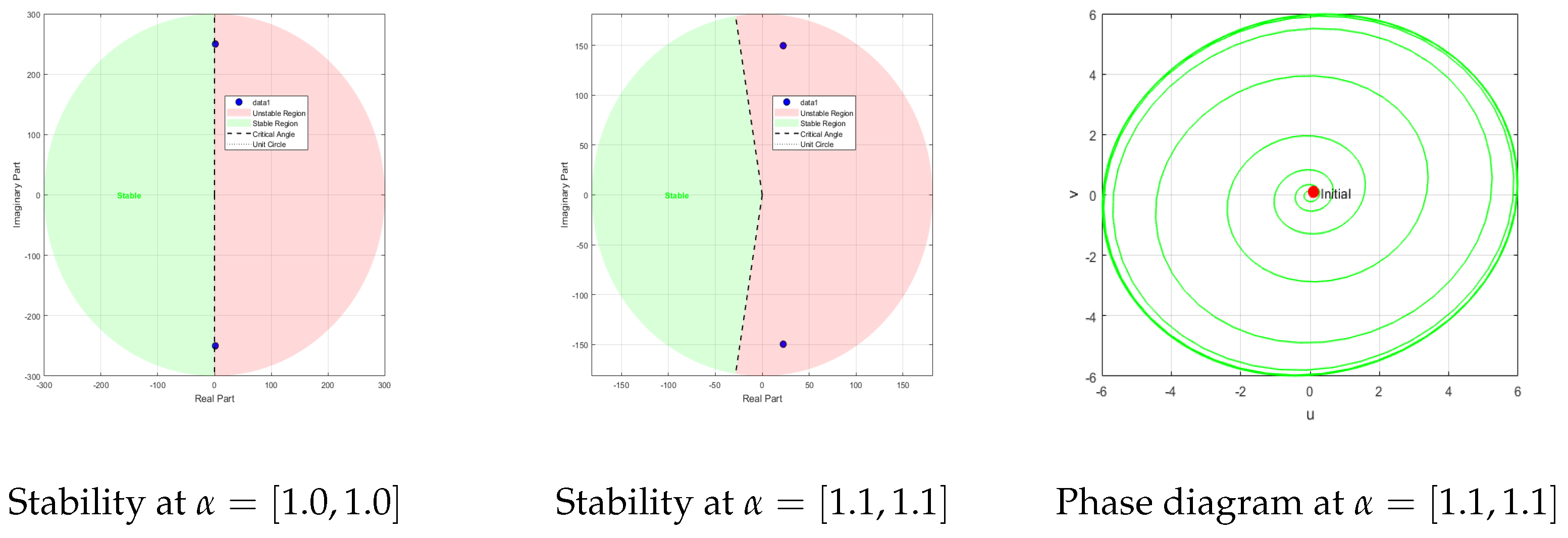
We set the parameters μ = 1.5 , ω = 250 , ν = 0 , η = 0 , κ = 1.0 , ζ = 1.0 . We can obtain equilibrium point ( 0 , 0 ) . Stability analyses are shown in Figure 4.
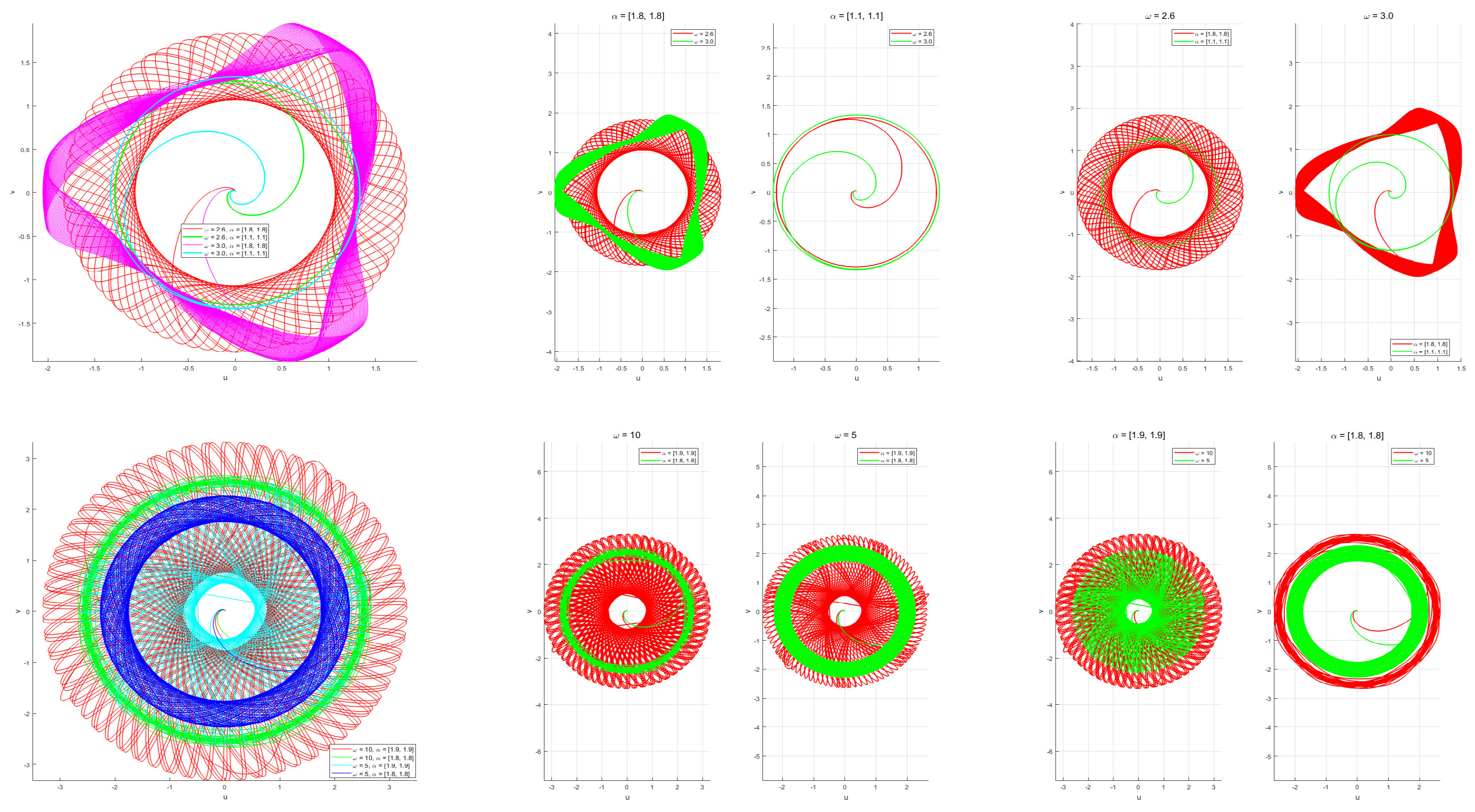
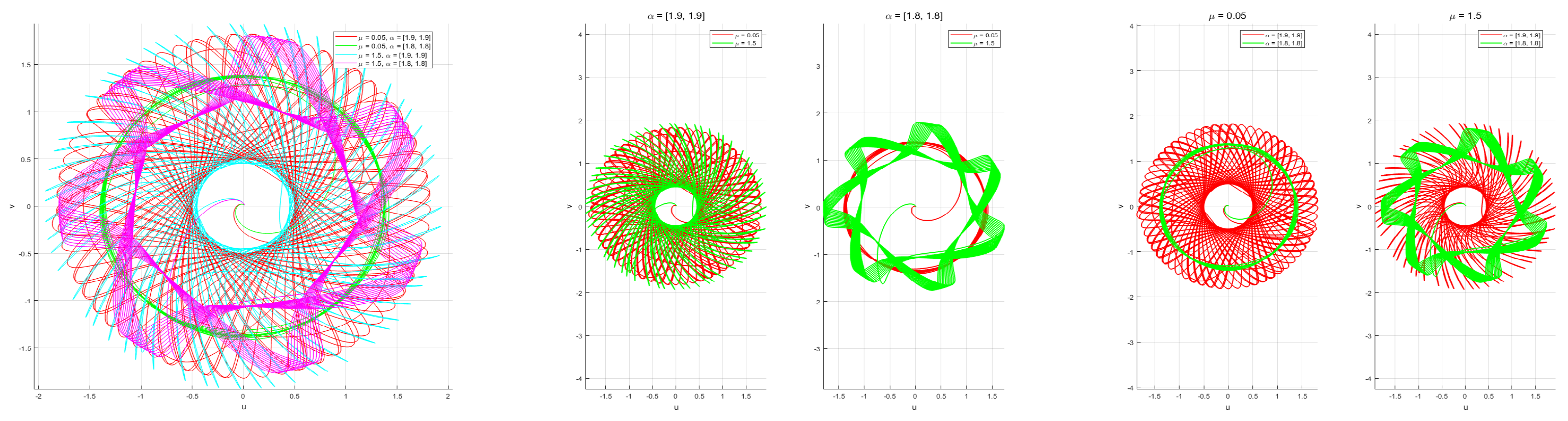
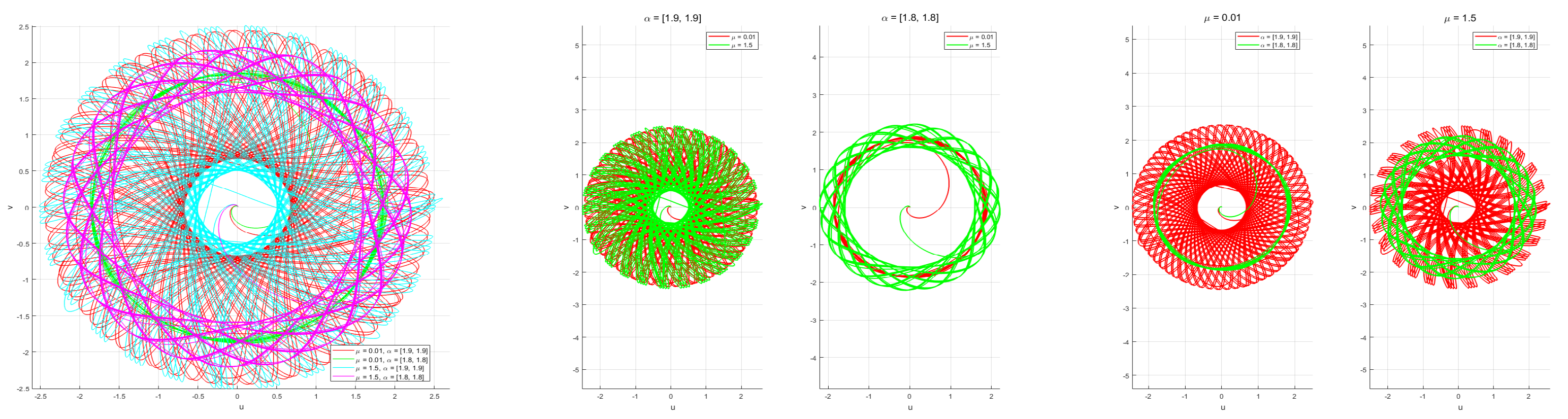
Figure 4 illustrates the stability analysis and phase diagrams of the system with parameters set to μ = 1.5 , ω = 250 , ν = 0 , η = 0 , κ = 1.0 , and ζ = 1.0 . Figure 5, Figure 6 and Figure 7 present the rich dynamical behaviors captured by the proposed high-precision numerical method for solving the fractional-order Ginzburg–Landau equation. Emphasizes the diversity and complexity of fractional-order systems in parameter space.
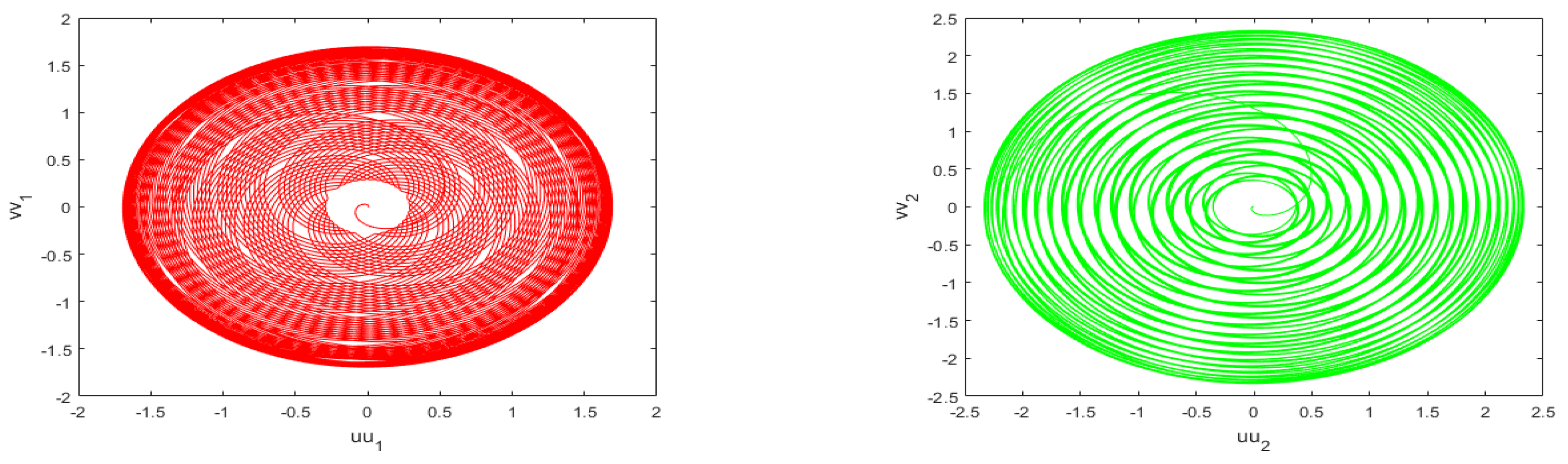
Figure 8 shows a comparison of numerical results under different fractional derivative orders α = [ 1 , 1 ] , α = [ 0.8 , 0.8 ] , α = [ 1.4 , 1.4 ] , with parameters μ = 0.98 , ω = 1.66 , ν = 0 , η = 0 , κ = 1.0 , ζ = 0.3 . This figure clearly reveals the decisive influence of the fractional derivative order α on the system’s dynamic behavior. By comparing solution trajectories under different α values, it demonstrates that the fractional-order parameter is a key factor regulating system dynamics, such as convergence speed and oscillation modes.
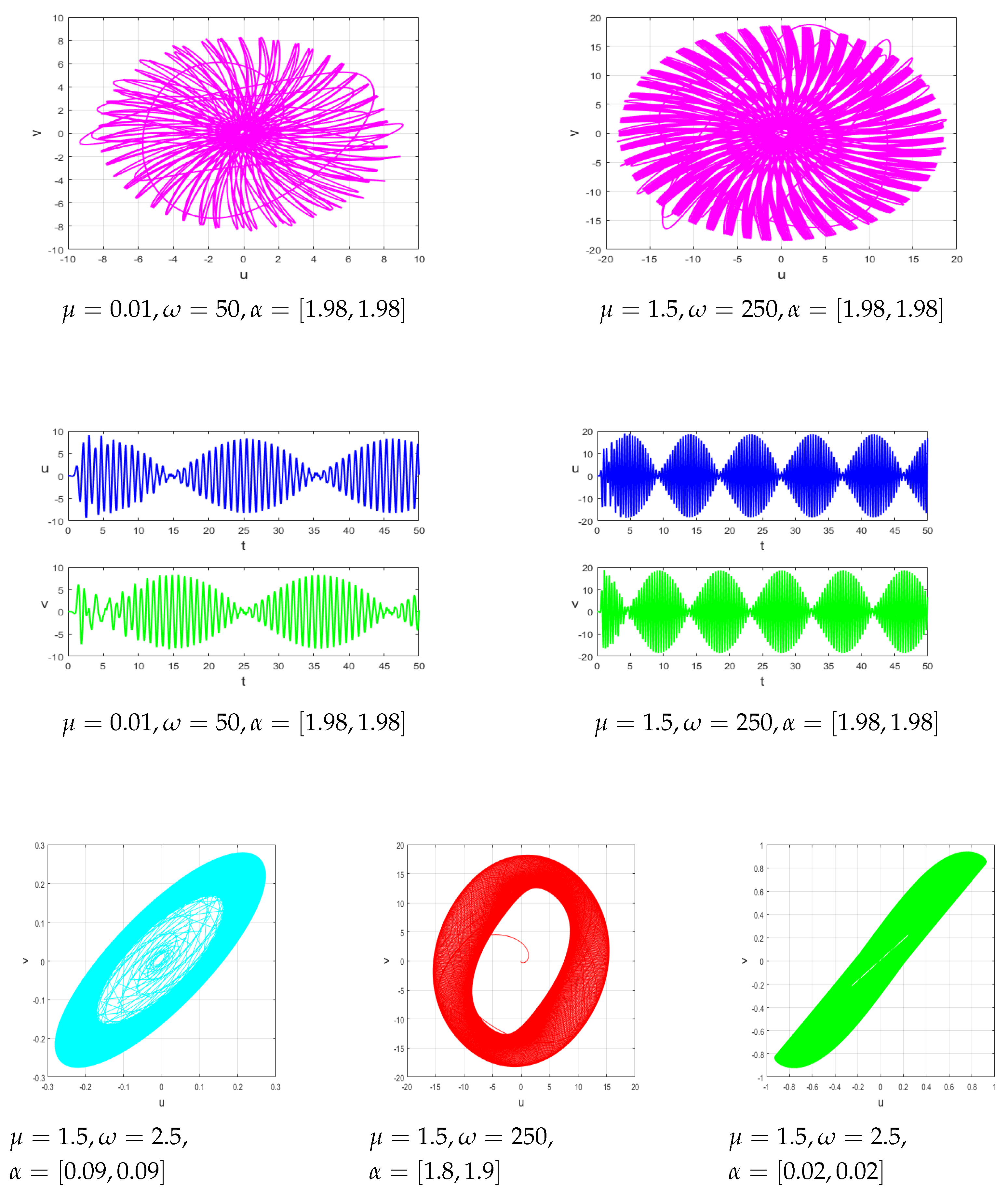
Figure 9 shows a comparison of phase diagrams under different parameters μ , ω , and fractional orders α , with κ = 1.0 , ζ = 1.0 , ν = 0 , η = 0 . These phase portraits reveal the system’s rich dynamic characteristics, potentially including stable limit cycles, chaotic attractors, and other complex phenomena. This illustrates the diversity and complexity exhibited by the fractional-order system in the parameter space.
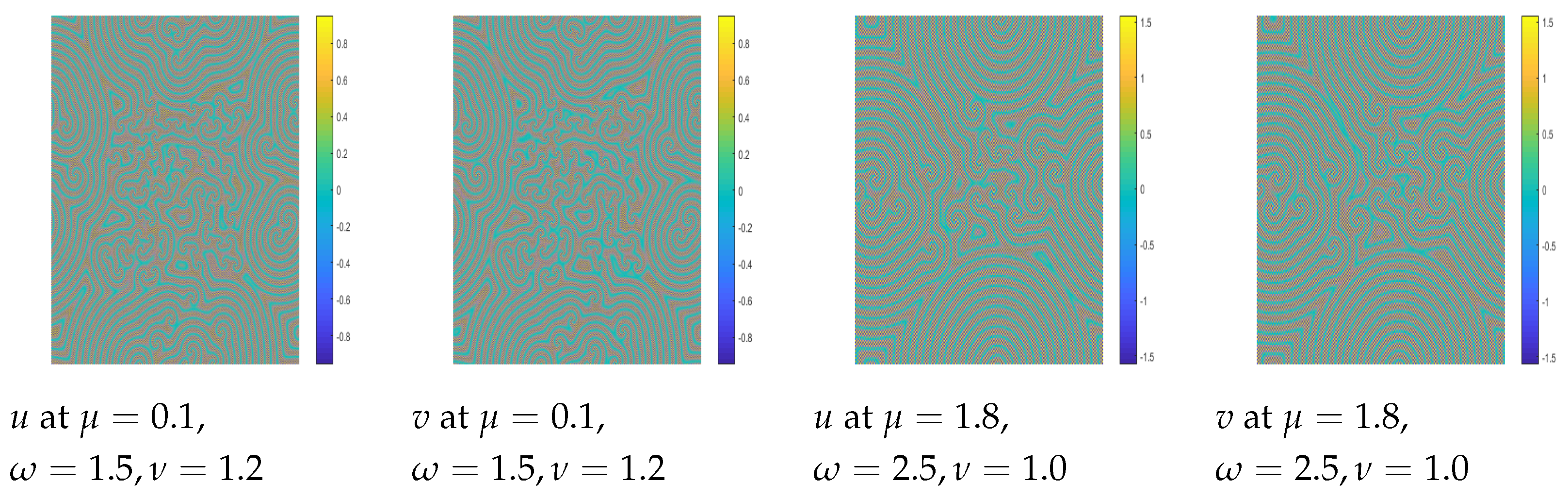
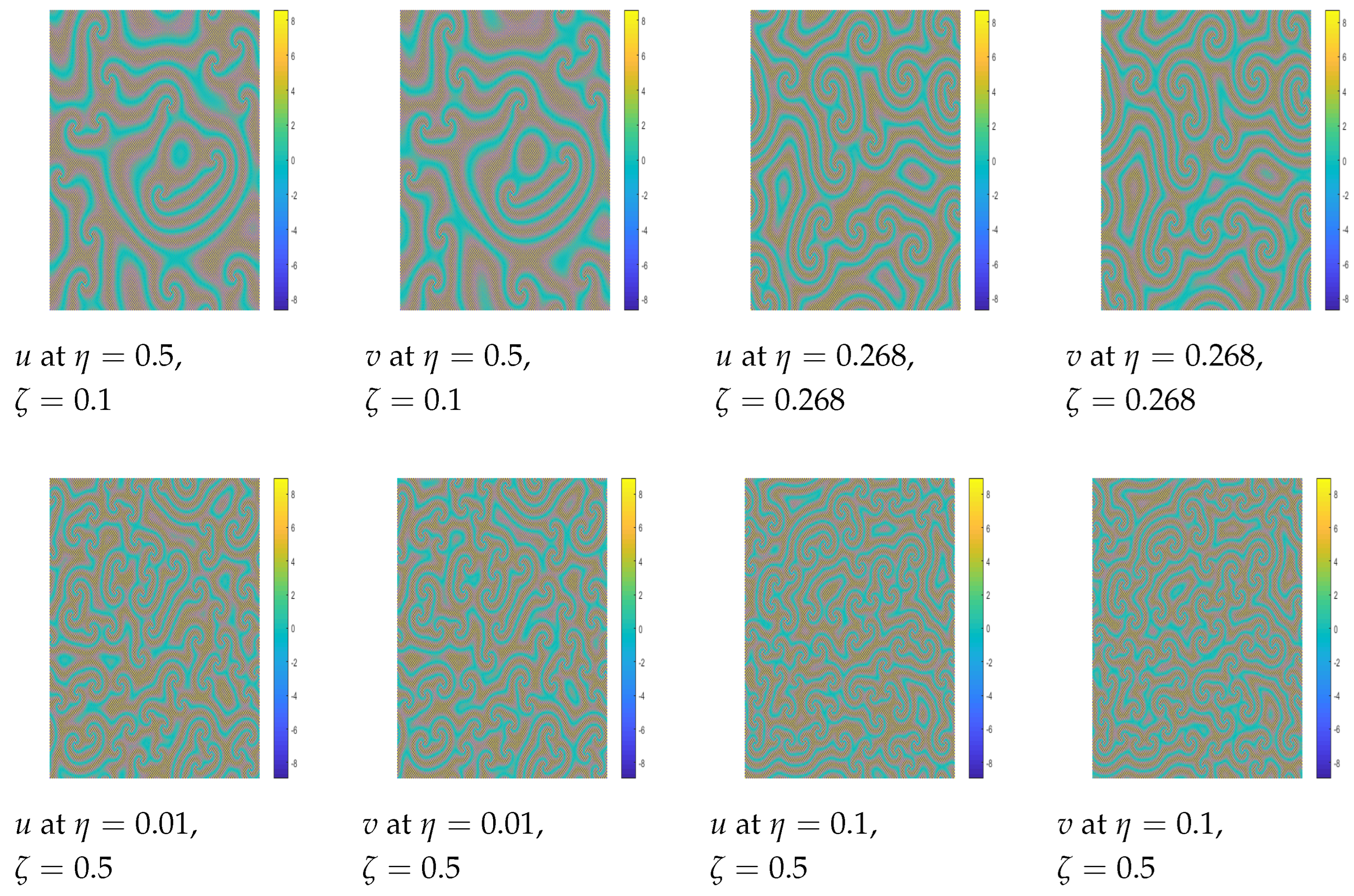
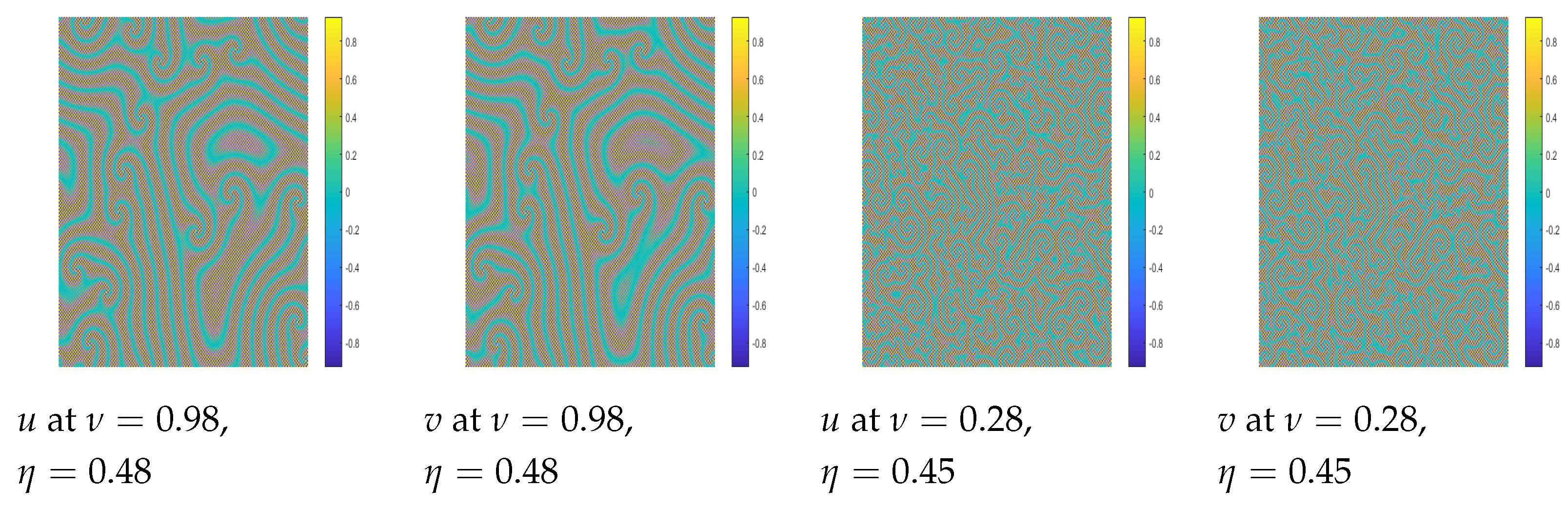
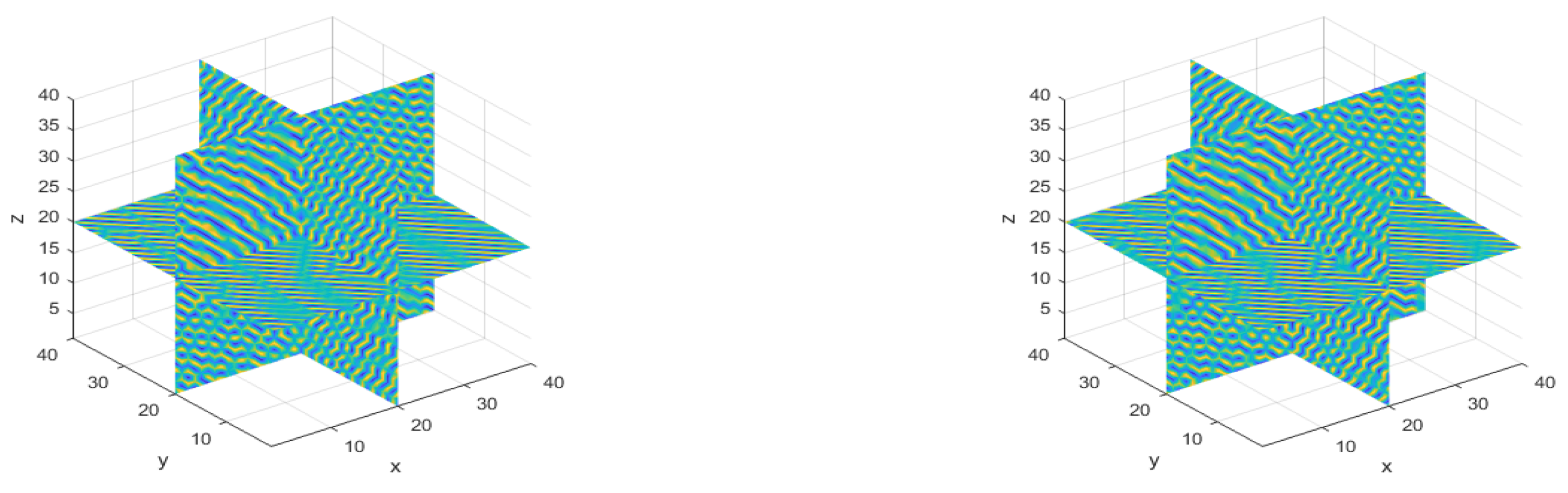
Using the present method, we discover some novel dynamic behaviors, which are shown in Figure 9, Figure 10, Figure 11, Figure 12 and Figure 13. For α 1 = α 2 = 1 , the time derivative can be calculated using the Euler format. The method can be extended and applied to 3D space. The 3D patterns are shown in Figure 13.
Figure 11 shows some novel two-dimensional patterns simulated under different parameter conditions using the proposed high-precision numerical method. These patterns may exhibit different morphological features compared to Figure 10, such as stripes, spots, or spiral waves, further demonstrating the high diversity and novelty of pattern formation in fractional-order systems and expanding the understanding of spatial dynamics in nonlinear systems.
Figure 12 shows two-dimensional pattern formation with parameters μ = 0.98 , ω = 0.98 , κ = 1.5 , ζ = 0.3 , n = 200 , τ = 0.2 , h = 0.8 , m = 20,000. Figure 12 provides a detailed visual representation of the system’s spatial structure under a specific parameter set after long-time evolution (20,000 time steps), verifying the stability of the numerical method in long-term simulations and its capability to capture specific dynamic states.
Three-dimensional patterns simulated by extending the proposed high-precision numerical method to 3D space. Figure 13 not only proves the effectiveness and applicability of the proposed algorithm in handling high-dimensional problems but, more importantly, reveals that fractional-order systems can also generate rich and novel dynamic patterns in three-dimensional space, providing a powerful visualization tool and insights for studying the spatial dynamics of high-dimensional fractional-order nonlinear systems.
Based on systematic numerical simulations presented in Figure 1, Figure 2, Figure 3, Figure 4, Figure 5, Figure 6, Figure 7, Figure 8, Figure 9, Figure 10, Figure 11, Figure 12 and Figure 13, this study successfully develops and validates an effective high-precision numerical method for solving the time-fractional complex Ginzburg–Landau equation. The method demonstrates remarkable capability in capturing complex dynamical behaviors across different fractional orders and parameter regimes. Through comprehensive comparisons with established algorithms (Figure 1, Figure 2 and Figure 3), the proposed scheme shows superior performance in accuracy and stability. More significantly, as revealed in Figure 8, Figure 9, Figure 10, Figure 11, Figure 12 and Figure 13, the method enables the discovery of rich dynamical phenomena, including chaotic oscillations and novel two/three-dimensional pattern formations that are uniquely characteristic of fractional-order systems.

5. Conclusions

This study proposes a high-precision numerical method for solving the time-fractional Ginzburg–Landau equation, combining finite difference schemes with an improved Grünwald–Letnikov approximation. Numerical simulations reveal rich dynamical behaviors, including chaotic oscillations and novel two-/three-dimensional patterns. This work provides a reliable computational framework for investigating complex spatiotemporal dynamics in fractional-order systems.
In the next step, we will focus on breaking through the stability theory of numerical methods for fractional-order systems and deepen their application in physics, exploring the intrinsic mechanisms of physical phenomena such as fractional order and system memory effect, anomalous transport and pattern formation.

Author Contributions

Methodology, W.Z.; Writing—original draft, W.Z. and Y.W.; Writing—review & editing, Y.W.; Funding acquisition, Y.W. All authors have read and agreed to the published version of the manuscript.

Funding

This paper is supported by The Doctoral Innovation Research Fund Project of Jining Normal University: (jsbsjj2355). Natural Science Foundation of Inner Mongolia (2025MS01012, 2024LHMS06025, and 2025LHMS06004). Doctoral research start-up Fund of Inner Mongolia University of Technology (DC2300001252, DC2400003130).

Data Availability Statement

The data used to support the findings of this study are available from the corresponding author upon request.

Conflicts of Interest

The authors declare that there are no conflicts of interest regarding the publication of this article.

References

  1. Samko, S.G.; Kilbas, A.A.; Marichev, O.I. Fractional Integrals and Derivatives: Theory and Applications; Gordon and Breach Science Publishers: Yverdon, Switzerland, 1993. [Google Scholar]
  2. Oldham, K.B.; Spanier, J. The Fractional Calculus: Theory and Applications of Differentiation and Integration to Arbitrary Order; Academic Press: New York, NY, USA, 1974. [Google Scholar]
  3. Miller, K.S.; Ross, B. An introduction to the Fractional Calculus and Fractional Differential Equations; John Wiley & Sons: New York, NY, USA, 1993. [Google Scholar]
  4. Kilbas, A.A.; Srivastava, H.M.; Trujillo, J.J. Theory and Applications of Fractional Differential Equations; Elsevier: Amsterdam, The Netherlands, 2006. [Google Scholar]
  5. Petráš, I. Fractional-Order Nonlinear Systems, Modeling, Analysis and Simulation; Springer: Heidelberg, Germany; Dordrecht, The Netherlands; London, UK; New York, NY, USA, 2011. [Google Scholar]
  6. Zhou, Y. Basic Theory of Fractional Differential Equations; World Scientific: Singapore, 2014. [Google Scholar]
  7. Baleanu, D.; Diethelm, K.; Scalas, E.; Trujillo, J.J. Fractional Calculus: Models and Numerical Methods; World Scientific: Singapore, 2012. [Google Scholar]
  8. Podlubny, I. Fractional Differential Equations; Academic Press: San Diego, CA, USA, 1999. [Google Scholar]
  9. Podlubny, I. Matrix Approach to Discrete Fractional Calculus. Fract. Calc. Appl. Anal. 2000, 3, 359–386. [Google Scholar]
  10. Podlubny, I.; Chechkin, A.; Skovranek, T.; Chen, Y.Q.; Vinagre, J.M. Matrix approach to discrete fractional calculus II: Partial fractional differential equations. J. Comput. Phys. 2009, 228, 3137–3153. [Google Scholar] [CrossRef]
  11. Ford, N.J.; Simpson, J.R. The Numerical Solution of Fractional Differential Equations: Speed versus Accuracy. J. Comput. Appl. Anal. 2001, 136, 367–381. [Google Scholar] [CrossRef]
  12. Ford, N.J.; Simpson, J.R. A New Look at the Numerical Solution of Fractional Differential Equations. In Proceedings of the 15th IMACS World Congress on Scientific Computation, Modelling and Applied Mathematics, Berlin, Germany, 24–29 August 1997. [Google Scholar]
  13. Ford, N.J.; Simpson, J.R. The Numerical Solution of Fractional Differential Equations: A Survey of Software and Applications. In Proceedings of the 2003 International Conference on Scientific and Engineering Computation, Melbourne, Australia, 2–4 June 2003. [Google Scholar]
  14. Ford, N.J.; Xiao, J.Y.; Yan, Y.B. A Finite Element Method for Time-Fractional Partial Differential Equations. Fract. Calc. Appl. Anal. 2011, 14, 454–474. [Google Scholar] [CrossRef]
  15. Meerschaert, M.M.; Tadjeran, C. Finite difference approximations for fractional advection-dispersion flow equations. J. Comput. Appl. Math. 2004, 172, 65–77. [Google Scholar] [CrossRef]
  16. Meerschaert, M.M.; Tadjeran, C. Finite difference approximations for two-sided space-fractional partial differential equations. Appl. Numer. Math. 2006, 56, 80–90. [Google Scholar] [CrossRef]
  17. Tadjeran, C.; Meerschaert, M.M.; Scheffler, H.P. A second-order accurate numerical approximation for the fractional diffusion equation. J. Comput. Phys. 2006, 213, 205–213. [Google Scholar] [CrossRef]
  18. Yang, J.Y.; Wang, Y.L.; Li, Z.Y. Exploring dynamics and pattern formation of a fractional-order three-variable Oregonator model. Netw. Heterog. Media 2025, 20, 1201–1229. [Google Scholar] [CrossRef]
  19. Meerschaert, M.M.; Scheffler, H.P.; Tadjeran, C. Finite difference methods for two-dimensional fractional dispersion equation. J. Comput. Phys. 2006, 211, 249–261. [Google Scholar] [CrossRef]
  20. Li, C.P.; Zeng, F.H. Numerical Methods for Fractional Calculus; Chapman and Hall/CRC: Boca Raton, FL, USA, 2015. [Google Scholar]
  21. Li, C.P.; Cai, M. Theory and Numerical Approximations of Fractional Integrals and Derivatives; Society for Industrial and Applied Mathematics: Philadelphia, PA, USA, 2020. [Google Scholar]
  22. Li, C.P.; Chen, A.J.; Ye, J.J. Numerical approaches to fractional calculus and fractional ordinary differential equation. J. Comput. Phys. 2011, 230, 3352–3368. [Google Scholar] [CrossRef]
  23. Diethelm, K.; Ford, N.J.; Freed, A.D. A predictor-corrector approach for the numerical solution of fractional differential equations. Nonlinear Dyn. 2004, 29, 3–22. [Google Scholar] [CrossRef]
  24. Wang, Y.L.; Jia, L.N.; Zhang, H.L. Numerical solution for a class of space-time fractional equation by the piecewise reproducing kernel method. Int. J. Comput. Math. 2019, 96, 2100–2111. [Google Scholar] [CrossRef]
  25. Wang, Y.L.; Liu, Y.; Li, Z.Y.; Zhang, H.L. Numerical solution of integro-differential equations of high-order Fredholm by the simplified reproducing kernel method. Int. J. Comput. Math. 2019, 96, 585–593. [Google Scholar] [CrossRef]
  26. Li, Z.Y.; Wang, Y.L.; Tan, F.G.; Wan, X.H.; Yu, H.; Duan, J.S. Solving a class of linear nonlocal boundary value problems using the reproducing kernel. Appl. Math. Comput. 2015, 265, 1098–1105. [Google Scholar] [CrossRef]
  27. Li, Z.Y.; Wang, M.C.; Wang, Y.L. Solving a class of variable order nonlinear fractional integral differential equations by using reproducing kernel function. AIMS Math. 2022, 7, 12935–12951. [Google Scholar] [CrossRef]
  28. Diethelm, K. The Analysis of Fractional Differential Equations: An Application-Oriented Exposition Using Differential Operators of Caputo Type; Springer: Berlin/Heidelberg, Germany, 2010. [Google Scholar]
  29. Diethelm, K.; Ford, N.J. Analysis of fractional differential equations. J. Math. Anal. Appl. 2002, 265, 229–248. [Google Scholar] [CrossRef]
  30. Li, C.P.; Qian, D.; Chen, Y.Q. On Riemann-Liouville and Caputo derivatives. Discret. Dyn. Nat. Soc. 2011, 2011, 562494. [Google Scholar] [CrossRef]
  31. Li, C.P.; Li, Z.Q. Stability and logarithmic decay of the solution to Hadamard-type fractional differential equation. J. Nonlinear Sci. 2021, 31, 31. [Google Scholar] [CrossRef]
  32. Li, C.P.; Li, Z.Q. The blow-up and global existence of solution to Hadamard-type fractional differential equations. Fract. Calc. Appl. Anal. 2020, 23, 1303–1337. [Google Scholar]
  33. Podlubny, I.; Petras, I.; Vinagre, B.M.; O’Leary, P.; Dorcak, L. Analogue realizations of fractional-order controllers. Non-Linear Dyn. 2002, 29, 281–296. [Google Scholar] [CrossRef]
  34. Xue, D.Y.; Chen, Y.Q. A unified framework for fractional-order system modeling, analysis and simulation. J. Syst. Simul. 2009, 21, 4973–4978. [Google Scholar]
  35. Xue, D.Y. Numerical implementation of fractional-order controllers. IET Control Theory Appl. 2017, 11, 1675–1681. [Google Scholar]
  36. Xue, D.Y. Analysis and design of fractional-order proportional-integral-derivative controllers. Acta Autom. Sin. 2018, 44, 1–13. [Google Scholar]
  37. Benson, D.A.; Wheatcraft, S.W.; Meerschaert, M.M. Application of a fractional advection-dispersion equation. Water Resour. Res. 2000, 36, 1403–1412. [Google Scholar] [CrossRef]
  38. Benson, D.A.; Wheatcraft, S.W.; Meerschaert, M.M. The fractional-order governing equation of Lévy motion. Water Resour. Res. 2000, 36, 1413–1423. [Google Scholar] [CrossRef]
  39. Meerschaert, M.M.; Benson, D.A.; Bäumer, B. Multidimensional advection and fractional dispersion. Phys. Rev. E 1999, 59, 5026–5028. [Google Scholar] [CrossRef]
  40. Han, C.; Wang, Y.L. Numerical Solutions of Variable-Coefficient Fractional-in-Space KdV Equation with the Caputo Fractional Derivative. Fractal Fract. 2022, 6, 207. [Google Scholar] [CrossRef]
  41. Zhang, H.L.; Wang, Y.L.; Bi, J.X.; Bao, S.H. Novel pattern dynamics in a vegetation-water reaction-diffusion model. Math. Comput. Simul. 2026, 241, 97–116. [Google Scholar] [CrossRef]
  42. Zhang, S.; Zhang, H.L.; Wang, Y.L.; Li, Z.Y. Dynamic properties and numerical simulations of a fractional phytoplank-ton-zooplankton ecological model. Netw. Heterog. Media 2025, 20, 648–669. [Google Scholar] [CrossRef]
  43. Gao, X.L.; Zhang, H.L.; Wang, Y.L.; Li, Z.Y. Research on Pattern Dynamics Behavior of a Fractional Vegetation-Water Model in Arid Flat Environment. Fractal Fract. 2024, 8, 264. [Google Scholar] [CrossRef]
  44. Wang, X.H.; Zhang, H.L.; Wang, Y.L.; Li, Z.Y. Dynamic properties and numerical simulations of the fractional Hastings-Powell model with the Grünwald-Letnikov differential derivative. Int. J. Bifurc. Chaos 2025, 35, 2550145. [Google Scholar] [CrossRef]
  45. Gao, X.L.; Zhang, H.L.; Li, X.Y. Research on pattern dynamics of a class of predator-prey model with interval biological coefficients for capture. AIMS Math. 2024, 9, 18506–18527. [Google Scholar] [CrossRef]
  46. Che, H.; Yu-Lan, W.; Zhi-Yuan, L. Novel patterns in a class of fractional reaction-diffusion models with the Riesz fractional derivative. Math. Comput. Simul. 2022, 202, 149–163. [Google Scholar] [CrossRef]
  47. Gao, X.L.; Li, Z.Y.; Wang, Y.L. Chaotic Dynamic Behavior of a Fractional-Order Financial System with Constant Inelastic Demand. Int. J. Bifurc. Chaos 2024, 34, 2450111. [Google Scholar] [CrossRef]
  48. Meerschaert, M.M.; Sikorskii, A. Stochastic Models for Fractional Calculus; De Gruyter: Berlin, Germany, 2019. [Google Scholar]
  49. Sabzikar, F.; Meerschaert, M.M.; Chen, J. Tempered fractional calculus. J. Comput. Phys. 2015, 293, 14–28. [Google Scholar] [CrossRef]
  50. Meerschaert, M.M.; Benson, D.A.; Scheffler, H.P.; Baeumer, B. Stochastic solution of space-time fractional diffusion equations. Phys. Rev. E 2002, 65, 041103. [Google Scholar] [CrossRef]
  51. Aranson, I.S.; Kramer, L. The world of the complex Ginzburg-Landau equation. Rev. Mod. Phys. 2002, 74, 99–143. [Google Scholar] [CrossRef]
  52. Kuramoto, Y. Chemical Oscillations, Waves and Turbulence; Springer: New York, NY, USA, 1984. [Google Scholar]
  53. Ginzburg, V.L.; Landau, L.D. On the Theory of Superconductivity. In On Superconductivity and Superfluidity; Springer: Berlin/Heidelberg, Germany, 2009. [Google Scholar]
  54. Tarasov, V.; Zaslavsky, G. Fractional Ginzburg-Landau equation for fractal media. Phys. A 2005, 354, 249–261. [Google Scholar] [CrossRef]
  55. Tarasov, V.; Zaslavsky, G. Fractional dynamics of coupled oscillators with long-range interaction. Chaos 2006, 16, 023110. [Google Scholar] [CrossRef]
  56. Milovanov, A.; Rasmussen, J. Fractional generalization of the Ginzburg-Landau equation: An unconventional approach to critical phenomena in complex media. Phys. Lett. A 2007, 337, 75–80. [Google Scholar] [CrossRef]
  57. Fei, M.; Huang, C.; Wang, N.; Zhang, G. Galerkin-Legendre spectral method for the nonlinear Ginzburg-Landau equation with the Riesz fractional derivative. Math. Methods Appl. Sci. 2021, 15, 2711–2730. [Google Scholar] [CrossRef]
  58. Ding, H.F.; Li, C.P. Numerical analysis of the high-order scheme of the damped nonlinear space fraction Schrödinger equation. Appl. Math. Lett. 2023, 141, 108621. [Google Scholar] [CrossRef]
  59. Wang, N.; Huang, C. An efficient split-step quasi-compact finite difference method for the nonlinear fractional Ginzburg–Landau equations. Comput. Math. Appl. 2018, 75, 2223–2242. [Google Scholar] [CrossRef]
  60. Zhang, Z.; Li, M.; Wang, Z. A linearized Crank–Nicolson Galerkin FEMs for the nonlinear fractional Ginzburg–Landau equation. Appl. Anal. 2019, 98, 2648–2667. [Google Scholar] [CrossRef]
  61. Mohebbi, A. Fast and high-order numerical algorithms for the solution of multidimensional nonlinear fractional Ginzburg–Landau equation. Eur. Phys. J. Plus 2018, 133, 67. [Google Scholar] [CrossRef]
  62. Mvogo, A.; Tambue, A.; Ben-Bolie, G.; Kofane, T. Localized numerical impulse solutions in diffuse neural networks modeled by the complex fractional Ginzburg-Landau equation. Commun. Nonlinear Sci. Numer. Simul. 2016, 39, 396–410. [Google Scholar] [CrossRef]
  63. Gao, H.; Sun, W. An efficient fully linearized semi-implicit Galerkin-mixed FEM for the dynamical Ginzburg-Landau equations of superconductivity. J. Comput. Phys. 2015, 294, 329–345. [Google Scholar] [CrossRef]
  64. Li, M.; Huang, C.; Wang, N. Galerkin finite element method for the nonlinear fractional Ginzburg-Landau equation. Appl. Numer. Math. 2017, 118, 131–149. [Google Scholar] [CrossRef]
  65. Du, R.; Wang, Y.Y.; Hao, Z.P. High-dimensional nonlinear Ginzburg-Landau equation with fractional Laplacian: Dis-cretization and simulations. Commun. Nonlinear Sci. Numer. Simul. 2021, 102, 105920. [Google Scholar] [CrossRef]
  66. He, D.; Pan, K. An unconditionally stable linearized difference scheme for the fractional Ginzburg-Landau equation. Numer. Algorithms 2018, 79, 899–925. [Google Scholar] [CrossRef]
  67. Li, M.; Huang, C.M. An efficient difference scheme for the coupled nonlinear fractional Ginzburg-Landau equations with the fractional Laplacian. Numer. Methods Partial. Differ. Equ. 2019, 35, 394–421. [Google Scholar] [CrossRef]
  68. Wang, P.; Huang, C.M. An implicit midpoint difference scheme for the fractional Ginzburg-Landau equation. J. Comput. Phys. 2016, 312, 31–49. [Google Scholar] [CrossRef]
  69. Zhang, M.; Zhang, G.F.; Liao, L.D. Fast iterative solvers and simulation for the space fractional Ginzburg-Landau equations Ginzburg-Landau equations. Comput. Appl. Math. 2019, 78, 1793–1800. [Google Scholar] [CrossRef]
  70. Lu, H.; Lü, S.J.; Zhang, M.J. Fourier spectral approximations to the dynamics of 3D fractional complex Ginz-burg-Landau equation. Discret. Contin. Dyn. Syst. Ser. A 2017, 37, 2539–2564. [Google Scholar] [CrossRef]
  71. Ding, H.F.; Li, C.P. High-order numerical algorithm and error analysis for the two-dimensional nonlinear spatial fractional complex Ginzburg–Landau equation. Commun. Nonlinear Sci. Numer. Simul. 2023, 120, 107160. [Google Scholar] [CrossRef]
  72. Gao, Y.F.; Chang, S.X.; Lu, C.N. A Second-Order Alikhanov Type Implicit Scheme for the Time-Space Fractional Ginzburg–Landau Equation. Adv. Appl. Math. Mech. 2024, 16, 1451–1473. [Google Scholar] [CrossRef]
  73. Heydari, M.H.; Razzaghi, M. Piecewise fractional Chebyshev cardinal functions: Application for time fractional Ginzburg-Landau equation with a non-smooth solution. Chaos Solitons Fractals 2023, 171, 113445. [Google Scholar] [CrossRef]
  74. Aboelenen, T.; Alqawba, M. Stability analysis and error estimates of local discontinuous Galerkin method for nonlinear fractional Ginzburg–Landau equation with the fractional Laplacian. Eur. Phys. J. Spec. Top. 2023, 232, 2607–2617. [Google Scholar] [CrossRef]
  75. Liu, J.C.; Li, H.; Liu, Y. A Space-Time Finite Element Method for the Fractional Ginzburg-Landau Equation. Fractal Fract. 2023, 7, 564. [Google Scholar] [CrossRef]
  76. Raviola, L.A.; De Leo, M.F. Performance of affine-splitting pseudo-spectral methods for fractional complex Ginz-burg-Landau equations. Appl. Math. Comput. 2024, 466, 128428. [Google Scholar]
  77. Carreno-Diaz, J.F.; Kaikina, E.I. Neumann problem for fractional Ginzburg-Landau equation on a upper-right quarter plane. J. Differ. Equ. 2025, 418, 258–304. [Google Scholar] [CrossRef]
  78. Xue, D.Y. Fractional Calculus and Fractional-Order Control; Science Press: Beijing, China, 2018. [Google Scholar]
  79. Dorčák, L. Numerical Models for Simulation the Fractional-Order Control Systems; UEF-04-94; The Academy of Sciences Institute of Experimental Physics: Kosice, Slovakia, 1994. [Google Scholar]
Figure 1. Comparison of numerical results in different method at μ = 0.01 ,   ω = 50 , κ = 1.0 ,   ζ = 1.0 ,   α = [ 1 , 1 ] ,   x 0 = [ 0.1 , 0.1 ] .
Fractalfract 09 00738 g001
Figure 2. Comparison of phase diagram in different method at κ = 1.0 ,   ζ = 1.0 ,   α = [ 1 , 1 ]   , x 0 = [ 0.1 , 0.1 ] .
Fractalfract 09 00738 g002
Figure 3. Comparison of numerical results in different method (Ref. [5] Petrás’s method, present method and predictive-corrective method) at μ = 1.5 ,   ω = 2.5 ,   ν = 0 ,   η = 0 ,   κ = 1.0 ,   ζ = 1.0 ,     h = 0.001 ,   t [ 0 , 200 ] ,   α = [ 0.99 , 0.99 ] ,   x 0 = [ 0.01 , 0.01 ] .
Fractalfract 09 00738 g003
Figure 4. Stability and phase diagrams at μ = 1.5 ,   ω = 250 ,   ν = 0 ,   η = 0 ,   κ = 1.0 ,   ζ = 1.0 ,   h = 0.001 ,   t [ 0 , 10 ] ,   x 0 = [ 0.1 , 0.1 ] .
Fractalfract 09 00738 g004
Figure 5. Comparison of phase diagram in different fractional derivative α , and different ω , μ = 1.5 ,   ν = 0 ,   η = 0 ,   κ = 1.0 ,   ζ = 1.0 ,   h = 0.005 ,   t [ 0 , 200 ] ,   x 0 = [ 0.01 , 0.01 ] .
Fractalfract 09 00738 g005
Figure 6. Comparison of phase diagram in different fractional derivative α = [ 1.9 , 1.9 ] , α = [ 1.8 , 1.8 ] , ν = 0.01 , ν = 1.5 , ω = 2.5 ,   ν = 0 ,   η = 0 ,   κ = 1.0 ,   ζ = 1.0 ,   h = 0.005 ,   t [ 0 , 200 ] ,   x 0 = [ 0.01 , 0.01 ] .
Fractalfract 09 00738 g006
Figure 7. Comparison of phase diagram in different fractional derivative α = [ 1.9 , 1.9 ] , α = [ 1.8 , 1.8 ] , and ν = 0.01 , ν = 1.5 , ω = 4.5 ,   ν = 0 ,   η = 0 ,   κ = 1.0 ,   ζ = 1.0 ,   h = 0.005 ,   t [ 0 , 200 ] ,   x 0 = [ 0.01 , 0.01 ] .
Fractalfract 09 00738 g007
Figure 8. Comparison of numerical results in different fractional derivative α = [ 1 , 1 ] ,   α = [ 0.8 , 0.8 ] ,   α = [ 1.4 , 1.4 ] , and μ = 0.98 ,   ω = 1.66 ,   ν = 0 ,   η = 0 ,   κ = 1.0 ,   ζ = 0.3 ,   h = 0.01 ,   t n = 300 ,   x 0 = [ 0.01 , 0.01 ] , t [ 0 , 500 ] , u u 1 = u α = [ 1 , 1 ] u α = [ 0.8 , 0.8 ] ,   v v 1 = v α = [ 1 , 1 ] v α = [ 0.8 , 0.8 ] ,   u u 2 = u α = [ 1 , 1 ] u α = [ 1.4 , 1.4 ] , v v 2 = v α = [ 1 , 1 ] v α = [ 1.4 , 1.4 ] .
Fractalfract 09 00738 g008
Figure 9. Comparison of phase diagram in different μ , ω , α at κ = 1.0 ,   ζ = 1.0 ,   ν = 0 ,   η = 0 ,   h = 0.001 ,   t n = 50 ,   x 0 = [ 0.01 , 0.01 ] .
Fractalfract 09 00738 g009
Figure 10. μ = 1.8 ,   ω = 2.5 ,   ν = 1.0 ,   η = 0 ,   κ = 1 ,   ζ = 0   , n = 200 ,   τ = 0.2 ,   h = 0.8 ,     m = 4000 ,   α = [ 1 , 1 ] .
Fractalfract 09 00738 g010
Figure 11. Pattern dynamic behavior at μ = 0 ,   ω = 0 ,   ν = 1 ,   κ = 1 ,   τ = 0.002 ,   h = 0.08 ,   m = 20,000 , n = 200 , α = [ 1 , 1 ] .
Fractalfract 09 00738 g011
Figure 12. μ = 0.98 ,   ω = 0.98 ,   κ = 1.5 ,   ζ = 0.3 ,   n = 200 ,   τ = 0.2 ,   h = 0.8 ,   m = 20,000.
Fractalfract 09 00738 g012
Figure 13. The 3D pattern dynamic behavior at μ = 0 ,   ω = 0 ,   ν = 1 ,   κ = 1 ,   τ = 0.002 ,   h = 0.08 ,   m = 20,000 , n = 40 , η = 0.1 ,   ζ = 0.28 ,   α = [ 1 , 1 ] .
Fractalfract 09 00738 g013
Table 1. The calculation result of p-order polynomial generating function g p ( z ) , p = 1 , 2 , , 8 .
pgp(z)
1 g 1 ( z ) = 1 z
2 g 2 ( z ) = 3 2 2 z + 1 2 z 2
3 g 3 ( z ) = 11 6 3 z + 3 2 z 2 1 3 z 3
4 g 4 ( z ) = 25 12 4 z + 3 z 2 2 3 z 3 + 1 4 z 4
5 g 5 ( z ) = 137 60 5 z + 5 z 2 10 3 z 3 + 5 4 z 4 1 5 z 5
6 g 6 ( z ) = 49 20 6 z + 15 2 z 2 20 3 z 3 + 15 4 z 4 6 5 z 5 + 1 6 z 6
7 g 7 ( z ) = 363 140 7 z + 21 2 z 2 35 3 z 3 + 35 4 z 4 21 5 z 5 + 7 6 z 6 1 7 z 7
8 g 8 ( z ) = 761 280 8 z + 14 z 2 56 3 z 3 + 35 2 z 4 56 5 z 5 + 14 3 z 6 8 7 z 7 + 1 8 z 8
Table 2. High-precision backward-difference scheme coefficients of first-order derivative.
o ( h p ) y k y k 1 y k 2 y k 3 y k 4 y k 5 y k 6 y k 7 y k 8
o ( h ) 1−1
  o ( h 2 ) 3 2 −2 1 2
  o ( h 3 ) 11 6 −3 3 2 1 3
  o ( h 4 ) 25 12 −43 4 3 1 4
  o ( h 5 ) 137 60 −55 10 3 5 4 1 5
  o ( h 6 ) 49 20 −6 15 2 20 3 15 4 6 5 1 6
  o ( h 7 ) 363 140 −7 21 2 35 3 35 4 21 5 7 6 1 7
  o ( h 8 ) 761 280 −814 56 3 35 2 56 5 14 3 8 7 1 8
Table 3. High -precision backward-difference scheme coefficients of second-order derivative α = 2 .
o ( h p ) y k y k 1 y k 2 y k 3 y k 4 y k 5 y k 6 y k 7 y k 8 y k 9 y k 10 y k 11 y k 12
o ( h 2 ) 1−21
  o ( h 4 ) 9 4 −6 11 2 −2 1 4
  o ( h 6 ) 121 36 −11 29 2 92 9 17 4 −1 1 9
  o ( h 8 ) 625 144 50 3 57 2 266 9 497 24 −10 59 18 2 3 1 16
  o ( h 10 ) 18,769 3600 137 6 287 6 587 9 1537 24 3506 75 461 18 31 3 139 48 1 2 1 25
  o ( h 12 ) 2401 400 147 5 291 4 368 3 1237 8 3772 25 5216 45 −70 521 16 101 9 269 100 2 5 1 36
Table 4. High-precision backward-difference scheme coefficients of third-order derivative α = 3 .
o ( h p ) y k y k 1 y k 2 y k 3 y k 4 y k 5 y k 6 y k 7 y k 8 y k 9 y k 10 y k 11 y k 12
o ( h 1 ) 1−33−1
  o ( h 3 ) 27 8 27 2 171 8 −17 57 8 3 2 1 8
  o ( h 5 ) 1331 216 121 4 517 8 2875 36 511 8 139 4 935 72 13 4 1 2 1 27
  o ( h 7 ) 15 , 625 1728 625 12 2225 16 8329 36 17 , 291 64 469 2 11 , 195 72 159 2 1993 64 985 108 91 48 1 4 1 64
Disclaimer/Publisher’s Note: The statements, opinions and data contained in all publications are solely those of the individual author(s) and contributor(s) and not of MDPI and/or the editor(s). MDPI and/or the editor(s) disclaim responsibility for any injury to people or property resulting from any ideas, methods, instructions or products referred to in the content.