Abstract
In this paper, we first present multiple numerical simulations of the anti-symmetric matrix in the stability criteria for fractional order systems (FOSs). Subsequently, this paper is devoted to the study of the admissibility criteria for descriptor fractional order systems (DFOSs) whose order belongs to (0, 2). The admissibility criteria are provided for DFOSs without eigenvalues on the boundary axes. In addition, a unified admissibility criterion for DFOSs involving the minimal linear matrix inequality (LMI) variable is provided. The results of this paper are all based on LMIs. Finally, numerical examples were provided to validate the accuracy and effectiveness of the conclusions.
1. Introduction
Fractional calculus (FC) has a history of three centuries, and many researchers have studied and discussed it as a purely theoretical field. In recent years, it has become increasingly recognized that many dynamical systems can be more accurately described using FC and integrals rather than conventional integer-order models [1]. FOSs are also widely used in fuzzy systems [2,3], switching systems [4,5], robust control [6,7], and other fields [8,9]. In addition, recent studies have made advancements in analyzing the stability and performance of FOSs and applying them to more complex real-world systems [10]. For example, [4] applied switched FOSs to an
circuit and accurately portrayed the relationship between voltage and current in the circuit to obtain the switching rate. Xu et al. [11] developed a fractional derivative model to describe the complex viscoelastic creep behaviors of Hami Melon.
Stability is a fundamental property of control systems [12,13,14]. For FOSs, Matignon [15] proposed the first stability criterion, indicating that the stability problem of FOSs can be attributed to the eigenvalue problem of the pseudo-state matrix. Although this criterion theoretically analyzed stability, the design of the controller remains challenging. Oustaloup et al. [16] pioneered the famous CRONE control technique, making controller design and control simulation possible but still not based on LMIs. Since then, FOSs have entered the field of automatic control. Building upon this foundation, Farges et al. [17] concentrated on formulating LMI conditions to ensure the stability of commensurate FOSs through the application of two complex variables. In [18], an approach leveraging an LMI-based stability criterion, which utilizes a reduced number of real variables, was proposed for solving convex optimization problems, ultimately facilitating the design of the controller. In the latest study, a practical stability condition for FOSs is presented, employing the LMI method. Convex optimization problems involving LMIs can represent numerous issues in control theory. This approach has enhanced the efficacy of solving control theory-related problems since the early 1990s. Based on this approach, refs. [19,20,21,22,23,24] focused on the stability of FOSs with order
and
, respectively. However, the decision matrices were either too complex in form or too numerous in quantity in the stability criteria for the FOSs mentioned above, making these criteria too complex and not conducive to controller design [25]. Zhang et al. [26] recently derived a set of LMI-based criteria for the stability and stabilization of FOSs with fractional order
belonging to the interval
, which involves minimal real LMI variables.
It is well known that for descriptor systems, admissibility is a very important property. Therefore, in addition to stability, we need to consider regularity and non-impulsivity [27,28]. There are a large number of achievements in the area of admissibility [29,30,31,32,33,34,35]. For DFOSs with orders
, admissibility criteria based on a set of strict LMIs representations were given in [36,37], respectively. For orders belonging to
, Marir et al. [35] proposed an observer-based controller to ensure the admissibility of DFOSs. However, the results in [35] involved both complex numbers and complex matrices, making it challenging to determine feasible solutions. In [38], the investigation delved into admissibility and robust stabilization criteria for DFOSs within the order range of
. This was accomplished through the application of a method employing strict LMIs with real matrices, facilitating straightforward solutions. N’Doye et al. [39] focused on DFOSs with order
. However, only sufficient conditions were given. For DFOSs with a given fractional order belonging to
, Wang et al. [40] provided admissibility and quadratic admissibility criteria. However, their approach involved multiple real decision variables.
Although there are many results on the stability criteria for FOSs, the simulation of the antisymmetric matrix in the criteria is a challenge. In this regard, we provide a variety of simulations. There are many results on the admissibility criteria for DFOSs, but for DFOSs without eigenvalues on the boundary axes, no report on the admissibility criterion using the LMI expression was found. Meanwhile, there are few reports on the admissibility criteria using the minimal LMIs variable. Inspired by the above discussion, this paper proposes novel admissibility criteria by converting the assumption that there are no eigenvalues on the boundary axes to LMIs. Subsequently, this paper derives a new criterion on the DFOSs admissibility condition of fractional order
in a more concise form than [41]. The contributions of this paper are as follows:
- (1)
- The simulation of the anti-symmetric matrix within the stability criteria based on LMIs for FOSs has consistently presented challenges. This paper addresses these challenges by utilizing MATLAB, offering a range of simulation methods employing both the LMI toolbox and the YALMIP toolbox.
- (2)
- There are a large number of results for the admissibility criteria for DFOSs with eigenvalues not on the boundary axes, but none of them deal with them directly using LMIs. This paper advances this area by converting this hypothetical condition into LMI-based admissibility criteria, thus making it easy to use MATLAB to determine feasible solutions.
- (3)
- Previously proposed admissibility criteria for DFOSs include several decision variables and even involve complex variables, making it difficult to determine feasible solutions using MATLAB. The admissibility criteria proposed in this paper involve the minimal LMIs variable, which makes it easy to determine feasible solutions.
- (4)
- Diverging from the methodologies of existing algorithms, which segregate the interval into two distinct ranges: and , this research constructs an LMI structure, which is applicable to DFOSs with .
- (5)
- The admissibility criteria derived in this paper, through the application of methodologies including contract transformation, are contingent solely upon factors such as fractional order, the pseudo state matrix, and the direction of control.
The paper is organized as follows. Section 2 introduces several preliminary results. Section 3 presents our main results for FOSs and DFOSs. In Section 4, we validate the theoretical results through numerical examples. Finally, Section 5 concludes the paper.
Notations: Let
denote the set of complex (real) matrices with dimensions
. For
,
,
,
. I denotes an identity matrix with appropriate dimensions.
indicates that matrix X is negatively definite (positively definite).
represents the transpose (transpose conjugate) of the matrix X.
.
represents the Kronecker product of two matrices A and B.
denotes the largest (smallest) integer not greater than (not less than)
.
2. Problem Statements and Preliminaries
Consider the unforced descriptor fractional order system
where
is the constant matrix and
is the physical state vector.
is the singular matrix and
.
is the Caputo fractional derivative with order
of function
.
Prior to deriving the admissibility criterion for DFOSs, we first introduce the following definition and lemmas.
Definition 1
Lemma 1
([38]). If System (1) is regular, then there exist invertible matrices R and L such that
where N is a nilpotent matrix and
Lemma 2.
For given
,
if and only if
or
where
is the real part (imaginary part) of Z.
Proof.
Assume that Equation (3) holds, i.e., for
,
Therefore, by the property of conjugation, we obtain the following:
Namely,
Similarly, if Equation (6) holds, then Equation (3) holds. Therefore, it can be concluded that
Pre- and postmultiplying (7) by
and its conjugate transpose, it can be inferred that Equation (4) holds. Subsequently, according to Theorem 1 in [15], Equation (5) holds. Conversely, Equation (3) can also be derived from Equations (4) or (5). □
Lemma 3.
Matrix
is D-stable, as defined in [18], if and only if there exist
, such that
where M is a generalized negative definite matrix satisfying the form
and N satisfies the form
where
,
,
is any matrix with a full column rank satisfying
,
, and
Proof.
(Necessity) In the case of
, by Theorem 2.2 in [38], there exist
satisfying
Noting that
is non-singular, let
Therefore, condition (8) holds.
(Sufficiency) The sufficiency of the theorem is proved according to the reverse process of the proof of necessity. In this way, the proof is complete. □
Remark 1.
When the fractional order
, Lemma 3 reduces to Theorem 3.1 in [12].
3. Main Results
Firstly, this section presents various numerical simulation methods for evaluating the stability criteria of fractional order systems (FOSs) with orders in the interval
. Then, new LMI-based admissibility criteria of order
and
are provided, and subsequently, admissibility criteria for DFOSs of order
involving the minimal LMIs variable are given.
3.1. Multiple Simulations of Anti Symmetric Matrices in Stability Criteria of FOSs
If
is a nonsingular matrix, System (1) reduces to a FOSs as follows:
For the seductiveness of System (13), Theorem 2.1 in [18] provides an effective LMI result. The feasible solution is solved using the MATLAB LMI toolbox. Relevant results are now provided to extend the LMI approach to simulation.
Theorem 1.
Proof.
Notice that, for any matrix
, there is
. Thus, in conjunction with Theorem 2.1 in [18], Theorem 1 holds. □
Remark 2.
In contrast to Theorem 2.1 in [18], the result of Corollary 8 is more general since it does not require matrix Y to be a skew symmetry matrix.
Previous numerical simulation methods on LMI-based stability criteria are based on the MATLAB LMIs toolbox [18]. Now, based on the following example, we extend the numerical simulation method.
Example 1.
Consider the fractional-order system (13) with
and
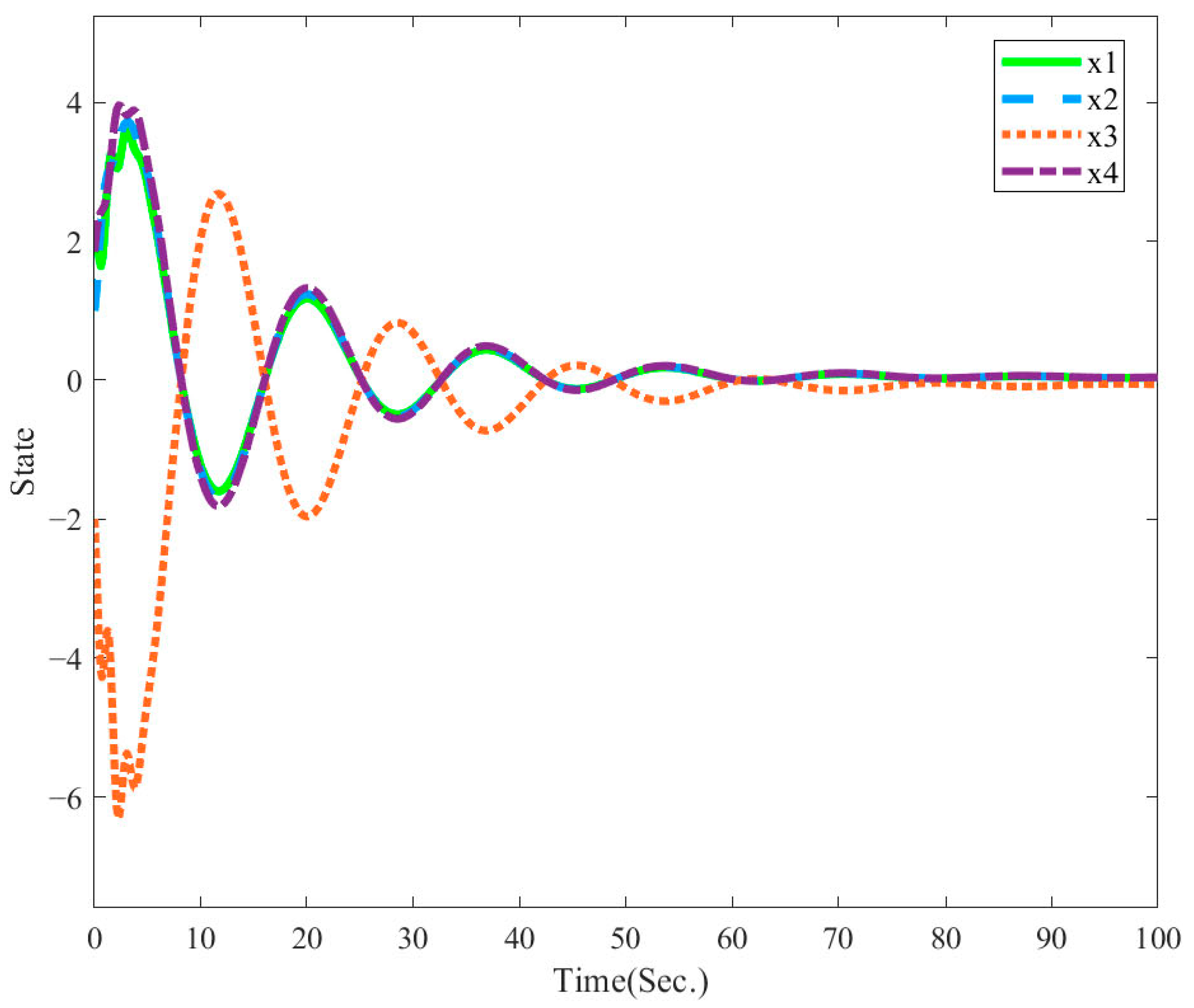
By calculating the eigenvalues of A, it can be seen that the system is stable. Based on the above analysis, using the MATLAB commands in Appendix A, the corresponding feasible solutions are listed in Table 1. The state diagram of the system in Example 1 is shown in Figure 1. It is evident that the system is stable.
Table 1.
Numerical simulation method and results.
Figure 1.
State responses of the system in Example 1 with
.
Remark 3.
Referring to Table 2, our approach involves the least number of actual decision variables, has low algorithmic complexity, reduces stabilisation conservatism, and does not involve an antisymmetric matrix, making it easy to solve for the decision variables. Overall, from the comparison in Table 2, our results outperform the existing results.
Table 2.
Comparison of our approach compared to existing approaches.
3.2. Admissibility Criteria Based on LMIs for DFOSs with Eigenvalues Not on Boundary Axes
For DFOSs without eigenvalues of the boundary axes, we propose novel LMIs based on admissibility criteria. Firstly, the admissibility criteria for SOFS of order
are as follows.
Theorem 2.
Proof.
(Sufficiency) Assume the existence of a complex matrix X, such that conditions (16)–(19) hold, respectively. According to condition (19), matrix A is nonsingular. Let
be the generalized eigenvalue of A, i.e.,
Therefore,
Let
then the left side of Equation (20) is equivalent to
which has zero eigenvalue, making Equation (20) not hold. Similarly, Equation (20) does not hold when
Therefore, there is no characteristic root of triple
that falls on the line
. By Theorem 10 in [31], System (1) is admissible if conditions (18) and (19) hold.
Remark 4.
Theorem 2 presents a novel admissibility criterion for DFOSs with the order in the interval
, thereby enriching the study of DFOS admissibility. However, Theorem 2 includes a complex variable, which poses challenges for numerical simulation.
On the basis of Theorem 2, some corollaries are given.
Corollary 1.
Proof.
Let
be the generalized eigenvalue of the matrix A for
., i.e.,
From condition (23), we can obtain that
After that, Corollary 1 holds with reference to a similar proof procedure as for Theorem 2. □
Remark 5.
Corollary 1 is equivalent to Theorem 2, offering the admissibility criterion from an alternative perspective.
Corollary 2.
Proof.
Corollary 3.
Proof.
From Theorem 2, there exists
, satisfying conditions (16) and (17). From Equation (16) and the nature of the conjugate we obtain the following:
Adding Equations (16) and (34) provides
Let
. Therefore, condition (30) holds. According to Lemma 2, Equation (31) can be obtained from Equation (17). Combining conditions (18) and (19) in Theorem 2, Corollary 3 is proven. □
Corollary 4.
Proof.
By Corollary 3, System (1) with
is admissible if there exist
, satisfying conditions (35) and (36) and
, satisfying conditions (32) and (33). As can be seen from condition (33), A is nonsingular. If
and is substituted into Equation (32), we obtain the following:
Pre- and post-multiplying (39) by
and its transpose, it can be inferred that conditions (36) and (38) hold, where
. □
Remark 6.
To improve upon Theorem 2, Corollaries 2, 3, and 4 involve only real variables. However, it should be noted that these corollaries are not favorable for numerical simulation because Equations (28), (32), and (38) are all nonstrict LMIs. This characteristic, combined with rounding errors in numerical computation, can lead to fragility in maintaining the equilibrium loss constraint.
Corollary 5.
Proof.
(Sufficiency) Using row and column transformations of matrices, there exist
, satisfying (44). Let
be the generalized eigenvalue of the matrix A satisfying Equation (20). Therefore,
According to Equations (41) and (45), using the nature of the Kronecker product yields the following:
Similar to the proof process in Theorem 2, it can be shown that there is no characteristic root of triple
that falls on the line
. According to Lemma 1, there exist
, satisfying Equation (44) and substituting them into Equation (43), then the
block yields
which implies that
is nonsingular, i.e., System (1) is regular and impulse-free. Therefore, by Lemma 1, there exist
, such that
Substituting Equation (46) into conditions (42) and (43), respectively, we are able to obtain the following:
Thus,
If
and we combine Equation (47), we can obtain that
indicating that
Considering the proof process of Theorem 2, it follows from Equation (48) that
which implies that System (1) is stable. Thus, System (1) is admissible.
(Necessity) Aussume that System (1) is admissible. Then, there exist
, satisfying (2). According to Lemma 1 in [26] and Lemma 1, there exists
, satisfying Equations (11) and (12). Let
Therefore, Equations (40) and (41) hold. By Lemma 1, there exist
, satistying condition (2) and
Noting the process of proving sufficiency, according to Equation (49) we obtain the following:
Thus, there exists a positive matrix
satisfying
If
and we combine Equation (50), it can be determined that condition (42) holds. Let
then it is shown that condition (43) holds. □
Remark 7.
Corollary 7 presents a strict LMI acceptability criterion, which facilitates the determination of feasible solutions in numerical simulations.
The novel admissibility criteria for SOFS of order
are as follows.
Theorem 3.
Proof.
(Sufficiency) Assume the existence of a complex matrix X, such that conditions (51)–(54) hold, respectively. According to condition (54), matrix A is nonsingular. Let
be the generalized eigenvalue of the matrix A, i.e.,
From condition (52), we can obtain that
Combining Equations (55) and (56), it can be concluded that
Setting
from Equation (57), we obtain
Setting
from Equation (57), we obtain
Equations (58) and (59) cannot both hold. Therefore, the generalized eigenvalue
of A cannot be
Therefore, the generalized eigenvalue of A does not fall on the line
. By Lemma 1, there exist
, satisfying Equation (44). Let
Substituting (60) into the condition (54), the blocks on both sides of the equation located at
are
Without loss of generality, by making
, the blocks on both sides of Equation (61) located at
can be rewritten as follows:
which indicates that
and
is nonsingular, i.e., System (1) is regular and impulse-free. Since System (1) is regular, by Lemma 1, there exist
, satisfying
Let
Substituting Equations (62) and (63) into conditions (53) and (54) yields the following:
which illustrates that J and
are nonsingular, and that
Combining Equations (64) and (65), it follows that
From Theorem 8 in [32] and Lemma 1, Equation (66) states that
, which indicates that
is stable. Pre- and post-multiplying (66) by J and its transpose, it can be inferred that
which indicates that
is stable, and so is J. Furthermore, System (1) is stable. Thus, System (1) is admissible.
(Necessity) Suppose that System (1) is admissible. By Theorem 8 in [32], there exist
, satisfying Equations (9) and (10). Also, there exist
, satisfying Equation (2), where
. Let
Therefore, the matrices
and
satisfy (51) and (52). From Lemma 1, condition
holds. From Theorem 8 in [32], there exist
, satisfying conditions (9) and (10). Pre- and post-multiplying (10) by
and its transpose, it can be inferred that
which indicates that
and further
There exist
, satisfying condition (9) and
Let
Combining Equations (68) and (69), the following equation holds:
Noticing that,
Combined with the above equation, Equation (70) is converted to
Pre- and post-multiplying (71) by
and its transpose, it can be inferred that
Let
Equation (72) is rewritten as follows:
which indicates that condition (53) holds. Since
from Equation (10), the following Equation holds:
where
Therefore, condition (54) holds. □
Remark 8.
Theorem 3 introduces a novel admissibility criterion for DFOSs with orders in the interval
, thereby contributing to the enrichment of DFOS admissibility studies. However, Theorem 3 includes a nonstrict LMIs condition, which poses challenges for numerical simulation.
Corollary 6.
Proof.
Let
be the generalized eigenvalue of the matrix A for
, i.e.,
From condition (74), we can obtain the following:
After that, Corollary 6 holds with reference to a similar proof procedure for Theorem 3. □
Remark 9.
Corollary 6 provides an equivalent formulation of Theorem 3. To facilitate numerical simulations, a strict LMI admissibility criterion is presented as follows.
Corollary 7.
Proof.
(Sufficiency) Let
be the generalized eigenvalue of the matrix A, satisfying Equation (45). Combining Equations (45) and (78) yields
Similar to the proof process in Theorem 3, it can be shown that there is no characteristic root of triple
that falls on the line
. By Lemma 1, there exist
, satisfying Equation (44). Substituting Equation (44) into Equation (80), the
block is
showing that
is nonsingular; that is, the regularity and non impulsivity of the system (1) have been proven. Thus, by Lemma 1, there exist R and L, such that
Substituting Equation (82) into conditions (79) and (80), respectively, we obtain the following:
Therefore, based on Equations (80) and (84), it can be deduced that
Let
. According to Equation (83), it is easy to see that the following equation holds:
Reconsidering the proof of Theorem 3, it follows from the above equation:
indicating that System (1) is stable. Therefore, System (1) is admissible.
(Necessity) Suppose that System (1) is admissible. By Theorem 2.3 in [38], there exist
, satisfying Equations (77) and (78). By Lemma 1, there exist
, satistying condition (2) and
Noting the process of proving sufficiency, according to Equation (85) we obtain the following:
Thus, there exist
, satisfying
Let
and combining Equation (86) proves that condition (79) holds. Let
then it is shown that condition (80) holds. □
3.3. Admissibility Criteria for DOFS Involving Minimal LMIs Variable
For the admissibility criterion for descriptor fractional order systems of order belonging to
and
, respectively, the criteria in [36,38] are good results based on strict LMIs. However the solution of their corresponding LMIs needs to involve two or three solved variables, including redundant and nonessential variables. In the following, for DFOSs of order
within interval
and interval
, respectively, we provides the admissibility criterion involving the minimum LMI variables, respectively.
Theorem 4.
System (1) with
is admissible iff there exists
, such that
where S has the same definition in Theorem 2 in [36].
Proof.
(Sufficiency) Suppose that there exists
, satisfying conditions (87) and (88). From Theorem 2 in [36], let
to determine that System (1) with order
is admissible.
(Necessity) Suppose that System (1) is admissible. Then, there exist
, satisfying Equation (2), and
. According to Theorem 8 in [32], there exists
, satisfying Equation (11) and (12). By the definition of S in Theorem 2 in [36], construct S as follows:
and let
where H is an arbitrary nonsingular matrix. The necessity of the theorem is proved by substituting Equations (89) and (90) into conditions (87) and (88). □
Theorem 5.
System (1) with
is admissible iff there exists
, such that
where S has the same definition in Theorem 2.2 in [38].
Proof.
(Sufficiency) Assume that there exists
, satisfying conditions (91) and (92). From Theorem 2.2 in [38], let
to determine that System (1) with order
is admissible.
(Necessity) Suppose that System (1) with order
is admissible. There exist
, satisfying condition (2). According to Theorem 8 in [32], there exist
, satisfying
By the definition of S in Theorem 2 in [36], construct S as follows:
and let
where H is an arbitrary nonsingular matrix. The necessity of the theorem is proved by substituting Equations (93) and (94) into conditions (91) and (92). □
Theorem 6.
System (1) with
is admissible iff there exists
, such that
where
,
have the same definition as in Lemma 3 and Theorem 2 in [36], respectively.
Proof.
Combining the proof process of Theorem 4 and Theorem 5 shows that Theorem 6 holds. □
Remark 10.
The conditions outlined in Theorems 4 and 5 are stringent LMI-based conditions that do not involve equality constraints. Consequently, there is no need to introduce the redundant solved variable Q. This simplification results in a solution that is both more straightforward and efficient, leading to outcomes that are more effective and fundamental.
Remark 11.
System (1) reduces to a descriptor integer order system in the case of
. It is evident that both Theorems 4 and 5 reduce to Theorem 2.1 in [33]. Therefore, Theorems 4 and 5 can be regarded as extensions of the theory of admissibility, transitioning from descriptor integer order systems to descriptor fractional order systems in a consistent manner.
Remark 12.
System (1) reduces to a normal integer system in case of
and
. Under these conditions,
, and both Theorems 4 and 5 reduce to the Lyapunov stability theorem. Therefore, Theorems 4 and 5 can be seen as consistent extensions of the Lyapunov stability theorem from normal systems to DOFS.
4. Numerical Examples
In order to validate the effectiveness of the theories introduced in Section 3, two simulation examples are provided.
Example 2.
Consider System (1) with
and
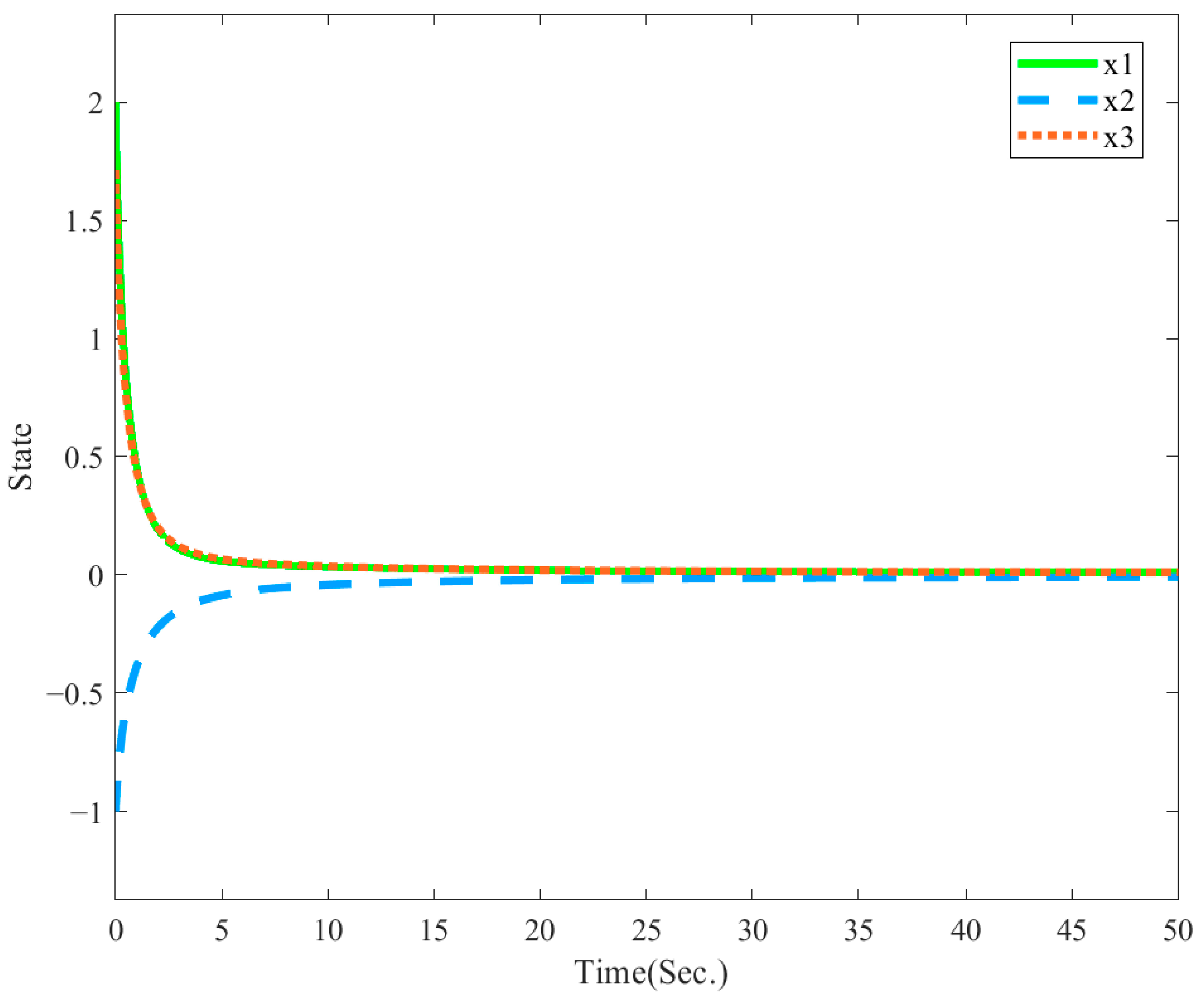
The state diagram of the system in Example 2 is shown in Figure 2. It is evident that the system is stable.
Figure 2.
State responses of the system in Example 2 with
.
Example 3.
Consider the descriptor fractional order system (1) with
and
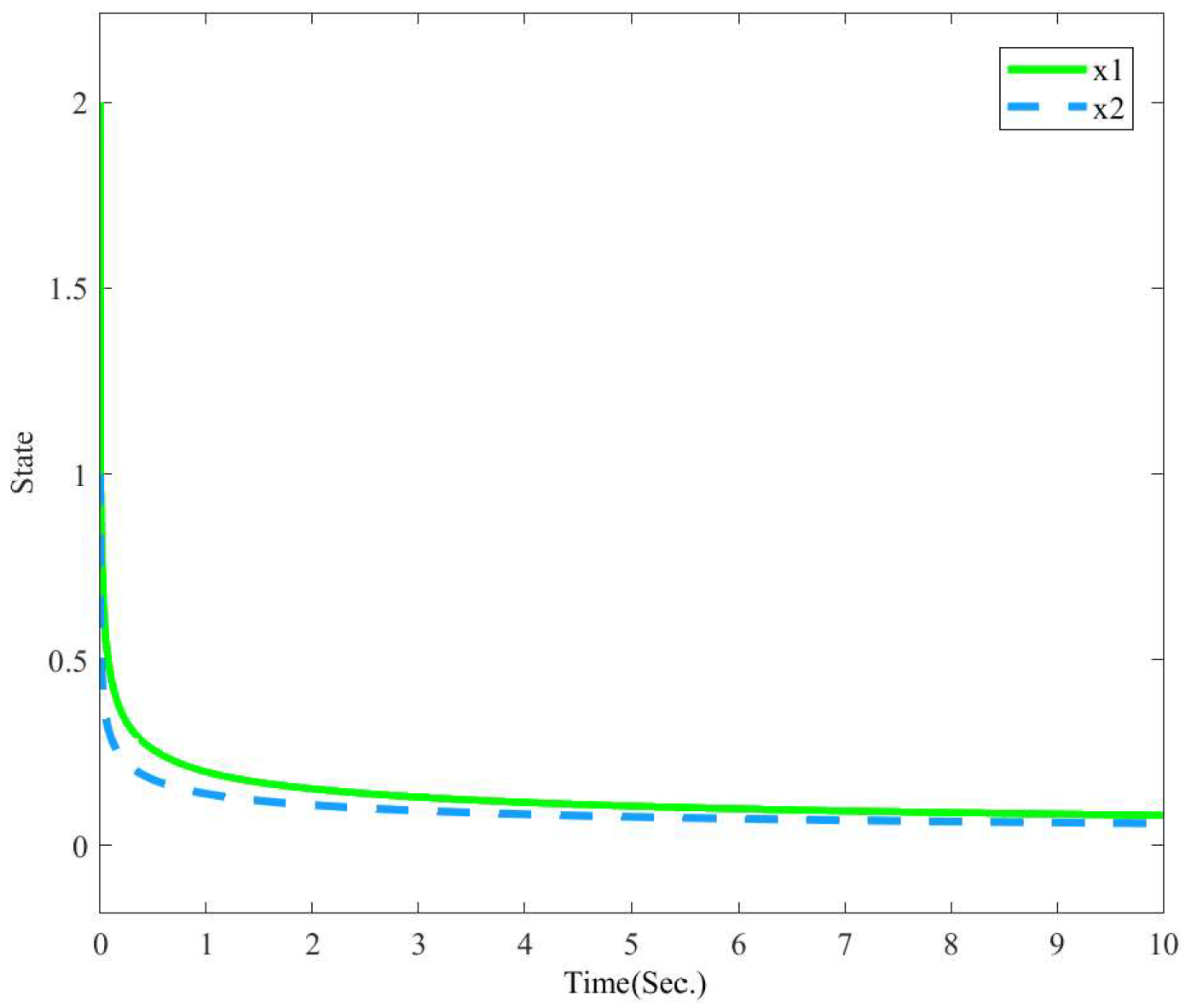
The state diagram of the system in Example 3 is shown in Figure 3. It is evident that the system is stable.
Figure 3.
State responses of the system in Example 3 with
.
5. Conclusions
This paper first analyzes the stability of FOSs and provides multiple simulation methods for the antisymmetric matrix in the stability criterion. Subsequently, the admissibility criteria for DFOSs with eigenvalues not on the boundary axes are investigated in depth. Novel admissibility criteria of order
and
are proposed, respectively. Additionally, this paper introduces admissibility criteria involving the minimal LMI variable. The validity of the conclusions presented in this paper is demonstrated through several numerical examples. Building on the methods discussed, future work will focus on the design of controllers for DFOSs with uncertain derivative matrices.
Author Contributions
Conceptualization, methodology, validation, X.W. and J.-X.Z.; investigation, software, writing—original draft, X.W.; methodology, supervision, validation, J.-X.Z. All authors have read and agreed to the published version of the manuscript.
Funding
This work was supported in part by the National Natural Science Foundation of China under Grant 62103093, the National Key Research and Development Program of China under Grant 2022YFB3305905, the Xingliao Talent Program of Liaoning Province of China under Grant XLYC2203130, the Science and Technology Foundation of Liaoning Province of China under Grant 2023-MS-087, and the Fundamental Research Funds for the Central Universities of China under Grant N2108003.
Data Availability Statement
No new data were created or analyzed in this study. Data sharing is not applicable to this article.
Conflicts of Interest
The authors declare no conflicts of interest.
Correction Statement
This article has been republished with a minor correction to resolve spelling and grammatical errors. This change does not affect the scientific content of the article.
Appendix A
Appendix A.1

Appendix A.2

Appendix A.3

Appendix A.4

Appendix A.5

Appendix A.6

Appendix A.7

References
- Marir, S.; Chadli, M.; Basin, M.V. Bounded real lemma for singular linear continuous-time fractional-order systems. Automatica 2022, 135, 109962. [Google Scholar] [CrossRef]
- Li, R.C.; Zhang, Q.L. Robust H∞ sliding mode observer design for a class of Takagi-Sugeno fuzzy descriptor systems with time-varying delay. Appl. Math. Comput. 2018, 337, 158–178. [Google Scholar] [CrossRef]
- Li, R.C.; Zhang, Q.L. Robust H∞ observer-based sliding mode control for uncertain Takagi-Sugeno fuzzy descriptor systems with unmeasurable premise variables and time-varying delay. Inf. Sci. 2021, 566, 239–261. [Google Scholar]
- Zhang, X.F.; Wang, Z. Stability and robust stabilization of uncertain switched fractional order systems. ISA Trans. 2020, 103, 1–9. [Google Scholar] [CrossRef] [PubMed]
- Wang, Z.; Xue, D.Y.; Pan, F. Observer-based robust control for singular switched fractional order systems subject to actuator saturation. Appl. Math. Comput. 2021, 411, 126538. [Google Scholar] [CrossRef]
- Aghayan, Z.S.; Alfi, A.; Mousavi, Y.; Kucukdemiral, I.B.; Fekih, A. Guaranteed cost robust output feedback control design for fractional-order uncertain neutral delay systems. Chaos Solitons Fractals 2022, 163, 112523. [Google Scholar] [CrossRef]
- Gong, P.; Lan, W.; Han, Q.L. Robust adaptive fault-tolerant consensus control for uncertain nonlinear fractional-order multi-agent systems with directed topologies. Automatica 2020, 117, 109011. [Google Scholar] [CrossRef]
- Angel, L.; Viola, J. Fractional order PID for tracking control of a parallel robotic manipulator type delta. ISA Trans. 2018, 79, 172–188. [Google Scholar] [CrossRef] [PubMed]
- Zhang, X.F.; Huang, W.K.; Wang, Q.G. Robust H∞ adaptive sliding mode fault tolerant control for T-S fuzzy fractional order systems with mismatched disturbances. IEEE Trans. Circuits Syst. Regul. Pap. 2021, 68, 1297–1307. [Google Scholar] [CrossRef]
- Sun, H.G.; Zhang, Y.; Baleanu, D.; Chen, W.; Chen, Y.Q. A new collection of real world applications of fractional calculus in science and engineering. Commun. Nonlinear Sci. Numer. Simulat. 2018, 64, 213–231. [Google Scholar] [CrossRef]
- Xu, Z.; Chen, W. A fractional-order model on new experiments oflinear viscoelastic creep of Hami Melon. Comput. Math. Appl. 2013, 66, 677–681. [Google Scholar] [CrossRef]
- Duan, G.R.; Patton, R.J. A note on hurwitz stability of matrices. Automatica 1998, 34, 509–511. [Google Scholar] [CrossRef]
- Zhang, J.X.; Chai, T.Y. Proportional-integral funnel control of unknown lower-triangular nonlinear systems. IEEE Trans. Autom. Control 2024, 69, 1921–1927. [Google Scholar] [CrossRef]
- Zhang, J.X.; Ding, J.L.; Chai, T.Y. Fault-tolerant prescribed performance control of wheeled mobile robots: A mixed-gain adaption approach. IEEE Trans. Autom. Control 2024, 1–8. [Google Scholar] [CrossRef]
- Matignon, D. Stability result on fractional differential equations with applications to control processing. Comput. Eng. Syst. Appl. 1996, 2, 963–968. [Google Scholar]
- Oustaloup, A.; Mathieu, B.; Lanusse, P. The CRONE control of resonant plants: Application to a flexible transmission. Eur. J. Control 1995, 1, 113–121. [Google Scholar] [CrossRef]
- Farges, C.; Moze, M.; Sabatier, J. Pseudo-state feedback stabilization of commensurate fractional order systems. Automatica 2010, 46, 1730–1734. [Google Scholar] [CrossRef]
- Zhang, X.F.; Chen, Y.Q. D-stability based LMI criteria of stability and stabilization for fractional order systems. In Proceedings of the International Design Engineering Technical Conferences & Computers and Information in Engineering Conference (DETC/CIE), Boston, MA, USA, 2–5 August 2015. DETC2015-46692. [Google Scholar]
- Chilali, M.; Gahinet, P. H∞ design with pole placement constraints: An LMI approach. IEEE Trans. Autom. Control 1996, 41, 358–367. [Google Scholar] [CrossRef]
- Lu, J.G.; Chen, Y.Q. Robust stability and stabilization of fractional-order interval systems with the fractional order α: The 0 < α < 1 case. Automatica 2008, 44, 2985–2988. [Google Scholar]
- Ahn, H.S.; Chen, Y.Q. Necessary and sufficient stability condition of fractional-order interval linear systems. Automatica 2008, 44, 2985–2988. [Google Scholar] [CrossRef]
- Wei, Y.H.; Chen, Y.Q.; Cheng, S.S.; Wang, Y. Completeness on the stability criterion of fractional order LTI systems. Fract. Calc. Appl. Anal. 2017, 20, 159–172. [Google Scholar] [CrossRef]
- Aguila-Gamacho, N.; Duarte-Mermound, M.A.; Gallegos, J.A. Lyapunov functions for fractional order systems. Commun. Nonlinear Sci. Numer. Simul. 2014, 19, 2951–2957. [Google Scholar] [CrossRef]
- Reyad, E.K.; Shaher, M. Stability analysis of composite fractional systems. Int. J. Appl. Math. 2003, 12, 73–85. [Google Scholar]
- Wei, Y.H.; Tse, P.W.; Yao, Z.; Wang, Y. The output feedback control synthesis for a class of singular fractional order systems. ISA Trans. 2017, 69, 1–9. [Google Scholar] [CrossRef] [PubMed]
- Zhang, X.F.; Lin, C.; Chen, Y.Q.; Boutat, D. A unified framework of stability theorems for LTI fractional order systems with 0 < α < 2. IEEE Trans. Circuits Syst. II Express Briefs 2020, 67, 3237–3241. [Google Scholar]
- Di, Y.; Zhang, J.X.; Zhang, X.F. Robust stabilization of descriptor fractional-order interval systems with uncertain derivative matrices. Appl. Math. Comput. 2023, 453, 128076. [Google Scholar] [CrossRef]
- Marir, S.; Chadli, M.; Basin, M.V. Necessary and sufficient admissibility conditions of dynamic output feedback for singular linear fractional-order systems. Asian J. Control 2023, 25, 2439–2450. [Google Scholar] [CrossRef]
- Lin, C.; Chen, B.; Shi, P.; Yu, J.P. Necessary and sufficient conditions of observer-based stabilization for a class of fractional-order descriptor systems. Syst. Control Lett. 2018, 112, 31–35. [Google Scholar] [CrossRef]
- Zhang, X.F.; Yan, Y.Q. Admissibility of fractional order descriptor systems based on complex variables: An LMI approach. Fractal Fract. 2020, 4, 8. [Google Scholar] [CrossRef]
- Zhang, X.F.; Zhao, Z.L.; Li, L. An alternative admissibility theorem for singular fractional order systems. IEEE Access 2019, 7, 126005–126013. [Google Scholar] [CrossRef]
- Sabatier, J.; Moze, M.; Farges, C. LMI stability conditions for fractional order systems. Comput. Math. Appl. 2010, 59, 1594–1609. [Google Scholar] [CrossRef]
- Zhang, X.F.; Chen, Y.Q. Improvement of strict LMI admissibility criteria of singular systems: Continuous and discrete. In Proceedings of the International Design Engineering Technical Conferences & Computers and Information in Engineering Conference (DETC/CIE), Boston, MA, USA, 2–5 August 2015. V009T07A028. [Google Scholar]
- Shen, J.; Lam, J. State feedback H∞ control of commensurate fractional-order systems. Int. J. Syst. Sci. 2014, 45, 363–372. [Google Scholar] [CrossRef]
- Marir, S.; Chadli, M. Robust admissibility and stabilization of uncertain singular fractional-order linear time-invariant systems. IEEE/CAA J. Autom. Sin. 2019, 6, 685–692. [Google Scholar] [CrossRef]
- Marir, S.; Chadli, M.; Bouagada, D. New admissibility conditions for singular linear continuous-time fractional-order systems. J. Frankl. Inst. 2019, 7, 126005–126013. [Google Scholar] [CrossRef]
- Zhang, X.F.; Zhao, Z.L.; Wang, Q.G. Static and dynamic output feedback stabilisation of descriptor fractional order systems. IET Control Theory Appl. 2020, 14, 324–333. [Google Scholar] [CrossRef]
- Zhang, X.F.; Chen, Y.Q. Admissibility and robust stabilization of continuous linear singular fractional order systems with the fractional order α: The 0 < α < 1 case. ISA Trans. 2018, 82, 42–50. [Google Scholar] [PubMed]
- N’Doye, I.; Darouach, M.; Zasadzinski, M.; Radhy, N.E. Robust stabilization of uncertain descriptor fractional-order systems. Automatica 2013, 49, 1907–1913. [Google Scholar] [CrossRef]
- Wang, Y.Y.; Zhang, X.F.; Boutat, D.; Shi, P. Quadratic admissibility for a class of LTI uncertain singular fractional-order systems with 0 < α < 2. Fractal Fract. 2022, 7, 1. [Google Scholar]
- Di, Y.; Zhang, L.X.; Zhang, X.F. Alternate admissibility LMI criteria for descriptor fractional order systems with 0 < α < 2. Fractal Fract. 2023, 7, 577. [Google Scholar]
Disclaimer/Publisher’s Note: The statements, opinions and data contained in all publications are solely those of the individual author(s) and contributor(s) and not of MDPI and/or the editor(s). MDPI and/or the editor(s) disclaim responsibility for any injury to people or property resulting from any ideas, methods, instructions or products referred to in the content. |
© 2024 by the authors. Licensee MDPI, Basel, Switzerland. This article is an open access article distributed under the terms and conditions of the Creative Commons Attribution (CC BY) license (https://creativecommons.org/licenses/by/4.0/).