Article

Stability Analysis for a Class of Novel Variable-Order Caputo Fractional-Order Dual Switching System


1
Guizhou Key Laboratory of Artificial Intelligence and Brain-Inspired Computing, Guizhou Education University, Guiyang 550018, China
2
China Tower Corporation Guizhou Branch, Guiyang 550081, China
3
School of Artificial Intelligence and Electrical Engineering, Guizhou Institute of Technology, Guiyang 550003, China
4
Special Key Laboratory of Artificial Intelligence and Intelligent Control of Guizhou Province, Guizhou Institute of Technology, Guiyang 550003, China
*
Author to whom correspondence should be addressed.
Fractal Fract. 2026, 10(7), 461; https://doi.org/10.3390/fractalfract10070461
Submission received: 21 May 2026 / Revised: 19 June 2026 / Accepted: 8 July 2026 / Published: 9 July 2026
(This article belongs to the Special Issue Advances in Dynamics and Control of Fractional-Order Systems)

Abstract

In this paper, we investigate the stability analysis for a class of novel variable-order Caputo fractional-order dual switching systems. First, the short memory principle is adopted to construct the studied system model, where the Caputo fractional order is randomly time-varying, and the outer deterministic switching signal governs the overall dwell-time scheduling of subsystems. Under the designed event-triggered deterministic switching strategy, each fractional-order subsystem is characterized by an internal Markov random jumping processing. Secondly, combining the multiple Lyapunov functions method, fractional-order comparison lemma and average dwell time (ADT) technique, the corresponding sufficient stability criteria are established to guarantee the globally asymptotic stability almost surely (GAS a.s.) and the global Mittag–Leffler stability almost surely (GMLS a.s.). Finally, a numerical simulation example is presented to verify the feasibility and effectiveness of the derived theoretical results.

1. Introduction

The fractional-order switching system (FOSS) consists of a finite number of fractional-order subsystems and a switching law. This switching law controls the activation of the subsystems. This class of systems unifies the hereditary property of fractional calculus with the multi-modal characteristics of switching systems, thereby offering enhanced modeling capability for complex real-world processes featuring time-varying memory effects and structural switching. The FOSS has been widely used in many control fields, such as power electronic systems [1,2], Synchronous Motor Systems [3], fault estimation [4] and other fields [5].
Stability analysis constitutes the core theoretical foundation for reliable operation of FOSS. It characterizes the coupled evolution driven by fractional-order differential operators and multi-mode switching signals, thereby yielding criteria that eliminate state divergence and sustained oscillations caused by structural or parameter variations, while further guiding the design of feasible switching logics and feedback controllers. The exponential stability [6,7,8] of Caputo fractional-order impulsive switched systems was studied by combining the multiple Lyapunov functions method and the mode-dependent average dwell time method. Jiayuan et al. solved the controllability problem [9,10] of a fractional-order impulsive switched system, and established the related controllability conditions by algebraic method. The sampled-data stabilization problem [11] for a class of fractional-order switched nonlinear systems with arbitrary switching was studied by using fuzzy logic system to approximate fractional-order systems. However, all the above results focus on constant-order fractional switched systems, where the fractional order is fixed and only single switching signals are involved. Such frameworks cannot characterize time-varying memory effects or dual switching dynamics, which constitutes a major limitation of existing constant-order fractional switching studies. If we can design different control laws and parameters for each subsystem, it will reduce the conservatism of the system, which promotes the development of this topic.
Variable-order fractional systems, as a vital branch of fractional calculus theory, significantly enhance the modeling capabilities for complex physical processes and dynamic behaviors. They show unique advantages in describing phenomena with time-varying memory characteristics and cross-scale evolution, such as aging materials and biological tissue seepage [12,13,14]. Significant progress has been made in both controller design and stability analysis for variable-order fractional systems [15,16,17,18]. The stabilization problem of variable-order Riemann–Liouville fractional-order switched systems [15] under unknown non-linearity was studied by designing controllers and state-dependent switching laws. The initial value problem of a variable-order scalar nonlinear differential equation about the generalized proportional Caputo fractional derivative is studied [16]. Considering the piece-wise constant order of fractional derivative, the Ulam-type stability is defined and the sufficient conditions are obtained. Benkerrouche et al. studied the finite-time stability of fractional-order variable-order discrete neural networks [17,18]. Recently, Attia et al. [19] proposed an efficient numerical approach for differential equations with a new fractional derivative operator, and Al Salman et al. [20] studied the qualitative properties of coupled Langevin systems under generalized Liouville=-Caputo fractional derivatives. These studies, however, are limited to deterministic single-structure variable-order systems and do not incorporate switching dynamics or stochastic effects. Nevertheless, while these studies enhance the modeling flexibility of variable-order fractional systems, they remain confined to single switching structures and do not address the undefined Caputo derivative caused by simultaneous subsystem switching and fractional-order jumps. Moreover, preserving the full long-memory property in such dual switching and order-varying systems incurs excessive computational overhead and potential data explosion. In practice, the system dynamics are often dominated by recent historical states rather than the entire time history, which motivates the use of the short-memory principle. This constitutes a key starting point for this research.
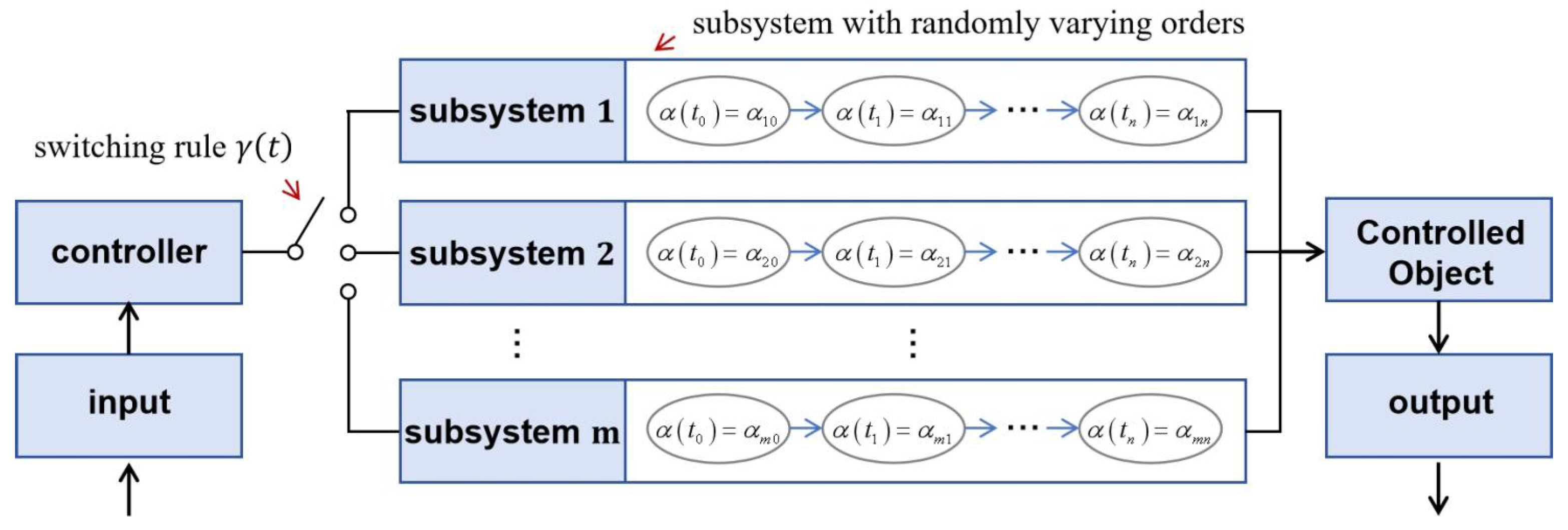
The dual switching system consists of deterministic switching subsystems and stochastic switching subsystems, used to describe a class of hybrid systems with complex switching mechanisms [21,22]. Although dual switching theory has been well established for integer-order systems, its extension to fractional-order systems remains completely missing in the literature. To the best of our knowledge, this work represents the first attempt to introduce the dual switching structure into the fractional-order framework. Fractional-order dual switching system describes a system composed of a series of fractional-order subsystems and a deterministic switching rule. The fractional order of each subsystem is randomly variable. We characterize the random switching of fractional orders as a Markov process. Its framework is illustrated in Figure 1. In the figure, γ ( t ) is the deterministic switching rule used to control the currently activated fractional-order subsystem. α ( t ) is the time-varying order, which is determined by the transition rate of the Markov process.
To illustrate the practical motivation of the proposed dual-switching structure, consider power system frequency control. In this case, different operating conditions (normal mode, emergency mode, and islanded mode) are controlled by a deterministic switching signal γ ( t ) based on event-triggered conditions (such as load changes or fault events). Within each operating mode, the dynamic fractional order of the power system varies randomly due to environmental factors such as temperature fluctuations and stochastic load changes, reflecting frequency-dependent line characteristics and load behavior. This random variation is naturally modeled as a continuous-time Markov chain σ ( t ) , since the future order depends only on current environmental conditions rather than the entire history. This application directly demonstrates the necessity of dual switching: subsystem switching is deterministic and event-driven, whereas the order changes are stochastic and memoryless.
In this paper, we address the asymptotic stability and exponential stability of a novel variable-order Caputo fractional-order dual switching system. Our main contributions are as follows:
  • In fractional-order dual switching systems, the lower integral bound dynamically varies once switching events occur. Under such circumstances, the state evolution of the newly activated subsystem can no longer be initialized from the initial time instant t = 0 , which contradicts the intrinsic long-memory property of fractional-order systems. To resolve this integral initial time shift problem for fractional subsystems, this paper adopts the short-memory principle.
  • Using a stochastic multiple Lyapunov function and probabilistic analysis, we obtain sufficient conditions for the global asymptotic stability almost surely (GAS a.s.) of the proposed VCFO-DSS.
  • Moreover, under an additional power-type bound condition, we prove the global Mittag–Leffler stability almost surely (GMLS a.s.) for the system, which guarantees a Mittag–Leffler decay rate—faster than arbitrary power laws yet slower than exponential—and significantly improves the stability characterization.
The remainder of this paper is organized as follows. Section 2 presents preliminary definitions, useful lemmas, and the short-memory principle. Section 3 elaborates on the system modeling and stability analysis of the VSM-CFODSS. Subsequently, a numerical simulation example is provided in Section 4 to verify the effectiveness of the derived theoretical results. Finally, Section 5 concludes the whole paper.

2. Preliminaries

In this section, we will review the definition and properties of Caputo fractional integrals and derivatives, and introduce the principle of short memory. In this paper, we only consider Caputo fractional derivatives. Then, we show some inequalities that will be used.

2.1. Caputo Fractional Derivative

Definition 1
([23]). Given the non-integer order 0 < α < 1 , the Caputo fractional derivative is defined as
D t α t 0 C f ( t ) = 1 Γ ( 1 α ) t 0 t f ( τ ) ( t τ ) α d τ .
where D t α t 0 C represents the Caputo fractional derivative of order α defined on the interval [ t 0 , t ] . The Euler’s Gamma function is Γ ( s ) = 0 e t t s 1 d t , Re ( s ) > 0 , which satisfies the recursive property Γ ( s + 1 ) = s Γ ( s ) .
Definition 2
([24]). For the deterministic switching signal γ ( t ) with switching instants { t k } k 0 , let N ( t 0 , t ) denote the switching number on interval [ t 0 , t ] . If there exist constants τ a > 0 and N 0 0 such that
N ( t 0 , t ) N 0 + t t 0 τ a ,
then τ a is called the average dwell time.

2.2. Some Inequalities

Lemma 1
([25]). Suppose that α > 0 , T , f ( t ) , g ( t ) : [ t 0 , T ) R + are locally integrable, and h ( t ) : [ t 0 , T ) R + is a bounded, nondecreasing and continuous function with
g ( t ) f ( t ) + h ( t ) t 0 t ( t s ) α 1 g ( s ) d s .
If f ( t ) is nondecreasing, a tighter estimation can be obtained as
g ( t ) f ( t ) E α h ( t ) Γ ( α ) ( t t 0 ) α ,
where E α ( · ) = k = 0 ( · ) k Γ ( α k + 1 ) is the Mittag–Leffler function.
Lemma 2
([26], Corollary 4.2). For any 0 < α < 1 and λ > 0 , the Mittag–Leffler function satisfies
E α ( λ t α ) e β α λ 1 / α t , t 0 ,
where β α = 1 Γ ( 1 + α ) 1 / α .

2.3. Almost Surely Stability Definitions

Definition 3
([27,28]). The system model (9) is said to be globally asymptotically stable almost surely (GAS a.s.), if the following two properties are verified simultaneously:
P sup t t 0 x ( t ) < ε = 1 ,
where ε > 0 , δ ( ε ) > 0 , such that when x 0 < δ ( ε ) .
P sup t T ( r , ε ^ ) x ( t ) < ε ^ = 1 ,
where r , ε ^ > 0 , T ( r , ε ^ ) 0 , such that when x 0 < r .
Definition 4
([29]). The equilibrium x = 0 of the VSM-CFODSS (9) is said to be globally Mittag–Leffler stable almost surely (GMLS a.s.), if there exist constants λ > 0 , α ( 0 , 1 ) and a positive constant C > 0 such that for every initial condition x 0 R n and for almost every sample path ω Ω ,
x ( t ; x 0 ) C x 0 E α λ ( t t 0 ) α , t t 0 .

3. Stability Analysis

In this section, we focus on the stability analysis of the variable-order Caputo fractional-order dual switching system (VSM-CFODSS). First, we introduce the system model considered in this paper.

3.1. Variable-Order Caputo Fractional-Order Dual Switching System Model Based on Short Memory Principle

Based on the short memory principle and the variable-order method, we present a class of variable-order short memory Caputo fractional-order switching system (VSM-CFODSS) as follows:
D t α σ ( t ) β ( t ) C x ( t ) = f γ ( t , σ ( t ) ) ( x ( t ) ) , β ( t ) [ t 0 ,   t ) , k = 0 ,   1 ,   2 ,   , 0 < α σ ( t ) < 1 , x ( t 0 ) = x 0 R n .
where x ( t ) R n is the state vector, x 0 is the initial state, and x k is the state value at the k-th switching instant t k . σ ( t ) : [ t 0 , ) N ¯ = { 1 , 2 , , N } is the Markov stochastic switching signal, which is a right-continuous piecewise constant function. The Markov chain assumption captures memoryless random variations of the fractional order, consistent with the core philosophy of switched systems where the active mode depends only on the current switching signal. The fractional order α σ ( t ) is time-varying and updated once σ ( t ) switches. γ ( t ) : [ t 0 , ) M ¯ = { 1 , 2 , , M } is the deterministic switching signal, which determines the index of the currently activated subsystem. For any t [ t k , t k + 1 ) , let σ ( t ) = i and γ ( t ) = j , which means the system operates with the fractional-order α i and the j-th subsystem f j ( x ( t ) ) is activated. The system functions f j : R n R n are Lipschitz continuous. In addition, the lower bound β ( t ) = t k is determined by the deterministic switching instants and updated synchronously with the switching events.
Remark 1.
Lemma 1 holds for any lower bound on the Caputo derivative. Therefore, the decay estimate depends only on the state at the beginning of the switching interval and the elapsed time, and does not depend on the complete history prior to the lower bound. This property is crucial for the stability analysis of short-memory fractional-order dual switching systems.

3.2. Switching Rule Design

Let { t k } k 0 be the sequence of deterministic switching instants, with t 0 = 0 as the initial time. For a given minimum dwell time τ d > 0 , the deterministic switching signal γ ( t ) is defined as follows:
γ ( t ) = j , if i j , E V j ( x ( t ) ) μ j E V i ( x ( t ) ) and t t k τ d , i , otherwise ,
where i = γ ( t ) denotes the active subsystem just before time t, and j is the other subsystem. When a switch occurs at time t, the switching instant t k + 1 = t is recorded and the timer resets. E [ · ] is the mathematical expectation operator; V i ( · ) and V j ( · ) are the Lyapunov functions corresponding to subsystem i and subsystem j, respectively.
The switching signal γ ( t ) is updated only when both the Lyapunov function expectation condition and the minimum dwell time constraint are satisfied simultaneously, which is a typical characteristic of event-triggered control. Once a switch is activated at time t, we set t k + 1 = t to record the new switching instant and reset the dwell time timer accordingly.
Remark 2.
The above switching rule imposes a strict positive lower bound on the interval between any two successive switches, namely t k + 1 t k τ d , which fundamentally rules out the occurrence of Zeno phenomena, i.e., infinitely many switching actions within a finite time interval. Furthermore, by selecting a sufficiently large value of τ d to satisfy the average dwell time condition τ a > ln μ max λ min , all stability conclusions derived in Theorem 1 and Corollary 1 still hold. Here, τ a is the average dwell time. The detailed definitions of μ max and λ min will be provided in the following stability analysis.

3.3. GAS a.s. of VSM-CFODSS

Theorem 1.
Consider the VSM-CFODSS described by (9). Under the following assumptions:
( H1 ) κ 1 ( x ( t ) ) V i ( x ( t ) ) κ 2 ( x ( t ) ) , x ( t ) R n , i N ¯ ; ( H2 ) D t α s t k C V i ( x ( t ) ) λ i V i ( x ( t ) ) , t [ t k ,   t k + 1 ) , x ( t ) R n , s M ¯ , i N ¯ ; ( H3 ) τ a > ln μ max β α min ( λ min ) 1 / α min ,
where κ 1 , κ 2 K are class K functions, and μ max = max j N ¯ μ j , λ min = min i N ¯ λ i ,   α min = min s M ¯ α s ,   β α min = 1 Γ ( 1 + α min ) 1 / α min , and τ a is the average dwell time of the deterministic switching signal γ ( t ) . Then the system (9) is globally asymptotically stable almost surely (GAS a.s.).
Proof. 
Inside [ t k , t k + 1 ) , let the jump times of σ ( t ) be
t k = t k , 0 < t k , 1 < < t k , L k = t k + 1 ,
and denote by α s the constant fractional order on [ t k , , t k , + 1 ) .
Fix a subinterval [ t k , , t k , + 1 ) where the fractional order is α s . Taking expectation on both sides of Assumption (H2), we interchange the expectation and the Caputo derivative. This is valid by writing the Caputo derivative in its integral form and applying Fubini’s theorem, since V i ( x ( t ) ) is Lipschitz continuous, measurable, absolutely integrable, and the initial condition is bounded [30]. Thus we obtain
D t α s t k C E [ V i ( x ( t ) ) ] λ i E [ V i ( x ( t ) ) ] , t [ t k , ,   t k , + 1 ) .
Applying the fractional comparison lemma (Lemma 1) now includes explicit identification of g ( t ) = E [ V i ( x ( t ) ) ] , f ( t ) = E [ V i ( x ( t k , ) ) ] , and h ( t ) 1 yields
E [ V i ( x ( t ) ) ] E [ V i ( x ( t k , ) ) ] E α s λ i ( t t k , ) α s , t [ t k , ,   t k , + 1 ) .
Applying this inequality recursively from t k to t gives
E [ V i ( x ( t ) ) ] E [ V i ( x ( t k ) ) ] m = 0 1 E α s m λ i ( t k , m + 1 t k , m ) α s m · E α s λ i ( t t k , ) α s .
By the monotonicity of the Mittag–Leffler function for negative arguments [31], E α ( z ) is decreasing in α > 0 for z < 0 . Thus for α s m α min , we have E α s m ( λ i Δ m α s m ) E α min ( λ i Δ m α min ) . Applying this to (14) and then using Lemma 2 (with α = α min ), we obtain
E α min ( λ i Δ α min ) e β α min λ i 1 / α min Δ ,
where β α min = 1 / Γ ( 1 + α min ) 1 / α min and α min = min s M ¯ α s . Applying this bound to each factor in the product yields
E [ V i ( x ( t ) ) ] E [ V i ( x ( t k ) ) ] e ρ i ( t t k ) ,
where ρ i = β α min λ i 1 / α min . At a deterministic switching instant t k , the event-triggered switching rule (10) ensures that for the switching pair i j , we have
E [ V j ( x ( t k ) ) ] μ j E [ V i ( x ( t k ) ) ] μ max E [ V i ( x ( t k ) ) ] .
Define μ max = max j μ j and ρ min = min i ρ i = β α min ( λ min ) 1 / α min . By iterating the decay estimate (16) over each switching interval and multiplying the switching gain μ max at each switching instant, together with the average dwell time condition N ( t 0 , t ) N 0 + ( t t 0 ) / τ a , we obtain
E [ V γ ( t ) ( x ( t ) ) ] E [ V γ ( t 0 ) ( x 0 ) ] μ max N ( t 0 , t ) e ρ min ( t t 0 ) E [ V γ ( t 0 ) ( x 0 ) ] μ max N 0 exp ln μ max τ a ρ min ( t t 0 ) .
By Assumption (H3), τ a > ln μ max / ρ min , so ln μ max τ a ρ min < 0 . Hence,
lim t E [ V γ ( t ) ( x ( t ) ) ] = 0 .
Assumption (H1) gives κ 1 ( x ( t ) ) V γ ( t ) ( x ( t ) ) with κ 1 K . Taking expectations,
E [ κ 1 ( x ( t ) ) ] E [ V γ ( t ) ( x ( t ) ) ] C e ρ min ( t t 0 ) .
We now verify the two conditions in Definition 2. For any ε > 0 , by Markov’s inequality,
P x ( t ) ε E [ κ 1 ( x ( t ) ) ] κ 1 ( ε ) C e ρ min ( t t 0 ) κ 1 ( ε ) .
The exponential decay estimate in (21) implies that for any sequence { t n } with t n , n = 1 P ( x ( t n ) ε ) < . By the Borel–Cantelli lemma, x ( t ) < ε eventually holds almost surely. Path continuity then yields sup t T x ( t ) < ε for some finite T almost surely. Choosing δ ( ε ) > 0 sufficiently small such that the bound in (21) holds uniformly in t gives
P sup t t 0 x ( t ) < ε = 1 .
For any r , ε ^ > 0 , suppose x 0 < r . Then E [ V γ ( t 0 ) ( x 0 ) ] κ 2 ( r ) . From (18),
E [ V γ ( t ) ( x ( t ) ) ] κ 2 ( r ) μ max N 0 e ρ min ( t t 0 ) .
Again by Markov’s inequality,
P x ( t ) ε ^ E [ κ 1 ( x ( t ) ) ] κ 1 ( ε ^ ) κ 2 ( r ) μ max N 0 κ 1 ( ε ^ ) e ρ min ( t t 0 ) .
Choose T ( r , ε ^ ) sufficiently large so that the right-hand side of (24) is less than any given η > 0 . By the Borel–Cantelli lemma, x ( t ) < ε ^ for all sufficiently large t almost surely. Thus,
P sup t T ( r , ε ^ ) x ( t ) < ε ^ = 1 .
Therefore, the system (9) is globally asymptotically stable almost surely (GAS a.s.). □
Remark 3.
As proved by Theorem 1, we noticed that although the short memory principle was introduced and the memory interval was shortened by the deterministic switching signal γ ( t ) , the inherent memory property of Caputo fractional-order systems still existed. Within the deterministic dwell time interval [ t k , t k + 1 ) , for any random jumping instant of fractional-order t k v , the system inherits memory from the initial moment t k , and its state left and right limits are not equal, i.e., x ( t k ) x ( t k + ) . In addition, at any deterministic switching instant t k of the outer switching signal, the system state remains continuous, and the left and right limit values of state are identical, that is x ( t k ) = x ( t k ) = x ( t k + ) .

3.4. Global Mittag–Leffler Stability a.s. of VSM-CFODSS

Corollary 1.
Under the same conditions as in Theorem 1, suppose additionally that there exist constants p 1 , p 2 , q > 0 such that for all i N ¯ ,
p 1 x ( t ) q V i ( x ( t ) ) p 2 x ( t ) q , t t 0 .
Then the VSM-CFODSS (9) is globally Mittag–Leffler stable almost surely (GMLS a.s.).
Proof. 
From Assumption (H2) and the fractional-order comparison lemma, for any deterministic interval [ t k , t k + 1 ) we have
E [ V i ( x ( t ) ) ] E [ V i ( x ( t k ) ) ] E α min λ i ( t t k ) α min , t [ t k ,   t k + 1 ) ,
where α min = min s M ¯ α s and λ min = min i N ¯ λ i . The derivation is identical to that in Theorem 1, with the only difference that the power-type bound p 1 x q V i ( x ) allows us to convert the Lyapunov function decay into a decay of E [ x ( t ) q ] .
Applying the event-triggered switching rule (10) and the average dwell time condition τ a > ln μ max λ min recursively yields
E x ( t ) q C 0 p 1 E α min λ min ( t t 0 ) α min , t t 0 ,
for some constant C 0 > 0 .
To deduce almost-sure convergence from the decay of E [ x ( t ) q ] , we apply Markov’s inequality. For any ε > 0 ,
P x ( t ) ε E [ x ( t ) q ] ε q C 0 p 1 ε q E α min λ min ( t t 0 ) α min .
The right-hand side decays faster than any power law. Hence, for any increasing sequence { t n } with t n , we have n = 1 P ( x ( t n ) ε ) < . By the Borel–Cantelli lemma, x ( t n ) < ε for all sufficiently large n almost surely. Path continuity then implies x ( t ) < ε eventually holds almost surely.
The above moment estimate, combined with the Borel–Cantelli argument, yields the pathwise bound
x ( t ; x 0 ) C x 0 E α min λ min ( t t 0 ) α min , t t 0 , a . s . ,
with C = p 2 p 1 μ max N 0 1 / q (up to a possible enlargement to absorb the initial transient). This exactly matches Definition 4 with α = α min and λ = λ min . Therefore, the system (9) is globally Mittag–Leffler stable almost surely (GMLS a.s.). □
Remark 4.
The global Mittag–Leffler stability almost surely (GMLS a.s.) established in Corollary 1 is strictly stronger than the global asymptotic stability almost surely (GAS a.s.) proved in Theorem 1; i.e., GMLS a.s. ⇒ GAS a.s., while the converse fails without the power-type bound condition (R1).
Remark 5.
Let x ( t ) and x ˜ ( t ) denote the solutions of the original full-memory Caputo system and the short-memory system (9), respectively. Under Assumption (H2), for t [ t k , t k + 1 ) , the truncation error satisfies x ( t ) x ˜ ( t ) C ( t t k ) α min for some constant C > 0 , provided that the active subsystem is stable. Hence, the error decays as the dwell time increases, and the short-memory approximation becomes increasingly accurate over longer sub-interval lengths. For subsystems that are not necessarily stable, the short-memory model is interpreted as a pragmatically motivated approximation, which is standard in fractional-order system simulation and control applications [26,32]. Consequently, the stability results established in Theorem 1 and Corollary 1 are rigorously derived for the short-memory system (9), while the above error bound ensures that the approximation error relative to the full-memory system remains controlled under the stated conditions.

4. Simulation Examples

4.1. On the Choice of Memory Length

The short-memory principle approximates the full Caputo derivative D t α t 0 x ( t ) by a moving-window integral D t α t L x ( t ) , where L is the memory length [32]. In our VSM-CFODSS (9), the lower bound is set to β ( t ) = t k for t [ t k , t k + 1 ) , i.e., the memory length is L = t t k . This choice is motivated by two considerations. Accuracy. The truncation error caused by resetting the lower bound from t 0 to t k is bounded by O ( ( t t k ) α ) for stable subsystems [26]. As the dwell time increases, this error decays, and the short-memory approximation becomes increasingly accurate.
Computational complexity. Without the short-memory principle, the numerical evaluation of the Caputo derivative at time t requires integrating over the entire interval [ t 0 , t ] , leading to a computational cost of O ( ( t t 0 ) 2 ) per time step, which grows unbounded as t increases. By resetting the memory to t k , the cost per step is reduced to O ( ( t t k ) 2 ) O ( τ d 2 ) , where τ d is the maximum dwell time. This makes long-time simulation feasible.
Trade-off. Our choice L = t t k retains all history since the last deterministic switch, which is most relevant for the currently active subsystem, while discarding the more distant past whose influence decays over time. This balances model fidelity and computational tractability. All simulations presented below are conducted under this short-memory approximation.

4.2. Numerical Simulation

Consider the VSM-CFODSS defined in (9) with N = 2 and M = 2 . The state vector is x ( t ) = [ x 1 ( t ) , x 2 ( t ) ] T R 2 , and the initial condition is set to x 0 = [ 2 , 1 ] T . The subsystem functions are defined as
f 1 ( x ) = 0.2 x 1 + 0.5 x 2 0.2 x 1 1.0 x 2 , f 2 ( x ) = 1.0 x 1 + 0.2 x 2 0.1 x 1 0.8 x 2 .
The deterministic switching signal γ ( t ) is generated by the event-triggered rule (10) with the multiple Lyapunov functions
V 1 ( x ) = 0.5 x 1 2 + x 2 2 , V 2 ( x ) = x 1 2 + 0.5 x 2 2 ,
which satisfy Assumptions (H1) and (H2) with λ 1 = 2.5 and λ 2 = 2 . The jump bounds satisfy μ 1 = μ 2 = 2 , yielding μ max = 2 and λ min = 2 . The average dwell time condition is satisfied with τ a > ln 2 / 2 = 0.3466 .
The stochastic switching signal σ ( t ) , which determines the fractional order, depends on the currently active subsystem. When γ ( t ) = 1 , σ ( t ) evolves as a continuous-time Markov chain on the state space { 1 , 2 } , corresponding to fractional orders α 1 = 0.8 and α 2 = 0.5 . When γ ( t ) = 2 , σ ( t ) evolves as another Markov chain on the state space { 3 , 4 } , corresponding to α 3 = 0.6 and α 4 = 0.7 . The two Markov chains are governed by the following transition rate matrices:
Λ 1 = 2 2 1 1 , Λ 2 = 3 3 1 1 .
The power-type bound condition (R1) holds with q = 2 , p 1 = 1 , and p 2 = 1 .
To investigate the influence of the Markov switching rate on system stability, two cases are examined and compared.

4.2.1. Comparison of Fast and Slow Markov Switching Rates

The fast switching case uses the original transition rate matrices Λ 1 and Λ 2 defined above, which produce frequent jumps of the fractional order σ ( t ) .
The slow switching case uses reduced transition rate matrices to generate less frequent changes of the fractional order:
Λ 1 slow = 0.5 0.5 0.25 0.25 , Λ 2 slow = 0.5 0.5 0.25 0.25 .
All other system parameters, including the subsystem dynamics f 1 , f 2 , the deterministic switching rule γ ( t ) , the Lyapunov functions V 1 , V 2 , and the initial condition x 0 , remain identical between the two cases.
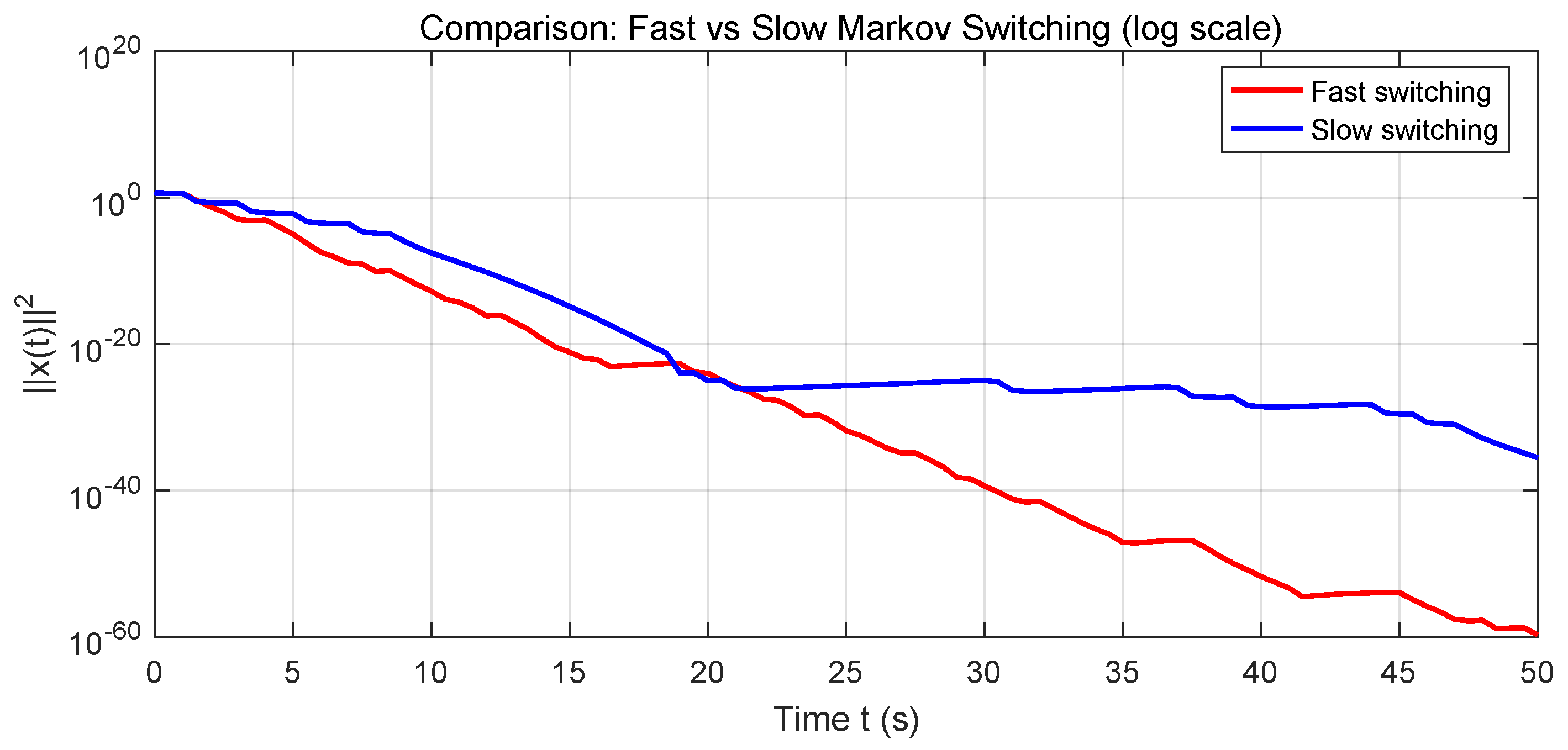
Figure 2 shows the squared state norm x ( t ) 2 on a logarithmic scale for the fast and slow Markov switching cases. The red curve, corresponding to fast switching, decays more rapidly than the blue curve, which corresponds to slow switching. Both curves converge to zero, confirming that the system remains stable under both switching rates. This result demonstrates that a higher Markov switching rate improves convergence performance while preserving stability.
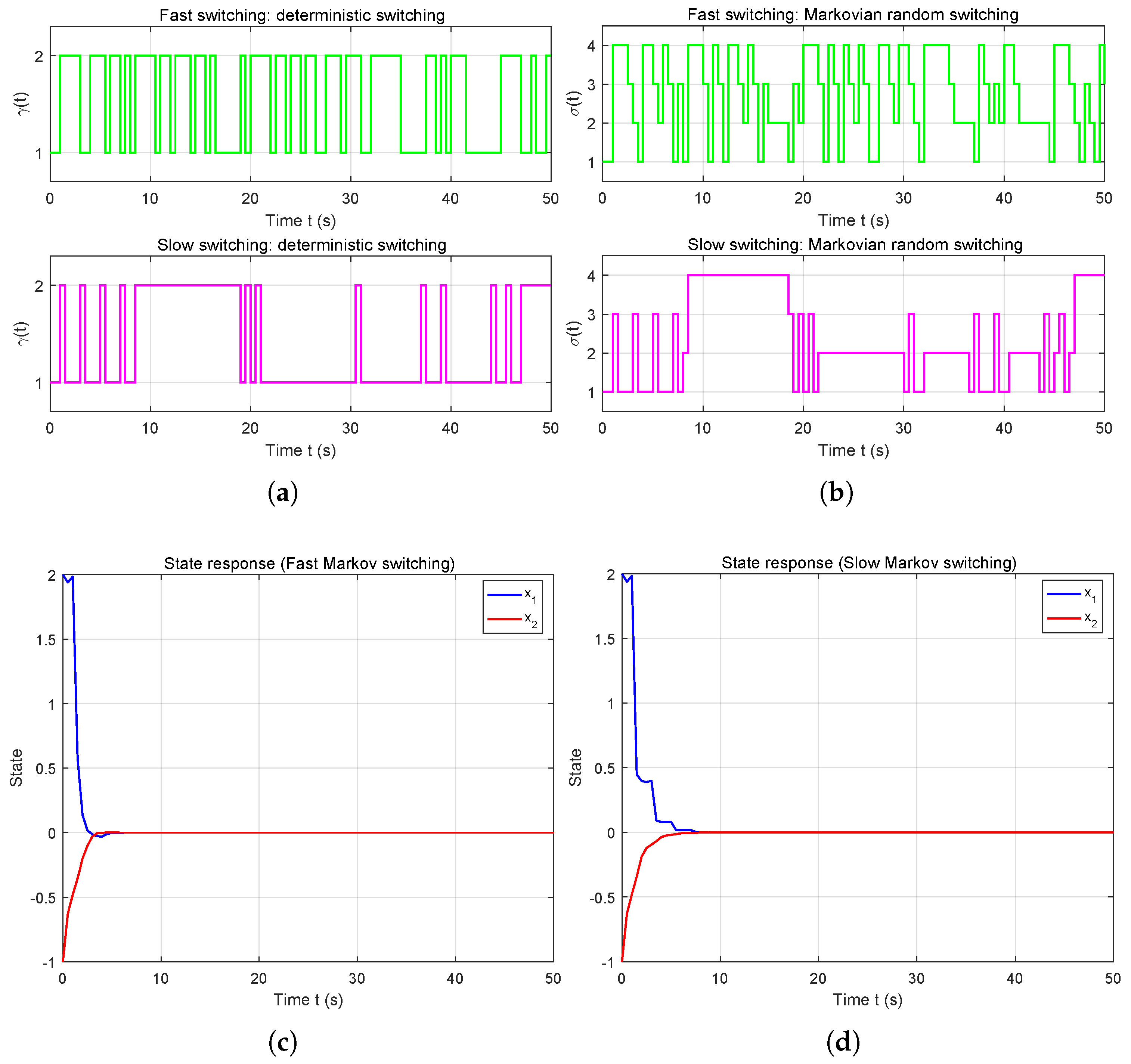
Figure 3 presents the simulation results for both switching rate cases. Panel (a) displays the deterministic switching signal γ ( t ) . The switching frequency remains high in both cases, indicating that the event-triggered mechanism operates effectively irrespective of the Markov switching rate. Panel (b) shows sample paths of the Markov chain σ ( t ) . In the fast switching case, σ ( t ) jumps frequently among the four fractional orders, whereas in the slow switching case, it stays in each mode for substantially longer durations. Panel (c) plots the state responses x 1 ( t ) and x 2 ( t ) under fast switching, and panel (d) shows the state responses under slow switching. Both cases achieve asymptotic stability. The fast switching case exhibits larger fluctuations but converges faster than the slow switching case, which is consistent with the analysis in Figure 2. The trajectories in both cases converge to zero, confirming the theoretical results.

4.2.2. Sensitivity Analysis on Average Dwell Time

To further quantify the effect of average dwell time (ADT) on system stochastic convergence performance, Monte Carlo sensitivity simulations are carried out with 100 independent runs for three typical ADT values τ a = 0.5 , 1.0 , 2.0 . The corresponding statistical results are presented in Table 1.
As illustrated in Table 1, the average convergence time increases monotonically with the growth of τ a . The fastest state decay is obtained at τ a = 0.5 with an average convergence time of 2.97 s , while the convergence process becomes slower as τ a increases, reaching 5.11 s for τ a = 2.0 . Meanwhile, the number of switching events decreases significantly with increasing ADT values, indicating a reduced switching frequency for larger τ a .
Such a performance difference originates from the distinct stability characteristics of individual subsystems. Specifically, Subsystem 2 possesses stable dynamics and facilitates state convergence, whereas Subsystem 1 exhibits unstable behavior that deteriorates the transient performance. A smaller ADT allows more frequent activation of the stable subsystem, thus accelerating the global state decay. In contrast, a larger ADT prolongs the operating duration of the unstable subsystem, which inevitably slows down the overall convergence rate. Notably, all tested ADT cases guarantee system stability, which numerically verifies the feasibility and sufficiency of the theoretical ADT constraint in Condition (H3). The observed data fluctuation reflected by standard deviations is consistent with the inherent stochasticity of Markov switching mechanisms.
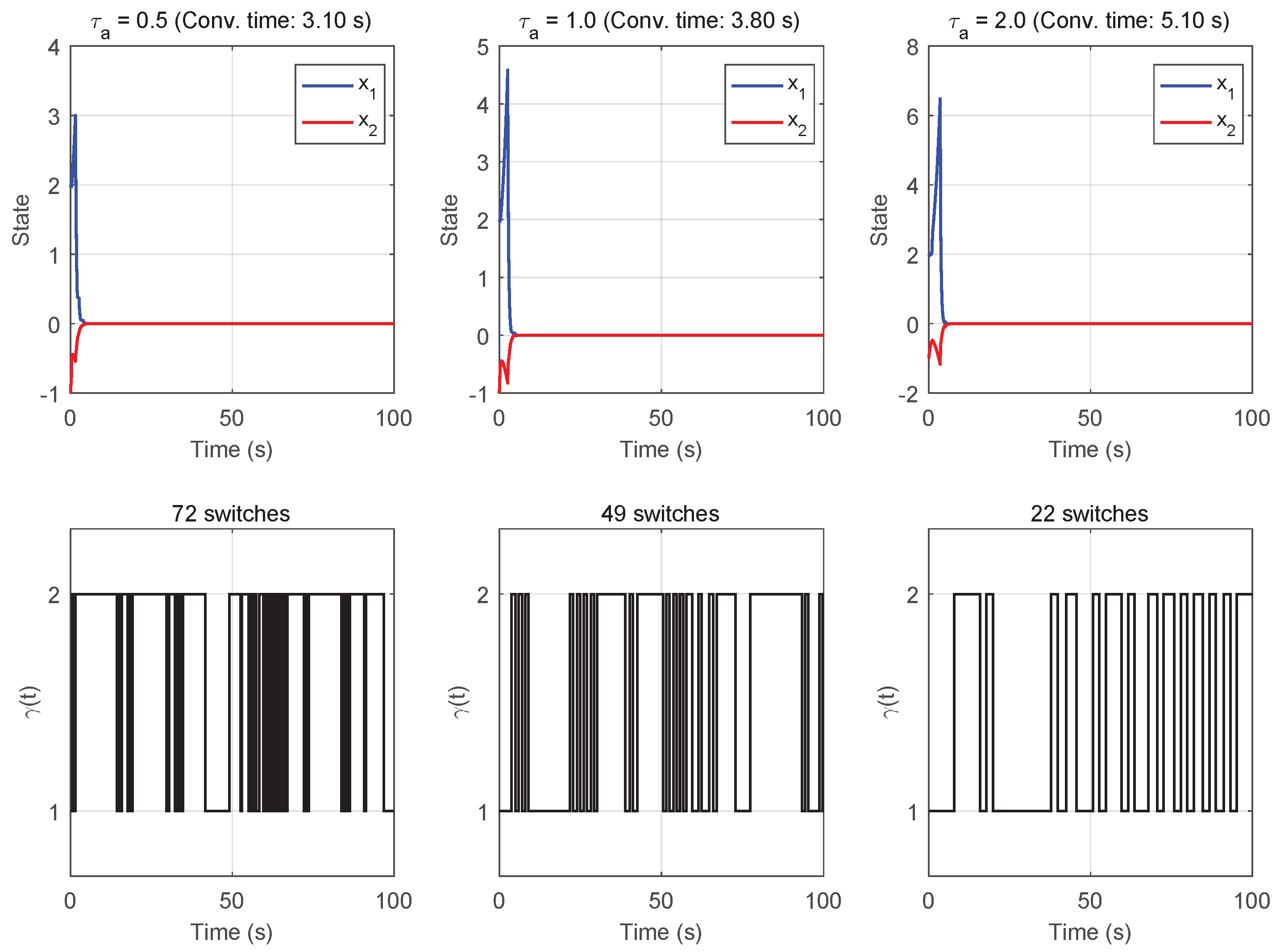
Figure 4 depicts the representative state trajectories and switching sequences under different ADT parameters. It can be clearly observed that smaller τ a corresponds to more frequent switching behavior and faster state convergence, while larger τ a leads to sparse switching and relatively conservative convergence performance. The above numerical results demonstrate that the average dwell time can effectively regulate the system transient behavior while maintaining the almost-sure stability, which further validates the correctness and practicability of the established theoretical criteria.

5. Conclusions

This paper studies the stability of variable-order short-memory Caputo fractional-order dual switching systems (VSM-CFODSS). The short-memory principle is employed to handle the dynamic lower bound caused by switching events, and a quantitative error analysis is provided to justify the approximation. Using stochastic multiple Lyapunov functions, the fractional comparison lemma, and the average dwell time technique, we derive sufficient conditions for global asymptotic stability almost surely (GAS a.s.) and global Mittag–Leffler stability almost surely (GMLS a.s.). The proposed event-triggered deterministic switching rule, combined with subsystem-dependent Markov chains governing the fractional-order variations, effectively captures the dual-timescale switching dynamics and avoids Zeno behaviour through a minimum dwell-time constraint.
Numerical simulations, including a Monte Carlo sensitivity analysis with respect to the average dwell time, verify the theoretical results. They show that the system converges under different switching rates and ADT values. The statistical results confirm that all tested ADT values ensure stability, which is consistent with condition (H3), and illustrate the trade-off between switching frequency and convergence speed.
Future work will extend the proposed framework to discrete-time settings, generalize the stability results to broader classes of stochastic processes, and investigate the application of the proposed methods to practical engineering problems such as power electronics and networked control systems.

Author Contributions

Conceptualization, Q.M. and F.L.; methodology, Q.M. and B.L.; software, Q.M.; validation, Q.M., B.L. and F.L.; formal analysis, Q.M. and B.L.; writing—original draft preparation, Q.M.; writing—review and editing, B.L. and F.L.; visualization, Q.M.; supervision, F.L.; funding acquisition, F.L. and Q.M. All authors have read and agreed to the published version of the manuscript.

Funding

This research was funded by the National Natural Science Foundation of China, grant numbers 61813006 and 61973329; the Guizhou Provincial Science and Technology Foundation, grant number QN[2025]438; and the Doctoral Program of Guizhou Education University, grant number 2025GCC014.

Data Availability Statement

The original contributions presented in this study are included in the article. Further inquiries can be directed to the corresponding author.

Acknowledgments

During the preparation of this manuscript, the authors did not use any generative AI tools for text, data, or graphic generation. The authors take full responsibility for the content of this publication.

Conflicts of Interest

Bin Li is employed by China Tower Corporation Guizhou Branch, Guiyang, China. The remaining authors declare that the research is conducted in the absence of any commercial or financial relationships that could be construed as a potential conflict of interest.

References

  1. Liu, H.; He, L.; Cheng, B. A Powerless Fractional-Order WPT System with Extended Zero Voltage Switching Region. IEEE Trans. Ind. Electron. 2025, 72, 3525–3533. [Google Scholar] [CrossRef]
  2. Ma, C.; Zhu, X.; He, H. Fractional-Order Modeling and Analysis of Boost ZVS Quasi-Resonant Converter. In Proceedings of the 2025 IEEE 16th International Symposium on Power Electronics for Distributed Generation Systems (PEDG), Nanjing, China, 22–25 June 2025. [Google Scholar]
  3. Sui, S.; Tong, S. FTC Design for Switched Fractional-Order Nonlinear Systems: An Application in a Permanent Magnet Synchronous Motor System. IEEE Trans. Cybern. 2023, 53, 2506–2515. [Google Scholar] [CrossRef] [PubMed]
  4. Zhang, C.; Yang, H.; Jiang, B. Fault Estimation and Accommodation of Fractional-Order Nonlinear, Switched, and Interconnected Systems. IEEE Trans. Cybern. 2022, 52, 1443–1453. [Google Scholar] [CrossRef] [PubMed]
  5. Hou, J.; Xi, R.; Liu, P.; Liu, T. The switching fractional order chaotic system and its application to image encryption. IEEE/CAA J. Autom. Sin. 2017, 4, 381–388. [Google Scholar] [CrossRef]
  6. Liao, Q.; Luo, D. Exponential stability of fractional order impulsive switched system with stable and unstable subsystems. Commun. Nonlinear Sci. Numer. Simul. 2025, 149, 108940. [Google Scholar] [CrossRef]
  7. Zhang, J.; Nie, X. Exponential stability of fractional-order uncertain systems with asynchronous switching and impulses. Int. J. Robust Nonlinear Control 2024, 34, 7285–7313. [Google Scholar] [CrossRef]
  8. He, D.; Xu, L. Exponential stability of impulsive fractional switched systems with time delays. IEEE Trans. Circuits Syst. II Express Briefs 2021, 68, 1972–1976. [Google Scholar] [CrossRef]
  9. Yan, J.; Hu, B.; Guan, Z.H.; Li, T.; Zhang, D.X. On controllability and observability of a class of fractional-order switched systems with impulse. Nonlinear Anal. Hybrid Syst. 2023, 50, 101378. [Google Scholar] [CrossRef]
  10. Yan, J.; Hu, B.; Guan, Z.H.; Zhang, D.X. On controllability of fractional-order impulsive and switching systems with time delay. Appl. Math. Comput. 2025, 497, 129357. [Google Scholar] [CrossRef]
  11. Feng, Z.; Li, S.; Zou, W.; Xiang, Z. Sampled-Data Stabilization for a Class of Fractional-Order Switched Nonlinear Systems. IEEE Trans. Syst. Man Cybern. Syst. 2024, 54, 2603–2612. [Google Scholar] [CrossRef]
  12. Benbouhenni, H.; Yessef, M.; Bizon, N.; Kadi, S.; Bossoufi, B.; Alhejji, A. Hardware-in-the-loop simulation to validate the fractional-order neuro-fuzzy power control of variable-speed dual-rotor wind turbine systems. Energy Rep. 2024, 11, 4904–4923. [Google Scholar] [CrossRef]
  13. Almheidat, M.; Alqudah, M.; Israr, M.; Ayub, A. A physics-guided deep neural network approach for simulating variable-order fractional chaotic financial models. Digit. Signal Process. 2026, 168, 105621. [Google Scholar] [CrossRef]
  14. Mozyrska, A.D.; Wyrwas, M.; Oziablo, P. Digital PID controllers with fractional variable order techniques and two discrete-time operator variants. Bull. Pol. Acad. Sci. Tech. Sci. 2025, 73, e153831. [Google Scholar]
  15. Peng, X.; Wang, Y.J.; Zuo, Z.Q. Co-design of state-dependent switching law and control scheme for variable-order fractional nonlinear switched systems. Appl. Math. Comput. 2022, 415, 126725. [Google Scholar] [CrossRef]
  16. O’Regan, D.; Agarwal, R.P.; Hristova, S.; Abbas, M.I. Existence and Stability Results for Differential Equations with a Variable-Order Generalized Proportional Caputo Fractional Derivative. Mathematics 2024, 12, 233. [Google Scholar] [CrossRef]
  17. Hamadneh, T.; Hioual, A.; Alsayyed, O.; Al-Khassawneh, Y.A.; Al-Husban, A.; Ouannas, A. Finite Time Stability Results for Neural Networks Described by Variable-Order Fractional Difference Equations. Fractal Fract. 2023, 7, 616. [Google Scholar] [CrossRef]
  18. Benkerrouche, A.; Guedim, S.; Nisar, K.S.; Amara, A.; Souid, M.S.; Günerhan, H. Fractional differential equations of non-autonomous variable-order. J. Comput. Appl. Math. 2026, 478, 117235. [Google Scholar] [CrossRef]
  19. Attia, N.; Akgül, A.; Seba, D.; Nour, A.; De la Sen, M.; Bayram, M. An Efficient Approach for Solving Differential Equations in the Frame of a New Fractional Derivative Operator. Symmetry 2023, 15, 144. [Google Scholar] [CrossRef]
  20. Al Salman, H.J.; Awadalla, M.; Subramanian, M.; Abuasbeh, K. On a System of Coupled Langevin Equations in the Frame of Generalized Liouville–Caputo Fractional Derivatives. Symmetry 2023, 15, 204. [Google Scholar] [CrossRef]
  21. Long, F.; Liu, C.; Ou, W. Almost sure stability for a class of dual switching linear discrete-time systems. Concurr. Comput. Pract. Exp. 2021, 33, e5666. [Google Scholar]
  22. Mu, Q.; Long, F.; Wang, Q. Asymptotic stability of fractional order switching nonlinear system based on short memory principle. Asian J. Control 2025, 27, 1993–2001. [Google Scholar] [CrossRef]
  23. Kilbas, A.A.; Marzan, S.A. Nonlinear differential equations with the Caputo fractional derivative in the space of continuously differentiable functions. Differ. Equ. 2005, 41, 84–89. [Google Scholar] [CrossRef]
  24. Hespanha, J.P.; Morse, A.S. Stability of switched systems with average dwell-time. In Proceedings of the 38th IEEE Conference on Decision and Control, Phoenix, AZ, USA, 7–10 December 1999; Volume 3, pp. 2655–2660. [Google Scholar]
  25. Jiao, T.; Zong, G.; Zhu, Q.; Wang, L.; Sun, H. Stability analysis of random fractional-order nonlinear systems and its application. Commun. Nonlinear Sci. Numer. Simul. 2025, 140, 108342. [Google Scholar] [CrossRef]
  26. Deng, W. Short memory principle and a predictor–corrector approach for fractional differential equations. J. Comput. Appl. Math. 2007, 206, 174–188. [Google Scholar] [CrossRef]
  27. Wu, C.; Liu, X. Updating tk−1 is significant to Caputo fractional order switching systems: A reply to Hu’s comments. Nonlinear Anal. Hybrid Syst. 2022, 44, 101123. [Google Scholar] [CrossRef]
  28. Norris, J.R. Markov Chains; Cambridge University Press: New York, NY, USA, 2009. [Google Scholar]
  29. Li, Y.; Chen, Y.; Podlubny, I. Mittag–Leffler stability of fractional order nonlinear dynamic systems. Automatica 2009, 45, 1965–1969. [Google Scholar] [CrossRef]
  30. Mao, X. Stochastic Differential Equations and Applications, 2nd ed.; Horwood Publishing: Chichester, UK, 2007; p. 422. [Google Scholar]
  31. Ashurov, R.R.; Sulaymonov, I.A. Monotonicity in the Parameter of the Mittag-Leffler Function and Determining the Fractional Exponent of the Subdiffusion Equation. Lobachevskii J. Math. 2025, 46, 6411–6424. [Google Scholar] [CrossRef]
  32. Podlubny, I. Fractional Differential Equations: An Introduction to Fractional Derivatives, Fractional Differential Equations, to Methods of Their Solution and Some of Their Applications; Mathematics in Science and Engineering; Academic Press: Cambridge, MA, USA, 1999; Volume 198. [Google Scholar]
Figure 1. The framework of fractional-order dual switching systems with variable order.
Fractalfract 10 00461 g001
Figure 2. Comparison of the squared state norm x ( t ) 2 under fast and slow Markov switching rates on a logarithmic scale.
Fractalfract 10 00461 g002
Figure 3. Simulation results of the VSM-CFODSS with different Markov switching rates: (a) deterministic switching signal γ ( t ) ; (b) Markovian random switching signal σ ( t ) ; (c) state response under fast switching; (d) state response under slow switching.
Fractalfract 10 00461 g003
Figure 4. Typical state trajectories and switching signals under different average dwell times. For each τ a , the simulation trajectory closest to the mean convergence time is selected. (Top): state responses x 1 ( t ) and x 2 ( t ) . (Bottom): the corresponding switching signal γ ( t ) .
Fractalfract 10 00461 g004
Table 1. Statistical performance under different average dwell times (mean ± standard deviation over 100 Monte Carlo runs).
τ a Number of SwitchesConvergence Time (s)
0.5 84.5 ± 15.8 2.97 ± 2.59
1.0 45.3 ± 7.2 3.81 ± 3.64
2.0 24.8 ± 4.4 5.11 ± 3.50
Results are reported as mean ± standard deviation over 100 independent Monte Carlo trials.
Disclaimer/Publisher’s Note: The statements, opinions and data contained in all publications are solely those of the individual author(s) and contributor(s) and not of MDPI and/or the editor(s). MDPI and/or the editor(s) disclaim responsibility for any injury to people or property resulting from any ideas, methods, instructions or products referred to in the content.