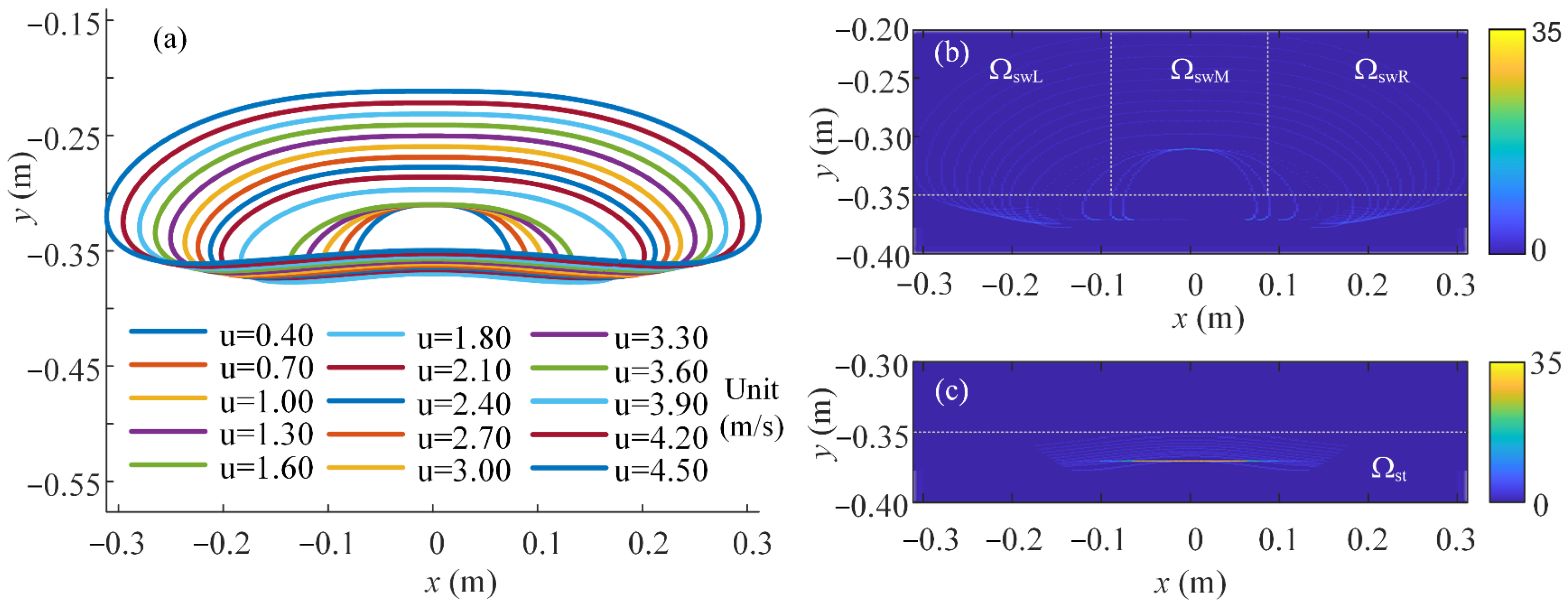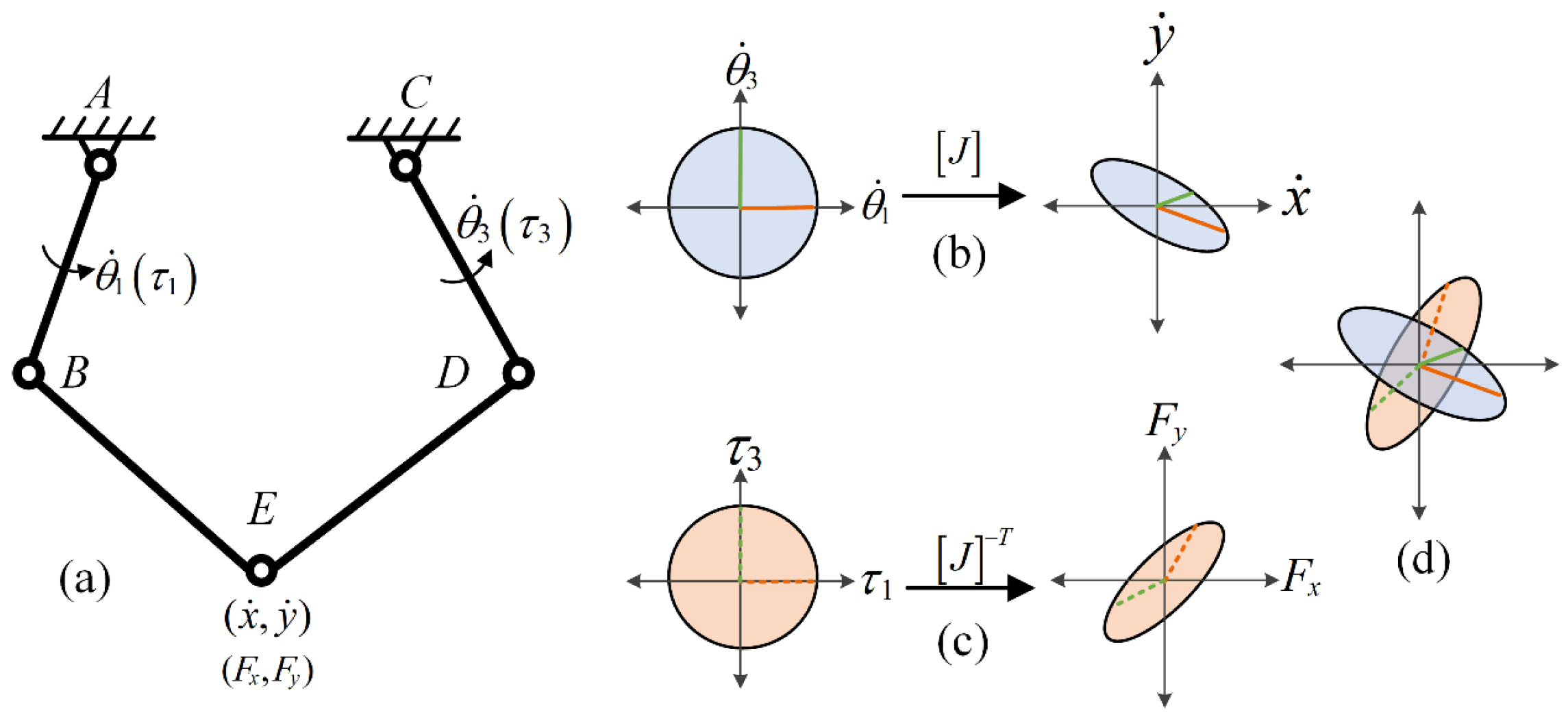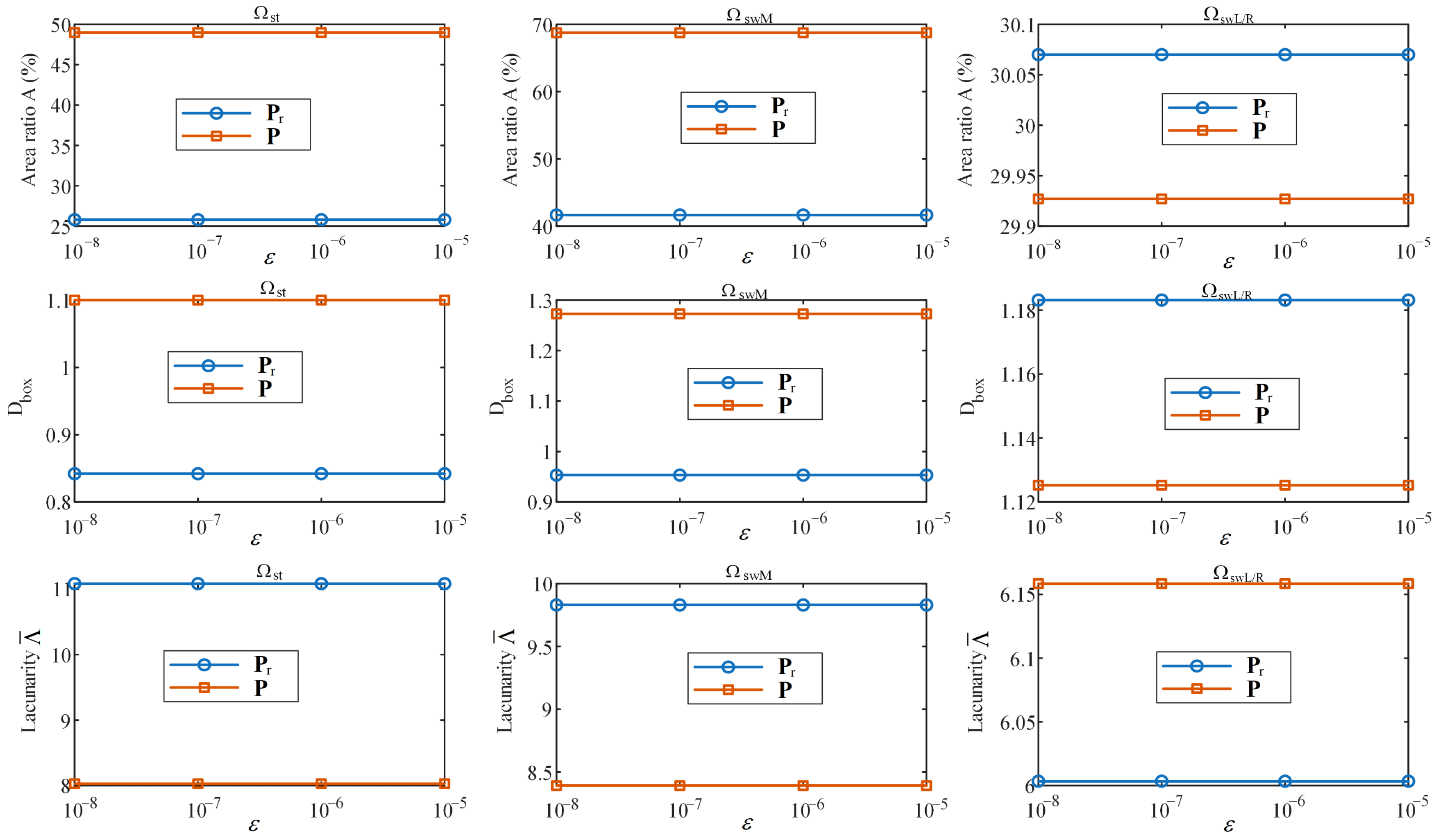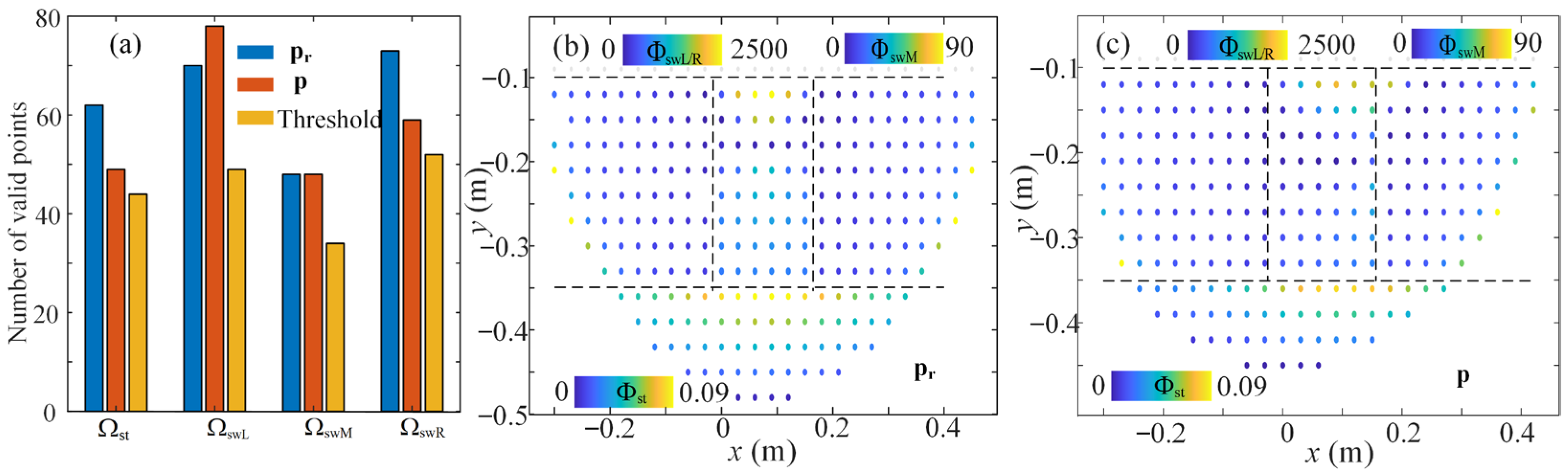

Optimization and Experimental Evaluation of a Legged Robot Mechanism Based on Task Space Partitioning

Abstract
1. Introduction
1.1. Research Background and Motivation
1.2. Literature Review
2. Task Space Formulation and Partitioning
3. Kinematics and Jacobian Mechanism
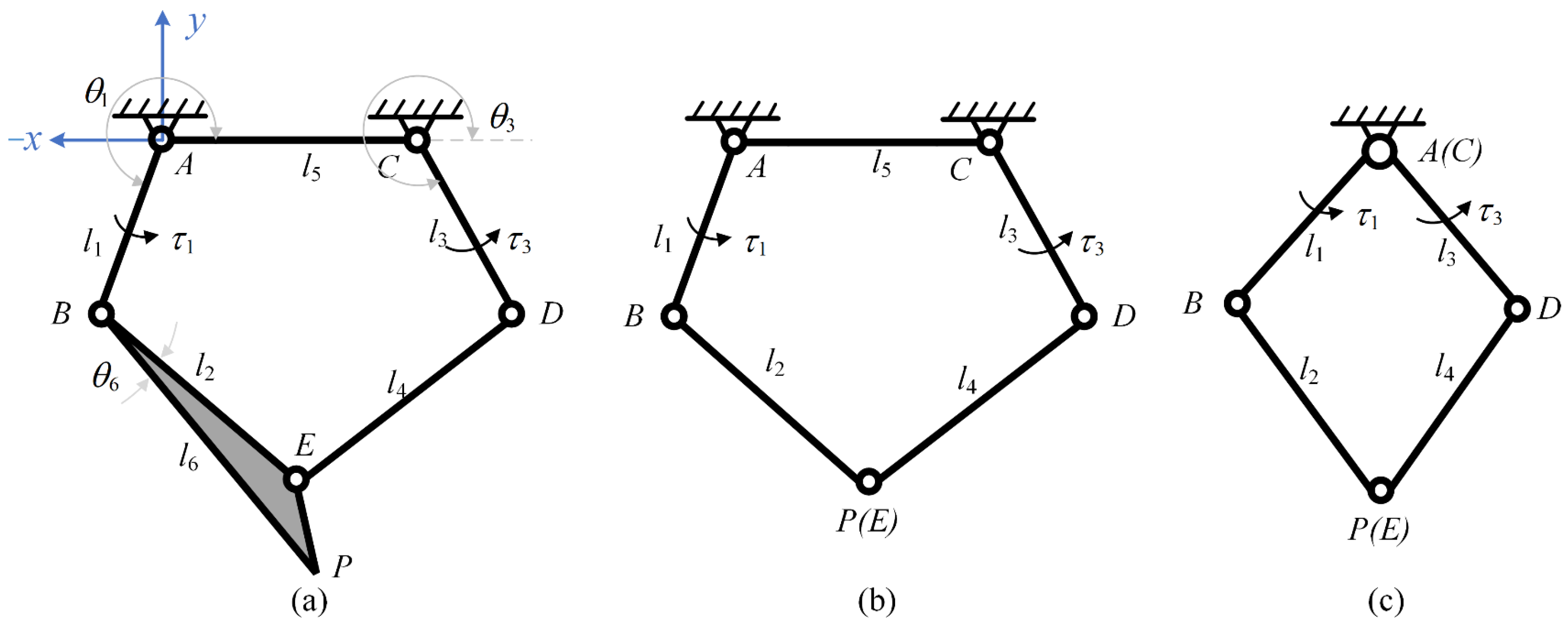
3.1. Kinematic Modeling of a Planar Five-Bar Mechanism
3.2. Velocity Ellipses and Manipulability of the Mechanism
4. Kinematic Indices and Parameter Optimization of the Mechanism
4.1. Task Space Sampling and Screening of Valid Operating Points
4.2. Construction of Partitioned Kinematic Indices
4.3. Index Normalization and Parameter Optimization Model
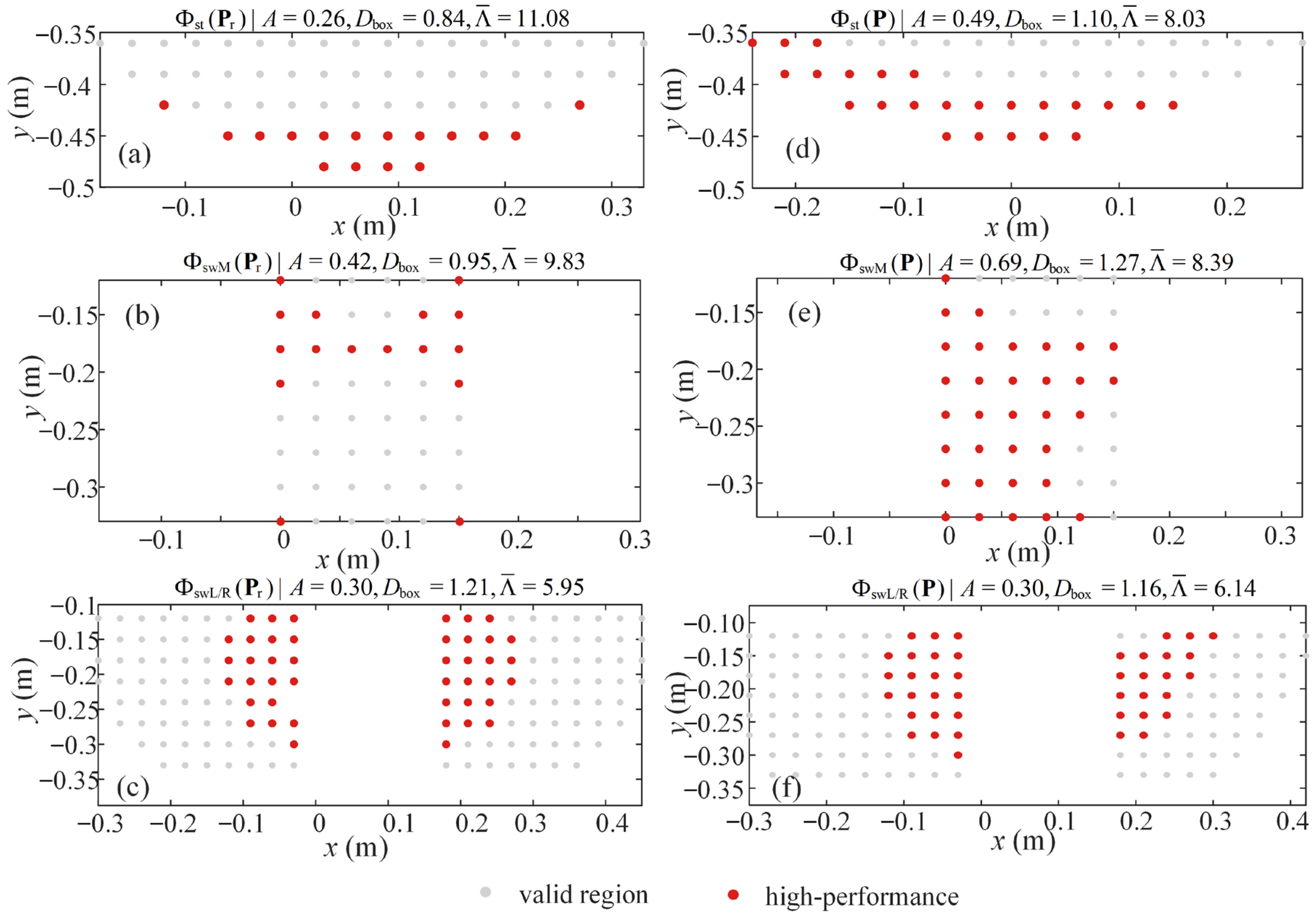
4.4. Transmission Performance Field and Spatial Distribution Evaluation of High-Performance Regions
4.5. Parameter Sensitivity and Final Optimization Results
4.5.1. Sensitivity to Objective Function Weights
4.5.2. Sensitivity Analysis of Task Space Partition Boundaries
4.5.3. Sensitivity Analysis of the Regularization Parameter
4.5.4. Analysis of Optimization Results
5. Experimental Validation
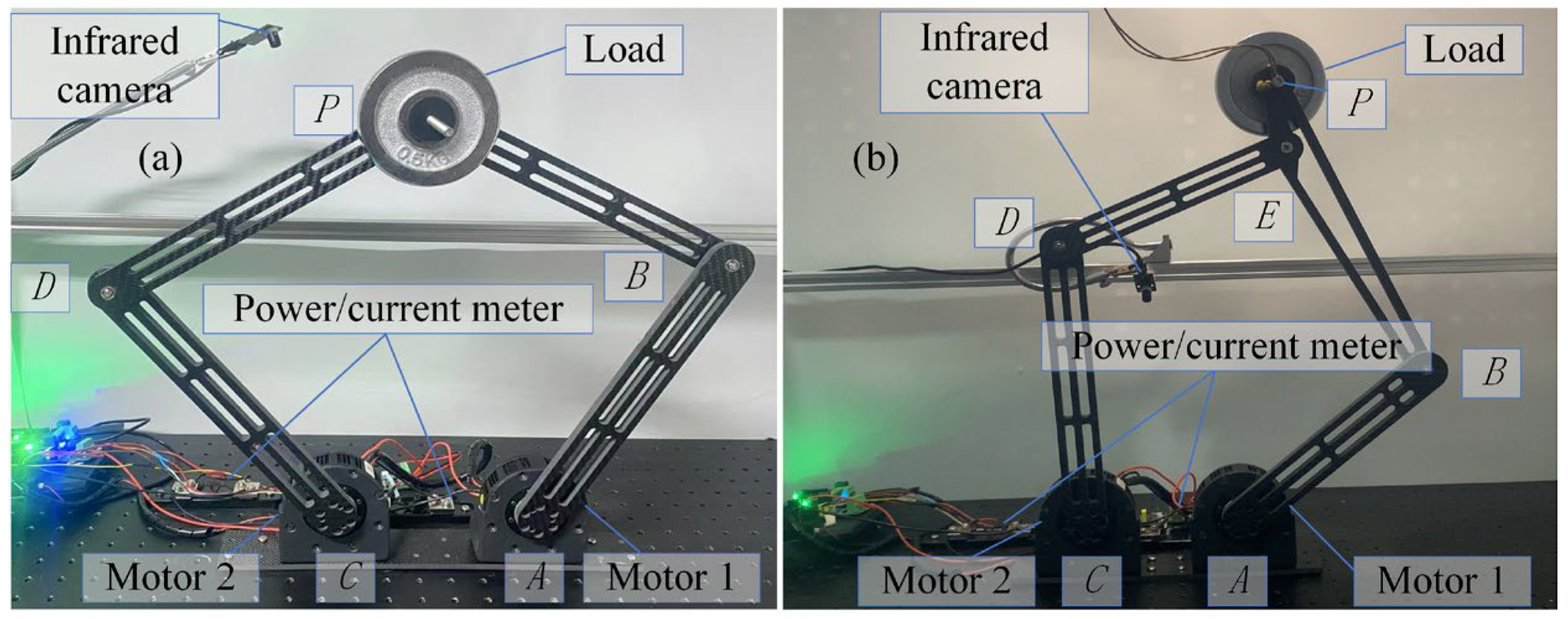
5.1. Experimental Setup and Test Methods
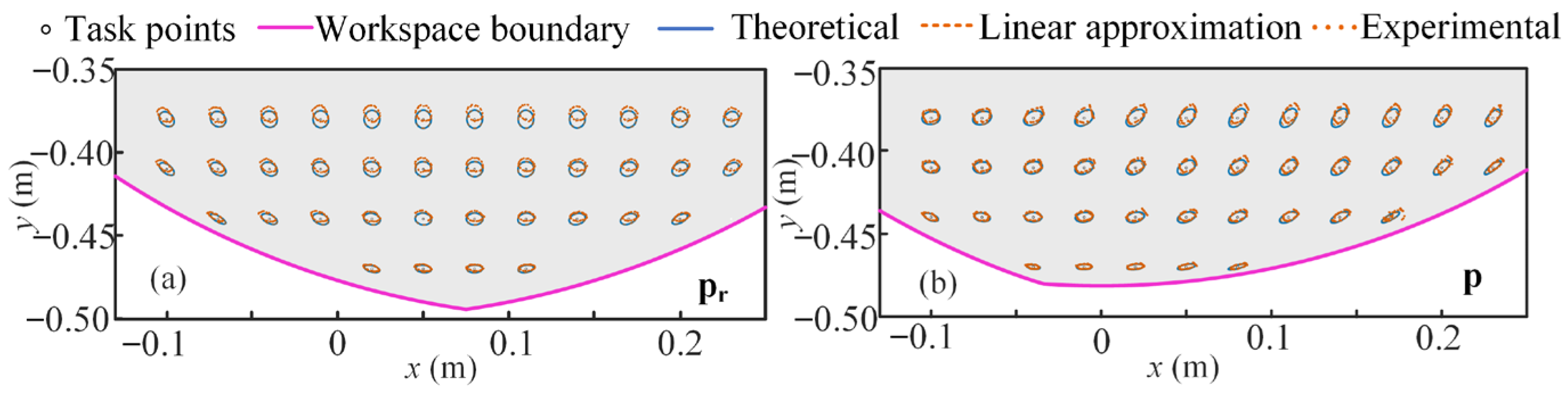
5.2. Validation of Velocity Ellipse Characteristics
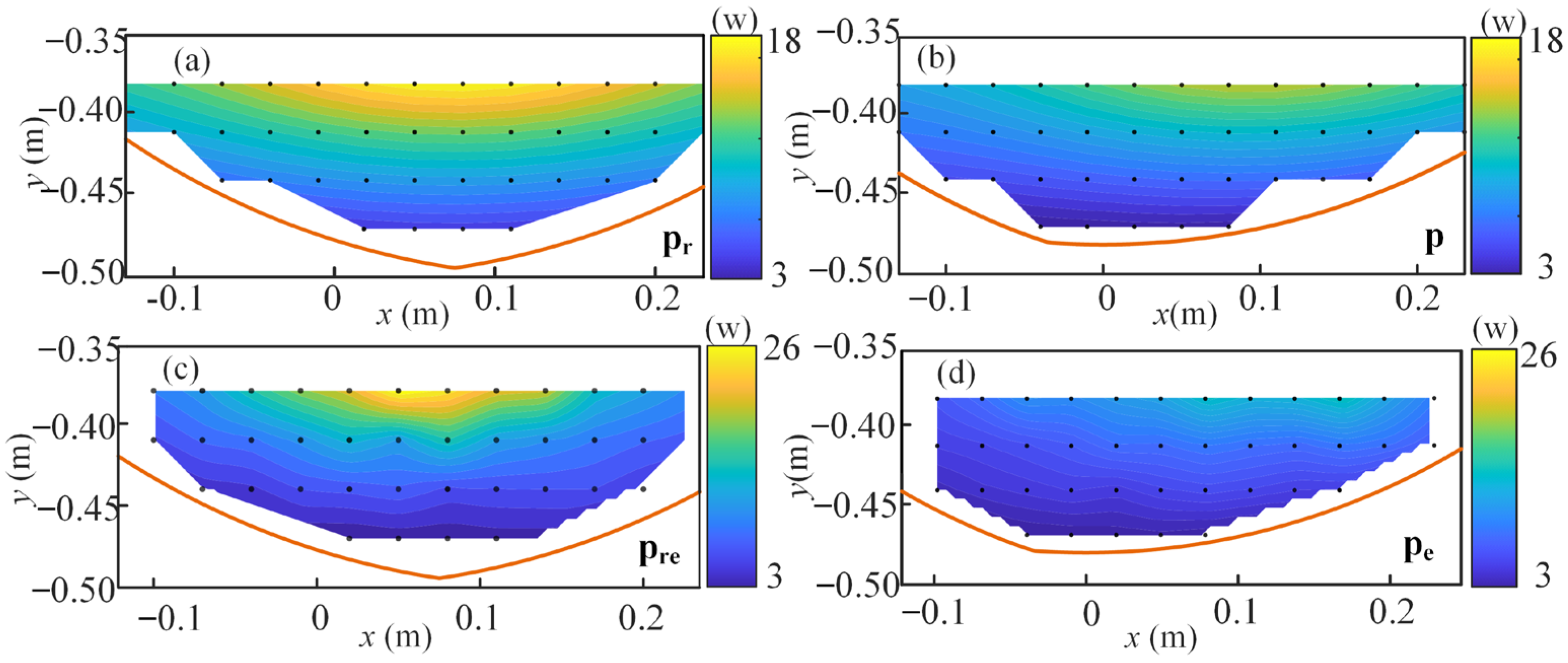
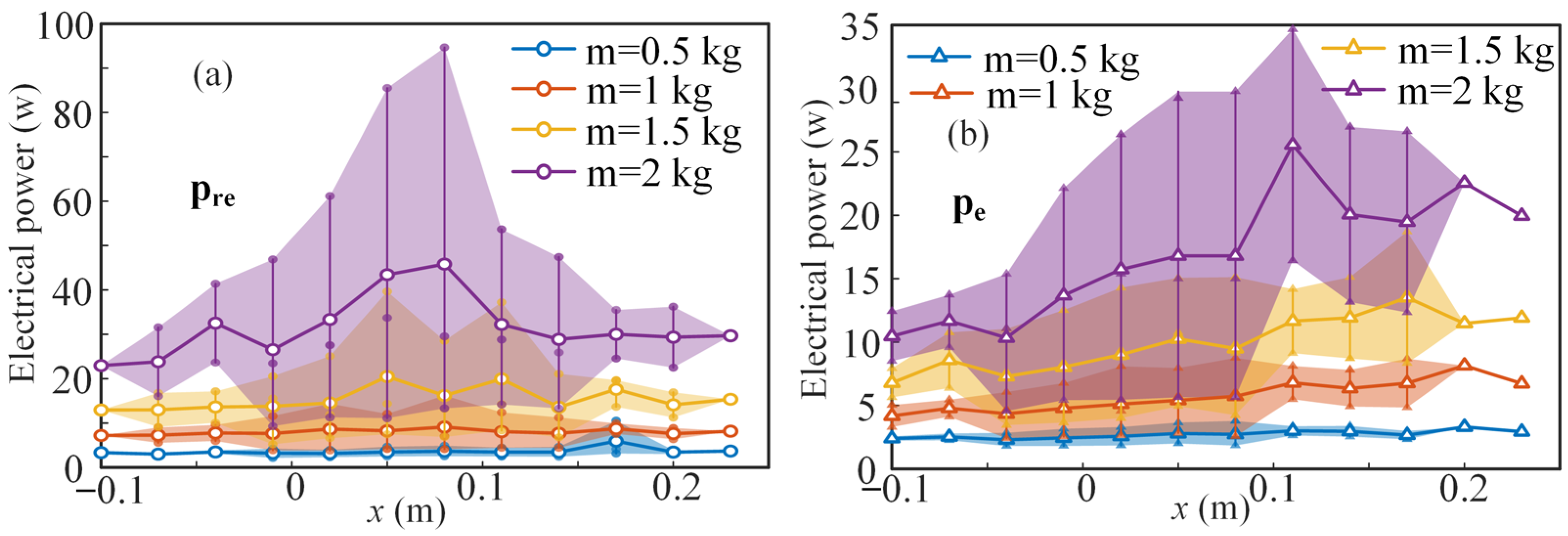
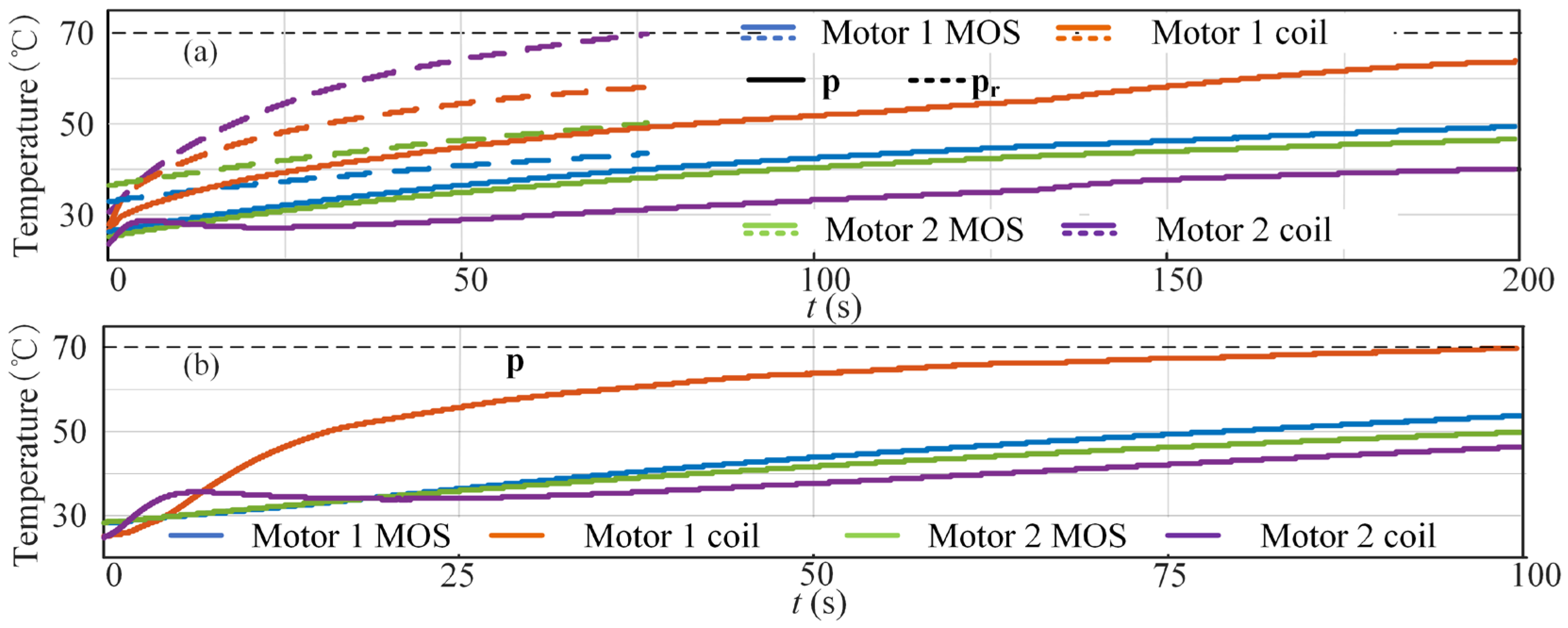
5.3. Static Power Consumption Experiment
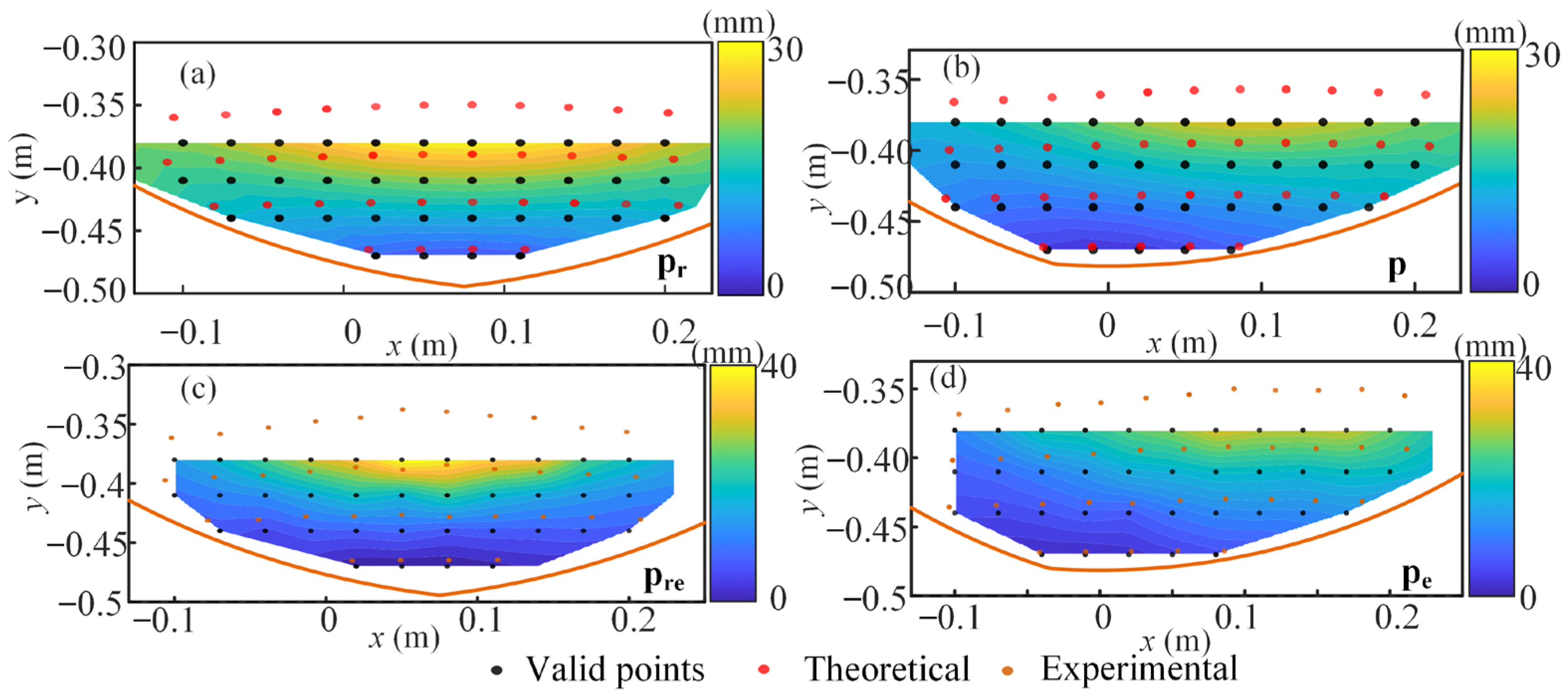
5.4. Limit Load Capacity
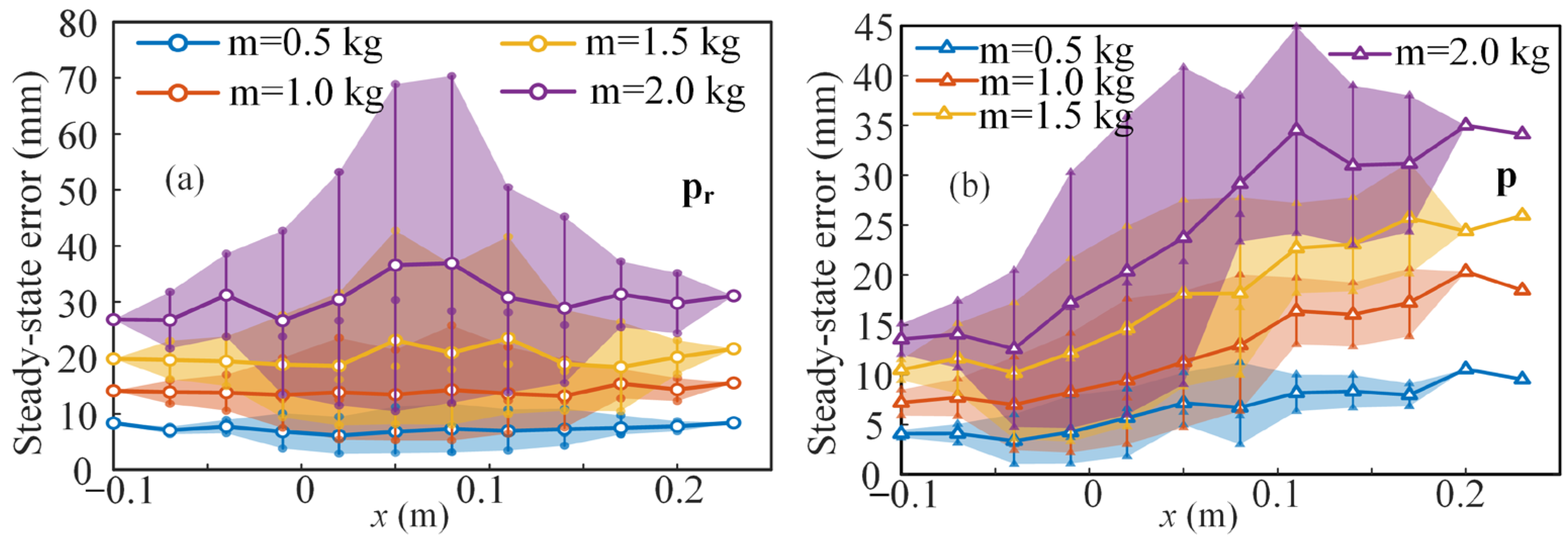
5.5. Steady-State Position Error Experiment
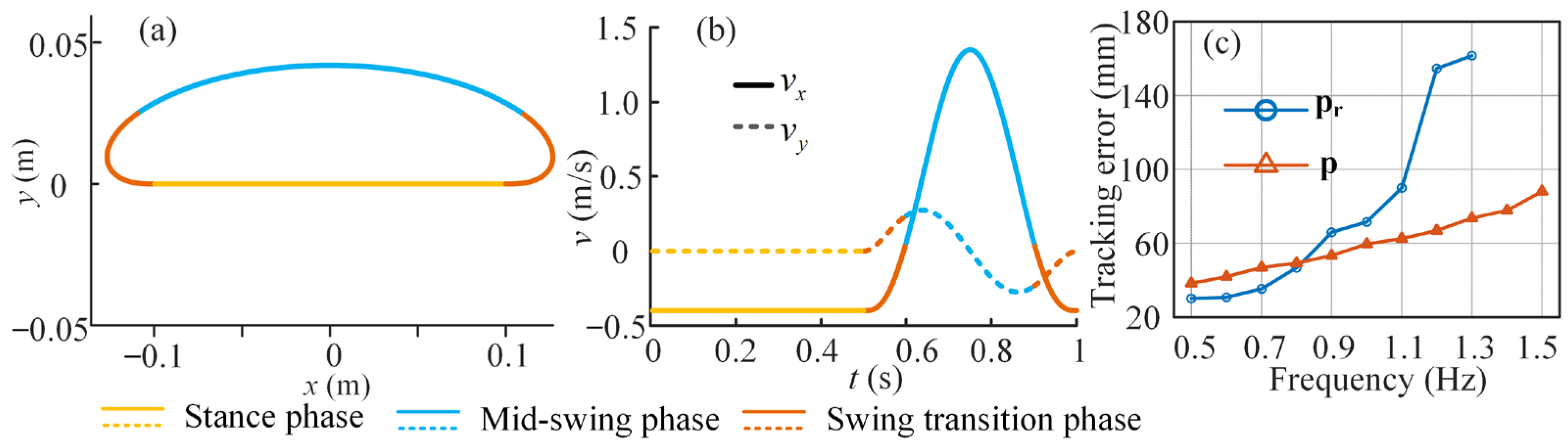
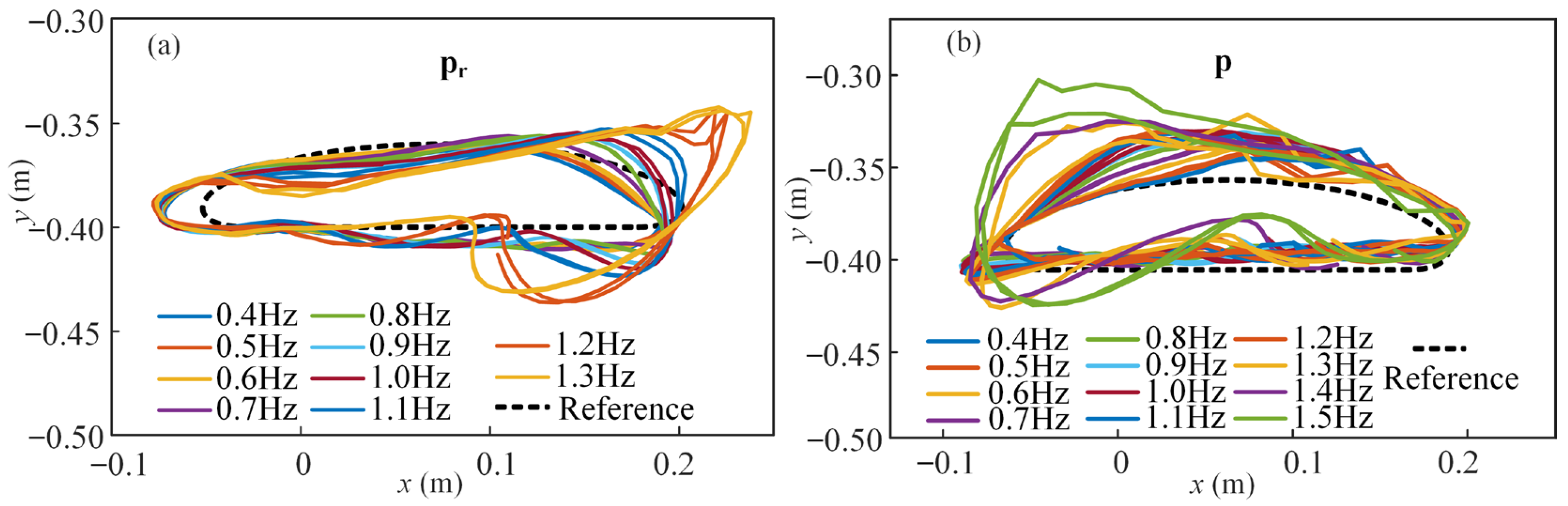
5.6. Dynamic Trajectory-Tracking Experiment
6. Conclusions
Supplementary Materials
Author Contributions
Funding
Data Availability Statement
Conflicts of Interest
References
- Taheri, H.; Mozayani, N. A Study on Quadruped Mobile Robots. Mech. Mach. Theory 2023, 190, 105448. [Google Scholar] [CrossRef]
- Kau, N.; Schultz, A.; Ferrante, N.; Slade, P. Stanford Doggo: An open-source, quasi-direct-drive quadruped. In Proceedings of the 2019 International Conference on Robotics and Automation (ICRA), Montreal, QC, Canada, 20–24 May 2019; pp. 6309–6315. [Google Scholar] [CrossRef]
- Liu, B.; Ge, W.; Li, Y. Design and Optimization of a Kangaroo-Inspired Jumping Robot. In Proceedings of the 2022 5th World Conference on Mechanical Engineering and Intelligent Manufacturing (WCMEIM), Ma’anshan, China, 18–20 November 2022; IEEE: Piscataway, NJ, USA, 2022; pp. 314–318. [Google Scholar] [CrossRef]
- Wang, G.; Zhou, M.; Sun, H.; Wei, Z.; Dong, H.; Xu, T.; Yin, D. Mechanism Analysis and Optimization Design of Exoskeleton Robot with Non-Circular Gear–Pentabar Mechanism. Machines 2024, 12, 351. [Google Scholar] [CrossRef]
- Hutter, M.; Gehring, C.; Lauber, A.; Gunther, F.; Bellicoso, C.D.; Tsounis, V.; Fankhauser, P.; Diethelm, R.; Bachmann, S.; Bloesch, M.; et al. Anymal—Toward Legged Robots for Harsh Environments. Adv. Robot. 2017, 31, 918–931. [Google Scholar] [CrossRef]
- Liu, X.; Jin, Y.; Jiang, L.; Shi, X.; Huang, T. Wheeled Jumping Robot by Power Modulation Using Twisted String Lever Mechanism. J. Zhejiang Univ. Sci. A 2021, 22, 767–776. [Google Scholar] [CrossRef]
- Wensing, P.M.; Wang, A.; Seok, S.; Otten, D.; Lang, J.; Kim, S. Proprioceptive Actuator Design in the MIT Cheetah: Impact Mitigation and High-Bandwidth Physical Interaction for Dynamic Legged Robots. IEEE Trans. Robot. 2017, 33, 509–522. [Google Scholar] [CrossRef]
- Kashiri, N.; Abate, A.; Abram, S.J.; Albu-Schäffer, A.; Clary, P.J.; Daley, M.; Faraji, S.; Furnémont, R.; Garabini, M.; Geyer, H.; et al. An Overview on Principles for Energy Efficient Robot Locomotion. Front. Robot. AI 2018, 5, 129. [Google Scholar] [CrossRef] [PubMed]
- Bledt, G.; Powell, M.J.; Katz, B.; Di Carlo, J.; Wensing, P.M.; Kim, S. MIT Cheetah 3: Design and Control of a Robust, Dynamic Quadruped Robot. In Proceedings of the 2018 IEEE/RSJ International Conference on Intelligent Robots and Systems (IROS), Madrid, Spain, 1–5 October 2018; pp. 2245–2252. [Google Scholar] [CrossRef]
- Park, J.; Kim, K.S.; Kim, S. Design of a Cat-Inspired Robotic Leg for Fast Running. Adv. Robot. 2014, 28, 1587–1598. [Google Scholar] [CrossRef]
- Sugahara, Y.; Kawase, M.; Mikuriya, Y.; Hosobata, T.; Sunazuka, H.; Hashimoto, K.; Lim, H.O.; Takanishi, A. Support Torque Reduction Mechanism for Biped Locomotor with Parallel Mechanism. In Proceedings of the 2004 IEEE/RSJ International Conference on Intelligent Robots and Systems (IROS), Sendai, Japan, 28 September–2 October 2004; pp. 3213–3218. [Google Scholar] [CrossRef]
- Haldane, D.W.; Plecnik, M.M.; Yim, J.K.; Fearing, R.S. Robotic Vertical Jumping Agility via Series-Elastic Power Modulation. Sci. Robot. 2016, 1, eaag2048. [Google Scholar] [CrossRef]
- Hong, C.; Tang, D.; Quan, Q.; Deng, Z.; Cai, K. A Combined Series-Elastic Actuator and Parallel-Elastic Leg No-Latch Bio-Inspired Jumping Robot. Mech. Mach. Theory 2020, 149, 103814. [Google Scholar] [CrossRef]
- Liu, B.; Ren, Y.; Wang, Z.; Jin, S.; Ge, W. The Multimodal Bionic Robot Integrating Kangaroo-Like Jumping and Tortoise-Like Crawling. J. Bionic Eng. 2025, 22, 1637–1654. [Google Scholar] [CrossRef]
- Bastien, J.; Birglen, L. Power Efficient Design of a Compliant Robotic Leg Based on Klann’s Linkage. IEEE/ASME Trans. Mechatron. 2023, 28, 814–824. [Google Scholar] [CrossRef]
- Lee, J.; Lee, G.; Oh, Y. Energy-Efficient Robotic Leg Design Using Redundantly Actuated Parallel Mechanism. In Proceedings of the 2017 IEEE International Conference on Advanced Intelligent Mechatronics (AIM), Munich, Germany, 3–7 July 2017; pp. 1203–1208. [Google Scholar] [CrossRef]
- Wang, R.; Lu, Z.; Xiao, Y.; Zhao, Y.; Jiang, Q.; Shi, X. Design and Control of a Multi-Locomotion Parallel-Legged Bipedal Robot. IEEE Robot. Autom. Lett. 2024, 9, 1993–2000. [Google Scholar] [CrossRef]
- Nizami, M.H.A.; Shah, Z.A.; Ayaz, Y.; Khan, M.J.; Ali, S.; Naveed, M.; Akhtar, K.; Dancey, D.; Nawaz, R. Proximal Actuation of an Elastically Loaded Scissors Mechanism for the Leg Design of a Quadruped Robot. IEEE Access 2020, 8, 208240–208252. [Google Scholar] [CrossRef]
- Liu, J.; Wang, Z.; Qian, L.; Luo, R.; Luo, X. Task-Oriented Systematic Design of a Heavy-Duty Electrically Actuated Quadruped Robot with High Performance. Sensors 2023, 23, 6696. [Google Scholar] [CrossRef]
- Liu, S.; Ding, J.; Lu, C.; Wang, Z.; Su, B.; Guo, Z. A Novel Optimization Design of Dual-Slide Parallel Elastic Actuator for Legged Robots. IEEE/ASME Trans. Mechatron. 2024, 29, 2886–2894. [Google Scholar] [CrossRef]
- Amir, R.; Akbarzadeh, A. Study on Jacobian, Singularity and Kinematics Sensitivity of the FUM 3-PSP Parallel Manipulator. Mech. Mach. Theory 2015, 86, 211–234. [Google Scholar] [CrossRef]
- Shen, C.; Qu, H.; Guo, S.; Li, X. Kinematics Analysis and Singularity Avoidance of a Parallel Mechanism with Kinematic Redundancy. Chin. J. Mech. Eng. 2022, 35, 113. [Google Scholar] [CrossRef]
- Rosyid, A.; El-Khasawneh, B.; Alazzam, A. Performance Measures of Parallel Kinematics Manipulators. Mech. Sci. 2020, 11, 49–73. [Google Scholar] [CrossRef]
- Ramesh, S.; Plecnik, M. A Direct-Drive Five-Bar Manipulator with Tuned Directional First-Order Kinematics for Low Energy Consumption in Vertical Loading. Int. J. Robot. Res. 2025, 44, 317–338. [Google Scholar] [CrossRef]
- Kenneally, G.; De, A.; Koditschek, D.E. Design Principles for a Family of Direct-Drive Legged Robots. IEEE Robot. Autom. Lett. 2016, 1, 900–907. [Google Scholar] [CrossRef]
- Yoshikawa, T. Manipulability of Robotic Mechanisms. Int. J. Robot. Res. 1985, 4, 3–9. [Google Scholar] [CrossRef]
- Gosselin, C.; Angeles, J. A Global Performance Index for the Kinematic Optimization of Robotic Manipulators. J. Mech. Des. 1991, 113, 220–226. [Google Scholar] [CrossRef]
- Angeles, J.; López-Cajún, C.S. Kinematic Isotropy and the Conditioning Index of Serial Robotic Manipulators. Int. J. Robot. Res. 1992, 11, 560–571. [Google Scholar] [CrossRef]
- Wu, H.; Li, X.; Yang, X. Dimensional Synthesis for Multi-Linkage Robots Based on a Niched Pareto Genetic Algorithm. Algorithms 2020, 13, 203. [Google Scholar] [CrossRef]
- Ben Hamida, I.; Laribi, M.A.; Mlika, A.; Romdhane, L.; Zeghloul, S.; Carbone, G. Multi-Objective Optimal Design of a Cable Driven Parallel Robot for Rehabilitation Tasks. Mech. Mach. Theory 2021, 156, 104141. [Google Scholar] [CrossRef]
- Molaei, F.; Ghatrehsamani, S. Kinematic-Based Multi-Objective Design Optimization of a Grapevine Pruning Robotic Manipulator. AgriEngineering 2022, 4, 606–625. [Google Scholar] [CrossRef]
- Kajita, S.; Kanehiro, F.; Kaneko, K.; Yokoi, K.; Hirukawa, H. The 3D Linear Inverted Pendulum Mode: A Simple Modeling for Biped Walking Pattern Generation. In Proceedings of the 2001 IEEE/RSJ International Conference on Intelligent Robots and Systems (IROS), Maui, HI, USA, 29 October–3 November 2001; pp. 239–246. [Google Scholar] [CrossRef]
- Kajita, S.; Kanehiro, F.; Kaneko, K.; Fujiwara, K.; Harada, K.; Yokoi, K.; Hirukawa, H. Biped Walking Pattern Generation by Using Preview Control of Zero-Moment Point. In Proceedings of the 2003 IEEE International Conference on Robotics and Automation (ICRA), Taipei, Taiwan, 14–19 September 2003; pp. 1620–1626. [Google Scholar] [CrossRef]
- Geyer, H.; Saranli, U. Gait Based on the Spring-Loaded Inverted Pendulum. In Humanoid Robotics: A Reference; Goswami, A., Vadakkepat, P., Eds.; Springer: Dordrecht, The Netherlands, 2017; pp. 1–25. [Google Scholar] [CrossRef]
- Kong, L.; Wang, K.; M’Halla Ep Aounallah, R.; Dai, J.S.; Spyrakos-Papastavridis, E. Kinematic and Dexterity Analysis for Stable Jacobian-Switching Control of a Real-Time Reconfigurable Robotic Mechanism. J. Mech. Robot. 2026, 18, 051008. [Google Scholar] [CrossRef]
- Leibrandt, K.; Da Cruz, L.; Bergeles, C. Designing Robots for Reachability and Dexterity: Continuum Surgical Robots as a Pretext Application. IEEE Trans. Robot. 2023, 39, 2989–3007. [Google Scholar] [CrossRef]
- Chavdarov, I. Application of Barycentric Coordinates and the Jacobian Matrix to the Analysis of a Closed Structure Robot. Robotics 2024, 13, 152. [Google Scholar] [CrossRef]
- Wu, J.; Jin, X.; Mi, S.; Tang, J. An Effective Method to Compute the Box-Counting Dimension Based on the Mathematical Definition and Intervals. Results Eng. 2020, 6, 100106. [Google Scholar] [CrossRef]
- Wen, T.; Cheong, K.H. The Fractal Dimension of Complex Networks: A Review. Inf. Fusion 2021, 73, 87–102. [Google Scholar] [CrossRef]
- Pinto, E.P.; Pires, M.A.; Antunes, T.B.F.; da Silva, R.N.; Queirós, S.M.D. Statistical Insights into Spatial Patterns: A Panorama About Lacunarity. Fractal Fract. 2025, 9, 570. [Google Scholar] [CrossRef]
- Sahu, A.K.; Roy, A. Clustering, Connectivity and Flow Responses of Deterministic Fractal-Fracture Networks. Adv. Geosci. 2020, 54, 149–156. [Google Scholar] [CrossRef]
- Maes, L.D.; Herbin, M.; Hackert, R.; Bels, V.L.; Abourachid, A. Steady Locomotion in Dogs: Temporal and Associated Spatial Coordination Patterns and the Effect of Speed. J. Exp. Biol. 2008, 211, 138–149. [Google Scholar] [CrossRef] [PubMed]
- Keller, T.S.; Weisberger, A.M.; Ray, J.L.; Hasan, S.S.; Shiavi, R.G.; Spengler, D.M. Relationship Between Vertical Ground Reaction Force and Speed During Walking, Slow Jogging, and Running. Clin. Biomech. 1996, 11, 253–259. [Google Scholar] [CrossRef]
- Nilsson, J.; Thorstensson, A. Ground Reaction Forces at Different Speeds of Human Walking and Running. Acta Physiol. Scand. 1989, 136, 217–227. [Google Scholar] [CrossRef]
- Rumph, P.F.; Lander, J.E.; Kincaid, S.A.; Baird, D.K.; Kammermann, J.R.; Visco, D.M. Ground Reaction Force Profiles from Force Platform Gait Analyses of Clinically Normal Mesomorphic Dogs at the Trot. Am. J. Vet. Res. 1994, 55, 756–761. [Google Scholar] [CrossRef]
- Seok, S.; Wang, A.; Chuah, M.Y.; Hyun, D.J.; Lee, J.; Otten, D.M.; Lang, J.H.; Kim, S. Design Principles for Energy-Efficient Legged Locomotion and Implementation on the MIT Cheetah Robot. IEEE/ASME Trans. Mechatron. 2015, 20, 1117–1129. [Google Scholar] [CrossRef]






| Research Category | Main Focus | Advantages | Limitations Relative to This Study |
|---|---|---|---|
| Actuator-aware leg design [2,6,7,8,9,10,11,12,13,14,17,18,19,20] | Actuator placement, torque demand, inertia, energy efficiency | Closely related to actuator limits and dynamic performance | Mainly focuses on system-level actuator or leg design; local task-space transmission distribution is not explicitly characterized |
| Jacobian-based mechanism optimization [21,22,23,24,25,26,27,28,29,30,31] | Manipulability, condition number, workspace, multi-objective optimization | Provides mature physical indicators for kinematic synthesis | Mostly uses global or averaged indices; gait-function differences among task regions are weakly represented |
| Gait-model-based task generation [32,33,34] | LIP/SLIP models and biological gait data | Provides physically meaningful task space trajectories | Mainly used for gait analysis and control rather than dimensional synthesis |
| Spatial/fractal characterization [35,36,37,38,39,40,41] | Box-counting dimension, lacunarity, spatial distribution | Quantifies multi-scale spatial filling and heterogeneity | Rarely linked with Jacobian-based mechanism optimization of robotic legs |
| Parameter | Range () | Range () | Parameter | Range () | Range () |
|---|---|---|---|---|---|
| (m) | 0.25 | (m) | 0.15 | ||
| (m) | 0.25 | (m) | \ | ||
| (m) | 0.25 | (°) | \ | ||
| (m) | 0.25 |
| (N·m) | (rpm) | Total Mass (kg) | CoM Height (m) | Target Speed (m/s) | Gait Period (s) | Duty Factor | (N) | (m/s) |
|---|---|---|---|---|---|---|---|---|
| 11 | 240 | 5.5 | 0.4 | 2.0 | 0.5 | 0.5 | 55 | 7.5 |
| Case | ||||||||||
|---|---|---|---|---|---|---|---|---|---|---|
| 1 | 0.33 | 0.33 | 0.33 | 0.993 | 0.566 | 0.518 | 0.903 | 1.000 | 1.143 | 0.836 |
| 2 | 0.50 | 0.25 | 0.25 | 0.824 | 0.731 | 0.647 | 0.790 | 1.000 | 1.114 | 0.808 |
| 3 | 0.25 | 0.50 | 0.25 | 0.991 | 0.527 | 0.573 | 0.903 | 1.000 | 1.143 | 0.836 |
| 4 | 0.25 | 0.25 | 0.50 | 0.989 | 0.594 | 0.495 | 0.903 | 1.000 | 1.143 | 0.836 |
| 5 | 0.40 | 0.40 | 0.20 | 0.960 | 0.476 | 0.671 | 1.323 | 1.000 | 1.143 | 0.973 |
| 6 | 0.40 | 0.20 | 0.40 | 0.891 | 0.674 | 0.539 | 0.903 | 1.000 | 1.129 | 0.836 |
| 7 | 0.20 | 0.40 | 0.40 | 0.990 | 0.558 | 0.552 | 0.903 | 1.000 | 1.129 | 0.836 |
| Case | ||||||||||
|---|---|---|---|---|---|---|---|---|---|---|
| 1 | −0.32 | −0.10 | 0.09 | 0.881 | 0.433 | 0.685 | 1.500 | 1.000 | 1.111 | 1.015 |
| 2 | −0.35 | −0.10 | 0.09 | 0.824 | 0.731 | 0.647 | 0.790 | 1.000 | 1.114 | 0.808 |
| 3 | −0.38 | −0.10 | 0.09 | 0.743 | 0.653 | 0.734 | 0.705 | 1.000 | 1.105 | 0.797 |
| 4 | −0.35 | −0.12 | 0.09 | 0.848 | 0.560 | 0.548 | 0.935 | 0.977 | 1.172 | 0.824 |
| 5 | −0.35 | −0.08 | 0.09 | 0.951 | 0.536 | 0.725 | 1.694 | 0.944 | 1.100 | 1.036 |
| 6 | −0.35 | −0.10 | 0.07 | 0.786 | 0.510 | 0.690 | 0.806 | 1.250 | 1.013 | 0.827 |
| 7 | −0.35 | −0.10 | 0.11 | 0.812 | 0.699 | 0.612 | 0.806 | 0.889 | 1.127 | 0.908 |
| Parameter | (m) | (m) | (m) | (m) | (m) | (m) | (°) |
|---|---|---|---|---|---|---|---|
| Result | 0.200 | 0.239 | 0.292 | 0.210 | 0.132 | 0.257 | 3.97 |
| Scheme | ||||||||||
|---|---|---|---|---|---|---|---|---|---|---|
| This study | 1.631 | 1.291 | 0.925 | 0.824 | 0.731 | 0.647 | 0.790 | 1.000 | 1.114 | 0.808 |
| 1 | 0.142 | 3.234 | 1.477 | 4.872 | 0.333 | 0.091 | 2.919 | 1.000 | 1.143 | 1.096 |
| 2 | 4.312 | 0.333 | 1.240 | 0.804 | 3.823 | 4.636 | 2.371 | 0.750 | 1.028 | 1.082 |
| 3 | 0.426 | 0.665 | 1.236 | 1.296 | 0.868 | 0.427 | 1.822 | 1.000 | 1.142 | 1.068 |
Disclaimer/Publisher’s Note: The statements, opinions and data contained in all publications are solely those of the individual author(s) and contributor(s) and not of MDPI and/or the editor(s). MDPI and/or the editor(s) disclaim responsibility for any injury to people or property resulting from any ideas, methods, instructions or products referred to in the content. |
© 2026 by the authors. Licensee MDPI, Basel, Switzerland. This article is an open access article distributed under the terms and conditions of the Creative Commons Attribution (CC BY) license.
Share and Cite
Liu, B.; Wang, Z.; Ge, W.; Zhang, Y. Optimization and Experimental Evaluation of a Legged Robot Mechanism Based on Task Space Partitioning. Fractal Fract. 2026, 10, 401. https://doi.org/10.3390/fractalfract10060401
Liu B, Wang Z, Ge W, Zhang Y. Optimization and Experimental Evaluation of a Legged Robot Mechanism Based on Task Space Partitioning. Fractal and Fractional. 2026; 10(6):401. https://doi.org/10.3390/fractalfract10060401
Chicago/Turabian StyleLiu, Bin, Zhuo Wang, Wenjie Ge, and Yonghong Zhang. 2026. "Optimization and Experimental Evaluation of a Legged Robot Mechanism Based on Task Space Partitioning" Fractal and Fractional 10, no. 6: 401. https://doi.org/10.3390/fractalfract10060401
APA StyleLiu, B., Wang, Z., Ge, W., & Zhang, Y. (2026). Optimization and Experimental Evaluation of a Legged Robot Mechanism Based on Task Space Partitioning. Fractal and Fractional, 10(6), 401. https://doi.org/10.3390/fractalfract10060401