
Article

Stress-Dependent Permeability Variation and Anisotropic Characteristics of Cataclastic Coal: Laboratory Tests and Dual-Pore Fractal Modeling
1
College of Geoscience and Surveying Engineering, China University of Mining and Technology (Beijing), Beijing 100083, China
2
State Key Laboratory for Fine Exploration and Intelligent Development of Coal Resources, Beijing 100083, China
3
Research Institute of Exploration and Development, Liaohe Oilfield Company, Petrochina, Panjin 124010, China
*
Author to whom correspondence should be addressed.
Fractal Fract. 2026, 10(6), 383; https://doi.org/10.3390/fractalfract10060383
Submission received: 8 May 2026 / Revised: 30 May 2026 / Accepted: 31 May 2026 / Published: 2 June 2026
(This article belongs to the Special Issue Applications of Fractal Analysis in Structural Geology)

Abstract

Permeability acts as a core parameter governing the efficient and cost-effective development of deep coalbed methane (CBM) reservoirs. The evolution of permeability in deep CBM formations is predominantly driven by the coupled deformation of pore and fracture systems under in-situ stress, yet the intrinsic mechanisms behind this process have not been fully elucidated. In this work, permeability tests were carried out on cataclastic coal specimens in three orientations under both loading and unloading conditions with confining pressures. Experimental results reveal that coal permeability decreases exponentially with increasing effective stress (R2 is about 0.99; reduction is about 86%), exhibiting strong anisotropy and displays significant hysteresis during unloading. To interpret these phenomena, we establish a dual-pore fractal series model that uniquely integrates serial flow coupling between matrix pores and fractures and quantifies stress-driven changes in fractal dimension, tortuosity, and maximum pore size. The model successfully reproduces experimental results (mean relative error ≤ 4.2%) and provides mechanistic insights into stress-induced permeability evolution. Stress increases fractal dimension and tortuosity while reducing maximum pore size, rendering pore structures more complex and less conductive. Incomplete recovery of fractal parameters during unloading explains the observed hysteresis. This mechanistic framework, combining the experiment and theory, offers quantitative support for optimizing CBM extraction strategies.

1. Introduction

As a critical unconventional natural gas resource, deep coalbed methane plays a pivotal strategic role in the optimization of global energy mix, the reduction of carbon emissions, and the achievement of carbon neutrality targets [1,2,3]. The storage and migration of deep CBM are mainly controlled by the dual-pore system of coal, in which matrix pores provide gas storage space while cleats and fractures act as the dominant flow channels [4,5]. However, coalification and tectonic deformation greatly complicate the pore structure of coal, forming multi-scale, irregular pore-fracture networks [6,7]. Cataclastic coal is even more complicated because its primary structure is destroyed, generating distorted pores and irregular fractures that strongly affect gas movement [8]. The migration behavior of gas in such complicated pore structures is still not well understood, which significantly restricts the production efficiency of deep CBM reservoirs.
Permeability is a significant parameter that characterizes the fluid migration capacity [9], and numerous experimental studies have demonstrated its strong stress dependence in coal [10,11,12,13]. Wang et al. (2020) [11] reported that coal permeability decreases exponentially with the rising of confining pressure, while Zou et al. (2019) [13] observed that axial stress could reduce permeability by nearly one order of magnitude. Cyclic loading and unloading induced irreversible permeability reduction, with the magnitude of decline diminishing with repeated cycles [12]. Similar conclusions were drawn by Mitra et al. (2012) [14], who confirmed that the accumulation of effective stress is a dominant factor in the sustained permeability loss during methane adsorption-desorption processes. Consistently, recent pore structure studies have emphasized that stress not only reduces fracture apertures but also alters multiscale pore connectivity, thereby enhancing permeability stress sensitivity [15]. Although these findings highlight the strong coupling between stress and permeability evolution, most previous work treated coal as an isotropic medium and did not fully account for the anisotropy induced by bedding planes and cleats.
Field and laboratory measurements have shown that deep coals generally exhibit significant permeability anisotropy [16,17]. Permeability parallel to bedding could be up to 17 times higher than that perpendicular to bedding [18]. Yue et al. (2015) [19] found that permeability along face cleats was nearly an order of magnitude greater than that along butt cleats, and significant anisotropy was also observed in gas-bearing coals [20,21]. Recently, Gong et al. (2026) [10] conducted a comparative study on the permeability of cataclastic coals along face and butt cleat directions, but neglected the influences of bedding and dual-pore structure. The integrated role of the dual-pore system in controlling permeability anisotropy, especially under stress evolution, has not yet been systematically clarified [7,22].
As an effective method to characterize the complex pore structure and heterogeneity of porous media, fractal theory has been widely used in CBM reservoir research [23,24,25]. Experimental results have confirmed that coal pores exhibit distinct fractal features, and the fractal dimension provides a quantitative metric for assessing the structural complexity of pore-fracture systems [15]. The geometry, including pore size, shape, and connectivity, plays a fundamental role in constraining gas flow capacity [26], and variations in fractal dimension reflect differences in pore network tortuosity and connectivity: higher values indicate more complex structures, whereas lower values correspond to relatively homogeneous systems [27]. Fu et al. (2022) [28] indicates that coal metamorphism diminishes pore complexity, with fractal dimension exhibiting a negative association with porosity. At the macroscopic level, fracture patterns exhibit fractal geometry [29]. Ma (2022) [30] employed combined SEM and mercury intrusion analyses to establish that both pore volume and diameter serve as joint regulators of the fractal structure in coals. Despite these advances, the structure of coal generally presents a dual-pore system, ranging from nanopores to centimeter-scale fractures [31,32]. Gas migration in such systems is strongly affected by both micropore storage and fracture seepage [22]. However, most studies have focused on single-scale fractal characterization, without systematically addressing the coupling between pores and fractures across multiple scales. This limitation, together with the insufficient consideration of anisotropic dual-pore behavior, has hindered a full understanding of how complicated pore structures control permeability anisotropy and stress sensitivity in deep CBM reservoirs.
To address these gaps, this study focuses on the permeability and anisotropy property of deep cataclastic coal and laboratory permeability tests were conducted on specimens in three principal orientations: normal to the bedding plane, aligned with the face cleats, and aligned with the butt cleats. The experiments were performed under both loading and unloading paths with different confining pressures to capture the stress-dependent evolution of permeability. On this basis, a dual-pore fractal series model was established to describe the coupling between pores and fractures and to analyze the dynamic evolution of internal structures under stress. The combined experimental and modeling results provide new insights into the mechanisms controlling permeability anisotropy in deep coal reservoirs and provide a theoretical basis for enhancing CBM exploitation efficiency.

2. Specimens and Experiments

2.1. Specimen Collection and Microscopic Observation

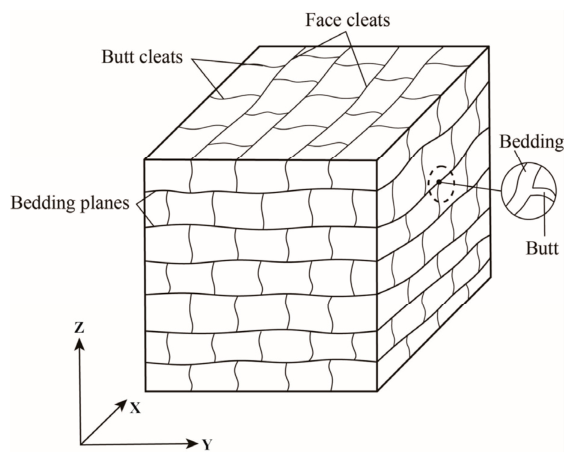
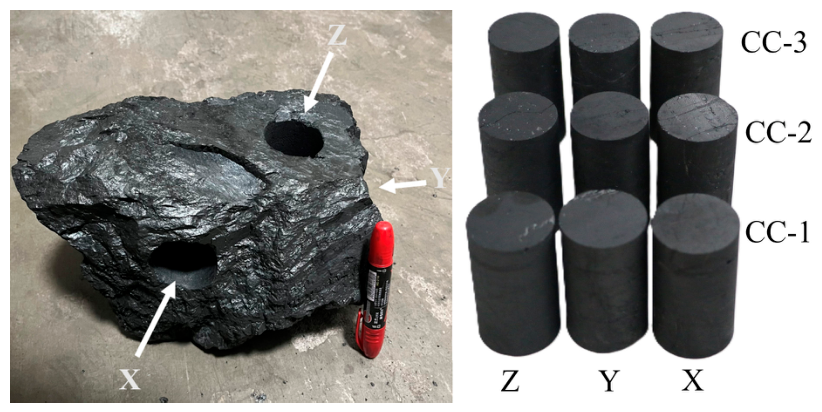
Deep coalbed methane reservoirs consist predominantly of primary coal, which retains intact bedding planes and a well-ordered cleat network, accompanied by minor cataclastic coal whose primary structure is partially to completely destroyed, resulting in distorted pores, irregular fractures, and a disordered but highly developed cleat system orthogonal to the bedding planes. The typical structures are shown in Figure 1 [33,34,35]. Face cleats and butt cleats are at right angles to one another and both are perpendicular to the bedding plane, with butt cleats terminating at intersections with face cleats [36]. These structural features make cataclastic coal exhibit stronger permeability anisotropy and higher stress sensitivity. To systematically characterize the permeability anisotropy of deep coal, three big cataclastic coal blocks named CC-1, CC-2, and CC-3 were obtained from the “sweet spot” of a deep CBM development zone in the Qinshui Basin (corresponding to the No. 3 coal seam, burial depth ~600 m). Specimens were sealed on-site using plastic film and wax and transported to the laboratory, where cylindrical core plugs were prepared in three orientations: Z normal to bedding plane; X parallel to bedding plane and face cleats; and Y parallel to bedding plane and butt cleats. Owing to the inherent brittleness of deep coal, cylindrical core plugs (38 mm diameter × 70 mm length) were extracted using high-precision wire-cutting technology, with dimensional tolerances strictly controlled within 0.5%.
As depicted in Figure 2, specimen CC-2 exhibits a well-developed fracture system, with multiple fractures of varying length and aperture intersecting across the specimen surface, forming a complex network. Specimen CC-3 displays a moderate degree of fracturing, though with lower fracture density and aperture compared to CC-2. In contrast, CC-1 contains only a few isolated microcracks. The physical properties of the three specimens are presented in Table 1, where porosity shows significant variation.
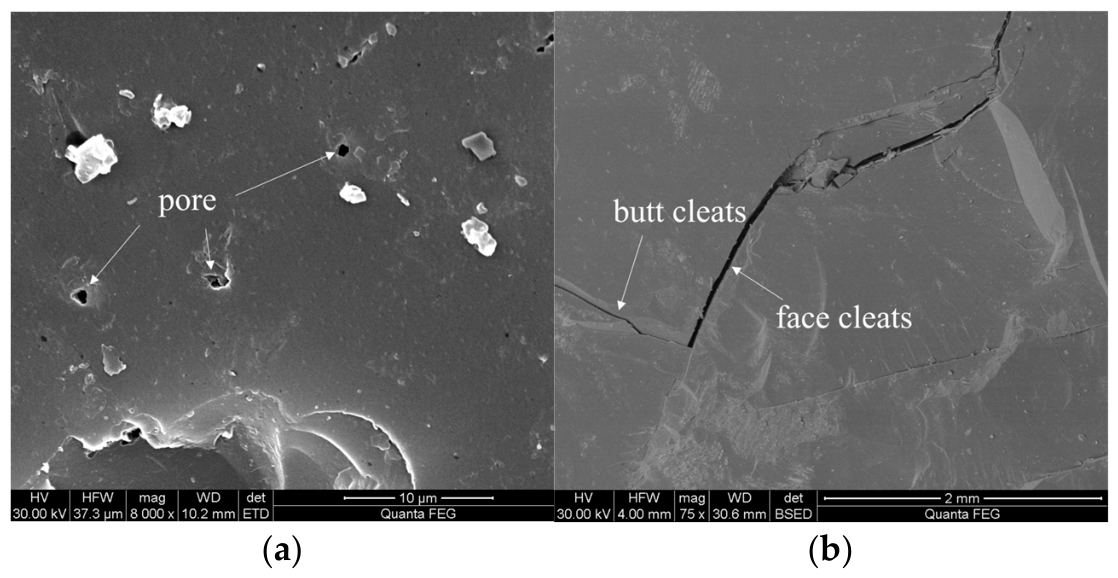
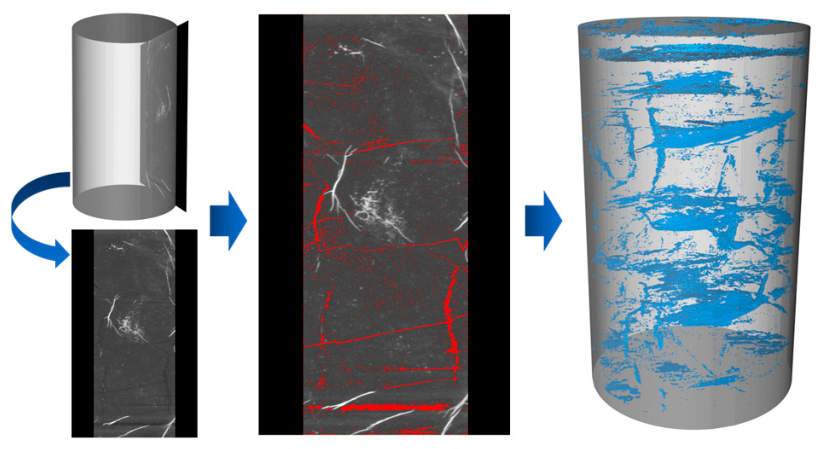
The microstructural characteristics of the coal specimens were examined using SEM. Taking specimen CC-3 as an example (Figure 3), the pore structure exhibits pronounced multiscale features, with pore sizes varying widely and distributed irregularly. The pores are predominantly sub-rounded to elongated in shape (Figure 3a), consistent with the observations of Liu et al. (2023) [37]. Figure 3b presents the SEM image of the cleat system, revealing two nearly orthogonal sets of cleats: face cleats and butt cleats. The face cleat exhibits larger apertures, is more continuous, and extends over longer distances, while the butt cleat has smaller apertures and terminate at intersections with the face cleat [36]. In addition, X-ray μCT was employed to characterize the internal pore-fracture network of the coal specimen. Figure 4 shows the 2D cross-sectional slice of the specimen, where the orthogonal cleat system and irregularly distributed pores are clearly visible, consistent with the SEM observations. The three-dimensional pore-fracture network of the coal is reconstructed, which clearly displays several nearly parallel bedding planes, with a few fractures cutting across them. Matrix pores are randomly distributed in the coal matrix with poor connectivity. This distinctive structural configuration plays an important role in controlling methane flow and production in CBM reservoirs.

2.2. Coal Specimen Permeability Measurement

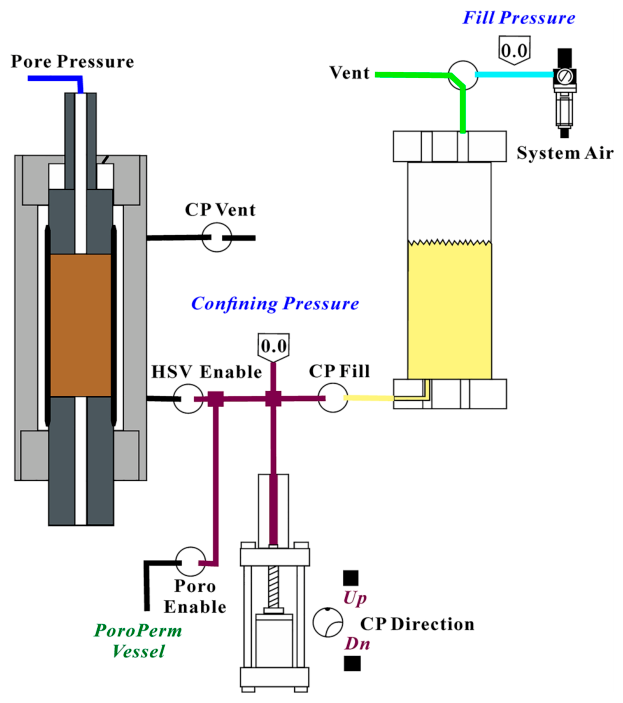
Helium permeability along the Z, X, and Y orientations was determined via the transient pulse decay method. Helium is used because it is an inert non-adsorbed gas, which can exclude the interference of matrix expansion/contraction caused by adsorption on permeability so as to study the influence of stress on pore-fracture system alone. A schematic diagram of the experimental apparatus is provided in Figure 5 [38,39]. In this experiment, confining pressure was applied using oil as the hydraulic fluid. The confining stress path was 2~21~2 MPa, with a constant pore pressure of 1 MPa. Effective stress was defined as the difference between confining pressure and pore pressure. Both the loading and unloading phases were conducted at a pressure change rate of 0.02 MPa/s to ensure stability and repeatability during testing. The measurement error was controlled to within 2.5%. For a burial depth of ~600 m, the overburden pressure is approximately 12–15 MPa, and horizontal in-situ stresses typically range from 10 to 20 MPa [40]. Thus, the selected effective stress range of 1–20 MPa comprehensively covers the actual geomechanical conditions of the target coal seam. The transient pressure pulse method involves applying a sudden gas pressure pulse to the upstream chamber of the system. As the pressure pulse gradually propagates to the downstream chamber, the pressure variation from the upstream to the downstream reservoirs is recorded over time to calculate the permeability [41]. The calculation is based on the following equation:
K = μ β L A 1 V 1 + 1 V 2 1 ln Δ P ( t ) Δ P 0 Δ t
where K is the measured permeability, β is the gas compressibility, μ is the dynamic viscosity of the fluid, L is the coal specimen’s length, A is the cross-sectional area, and V1 and V2 signify the volumes of the upstream and downstream chambers, respectively. ΔP(t) is the pressure differential between the upstream and downstream chambers at the moment of t, ΔP0 is the initial pressure pulse difference, and Δt is the time difference.

3. Experimental Results of Permeability

3.1. Permeability and Stress Sensitivity

Over the effective stress range of 1~20 MPa, the permeability of CC-1, CC-2, and CC-3 ranged from 0.02~0.85 mD, 0.15~2.10 mD, and 0.02~1.00 mD, respectively, indicating the low-permeability [42]. The observed differences in permeability among the specimens strongly correlate with the degree of surface fracture development in the cylindrical plugs (Figure 2): specimen CC-2, with the most extensively developed fracture network, exhibits the highest permeability, followed by CC-3, with CC-1 being the lowest. It demonstrates that the development of natural fractures is a primary control on the permeability of CBM reservoirs [43,44].
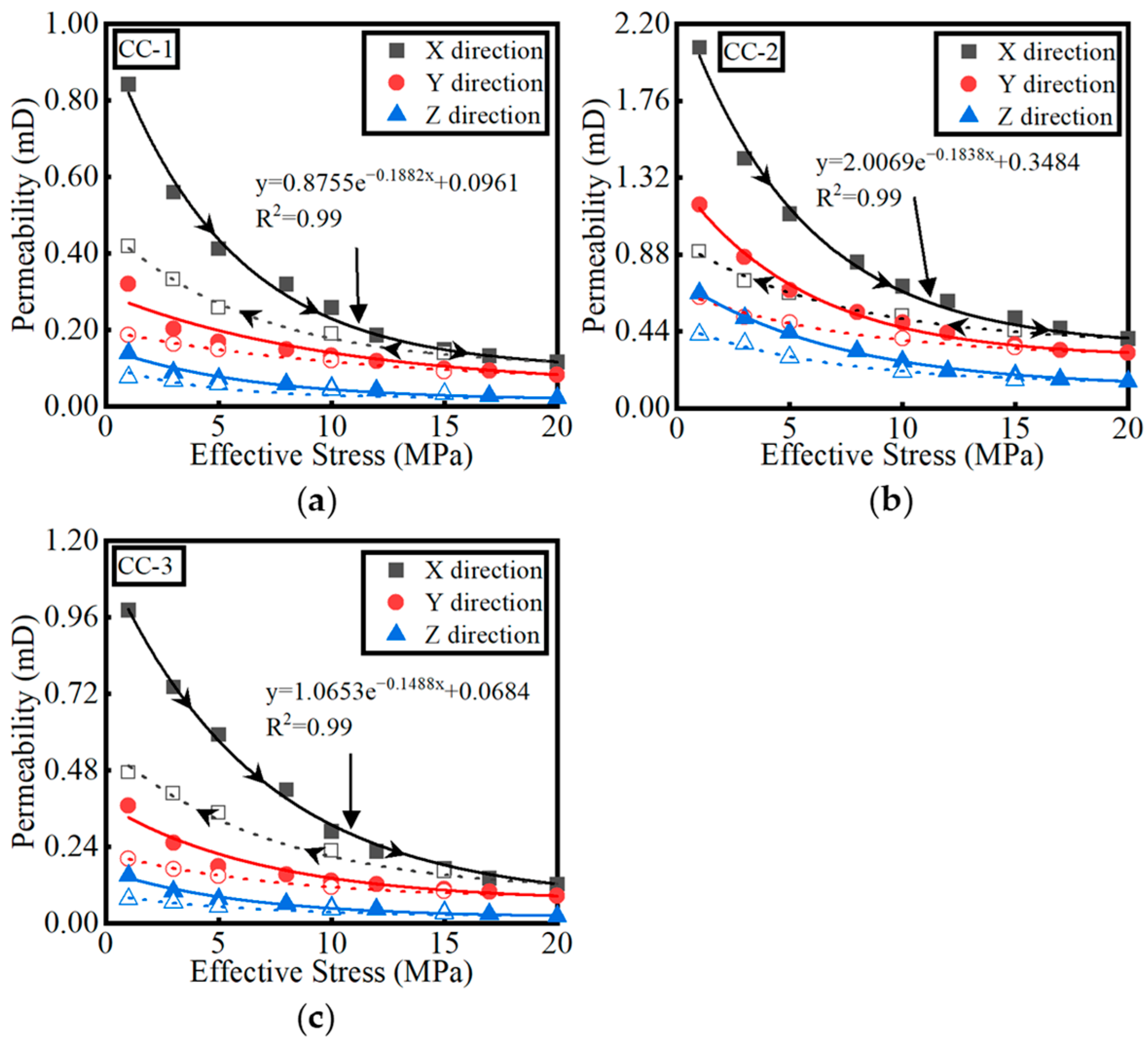
Coal permeability exhibits significant stress dependence. Taking the X direction of specimen CC-1 as an example, the permeability was 0.8426 mD at an effective stress of 1 MPa. As the stress increased to 10 MPa, the permeability sharply declined to 0.2582 mD, representing an average reduction of approximately 80%. Upon further loading to 20 MPa, permeability continued to decrease, reaching 0.1161 mD. This demonstrates clear stress sensitivity, with the rate of permeability decline being markedly greater in the low stress regime than under high stress. Importantly, the confining pressure used in this experiment is hydrostatic pressure and pure hydrostatic pressure, which basically does not produce new cracks [45]. In addition, the main role of hydrostatic pressure is to close the existing cracks and pores in the coal sample and increase the friction force, which can significantly improve the strength and Young’s modulus of the sample, and inhibit the generation of cracks [46]. Through in-situ CT experiments under confining pressure of 0~25 MPa, Cheng et al. (2026) [47] found that simply increasing the hydrostatic confining pressure would only lead to the gradual closure of the original cracks in the coal body, and no new cracks were observed. Therefore, the nonlinear decay trend can result from the differential stress response of the pore and fracture system. At low stress stages, the fractures and pores in coal specimens are relatively open; as effective stress increases, these features rapidly close, significantly reducing the cross-sectional area available for gas flow and causing a sharp drop in permeability. At higher stress levels, most of the compressible pores and fractures have already closed. The remaining residual microfractures and irregular pores, due to their structural rigidity, exhibit limited compressibility, resulting in a slower rate of permeability decline.
The permeability reduction exhibited a clear directional dependence during loading, following the order X > Y > Z and indicating that stress sensitivity is strongest along the X direction. This can be ascribed to the higher density of large-aperture and well-connected pores and fractures in the X direction. The flow pathways undergo significant compression and deformation under stress, resulting in the greatest permeability decline. In the Y direction, permeability is influenced by butt cleats, which have lower connectivity and smaller apertures compared to the X direction, leading to a more moderate permeability reduction under stress. In the Z direction, the bedding planes act as barriers to flow, resulting in inherently poor connectivity of flow paths. As a consequence, the pores and fractures are less susceptible to closure, and the permeability reduction is the smallest among the three directions. Specimens CC-2 and CC-3 exhibit similar directional permeability trends, further confirming that the variation in permeability under stress is intimately connected to the connectivity, development, and aperture of the internal pore-fracture system in fractured coals.
Regression analysis reveals a negative exponential dependence of coal permeability on effective stress (Figure 6), expressed by
K = c + a e b x
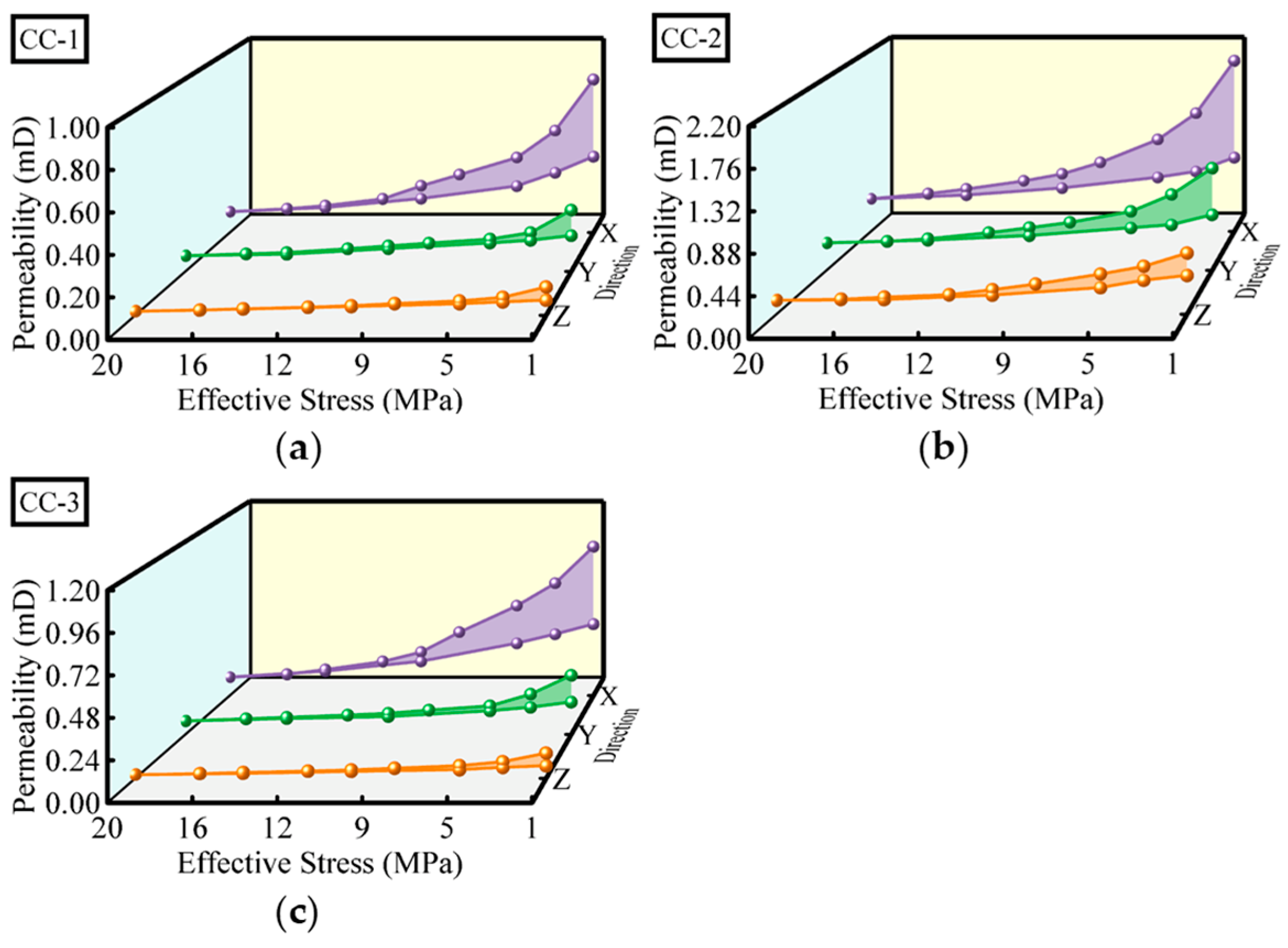
where a and c are fitting constants, x is the effective stress, and b denotes the stress sensitivity coefficient, with larger values signifying a steeper permeability decline under increasing stress. As depicted in Figure 6, coal permeability increases nonlinearly during unloading as effective stress decreases, yet fails to recover its initial value, indicating pronounced hysteresis. By comparing the permeability of coal specimens during loading and unloading under varying effective stress, the degree of hysteresis and its dependence on effective stress can be quantitatively characterized. Figure 7 shows that permeability hysteresis becomes more pronounced as effective stress decreases, which is likely related to the stress sensitivity of the pore-fracture system. The internal pore and fracture structures in coals undergo both elastic and plastic deformation under stress, and may also experience sorption-induced strain under gas loading [48]. Immediate recovery of elastic deformation contrasts sharply with delayed plastic restoration upon unloading, producing pronounced hysteresis that becomes more severe at lower stress levels.
Figure 7 highlights the hysteresis area as the shaded region, quantifying the degree of permeability hysteresis. Its magnitude decreases in the order: Z < Y < X. This discrepancy arises from differential development of the pore-fracture system. Along the X direction, fractures and pores, particularly face cleats, are more extensively developed and possess wider apertures. Consequently, greater overall deformation occurs under stress, encompassing a larger irreversible plastic component, which yields the largest hysteresis area. In the Y direction, butt cleats are sparser and less continuous, resulting in reduced plastic strain and a smaller hysteresis loop relative to X. Along the Z direction, fracture and pore connectivity is severely impeded by bedding plane, leading to negligible plastic deformation and the smallest hysteresis area.

3.2. Anisotropy in Permeability

Figure 6 reveals significant anisotropy in permeability across the three orientations of the coal specimens, following the trend Z < Y < X. This anisotropy is ascribed to the internal pore-fracture structure. As shown in the CT image (Figure 4), the coal specimen contains multiple sets of nearly parallel bedding planes. In directions parallel to the bedding, these fractures provide well-connected flow channels, resulting in high permeability; in the direction perpendicular to the bedding, the bedding planes act as barriers, leading to low permeability. Furthermore, Figure 3b illustrates the characteristics of face and butt cleats: well-developed and continuous face cleats dominate the X direction, whereas Y direction butt cleats are sparser and more discontinuous. Consequently, permeability follows the order X > Y > Z. To quantitatively characterize the anisotropic differences in permeability of coal specimens, the anisotropy index Λ is defined as follows:
Λ i j = K i K j K j
where K represents the permeability values obtained through measurement of the coal specimen, i and j denote different flow directions. For computational convenience, it is assumed that Ki > Kj.
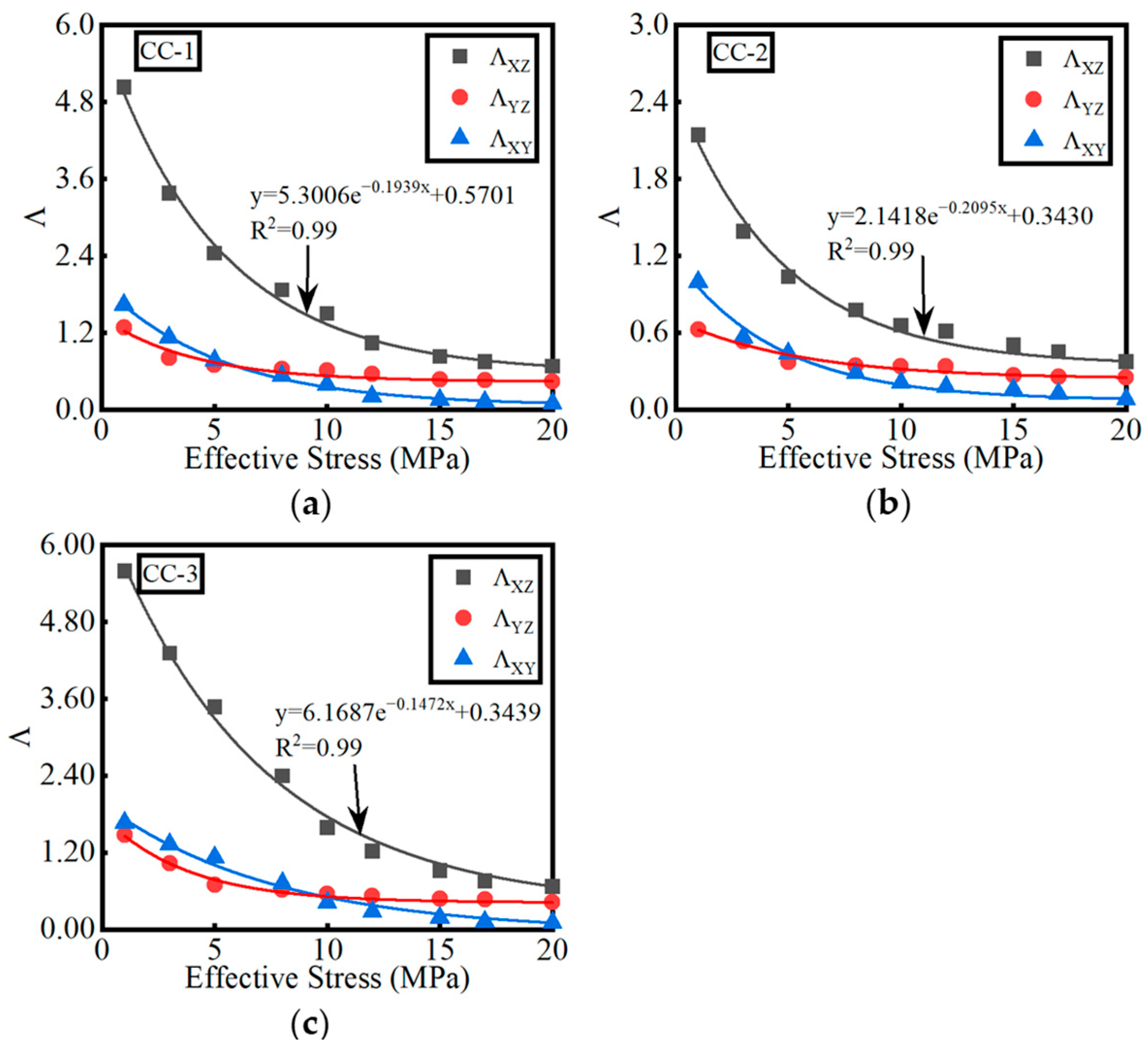
Figure 8 illustrates the directional differences in coal permeability and their variation with effective pressure. Under low-pressure conditions, the permeability differences follow the order XZ > XY > YZ. This trend is primarily ascribed to the well-developed face cleats oriented along the X-direction, which exhibit good extension, connectivity, and large apertures, providing highly efficient flow pathways. As a result, initial permeability along X substantially exceeds that in the Z and Y directions. In contrast, the Z direction is characterized by poorly developed pores and fractures, often interrupted by bedding planes, leading to the lowest initial permeability. The permeability differences between directions exhibit a negative exponential decline as effective pressure increasing. While the effective stress exceeds 10 MPa, the permeability difference between the Y and Z directions (YZ) surpasses that between the X and Y directions (XY). The shift occurs because the permeability contrast in the XY direction is primarily governed by the structural characteristics of face and butt cleats. With increasing effective stress, both face cleats and butt cleats undergo substantial closure, diminishing their aperture. Consequently, the contribution of the cleat system to permeability declines, reducing the permeability contrast between the X and Y directions. In contrast, the permeability differences in the XZ and YZ directions are largely controlled by the structure of the Z direction. The substantially lower permeability along Z, relative to X and Y, stems from limited pore-fracture development, narrow apertures, and frequent interruption by bedding planes. As stress increases, these intrinsic structural limitations persist, maintaining a noticeable degree of anisotropy in both the XZ and YZ directions.

4. Fractal Permeability Modeling and Analysis

4.1. Fractal Dual-Pore Series Modeling

As a complicated dual-pore medium, deep coal exhibits distinct cross-scale fractal characteristics in its pore structure [6,7,49]. Coal pore-fracture networks exhibit self-similarity, and their structural complexity can be quantified by the fractal dimension [24,30]. A higher fractal dimension reflects a more intricate pore-fracture network and more tortuous flow pathways, whereas a lower value indicates a comparatively simpler structure [27]. To investigate the multiscale flow mechanisms in different directions of the coal specimens, this study adopts a capillary bundle model. The pores and fractures within coal are conceptualized as a series of interconnected and tortuous capillaries, where capillaries of varying diameters represent pores and fractures at different scales [50,51]. Based on fractal theory [52], the quantity of pores in a porous medium as a function of pore size follows the relationship
r max r D 1 = N > r
where rmax is the maximum pore dimension, D1 is the fractal dimension of the pores, and N(>r) is the quantity of pores in the porous medium. Owing to the numerous and highly intricate pore systems in coal, N(>r) can be treated as a continuous differentiable function. Taking its differential yields the number of capillary-like pores within the size range r~r + dr:
d N ( > r ) = D 1 r max D 1 r D 1 1 d r
The volumetric flow rate q for a single cylindrical capillary with a circular cross-section follows Poiseuille’s law [53]:
q = π r 4 d p 8 τ 1 μ d l
where dp is the pressure differential across the capillary, q is the flow rate through an individual capillary, l is the capillary length, and τ1 is pore tortuosity. The total flow rate through the coal reservoir over seepage area A is then obtained by integrating q from the rmin to rmax:
Q = r min r max q d N ( r ) = π D 1 r max D 1 d p 8 ( 4 D 1 ) τ 1 μ d l ( r max 4 D 1 r min 4 D 1 )
where Q is the total pore flow on seepage section A, rmin is the minimum pore dimension, and rmax is the maximum pore dimension. Based on the Darcy law [54], the flow rate in the capillary can be calculated by the following formula:
Q = K A d p μ d l
The seepage area A can be obtained by integrating the pore area of the porous medium:
A = r min r max π r 2 d N ( r )
Combining Equations (7)–(9) can obtain
K 1 = ( 2 D 1 ) ( r max 4 D 1 r min 4 D 1 ) 8 τ 1 ( 4 D 1 ) ( r max 2 D 1 r min 2 D 1 )
Equation (10) is the calculation formula for the coal pore permeability K1. The fracture permeability is on a different scale from the pore permeability but model is approximate. The formula is as follows:
K 2 = ( 2 D 2 ) ( λ max 4 D 2 λ min 4 D 2 ) 8 τ 2 ( 4 D 2 ) ( λ max 2 D 2 λ min 2 D 2 )
where D2 is the fractures fractal dimension, λmax and λmin are the maximum and minimum fractures apertures, and τ2 is the fractures tortuosity. The flow path of gas is usually continuous in coal. Gas undergoes desorption from matrix pores, diffuses into the fracture network, and subsequently flows through fractures toward the wellbore. The continuity of this flow path makes the matrix pores and fractures behave in a series relationship during the flow process rather than an independent or parallel relationship. In a series system, the seepage flow rates of the pores and fractures are equal, and the overall pressure difference is equal to the sum of their respective pressure differences. Based on Darcy’s law, the permeability is inversely proportional to the pressure difference. Therefore, the permeability of coal can be approximated as
K 0 = ( 1 K 1 + 1 K 2 ) 1
where K0 is the theoretical permeability of coal specimen. Importantly, the series model is suitable for the case where the matrix permeability is much smaller than the fracture permeability, the connectivity of pores and fractures is poor, and there is no penetrating fracture network. At this time, the fluid flow path conforms to the series mode of “pore-fracture-wellbore”, and the model is applicable. For reservoirs with good pore connectivity and highly interconnected fractures, there are parallel flow paths for fluid flow. Only using the series model will underestimate the permeability.

4.2. Fractal Dual-Pore Series Model Analysis

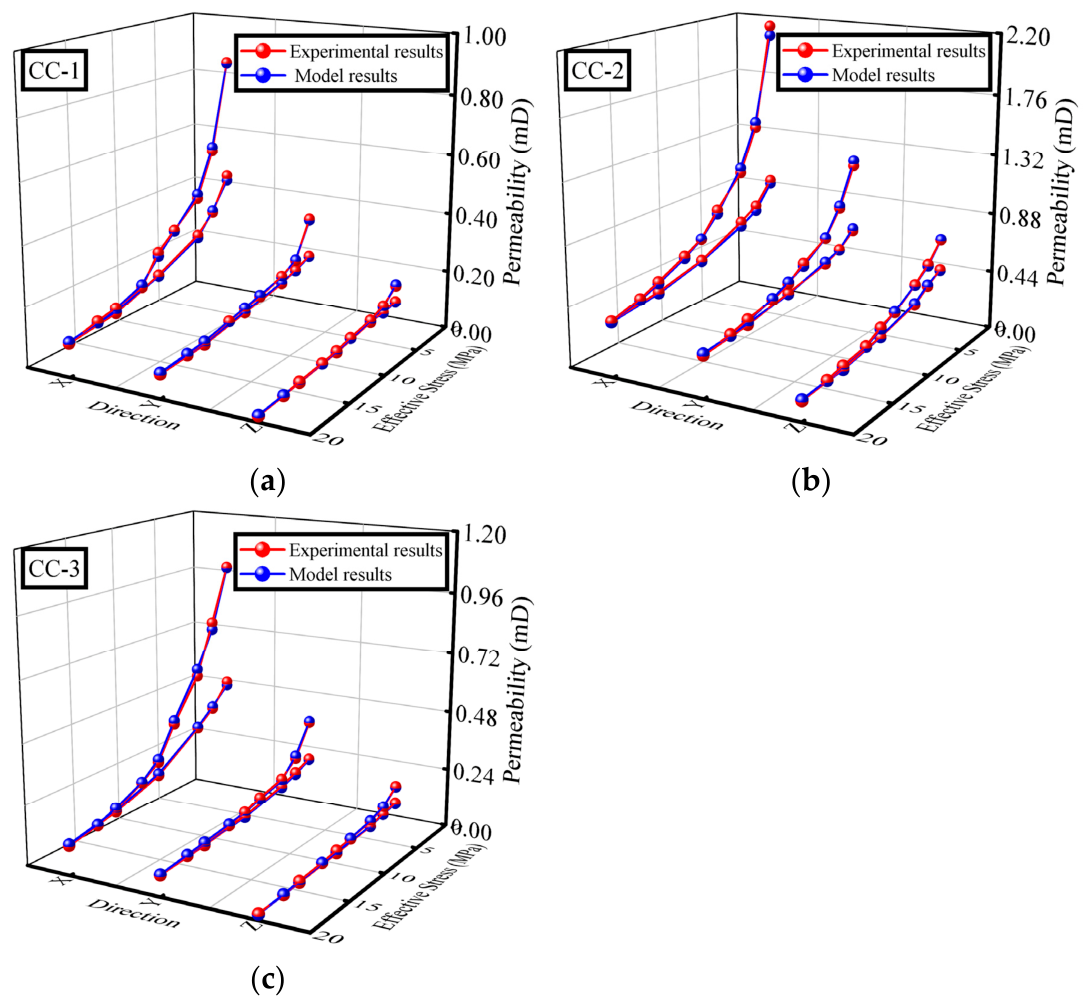
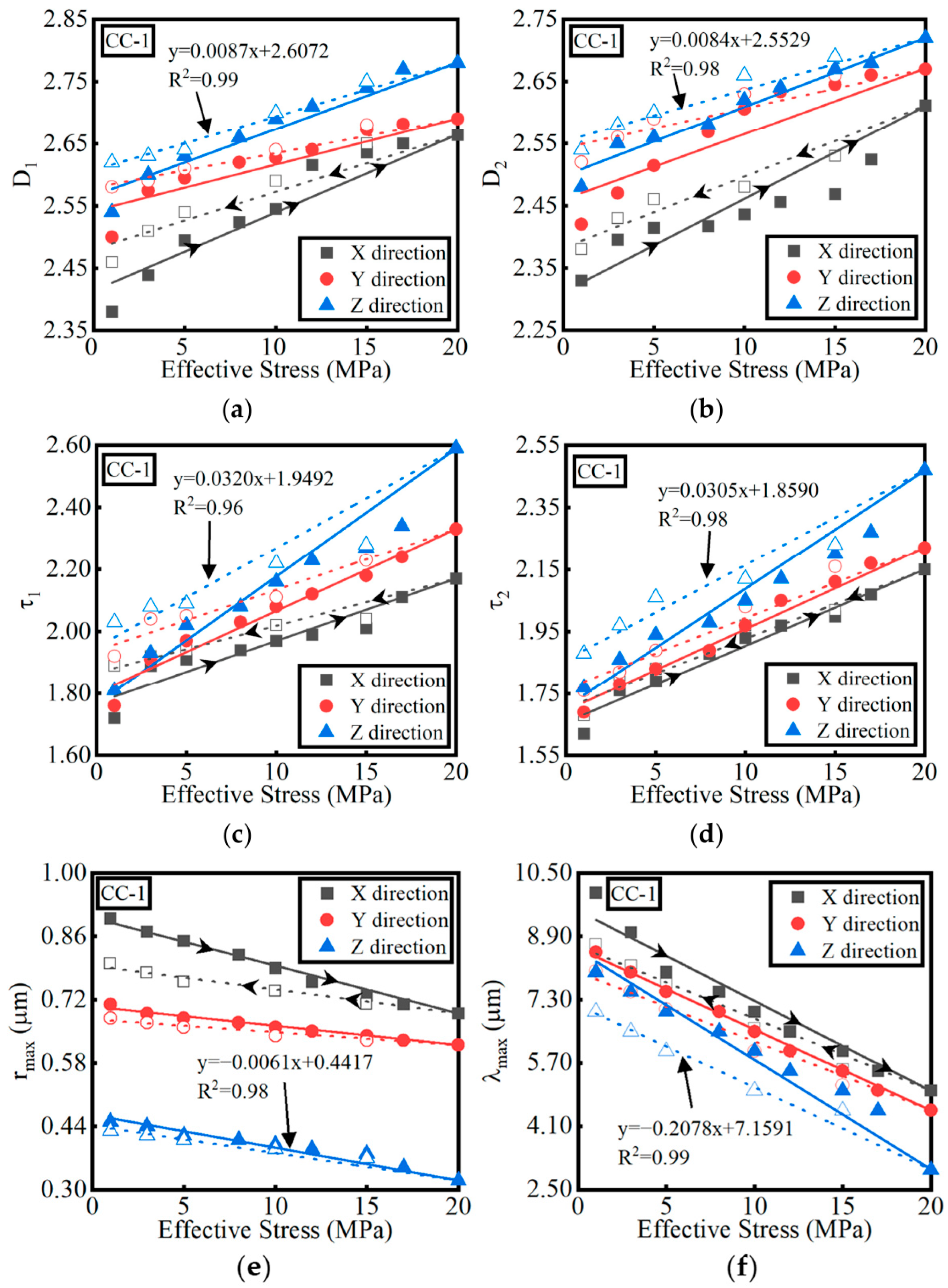
A comparison between the experimental results and the theoretical predictions from the fractal dual-pore series model is shown in Figure 9. The model results show strong agreement with the measured results, with an average relative error ≤ 4.2% and a maximum local error of less than 5%. Using the established dual porosity fractal series model, the matrix permeability and fracture permeability are calculated respectively, and the contribution of matrix pores and fractures to the total permeability is quantitatively distinguished. The results show that the contribution of fractures to permeability is as high as 95%~99%, which indicates that fractures are the main migration channels of fluids, while matrix pores mainly provide storage space for fluids. This demonstrates that the fractal series model effectively captures the permeability behavior of deep coal characterized by a dual-pore structure. Model parameters were determined by fitting the experimental permeability data using the Levenberg–Marquardt nonlinear least-squares algorithm, with the fitting process strictly constrained by microstructural features obtained from CT and SEM observations to ensure physical meaningfulness. Three coal specimens exhibit similar pore-fracture fractal dimensions, tortuosity, and maximum pore size. Figure 10 depicts the structural parameters of specimen CC-1, revealing significant anisotropy. Specifically, both the fractal dimension and tortuosity are lowest along the X direction and highest along the Z direction, while the maximum pore size is largest along the X direction and smallest along the Z direction. These directional trends are consistent with the microstructural characteristics observed by SEM (Figure 3) and μCT (Figure 4). The results suggest that, along the X direction, the pore-fracture system is more orderly, characterized by wider apertures and superior connectivity, providing smoother and more efficient fluid pathways. In contrast, the Y direction exhibits more complex structure than the X direction but is less complex than the Z direction. The Z direction has the most structurally complex system, with smaller pore or fracture apertures, poor connectivity, and highly tortuous flow paths, resulting in the weakest fluid transport capacity.

5. Discussion

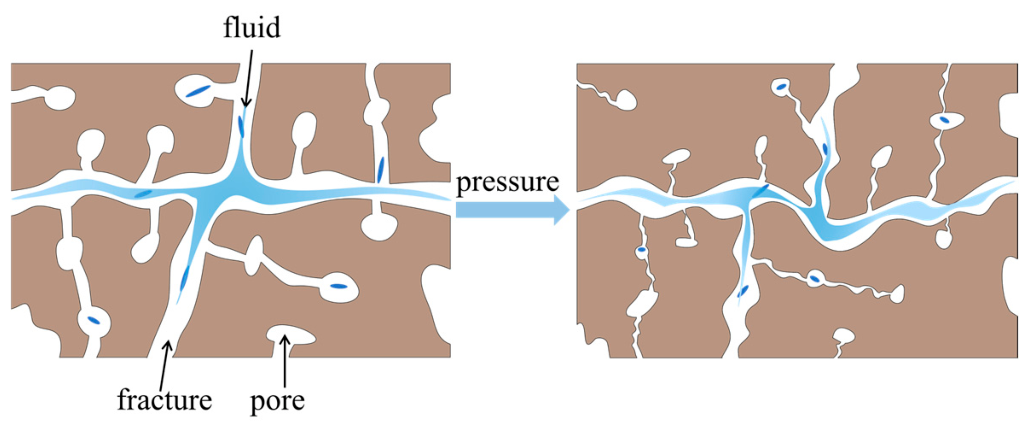
As shown in Figure 10, with increasing effective stress, the fractal dimension and tortuosity of the specimen increase linearly, while the maximum pore size decreases linearly. These trends demonstrate that increasing stress renders the internal pore-fracture structure of deep coal more intricate, with diminished apertures and enhanced flow-path tortuosity (Figure 11). This structural evolution impairs fluid transport and consequently reduces permeability. Although partial recovery of these parameters is observed during the unloading stage, none revert to their initial values, signifying partial irreversibility of stress-induced alterations in the pore-fracture system. The irreversibility explains the observed permeability hysteresis and confirms that stress-induced microstructural deformation is a significant mechanism governing the stress sensitivity of permeability.
The experimental results and fractal modeling together provide new insights into the stress-dependent permeability behavior of deep cataclastic coals. The observed negative exponential decline of permeability with effective stress is consistent with earlier studies on stress sensitivity of coal reservoirs, but the directional differences identified here highlight the unique role of cleat systems. Permeability in the face cleat direction not only exhibited the highest initial values but also showed the strongest stress sensitivity and largest hysteresis during unloading, confirming that flow pathways dominated by large-aperture and well-connected fractures are most vulnerable to irreversible closure under stress. In contrast, permeability perpendicular to bedding remained consistently low but relatively stable, indicating that bedding planes act as barriers limiting both initial flow capacity and stress-induced damage. The application of fractal theory further revealed the underlying structural mechanisms. Increases in fractal dimension and tortuosity with stress indicate that the pore structure becomes more complicated and less conductive as effective stress rises. The reduction of maximum pore size under compression further constrains gas migration. Although partial recovery was observed during unloading, the incomplete restoration of fractal parameters demonstrates that the microstructural deformation caused by stress is only partly elastic and largely irreversible, which explains the hysteresis in permeability recovery. These findings corroborate the dual-pore fractal series model as a robust framework for coupling microstructural evolution with macroscopic flow behavior in deep coal reservoirs.
From a reservoir engineering perspective, the pronounced permeability anisotropy implies that gas production potential is direction-dependent. Wells or hydraulic fractures oriented along face cleats are expected to achieve higher initial deliverability but may also suffer greater declines with reservoir depletion or stress redistribution. Conversely, butt cleat and normal bedding directions, exhibit more stable performance under stress, although less permeable. This suggests that reservoir stimulation strategies for deep CBM should account for anisotropic permeability evolution: maximizing connectivity along face cleats while mitigating stress-induced closure. Note that some open issues exist in the study, the experimental work was based on a limited number of specimens and stress ranges, and the effects of gas sorption-induced deformation were not explicitly incorporated. In addition, although the fractal model captures the key features of dual-pore systems, further refinement is required to integrate multiscale heterogeneity and time-dependent creep effects. A comprehensive investigation of permeability evolution in different types of cataclastic coals, incorporating wide stress range and gas sorption effects, will be addressed in future work.

6. Conclusions

This study investigates the permeability of deep coal under varying effective stress conditions through measurements on three oriented specimen sets. A fractal dual-pore series model was developed to represent permeability. The combined approach of experiment and theoretical modeling was employed to analyze the anisotropy and stress sensitivity of permeability in deep coal. The key findings are presented below:
Coal permeability exhibits a negative exponential dependence on effective stress and displays pronounced hysteresis upon unloading. The coal specimens permeability displays significant permeability anisotropy, following the order: perpendicular to bedding plane < parallel to butt cleats < parallel to face cleats. The permeability anisotropy reduces exponentially with increasing effective pressure. At low stress stages, the difference between the perpendicular bedding plane and butt cleats directions is minimal. When effective stress value exceeds 10 MPa, the permeability contrast between the face and butt cleats directions becomes the smallest.
The results of modeling show that three specimens exhibit significantly directional differences in structural parameters: fractal dimension and tortuosity are lowest in the parallel face cleat direction and highest in the perpendicular bedding plane direction, while the maximum pore size is largest in the parallel face cleats direction and smallest in the perpendicular bedding plane direction. As effective stress increases, fractal dimension and tortuosity increase linearly, while the maximum pore size decreases linearly. The maximum pore size, tortuosity, and fractal dimension are among the key parameters governing the stress sensitivity and anisotropy of permeability.

Author Contributions

Conceptualization, F.G.; methodology, Y.W.; software, W.K.; validation, S.P. and Z.Z.; data curation, F.G.; writing—original draft preparation, Y.W.; writing—review and editing, F.G.; funding acquisition, F.G. All authors have read and agreed to the published version of the manuscript.

Funding

This research was funded by the Coal-Major Project, grant number 2025ZD1700703, the National Natural Science Fund Projects, grant number 42474146, and the CNPC Innovation Found, grant number 2024DQ02-0133.

Data Availability Statement

The data that supports the findings of this study are available from the corresponding author upon reasonable request.

Conflicts of Interest

Author Wujiang Kang was employed by the company Research Institute of Exploration and Development, Liaolei Oilfield Company, Petrochina. The remaining authors declare that the research was conducted in the absence of any commercial or financial relationships that could be construed as a potential conflict of interest.

References

  1. Gong, F.; Cheng, J.; Wang, G.; Peng, S.; Zhang, Z. The effect of lamination on elastic anisotropy of primary coals under confining pressure: Experiment and theoretical modelling. Geophys. Prospect. 2025, 73, 1228–1242. [Google Scholar] [CrossRef]
  2. Ivanova, S.; Vesnina, A.; Fotina, N.; Prosekov, A. An overview of carbon footprint of coal mining to curtail greenhouse gas emissions. Sustainability 2022, 14, 15135. [Google Scholar] [CrossRef]
  3. Zhang, J.; Lin, H.; Li, S.; Yang, E.; Ding, Y.; Bai, Y.; Zhou, Y. Accurate gas extraction (AGE) under the dual-carbon background: Green low-carbon development pathway and prospect. J. Clean. Prod. 2022, 377, 134372. [Google Scholar] [CrossRef]
  4. Zhao, M.; Jin, Y.; Liu, X.; Zheng, J.; Liu, S. Characterizing the complexity assembly of pore structure in a coal matrix: Principle, methodology, and modeling application. J. Geophys. Res. Solid Earth 2020, 125, e2020JB020110. [Google Scholar] [CrossRef]
  5. Zhou, H.; Zhang, L.; Wang, X.; Rong, T.; Wang, L. Effects of matrix-fracture interaction and creep deformation on permeability evolution of deep coal. Int. J. Rock Mech. Min. Sci. 2020, 127, 104236. [Google Scholar] [CrossRef]
  6. Pan, J.; Zhang, Z.; Li, M.; Wu, Y.; Wang, K. Characteristics of multi-scale pore structure of coal and its influence on permeability. Nat. Gas Ind. B 2019, 6, 357–365. [Google Scholar] [CrossRef]
  7. Shen, Z.; Meng, Z.; Liu, Y.; Lei, J.; Shen, W.; Ren, H.; Gao, T.; Zhang, K.; Wang, Y.; Tan, L. Relationship between multiscale nanopore structure and coal connectivity during coalification process. Microporous Mesoporous Mater. 2023, 360, 112717. [Google Scholar] [CrossRef]
  8. Zhang, K.; Jin, Y.; Meng, Z.; Wang, X.; Li, M. Experimental investigation on pore characteristics of heterogenous coal structures reservoir and coalbed methane diffusion/seepage behaviors. Phys. Fluids 2024, 36, 076612. [Google Scholar] [CrossRef]
  9. He, Y.; Li, X.; Xie, H.; Li, X.; Xia, T.; Chen, S. Dynamics change of coal methane adsorption/desorption and permeability under temperature and stress conditions. Phys. Fluids 2025, 37, 016605. [Google Scholar] [CrossRef]
  10. Gong, F.; Wu, Y.; Kang, W.; Peng, S.; Wang, G.; Bao, Y. Comparison of permeability in cataclastic coals along the face and butt cleat directions: Experiment and fractal analysis. J. Geophys. Eng. 2026, 23, 109–118. [Google Scholar] [CrossRef]
  11. Wang, J.; Wan, Z.; Wang, Y.; Liu, Z.; Liu, S.; Zhang, H.; Pei, Q. Effect of Stress and Moisture Content on Permeability of Gas-Saturated Raw Coal. Geofluids 2020, 2020, 8837758. [Google Scholar] [CrossRef]
  12. Yang, D.; Qi, X.; Chen, W.; Wang, S.; Yang, J. Anisotropic permeability of coal subjected to cyclic loading and unloading. Int. J. Geomech. 2018, 18, 04018093. [Google Scholar] [CrossRef]
  13. Zou, Y.; Cheng, B. Experimental study on mapping mechanism of loading process of rock and coal and gas permeability. Coal Sci. Technol. 2019, 47, 224–230. [Google Scholar]
  14. Mitra, A.; Harpalani, S.; Liu, S. Laboratory measurement and modeling of coal permeability with continued methane production: Part 1—Laboratory results. Fuel 2012, 94, 110–116. [Google Scholar] [CrossRef]
  15. Wang, Z.; Cheng, Y.; Qi, Y.; Wang, R.; Wang, L.; Jiang, J. Experimental study of pore structure and fractal characteristics of pulverized intact coal and tectonic coal by low temperature nitrogen adsorption. Powder Technol. 2019, 350, 15–25. [Google Scholar] [CrossRef]
  16. Lou, Z.; Wang, K.; Zang, J.; Zhao, W.; Qin, B.; Kan, T. Effects of permeability anisotropy on coal mine methane drainage performance. J. Nat. Gas Sci. Eng. 2021, 86, 103733. [Google Scholar] [CrossRef]
  17. Duan, M.; Jiang, C.; Gan, Q.; Zhao, H.; Yang, Y.; Li, Z. Study on permeability anisotropy of bedded coal under true triaxial stress and its application. Transp. Porous Media 2020, 131, 1007–1035. [Google Scholar] [CrossRef]
  18. Koenig, R.; Stubbs, P. Interference testing of a coalbed methane reservoir. In Proceedings of the SPE Unconventional Resources Conference/Gas Technology Symposium, Louisville, Kentucky, 18–21 May 1986. [Google Scholar]
  19. Yue, G.; Wang, H.; Zhao, Y.; Liang, W. Permeability characteristics of structurally anisotropic coal. Sci. Technol. Rev. 2015, 33, 50–55. [Google Scholar]
  20. Wang, D.; Lv, R.; Wei, J.; Zhang, P.; Yu, C.; Yao, B. An experimental study of the anisotropic permeability rule of coal containing gas. J. Nat. Gas Sci. Eng. 2018, 53, 67–73. [Google Scholar] [CrossRef]
  21. Yan, J.; Meng, Z.; Zhang, K.; Yao, H.; Hao, H. Pore distribution characteristics of various rank coals matrix and their influences on gas adsorption. J. Pet. Sci. Eng. 2020, 189, 107041. [Google Scholar] [CrossRef]
  22. Lu, S.; Cheng, Y.; Li, W.; Wang, L. Pore structure and its impact on CH4; adsorption capability and diffusion characteristics of normal and deformed coals from Qinshui Basin. Int. J. Oil Gas Coal Technol. 2015, 10, 94–114. [Google Scholar] [CrossRef]
  23. Guo, F.; Liu, G.; Zhang, Z.; Lv, R.; Xian, B.; Lin, J.; Barakos, G.; Chang, P. A Fractal Adsorption Model on Methane in Coal with Temperature Effect Dependence. Fractal Fract. 2024, 8, 370. [Google Scholar] [CrossRef]
  24. Jiang, W.; Zhou, Y.; Wu, C.; Du, M. Fractal characteristics and theirs influence on methane adsorption in high-rank coals with NMR. Front. Earth Sci. 2023, 10, 1047557. [Google Scholar] [CrossRef]
  25. Wang, L.; Wu, S.; Han, S.; Hu, B.; Wang, Q.; Zhang, K.; Song, T. Fractal analysis of coal pore structure based on low-pressure gas adsorption and its influence on methane adsorption capacity: A perspective from micropore filling model. Energy Fuels 2024, 38, 4031–4046. [Google Scholar] [CrossRef]
  26. Liu, W.; Han, D.; Xu, H.; Chu, X.; Qin, Y. Modeling of gas migration in a dual-porosity coal seam around a borehole: The effects of three types of driving forces in coal matrix. Energy 2023, 264, 126181. [Google Scholar] [CrossRef]
  27. Lin, H.; Tian, S.; Jiao, A.; Cao, Z.; Song, K.; Zou, Y. Pore characteristics and fractal dimension analysis of tectonic coal and primary-structure coal: A case study of Sanjia coal mine in Northern Guizhou. ACS Omega 2022, 7, 27300–27311. [Google Scholar] [CrossRef] [PubMed]
  28. Fu, W.; Hu, W.; Yi, T.; Kane, O.I.; Zhang, M.; Huang, X. Fractal Dimension Analysis of Pores in Coal Reservoir and Their Impact on Petrophysical Properties: A Case Study in the Province of Guizhou, SW China. Minerals 2022, 12, 1425. [Google Scholar] [CrossRef]
  29. Zhao, T.; Zou, G.; Peng, S.; Zeng, H.; Gong, F.; Yin, Y. Analysis of the viscoelasticity in coal based on the fractal theory. Geophysics 2023, 88, WA177–WA187. [Google Scholar] [CrossRef]
  30. Ma, Y. Multiscale Fractal Characterization of Pore Structure for Coal in Different Rank Using Scanning Electron Microscopy and Mercury Intrusion Porosimetry. Processes 2022, 10, 1577. [Google Scholar] [CrossRef]
  31. Han, L.; Shen, J.; Qu, J.; Ji, C. Characteristics of a multi-scale fracture network and its contributions to flow properties in anthracite. Energy Fuels 2021, 35, 11319–11332. [Google Scholar] [CrossRef]
  32. Le, T.; Ha, Q.; Panfilov, I.; Moyne, C. Multiscale model for flow and transport in CO2-enhanced coalbed methane recovery incorporating gas mixture adsorption effects. Adv. Water Resour. 2020, 144, 103706. [Google Scholar] [CrossRef]
  33. Li, R.; Wang, S.; Lyu, S.; Lu, W.; Li, G.; Wang, J. Geometry and filling features of hydraulic fractures in coalbed methane reservoirs based on subsurface observations. Rock Mech. Rock Eng. 2020, 53, 2485–2492. [Google Scholar] [CrossRef]
  34. Kang, J.; Fu, X.; Shen, J.; Liang, S.; Chen, H.; Shang, F. Characterization of coal structure of high-thickness coal reservoir using geophysical logging: A case study in Southern Junggar Basin, Xinjiang, Northwest China. Nat. Resour. Res. 2022, 31, 929–951. [Google Scholar] [CrossRef]
  35. Wang, K.; Zang, J.; Wang, G.; Zhou, A. Anisotropic permeability evolution of coal with effective stress variation and gas sorption: Model development and analysis. Int. J. Coal Geol. 2014, 130, 53–65. [Google Scholar] [CrossRef]
  36. Zhang, Y.; Tsang, M.; Knackstedt, M.; Turner, M.; Latham, S.; Macaulay, E.; Pitchers, R. A three-dimensional feature extraction-based method for coal cleat characterization using X-ray μCT and its application to a Bowen Basin coal specimen. J. Rock Mech. Geotech. Eng. 2024, 16, 153–166. [Google Scholar] [CrossRef]
  37. Liu, P.; Nie, B.; Zhao, Z.; Li, J.; Yang, H.; Qin, C. Permeability of micro-scale structure in coal: Insights from μ-CT image and pore network modelling. Gas Sci. Eng. 2023, 111, 204931. [Google Scholar] [CrossRef]
  38. Siriwardane, H.; Haljasmaa, I.; McLendon, R.; Irdi, G.; Soong, Y.; Bromhal, G. Influence of carbon dioxide on coal permeability determined by pressure transient methods. Int. J. Coal Geol. 2009, 77, 109–118. [Google Scholar] [CrossRef]
  39. Evans, B.; Wong, T. Fault Mechanics and Transport Properties of Rocks; Academic Press: San Diego, CA, USA, 1992. [Google Scholar]
  40. Chen, Z.; Fu, X.; Li, G.; Shen, J.; Tian, Q.; Cheng, M.; Wang, Y. Investigation on the CBM Extraction Techniques in the Broken-Soft and Low-Permeability Coal Seams in Zhaozhuang Coalmine. Geofluids 2021, 2021, 1163413. [Google Scholar] [CrossRef]
  41. Dicker, A.; Smits, R. A practical approach for determining permeability from laboratory pressure-pulse decay measurements. In Proceedings of the SPE International Oil and Gas Conference and Exhibition in China, Tianjin, China, 1–4 November 1988. [Google Scholar]
  42. Pan, Z.; Connell, L. Modelling permeability for coal reservoirs: A review of analytical models and testing data. Int. J. Coal Geol. 2012, 92, 1–44. [Google Scholar] [CrossRef]
  43. Cao, Q.; Jiang, K.; Wen, Z.; Wang, X.; Qi, M.; Yin, Z. Characteristics of organic matter pores and the relationship with current pressure system of Lower Silurian Longmaxi shales in Dingshan Field, southern Sichuan, China. Geofluids 2021, 2021, 9967479. [Google Scholar] [CrossRef]
  44. Ma, K.; Wang, L.; Peng, Y.; Long, L.; Wang, S.; Chen, T. Permeability characteristics of fractured rock mass: A case study of the Dongjiahe coal mine. Geomat. Nat. Hazards Risk 2020, 11, 1724–1742. [Google Scholar] [CrossRef]
  45. Jaeger, J.; Cook, N.; Zimmerman, R. Fundamentals of Rock Mechanics; John Wiley & Sons: Hoboken, NJ, USA, 2009. [Google Scholar]
  46. Zhang, L.; Ren, T.; Li, X.; Tan, L. Acoustic emission, damage and cracking evolution of intact coal under compressive loads: Experimental and discrete element modelling. Eng. Fract. Mech. 2021, 252, 107690. [Google Scholar] [CrossRef]
  47. Cheng, Y.; Zhao, C.; Li, W. Stress-sensitivity of coal fracture systems and its governing mechanism on permeability. J. China Coal Soc. 2026, 51, 426–447. [Google Scholar]
  48. Li, J.; Li, B.; Cheng, Q.; Gao, Z. Characterization of anisotropic coal permeability with the effect of sorption-induced deformation and stress. Fuel 2022, 309, 122089. [Google Scholar] [CrossRef]
  49. Gong, F.; Zou, G.; Zhang, Z.; Peng, S.; Wang, G.; Chen, H. An anisotropic rock physics modeling for the coalbed methane reservoirs and its applications in anisotropy parameter prediction. J. Appl. Geophys. 2024, 225, 105381. [Google Scholar] [CrossRef]
  50. Yu, S.; Kang, Q.; Mehana, M. Quantifying the effect of pore-size dependent wettability on relative permeability using capillary bundle model. J. Geophys. Res. Solid Earth 2024, 129, e2024JB028674. [Google Scholar] [CrossRef]
  51. Yuan, Y.; Meng, Y.; Su, X.; Tang, H. New method for quantitative prediction of liquid flowback based on the capillary bundle model. ACS Omega 2020, 6, 465–475. [Google Scholar] [CrossRef]
  52. Erol, S.; Fowler, S.; Harcouët-Menou, V.; Laenen, B. An analytical model of porosity-permeability for porous and fractured media. Transp. Porous Media 2017, 120, 327–358. [Google Scholar] [CrossRef]
  53. Pincock, C. The derivation of Poiseuille’s law: Heuristic and explanatory considerations. Synthese 2021, 199, 11667–11687. [Google Scholar] [CrossRef]
  54. Darcy, H. Les Fontaines Publiques de la Ville de Dijon: Exposition et Application des Principes à Suivre et des Formules à Employer dans les Questions de Distribution d’Eau; Victor Dalmont: Paris, France, 1856. [Google Scholar]
Figure 1. Schematic distribution bedding plane, face cleat, and butt cleat of cataclastic coal [35].
Fractalfract 10 00383 g001
Figure 2. Cataclastic coal specimen collection and plunger-shaped coal specimen.
Fractalfract 10 00383 g002
Figure 3. Microscopic observation of coal specimen CC-3: (a) SEM image of pores; (b) SEM image of cleats system.
Fractalfract 10 00383 g003
Figure 4. Scheme of three-dimensional reconstruction process of pore-fracture structure of coal specimen CC-3.
Fractalfract 10 00383 g004
Figure 5. Schematic diagram of permeability test system.
Fractalfract 10 00383 g005
Figure 6. Permeability as function of effective stress during loading (solid) and unloading (dashed) process: (a) CC-1; (b) CC-2; (c) CC-3.
Fractalfract 10 00383 g006
Figure 7. Hysteresis of permeability as function of effective stress: (a) CC-1; (b) CC-2; (c) CC-3.
Fractalfract 10 00383 g007
Figure 8. Permeability anisotropy difference as function of effective stress: (a) CC-1; (b) CC-2; (c) CC-3.
Fractalfract 10 00383 g008
Figure 9. The comparison between the calculation of the dual-pore fractal model and the experimental results: (a) CC-1; (b) CC-2; (c) CC-3.
Fractalfract 10 00383 g009
Figure 10. Pore-fracture fractal dimension, tortuosity, size as function of effective stress of coal specimen CC-1 during loading (solid) and unloading (dashed) processes: (a) fractal dimension of the pore; (b) fractal dimension of the fracture; (c) pores tortuosity; (d) fracture tortuosity; (e) the maximum pore size; (f) the maximum fracture aperture.
Fractalfract 10 00383 g010
Figure 11. Schematic diagram of deep coal pore structure changing with effective pressure.
Fractalfract 10 00383 g011
Table 1. Basic physical parameters of specimens.
Specimen NumberDensity (g/cm3)Porosity (%)Maximum Vitrinite Reflectance (%)Organic Matter Content (%)Clay Mineral Content (%)Calcite Content (%)Quartz Content (%)Pyrite Content (%)
CC-11.475.982.6885.210.32.11.80.6
CC-21.417.981.7889.76.21.71.31.1
CC-31.446.822.1887.47.42.61.70.9
Disclaimer/Publisher’s Note: The statements, opinions and data contained in all publications are solely those of the individual author(s) and contributor(s) and not of MDPI and/or the editor(s). MDPI and/or the editor(s) disclaim responsibility for any injury to people or property resulting from any ideas, methods, instructions or products referred to in the content.