
Article

Tempered Fractional Deterministic Learning for Online Battery State-of-Health Estimation: A Cycle-Level Benchmark Study


1
Department of Electronics Engineering, Applied College, University of Ha’il, Ha’il 2440, Saudi Arabia
2
Computer Science Department, Applied College, University of Ha’il, Ha’il 2440, Saudi Arabia
3
Department of Management Information Systems, Applied College, University of Ha’il, Ha’il 2440, Saudi Arabia
4
Department of Mathematics and Statistics, College of Engineering, Abu Dhabi University, Abu Dhabi P.O. Box 59911, United Arab Emirates
*
Author to whom correspondence should be addressed.
Fractal Fract. 2026, 10(5), 331; https://doi.org/10.3390/fractalfract10050331
Submission received: 27 March 2026 / Revised: 27 April 2026 / Accepted: 5 May 2026 / Published: 12 May 2026

Abstract

Accurate battery state-of-health (SOH) estimation is essential for safe and reliable electric-vehicle operation. This paper presents a Tempered Fractional Deterministic Learning (TF-DL) framework that combines deterministic learning with a tempered fractional adaptation law to introduce tunable memory and graceful forgetting into SOH estimation. Two realizations are considered: an exact truncated variant (TF-DL-T) and an embedded low-memory variant (TF-DL-E). The framework is evaluated on a NASA-derived cycle-level battery aging benchmark with capacity-based SOH labels and a battery-level train/test split. After filtering, 14 batteries were retained, of which 9 were used for training and 5 unseen batteries were used for testing. Random Forest achieved the best overall performance (MAE = 0.0436, RMSE = 0.0496), while LSTM was the strongest sequence baseline (MAE = 0.0757, RMSE = 0.0920). Among the online RBF-based methods, TF-DL-E achieved the best performance (MAE = 0.0966, RMSE = 0.1077), outperforming GD-DL and TF-DL-T. Unlike offline methods, TF-DL-E operates online with constant memory, which makes it suitable for embedded battery management systems. The results indicate that TF-DL-E is the more robust and practically relevant tempered variant, whereas TF-DL-T remains more fragile and parameter-sensitive.

1. Introduction

Li-ion batteries have found their way to be the most common energy-storage technology in electric vehicles due to their high-energy density, long cycle life, and desirable power characteristics. Their safe and efficient use, however, depends strongly on accurate estimation of key internal states, particularly the state of charge (SOC) and the state of health (SOH). Reliable SOH information is essential not only for range prediction and maintenance planning, but also for safety supervision, warranty management, energy management, and fleet-level decision support. Recent surveys show that machine-learning and deep-learning approaches are increasingly complementing, and in some cases surpassing, classical model-based estimators when operating conditions become highly nonlinear, noisy, and variable across temperature, duty cycle, and aging stage [1,2,3]. In addition, battery-health estimation is now closely connected to broader vehicle- and grid-level services, such as fleet analytics, resilience-oriented scheduling, and intelligent energy management [4,5,6].
Within data-driven SOH/SOC estimation, a wide spectrum of methods has been investigated. Feature-based machine-learning models and hybrid electrochemical/data-driven estimators can provide strong performance when informative health features are available [7,8]. Recurrent and hybrid deep-learning architectures have also demonstrated strong nonlinear modeling capability for battery diagnostics, prognostics, and safety-related monitoring [9]. Related developments include temporal models with uncertainty representation for risk-aware estimation [10], deep-reinforcement-learning-guided estimation for adaptive operation [11], active cell-equalization strategies [12], interpretable fault diagnosis in heavy-duty electric vehicles [13], remaining-life prediction [14], and adaptive charging-time prediction through transfer learning [15]. More generally, the design of data-driven battery monitoring pipelines is tightly connected to fault diagnosis, energy management, and decision support in modern electric-vehicle systems [5,6,16].
Despite this progress, three persistent challenges remain. First, battery degradation evolves over long horizons and exhibits multi-rate behavior; therefore, an effective estimator should exploit informative historical trends while attenuating stale or corrupted information. Normal first-order online updates possess limited memory and can be made fragile by nonstationary operation and noisy sensing. Second, health estimators must be robustly cross-battery and cross-condition with respect to the health estimator, and must have access to valuable information based on previously observed degradation behavior. Third, battery-management-system-grade algorithms must remain lightweight, stable, and compatible with observer-based safety logic and embedded implementation. These issues are repeatedly emphasized in recent reviews of machine-learning and neural-network-based SOH estimation, which also note that evaluation practices remain fragmented across datasets, labels, and operating scenarios [1,2,17,18]. Representative sequence-learning approaches such as LSTM and CNN–BiLSTM can provide strong predictive performance on public battery datasets, whereas uncertainty-aware and dynamic-condition methods further improve robustness and practical relevance [19,20,21,22].
A broader qualitative comparison with representative SOH estimation families is provided in Appendix A; see Table A1, where the proposed TF-DL framework is positioned relative to tree-based machine learning, recurrent deep learning, hybrid sequence models, and uncertainty-aware approaches.
Fractional calculus offers a principled way to model memory and hereditary effects that naturally arise in battery aging processes. In particular, tempered fractional operators preserve the long-memory benefit of fractional calculus while introducing exponential attenuation of distant history, thereby improving numerical stability and reducing the influence of obsolete information [23]. Recent developments in tempered fractional gradient descent have formalized these advantages and given recursive algorithms with controlled truncation error and desirable convergence behavior to noisy and nonstationary learning tasks [24]. Parallel to this, the theory of Deterministic Learning (DL) offers a small, theoretically motivated framework to solve problems of unknown nonlinear dynamics by radial-basis-function (RBF) neural networks using partial persistence of excitation [25,26]. The two directions of study are complementary to each other: deterministic learning provides a structured local-learning algorithm, and tempered fractional optimization provides a tunable memory algorithm that is well adapted to slow-varying and noise-corrupted battery-health dynamics.
Driven by this complementarity, this study offers a Tempered Fractional Deterministic Learning (TF-DL) system to estimate battery SOH. The key concept is that the traditional first-order DL weight-adaptation law is substituted by a tempered fractional update to allow the learning dynamics to use the informative long-range history and high discounts to use outdated data. The resulting framework remains compatible with observer-based and control-oriented BMS architectures. In this broader context, fault-tolerant LPV and fuzzy control strategies rely on reliable SOH/SOC indicators [27,28,29,30], while conformable–fractional optimization tools offer additional flexibility for memory-aware adaptation and control design [31]. Recent advances in nonlinear and fractional observers, including non-fragile H observers, unknown-input observers for tempered fractional systems, finite-time results for fuzzy delayed structures, and fractional state-detection tools, further highlight the relevance of hybrid model–data approaches in battery-management applications [32,33,34,35,36]. Observer and software–sensor design for renewable-energy and sensorless-drive systems has also reached a mature level of practical deployment, which reinforces the plausibility of deploying TF-DL-type estimators on embedded hardware [37,38,39,40,41].
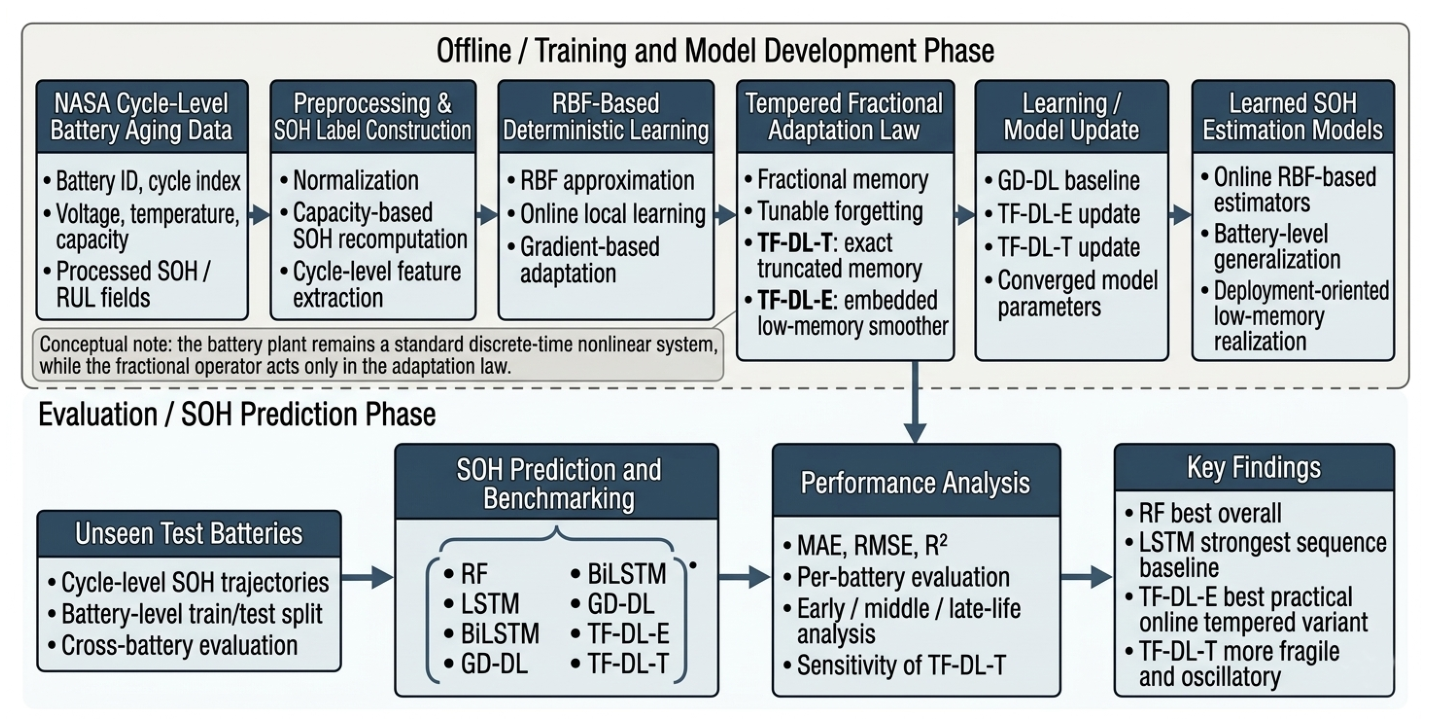
Figure 1 summarizes the revised logic of the proposed TF-DL framework. The upper part of the figure corresponds to the offline/training and model development phase, in which NASA cycle-level battery aging data are preprocessed, the SOH target is constructed from capacity, local nonlinear dynamics are represented with an RBF-based deterministic-learning core, and the parameter adaptation is enhanced by tempered fractional memory. The lower part of the figure corresponds to the evaluation/cycle-level SOH prediction phase, where the trained models are benchmarked on unseen test batteries and compared against representative baselines. Importantly, the figure also makes explicit that the battery plant itself remains a standard discrete-time nonlinear system, whereas the fractional operator acts only in the adaptation law. This distinction is central to the formulation of the manuscript and clarifies the role of tempering and fractional memory in the proposed estimator.
For convenience, the principal abbreviations and mathematical symbols used throughout the manuscript are summarized in Appendix B; see Table A2 and Table A3. Additional supporting comparisons and notations are reported in Appendices Appendix A and Appendix B.
The main contributions of this paper are as follows:
  • A tempered fractional deterministic learning framework is formulated in which the fractional operator is introduced explicitly in the adaptation law rather than in the battery plant model. This resolves the ambiguity that often arises when fractional-order learning rules are embedded into standard nonlinear estimators.
  • Two practical realizations are developed: an exact truncated tempered fractional law (TF-DL-T) and an embedded low-memory approximation (TF-DL-E), the latter providing an O ( 1 ) -memory implementation suitable for deployment-oriented battery-management applications.
  • The practical roles of the two tempered variants are clarified empirically: TF-DL-E acts as a smoother and more stable online tempered adaptation mechanism, whereas TF-DL-T is shown to be more fragile and parameter-sensitive under cross-battery SOH generalization.
  • The framework is validated on a NASA-derived cycle-level SOH benchmark with explicit capacity-based SOH label construction and a battery-level train/test split, and is compared against representative baselines, including Random Forest, LSTM, and BiLSTM in addition to GD-DL, TF-DL-E, and TF-DL-T [19,20,42,43].
The remainder of the paper is organized as follows. Section 2 reviews the essentials of deterministic learning and tempered fractional optimization. Section 3 presents the TF-DL estimator, its finite-memory and embedded realizations, and the associated convergence statement. Section 4 reports the NASA cycle-level SOH benchmark, including the battery-level split, the comparison with external baselines, the battery-wise and life-stage analysis, and the sensitivity study of the truncated fractional variant. Finally, Section 5 summarizes the main findings and outlines future research directions.

2. Preliminaries

This section briefly reviews the theoretical foundations of the proposed framework, namely the system-identification principles of Deterministic Learning (DL) and the optimization mechanics of tempered fractional calculus. Their combination provides the basis of the proposed TF-DL approach.

2.1. Deterministic Learning Theory

Deterministic Learning (DL) is a framework for the fast identification and compact representation of unknown nonlinear dynamics along operating trajectories. It is commonly implemented with Radial Basis Function (RBF) neural networks and relies on a partial persistence of excitation (PE) condition to guarantee local identifiability of the learned dynamics [25].
In the present work, the battery degradation process is represented by the discrete-time nonlinear model
x k + 1 = x k + T s F ( x k , u k ; ϑ k ) + ω k ,
where x k R n collects the measurable variables available to the estimator (e.g., voltage, current, temperature, or derived features), u k R m denotes the applied excitation or input, T s > 0 is the sampling period, and ω k is a bounded disturbance satisfying ω k ω * . The vector ϑ k denotes slowly varying latent health-related parameters, and the state of health (SOH) is regarded as a function of these parameters, i.e.,
h k = Ψ ( ϑ k ) , h k ( 0 , 1 ] .
Equation (1) is a standard discrete-time nonlinear state evolution; the fractional operator introduced later acts only in the adaptation law and not in the battery state equation itself. In the experimental section, this general formulation is specialized to cycle-level SOH prediction, where the target is constructed from the capacity trajectory of each battery.
On a compact operating domain Ω R n + m , the unknown nonlinear map F can be approximated by an RBF network as
F ( x , u ) = W * S ( x , u ) + ε ( x , u ) ,
where W * R N × n is the ideal weight matrix, S ( x , u ) R N is the regressor vector, and ε ( x , u ) R n is the bounded approximation error satisfying
ε ( x , u ) ε * , ( x , u ) Ω .
The regressor is constructed from Gaussian basis functions
s i ( z ξ i ) = exp z ξ i 2 η 2 , z = x T u T T ,
where ξ i denotes the center of the ith basis function and η > 0 is the common width parameter.
A cornerstone of DL theory is that, for a recurrent or nearly recurrent operating trajectory φ ζ , only a subset of basis functions located near that trajectory is effectively excited. Let S ζ ( x k , u k ) denote the corresponding local subvector of S ( x k , u k ) . Then the partial PE condition requires the existence of constants α 1 , α 2 > 0 and an integer window length δ N such that, for all k 0 0 ,
α 2 I 1 δ k = k 0 k 0 + δ S ζ ( x k , u k ) S ζ ( x k , u k ) α 1 I > 0 .
Under (6), standard DL results imply that a gradient-type adaptation law drives the local weight estimation error to a compact neighborhood of zero exponentially fast, up to the effects of ε * and ω * . Consequently, the learned local dynamics can be stored in a compact neural representation, thereby forming a reusable knowledge element associated with the operating mode ζ [25].

2.2. Tempered Fractional Calculus and Gradient Descent

Fractional calculus is a generalization of classical integration and differentiation to non-integer orders, and a principled way of adding memory and hereditary effects to modeling, estimation, and optimization [23]. This is desirable in online learning due to the fact that information associated with degradation is spread across long horizons. Tempering further adds an exponential factor to the fractional memory kernel to focus on informative recent history, and suppress obsolete information, to enhance numerical stability in nonstationary and noisy environments [24].
To model this behavior in the adaptation law, the present work employs a tempered fractional accumulation of past gradients.
Definition 1
(Tempered fractional gradient memory). Let J : R p R be a continuously differentiable loss function and let θ k R p denote the parameter vector at iteration k. For a fractional order α ( 0 , 1 ) and a tempering parameter λ > 0 , define the kernel
c 0 ( α ) = 1 , c j ( α ) = ( 1 ) j α j = Γ ( j + α ) Γ ( α ) Γ ( j + 1 ) , j 1 ,
which satisfies c j ( α ) > 0 for all j 0 and c j ( α ) j α 1 / Γ ( α ) as j . The discrete tempered fractional accumulation of past gradients is then defined as
G k ( α , λ ) = j = 0 k c j ( α ) e λ j J ( θ k j ) .
The associated Tempered Fractional Gradient Descent (TFGD) update is
θ k + 1 = θ k η G k ( α , λ ) , η > 0 .
When λ = 0 , (8) reduces to an untempered discrete fractional memory operator. The parameter α controls the strength of long-range memory, whereas λ controls the forgetting rate. Hence, ( α , λ ) jointly determine how strongly the algorithm exploits remote history and how fast stale information is discarded.
Lemma 1
(Tempered kernel summability and truncation bound). For α ( 0 , 1 ) and λ > 0 , the kernel in (7) is absolutely summable after tempering, and
j = 0 c j ( α ) e λ j = ( 1 e λ ) α = : d α , λ .
Moreover, if
τ L ( α , λ ) : = j = L + 1 c j ( α ) e λ j ,
then
τ L ( α , λ ) = O e λ L L α 1 , L .
Therefore, the tempered fractional memory admits a controllable finite-memory approximation whose truncation error decays exponentially in the memory horizon L.
For embedded Battery Management System (BMS) implementation, an exact infinite-history realization of (8) is unnecessary. A practical truncated-memory realization is
G k , L ( α , λ ) = j = 0 min { k , L } c j ( α ) e λ j J ( θ k j ) ,
where L is a prescribed memory length. If J ( θ k ) G * for all k, then the truncation error satisfies
G k ( α , λ ) G k , L ( α , λ ) G * τ L ( α , λ ) .
Hence, (13) preserves the fractional-order interpretation while remaining compatible with finite-memory hardware.
For highly resource-constrained embedded realization, one may additionally employ the exponentially filtered surrogate
M k = β M k 1 + ( 1 β ) J ( θ k ) , 0 < β = e λ < 1 , M 0 = J ( θ 0 ) ,
together with
θ k + 1 = θ k η M k .
It is important to note that (15) and (16) constitute an implementable low-memory approximation of the tempered fractional memory, not an exact Grünwald–Letnikov realization. This distinction is made explicit here to avoid conflating the exact fractional operator with its embedded surrogate.

2.3. Synthesis: Rationale for a Novel Fusion

Classical DL offers an elegant mechanism for learning and storing local nonlinear dynamics along recurrent trajectories, but its standard adaptation law is essentially instantaneous and therefore has limited memory of past gradients. This can be limiting in battery SOH estimation since degradation varies across long horizons, is rate-dependent, and is also due to the noise in measurements, temperature variation, and changing load conditions.
The tempered fractional memory operator in (8) is just the answer to this problem. It retains informative historical trends, but dampens stale or noisy information by building up past gradients with the help of the kernel c j ( α ) e λ j . The degree of long-range memory is parameterized by α , and graceful forgetting and numerical regularization are offered by λ . The resulting learning dynamics are thus more consistent with the slow-changing phenomena of battery aging rather than the standard first-order gradient adaptation.
The TF-DL framework thus proposed integrates two complementary mechanisms:
  • Deterministic Learning Structure: Local nonlinear dynamics of battery degradation are learned, identified under partial PE, and represented by an RBF-based learning structure;
  • Tempered Fractional Adaptation: The online learning law has a tunable memory that enables the slow health evolution to be tracked in a more robust manner under noisy and nonstationary operating conditions.
This synthesis also clarifies the role of “fractional” in the manuscript: the battery plant model (1) remains a standard discrete-time nonlinear system, whereas the fractional operator is introduced in the parameter adaptation dynamics. In the next section, this operator is embedded explicitly into the DL estimator. Two realizations are considered: the truncated tempered fractional law (13), which preserves the explicit fractional-memory interpretation, and the filtered surrogate formulations (15) and (16), which provide a low-memory implementation better suited to embedded deployment.

3. Tempered Fractional Deterministic Learning Algorithm

Building on the deterministic learning framework of Section 2 and the tempered fractional memory operator introduced in (8), this section develops the proposed Tempered Fractional Deterministic Learning (TF-DL) algorithm for battery SOH estimation. The key design principle is as follows: the battery plant remains modeled by the standard discrete-time nonlinear system (1), while the adaptation law used to learn the local degradation dynamics is endowed with tempered fractional memory. This separation preserves the physical interpretation of the battery model while introducing tunable long-range memory into the learning mechanism.

3.1. Problem Formulation and TF-DL Architecture

The objective of TF-DL is twofold:
  • To identify and represent local battery degradation dynamics under recurrent operating conditions;
  • To exploit the resulting model structure for online SOH estimation.
The battery dynamics are described by
x k + 1 = x k + T s F ( x k , u k ; ϑ k ) + ω k ,
where x k R n is the measurable state or feature vector, u k R m is the input, ϑ k is a slowly varying health-related parameter vector, and ω k is a bounded disturbance. The nonlinear map F is approximated locally by an RBF network,
F ( x k , u k ) = W * S ( x k , u k ) + ε ( x k , u k ) ,
with bounded approximation error.
The full TF-DL workflow can be interpreted in two phases:
  • Model development/knowledge acquisition: The estimator learns a local dynamic representation under a recurrent operating mode and stores the converged model parameters;
  • Online inference: The learned model structure is used for SOH estimation, and, in the general bank-based setting, multiple stored local models may be evaluated in parallel.
Accordingly, the knowledge bank stores, for each learned mode m,
B m = W ^ m , Ω m , h m ,
where W ^ m is the converged weight matrix of the local dynamic model, Ω m is the validity region or operating window associated with that mode, and h m is the nominal SOH label or representative health level attached to the learned trajectory. This definition clarifies that the knowledge bank stores not only neural weights, but also the operating context in which these weights are valid. Although the experimental section later focuses on cycle-level SOH benchmarking, the bank-based formulation is retained here as the general TF-DL architecture.

3.2. TF-DL State Estimator and Exact Tempered Fractional Weight Update

During the model-development phase, the battery dynamics are learned with the discrete-time estimator
x ^ k + 1 = x ^ k + T s W ^ k S ( x k , u k ) + K e k , e k : = x k x ^ k .
where x ^ k R n is the state estimate, W ^ k R N × n is the adaptive weight matrix, K R n × n is the observer gain matrix chosen such that ( I T s K ) is Schur, and S ( x k , u k ) R N is the RBF regressor.
Using (17) and (20), the one-step-ahead estimation error satisfies
e k + 1 = ( I T s K ) e k + T s W ˜ k S ( x k , u k ) + T s ε ( x k , u k ) + ω k ,
where
W ˜ k : = W * W ^ k
is the weight estimation error.
To adapt the weights, define the instantaneous identification loss
J k ( W ^ k ) = 1 2 e k + 1 2 .
Its gradient with respect to W ^ k is
W ^ k J k = T s S ( x k , u k ) e k + 1 .
For compactness, introduce the instantaneous DL correction matrix
Y k : = T s S ( x k , u k ) e k + 1 R N × n .
Then the exact tempered fractional TF-DL update is
W ^ k + 1 = W ^ k + Γ j = 0 k c j ( α ) e λ j Y k j ,
where Γ = Γ > 0 is the adaptation gain matrix, α ( 0 , 1 ) is the fractional order, λ > 0 is the tempering parameter, and
c 0 ( α ) = 1 , c j ( α ) = ( 1 ) j α j = Γ ( j + α ) Γ ( α ) Γ ( j + 1 ) , j 1 .
Equation (26) is the core TF-DL learning law. It shows explicitly that the fractional operator acts on the sequence of past DL correction terms { Y k } , rather than on the battery state equation itself. Hence, the method is fractional in adaptation but non-fractional in plant dynamics. The parameter α controls how strongly past gradients influence the current update, while λ attenuates remote information and thereby prevents obsolete data from dominating the learning process.

3.3. Physical Interpretation of the Learned Local Model

One of the typical shortcomings of the data-driven estimators is that the weights learned are usually viewed as black-box quantities. The adaptive RBF weights are not seen as actual electrochemical parameters in the current TF-DL structure, but can be converted to local, physically meaningful sensitivity indicators using the Jacobian of the learned local dynamics. This gives an effective medium between the nonlinear learner and values that are immediately applicable to the battery interpretation.
To illustrate this idea, consider a scalar voltage-related local model with state/input vector
z k = v k i k T k ,
where v k is the terminal voltage, i k is the applied current, and T k is the temperature or an available thermal feature. For a stored operating mode m, the learned local dynamic map is
F ^ m ( z ) = w ^ m S ( z ) ,
where w ^ m R N denotes the converged weight vector associated with the voltage channel. A first-order local linearization around the nominal operating point z ¯ m of the stored mode yields
F ^ m ( z ) F ^ m ( z ¯ m ) + F ^ m v | z ¯ m ( v v ¯ m ) + F ^ m i | z ¯ m ( i i ¯ m ) + F ^ m T | z ¯ m ( T T ¯ m ) .
This linearization permits the definition of local interpretable sensitivity coefficients. In particular, a resistance-related quantity can be defined based on the sensitivity of the learned voltage dynamics to current as
R eff m ( z ¯ m ) : = T s F ^ m i | z ¯ m ,
which plays the role of an effective incremental resistance-like indicator at the operating point z ¯ m . The minus sign is chosen so that an increase in discharge current, which usually causes a voltage drop, corresponds to a positive resistance-like quantity.
Since
F ^ m i ( z ) = w ^ m S i ( z ) ,
and the Gaussian basis functions satisfy
s j i ( z ) = 2 η 2 i ξ j , i s j ( z ) , j = 1 , , N ,
where ξ j , i denotes the current coordinate of the jth RBF center, the effective resistance-like indicator can be written explicitly as
R eff m ( z ¯ m ) = 2 T s η 2 j = 1 N w ^ j m i ¯ m ξ j , i s j ( z ¯ m ) .
In the same way, additional local sensitivity indicators can be defined, for example
A v m ( z ¯ m ) : = T s F ^ m v | z ¯ m ,
which quantifies the local sensitivity of the learned dynamics to voltage, and
G T m ( z ¯ m ) : = T s F ^ m T | z ¯ m ,
which quantifies the local sensitivity to temperature. These quantities do not constitute exact electrochemical parameter identification; rather, they are mode-dependent local surrogates extracted from the learned nonlinear model. Their main role is to provide interpretable summaries of how the stored model reacts to current, voltage, and temperature variations around each operating point.
If physical interpretability is desired in the knowledge bank itself, the stored item associated with mode m may be augmented as
B m = W ^ m , Ω m , h m , R eff m , A v m , G T m ,
so that each local model is accompanied not only by its neural representation and health label, but also by a compact set of interpretable local sensitivity descriptors. In this way, the TF-DL framework preserves the flexibility of data-driven learning while providing a principled path toward physically meaningful interpretation of the learned local dynamics.

3.4. Finite-Memory Realization and Embedded Low-Memory Surrogate

Although (26) is exact, its direct use requires access to the entire gradient history. For embedded battery-management implementation, a finite-memory realization is preferable. Let L N denote the prescribed memory horizon. The truncated TF-DL memory term is defined as
Ξ k ( L ) = j = 0 min { k , L } c j ( α ) e λ j Y k j ,
and the corresponding implementable TF-DL update becomes
W ^ k + 1 = W ^ k + Γ Ξ k ( L ) .
This formulation preserves the explicit fractional order α and therefore retains the intended tempered fractional interpretation. In view of Lemma 1, if Y k Y * for all k, then
j = 0 k c j ( α ) e λ j Y k j Ξ k ( L ) Y * τ L ( α , λ ) ,
where τ L ( α , λ ) is the tempered tail defined in Section 2. Thus, the finite-memory TF-DL law remains a controlled approximation of the exact operator.
For highly resource-constrained platforms, an even lighter implementation is obtained through the exponentially filtered surrogate
M k = β M k 1 + ( 1 β ) Y k , β = e λ ( 0 , 1 ) , M 0 = Y 0 ,
together with the weight update
W ^ k + 1 = W ^ k + Γ M k .
The surrogate (41) and (42) preserve the desired tempered forgetting mechanism and are attractive for real-time BMS deployment because it requires constant memory and fixed per-step complexity. However, unlike (39), it is not an exact Grünwald–Letnikov realization; it should therefore be described as a low-memory approximation of the tempered fractional law rather than as the exact fractional operator itself.
Accordingly, the proposed framework has two practical implementations:
  • TF-DL-T: The truncated tempered fractional update (39), used when preservation of the explicit fractional order is required;
  • TF-DL-E: The embedded low-memory surrogate (42), used when constant-memory implementation is prioritized.

3.5. Convergence Statement and Design Implications

Since the battery plant (17) is a standard discrete-time nonlinear system and the fractional memory appears only in the adaptation law, stability can be analyzed through a classical discrete-time Lyapunov framework applied to an augmented estimator state. This avoids incorrectly treating the plant itself as a fractional-order dynamical system.
Assumption 1.
Let
A : = I T s K .
Assume that there exists a constant q e ( 0 , 1 ) such that
A 2 2 1 q e .
Assumption 2.
The local regressor subvector associated with the recurrent operating mode, denoted by S ζ ( x k , u k ) , is uniformly bounded and satisfies the partial persistence of excitation condition (6). In particular, there exists a constant S ¯ ζ > 0 such that
S ζ ( x k , u k ) 2 S ¯ ζ ,
and there exist α 1 > 0 and a window length δ N such that
1 δ j = k k + δ 1 S ζ ( x j , u j ) S ζ ( x j , u j ) α 1 I
for all k in the recurrent operating region of interest.
Assumption 3.
The truncated TF-DL memory term can be decomposed as
Ξ k ( L ) = Y k + Δ k , Y k : = T s S ζ ( x k , u k ) e k + 1 ,
where the finite-memory perturbation Δ k is uniformly bounded:
Δ k F Δ ¯ L .
If the exact infinite-memory tempered operator is taken as the reference law, then one may further write
Δ ¯ L c Δ τ L ( α , λ )
for some constant c Δ > 0 .
Proposition 1
( δ -step UUB property of TF-DL with finite memory). Consider the estimator (20) with the truncated TF-DL update (39), and restrict attention to the locally excited weight submatrix W ˜ ζ , k associated with S ζ ( x k , u k ) . Define the Lyapunov function
V k = e k 2 2 + tr W ˜ ζ , k Γ 1 W ˜ ζ , k .
Let
γ ¯ : = λ max ( Γ ) .
For any scalar η > 0 , define
c e : = q e 2 6 γ ¯ T s 2 S ¯ ζ 2 ( 1 q e ) , c b : = 1 6 γ ¯ T s 2 S ¯ ζ 2 ,
and
c 1 : = 2 q e + 6 γ ¯ T s 2 S ¯ ζ 2 , c 2 : = η 1 + 2 γ ¯ .
Assume that Γ is sufficiently small and that η > 0 is chosen so that c e > 0 , c b > 0 , and the final coefficients below are positive. Then there exist positive constants ρ e , ρ w , σ 1 , σ 2 , σ 3 such that
V k + δ V k ρ e j = k k + δ 1 e j 2 2 ρ w j = k k + δ 1 W ˜ ζ , j F 2 + σ 1 δ ε * 2 + σ 2 δ ω * 2 + σ 3 δ Δ ¯ L 2 .
Consequently, the pair ( e k , W ˜ ζ , k ) is uniformly ultimately bounded. If (49) holds, then the last term in (53) can be written as σ ˜ 3 δ ( τ L ( α , λ ) ) 2 for a suitable constant σ ˜ 3 > 0 .
Proof. 
Let
d k : = T s ε ( x k , u k ) + ω k ,
so that the local error dynamics become
e k + 1 = A e k + T s W ˜ ζ , k S ζ , k + d k , A : = I T s K , S ζ , k : = S ζ ( x k , u k ) .
Also, from (39) and (47),
W ˜ ζ , k + 1 = W ˜ ζ , k Γ ( Y k + Δ k ) , Y k = T s S ζ , k e k + 1 .
Define
b k : = T s W ˜ ζ , k S ζ , k .
Then (55) can be written as
e k + 1 = A e k + b k + d k .
Using the identity
p + q 2 2 = p 2 2 + 2 ( p + q ) q q 2 2
with p = A e k + d k and q = b k , we obtain
e k + 1 2 2 = A e k + d k 2 2 + 2 e k + 1 b k b k 2 2 .
By Young’s inequality, for any ν > 0 ,
A e k + d k 2 2 ( 1 + ν ) A e k 2 2 + 1 + 1 ν d k 2 2 .
Using (44) and choosing
ν = q e 2 ( 1 q e ) ,
it follows that
A e k + d k 2 2 1 q e 2 e k 2 2 + 2 q e d k 2 2 .
Substituting (58) into (57) yields
e k + 1 2 2 e k 2 2 q e 2 e k 2 2 + 2 q e d k 2 2 + 2 e k + 1 b k b k 2 2 .
Now consider the weight-energy increment:
tr W ˜ ζ , k + 1 Γ 1 W ˜ ζ , k + 1 tr W ˜ ζ , k Γ 1 W ˜ ζ , k = 2 tr W ˜ ζ , k Y k 2 tr W ˜ ζ , k Δ k + tr ( Y k + Δ k ) Γ ( Y k + Δ k ) .
Because
tr W ˜ ζ , k Y k = T s e k + 1 W ˜ ζ , k S ζ , k = e k + 1 b k ,
the mixed term in (59) is canceled exactly by the first term in (60).
For the remaining terms, Young’s inequality yields
2 tr W ˜ ζ , k Δ k η W ˜ ζ , k F 2 + η 1 Δ k F 2 .
Moreover,
tr ( Y k + Δ k ) Γ ( Y k + Δ k ) 2 γ ¯ Y k F 2 + 2 γ ¯ Δ k F 2 .
Since
Y k F 2 = T s 2 S ζ , k 2 2 e k + 1 2 2 T s 2 S ¯ ζ 2 e k + 1 2 2 ,
and
e k + 1 2 2 = A e k + b k + d k 2 2 3 A e k 2 2 + 3 b k 2 2 + 3 d k 2 2 ,
we obtain, using (44),
Y k F 2 3 T s 2 S ¯ ζ 2 ( 1 q e ) e k 2 2 + 3 T s 2 S ¯ ζ 2 b k 2 2 + 3 T s 2 S ¯ ζ 2 d k 2 2 .
Substituting (63) into (62) and combining the result with (59) and (61) yields
V k + 1 V k c e e k 2 2 c b b k 2 2 + η W ˜ ζ , k F 2 + c 1 d k 2 2 + c 2 Δ k F 2 ,
with c e , c b , c 1 , c 2 defined in (51) and (52).
Summing (64) from j = k to j = k + δ 1 yields
V k + δ V k c e j = k k + δ 1 e j 2 2 c b j = k k + δ 1 b j 2 2 + η j = k k + δ 1 W ˜ ζ , j F 2 + c 1 j = k k + δ 1 d j 2 2 + c 2 j = k k + δ 1 Δ j F 2 .
Now
d j 2 2 = T s ε j + ω j 2 2 2 T s 2 ε * 2 + 2 ω * 2 ,
and, by Assumption 3,
Δ j F 2 Δ ¯ L 2 .
Hence, the last two sums in (65) contribute only bounded perturbation terms of order δ ε * 2 , δ ω * 2 , and δ Δ ¯ L 2 .
Because b j = T s W ˜ ζ , j S ζ , j ,
j = k k + δ 1 b j 2 2 = T s 2 j = k k + δ 1 W ˜ ζ , j S ζ , j 2 2 .
To exploit the partial PE condition, introduce the frozen weight matrix W ˜ ζ , k and write
W ˜ ζ , j = W ˜ ζ , k + W ˜ ζ , j W ˜ ζ , k .
Using the inequality
a + b 2 2 1 2 a 2 2 b 2 2 ,
we obtain
j = k k + δ 1 W ˜ ζ , j S ζ , j 2 2 1 2 j = k k + δ 1 W ˜ ζ , k S ζ , j 2 2 j = k k + δ 1 ( W ˜ ζ , j W ˜ ζ , k ) S ζ , j 2 2 δ α 1 2 W ˜ ζ , k F 2 S ¯ ζ 2 j = k k + δ 1 W ˜ ζ , j W ˜ ζ , k F 2 ,
where the first term follows from (46).
From (56),
W ˜ ζ , j W ˜ ζ , k = i = k j 1 Γ ( Y i + Δ i ) , j { k , , k + δ 1 } .
Using Y i F T s S ¯ ζ e i + 1 2 , Δ i F Δ ¯ L , and the boundedness of Γ , there exists a constant
c 3 = c 3 ( δ , T s , S ¯ ζ , γ ¯ ) > 0
such that
j = k k + δ 1 W ˜ ζ , j W ˜ ζ , k F 2 c 3 j = k k + δ 1 e j 2 2 + c 3 δ ε * 2 + c 3 δ ω * 2 + c 3 δ Δ ¯ L 2 .
Substituting (67) into (66) yields
j = k k + δ 1 W ˜ ζ , j S ζ , j 2 2 δ α 1 2 W ˜ ζ , k F 2 c 4 j = k k + δ 1 e j 2 2 c 4 δ ε * 2 c 4 δ ω * 2 c 4 δ Δ ¯ L 2 ,
for a constant c 4 = c 4 ( δ , T s , S ¯ ζ , γ ¯ ) > 0 .
For each j { k , , k + δ 1 } ,
W ˜ ζ , k F 2 1 2 W ˜ ζ , j F 2 W ˜ ζ , j W ˜ ζ , k F 2 .
Summing this inequality over the window yields
δ W ˜ ζ , k F 2 1 2 j = k k + δ 1 W ˜ ζ , j F 2 j = k k + δ 1 W ˜ ζ , j W ˜ ζ , k F 2 .
Combining (69) with (67) and (68), one obtains
j = k k + δ 1 W ˜ ζ , j S ζ , j 2 2 α 1 4 j = k k + δ 1 W ˜ ζ , j F 2 c 5 j = k k + δ 1 e j 2 2 c 5 δ ε * 2 c 5 δ ω * 2 c 5 δ Δ ¯ L 2 ,
for a constant c 5 = c 5 ( δ , T s , S ¯ ζ , γ ¯ ) > 0 .
Substituting (70) into (65) gives
V k + δ V k c e c b T s 2 c 5 j = k k + δ 1 e j 2 2 c b T s 2 α 1 4 η j = k k + δ 1 W ˜ ζ , j F 2 + σ 1 δ ε * 2 + σ 2 δ ω * 2 + σ 3 δ Δ ¯ L 2 ,
where
σ 1 : = 2 c 1 T s 2 + c b T s 2 c 5 , σ 2 : = 2 c 1 + c b T s 2 c 5 , σ 3 : = c 2 + c b T s 2 c 5 .
Therefore, if Γ is sufficiently small and η is chosen such that
ρ e : = c e c b T s 2 c 5 > 0 , ρ w : = c b T s 2 α 1 4 η > 0 ,
then (71) becomes exactly (53). The latter is a standard discrete-time δ -step Lyapunov decay with bounded perturbation, which implies that ( e k , W ˜ ζ , k ) is uniformly ultimately bounded. Finally, if (49) holds, then the perturbation term is of order ( τ L ( α , λ ) ) 2 , which completes the proof.    □
If the surrogate update (42) is used instead of (39), the same window-based argument applies with an additional mismatch term
Δ surr , k : = Ξ k ( L ) M k ,
which enters the δ -step bound additively through an extra term of the form
σ 4 δ Δ ¯ surr 2 , Δ ¯ surr : = sup k Δ surr , k .
Hence, the embedded version remains stable in the practical UUB sense provided the surrogate mismatch is uniformly bounded and sufficiently small.

3.6. Knowledge Bank Construction and Online SOH Estimation

After convergence of the learning phase under operating mode m, the learned local dynamics are stored as the bank item B m defined in (19). Collecting all learned modes yields the knowledge bank
Ψ = B 1 , B 2 , , B M = ( W ^ 1 , Ω 1 , h 1 ) , ( W ^ 2 , Ω 2 , h 2 ) , , ( W ^ M , Ω M , h M ) .
During online operation, each stored model is used in a parallel bank of mode-conditioned estimators,
x ¯ k + 1 m = x ¯ k m + T s ( W ^ m ) S ( x k , u k ) + K m x k x ¯ k m , m = 1 , , M ,
where x ¯ k m is the state estimate produced by the mth stored model. The corresponding residual is
r k m = x k x ¯ k m .
The active degradation mode is then selected according to the minimum-residual principle,
s k = arg min m { 1 , , M } r k m .
Two SOH estimation strategies are then possible:
  • Hard mode selection:
    h ^ k = h s k ;
  • Residual-weighted fusion:
    h ^ k = m = 1 M π k m h m , π k m = exp ( γ r k m ) = 1 M exp ( γ r k ) , γ > 0 .
The hard strategy is simple and interpretable, while the soft strategy is smoother and can better handle transitions between neighboring operating modes. In both cases, the role of the knowledge bank is explicit: it stores reusable local dynamic representations together with their operating context and associated health labels, thereby enabling mode-aware SOH estimation in real time. The experimental section later focuses on cycle-level SOH benchmarking, but the present formulation summarizes the more general bank-based TF-DL architecture.
For clarity, the overall TF-DL procedure is summarized in Algorithm 1. The algorithm highlights the two operational phases of the framework, namely model development and online inference, while the detailed update equations are given in the preceding subsections.
Algorithm 1 Compact TF-DL Procedure
Require: Training set D train , online/test data D test , TF-DL parameters, RBF dictionary
Ensure: Knowledge bank Ψ , online hard-selected estimate, optional soft estimate
1:
Offline phase: model development
2:
Initialize the knowledge bank Ψ
3:
for each training sequence/recurrent operating mode do
4:
      Build the local feature vector and RBF regressor
5:
      Run the TF-DL learning law (TF-DL-T or TF-DL-E)
6:
      Learn a local model and store it as a bank item B m = ( W ^ m , Ω m , h m )
7:
      Update the knowledge bank: Ψ Ψ { B m }
8:
end for
9:
Online phase: inference
10:
for each incoming sample do
11:
      for each stored model B m Ψ  do
12:
            Propagate the corresponding local estimator
13:
            Compute the residual r k m
14:
      end for
15:
      Select the active model by the hard minimum-residual rule
16:
      Compute the hard-selected estimate
17:
      Optionally compute the soft residual-weighted fused estimate
18:
end for
19:
return  Ψ and the online estimates

4. Experimental Results and Discussion

This section evaluates the proposed TF-DL framework on an explicit cycle-level battery SOH benchmark derived from the NASA Prognostics Center of Excellence (PCoE) Li-ion battery aging dataset. The official NASA source provides charge, discharge, and impedance cycles, explicitly reports discharge–cycle capacity, and defines end of life through a 30% capacity-fade criterion, which makes capacity-based SOH labeling scientifically well grounded [42]. In the present revision, a processed cycle-level tabular derivative of the NASA dataset was used in order to facilitate direct machine-learning benchmarking with battery-level train/test splitting [43].

4.1. NASA Cycle-Level SOH Benchmark: Dataset, Label Construction, and Split

The processed cycle-level CSV contains 1415 rows from 34 batteries and includes the variables battery_id, cycle, voltage, temperature, capacity, soh, and rul. However, the provided SOH field in the processed file exhibits values slightly greater than one for several batteries in the early cycles. To ensure a consistent target definition, SOH was recomputed from the capacity trajectory of each battery as
SOH k = Q k Q ref ,
where Q k is the cycle-level capacity and Q ref is the maximum capacity over the first five available cycles of the corresponding battery. The SOH values obtained were capped at 1.0 to prevent the unrealistic values above unity in the benchmark target. The option maintains the degradation trend at the cycle level and minimizes artifacts of normalization passed on by the processed source.
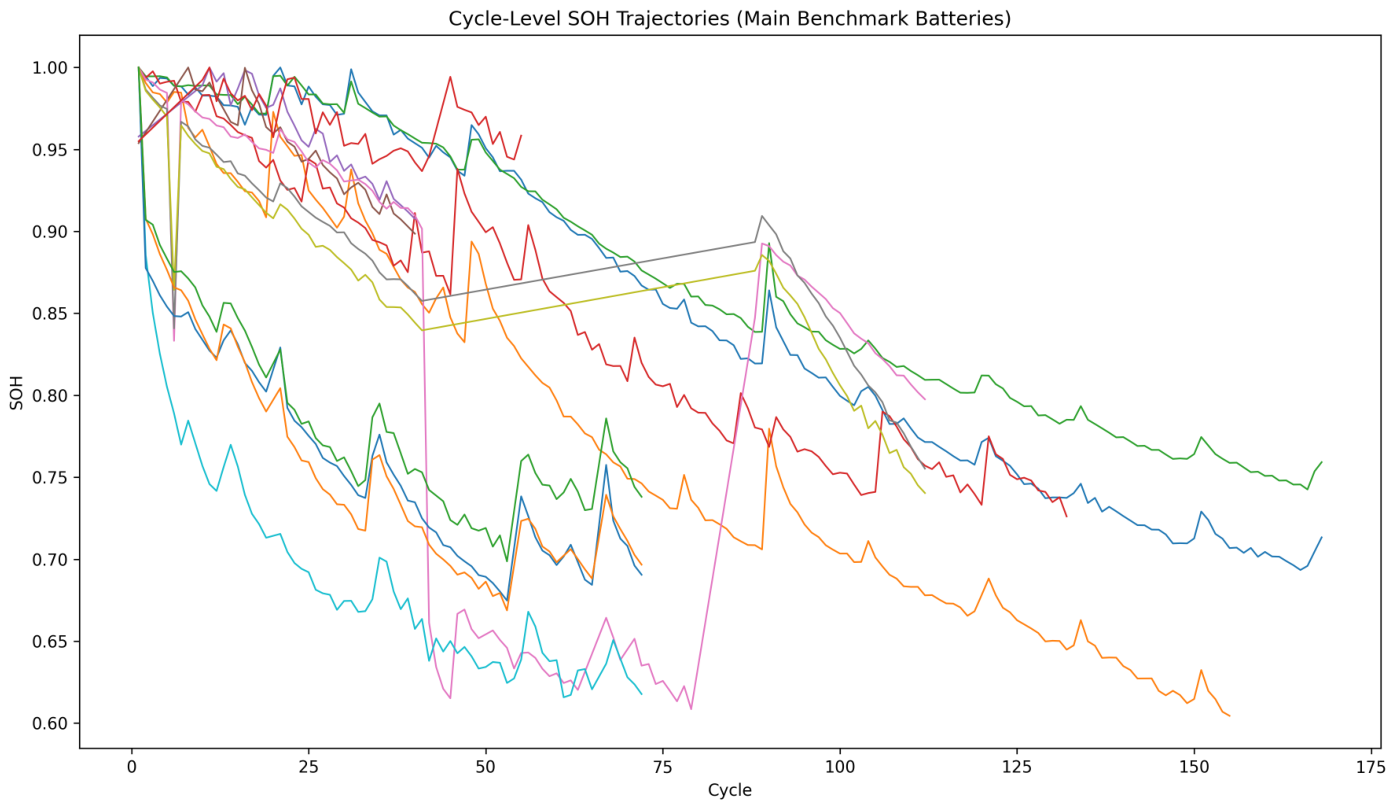
Figure 2 shows that the degradation trajectories are heterogeneous across batteries: some cells degrade gradually and remain near 0.8 SOH over many cycles, whereas others decline much faster toward the 0.6–0.7 range. This heterogeneity is precisely why a battery-level train/test split is more informative than a random row-level split.
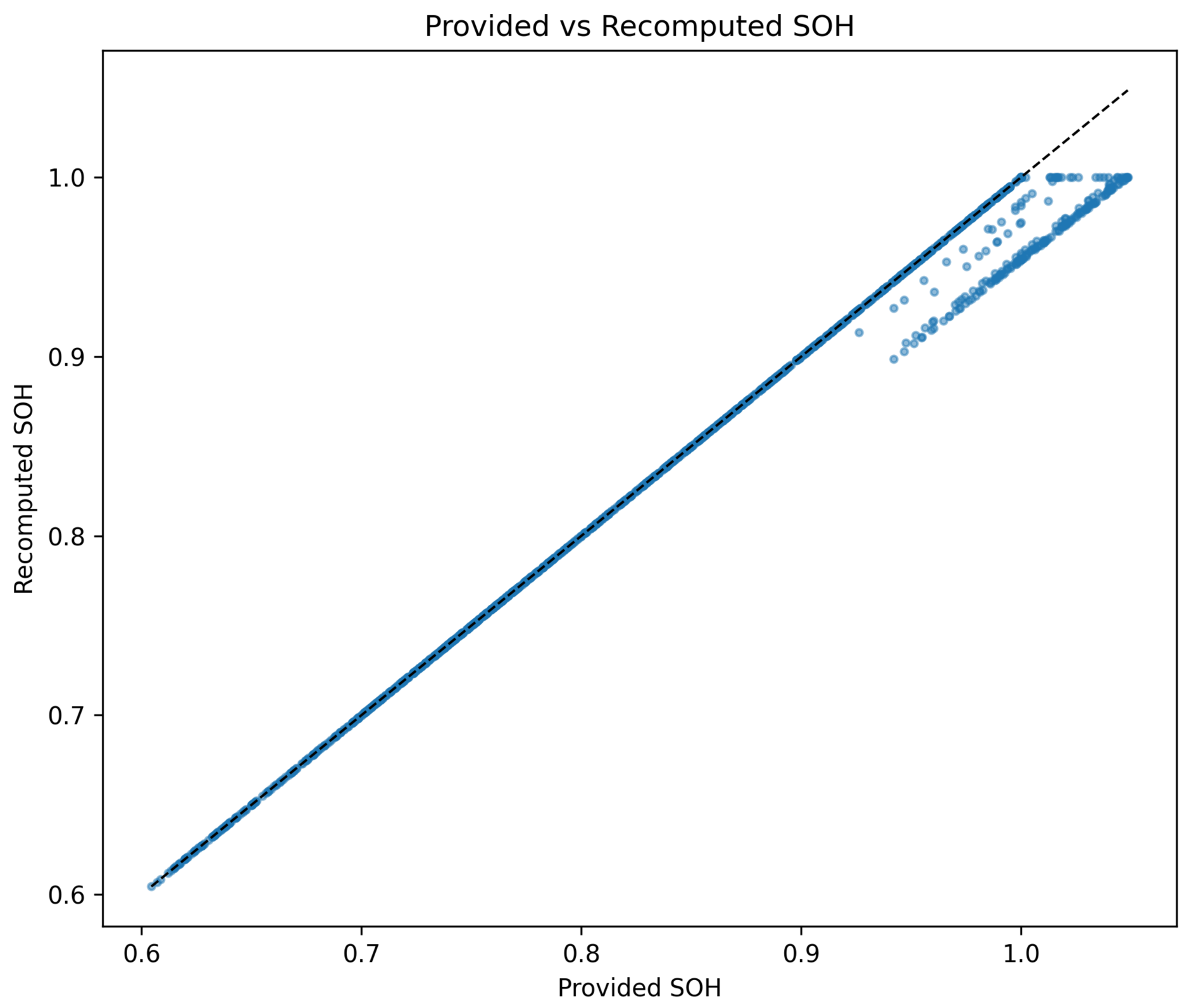
Figure 3 confirms that the recomputed SOH remains largely consistent with the processed label, but removes the slight values above 1.0 observed in the raw tabular derivative. This preprocessing step is therefore retained in all subsequent experiments.
To form the main benchmark, only batteries with at least 30 cycles were retained, yielding 14 eligible batteries. A battery-level split was then used: nine batteries for training and five unseen batteries for testing. The train/test split is summarized in Table 1. This split is deliberately stricter than random row partitioning because it evaluates cross-battery generalization rather than interpolation within the same degradation trajectory.
Table 1 highlights two key aspects of the benchmark: first, the target is a recomputed capacity-based SOH rather than a directly reused processed label; second, the test batteries are fully unseen during training. This makes the reported results a genuine measure of battery-to-battery generalization rather than of within-cell interpolation.

4.2. Compared Methods and Training Configuration

Six methods were evaluated on the same benchmark:
  • RF: Random Forest using hand-crafted cycle-level features;
  • LSTM: Unidirectional Long Short-Term Memory network with an eight-cycle temporal window;
  • BiLSTM: Bidirectional LSTM with the same sequence window;
  • GD-DL: Online RBF-based deterministic learning with instantaneous gradient adaptation;
  • TF-DL-E: The proposed embedded low-memory tempered deterministic learning variant;
  • TF-DL-T: The proposed exact truncated tempered fractional deterministic learning variant.
The RF and sequence models were trained directly on the cycle-level benchmark, whereas GD-DL, TF-DL-E, and TF-DL-T were implemented as online RBF regressors with 25 centers. For the sequence models, the temporal context window was fixed to eight cycles, and for TF-DL-T, the default fractional parameters were ( α , λ , L ) = ( 0.7 , 0.4 , 20 ) unless otherwise stated in the sensitivity study below.
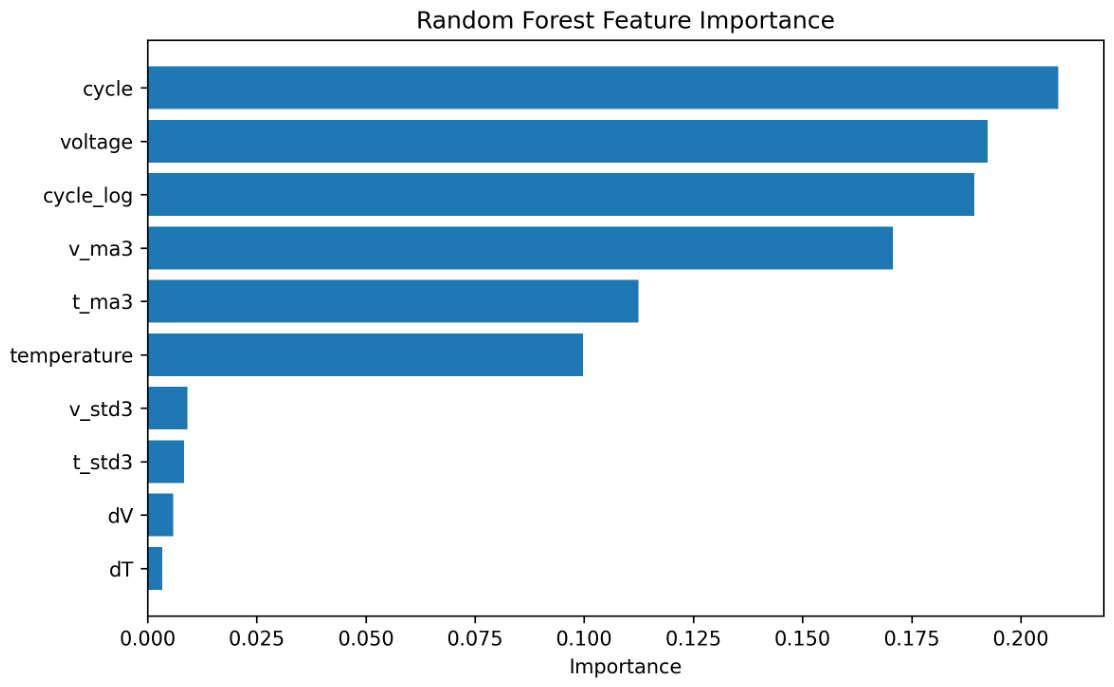
Figure 4 shows that the SOH benchmark is dominated by degradation-time and slow trend information rather than by very local differential features. The most important variables are cycle number, voltage, logarithmic cycle count, and moving-average summaries, whereas d V , d T , and the short-window standard deviations play a secondary role.
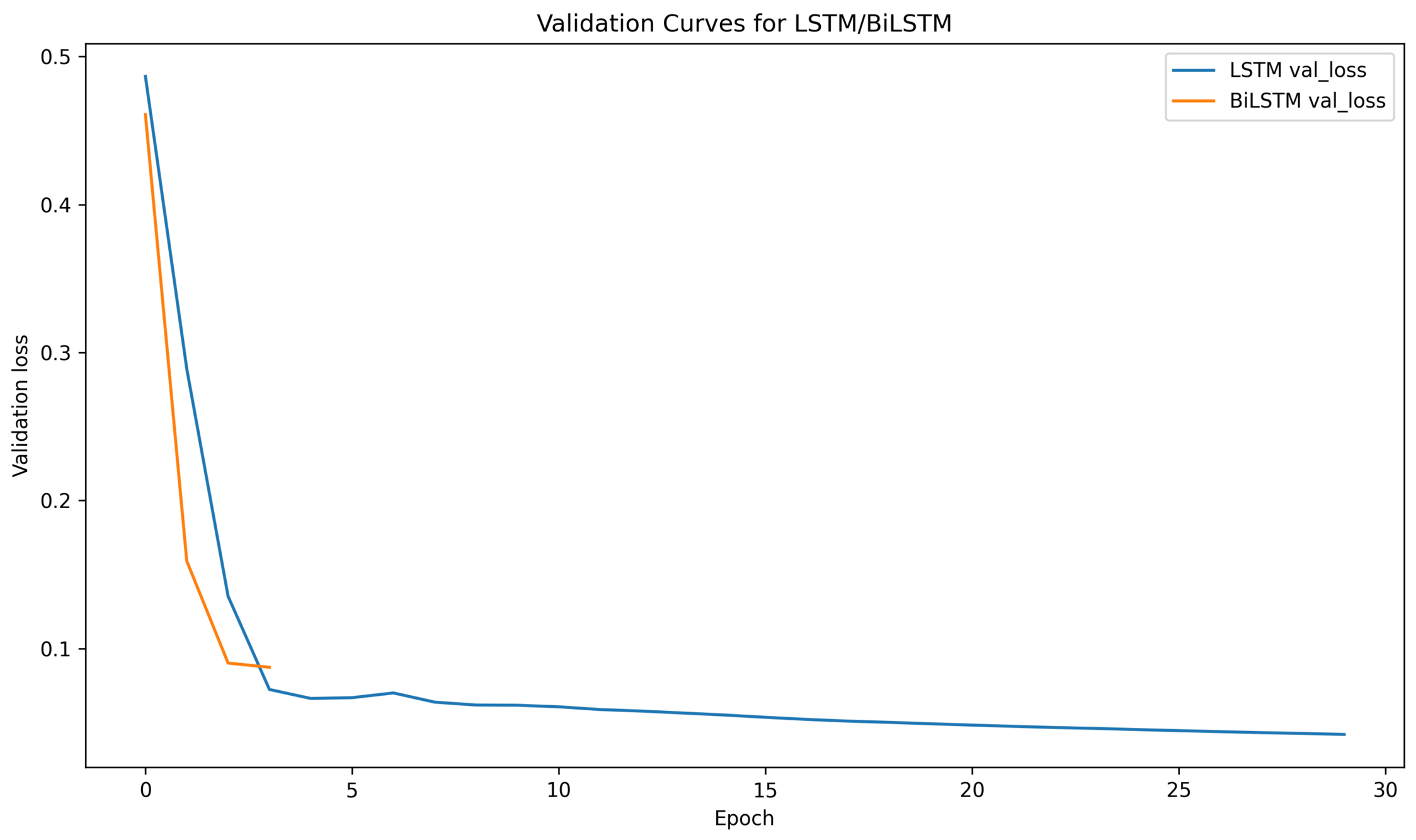
Figure 5 already hints that the higher-capacity bidirectional sequence model is not necessarily advantageous in this setting: although BiLSTM achieves a fast initial reduction in validation loss, its final test performance is substantially worse than that of the simpler LSTM.

4.3. Main Quantitative Results

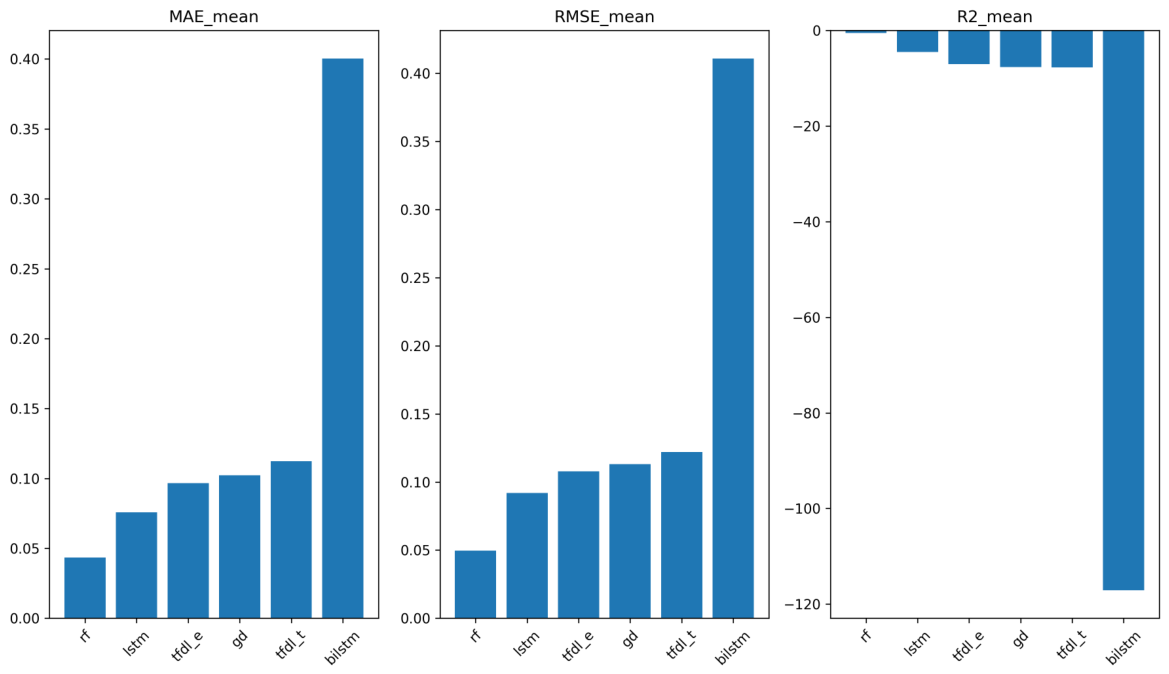
The main benchmark results are summarized in Table 2 and visualized in Figure 6 and Figure 7. The ranking is clear. RF is the strongest model overall, achieving the lowest mean MAE and RMSE. LSTM is the second-best method and the strongest neural baseline. Among the online RBF-based estimators, TF-DL-E performs best and improves over both GD-DL and TF-DL-T. By contrast, BiLSTM fails badly on this benchmark and should be regarded as over-parameterized for the present cross-battery SOH task.
Table 2 shows that the new benchmark is substantially harder than the earlier dynamic-profile tracking task, because even the strongest method has a slightly negative mean R 2 across unseen batteries. This does not invalidate the benchmark; rather, it indicates that the train/test split genuinely measures cross-battery SOH generalization. In that setting, RF remains the strongest predictor, LSTM is the strongest sequence model, and TF-DL-E is the best practical tempered online variant.
Figure 6 conveys the same ranking visually: RF is clearly the strongest baseline, LSTM is second, TF-DL-E is the strongest online tempered variant, and BiLSTM collapses badly.
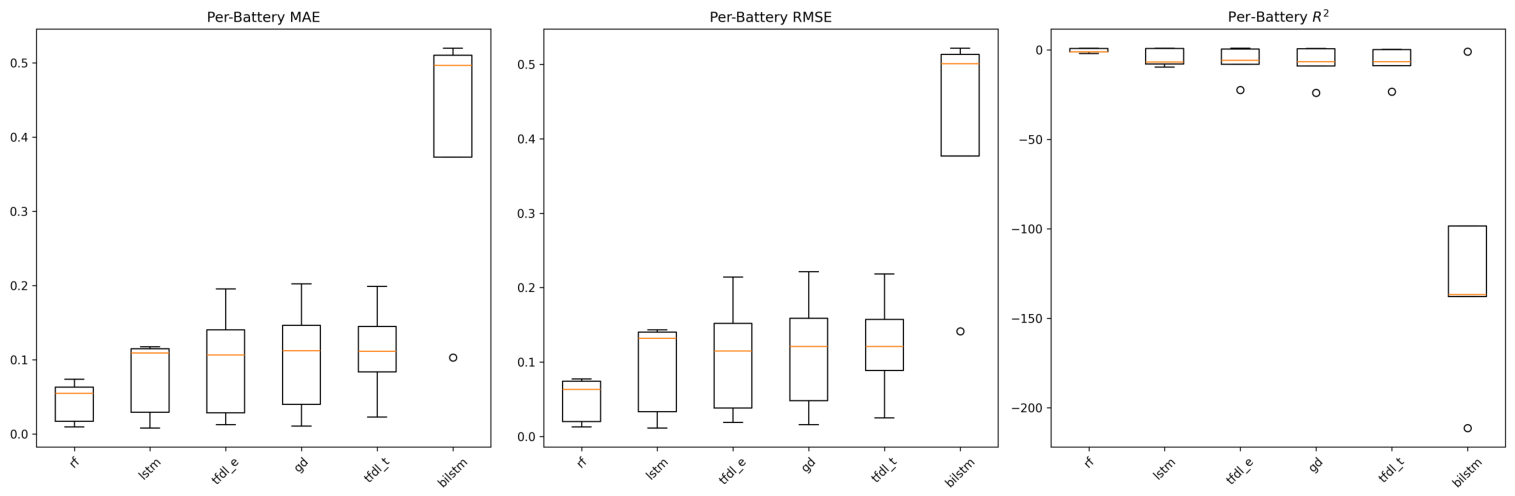
Figure 7 emphasizes that the variability in battery-to-battery performance in this benchmark is large. RF is the most constrained and least error distribution, and TF-dl-E, GD-dl, and TF-dl-T are far more test-battery sensitive. This observation is consistent with the negative mean R 2 values in Table 2: some test batteries are substantially more difficult than others.

4.4. Battery-Level Behavior and Cross-Battery Generalization

The battery-level metrics show a consistent pattern. Two test batteries, B0005 and B0030, are comparatively easier: RF and LSTM achieve positive R 2 values, and the online RBF-based methods also remain reasonable. In contrast, B0045, B0047, and B0048 are much harder and induce strongly negative R 2 values for most methods. This indicates that the main challenge of the benchmark is not noise alone, but battery-to-battery distribution shift.
Table 3 shows that TF-DL-E improves over GD-DL on four of the five test batteries (B0005, B0045, B0047, and B0048) and also outperforms TF-DL-T on all five test batteries. The only battery where GD-DL slightly surpasses TF-DL-E is B0030. This battery-level evidence is important because it confirms that the embedded tempered-memory realization yields practical gains beyond what is visible in the overall mean alone.
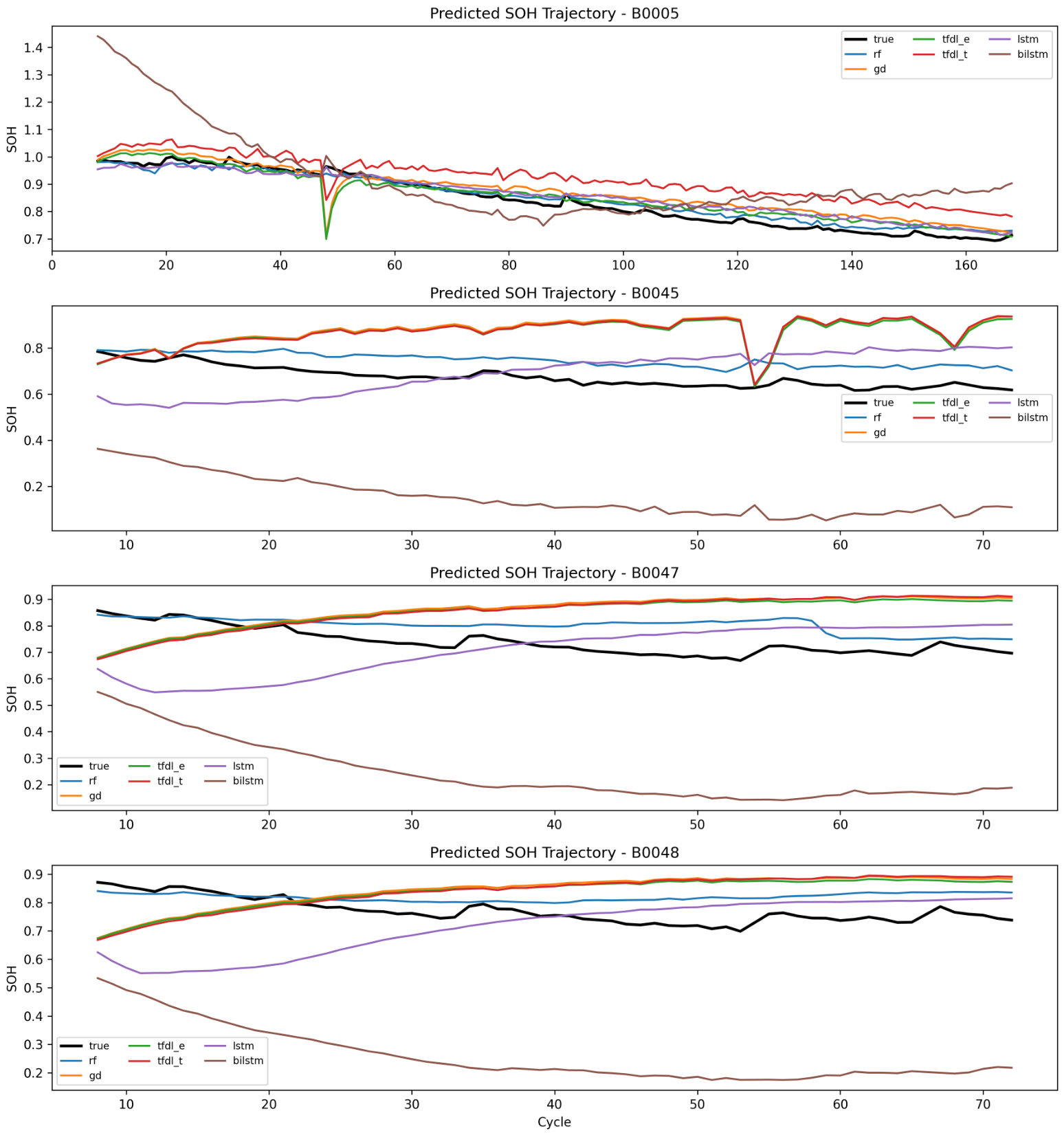
Figure 8 provides qualitative insight into the battery-level behavior. For B0005, several models follow the decreasing SOH trajectory reasonably well, with RF and LSTM visually closest to the target and TF-DL-E remaining competitive. For the harder batteries B0045, B0047, and B0048, however, several methods tend to overestimate SOH late in life, which explains the strongly negative R 2 values in Table 2. In these difficult cases, TF-DL-E remains consistently better than GD-DL and TF-DL-T, although it does not match the accuracy of RF.

4.5. Why TF-DL-T Fails and TF-DL-E Succeeds

The most important conceptual finding of this new benchmark concerns the practical behavior of the two tempered variants. TF-DL-E, the embedded low-memory realization, is not the best overall predictor, but it is clearly the best online tempered/RBF-based variant. TF-DL-T, the exact truncated fractional realization, remains the weakest practical online method. This difference is not only visible in the aggregate metrics; it also appears directly in the adaptation dynamics.
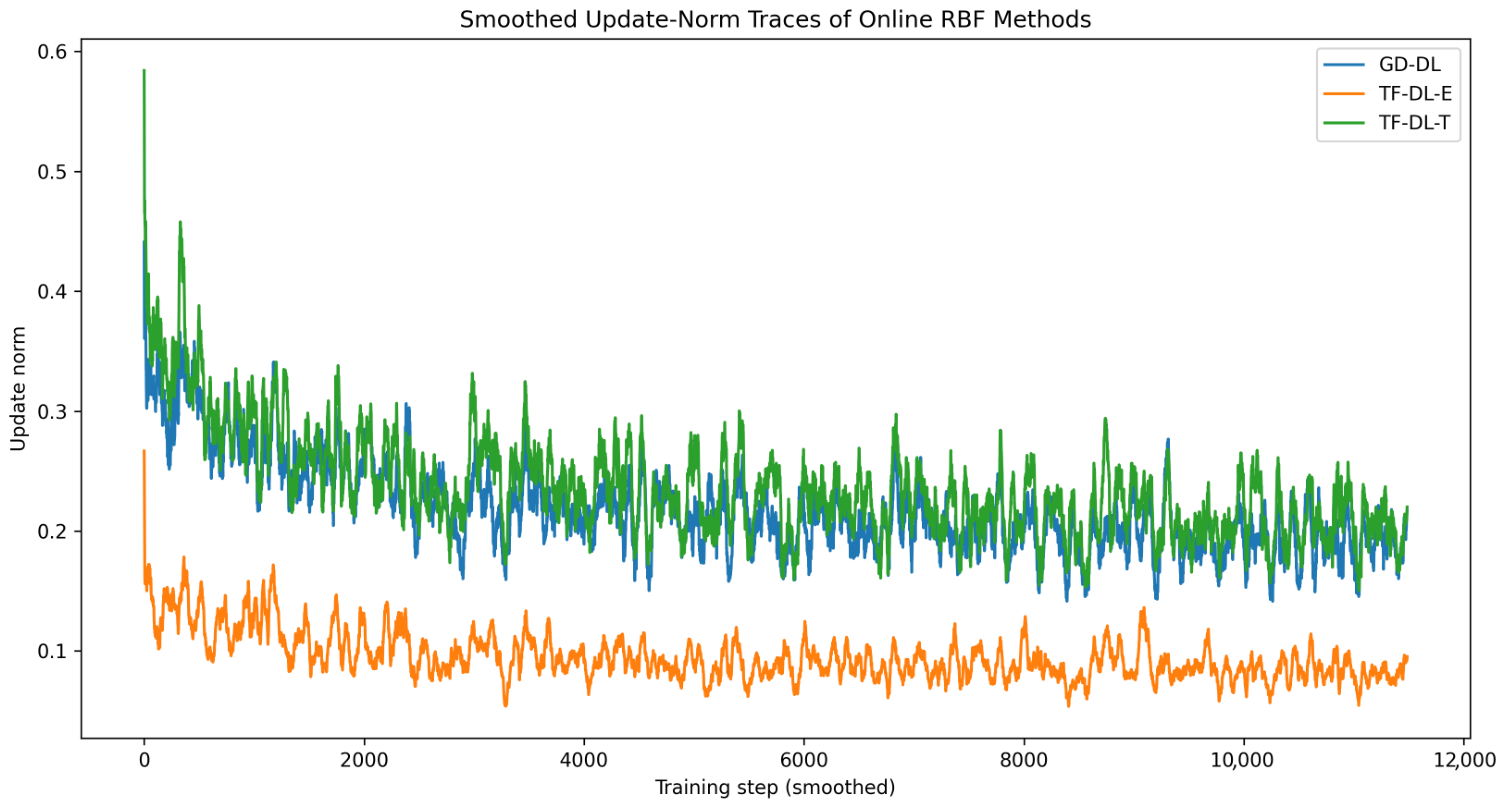
Figure 9 strongly supports the following interpretation. TF-DL-E behaves like a regularized exponentially smoothed memory: its update norms are systematically smaller and less oscillatory than those of GD-DL and especially TF-DL-T. This helps explain why TF-DL-E remains the strongest practical online tempered variant on the benchmark. By contrast, TF-DL-T accumulates a more explicit history of past correction terms and therefore becomes more sensitive to cross-battery variability and to mismatch between the intended fractional memory and its finite truncation.

4.6. Stage-Wise Performance over Early, Middle, and Late Life

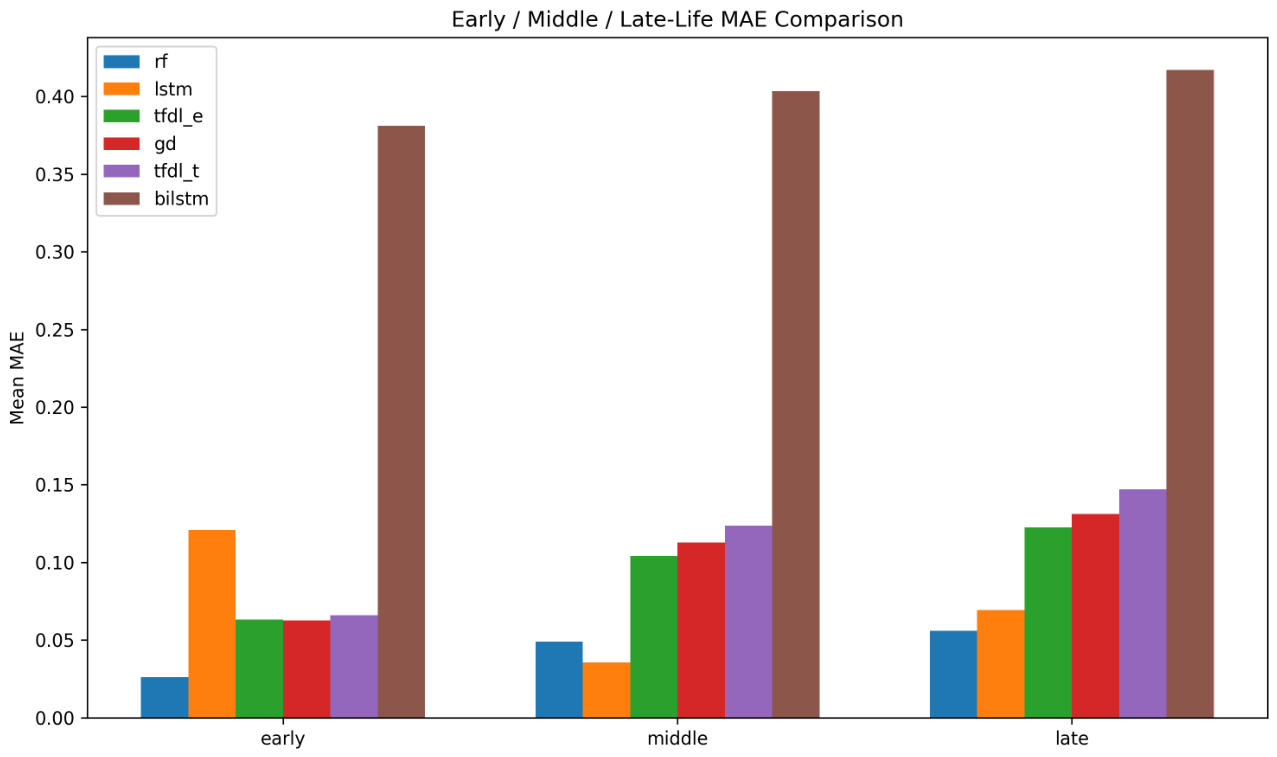
To understand how the compared methods behave over different parts of the degradation trajectory, the test sequences were partitioned into early, middle, and late-life segments of equal relative length. Figure 10 reports the corresponding mean MAE values.
Figure 10 confirms three trends. First, RF remains the strongest method across all three life stages. Second, the online RBF-based methods become substantially weaker in the middle and late stages, which is consistent with the increasing cross-battery divergence observed in Figure 2. Third, within that online family, TF-DL-E remains consistently better than GD-DL and TF-DL-T in the middle and late-life regions, which are precisely the regimes where stale-memory accumulation is most likely to be harmful.

4.7. Sensitivity of the Truncated Fractional Variant

To determine whether the poor behavior of TF-DL-T is merely caused by a bad default setting, a dedicated sensitivity analysis was conducted over
α { 0.4 , 0.6 , 0.8 } , λ { 0.1 , 0.3 , 0.5 } , L { 5 , 10 , 20 , 30 } .
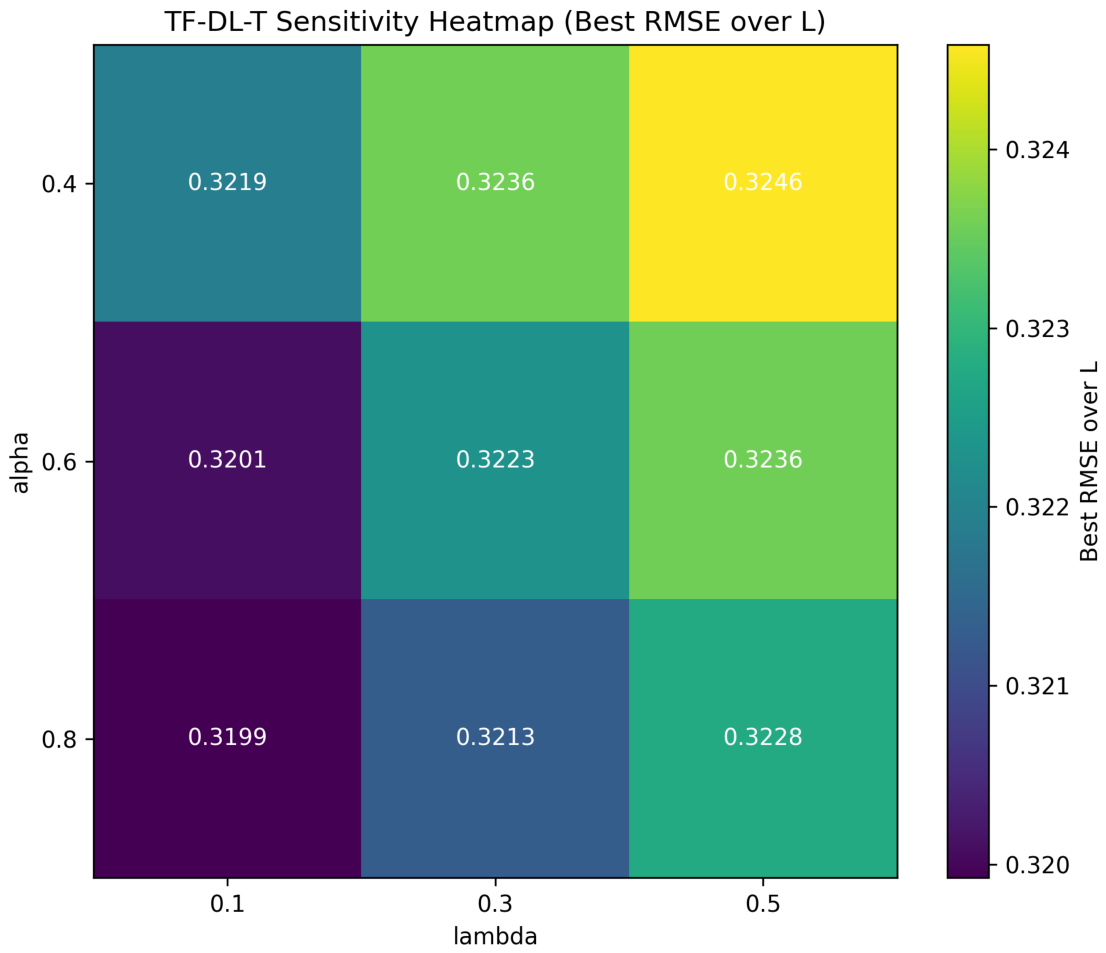
The results are summarized in Figure 11 and Table 4.
Table 4 and Figure 11 show that TF-DL-T remains weak throughout the scanned parameter region: the best explored RMSE is approximately 0.3199 and the worst is approximately 0.3311, while the validation R 2 remains strongly negative for all tested settings. Two conclusions follow. First, TF-DL-T does not fail merely because of one poor default hyperparameter choice. Second, the most fragile region occurs when the memory order is high, tempering is weak, and the truncation horizon is short, i.e., when the method attempts to preserve strong long-range memory without a sufficient finite horizon to represent it faithfully. This observation is fully consistent with the oscillatory update behavior already shown in Figure 9.

4.8. Discussion and Limitations

The level of SOH benchmark on the NASA cycle significantly enhances the experimental section since it implies a clear degradation label and a battery-level generalization test. Meanwhile, the findings indicate that this environment is much more difficult than the previous dynamic tracking task. Specifically, some unknown (B0045, B0047, and B0048) test batteries yield large negative values of R 2 on most models, such as RF and LSTM, meaning that there is significant cross-battery variance and variance shift.
On methodological grounds, it is not that TF-DL-E is the best predictor on the whole, but that it is the best functional online tempered one. TF-DL-E has better performance in four of the five test batteries and is better than TF-DL-T on all five. This battery-level benefit, along with the less jagged update-norm behavior in Figure 9, is consistent with the intuition that a tempered-memory realization embedded within is a regularizer, soothing in behavior. In comparison, TF-DL-T seems to be excessively fragile with the current cross-battery SOH configuration, and the sensitivity analysis shows that this limitation is structural, other than just a tuning artifact.
The current benchmark still has limitations. First, the processed cycle-level CSV is a derivative of the official NASA PCoE dataset rather than the original raw MAT structure, so the preprocessing choices of the derivative may affect the exact benchmark difficulty. Second, only 14 batteries satisfied the main 30-cycle filtering criterion, and only 5 unseen batteries were used for testing, so the current cross-battery results should be interpreted as a strong but still limited proof of concept. Third, the feature set remains intentionally lightweight and was chosen to keep the comparison aligned with the online/embedded motivation of the paper rather than to maximize absolute offline predictive accuracy. These limitations notwithstanding, the present benchmark materially improves the empirical support of the manuscript by providing a true cycle-level SOH test and by clarifying the distinct practical roles of TF-DL-E and TF-DL-T.

5. Conclusions

This paper presented a Tempered Fractional Deterministic Learning (TF-DL) framework for battery state-of-health estimation, in which the fractional operator is introduced in the adaptation dynamics rather than in the battery plant model itself. The proposed formulation combines deterministic learning with tempered memory and graceful forgetting, and it distinguishes between two practical realizations: the exact truncated fractional variant TF-DL-T and the embedded low-memory variant TF-DL-E.
The experimental validation was conducted on a NASA-derived cycle-level SOH benchmark with explicit capacity-based SOH labeling and a battery-level train/test split. After filtering, 14 batteries were retained, of which 9 were used for training and 5 unseen batteries were used for testing. On this benchmark, Random Forest achieved the best overall performance (MAE = 0.0436, RMSE = 0.0496), while LSTM was the strongest sequence baseline (MAE = 0.0757, RMSE = 0.0920). Among the online RBF-based methods, TF-DL-E achieved the best performance (MAE = 0.0966, RMSE = 0.1077), outperforming both GD-DL and TF-DL-T, whereas BiLSTM failed to generalize effectively on the unseen batteries.
One of the significant findings of the research is that the most practically useful tempered variant is TF-DL-E. It did not outperform RF or LSTM at raw predictive accuracy, but was able to improve upon GD-DL on a majority of test batteries and TF-DL-T on all test batteries. The update-norm analysis indicated that TF-DL-E generates much smoother and smaller updates compared to both GD-DL and TF-DL-T, which is consistent with the interpretation that the embedded tempered-memory realization is a stabilizing regularizer. In contrast, TF-DL-T was more oscillatory and weaker, and the poor performance of the method could not be improved by a special sensitivity analysis across the fractional order, tempering parameter, and truncation horizon.
Overall, the proposed framework should therefore be viewed not as the strongest offline predictor, but as a practically motivated online learning approach whose main contribution lies in the integration of tempered memory into deterministic learning. In particular, the results support TF-DL-E as the more robust and deployment-relevant realization of tempered fractional adaptation for battery SOH estimation. Future work will focus on cross-chemistry validation, hardware-oriented implementation, and tighter integration with observer-based and uncertainty-aware battery-management architectures.

Author Contributions

Conceptualization, Y.B.; methodology, O.K.; software, I.B.; validation, Y.B. and I.B.; formal analysis, M.F.; investigation, M.F.; writing—original draft, O.K. All authors have read and agreed to the published version of the manuscript.

Funding

This research has been funded by Scientific Research Deanship at University of Ha’il, Saudi Arabia through project number RG-25051.

Data Availability Statement

The data used in this study are publicly available from the Kaggle repository “NASA Battery Degradation Dataset (Cycle-Level CSV)” maintained by yashxss, available at https://www.kaggle.com/datasets/yashxss/nasa-battery-cycle-level-dataset (accessed on 18 April 2026). The analyzed file corresponds to a processed and consolidated cycle-level battery aging dataset derived from the NASA Prognostics Center of Excellence (PCoE) Li-ion battery aging dataset. The official NASA source describing the original experimental protocol and field definitions is available at https://data.nasa.gov/dataset/li-ion-battery-aging-datasets (accessed on 18 April 2026) [42,43].

Conflicts of Interest

The authors declare no conflicts of interest.

Appendix A. Qualitative Comparison of SOH Estimation Families

This appendix provides a compact qualitative positioning of representative battery SOH estimation families relative to the proposed TF-DL framework. It complements the NASA cycle-level SOH benchmark reported in Section 4 by highlighting the main strengths and limitations of each family from the perspectives of accuracy, interpretability, temporal modeling, online adaptability, and deployment suitability.
Table A1. Qualitative positioning of representative battery SOH estimation families.
FamilyTypical MethodsMain AdvantagesMain DrawbacksExample Refs
Review studiesSurveys and comparative reviewsBroad taxonomy; identify open challenges in data, robustness, interpretability, and deploymentDo not provide a deployable estimator; cross-paper numerical comparisons are often not directly comparable[1,2]
Classical MLRF, boosting,
feature-based regression
Fast inference; strong with engineered features; lightweight; often highly competitive on cycle-level SOH benchmarksDepend on feature quality; weaker explicit temporal modeling; limited online adaptation[7,8]
Sequence DLLSTM, BiLSTMCapture temporal degradation trends effectively; suitable for sequential cycle-level learningHigher training cost; lower interpretability; can overfit or generalize poorly under cross-battery shift[9,19,20]
Uncertainty-aware DLTemporal DL with confidence estimationProvides uncertainty information for risk-aware decisions; useful for diagnostics and maintenance planningAdded calibration and modeling complexity; may require larger datasets for reliable uncertainty estimates[10,21]
Control-oriented methodsDRL, observers, hybrid estimation/controlNatural link to closed-loop BMS operation; strong connection with safety supervision and health-aware controlMore tuning effort; stronger modeling assumptions; often harder to benchmark directly against offline predictive models[11,44]
Proposed methodTF-DL-E/TF-DL-TOnline bank-based learning; explicit tempered forgetting; constant-memory implementation for TF-DL-E; interpretable local-model structureOn the NASA cycle-level SOH benchmark, TF-DL-E remained below RF and LSTM in raw accuracy, while TF-DL-T was weaker and more fragile; the main contribution is therefore practical online tempered adaptation rather than best absolute offline predictionThis work

Appendix B. Abbreviations and Notation

This appendix summarizes the principal abbreviations and mathematical symbols used throughout the manuscript for ease of reference.
Table A2. Principal abbreviations used in the manuscript.
AbbreviationMeaning
SOHState of Health
SOCState of Charge
BMSBattery Management System
DLDeterministic Learning
TF-DLTempered Fractional Deterministic Learning
TF-DL-EEmbedded low-memory TF-DL variant
TF-DL-TTruncated exact tempered TF-DL variant
RBFRadial Basis Function
PEPersistence of Excitation
TFGDTempered Fractional Gradient Descent
RFRandom Forest
LSTMLong Short-Term Memory
BiLSTMBidirectional Long Short-Term Memory
MAEMean Absolute Error
RMSERoot Mean Square Error
MAPEMean Absolute Percentage Error
RULRemaining Useful Life
Table A3. Principal mathematical symbols used in the manuscript.
SymbolMeaning
x k State or measurable feature vector at time step k
u k Input/excitation vector at time step k
T s Sampling period
F ( x k , u k ; ϑ k ) Unknown nonlinear battery-related dynamics
ϑ k Slowly varying latent health-related parameter vector
ω k Bounded disturbance/measurement noise
h k Health-related quantity associated with the battery state
Ψ ( ϑ k ) Mapping from latent health parameters to health indicator
S ( x k , u k ) RBF regressor vector
W * Ideal RBF weight matrix
W ^ k Estimated RBF weight matrix at time step k
W ˜ k Weight estimation error, W ˜ k = W * W ^ k
ε ( x k , u k ) RBF approximation error
ξ i Center of the ith RBF basis function
η RBF width parameter
S ζ ( x k , u k ) Local regressor subvector associated with operating mode ζ
δ Window length in the partial PE condition
α Fractional order parameter
λ Tempering parameter
c j ( α ) Tempered fractional kernel coefficient
G k ( α , λ ) Tempered fractional accumulation of past gradients
G k , L ( α , λ ) Truncated tempered fractional memory term
τ L ( α , λ ) Tail of the tempered kernel beyond horizon L
M k Embedded low-memory surrogate accumulator
KObserver gain matrix
Γ Adaptation gain matrix
e k State estimation error, e k = x k x ^ k
Y k Instantaneous DL correction term
Ξ k ( L ) Truncated TF-DL memory term
B m Bank item associated with mode m
Ω m Validity region/operating context of stored mode m
r k m Residual produced by the mth stored estimator
s k Selected mode index under hard minimum-residual selection
π k m Residual-based soft weighting coefficient for mode m
γ Residual-weighting sharpness parameter

References

  1. Haraz, A.; Abualsaud, K.; Massoud, A. State-of-health and state-of-charge estimation in electric vehicles batteries: A survey on machine learning approaches. IEEE Access 2024, 12, 158110–158139. [Google Scholar] [CrossRef]
  2. Soyoye, B.D.; Bhattacharya, I.; Dhason, M.V.A.; Banik, T. State of charge and state of health estimation in electric vehicles: Challenges, approaches and future directions. Batteries 2025, 11, 32. [Google Scholar] [CrossRef]
  3. Mousaei, A.; Naderi, Y.; Bayram, I.S. Advancing state of charge management in electric vehicles with machine learning: A technological review. IEEE Access 2024, 12, 43255–43283. [Google Scholar] [CrossRef]
  4. Cavus, M.; Bell, M. Enabling Smart Grid Resilience with Deep Learning-Based Battery Health Prediction in EV Fleets. Batteries 2025, 11, 283. [Google Scholar] [CrossRef]
  5. Essoufi, M.; Benzaouia, M.; Hajji, B.; Rabhi, A.; Calì, M. Advancing Energy Management Strategies for Hybrid Fuel Cell Vehicles: A Comparative Study of Deterministic and Fuzzy Logic Approaches. World Electr. Veh. J. 2025, 16, 444. [Google Scholar] [CrossRef]
  6. Kermansaravi, A.; Refaat, S.S.; Trabelsi, M.; Vahedi, H. AI-based energy management strategies for electric vehicles: Challenges and future directions. Energy Rep. 2025, 13, 5535–5550. [Google Scholar] [CrossRef]
  7. Akbar, K.; Zou, Y.; Awais, Q.; Baig, M.J.A.; Jamil, M. A machine learning-based robust state of health (SOH) prediction model for electric vehicle batteries. Electronics 2022, 11, 1216. [Google Scholar] [CrossRef]
  8. Fadlaoui, O.; Masaif, N. Machine Learning-Based Estimation of State of Charge and State of Health in Lithium-Ion Batteries for Electric Vehicles. In Proceedings of the 2025 IEEE International Conference on Circuit, Systems and Communication (ICCSC), Fez, Morocco, 19–20 June 2025; pp. 1–9. [Google Scholar]
  9. Zhang, Q.; Huang, X. Deep Learning Approaches for Enhancing Battery Safety and Performance in Electric Vehicles. IEEE Trans. Consum. Electron. 2025, 71, 4677–4683. [Google Scholar] [CrossRef]
  10. Chen, C.; Chen, H.; Shi, J.; Yue, D.; Shi, G.; Lyu, D. Estimating Lithium-Ion Battery Health Status: A Temporal Deep Learning Approach with Uncertainty Representation. IEEE Sens. J. 2025, 25, 26931–26943. [Google Scholar] [CrossRef]
  11. Saeed, M.; Khalatbarisoltani, A.; Altaf, F.; Pan, Y.; Lu, S.; Hu, X. Deep Reinforcement Learning Guided Framework for State Estimation of Li-ion Batteries: A Control-Oriented Approach with High Adaptability. IEEE/ASME Trans. Mechatron. 2025, 30, 5097–5109. [Google Scholar] [CrossRef]
  12. Arandhakar, S.; Nakka, J. Deep learning-driven robust model predictive control based active cell equalisation for electric vehicle battery management system. Sustain. Energy Grids Netw. 2025, 42, 101694. [Google Scholar] [CrossRef]
  13. Xiong, X.; Zhang, Y.; Feng, W. Robust battery fault detection for electric mining trucks using deep learning with enhanced interpretability. J. Power Sources 2025, 655, 237965. [Google Scholar] [CrossRef]
  14. Kamişli, K.; Taş, İ.Ċ. Estimation of Battery Remaining Life-time with Deep Learning Methods. Int. J. New Find. Eng. Sci. Technol. 2025, 3, 32–42. [Google Scholar] [CrossRef]
  15. Tanmayi, G.; Radha, R.; Varshitha, U.V.S.; Prakash, P.A. Leveraging deep transfer learning and adaptive power models for enhanced charging time prediction in electric vehicles. Energy Inform. 2025, 8, 110. [Google Scholar] [CrossRef]
  16. Samanta, A.; Chowdhuri, S.; Williamson, S.S. Machine learning-based data-driven fault detection/diagnosis of lithium-ion battery: A critical review. Electronics 2021, 10, 1309. [Google Scholar] [CrossRef]
  17. Le, T.D.; Park, J.H.; Lee, M.Y. Neural Architectures and Learning Strategies for State-of-Health Estimation of Lithium-Ion Batteries: A Critical Review. Batteries 2026, 12, 76. [Google Scholar] [CrossRef]
  18. Mbagaya, L.; Reddy, K.; Botes, A. Machine Learning Techniques for Battery State of Health Prediction: A Comparative Review. World Electr. Veh. J. 2025, 16, 594. [Google Scholar] [CrossRef]
  19. Zhang, L.; Ji, T.; Yu, S.; Liu, G. Accurate Prediction Approach of SOH for Lithium-Ion Batteries Based on LSTM Method. Batteries 2023, 9, 177. [Google Scholar] [CrossRef]
  20. Buvanesan, A.V.; Venugopal, B.M.; Murugan, C.K.; Velusamy, D.H. Deep Learning for State of Health Estimation in EV Batteries: A CNN-BiLSTM Approach. AIP Adv. 2025, 15, 075327. [Google Scholar] [CrossRef]
  21. Thelen, A.; Huan, X.; Paulson, N.; Onori, S.; Hu, Z.; Hu, C. Probabilistic Machine Learning for Battery Health Diagnostics and Prognostics—Review and Perspectives. npj Mater. Sustain. 2024, 2, 14. [Google Scholar] [CrossRef]
  22. Xiong, J.; Xia, M.; Xu, S.; Ding, P.; Pan, H.; Gao, Q.; Guo, W.; Min, Y. State-of-Health Estimation of Lithium-Ion Battery under Dynamic Conditions Using a Dual-Domain Feature Fusion Machine Learning Approach. Ionics 2026, 1–25. [Google Scholar] [CrossRef]
  23. Oldham, K.; Spanier, J. The Fractional Calculus: Theory and Applications of Differentiation and Integration to Arbitrary Order; Elsevier: New York, NY, USA, 1974; Volume 111. [Google Scholar]
  24. Naifar, O. Tempered fractional gradient descent: Theory, algorithms, and robust learning applications. Neural Netw. 2025, 193, 108005. [Google Scholar] [CrossRef]
  25. Wang, C.; Hill, D.J. Deterministic Learning Theory for Identification, Recognition, and Control; CRC Press: Boca Raton, FL, USA, 2018. [Google Scholar]
  26. Park, J.; Sandberg, I.W. Universal Approximation Using Radial-Basis-Function Networks. Neural Comput. 1991, 3, 246–257. [Google Scholar] [CrossRef] [PubMed]
  27. Dhahri, S.; Naifar, O. Fault-Tolerant Tracking Control for Linear Parameter-Varying Systems under Actuator and Sensor Faults. Mathematics 2023, 11, 4738. [Google Scholar] [CrossRef]
  28. Dhahri, S.; Naifar, O. Robust Fault Estimation and Tolerant Control for Uncertain Takagi–Sugeno Fuzzy Systems. Symmetry 2023, 15, 1894. [Google Scholar] [CrossRef]
  29. Salan, R.B.; Kahouli, O.; Hadjabdallah, A. A nonlinear Takagi-Sugeno fuzzy logic control for single machine power system. Int. J. Adv. Manuf. Technol. 2017, 90, 575–590. [Google Scholar] [CrossRef]
  30. Kahouli, O.; Ashammari, B.; Sebaa, K.; Djebali, M.; Abdallah, H.H. Type-2 fuzzy logic controller based PSS for large scale power systems stability. Eng. Technol. Appl. Sci. Res. 2017, 8, 3380–3386. [Google Scholar] [CrossRef]
  31. Alaia, E.B.; Dhahri, S.; Naifar, O. A Gradient-Based Optimization Algorithm for Optimal Control Problems with General Conformable Fractional Derivatives. IEEE Access 2025, 13, 140270–140281. [Google Scholar] [CrossRef]
  32. Jmal, A.; Ahmed, H. New stability results for Caputo conformable fractional-order systems—Application for a non-fragile H observer. Int. J. Syst. Sci. 2026, 57, 613–621. [Google Scholar] [CrossRef]
  33. Kahouli, O.; Gassara, H.; Aloui, A.; Elleuch, Z.; Bouteraa, Y. Observer-based finite-time control of conformable Takagi–Sugeno fuzzy systems with time delay. Asian J. Control 2026, 28, 233–239. [Google Scholar] [CrossRef]
  34. Kahouli, O.; Elloumi, M.; Naifar, O.; Alsaif, H.; Bouteraa, Y. Electrical circuits described by general fractional conformable derivative. Front. Energy Res. 2022, 10, 851070. [Google Scholar] [CrossRef]
  35. Kahouli, O.; Albadran, S.; Elleuch, Z.; Bouteraa, Y.; Makhlouf, A.B. Stability results for neutral fractional stochastic differential equations. AIMS Math. 2024, 9, 3253–3263. [Google Scholar] [CrossRef]
  36. Zdiri, M.A.; Bouzidi, B.; Kahouli, O.; Abdallah, H.H. Fault Detection Method for Boost Converters in Solar PV Systems. In Proceedings of the 2019 19th International Conference on Sciences and Techniques of Automatic Control and Computer Engineering (STA), Sousse, Tunisia, 24–26 March 2019; pp. 237–242. [Google Scholar] [CrossRef]
  37. Naifar, O.; Boukettaya, G.; Ouali, A. Global stabilization of an adaptive observer-based controller design applied to induction machine. Int. J. Adv. Manuf. Technol. 2015, 81, 423–432. [Google Scholar] [CrossRef]
  38. Naifar, O.; Boukettaya, G.; Oualha, A.; Ouali, A. A comparative study between a high-gain interconnected observer and an adaptive observer applied to IM-based WECS. Eur. Phys. J. Plus 2015, 130, 88. [Google Scholar] [CrossRef]
  39. Naifar, O.; Boukettaya, G.; Ouali, A. Robust software sensor with online estimation of stator resistance applied to WECS using IM. Int. J. Adv. Manuf. Technol. 2016, 84, 885–894. [Google Scholar] [CrossRef]
  40. Ayadi, M.; Naifar, O.; Derbel, N. Sensorless control with an adaptive sliding mode observer for wind PMSG systems. In Proceedings of the 2017 14th International Multi-Conference on Systems, Signals & Devices (SSD), Marrakech, Morocco, 28–31 March 2017; pp. 33–37. [Google Scholar]
  41. Naifar, O. Practical observer design for nonlinear systems using caputo fractional derivative with respect to another function. In Proceedings of the 2025 IEEE 22nd International Multi-Conference on Systems, Signals & Devices (SSD), Monastir, Tunisia, 17–20 February 2025; pp. 411–418. [Google Scholar]
  42. NASA Ames Prognostics Center of Excellence. Li-Ion Battery Aging Datasets. NASA Open Data Portal. The Dataset Includes Charge, Discharge, and Impedance Cycles; Discharge Records Include Capacity, and the Experiments Were Run to an End-of-Life Criterion of 30% Capacity Fade. 2026. Available online: https://data.nasa.gov/dataset/li-ion-battery-aging-datasets (accessed on 18 April 2026).
  43. yashxss. NASA Battery Degradation Dataset (Cycle-Level CSV). 2025. Kaggle Dataset. Processed and Consolidated Cycle-Level Battery Aging Data Derived from the NASA PCoE Battery Dataset. Available online: https://www.kaggle.com/datasets/yashxss/nasa-battery-cycle-level-dataset (accessed on 18 April 2026).
  44. Naifar, O.; Boukettaya, G. On observer design of systems based on renewable energy. In Advances in Observer Design and Observation for Nonlinear Systems: Fundamentals and Applications; Springer International Publishing: Cham, Switzerland, 2022; pp. 135–176. [Google Scholar]
Figure 1. Overview of the revised TF-DL workflow for the NASA cycle-level SOH benchmark. In the training phase, cycle-level battery aging data are preprocessed, the SOH target is constructed from capacity, and deterministic learning is combined with tempered fractional adaptation through the TF-DL-T and TF-DL-E variants. In the evaluation phase, the resulting models are benchmarked on unseen test batteries and compared against representative baselines, with performance analyzed through battery-level and life-stage-aware metrics.
Fractalfract 10 00331 g001
Figure 2. Cycle-level SOH trajectories for the main benchmark batteries after preprocessing and SOH recomputation. Each colored line represents the SOH trajectory of an individual benchmark battery. Differences in slope indicate different degradation rates across batteries, while small local fluctuations reflect cycle-to-cycle variability and local non-monotone aging behavior.
Fractalfract 10 00331 g002
Figure 3. Provided versus recomputed SOH values. Most points remain close to the diagonal, but the processed source contains several values above 1.0, whereas the recomputed target is clipped to 1.0 by construction.
Fractalfract 10 00331 g003
Figure 4. Random Forest feature importance on the NASA cycle-level SOH benchmark. The dominant predictors are cycle, voltage, logarithmic cycle index, and short-window voltage and temperature averages.
Fractalfract 10 00331 g004
Figure 5. Validation curves ofthe LSTM and BiLSTM baselines. BiLSTM descends rapidly in validation loss during the first epochs but generalizes poorly on unseen batteries, whereas LSTM converges more gradually and remains more stable.
Fractalfract 10 00331 g005
Figure 6. Overall mean MAE, RMSE, and R 2 for the compared methods on the NASA cycle-level SOH benchmark.
Fractalfract 10 00331 g006
Figure 7. Per-battery distributions of MAE, RMSE, and R 2 on the 5 test batteries. RF shows the tightest low-error distribution, whereas TF-DL-E, GD-DL, and TF-DL-T exhibit larger variability across batteries.
Fractalfract 10 00331 g007
Figure 8. Representative predicted SOH trajectories for the four longest test batteries. RF and LSTM generally follow the trend most closely, whereas TF-DL-E remains the best online RBF-based variant, and TF-DL-T tends to be biased high or unstable.
Fractalfract 10 00331 g008
Figure 9. Smoothed update-norm traces of GD-DL, TF-DL-E, and TF-DL-T during online RBF training. TF-DL-E has the smallest and smoothest updates, GD-DL is noisier, and TF-DL-T exhibits the largest and most oscillatory updates.
Fractalfract 10 00331 g009
Figure 10. Mean MAE over early, middle, and late-life segments. RF remains the most accurate model across all stages. TF-DL-E remains below GD-DL and TF-DL-T in the middle and late stages, whereas BiLSTM is consistently the worst.
Fractalfract 10 00331 g010
Figure 11. TF-DL-T sensitivity heatmap showing the best RMSE over the explored truncation horizons L for each ( α , λ ) pair. The surface is relatively flat and uniformly poor, indicating that tuning alone does not rescue TF-DL-T on this benchmark.
Fractalfract 10 00331 g011
Table 1. NASA cycle-level SOH benchmark setup.
ItemValue
Data sourceProcessed cycle-level tabular derivative of the NASA PCoE Li-ion battery aging dataset
Official provenanceNASA PCoE aging dataset with charge, discharge, and impedance cycles; discharge records include capacity
Total rows/total batteries1415 rows/34 batteries
Target variableRecomputed SOH, SOH k = Q k / Q ref , clipped to 1.0
Reference capacity Q ref Maximum capacity over the first 5 available cycles of each battery
Eligibility criterionBatteries with at least 30 cycles
Eligible batteries14
Train batteriesB0006, B0007, B0018, B0029, B0042, B0043, B0044, B0046, B0053
Test batteriesB0005, B0030, B0045, B0047, B0048
Temporal context window8 cycles
Feature familiesCycle index, logarithmic cycle index, voltage, temperature, first differences, and short-window moving statistics
Compared methodsRF, LSTM, BiLSTM, GD-DL, TF-DL-E, TF-DL-T
Table 2. Overall performance on the NASA cycle-level SOH benchmark (5 unseen test batteries).
MethodMAERMSEMAPE (%)Mean R 2
RF0.04360.04966.09−0.5269
LSTM0.07570.092010.12−4.5386
TF-DL-E0.09660.107713.60−7.0355
GD-DL0.10220.113114.39−7.6574
TF-DL-T0.11230.122115.58−7.7074
BiLSTM0.40040.410852.84−117.1091
Table 3. Per-battery RMSE on the five unseen test batteries. Lower is better.
MethodB0005B0030B0045B0047B0048
RF0.02000.01280.07720.07450.0635
LSTM0.03350.01130.13180.14020.1433
TF-DL-E0.03840.01900.21420.15200.1151
GD-DL0.04820.01600.22140.15890.1210
TF-DL-T0.08880.02490.21840.15750.1210
BiLSTM0.14140.37700.52180.50070.5133
Table 4. Best and worst explored TF-DL-T sensitivity configurations on the validation split used for tuning.
Case α λ LMAERMSEMAPE (%) R 2
Best explored0.80.1300.23200.319925.09−23.4069
Worst explored0.80.150.28590.331131.49−25.1342
Disclaimer/Publisher’s Note: The statements, opinions and data contained in all publications are solely those of the individual author(s) and contributor(s) and not of MDPI and/or the editor(s). MDPI and/or the editor(s) disclaim responsibility for any injury to people or property resulting from any ideas, methods, instructions or products referred to in the content.