1. Introduction
Special functions, developed over centuries and supported by a vast literature, are defined with nuance and possess wide applicability in mathematics and other fields. These functions have historically been essential in the advancement of pure and applied mathematics, engineering, physics, and other fields that depend on mathematical approaches as core instruments.
For many years, the study of special numbers and polynomials has been an important part of mathematical analysis, interacting with other disciplines such as mathematical physics, fractional calculus, and differential and integral equations. Furthermore, these special polynomials facilitate the seamless derivation of several valuable identities and play a crucial role in establishing new classifications of special polynomials. Due to their widespread application in a variety of mathematical contexts, the Apostol-type, Gould–Hopper, and Bell polynomials are particularly noteworthy.
This study will constantly utilize the following notations: let be the set of real numbers, the set of positive real numbers, the set of complex numbers, the set of integers, the set of positive integers, and the set of non-negative integers.
The Gould–Hopper polynomials (GHP), represented by
[
1], are defined by
For
, GHP
reduces to the Hermite Kampé de Fériet polynomials
[
2], which are given as:
The generalized Bell polynomials, represented as
[
3], are defined by
Taking
in (
1), we get
where
denotes the classical Bell polynomials [
4].
The Bernoulli, Euler, and Genocchi polynomials of the Apostol type and order
[
5,
6,
7] are defined, respectively, by
where
and
are arbitrary complex parameters. When
in (
3), (
4) and (
5), we get
which represent the Bernoulli, Euler, and Genocchi numbers of the Apostol type and order
, respectively.
The class of generalized Apostol-type polynomials (UATP)
[
8] is defined as
where
represents the generalized Apostol-type numbers, which are given as:
The Bernoulli, Euler, and Genocchi polynomials of the Apostol type are among the several classical polynomial sequences that fall under the class of generalized Apostol-type polynomials. Considerable families of hybrid special polynomials linked to Apostol-type polynomials have been introduced and investigated in recent studies, for example, Srivastava et al. [
9] derived some identities and relation involving the modified degenerate Hermite-based Apostol–Bernoulli and Apostol–Euler polynomials. Luo et al. [
5] studied some generalizations of the Apostol–Bernoulli and Apostol–Euler polynomials. Srivastava et al. [
10] discussed the truncated-exponential based Apostol-type polynomials. Araci et al. [
11] established some unified formulas involving generalized-Apostol-type-Gould–Hopper polynomials and multiple power sums. Ramírez and Cesarano [
12] applied the monomiality principle to introduce some results on a family of Apostol–Hermite–Bernoulli-type polynomials. Cesarano et al. [
13] examined the Apostol-type Hermite degenerated polynomials. These hybrid polynomials are of great importance because they have important mathematical qualities, including differential equations, generating functions, series and determinant definitions, and other fundamental traits.
Recently, Sidaoui et al. [
14] introduced Apostol-type Gould–Hopper–Bell polynomials (GHBlATP)
of order
, which are defined by
The series definitions of the GHBlATP
of order
are given as:
By substituting
in (
8), we obtain the unified Gould–Hopper–Apostol-type polynomials
of order
[
15]:
Setting
in (
8), we get the unified Bell–Apostol-type polynomials of two variables (2VUBlAP)
of order
as:
Setting
in (
8), we get the unified Bell–Apostol-type polynomials
of order
as:
Substituting
into (
8), we derive the Hermite Kampé de Fériet–Bell–Apostol-type polynomials
of order
as:
Setting
in (
8) yields the Gould–Hopper–Bell polynomials
, which are defined by [
16]:
The combination of integral transforms and fractional calculus has developed into an important cross-disciplinary field during the past forty years, primarily due to its extensive application in a variety of technical and scientific fields. Furthermore, fractional calculus provides an effective tool for identifying new characteristics and connections among special polynomials. It is possible to develop novel extensions of hybrid forms of special polynomials by utilizing fractional operators combined with existing special polynomials [
17,
18,
19].
Fractional operators provide a more precise depiction of intricate systems that cannot be represented by integer-order derivatives. Consequently, they possess substantial applications across many domains, encompassing multiple branches of mathematics, physics [
20], finance [
21], and engineering [
22]. For example, the behavior of viscoelastic materials, biological systems, and electrical networks can be characterized using fractional operators [
23]. Furthermore, fractional operators are utilized in electromagnetics to characterize the behavior of electromagnetic waves in materials exhibiting fractional-order dielectric and magnetic characteristics [
24]. Additional uses of fractional calculus and special polynomials are presented in [
25,
26,
27,
28].
The Euler integral, which was introduced by Srivastava and Manocha [
29], is one of the helpful fractional operators on special polynomials. Through the use of the Euler integral as a fundamental tool, researchers were able to discover new avenues for the advancement of special polynomial theory. By utilizing the Euler integral formulation, Dattoli et al. [
30,
31] have significantly advanced the theory and use of special polynomials. The Euler integral [
29] (p. 218) is defined as follows:
which leads to the following [
30]:
and consequently, we can get
The effective utilization of fractional operators can be accomplished by integrating the features of exponential operators with carefully selected integral representations.
This study’s originality lies in the development of a generalized class of special polynomials. This investigation advances the utilization of fractional methods to produce a comprehensive class of polynomials that builds upon and extends existing families (e.g., Gould–Hopper, Gould–Hopper–Bernoulli, Gould–Hopper–Euler, and Gould–Hopper–Genocchi polynomials [
1,
32,
33,
34]; Bell, Gould–Hopper–Bell, Bell–Bernoulli, Bell–Euler, and Bell–Genocchi polynomials [
3,
4,
35,
36]; Apostol-type, Apostol–Bernoulli, Apostol–Euler, and Apostol–Genocchi polynomials [
5,
6,
8,
37]; Bell–Apostol–Bernoulli, Bell–Apostol–Euler, and Bell–Apostol–Genocchi polynomials [
38,
39]; Gould-Hopper-Apostol-Bernoulli, Gould–Hopper–Apostol–Euler, and Gould–Hopper–Apostol–Genocchi polynomials [
15,
16,
39]; and Gould–Hopper–Bell–Apostol-type polynomials [
14]). This family advances the theory of special functions by presenting and meticulously examining a new, extensive class of polynomials. This approach shows how fractional operational methods can be useful and flexible when building and analyzing generalized polynomial structures. It also shows how associating special polynomials with fractional calculus can be useful in areas where fractional derivatives are useful and important.
This work is motivated by the contributions of Dattoli et al. [
30], Dattoli [
31], Khan et al. [
19,
40], Yasmin and Muhyi [
18], Wani [
41], and Zayed et al. [
42], who emphasized the significance of fractional operators in enhancing both theoretical and practical approaches within the domain of special functions. This study uses a fractional operator technique to introduce a fractional family of special polynomials, referred as the fractional Gould–Hopper–Bell–Apostol-type polynomials. In
Section 2, we initially employ operational approaches to derive the operational expression of the Gould–Hopper–Bell–Apostol-type polynomials. We further enhance this technique by integrating fractional operators to formulate a more comprehensive generalization of these polynomials. Corresponding generating functions and series expressions are also developed.
Section 3 concentrates on developing pertinent summation relations. In
Section 4, we derive specific symmetry identities for these fractional polynomials.
Section 5 concentrates on deriving the multiplicative and derivative operators, together with the differential equation that the established family satisfies.
Section 6 highlights specific members within the introduced family, including the fractional Gould–Hopper–Bell–Apostol–Bernoulli, Euler, and Genocchi polynomials, demonstrating comparable outcomes for each.
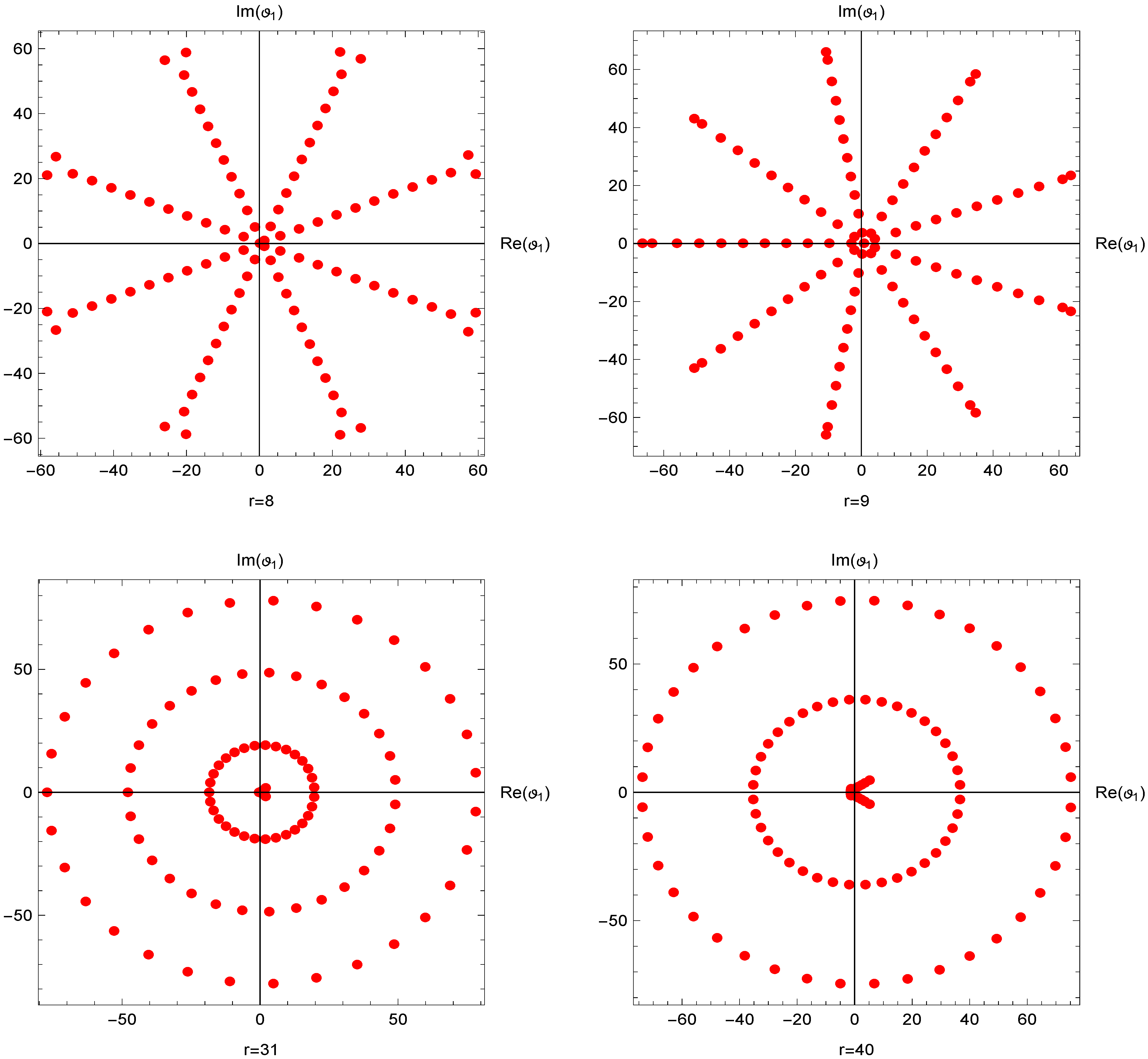
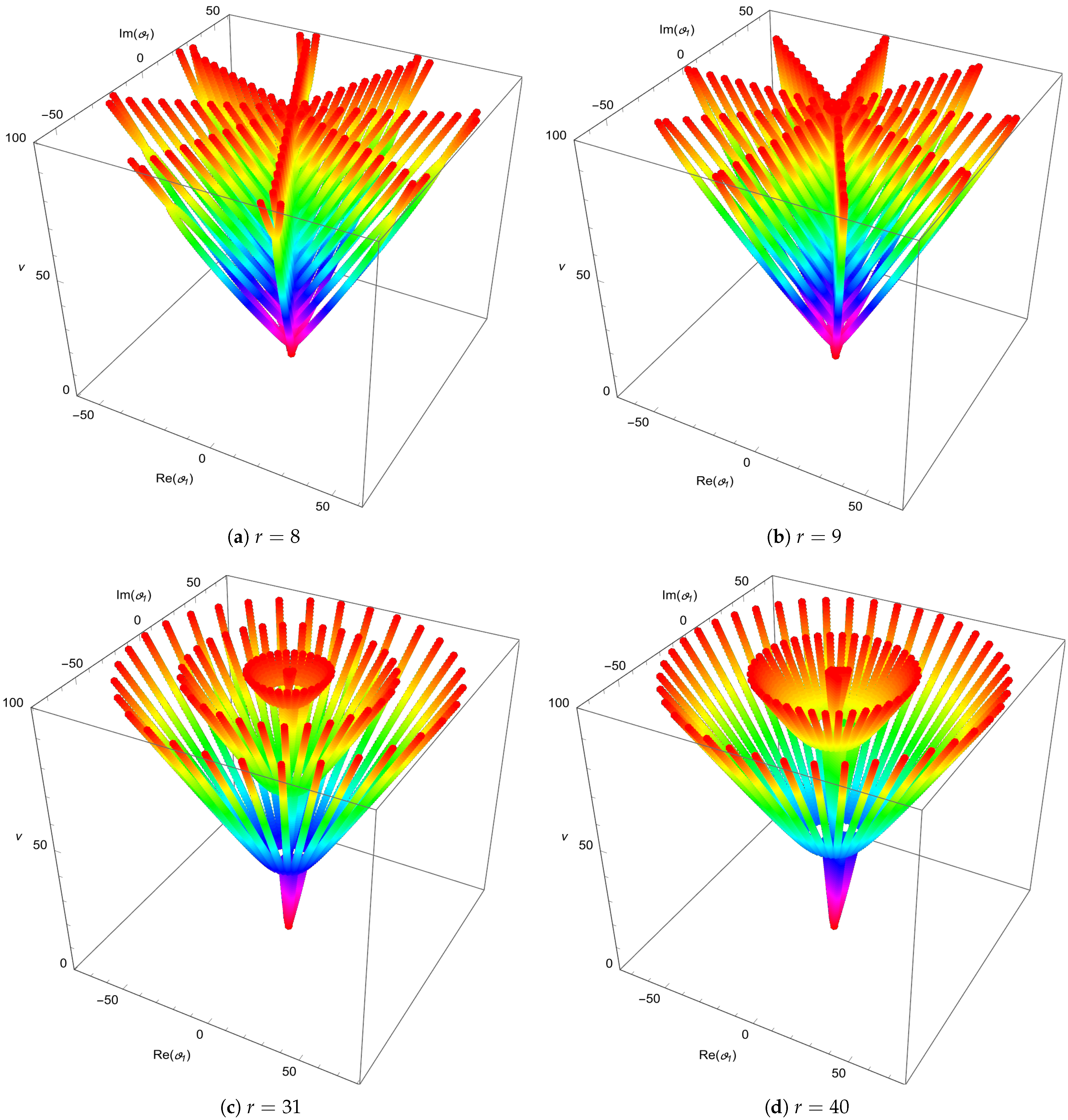
Section 7 offers visual and numerical insights into these polynomials’ behavior by presenting computational results, zero distributions, and graphical visualizations for a specific class of fractional Gould–Hopper–Bell–Apostol-type polynomials, utilizing Mathematica.
Appendix A provides a comprehensive summary of the polynomials and their corresponding symbols.
2. Fractional Gould–Hopper–Bell–Apostol-Type Polynomials
This section begins by establishing an operational relationship between GHBlATP and 2VUBlAP . Subsequently, utilizing the acquired operational representation and considering the Euler integral, we formulate the fractional Gould–Hopper–Bell–Apostol-type polynomials.
Upon differentiating expression (
8)
r times with respect to
, we obtain
Next, on differentiating expression (
8) with respect to
, we find
From (
18) and (
19), we obtain
From (
13), it follows that
Solving (
20) subject to initial condition (
21), we get
We now derive the fractional Gould–Hopper–Bell–Apostol-type polynomials by demonstrating the subsequent results:
Theorem 1. The fractional Gould–Hopper–Bell–Apostol-type polynomials, denoted as are defined by Proof. Substituting
with
in (
17) and subsequently applying the derived equation to
yields the following transformation:
which, after applying the operational relation (
22), results in
In (
24), the integral transform on the right side generates a new family of special polynomials, termed the fractional Gould–Hopper–Bell–Apostol-type polynomials (FGHBlATP). Let these polynomials be represented as
, yielding
From (
24) and (
25), we get assertion (
23). □
Remark 1. For , FGHBlATP reduce to the fractional Gould–Hopper–Apostol-type polynomials (FGHATP) , which satisfy the operational representation: Remark 2. For , FGHBlATP reduce to the fractional Hermite Kampé de Fériet–Bell–Apostol-type polynomials (FHKDFBlATP) , which satisfy the operational representation: Next, the generating function for FGHBlATP is established by proving the following theorem:
Theorem 2. The following generating function for FGHBlATP holds true: Proof. By summing both sides of (
25) after multiplying by
, we derive
Applying (
8) to the right-hand side of (
27), we have
Finally, utilizing identity (
17) on the right-hand side of (
28) yields assertion (
26). □
Remark 3. Setting in (26), we get the generating function of FGHATP : Remark 4. Setting in (26), we get the generating function of FHKDFBlATP : Remark 5. Setting in (26), we get the generating function of the fractional Gould–Hopper–Bell polynomials (FGHBlP) : The following results are established to present the series representations for FGHBlATP :
Theorem 3. For FGHBlATP , the following series representation holds true: Proof. In view of (
11), (
25) becomes
Applying (
17) to the right-hand side of (
32) yields (
31). □
Remark 6. Setting in (31), we get the series representation that is satisfied by FGHATP : Remark 7. Setting in (31), we get the series representation for FHKDFBlATP : Remark 8. Setting in (31), we get the series representation for FGHBlP : Theorem 4. FGHBlATP satisfy the following series expression: Proof. Utilizing (
2), (
26), and (
29), we obtain
Equating coefficients of similar powers of
yields the result presented in (
33). □
Theorem 5. The following explicit formula for FGHBlATP holds true: Proof. Equations (
7), (
26), and (
30), together with a similar argument to that employed in the proof of Theorem 4, lead to assertion (
34). □




 ,
,