


Abstract
Differential equations with fractional order play an important role in modeling some natural phenomena. This paper investigates the dynamics of the fractional-order commensal symbiosis model with the Allee effect. This model describes the relationship between prey and predator populations. The piecewise-constant approximation technique is applied to discretize this model. Equilibrium points are established, and local stability conditions are calculated using fractional-order linearization and eigenvalue-based arguments. Moreover, the bifurcation theory is successfully invoked to discuss the period-doubling bifurcation. In particular, sufficient conditions are effectively determined for the emergence of the period-doubling bifurcation. We utilize the hybrid control approach to control the behavior of the considered system. Then, some numerical examples are presented to demonstrate the accuracy and validity of the theoretical results. The findings indicate that fractional order and Allee effects improve system dynamics and substantially improve stability limits and bifurcation structures, providing new insights into how to handle the dynamics of ecological systems.
1. Introduction
An effective mathematical structure for modeling connections in which one organism benefits from the existence of another without generating a major positive or undesirable effect on the other organism is given by the commensal symbiosis model [1,2]. The presence of the host species usually leads to a greater per-capita growth rate for the benefiting species, whereas the host maintains its own basic population dynamics. The ecologically relevant phenomena that populations are unable to remain below an acceptable density, even under ideal environmental circumstances, can be seen in the model when an Allee effect is included into the growth of the commensal population. These mathematical representations are particularly effective for exploring microbial consortia, interactions between plants and microbes, and cooperative–neutral ecological interactions in which the beneficiary species relies on a microenvironment or resource associated with the host for its long-term existence. Fractional-order derivatives have been increasingly prevalent in environmental simulation recently, since they can offer more precise results than standard integer-order models. Moreover, they incorporate long-behavior dynamics, anomalous diffusion, and sub-exponential growth patterns that can be seen in real biological systems [3].
Various studies, which were used to investigate the dynamic behaviors, stability features, and environmental effects associated with commensal symbiosis, have attracted several scholars to describe some biological phenomena such as a fractional-order commensal symbiosis model with the Allee effect. Understanding the long-term behavior of commensal systems is extensively dependent on the investigation of equilibria. Utilizing comparison theorems to deduce the cases in which these equilibria are stable or unstable, Liu et al. [4] analyzed the stability of a system of commensalism and parasitism with harvesting in commensal species. The stability of a commensalism system involving Michaelis–Menten harvesting was examined in [5]. This system also highlighted the criteria for global attractivity and equilibrium stability. More research has concentrated on systems which involve functional responses, like the Holling type. The stability of a commensalism structure incorporating Holling-type responses, for illustration, was successfully explored in [2] to demonstrate how these nonlinear terms effectively impact the equilibrium states of the system. Furthermore, Chen et al. [6] obtained some constraints under which the positive equilibrium of a commensal system with a Holling II functional response is global. The Allee effect may boost the species’ ultimate density, pointing to a possible favorable function in some symbiotic situations [7]. In addition, the findings in [8] illustrated that the positive equilibrium is globally stable where the Allee effect was encountered by the first species. This emphasizes the stabilizing impact of the Allee effect on population structure [8]. The period-doubling bifurcations in a discrete-time commensal system with the Allee effect was addressed in [9]. This study emphasized that the possibility of intricate oscillatory dynamics and bifurcations around coexistence points can be beneficially shown [9]. Finally, a commensal scheme with nonlinear dispersal and the Allee effect was successfully investigated in [10]. Zhong et al. [10] discussed the impacts of the Allee effect in complex ecological circumstances and explained how spatial heterogeneity impact stability and bifurcation behavior.
Despite these improvements, some significant gaps persist. The vast majority of studies on ecology utilize straightforward hypotheses about commensal relationships. As a result, the desire to more effectively understand interactions among organisms that do not fully benefit from each other is the motivation that drives the investigation of a fractional-order commensal symbiosis model. Through the utilization of fractional derivatives, scholars can modify the adaptability of fractional-order systems and analyze how various types of input impact stability, bifurcation, chaos, and coexistence conditions. The importance of analyzing a fractional-order commensal symbiosis system stems from its capability to present an improved and adaptable explanation for interactions in ecology in which one species takes advantage while the other stays unaffected. In order to effectively deal with previous challenges, this research discuses the dynamics of a novel fractional-order commensal symbiosis model which demonstrates the complicated nature of long-term ecological connections. This study is successfully carried out to establish equilibrium points, examine local stability, find bifurcation, and investigate how fractional orders affect the system’s behavior. Furthermore, some numerical simulations are presented to verify the results obtained.
The fractional-order commensal symbiosis model with the Allee effect is given by
where is the fractional-order parameter and . The variables and are considered to be the population densities of the prey and predator at time t, respectively. and represent the intrinsic prey and predator growth rates, respectively. describes the competition among individuals of prey and has a similar meaning to . Moreover, C describes the intensity of the cooperative effect of the predator on the prey, and the term is the Allee effect, while represents the constant of the Allee effect. Finally, is a fractional derivative of the conformable type, as defined in [11].
where is the discretization parameter. It was shown in [12] that the following fact was evidenced from Equation (2).
2. Discretization Process
The discretization process of system (1) using the piecewise-constant approximation method [13,14] is shown in this section. Applying this technique, we obtain
where represents the integer part of , and is a discretization parameter. By applying relation (3), the first equation of system (4) can be rewritten as
Separating variables yields
Integrating over the interval gives
Taking the limit as and introducing the notation , , we obtain
The second equation of system (4) is similarly solved to end up with
Consequently, the discrete-time counterpart of system (1) can be expressed as the following two-dimensional nonlinear system:
where S is the discretization parameter.
3. The Existence and Local Stability of the Fixed Points
In this section, we analyze the stability of fixed points of system (10). First, the equilibrium points of system (10) are determined by solving the following algebraic nonlinear system:
The Jacobian matrix of system (10) at any equilibrium point can be written as
Consequently, the characteristic equation of the previous matrix is
with
Next, the stability of the fixed points is examined with the help of Lemma 1 and Lemma 2.
Lemma 1
([14,15]). Let be a fixed point of system (10) with multipliers (eigenvalues of Jacobian matrix) and . Then,
- 1.
- If and , it is a sink point and locally asymptotically stable;
- 2.
- If and , it is a source point and locally unstable;
- 3.
- If and or and , it is a saddle point;
- 4.
- If or , it is non-hyperbolic.
Lemma 2
([14,16]). Suppose that the polynomial , where , and and are the two roots of . Then,
- 1.
- and if and only if and .
- 2.
- and if and only if and .
- 3.
- and (or and ) if and only if .
- 4.
- and if and only if and .
- 5.
- and are complex numbers and if and only if and .
Theorem 1.
The trivial fixed point and predator-free fixed point are non-hyperbolic.
Proof.
Using Lemma 1, it can be deduced that the points and are non-hyperbolic. □
Theorem 2.
The prey-free fixed point is a saddle point if , a source point if , and non-hyperbolic if .
Proof.
The matrix (11) at is
where
Using Lemma 1, it can be deduced that the point is a saddle point if , a source point if , and non-hyperbolic if . □
Theorem 3.
For the coexistence fixed point , we have the following results:
- 1.
- If , then is locally asymptotically stable (sink).
- 2.
- If , then is a source point.
- 3.
- If , then is a saddle point.
- 4.
- The fixed point is non-hyperbolic and the roots of the characteristic equation at this point are and if
Proof.
The matrix (11) () at can be expressed as
Here, we have
Hence, the characteristic polynomial is
By performing basic calculations, we find
Applying Lemma 2, we find the requirement. □
4. Period-Doubling Bifurcation Analysis
Here, we use the bifurcation theory presented in [14,17,18] to discuss the conditions under which the considered system encounters a period-doubling bifurcation at the coexistence fixed point
We make the assumption that the bifurcation parameter changes within a small portion of the set
Assume that . Then, system (10) is expressed as
Here, is a small perturbation from where . Utilizing the change of variables
the fixed point is simply shifted to the origin. Next, we apply the Taylor series at origin to expand and to the third order. Achieving this, system (13) turns into
where the values of the coefficients are presented in Appendix A. In addition, we obtain the normal form of system (14) at using the transformation
Assume that
and
5. Chaos Control
This section focuses on the implementation of chaos control approaches on system (10). More specifically, two different control mechanisms are implemented to manage bifurcations and reduce chaotic behavior. It is worth noting that studies on the control of chaos in discrete-time dynamical systems are currently quite active. Several methods for controlling bifurcation scenarios and stabilizing chaotic motions in various kinds of discrete-time systems have been developed in recent years [19].
In this paper, we utilize the hybrid control method [20] to control the behavior of system (10). Applying this method leads to the following controlled system:
where is a control parameter for the hybrid control method and
The stability of the system at its positive fixed point determines the controllability of system (16). We calculate the Jacobian matrix of system (16) at its unique positive fixed point in order to analyze this stability characteristic. Achieving this gives
The characteristic polynomial of the Jacobian matrix computed at can therefore be represented as follows:
where
The controllability analysis of system (16) is used as the basis for the following lemma:
Lemma 3.
Here, the expression
denotes the feedback control force, while and represent the feedback gains that adjust the system dynamics. The Jacobian matrix for the controlled system (19) is given as follows:
where
In addition, the Jacobian matrix ’s characteristic polynomial is calculated as follows:
Let and be the roots of characteristic Equation (20); then we have
The marginal stability boundaries of the relevant controlled system are then obtained by setting and enforcing the condition . The eigenvalues and are guaranteed to be on the boundaries of the open unit disk under the following conditions:
Consequently, for fixed parameter values, the stable eigenvalues of the controlled system are confined to the triangular region in the -plane bounded by the straight lines , , and .
6. Numerical Simulations
This section provides several numerical examples to show the accuracy and validity of the theoretical results.
Example 1.
System (10) is considered in this example with the parameter values , , , , , , , , and , together with the initial conditions . Suppose that S denotes the bifurcation parameter; then we observe that when the unique positive fixed point loses its stability and system (10) undergoes a period-doubling bifurcation. It is worth noting that the Jacobian matrix of the system computed at this fixed point is given by
Therefore, the characteristic polynomial of matrix is written as
whose roots are
In biological nature, the period-doubling bifurcation takes place when a system begins to alternate between two different dynamic states rather than repeating the same state. It frequently indicates the starting point of complex or chaotic behavior.
Example 2.
In this example, we discuss the behavior of system (10) under the parameter values
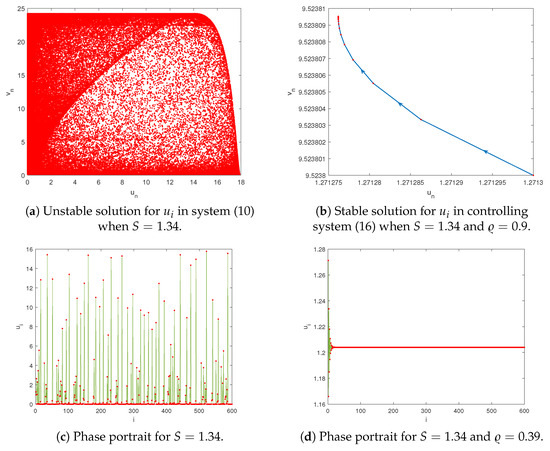
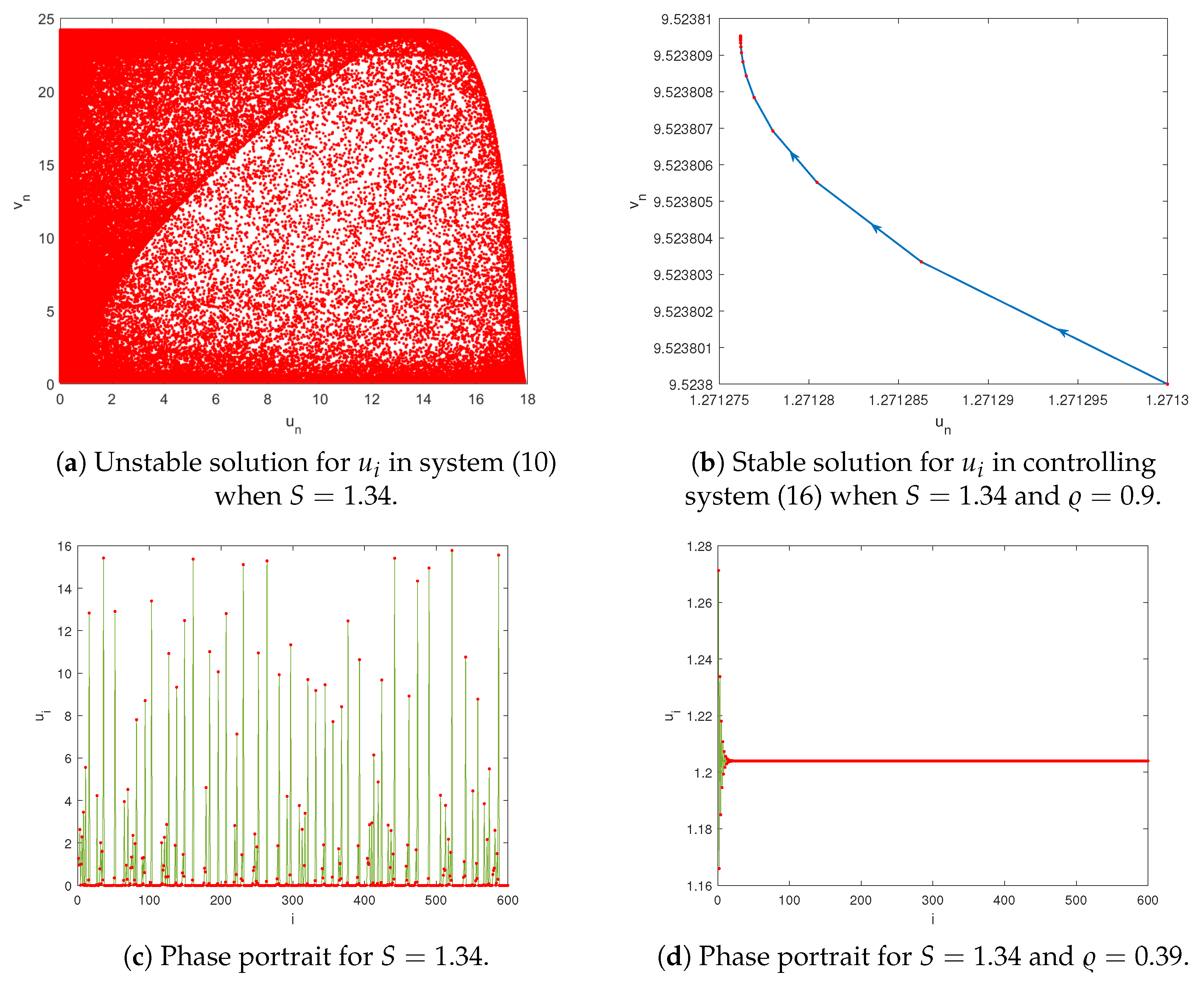
and the initial conditions . When we use these values, system (10) loses the stability of its fixed points through a period-doubling bifurcation. At , the system experiences chaotic behaviors as illustrated in Figure 1a,c. It should be noted that the fixed point becomes stable when the hybrid control technique is used, as can be seen in Figure 1b,d, and the chaotic behavior disappears, as can be seen in Figure 1a. This effectively shows how well the hybrid control approach controls chaotic behaviors and stabilizes the system.
Next, using the same parameter values, we apply the feedback control method to system (10). Under these conditions, the marginal stability of the controlled system (19) is characterized by the following relations:
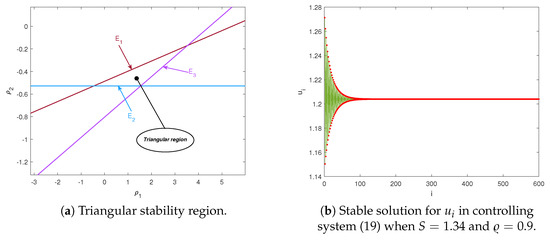
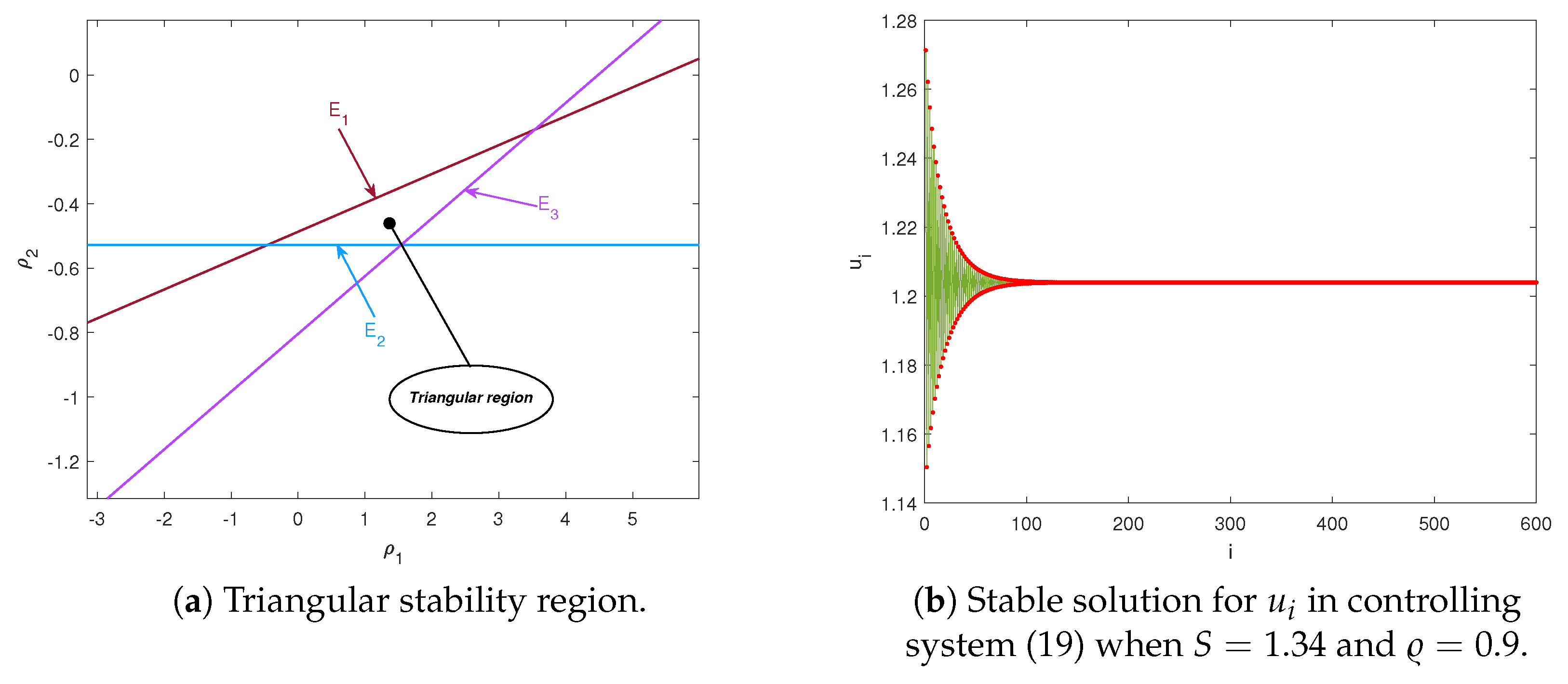
The stability zone of the controlled system is represented as a triangular region in the -plane that is bounded by the straight lines , , and . Figure 2a depicts that region.
Figure 2.
(a) Triangular stability region of the controlled system (19), bounded by , , and . (b) Time evolutions for and , respectively. The parameter values are: , , , , , , , , and .
As observed in Figure 2b, the fixed point becomes locally asymptotically stable for the inputs and . On the other hand, the point lies outside of the zone of stability when and are used. This leads to instability, as depicted in Figure 1a. From the perspective of the environment, the feedback control process can be understood as focused management techniques meant to prevent undesired oscillatory or chaotic activity and stabilize the dynamics of populations.
7. Results and Discussion
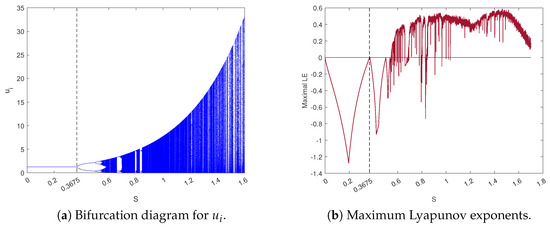
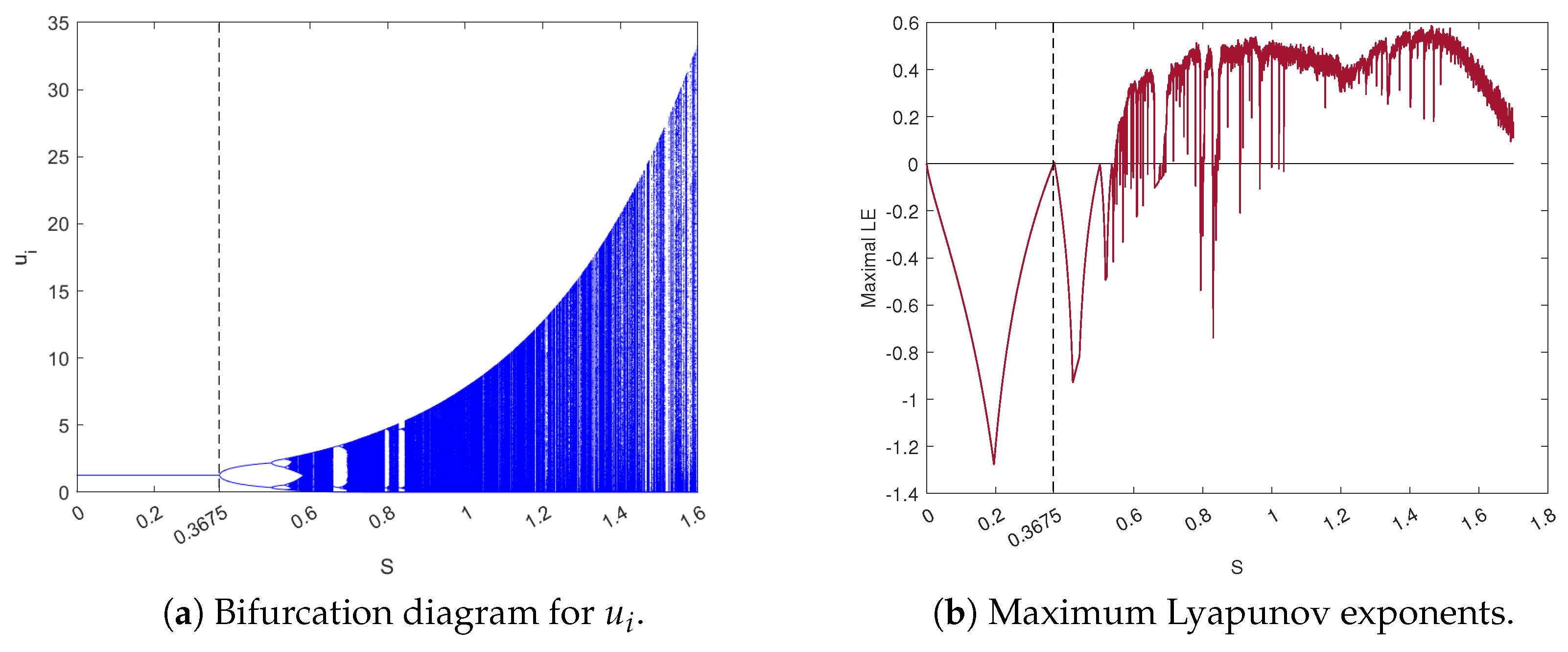
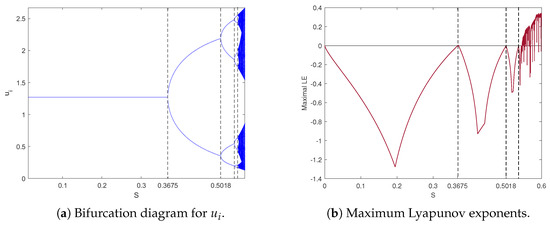
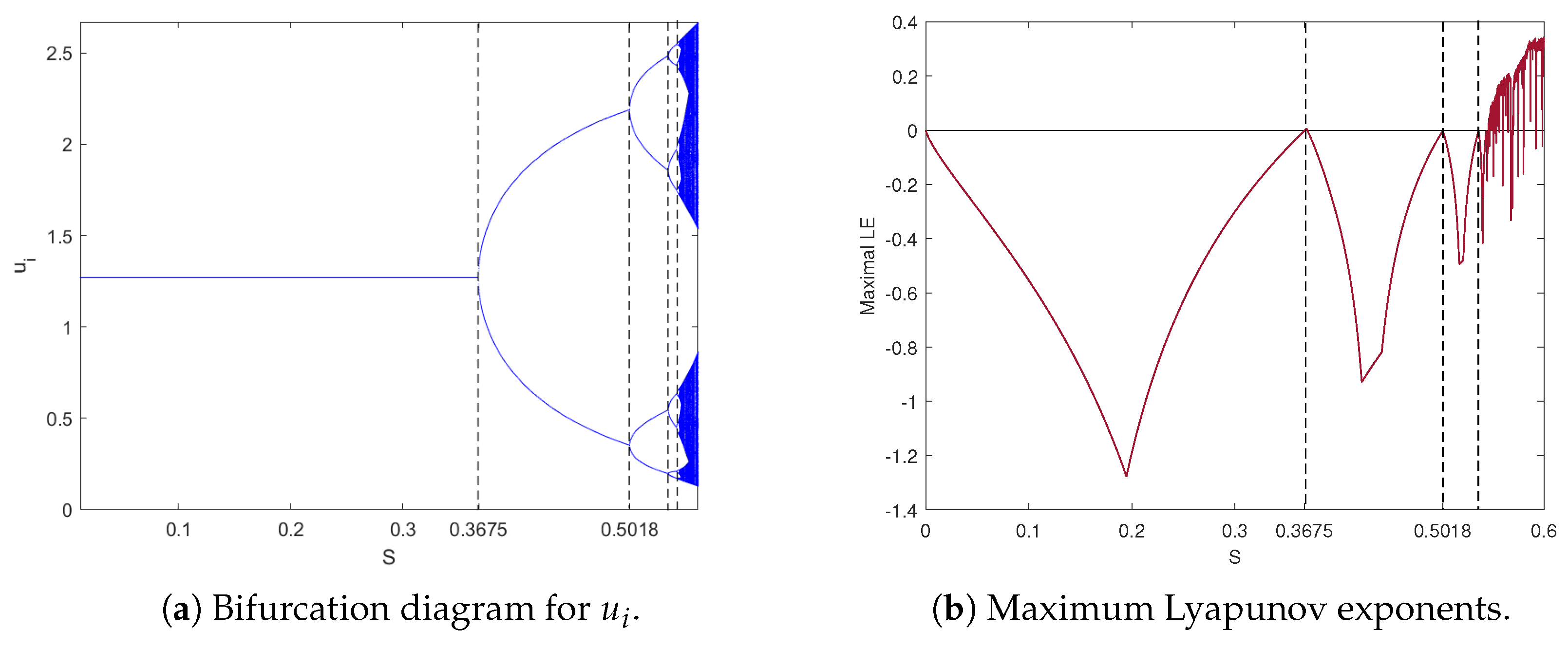
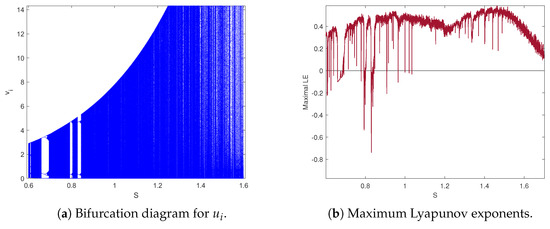
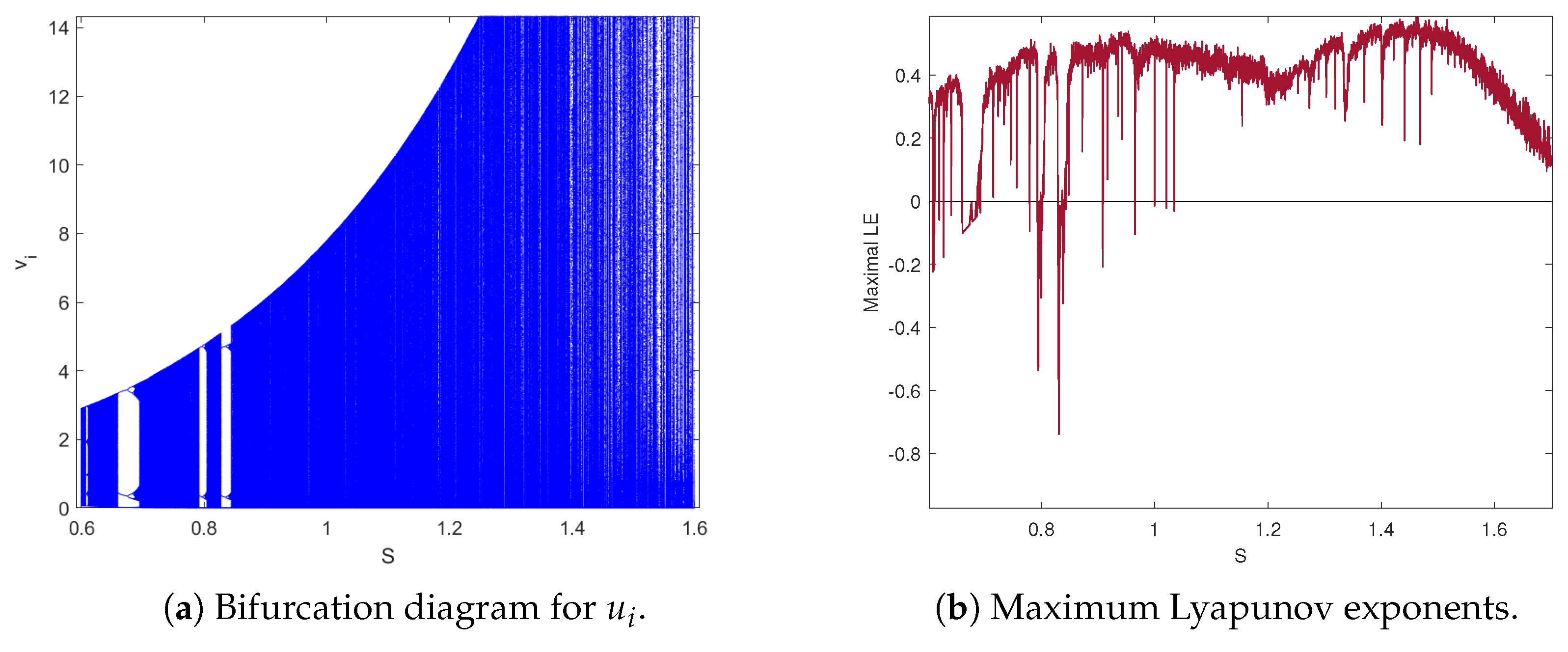
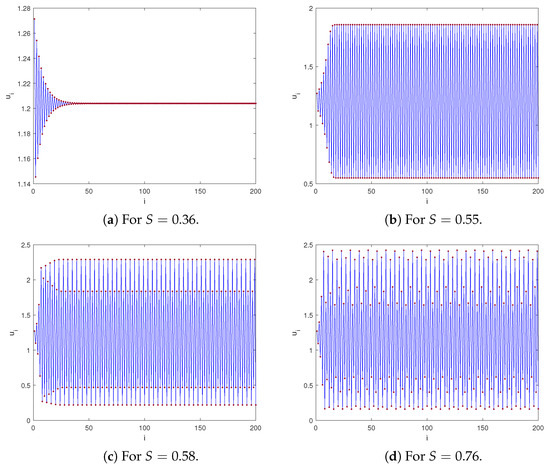
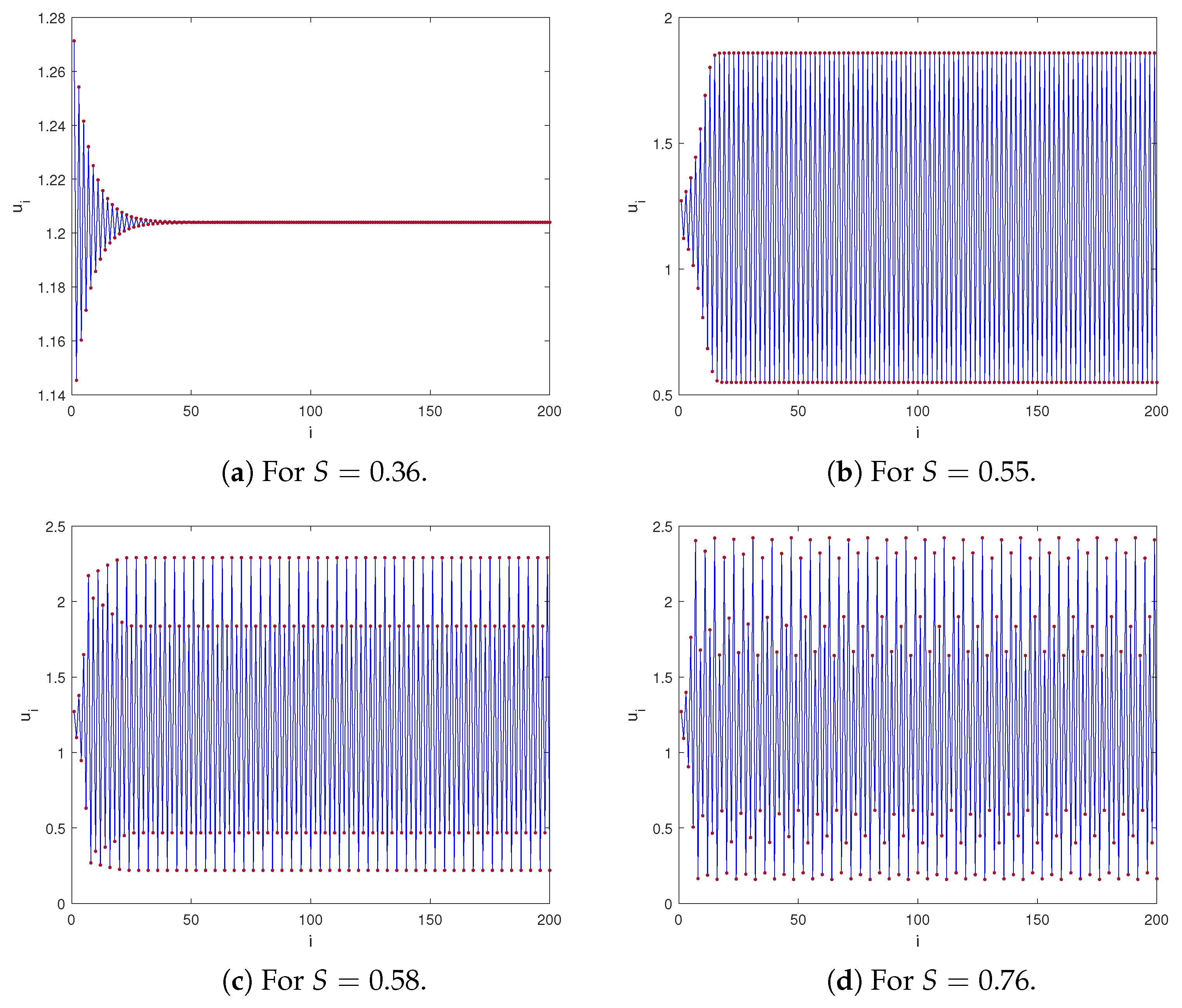
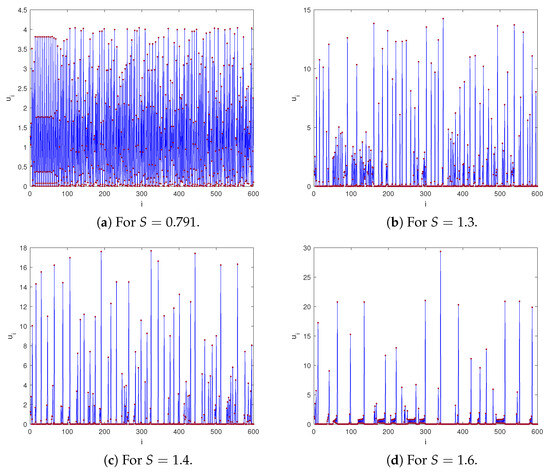
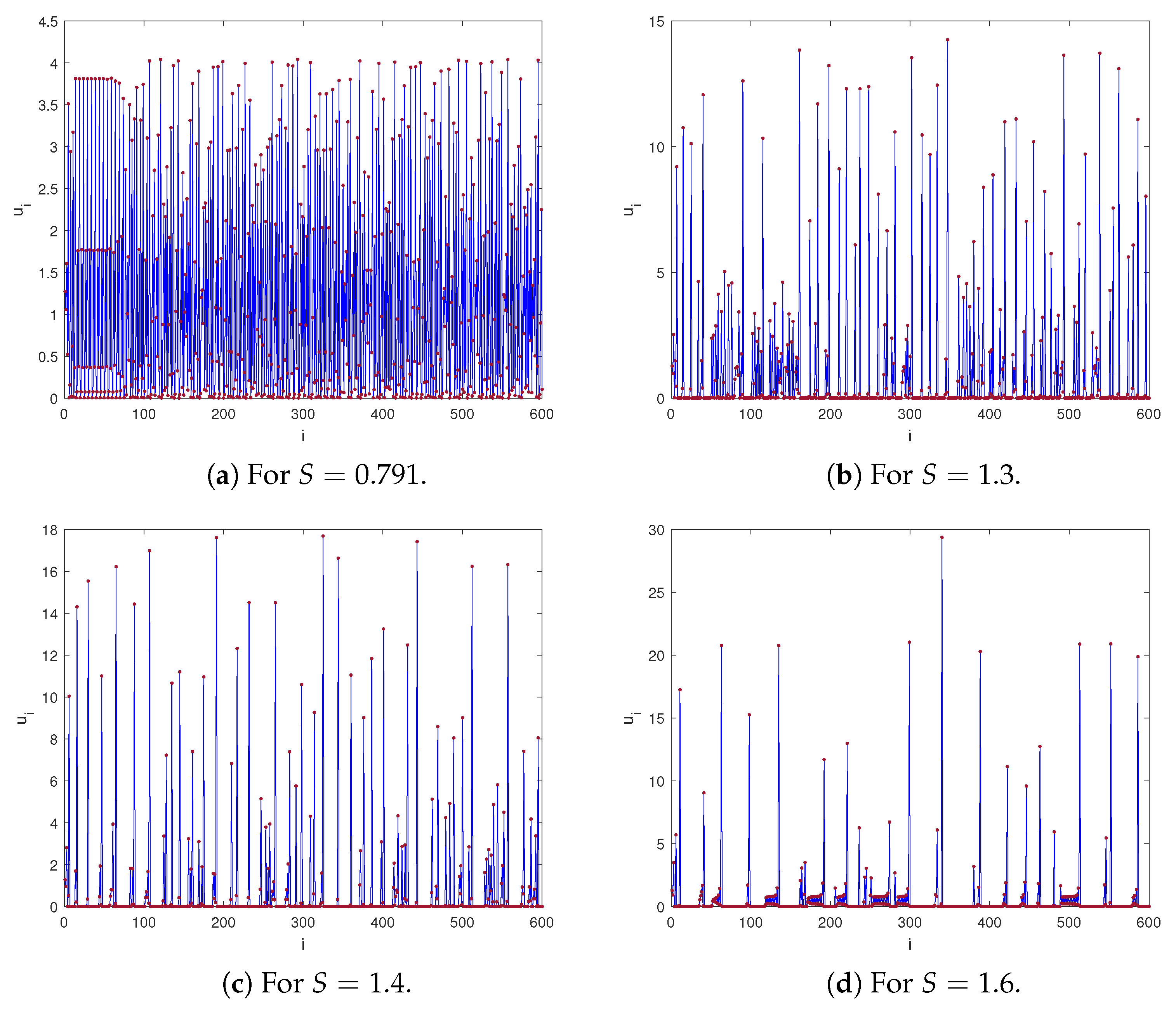
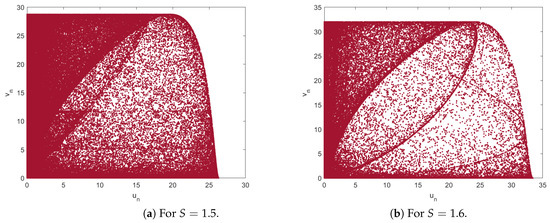
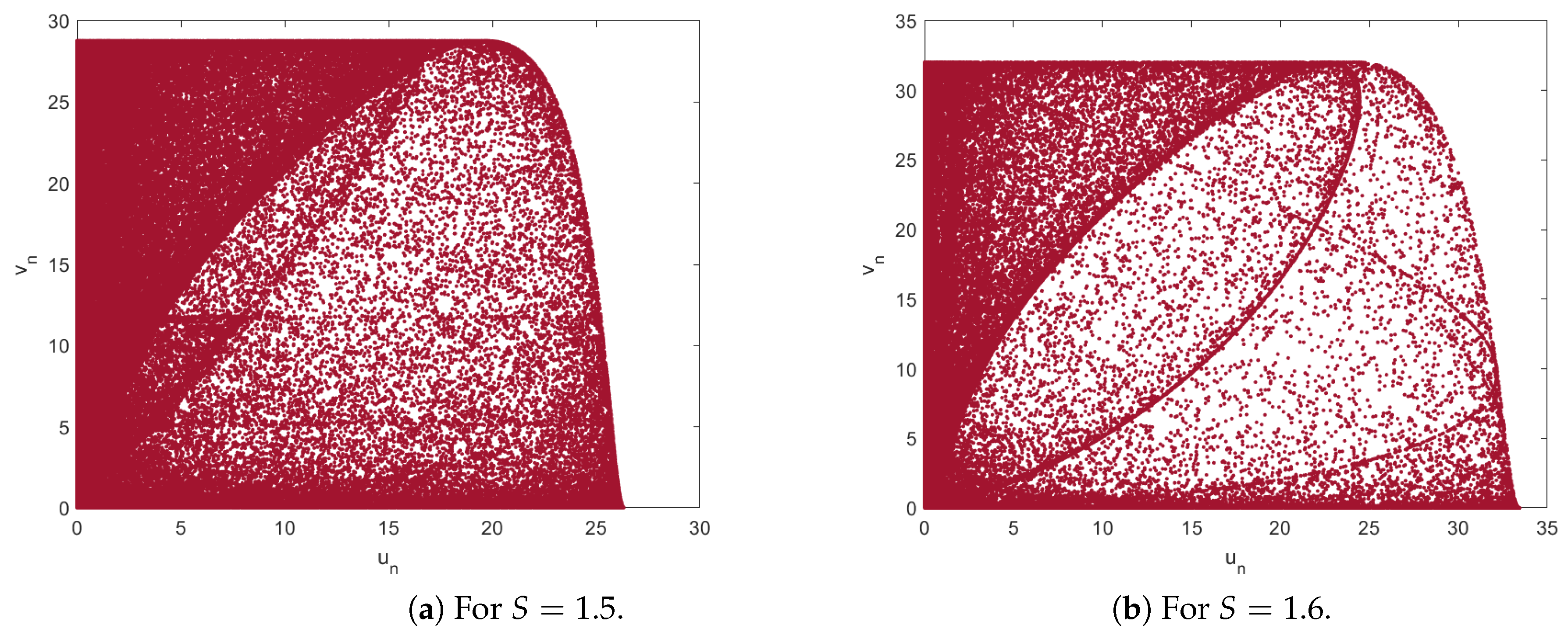
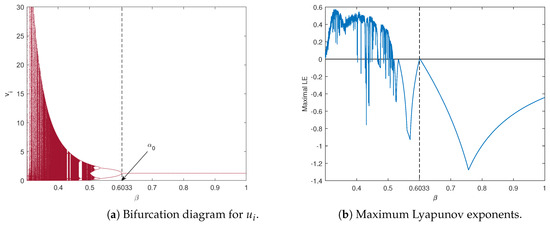
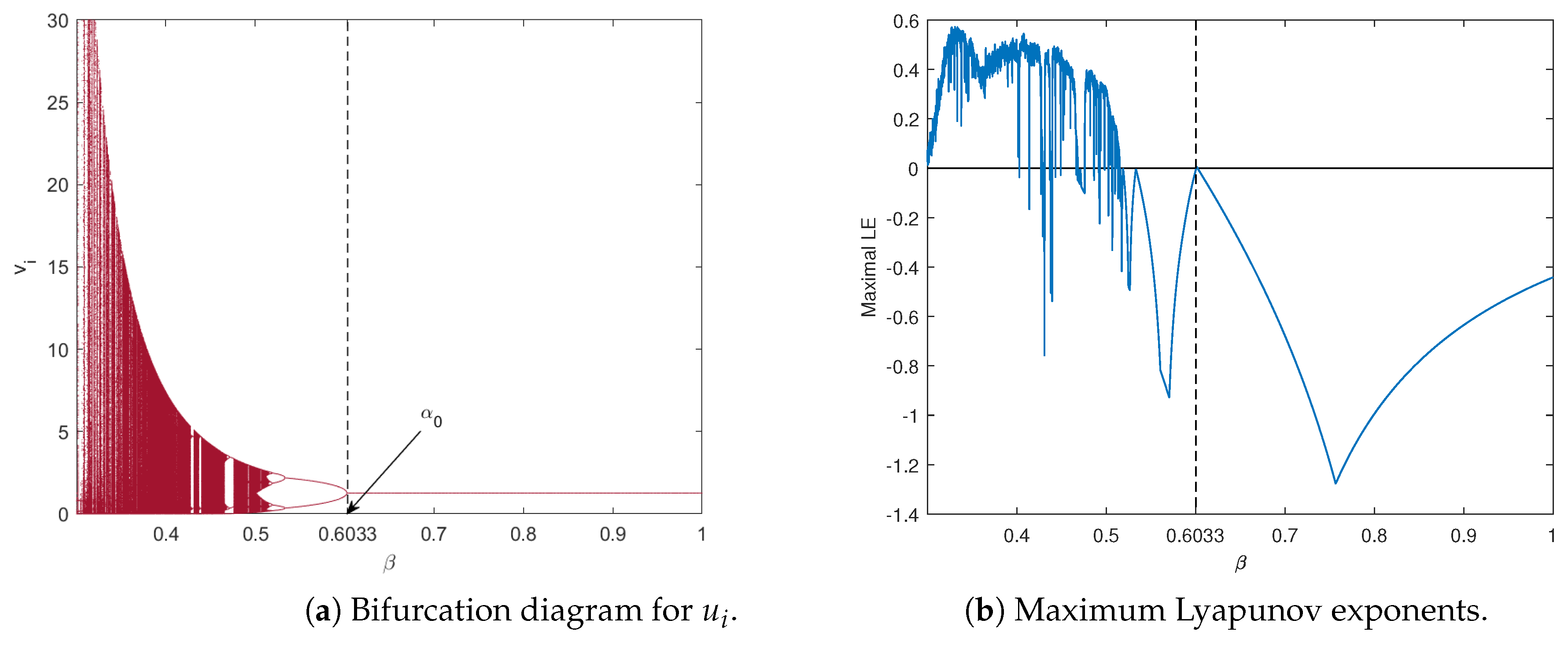
Here, we discuss the main results obtained in this article. The bifurcation graphs and the corresponding maximum Lyapunov exponents (MLEs) are clearly shown in Figure 3, Figure 4 and Figure 5 for the parameter ranges , , and , respectively. We also observe that Figure 3 presents the bifurcation plot together with the associated Lyapunov exponent of system (10) as functions of the bifurcation parameter S. The fixed point is stable inside the interval (see Figure 3a,b). This point becomes unstable at as a result of a period-doubling bifurcation. Furthermore, Figure 3b indicates that the Lyapunov exponent assumes both positive and negative values, revealing the alternation between regular and chaotic dynamics of the system. The time series associated with this case are shown in Figure 6 and Figure 7. This reveals a cascade of period-doubling bifurcations. As observed in Figure 6, the system experiences sequential periodic oscillations with periods 2, 4, and 8. Figure 7 clearly illustrates how this trend eventually leads to chaotic behavior. We display the phase portrait of system (10) for and in Figure 8a and Figure 8b, respectively, to additionally verify the presence of chaos. Note that Figure 9 depicts the bifurcation behavior and the associated Lyapunov exponent utilizing the previously specified parameters , , , , , , , , and , with . System (10) becomes unstable for . As increases beyond 0.6033, the system undergoes a subcritical period-doubling bifurcation at and becomes asymptotically stable for . Biologically, the period-doubling bifurcation occurs in this system when the system starts to switch between two distinct dynamic states instead of repeating the same state. In general, it signifies the beginning of chaotic or complex behavior. More specifically, a period-doubling bifurcation signifies a change from regular or stable population oscillations to more complicated and erratic dynamics. This pattern of behavior might suggest the establishment of multi-period population cycles in interacting species, which would imply ecological instability or sensitivity to changes in the environment. Such dynamics in commensal symbiosis systems show that, under specific conditions, the relationship can continue to result in unexpected population fluctuations even when one species benefits without harming the other. In addition, the Allee effect indicates that low-density populations are specifically susceptible, and period-doubling might point to vital limits beyond which populations undergo significant oscillations or even collapse.
Figure 3.
(a) Supercritical period−doubling bifurcation diagram of system (10). (b) Corresponding maximum Lyapunov exponents for the parameter values: , , , , , , , , and [0, 1.6].
Figure 4.
(a) Period−doubling bifurcation diagram of system (10). (b) Corresponding maximum Lyapunov exponents for the parameter values: , , , , , , , , and .
Figure 5.
(a) Period−doubling bifurcation diagram of system (10). (b) Corresponding maximum Lyapunov exponents for the parameter values: , , , , , , , , and .
Figure 6.
Time series for the parameter values: , , , , , , , and .
Figure 7.
Time series for the parameter values: , , , , , , , and .
Figure 8.
Phase portraits for the parameter values: , , , , , , , and .
Figure 9.
(a) Subcritical period-doubling bifurcation diagram of system (10). (b) Corresponding maximum Lyapunov exponents for the parameter values: , , , , , , , , and .
In Example 2, we show how well the hybrid control method controls chaotic behaviors and stabilizes system (10) under the parameter values
and the initial conditions . Using these values produces a period-doubling bifurcation, which causes system (10) to lose the stability of its fixed points. As can be observed in Figure 1b,d, we emphasize that when the hybrid control approach is employed, the chaotic behavior vanishes (see Figure 1a) and the fixed point becomes stable. Here, we compare the outcomes of the traditional integer-order model investigated by Wu et al. [21] with those of the suggested fractional-order commensal symbiosis model with the Allee effect. Despite both models employing similar biological bases, their dynamical behaviors differ dramatically because of the presence of fractional-order derivatives in the current study. In terms of equilibria existence and stability, both models have a trivial equilibrium, boundary equilibria, and a single positive equilibrium. Techniques like Jacobian matrix analysis were used in [21] to conclusively demonstrate that the positive equilibrium is stable. In comparison, the fractional-order model has a more sophisticated stability structure, where the stability is obtained using some conditions on the eigenvalues. The presence of bifurcation phenomena highly distinguishes the two models. Wu et al. [21] did not present a bifurcation or oscillatory behavior in the model they analyzed. However, period-doubling bifurcation appears in the present fractional-order model. In particular, while the classical model offers helpful observations about the stability and the persistence of commensal symbiosis systems with the Allee effect, it remains restricted to very simple dynamical behavior. The fractional-order model expands previous findings by integrating new effects and highlighting the presence of various dynamical phenomena, such as stability flipping and period-doubling bifurcations.
8. Conclusions
We mention the key findings in this section. The piecewise-constant approximation technique has provided effective results for the discretization of model (1). We have found that model (10) has four fixed points, namely a trivial fixed point, a predator-free fixed point, a prey-free fixed point, and a coexistence fixed point. These points become stable under some conditions provided in Theorems 1–3. Furthermore, we have noted that if and , then system (10) encounters a period-doubling bifurcation at the positive fixed point when the parameter h varies within a small neighborhood of . However, when then model (10) bifurcates from the fixed point to a two-periodic stable orbit. The controllability of system (16) has been successfully shown in Lemma 3. We then discussed some numerical examples from which we noticed that the point loses its stability and system (10) experiences a period-doubling bifurcation under some parameter values together with the initial conditions . In terms of biology, this system has encountered a period-doubling bifurcation when it started to alternate between two different dynamic stages rather than repeating the same state. This normally indicates the initiation of complicated or chaotic behavior.
Funding
This research received no external funding.
Data Availability Statement
Data are contained within the article.
Conflicts of Interest
The author declares no conflict of interest.
Appendix A
References
- Bronstein, J.L. Mutualism; Oxford University Press: Oxford, UK, 2015. [Google Scholar]
- Chen, F.; Chen, Y.; Li, Z.; Chen, L. Note on the persistence and stability property of a commensalism model with Michaelis–Menten harvesting and Holling type II commensalistic benefit. Appl. Math. Lett. 2022, 134, 108381. [Google Scholar] [CrossRef] [Scilit]
- Tarasov, V.E. Fractional Dynamics: Applications of Fractional Calculus to Dynamics of Particles, Fields and Media; Springer Science & Business Media: Berlin/Heidelberg, Germany, 2011. [Google Scholar]
- Liu, X.; Yue, Q. Stability property of the boundary equilibria of a symbiotic model of commensalism and parasitism with harvesting in commensal populations. AIMS Math. 2022, 7, 18793–18808. [Google Scholar] [CrossRef] [Scilit]
- Xu, L.; Xue, Y.; Lin, Q.; Lei, C. Global Attractivity of Symbiotic Model of Commensalism in Four Populations with Michaelis–Menten Type Harvesting in the First Commensal Populations. Axioms 2022, 11, 337. [Google Scholar] [CrossRef] [Scilit]
- Chen, F.; Chong, Y.; Lin, S. Global stability of a commensal symbiosis model with Holling II functional response and feedback controls. WSEAS Trans. Syst. Control 2022, 17, 279–286. [Google Scholar] [CrossRef] [Scilit]
- Lin, Q. Allee effect increasing the final density of the species subject to the Allee effect in a Lotka–Volterra commensal symbiosis model. Adv. Differ. Equ. 2018, 2018, 196. [Google Scholar] [CrossRef] [Scilit]
- Lei, C. Dynamic behaviors of a Holling type commensal symbiosis model with the first species subject to Allee effect. Commun. Math. Biol. Neurosci. 2019, 2019, 3. [Google Scholar]
- Işık, S. Stability and period-doubling Bifurcation in a modified commensal symbiosis model with Allee effect. Erzincan Univ. J. Sci. Technol. 2022, 15, 310–324. [Google Scholar] [CrossRef] [Scilit]
- Zhong, J.; Chen, L.; Chen, F. Stability and bifurcation in a two-patch commensal symbiosis model with nonlinear dispersal and additive Allee effect. Int. J. Biomath. 2024, 2450099. [Google Scholar] [CrossRef] [Scilit]
- Khalil, R.; Al Horani, M.; Yousef, A.; Sababheh, M. A new definition of fractional derivative. J. Comput. Appl. Math. 2014, 264, 65–70. [Google Scholar] [CrossRef] [Scilit]
- Abdeljawad, T. On conformable fractional calculus. J. Comput. Appl. Math. 2014, 279, 57–66. [Google Scholar] [CrossRef] [Scilit]
- Berkal, M.; Navarro, J.F.; Hamada, M.Y.; Semmar, B. Qualitative behavior for a discretized conformable fractional-order predator-prey model. J. Appl. Math. Comput. 2025, 71, 4815–4837. [Google Scholar] [CrossRef] [Scilit]
- Berkal, M.; Almatrafi, M.B. Bifurcation and Stability of Two-Dimensional Activator–Inhibitor Model with Fractional-Order Derivative. Fractal Fract. 2023, 7, 344. [Google Scholar] [CrossRef] [Scilit]
- Berkal, M.; Navarro, J.F. Qualitative behavior of a two-dimensional discrete-time prey–predator model. Comput. Math. Methods 2021, 3, e1193. [Google Scholar] [CrossRef] [Scilit]
- Berkal, M.; Navarro, J.F. Qualitative study of a second order difference equation. Turk. J. Math. 2023, 47, 516–527. [Google Scholar] [CrossRef] [Scilit]
- Kuznetsov, Y.A.; Kuznetsov, I.A.; Kuznetsov, Y. Elements of Applied Bifurcation Theory; Springer: New York, NY, USA, 1998; Volume 112. [Google Scholar]
- Wiggins, S. Introduction to Applied Nonlinear Dynamical System and Chaos; Springer: New York, NY, USA, 2003. [Google Scholar]
- Ahmed, R.; Tahir, N.; Ali Shah, N. An analysis of the stability and bifurcation of a discrete-time predator–prey model with the slow–fast effect on the predator. Chaos Interdiscip. J. Nonlinear Sci. 2024, 34, 033127. [Google Scholar] [CrossRef] [Scilit] [PubMed]
- Din, Q.; Zulfiqar, M.A. Qualitative behavior of a discrete predator-prey system under fear effects. Z. Naturforsch. A 2022, 77, 1023–1043. [Google Scholar] [CrossRef] [Scilit]
- Wu, R.; Li, L.; Lin, Q. A Holling type commensal symbiosis model involving Allee effect. Commun. Math. Biol. Neurosci. 2018, 2018, 6. [Google Scholar] [CrossRef] [Scilit]
Disclaimer/Publisher’s Note: The statements, opinions and data contained in all publications are solely those of the individual author(s) and contributor(s) and not of MDPI and/or the editor(s). MDPI and/or the editor(s) disclaim responsibility for any injury to people or property resulting from any ideas, methods, instructions or products referred to in the content. |
© 2026 by the author. Licensee MDPI, Basel, Switzerland. This article is an open access article distributed under the terms and conditions of the Creative Commons Attribution (CC BY) license.