
Article

Chaotic and Multi-Layer Dynamics in Memristive Fractional Hopfield Neural Networks
by
Vignesh Dhakshinamoorthy
1,*,
Shaobo He
2,† and
Santo Banerjee
3,†
1
Centre for Mathematical Science, Dhanalakshmi Srinivasan University, Perambalur 621 212, Tamil Nadu, India
2
School of Automation and Electronic Information, Xiangtan University, Xiangtan 411105, China
3
Department of Mathematical Sciences, Giuseppe Luigi Lagrange, Politecnico di Torino, 10129 Turin, Italy
*
Author to whom correspondence should be addressed.
These authors contributed equally to this work.
Fractal Fract. 2026, 10(4), 222; https://doi.org/10.3390/fractalfract10040222
Submission received: 2 March 2026 / Revised: 24 March 2026 / Accepted: 25 March 2026 / Published: 26 March 2026
(This article belongs to the Special Issue Fractional Dynamics Systems: Modeling, Forecasting, and Control)

Abstract

Artificial neural network and neuron models have made significant contributions to the area of neurodynamics. Investigating the dynamics of artificial neurons and neural networks is vital in developing brain-like systems and understanding how the brain functions. Neural network models and memristive neurons are currently demonstrating a lot of promise in the study of neurodynamics. In order to model the dynamics of biological synapses, this study explores the complex dynamical behavior of a discrete fractional Hopfield-type neural network using a flux-controlled memristive element with periodic memductance. Hyperbolic tangent and sine are the heterogeneous activation functions that are implemented in the proposed system to improve nonlinearity and replicate various forms of brain activity. Stability and bifurcation analyses are used to illustrate the nonlinear dynamical nature of the constructed network model. We examine how the fractional order ( ν ) and periodical memductance aspects influence the dynamics of the system to emphasize the emerging complex phenomena like multi-layered dynamics and the presence of several distinct dynamical states throughout the system variables. Randomness and complexity of the time series data for the proposed system are illustrated with the help of approximate entropy analysis. These findings could help researchers better understand brain-like memory networks, neuromorphic computers, and the theoretical study of neurological and mental abilities. The study of multi-layer attractors can be useful in advanced sensory devices, neuromorphic devices, and secure communication.

1. Introduction

The human brain serves as an inspiration for neural network architecture. In the brain, unique cells known as neurons establish complex interconnected networks by exchanging electrical impulses with one another to accelerate the processing of information. In the same way, artificial neurons interact to assess data and resolve challenges within an artificial neural network. Recent artificial intelligence technology employs neural networks, enabling the brain-like functioning of computers and information processing. These neural networks comprise layers of neurons resembling the structure of the brain. Researchers in the fields of physics, electronics, and electrical engineering have grown interested in the complexity of brain connection. Research on neurons and their networks has attracted a lot of interest in an effort to fully understand information processing. Understanding the basic computational principles of the brain by simulating problems mimicking biological neurons with the introduction of several physical elements has been top-priority research in recent years [1].
Electrical devices like memristors have the ability to regulate their resistance based on the past applied current or voltage [2]. They have attracted a lot of attention as possible components for representing synapse-like behavior in the study of neural networks. Synapses are the weighted links connecting any two neurons, indicating the strength of their connections. This is where memristors play a significant role in replicating the functions of the synapses, exhibiting interesting features such as neuromorphic computing with biological significance [3]. The dynamics of neurons and neural network systems can be significantly altered by external inputs like electric fields or electromagnetic radiation. These external inputs can particularly impact the electrical responses of neurons. Memristors have been used recently to investigate how electromagnetic radiation and induction affect neurons. Research on how electrical fields affect neurons [4] is among the most significant advances in the field of neuroscience. Furthermore, studies have focused on incorporating electromagnetic induction into the Hopfield neural networks [5,6] and Wilson neuron model [7] by employing memristive components. Also, research exploring firing patterns arising from network models including memristive electromagnetic induction have been carried out in [8,9] and the chaotic dynamics of Stenflo equations was investigated in [10]. Research contributions such as [11,12,13,14] are significant in demonstrating the importance of the memristor elements in neural network models.
Although the study of fractional calculus dates back to the 17th century, the development of supercomputers and ability to model real-world applications with improved accuracy have led to a notable increase in interest during recent years. Fractional operators have proven to be effective tools for capturing memory and heredity characteristics of processes, as well as for effectively simulating natural events. Fractional calculus has attracted the attention of the scientific community, emerging as a vital tool for modeling in several domains, including economics, biology, mechanics, physics, circuits, robotics and so on [15,16,17]. The application of fractional calculus in the investigation of the dynamics of neural networks has been the recent focus among the researchers. Some notable contributions to the literature on fractional neural networks include qualitative analysis of the network models with fractional order [18,19], application to encryption schemes [20], and bifurcation-based analysis of chaos and multi-stability [21]. Recent studies on fractional calculus highlight the enhancement brought to the modeling of neural networks, with stability and synchronization analysis of the memristive neural network systems in [22]; a passivity study was performed by Rajachakit et al. in [23] and the application of fractional memristors in neuron modeling was demonstrated in [24]. As a result, fractional calculus has improved mathematical representation and investigation of the dynamical nature of neural networks.
Synchronization of the fractional difference neural network model has been investigated by [25,26]. Also, the Rulkov neuron model employing discrete fractional operators was examined in [27], and neural network variable-order dynamics in discrete settings were introduced in [28]. Recent advances include synchronization findings, as in [29], analysis of chaotic dynamics in network models with distinct fractional orders for the state variables in [30], and study of stability properties of delay-based models, as in [18,31]. Recently, fractional difference memristors have become a research focus, including the development and investigation of novel memristor characteristics, as in [32], and dynamical analyses of the Rulkov neuron in [33] and memristor map in [34]. Recent research has examined nonlinear dynamical characteristics and generation of attractors in many layers (multi-layer) in memristor-coupled network models [35,36,37]. The authors in [38] presented the criterion for practical stability in fractional-order network models with discrete time, and Cao et al. in [39] explored the application of a memristor-based neuron model in a discrete-time framework. Based on the inspiration from the literature, with research work on discrete fractional memritors, multi-layered attractors and the increasing demand for creating biologically feasible models of neurons, this study intends to develop a novel nonlinear flux-driven memristor-coupled Hopfield-based fractional difference neural network with distinct activation functions. The significance and novelty of this research article are highlighted as follows:
1.
A novel memristor-coupled 4-D Hopfield neural network model is constructed with a Caputo fractional difference operator.
2.
In this research work, we introduce two different activation functions to the neurons: one periodic sine function and another hyperbolic tangent function. Construction of neural network models with heterogeneous activation functions plays a vital role in reflecting complex brain activities, neuron responses and functions. Considering a periodic activation function like the sine function is useful in modeling oscillating brain rhythms, while the hyperbolic tangent function imitates nonlinear spike initiation in neurons. Thus, considering heterogeneous activation function enhances the computational richness by introducing nonlinear dynamics.
3.
Memristors in neural systems are significant in reproducing biological synapses with memory effects. In Hopfield networks, memristor elements provide richer attractor dynamics. In this article, a discrete fractional-order memristor element is constructed by incorporating nonlinear functions like shifted tanh and shifted tanh with logistic terms that are capable of producing multi-layered attractors. Understanding the multi-layer attractor behavior of the neurons provides powerful insight to multi-stable brain states like memory states, attention and consciousness levels.
4.
Chaotic dynamics of the system are illustrated through bifurcation diagrams, the Lyapunov exponent, and basin of attraction diagrams. Further, the analyses are extended to identification of the coexisting nature of the state variables, and existence of multi-layered attractors and their significance in understanding the sensory functions of the brain are illustrated.
5.
The degree of unpredictability and irregularity in the resulting dynamics of Caputo fractional difference Hopfield neural networks can be measured by approximate entropy, or ApEn. Given that the Caputo operator is non-local, it is important for identifying small shifts in memory-driven state transitions. ApEn helps differentiate between periodic, chaotic, and hyperchaotic regimes by providing a measure of dynamical complexity.
This study is innovative due to the fact that it combines a memristive-based Hopfield neural network model with heterogeneity activation mechanisms using fractional difference-based operators. More specifically, in comparison to traditional constant or piecewise-based memductance formulations published in existing fractional memristive-type neural network models, the proposed periodical memductance approach provides time-dependent memory features. Additionally, this research shows that multi-layer attractor behavior exists, thereby enhancing the system’s dynamical richness. These characteristics make the proposed equation distinct from traditional memristive Hopfield-based neural network architectures that have been previously published.
The rest of this article is structured as follows: Fundamental mathematical concepts required for this study are reviewed in Section 2. Section 3 describes the modeling of the neural network model using discrete fractional-order memristor elements with periodic memductance, followed by a discussion of steady-state analysis in Section 4. The coexistence of the system states is investigated in detail in Section 5, and Section 6 presents basin diagrams. Section 7 investigates the impact of the memductance of the periodic memristor on the neural network dynamics, followed by concluding remarks in Section 8.

2. Prerequisites

Mathematical results that are necessary for the analysis in this research are reviewed in this section. Let N ρ = ρ , ρ + 1 , ρ + 2 , for ρ R .
Definition 1
([40]). Let χ : N ρ R be a function; then the β t h order fractional sum is
Δ ρ β χ ( τ ) = 1 Γ ( β ) α = ρ τ β ( τ α 1 ) ( β 1 ) χ ( α ) , τ N ρ + β , β > 0 .
Definition 2
([40]). The Caputo fractional difference of order β for χ : N ρ R is
Δ ρ β C χ ( τ ) = Δ ρ ( ν β ) Δ ν χ ( τ ) = 1 Γ ( ν γ ) α = ρ τ ( ν β ) ( τ α 1 ) ( ν β 1 ) Δ ν χ ( α ) ,
where ν = [ β ] + 1 , β > 0 , τ N ρ + ν β .
Theorem 1
([41]). Let the fractional difference system of order β be
Δ ρ β C χ ( τ ) = H ( τ + β 1 , χ ( τ + β 1 ) ) , Δ ν χ ( ρ ) = χ ν , γ = β + 1 ,
for ν = 0 , 1 , 2 , , γ 1 ; then equivalent numerical form of the system is
χ ( τ ) = χ 0 ( τ ) + 1 Γ ( β ) α = ρ + γ β τ β ( τ α + 1 ) ( β 1 ) H ( α + β 1 , χ ( α + β 1 ) ) , τ N β + γ ,
with
χ 0 ( τ ) = ν = 0 γ 1 ( τ ρ ) ( ν ) Γ ( ν + 1 ) Δ ν χ ( ρ ) .
Remark 1.
Consider the discrete kernel defined by ( τ α + 1 ) ( β 1 ) Γ ( β ) as Γ ( τ α ) Γ ( β ) Γ ( τ α β + 1 ) with ρ = 0 and α + β = ρ ; for β ( 0 , 1 ) the numerical version is as follows:
χ ( τ ) = χ ( 0 ) + 1 Γ ( β ) ρ = 1 τ Γ ( τ ρ + β ) Γ ( τ ρ + 1 ) H ( ρ 1 , χ ( ρ 1 ) ) .
Theorem 2
([42]). For β ( 0 , 1 ) , let the discrete fractional model be
Δ β Θ ( ω + 1 β ) = δ Θ ( ω ) , ω = 0 , 1 , 2 , ,
where δ R κ × κ . Let
U β = { δ C : | δ | < 2 cos | a r g δ | π 2 β β a n d | a r g δ | > β π 2 } .
System (7) attains asymptotic stability if all δ U β and is unstable for any δ C c l ( U β ) .

3. Discrete Fractional-Order Memristor-Coupled Neural Network Model

In contrast to integer-order systems, fractional-order memristor models consider the history of the input signal and are quite similar to the memory-dependent plasticity of biological synapses. A discrete-time fractional-order memristor with flux-driven nonlinearity is an advanced memory device that incorporates nonlinear input-dependent behavior through flux control and long-term memory effects with fractional order. Energy-efficient, brain-like computation is made possible by the modeling of complicated neural phenomena such as chaotic firing patterns and bifurcations, made attainable by the combination of fractional dynamics with flux control. This section presents the discrete-time fractional-order memristor element with periodic memductance and nonlinearity in the magnetic flux in terms of shifted hyperbolic tangent functions.

3.1. Memristor with Periodic Memductance

The discrete-time fractional-order memristor element is defined as follows:
i ( ϱ ) = [ μ 1 + μ 2 ( sin ( Φ ( ϱ ) ) ) ] ( z 3 ( ϱ ) z 4 ( ϱ ) ) , Δ κ ν Φ ( ϱ ) = μ 3 ( z 3 ( ϱ + ν 1 ) z 4 ( ϱ + ν 1 ) ) + Ψ ( Φ ( ϱ + ν 1 ) ) ,
where ( z 3 ( ϱ + ν 1 ) z 4 ( ϱ + ν 1 ) ) represents the inter-neuronal voltage difference, and the flux-driven nonlinearity is given as
Ψ ( ϱ ) = μ 4 [ Φ ( ϱ + ν 1 ) μ 5 [ i = 0 2 tanh ( Φ ( ϱ + ν 1 ) ( 1 Φ ( ϱ + ν 1 ) + ( 1 ) i 2 i ) ) ] + μ 6 [ i = 0 2 tanh ( Φ ( ϱ + ν 1 ) ( 2 ) i μ 7 ) ] ] .

3.2. Significance of the Memristor Element

The considered flux-driven nonlinearity function is incorporated with multiple hyperbolic tangent terms that introduce smooth, bounded nonlinear transformations. The equation mathematically combines shifted forms of tanh for flexible modeling of activation dynamics and simulating different saturation-like characteristics of neurons in a single formulation. The logistic dynamics-like term Φ ( ϱ ) ( 1 Φ ( ϱ ) ) captures neuronal firing probabilities and population-like interactions, whereas the other shifts in hyperbolic tangents diversify the response and produce multi-scale sensitivity. These nonlinearities improve attractor dynamics in neural networks, particularly in Hopfield-like neuron models, like biologically realistic state transitions, improved pattern recognition, and a richer memory capacity. This formulation also supports multi-stable and chaotic regimes that are helpful for decision-making and computing.

3.3. Zero-Pinched Hysteresis

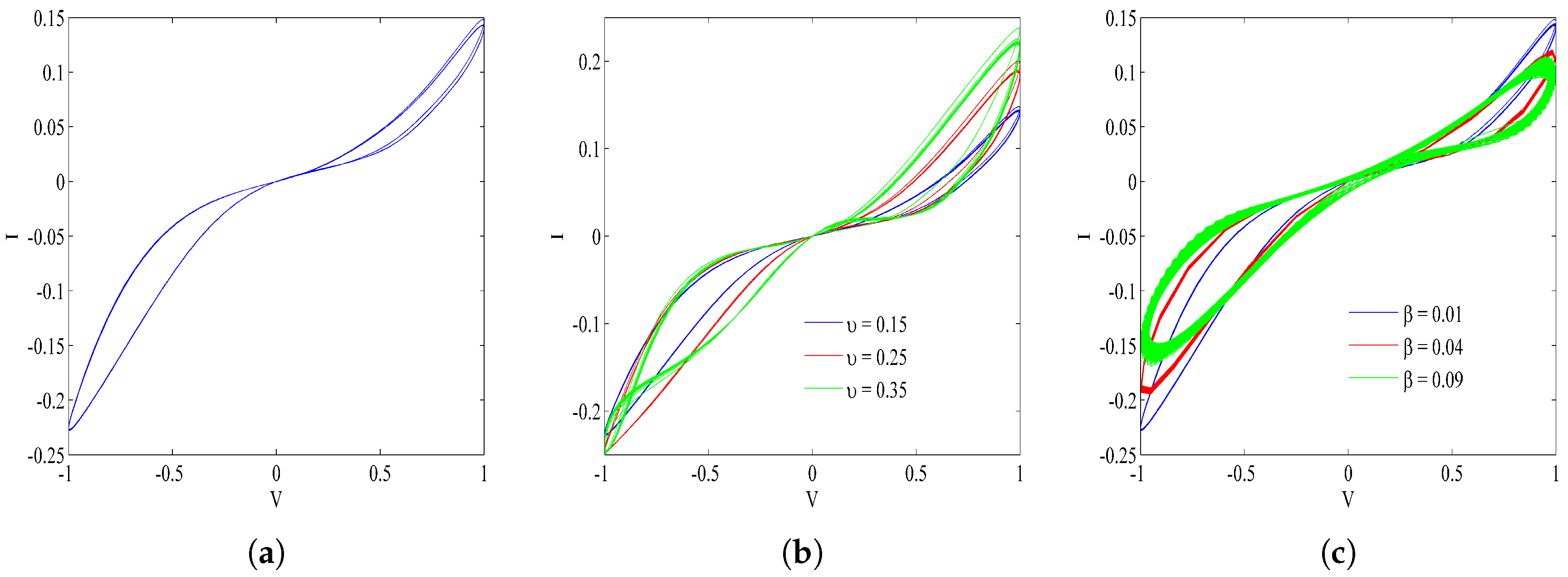
Figure 1a shows the V-I characteristic curve with voltage V = α sin ( 2 π β ϱ ) , where amplitude α = 1 and frequency β = 0.01 , and other parameters take the values μ 1 = 0.15 , μ 2 = 0.1 , μ 3 = 1.75 , μ 4 = 0.15 , μ 5 = 0.75 , μ 6 = 0.85 , μ 7 = 4 and fractional order ν = 0.15 . For the same set of parameter values as previously, Figure 1b shows the effect of the fractional order ( ν ) on the memristor element by simply changing ν = 0.15 , 0.25 , 0.35 . Pinched hysteresis loops acquired for different frequency values are used to verify the fingerprint of the memristor element. Figure 1c shows how the loop’s area decreases as the frequency increases ( β = 0.01 , 0.04 , 0.09 ).

3.4. Mathematical Model

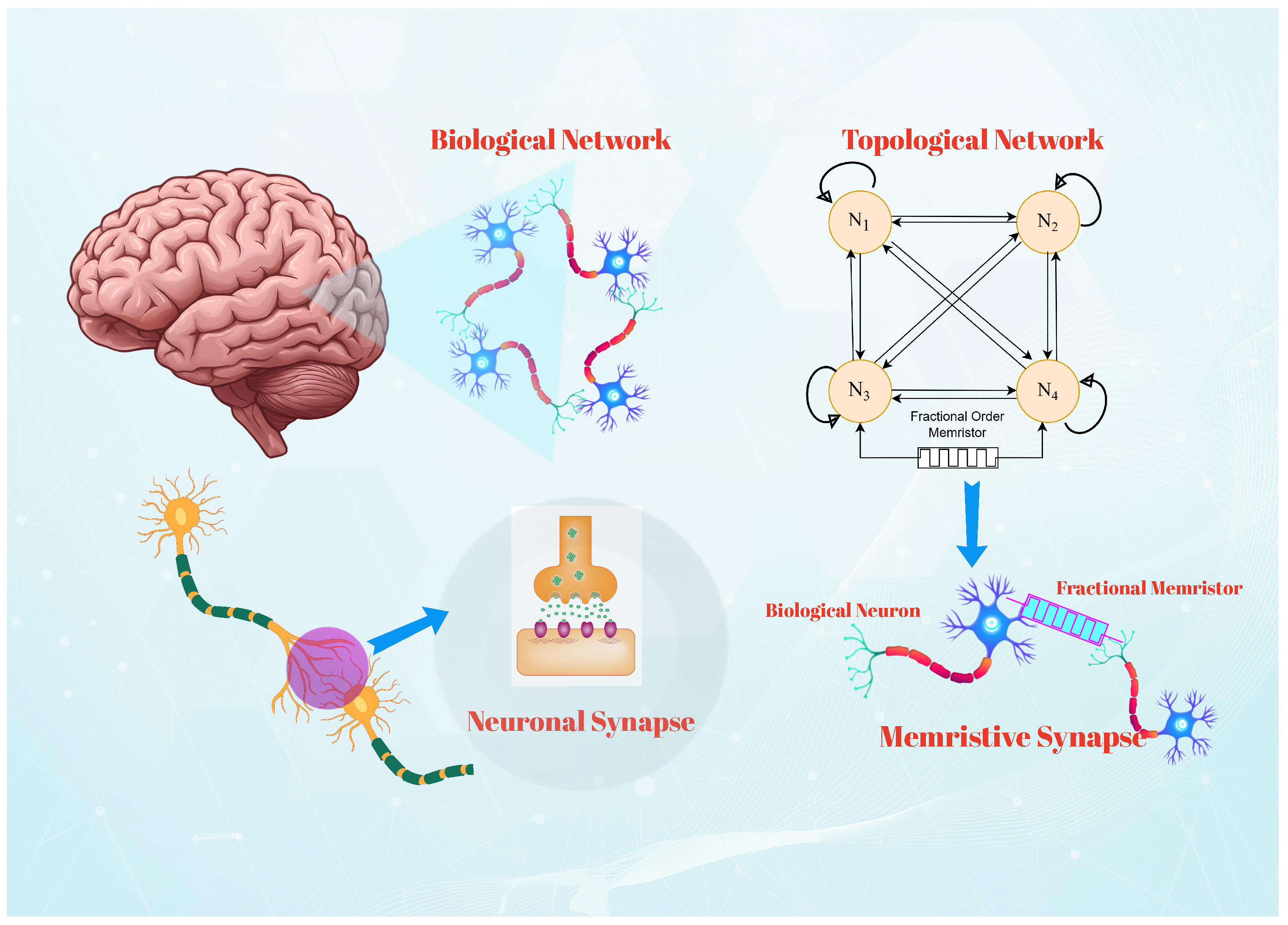
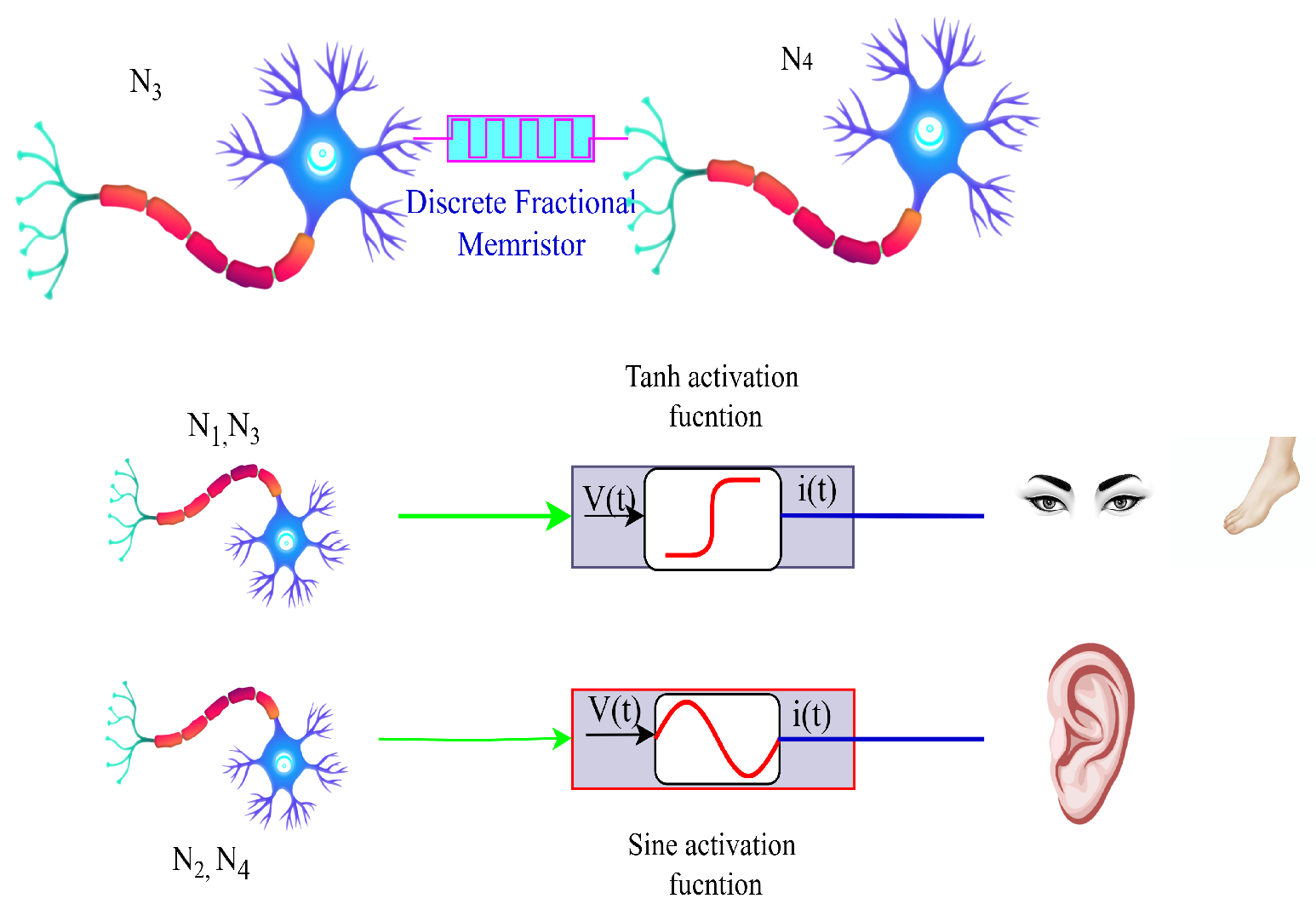
This section focuses on introducing the Caputo-type fractional difference operator-based Hopfield neural network model coupled with the flux-driven memristor element and heterogeneous activation function. Sinusoidal and hyperbolic tangent activation functions are used to represent various nonlinear features detected in brain dynamics. In addition to its uniform saturation and constrained output, which accurately depict the behavior of neuronal firing rates, the hyperbolic tangential function is frequently utilized in neural network models. Compared to that, utilizing the sine function provides periodic nonlinear behavior, which is helpful in the modeling of oscillatory brain responses and increases the diversity of system dynamics. Therefore, when compared to utilizing one type of activation function, the combination of multiple diverse activations increases the model’s overall versatility in describing complicated brain interactions. The topological structure of the proposed four-neuron Hopfield neural network model is provided in Figure 2 and its activation functions and application are given in Figure 3. Despite having four neurons in the network, the memristive-based flux variable Φ adds another dynamic variable. As a result, the entire model should be regarded as a five-dimensional (5D) dynamical model structure, in which the underlying memristive function is represented by the fifth dimension and the fourth dimension corresponds to neuron states.
The mathematical formulation of the Hopfield neural network model is given by
Δ τ ν z 1 ( ϱ ) = z 1 ( ϱ + ν 1 ) + δ 11 tanh ( z 1 ( ϱ + ν 1 ) ) + δ 12 sin ( z 2 ( ϱ + ν 1 ) ) + δ 13 tanh ( z 3 ( ϱ + ν 1 ) ) + δ 14 sin ( z 4 ( ϱ + ν 1 ) ) , Δ τ ν z 2 ( ϱ ) = z 2 ( ϱ + ν 1 ) + δ 21 tanh ( z 1 ( ϱ + ν 1 ) ) + δ 22 sin ( z 2 ( ϱ + ν 1 ) ) + δ 23 tanh ( z 3 ( ϱ + ν 1 ) ) + δ 24 sin ( z 4 ( ϱ + ν 1 ) ) , Δ τ ν z 3 ( ϱ ) = z 3 ( ϱ + ν 1 ) + δ 31 tanh ( z 1 ( ϱ + ν 1 ) ) + δ 32 sin ( z 2 ( ϱ + ν 1 ) ) + δ 33 tanh ( z 3 ( ϱ + ν 1 ) ) + δ 34 sin ( z 4 ( ϱ + ν 1 ) ) + P ( Φ ) ( z 3 ( ϱ + ν 1 ) z 4 ( ϱ + ν 1 ) ) , Δ τ ν z 4 ( ϱ ) = z 4 ( ϱ + ν 1 ) + δ 41 tanh ( z 1 ( ϱ + ν 1 ) ) + δ 42 sin ( z 2 ( ϱ + ν 1 ) ) + δ 43 tanh ( z 3 ( ϱ + ν 1 ) ) + δ 44 sin ( z 4 ( ϱ + ν 1 ) ) P ( Φ ) ( z 3 ( ϱ + ν 1 ) z 4 ( ϱ + ν 1 ) ) , Δ τ ν Φ ( ϱ ) = Ψ ( Φ ( ϱ + ν 1 ) ) + θ 3 ( z 3 ( ϱ + ν 1 ) z 4 ( ϱ + ν 1 ) ) ,
where Δ τ ν represents the Caputo difference operator of order 0 < ν 1 , ( z 1 , z 2 , z 3 , z 4 , Φ ) R 5 , ϱ N τ + 1 ν , with real-valued initial conditions ( z 1 ( 0 ) , z 2 ( 0 ) , z 3 ( 0 ) , z 4 ( 0 ) , Φ ( 0 ) ) . The synaptic weights are represented by δ k l for 1 k , l 4 and
  • P ( Φ ) = [ θ 1 + θ 2 sin ( Φ ) ] .
Fractional Sum Equation Method: A fractional difference equation can be transformed into a corresponding discrete fractional sum equation using the fractional sum equation approach, which makes it more convenient to solve or evaluate numerically. The definition 1 provides a generalization of the classical summation to a fractional order. The memory attribute of fractional-order systems is implicitly included in this formulation, which characterizes the present state variables as a summation of past states employing Theorem 1. Numerical iteration or mathematical characteristics of the model are then derived from the consequent fractional sum equation [43]. The dynamical analysis cannot be performed for the proposed system (11) in its proposed form, so the fractional sum equation method in [43] as described above with τ = 0 is employed to obtain the numerical form as
z 1 ( ϱ ) = z 1 ( 0 ) + 1 Γ ( ν ) q = 1 ϱ Γ ( ϱ q + ν ) Γ ( ϱ q + 1 ) ( z 1 ( q 1 ) + δ 11 tanh ( z 1 ( q 1 ) ) + δ 12 sin ( z 2 ( q 1 ) ) + δ 13 tanh ( z 3 ( q 1 ) ) + δ 14 sin ( z 4 ( q 1 ) ) ) , z 2 ( ϱ ) = z 2 ( 0 ) + 1 Γ ( ν ) q = 1 ϱ Γ ( ϱ q + ν ) Γ ( ϱ q + 1 ) ( z 2 ( q 1 ) + δ 21 tanh ( z 1 ( q 1 ) ) + δ 22 sin ( z 2 ( q 1 ) ) + δ 23 tanh ( z 3 ( q 1 ) ) + δ 24 sin ( z 4 ( q 1 ) ) ) , z 3 ( ϱ ) = z 3 ( 0 ) + 1 Γ ( ν ) q = 1 ϱ Γ ( ϱ q + ν ) Γ ( ϱ q + 1 ) ( z 3 ( q 1 ) + δ 31 tanh ( z 1 ( q 1 ) ) + δ 32 sin ( z 2 ( q 1 ) ) + δ 33 tanh ( x 3 ( q 1 ) ) + δ 34 sin ( z 4 ( q 1 ) ) + P ( Φ ) ( z 3 ( q 1 ) z 4 ( q 1 ) ) ) , z 4 ( ϱ ) = z 4 ( 0 ) + 1 Γ ( ν ) q = 1 ϱ Γ ( ϱ q + ν ) Γ ( ϱ q + 1 ) ( z 4 ( q 1 ) + δ 41 tanh ( z 1 ( q 1 ) ) + δ 42 sin ( z 2 ( q 1 ) ) + δ 43 tanh ( z 3 ( q 1 ) ) + δ 44 sin ( z 4 ( q 1 ) ) P ( Φ ) ( z 3 ( q 1 ) z 4 ( q 1 ) ) ) , Φ ( ϱ ) = Φ ( 0 ) + 1 Γ ( ν ) q = 1 ϱ Γ ( ϱ q + ν ) Γ ( ϱ q + 1 ) ( Ψ ( Φ ( q 1 ) ) + θ 3 ( z 3 ( q 1 ) z 4 ( q 1 ) ) ) , ϱ = 1 , 2 , .
The Caputo fractional difference operator is employed in modeling because it contains initial conditions in the same manner as classical difference equations, making it more suitable for engineering and physical applications. It efficiently captures non-local interactions and long-term interdependence in neural networks and signal processing. As fractional-order dynamics naturally occur in biological and cognitive systems, the flexibility of the Caputo operator makes it particularly helpful for modeling these systems. The computation at every repetition requires summation over all prior states due to the inclusion of fractional-order difference operations, which raises the computational complexity in comparison to conventional integer-order models. Nonetheless, the simulations are run over reasonable time periods, and effective recursive implementation guarantees that the computational expense is kept under control. As a result, the suggested numerical method is effective enough to examine the system’s dynamical characteristics.

4. State-Space Analysis

This section focuses on performing qualitative analyses like stability and bifurcation for system (11). Stability analysis in Hopfield neural networks ensures that the system consistently converges to stable equilibrium states, which represent recorded memory patterns. It ensures stable performance under minor disturbances, which is critical for accurate memory retrieval. Critical parameter values that cause qualitative shifts in network dynamics, such as the shift from stability to oscillations or chaos, can be found using bifurcation analysis. This is essential for understanding how system parameters affect memory capacity and pattern recognition. Numerical stability of the proposed system (11) is analyzed by determining the fixed points of the states under the following parameter assumptions: δ 11 = 0.4 , δ 12 = 0.6 , δ 13 = 0.3 , δ 14 = 0.6 , δ 21 = 0.1 , δ 22 = 0.7 , δ 23 = 1.2 , δ 24 = 0.1 , δ 31 = 0.14 , δ 32 = 0.6 , δ 33 = 0.5 , δ 34 = 0 , δ 41 = 1.3 , δ 42 = 0.5 , δ 43 = 0 , δ 44 = 0.4 , μ 1 = 0.1 , μ 2 = 0.4 , μ 3 = 0.5 , μ 4 = 0.8 , μ 5 = 0.5 , μ 6 = 0.5 , μ 7 = 3 , and ν = 0.75 , with (0.2, 0.8, 0.6, 0.5, 0.1) as the initial condition.
The fractional order and other values for parameters used to perform the simulations were chosen using ranges that are often reported in the literature on memristive-based dynamical models and fractional-order neural networks, respectively. These parameters were selected to meet the framework’s stability requirements and to effectively illustrate dynamical features, including oscillations, bifurcation processes, and stability. Also, the memory features usually associated with conventional fractional calculus modeling are reflected in the specified fractional orders. As a result, the parameter sets permit significant investigation of the system dynamics while being in line with mathematical specifications and previous research.
The proposed nonlinear dynamical model (11) has a unique fixed point given by Q 1 = ( 0 , 0 , 0 , 0 , 1.294124 ) . The fixed point ( Q 1 ) can be determined by having the system in equilibrium condition, that is, equating state parameters at subsequent iterations to ensure the resulting change within the system is zero. The equilibrium value ( Q 1 ) is obtained by evaluating the algebraic equation that results from introducing this stationary-state constraint into the corresponding equation. Under the specified dynamics, this point denotes a state in which the system remains constant.
The analysis of the stability characteristics for (11) is carried out employing Theorem 2. The Jacobian obtained for the fixed point Q 1 is
H ( P 1 ) = 0.6 0.6 0.3 0.6 0 0.1 0.3 1.2 0.1 0 0.14 0.6 0.98478 0.48478 0 1.3 0.5 0.48478 1.08478 0 0 0 0.5 0.5 1.42425
Eigenvalues corresponding to (13) are ξ 1 , 2 = 0.2476876 ± i 0.9400071 , ξ 3 , 4 = 1.237100 ± i 0.722998 , and ξ 5 = 1.424250 . According to Theorem 2, asymptotic stability of the system is ensured if the following conditions are satisfied by the eigenvalues:
(C1)
| ξ | < 2 cos | a r g ξ | π 2 ν ν ;
(C2)
| a r g ξ | > ν π 2 .
Since the argument of the negative real number is π , a r g u m e n t ( μ 5 ) = 3.14159 . For complex-valued eigenvalues, we get | a r g u m e n t ( ξ 1 , 2 ) | = 1.8284190 and | a r g u m e n t ( ξ 3 , 4 ) | = 2.6127001 . For ν = 0.75 , we have ν π 2 = 1.178571 . Thus, condition C 2 is satisfied by the eigenvalues.
| 0.2476876 ± i 0.9400071 | = 0.9721536 , | 1.237100 ± i 0.722998 | = 1.4328797 , | 1.424250 | = 1.424250 ,
and
2 cos | a r g μ 1 , 2 | π 1.25 0.75 = 0.9943329 , 2 cos | a r g μ 3 , 4 | π 1.25 0.75 = 1.5687504 , 2 cos | a r g μ 5 | π 1.25 0.75 = 1.6817921 .
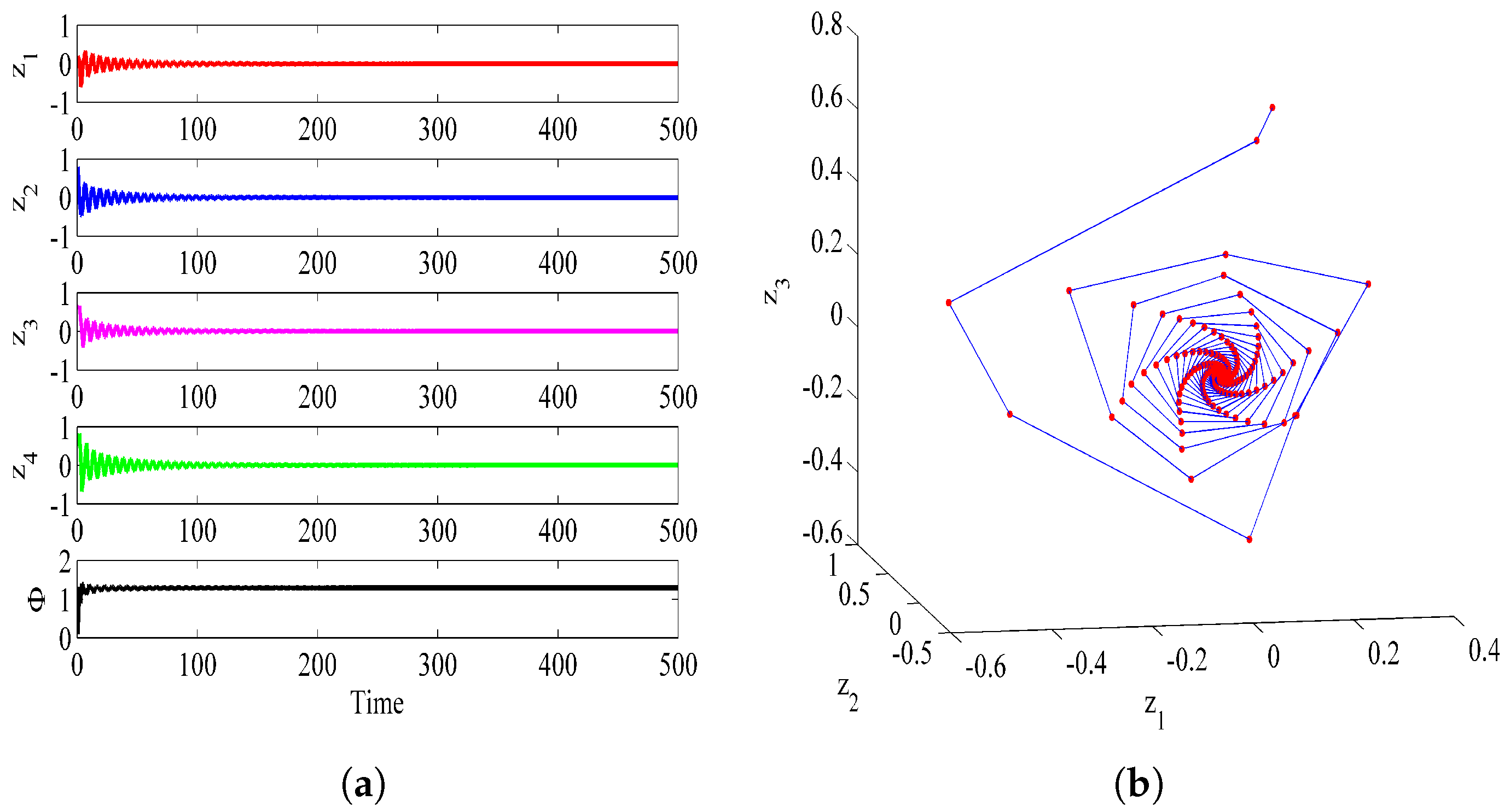
The condition C 1 is obviously met when comparing the entries that correspond to each of the eigenvalues from (14) and (15). As shown in Figure 4, system (11) at P 0 is asymptotically stable.
From a neurological point of view, the established stability constraints offer a significant understanding. The system states tend toward an equilibrium state when the eigenvalues meet the stability requirements in Theorem 2, suggesting that the neural behaviors stabilize after transitional oscillations. Physically, this represents an even balance connection among synapses and the memristive-based coupling process, in which the network’s transmission of signals is controlled by the inbuilt memory effect. The system may display oscillatory or complex behaviors, such as bifurcation or chaos, if the stability constraints are broken. These behaviors would indicate irregular neuronal firing patterns and increased dynamical complexity of the model.

Chaotic Dynamics

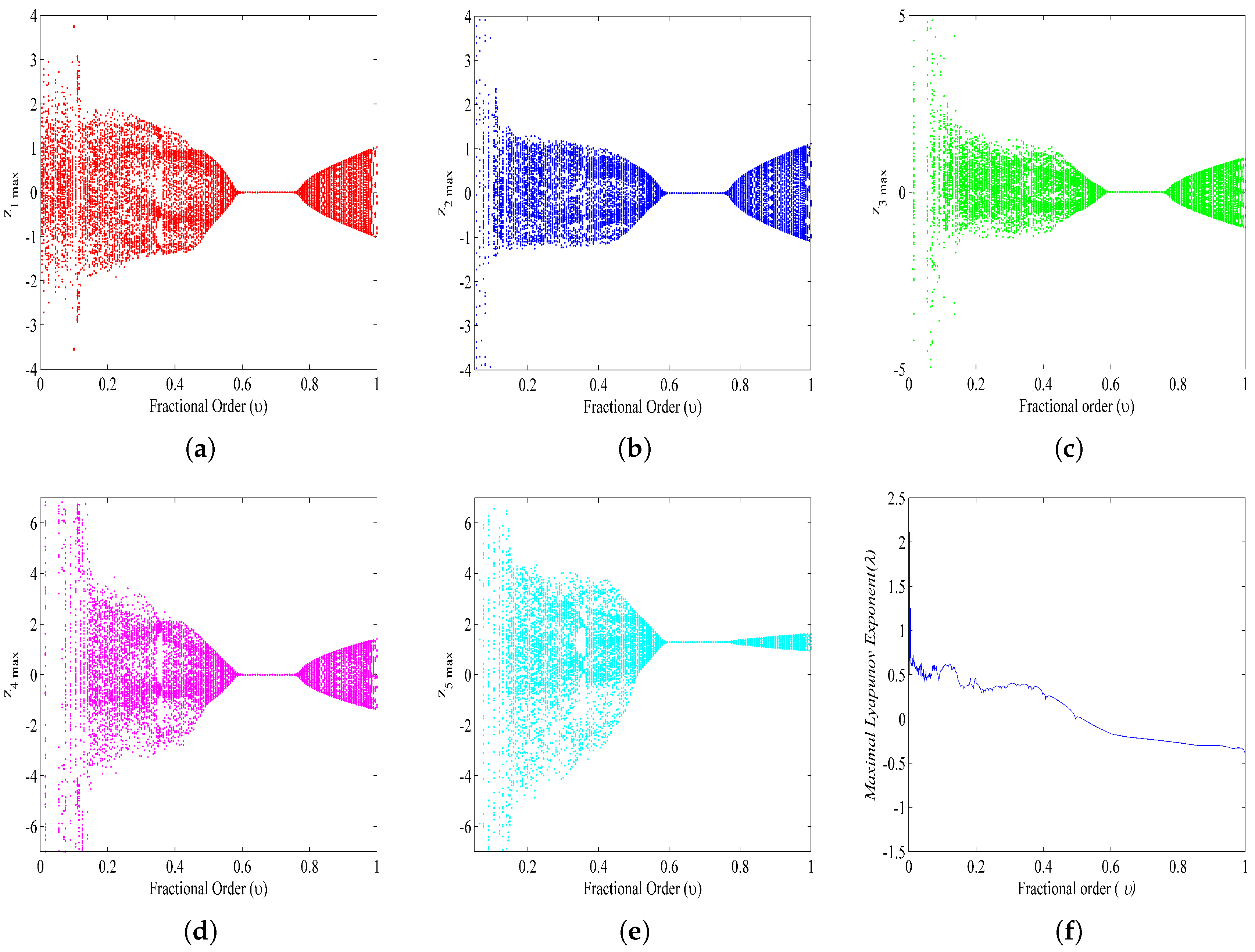
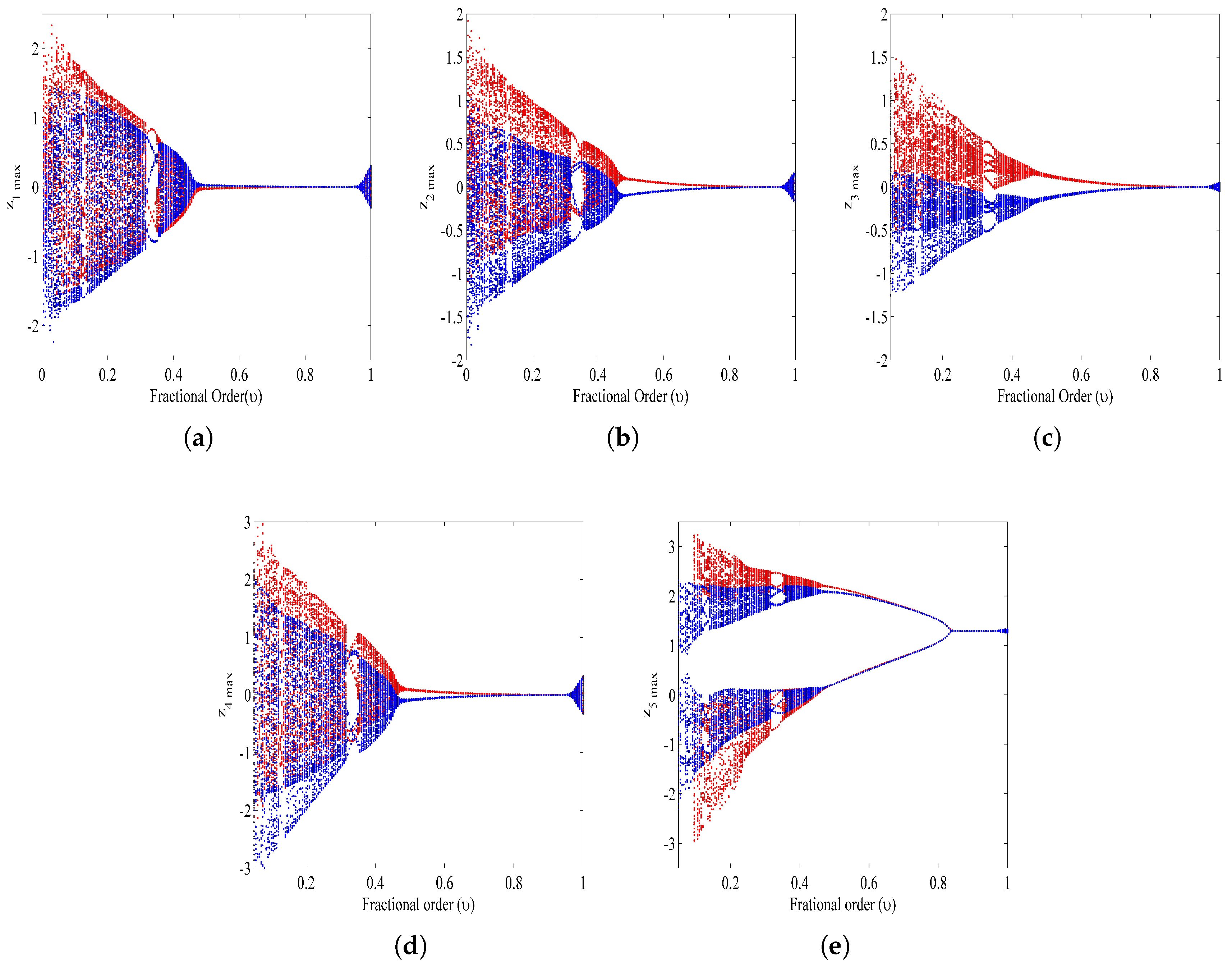
Bifurcation analysis gives important insights into how the qualitative dynamics of the system transform when parameters vary. They can display complex dynamical characteristics including multi-stability, limit cycles, and chaos because they are nonlinear. Identifying the critical parameter values at which the system changes between these behaviors is made easier by bifurcation theory. Here in this section, fractional order ( ν ) is chosen as the bifurcation parameter. To examine the nonlinear dynamical behavior of the proposed nonlinear flux-driven memristive neural network, bifurcation diagrams for the state variables supported by the greatest Lyapunov exponent obtained by employing the Jacobian matrix method [44] are shown in Figure 5. The Jacobian matrix-dependent approach calculates the greatest Lyapunov exponent to measure how sensitive the system is to initial conditions. This method evaluates a Jacobian matrix for each successive point in order to first linearize the system over its trajectory. Then, in order to prevent numerical overflow, the emergence of an arbitrary disturbance vector is generated by iteratively combining it with the associated Jacobian-derived matrices and performing normalization. The greatest Lyapunov exponent is obtained based on the mean exponential increase rate of this disturbance over an adequate time span. The typical numerical algorithm frequently employed in the analysis of nonlinear dynamical systems is followed in this process.
The same set of parameter values as in Section 4 is used for simulations and the fractional order ν ( 0 , 1 ) is varied.
This paper explores the complex dynamical characteristics of a discrete fractional Hopfield-type neural network using a flux-driven nonlinear memristor with periodic memductance, which is a novel method for simulating the dynamics of biological synapses. Hyperbolic tangent and sine are the heterogeneous activation functions that are implemented in the proposed system to improve nonlinearity and replicate various types of brain functions. Stability and bifurcation analyses are used to illustrate the system’s nonlinear dynamical analysis. We examine how periodic memductance parameters and fractional order ( ν ) affect system behavior in order to represent complex dynamical properties, including coexisting dynamics of the state variables and multi-layered attractors.
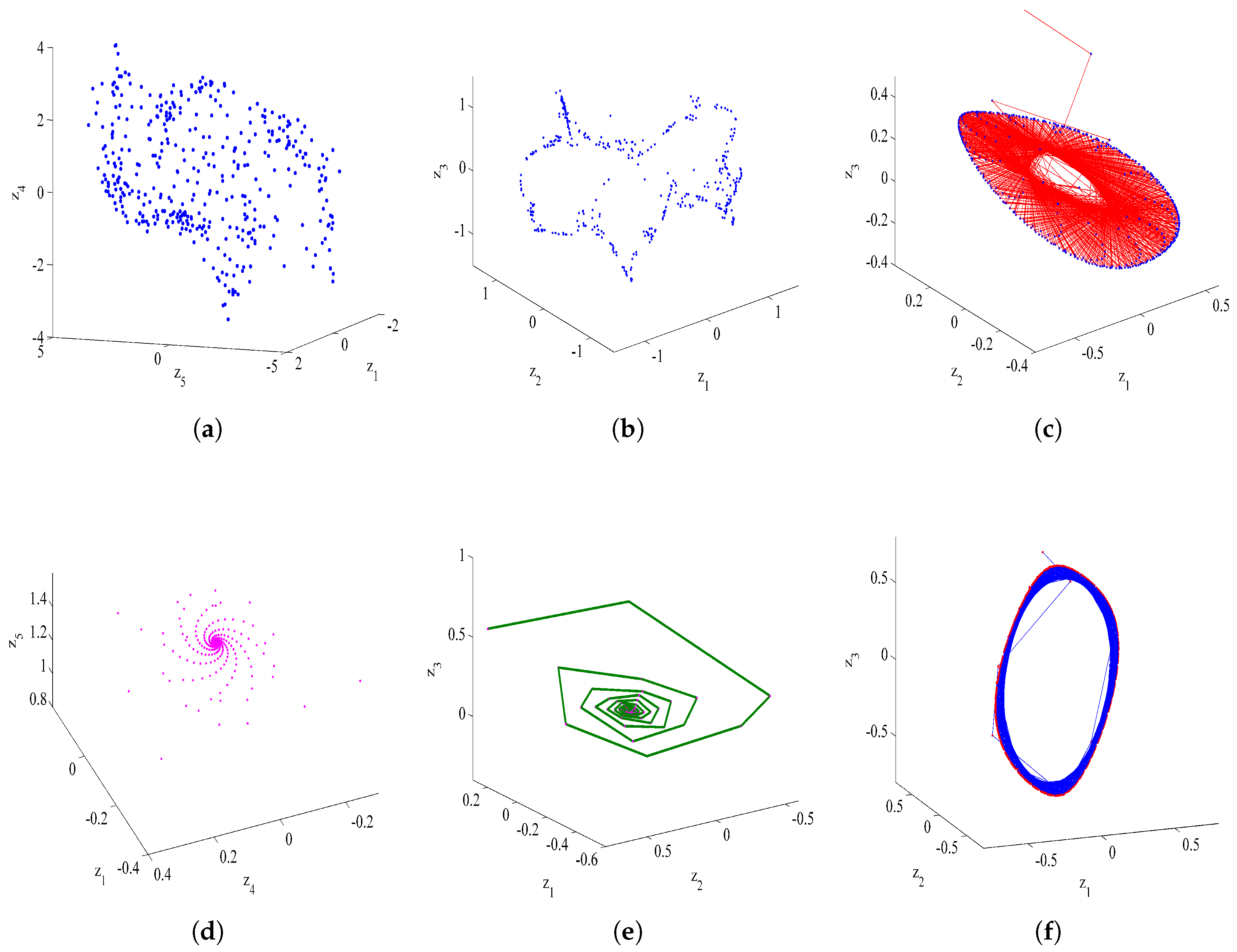
The system behaves chaotically at smaller fractional orders close to 0 because memory effects and non-local dynamics dominate, as in Figure 5. A partially stabilized neuronal firing pattern appears in the system, which shifts to periodic oscillations as the order increases. A stable equilibrium, which denotes the state of steady brain activity, is reached with a further increase in order. At higher fractional orders, the system returns to periodic behavior instead of remaining stable. When neuronal memory effects decrease to a higher order, brain-like systems re-enter rhythmic or oscillatory firing patterns after initial stable behavior. Therefore, fractional order is crucial for controlling complex transitions in Hopfield networks that are inspired by the brain. The largest Lyapunov exponents provide an accurate representation of the chaotic zones, as in Figure 5f. The chaotic zone is represented by positive values, whereas periodic or stable zones are indicated by negative values. Lyapunov exponents approaching zero represent the bifurcation points, which are those where the Lyapunov exponents are exactly zero. Figure 6 shows time-varying plots and 3-D phase plane plots to give a more thorough understanding of how each variable behaves inside the system.
Several significant dynamical shifts in the suggested system are revealed by the bifurcation structure diagram with regard to the typical fractional order ν . The dispersed points suggest chaotic dynamics with considerable responsiveness to initial circumstances for smaller thresholds of ν (around ν < 0.4 ). The chaotic patterns steadily decrease and proceed through a series of reduced period switches as ν rises, resulting in more ordered oscillatory behavior.
The trajectories condense to a single branch at ν 0.6 0.75 , suggesting convergence to a steady equilibrium state. Periodic oscillations reoccur and grow through a series of bifurcations above this point ( ν > 0.75 ), creating periodical intervals in the dynamics of the system. These transitions show that the equilibrium and complexities of the memristive-based neural network are strongly controlled by the fractional order.

5. Coexisting Attractors

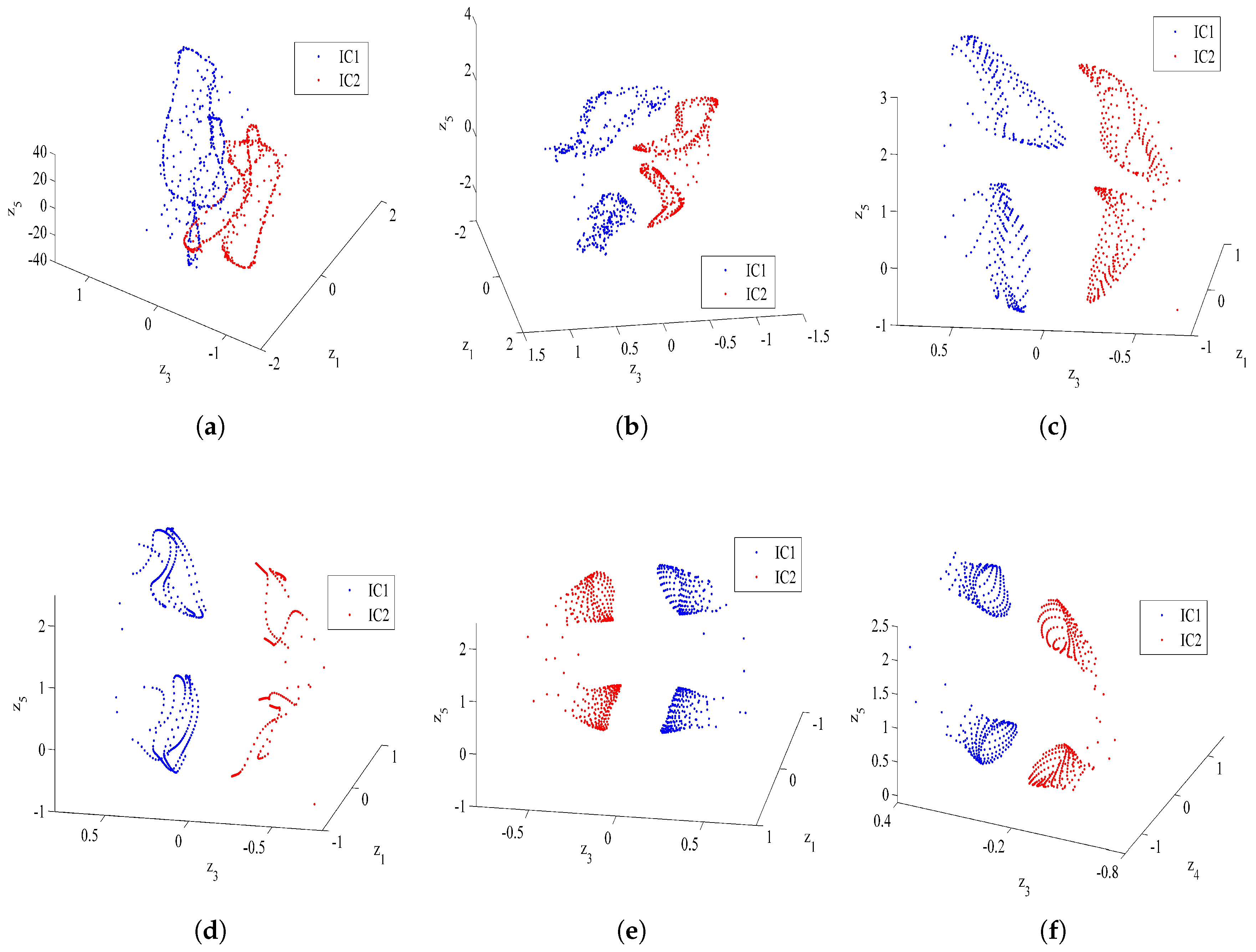
This section demonstrates the coexistence of the state variables based on the previously performed bifurcation analysis. There are significant implications for system dynamics and behavior when attractors coexist in physical systems. Depending on the system’s initial conditions, it presents a possibility for multiple outcomes or behaviors. This phenomenon greatly increases the complexity and diversity of system dynamics and is common in a variety of fields, including biology, engineering, economics, and physics. The coexistence of the state variables is analyzed through coexisting bifurcation and attractors using the same parameter values as in Section 4 with changes in δ 21 = 0.7 , δ 23 = 0.2 , δ 41 = 1 , μ 2 = 0.3 , μ 3 = 0.2 , and μ 4 = 1 and initial conditions I C 1 = ( 0.7 , 0.8 , 0.7 , 0.6 , 0.8 ) and I C 2 = ( 0.7 , 0.8 , 0.7 , 0.6 , 0.8 ) . The simulations are presented in Figure 7 and Figure 8.

6. Basin of Attraction and Entropy Analysis

This section investigates the system dynamics while varying initial conditions in the form of basin diagrams and the effect of μ 1 , μ 2 and fractional order ν in the formation of multi-layered attractors. The impact of fractional ordering ν on the system’s dynamical properties has been methodically examined by parameter sweep analysis employing basin diagrams, even though a detailed sensitivity evaluation is not provided directly. These basin maps provide a thorough depiction of the system’s equilibrium regions and attractor coexistence by demonstrating the underlying system’s long-term performance under a broad spectrum of initial conditions and values for parameters. This method makes it easy to see how the memory parameter ν affects the appearance of chaos, periodical behavior, and multi-stability. Specifically, the basin structures show how changes in ν alter the borders and distribution of attraction domains related to various dynamical states. As a result, the basin map analysis highlights the influence of fractional-order memories on the general dynamics, while successfully capturing system sensitivity to parameter changes. For investigating intricate chaotic behaviors in the specified memristive neural network, this method offers a straightforward and methodical substitute for traditional sensitivity analysis.
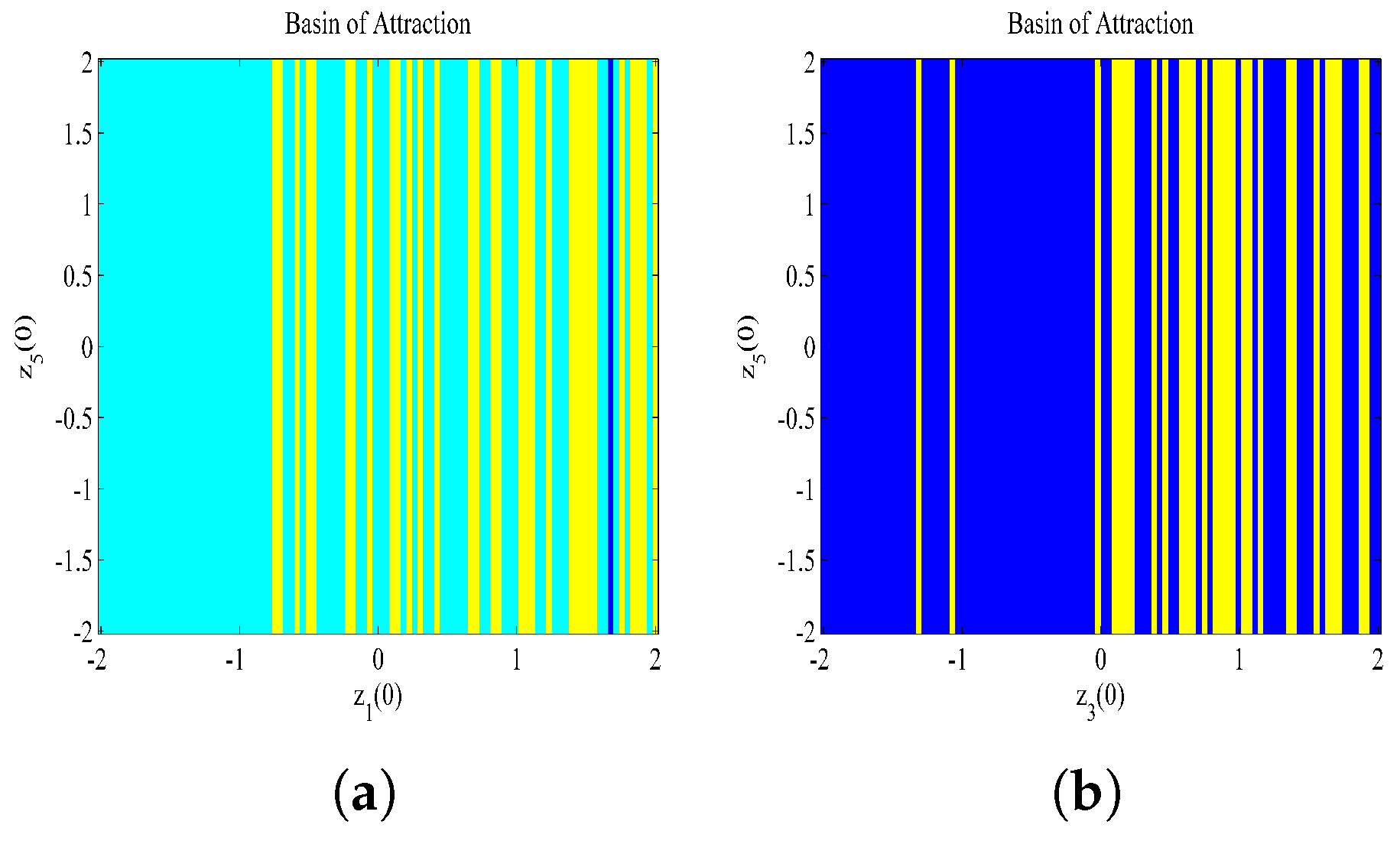
For the analysis the values are chosen as δ 11 = 0.4 , δ 12 = 0.6 , δ 13 = 0.3 , δ 14 = 1.1 , δ 21 = 0.1 , δ 22 = 0.7 , δ 23 = 0.2 , δ 24 = 1 , δ 31 = 0.14 , δ 32 = 0.6 , δ 33 = 0.5 , δ 34 = 1.5 , δ 41 = 0.25 , δ 42 = 0.5 , δ 43 = 0.8 , δ 44 = 0.4 , μ 3 = 0.8 , μ 4 = 0.1 , μ 5 = 0.2 , μ 6 = 3 , and μ 7 = 3 , with (0.3, 0.8, 0.6, 0.5, 0.1) as the initial condition. A variation in initial conditions of a dynamical system that results in a specific long-term behavior or attractor is represented as the basin of attraction in Figure 9. Depending on the initial state of neurons, the basin of attraction is crucial in deciding which memory pattern the network will converge to in Hopfield neural networks (HNNs) with parameters taking the values μ 1 0.43 , μ 2 = 0.4 , ν = 0.975 . These basins show how adaptable or resistant the dynamics of the network are to fluctuations and initial conditions. Figure 9a represents a basin diagram over initial states z 1 ( 0 ) z 5 ( 0 ) plane and Figure 9b represents basin diagram over the plane of initial states z 3 ( 0 ) z 5 ( 0 ) . Sensitive dependence on initial states, an aspect of multi-stability and complex attractor structures, is demonstrated by the rich overlapping of color combinations such as cyan (periodic), yellow (chaos), and blue (stable). The vertical stripes in basin of attraction diagrams in Figure 9 demonstrate how a Hopfield neural network’s final state is mostly insensitive to changes in z 5 ( 0 ) but very sensitive to one initial condition z 1 ( 0 ) in Figure 9a and z 3 ( 0 ) in Figure 9b. This represents asymmetric sensitivity, where specific neurons or states dominate the dynamics of the network. This is similar to how certain brain circuits or neurons are essential for memory recall or decision-making while background activity involving other neurons has little effect.
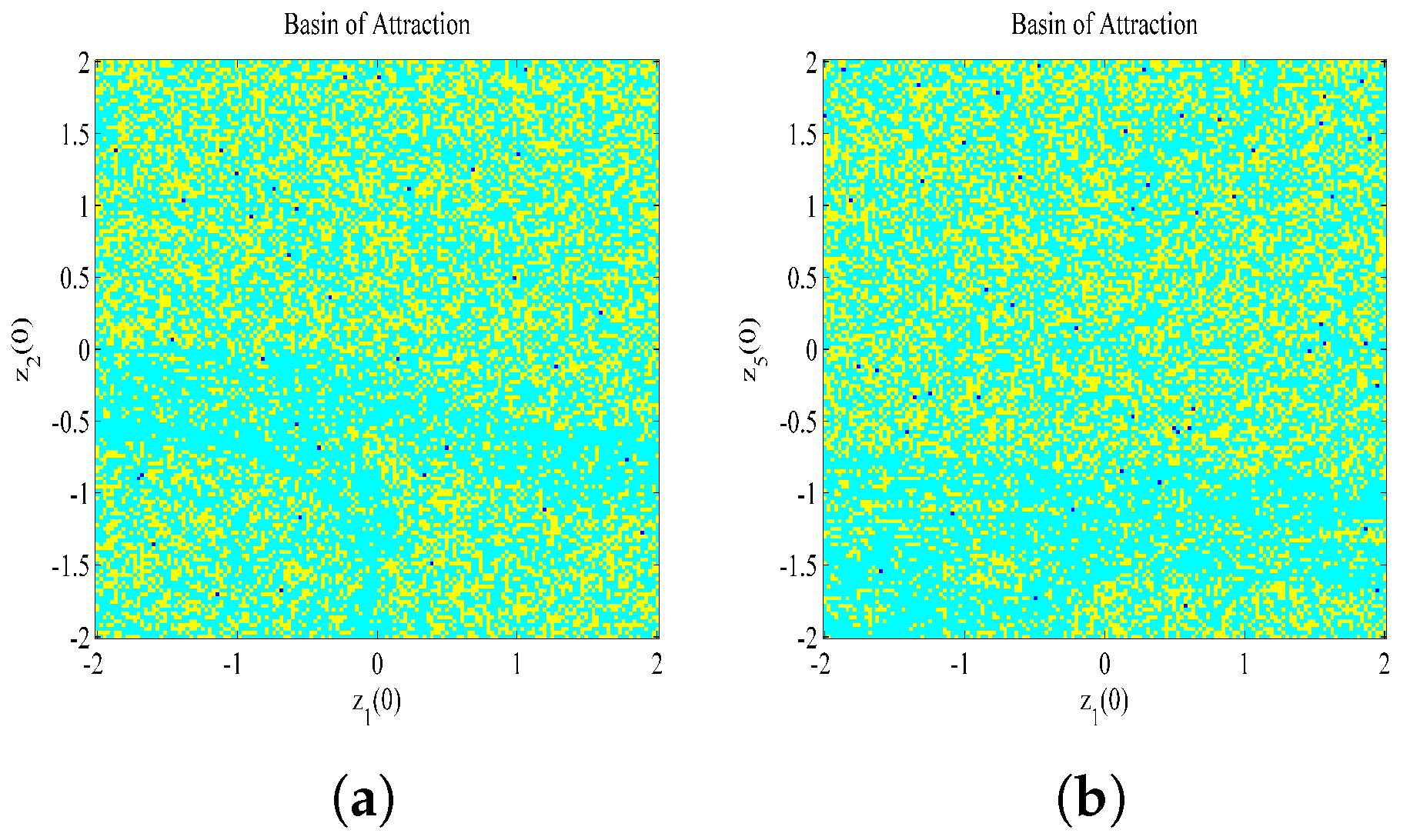
For in-depth analysis of the qualitative characteristics of system (11), the memductance-based parameters are considered as μ 1 0.42 , μ 2 = 0.425 , ν = 0.975 . The basin diagrams are presented for initial states z 1 ( 0 ) z 2 ( 0 ) in Figure 10a and for z 1 ( 0 ) z 5 ( 0 ) in Figure 10b. This indicates that the brain can generate entirely distinct memory states as a result of small changes in neuronal activity caused by noise or stimuli. The random transitions of the brain between states of activity, such as neuronal switching or seizure transitions, may be modeled by such behavior. Thus, in a brain-inspired network model (11), these basin plots show how complex, memory-influenced processes control both stable and unstable patterns.
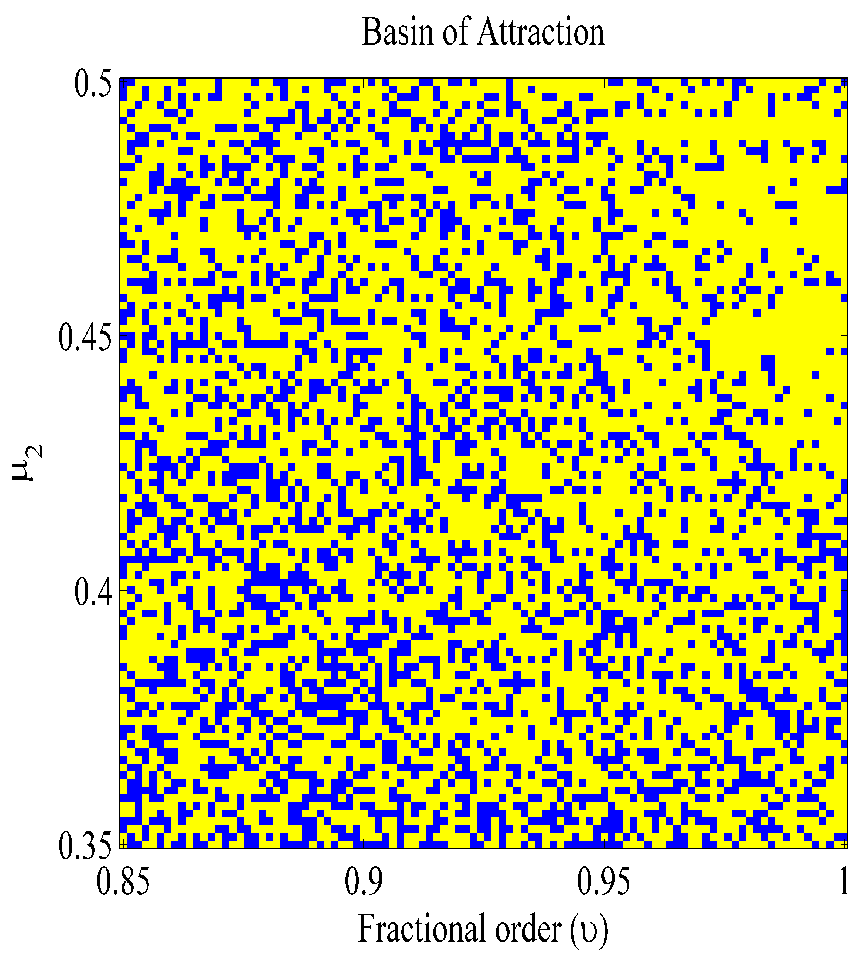
The importance of the memory effect induced by the fractional order ( ν ( 0.85 , 1 ) ) and the memristor-based parameter ( μ 2 ( 0.35 , 5 ) ) is presented with a basin diagram in Figure 11 with μ 1 = 0.42 . Fractional order reflects long-term memory effects, which have significance in real brain systems where previous activity influences future responses. Since memristors naturally replicate biological synapses by modifying conductivity based on prior currents, the memristive parameter μ 2 replicates synaptic plasticity. The complex, multicolored basin structure suggests multi-stability and sensitivity, similar to the brain’s ability to switch between several emotional or cognitive states. Neurons that fire at thresholds exhibit abrupt behavioral changes brought on by small changes to parameters. These patterns also show irregular or chaotic brain activity, which is frequently connected to attentional or creative changes. Thus, Figure 11 illustrates the functional diversity in the brain states.

Approximate Entropy Analysis

This section demonstrates the randomness of the state variables with approximate entropy. In particular, we perform entropy analysis considering composite approximate entropy through the averaging method. The randomness of system (11) is investigated by calculating the entropy value for each state variable individually and averaging them to arrive at a single time series. Approximate entropy (ApEn) is a statistical measure that quantifies the complexity and irregularity of time series data. It was introduced by Steve Pincus (1991) in [45], who compared data point sequences within a time series to assess predictability of the system state. Time series patterns that are close during a brief period of time and stay close as the sequence progresses indicate that the system is regular and has low entropy. The system is more complex and has a higher entropy if the patterns diverge. In biological signals where deterministic chaos and noise frequently coexist, such as heart rate variability, brain activity, or hormone rhythms, ApEn is very useful.
One of its primary strengths is that it works well with short and noisy datasets. It is defined by two parameters: tolerance r, which specifies similarity, and embedding dimension m, which defines pattern length. While a high ApEn denotes chaos or randomness, a low ApEn denotes predictability and order, like periodic or fixed-point behavior. ApEn helps in the detection of stable–unstable state transitions in neural networks and nonlinear dynamics. It has been used effectively for measuring stability, complexity, and adaptation in domains such as nonlinear control systems, neuroscience, and cardiology.
According to the entropy estimation method, an embedding level of m = 2 is used to calculate the approximate entropy value (ApEn). In entropy-based uncertainty analysis, the standard deviation corresponding to the associated time series is denoted by std ( U ) , and the tolerance value is chosen as r = 0.2 , std ( U ) . A composite entropy metric is obtained by averaging the ApEn values for each state variable. These configurations guarantee reliable and repeatable measurements of the system’s dynamical complexity.
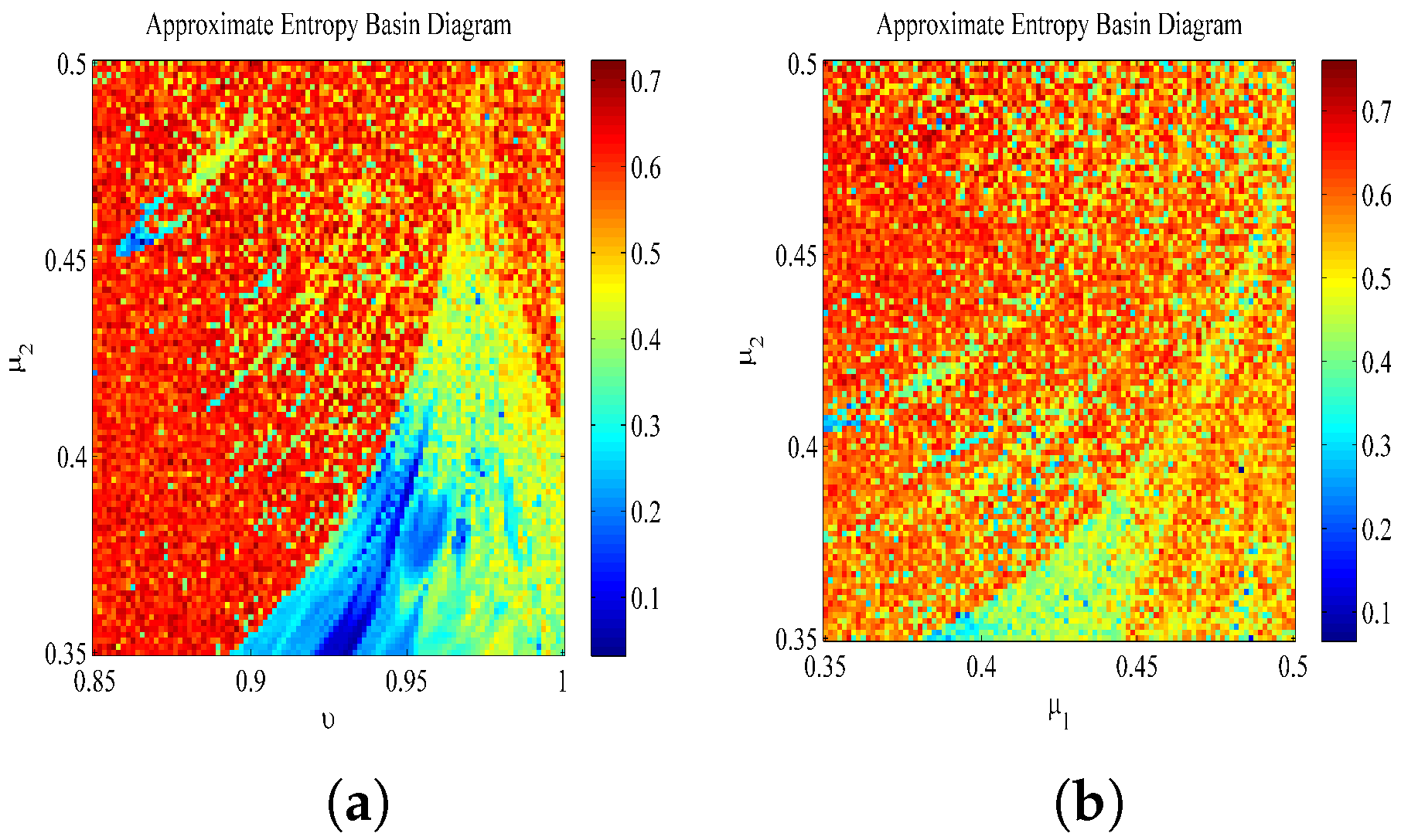
A better understanding of the dynamical complexity of the discrete fractional Hopfield neural network can be obtained from the approximate entropy basin diagram displayed in Figure 12a. The basin diagram is simulated for two parameters, the memristive parameter μ 2 and the fractional order ν . The fractional order determines memory depth, with lower values allowing long-term memory or past memory and larger values allowing short-term or memory of recent events. This provides a deep insight into how the memory effect induced by fractional order greatly affects the neuronal firing patterns regulated by memristor elements. The system exhibits a rich dynamical shift as ν approaches 1 and μ 2 increases, replicating a brain-like equilibrium between adaptive flexibility and memory stability. The nonlinear feedback of the network can be influenced by the memristive parameter, which represents synaptic plasticity. Figure 12b demonstrates the dynamics under varying memristive parameters μ 1 and μ 2 with ν = 0.975 . High ApEn values relate to irregular, chaotic-like activity, which implies multi-stability or an absence of stable attractors, whereas regions with low ApEn indicate regular, predictable action and possible convergence to stable memory states. Memristive elements often alter memory-dependent synaptic weights and nonlinear conductance, which affects the level of neuronal coupling and energy flow. In order to replicate actual brain adaptability, these entropy transitions help in finding important thresholds at which the network changes from dependable memory storage to instability.

7. Memductance-Driven Firing Pattern Dynamics

This section focuses on investigating the multi-layered attractors of the proposed model (11) under the impact of μ 1 and μ 2 , forming a major part of periodic memductance of the memristor together with fractional order ( ν ) . The main reason behind the choice of the parameters for this analysis is that μ 1 and μ 2 represent the synaptic nature of neurons and the fractional order ( ν ) brings in the memory and hereditary influence for system (11). The general form of the periodic memductance considered in this study is given by
M = μ 1 + μ 2 sin ( Φ ( t ) ) ,
where Φ denotes the internal state variable of the memristor. The behavior of the memductance is governed primarily by two parameters, μ 1 and μ 2 , which represent the synaptic weight and the oscillation amplitude, respectively. Consequently, the resulting neuronal dynamics are determined by the combination of μ 1 and μ 2 , giving rise to four distinct cases summarized in Table 1, with corresponding biological interpretation.

7.1. Synaptic Excitation with Rhythmic Boost

This section concentrates on analyzing the neural network dynamics considering case 1, as presented in Table 1; the reason behind the choice is that the synapse is excitatory at baseline and gets much more excitatory when it is periodically adjusted when both μ 1 and μ 2 are positive. In terms of biology, this means that the neuron produces powerful, synchronized firing patterns by continuously increasing incoming impulses and then boosting them even more during particular phases. In healthy networks, this kind of strengthening can encourage consistent communication, but it may also increase the network’s susceptibility to catastrophic excitation. This instance physically replicates circumstances in which synaptic gain is continuously enhanced by plasticity mechanisms, reflecting the way the brain maintains fundamental neural pathways. This situation is essential for understanding both powerful transmission of signals and hyperactivity risks since it generates the most sustained and self-building activity when compared to other scenarios.
The comparisons to neurological illnesses like Parkinson’s illness, schizophrenic disorder, and epilepsy in Table 1 are only meant to serve as theoretical parallels to show how complex neural mechanisms may mimic abnormal or oscillatory brain activity seen in these situations. The suggested model is not intended to be a physiological or clinical depiction of these illnesses. Instead, the neural network’s nonlinear behaviors are intuitively interpreted using these comparisons.

7.2. Scenario 1: μ 1 < μ 2

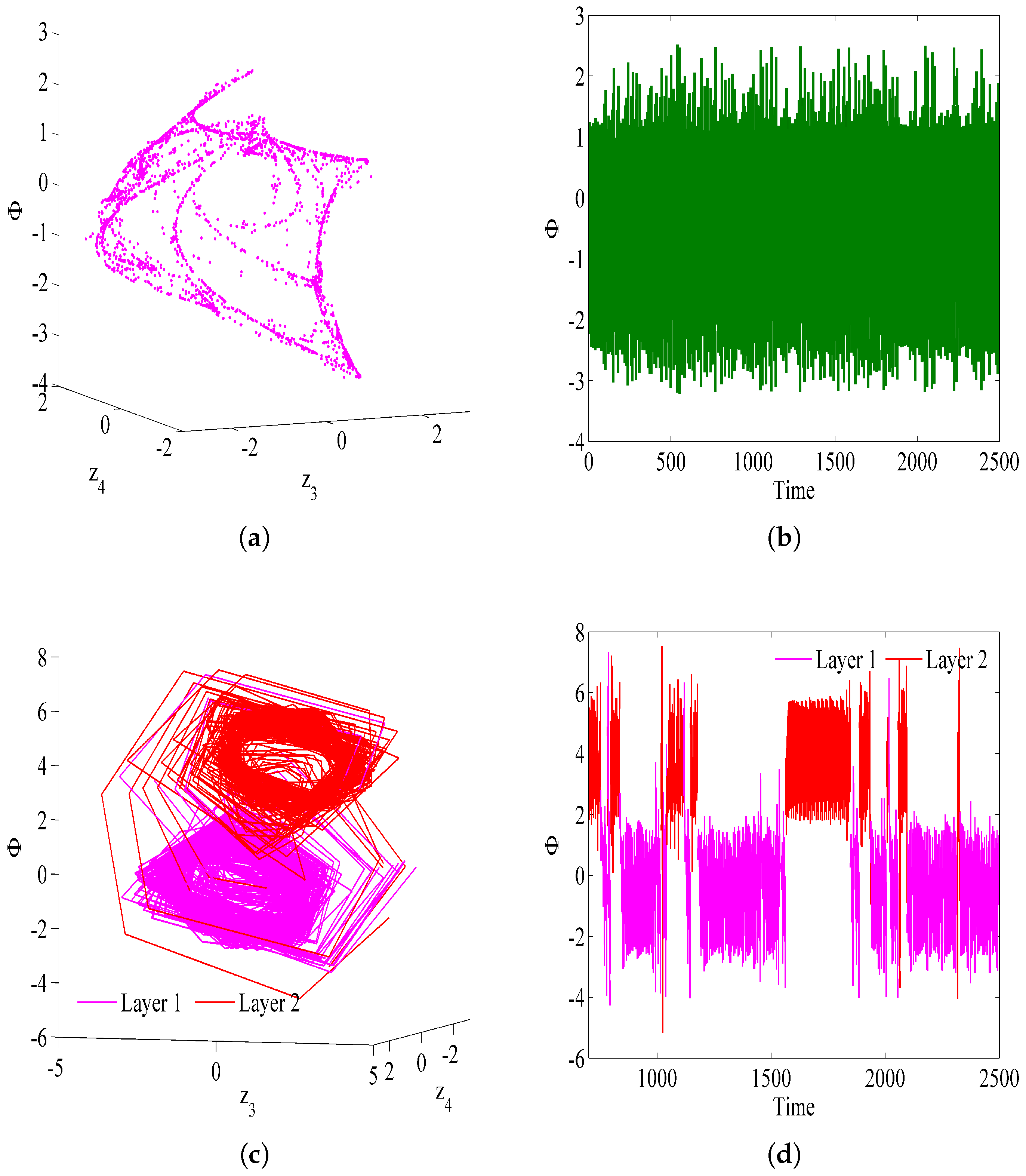
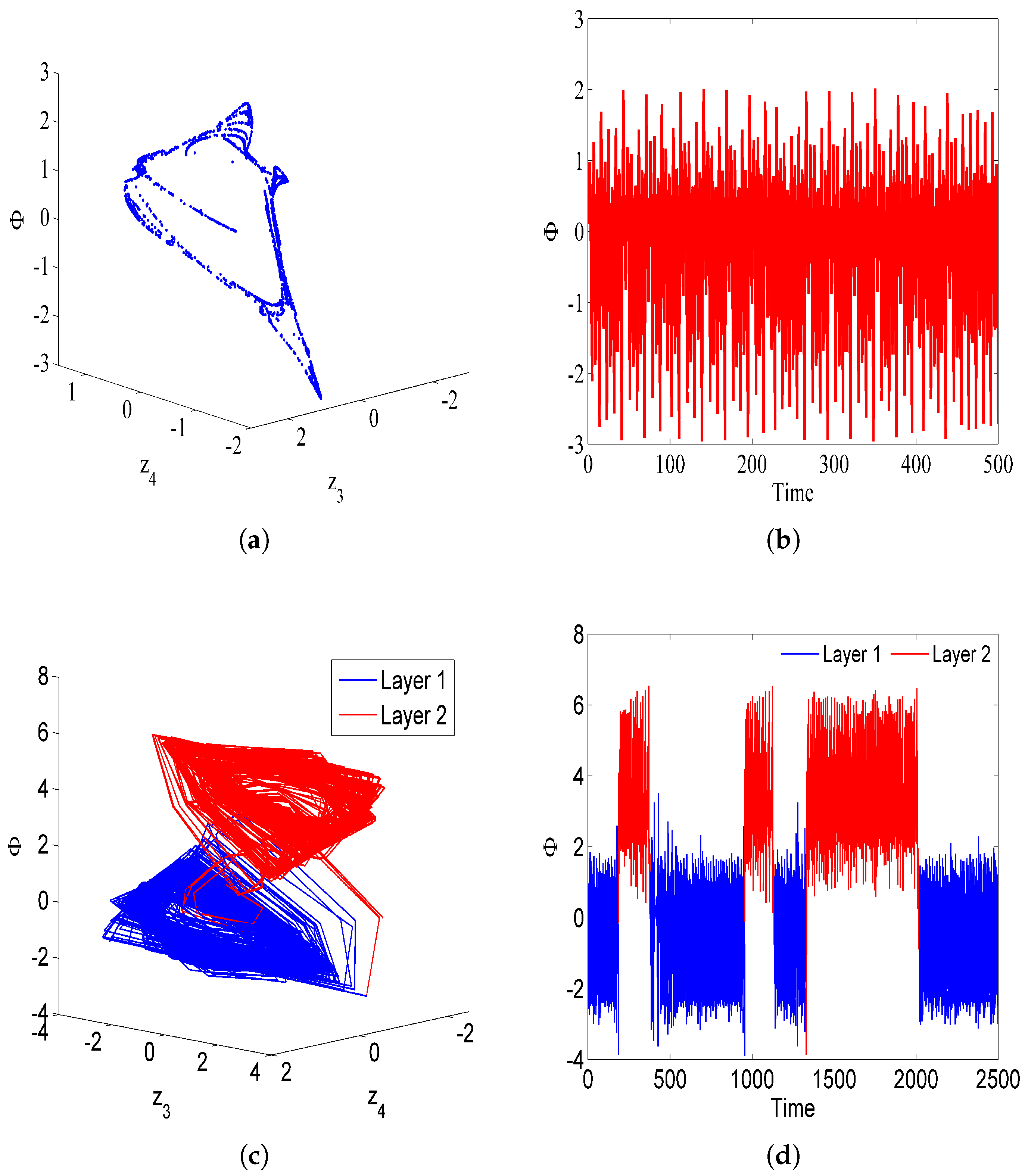
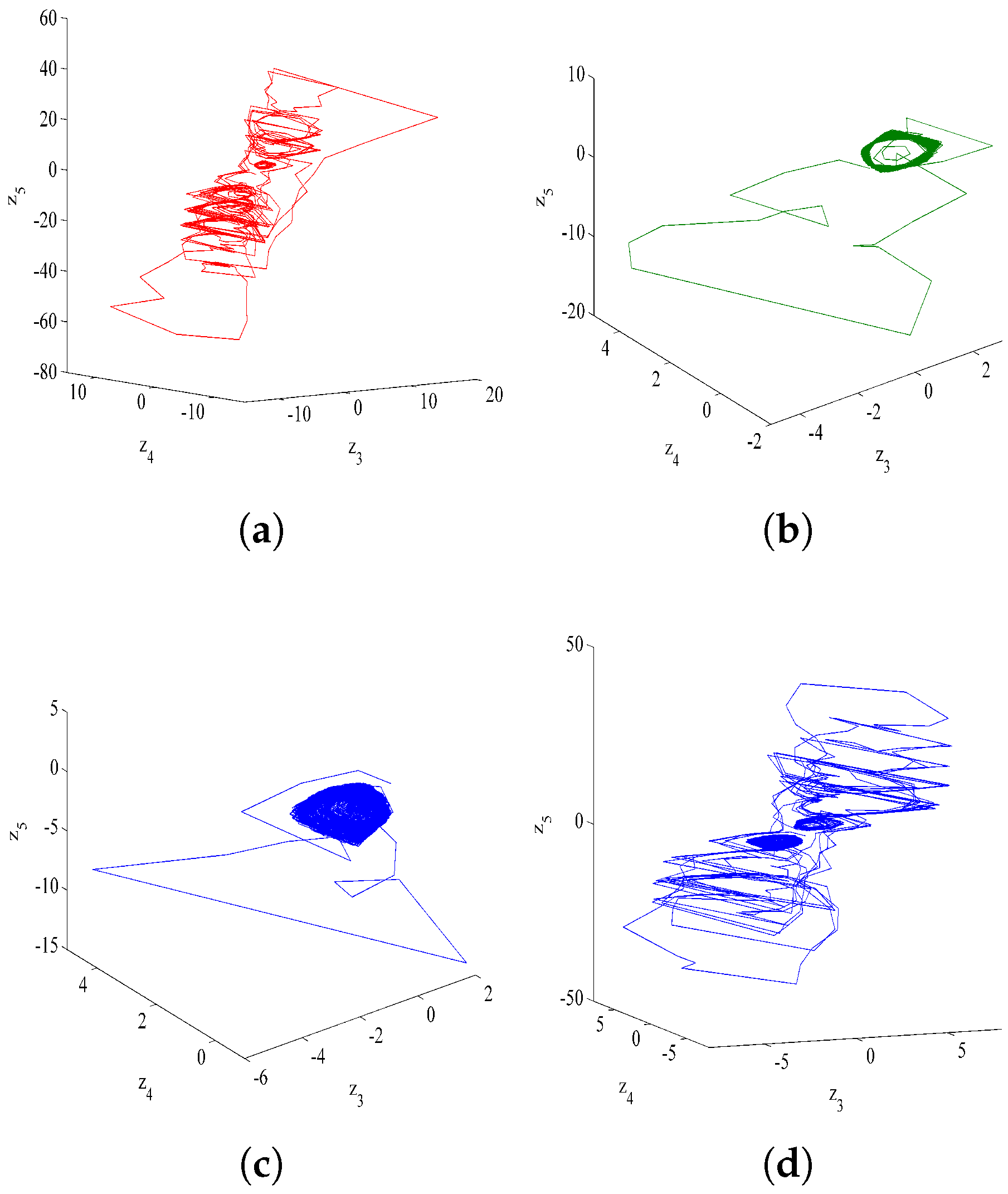
When the oscillation amplitude μ 2 is greater than μ 1 , synaptic strength changes significantly and can reach considerable excitation during peaks. Biologically, this could reflect a hyperactive excitatory synapse, in which neuronal populations fire powerfully and simultaneously at specific periods. The numerical analysis of the firing patterns are analyzed considering a fixed value of μ 1 = 0.1 with varying values of ν = 0.9 , 0.975 and μ 2 = 0.57 in Figure 13 and μ 2 = 0.6 in Figure 14. The firing rate ( Φ ) of two layers of neurons exhibits highly irregular variations in the time series plot, as in Figure 13d. Compared to Layer 1 (blue), Layer 2 (red) shows increased amplitude bursts, indicating that it is either strongly regulated or receives more excitatory input. These non-repetitive bursts show that the system is exhibiting complex unpredictable firing patterns rather than settling into a straightforward periodic rhythm. From a biological perspective, this implies that the interconnected neurons interact in an extremely nonlinear way, with slight changes to one layer’s activity having a significant impact on the other (Figure 13c). Such dynamics are typical of neural circuits with intense recurrent excitation or memristive synapses, which allow for rapid switching between distinct activity patterns. While avoiding uncontrolled excitation, this chaotic but restricted activity could simulate flexibility in brain networks, such as brief synchronization during attention or learning. Figure 13a,b, on the other hand, with a slight increase in the memory factor considering ν = 0.9 , exhibit a rather single-layered chaotic motion in comparison to bi-layer attractors exhibited by the neuron for ν = 0.975 .
The periodic evolution of the state variable Φ is displayed in the time series illustration Figure 14d (Layer 1 in magenta; Layer 2 in red). While Layer 2 displays occasional peaks with larger amplitudes, indicating occasions of greater-intensity synchronized firing, Layer 1 displays fast oscillations over a smaller frequency range, indicating chaotic spiking activity. With one layer retaining regular activity and the other producing bursts, which may correspond to excitation signaling in the network, this behavior demonstrates how the two levels may handle signals differently. Layer 1 trajectories (magenta) are more dispersed, indicating chaotic, irregular spiking, and the second layer paths (red) generate thicker concentrations with cyclic patterns, indicating more ordered bursts (Figure 14). The trajectories’ separation indicates that the layers are connected but function somewhat independently, with Layer 2 potentially regulating Layer 1 through synaptic connections. This illustrates how neurons may regulate system reliability with adaptability in information processing by maintaining a variety of firing patterns. In case of higher memory ν = 0.9 , the system rather exhibits highly chaotic tracjectories with higher bursting but on a single-layered attractor, as in Figure 14.

7.3. Scenario 2: μ 1 > μ 2

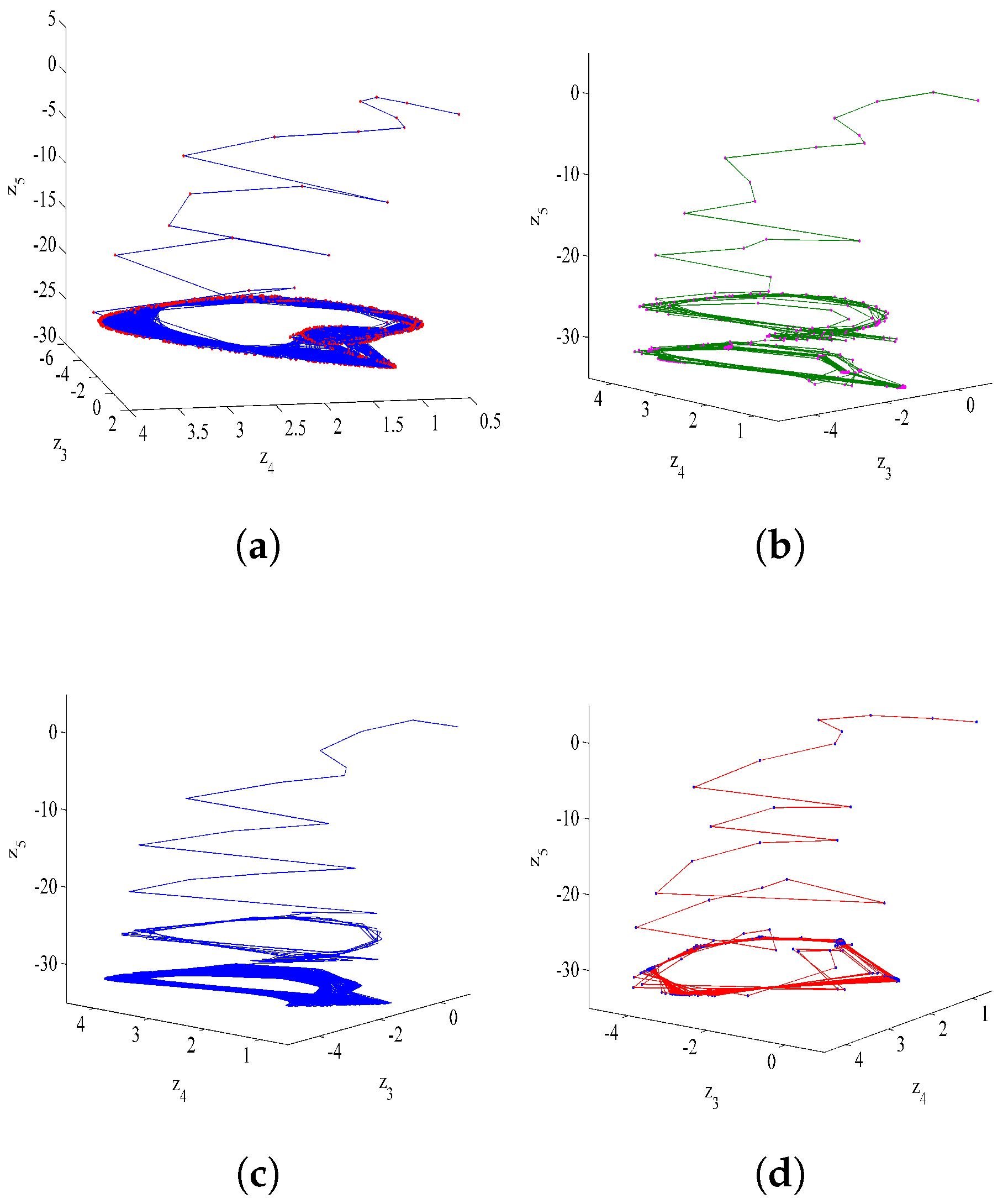
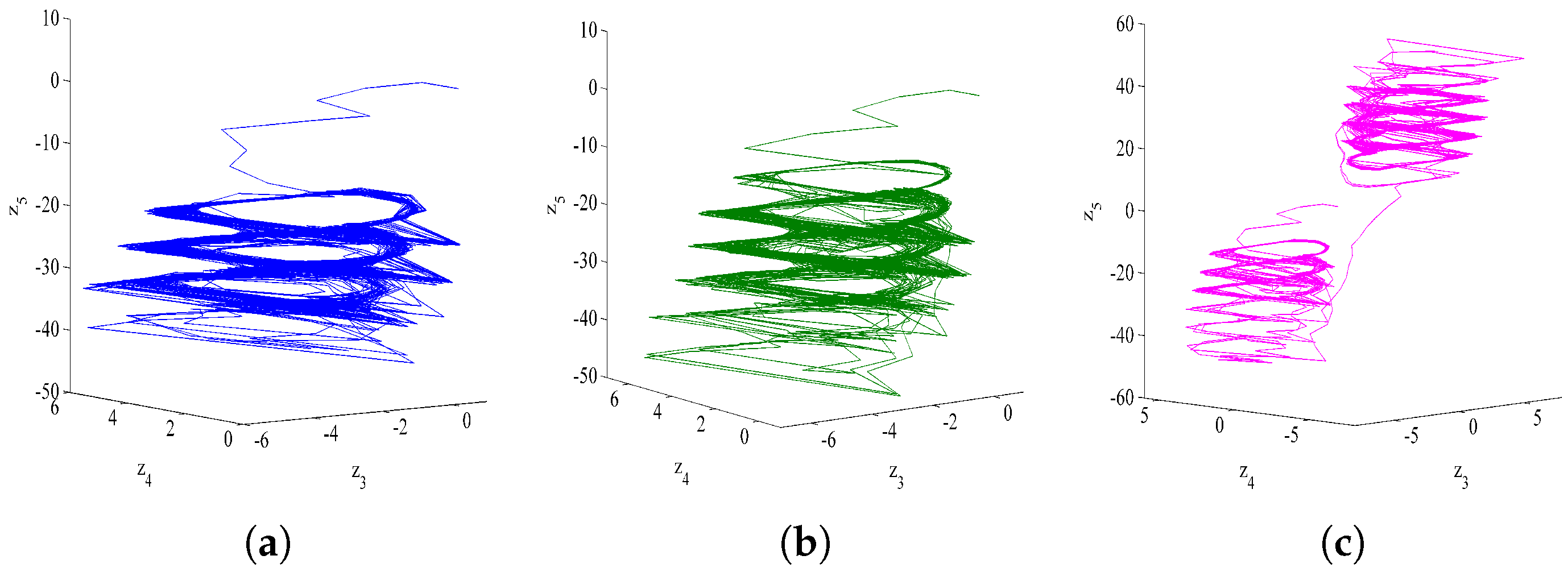
The transformation of the single-layer to two-layer attractors with varying fractional order can be observed in Figure 15 for fixed values of μ 1 = 0.41 and μ 2 = 0.2 and varying fractional order ν from 0.9 to 0.925 . When the fractional order is further raised to 0.95 and 0.975 it is observed that layers decrease to a single layer again. In biological terms, the transition from single-layer to two-layer attractors may be interpreted as the system accessing numerous parallel brain rhythms or memory states. Reducing to a single layer implies memory stability or state consolidation, similar to independent memory retrieval or focused attention.
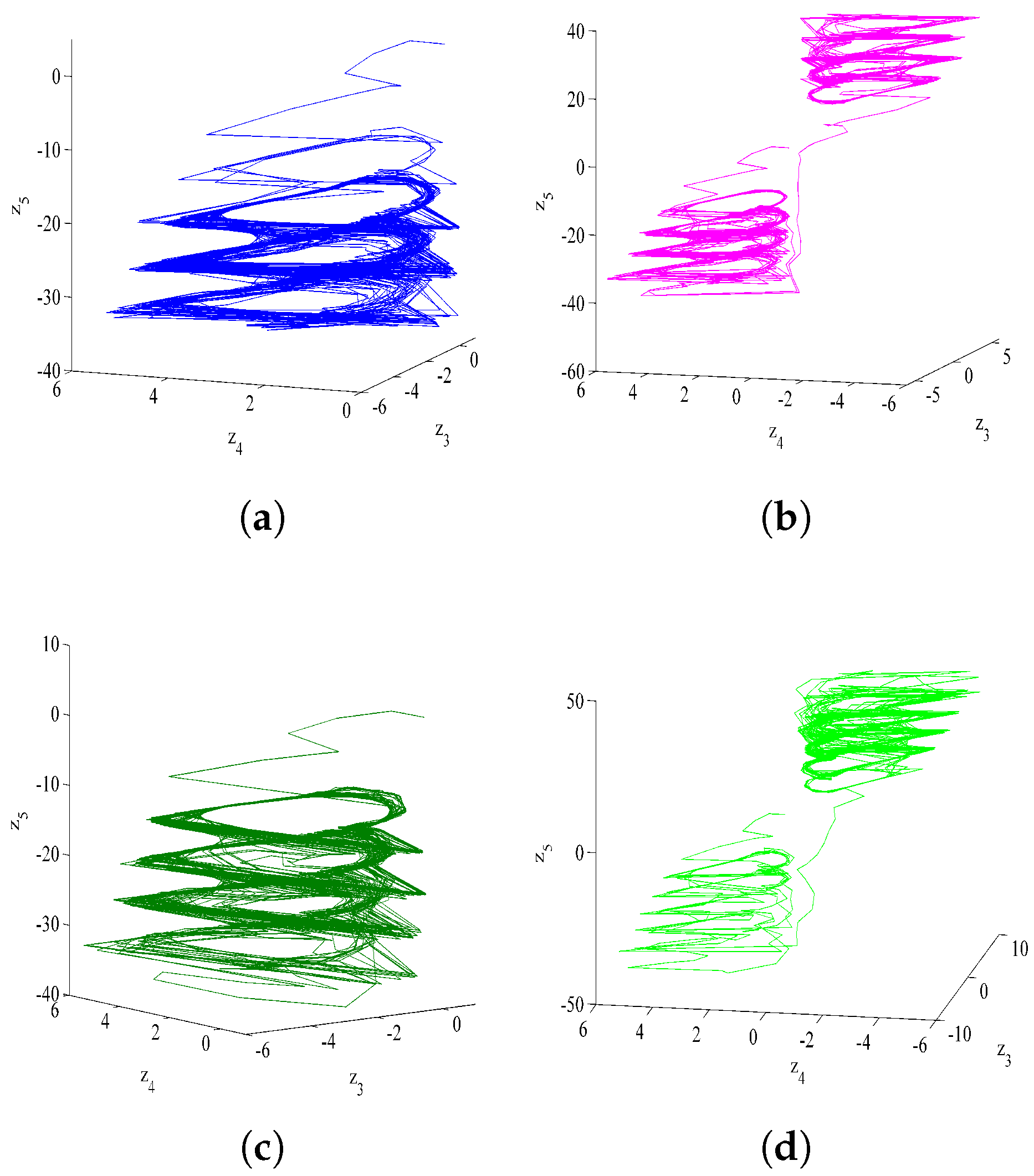
In order to further intensify our analysis, we increase the value of μ 2 = 0.3 and vary ν = 0.9 , 0.925 , 0.95 , 0.975 , with attractors presented in Figure 16. There are four layers of oscillations when the fractional order is ν = 0.9 , as in Figure 16a; the significant change in dynamics is visible when the fractional order ν is raised to 0.925 and there are symmetric layers of attractors: one along the positive axis and another along the negative axis. This shift is repeated again when ν = 0.95 , 0.975 , as in Figure 16c,d. Symmetrical attractor layers that emerge along both positive and negative axes might be a reflection of conflicting memory traces or bidirectional neural activity, similarly to how the brain switches between opposing views or judgments when faced with conflict.
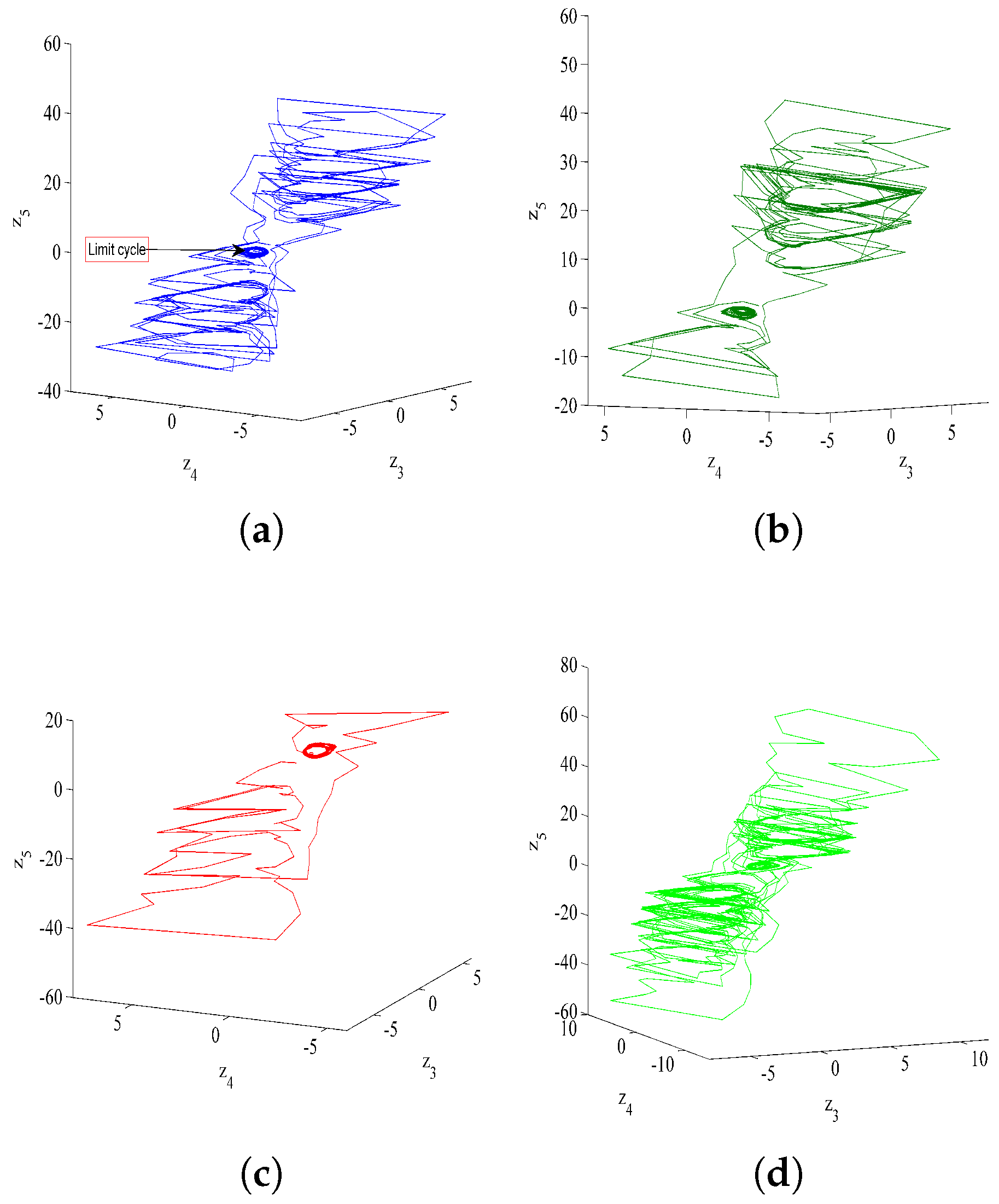
This pattern does not follow when μ 1 is increased to 0.42 , as observed in Figure 17. Memory-driven networks are particularly sensitive to synaptic changes, as seen by the dissection of this pattern in Figure 17. For increasing fractional order ( ν ) between 0.9 and 0.95 only the number of layers increases, while the symmetric multi-layer attractors are obtained for ν = 0.975 , as in Figure 17c. In this case, increasing ν only results in an increase in the number of layers, but not in their symmetry, which may indicate cognitive bias or unilateral activation.
For the next case, we increase both μ 1 and μ 2 to 0.43 and 0.4 , respectively. In this case, the formation of symmetric multi-layers can be observed in Figure 18, but in comparison to the previous three cases here in this case there is limit cycle formation about the equilibrium point P 1 in between symmetric multi-layered attractors. With increasing fractional order there is decrease and increase in layers but the limit cycle formed after initial chaotic behavior remains constant about equilibrium. A central limit cycle and symmetric multi-layers are produced by the system close to the equilibrium point ( P 1 ) . The system maintains a central rhythmic core, which may reflect fundamental mental function or default-mode network activity, even though it supports a variety of dynamic states (multi-layer attractors). This structure may biologically represent a balanced equilibrium.
For the final case, we consider μ 1 = 0.42 , μ 2 = 0.425 . In Figure 19a, the system for fractional order ν = 0.9 forms multi-layer attractors with a single limit cycle formed. When the fractional order increases, indicating a decrease in memory effects ν = 0.925 , 0.95 , the system does not exhibit multi-layered attractor behavior and just has uniform oscillations forming limit cycles. In Figure 19d, it can be noted that for ν = 0.975 formation of symmetric multi-layers of attractors with symmetric limit cycles formed about positive and negative axes exhibits complex behavior in neural networks that are affected by memory factors.

7.4. Discussion

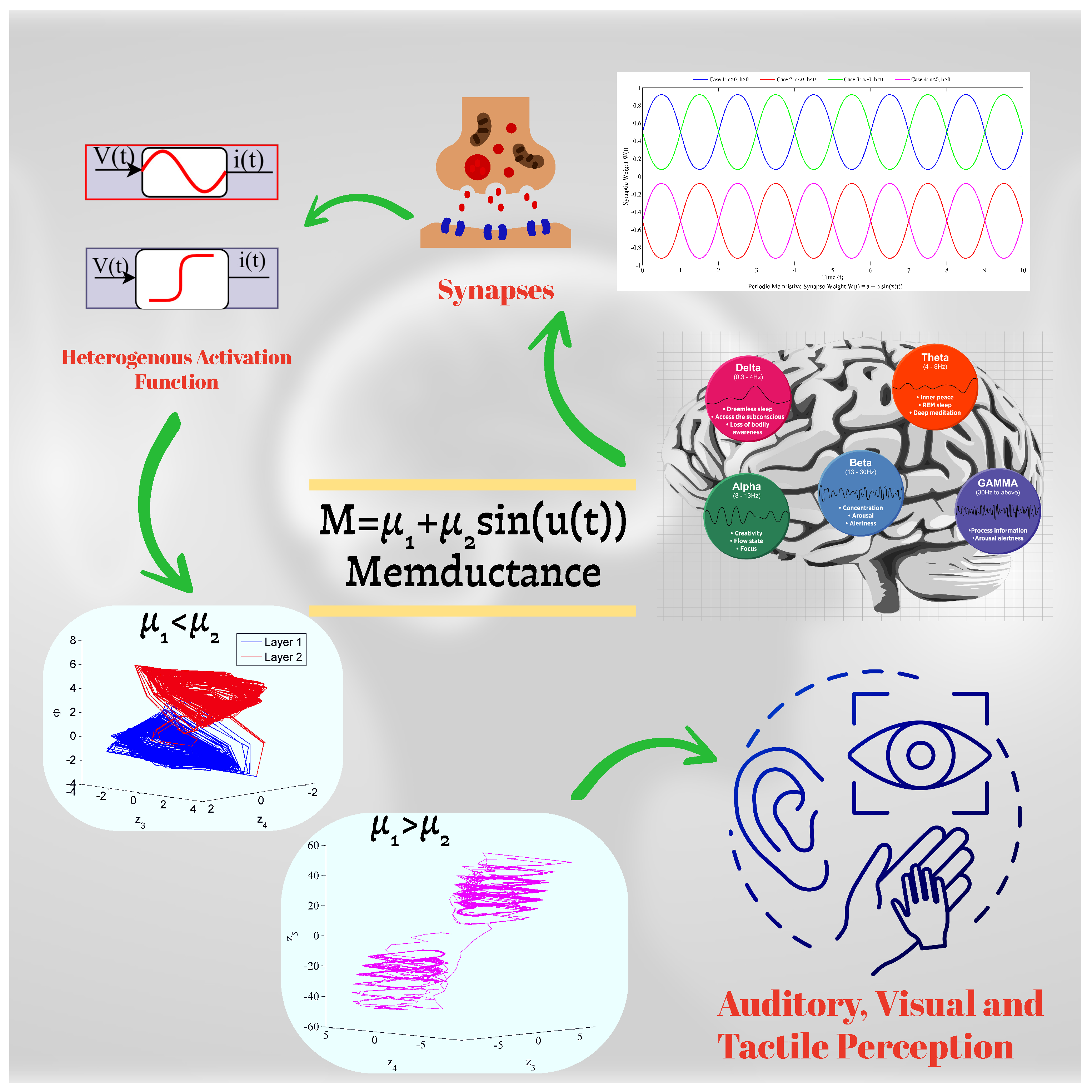
With rich dynamical transitions that resemble actual neural responses under various synaptic and historical memory conditions, this model’s interplay of periodic synaptic modulation and memory effects captures complex brain processes like rhythmic coordination, sensory alternation, attention switching, and decision stabilization. Multi-layered attractors provide valuable insights into how the brain interprets complicated sensory information in hearing, vision, and touch. They aid in the explanation of how the brain distinguishes between overlapping sounds, identifies speech patterns, and retains auditory continuity even in noisy settings. Multi-layered attractors in vision represent how the brain maintains perception in the face of confusing or incomplete input, such as object recognition or visual illusions. In touch, they describe how sensory information such as pressure, texture, and pain is used to drive precise motor activities and safety reactions. Strong, flexible, and influenced by context, interpretation of sensory input is made possible by these attractor dynamics. Their research demonstrates how the brain flexibly changes between multiple sensory states based on stimulus and memory. The biological interpretation of the multi-layered attractors in sensory functions is illustrated in Figure 20.
The formation of multiple-layer attractors in the described memristive-based neural network model has notable implications for real-world uses in secure communication technologies and computational neuroscience. Associative memories and multiple-state storage of information are made possible by the coexistence of several attractors in neuromorphic architectures, which can represent various stable memory states. The network’s flexibility and history-dependent processing skills are further improved by the memristive-based connectivity and the fractional-order memories, which are important characteristics for cognitive-inspired computational systems. From the standpoint of encrypted communication, multi-stability and complex dynamical structures can be used to produce a variety of chaotic signals that enhance signal masking and encryption efficiency. The dynamics of the system become more unpredictable when there are several coexisting attractors, which makes it more challenging to reconstruct signals without authorization. As a result, the suggested model offers a versatile foundation for creating sophisticated dynamical systems that may find use in chaos-based secure technology for communication and smart computing.

8. Concluding Remarks

The dynamical behavior and modeling capabilities of a discrete fractional Hopfield neural network are significantly improved by the addition of a flux-driven memristor with periodic memductance. Time-varying synaptic weights are introduced via the periodic memductance to record biological phenomena such as rhythmic regulation of synaptic effectiveness. Complex nonlinear responses that resemble mixed excitatory–inhibitory neuronal populations are made possible by the diverse structure of the network when combined with varied activation functions (tanh and sine). Steady-state dynamics of the system were investigated with stability analysis, numerically verified and supported with simulations. Backward bifurcations resemble brain transitions between cognitive states and demonstrate the sensitivity of the network dynamics to parameter changes. Multi-layered structures and coexisting attractors are indications of parallel processing and multi-stable storage representations. The combined design provides a more accurate representation of true neural mechanisms and is an effective means of studying memory recall, cognitive dynamics, and biological computation in brain-inspired systems. These results confirm that hierarchical, memory-driven, and state-dependent neuronal dynamics may be accurately captured by the discrete fractional-order Hopfield neural network model with periodic memductance. The multi-layered attractors not only illustrate complex dynamical activity but also offer flexible and versatile processing, a characteristic of biological brains. The results for approximate entropy that are presented provide in-depth knowledge of how the brain functions and show how fractional and memristive dynamics are combined to shape the balance between rigidity and flexibility in brain functions. Approximate entropy is especially helpful in understanding how neuronal information processing is altered by fractional-order interactions and long-term memory. The heat map provides a clear spatial illustration of how memory effects shift the unpredictable nature of neuronal processes. Investigating basin structures, coexisting attractors, stability, bifurcation, and approximate entropy in Caputo fractional difference Hopfield neural networks helps in capturing multi-stable behavior and long-term memory effects that are crucial to cognitive switching, psychological conditions like bipolar disorder, and decision-making. Robust pattern identification and fault-tolerant memory retrieval in noisy situations are made possible by basin and entropy-based analysis. Layered storage of memories and complex layered mental states are modeled by multi-layered attractors. This knowledge helps the development of advanced neurological prosthetic devices, therapies involving sensory integration, and artificial intelligence systems that simulate human perception. Thus, study of multi-layered dynamics in the Caputo fractional Hopfield model provide a basic framework for decoding how the brain dynamically interprets stimuli from the outside environment. This study can be further extended in future considering variable-order fractional models for more realistic modeling of the network dynamics, and future works will be focussed on hardware implementation for discrete fractional-order memristive neural networks.

Author Contributions

Conceptualization, V.D. and S.B.; methodology, V.D.; software, V.D.; validation, V.D., S.H. and S.B.; formal analysis, V.D.; investigation, V.D.; writing—original draft preparation, V.D.; writing—review and editing, S.H. and S.B.; visualization, V.D.; supervision, S.B.; project administration, S.H. and S.B. All authors have read and agreed to the published version of the manuscript.

Funding

This research received no financial support from any funding agency.

Data Availability Statement

This article does not generate or analyze any data.

Conflicts of Interest

The authors declare no conflicts of interest.

References

  1. Vignesh, D.; He, S.; Banerjee, S. A review on the complexities of brain activity: Insights from nonlinear dynamics in neuroscience. Nonlinear Dyn. 2025, 113, 4531–4552. [Google Scholar] [CrossRef]
  2. Chua, L. Memristor-the missing circuit element. IEEE Trans. Circuit Theory 1971, 18, 507–519. [Google Scholar] [CrossRef]
  3. Jo, S.H.; Chang, T.; Ebong, I.; Bhadviya, B.B.; Mazumder, P.; Lu, W. Nanoscale memristor device as synapse in neuromorphic systems. Nano Lett. 2010, 10, 1297–1301. [Google Scholar] [CrossRef]
  4. Ma, J.; Zhang, G.; Hayat, T.; Ren, G. Model electrical activity of neuron under electric field. Nonlinear Dyn. 2019, 95, 1585–1598. [Google Scholar] [CrossRef]
  5. Chen, C.; Min, F.; Zhang, Y.; Bao, B. Memristive electromagnetic induction effects on Hopfield neural network. Nonlinear Dyn. 2021, 106, 2559–2576. [Google Scholar] [CrossRef]
  6. Priyanka, T.; Vignesh, D.; Gowrisankar, A.; Ma, J. Multi-scroll dynamics and coexisting attractors in electromagnetic-induced Hopfield networks. Eur. Phys. J. Plus 2025, 140, 363. [Google Scholar] [CrossRef]
  7. Xu, Q.; Ju, Z.; Ding, S.; Feng, C.; Chen, M.; Bao, B. Electromagnetic induction effects on electrical activity within a memristive Wilson neuron model. Cogn. Neurodyn. 2022, 16, 1221–1231. [Google Scholar] [CrossRef]
  8. Bao, H.; Liu, W.; Hu, A. Coexisting multiple firing patterns in two adjacent neurons coupled by memristive electromagnetic induction. Nonlinear Dyn. 2019, 95, 43–56. [Google Scholar] [CrossRef]
  9. Bao, H.; Hu, A.; Liu, W.; Bao, B. Hidden bursting firings and bifurcation mechanisms in memristive neuron model with threshold electromagnetic induction. IEEE Trans. Neural Netw. Learn. Syst. 2019, 31, 502–511. [Google Scholar] [CrossRef]
  10. Banerjee, S.; Saha, P.; Chowdhury, A.R. Chaotic scenario in the Stenflo equations. Phys. Scr. 2001, 63, 177–180. [Google Scholar] [CrossRef]
  11. Guo, M.; Zhu, Y.; Liu, R.; Zhao, K.; Dou, G. An associative memory circuit based on physical memristors. Neurocomputing 2022, 472, 12–23. [Google Scholar] [CrossRef]
  12. Lai, Q.; Lai, C.; Kuate, P.D.K.; Li, C.; He, S. Chaos in a simplest cyclic memristive neural network. Int. J. Bifurc. Chaos 2022, 32, 2250042. [Google Scholar] [CrossRef]
  13. Itoh, M.; Chua, L.O. Memristor oscillators. Int. J. Bifurc. Chaos 2008, 18, 3183–3206. [Google Scholar] [CrossRef]
  14. Wu, F.; Gu, H.; Jia, Y. Bifurcations underlying different excitability transitions modulated by excitatory and inhibitory memristor and chemical autapses. Chaos Solitons Fractals 2021, 153, 111611. [Google Scholar] [CrossRef]
  15. Hilfer, R. Applications of Fractional Calculus in Physics; World Scientific: Singapore, 2000. [Google Scholar]
  16. Podlubny, I. Fractional-order systems and PI/sup/spl lambda//D/sup/spl mu//-controllers. IEEE Trans. Autom. Control 1999, 44, 208–214. [Google Scholar] [CrossRef]
  17. Tarasov, V.E. Fractional Dynamics: Applications of Fractional Calculus to Dynamics of Particles, Fields and Media; Springer Science & Business Media: Berlin/Heidelberg, Germany, 2011. [Google Scholar]
  18. Mao, X.; Wang, X.; Qin, H. Stability analysis of quaternion-valued BAM neural networks fractional-order model with impulses and proportional delays. Neurocomputing 2022, 509, 206–220. [Google Scholar] [CrossRef]
  19. Rajagopal, K.; Tuna, M.; Karthikeyan, A.; Koyuncu, İ.; Duraisamy, P.; Akgul, A. Dynamical analysis, sliding mode synchronization of a fractional-order memristor Hopfield neural network with parameter uncertainties and its non-fractional-order FPGA implementation. Eur. Phys. J. Spec. Top. 2019, 228, 2065–2080. [Google Scholar] [CrossRef]
  20. Xu, S.; Wang, X.; Ye, X. A new fractional-order chaos system of Hopfield neural network and its application in image encryption. Chaos Solitons Fractals 2022, 157, 111889. [Google Scholar] [CrossRef]
  21. Kaslik, E.; Sivasundaram, S. Nonlinear dynamics and chaos in fractional-order neural networks. Neural Netw. 2012, 32, 245–256. [Google Scholar] [CrossRef]
  22. Chen, J.; Zeng, Z.; Jiang, P. Global Mittag-Leffler stability and synchronization of memristor-based fractional-order neural networks. Neural Netw. 2014, 51, 1–8. [Google Scholar] [CrossRef]
  23. Rajchakit, G.; Chanthorn, P.; Niezabitowski, M.; Raja, R.; Baleanu, D.; Pratap, A. Impulsive effects on stability and passivity analysis of memristor-based fractional-order competitive neural networks. Neurocomputing 2020, 417, 290–301. [Google Scholar] [CrossRef]
  24. Ding, D.; Chen, X.; Yang, Z.; Hu, Y.; Wang, M.; Niu, Y. Dynamics of stimuli-based fractional-order memristor-coupled tabu learning two-neuron model and its engineering applications. Nonlinear Dyn. 2023, 111, 1791–1817. [Google Scholar] [CrossRef]
  25. You, X.; Song, Q.; Zhao, Z. Global Mittag-Leffler stability and synchronization of discrete-time fractional-order complex-valued neural networks with time delay. Neural Netw. 2020, 122, 382–394. [Google Scholar] [CrossRef]
  26. Liu, X.; Yu, Y. Synchronization analysis for discrete fractional-order complex-valued neural networks with time delays. Neural Comput. Appl. 2021, 33, 10503–10514. [Google Scholar] [CrossRef]
  27. Vivekanandhan, G.; Abdolmohammadi, H.R.; Natiq, H.; Rajagopal, K.; Jafari, S.; Namazi, H. Dynamic analysis of the discrete fractional-order Rulkov neuron map. Math. Biosci. Eng. 2023, 20, 4760–4781. [Google Scholar]
  28. Huang, L.L.; Park, J.H.; Wu, G.C.; Mo, Z.W. Variable-order fractional discrete-time recurrent neural networks. J. Comput. Appl. Math. 2020, 370, 112633. [Google Scholar] [CrossRef]
  29. Zhang, X.L.; Li, H.L.; Kao, Y.; Zhang, L.; Jiang, H. Global Mittag-Leffler synchronization of discrete-time fractional-order neural networks with time delays. Appl. Math. Comput. 2022, 433, 127417. [Google Scholar] [CrossRef]
  30. Abbes, A.; Ouannas, A.; Shawagfeh, N.; Khennaoui, A.A. Incommensurate fractional discrete neural network: Chaos and complexity. Eur. Phys. J. Plus 2022, 137, 235. [Google Scholar] [CrossRef]
  31. Alzabut, J.; Tyagi, S.; Abbas, S. Discrete fractional-order BAM neural networks with leakage delay: Existence and stability results. Asian J. Control 2020, 22, 143–155. [Google Scholar] [CrossRef]
  32. Peng, Y.; He, S.; Sun, K. Chaos in the discrete memristor-based system with fractional-order difference. Results Phys. 2021, 24, 104106. [Google Scholar] [CrossRef]
  33. Lu, Y.M.; Wang, C.H.; Deng, Q.L.; Xu, C. The dynamics of a memristor-based Rulkov neuron with fractional-order difference. Chin. Phys. B 2022, 31, 060502. [Google Scholar] [CrossRef]
  34. Khennaoui, A.A.; Ouannas, A. Dynamics Behaviours of a Discrete Memristor Map with Fractional Order. Innov. J. Math. (IJM) 2022, 1, 83–92. [Google Scholar] [CrossRef]
  35. He, S.; Vignesh, D.; Rondoni, L.; Banerjee, S. Chaos and multi-layer attractors in asymmetric neural networks coupled with discrete fractional memristor. Neural Netw. 2023, 167, 572–587. [Google Scholar] [CrossRef]
  36. He, S.; Vignesh, D.; Rondoni, L.; Banerjee, S. Chaos and firing patterns in a discrete fractional Hopfield neural network model. Nonlinear Dyn. 2023, 111, 21307–21332. [Google Scholar] [CrossRef]
  37. Vignesh, D.; He, S.; Banerjee, S. A novel discrete–time fractional-order memcapacitor model for electromagnetic radiation in memristor–coupled neural networks. Nonlinear Dyn. 2026, 114, 226. [Google Scholar] [CrossRef]
  38. Stamov, T. Practical stability criteria for discrete fractional neural networks in product form design analysis. Chaos Solitons Fractals 2024, 179, 114465. [Google Scholar] [CrossRef]
  39. Cao, H.; Wang, Y.; Banerjee, S.; Cao, Y.; Mou, J. A discrete Chialvo–Rulkov neuron network coupled with a novel memristor model: Design, Dynamical analysis, DSP implementation and its application. Chaos Solitons Fractals 2024, 179, 114466. [Google Scholar] [CrossRef]
  40. Abdeljawad, T. On Riemann and Caputo fractional differences. Comput. Math. Appl. 2011, 62, 1602–1611. [Google Scholar] [CrossRef]
  41. Ouannas, A.; Khennaoui, A.A.; Momani, S.; Grassi, G.; Pham, V.T. Chaos and control of a three-dimensional fractional order discrete-time system with no equilibrium and its synchronization. AIP Adv. 2020, 10, 045310. [Google Scholar] [CrossRef]
  42. Čermák, J.; Győri, I.; Nechvátal, L. On explicit stability conditions for a linear fractional difference system. Fract. Calc. Appl. Anal. 2015, 18, 651–672. [Google Scholar] [CrossRef]
  43. Wu, G.C.; Baleanu, D. Discrete fractional logistic map and its chaos. Nonlinear Dyn. 2014, 75, 283–287. [Google Scholar] [CrossRef]
  44. Wu, G.C.; Baleanu, D. Jacobian matrix algorithm for Lyapunov exponents of the discrete fractional maps. Commun. Nonlinear Sci. Numer. Simul. 2015, 22, 95–100. [Google Scholar] [CrossRef]
  45. Pincus, S.M. Approximate entropy as a measure of system complexity. Proc. Natl. Acad. Sci. USA 1991, 88, 2297–2301. [Google Scholar] [CrossRef] [PubMed]
  46. Jiruska, P.; De Curtis, M.; Jefferys, J.G.; Schevon, C.A.; Schiff, S.J.; Schindler, K. Synchronization and desynchronization in epilepsy: Controversies and hypotheses. J. Physiol. 2013, 591, 787–797. [Google Scholar] [CrossRef] [PubMed]
  47. Subramanian, J.; Savage, J.C.; Tremblay, M.È. Synaptic loss in Alzheimer’s disease: Mechanistic insights provided by two-photon in vivo imaging of transgenic mouse models. Front. Cell. Neurosci. 2020, 14, 592607. [Google Scholar] [CrossRef]
  48. Canitano, R.; Pallagrosi, M. Autism spectrum disorders and schizophrenia spectrum disorders: Excitation/inhibition imbalance and developmental trajectories. Front. Psychiatry 2017, 8, 69. [Google Scholar] [CrossRef]
  49. Asadi, A.; Madadi Asl, M.; Vahabie, A.H.; Valizadeh, A. The origin of abnormal beta oscillations in the parkinsonian corticobasal ganglia circuits. Park. Dis. 2022, 2022, 7524066. [Google Scholar] [CrossRef] [PubMed]
Figure 1. Pinched hysteresis loop of flux-driven periodic discrete fractional memristor. (a) V-I curve. (b) Impact of fractional order. (c) Impact of frequency.
Fractalfract 10 00222 g001
Figure 2. Schematic representation of neurons coupled with discrete fractional memristor.
Fractalfract 10 00222 g002
Figure 3. Schematic representation of neurons coupled with discrete fractional memristor and heterogeneous activation functions with their significance in sensory organs.
Fractalfract 10 00222 g003
Figure 4. Spiral curve moving inwards to the fixed point, demonstrating the stable behavior of the system states (11) at Q 1 (a) Time series plots of the state variables (b) 3D phase plane portrait demonstrating stability in z 1 z 2 z 3 plane.
Fractalfract 10 00222 g004
Figure 5. (ae) Bifurcation diagrams varying fractional order 0 < ν 1 , (f) corresponding maximum Lyapunov exponent diagram.
Fractalfract 10 00222 g005
Figure 6. 3-D phase plane portraits corresponding to bifurcation diagrams in Figure 5. (a) For ν = 0.2 in z 1 z 4 Φ plane (b) For ν = 0.4 in z 1 z 2 z 3 plane (c) For ν = 0.55 in z 1 z 2 z 3 plane (d) For ν = 0.6 in z 1 z 2 z 3 plane (e) For ν = 0.7 in z 1 z 2 z 3 plane (f) For ν = 0.9 in z 1 z 2 z 3 plane.
Fractalfract 10 00222 g006
Figure 7. (ae) Coexistence of state variables through bifurcation considering 0 < ν 1 with initial conditions I C 1 = ( 0.7 , 0.8 , 0.7 , 0.6 , 0.8 ) [ Red ] and I C 2 = ( 0.7 , 0.8 , 0.7 , 0.6 , 0.8 ) [ Blue ] .
Fractalfract 10 00222 g007
Figure 8. 3-D coexisting attractors for (a) ν = 0.1 , (b) ν = 0.15 , (c) ν = 0.3 , (d) ν = 0.35 , (e) ν = 0.4 , (f) ν = 0.425 with I C 1 = ( 0.7 , 0.8 , 0.7 , 0.6 , 0.8 ) [ Red ] and I C 2 = ( 0.7 , 0.8 , 0.7 , 0.6 , 0.8 ) [ Blue ] .
Fractalfract 10 00222 g008
Figure 9. Basin of attraction diagrams with varying (a) z 1 ( 0 ) and z 5 ( 0 ) for μ 1 = 0.43 ,   μ 2 = 0.4 , ν = 0.975 and (b) z 3 ( 0 ) and z 5 ( 0 ) for μ 1 0.43 , μ 2 = 0.4 , ν = 0.975 .
Fractalfract 10 00222 g009
Figure 10. Basin of attraction diagrams with varying (a) z 1 ( 0 ) and z 2 ( 0 ) for μ 1 = 0.42 , μ 2 = 0.425 , ν = 0.975 and (b) z 1 ( 0 ) and z 5 ( 0 ) for μ 1 0.42 , μ 2 = 0.425 , ν = 0.975 .
Fractalfract 10 00222 g010
Figure 11. Basin of attraction diagrams with varying ν and μ 2 for μ 1 = 0.42 .
Fractalfract 10 00222 g011
Figure 12. Approximate entropy diagrams with varying (a) ν and μ 2 for μ 1 = 0.42 and (b) μ 1 and μ 2 for ν = 0.975 .
Fractalfract 10 00222 g012
Figure 13. Multi-layered attractor analysis with time series plot for μ 1 = 0.1 , μ 2 = 0.57 : (a,b) ν = 0.9 , (c,d) ν = 0.975 .
Fractalfract 10 00222 g013
Figure 14. Multi-layered attractor analysis with time series plot for μ 1 = 0.1 , μ 2 = 0.6 : (a,b) ν = 0.9 and (c,d) ν = 0.975 .
Fractalfract 10 00222 g014
Figure 15. Multi-layered attractors for μ 1 = 0.41 , μ 2 = 0.2 : (a) ν = 0.9 , (b) ν = 0.925 , (c) ν = 0.95 , (d) ν = 0.975 .
Fractalfract 10 00222 g015
Figure 16. Multi-layered attractors for μ 1 = 0.41 , μ 2 = 0.3 : (a) ν = 0.9 , (b) ν = 0.925 , (c) ν = 0.95 , (d) ν = 0.975 .
Fractalfract 10 00222 g016
Figure 17. Multi-layered attractors for μ 1 = 0.42 , μ 2 = 0.3 : (a) ν = 0.9 , (b) ν = 0.95 , (c) ν = 0.975 .
Fractalfract 10 00222 g017
Figure 18. Multi-layered attractors for μ 1 = 0.43 , μ 2 = 0.4 : (a) ν = 0.9 , (b) ν = 0.925 , (c) ν = 0.95 , (d) ν = 0.975 .
Fractalfract 10 00222 g018
Figure 19. Multi-layered attractors for μ 1 = 0.42 , μ 2 = 0.425 : (a) ν = 0.9 , (b) ν = 0.925 , (c) ν = 0.95 , (d) ν = 0.975 .
Fractalfract 10 00222 g019
Figure 20. Biological interpretation of the multi-layered attractors in sensory functions.
Fractalfract 10 00222 g020
Table 1. Interpretation of memductance parameters μ 1 and μ 2 in periodic memristive synapses.
CaseSign of ( μ 1 , μ 2 ) Biological InterpretationPossible Neurological Conditions
1 ( + , + ) Excitation with rhythmic boostEpilepsy (hypersynchrony) [46]
2 ( , ) Inhibition with rhythmic suppressionAlzheimer’s disease (reduced synaptic efficacy) [47]
3 ( + , ) Periodic suppression leading to mistimed firingSchizophrenia/ASD (E/I timing dysregulation) [48]
4 ( , + ) Phasic excitation causing loss of inhibitionParkinson’s disorders (abnormal bursts and beta rhythms) [49]
Disclaimer/Publisher’s Note: The statements, opinions and data contained in all publications are solely those of the individual author(s) and contributor(s) and not of MDPI and/or the editor(s). MDPI and/or the editor(s) disclaim responsibility for any injury to people or property resulting from any ideas, methods, instructions or products referred to in the content.