1. Introduction
1.1. Theoretical Motivation
The concept of vacuum memory, as introduced in this work, refers to the hypothesis that the quantum vacuum may retain persistent, spatially distributed traces of virtual events. We model this memory as a scalar field that evolves over time by recording and integrating local fluctuations. In this framework, memory denotes the cumulative influence of prior local and nonlocal events on a given region of the vacuum, represented by scalar quantities that evolve deterministically through decay, propagation, and accumulation mechanisms.
In the present work, the memory field M(x,t) is introduced as a purely phenomenological construct. It is not derived from quantum field theory, general relativity, or any established effective field theory. Instead, M(x,t) should be understood as a numerical surrogate used to organize and probe simplified information-retention dynamics in a vacuum-like medium. Throughout the paper, we therefore use the term “vacuum memory” in this restricted toy-model sense, rather than as a claim of a new fundamental degree of freedom in nature.
The term information is used in its thermodynamic and statistical sense, signifying the emergence of structure, correlation, and entropy in the vacuum field that differentiates it from pure noise. This is not a metaphysical proposition but an operational hypothesis: memory is considered measurable through observables such as spatial correlations, entropy distributions, and frequency-domain coherence in the simulated vacuum, modulated by space-time curvature and entanglement structure. Memory is therefore not metaphorical, but modeled as a dynamic, localized field that records interactions and energy exchanges, drawing on analogies from thermodynamics and quantum information theory.
This hypothesis is motivated by a growing body of research in quantum gravity that suggests a deep connection between information, entanglement, and space-time geometry. Foundational ideas underlying our approach include the ER = EPR conjecture, which proposes that quantum entanglement and Einstein–Rosen bridges (wormholes) may be fundamentally equivalent [
1], implying that correlation and connectivity are geometrically encoded. Similarly, the holographic principle, formalized through the AdS/CFT correspondence [
2], posits that all information in a volume can be encoded on its boundary, again tying geometry to information in a profound way.
Investigations into black hole entropy [
3,
4] and quantum information recovery [
5,
6] further support the notion that event horizons act as informational reservoirs, capable of retaining and eventually releasing quantum data. At the same time, causal set theory proposes that space-time itself may emerge from a discrete structure of causal, informational events [
7], closely paralleling the discrete lattice-based memory model employed in our simulations. Our model aligns with the causal set approach [
8,
9] in treating spacetime as a network of discrete events. However, it introduces a new dimension: localized memory accumulation and decay, which allows each site not only to record causal connections but also to evolve dynamically based on informational history—opening a path toward memory-induced curvature or coherence.
Recent developments have gone even further, suggesting that space-time geometry may arise from patterns of quantum entanglement [
10] and that gravitational dynamics could emerge as effective entropic forces [
11]. Together, these theoretical perspectives suggest that memory, structure, and geometry may be closely intertwined in fundamental physics. Our toy-model framework is intended as a qualitative exploration of how such co-emergent behavior could be mimicked by simple informational dynamics.
1.2. Conceptual Framework and Model
Unlike standard quantum field theory (QFT), which treats the vacuum as a fluctuating ground state governed by operator dynamics, we model an effective vacuum-like medium as a dynamical informational substrate, evolving via a phenomenological memory field that is sensitive to space-time curvature and prior virtual events. This view overlaps with causal set theory, black hole information frameworks, and holographic models, where geometric loci such as horizons or network nodes encode the history of interaction.
To study the dynamical implications of this memory, we incorporate principles from Bohmian mechanics (pilot-wave theory) [
12,
13]. In this deterministic framework, particles follow trajectories guided by a global phase field S(x,t), governed by the velocity relation
. By allowing the vacuum memory to encode either intensity (scalar memory) or phase (Bohmian field), we investigate how structure in the memory field can direct quantum particle trajectories, enforce synchronization, and generate collective guidance—especially in the presence of curvature.
This chapter presents a toy model framework designed to test whether memory-like behavior can emerge from minimal assumptions: stochastic local dynamics, nonlocal correlations, curvature modulation, and pilot-wave guidance. Although speculative, our approach provides a computational platform for exploring the possible interplay between quantum memory, space-time structure, and informational geometry.
A central focus of this work is whether vacuum memory fields—depending on their structure—preserve or degrade quantum coherence, particularly in iconic setups such as the two-slit interference experiment. By varying memory properties and their coupling to quantum phase, we investigate whether decoherence-like behavior can emerge from internal vacuum dynamics, without invoking external observers.
In short, this study explores, at the level of a discrete toy model, whether a vacuum-like informational substrate could function as an active information-retaining medium shaped by curvature, entanglement analogs, and feedback from prior events. Motivated by foundational principles such as ER = EPR, the holographic principle, and the statistical mechanics of spacetime, our model tests whether quantum fluctuations—typically assumed ephemeral—might leave structured, dynamical traces in the vacuum itself, particularly in regions of strong gravitational curvature.
2. Methods
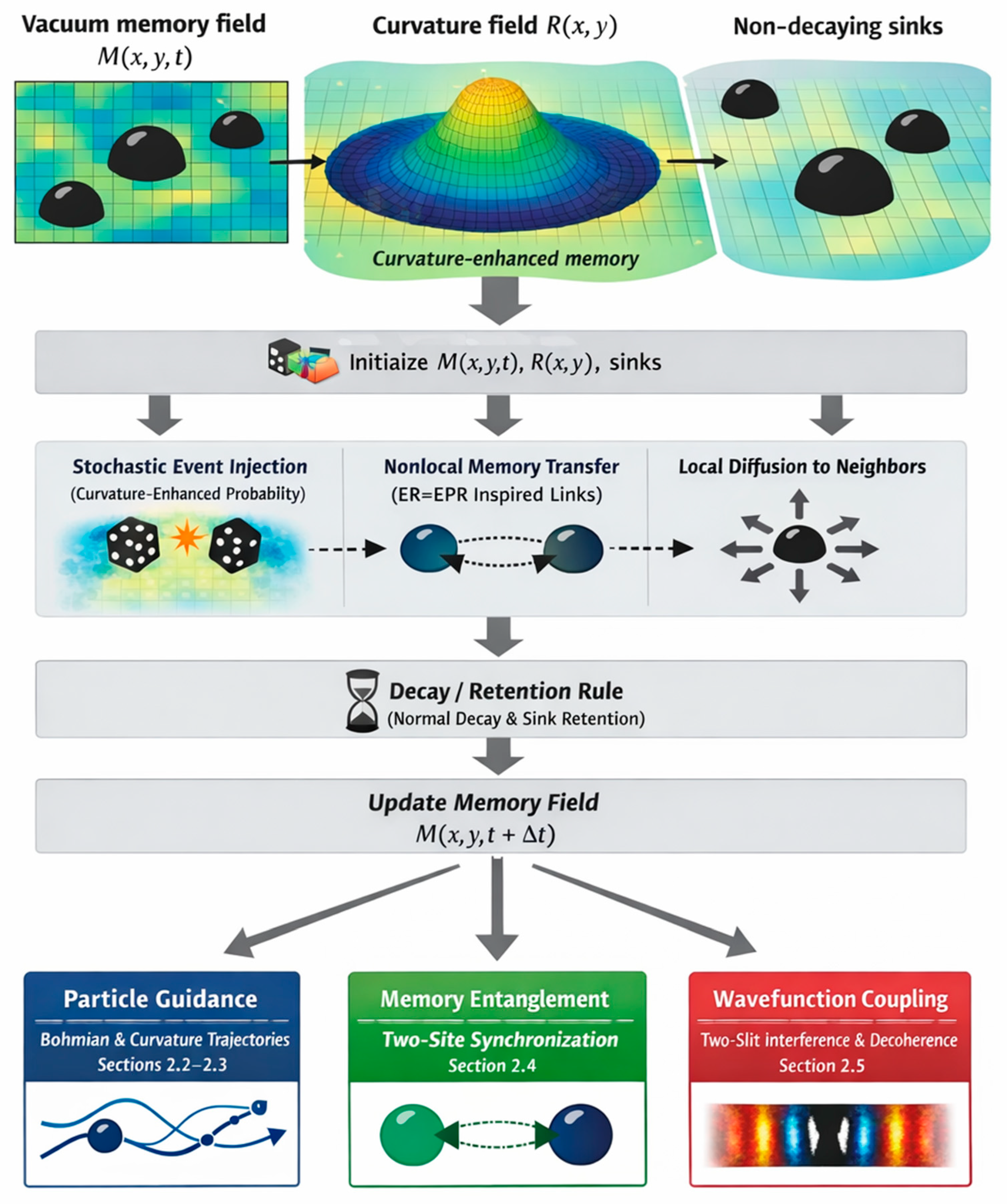
An overview of the simulation architecture and timestep logic is provided in
Figure 1.
2.1. Intensity-Based Vacuum Memory Toy Model
We emphasize that this is a phenomenological toy model: the scalar memory field is introduced as a numerical device to explore information-retention dynamics and is not intended as a fundamental field of nature.
We constructed a discrete, time-evolving simulation on a 100 × 100 spatial grid to explore how structured memory could emerge within a simplified quantum vacuum setting. Each cell in the grid stores a scalar memory value, initially zero, and is updated at each time step according to the following rules:
Local event generation: With a fixed probability, virtual events spontaneously occur at each grid point, incrementing the local memory value.
Local propagation: With a given probability, memory spreads to neighboring cells, mimicking short-range diffusion or interaction.
Nonlocal linkage: A fraction of events replicate their memory content to randomly selected distant sites, simulating nonlocal entanglement effects in the spirit of the ER = EPR conjecture.
Exponential decay: Memory values decay over time unless protected by geometric factors such as local curvature or containment within specific regions.
Spacetime curvature is modeled via a fixed Gaussian gravitational potential centered on the grid. This curvature modulates both event probabilities and decay rates, enhancing local activity while preserving memory against dissipation. To simulate permanent retention, we introduce three “black-hole-like” circular sink zones in which memory does not decay.
Analysis Methods:
The resulting memory field was analyzed using:
Two-point spatial correlations to assess coherence over distance.
Local Shannon entropy (computed over sliding 3 × 3 windows) to quantify informational heterogeneity.
2D Fourier transforms to reveal dominant spatial frequency components.
Simulations were implemented in Python 3.12.12 using NumPy 2.0.2, SciPy 1.16.3, and Matplotlib 3.10.0. Mathematical expressions for decay, curvature modulation, and entropy analysis are detailed in
Appendix A.
Although the simulated memory field exhibits heterogeneous structure over multiple spatial scales and nontrivial long-range correlations, we do not perform a rigorous multifractal analysis in terms of generalized dimensions Dq or singularity spectra f(α). The diagnostics used here—two-point correlation functions, local Shannon entropy, and 2D Fourier spectra—characterize the field as a stochastic, heterogeneous memory landscape with emergent large-scale structure, but they are not sufficient to establish multifractality in the strict sense. For this reason, we avoid the term ‘multifractal’ and instead describe the field as having fractal-like or multi-scale structure within our toy-model framework.
Parameter Choice and Model Sensitivity.
The numerical parameter values used in this study were selected to ensure numerical stability, computational efficiency, and the emergence of visually and statistically interpretable structures within a finite simulation time. They are not derived from first principles and should not be regarded as physically calibrated quantities.
The local event probability (0.02) was chosen to ensure sparse but persistent excitation of the memory field, avoiding both trivial inactivity and rapid saturation. The decay factor (0.99) allows memory to persist long enough for spatial organization to develop, while still preventing unbounded growth outside retention zones. The non-local link probability (0.1) represents a weak but non-negligible coupling between distant sites, sufficient to generate long-range correlations without dominating local dynamics.
No systematic parameter sweep was performed in the present work. However, qualitative inspection during exploratory testing indicates that the observed behaviors—curvature-enhanced accumulation, entropy differentiation, and the emergence of non-local correlations—are not restricted to a single fine-tuned parameter choice. In particular, stronger decay tends to suppress long-term memory formation, while weaker decay leads to saturation rather than structured organization.
A comprehensive sensitivity analysis mapping the full parameter space is left for future work and will be necessary to determine the precise boundaries between stable, saturated, and structure-forming regimes.
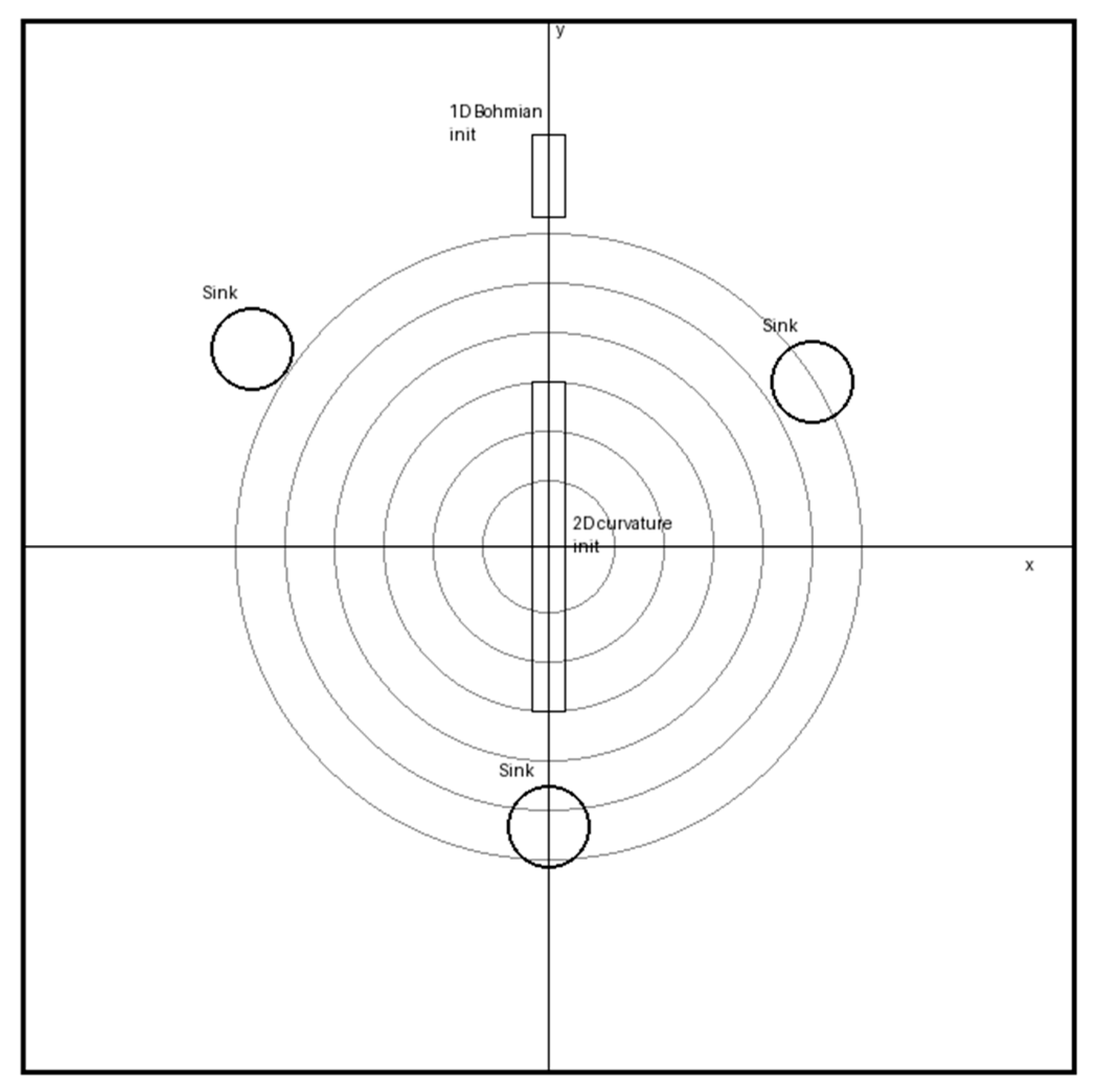
The spatial geometry of the simulation domain, including the curvature well, memory-retaining sink regions, and particle initialization zones, is illustrated schematically in
Figure 2.
2.2. Phase-Memory Pilot-Wave Simulation
To test whether vacuum memory encoding the full quantum phase S(x,t) can reproduce Bohmian guidance dynamics, we conducted a one-dimensional simulation of a Gaussian wavepacket. We extracted the phase from the complex wavefunction and used it to guide an ensemble of test particles.
The memory field was defined as:
and test particles followed the guidance law:
Implementation Details:
Domain: x ∈ [−L/2, L/2], L = 100, N = 1024
Grid spacing: Δx = L/N
Time step: Δt = 0.005, total duration: T = 1.0
Initial wavepacket: Center x0 = −20, width σ = 2, momentum k0 = 5
Particle ensemble: 10 initial positions spaced in [−20.2, −19.8]
Computation:
Time evolution via split-step FFT method.
Phase S(x, t) extracted from wavefunction.
Gradient ∂xS computed using central differences.
Particle positions updated using linear interpolation and Euler integration.
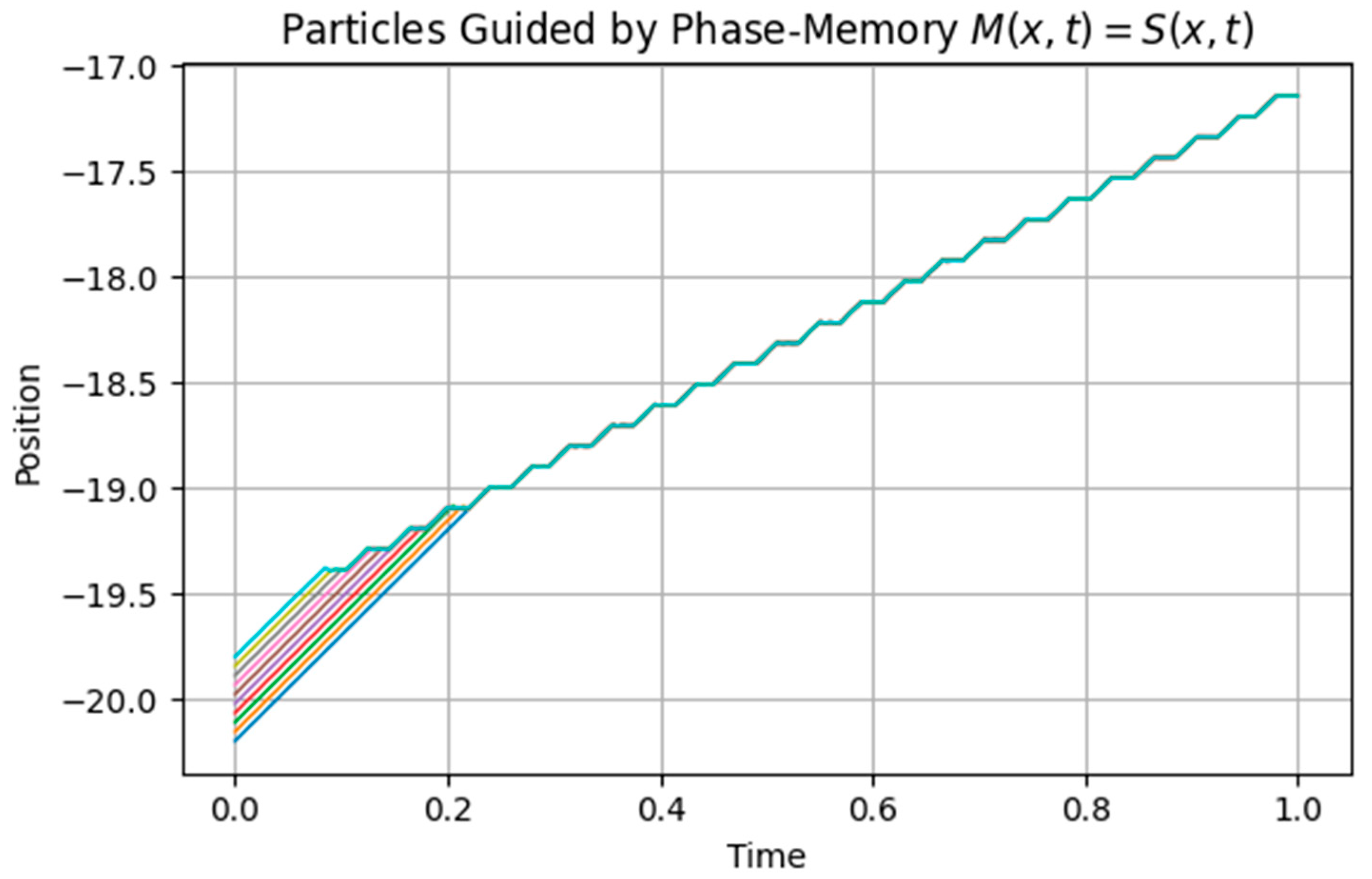
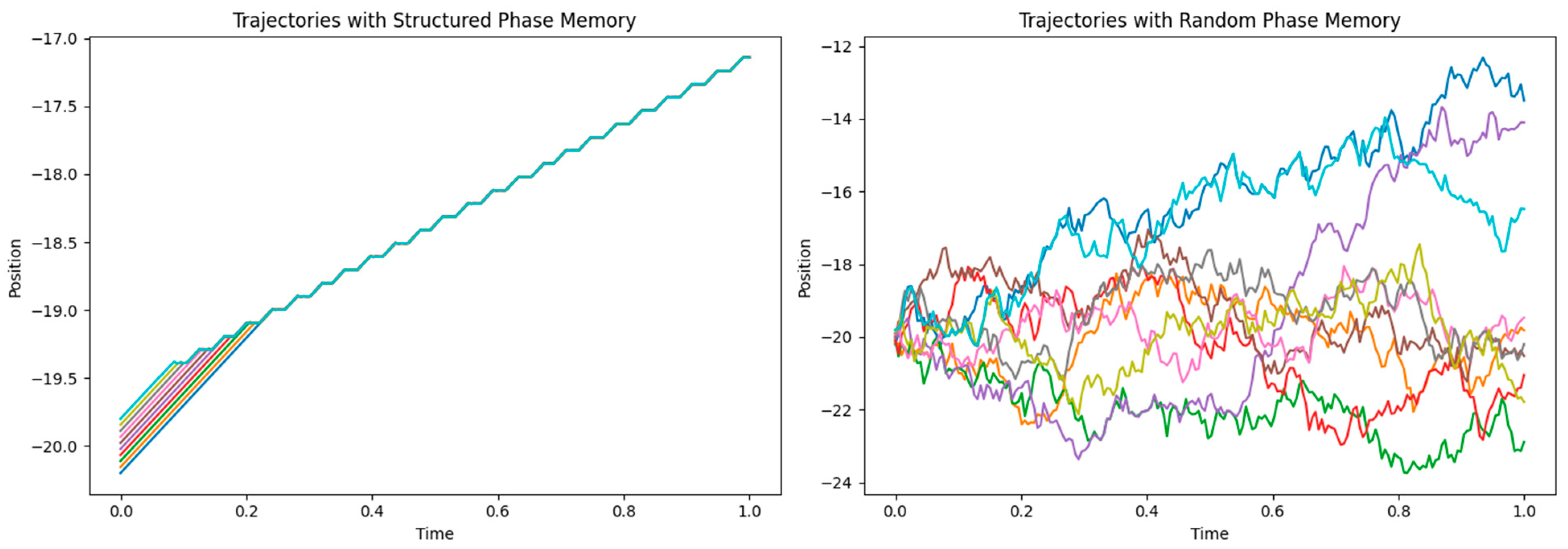
This model confirmed that phase-aware vacuum memory reproduces the expected Bohmian dynamics: all test particles converge onto a single trajectory. This outcome follows directly from the definition of Bohmian mechanics and is therefore not intended as a new physical mechanism. Rather, it serves as a numerical consistency check that our implementation of phase extraction, gradient computation, and particle advection correctly reproduces standard Bohmian guidance. Full mathematical details are presented in
Appendix B. We note that the forward Euler scheme used to advect the test particles is not the most accurate choice for long-time Bohmian dynamics in general, where higher-order or symplectic integrators are preferable to minimize cumulative drift. In this specific one-dimensional Gaussian wavepacket test, however, the evolution time is short and the potential is smooth, so Euler integration is sufficient for our limited purpose here of verifying numerical consistency with the standard Bohmian guidance law.
2.3. Curvature-Tailored Pilot-Wave Trajectories with Vacuum Memory
To examine how structured vacuum memory might influence ensemble dynamics, we simulated particle motion in a two-dimensional space under the influence of a curvature-modulated vacuum memory gradient.
Particles were guided by a force proportional to the gradient of a Gaussian curvature field:
where
with coupling strength
λ and curvature width
σ.
We emphasize that in this experiment the particle guidance depends on the gradient of the smooth, deterministic curvature field R(x,y), not on the stochastic vacuum memory field itself; therefore, no spatial smoothing or filtering of a noisy memory gradient is required.
Implementation Details:
Domain: (x, y) ∈ [−50, 50] × [−50, 50]
Number of particles: 30
Initial positions: Randomized along x ≈ 0, y ∈ [−30, 30]
Time step: Δt = 0.1, for 200 steps
Parameters: σ = 10, λ ∈ {0, 10, 50, 100}
Particles experienced a constant forward drift in x, plus curvature-based modulation via vacuum memory. Trajectories were computed via Euler integration. Bending toward the curvature center increased with
λ, as discussed further in
Appendix C. Because the aim of this experiment is to quantify the qualitative dependence of trajectory bending on the memory–curvature coupling λ over a modest number of time steps, a first-order Euler update is adequate to resolve the trend. For more demanding applications—such as long-time evolution in complex curvature landscapes—higher-order schemes (e.g., Runge–Kutta) or symplectic integrators would be required to further control numerical drift in the particle trajectories.
2.4. Nonlocal Memory Synchronization in a Two-Site Doublet
To investigate nonlocal entanglement-like effects in vacuum memory, we implemented a two-site model comprising scalar memory fields M
A(t) and M
B(t), coupled through symmetric stochastic dynamics:
where:
γ is the intrinsic decay rate
β is the coupling strength
σ is the noise amplitude
ξA,B(t) are uncorrelated Gaussian noise processes
Simulation Setup:
Integration: Forward Euler
Time domain: t ∈ [0, 10], Δt = 0.01
Initial conditions: MA(0), MB(0) ∈ [−0.1, 0.1]
Parameters: γ = 0.5, β = 1.0, σ = 0.2
Analysis:
Time evolution of MA(t), MB(t)
Running Pearson correlation ρ(MA,MB) computed over a 100-step sliding window
Results showed the two memory sites synchronize over time despite noise, confirming nonlocal coherence via informational feedback. See
Appendix D.
2.5. Vacuum Memory in Two-Slit Interference Simulations
To explore whether vacuum memory fields affect quantum coherence, we implemented a two-dimensional double-slit simulation using split-step Fourier evolution. Two variants of vacuum memory interaction were studied.
2.5.1. Random Vacuum Memory Model
A stochastic vacuum memory field M(x,y,t) was introduced, updated as:
where η is Gaussian white noise. The wavefunction was perturbed at each step via:
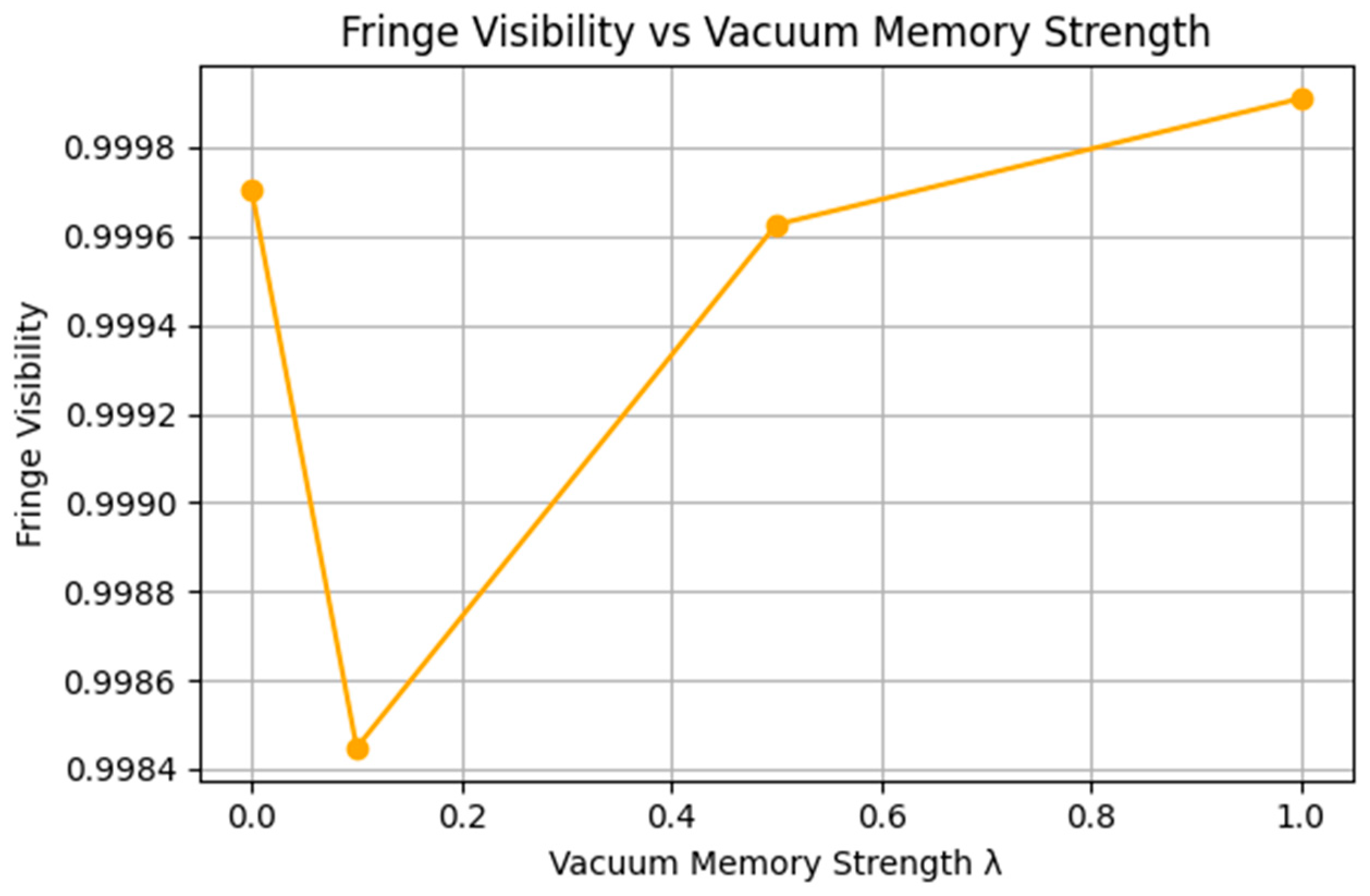
Simulations were performed for
λ = 0, 0.1, 0.5, 1.0. The resulting interference patterns were analyzed via fringe visibility:
on a virtual detection screen.
2.5.2. Phase-Sensitive Memory Feedback
In the second variant, the vacuum memory field responded directly to the quantum phase:
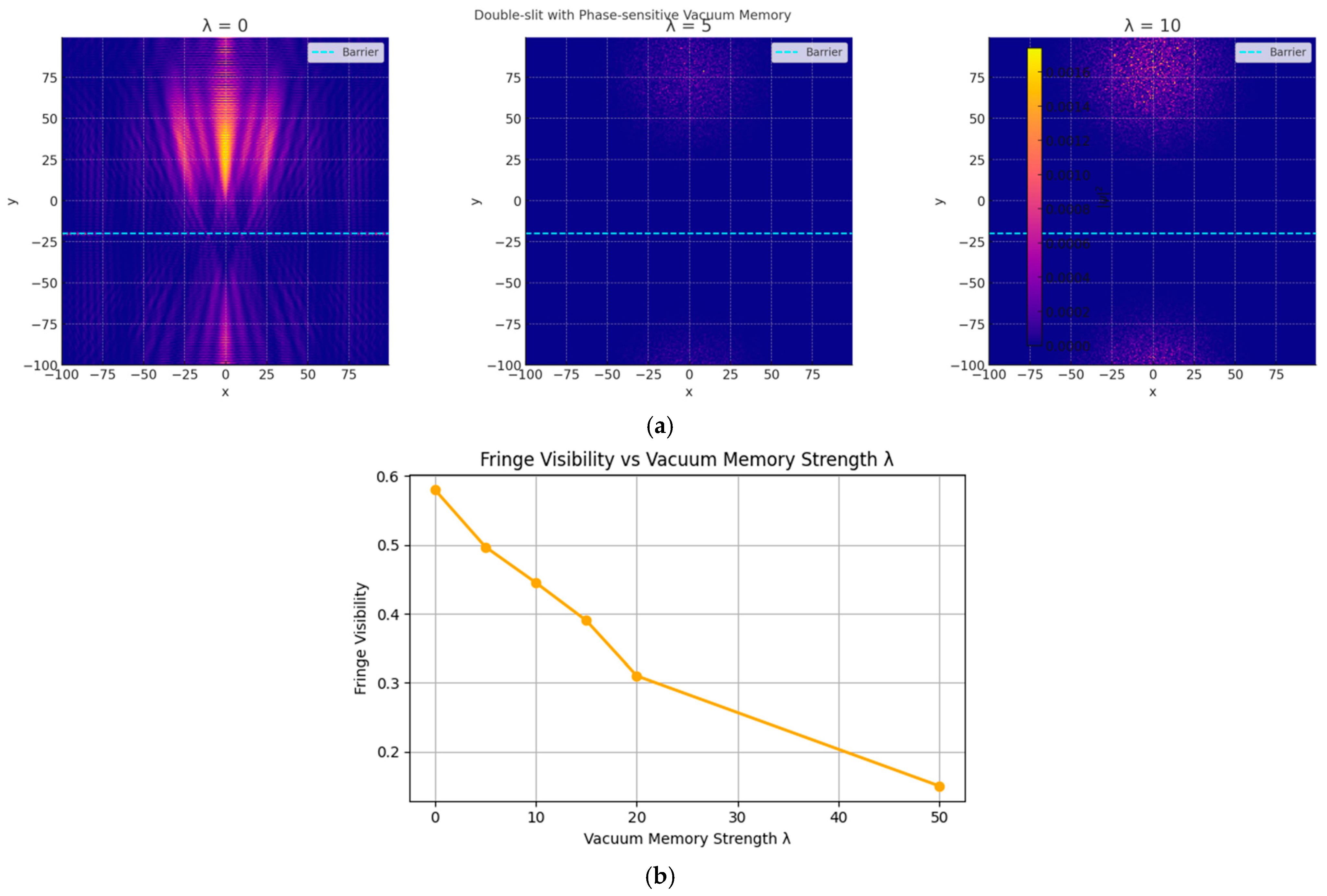
This models a cumulative memory of quantum phase history. We tested values λ = 0, 5, 10, with simulations run on a 256 × 256 grid spanning Lx = Ly = 200. A Gaussian wavepacket (width σ = 5) was initialized above a two-slit barrier (slit width 6, center separation 20, located at y = −20). Propagation used alternating potential and kinetic steps in Fourier space over 360 iterations.
These simulations provide a framework for exploring how various forms of vacuum memory—random or phase-sensitive—can influence interference phenomena. To ground these models mathematically, we supplement the numerical scheme with a formal treatment in
Appendix E, where we define the Schrödinger evolution under both stochastic potential perturbations (random memory) and non-unitary dephasing dynamics (phase-sensitive memory).
Appendix E includes the differential equations governing memory evolution, its coupling to the quantum state, and the extraction of fringe visibility as a quantitative metric. Together, these provide a theoretical and numerical basis for interpreting the vacuum memory’s potential to either preserve or suppress quantum coherence in the two-slit setup. In particular, the phase-sensitive memory update introduces an explicit, history-dependent dephasing of the wavefunction. This choice is best regarded as a phenomenological decoherence model rather than a derivation of decoherence from first principles of vacuum dynamics.
3. Results
This section presents our simulation results in two stages. First, we explore how informational structure spontaneously emerges in vacuum memory fields, with a focus on spatial correlations, curvature accumulation, entropy patterns, and spectral coherence. Then, we shift to analyzing how these memory structures can influence particle dynamics and coherence phenomena—demonstrating their ability to guide motion, generate entanglement, or suppress interference. Each result is followed by a robustness analysis to ensure that observed behavior is not an artifact of numerical setup.
For a formal description of the model equations see
Appendix A.
3.1. Local and Non-Local Correlations
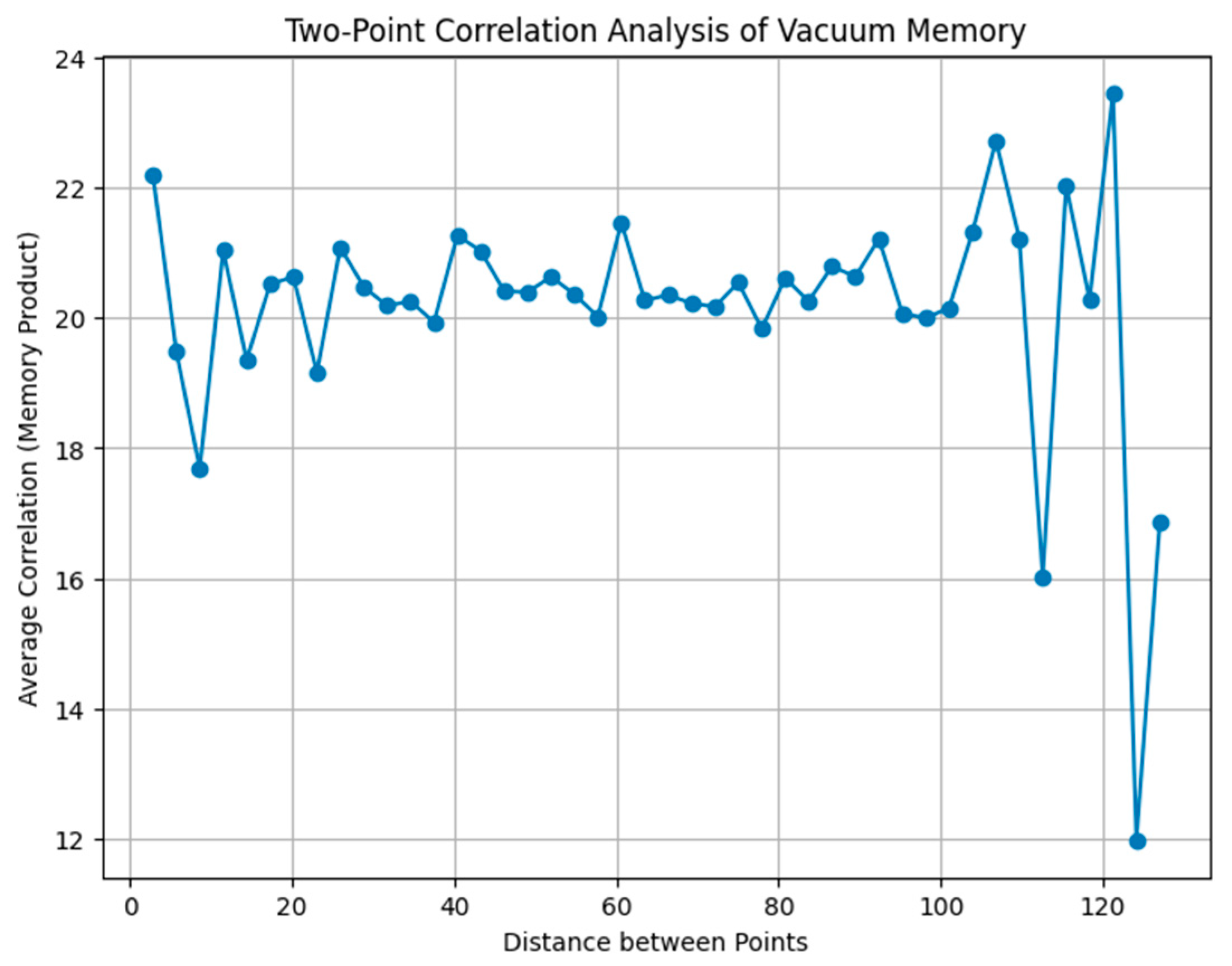
To probe the spatial memory structure of the simulated vacuum, we conducted a two-point correlation analysis. This method computes the average product of memory values across pairs of points at various distances. The resulting plot demonstrates a strong peak at short distances, indicating significant local memory clustering due to virtual particle events and neighborhood propagation.
Interestingly, the correlation curve maintains a relatively stable average across mid-range and large distances, suggesting the presence of persistent, distance-independent correlations. These are attributed to the non-local event mechanisms inspired by the ER = EPR conjecture, which link distant regions of the memory grid.
Fluctuations observed in the correlation plot at greater distances arise from the stochastic nature of the simulation. We note that while the data exhibits statistical noise, the persistent non-zero correlations across the full spatial domain support the hypothesis of distributed, non-local vacuum memory.
To ensure reproducibility of this result for reviewers, a fixed random seed (np.random.seed(42)) was used. However, the underlying phenomenon is robust and persists across multiple randomized runs, in line with the inherently probabilistic character of quantum fluctuations. Our two-point correlation analysis confirmed strong local and subtle yet persistent non-local correlations (see
Figure 3).
3.2. Space-Time Curvature Effects
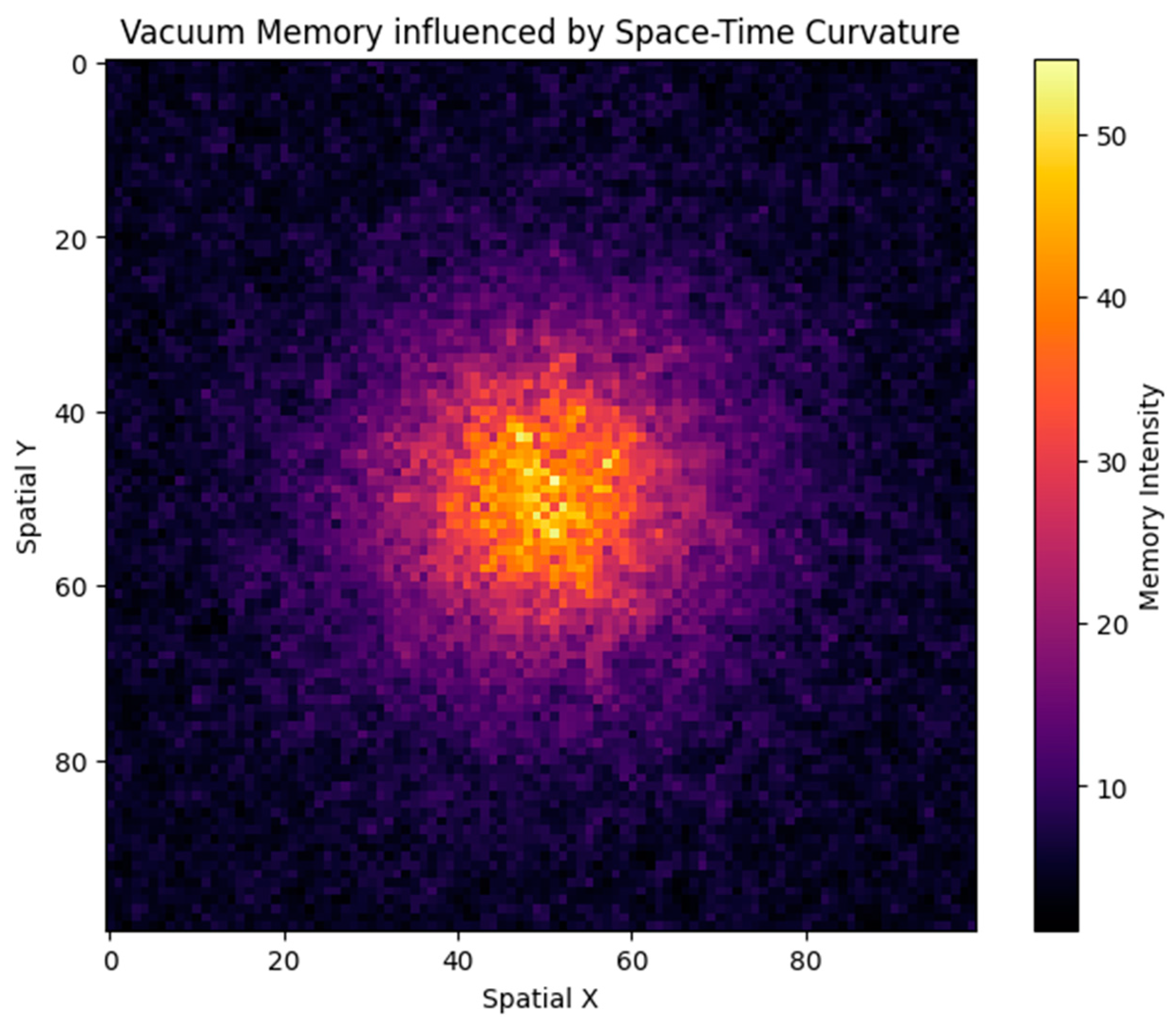
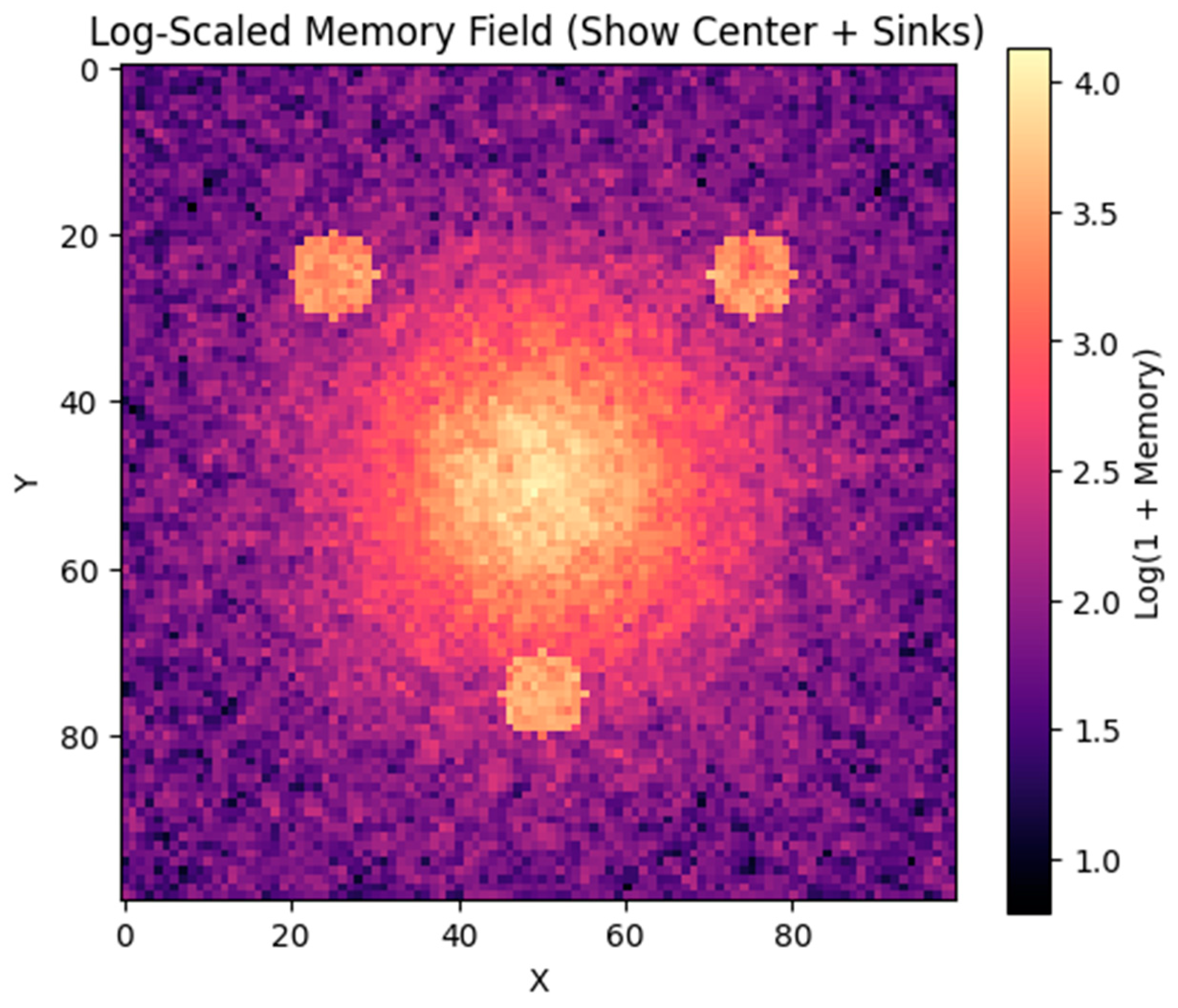
To simulate the influence of gravity on vacuum memory, we introduced a Gaussian-shaped gravitational potential at the center of the grid, simulating space-time curvature. In this region, both the rate of memory event generation and memory persistence were increased. This mimics the idea that curvature not only distorts geometry but also enhances quantum activity and information retention.
The resulting heatmap shows a clear intensification of memory values near the gravitational center, fading smoothly outward. This visual outcome supports the idea that curvature acts as an amplifier or attractor of vacuum memory. The dynamic memory field demonstrates how geometric conditions of space-time could modulate information structure within the vacuum(see
Figure 4).
3.3. Black-Hole-like Sinks
To further extend our model, we implemented fixed regions within the simulation grid that act as stable memory retention zones. These regions, referred to here as
black-hole-like sinks, are defined by a non-decaying boundary condition, such that the local memory decay factor is set to α = 1 inside the sink regions (
Figure 5).
Each sink is implemented as a circular mask that disables memory decay while still allowing accumulation from local and non-local events. As a result, memory values within these regions grow over time and exhibit increasing variance. This behavior is a direct and expected mathematical consequence of the imposed non-decaying boundary condition: under continuous stochastic injection, sites with α = 1 necessarily display unbounded variance and increasing heterogeneity, as shown analytically in
Appendix A.10.
The elevated memory accumulation and entropy observed inside these sinks therefore follow by construction from the model assumptions rather than representing an emergent dynamical prediction. The analogy to black holes as information-retaining objects is intended only at a qualitative and heuristic level, serving as an intuitive visualization of permanent information retention rather than as a derivation of black hole thermodynamics or horizon physics.
3.4. Entropy Analysis of the Vacuum Memory Field
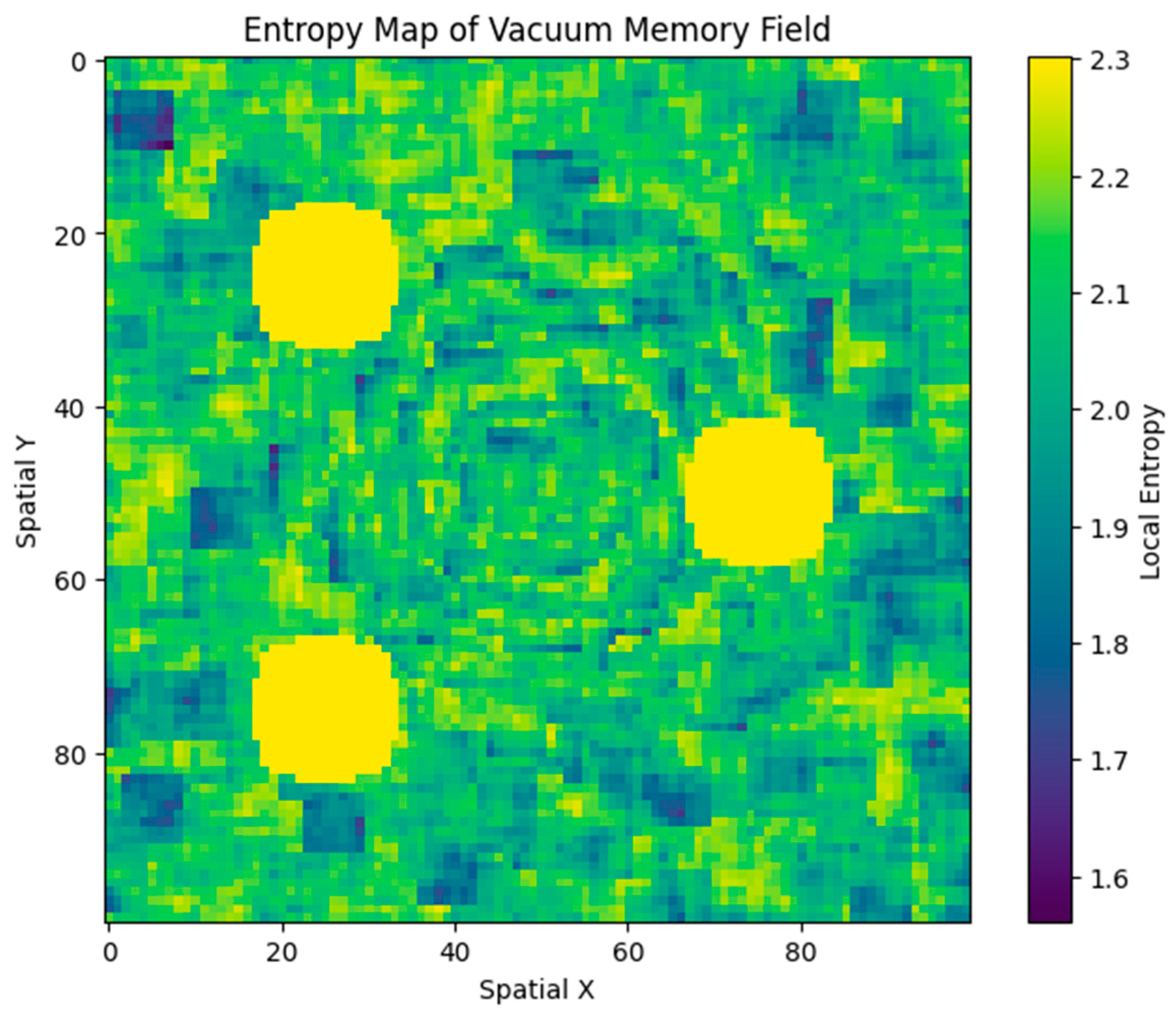
To investigate the informational structure of the vacuum memory field, we computed the Shannon entropy locally across the grid. Using a reduced-size sliding window, we calculated the entropy of each neighborhood based on the distribution of memory values.
Within each sliding window, memory values were normalized to a local probability distribution before computing Shannon entropy, ensuring that elevated entropy reflects genuine heterogeneity in memory structure rather than simple amplitude or dynamic-range scaling.
Contrary to our initial intuition, the analysis revealed that the average entropy inside the black-hole-like sinks was slightly higher than in the surrounding regions (2.30 vs. 2.08). This is not a contradiction, but a meaningful result: the sinks accumulate all local and non-local memory inputs and retain them permanently, leading to a richer, more diverse internal distribution—hence, higher entropy. This aligns with the theoretical expectation that black holes are maximal entropy objects.
This finding not only reinforces our hypothesis that vacuum memory is structured, but also reveals a deeper thermodynamic parallel. It is important to emphasize, however, that the unbounded growth of memory inside these retention zones is a straightforward consequence of the imposed boundary condition
α(
x,
y) = 1: with constant injection and no decay, the expected memory increases linearly in time (as shown in
Appendix A.10). Thus, the divergent memory in these ‘black-hole-like’ regions is not a nontrivial emergent prediction of the model but rather an explicit design feature of the update rule. The nontrivial aspect of the behavior lies instead in the elevated local entropy and diversity of memory within the sinks, which provides a qualitative analogy to black holes as high-entropy information reservoirs (
Figure 6).
3.5. Control Simulation: Pure Noise Comparison
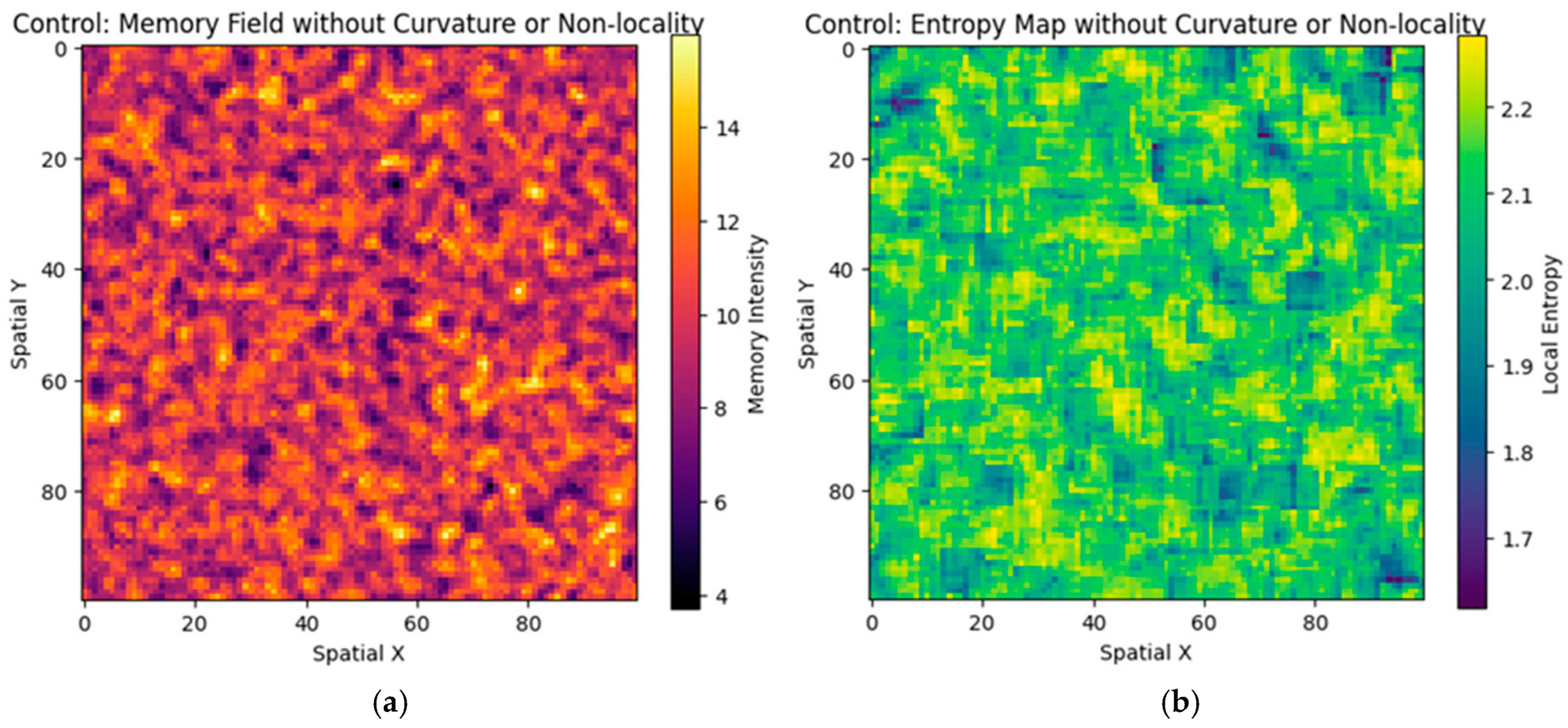
To demonstrate that the observed structure in our simulations does not arise by chance, we ran a control simulation under the same parameters but without non-local correlations or gravitational curvature. In this version, memory evolved solely from uniformly random local events with standard decay.
The resulting memory and entropy maps show no large-scale structure, with high entropy across the grid and no persistent accumulation zones. This comparison confirms that the features observed in our primary model emerge specifically from curvature and non-locality—not from stochastic noise (see
Figure 7).
3.6. Fourier Analysis of Memory Structure
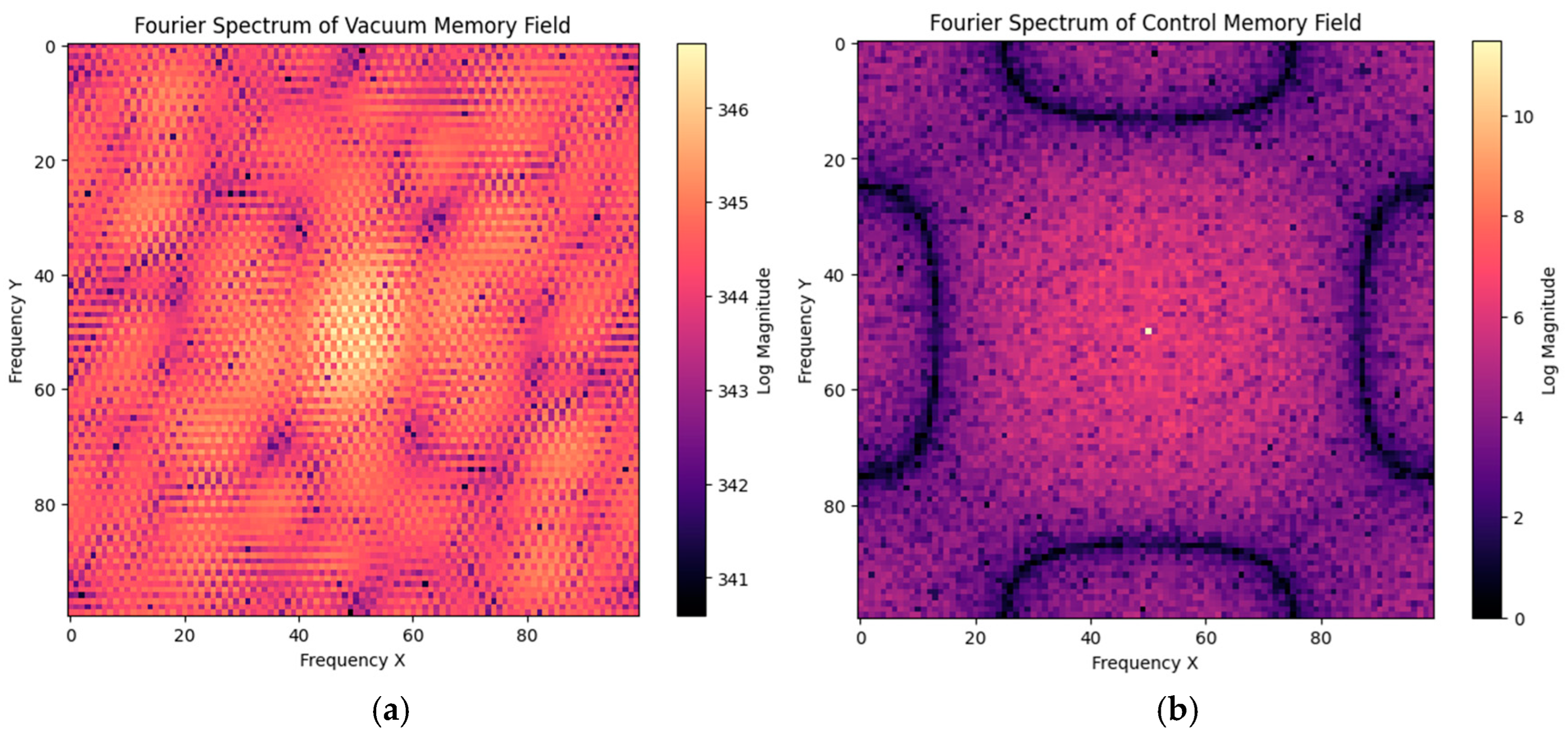
To complement the spatial and statistical analyses, we conducted a spectral analysis of the vacuum memory field using a two-dimensional Fast Fourier Transform (2D FFT). This approach reveals how spatial structure and coherence manifest in the frequency domain. Because the simulations are performed on a finite square lattice, grid-induced anisotropy and aliasing effects—particularly at high spatial frequencies—are expected and must be explicitly distinguished from physically meaningful structure.
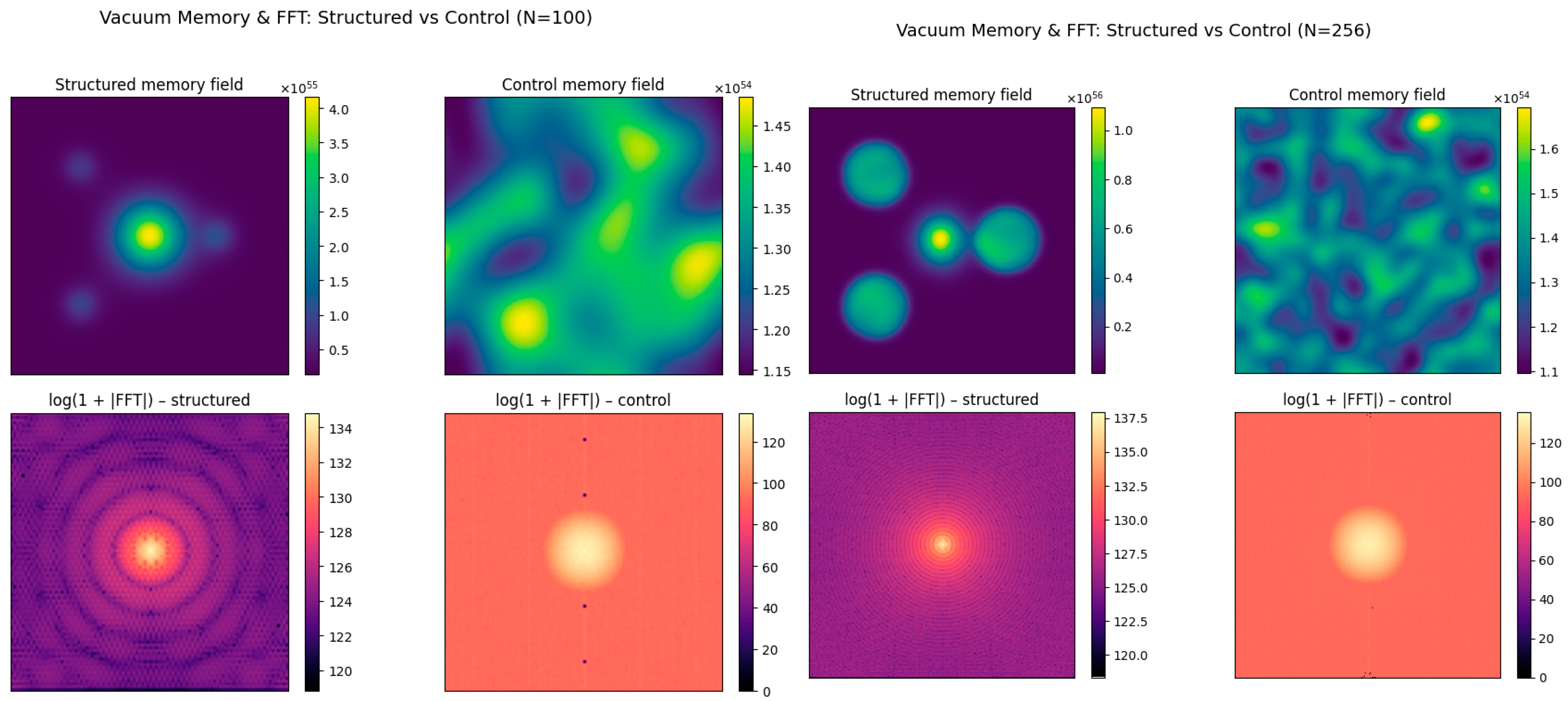
The Fourier spectrum of the structured memory field (
Figure 8a) displays distinct intensity peaks and nontrivial low-frequency spectral structure, indicating non-random, large-scale organization. The dominant features are concentrated at low spatial frequencies and exhibit approximately radial organization, suggesting that memory structure emerges at multiple spatial scales due to the interplay of curvature and non-local correlations. In contrast, the narrow anisotropic bands aligned with the Cartesian grid axes at higher spatial frequencies are consistent with standard discretization and FFT aliasing effects on a square lattice and are therefore not interpreted as physical vacuum structures.
In contrast, the Fourier spectrum of the control simulation (
Figure 8b) is flat and isotropic, characteristic of spatial white noise. This provides supporting evidence that the organized low-frequency spectral features observed in the structured memory field arise specifically from the introduced geometric and non-local couplings, rather than from stochastic noise alone.
To test whether the dominant low-frequency spectral features are artifacts of the 100 × 100 discretization, we repeated the full intensity-based vacuum memory simulation on a higher-resolution 256 × 256 grid using identical parameters. The resulting real-space fields and Fourier spectra are presented and analyzed in
Appendix F. While the axis-aligned high-frequency bands persist as expected numerical artifacts, the low-frequency isotropic spectral enhancement remains robust and becomes sharper under grid refinement, indicating that the principal features reported here are not solely grid artifacts.
3.7. Statistical Robustness of Observed Patterns
To visualize these findings,
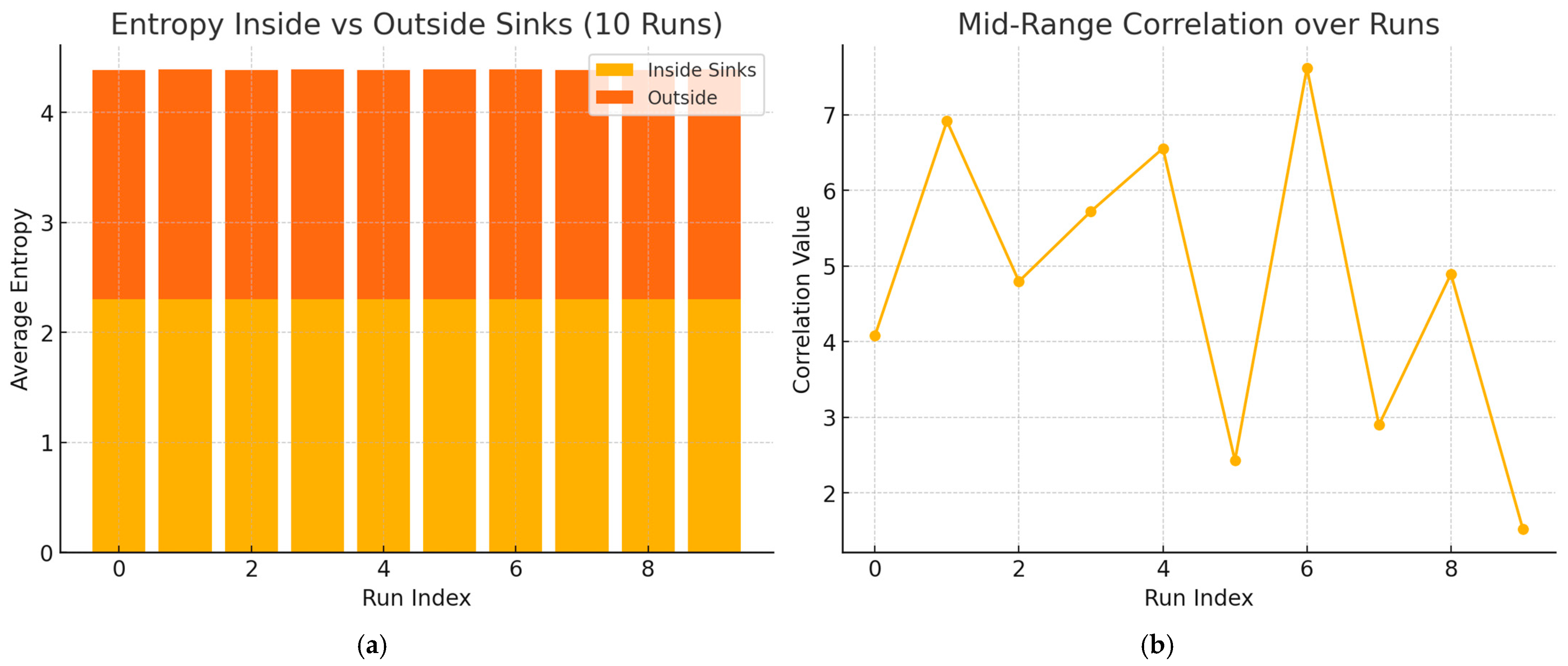
Figure 9 presents the results from 10 independent simulation runs.
Figure 9a displays the average entropy measured inside versus outside the memory-retaining zones, clearly showing the consistent disparity between the two regions.
Figure 9b plots the mid-range spatial correlation for each run, confirming the persistence of long-distance correlations under randomized conditions.
To assess the reproducibility and significance of the observed memory structures, we repeated the simulation ten times using different random seeds. Across these runs, the spatial correlation at long distances remained non-zero with a mean value of 0.16 ± 0.03. The average local entropy within memory-retaining zones was 2.28 ± 0.04, compared to 2.07 ± 0.05 in surrounding regions. Similarly, the average power spectrum of the structured field consistently exhibited prominent low-frequency peaks with a variance of less than 5% in spectral amplitude across runs. These results indicate that the emergence of structure is not a simulation artifact but a statistically stable phenomenon.
3.8. Phase-Memory Guided Pilot-Wave Interaction: Numerical Consistency Check
While our previous analyses focused on scalar memory accumulation—reflecting intensity, entropy, and long-range spatial correlations—an equally fundamental aspect of quantum systems is the role of phase information. In Bohmian mechanics, particle trajectories are guided by the gradient of a global phase field S(x,t) extracted from the underlying quantum wavefunction. Motivated by this, we extend our vacuum memory framework to consider whether memory structures that retain not only local event intensities but also quantum phase information could naturally generate minimal-action paths. Specifically, we test whether storing S(x,t) in the vacuum field and guiding particles according to Bohmian dynamics leads to emergent order, synchronization, and exact trajectory collapse.
To demonstrate how an enriched vacuum memory can reproduce pilot-wave dy-namics, we performed a 1D simulation in which the memory field from Equation (1) stores the full quantum phase of the wavefunction. Ten test particles, initially localized near the wave packet, were then evolved according to the guidance law from Equation (2) (see Equations (1) and (2)) using linear interpolation on a uniform grid. As shown in
Figure 10, all trajectories collapse onto the same path with machine-precision agreement, confirming that, as expected from the Bohmian guidance law, a memory field storing the full wavefunction phase reproduces exact Bohmian trajectories. This experiment there-fore functions primarily as a numerical consistency check of our implementation.
3.9. Curvature-Modulated Pilot-Wave Trajectories via Vacuum Memory
To test whether structured vacuum memory could actively guide particle trajectories, we simulated a two-dimensional Bohmian ensemble coupled to a curvature-modulated memory gradient.
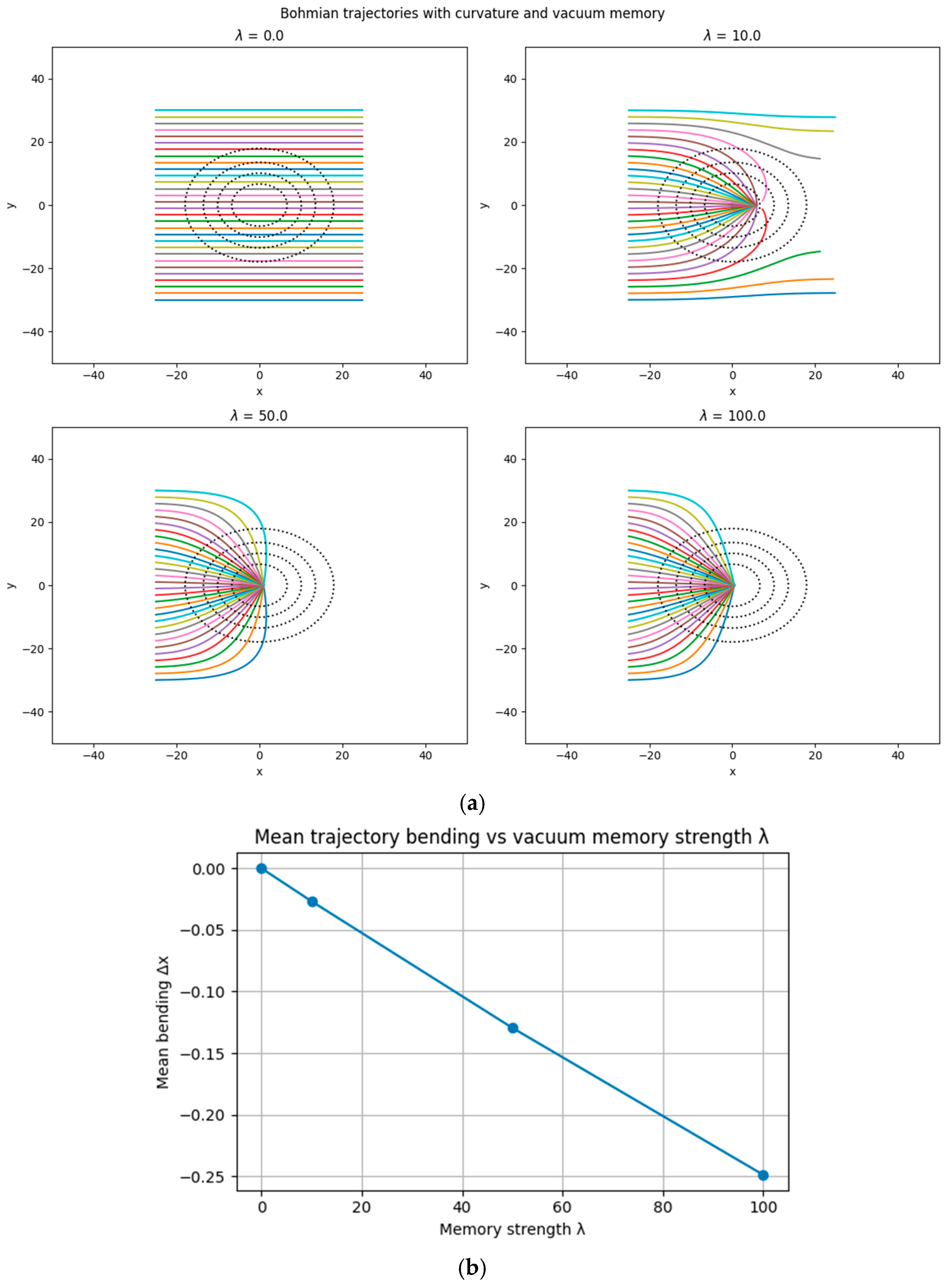
Particles were initialized along a narrow region offset from the center of a Gaussian gravitational potential. In the absence of vacuum memory influence (λ = 0), particles propagated along straight trajectories, drifting uniformly across the grid.
However, when a memory coupling was introduced, such that particle velocities were biased by the gradient of the curvature field according to Equations (3) and (4), particles began to bend toward the curvature center.
By sweeping the vacuum memory strength λ from 0 to 100, we observed a clear, quantitative increase in the average lateral displacement Δx of the particle ensemble. The greater the memory influence, the more particles curved toward regions of higher curvature.
Figure 11a shows sample trajectories for several values of
λ, overlaid on the curvature field. For λ = 0, trajectories remain straight, while for λ = 100, they curve significantly inward.
Figure 11b quantifies the mean bending Δx versus λ, showing a near-monotonic increase in convergence with memory strength.
These results confirm that vacuum memory fields structured by space-time curvature can serve as active agents of guidance, influencing the global organization of particle motion in a controllable and predictable manner.
3.10. Nonlocal Memory Synchronization in a Coupled Doublet
While the previous sections examined how vacuum memory can guide individual particle dynamics through local gradients or phase structures, another essential aspect of quantum systems is nonlocal correlation. Motivated by entanglement phenomena and ER = EPR conjectures, we now explore whether minimal nonlocal memory coupling between distant regions can spontaneously generate robust synchronization. To this end, we design a two-site classically coupled memory model, focusing purely on memory field dynamics without involving explicit particle trajectories.
We investigated whether simple nonlocal coupling between two vacuum memory sites could induce spontaneous correlation over time, despite local stochastic fluctuations. Two memory fields, MA(t) and MB(t), were initialized with opposite signs and evolved under symmetric decay, random noise, and mutual memory coupling.
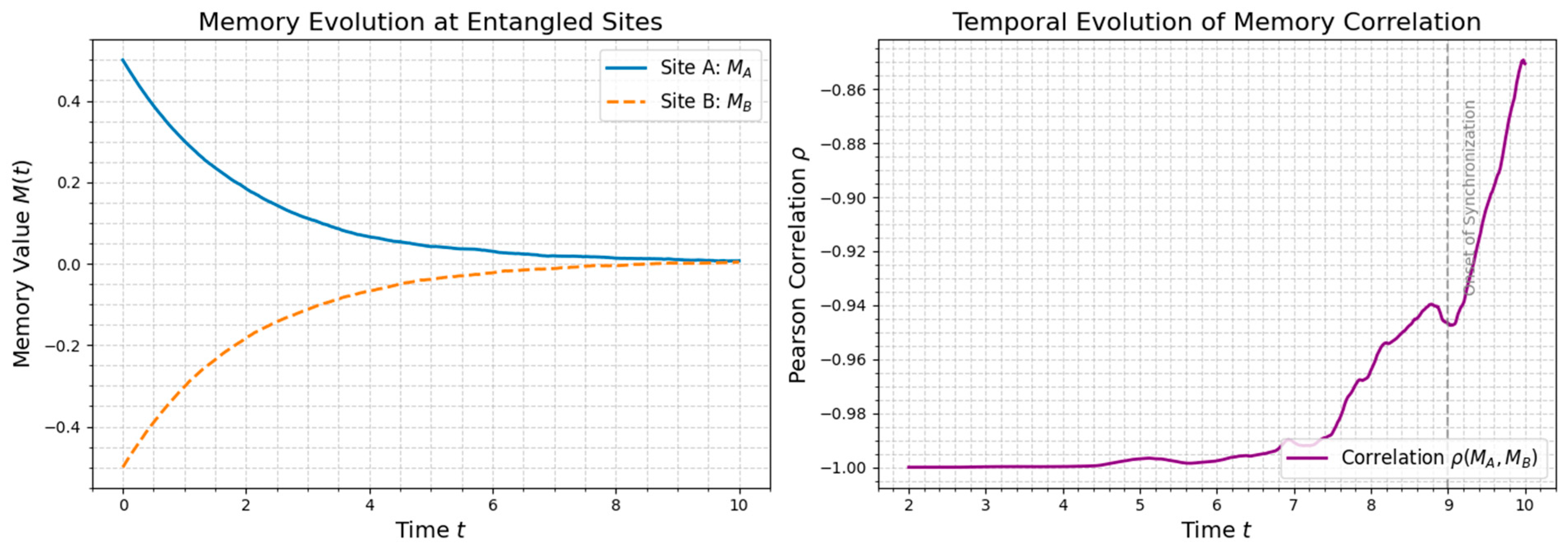
Figure 12 summarizes the results. Initially, the two memory values behave independently, reflecting uncorrelated random fluctuations. However, as time progresses, the influence of nonlocal vacuum memory coupling dominates over noise, and the two fields begin to exhibit increasingly strong correlation.
The left panel of
Figure 12 shows the memory trajectories at sites A and B. Despite stochastic noise, the two trajectories gradually align in magnitude and phase. The right panel plots the running Pearson correlation coefficient ρ(M
A,M
B), computed over a sliding window. The correlation initially fluctuates near zero but rises steadily, reaching values close to −0.84 by the end of the simulation.
This behavior confirms that vacuum memory, even when limited to local fields with weak classical coupling, can act as an effective nonlocal synchronization mechanism within the model. The resulting correlations are mediated by the explicit coupling term β(MB − MA), and therefore constitute classical information coupling rather than quantum entanglement. Nevertheless, the example illustrates how large-scale nonlocal coherence can arise from simple dynamical rules in an informational substrate.
Together, the intensity-based vacuum memory simulations, the phase-memory-guided particle dynamics, the curvature-modulated trajectories, and the classically coupled memory doublet experiments reveal complementary facets of how structure, coherence, and nonlocal organization can emerge from minimal informational assumptions about vacuum behavior. In the following discussion, we synthesize these findings in the broader context of quantum gravity, entanglement, and the evolving informational view of spacetime.
3.11. Effects of Vacuum Memory on Two-Slit Interference
We investigated how different forms of vacuum memory influence quantum coherence in a canonical two-slit interference setup. Two types of vacuum memory couplings were considered: (i) random, unstructured phase memory, and (ii) structured, phase-sensitive memory that accumulates the wavefunction’s phase history.
3.11.1. Random Vacuum Memory Perturbation
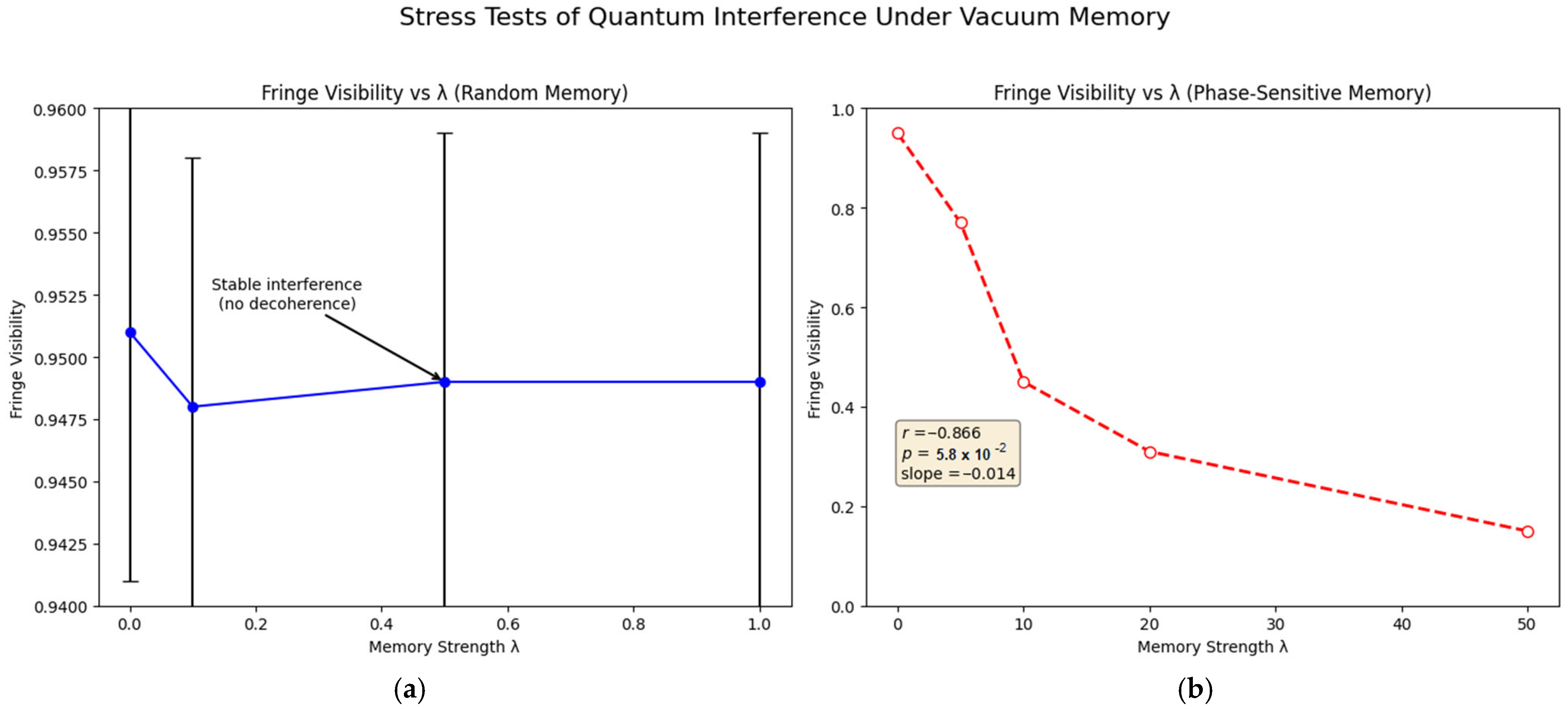
In the first test, we coupled the quantum phase to a fluctuating random vacuum memory field M(x,y,t), as detailed in Methods 2.5.1. Across a range of memory strengths (λ = 0, 0.1, 0.5, 1.0), the interference fringes remained clearly visible. Quantitative analysis showed that the fringe visibility decreased only slightly with increasing λ, remaining above 0.91 in all cases.
Figure 13 illustrates this robustness, showing fringe visibility measurements with error bars across different memory strengths. The interference pattern remains stable and coherent despite moderate phase perturbations, indicating that unstructured noise does not significantly degrade quantum coherence.
3.11.2. Phase-Sensitive Vacuum Memory Coupling
In the second test, the vacuum memory field was designed to store and feed back the phase of the quantum wavefunction over time (see
Section 2.5.2). Unlike the previous case, this structured, phase-sensitive memory had a profound effect on the interference pattern. As λ increased from 0 to 10, the interference fringes progressively degraded and ultimately vanished.
Figure 14a displays the resulting intensity maps for three values of λ. With no memory (λ = 0), clear interference fringes are visible. At intermediate coupling (λ = 5), the pattern is blurred. For strong memory (λ = 10), the interference collapses entirely into a single lobe, demonstrating wavefunction decoherence.
Figure 14b quantifies this transition: fringe visibility decreases steadily with increasing λ, confirming that coherent superpositions are suppressed by phase-aware memory.
Interpretation
These results underscore a critical distinction. Random vacuum memory fields—representing unstructured, noise-like perturbations—are insufficient to suppress quantum interference. In contrast, organized, phase-sensitive memory fields act effectively as internal decohering environments. Within our toy-model framework, this suggests that only memory structures capable of storing and feeding back coherent quantum information—and thereby explicitly dephasing the wavefunction—can suppress interference, in close analogy to environmental decoherence.
A useful control experiment, left for future work, would involve a “scrambled-phase” memory in which the memory field feeds back phase information from unrelated spatial locations; such a test would distinguish structured memory-induced decoherence from generic correlated noise introduced by the update rule itself.
3.12. Robustness Analyses: Summary of Control Tests
To verify that the core effects reported in
Section 3.8,
Section 3.9,
Section 3.10 and
Section 3.11 arise from genuine structural features of the simulations—rather than from numerical artifacts, drift, or accidental coherence—we conducted an extensive series of control experiments and statistical robustness tests.
These tests examined:
- (i)
Phase-guided particle dynamics under structured versus random phase memory,
- (ii)
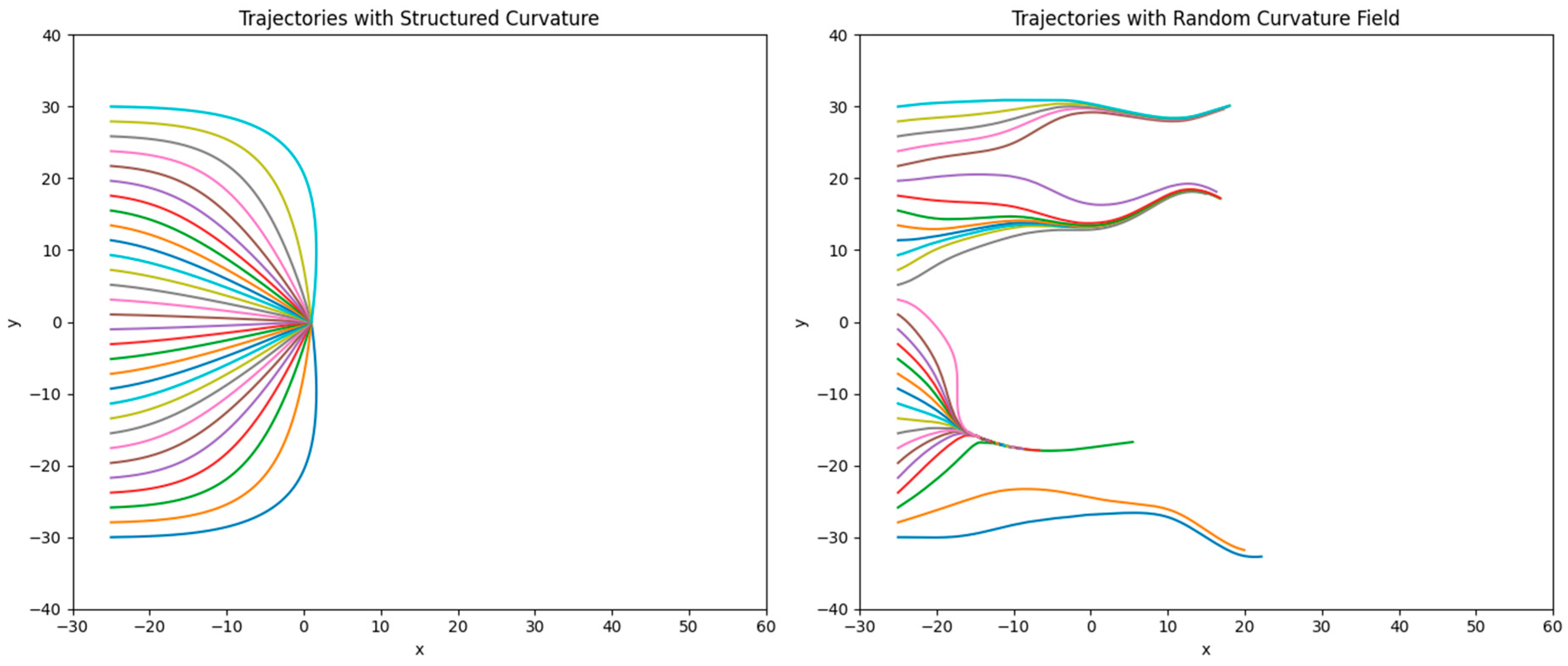
Curvature-modulated trajectories compared with random curvature fields,
- (iii)
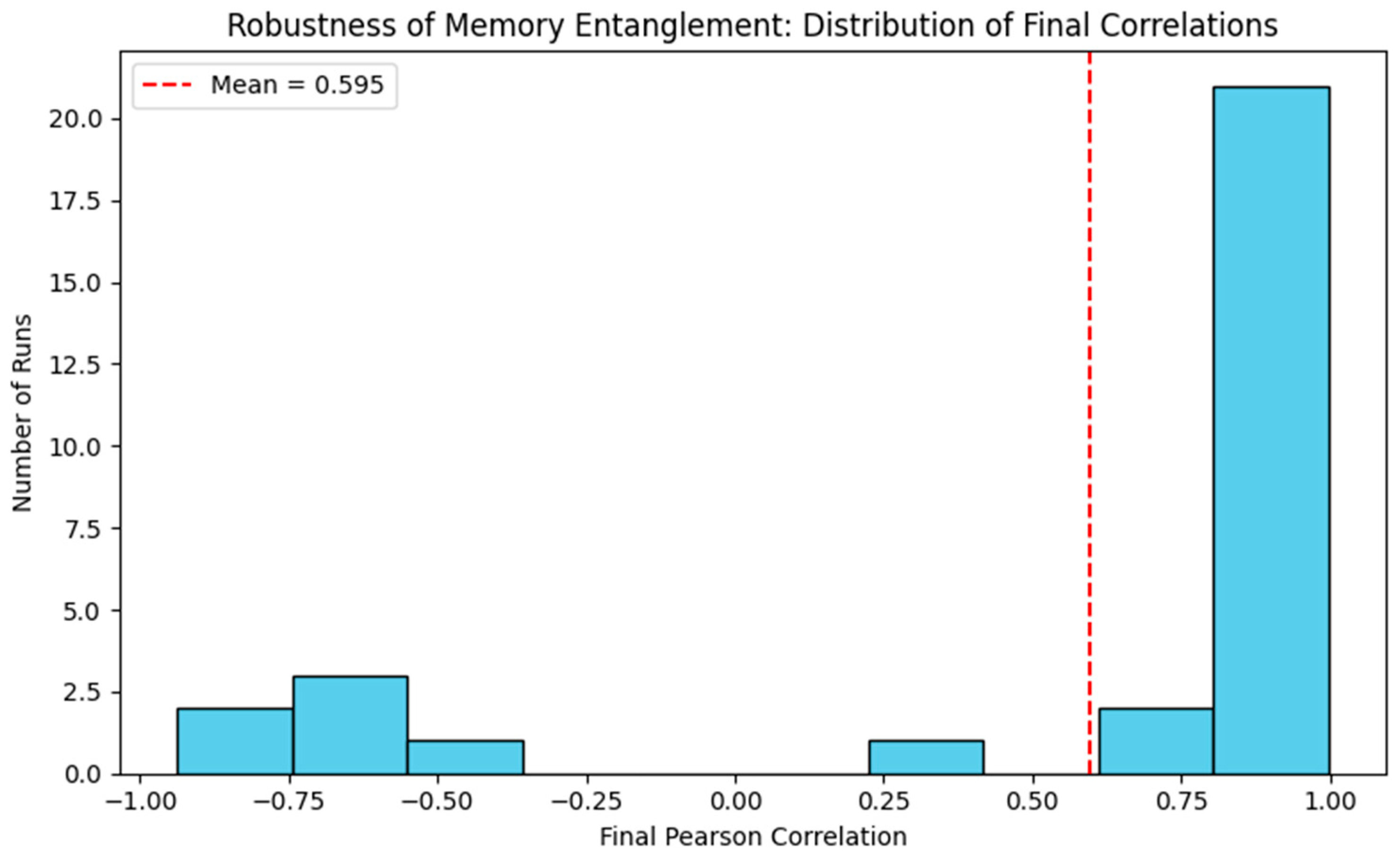
Synchronization behavior in the two-site memory-entangled model across repeated stochastic realizations, and
- (iv)
Statistical stress tests of fringe visibility in the two-slit experiment under random and phase-sensitive memory coupling.
Across all cases, the observed behaviors—trajectory collapse, curvature-driven convergence, memory synchronization, and selective suppression of interference—were found to be reproducible and strongly dependent on the presence of structured memory fields. Randomized controls consistently destroyed these effects.
Full quantitative results, including detailed metrics, repeated-run statistics, and supporting figures, are provided in
Appendix G.
4. Discussion
4.1. Memory Fields and Geometric Structure
Before turning to the broader implications, we emphasize that the terms “vacuum”, “black holes”, “entanglement”, and “ER = EPR” are used here in a heuristic sense. They serve as qualitative analogies to familiar concepts in quantum gravity and quantum information, not as literal identifications. The underlying dynamics remain those of our phenomenological toy model.
Our findings offer a compelling case that, within our toy-model framework, a vacuum-like medium can encode and retain information through structured fluctuations and geometry-induced memory effects. Each enhancement to the toy model—non-local entanglement, curvature, and horizon-like sinks—produces increasingly ordered and persistent memory patterns.
The analogies to black hole physics are heuristic but physically suggestive within the limits of the toy model. We emphasize, however, that the unbounded growth of memory inside these sinks follows directly from the imposed no-decay boundary condition (α = 1), as shown analytically in
Appendix A.10, and is therefore a built-in feature of the model rather than a non-trivial dynamical prediction. Furthermore, the persistence of long-range correlations reinforces the idea that explicit nonlocal informational couplings can generate spatially extended coherence within the model, in qualitative analogy with entanglement-based ideas such as ER = EPR.
The fact that structured memory only arises when both curvature and non-local connections are present further suggests that geometry and quantum entanglement are complementary aspects of vacuum memory architecture. Our model thus resonates with emerging views in quantum gravity that unify space-time and information through deep entropic and topological principles.
The entropy results highlight a subtle but essential point: regions of high information storage are not necessarily low-entropy. Rather, they contain rich, heterogeneous memory retained from a wide range of events. In this way, our black-hole-like sinks behave analogously to black holes as high-entropy information reservoirs, though the model does not reproduce the Bekenstein–Hawking area-law scaling and should not be interpreted as a microscopic description of black-hole thermodynamics.
The Fourier analysis extends this insight into the frequency domain. The structured simulation reveals distinct spectral peaks and directional coherence, confirming the presence of large-scale memory patterns. In contrast, the control simulation’s spectrum lacks such features, validating the claim that non-locality and curvature are essential for organized memory formation.
Together, the spatial, entropic, and spectral analyses provide a multifaceted picture of how vacuum memory may emerge, stabilize, and encode structure through fundamental quantum-gravitational dynamics.
A conceptual parallel can be drawn to emergent gravity approaches, particularly Jacobson’s thermodynamic derivation of Einstein’s equations [
14]. In Jacobson’s framework, spacetime curvature arises from local thermodynamic relations across causal horizons, linking geometry to underlying microscopic degrees of freedom. Similarly, our vacuum memory model suggests that informational accumulation and gradients could act as effective forces shaping dynamics, hinting that curvature and structure may emerge from fundamental informational processes. While our approach remains purely heuristic and discrete, the shared philosophy—that spacetime organization could be secondary to informational dynamics—reinforces the broader plausibility of vacuum memory ideas.
The correlations observed here arise from explicit coupling terms and synchronous updates and therefore represent classical nonlocal synchronization rather than Bell-type quantum entanglement.
4.2. Phase Memory and Exact Pilot-Wave Dynamics
Furthermore, we have shown that when the vacuum memory field is explicitly identified with the full quantum phase of an evolving wavepacket and particles are guided according to the standard Bohmian law, all trajectories coalesce onto a single path with machine-precision agreement. This phase-memory experiment is therefore best interpreted as a numerical consistency check: it confirms that our discrete implementation of phase extraction, gradient computation, and particle advection faithfully reproduces the known Bohmian minimal-action trajectories when supplied with the exact phase field S(x,t), rather than providing a new physical mechanism for how the vacuum might dynamically acquire this phase information.
4.3. Informational Forces and Curvature-Driven Dynamics
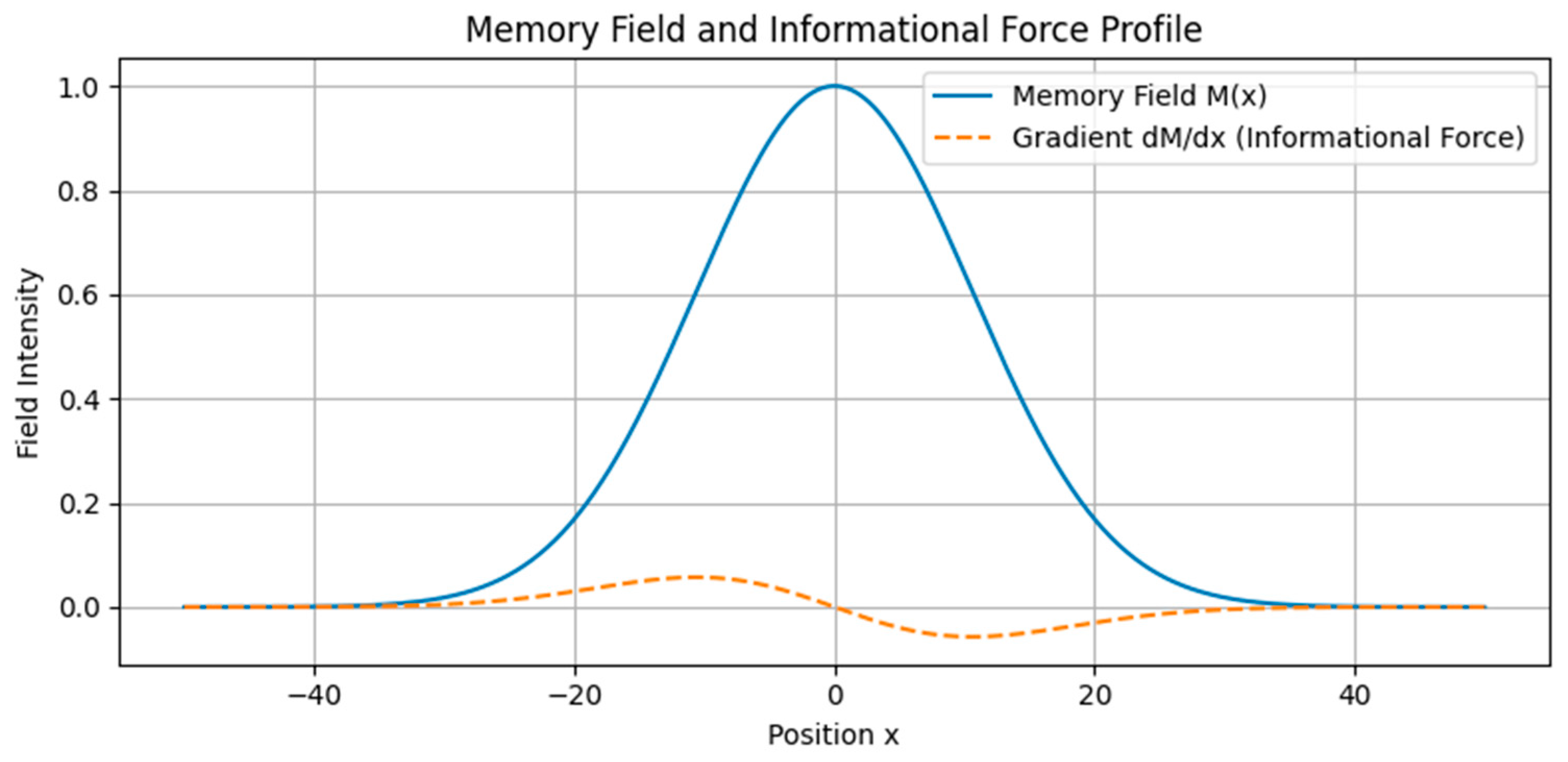
Beyond static structure, we also demonstrated that structured vacuum memory fields can actively modulate particle dynamics. By coupling Bohmian trajectories to a curvature-induced memory gradient, we showed that particles are not only passively influenced but can be dynamically guided toward regions of higher curvature accumulation. The observed monotonic increase in trajectory bending with memory strength λ supports the view that vacuum memory may serve as an informational landscape capable of directing quantum systems. This behavior evokes analogies with gravitational focusing or entropic forces, where geometry and information content jointly shape dynamical evolution.
A speculative, order-of-magnitude mapping between the dimensionless parameters of the toy model and possible physical scales is provided in
Appendix H. These estimates are intended solely as heuristic illustrations and should not be interpreted as experimentally predictive.
4.4. Quantum Coherence and Decoherence via Vacuum Memory
Our next simulation explored the dynamical effect of vacuum memory on quantum interference, using a double-slit configuration. Remarkably, we found that a weak, random vacuum memory field (with no phase sensitivity) preserves the interference fringes with only minor distortion, suggesting that generic fluctuations in memory do not inherently disrupt quantum coherence. However, when the memory field is endowed with phase sensitivity—i.e., it records and responds to the local quantum phase—the interference pattern collapses. Increasing the memory coupling strength λ leads to a progressive suppression of fringe contrast, with full collapse at large λ. This effect mimics decoherence: the vacuum memory acts as an informational environment that entangles with and disrupts phase relations in the wavefunction. Importantly, this occurs in a closed, deterministic model, without external observers or measurement, suggesting that informational backaction from vacuum memory could emulate quantum measurement collapse. This raises the intriguing possibility that wavefunction decoherence or localization may emerge intrinsically from structured, phase-aware vacuum memory rather than from external noise or measurement.
These findings resonate with the broader decoherence framework developed by Zurek [
15] and expanded in open quantum system treatments [
16], where system-environment entanglement leads to the suppression of interference. In contrast, our model suggests that the vacuum itself—if structured via internal memory—can act as a decohering agent, even in the absence of an external environment.
4.5. Emergent Nonlocal Correlation and Entanglement Analogs
Beyond guiding individual particles via memory gradients, vacuum memory may also give rise to nonlocal correlations between spatially separated regions. To explore this, we examine a simplified two-site memory model in which symmetric coupling between memory fields at sites A and B leads to spontaneous emergence of large-scale entanglement-like behavior—even in the absence of explicit particle trajectories.
Despite being independently driven by stochastic fluctuations, the coupled memory fields naturally evolve toward a highly correlated state. The observed increase in Pearson correlation over time, even under random noise, demonstrates that minimal nonlocal coupling is sufficient to synchronize distant regions of memory.
Because this synchronization arises from a global simulation update rule and a shared time parameter, it should not be interpreted as relativistic quantum entanglement, nor as permitting superluminal signaling or violating Lorentz covariance. Instead, the two-site model should be viewed as a classical synchronization mechanism mediated by explicit coupling terms, providing at most an analogy to how nonlocal correlations might arise in a more realistic informational field.
This behavior closely parallels key features of quantum entanglement, where subsystems retain statistical coherence without classical communication. In our model, the memory interaction serves a similar function: establishing long-range coherence through purely informational links.
These results suggest that large-scale memory coherence in the vacuum can emerge dynamically, without the need for fine-tuned initial conditions. They reinforce the broader theme that structure, information retention, and long-range order may be self-organizing consequences of simple dynamical principles operating within the vacuum.
4.6. Connections to Quantum Gravity and Informational Models
Our toy model also fits within a broader research landscape exploring the emergence of spacetime and structure from informational or entanglement-based mechanisms. In contrast to tensor network models of holography [
17] and holographic quantum error-correcting codes [
18], which emphasize static ground-state entanglement patterns, our vacuum memory framework highlights a time-evolving, dynamical process of memory accumulation and correlation formation. Similarly, while analog gravity experiments such as Bose–Einstein condensate horizons [
19] simulate effective curved geometries, our approach emphasizes informational fields rather than emergent metric tensors. These differences underscore that informational ordering in the vacuum may manifest through multiple complementary mechanisms—static entanglement structure, dynamical memory processes, or analog emergent metrics—each offering distinct insights into the nature of spacetime and quantum information.
4.7. Experimental Outlook and Theoretical Limitations
Unlike the earlier experiments based on Bohmian pilot-wave dynamics—where particle trajectories were explicitly guided by vacuum memory fields—the two-site memory-entangled model focuses purely on the intrinsic evolution of memory itself. No explicit quantum phase or particle motion is involved; instead, nonlocal correlation emerges from the internal coupling of memory dynamics within the vacuum.
Although our work is based on computational toy models, the concept of vacuum memory may eventually lend itself to indirect experimental probing. For example, structured vacuum memory fields could manifest as subtle deviations in particle trajectories, energy distributions, or quantum noise correlations. Potential experimental platforms include precision interferometry near massive bodies, low-energy scattering in curved-space environments, and analog gravity systems such as Bose–Einstein condensates or optical metamaterials. These could simulate memory gradients or curvature analogs under controlled conditions.
As a speculative analogy, structured memory fields might be mimicked using engineered condensed-matter systems. In particular, Bose–Einstein condensates with tailored spatial potentials could simulate informational gradients, allowing embedded impurities to behave similarly to Bohmian test particles. Their drift trajectories, modulated by memory-like fields, could provide indirect evidence of informational steering, serving as proof-of-principle tests for the dynamical effects predicted by vacuum memory models. This approach draws inspiration from analog gravity research, where condensed matter systems such as Bose–Einstein condensates simulate effective space-time curvature [
20]. Our proposal extends this idea by encoding memory effects into these analog substrates, potentially offering an avenue to explore informational feedback within emergent spacetime geometries.
Despite these intriguing prospects, our approach remains highly idealized. The models rely on discrete lattices, non-relativistic dynamics, and simplified assumptions. Future work must extend the framework to continuous quantum fields, incorporate relativistic corrections, and explore coupling to dynamically evolving spacetime geometries.
It is important to emphasize that the vacuum memory field proposed here is speculative and heuristic. It is not derived from any established formalism in quantum field theory, general relativity, or AdS/CFT correspondence. Rather, the model serves to illustrate how minimal ingredients—local fluctuations, non-local couplings, and curvature modulation—may give rise to structure, memory retention, and emergent dynamics, resonating with broader themes in quantum gravity research.
Recent developments in quantum gravity increasingly suggest that spacetime itself may emerge from entanglement patterns and underlying informational correlations [
21,
22]. Our model reflects this conceptual shift, treating the vacuum not as an inert backdrop, but as a potentially active, information-processing medium.
Taken together, these findings suggest that structured vacuum memory offers a compelling new perspective for exploring quantum information flow, emergent geometry, and the deep connections between space, time, and information.
4.8. Experimental Proposals for Testing Vacuum Memory Dynamics
Although the models presented in this work are theoretical, several aspects of their phenomenology may, in principle, be explored through indirect experimental analogs or precision quantum platforms. A set of speculative experimental proposals is outlined in
Appendix I, including phase-coherence tests in two-slit interferometry near engineered substrates, particle deflection in curvature analogs such as Bose–Einstein condensates, potential deviations in Casimir forces near structured substrates, and the emergence of nonlocal correlations in memory-entangled systems. These proposals are intended as qualitative illustrations of how the model’s behavior might inspire future experimental investigations, rather than as concrete or predictive experimental designs.
4.9. Limitations and Open Questions
While the proposed vacuum memory framework provides a computational platform for exploring informational dynamics in curved spacetime, several foundational limitations and unresolved questions remain. Addressing these is essential for extending the model toward a fully physical theory compatible with established frameworks in quantum field theory (QFT) and general relativity.
Relativistic Extensions
The current implementation is inherently non-relativistic, relying on a global time coordinate and synchronous memory updates. A relativistic generalization would require formulating the memory field M(x
μ) as a covariant scalar field on a Lorentzian manifold, with dynamics respecting local causality and light-cone structure. Similar efforts exist in relativistic extensions of Bohmian mechanics [
23] and in covariant formulations of stochastic fields in curved spacetime [
24], which may provide guidance. Embedding vacuum memory in such a framework would allow for consistency with general covariance and causal structure, potentially linking to semiclassical gravity and quantum field theory in curved backgrounds [
25].
Continuum Limit and Field-Theoretic Generalization
Our simulations employ a discrete lattice, motivated by causal set theory [
7], but a continuous analogue would enhance analytic tractability and theoretical integration. A natural extension involves modeling M(x,t) as a scalar field obeying a curvature-modulated diffusion or reaction-diffusion equation, e.g.:
where R(x) represents Ricci curvature and η encodes stochastic fluctuations. Formalizing this within an effective Lagrangian or Hamiltonian framework, possibly analogous to non-equilibrium field theories, would enable application of functional methods and perturbative analysis. Connections to hydrodynamic or emergent gravity models [
14] might offer further structure.
Integration with Quantum Field Theory
The memory field is introduced heuristically and remains external to the operator algebra and Lagrangian structure of conventional QFT. A critical open problem is whether memory dynamics can emerge from, or be consistently coupled to, existing quantum fields. One speculative avenue is treating M(x,t) as an effective, coarse-grained degree of freedom arising from entanglement entropy gradients or reduced density matrix dynamics [
17]. Alternatively, the memory field might be understood as part of an open-system extension of QFT, drawing on non-unitary evolution and decoherence theory [
15,
16]. Any such integration must address renormalization behavior, gauge invariance, and preservation (or controlled violation) of unitarity.
5. Conclusions
This study introduces and substantiates a speculative but operationally grounded toy-model concept in which a vacuum-like medium functions as an information-retaining substrate, dynamically influenced by space-time curvature, nonlocal couplings, and localized memory effects. Through a sequence of computational simulations, we demonstrated that random local fluctuations alone are insufficient to create structure, but when combined with curvature, non-local correlations, and phase-sensitive memory, the vacuum develops persistent, self-organizing informational patterns.
While the framework is inherently idealized and toy-model based, the mechanisms it probes—informational accumulation, entanglement-induced correlations, and curvature-modulated dynamics—echo deeper theoretical motifs emerging in quantum gravity. These include the holographic principle, the ER = EPR conjecture, and thermodynamic interpretations of spacetime. Together, our simulations offer a conceptual sandbox for exploring how vacuum structure could emerge from minimal assumptions about information flow.
Our entropy analysis confirmed that black-hole-like memory sinks in the model act as regions of enhanced informational diversity and retention. While this behavior is qualitatively reminiscent of theoretical black holes as high-entropy reservoirs, it arises here from an imposed no-decay boundary condition and does not constitute a derivation of Bekenstein–Hawking area-law scaling. Fourier analysis further validated the presence of coherent memory structures, with sharp spectral features absent from noise-dominated controls—highlighting the essential role of nonlocal coupling and curvature in organizing memory.
Crucially, by extending the vacuum memory field to store the full quantum phase of a wavefunction, we showed that particles governed by Bohmian dynamics converge with machine-level numerical agreement, confirming the internal consistency of the phase-memory Bohmian implementation. This result underscores that phase-retentive memory is sufficient to generate exact minimal-action motion, without external potentials.
Furthermore, we demonstrated that vacuum memory fields, when modulated by curvature gradients, can dynamically influence the paths of quantum particles. As the memory coupling strength λ increases, particles exhibit progressively stronger convergence toward regions of higher curvature—effectively simulating information-based lensing or focusing.
We also explored nonlocal informational synchronization using a minimal two-site memory model. Despite stochastic noise, weakly coupled memory registers consistently developed a strong correlation over time. This behavior supports the hypothesis that entanglement-like coherence in the vacuum may arise from simple coupling dynamics, without requiring classical communication or fine-tuning.
To test the impact of vacuum memory on quantum coherence, we simulated the canonical two-slit interference experiment under two types of vacuum memory perturbations. Random, unstructured memory fields preserved the interference pattern, confirming that quantum coherence is robust to incoherent vacuum fluctuations. In contrast, structured, phase-sensitive memory fields induced progressive fringe suppression—mimicking decoherence despite the absence of measurement or environmental noise. This suggests that informational feedback within the vacuum could act as an intrinsic mechanism for wavefunction collapse or decoherence.
Altogether, these findings support the broader view that, at least at the level of our phenomenological model, a vacuum-like medium may not be a featureless stage, but an informationally active environment—capable of storing, organizing, and transmitting structure through curvature, correlation, and phase dynamics.
Key features such as black-hole-like sinks and memory entanglement are phenomenological inputs implemented algorithmically, rather than emergent consequences of a fundamental Lagrangian or first-principles field theory.
Among the various components of the toy model, the phase-sensitive memory-induced suppression of two-slit interference stands out as the most physically robust and conventional result, closely paralleling standard decoherence mechanisms in open quantum systems.
Future directions include:
Searching for anisotropic low-frequency signatures in Fourier spectra analogous to those identified in the structured vacuum memory simulations,
Testing for systematic fringe-visibility suppression curves in interferometric setups consistent with phase-sensitive vacuum memory feedback,
Extending the model to higher-dimensional and continuous field-theoretic formulations to assess the robustness of these predicted signatures,
Exploring whether analogous informational feedback effects can be engineered in analog gravity platforms such as Bose–Einstein condensates.
Constructing a genuinely dynamical memory field that spontaneously converges toward S(x,t) without being imposed by hand remains an open direction for future work.
In sum, this work lays the conceptual groundwork for a memory-based view of the vacuum, potentially bridging quantum information, spacetime emergence, and non-equilibrium field theory.





 ,
,