
Article

New Fractional Hermite–Hadamard-Type Inequalities for Caputo Derivative and MET-(p, s)-Convex Functions with Applications

1
Department of Mathematics, Quaid-Azam University, Islamabad 45320, Pakistan
2
School of Mathematical Sciences, Zhejiang Normal University, Jinhua 321004, China
*
Author to whom correspondence should be addressed.
Fractal Fract. 2026, 10(1), 62; https://doi.org/10.3390/fractalfract10010062
Submission received: 10 December 2025 / Revised: 6 January 2026 / Accepted: 8 January 2026 / Published: 15 January 2026
(This article belongs to the Special Issue Advances in Fractional Integral Inequalities: Theory and Applications)

Abstract

This article investigates fractional Hermite–Hadamard integral inequalities through the framework of Caputo fractional derivatives and MET- ( p , s ) -convex functions. In particular, we introduce new modifications to two classical fractional extensions of Hermite–Hadamard-type inequalities, formulated for both MET- ( p , s ) -convex functions and logarithmic ( p , s ) -convex functions. Moreover, we obtain enhancements of inequalities like the Hermite–Hadamard, midpoint, and Fejér types for two extended convex functions by employing the Caputo fractional derivative. The research presents a numerical example with graphical representations to confirm the correctness of the obtained results.

1. Introduction

Convex functions play important roles in mathematical analysis, including optimization theory and numerical integration. Among the many varieties of convex functions, trigonometric convex functions have drawn a lot of interest because of their intrinsic qualities and uses in a variety of physical and mathematical issues. Refining and improving the conclusions in these disciplines has been made possible by the study of inequalities involving such functions, especially fractional integral inequalities. Fractional calculus, a generalization of classical calculus, involving derivatives and integrals of any order, has been extensively used in the analysis of convex functions. In fact, such a generalization aims to become a more general model for the problem and as such is a tool that is available for estimating and justifying the results of solving problems based on real disciplines in which the use of calculus is not possible. Therefore, it is very important to use the concept of the inequalities of fractional integrals and Hermite–Hadamard ones in particular. Inequalities of this kind play a key role in the estimation of integrals of convex functions, giving numerical estimations for different integral expressions, all of which are necessary for physics, engineering, and economic disciplines. The Hermite–Hadamard inequality is a basic result in convex analysis that provides bounds for the integral of a convex function over a certain interval. Specifically, if f is convex on [ x , y ] , the Hermite–Hadamard inequality states
f x + y 2 1 y x x y f ( t ) d t f ( x ) + f ( y ) 2 .
The extension to fractional integrals has only recently become an attractive subject for researchers. Substantial efforts have been made by numerous authors to formulate the fractional version of Hermite–Hadamard’s inequality and apply it in the context of convex functions of various types, including trigonometric ones. For instance, P. O. Mohammed et al. [1] designed a new type of discrete inequalities of the Hermite–Hadamard type for convex functions with integro-differential properties that cover trigonometric functions as special cases. However, the most significant development was the inclusion of fractional integrals in these inequalities, opening numerous new perspectives for applications in the field of fractional calculus. In a similar manner, F. X. Chen [2] approached the fractional generalization of the classical Hermite–Hadamard inequality for convex functions using fractional integrals. This approach allowed the creation of a broader field for the study of convex functions, which includes the trigonometric ones and academic methods for solving fractional calculus for integral inequalities. The importance of these new findings lies in the fact that modern applications of fractional derivatives or integrals require more precise limitation of criteria based on the behavior of various systems represented by convex functions. For the most recent discoveries related to the Hermite–Hadamard-type inequality, the interested reader is directed towards [3,4,5]. The application of fractional calculus to derive inequalities in relation to the behavior of convex functions includes broader fields of investigations beyond conventional Riemann–Liouville fractional integrals. T. Abdeljawad et al. [6] and G. Rahman et al. [7] have investigated the application of the Caputo fractional derivative in inequalities, providing new bounds and findings relevant to the theory behind the convex and trigonometric functions. These types of fractional derivatives provide users with more opportunities to work with real-life systems with a memory effect, such as energy consumption or material science. Furthermore, fractional calculus assisted in the development of inequalities that feature Fejer–Hadamard inequalities, which are typically associated with the Hermite–Hadamard inequalities (e.g., see [8]). G. Farid et al. [9] used these inequalities in the framework of fractional derivatives, resulting in new findings concerning convex functions. The researchers managed to include fractional integrals in the study, which helps in broadening the field of application of such inequalities and their validity over various issues associated with the study of trigonometric functions. Current researches in fractional integral inequalities allow users to formulate new strategies and approaches to study complex cases in fields involving mathematical modeling, optimization, and numerical integration. Moreover, these advanced methodologies have enormous influence on the development and enhancement of numerical quadrature of the exemplary apparatus of convex functions and other approximate techniques such as trigonometric ones. For example, M. Samraiz et al. [10] and R. S. Ali et al. [11] used fractional-type inequalities to develop various new quadrature as a new worthy estimate of the integral with convex functions.
The fractional Hermite–Hadamard-type inequality is a new area of research that has recently been attracting much attention because it describes non-local dynamics and memory-dependent processes in mathematical models. Classical convexity concepts have been developed to various generalized settings such as logarithmic and exponential convexity, but in practice, more flexible function classes are needed as well to model examples with hybrid growth and oscillatory behavior. The natural generalization which can account for both exponential and oscillatory phenomena for a wide range of its applications in engineering, physics, reliability theory and mathematical programming is the modified exponential trigonometric ( p , s ) -convexity. Though Caputo fractional derivatives have attracted more and more attention, to the best of our knowledge, there are no complete Hermite–Hadamard-type inequalities for MET- ( p , s ) -convex and log- ( p , s ) -convex functions in a higher-dimensional case under Caputo operators. This inspires us to consider new fractional integral inequalities which gather advanced classes of convexity with non-local fractional operators. The author overcomes this deficit by introducing new (Hermite–Hadamard-type) inequalities with the use of Caputo derivative for MET- ( p , s ) -convex and log- ( p , s ) -convex functions as well as providing motivation for their applications to engineering problems.

2. Preliminaries

This section contains the materials and basic definitions on which this paper is based. The standard definition of a convex function is stated as follows [12]:
Definition  1.
A function f : I R R is said to be convex if it fulfills the inequality
f ( t a 1 + ( 1 t ) b 1 ) t f ( a 1 ) + ( 1 t ) f ( b 1 ) ,
where a 1 , b 1 I and t [ 0 , 1 ] .
Among the most significant generalizations there is s-convexity, introduced in [13] as follows:
Definition 2
(s-convex function). For some fixed s ( 0 , 1 ] , a function f : [ 0 , ) R is said to be s-convex in the second sense if
f ( t a 1 + ( 1 t ) b 1 ) t s f ( a 1 ) + ( 1 t ) s f ( b 1 ) ,
holds for all a 1 , b 1 [ 0 , ) and t [ 0 , 1 ] .
Definition 3
(p-convex set [14]). If J ( 0 , ) is a real interval and p R { 0 } , then it is said to be a p-convex set if
t a 1 p + ( 1 t ) b 1 p 1 p J f o r a l l a 1 , b 1 J a n d t [ 0 , 1 ] .
Definition 4
(p-convex function [14]). Let J ( 0 , ) be a real interval and p R { 0 } . A function f : J R is said to be a p-convex function if
f t a 1 p + ( 1 t ) b 1 p 1 p t f ( a 1 ) + ( 1 t ) f ( b 1 ) ,
for all a 1 , b 1 J and t [ 0 , 1 ] . If the inequality in (4) is reversed, then f is said to be p-concave.
Definition 5
(trigonometrically convex function [15]). A non-negative function f : I R R is called a trigonometrically convex function on the interval I, if for each a 1 , b 1 I and t [ 0 , 1 ] ,
f ( t a 1 + ( 1 t ) b 1 ) sin ( 2 π t ) f ( a 1 ) + cos ( 2 π t ) f ( b 1 ) .
Definition 6
(exponential trigonometric convex function [16]). A function f : I R R is defined as an exponential trigonometric convex function if
f ( t a 1 + ( 1 t ) b 1 ) sin π t 2 e 1 t f ( a 1 ) + cos π t 2 e t f ( b 1 ) ,
for every t [ 0 , 1 ] and a 1 , b 1 I .
Definition 7
(modified exponential trigonometric convex function [17]). Let f : I R R 0 + . The function f is called a modified exponential trigonometric convex function if for every a 1 , b 1 I and t [ 0 , 1 ] , the following inequality holds:
f t a 1 + ( 1 t ) b 1 sin π t 2 e ( 1 t ) f ( a 1 ) + cos π t 2 e t f ( b 1 ) .
Definition 8
([18]). Let p 0 and 0 < s 1 . A function f : ( 0 , ) R is said to be ( p , s ) -convex in the second sense if, for all a 1 , b 1 ( 0 . ) and t [ 0 , 1 ] , the inequality
f ( t a 1 p + ( 1 t ) b 1 p ) 1 p t s f ( a 1 ) + ( 1 t ) s f ( b 1 ) ,
holds.
Example 1.
Let f : ( 0 , ) [ 0 , ) be defined by
f ( x ) = x p , p > 0 ,
and let 0 < s 1 . Then, f is ( p , s ) -convex in the second sense.
Definition 9
([19,20,21]). Let f L [ a , b ] . Then, the left-sided and right-sided Riemann–Liouville fractional integrals of order α > 0 with a 0 and a < x < b are defined as follows, respectively:
I a + α f ( x ) = 1 Γ ( α ) a x ( x t ) α 1 f ( t ) d t , x > a ,
I b α f ( x ) = 1 Γ ( α ) x b ( t x ) α 1 f ( t ) d t , x < b ,
where Γ ( · ) is the Gamma function.
These operators extend the classical integral to arbitrary real orders and are fundamental in fractional calculus.

Properties of Riemann–Liouville Fractional Integral

1.
Linearity: [19,22] For x , y R , the Riemann–Liouville fractional integral satisfies
I a + α ( x f + y g ) = x I a + α f + y I a + α g ,
and similarly for I b α .
2.
Reduction to the classical integral: [20,22] For α = 1 , the Riemann–Liouville fractional integral reduces to the standard first-order integral:
I a + 1 f ( x ) = a x f ( t ) d t , I b 1 f ( x ) = x b f ( t ) d t .
3.
Identity property: [19,23] In the limiting sense,
lim α 0 + I a + α f ( x ) = f ( x ) , lim α 0 + I b α f ( x ) = f ( x ) ,
for almost every x ( a , b ) .
4.
Semigroup property: [19,20] For α , β > 0 , the following composition rule holds:
I a + α I a + β f = I a + α + β f , I b α I b β f = I b α + β f .
5.
Action on power functions: [19,22] For μ > 1 , one has
I a + α ( x a ) μ = Γ ( μ + 1 ) Γ ( μ + α + 1 ) ( x a ) μ + α ,
with an analogous expression for the right-sided operator.
6.
Differentiation rule: [20,23] If the derivative exists, then
d d x I a + α f ( x ) = I a + α 1 f ( x ) , α > 0 ,
and
d d x I b α f ( x ) = I b α 1 f ( x ) .
7.
Fractional integration by parts: [19,22] For suitable functions f and g, the following identity holds:
a b I a + α f ( x ) g ( x ) d x = a b f ( x ) I b α g ( x ) d x .
Definition 10
([19,21,24]).  For μ > 0 , μ N , with m = μ + 1 , m N , f C [ a 1 , b 1 ] and a 1 < x < b 1 , the Caputo fractional derivatives of order μ for the left and right sides are defined as follows:
D a 1 + μ C f ( x ) = 1 Γ ( m μ ) a 1 x ( x t ) m μ 1 f ( m ) ( t ) d t ,
where x > a 1 , and
D b 1 μ C f ( x ) = 1 Γ ( m μ ) x b 1 ( t x ) m μ 1 f ( m ) ( t ) d t ,
where x < b 1 , respectively.

3. Main Results

Firstly, we will introduce a new class of convex functions which is a new version of the modified exponential trigonometric convex function known as the modified exponential trigonometric (p,s)-convex function (i.e., MET- ( p , s ) -convex function).
Definition 11
(MET- ( p , s ) -convex function). A function f : I R R is called an MET-(p,s)-convex function if for every p R { 0 } and s ( 0 , 1 ] , then
f t a 1 p + ( 1 t ) b 1 p 1 p sin π t 2 e ( 1 t ) s f ( a 1 ) + cos π t 2 e t s f ( b 1 ) ,
where t [ 0 , 1 ] and a 1 , b 1 I .

Graphical Validation of the MET- ( p , s ) -Convex Function

Example 2.
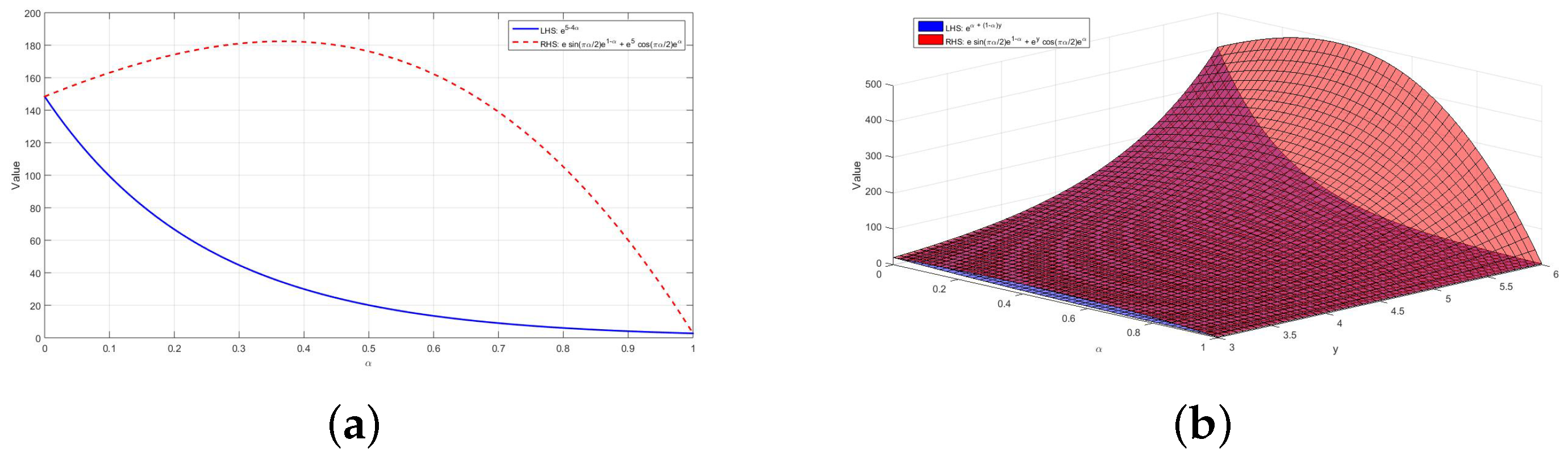
Numerical analysis of the MET-(p,s)-convex function inequality for f ( x ) = e x with parameters a 1 = 1 , b 1 [ 4 , 6 ] , p = 1 , and s = 1 demonstrates that the inequality holds across all t [ 0 , 1 ] , with equality at the boundaries t = 0 and t = 1 , as evidenced by the close alignment of the left-hand side (LHS) and right-hand side (RHS) in Figure 1.
Two-Dimensional Visualization Insights: The 2D plot (Figure 1a) illustrates the behavior of the LHS, e 5 4 t , and RHS, e sin ( π t / 2 ) e 1 t + e 5 cos ( π t / 2 ) e t , revealing that the RHS consistently dominates the LHS for t [ 0 , 1 ] , with the largest discrepancy occurring around t = 0.5 , confirming the robustness of the inequality for large b 1 .
Three-Dimensional Surface Analysis: A 3D surface plot (Figure 1b) over t [ 0 , 1 ] , a 1 = 1 and b 1 [ 4 , 6 ] highlights the exponential growth of both the LHS, e t + ( 1 t ) b 1 , and RHS, driven by the e b 1 cos ( π t / 2 ) e t term, with the RHS surface surpassing the LHS for b 1 [ 4 , 6 ] .
Example 3.
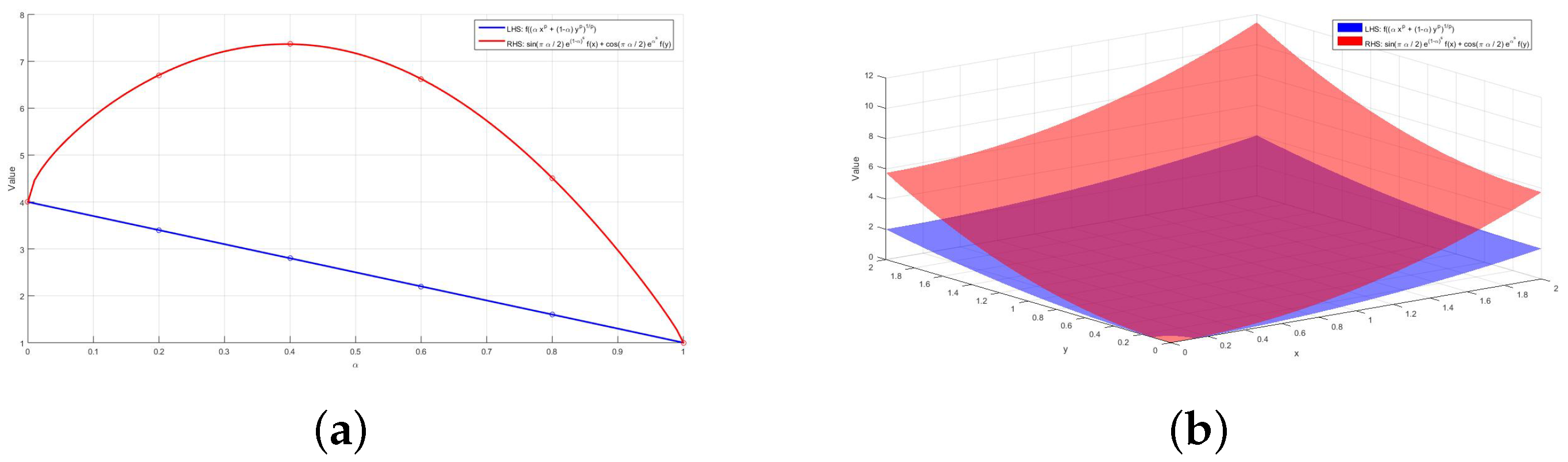
Let f be a mapping defined on real numbers by f ( x ) = x 2 ; then, f is an MET- ( p , s ) -convex function (see Figure 2).
In this section, we present advancements in fractional integral inequalities involving MET- ( p , s ) -convex functions and Caputo fractional derivatives.
Theorem 1.
Suppose that f : [ a 1 , b 1 ] R R is a function such that f ( m ) C [ a 1 , b 1 ] , m = [ μ ] + 1 , m N and 0 < a 1 < b 1 . If f ( m ) is a MET- ( p , s ) -convex function, then with respect to the Caputo fractional derivative, the following holds for every p R { 0 } and s ( 0 , 1 ] :
f ( m ) a 1 p + b 1 p 2 1 p p e 1 2 s Γ ( m μ + 1 ) 2 ( b 1 p a 1 p ) m μ [ D b 1 μ ; u p C f ( m ) ( a 1 p ) + ( 1 ) m D a 1 + μ ; u p C f ( m ) ( b 1 p ) ] 2 e 2 1 s × f ( m ) ( a 1 ) + f ( m ) ( b 1 ) 2 ,
where μ 0 .
Proof. 
As f ( m ) is a MET- ( p , s ) -convex function, then for x 1 , y 1 [ a 1 , b 1 ] , we obtain
f ( m ) x 1 p + y 1 p 2 1 p e 1 2 s 2 ( f ( m ) ( x 1 ) + f ( m ) ( y 1 ) ) ,
Put x 1 p = α a 1 p + ( 1 α ) b 1 p and y 1 p = ( 1 α ) a 1 p + α b 1 p α [ 0 , 1 ] ; then, Equation (15) becomes
f ( m ) a 1 p + b 1 p 2 1 p e 1 2 s 2 f ( m ) α a 1 p + ( 1 α ) b 1 p 1 p + f ( m ) ( 1 α ) a 1 p + α b 1 p 1 p .
Multiplying both sides by α m μ 1 and integrating α over [ 0 , 1 ] yields
f ( m ) a 1 p + b 1 p 2 1 p 0 1 α m μ 1 d α e 1 2 s 2 [ 0 1 ( f ( m ) ( α a 1 p + ( 1 α ) b 1 p ) 1 p α m μ 1 d α + 0 1 f ( m ) ( ( 1 α ) a 1 p + α b 1 p ) 1 p ) α m μ 1 d α ] .
After making some suitable substitutions, we obtained the following result:
1 m μ f ( m ) a 1 p + b 1 p 2 1 p p e 1 2 s 2 ( b 1 p a 1 p ) m μ [ a 1 b 1 f ( m ) ( u ) ( b 1 p u p ) m μ 1 u p 1 d u + ( 1 ) m a 1 b 1 f ( m ) ( v ) ( v p a 1 p ) m μ 1 v p 1 d v ] .
This implies that
f ( m ) a 1 p + b 1 p 2 1 p p e 1 2 s Γ ( m μ + 1 ) 2 ( b 1 p a 1 p ) m μ [ D b 1 μ ; u p C f ( m ) ( a 1 p ) + ( 1 ) m D a 1 + μ ; u p C f ( m ) ( b 1 p ) ] .
Now, for the second part of the inequality,
f ( m ) ( α a 1 p + ( 1 α ) b 1 p ) 1 p sin π α 2 e ( 1 α ) s f ( m ) ( a 1 ) + cos π α 2 e α s f ( m ) ( b 1 ) ,
and
f ( m ) ( α b 1 p + ( 1 α ) a 1 p ) 1 p sin π α 2 e ( 1 α ) s f ( m ) ( b 1 ) + cos π α 2 e α s f ( m ) ( a 1 ) ,
by adding (18) and (19), we get
f ( m ) ( α a 1 p + ( 1 α ) b 1 p ) 1 p + f ( m ) ( α b 1 p + ( 1 α ) a 1 p ) 1 p sin π α 2 e ( 1 α ) s + cos π α 2 e α s × f ( m ) ( a 1 ) + f ( m ) ( b 1 ) .
Since α [ 0 , 1 ] and s ( 0 , 1 ] , then sin π α 2 e ( 1 α ) s + cos π α 2 e α s 2 e ( 1 2 ) s , and Equation (20) becomes
f ( m ) ( α a 1 p + ( 1 α ) b 1 p ) 1 p + f ( m ) ( α b 1 p + ( 1 α ) a 1 p ) 1 p 2 e ( 1 2 ) s f ( m ) ( a 1 ) + f ( m ) ( b 1 ) .
Multiplying both sides by α m μ 1 and integrating α over [ 0 , 1 ] yields
0 1 α m μ 1 f ( m ) ( α a 1 p + ( 1 α ) b 1 p ) 1 p d α + 0 1 α m μ 1 f ( m ) ( α b 1 p + ( 1 α ) a 1 p ) 1 p d α 2 e ( 1 2 ) s 0 1 α m μ 1 d α f ( m ) ( a 1 ) + f ( m ) ( b 1 ) .
By using the same procedure as used in the above inequality, we get
p e 1 2 s Γ ( m μ + 1 ) 2 ( b 1 p a 1 p ) m μ [ D b 1 μ ; u p C f ( m ) ( a 1 p ) + ( 1 ) m D a 1 + μ ; u p C f ( m ) ( b 1 p ) ] 2 e 2 1 s f ( m ) ( a 1 ) + f ( m ) ( b 1 ) 2 .
Combining (17) and (21), we get the required inequality. □
Corollary  1.
Under the assumptions of Theorem 1, if we take p = 1 and s = 1 , then we obtain the fractional integral inequality for the modified exponential trigonometric convex function:
f ( m ) a 1 + b 1 2 e 2 Γ ( m μ + 1 ) ( b 1 a 1 ) m μ [ D b 1 μ ; u p C f ( m ) ( a 1 ) + ( 1 ) m D a 1 + μ ; u p C f ( m ) ( b 1 ) ] 2 e f ( m ) ( a 1 ) + f ( m ) ( b 1 ) 2 .
Theorem 2.
Suppose that f : [ a 1 , b 1 ] R R is a function such that f ( m ) C [ a 1 , b 1 ] , m = [ μ ] + 1 , m N and 0 < a 1 < b 1 . If f ( m ) is a MET- ( p , s ) -convex function, then with respect to the Caputo fractional derivative, the following holds for every p R { 0 } and s ( 0 , 1 ] :
f ( m ) a 1 p + b 1 p 2 1 p 2 m μ p e 1 2 s Γ ( m μ + 1 ) 2 ( b 1 p a 1 p ) m μ [ D a 1 p + b 1 p 2 1 p + f ( m ) ( b 1 p ) μ ; u p C + ( 1 ) m D a 1 p + b 1 p 2 1 p f ( m ) ( a 1 p ) μ ; u p C ] 2 e 2 1 s f ( m ) ( a 1 ) + f ( m ) ( b 1 ) 2 ,
where μ 0 .
Proof. 
Since f m is a MET- ( p , s ) -convex function, then for x 1 , y 1 [ a 1 , b 1 ] , we have
f ( m ) x 1 p + y 1 p 2 1 p e 1 2 s 2 ( f ( m ) ( x 1 ) + f ( m ) ( y 1 ) ) ,
Put x 1 p = α 2 a 1 p + 2 α 2 b 1 p and y 1 p = 2 α 2 a 1 p + α 2 b 1 p α [ 0 , 1 ] , Equation (24) becomes
f ( m ) a 1 p + b 1 p 2 1 p e 1 2 s 2 f ( m ) α 2 a 1 p + 2 α 2 b 1 p 1 p + f ( m ) 2 α 2 a 1 p + α 2 b 1 p 1 p .
Multiplying both sides by α m μ 1 and integrating α over [ 0 , 1 ] yields
f ( m ) a 1 p + b 1 p 2 1 p 0 1 α m μ 1 d α e 1 2 s 2 [ 0 1 ( f ( m ) α 2 a 1 p + 2 α 2 b 1 p 1 p α m μ 1 d α + 0 1 f ( m ) 2 α 2 a 1 p + α 2 b 1 p 1 p α m μ 1 d α ] .
After making some suitable substitutions, we obtained the following result:
1 m μ f ( m ) a 1 p + b 1 p 2 1 p 2 m μ p e 1 2 s 2 ( b 1 p a 1 p ) m μ [ a 1 p + b 1 p 2 1 p b 1 f ( m ) ( u ) ( b 1 p u p ) m μ 1 u p 1 d u + ( 1 ) m a 1 a 1 p + b 1 p 2 1 p f ( m ) ( v ) ( v p a 1 p ) m μ 1 v p 1 d v ] .
This implies that
f ( m ) a 1 p + b 1 p 2 1 p 2 m μ p e 1 2 s Γ ( m μ + 1 ) 2 ( b 1 p a 1 p ) m μ [ D a 1 p + b 1 p 2 1 p + f ( m ) ( b 1 p ) μ ; u p C + ( 1 ) m D a 1 p + b 1 p 2 1 p f ( m ) ( a 1 p ) μ ; u p C ] .
Now, for the second part of the inequality,
f ( m ) α 2 a 1 p + 2 α 2 b 1 p 1 p sin π α 4 e 2 α 2 s f ( m ) ( a 1 ) + cos π α 4 e α 2 s f ( m ) ( b 1 ) ,
and
f ( m ) α 2 b 1 p + 2 α 2 a 1 p 1 p sin π α 4 e 2 α 2 s f ( m ) ( b 1 ) + cos π α 4 e α 2 s f ( m ) ( a 1 ) ,
by adding (27) and (28), we get
f ( m ) α 2 a 1 p + 2 α 2 b 1 p 1 p + f ( m ) α 2 b 1 p + 2 α 2 a 1 p 1 p sin π α 4 e 2 α 2 s + cos π α 4 e α 2 s × f ( m ) ( a 1 ) + f ( m ) ( b 1 ) .
Since α [ 0 , 1 ] and s ( 0 , 1 ] , then sin π α 4 e 2 α 2 s + cos π α 4 e α 2 s 2 e ( 1 2 ) s Equation (29) becomes
f ( m ) α 2 a 1 p + 2 α 2 b 1 p 1 p + f ( m ) α 2 b 1 p + 2 α 2 a 1 p 1 p 2 e ( 1 2 ) s f ( m ) ( a 1 ) + f ( m ) ( b 1 ) .
Multiplying both sides by α m μ 1 and integrating α over [ 0 , 1 ] ,
0 1 α m μ 1 f ( m ) α 2 a 1 p + 2 α 2 b 1 p 1 p d α + 0 1 α m μ 1 f ( m ) α 2 b 1 p + 2 α 2 a 1 p 1 p d α 2 e ( 1 2 ) s × f ( m ) ( a 1 ) + f ( m ) ( b 1 ) 0 1 α m μ 1 d α .
By using the same procedure as used in the above inequality, we get
2 m μ p e 1 2 s Γ ( m μ + 1 ) 2 ( b 1 p a 1 p ) m μ D a 1 p + b 1 p 2 1 p + f ( m ) ( b 1 p ) μ ; u p C + ( 1 ) m D a 1 p + b 1 p 2 1 p f ( m ) ( a 1 p ) μ ; u p C 2 e 2 1 s f ( m ) ( a 1 ) + f ( m ) ( b 1 ) 2 .
Combining (26) and (30), we get the required inequality. □
Corollary 2.
Under the assumptions of Theorem 2, if we take p = 1 and s = 1 , then we obtain the Caputo fractional integral inequality for modified exponential trigonometric convex function:
f ( m ) a 1 + b 1 2 e 2 2 m μ Γ ( m μ + 1 ) ( b 1 a 1 ) m μ [ D a 1 + b 1 2 1 p + f ( m ) ( b 1 ) μ C + ( 1 ) m D a 1 + b 1 2 1 p f ( m ) ( a 1 ) μ C ] 2 e f ( m ) ( a 1 ) + f ( m ) ( b 1 ) 2 .
Definition 12.
We assume that
h ( m ) = sup x [ a 1 , b 1 ] | h ( m ) ( x ) | ,
where h : [ a 1 , b 1 ] R is such that h C [ a 1 , b 1 ] .
We also introduce the following convolution f h of the functions f and h, in the context of Caputo fractional derivatives:
D a 1 + μ ; t p C ( f h ) ( x p ) = 1 Γ ( m μ ) a 1 x ( x p t p ) m μ 1 f ( m ) ( t p ) h ( m ) ( t ) t p 1 d t ,
where x > a 1 , and
D b 1 μ ; t p C ( f h ) ( x p ) = ( 1 ) m Γ ( m μ ) x b 1 ( t p x p ) m μ 1 f ( m ) ( t p ) h ( m ) ( t ) t p 1 d t ,
where x < b 1 , respectively.
Lemma 1
([9]). For 0 < μ 1 , we have
| a 1 μ b 1 μ |   ( b 1 a 1 ) μ .
Lemma 2
([25]). Let f : [ a 1 , b 1 ] R , a 1 < b 1 be such that f C [ a 1 , b 1 ] . If f ( m ) is symmetric to a 1 + b 1 2 ; then, the inequality for fractional Caputo derivatives holds:
D a 1 + μ C f ( b 1 ) = ( 1 ) m D b 1 μ C f ( a 1 ) = 1 2 D a 1 + μ C f ( b 1 ) + ( 1 ) m D b 1 μ C f ( a 1 ) .
Theorem 3.
Let f : [ a 1 , b 1 ] R such that f ( m ) C [ a 1 , b 1 ] . Also let f ( m ) be a +ve and MET- ( p , s ) -convex function on [ a 1 , b 1 ] , m = [ μ ] + 1 and m N . If h : [ a 1 , b 1 ] R is a function such that h C [ a 1 , b 1 ] and h m is non-negative integrable and symmetric to ( a 1 p + b 1 p 2 ) 1 p , then with respect to the Caputo fractional derivative, the following holds for every p R { 0 } and s ( 0 , 1 ] :
f ( m ) a 1 p + b 1 p 2 1 p D a 1 + μ ; u p C h m ( b 1 p ) + ( 1 ) m D b 1 μ ; u p C h m ( a 1 p ) e 1 2 s 2 × [ D a 1 + μ ; u p C ( f ( m ) h m ) ( b 1 p ) + ( 1 ) m D b 1 μ ; u p C ( f ( m ) h m ) ( a 1 p ) 2 e 2 1 s f ( m ) ( a 1 ) + f ( m ) ( b 1 ) 2 D a 1 + μ ; u p C h m ( b 1 p ) + ( 1 ) m D b 1 μ ; u p C h m ( a 1 p ) ,
where μ 0 .
Proof. 
Since f m is a MET-(p,s)-convex function, then for x 1 , y 1 [ a 1 , b 1 ] , we have
f ( m ) x 1 p + y 1 p 2 1 p e 1 2 s 2 ( f ( m ) ( x 1 ) + f ( m ) ( y 1 ) ) .
Put x 1 p = α a 1 p + ( 1 α ) b 1 p and y 1 p = ( 1 α ) a 1 p + α b 1 p α [ 0 , 1 ] .
Equation (33) becomes
f ( m ) a 1 p + b 1 p 2 1 p e 1 2 s 2 f ( m ) α a 1 p + ( 1 α ) b 1 p 1 p + f ( m ) ( 1 α ) a 1 p + α b 1 p 1 p .
Multiplying both sides by α m μ 1 h m ( α b 1 p + ( 1 α ) a 1 p ) and integrating α over [ 0 , 1 ] ,
f ( m ) a 1 p + b 1 p 2 1 p 0 1 α m μ 1 h m ( α b 1 p + ( 1 α ) a 1 p ) 1 p d α e 1 2 s 2 × [ 0 1 α m μ 1 h m ( α b 1 p + ( 1 α ) a 1 p ) 1 p f ( m ) α a 1 p + ( 1 α ) b 1 p 1 p d α + 0 1 α m μ 1 h m ( α b 1 p + ( 1 α ) a 1 p ) 1 p f ( m ) ( 1 α ) a 1 p + α b 1 p 1 p d α ] .
After making some suitable substitutions, we obtained the following result:
p ( b 1 p a 1 p ) m μ f ( m ) a 1 p + b 1 p 2 1 p 0 1 ( u p a ! p ) m μ 1 h m ( u ) u p 1 d u p e 1 2 s 2 ( b 1 p a 1 p ) m μ × [ a 1 b 1 f ( m ) ( a 1 p + b 1 p u p ) 1 p ) ( u p a 1 p ) m μ 1 h m ( u ) u p 1 d u + a 1 b 1 f ( m ) ( u ) ( b 1 p u p ) m μ 1 h m ( u ) u p 1 d u ] .
This implies that
f ( m ) a 1 p + b 1 p 2 1 p [ D a 1 + μ ; u p C h m ( b 1 p ) + ( 1 ) m D b 1 μ ; u p C h m ( a 1 p ) ] e 1 2 s 2 [ D a 1 + μ ; u p C ( f ( m ) h m ) ( b 1 p ) + ( 1 ) m D b 1 μ ; u p C ( f ( m ) h m ) ( a 1 p ) ] .
Now, for the second part of the inequality,
f ( m ) ( α a 1 p + ( 1 α ) b 1 p ) 1 p sin π α 2 e ( 1 α ) s f ( m ) ( a 1 ) + cos π α 2 e α s f ( m ) ( b 1 ) ,
and
f ( m ) ( α b 1 p + ( 1 α ) a 1 p ) 1 p sin π α 2 e ( 1 α ) s f ( m ) ( b 1 ) + cos π α 2 e α s f ( m ) ( a 1 ) ,
by adding (35) and (36), we get
f ( m ) ( α a 1 p + ( 1 α ) b 1 p ) 1 p + f ( m ) ( α b 1 p + ( 1 α ) a 1 p ) 1 p sin π α 2 e ( 1 α ) s + cos π α 2 e α s × f ( m ) ( a 1 ) + f ( m ) ( b 1 ) .
Since α [ 0 , 1 ] and s ( 0 , 1 ] , then sin π α 2 e ( 1 α ) s + cos π α 2 e α s 2 e ( 1 2 ) s (37) becomes
f ( m ) ( α a 1 p + ( 1 α ) b 1 p ) 1 p + f ( m ) ( α b 1 p + ( 1 α ) a 1 p ) 1 p 2 e ( 1 2 ) s f ( m ) ( a 1 ) + f ( m ) ( b 1 ) .
Multiplying both sides by α m μ 1 h m ( α b 1 p + ( 1 α ) a 1 p ) 1 p and integrating α over [ 0 , 1 ] ,
0 1 α m μ 1 h m ( α b 1 p + ( 1 α ) a 1 p ) 1 p f ( m ) ( α a 1 p + ( 1 α ) b 1 p ) 1 p d α + 0 1 α m μ 1 h m ( α b 1 p + ( 1 α ) a 1 p ) 1 p × f ( m ) ( α b 1 p + ( 1 α ) a 1 p ) 1 p d α 2 e ( 1 2 ) s f ( m ) ( a 1 ) + f ( m ) ( b 1 ) × 0 1 h m ( α b 1 p + ( 1 α ) a 1 p ) 1 p α m μ 1 d α .
By using the same procedure as used in the above inequality, we get
e 1 2 s 2 [ D a 1 + μ ; u p C ( f ( m ) h m ) ( b 1 p ) + ( 1 ) m D b 1 μ ; u p C ( f ( m ) h m ) ( a 1 p ) 2 e 2 1 s × f ( m ) ( a 1 ) + f ( m ) ( b 1 ) 2 [ D a 1 + μ ; u p C h m ( b 1 p ) + ( 1 ) m D b 1 μ ; u p C h m ( a 1 p ) ] .
Combining (34) and (38), we get the required inequality. □
Corollary 3.
Under the assumptions of Theorem 3, if we take p = 1 and s = 1 , then we get the weighted Caputo fractional integral inequality for the modified exponential trigonometric convex function:
f ( m ) a 1 + b 1 2 [ D a 1 + μ C h m ( b 1 ) + ( 1 ) m D b 1 μ C h m ( a 1 ) ] e 2 [ D a 1 + μ C f ( m ) h m ( b 1 ) + ( 1 ) m D b 1 μ C f ( m ) h m ( a 1 ) ] 2 e f ( m ) ( a 1 ) + f ( m ) ( b 1 ) 2 × D a 1 + μ C h m ( b 1 ) + ( 1 ) m D b 1 μ C h m ( a 1 ) .
Definition 13
(Log (p,s) convex function). A function f : I R ( 0 , ) is said to be log-convex if l o g f is convex, or, equivalently, has the inequality for every p R { 0 } and s ( 0 , 1 ] :
f ( α a 1 p + ( 1 α ) b 1 p ) 1 p f ( a 1 ) α s f ( b 1 ) ( 1 α ) s ,
where ∀ a 1 , b 1 I and α [ 0 , 1 ] .
Theorem 4.
Suppose that f : [ a 1 , b 1 ] R ( 0 , ) is a positive function such that f ( m ) C [ a 1 , b 1 ] , m = [ μ ] + 1 , m N , and 0 < a 1 < b 1 . If f ( m ) is a l o g ( p , s ) -convex function, then for the fractional Caputo derivative we have, for every p R { 0 } and s ( 0 , 1 ] ,
f ( m ) a 1 p + b 1 p 2 1 p p ( m μ ) 1 2 s Γ ( m μ ) ( b 1 p a 1 p ) m μ 2 s [ D b 1 μ ; u p C f ( m ) ( a 1 p ) × ( 1 ) m D a 1 + μ ; u p C f ( m ) ( b 1 p ) ] f ( m ) ( a 1 ) s f ( m ) ( b 1 ) s ,
where μ 0 .
Proof. 
Since f ( m ) is a l o g ( p , s ) -convex function, then for x 1 , y 1 [ a 1 , b 1 ] , we have
f ( m ) x 1 p + y 1 p 2 1 p f ( m ) ( x 1 ) s f ( m ) ( y 1 ) s .
Put x 1 p = α a 1 p + ( 1 α ) b 1 p and y 1 p = ( 1 α ) a 1 p + α b 1 p α [ 0 , 1 ] and p ( 0 , 1 ] .
Then, Equation (42) becomes
f ( m ) a 1 p + b 1 p 2 1 p f ( m ) α a 1 p + ( 1 α ) b 1 p 1 p s × f ( m ) ( 1 α ) a 1 p + α b 1 p 1 p s .
Multiplying both sides by α m μ 1 and integrating α over [ 0 , 1 ] ,
f ( m ) a 1 p + b 1 p 2 1 p 0 1 α m μ 1 d α 0 1 α m μ 1 [ f ( m ) α a 1 p + ( 1 α ) b 1 p 1 p s × f ( m ) ( 1 α ) a 1 p + α b 1 p 1 p s ] d α .
By using the Rogers–Holder Inequality, we get
1 m μ f ( m ) a 1 p + b 1 p 2 1 p 0 1 α m μ 1 f ( m ) α a 1 p + ( 1 α ) b 1 p 1 p s d α × 0 1 α m μ 1 f ( m ) ( 1 α ) a 1 p + α b 1 p 1 p s d α .
After making some suitable substitutions, we obtained the following result:
1 m μ f ( m ) a 1 p + b 1 p 2 1 p p ( b 1 p a 1 p ) m μ a 1 b 1 f ( m ) ( u ) ( b 1 p u p ) m μ 1 u p 1 d u s × p ( 1 ) m ( b 1 p a 1 p ) m μ a 1 b 1 f ( m ) ( v ) ( v p a 1 p ) m μ 1 v p 1 d v s .
This implies that
f ( m ) a 1 p + b 1 p 2 1 p p ( m μ ) 1 2 s Γ ( m μ ) ( b 1 p a 1 p ) m μ 2 s D b 1 μ ; u p C f ( m ) ( a 1 p ) × ( 1 ) m D a 1 + μ ; u p C f ( m ) ( b 1 p ) .
For the second part of the inequality, we again use the definition of log-(p,s)-convex functions:
f ( m ) ( α a 1 p + ( 1 α ) b 1 p ) 1 p f ( m ) ( a 1 ) α s f ( m ) ( b 1 ) ( 1 α ) s ,
and
f ( m ) ( ( 1 α ) a 1 p + α b 1 p ) 1 p f ( m ) ( a 1 ) ( 1 α ) s f ( m ) ( b 1 ) α s .
Multiplying (44) and (45), we get
f ( m ) ( α a 1 p + ( 1 α ) b 1 p ) 1 p × f ( m ) ( ( 1 α ) a 1 p + α b 1 p ) 1 p f ( m ) ( a 1 ) α s f ( m ) ( b 1 ) ( 1 α ) s × f ( m ) ( a 1 ) ( 1 α ) s f ( m ) ( b 1 ) α s .
Since α s + ( 1 α ) s 1 for s ( 0 , 1 ] and α [ 0 , 1 ] , the above inequality becomes
f ( m ) ( α a 1 p + ( 1 α ) b 1 p ) 1 p × f ( m ) ( ( 1 α ) a 1 p + α b 1 p ) 1 p f ( m ) ( a 1 ) f ( m ) ( b 1 ) ,
and taking s 2 power on both sides, we get
f ( m ) ( α a 1 p + ( 1 α ) b 1 p ) 1 p s × f ( m ) ( ( 1 α ) a 1 p + α b 1 p ) 1 p s f ( m ) ( a 1 ) s × f ( m ) ( b 1 ) s ,
multiplying both sides by α m μ 1 and integrating α over [ 0 , 1 ] , we get
0 1 α m μ 1 f ( m ) ( α a 1 p + ( 1 α ) b 1 p ) 1 p s f ( m ) ( ( 1 α ) a 1 p + α b 1 p ) 1 p s d α f ( m ) ( a 1 ) s × f ( m ) ( b 1 ) s 0 1 α m μ 1 d α ,
by using the same procedure in the above inequality, we get
p ( m μ ) 1 2 s Γ ( m μ ) ( b 1 p a 1 p ) m μ 2 s D b 1 μ ; u p C f ( m ) ( a 1 p ) × ( 1 ) m D a 1 + μ ; u p C f ( m ) ( b 1 p ) f ( m ) ( a 1 ) s × f ( m ) ( b 1 ) s .
Combining (43) and (46), we get (41). □
Corollary 4.
Under the assumptions of Theorem 4, if we take p = 1 and s = 1 , then we obtain the Caputo fractional integral inequality for log-convex functions:
f ( m ) a 1 + b 1 2 ( m μ ) 1 / 2 Γ ( m μ ) ( b 1 a 1 ) m μ 2 D b 1 μ C f ( m ) ( a 1 ) · ( 1 ) m D a 1 + μ C f ( m ) ( b 1 ) f ( m ) ( a 1 ) f ( m ) ( b 1 ) .

4. Applications

Example 4.
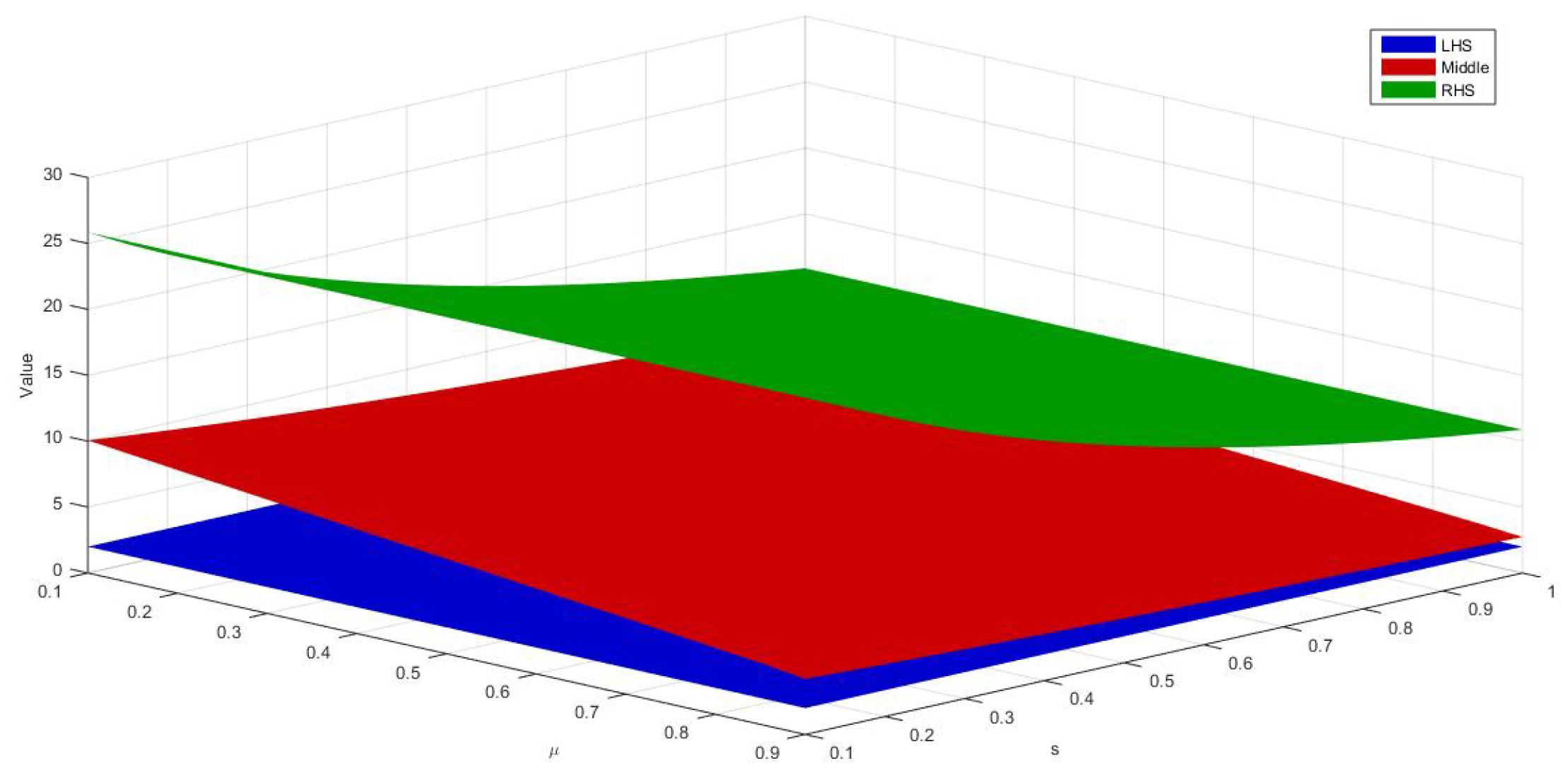
To authenticate the result obtained in Theorem 1, we have used Matlab, choosing f ( x ) = x 2 with m = 2 , p = 1 , a 1 = 1 , b 1 = 2 and including a combination of values μ { 0.1 , 0.3 , 0.5 , 0.7 , 0.9 } and s { 0.1 , 0.3 , 0.5 , 0.7 , 1.0 } for the graph of the Hermite–Hadmard inequality (14) as shown in Figure 3. In Table 1, we provide the Hermite–Hadamrd inequality (14) for numerical validation.
Example 5.
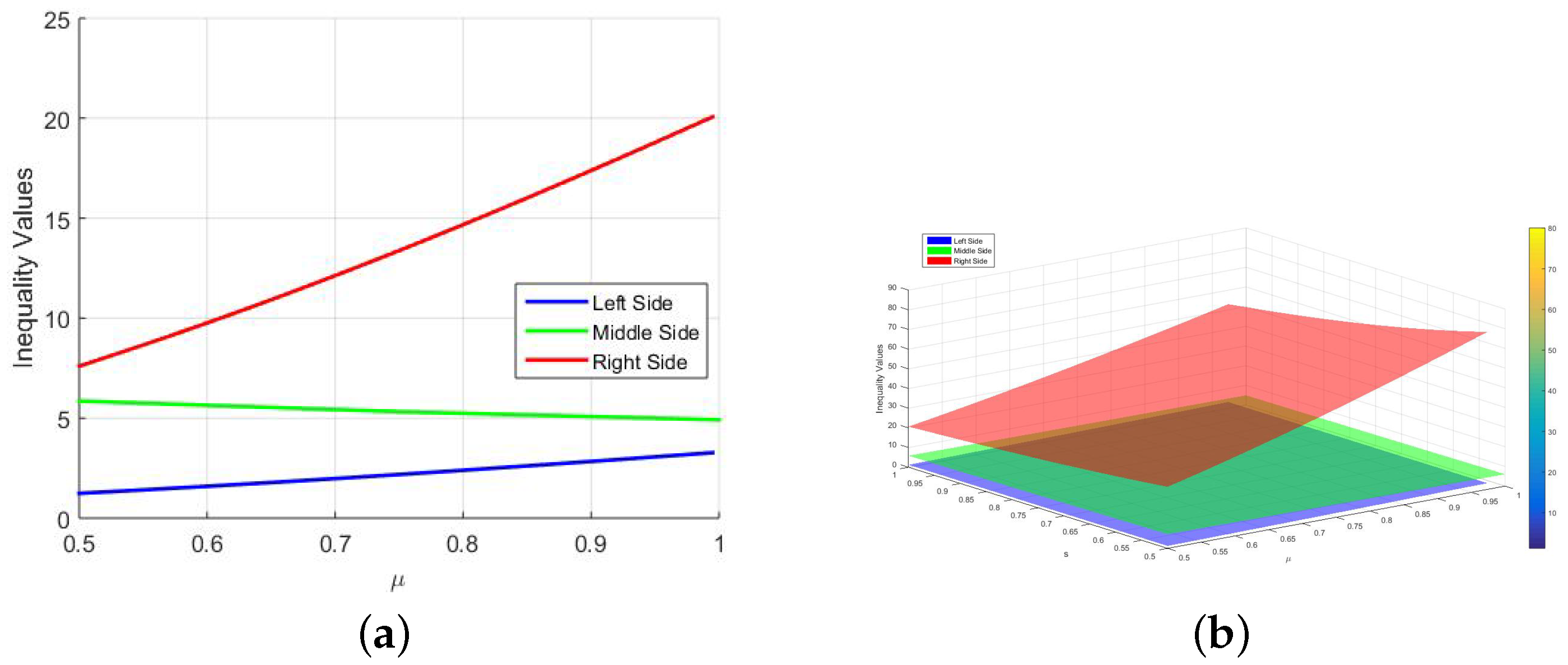
To illustrate the validity of Theorem 3, we present numerical results verifying inequality (32) for the functions f ( x ) = e x and h ( x ) = x 2 over the interval [ 0 , 1 ] , setting m = 0 , p = 1 , and s = 1.0 for the graph of the Hermite–Hadamard inequality (32), as shown in Figure 4. Table 2 below summarizes the values of the left, middle, and right sides of the inequality for fractional orders μ = 0.5 , 0.75 , 1.0 , and [ a 1 , b 1 ] = [ 0 , 1 ] computed using the Caputo fractional derivatives.

5. Conclusions

This study successfully establishes new fractional Hermite–Hadamard integral inequalities by leveraging Caputo fractional derivatives and MET-(p, s)-convex functions. The introduced modifications to classical fractional extensions, encompassing both MET- and logarithmic (p, s)-convex functions, provide a robust framework for refining inequalities such as Hermite–Hadamard, midpoint, and Fejér types. The derived results are substantiated through a numerical example with graphical illustrations, confirming their accuracy and applicability. The results also improve and generalize fractional calculus and convex analysis, with useful implications for both theoretical and applied mathematics.

Author Contributions

M.S.Z.: Conceptualization, Investigation, Methodology, Software, Validation, Visualization, Writing—original draft, Writing—review and editing. A.H.: Conceptualization, Investigation, Methodology, Supervision, Validation, Visualization. Y.W.: Formal analysis, Funding acquisition, Investigation, Methodology, Project administration, Validation, Visualization. All authors have read and agreed to the published version of the manuscript.

Funding

This work was supported by the National Natural Science Foundation of China under Grant No. 12171435.

Data Availability Statement

No additional dataset is required to support the study.

Conflicts of Interest

The authors declare that they have no known competing financial interests or personal relationships that could have appeared to influence the work reported in this paper.

References

  1. Mohammed, P.O.; Abdeljawad, T.; Alqudah, M.A.; Jarad, F. New discrete inequalities of Hermite-Hadamard type for convex functions. Adv. Differ. Equ. 2021, 2021, 122. [Google Scholar] [CrossRef]
  2. Chen, F.X. Extensions of the Hermite-Hadamard inequality for convex functions via fractional integrals. J. Math. Inequal. 2016, 10, 75–81. [Google Scholar] [CrossRef]
  3. Sun, W.; Wan, H. Hermite–Hadamard-type inequalities involving several kinds of fractional calculus for harmonically convex functions. Fractals 2023, 31, 2350109. [Google Scholar] [CrossRef]
  4. Du, T.S.; Long, Y. The multi-parameterized integral inequalities for multiplicative Riemann–Liouville fractional integrals. J. Math. Anal. Appl. 2025, 541, 128692. [Google Scholar] [CrossRef]
  5. Lakhdari, A.; Bin-Mohsin, B.; Jarad, F.; Xu, H.; Meftah, B. A parametrized approach to generalized fractional integral inequalities: Hermite–Hadamard and Maclaurin variants. J. King Saud. Univ. Sci. 2024, 36, 103523. [Google Scholar] [CrossRef]
  6. Abdeljawad, T.; Ali, M.A.; Mohammed, P.O.; Kashuri, A. On inequalities of Hermite-Hadamard-Mercer type involving Riemann-Liouville fractional integrals. AIMS Math. 2021, 6, 712–725. [Google Scholar] [CrossRef]
  7. Rahman, G.; Hussain, A.; Alim, A.; Nisarm, K.S.; Mohamedm, R.N. More general weighted-type fractional integral inequalities via Chebyshev functionals. Fractal Fract. 2021, 5, 232. [Google Scholar] [CrossRef]
  8. Imran, M.; Mubeen, S.; Khan, A.; Abdeljawad, T. Refinements of some fractional integral inequalities involving extended convex functions and fractional Caputo derivatives. J. Inequalities Appl. 2025, 2025, 12. [Google Scholar] [CrossRef]
  9. Farid, G.; Javed, A.; Naqvi, S. Hadamard and Fejer-Hadamard inequalities and related results via Caputo fractional derivatives. Bull. Math. Anal. Appl. 2017, 9, 16–30. [Google Scholar]
  10. Samraiz, M.; Nawaz, F.; Abdalla, B.; Abdeljawad, T.; Rahman, G. Estimates of trapezium-type inequalities for h-convex functions with applications to quadrature formulae. AIMS Math. 2021, 6, 7625–7648. [Google Scholar] [CrossRef]
  11. Ali, R.S.; Mukheimer, A.; Abdeljawad, T.; Mubeen, S.; Ali, S.; Rahman, G. Some new harmonically convex function type generalized fractional integral inequalities. Fractal Fract. 2021, 5, 54. [Google Scholar] [CrossRef]
  12. Pecaric, J.; Proschan, F.; Tong, Y.L. Convex Functions, Partial Orderings, and Statistical Applications; Academic Press: New York, NY, USA, 1992. [Google Scholar]
  13. Hudzik, H.; Maligranda, L. Some remarks on s-convex functions. Aequ. Math. 1994, 48, 100–111. [Google Scholar] [CrossRef]
  14. Iscan, I. Ostrowski type inequalities for p-convex functions. New Trends Math. Sci. 2016, 4, 140–150. [Google Scholar]
  15. Kadakal, H. Hermite-Hadamard type inequalities for trigonometrically convex functions. Sci. Stud. Res. Ser. Math. Inform. 2018, 28, 19–28. [Google Scholar]
  16. Kadakal, M.; Iscan, I.; Agarwal, P.; Jleli, M. Exponential trigonometric convex functions and Hermite-Hadamard type inequalities. Math. Slovaca 2021, 71, 43–56. [Google Scholar] [CrossRef]
  17. Budak, K.D.; Gürbüz, M.U. Modified exponential trigonometric convex functions and some integral inequalities. Turkish J. Inequal. 2024, 8, 60–72. [Google Scholar]
  18. Khan, M.B.; Treanțǎ, S.; Budak, H. Generalized p-convex fuzzy-interval-valued functions and inequalities based upon the fuzzy-order relation. Fractal Fract. 2022, 6, 63. [Google Scholar]
  19. Samko, S.G.; Kilbas, A.A.; Marichev, O.I. Fractional Integrals and Derivatives: Theory and Applications; Gordon and Breach Science Publishers: Yverdon, Switzerland, 1993. [Google Scholar]
  20. Podlubny, I. Fractional Differential Equations; Arcademic Press: San Diego, CA, USA, 1999. [Google Scholar]
  21. Stempin, P.; Sumelka, W. Approximation of Fractional Caputo Derivative of Variable Order and Variable Terminals with Application to Initial/Boundary Value Problems. Fractal Fract. 2025, 9, 269. [Google Scholar] [CrossRef]
  22. Kilbas, A.A.; Srivastava, H.M.; Trujillo, J.J. Theory and Applications of Fractional Differential Equations; Elsevier: Amsterdam, The Netherlands, 2006. [Google Scholar]
  23. Sarıkaya, M.Z.; Dahmani, Z.; Kırış, M.E.; Ahmad, F. (k, s)–Riemann–Liouville fractional integral and applications. Hacet. J. Math. Stat. 2016, 45, 77–89. [Google Scholar]
  24. Caputo, M.; Fabrizio, M. A new definition of fractional derivative without singular kernel. Prog. Fract. Differ. Appl. 2015, 1, 73–85. [Google Scholar]
  25. Khan, H.; Ahmed, S.; Alzabut, J.; Azar, A.T.; Gómez-Aguilar, J.F. Nonlinear variable order system of multi-point boundary conditions with adaptive finite-time fractional-order sliding mode control. Int. J. Dyn. Control. 2024, 12, 2597–2613. [Google Scholar] [CrossRef]
Figure 1. The 2D and 3D graphs for f ( x ) = e x are presented in figure (a) and (b) respectively.
Fractalfract 10 00062 g001
Figure 2. The 2D and 3D graphs for f ( x ) = x 2 and choice of parameters a 1 = 1 , b 1 = 2 , p = 2 , s = 0.5 and t [ 0 , 1 ] are presented in figure (a) and (b) respectively.
Fractalfract 10 00062 g002
Figure 3. Three-dimensional view of the Hermite–Hadamard inequality (14).
Fractalfract 10 00062 g003
Figure 4. The 2D and 3D graphs for f ( x ) = e x and h ( x ) = x 2 ; choice of parameters a 1 = 1 , b 1 = 2 and α [ 0 , 1 ] are presented in figure (a) and (b) respectively.
Fractalfract 10 00062 g004
Table 1. Numerical validation of the Hermite–Hadamard inequality.
μ sLHSMiddleRHS
0.10.12.000010.068625.8260
0.10.32.00008.927120.3120
0.10.52.00008.033316.4532
0.10.72.00007.330713.6992
0.11.02.00006.529010.8732
0.30.12.00008.754025.8260
0.30.32.00007.761920.3120
0.30.52.00006.985816.4532
0.30.72.00006.375313.6992
0.31.02.00005.678410.8732
0.50.12.00007.177725.8260
0.50.32.00006.366520.3120
0.50.52.00005.729316.4532
0.50.72.00005.230013.6992
0.51.02.00004.654810.8732
0.70.12.00005.745325.8260
0.70.32.00005.095720.3120
0.70.52.00004.585716.4532
0.70.72.00004.186013.6992
0.71.02.00003.726110.8732
0.90.12.00004.312925.8260
0.90.32.00003.823820.3120
0.90.52.00003.440916.4532
0.90.72.00003.140913.6992
0.91.02.00002.797510.8732
Table 2. Numerical values verifying inequality (32) for f ( x ) = e x , h ( x ) = x 2 on [ 0 , 1 ] .
μ Left SideMiddle SideRight Side
0.51.2405.8587.596
0.751.1285.3246.917
1.01.0424.9176.387
Disclaimer/Publisher’s Note: The statements, opinions and data contained in all publications are solely those of the individual author(s) and contributor(s) and not of MDPI and/or the editor(s). MDPI and/or the editor(s) disclaim responsibility for any injury to people or property resulting from any ideas, methods, instructions or products referred to in the content.