Article

Fractal and Fluid Mobility Analysis of Pore-Throat Systems in Sandstone Reservoirs Based on HPMI and NMR: A Case Study from the Nahr Umr Formation, Iraq


1
School of Energy, Chengdu University of Technology, Chengdu 610059, China
2
State Key Laboratory of Oil and Gas Reservoir Geology and Exploitation, Chengdu University of Technology, Chengdu 610059, China
3
Research Institute of Petroleum Exploration & Development, Beijing 100080, China
*
Author to whom correspondence should be addressed.
Fractal Fract. 2026, 10(1), 15; https://doi.org/10.3390/fractalfract10010015 (registering DOI)
Submission received: 21 November 2025 / Revised: 20 December 2025 / Accepted: 24 December 2025 / Published: 25 December 2025
(This article belongs to the Special Issue Analysis of Geological Pore Structure Based on Fractal Theory)

Abstract

The pore architecture of the Nahr Umr Formation sandstone reservoirs is highly complex and heterogeneous, severely limiting efficient oilfield development. Conventional methods often fail to adequately characterize such intricate pore systems, necessitating the application of fractal theory. Focusing on sandstone samples from the Nahr Umr-B Member, this study integrates thin section identification, XRD, HPMI, and NMR to characterize the fractal features of the reservoir pore structure and evaluate fluid mobility. The results indicate that from Type I to Type III reservoirs, displacement pressure and median pressure gradually increase, whereas the average and median pore-throat radius gradually decrease, and the pore-throat sorting coefficient decreases. For instance, Type I reservoirs exhibit an average displacement pressure of 0.15 MPa, a median pressure of 0.81 MPa, an average pore-throat radius of 1.96 μm, and a median pore-throat radius of 2.85 μm; in contrast, Type III reservoirs show averages of 14.43 MPa, 45.32 MPa, 0.02 μm, and 0.03 μm, respectively. These trends reflect a gradual deterioration in pore connectivity, increased resistance to fluid flow, and a reduction in the development of larger pore throats. From Type I to Type III reservoirs, both the total fractal dimension (DH) and the movable fluid pore fractal dimension (DN2) show a gradual increasing trend. This indicates that the pore structure becomes increasingly complex and heterogeneous, the complexity of the movable fluid pore space increases, and fluid mobility progressively weakens. Furthermore, higher quartz content and lower cement and clay mineral contents correspond to smaller reservoir pore fractal dimensions and stronger fluid mobility. For example, Sample No. 3 (Type I) has a quartz content of 91.97%, a cement content of 1.64%, and a clay mineral content of 6.4%, with a DH of 2.4385 and DN2 of 2.9323. Conversely, Sample No. 4 (Type III) has a quartz content of 49.72%, a cement content of 11.21%, and a clay mineral content of 39.07%, with a DH of 3.9099 and DN2 of 2.9762. Compared to DH, DN2 reduces the prediction error for dynamic quality by over 70% on average, offering a more reliable prediction of fluid mobility and providing a more precise scale for evaluating reservoir development potential.

1. Introduction

Sandstone reservoirs, influenced by the complex interplay of sedimentary environment, diagenesis, and tectonic activity, universally exhibit strong heterogeneity, particularly at the microscopic pore structure level [1]. The size, morphology, distribution, and connectivity of pores and throats are critical factors controlling fluid storage and transport capacity within reservoirs [2,3]. Consequently, the precise quantitative characterization of microscopic pore structures and elucidation of their intrinsic relationship with fluid mobility are of significant theoretical and practical importance for effectively identifying “sweet spot” reservoirs, optimizing development strategies, and enhancing hydrocarbon recovery [4,5].
Traditional reservoir evaluation methods predominantly rely on macroscopic parameters such as porosity and permeability. However, these parameters often fail to fully capture the complexity of the microscopic pore network. For instance, reservoirs with similar porosity can exhibit vastly different seepage capacities due to differences in pore-throat structure [6]. To overcome the limitations of conventional approaches, fractal geometry theory has been introduced into reservoir geology. The fractal dimension can quantitatively characterize the complexity and heterogeneity of pore structures [7,8]. Reservoir pore systems are typical multi-fractal media, where pore surface roughness, pore-throat size distribution, and pore network tortuosity all exhibit fractal characteristics [9]. Generally, increasing pore structure heterogeneity leads to a higher fractal dimension, while simpler, more uniform pore structures correspond to lower fractal dimensions [10]. Currently, methods for calculating fractal dimensions using various experimental techniques such as high-pressure mercury injection (HPMI), nuclear magnetic resonance (NMR), nitrogen adsorption, and image analysis have become increasingly mature and are widely applied in the evaluation of tight sandstone, carbonate, and shale reservoirs [9,10,11,12]. Xia et al., based on casting thin sections and HPMI data, confirmed that reservoir pore structures exhibit fractal characteristics over certain scales, with fractal dimensions showing strong correlations with pore-throat structural parameters [13]. Zhang et al., utilizing NMR experiments, discovered that effective storage spaces and movable fluid pores in reservoirs also possess fractal properties, and that fractal dimensions can effectively characterize pore-throat connectivity. In fractal theory, the ideal fractal dimension for a three-dimensional shape typically lies between 2 and 3 [14]. However, Wu et al. found that for the same volume, a sphere has the minimum surface area, while spiny or intricate pore shapes possess a larger specific surface area than a sphere, leading to higher fractal dimensions (D > 3). Thus, pore structures with fractal dimensions exceeding 3 (D > 3) correspond to highly heterogeneous, interconnected pore systems [15,16]. Fluids in reservoirs can be classified into movable and irreducible (bound) fluids based on their occurrence state within the pores. Movable fluid is the direct contributor to hydrocarbon production, making movable fluid saturation and movable fluid porosity key dynamic indicators for reservoir quality evaluation [17,18]. The use of NMR T2 spectra, combined with a T2 cutoff value to distinguish movable from irreducible fluid, has become a standard method for accurately assessing fluid mobility [19,20].
Iraq possesses abundant oil and gas resources hosted in reservoirs ranging from the Paleozoic to the Neogene, with approximately 76% of these resources located within Cretaceous reservoirs [21]. The Nahr Umr Formation clastic rocks represent one of the most important Cretaceous clastic deposits in Iraq, containing essential geological elements for hydrocarbon accumulation, including source rocks, reservoirs, and seals [22]. However, the Nahr Umr Formation reservoirs have undergone a complex diagenetic evolution, including compaction, quartz overgrowths, carbonate cementation, and clay mineral infilling [23]. These intense diagenetic alterations have resulted in extremely complex pore structures and strong heterogeneity in the Nahr Umr sandstone reservoirs, severely constraining efficient field development. Although previous studies have investigated the sedimentology and diagenetic characteristics of these reservoirs [24], systematic quantitative characterization of their microscopic pore structures—particularly research utilizing fractal theory to unravel the intrinsic links between pore complexity and fluid mobility—remains limited.
This study focuses on the Nahr Umr Formation sandstone reservoirs in Oilfield A. It employs an integrated methodology, including thin-section petrography, SEM, XRD, HPMI, and NMR, to characterize the fractal nature of the pore structure and evaluate fluid mobility. Fractal dimensions representing different aspects of the pore system—the overall pore structure, movable fluid pores, and irreducible fluid pores—are calculated based on HPMI and NMR data. The study further analyses the effects of macroscopic reservoir properties, mineral composition, and microscopic pore structure parameters on fractal dimensions and fluid mobility, ultimately revealing the mechanisms by which pore structure complexity (fractal dimension) influences fluid mobility.

2. Geological Setting

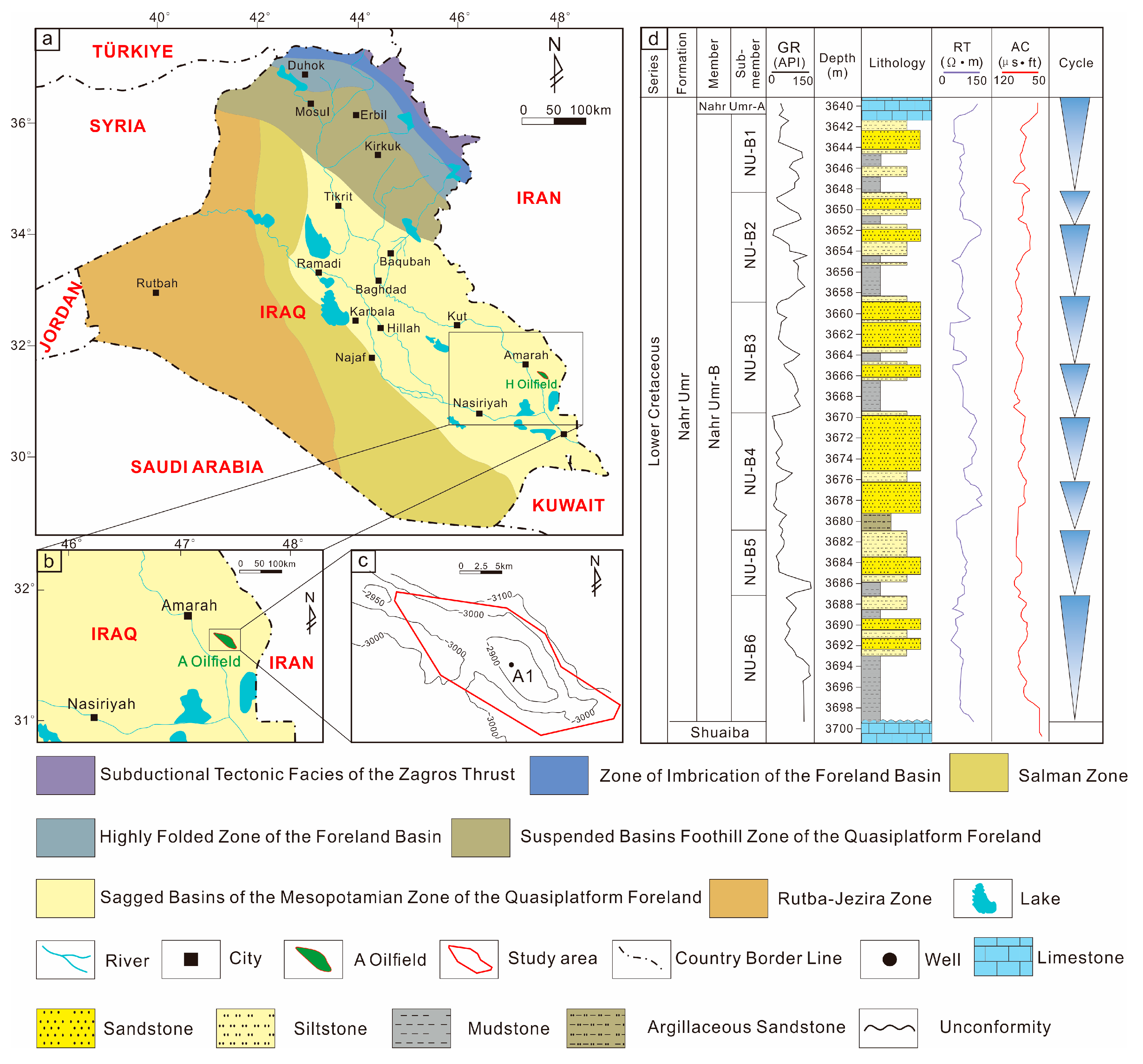
Oilfield A is located in southeastern Iraq, bordering Iran to the east, and is a giant field with clastic rocks as its main productive intervals (Figure 1a,b). The field lies in the southwestern part of the Mesopotamian Basin. Its structure is an anticlinal uplift, dipping from southwest to northeast, which formed during the Neogene Zagros Orogeny [25] (Figure 1c). The basement consists of Precambrian metamorphic rocks, Lower Cambrian metamorphic rocks, and volcaniclastic rocks. The primary oil-producing reservoir is the Cretaceous Mishrif Formation limestone, followed by the clastic reservoirs of the Neogene Jeribe Formation, the Paleogene Upper Kirkuk Formation, and the Cretaceous Nahr Umr Formation [26].
During the deposition of the Nahr Umr Formation, the paleotopography was a broad, gentle slope, higher in the west and lower in the east, with sediment sourced from the denudation area west of the study area. The Nahr Umr Formation is primarily composed of mudstone, medium- to fine-grained sandstone, and siltstone, with carbonate rocks developed in some areas [23]. Its base is marked by dark black mudstone unconformably overlying the yellow-light grey limestone at the top of the Shuaiba Formation. The top of the Nahr Umr Formation has a conformable contact with the limestone or dolomite at the base of the overlying Mauddud Formation [24]. Based on lithological differences, the Nahr Umr Formation can be divided from top to bottom into the Nahr Umr-A and Nahr Umr-B members. The later-deposited Nahr Umr-A Member was deposited during an overall transgression with reduced clastic supply; the sedimentary facies in the study area was a shallow marine carbonate platform, resulting in a lithology dominated by limestone interbedded with thin argillaceous limestone layers. The earlier-deposited Nahr Umr-B Member belongs to a tide-dominated deltaic facies comprising fine-grained clastic sediments. Consequently, the lithology of the Nahr Umr-B Member is predominantly sandstone, mudstone, and argillaceous sandstone (Figure 1d). The Nahr Umr-B Member, with a thickness of 50–70 m, is the target interval of this study. Based on variations in well log responses and lithological assemblages, the Nahr Umr-B Member can be subdivided into six sub-members, designated NU-B1 to NU-B6 from top to bottom (Figure 1d).

3. Materials and Methods

3.1. Sample Information

For this study, twelve sandstone core samples from the Nahr Umr-B Member in Well A1, Oilfield A, were selected. The lithology comprises light yellow medium-grained sandstones, fine-grained sandstones, and siltstones, with sampling depths ranging from 3644.25 m to 3687.74 m (Table 1). First, a 5 mm thick subsection was cut from each of the 12 cylindrical core samples (original dimensions: 50 mm in length, 25 mm in diameter) to prepare casting thin sections for microscopic observation and scanning electron microscopy (SEM) analysis. Subsequently, another 5 mm subsection was taken for X-ray diffraction (XRD) analysis to determine the bulk mineral composition and types of clay minerals. Following this, nuclear magnetic resonance (NMR) and high-pressure mercury injection (HPMI) experiments were conducted sequentially. Porosity and permeability were determined using the NMR results. All experiments were performed at the National Key Laboratory of Oil and Gas Reservoir Geology and Exploitation at the Chengdu University of Technology, adhering strictly to standard industry procedures and conditions.

3.2. Thin Section Analysis

Thin section analysis was conducted using a DM2500P polarizing microscope (manufactured by LEICA, Wetzlar, Hesse, Germany) to identify rock components including quartz, feldspar, carbonate minerals, heavy minerals, and clay minerals. Prior to observation, the thin sections were cleaned, polished, and stained with a mixed solution of alizarin red-S and potassium ferrocyanide to enhance the identification of carbonate minerals. Additionally, thin sections stained with blue epoxy resin were prepared for pore structure examination. All experiments were performed in accordance with the Chinese petroleum and natural gas industry standard “SY/T 5368-2016 Standard for Rock Thin Section Identification” [27].

3.3. Scanning Electron Microscopy

Observation of twelve crushed samples was performed using a Quanta 250 FEG field emission scanning electron microscope (manufactured by FEI, Hillsboro, OR, USA). The crushed samples were cleaned with ethanol and coated with a 5 nm gold film to enhance conductivity and achieve high-resolution imaging. The instrument enables mineral identification through secondary electron (SE) imaging, backscattered electron (BSE) imaging, and energy dispersive spectroscopy (EDS). Under an accelerating voltage of 30 kV and a working distance of 5–10 mm, the FE-SEM pore imaging resolution reached 2.5 nm. The experiments followed the Chinese petroleum and natural gas industry standard “SY/T 5162-2021 Analytical Method for Rock Samples by Scanning Electron Microscopy” [27].

3.4. X-Ray Diffraction

The twelve crushed samples were ground into powder, ensuring fine and uniform particle size, then mixed with ethanol, ground again, and spread onto glass slides to create flat test specimens without preferred orientation. Experiments were conducted using a BTX-II benchtop X-ray diffractometer (manufactured by OLYMPUS, Center Valley, PA, USA). The experimental process utilized Cu Kα radiation at 40 kV voltage and 30 mA current. Data acquisition employed continuous scanning mode with a scanning range (2θ) of 5° to 55°, a resolution of 0.25°, and a scanning speed of 2° per minute. To minimize geometric errors, both the divergence slit and anti-scatter slit were set to 1 mm to ensure a constant illumination length. The experiments followed the Chinese petroleum and natural gas industry standard “SY/T 5163-2018 Analytical Method for Clay Minerals and Common Non-clay Minerals in Sedimentary Rocks by X-ray Diffraction” [28].

3.5. Nuclear Magnetic Resonance

The twelve evacuated samples were placed in a KCl solution with a salinity of 152 g/L for 7 days. After the samples were fully saturated with water, water-saturated NMR experiments were conducted using an MR Cores HP20L high-precision nuclear magnetic resonance analyzer (manufactured by Niumag, Yangzhou, Jiangsu, China). The instrument operated at a frequency of 2 MHz, with an echo interval of 0.6 ms, a wait time of 3 s, 128 scan repetitions, a receiver gain of 40%, 1024 echoes, and a test temperature of 35 °C. Subsequently, the samples were subjected to high-speed centrifugation at a centrifugal force equivalent to 4 MPa. Previous studies have shown that under 4 MPa centrifugal pressure, sandstone samples lose nearly all movable water [29,30], thus dividing the fluid in the core pores into movable and irreducible (bound) fluids. After complete expulsion of the movable fluid, NMR experiments were performed on the centrifuged samples, recording the NMR T2 spectra before and after centrifugation. The experiments followed the Chinese petroleum and natural gas industry standard “SY/T 6490-2014 Specification for Laboratory Measurement of NMR Parameters of Rock Samples” [31].

3.6. High-Pressure Mercury Injection

To ensure the consistency of experimental results across different measurements, the high-pressure mercury injection (HPMI) tests were conducted using the same set of twelve original samples immediately following the NMR experiments. The HPMI analysis was performed using an AutoPore V 9600 mercury porosimeter (manufactured by Micromeritics, Norcross, GA, USA) under laboratory conditions maintained at 20 °C and 50% humidity. The measurement employed a stepwise pressure increase protocol, with the intruding mercury pressure ranging from 0.0069 MPa to 379.225 MPa, corresponding to a pore-throat diameter conversion range of 0.002 to 109.221 μm. The instrumental measurement error was controlled within ±0.05%. All experimental procedures strictly adhered to the Chinese National Standard “GB/T 29171-2012 Determination of Capillary Pressure Curves for Rocks” [32,33].

3.7. Fractal Theory

3.7.1. Fractal Dimension Calculation Based on High-Pressure Mercury Injection

The fractal dimension characterizes the self-similarity and complexity of irregular geometries and provides a theoretical basis for revealing the geometric characteristics of heterogeneous porous media in reservoirs [28]. Currently, there are six main mathematical models for determining the fractal dimension, including the geometric model, two-dimensional capillary model, three-dimensional capillary model, spherical model, thermodynamic model, and wetting phase model. Among these, the three-dimensional capillary model and the wetting phase model are more widely applied [34,35]. Since the wetting phase model does not satisfy the condition that rmin ≪ rmax, the fractal dimension calculated by the three-dimensional capillary model is considered more reasonable [36]. Based on fractal theory, fractal characteristics can be expressed by a power-law function [37]:
N r r D
Here, N ( r ) represents the number of units of radius r required to fill the entire fractal object; r is the pore radius in µm; and D is the fractal dimension.
According to the capillary model, N ( r ) can be expressed as follows:
N r = V H g π r 2 L
Here, V Hg represents the cumulative volume of mercury (cm3) at a specific pressure, and L is the length of the capillary (µm).
The capillary pressure P c can be expressed as follows:
p c = 2 σ cos θ r
Here, P c represents the capillary pressure in MPa; σ is the surface tension in dyne/cm; and θ is the contact angle in degrees (°).
By combining Equations (1)–(3), the following expression can be derived:
V H g p c 2 D
The mercury saturation can then be calculated as
S H g = V H g V p
where S Hg represents the mercury saturation in %, and V p is the pore volume in cm3.
By combining Equations (4) and (5), the following relationship can be obtained:
S H g = a p c 2 D
Here, a is a constant.
Taking the logarithm of both sides of Equation (6), we have
lg S H g = D 2 lg p c + C
where C is a constant.
Due to the multifractal characteristics of tight sandstone pore structures [38], the cross-plot of lg S Hg versus lg P c exhibits multiple slope intervals, corresponding to distinct fractal regions. Segmented linear regression is applied within these different fractal intervals to determine the slope K for each interval. The fractal dimension for each respective interval is then calculated based on the slope as follows:
D = K + 2
Here, K is the slope of each fractal interval on the cross-plot of lg S Hg versus lg P c .
In this study, the coefficient of determination (R2) and the Pearson correlation coefficient (r) were employed to evaluate the strength of linear relationships between variables and the goodness of fit. Based on general statistical conventions, R2 and r were classified into five levels. For R2, the goodness of fit is categorized as poor (R2 < 0.2), weak (0.2 ≤ R2 < 0.4), moderate (0.4 ≤ R2 < 0.6), good (0.6 ≤ R2 < 0.8), and excellent (R2 ≥ 0.8). Similarly, regarding the correlation coefficient, values of ∣r∣ < 0.20 are evaluated as poor (very weak correlation); 0.20 ≤ ∣r∣ < 0.40 as weak (weak correlation); 0.40 ≤ ∣r∣ < 0.60 as moderate; 0.60 ≤ ∣r∣ < 0.80 as good (strong correlation); and ∣r∣ ≥ 0.80 as excellent (very strong correlation).

3.7.2. Fractal Dimension Calculation Based on Nuclear Magnetic Resonance

According to the principles of NMR, different T2 relaxation times correspond to the relaxation characteristics of fluids in pores of different sizes: larger pores are associated with longer relaxation times, while smaller pores correspond to shorter relaxation times. Based on NMR theory, the T2 relaxation time can be simplified as [39]
1 T 2 = F s ρ r
where F s represents the geometric shape factor of the pores (with F s = 2 for cylindrical pores and F s = 3 for spherical pores), r denotes the pore radius in µm, and ρ is the surface relaxivity of the rock in µm/ms.
According to fractal geometry theory, when the minimum pore-throat radius is much smaller than the maximum pore-throat radius, the following relationship holds [40]:
S v = r r m a x 3 D
Here, S V is the cumulative pore volume fraction in %, D is the fractal dimension, r is the pore-throat radius in µm, and r max is the maximum pore-throat radius in µm.
Substituting Equation (9) into Equation (10), we have
S v = T 2 T 2 m a x 3 D
where T 2 max is the maximum relaxation time.
Taking the logarithm of both sides of Equation (11) yields
l g S v = 3 D l g T 2 3 D l g T 2 m a x
A linear relationship exists between lg T 2 and lg S v . The fractal dimension can be calculated from the slope K of the fitted line in the double logarithmic plot.
D = 3 K
Here, K is the slope of each fractal interval on the cross-plot of lg T 2 versus lg S v .

4. Results

4.1. Petrological Characteristics and Pore-Throat Types

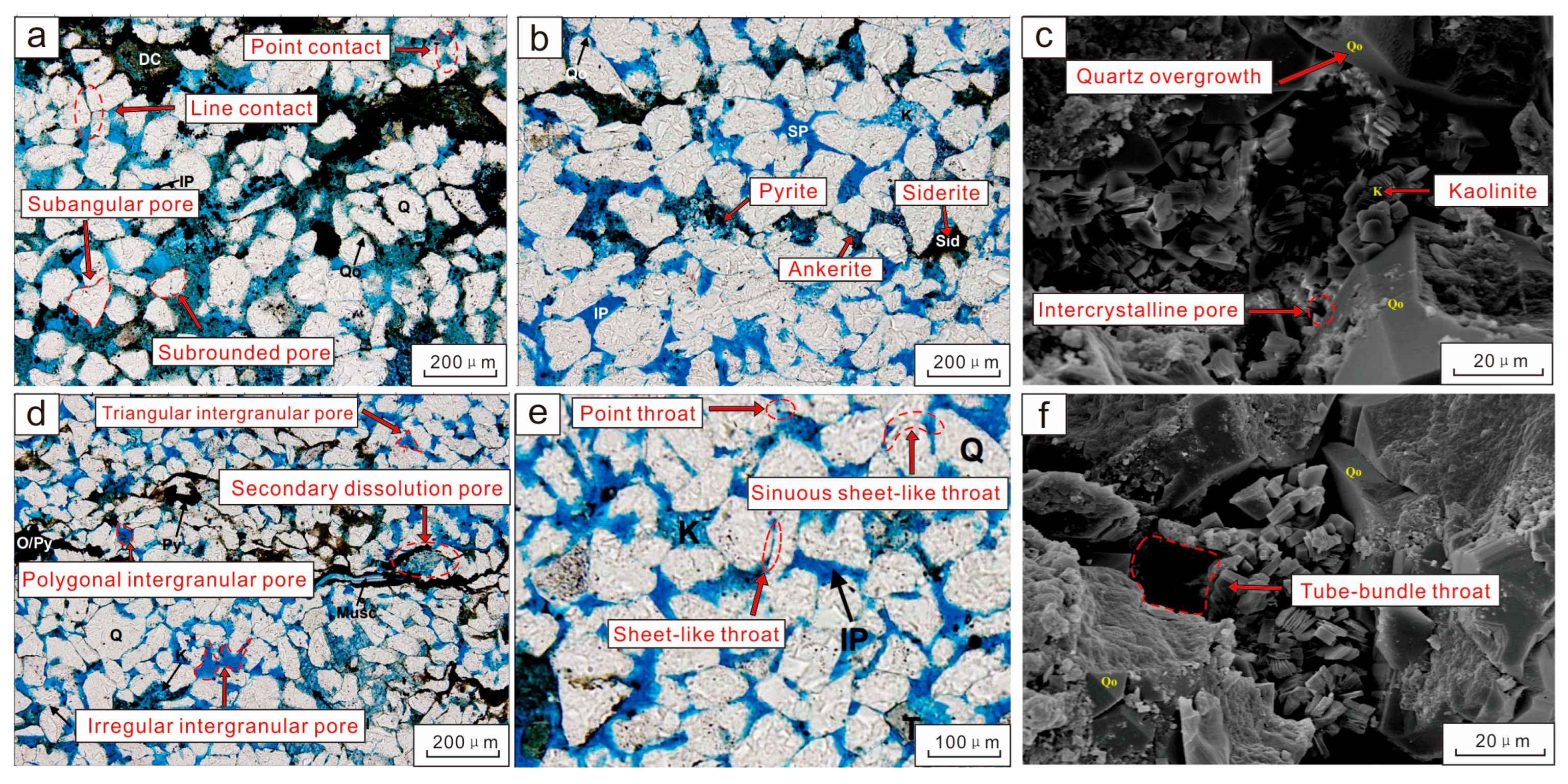
The sandstones in the study area are predominantly light yellowish-brown medium and fine-grained sandstones, with particle roundness ranging from subangular to subrounded (Figure 2a). Grain contacts are mainly point and line contacts (Figure 2a). As this study focuses on porous reservoirs, all twelve samples were selected from intervals with relatively underdeveloped fractures. The porosity of the twelve sandstone samples from the Nahr Umr-B Member ranges from 2.57% to 18.04%, with an average of 9.38%, while permeability ranges from 0.018 × 10⁻³ μm2 to 4.4 × 10⁻³ μm2, with an average of 1.752 × 10⁻³ μm2 (Table 1).
X-ray diffraction and thin section analysis results (Table 2) show that quartz is the most abundant framework grain in the study area, ranging from 45.72% to 91.97%, with an average of 71.69%. Thin section observations indicate extremely low feldspar content and an almost complete absence of lithic components, classifying the sandstones as quartz arenites. Cement minerals are primarily calcite, ankerite, siderite, and pyrite (Figure 2b), with contents ranging from 1.64% to 13.36%, averaging 6.47%. The total clay mineral content ranges from 6.4% to 39.07%. The clay mineral is dominated by kaolinite (Figure 2c), which accounts for 72% to 89% of the total clay fraction, with minor amounts of illite, smectite, and mixed-layer illite/smectite (I/S) (Table 2).
Casting thin section and scanning electron microscopy observations reveal that the pore types in the twelve sandstone samples from the Nahr Umr-B Member include intergranular pores, secondary dissolution pores, and intercrystalline pores. Intergranular pores, formed by the reduction in original pore space due to compaction and cementation during diagenetic evolution, exhibit diverse shapes such as triangular, polygonal, and irregular (Figure 2d). Secondary dissolution pores, formed by the dissolution of mineral edges and cements, typically display irregular shapes with concave or serrated boundaries (Figure 2d). Intercrystalline pores are associated with clay minerals such as kaolinite, illite, and mixed-layer illite/smectite (I/S) formed during diagenesis, often occurring within clay mineral aggregates on mineral surfaces (Figure 2c). The dominant throat types in the study area are sheet-like, curved sheet-like, and point-shaped throats (Figure 2e), followed by tubular throats (Figure 2f).

4.2. Characterization of Pore-Throat Structures by HPMI

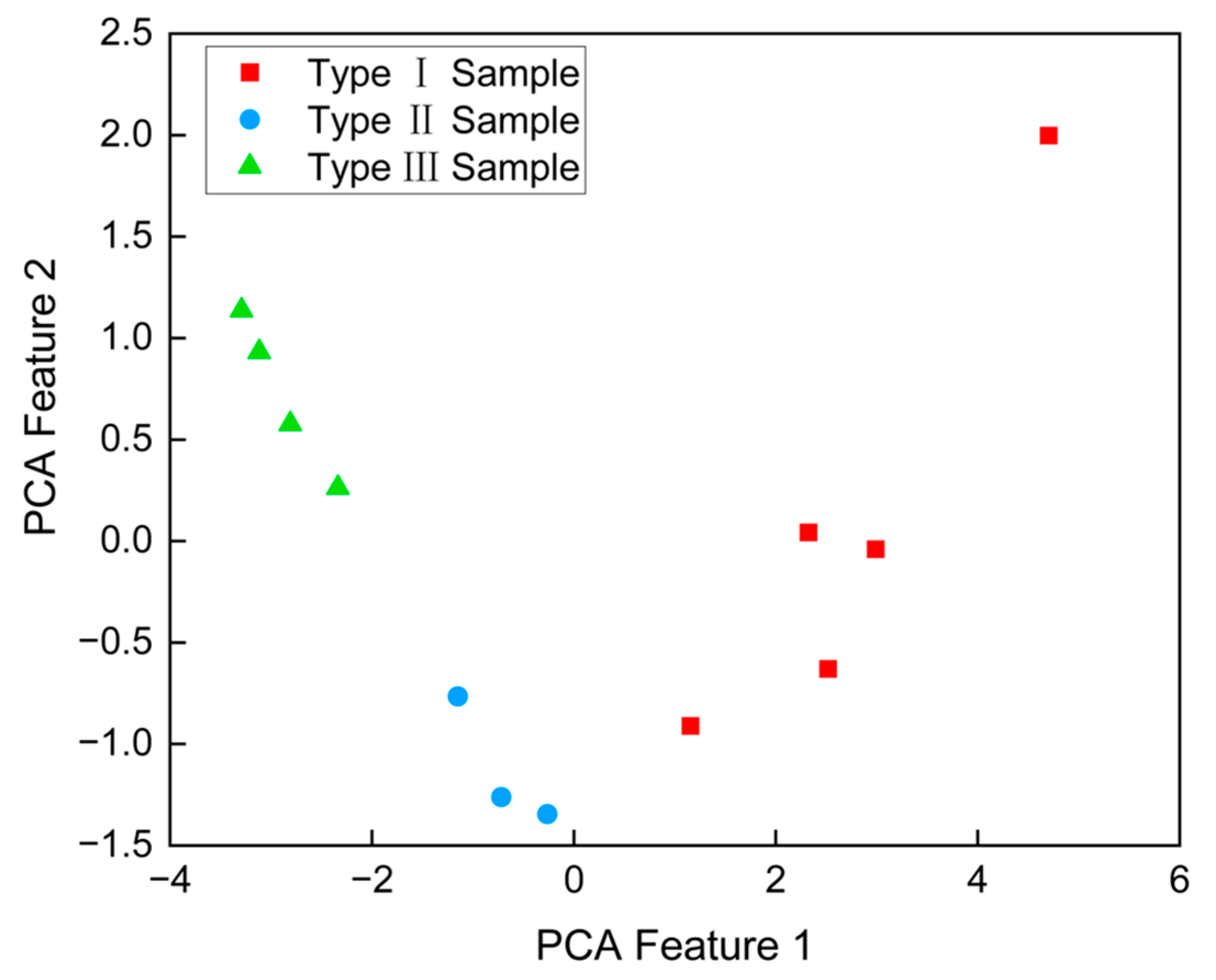
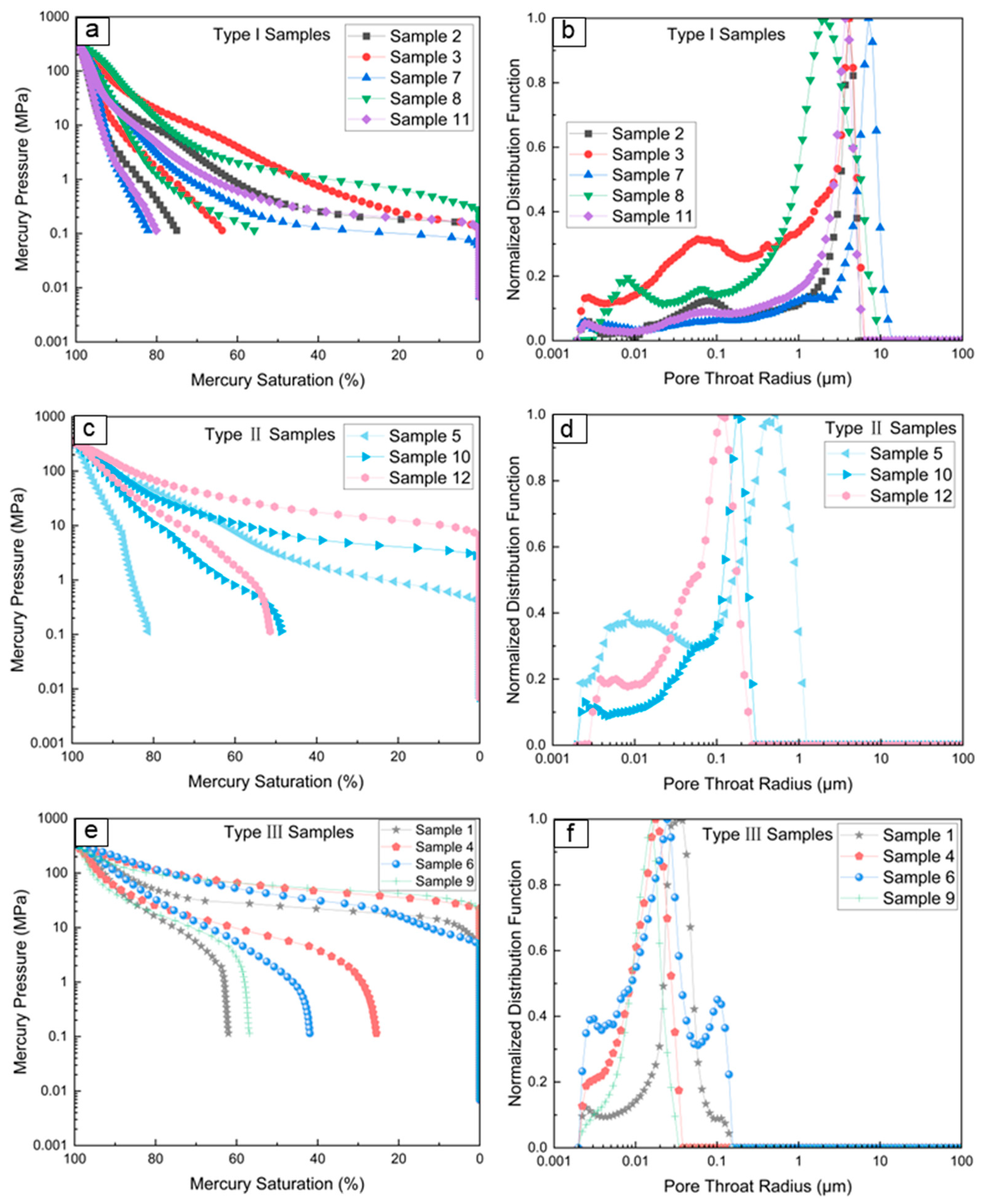
The capillary pressure curves and pore-throat structural parameters obtained from high-pressure mercury injection experiments on twelve samples are shown in Table 3. The displacement pressure of the twelve samples ranges from 0.06 MPa to 24.76 MPa, with an average of 5.76 MPa; the median pressure ranges from 0.17 MPa to 59.3 MPa, with an average of 18.18 MPa; the average pore-throat radius ranges from 0.01 μm to 6.2 μm, with an average of 1.23 μm; and the median pore-throat radius ranges from 0.01 μm to 4.8 μm, with an average of 0.85 μm. The normalized pore-throat radius distribution function indicates a wide distribution range of pore-throat radius, primarily between 0.01 μm and 10 μm. The pore-throat radius distribution functions are predominantly unimodal, with peak positions ranging from 0.01 μm to 10 μm, showing significant variation among different samples. These experimental data reflect that the twelve sandstone samples are characterized by large differences in pore connectivity, fluid migration resistance, and pore-throat size sorting. Based on petrophysical properties (porosity) and pore-throat structure characteristics (peak interval of pore size distribution), the sandstone reservoir pore-throat structures in the study area are classified into Types I, II, and III, corresponding to Type I, Type II, and Type III reservoirs, respectively. Type I samples exhibit a porosity greater than 10%, with the peak pore diameter mainly distributed between 1 and 10 μm. Type II samples have a porosity ranging from 5% to 10%, with the peak pore diameter mainly distributed between 0.1 and 1 μm. Type III samples have a porosity ranging from 2% to 5%, with the peak pore diameter mainly distributed between 1 and 10 μm. To validate the reliability of the classification criteria, the raw data (porosity and peak pore-throat radius) were first standardized using StandardScaler. Subsequently, Principal Component Analysis (PCA) was employed to reduce the high-dimensional features into two dimensions, where the x-axis (PCA Feature 1) and y-axis (PCA Feature 2) represent the first and second principal components, respectively. These two components capture the primary directions of variance within the data. The K-means clustering algorithm was then applied to group the dimensionality-reduced data, and a clustering visualization was generated (Figure 3). In this plot, each point represents an individual sample, with coordinates corresponding to its scores on the two principal component dimensions. The clustering results are clearly discernible from the spatial aggregation of the sample points; different sample types exhibit distinct boundaries with no significant overlap in the reduced-dimensional space (Figure 3). Furthermore, the clustering outcome aligns consistently with the classification results based on the aforementioned criteria, thereby verifying the reliability of the proposed classification standard.
Type I samples are dominated by intergranular and secondary dissolution pores. Their mercury intrusion curves exhibit a relatively long plateau at a relatively low position (Figure 4a). Type I samples have low displacement pressure (average 0.15 MPa) and low median pressure (average 0.81 MPa), large median pore-throat radius (average 1.96 μm) and large average pore-throat radius (average 2.85 μm), with an average sorting coefficient of 2.56. The pore size distribution of Type I samples is unimodal, with peaks mainly between 1–10 μm (Figure 4b). Type I reservoirs are characterized by good pore connectivity, low fluid flow resistance, relatively poor pore-throat size sorting, and a pore-throat size distribution skewed towards larger pores with well-developed larger throats.
Type II samples contain intergranular pores, secondary dissolution pores, and intercrystalline pores. Their mercury intrusion curves show a plateau at a relatively higher position (Figure 4c). Type II samples have higher displacement pressure (average 3.56 MPa) and higher median pressure (average 10.94 MPa), smaller median pore-throat radius (average 0.13 μm) and smaller average pore-throat radius (average 0.15 μm), with an average sorting coefficient of 1.9. The pore size distribution of Type II samples is unimodal, with peaks mainly between 0.1–1 μm (Figure 4d). Type II reservoirs are characterized by moderate pore connectivity, relatively high fluid flow resistance, moderate pore-throat size sorting, a pore-throat size distribution skewed towards smaller pores, and limited development of larger throats.
Type III samples are predominantly composed of intercrystalline pores. Their mercury intrusion curves show the highest plateau position (Figure 4e). Type III samples have the highest displacement pressure (average 14.43 MPa) and the highest median pressure (average 45.32 MPa), the smallest median pore-throat radius (average 0.02 μm) and the smallest average pore-throat radius (average 0.03 μm), with an average sorting coefficient of 1.25. The pore size distribution of Type III samples is unimodal, with peaks mainly between 0.01–0.1 μm (Figure 4f). Type III reservoirs are characterized by poor pore connectivity, high fluid flow resistance, good pore-throat size sorting, a pore-throat size distribution skewed towards very fine pores, and underdeveloped larger throats.

4.3. Characterization of Movable Fluid Features by NMR

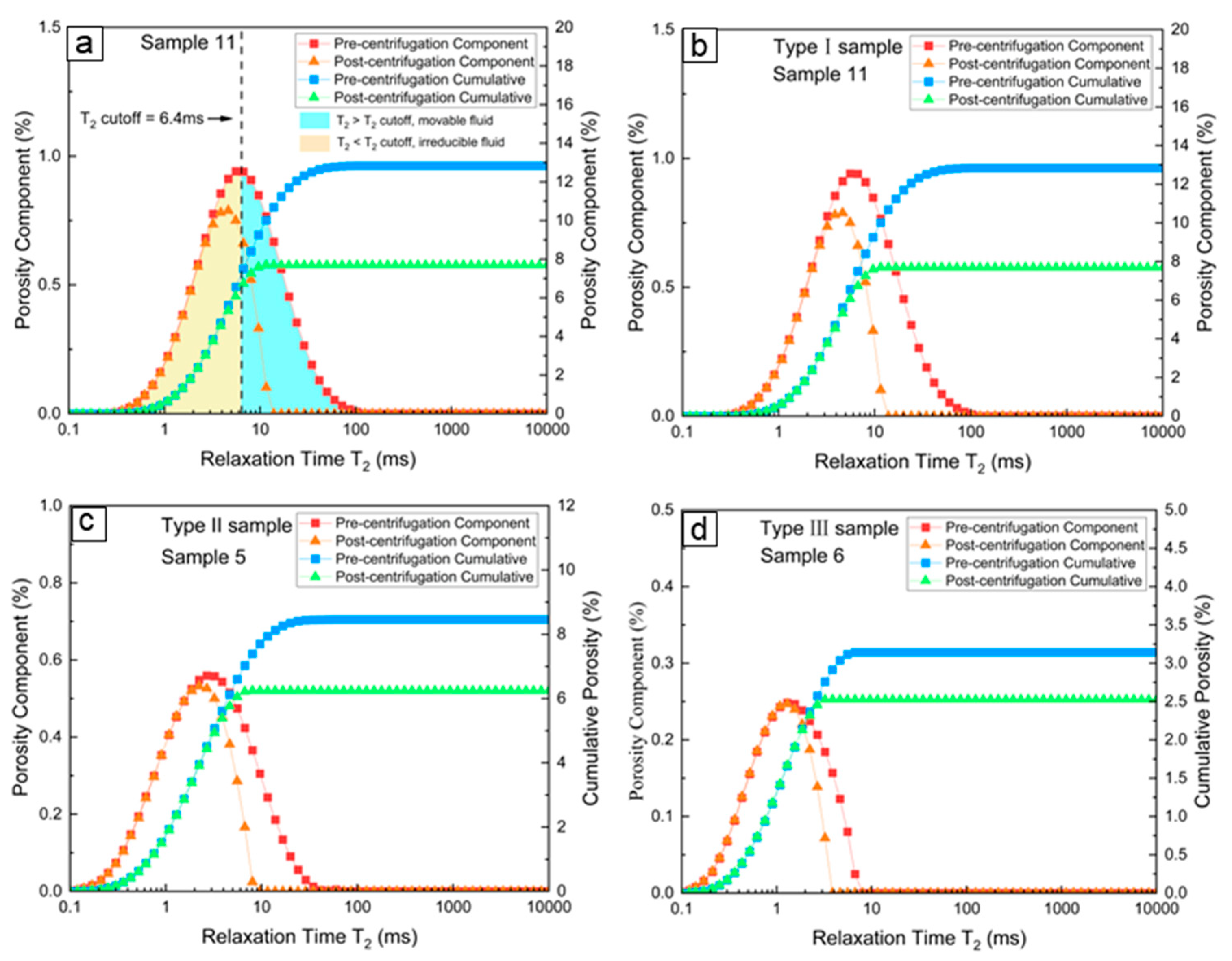
Fluids in reservoir pores can be classified into movable and irreducible (bound) fluids. Fluids in a free state within connected pores are termed movable fluids, whereas fluids trapped in micropores due to capillary forces and interfacial tension are termed irreducible fluids [41,42]. Movable fluid saturation, defined as the percentage of movable fluid volume relative to the total pore volume, is a key parameter for evaluating reservoir fluid mobility [43]. The movable fluid content was determined from NMR experiments using the T2 cutoff method [44]. This method uses the T2 cutoff value as a relaxation time threshold: fluids in pore throats larger than the T2 cutoff can be completely displaced, while fluids in pore throats smaller than the T2 cutoff remain bound. Thus, the T2 cutoff value serves as an indicator of pore-throat structure quality (Figure 5a). The results (Table 4) show that the movable fluid saturation of the twelve sandstone samples from the Nahr Umr-B Member in the study area ranges from 15.8% to 62.9%, with distinct differences among the different reservoir types. Type I reservoir samples exhibit a T2 relaxation time peak at approximately 10 ms, the highest movable fluid saturation (average 50.68%), and the highest movable fluid porosity (average 7.76%) (Figure 5b). Type II reservoir samples show T2 relaxation time peaks between 0.1 ms and 1 ms, lower movable fluid saturation (average 23.97%), and lower movable fluid porosity (average 1.78%) (Figure 5c). Type III reservoir samples display a T2 relaxation time peak at approximately 0.1 ms, the lowest movable fluid saturation (average 22.84%), and the lowest movable fluid porosity (average 0.78%) (Figure 5d). From Type I to Type II and further to Type III reservoirs, both movable fluid saturation and movable fluid porosity exhibit a clear decreasing trend, indicating a gradual reduction in fluid mobility.

4.4. Fractal Characteristics of Pore Structure

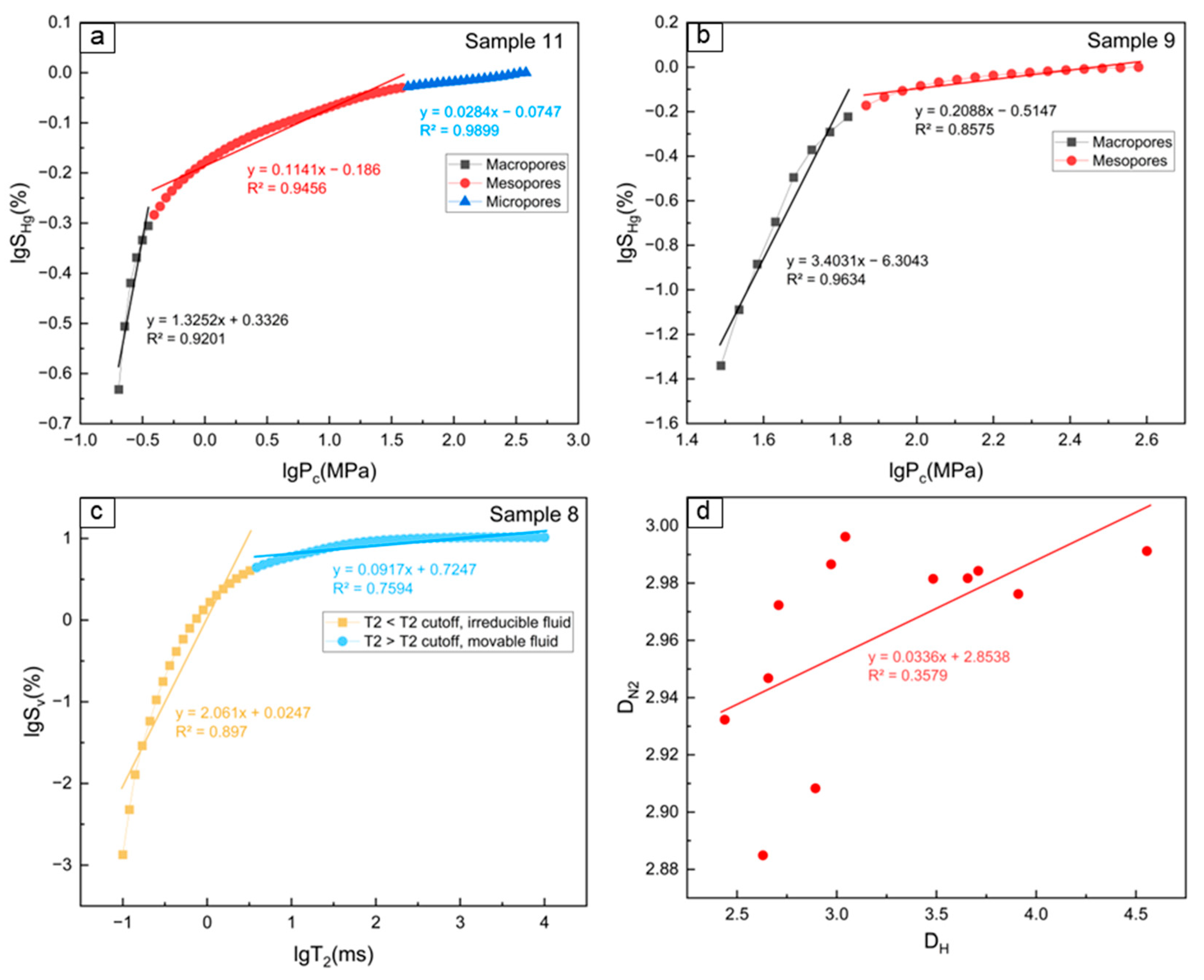
The fractal dimension results calculated based on the three-dimensional capillary model from both experimental methods indicate that the pore throats of the reservoirs in the study area exhibit multi-segment fractal characteristics, suggesting the presence of pore-throat systems with distinct independent features (Figure 6). The curves fitted from high-pressure mercury injection (HPMI) data show two or three segments (Figure 6a,b), with good fitting quality and clear inflection points. Based on these multi-segment fractal characteristics, the pore-throat systems can be divided into relatively large, medium, and small categories without fixed pore-size boundaries.
The 3D capillary model and its derived equations remain applicable and effective for characterizing such complex reservoirs. Although classical theory confines the Euclidean dimension D to the range of 2–3, values of D > 3 (or even significantly higher) are frequently observed in large pore-throat systems or united pore intervals, both in this study and in literature regarding strongly heterogeneous complex reservoirs [16,45,46,47]. The calculated D > 3 does not indicate model failure; rather, it reflects the extreme complexity of the pore geometry. According to fractal geometry and pore structure theories, interconnected pores form “spiky sphere”-like united pores. With a constant pore volume, these united pores, characterized by irregular internal surfaces and multiple throat connections, exhibit a specific surface area far exceeding that of ideal spheres [16]. This extremely high specific surface-to-volume ratio results in a steeper slope on the double-logarithmic plot of high-pressure mercury intrusion, mathematically yielding a fractal dimension numerically greater than 3. Furthermore, large pore-throat systems are often accompanied by significant differences in pore and throat radius (i.e., a high pore-throat ratio) [47]. Mercury must overcome high pressure to break through narrow throats before instantly filling the united pore space. This characteristic of “significant volume increase with minimal pressure rise” is mapped as exceptionally high dimension values in the fractal model, mathematically manifesting as a steepened fitting slope that causes the D value to exceed the geometric upper limit. In this context, the D value can serve as a structural complexity index characterizing the degree to which the pore structure deviates from an ideal smooth capillary bundle. Therefore, the model remains valid as it can quantitatively indicate the heterogeneity and connectivity complexity of the reservoir’s pore structure through the extent to which D exceeds 3. The overall fractal dimension for the entire pore space, obtained by weighting the fractal dimensions of each pore segment by their respective pore volumes, is calculated as follows:
D H = D 1 ϕ 1 + D 2 ϕ 2 + D 3 ϕ 3 ϕ 1 + ϕ 2 + ϕ 3
where D H is the total fractal dimension of the reservoir calculated from HPMI, D 1 is the fractal dimension of large-scale pore throats, ϕ 1 is the porosity contributed by large-scale pore throats, D 2 is the fractal dimension of medium-scale pore throats, ϕ 2 is the porosity contributed by medium-scale pore throats, D 3 is the fractal dimension of small-scale pore throats, and ϕ 3 is the porosity contributed by small-scale pore throats.
Comparison of fractal dimensions among different sample types shows that from Type I to Type III samples, the fractal dimension gradually increases, indicating progressively more complex pore structures and enhanced heterogeneity (Table 5). The total fractal dimension DH of Type I samples ranges from 2.6299 to 2.893, with an average of 2.6653, representing the simplest pore structure and weakest heterogeneity. Type II samples have DH values ranging from 2.9718 to 3.7092, averaging 3.3881, showing relatively more complex pore structures and stronger heterogeneity compared to Type I. Type III samples exhibit DH values from 3.043 to 4.5543, with an average of 3.7909, indicating the most complex pore structures and strongest heterogeneity. Dong et al. [47] calculated fractal dimensions ranging from 4 to 5.5 for complex reservoirs characterized by extremely strong heterogeneity, which is similar to the results obtained for the Type II and Type III samples with complex pore structures in this study. Although DH > 3, these values still hold clear physical significance for characterizing reservoir quality: values approaching 3 suggest that the pore structure tends toward complex space filling, whereas values significantly exceeding 3 indicate that the reservoir has entered a heterogeneous stage characterized by extremely complex pore-throat structures and highly irregular surfaces.
The fractal dimension of the movable fluid pore structure in sandstone reservoirs was calculated using scatter plots of logT2 versus logSv (Figure 6c). The scatter plot is divided into two parts at the T2 cutoff value. Data points with T2 < T2 cutoff represent pores containing irreducible fluid (irreducible pores), while those with T2 > T2 cutoff represent pores containing movable fluid (movable pores). For Type I samples, the average fractal dimension of irreducible pores (DN1) is 0.9157, and that of movable pores (DN2) is 2.9289. Type II samples have average (DN1) and (DN2) values of 1.106 and 2.9841, respectively. Type III samples show average (DN1) and (DN2) values of 0.9582 and 2.9863, respectively. Correlation analysis between DH and DN2 reveals a weak positive relationship (Figure 6d).

5. Discussion

5.1. Influence of Reservoir Physical Properties on Fractal Dimension and Fluid Mobility

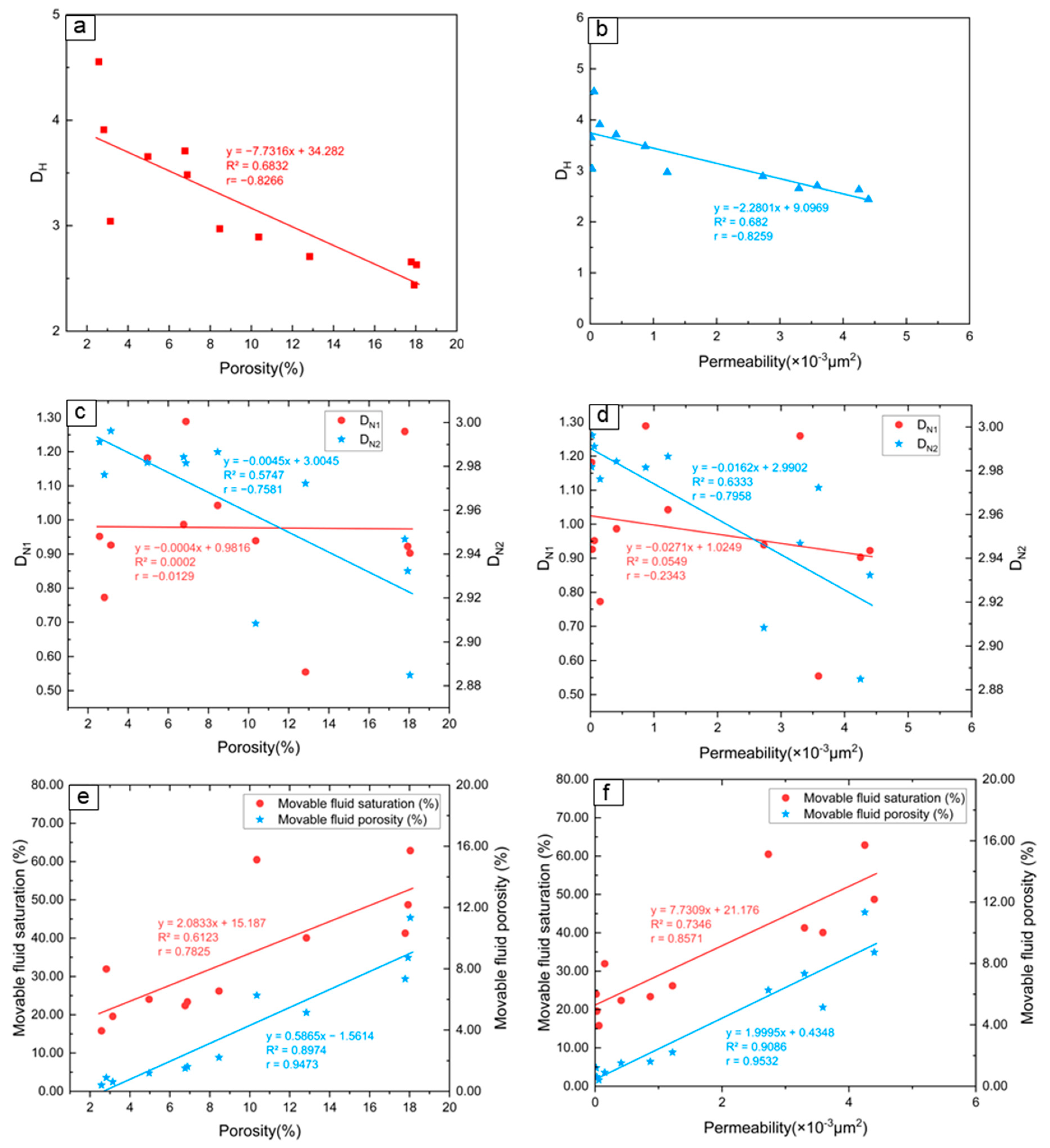
By comparatively analyzing the physical properties and fractal dimensions calculated by different methods, the intrinsic relationship between pore complexity at various scales and reservoir quality is revealed. The results indicate that reservoir porosity and permeability exhibit a strong negative correlation and a good degree of fit with the total pore fractal dimension (DH) derived from high-pressure mercury intrusion. Specifically, the correlation coefficients (r) are −0.8266 and −0.8259, and the coefficients of determination (R2) are 0.6832 and 0.682, respectively (Figure 7a,b). DH characterizes the overall heterogeneity of the full-scale pore-throat distribution. High-porosity and high-permeability reservoirs typically consist of relatively large pore throats with well-connected pore networks and relatively simple structures, resulting in lower DH values. In contrast, low-porosity and low-permeability reservoirs are filled with numerous fine, tortuous pore throats and exhibit rough pore surfaces and highly irregular structures, leading to significantly higher DH values due to their geometric complexity. Thus, DH can serve as an effective indicator for evaluating overall reservoir quality, with lower values indicating better physical properties.
The NMR-derived bound fluid fractal dimension (DN2) exhibits a poor negative correlation and a poor degree of fit with reservoir porosity and permeability. Specifically, the correlation coefficients (r) are −0.0129 and −0.2343, and the coefficients of determination (R2) are 0.0002 and 0.0549, respectively (Figure 7c,d). This is because DN2 reflects the structural complexity of micropores occupied by irreducible fluid (e.g., intercrystalline pores of clay minerals, micro-fractures), which contribute minimally to macroscopic physical properties. As a result, the correlation between pore structure complexity and physical properties is extremely weak. In contrast, the movable fluid fractal dimension (DN2) exhibits a good negative correlation and a moderate-to-good degree of fit with porosity and permeability. Specifically, the correlation coefficients (r) are −0.7581 and −0.7958, and the coefficients of determination (R2) are 0.5747 and 0.6333, respectively (Figure 7c,d). In reservoirs with better physical properties, the main flow pathways for fluids are relatively straighter and simpler, resulting in lower DN2 values. In reservoirs with poorer physical properties, even if some movable fluid pathways exist, these pathways are more tortuous and irregular, leading to higher DN2 values. Therefore, DN2 can serve as an indicator for evaluating the quality of “effective flow paths” in reservoirs.
Movable fluid porosity exhibits an excellent positive correlation and an excellent degree of fit with both total porosity and permeability. Specifically, the correlation coefficients (r) are 0.9473 and 0.9532, and the coefficients of determination (R2) are 0.8974 and 0.9086, respectively (Figure 7e,f). This indicates that porosity, as a measure of storage space, directly determines the absolute volume of movable fluid that the rock can accommodate, serving as the material basis for movable fluid occurrence. Permeability, as a key parameter characterizing pore network connectivity, implies that high permeability corresponds to large pore-throat sizes and good connectivity, enabling the formation of large-scale effective pore networks and providing space for high movable fluid content. Movable fluid saturation exhibits a good-to-excellent positive correlation and a good degree of fit with both porosity and permeability. Specifically, the correlation coefficients (r) are 0.7825 and 0.8571, and the coefficients of determination (R2) are 0.6123 and 0.7346, respectively (Figure 7e,f). As reservoir physical properties improve, not only does the absolute volume of movable fluid increase, but its proportion in the total pore fluid also rises. The mechanism behind this is that the large pore-throat structures in high-porosity and high-permeability reservoirs reduce capillary binding effects, lower irreducible water saturation, and thereby increase the relative proportion of movable fluid.

5.2. Influence of Pore Structure Parameters on Fractal Dimension and Fluid Mobility

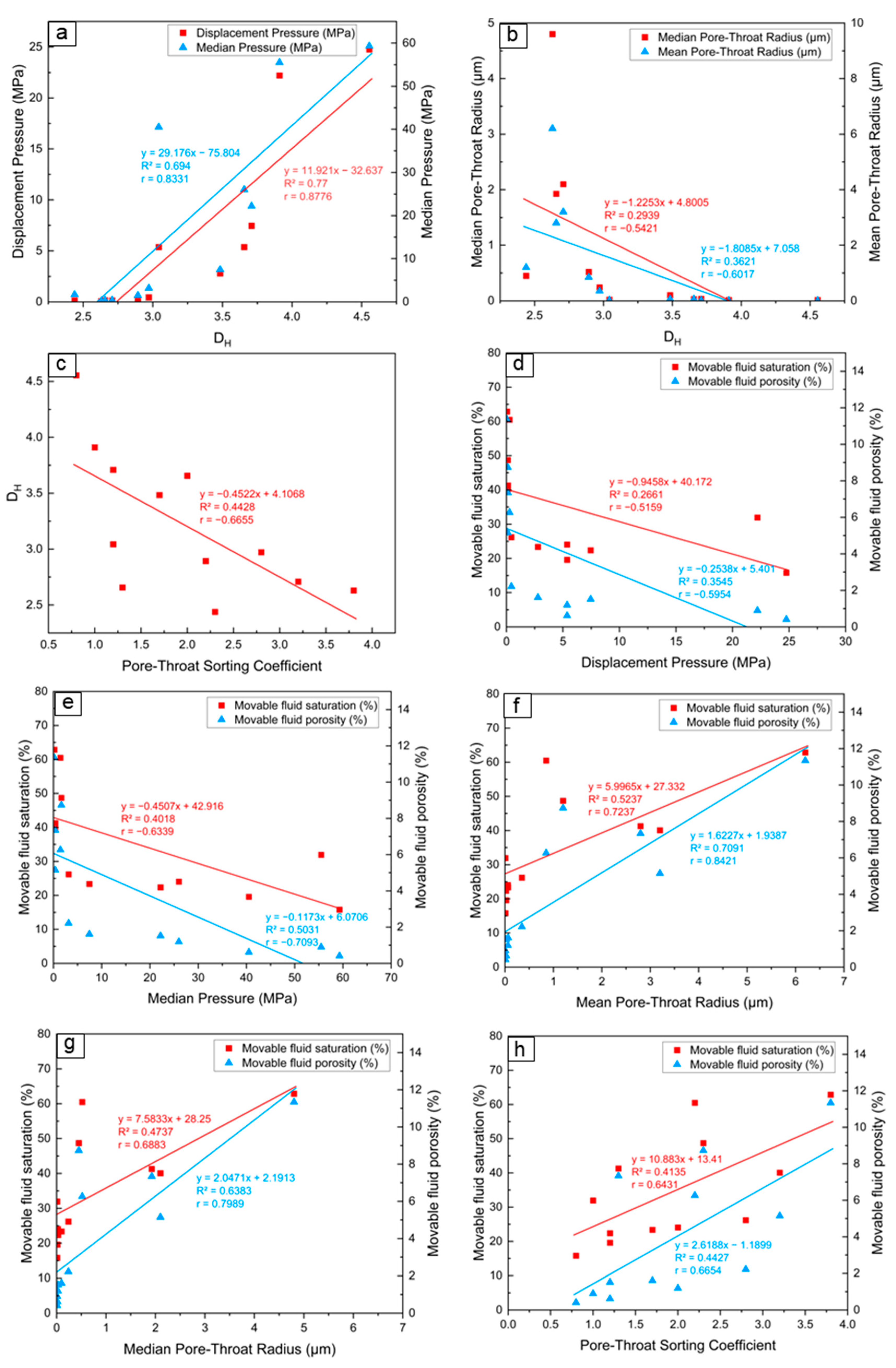
The total pore fractal dimension (DH) exhibits certain correlations with various pore-throat structure parameters, revealing the controlling effect of pore geometry on reservoir complexity. DH exhibits an excellent positive correlation and a good degree of fit with both displacement pressure and median pressure. Specifically, the correlation coefficients (r) are 0.8776 and 0.8331, and the coefficients of determination (R2) are 0.77 and 0.694, respectively (Figure 8a). Type I samples generally exhibit low displacement and median pressures (e.g., Sample 7: displacement pressure = 0.06 MPa, median pressure = 0.17 MPa), corresponding to relatively small DH values (DH = 2.6299). In contrast, Type III samples display extremely high displacement and median pressures (e.g., Sample 4: displacement pressure = 22.2 MPa, median pressure = 55.50 MPa), with correspondingly elevated DH values (DH = 3.9099). Higher displacement and median pressures indicate finer pore-throat radius and poorer pore connectivity. Reservoir structures composed of such fine, tortuous, and complex pore throats exhibit stronger geometric heterogeneity and irregularity, resulting in higher fractal dimensions.
DH exhibits a moderate-to-good negative correlation and a weak degree of fit with both average and median pore-throat radius. Specifically, the correlation coefficients (r) are −0.6017 and −0.5421, and the coefficients of determination (R2) are 0.3621 and 0.2939, respectively (Figure 8b). Type I samples possess relatively large pore throats (e.g., Sample 7: mean pore-throat radius = 6.20 μm, median pore-throat radius = 4.8 μm), characterized by relatively simple pore structures and smoother surfaces, leading to lower DH values. As the pore-throat radius decreases to the nanoscale (e.g., Type II and III samples), DH values increase. This suggests that as the dominant pore structure shifts toward nanoscale pore throats, pore morphology becomes more irregular, specific surface area increases dramatically, and tortuosity rises. This high complexity and spatial filling capacity at smaller scales are precisely reflected in higher fractal dimensions.
DH exhibits a good negative correlation and a moderate degree of fit with the pore-throat sorting coefficient. Specifically, the correlation coefficient (r) is −0.6655, and the coefficient of determination (R2) is 0.4428 (Figure 8c). Although Type I samples have large pore-throat radii, their pore-throat sorting coefficients are generally high (e.g., Sample 7: sorting coefficient = 3.80), indicating a wide distribution range of pore-throat sizes and poor sorting. However, due to the dominance of large pore throats, the overall structural complexity (DH) remains relatively low. In contrast, tight Type II and III reservoirs exhibit lower sorting coefficients (e.g., Sample 9: sorting coefficient = 0.80), indicating that although their pore-throat radii are extremely fine, their distribution is relatively concentrated. Despite good size sorting, the inherent extreme tortuosity and irregularity of micro–nanoscale channels result in very high DH values (e.g., Sample 9: DH = 4.5543).
The movable fluid parameters (movable fluid saturation and movable fluid porosity) exhibit a moderate negative correlation and a weak degree of fit with displacement pressure. Specifically, the correlation coefficients (r) are −0.5159 and −0.5954, and the coefficients of determination (R2) are 0.2661 and 0.3545, respectively (Figure 8d). The movable fluid parameters (movable fluid saturation and movable fluid porosity) exhibit a good negative correlation and a moderate degree of fit with median pressure. Specifically, the correlation coefficients (r) are −0.6339 and −0.7093, and the coefficients of determination (R2) are 0.4018 and 0.5031, respectively (Figure 8e). Type I samples, characterized by low displacement pressure, achieve the highest movable fluid saturation (up to 62.86% in Sample 7) and movable fluid porosity (up to 11.34% in Sample 7). In contrast, Type II and III samples show reduced movable fluid parameters. This is because higher displacement pressure indicates finer pore throats, which exhibit strong adsorption and retention capacity for bound water. In such fine pore throats, fluids experience significant capillary resistance and pronounced specific surface area effects, resulting in most fluids being trapped on pore surfaces or in dead-end pores, thereby drastically reducing the proportion of movable fluid.
The movable fluid parameters (movable fluid saturation and movable fluid porosity) exhibit a good-to-excellent positive correlation and a moderate-to-good degree of fit with the average pore-throat radius. Specifically, the correlation coefficients (r) are 0.7237 and 0.8421, and the coefficients of determination (R2) are 0.5237 and 0.7091, respectively (Figure 8f). The movable fluid parameters (movable fluid saturation and movable fluid porosity) exhibit a good positive correlation and a moderate-to-good degree of fit with the median pore-throat radius. Specifically, the correlation coefficients (r) are 0.6883 and 0.7989, and the coefficients of determination (R2) are 0.4737 and 0.6383, respectively (Figure 8g). Pore-throat radius is the most direct factor determining fluid mobility. The large pore throats in Type I samples provide broad flow pathways with weak capillary binding, facilitating fluid movement and resulting in high movable fluid porosity (e.g., 11.34% in Sample 7). As pore-throat radius decrease, particularly to the nanoscale in Type II and III samples, capillary forces increase exponentially, converting most pore water into bound water and nearly eliminating effective flow pathways, leading to extremely low movable fluid parameters (e.g., 15.8% movable fluid saturation and 0.41% movable fluid porosity in Sample 9).
The movable fluid parameters (movable fluid saturation and movable fluid porosity) exhibit a good positive correlation and a moderate degree of fit with the pore-throat sorting coefficient. Specifically, the correlation coefficients (r) are 0.6431 and 0.6654, and the coefficients of determination (R2) are 0.4153 and 0.4427, respectively (Figure 8h). For instance, Type I reservoir samples (e.g., Sample 7) exhibit a high sorting coefficient of 3.80, indicating a wide distribution of pore-throat sizes, yet achieve the highest movable fluid saturation of 62.86%. Conversely, Type II and III reservoirs (e.g., Sample 9) have low sorting coefficients (e.g., 0.80), reflecting uniform pore-throat sizes, but also show the lowest movable fluid saturation of 15.81%. The physical mechanism behind this phenomenon lies in the fact that a high sorting coefficient (poor sorting) implies the coexistence of pore throats with significantly different sizes. Although numerous fine pore throats are present, the existence of a few large or ultra-large pore throats creates “preferential pathways” for fluid flow, where capillary binding is weak, contributing the majority of movable fluid. In contrast, a low sorting coefficient indicates that the pore-throat radius in tight sandstone reservoirs are uniformly at the nanoscale, and the entire pore system exhibits strong capillary binding capacity, resulting in extremely low movable fluid parameters.

5.3. Influence of Mineral Content on Fractal Dimension and Fluid Mobility

5.3.1. Influence of Quartz Content on Fractal Dimension and Fluid Mobility

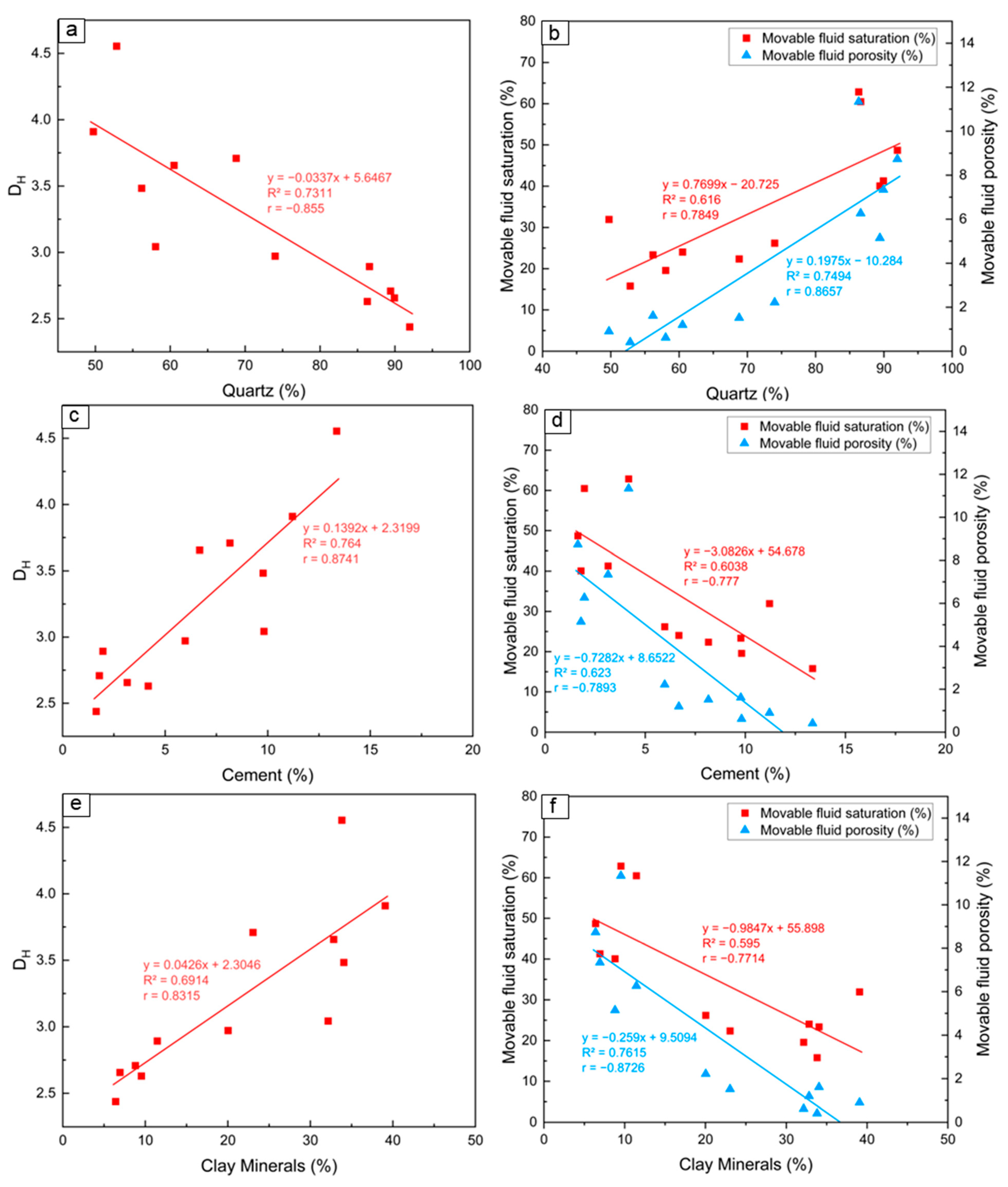
The results indicate that the quartz content in the reservoir exhibits an excellent positive correlation and a good degree of fit with DH. Specifically, the correlation coefficient (r) is 0.855, and the coefficient of determination (R2) is 0.7311. (Figure 9a). As the most dominant framework grain in reservoir rocks, quartz exhibits stable chemical properties, strong physical abrasion resistance, and generally regular particle morphology. Consequently, high quartz content indicates high compositional maturity and a relatively simple and stable rock support framework. This facilitates the preservation of primary intergranular pores, resulting in relatively straight pore network boundaries, good connectivity, and weak overall heterogeneity. For example, Sample 3, with a quartz content as high as 91.97%, exhibits a correspondingly low total fractal dimension (DH = 2.4385). This confirms that high quartz content forms the basis for simple pore structures, leading to lower fractal dimensions.
Quartz content exhibits a good-to-excellent positive correlation and a good degree of fit with both movable fluid saturation and movable fluid porosity. Specifically, the correlation coefficients (r) are 0.7849 and 0.8657, and the coefficients of determination (R2) are 0.616 and 0.7494, respectively (Figure 9b). Reservoirs with high quartz content generally experience relatively weak diagenetic alteration, and their pore structures are dominated by primary intergranular pores with larger pore-throat radii and relatively smaller specific surface areas. In such pore systems, fluids experience weaker capillary binding and grain surface adsorption, resulting in low irreducible water saturation, with most pore spaces occupied by free fluids. Therefore, both the proportion of movable fluid in the total pore fluid (movable fluid saturation) and its proportion in the total rock volume (movable fluid porosity) are relatively high. For instance, Type I samples generally exhibit high quartz content and significantly superior movable fluid parameters compared to Type II and III samples, with Sample 7 achieving a movable fluid porosity as high as 11.34%.

5.3.2. Influence of Clay Mineral Content on Fractal Dimension and Fluid Mobility

Clay mineral content exhibits an excellent positive correlation and a good degree of fit with DH. Specifically, the correlation coefficient (r) is 0.8741, and the coefficient of determination (R2) is 0.764 (Figure 9c). The clay minerals in the reservoirs of the study area are predominantly authigenic kaolinite. Kaolinite often fills primary intergranular pores in the form of booklet-like or vermicular aggregates, and itself contains numerous intercrystalline micropores. This filling pattern significantly alters the geometry of the original pores, making pore boundaries highly irregular and creating micro- to nanoscale complex structures within the macroscopic pores. This not only increases the specific surface area of the pores but also significantly enhances the tortuosity of the flow paths, leading to a sharp increase in the heterogeneity and complexity of the pore system. Consequently, higher clay mineral content results in more irregular pore structures across multiple scales and higher fractal dimensions. For example, Sample 4, with a clay content of 39.07%, exhibits a correspondingly high DH value of 3.9099.
Clay mineral content is a key factor limiting reservoir fluid mobility. Accordingly, it exhibits a good negative correlation and a good degree of fit with both movable fluid saturation and movable fluid porosity. Specifically, the correlation coefficients (r) are −0.777 and −0.7893, and the coefficients of determination (R2) are 0.6038 and 0.623, respectively (Figure 9d). Its detrimental effects are primarily manifested in two aspects: First, clay minerals, dominated by kaolinite, possess a large specific surface area and hydrophilicity. Through physical adsorption and the strong capillary action of micropores, they can trap significant volumes of fluid, which constitutes the main body of irreducible water and cannot participate in effective flow. Second, kaolinite aggregates can block pore-throats connecting pores, segmenting originally connected pores into isolated or semi-isolated pores, rendering the fluids within them immobile. Therefore, as clay mineral content increases, the irreducible water content of the reservoir rises sharply, and the effective flow space decreases, leading to a continuous decline in movable fluid parameters.
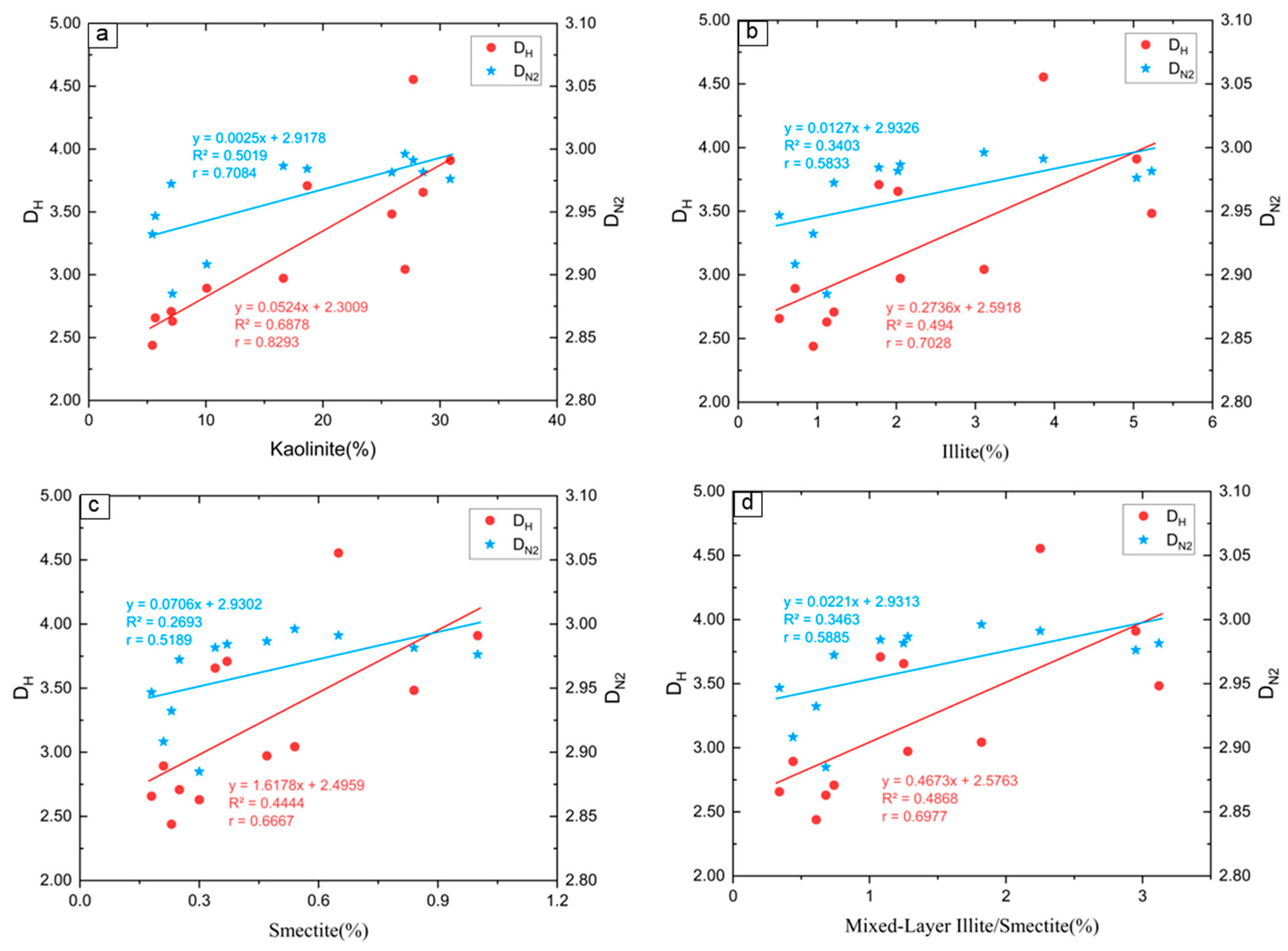
Kaolinite content, as the dominant clay mineral, exhibits a good positive correlation and a moderate degree of fit with both DH and DN2, with correlation coefficients (r) of 0.8293 and 0.7084, and coefficients of determination (R2) of 0.6878 and 0.5019, respectively (Figure 10a). This indicates that kaolinite, as the absolutely dominant clay mineral component in the study area, is the primary mineralogical factor leading to the complexification of the reservoir pore structure and increasing its heterogeneity. The contents of other clay minerals (illite, smectite, and mixed-layer illite/smectite) are relatively low. The variations in DH and DN2 induced by differences in their content are less pronounced compared to kaolinite, but they still exhibit moderate-to-good positive correlations and weak-to-moderate degrees of fit with DH and DN2. Specifically, the correlation coefficients (r) for illite content with DH and DN2 are 0.7028 and 0.5833 (Figure 10b), respectively; for smectite, they are 0.6667 and 0.5189 (Figure 10c); and for mixed-layer illite/smectite (I/S), they are 0.6977 and 0.5885 (Figure 10d). This suggests that despite their lower content, Illite, smectite, and mixed-layer illite/smectite (I/S) still contribute to the heterogeneity of the pore-throat structure by filling pore throats or developing intercrystalline micropores, though their influence is less significant than that of kaolinite. Notably, the correlations and goodness-of-fit for all types of clay minerals with DH are consistently higher than with DN2. This is because clay minerals primarily increase the surface area and geometric complexity of the overall pore space (i.e., DH) by developing abundant micropores and intercrystalline micropores. In contrast, DN2 characterizes the effective pore network occupied by movable fluids. Since the bound water space within and adsorbed onto the surface of clay minerals cannot be captured by DN2, the correlation between clay content and DN2 is relatively weaker.

5.3.3. Influence of Cement Content on Fractal Dimension and Fluid Mobility

Cement content exhibits an excellent positive correlation and a good degree of fit with DH. Specifically, the correlation coefficient (r) is 0.8315, and the coefficient of determination (R2) is 0.6914 (Figure 9e). The study area exhibits diverse cement types, primarily including calcite, carbonate minerals, and heavy minerals. These cements are products of mid-to-late diagenesis, precipitated between detrital grains in the form of pore-filling. Cementation is a typical destructive diagenetic process that irregularly occupies original pore spaces, resulting in highly complex and irregular residual pore morphologies. Stronger cementation leads to greater alteration and segmentation of original pores, more tortuous boundaries of residual pores, and consequently enhanced heterogeneity of the pore network. Therefore, high cement content inevitably results in high fractal dimensions. For example, Sample 9, with a cement content of 13.36%, exhibits the highest DH value among all samples (4.5543).
The destructive effect of cement on movable fluid parameters is significant. Cement content exhibits a good-to-excellent negative correlation and a moderate-to-good degree of fit with movable fluid saturation and movable fluid porosity. Specifically, the correlation coefficients (r) are −0.7714 and −0.8726, and the coefficients of determination (R2) are 0.595 and 0.7615, respectively (Figure 9f). Cement occupies the effective pore space that could otherwise store movable fluid, directly leading to a reduction in total porosity. More critically, cement preferentially precipitates at pore throats, significantly reducing throat radius or even completely blocking them, thereby severely impairing pore connectivity and causing a sharp decline in permeability. This renders a large proportion of pores ineffective or inefficient for storage. Consequently, higher cement content results in lower effective porosity and movable fluid saturation in the reservoir. For instance, Type III samples, which generally have high cement content, exhibit movable fluid porosity values all below 1.2%.

5.4. Relationship Between Fractal Dimension and Fluid Mobility

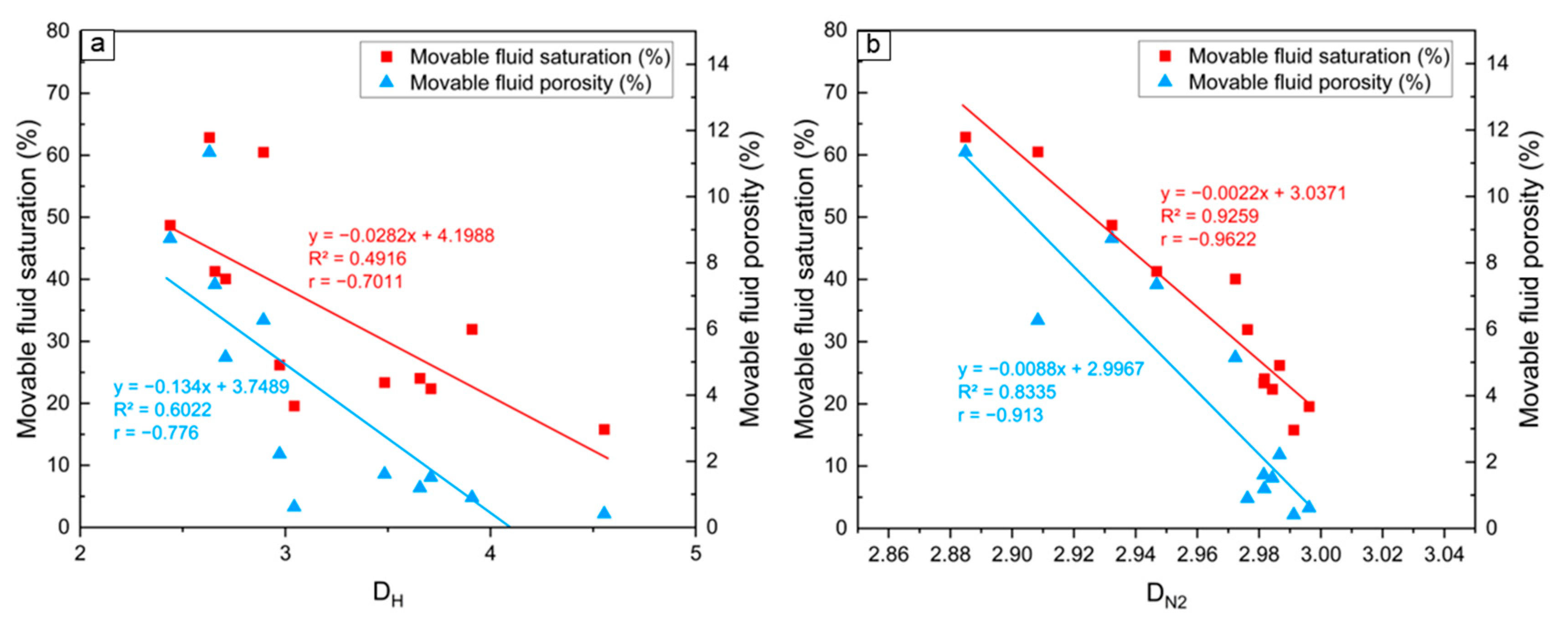
By comparatively analyzing the total pore fractal dimension (DH) calculated from high-pressure mercury injection and the movable fluid pore fractal dimension (DN2) derived from NMR T2 spectra, the controlling mechanism of pore structure complexity at different scales on fluid mobility is revealed. The total fractal dimension (DH)) exhibits a good negative correlation with both movable fluid saturation and movable fluid porosity, with correlation coefficients (r) of −0.7011 and −0.776, respectively (Figure 11a). DH quantifies the overall geometric complexity of the full pore-throat size distribution from the nanoscale to the microscale. A higher DH value indicates strong reservoir heterogeneity, a significant volumetric proportion of fine pore throats and ineffective pores, and rougher pore surfaces. This leads to a larger proportion of fluids being bound by capillary forces or trapped in dead-end pores, thereby macroscopically limiting the storage space for movable fluids.
The movable fluid fractal dimension (DN2) exhibits an excellent negative correlation with both movable fluid saturation and movable fluid porosity, with correlation coefficients of −0.9622 and −0.913, respectively (Figure 11b). To quantitatively verify the sensitivity and precision of fractal dimensions as indicators for reservoir dynamic quality, this study conducted a comparative analysis of the predictive performance of DH and DN2 for movable fluid saturation and movable fluid porosity, respectively. Statistical analysis shows that the coefficient of determination (R2) between DH and movable fluid saturation is only 0.4916, indicating that it explains only about 49.2% of the data variance. In contrast, DN2 exhibits an extremely strong linear correlation, with its R2 significantly improved to 0.9259. Through the introduction of residual variance analysis, it was quantified that replacing DH with DN2 results in an 85.42% relative reduction in the prediction residual variance. This implies that DN2 captures changes in fluid occurrence states with extreme sensitivity. Similarly, DH shows limited explanatory power for movable fluid porosity (R2 = 0.6002), leaving approximately 40% of the variance unexplained. Conversely, the (R2) for DN2 reaches 0.8335, indicating it can more accurately characterize the volumetric features of the effective reservoir space. Calculation results demonstrate that the DN2-based prediction model reduces the residual variance by 58.35%.
Synthesizing the results of both parameters, DN2 reduces the prediction error for dynamic quality by over 70% on average compared to DH, which incorporates full-aperture information. This quantitative evidence strongly confirms that, unlike DH, which reflects the static and overall heterogeneity of the reservoir, DN2 reflects the quality of reservoir dynamic transport properties more directly and sensitively. By quantifying the quality of effective flow paths, DN2 provides a significantly more reliable fractal indicator for the accurate prediction of fluid mobility and the evaluation of reservoir development potential.

6. Conclusions

(1) The sandstone lithology of the twelve sandstone samples from the Nahr Umr-B Member in the study area is predominantly quartz arenite. Reservoir pore types are mainly intergranular pores, secondary dissolution pores, and intercrystalline pores, with throat geometries dominated by sheet-like, curved sheet-like, and point-shaped types. Based on capillary pressure curves and pore-throat structural parameters, the pore-throat structures of the sandstone reservoirs can be classified into Types I, II, and III, corresponding to Type I, II, and III reservoirs, respectively. From Type I to Type III reservoirs, displacement pressure and median pressure progressively increase, while the average pore-throat radius, median pore-throat radius, and pore-throat sorting coefficient systematically decrease. This evolution reflects a continuous deterioration in pore connectivity, a significant increase in fluid flow resistance, and a gradual reduction in the development of larger pore throats.
(2) Fractal curves transformed from HPMI data exhibit distinct multi-segment fractal characteristics. Successive inflection points allow for the division into three relatively scaled pore-throat systems (large, medium, and small) without fixed pore-size boundaries. The overall fractal dimension (DH) for the entire pore space was obtained by weighting the fractal dimensions of each segment by their respective pore volumes. DH increases progressively from Type I to Type III reservoirs, indicating a systematic increase in pore structure complexity and pore heterogeneity. The movable fluid pore fractal dimension (DN2), calculated from NMR data, also shows a gradual increase from Type I to Type III reservoirs, demonstrating heightened complexity within the movable fluid pore network. Concurrently, both movable fluid saturation and movable fluid porosity exhibit a marked decreasing trend, confirming a gradual weakening in fluid mobility.
(3) Fractal dimensions and fluid mobility are governed by reservoir physical properties, pore structure parameters, and mineral composition. Superior reservoir quality (approaching Type I characteristics), higher quartz content, and lower cement and clay mineral contents correlate strongly with lower fractal dimensions and enhanced fluid mobility.
(4) Although DH can quantify the complexity of the entire pore space, its predictive accuracy for dynamic parameters is limited. Compared to DH, DN2 reduces the prediction error for dynamic quality by over 70% on average, thereby offering a more reliable prediction of fluid mobility and providing a more precise scale for evaluating reservoir development potential. Future research could further explore the applicability of DN2 in reservoirs of different lithologies and integrate it with multi-physics approaches (such as CT scanning) and advanced imaging techniques to achieve a more comprehensive understanding and prediction of reservoir performance.

Author Contributions

All the authors actively contributed to the preparation of this research article. Data curation, methodology, and funding acquisition, M.F.; writing—original draft and writing—review and editing, T.L.; funding acquisition, investigation, project administration, and resources, Y.D., J.X. and R.G.; formal analysis, software, and validation, R.W.; writing—review and editing, M.F. All authors have read and agreed to the published version of the manuscript.

Funding

This research was funded by the Research Institute of Petroleum Exploration & Development (Grants: RIPED-2023-JS-1986).

Data Availability Statement

The data that support the findings of this study are available from the corresponding author upon reasonable request.

Acknowledgments

The authors gratefully thank the main editors and anonymous reviewers for their valuable comments and suggestions leading to improvement of this paper.

Conflicts of Interest

Authors Ya Deng, Jiacheng Xu, and Rui Guo are employed by the company Research Institute of Petroleum Exploration & Development. The remaining authors declare that the research was conducted in the absence of any commercial or financial relationships that could be construed as a potential conflict of interest.

References

  1. Ji, Y.D.; Zhu, K.P.; Li, K.; Zhao, C.H.; Liu, K.D.; Ning, D.Y.; Liu, X.; Yan, P.Z.; Zhao, S.X. Study on the microscopic pore structure and seepage mechanism of the Luohe Formation sandstone in the roof of coal seams in the Huanglong Coalfield. Sci. Rep. 2025, 15, 33568. [Google Scholar] [CrossRef]
  2. Li, J.L.; Ji, L.L.; Jiang, W.B.; Lin, M.; Mao, M.; Wei, X.L.; Cao, G.H.; Qin, F. Investigation of pore structures and flow transport characteristics of continental shale in Dongying Sag. J. Pet. Explor. Prod. Technol. 2025, 15, 163. [Google Scholar] [CrossRef]
  3. Liu, S.; Wang, M.; Cheng, Y.L.; Yu, X.N.; Duan, X.M.; Kang, Z.; Xiong, Y.X. Fractal insights into permeability control by pore structure in tight sandstone reservoirs, Heshui area, Ordos Basin. Open Geosci. 2025, 17, 20250791. [Google Scholar] [CrossRef]
  4. Lin, W.; Zhao, X.L.; Li, M.T.; Zhuang, Y. Pore Structure Characterization and Fractal Characteristics of Tight Limestone Based on Low-Temperature Nitrogen Adsorption and Nuclear Magnetic Resonance. Fractal Fract. 2024, 8, 371. [Google Scholar] [CrossRef]
  5. Tang, L.D.; Zhang, Y.B.; Tang, X.Y.; Zhang, Q.H.; Chen, M.J.; Pei, X.H.; Kang, Y.; Zhang, Y.G.; Liu, Y.T.; Zhou, B.H. Pore Structure and Fractal Characteristics of Kelasu Ultra-Deep Tight Sandstone Gas Reservoirs. Processes 2025, 13, 3074. [Google Scholar] [CrossRef]
  6. Zhang, H.R.; Yuan, Y.; Chen, J.W.; Liang, J.; Zhao, H.L. Pore Structure Characteristics and Reservoir Classification of Tight Sandstones within the Upper Permian Longtan Formation in the Laoshan Uplift, South Yellow Sea Basin: Implications for Hydrocarbon Exploration. J. Mar. Sci. Eng. 2024, 12, 732. [Google Scholar] [CrossRef]
  7. Chang, B.; Tong, Q.; Cao, C.; Zhang, Y.D. Effect of pore-throat structure on movable fluid and gas–water seepage in tight sandstone from the southeastern Ordos Basin, China. Sci. Rep. 2025, 15, 7714. [Google Scholar] [CrossRef]
  8. Kang, Y.; Zhu, R.K.; Liu, K.Q.; Zhang, J.Y.; Liu, C. Pore Fractal and Structure Analysis of Pore-Filling Chlorite in Continental Shales: A Case Study from the Qingshankou Formation in the Gulong Sag. Fractal Fract. 2025, 9, 266. [Google Scholar] [CrossRef]
  9. Zhao, X.L.; Yang, Z.M.; Zhou, S.B.; Luo, Y.T.; Liu, X.W.; Zhang, Y.P.; Lin, W.; Xiao, Q.H.; Niu, Z.K. Research on Characterization and Heterogeneity of Microscopic Pore Throat Structures in Tight Oil Reservoirs. ACS Omega 2021, 6, 24672–24682. [Google Scholar] [CrossRef] [PubMed]
  10. Wang, J.Y.; Jiang, F.J.; Zhang, C.L.; Song, Z.Z.; Mo, W.L. Study on the Pore Structure and Fractal Dimension of Tight Sandstone in Coal Measures. Energy Fuels 2021, 35, 3887–3898. [Google Scholar] [CrossRef]
  11. Li, C.Y.; Dai, W.H.; Luo, B.F.; Pi, J.; Liu, Y.S.; Zhang, Y. New fractal-dimension-based relation model for estimating absolute permeability through capillary pressure curves. J. Pet. Sci. Eng. 2021, 196, 107672. [Google Scholar] [CrossRef]
  12. Wang, L.H.; Li, X.F.; Wang, J.J.; Zhang, H.B.; Shi, H.G.; Liu, G.F.; Yang, D.Y. Effect of pore-throat structure on irreducible water saturation and gas seepage capacity in a multilayer tight sandstone gas reservoir. Geoenergy Sci. Eng. 2025, 249, 213787. [Google Scholar] [CrossRef]
  13. Xia, Y.X.; Cai, J.C.; Perfect, E.; Wei, W.; Zhang, Q.; Meng, Q.B. Fractal dimension, lacunarity and succolarity analyses on CT images of reservoir rocks for permeability prediction. J. Hydrol. 2019, 579, 124198. [Google Scholar] [CrossRef]
  14. Zhang, F.; Jiang, Z.X.; Sun, W.; Li, Y.H.; Zhang, X.; Zhu, L.; Wen, M. A multiscale comprehensive study on pore structure of tight sandstone reservoir realized by nuclear magnetic resonance, high pressure mercury injection and constant-rate mercury injection penetration test. Mar. Pet. Geol. 2019, 109, 208–222. [Google Scholar] [CrossRef]
  15. Wang, W.; Wang, R.Y.; Wang, L.N.; Qu, Z.Y.; Ding, X.Y.; Gao, C.L.; Meng, W.C. Pore structure and fractal characteristics of tight sandstones based on nuclear magnetic resonance: A case study in the Triassic Yanchang Formation of the Ordos Basin, China. ACS Omega 2023, 8, 16284–16297. [Google Scholar] [CrossRef] [PubMed]
  16. Wu, X.B.; Du, Z.W.; Qiang, X.L.; Lei, T.; Jiang, T.T.; Wang, W.; Zhu, Y.S. Binary pore structure and fractal characteristics of tight sandstone: A case study of Chang 7 Member of Triassic Yanchang Formation in Ordos Basin. Pet. Geol. Recovery Effic. 2024, 31, 45–56. (In Chinese) [Google Scholar] [CrossRef]
  17. Wu, B.H.; Xie, R.H.; Wang, X.Y.; Wang, T.Y.; Yue, W.Z. Characterization of pore structure of tight sandstone reservoirs based on fractal analysis of NMR echo data. J. Nat. Gas Sci. Eng. 2020, 81, 103483. [Google Scholar] [CrossRef]
  18. Teng, Y.X.; Er, C.; Zhao, J.Z.; Guo, Q.Q.; Shen, C.M.; Tan, S.J. Pore structure characterization based on NMR experiment: A case from the Shanxi Formation tight sandstones in the Daning-Jixian area, eastern Ordos Basin. Energy Geosci. 2023, 4, 100192. [Google Scholar] [CrossRef]
  19. Guo, X.B.; Huang, Z.L.; Zhao, L.B.; Han, W.; Ding, C.; Sun, X.W.; Yan, R.T.; Zhang, T.H.; Yang, X.J.; Wang, R.M. Pore structure and multi-fractal analysis of tight sandstone using MIP, NMR and NMRC methods: A case study from the Kuqa depression, China. J. Pet. Sci. Eng. 2019, 178, 544–558. [Google Scholar] [CrossRef]
  20. Zhang, H.T.; Li, G.R.; Guo, H.P.; Zhang, W.J.; Wang, Y.M.; Li, W.B.; Zhou, J.Y.; Wang, C.S. Applications of nuclear magnetic resonance (NMR) logging in tight sandstone reservoir pore structure characterization. Arab. J. Geosci. 2020, 13, 1–8. [Google Scholar] [CrossRef]
  21. Verma, M.K.; Ahlbrandt, T.S.; Al-Gailani, M. Petroleum reserves and undiscovered resources in the total petroleum systems of Iraq: Reserve growth and production implications. GeoArabia 2004, 9, 51–74. [Google Scholar] [CrossRef]
  22. Al-Dabbas, M.A.; Al-Jassim, J.A.; Qaradaghi, A.I. Siliciclastic deposit of the Nahr Umr Formation, sedimentological and depositional environment studies, central and southern Iraq. Arab. J. Geosci. 2013, 6, 4771–4783. [Google Scholar] [CrossRef]
  23. Lyu, Z.; Wang, Y.P.; Wang, Y.J.; Dai, H.S.; Zhu, G.Y.; Mu, L.F. Controlling Factors on Physical Properties of Cretaceous Nahr Umr Formation Sandstone Reservoir in Halfaya Oilfield, Iraq. J. Earth Sci. Environ. 2019, 41, 707–720. (In Chinese) [Google Scholar]
  24. Zhu, X.E.; Jin, Z.K.; Yi, S.; Wei, K.; Li, Y. Sedimentary characteristics and depositional environment of clastie deposits: The Cretaceous Nahr Umr formation, Halfaya oilfield, Iraq. China Sci. 2023, 18, 956–965+986. (In Chinese) [Google Scholar]
  25. Al-Juboury, A.I.A. The Upper Miocene Injana (Upper Fars) Formation of Iraq: Insights on provenance history. Arab. J. Geosci. 2009, 2, 337–364. [Google Scholar] [CrossRef]
  26. Athersuch, J. Ostracod faunas from the Halul, Laffan and Nahr Umr Formations of offshore Abu Dhabi, U.A.E. J. Micropalaeontol. 1987, 6, 1–10. [Google Scholar] [CrossRef]
  27. Wang, L.M.; Cheng, L.; Yin, S.H.; Chen, W.; Li, H.J.; Li, S.; Zhang, C. Pore structure evolution and fractal characteristics of sandstone uranium ore under different leaching temperatures. Powder Technol. 2025, 454, 120713. [Google Scholar] [CrossRef]
  28. Wang, W.G.; Lin, C.Y.; Zhang, X.G. Fractal Dimension Analysis of Pore Throat Structure in Tight Sandstone Reservoirs of Huagang Formation: Jiaxing Area of East China Sea Basin. Fractal Fract. 2024, 8, 374. [Google Scholar] [CrossRef]
  29. Jiang, F.J.; Zhang, C.L.; Wang, K.; Zhao, Z.F.; Zhong, K.S. Characteristics of micropores, pore throats, and movable fluids in the tight sandstone oil reservoirs of the Yanchang Formation in the southwestern Ordos Basin, China. AAPG Bull. 2019, 103, 2835–2859. [Google Scholar] [CrossRef]
  30. Zang, Q.B.; Liu, C.L.; Awan, R.S.; Yang, X.Y.; Li, G.X.; Wu, Y.P.; Lu, Z.D.; Feng, D.H. Occurrence characteristics of the movable fluid in heterogeneous sandstone reservoir based on fractal analysis of NMR data: A case study of the Chang 7 Member of Ansai Block, Ordos Basin, China. J. Pet. Sci. Eng. 2022, 214, 110499. [Google Scholar] [CrossRef]
  31. Zhang, Q.P.; Yang, C.; Tian, Y.; Liu, H.; Xiao, W.; Wang, Z.K.; Mi, Z.R.; Li, Z.Y.; Huo, Y.; Li, Y.; et al. Effect of microscopic pore–throat structure heterogeneity on waterflooding seepage characteristics of tight sandstone reservoirs. Open Geosci. 2025, 17, 20250798. [Google Scholar] [CrossRef]
  32. Li, P.; Shen, B.J.; Liu, Y.L.; Bi, H.; Liu, Z.B.; Bian, R.K.; Wang, P.W.; Li, P. The fractal characteristics of the pore throat structure of tight sandstone and its influence on oil content: A case study of the Chang 7 Member of the Ordos Basin, China. Pet. Sci. 2025, 22, 2262–2273. [Google Scholar] [CrossRef]
  33. Zhang, H.M.; Li, X.J.; Liu, J.F.; Wang, Y.P.; Guo, L.; Wu, Z.Y.; Tian, Y.F. A Fractal Characteristics Analysis of the Pore Throat Structure in Low-Permeability Sandstone Reservoirs: A Case Study of the Yanchang Formation, Southeast Ordos Basin. Fractal Fract. 2025, 9, 224. [Google Scholar] [CrossRef]
  34. Wang, F.Y.; Jiao, L.; Liu, Z.C.; Tan, X.Q.; Wang, C.L.; Gao, J. Fractal analysis of pore structures in low permeability sandstones using mercury intrusion porosimetry. J. Porous Media 2018, 21, 1097–1119. [Google Scholar] [CrossRef]
  35. Wang, W.R.; Yue, D.L.; Eriksson, K.A.; Qu, X.F.; Li, W.; Lyu, M.; Zhang, J.Q.; Zhang, X.T. Quantification and Prediction of Pore Structures in Tight Oil Reservoirs Based on Multifractal Dimensions from Integrated Pressure- and Rate-Controlled Porosimetry for the Upper Triassic Yanchang Formation, Ordos Basin, China. Energy Fuels 2020, 34, 4366–4383. [Google Scholar] [CrossRef]
  36. Lai, J.; Wang, G.W.; Zheng, Y.Q.; Li, W.L.; Cai, C. Method for calculating the fractal dimension of the pore structure of low permeability reservoirs: A case study on the Xujiahe formation reservoir in central Sichuan Basin. J. Northeast Pet. Univ. 2013, 37, 1–7. (In Chinese) [Google Scholar] [CrossRef]
  37. Li, K.W. Analytical derivation of Brooks–Corey type capillary pressure models using fractal geometry and evaluation of rock heterogeneity. J. Pet. Sci. Eng. 2010, 73, 20–26. [Google Scholar] [CrossRef]
  38. Song, Z.Z.; Liu, G.D.; Yang, W.W.; Zou, H.Y.; Sun, M.L.; Wang, X.L. Multi-fractal distribution analysis for pore structure characterization of tight sandstone—A case study of the Upper Paleozoic tight formations in the Longdong District, Ordos Basin. Mar. Pet. Geol. 2018, 92, 842–854. [Google Scholar] [CrossRef]
  39. Wang, Z.F.; Yao, Y.B.; Ma, R.Y.; Zhang, X.N.; Zhang, G.B. Application of Multifractal Analysis Theory to Interpret T2 Cutoffs of NMR Logging Data: A Case Study of Coarse Clastic Rock Reservoirs in Southwestern Bozhong Sag, China. Fractal Fract. 2023, 7, 57. [Google Scholar] [CrossRef]
  40. Zhang, Z.Y.; Weller, A. Fractal dimension of pore-space geometry of an Eocene sandstone formation. Geophysics 2014, 79, D377–D387. [Google Scholar] [CrossRef]
  41. Huang, H.X.; Li, R.X.; Xiong, F.Y.; Hu, H.; Sun, W.; Jiang, Z.X.; Chen, L.; Wu, L. A method to probe the pore-throat structure of tight reservoirs based on low-field NMR: Insights from a cylindrical pore model. Mar. Pet. Geol. 2020, 117, 104344. [Google Scholar] [CrossRef]
  42. Xu, Y.Q.; Liu, L.Y.; Zhu, Y.S. Characteristics of movable fluids in tight sandstone reservoir and its influencing factors: A case study of Chang 7 reservoir in the Southwestern of Ordos Basin. J. Pet. Explor. Prod. Technol. 2021, 11, 3493–3507. [Google Scholar] [CrossRef]
  43. Li, P.; Jia, C.Z.; Jin, Z.J.; Liu, Q.Y.; Zheng, M.; Huang, Z.K. The characteristics of movable fluid in the Triassic lacustrine tight oil reservoir: A case study of the Chang 7 member of Xin’anbian Block, Ordos Basin, China. Mar. Pet. Geol. 2019, 102, 126–137. [Google Scholar] [CrossRef]
  44. Zhang, H.M.; Guo, L.; Wu, Z.Y.; Ma, J.B. Pore-throat structure, fractal characteristics and permeability prediction of tight sandstone: The Yanchang Formation, Southeast Ordos Basin. Sci. Rep. 2024, 14, 27913. [Google Scholar] [CrossRef]
  45. Lai, J.; Wang, G.W.; Fan, Z.Y.; Chen, J.; Wang, S.C.; Zhou, Z.L.; Fan, X.Q. Insight into the pore structure of tight sandstones using NMR and HPMI measurements. Energy Fuels 2016, 30, 10200–10214. [Google Scholar] [CrossRef]
  46. Rahimi, R.; Bagheri, M.; Masihi, M. Characterization and estimation of reservoir properties in a carbonate reservoir in Southern Iran by fractal methods. J. Pet. Explor. Prod. Technol. 2018, 8, 31–41. [Google Scholar] [CrossRef]
  47. Dong, X.X.; Meng, X.Z.; Pu, R.H. Occurrence characteristics of movable fluids based on the division of pore throat system in tight gas reservoir by fractal theory. Nat. Gas Ind. 2023, 43, 78–90. [Google Scholar] [CrossRef]
Figure 1. Geological setting: (a) regional tectonic map of Iraq (modified after [25]); (b) location map of the study area; (c) structural map of the study area; (d) composite stratigraphic column.
Fractalfract 10 00015 g001
Figure 2. Pore-throat characteristics under polarized light microscopy and scanning electron microscopy: (a) subangular–subrounded particle roundness with predominantly point-line contacts, casting thin section, Sample 11; (b) ankerite cement, pyrite cement, and siderite cement, casting thin section, Sample 7; (c) quartz overgrowth and kaolinite with intercrystalline pores, SEM, Sample 7; (d) triangular, polygonal, and irregular intergranular pores, and secondary dissolution pores, casting thin section, Sample 2; (e) sheet-like, curved sheet-like, and point-shaped throats, casting thin section, Sample 11; (f) tubular throats, SEM, Sample 2.
Fractalfract 10 00015 g002
Figure 3. K-means clustering results based on petrophysical properties (porosity) and pore-throat characteristic parameters (peak pore-throat radius).
Fractalfract 10 00015 g003
Figure 4. Capillary pressure curves and pore-throat radius distribution curves for different samples in the study area: (a) capillary pressure curves for Type I samples; (b) normalized pore size distribution curves for Type I samples; (c) capillary pressure curves for Type II samples; (d) normalized pore size distribution curves for Type II samples; (e) capillary pressure curves for Type III samples; (f) normalized pore size distribution curves for Type III samples.
Fractalfract 10 00015 g004
Figure 5. Schematic diagram of determining movable fluid saturation using the T2 cutoff method and NMR T2 spectra of the three sample types: (a) schematic diagram of determining movable fluid saturation using the T2 cutoff method; (b) NMR T2 spectrum of Type I samples; (c) NMR T2 spectrum of Type II samples; (d) NMR T2 spectrum of Type III samples.
Fractalfract 10 00015 g005
Figure 6. Fractal characteristics calculated by different experimental methods: (a) three-segment fractal characteristics from high-pressure mercury injection; (b) two-segment fractal characteristics from high-pressure mercury injection; (c) fractal characteristics from nuclear magnetic resonance; (d) cross-plot of DH versus DN2.
Fractalfract 10 00015 g006
Figure 7. Cross-plots of reservoir physical parameters versus fractal dimensions and fluid mobility parameters: (a) cross-plot of total fractal dimension (DH) versus porosity; (b) cross-plot of total fractal dimension (DH) versus permeability; (c) cross-plot of irreducible fluid pore fractal dimension (DN1) and movable fluid pore fractal dimension (DN2) versus porosity; (d) cross-plot of irreducible fluid pore fractal dimension (DN1) and movable fluid pore fractal dimension (DN2) versus permeability; (e) cross-plot of porosity versus movable fluid parameters; (f) cross-plot of permeability versus movable fluid parameters.
Fractalfract 10 00015 g007
Figure 8. Cross-plots of pore structure characteristic parameters versus fractal dimensions and fluid mobility parameters: (a) cross-plot of DH versus displacement pressure and median pressure; (b) cross-plots of DH versus mean pore-throat radius and median pore-throat radius; (c) cross-plot of DH versus pore-throat sorting coefficient; (d) cross-plot of movable fluid parameters versus displacement pressure; (e) cross-plot of movable fluid parameters versus median pressure; (f) cross-plot of movable fluid parameters versus mean pore-throat radius; (g) cross-plot of movable fluid parameters versus median pore-throat radius; (h) cross-plot of movable fluid parameters versus pore-throat sorting coefficient.
Fractalfract 10 00015 g008
Figure 9. Cross-plots of different rock mineral contents versus fractal dimensions and fluid mobility parameters: (a) cross-plot of quartz content versus DH; (b) cross-plot of quartz content versus movable fluid parameters; (c) cross-plot of cement content versus DH; (d) cross-plot of cement content versus movable fluid parameters; (e) cross-plot of clay mineral content versus DH; (f) cross-plot of clay mineral content versus movable fluid parameters.
Fractalfract 10 00015 g009
Figure 10. Cross-plots of different clay minerals versus DH and DN2: (a) cross-plot of kaolinite content versus DH and DN2; (b) cross-plot of illite content versus DH and DN2; (c) cross-plot of smectite content versus DH and DN2; (d) cross-plot of mixed-layer illite/smectite content versus DH and DN2.
Fractalfract 10 00015 g010
Figure 11. Cross-plots of fractal dimensions versus fluid mobility parameters: (a) cross-plot of DH versus movable fluid parameters; (b) cross-plot of DN2 versus movable fluid parameters.
Fractalfract 10 00015 g011
Table 1. Basic information on samples from the study area.
Sample IDWellDepth
(m)
LithologyPorosity
(%)
Permeability
(×10−3 μm2)
1A13644.25siltstone4.960.018
2A13652.50medium-grained sandstone17.783.300
3A13659.05medium-grained sandstone17.924.400
4A13663.35siltstone2.820.152
5A13670.20fine-grained sandstone8.461.220
6A13675.62siltstone3.140.027
7A13677.20medium-grained sandstone18.044.250
8A13678.47medium- to fine-grained sandstone10.352.730
9A13681.25siltstone2.570.060
10A13683.75fine-grained sandstone6.880.870
11A13684.65medium-grained sandstone12.833.590
12A13687.74fine-grained sandstone6.770.410
Table 2. Statistical table of rock composition by X-ray diffraction for samples from the study area.
Sample IDQuartz (%)Cement
(%)
Total Clay Minerals
(%)
Specific Clay Minerals
Kaolinite
(%)
Illite
(%)
Smectite
(%)
Mixed-Layer
Illite/Smectite
(%)
160.506.6832.8229.212.020.34 1.25
289.923.156.935.890.520.18 0.34
391.971.646.404.610.950.23 0.61
449.7211.2139.0730.085.041.00 2.95
574.005.9820.0216.222.050.47 1.28
658.039.8132.1526.683.110.54 1.82
786.304.179.537.431.120.30 0.68
886.591.9611.4510.080.720.21 0.44
952.8313.3633.8127.053.860.65 2.25
1056.179.7834.0524.865.230.84 3.12
1189.411.798.806.61.210.25 0.74
1268.808.1623.0419.811.780.37 1.08
Table 3. Pore-throat structure parameters of sandstone samples from the study area.
Sample IDPore-Throat ClassificationDisplacement Pressure
(MPa)
Median Pressure (MPa)Median Pore-Throat Radius
(μm)
Mean Pore-Throat Radius (μm)Pore-Throat Sorting
Coefficient
2I0.150.391.932.801.30
3I0.131.650.451.202.30
7I0.060.174.806.203.80
8I0.281.450.520.852.20
11I0.130.372.103.203.20
Type I Average0.150.811.962.852.56
5II0.443.150.240.352.80
10II2.797.450.100.071.70
12II7.4522.200.030.021.20
Type II Average3.5610.940.130.151.90
1III5.3726.000.030.062.00
4III22.2055.500.010.011.00
6III5.3740.500.020.031.20
9III24.7659.300.010.010.80
Type III Average14.4345.320.020.031.25
Maximum24.7659.300.030.062.00
Minimum5.3726.000.010.010.80
Average14.4345.320.020.031.25
Table 4. NMR data of sandstone samples from the study area.
Sample IDReservoir TypeT2 Cutoff
(ms)
Movable Fluid Saturation (%)Irreducible Fluid Saturation
(%)
Movable Fluid Porosity
(%)
2I14.641.2858.727.34
3I13.048.7151.298.73
7I8.762.8637.1411.34
8I3.360.4939.516.26
11I6.440.0759.935.14
Average9.250.6849.327.76
5II4.926.1873.822.21
10II5.423.3676.641.61
12II3.222.3677.641.51
Average4.523.9776.031.78
1III4.924.0375.971.19
4III2.331.9368.070.90
6III2.619.5880.420.61
9III2.715.8184.190.41
Average3.122.8477.160.78
Table 5. Fractal dimensions of sandstone samples from the study area calculated based on HPMI and NMR.
Sample IDReservoir TypeHPMINMR
D1ϕ1D2ϕ2D3ϕ3DHDN1DN2
2I3.24018.572.12767.972.02691.242.65691.25952.9468
3I2.90956.552.18969.472.05511.902.43850.92252.9323
7I3.08949.742.11755.442.03872.852.62990.90282.8849
8I3.76084.892.13783.992.06221.472.89300.9392.9083
11I3.32526.362.11415.622.02840.852.70830.55472.9723
5II4.70792.672.1695.78n.a.n.a.2.97181.04262.9866
10II5.07783.022.31222.502.08631.363.48341.28902.9815
12II5.4523.122.21533.64n.a.n.a.3.70920.98662.9843
1III4.81722.822.12992.14n.a.n.a.3.65621.18182.9817
4III5.30251.532.26711.29n.a.n.a.3.90990.77272.9762
6III5.7060.412.97581.492.23981.243.04300.92632.9962
9III6.12491.542.20881.03n.a.n.a.4.55430.95182.9912
“n.a.” indicates that the sample does not exhibit fractal characteristics at that particular scale.
Disclaimer/Publisher’s Note: The statements, opinions and data contained in all publications are solely those of the individual author(s) and contributor(s) and not of MDPI and/or the editor(s). MDPI and/or the editor(s) disclaim responsibility for any injury to people or property resulting from any ideas, methods, instructions or products referred to in the content.