The Industrial Internet of Things (IIoT) is reshaping the relationship between physical industrial processes and digital computing infrastructures. As industrial systems become increasingly connected, data-intensive, and intelligent, the conventional model in which sensing devices primarily transmit data to centralized cloud platforms is evolving towards a more distributed computing environment. Cloud computing remains fundamental to large-scale storage, processing, coordination, and analytics, but latency-sensitive, privacy-critical, resource-constrained, and highly distributed applications increasingly require computation and intelligence to be positioned closer to where data are generated. The resulting architecture is better understood as a continuum spanning embedded devices, edge and fog nodes, cloud infrastructure, and distributed intelligent services.
In this Editorial, we use the term cloud–edge intelligence to describe the distribution not only of computation and storage, but also of analytics, machine learning, security functions, and decision-making capabilities across connected devices, edge/fog infrastructure, and cloud platforms. This perspective extends the established concept of edge computing [
1] and the broader development of edge intelligence [
2] towards the requirements of IIoT environments, where computational placement must often be reconciled with latency, reliability, privacy, cybersecurity, bandwidth, resource availability, and operational cost. These requirements are particularly important in IIoT because increased connectivity is transforming historically more isolated industrial and control environments into complex cyber–physical ecosystems [
3].
The eight contributions published in this Special Issue, “Application of Cloud Computing in Industrial Internet of Things”, examine different elements of this transition. Although the contributions span both industrial and adjacent IoT application domains including smart cities, healthcare, condition monitoring, digital twins, cybersecurity, and decentralized services, they address architectural and computational challenges increasingly shared across cloud-enabled IIoT ecosystems. Taken collectively, they provide complementary perspectives on embedded sensing, cloud architectures, fog and edge resource allocation, digital twins, decentralized trust, federated learning, and adversarially robust distributed intelligence.
At the physical and sensing layer, Herrera et al. demonstrate how low-cost embedded technologies can support practical IoT applications in smart-city environments. Using accessible platforms and communication technologies, the study illustrates applications including environmental monitoring, surveillance, flood detection, and fleet-related services. The implications are far-reaching for cloud-based IIoT; however, increasingly complex cloud infrastructures do not eliminate the need for affordable, energy-efficient, and deployable sensor infrastructure. However, the potential for greater levels of intelligence and analytics can only occur if there is sufficient quality, availability, connectivity, and computational capacity at the “edge” of the physical world.
Dritsas and Trigka outline further architectural perspectives with their study of cloud computing within the context of IIoT. They also explore distributed, centralized, and hybrid cloud architectures as well as emerging areas such as AI, security, data management, and scalable cloud services. As they note, whilst cloud-based IIoT may appear to offer nothing but the remote processing of industrial data, its development increasingly relies upon a diverse (heterogeneous) computational environment where both cloud and edge resources must be coordinated to meet application requirements. In addition, this direction is being aligned with the broader trend toward edge computing, whereby computation is brought closer to the source of the data in order to mitigate issues surrounding latency, bandwidth, and privacy [
1]. Vehicular cloud networks provide a concrete example of this multi-tier principle where the vehicular resources, roadside infrastructure, and back-end cloud services can be organized as distinct but interconnected computing tiers, each presenting its own security exposure [
4].
It will become even clearer why intelligent decision making regarding where computational workloads should be executed is needed when considering time-sensitive applications. EL-Natat et al. investigate optimized resource allocation in a deadline-aware healthcare model based on fog computing. They identify priorities in terms of deadlines and criticality constraints in their task prioritization algorithm and demonstrate how workload allocation impacts response time, makespan, resource utilization, and throughput. Although the application setting here is healthcare rather than industrial automation, the scheduling problem underlying the investigation is directly transferable to IIoT environments subject to latency and deadline requirements. Similarly to condition monitoring (which employs data-driven approaches), industrial inspection, process monitoring, anomaly detection/response, and predictive maintenance all necessitate decision making concerning when and where computational workloads should be executed.
Walani and Doorsamy address this issue more directly with an empirical comparison of edge and cloud computing in the context of data-driven condition monitoring. Their findings highlight the synergistic benefits presented by both paradigms, leveraging local edge processing for lower latency and proximity to data sources but combining it with cloud infrastructure that offers increased computation resources and ultimate scalability. This comparison gives way to one crucial and general conclusion that is beyond this specific application: the main question for many of the emerging IIoT systems is not simply edge or cloud, but which task will execute where, when, and under what constraints.
This shift places resource-aware computing at the center of cloud–edge IIoT design. The static assignment of workloads to either the cloud or the edge is unlikely to be sufficient for systems operating under changing network, computational, security, and operational conditions. More adaptive architectures will need to determine dynamically how computation, storage, analytics, and inference should be distributed according to competing requirements such as response time, bandwidth, energy availability, computational capability, privacy exposure, resilience, and cost. The contributions approach this problem from different perspectives and collectively emphasize the need for orchestration across the computing continuum.
Digital twins provide another important mechanism for integrating physical processes with distributed computational resources. La Guardia demonstrates a low-cost approach to three-dimensional urban digital twinning by integrating 3D geospatial information, IoT data, databases, web technologies, and open-source computational tools. Although the study is situated in an urban rather than an industrial manufacturing environment, its underlying architecture demonstrates the importance of linking heterogeneous sensing data with digital representations and computational services. More broadly, digital-twin studies have placed an increased focus on the interconnectedness of physical and virtual entities with respect to bidirectional data flows between them as well as enabling technologies including IoT, AI, and data analytics [
5].
In this cloud–edge continuum, digital twins can thus be seen as a connective thread bringing together physical sensing, data processing and analytics, simulation, and decision support. And their move from descriptive to predictive and prescriptive systems will be more reliant than ever on scalable cloud efficiency and edge minus timing.
Within the cloud–edge continuum, digital twins can therefore be viewed as an integration mechanism connecting physical sensing, data processing, analytics, simulation, and decision support. Their progression from descriptive representations towards predictive and prescriptive systems will depend increasingly on scalable cloud resources, timely edge processing, robust data integration, and trustworthy artificial intelligence. The real challenge is not just about creating more detailed digital models, but also about keeping the connections between the physical world, these models, and the decisions we make from them accurate and up-to-date. As we spread intelligence across more devices and systems, we also need to make sure security, privacy, and trust are maintained across the entire network, from individual devices to the cloud. Securing the Industrial Internet of Things (IIoT) can not be done with just one method of defense; the whole system is vulnerable, including devices, communication channels, computing infrastructure, data, machine learning models, and application processes. This is especially critical in industrial settings, where a cybersecurity breach can have serious consequences, not just for digital information, but also for the continuity of operations and physical processes. In these environments, the stakes are high, and the potential impacts of a security failure are far-reaching. Therefore, it is essential to adopt a comprehensive approach to security, one that considers all aspects of the IIoT ecosystem and ensures that every component, from devices to cloud services, is protected and trustworthy. By doing so, we can build a more resilient and secure IIoT infrastructure that supports the complex interactions between the physical and digital worlds.
Mohammed Abdul et al. focus on the adoption of blockchain in areas such as decentralized finance, gaming, and data analytics. This research is not concerned about barriers to IIoT that it identifies: scalability, interoperability, technical complexity, and governance and regulatory uncertainty are similarly familiar issues hindering the adoption of distributed-ledger technologies in industrial environments as well. Such technologies may also enable provenance, distributed trust, the auditable exchange of information, and/or multi-party coordination in an IIoT context; however, it is crucial to integrate them into existing computational and operational infrastructures in order for them to achieve real-world value.
Distributed intelligence in distributed learning systems brings a set of new trust problems. We describe the main problems of distributed learning in a distributed intelligence setting in this section. Learning enables collaborative model development while retaining training data collocated on distributed devices and organized in a distributed manner of organizations, as in [
6]. By retaining training data at the distributed clients, such a setup enables a distributed learning environment and a collaborative model development, for distributed learning, while retaining training data at the distributed clients in environments where operational or sensitive information is distributed across decentralized data, however, in itself does not guarantee any form of secure or even trustworthy learning. Zafar et al.’s ablation studies show a practical effect on federated learning achieved by adversarial optimization for secure and efficient 5G edge-computing networks. Their results demonstrate that federated systems are still vulnerable to adversarial attack, and that robust methods must be designed for an adversarial setting. Complementarily, Ibaisi et al. explore federated learning and amino acid encoding in the context of IoT malware detection, showing that distributed-learning performance is driven by data heterogeneity, feature representation, and model design. The detection performance is not necessarily improved by alternative representations or increasingly complex architectures.
Together, these contributions support an important distinction, and these aspects need to be distinguished from each other. Privacy-preserving learning may address one dimension of privacy, but trustworthy distributed intelligence is also important. Safely training intelligence within distributed environments requires robustness against adversarial clients and manipulated inputs, with the handling of non-independent and identically distributed (Non-IID) data, secure aggregation, model integrity, sufficient resources, and proper feature representation for the distributed intelligence of future cloud–edge systems. These requirements suggest that future cloud–edge intelligence will need security to be integrated into the learning architecture, as opposed to it being added as a separate layer after the learning architecture has been deployed.
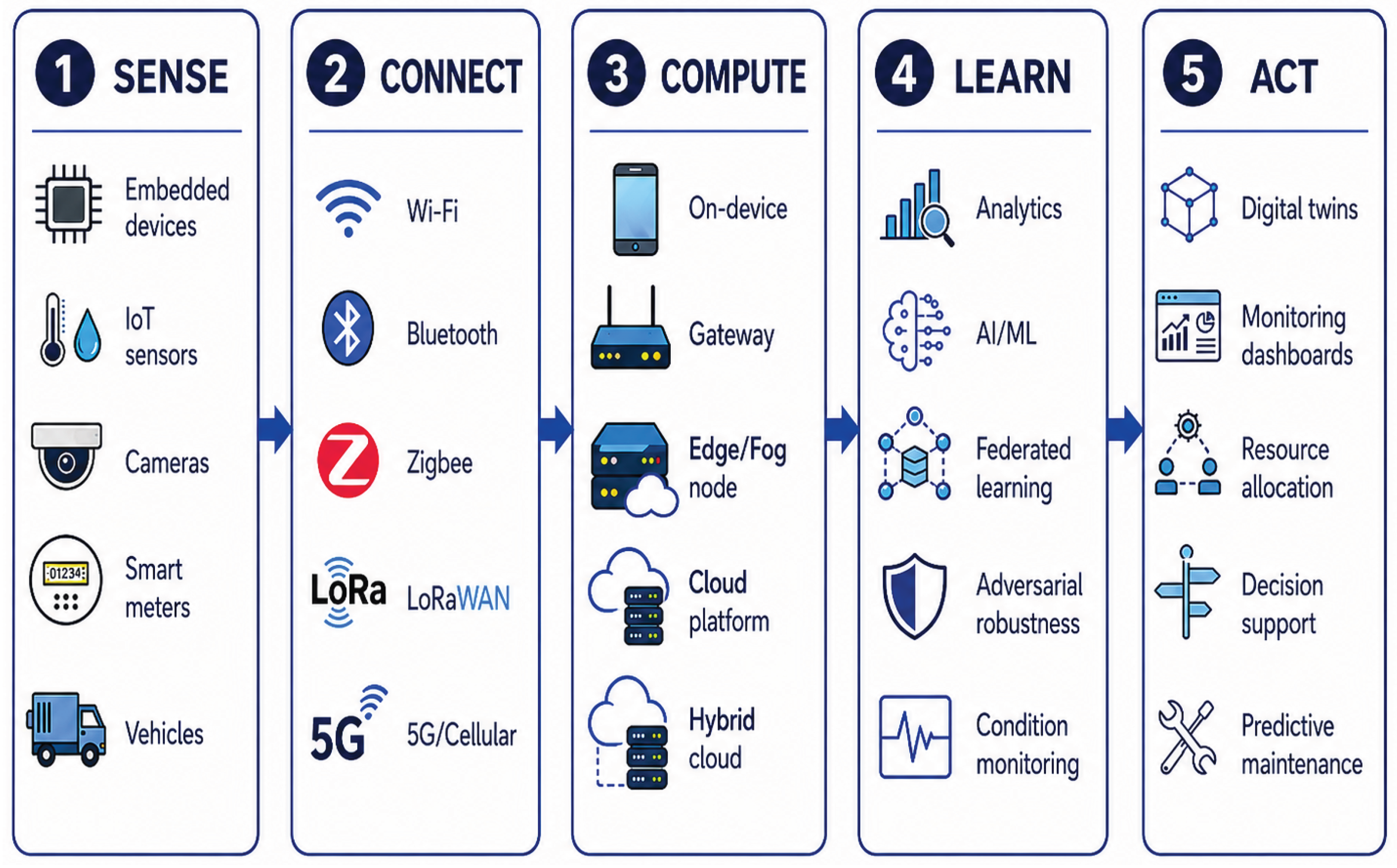
All of the contributions in this Special Issue can be summarized through a simple five-stage conceptualization as shown in
Figure 1.
Physical environments can be accessed by means of sensing and embedded platforms; connectivity and cloud architectures enable the sharing of information and of computational resources; edge, fog, and cloud architectures offer distributed computation; distributed data is converted into intelligence by means of analytics and of federated learning; monitoring, resource allocation, digital twins, and intelligent services are used to take informed actions. Decentralized trust and cybersecurity can be found to cut across rather than be confined to individual stages. These mechanisms cut across stages rather than occupying only one stage of this progression.
This synthesis also exposes a broader limitation in the current research landscape. Device-level design, resource orchestration, digital twins, machine learning, and distributed trust are frequently investigated as separate technological problems. Yet the practical value of cloud–edge intelligence will increasingly depend on their joint operation. The next research challenge is therefore not simply to optimize individual components, but to design adaptive systems in which sensing, communication, computation, learning, security, and decision making are co-designed and dynamically coordinated.
Four research questions appear particularly important.
First, how should an IIoT system determine whether a workload should execute on-device, at the edge, in the fog, or in the cloud when latency, bandwidth, energy, privacy, cybersecurity, reliability, and monetary cost impose competing requirements? Existing resource-allocation and edge–cloud studies provide important foundations, but future orchestration will increasingly require multi-objective and context-aware decisions that can adapt at runtime rather than relying solely on static placement.
Second,
how can distributed and federated learning simultaneously address Non-IID data, constrained devices, adversarial clients, privacy, model integrity, and communication efficiency? Federated learning provides a powerful architecture for distributed intelligence [
6], but the contributions by Zafar et al. and Ibaisi et al. demonstrate that distribution creates its own challenges. Addressing these requirements together rather than independently is essential if federated intelligence is to become dependable in operational IIoT environments.
In addition to the previous two questions, the third question addresses the issue of
how the digital twin can remain current and reliable when it is connected to a physical system and at the same time incorporates real-time edge intelligence, cloud-based analytics (including predictive analysis), and decision-making capabilities. As the digital twin moves away from being primarily used for the visual representation of a system and becomes more focused on predicting what will occur within the system and providing information on how best to make decisions about the operation of the system, there are additional requirements for the data quality, the synchronization of data between the digital twin and the physical system, where the computations occur, how to handle uncertainty associated with the predictions made by the digital twin, ensuring that the digital twin remains secure from unauthorized access, and validating that the digital twin accurately represents the behavior of the physical system [
5].
The final question for consideration is how to integrate various types of IIoT components into a single operational system and evaluate that operational system as a whole rather than evaluating each component individually. As highlighted by the variety of technologies discussed in this Special Issue (ranging from embedded devices and IoT protocols to fog computing, digital twins, federated learning, and distributed trust), interoperability is a common thread that runs throughout all aspects of the IIoT.
We believe that future evaluations of edge-based services will have to take account of a greater variety of factors (predictive performance, latency, bandwidth, computational requirements, energy consumption, scalability, robustness, security, etc.) as opposed to assessing just application accuracy or the pure computational performance. As such we do not see an “either/or” situation arising with respect to whether cloud computing is being supplanted by edge computing. Instead, cloud, edge, and embedded computing devices are becoming increasingly intertwined elements of an expanding computational and intelligent continuum. Cloud-based platforms will continue to play a central role in providing scalable storage, large-scale analytics capabilities, coordination functions, and high-demand compute applications. Edge and fog-based resources will deliver proximity, real-time responses, and local processing abilities. Distributed intelligence will become the key to determining how data can be transformed into decisions at each level. Therefore the emerging challenge is not merely one of moving computation from the cloud down to the edge but rather it is now about determining where along the cloud–edge continuum that sensing, communication, computation, learning, and decision making should occur in a dynamic manner so as to preserve both security and trustworthiness while ensuring reliability and resource utilization. The works included within this Special Issue provide a series of complementary views on this evolving landscape and demonstrate a compelling need to transition away from individually optimized technologies toward integrated, adaptable, and trustworthy ones.
Papers Published in the Special Issue. The following eight papers were published in the Special Issue “Application of Cloud Computing in Industrial Internet of Things”:
Herrera, V.; de Araújo, H.; Penteado, C.; Gazziro, M.; Carmo, J. Low-Cost Embedded System Applications for Smart Cities.
Big Data Cogn. Comput. 2025,
9, 19.
https://doi.org/10.3390/bdcc9020019.
Dritsas, E.; Trigka, M. A Survey on the Applications of Cloud Computing in the Industrial Internet of Things.
Big Data Cogn. Comput. 2025,
9, 44.
https://doi.org/10.3390/bdcc9020044.
EL-Natat, A.; El-Bahnasawy, N.; El-Sayed, A.; Elkazzaz, S. Optimized Resource Allocation Algorithm for a Deadline-Aware IoT Healthcare Model.
Big Data Cogn. Comput. 2025,
9, 80.
https://doi.org/10.3390/bdcc9040080.
La Guardia, M. 3D Urban Digital Twinning on the Web with Low-Cost Technology: 3D Geospatial Data and IoT Integration for Wellness Monitoring.
Big Data Cogn. Comput. 2025,
9, 107.
https://doi.org/10.3390/bdcc9040107.
Mohammed Abdul, S.; Shrestha, A.; Yong, J. Toward the Mass Adoption of Blockchain: Cross-Industry Insights from DeFi, Gaming, and Data Analytics.
Big Data Cogn. Comput. 2025,
9, 178.
https://doi.org/10.3390/bdcc9070178.
Zafar, S.; White, J.; Legg, P. Federated Learning with Adversarial Optimisation for Secure and Efficient 5G Edge Computing Networks.
Big Data Cogn. Comput. 2025,
9, 238.
https://doi.org/10.3390/bdcc9090238.
Ibaisi, T.; Kuhn, S.; Kazim, M.; Kara, I.; Altindag, T.; Rehman, M. A Comparative Study of Federated Learning and Amino Acid Encoding with IoT Malware Detection as a Case Study.
Big Data Cogn. Comput. 2026,
10, 111.
https://doi.org/10.3390/bdcc10040111.