1. Introduction
Blockchain technology was initially introduced as the underlying infrastructure supporting cryptocurrencies, most notably Bitcoin. Early blockchain systems, often referred to as the first generation of blockchain technologies, focused primarily on secure and decentralized digital currency transactions. These systems relied on the Proof of Work (PoW) consensus mechanism to ensure agreement among distributed participants and to protect the network from malicious behavior.
The evolution of blockchain technology led to the emergence of second-generation platforms that introduced programmable smart contracts, enabling the execution of application logic directly within the blockchain environment. Platforms such as Ethereum extended the applicability of blockchain systems beyond digital currencies by enabling decentralized applications and automated contract execution [
1].
In recent years, blockchain technology has evolved further and is increasingly used as a foundational infrastructure for a wide range of distributed systems, including supply chain management, digital identity platforms, smart city infrastructures, data integrity systems, and enterprise information systems. The adoption of blockchain in such diverse application domains is largely motivated by its core characteristics, including decentralization, tamper-resistant data storage, and transparent verification of transactions [
2].
However, the growing diversity of blockchain applications has also revealed limitations of early consensus mechanisms. Proof of Work, while highly secure and robust in open environments, is often considered inefficient in terms of energy consumption and system performance when applied to many modern blockchain use cases. Consequently, a large number of alternative consensus mechanisms have been proposed in the literature. These mechanisms attempt to address various limitations of earlier approaches by modifying the security resource, validator selection process, or agreement architecture [
3].
As a result, the consensus design space has become increasingly complex. Different consensus mechanisms exhibit distinct advantages and trade-offs with respect to security, scalability, decentralization, energy efficiency, and system governance. Selecting an appropriate consensus mechanism therefore represents a critical architectural decision when designing a blockchain-based system. However, the lack of systematic guidelines for mapping system requirements to consensus properties makes this decision challenging for system designers.
Despite the large number of proposed consensus mechanisms, their selection is often performed without a structured methodology that links system requirements to consensus properties. In many cases, consensus protocols are adopted based on popularity or historical precedent rather than on a systematic evaluation of system characteristics and operational constraints [
4].
This paper addresses this challenge by proposing a structured framework for selecting blockchain consensus mechanisms. In the context of this work, the term “data-driven” refers to the use of structured system requirements and measurable design parameters such as performance constraints, security assumptions, and governance models as inputs to the consensus selection process. The proposed framework does not rely on empirical datasets or machine learning techniques. Instead, it uses formalized system characteristics to support a multi-criteria, requirement-driven decision process. The framework organizes the consensus design space along several analytically separable design dimensions that capture key architectural properties of blockchain systems. By linking consensus mechanisms to validator governance models, security resources, agreement architectures, and performance characteristics, the proposed framework provides a methodology for aligning consensus design with the requirements of specific application domains.
The main contributions of this paper are as follows:
A structured analysis of blockchain consensus mechanisms that identifies key architectural design dimensions influencing security, scalability, decentralization, and system governance.
A 7-layer consensus selection framework (CD-7) that transforms consensus design from an ad hoc choice into a systematic architectural decision process.
A conceptual consensus design space that visualizes the relationships between identity-based and resource-based security models across different validator admission structures.
A validation of the proposed framework through five representative application scenarios, including institutional governance, infrastructure monitoring, and post-quantum secure systems.
The remainder of this paper is organized as follows.
Section 2 reviews existing studies on blockchain consensus mechanisms and their classification approaches.
Section 3 provides a structured overview of the selected consensus mechanisms included in this study.
Section 4 introduces the proposed consensus selection framework and describes its conceptual foundations.
Section 5 demonstrates the applicability of the framework through several representative application scenarios.
Section 6 discusses the implications and limitations of the proposed approach. Finally,
Section 7 concludes the paper and outlines potential directions for future research.
2. Related Work
Blockchain technology has become a key component of modern distributed systems, with consensus mechanisms playing a fundamental role in ensuring the security, scalability, and reliability of decentralized networks. Over the past decade, a significant body of research has analyzed different consensus algorithms and their properties. However, most existing studies focus either on specific protocol designs or on performance comparisons, rather than providing a systematic framework for selecting consensus mechanisms based on application requirements.
One of the most widely cited surveys of blockchain technology is presented by Zheng et al., who provide a comprehensive overview of blockchain architecture, consensus mechanisms, application domains, and open research challenges. Their work analyzes the fundamental components of blockchain systems, including block structures, cryptographic primitives, and distributed consensus protocols, while also highlighting key limitations such as scalability constraints and energy consumption in Proof-of-Work systems [
5]. Although this survey provides a broad overview of blockchain technology, it does not address the problem of selecting consensus mechanisms according to system design requirements.
Several studies have focused specifically on the classification and comparison of consensus algorithms. The IEEE survey on blockchain consensus mechanisms provides an extensive taxonomy of protocols such as Proof-of-Work (PoW), Proof-of-Stake (PoS), and Byzantine Fault Tolerant (BFT) mechanisms. These works analyze the fundamental principles behind consensus protocols and discuss their advantages and limitations. However, such surveys typically emphasize protocol categorization rather than the systematic selection of consensus mechanisms for specific system architectures [
6].
Another important research direction concerns the evaluation of consensus mechanisms according to performance and security criteria. Bamakan et al. analyze consensus protocols using multiple evaluation metrics, including throughput, energy efficiency, decentralization level, and resistance to security attacks [
7]. Similarly, Gervais et al. investigate the security and performance trade-offs of Proof-of-Work systems and demonstrate how protocol parameters influence the stability and robustness of blockchain networks [
8]. While these works provide valuable insights into the performance characteristics of consensus algorithms, they primarily focus on analytical comparisons rather than decision-support methodologies for selecting appropriate mechanisms.
From an architectural perspective, Vukolić investigates the fundamental differences between classical Byzantine Fault Tolerant protocols and Nakamoto-style consensus mechanisms. This line of research highlights how different consensus paradigms influence the scalability, communication complexity, and fault tolerance of distributed ledger systems [
9]. However, these architectural analyses generally focus on specific protocol families rather than providing a unified framework that connects consensus properties with system-level requirements.
In addition to protocol analysis, several studies investigate blockchain applications across different domains. For example, Kaur et al. provide a survey of blockchain applications in financial systems, Internet of Things environments, and decentralized autonomous organizations [
10]. These studies illustrate the diversity of blockchain use cases, but they typically focus on application domains rather than on the methodological selection of consensus protocols.
Recent research has also explored alternative consensus mechanisms that utilize useful computational work instead of purely cryptographic puzzles. Toulemonde et al. propose a Useful Work protocol in which participants perform verifiable computations for externally submitted tasks, such as scientific or mathematical problems [
11]. Similar approaches investigate the integration of machine learning workloads or other useful computations into consensus processes. These emerging mechanisms aim to address the energy inefficiency of traditional Proof-of-Work systems, but they remain focused on individual protocol designs rather than providing a general decision framework.
Despite the large body of research on blockchain consensus mechanisms, two main limitations remain in the existing literature. First, most studies analyze consensus protocols individually without providing a structured methodology for selecting an appropriate mechanism based on system requirements. Second, many surveys focus primarily on traditional consensus models and do not systematically incorporate emerging paradigms such as useful-work consensus, machine learning-based consensus, or post-quantum security considerations. A comparative overview of representative studies and their research focus is summarized in
Table 1.
To address these limitations, this paper proposes a structured framework for the systematic selection of blockchain consensus mechanisms. The proposed approach organizes the consensus design space according to several fundamental dimensions, including validator admission models, security resource models, agreement architectures, and performance trade-offs. By mapping consensus mechanisms into this multi-dimensional design space, the framework provides a practical methodology for aligning consensus protocols with the architectural and operational requirements of real-world blockchain systems.
The criteria used for comparison are derived from recurring design dimensions identified across the literature, particularly those related to validator participation, security assumptions, agreement mechanisms, and system performance. These dimensions form the basis of the proposed framework and are consistent with prior studies that classify consensus mechanisms according to participation models, security resources, and performance trade-offs [
5,
6,
7,
8].
3. Selection Scope and Overview of Mechanisms
Blockchain consensus mechanisms have developed into a broad and heterogeneous field that includes substantially different validation logics, governance structures, and assumptions about the resources required to achieve agreement. Over time, a large number of new proposals have been introduced, ranging from foundational models to highly specialized or application-oriented designs. Simply listing these mechanisms without a clear selection rationale would offer limited analytical insight. For this reason, the present section clarifies the criteria used to determine which mechanisms are included in this study and then provides a structured overview of the selected approaches.
3.1. Selection Scope and Design Rationale
The purpose of this study is not to provide an exhaustive catalog of all consensus mechanisms proposed in the literature, but rather to construct a representative and structurally diverse design landscape that enables the development of a generalized selection framework. Given the large number of published mechanisms, many of which represent incremental optimizations or application-specific adjustments, a selective and principled approach was necessary.
The mechanisms included in this study were chosen according to several guiding criteria.
First, foundational paradigms were selected in order to capture the core architectural shifts that have shaped blockchain consensus research. These include Proof of Work (PoW) as the first widely deployed blockchain consensus mechanism, Proof of Stake (PoS) as a fundamental alternative to computation based validation, Practical Byzantine Fault Tolerance (PBFT) as the classical Byzantine agreement model adapted to distributed ledgers, and Directed Acyclic Graph (DAG) as a structural alternative to linear blockchain architectures.
Second, the selection was guided by resource-based diversity. Consensus mechanisms fundamentally differ in the primary resource used to establish agreement [
12]. The selected mechanisms collectively represent validation models based on computational power, virtual stake, identity and authority, storage capacity and time commitment, reputation and trust relationships, activity and contribution metrics, delegated and federated governance, hybrid constructions, machine learning effort, and quantum cryptographic principles. This diversity ensures that the subsequent classification is not limited to a single consensus philosophy.
Third, representative mechanisms introducing structurally meaningful variations in validation resources, governance structures, or agreement architectures were included. Mechanisms were selected if they alter the governance structure, the underlying validation resource, or the fault tolerance model in a conceptually significant way. Minor parameter adjustments and rebranded implementations without structural novelty were excluded.
Finally, both practically deployed mechanisms and research-level proposals were incorporated. Including mechanisms that exist primarily in scientific literature allows the framework to account for emerging directions in consensus design, particularly in areas such as machine learning integration and quantum-resilient architectures.
The selection of the 32 consensus mechanisms was guided by the objective of capturing a representative and structurally diverse set of designs, covering distinct validation resources, governance models, and agreement architectures, while excluding purely incremental variations.
Through this structured selection strategy, the analyzed mechanisms span the principal consensus design dimensions required to evaluate adaptability across heterogeneous operational environments. This representational completeness forms the analytical foundation for the seven-layer consensus design framework developed in
Section 4. Consensus mechanisms form the operational backbone of blockchain systems, enabling distributed nodes to agree on transaction validity without centralized coordination. This section presents the analyzed mechanisms in a structured descriptive manner, providing historical context, operational principles, implementation status, and distinguishing characteristics.
3.2. Consensus Mechanism Overview
While this section provides a descriptive overview of individual consensus mechanisms, their systematic categorization and comparative analysis are performed in
Section 4 through the proposed seven-layer consensus design framework. This subsection provides a structured overview of the consensus mechanisms selected according to the criteria defined in
Section 3.1. The goal is not to present exhaustive technical specifications, but to establish a consistent descriptive baseline that supports the comparative categorization developed in
Section 4.
Each mechanism is described using a uniform structure that includes the year of introduction, core operational principle, deployment status, and its distinguishing characteristics. Where applicable, the implementation status of each mechanism is explicitly indicated, distinguishing between production-deployed systems and research-stage proposals. Mechanisms that currently exist primarily at the research level are explicitly identified as such.
The mechanisms are presented in a logically organized sequence, beginning with early consensus paradigms that shaped blockchain development, followed by mechanisms introducing alternative security resources, governance structures, or agreement models, and concluding with emerging and research-oriented approaches. This progression reflects both historical development and conceptual diversification within the consensus design space.
The following subsections introduce each mechanism individually.
3.2.1. Proof of Work
Proof of Work (PoW), introduced by Nakamoto in 2008 [
13], represents the first widely deployed blockchain consensus mechanism. It requires network participants (miners) to solve computationally intensive cryptographic puzzles in order to propose new blocks. Security is achieved through economic cost: an adversary must control a majority of the network’s computational power to manipulate the ledger.
PoW is implemented in Bitcoin and several early-generation blockchains. Its defining characteristic is the transformation of computational power into a security resource. While it established strong probabilistic security and decentralization, its substantial energy consumption and limited scalability motivated the development of alternative models.
3.2.2. Proof of Stake
Proof of Stake (PoS), proposed in 2012 by King and Nadal [
14], replaces computational competition with economic commitment. Validators are selected proportionally to the amount of cryptocurrency they lock as stake, shifting security guarantees from energy expenditure to financial incentives.
PoS and its variants (e.g., Ouroboros, Casper, Tendermint) are now widely implemented across contemporary blockchain platforms [
15]. Its distinctiveness lies in significantly reducing energy requirements while maintaining economic deterrence. However, token concentration introduces governance and centralization concerns that remain an active research topic.
3.2.3. Delegated Proof of Stake
Delegated Proof of Stake (DPoS), introduced by Larimer in 2014 [
16], modifies the PoS paradigm by incorporating a representative voting layer. Token holders elect a limited number of delegates responsible for block production, thereby increasing throughput and reducing confirmation time.
DPoS has been implemented in platforms such as EOS and BitShares [
17]. Its primary innovation is the separation between economic stake and operational block validation. While this model enhances performance, it introduces structured governance and potential concentration of influence among elected delegates.
3.2.4. Proof of Authority
Proof of Authority (PoA), formalized in 2017 [
18], is designed for permissioned blockchain environments. Instead of relying on stake or computation, PoA assigns block validation rights to pre-approved validators whose real-world identities are known.
This model is commonly used in enterprise and consortium blockchains. Its distinguishing feature is replacing economic or computational security with identity-based trust. While highly efficient and energy conservative, it trades off decentralization for operational control.
3.2.5. Proof of History
Proof of History (PoH), introduced by Yakovenko in 2018 [
19], establishes a cryptographic time-ordering mechanism using sequential hashing. Rather than functioning as a standalone consensus protocol, PoH provides a verifiable time source that enables parallel transaction processing.
PoH is implemented within the Solana blockchain architecture. Its innovation lies in decoupling transaction ordering from consensus voting, enabling high throughput. However, its effectiveness depends on precise hardware synchronization and integration with additional consensus layers.
3.2.6. Practical Byzantine Fault Tolerance
Practical Byzantine Fault Tolerance (PBFT), developed by Castro and Liskov in 1999 [
20], is a deterministic consensus algorithm designed for asynchronous distributed systems. PBFT tolerates up to one-third of malicious nodes by employing multi-phase message exchange to ensure agreement on transaction order.
PBFT forms the foundation of numerous permissioned blockchain systems and enterprise platforms. Its defining characteristic is deterministic finality without probabilistic confirmation. Nevertheless, communication complexity grows quadratically with network size, limiting scalability in large public environments.
3.2.7. Directed Acyclic Graph
Directed Acyclic Graph (DAG) architectures emerged in blockchain applications around 2014–2015 through projects such as IOTA and Nano [
21]. Instead of grouping transactions into blocks, DAG-based systems allow each transaction to validate previous ones, enabling parallel processing.
DAG models emphasize scalability and reduced latency by eliminating global block intervals. Their distinguishing feature is the absence of traditional block mining. However, coordination, security analysis, and attack resistance mechanisms remain areas of ongoing development.
3.2.8. Honey Badger BFT
HoneyBadgerBFT, proposed in 2016 by Miller et al. [
22], represents the first practical asynchronous Byzantine Fault Tolerant (BFT) protocol that operates without timing assumptions. Unlike partially synchronous BFT systems, HoneyBadgerBFT guarantees safety and liveness even under unpredictable network delays by combining reliable broadcast, erasure coding, and binary Byzantine agreement.
The protocol is designed for fully asynchronous environments and has been experimentally validated in distributed settings with large numbers of nodes. Its defining characteristic is complete independence from network synchrony assumptions, which enhances robustness in adversarial or unreliable network conditions. However, this robustness comes at the cost of increased cryptographic overhead and potentially higher latency compared to partially synchronous BFT systems.
3.2.9. FIBFT
FIBFT, introduced in 2023 by Gao et al. [
23], extends Byzantine consensus models to address scalability challenges in edge computing environments. The protocol integrates clustering techniques, specifically K-medoids, to partition nodes into subnets based on performance characteristics. Each subnet then executes an enhanced Byzantine agreement protocol.
This architecture reduces communication complexity and improves scalability by limiting consensus rounds within smaller groups. Its distinctive feature lies in combining machine learning-based clustering with consensus logic. While promising for large-scale and heterogeneous environments, the approach introduces additional computational overhead related to clustering and dynamic subnet management.
3.2.10. Ripple Protocol Consensus Algorithm
The Ripple Protocol Consensus Algorithm (RPCA), deployed in 2012 by Ripple Labs [
24], operates using a Unique Node List (UNL) model. Each validator maintains a list of trusted nodes and reaches consensus when a supermajority (typically 80%) agrees on transaction validity.
RPCA is optimized for financial settlement systems and is actively used within the Ripple network for cross-border transactions. Its defining feature is the reliance on partially overlapping trusted validator sets rather than open participation. This design enables rapid confirmation and low energy usage, but introduces structured trust assumptions that differentiate it from fully permissionless networks [
25].
3.2.11. Stellar Consensus Protocol
The Stellar Consensus Protocol (SCP), introduced in 2015 by Mazières [
26], is based on the Federated Byzantine Agreement (FBA) model. In SCP, each node selects its own quorum slice—trusted peers whose agreement it requires for consensus. Consensus emerges from the intersection of these quorum slices across the network.
SCP is implemented in the Stellar network and supports decentralized financial infrastructure. Its distinguishing property is decentralized quorum configuration, allowing open membership without predefined validator sets. While highly efficient and energy conservative, the security of SCP depends on careful quorum slice selection to prevent network fragmentation.
3.2.12. Proof of Elapsed Time
Proof of Elapsed Time (PoET), introduced by Intel in 2016 [
27], leverages Trusted Execution Environments (TEE), such as Intel SGX, to generate verifiable random wait times for leader selection. Validators compete by generating secure random timers, and the node with the shortest valid wait time proposes the next block.
PoET has been implemented within the Hyperledger Sawtooth platform and is primarily intended for permissioned enterprise blockchains. Its defining innovation is shifting consensus fairness enforcement from economic or computational resources to harware-based secure randomness. This dependence on trusted hardware introduces potential risks related to enclave vulnerabilities and manufacturer trust assumptions.
3.2.13. Proof of Burn
Proof of Burn (PoB), proposed in 2012 by Stewart [
28], replaces computational mining with the irreversible destruction of cryptocurrency tokens. Participants send coins to verifiably unspendable addresses, thereby demonstrating long-term economic commitment to the network.
PoB has been implemented in projects such as Slimcoin and serves as an alternative resource-based consensus approach. Its defining feature is the transformation of financial sacrifice into mining probability. Although it reduces energy expenditure relative to PoW, it introduces irreversible capital loss and requires careful economic modeling to prevent inefficiencies.
3.2.14. Proof of Capacity
Proof of Capacity (PoC), popularized by Burstcoin in 2014 [
29], utilizes storage space as the primary security resource. Participants precompute and store cryptographic data (plotting), which is later used to determine eligibility for block generation.
PoC enables energy-efficient consensus by replacing active computation with disk storage utilization. Its distinguishing characteristic is reliance on storage capacity rather than computational power or financial stake. However, ensuring honest space commitment and preventing manipulation through storage optimization techniques remains an ongoing challenge.
3.2.15. Proof of Space
Proof of Space (PoSpace), formally described in 2015 by Dziembowski et al. [
30], uses disk storage capacity as the primary resource for achieving consensus. Participants allocate a specified amount of storage to commit cryptographic data that can later be efficiently verified by the network.
Unlike Proof of Work, PoSpace minimizes continuous computational effort by relying on precomputed storage commitments. The model has influenced systems such as Chia and related storage-based blockchains. Its distinguishing characteristic lies in transforming persistent storage allocation into a security primitive, thereby reducing operational energy consumption. However, maintaining reliable proof verification and preventing storage manipulation remain technical challenges.
3.2.16. Proof of Space-Time
Proof of Space-Time (PoST), introduced in 2016 by Moran and Orlov [
31], extends storage-based consensus by requiring participants to prove that they have retained specific data over a defined time interval. Rather than merely demonstrating disk allocation, PoST ensures continuous storage commitment through periodic cryptographic verification.
The mechanism emphasizes long-term data persistence as a trust resource and has influenced decentralized storage networks. Its defining feature is coupling spatial commitment with temporal guarantees, thereby strengthening reliability assurances. Nevertheless, ensuring secure long-term storage verification without introducing new attack vectors remains an area of active research.
3.2.17. Proof of Activity
Proof of Activity (PoAct), proposed in 2014 by Bentov et al. [
32], combines elements of Proof of Work and Proof of Stake. The protocol begins with a PoW-based empty block generation phase, followed by a PoS-based validator selection process that finalizes the block through digital signatures from selected stakeholders.
This hybrid design aims to integrate computational security with economic stake-based validation. Its distinctive contribution is the layered security structure that distributes responsibility across two resource models. While enhancing robustness, the dual-phase architecture increases implementation complexity and partially preserves PoW energy costs.
3.2.18. Proof of Engagement
Proof of Engagement (PoE), introduced in 2021 by Xu et al. [
33], evaluates nodes based on their active participation and contribution within the network. Engagement metrics, including transaction activity and computational contribution, determine the probability of being selected as a block proposer.
The mechanism remains primarily conceptual and described in academic literature. Its defining feature is shifting consensus eligibility toward behavioral contribution rather than static resource ownership. By attempting to mitigate wealth concentration effects, PoE introduces dynamic participation metrics, although safeguarding against artificial engagement inflation presents a significant design challenge.
3.2.19. Proof of Importance
Proof of Importance (PoI), deployed within the NEM blockchain in 2015 [
34], extends stake-based validation by incorporating transaction graph analysis into validatorselection. Accounts are assigned an importance score derived from token holdings and network activity metrics.
PoI is implemented in production and emphasizes economic participation alongside ownership. Its distinguishing feature is the integration of graph-theoretic influence modeling into consensus probability. While reducing passive wealth dominance, the computational complexity of importance scoring and potential manipulation of activity metrics require careful governance mechanisms.
3.2.20. Proof of Stake Velocity
Proof of Stake Velocity (PoSV), introduced by Ren in 2014 for the Reddcoin network [
35], combines stake ownership with transactional activity as determinants of validator selection. In addition to holding tokens, participants must demonstrate active participation to maintain influence.
PoSV has been deployed in cryptocurrency systems emphasizing transactional throughput. Its defining characteristic is integrating monetary velocity into the consensus model, thereby incentivizing circulation rather than passive holding. Although improving network dynamism, maintaining balanced incentive structures without enabling artificial transaction generation is a persistent challenge.
3.2.21. Proof of Vote
Proof of Vote (PoV), proposed in 2017 by Li et al. [
36], is designed for consortium blockchain environments. Block validation is achieved through structured voting among authorized participants, separating decision authority from block creation roles.
The model exists primarily in academic proposals. Its distinctive aspect is formalizing consensus as an explicit voting protocol rather than probabilistic resource competition. While energy-efficient and suitable for closed governance structures, PoV inherently relies on predefined trust relationships among consortium members.
3.2.22. Proof of Trust
Proof of Trust (PoT), introduced in 2018 by Bahri and Girdzijauskas [
37], incorporates trust metrics into validator selection. Nodes accumulate trust scores based on historical behavior, and higher-trust nodes face reduced validation difficulty or increased selection probability.
The mechanism is primarily described in research studies and has not achieved widespread deployment. Its distinguishing contribution lies in formalizing trust graphs as a consensus resource. While potentially reducing computational effort, designing tamper-resistant trust evaluation frameworks presents substantial complexity.
3.2.23. Proof of Reputation
Proof of Reputation (PoR), proposed in 2020 by Dehez-Clementi et al. [
38], determines validator selection based on accumulated reputation scores derived from historical behavior. Nodes gain influence through consistent participation and correct validation activity rather than computational power or economic stake.
PoR remains primarily an academic proposal. Its defining feature is formalizing social or behavioral capital as a consensus resource. While potentially reducing energy consumption and improving accountability, designing objective, manipulation-resistant reputation metrics presents a central implementation challenge.
3.2.24. Proof of Contribution
Proof of Contribution (PoCon), hereafter abbreviated as PoCon to distinguish it from Proof of Capacity (PoC), was introduced in 2018 by (Xue et al., 2018) [
39]. It modifies the Proof of Work paradigm by integrating contribution-based weighting into mining difficulty. Nodes that have previously contributed successfully to the network may receive adjusted validation conditions.
The mechanism exists primarily in the research literature and seeks to balance fairness and energy efficiency. Its distinctive characteristic lies in linking historical productive behavior to consensus probability. However, accurately measuring contribution without introducing exploitable incentive distortions remains a complex design challenge.
3.2.25. Proof of Luck
Proof of Luck (PoL), proposed in 2016 by Milutinović [
40], utilizes Trusted Execution Environments (TEE) to generate secure random values used for leader selection. Validators produce cryptographically verifiable “luck” values, and the highest value determines block proposer eligibility.
PoL is described primarily in academic work and has not achieved broad deployment. Its defining innovation is replacing computational competition with hardware-enforced randomness. The model significantly reduces energy requirements but introduces dependency on secure enclave integrity and hardware trust assumptions.
3.2.26. Yuma Consensus
The Yuma Consensus Protocol, introduced in 2021 within the Bittensor network [
41], evaluates contributions such as machine learning model outputs through validator scoring mechanisms. Participants submit models, which are assessed using transparent performance metrics to determine reward allocation.
Yuma is actively deployed within the Bittensor AI ecosystem. Its distinguishing characteristic is embedding incentive-aligned evaluation of AI contributions directly into consensus logic. While promoting fairness and measurable productivity, the system depends on carefully calibrated scoring functions and resistant commit-reveal mechanisms to prevent model copying or manipulation.
3.2.27. Proof of Learning
Proof of Learning (PoLearn), introduced in 2019 by Bravo-Marquez et al. [
42], integrates machine learning training tasks into consensus. Validators compete by training models on published datasets, and performance on unseen evaluation data determines block validation rights.
The mechanism remains largely theoretical. Its defining feature is transforming computational effort into socially useful work rather than arbitrary cryptographic puzzles. Although conceptually attractive for sustainability, coordinating dataset integrity, evaluation fairness, and ongoing task supply present nontrivial operational complexity.
3.2.28. Proof of Karma
Proof of Karma (PoK), proposed in 2022 by Biswas et al. [
43], assigns leadership probability based on accumulated behavioral scores referred to as “karma.” Nodes that consistently behave according to protocol rules increase their likelihood of selection.
The model is described in academic literature and is intended for consortium or controlled environments. Its distinctive element lies in integrating behavioral reinforcement directly into leader election. Ensuring resistance against artificial karma inflation and maintaining decentralized fairness remain significant design considerations.
3.2.29. Proof of Endorse Contracts
Proof of Endorse Contracts (PoEC), introduced in 2022 [
44], facilitate cross-chain consensus transfer by allowing a supervisory blockchain to endorse state decisions executed within a subordinate chain. Validators reference externally confirmed contract states to validate blocks.
PoEC is primarily conceptual and targets interoperability between blockchain systems. Its distinguishing contribution is decoupling consensus validation from native resource models by leveraging external verification layers. While potentially scalable, it introduces dependency on cross-chain communication integrity and supervisory network reliability.
3.2.30. Quantum Teleportation-Based Consensus
The quantum teleportation-based consensus mechanism, proposed in 2022 by Wen et al. [
45], explores the use of quantum entanglement and state projection to validate blockchain transactions. By transferring quantum states rather than classical messages, the protocol aims to achieve high-security verification independent of classical computational constraints.
This approach remains theoretical due to the current limitations of quantum hardware. Its defining characteristic is leveraging quantum mechanical properties such as entanglement to achieve theoretically unconditional security. Practical deployment is constrained by qubit coherence management and large-scale quantum infrastructure feasibility.
3.2.31. Quantum Zero-Knowledge-Based Consensus
Quantum zero-knowledge consensus, introduced in 2022 [
46], integrates quantum zero-knowledge proofs to validate transactions without revealing sensitive information. The protocol applies quantum cryptographic principles to replace classical probabilistic verification models.
The mechanism is currently conceptual. Its distinguishing property lies in combining privacy-preserving validation with post-quantum security assumptions. Although energy-efficient in classical terms, it depends entirely on the maturity and scalability of quantum computing systems.
3.2.32. Post-Quantum Delegated Proof of Luck
Post-Quantum Delegated Proof of Luck (PQ-DPoL), proposed in 2023 by Kim et al. [
47], integrates post-quantum cryptographic primitives such as CRYSTALS-Dilithium into a delegated consensus structure. Validators are elected through a representative model similar to DPoS, while cryptographic security is reinforced against quantum adversaries.
PQ-DPoL is currently described in research studies. Its defining contribution is combining delegated governance with post-quantum resilience. While improving long-term cryptographic robustness, it inherits governance concentration risks typical of delegated systems.
3.3. Diversification of the Consensus Design Space
Since the introduction of the first blockchain consensus mechanisms, the design space of distributed agreement protocols has expanded significantly. Early paradigms such as Proof of Work and Byzantine fault-tolerant protocols established the fundamental principles of decentralized agreement. As blockchain systems began to be applied in different operational environments, numerous alternative consensus approaches were proposed in order to address limitations related to scalability, energy efficiency, governance structures, and validation resources.
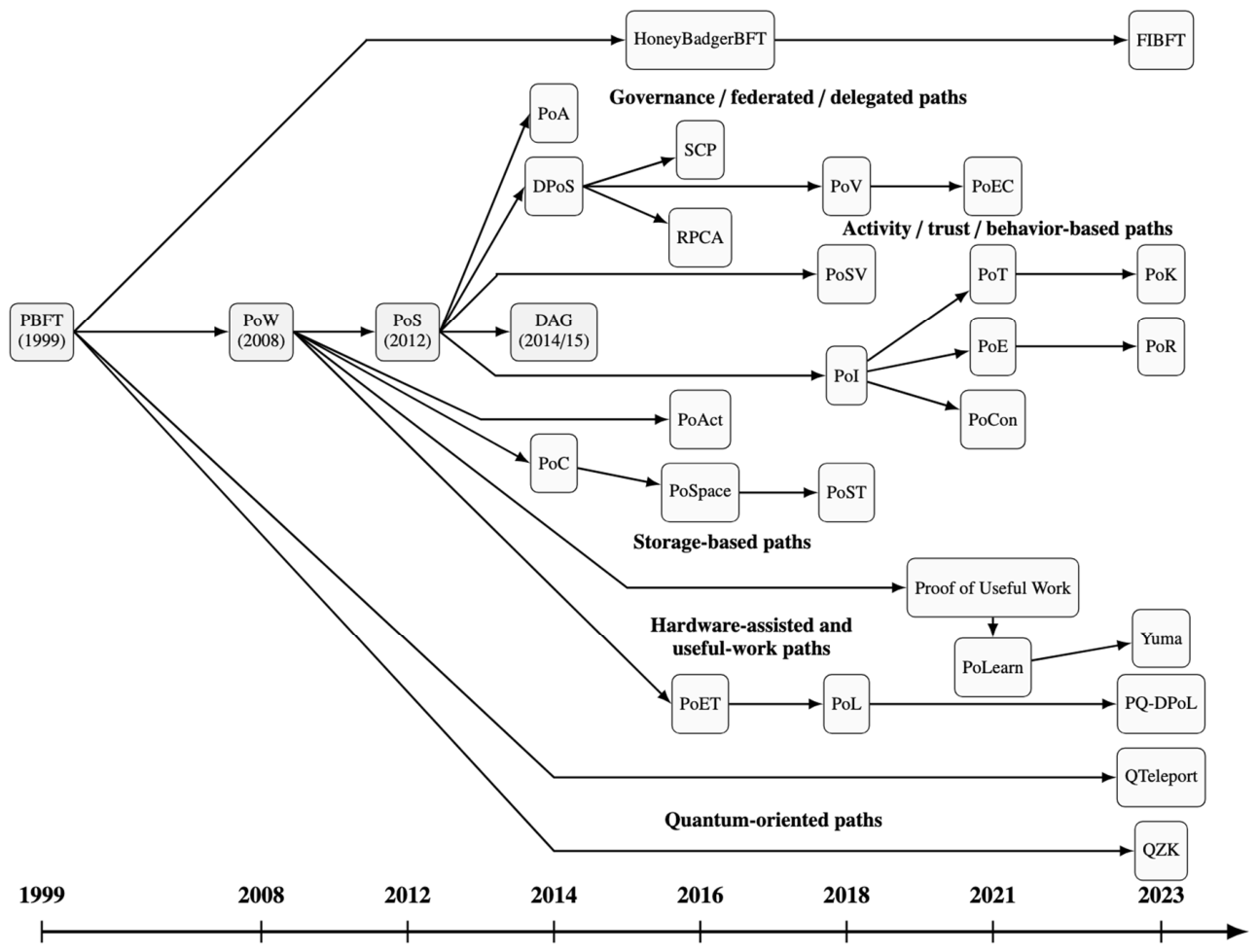
Over time, these developments have resulted in a diverse ecosystem of consensus mechanisms. Many proposals introduce new validation resources, such as economic stake, storage capacity, behavioral metrics, or hardware-assisted randomness, while others modify the governance structure or communication architecture of existing protocols. As a consequence, the consensus landscape has evolved into a branching design space in which new mechanisms often build upon, extend, or conceptually derive from earlier paradigms.
Figure 1 provides a conceptual overview of this diversification. The diagram illustrates how foundational consensus paradigms gave rise to multiple design branches, including stake-based validation, storage-oriented mechanisms, behavioral and reputation-based models, machine learning–integrated approaches, and quantum-oriented proposals. While not representing a strict genealogical relationship, the figure highlights the conceptual connections among the mechanisms analyzed in this study and illustrates how the consensus design space has progressively expanded over time.
This diversification of consensus mechanisms motivates the need for a structured analytical framework capable of systematically evaluating different designs across multiple architectural dimensions. The following section introduces the proposed seven-layer consensus design framework used to organize and analyze the mechanisms presented in this study.
4. The CD-7 Framework for Systematic Consensus Mechanism Selection
While
Section 3 provided a structured overview of existing consensus mechanisms, descriptive analysis alone does not sufficiently support the systematic selection of a consensus model for a new blockchain system. In practice, blockchain architects must select a consensus mechanism based on a set of design constraints, including governance structure, validator participation rules, available security resources, and desired performance characteristics.
Given the rapid proliferation of consensus proposals, selecting an appropriate mechanism has become a non-trivial design problem. Different consensus mechanisms rely on fundamentally different assumptions regarding security, trust, and validator coordination. Consequently, choosing an inappropriate consensus mechanism may lead to inefficiencies, security vulnerabilities, or governance conflicts within the network.
To address this challenge, this section introduces a structured framework for consensus mechanism selection. Rather than focusing on specific blockchain implementations, the framework analyzes intrinsic properties of consensus algorithms and organizes them along several analytically separable design dimensions. These dimensions capture the essential design choices that define how consensus is achieved in distributed ledger systems.
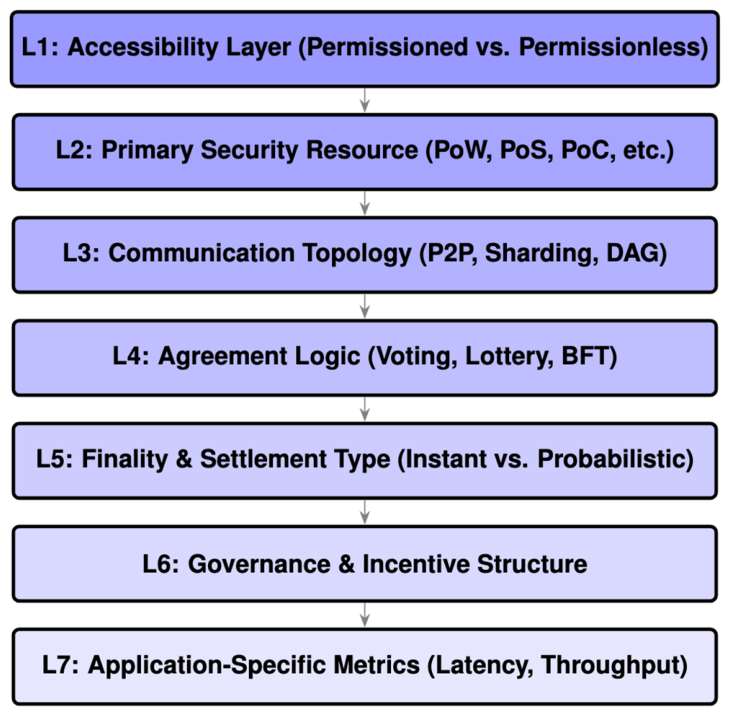
The proposed framework consists of seven analytical layers that capture the key architectural dimensions of consensus design:
L1: Accessibility layer (validator admission model)
L2: Primary security resource
L3: Communication topology
L4: Agreement logic
L5: Finality and settlement model
L6: Governance and incentive structure
L7: Application-specific performance metrics
The relationships between these layers and their role in the consensus selection process are illustrated in
Figure 2. Together, these seven layers form a structured decision-oriented architecture that guides the systematic selection of consensus mechanisms by progressively narrowing the design space according to network requirements. Rather than evaluating individual consensus algorithms in isolation, system designers can identify suitable candidates by matching network requirements with the fundamental properties of the underlying protocol.
The selection of the seven analytical layers in the proposed CD-7 framework is grounded in a synthesis of recurring design dimensions identified across the blockchain consensus literature. Prior studies and surveys consistently emphasize several fundamental aspects of consensus protocols, including validator participation models, underlying security resources, agreement mechanisms, and performance trade-offs. The seven layers were derived by abstracting these recurring dimensions into a structured decision model, where each layer corresponds to a distinct category of consensus design choices identified in prior studies.
These dimensions are not introduced as entirely new constructs, but correspond to recurring categories identified in prior literature on blockchain consensus mechanisms. These dimensions correspond to categories commonly used in prior classification and survey studies [
6,
7,
8], which analyze consensus mechanisms based on participation models, security resources, and performance characteristics. For example, validator participation models and permission structures are widely discussed in classification surveys, while security resources such as computational work, economic stake, and identity-based trust form the basis of many consensus taxonomies [
6,
7,
8]. Similarly, agreement architectures and performance trade-offs are central elements in comparative studies of consensus protocols. The CD-7 framework integrates these previously identified dimensions into a unified decision-oriented structure.
The proposed framework consolidates these aspects into a structured set of analytically separable layers, each representing an independent design decision that influences the behavior and properties of the consensus mechanism. The Accessibility Layer captures how validators are admitted, reflecting governance and trust assumptions. The Primary Security Resource layer represents the fundamental mechanism for Sybil resistance, as widely discussed in Proof-of-Work, Proof-of-Stake, and related paradigms. Communication topology and agreement logic layers abstract the structural and algorithmic organization of consensus, while finality, governance, and performance layers capture operational and system-level characteristics.
This layered decomposition enables a systematic separation of concerns, allowing consensus mechanisms to be analyzed and compared based on their architectural components rather than as monolithic protocols. Unlike traditional taxonomies that primarily focus on classification, the proposed framework is designed to support decision-making by explicitly mapping system requirements to consensus design choices.
4.1. Accessibility Layer (Validator Admission Model)
The first and most fundamental design decision concerns validator participation. Consensus mechanisms differ significantly in how validators are admitted to the network and how the validator set is formed.
Three primary validator admission models can be distinguished:
Permissionless validation. In permissionless systems, any participant may attempt to become a validator without prior approval. Validator eligibility is determined solely by protocol-defined requirements such as computational work, token ownership, or storage capacity. This model maximizes openness and decentralization but requires mechanisms that prevent Sybil attacks.
Protocol-restricted validation. In this model, validator participation is determined by protocol rules rather than direct administrative approval. Validators may be selected through mechanisms such as delegation, federated trust, or weighted voting. While participation in the network may remain open, the validator set itself is restricted by protocol-defined mechanisms.
Permissioned validation. Permissioned systems rely on a predefined validator set. Validator nodes are explicitly authorized by network governance rules or administrative entities. Such systems are common in enterprise and consortium blockchain deployments where participant identities are known.
These three models define the institutional structure of validator participation and strongly influence the security assumptions of the consensus mechanism.
4.2. Primary Security Resource
The second dimension concerns the fundamental resource used to secure the network and prevent Sybil attacks. In decentralized systems, validators must demonstrate control over a scarce or verifiable resource in order to influence the consensus process.
Most consensus mechanisms can be categorized according to the primary resource they employ:
Computational work (Proof of Work)
Economic stake (Proof of Stake)
Storage capacity (Proof of Space/Capacity)
Identity or authority (Proof of Authority)
Reputation or trust relationships
Useful computational work such as machine learning tasks
Quantum cryptographic primitives
From a conceptual perspective, these mechanisms can be grouped into two fundamental security paradigms.
The first paradigm is resource-based security, where validator influence is proportional to the quantity of a scarce resource controlled by the participant. Examples include Proof of Work and Proof of Stake.
The second paradigm is identity-based security, where consensus relies on known validators, trusted entities, or institutional authority. Byzantine Fault Tolerant protocols and authority-based systems typically fall within this category.
Emerging consensus models based on machine learning tasks or quantum cryptographic primitives extend the resource-based paradigm by introducing alternative forms of verifiable work or cryptographic validation.
4.3. Communication Topology and Agreement Logic
Once the validator set has been established, consensus mechanisms must provide a protocol for validators to reach an agreement on the ordering and validity of transactions.
Several distinct agreement architectures have emerged in the literature:
Nakamoto consensus. This probabilistic consensus model relies on block production competitions among validators. Blocks are appended to the chain through resource-based leader selection mechanisms such as Proof of Work or Proof of Stake.
Byzantine Fault Tolerant (BFT) consensus. BFT protocols rely on deterministic voting among validators to reach agreement on the next block. These protocols provide strong safety guarantees but typically require a known validator set.
Federated consensus. Federated systems allow validators to define trust relationships with subsets of other validators. Agreement emerges through overlapping trust sets rather than a globally defined validator group.
DAG-based consensus. Directed acyclic graph (DAG) architectures replace the linear blockchain structure with graph-based transaction confirmation mechanisms. Validators confirm transactions by referencing multiple previous transactions rather than extending a single chain.
Each architecture represents a different trade-off between decentralization, communication complexity, and finality guarantees.
4.4. Finality, Governance, and Performance Trade-Offs
Consensus mechanisms also differ in their operational performance characteristics. These characteristics reflect fundamental trade-offs between security, decentralization, scalability, and resource efficiency.
The most frequently analyzed properties include:
No consensus mechanism simultaneously optimizes all of these properties. Instead, consensus protocols position themselves at different points within the design space defined by these trade-offs. Resource-based mechanisms such as Proof of Work typically prioritize decentralization and security, while BFT-based protocols often provide higher throughput and lower latency at the cost of reduced validator openness.
These trade-offs play a critical role when selecting an appropriate consensus mechanism for a specific application domain.
4.5. Mapping Consensus Mechanisms in the Design Space
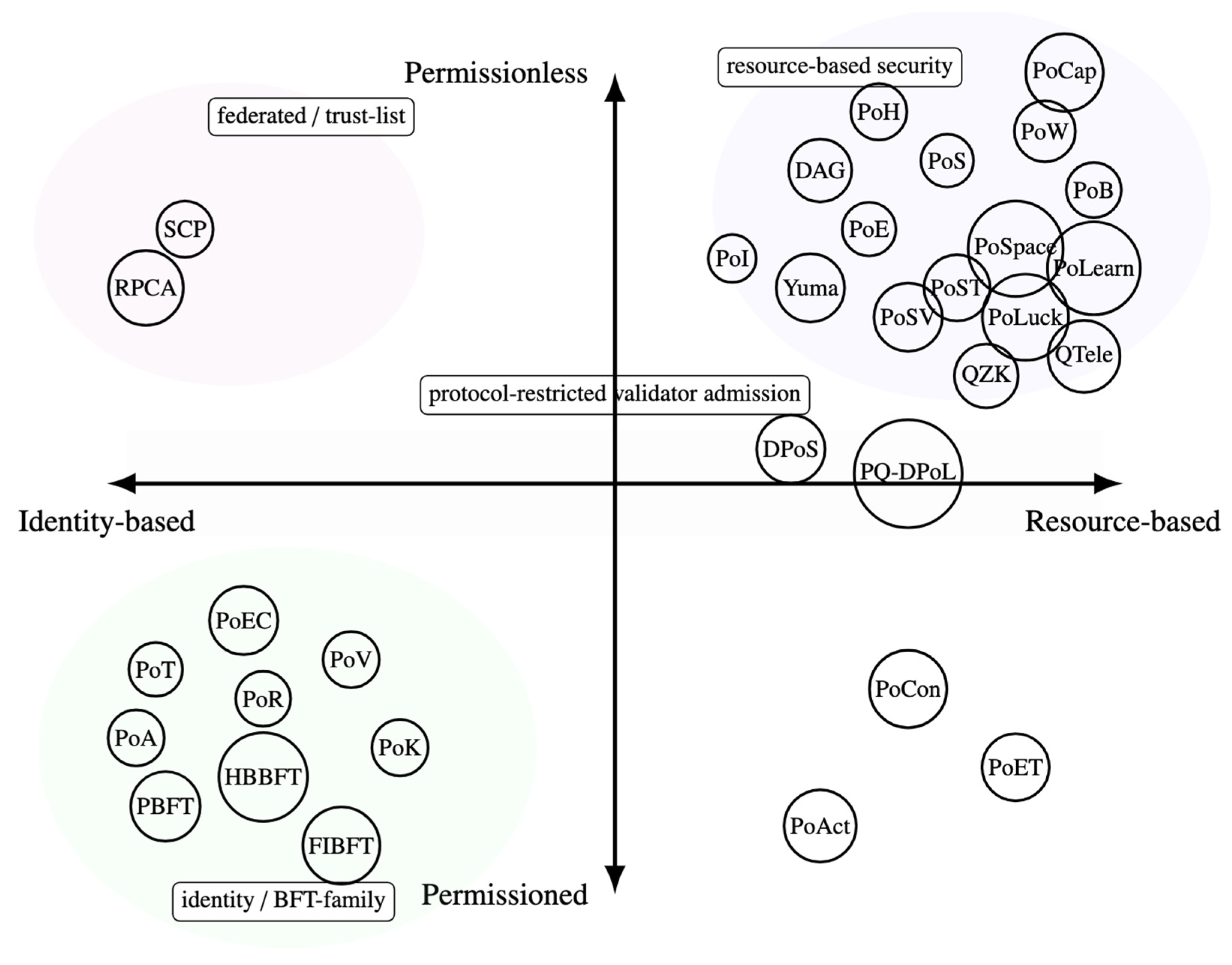
The interaction between validator admission models and security paradigms defines a conceptual design space for blockchain consensus mechanisms.
Figure 3 illustrates this design space by mapping representative consensus mechanisms according to these two dimensions.
Resource-based mechanisms such as Proof of Work and Proof of Stake typically operate in permissionless environments, whereas identity-based mechanisms such as PBFT and Proof of Authority are commonly deployed in permissioned networks. Protocol-restricted models occupy an intermediate position, combining elements of both paradigms.
4.6. Positioning of Consensus Mechanisms in the Design Space
The position of each consensus mechanism in the design space is determined by its dominant validator admission model and the primary security paradigm described in the literature.
The vertical axis represents the validator admission model, ranging from permissioned systems with predefined validator sets to permissionless systems where validator participation is open to any network participant.
The horizontal axis represents the dominant security paradigm. Resource-based mechanisms derive security from the control of scarce computational or economic resources, whereas identity-based mechanisms rely on known validators, institutional trust, or authority-based governance.
Some consensus mechanisms exhibit hybrid characteristics. In such cases, their placement reflects the dominant operational model reported in protocol specifications or academic analyses. Mechanisms positioned near the horizontal axis correspond to protocol-restricted validator admission models, where network participation may remain open but block production rights are limited by protocol-defined selection rules.
4.7. Framework-Based Prioritization and Comparative Evaluation
The proposed CD-7 framework enables the prioritization of consensus mechanisms through a sequential filtering process across its seven layers. Instead of ranking protocols based on a single criterion, the framework progressively constrains the set of feasible candidates by aligning system requirements with architectural properties.
At the initial stage, the validator admission model (L1) eliminates incompatible classes of consensus mechanisms by defining whether the system requires permissionless, protocol-restricted, or permissioned participation. This decision alone significantly reduces the candidate space. The second layer (L2) further refines the selection by identifying the dominant security resource, such as computational work, economic stake, storage, or identity.
Subsequent layers (L3–L5) determine the structural and operational characteristics of the system, including communication topology, agreement logic, and finality requirements. Finally, governance (L6) and performance constraints (L7) guide the prioritization of remaining candidates based on application-specific requirements.
Through this layered decision process, consensus mechanisms are not evaluated in isolation but are prioritized based on their compatibility with system-level constraints.
In contrast to existing approaches, which primarily provide descriptive taxonomies or isolated performance comparisons, the proposed framework introduces a decision-oriented structure that integrates multiple evaluation dimensions into a unified selection process.
Traditional surveys typically analyze consensus mechanisms using either qualitative classifications (e.g., PoW vs. PoS vs. BFT) or quantitative performance metrics such as throughput, latency, and scalability. While these analyses provide valuable insights, they do not directly support decision-making, as they treat performance characteristics independently of governance models and system constraints.
The CD-7 framework addresses this limitation by combining both qualitative and quantitative aspects within a single structured model. Qualitative properties such as decentralization, fault tolerance, and trust assumptions are captured in layers L1, L3, and L4, while quantitative considerations such as throughput, latency, and efficiency are incorporated in layer L7.
This integration enables a more comprehensive evaluation compared to traditional approaches. Instead of optimizing for a single metric, the framework supports multi-criteria decision-making by aligning consensus properties with application requirements.
Furthermore, unlike existing methods, the proposed framework explicitly models trade-offs between key system properties, such as decentralization, scalability, and security, thereby providing a practical tool for navigating the consensus design space.
4.8. Decision Framework for Consensus Selection
Based on the previously defined dimensions, the selection of a consensus mechanism can be formulated as a structured decision process.
The process begins by determining the validator admission model required by the network. This decision defines the institutional structure of validator participation. The next step involves selecting the security resource used to prevent Sybil attacks. Subsequently, an appropriate agreement architecture must be chosen to coordinate the validator set.
Finally, candidate consensus mechanisms are evaluated according to the performance requirements of the target application.
This sequential decision process transforms consensus selection from an ad hoc choice into a structured architectural design problem. Instead of evaluating consensus algorithms individually, system architects can narrow the set of candidate mechanisms by progressively matching network requirements with the structural properties of consensus protocols.
The resulting framework provides a practical methodology for selecting blockchain consensus mechanisms across a wide range of application domains. This interpretation is consistent with the decision-oriented nature of the framework, where system parameters are used as structured input for selecting suitable consensus mechanisms.
5. Application Scenarios and Framework Validation
The selected application scenarios are intended to represent distinct regions of the consensus design space, rather than specific real-world implementations. Each scenario was chosen to reflect a different combination of validator admission models, security resources, and performance requirements, thereby enabling a systematic evaluation of the framework across heterogeneous system conditions. Specifically, the scenarios cover permissioned identity-based systems (waste management, institutional voting), protocol-restricted hybrid environments (smart city platforms), emerging security paradigms (post-quantum enterprise systems), and resource-based computation-driven models (cloud business intelligence platforms). This selection ensures that all major dimensions of the proposed framework are exercised, providing a representative validation of its applicability across diverse classes of distributed systems.
Rather than prescribing a single universally optimal consensus mechanism, the framework enables the identification of candidate consensus models that best align with the structural requirements of a given system. Each scenario is therefore analyzed by mapping system characteristics to the seven framework layers: validator admission model, security resource model, agreement architecture, and performance requirements. The decision process enabled by the CD-7 framework can be illustrated through a simplified example. Consider a blockchain system designed for a decentralized financial application that requires open validator participation, strong security guarantees, and moderate transaction throughput.
Following the framework, the first layer (L1) indicates that the network requires permissionless validator participation. The second layer (L2) determines the dominant security resource, such as computational work or economic stake. The subsequent layers (L3–L4) guide the selection of an appropriate agreement architecture, for example a Nakamoto-style protocol or a BFT-based mechanism depending on the required finality guarantees.
The remaining layers refine the decision by considering settlement properties (L5), governance and incentive structures (L6), and application-specific performance requirements (L7). Through this layered filtering process, the set of candidate consensus mechanisms can be progressively narrowed to those that best match the requirements of the target system.
5.1. Blockchain-Based Waste Management Systems
Waste management infrastructures in smart cities increasingly rely on distributed data collection, regulatory compliance monitoring, and transparent auditing of waste flows. Blockchain technology has been proposed as a mechanism for ensuring tamper-resistant recording of waste collection, transportation, and disposal events [
48].
In such systems, participating entities typically include municipal authorities, waste collection companies, recycling facilities, and regulatory agencies. The set of participants is therefore known in advance and controlled through institutional governance.
Within the proposed framework, this scenario corresponds to a permissioned validator admission model, as validator nodes are operated by authorized organizations participating in the waste management ecosystem. The dominant security resource is institutional identity, since validators represent regulated entities rather than anonymous participants.
Given the limited number of validators and the requirement for high data integrity, Byzantine Fault Tolerant (BFT) agreement architectures are particularly suitable. Protocols such as Practical Byzantine Fault Tolerance (PBFT), Flexible Byzantine Fault Tolerance (FIBFT), or authority-based models such as Proof of Authority (PoA) provide deterministic finality and predictable transaction confirmation times.
Performance requirements in this scenario prioritize reliability, auditability, and regulatory transparency rather than maximum throughput or full decentralization.
5.2. Institutional Blockchain Voting Systems
Blockchain-based voting systems have been explored as mechanisms for ensuring transparency, integrity, and verifiability in organizational decision-making processes. One example is the use of blockchain technology for recording and validating voting results in institutional governance bodies such as faculty councils [
49].
In this context, all participants are known members of the institution, and validator nodes are typically operated by trusted organizational units or administrative infrastructure.
Consequently, the validator admission model is naturally permissioned, with validator identity serving as the primary security resource. The consensus mechanism must guarantee strong consistency, deterministic finality, and resistance to Byzantine faults.
Agreement architectures based on Byzantine Fault Tolerance are therefore well suited to this environment. Protocols such as PBFT or HoneyBadgerBFT enable reliable consensus among a limited set of validators while maintaining strong safety guarantees.
From a performance perspective, voting systems prioritize correctness and auditability over scalability. Transaction volumes are typically low, while the consequences of incorrect consensus are significant. As a result, consensus models emphasizing strong consistency are preferable to probabilistic mechanisms.
5.3. Smart City Infrastructure Platforms
Smart city platforms integrate data streams from numerous urban services, including transportation systems, environmental sensors, energy management infrastructure, and public services [
50]. Blockchain technology has been proposed as a mechanism for coordinating data sharing and ensuring trust among multiple stakeholders.
Unlike purely institutional systems, smart city platforms often allow participation by various service providers, infrastructure operators, and external partners. While access to the network may be open, validator selection is typically governed by protocol rules or delegated governance structures.
This scenario therefore corresponds to a protocol-restricted validator admission model. Validator selection may be influenced by economic stake, service participation, or delegated authority within the platform ecosystem.
The dominant security resource in this context is often economic stake or participation weight. Consensus models such as Proof of Stake (PoS), Delegated Proof of Stake (DPoS), or activity-weighted mechanisms such as Proof of Importance (PoI) provide mechanisms for aligning validator influence with platform participation.
Agreement architectures in such systems often combine stake-weighted validator selection with probabilistic block production models similar to Nakamoto-style consensus.
Performance requirements emphasize scalability and transaction throughput, as smart city infrastructures may generate large volumes of data from heterogeneous sources.
5.4. Post-Quantum Secure Enterprise Systems
Enterprise blockchain deployments increasingly consider long-term cryptographic security as a critical design requirement. The potential emergence of large-scale quantum computers introduces risks to widely used public-key cryptographic schemes such as elliptic curve signatures [
51].
Organizations seeking long-term integrity of blockchain records may therefore consider consensus mechanisms compatible with post-quantum cryptographic primitives.
In this scenario, validator participation is typically restricted to known organizational entities, resulting in a protocol restricted or permissioned validator model. The security resource remains resource-based, but the consensus protocol must support post-quantum cryptographic operations.
An example of such an approach is Post-Quantum Delegated Proof of Luck (PQ-DPoL), which combines delegated validator selection with post-quantum signature schemes. By integrating quantum-resistant cryptographic primitives into validator authentication and block validation processes, such systems aim to preserve long-term security guarantees.
Performance requirements in enterprise environments prioritize predictability, security robustness, and operational stability over maximum decentralization.
5.5. Blockchain-Based Cloud Business Intelligence Platforms
Cloud-based business intelligence platforms increasingly integrate advanced analytics and machine learning capabilities for large-scale data processing. When such platforms incorporate blockchain technology to ensure data provenance, auditability, or decentralized coordination among service providers, consensus design may take advantage of the computational resources already present within the system.
In particular, platforms performing extensive machine learning training may consider consensus mechanisms that transform useful computational work into validator selection criteria.
Within the proposed framework, this scenario typically corresponds to a permissionless or protocol-restricted validator admission model, depending on whether external contributors may participate in training tasks. The dominant security resource becomes useful computational work, specifically machine learning model training and evaluation.
Proof of Learning (PoLearn) represents an example of such an approach, where validator selection is linked to the quality of trained models evaluated on unseen data. This mechanism allows computational effort to contribute both to consensus formation and to the improvement of analytical models used by the platform.
However, the practical applicability of PoLearn depends on the availability of reliable evaluation pipelines capable of verifying model quality while preventing manipulation or collusion among participants.
5.6. Comparative Scenario Analysis
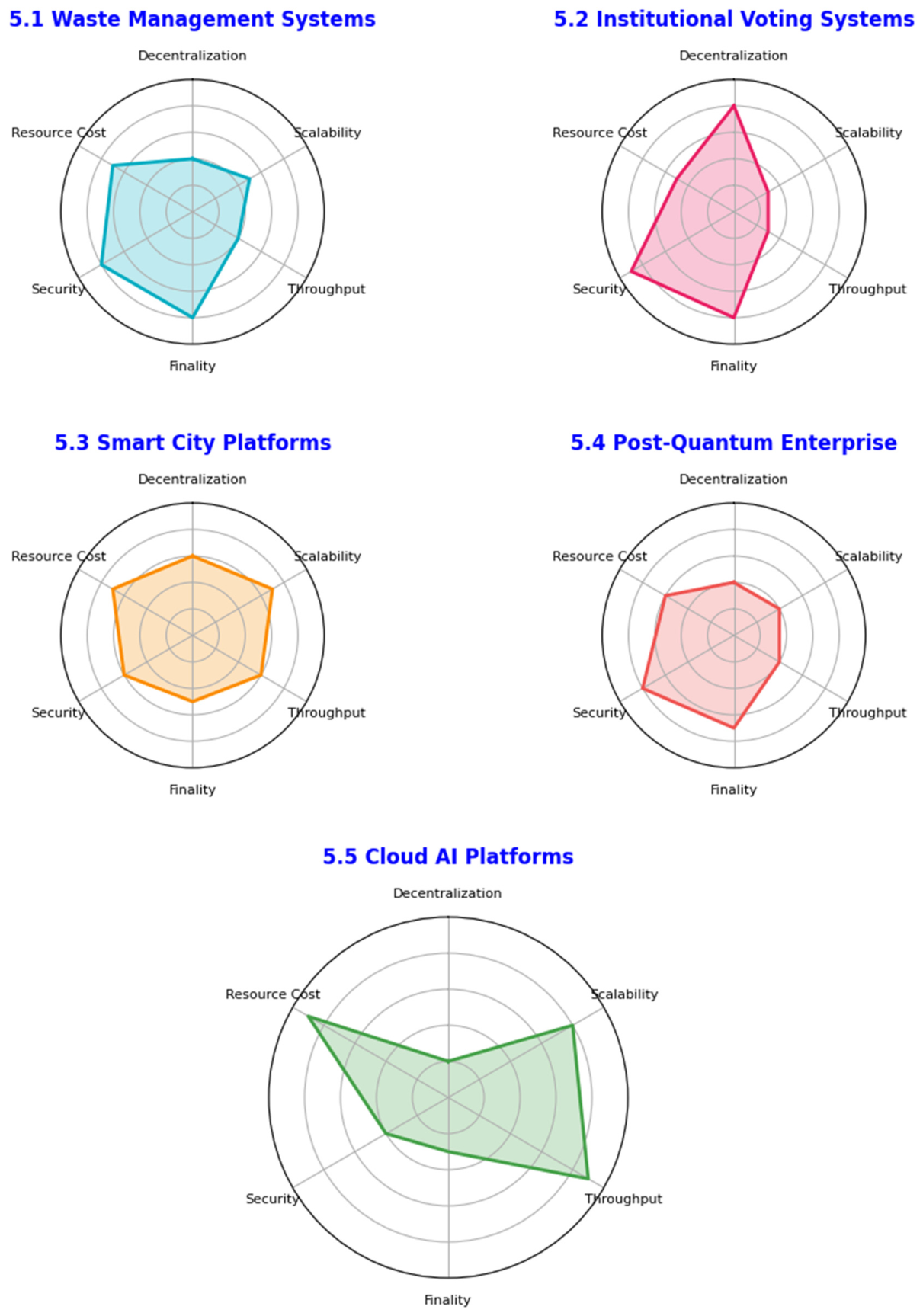
The results presented in
Figure 4 provide a comparative visualization of how different application scenarios map onto key consensus design requirements. Each radar chart illustrates the relative importance of fundamental system properties, including decentralization, scalability, throughput, finality, security, and resource efficiency, as derived from the corresponding use-case constraints.
A clear differentiation between scenarios can be observed. Institutional systems, such as voting platforms, emphasize security and deterministic finality while placing less importance on scalability and throughput. In contrast, smart city platforms and cloud-based data systems prioritize scalability and throughput due to the high volume of data processing, while maintaining moderate security and decentralization requirements. Similarly, enterprise and infrastructure-oriented systems exhibit more balanced profiles, with increased emphasis on reliability, auditability, and long-term security.
The radar charts clearly demonstrate that no single consensus mechanism can optimally satisfy all criteria simultaneously, reinforcing the presence of inherent trade-offs within the consensus design space. Instead, each application domain corresponds to a distinct performance profile that reflects its operational priorities.
The proposed framework enables dynamic adjustment by allowing system designers to systematically prioritize different layers and performance dimensions according to application-specific requirements. Rather than relying on static comparisons of consensus protocols, the framework supports adaptive decision-making in which the relative importance of criteria such as security, decentralization, or efficiency can be adjusted based on system context. This capability represents a key advantage over traditional approaches, which typically evaluate consensus mechanisms using fixed or isolated metrics.
Table 2 summarizes the relationship between application scenarios and the corresponding framework dimensions, while
Figure 4 provides a multi-criteria visual comparison of their performance requirements. The selection of candidate consensus mechanisms is derived directly from the constraints identified across the seven framework layers, ensuring traceability between system requirements and protocol selection.
Together, these results demonstrate that consensus mechanisms cannot be evaluated independently of system context. Instead, appropriate consensus models emerge from the interaction between validator governance, available security resources, agreement protocols, and performance objectives. The proposed framework therefore provides a structured and systematic methodology for aligning consensus design with the architectural and operational requirements of blockchain systems.
6. Discussion
The analysis presented in
Section 4 and
Section 5 demonstrates that the selection of blockchain consensus mechanisms cannot be treated as a purely technical choice independent of system context. Instead, the appropriate consensus model emerges from the interaction between governance structure, available security resources, agreement architecture, and performance requirements. In addition, the framework does not prescribe a fully automated decision process, and the final selection of a consensus mechanism may still depend on expert judgment and context-specific considerations.
The proposed framework organizes these design factors into a structured decision process consisting of seven analytical layers (L1–L7).
One important observation from the analyzed scenarios is the vertical alignment between layers. For instance, in institutional governance (
Section 5.2), the restriction at the Accessibility Layer (L1) directly dictates the deterministic nature of the Finality Layer (L5). This layered approach enables system designers to evaluate consensus mechanisms in relation to the structural properties of the target system rather than selecting protocols based solely on popularity or historical precedent.
A complementary observation is that different application domains naturally align with distinct regions of the consensus design space. Institutional governance systems, such as faculty voting platforms, tend to operate within permissioned environments where validator identity represents the primary security resource. In such cases, Byzantine Fault Tolerant consensus architectures provide deterministic finality and strong consistency guarantees.
Infrastructure-oriented systems, including waste management platforms and smart city data coordination systems, often involve multiple organizations with partially shared governance responsibilities. These environments frequently adopt consortium or protocol-restricted validator models, where authority or economic participation determines validator influence.
In contrast, large-scale open systems and distributed computational platforms tend to rely on resource-based security models in which validator influence is derived from measurable contributions such as computational work, economic stake, or storage capacity. In these contexts, consensus mechanisms based on probabilistic leader selection or delegated participation become more suitable.
The framework also highlights the increasing diversification of security resources used by modern consensus mechanisms. While early blockchain systems relied primarily on computational work or economic stake, recent proposals incorporate additional resources such as storage capacity, reputation systems, trusted hardware, or useful computational tasks such as machine learning workloads. These developments indicate that consensus design is gradually expanding beyond traditional resource models toward more application-specific security primitives.
Another important observation concerns the role of emerging technological constraints, particularly the potential impact of quantum computing on cryptographic infrastructures. Recent studies have demonstrated that sufficiently advanced quantum computers could compromise widely used public-key cryptographic schemes, including those underlying blockchain systems, thereby posing significant security risks [
52]. Enterprise systems requiring long-term data integrity may therefore increasingly consider post-quantum cryptographic compatibility when selecting consensus protocols.
Recent research has also explored quantum Byzantine agreement protocols, which leverage quantum mechanical properties to achieve higher fault tolerance and information-theoretic security. Such approaches have been shown to tolerate up to 50% faulty nodes while maintaining decentralization, representing a promising direction for future consensus designs [
53].
Despite these advantages, several limitations of the proposed framework should be acknowledged. First, the categorization of consensus mechanisms relies on dominant design characteristics, while real-world implementations may combine multiple architectural features. Hybrid consensus architectures continue to emerge, blurring the boundaries between previously distinct design paradigms. Furthermore, the mapping within the CD-7 framework acknowledges the “Consensus Trilemma”; as shown in our multi-scenario analysis (
Figure 4), increasing decentralization (L1/L3) often necessitates trade-offs in throughput or finality (L5/L7).
Second, performance characteristics such as scalability, energy efficiency, and throughput were evaluated qualitatively rather than through quantitative benchmarking. Although this approach enables comparison across heterogeneous consensus models, it does not replace empirical performance evaluation within specific deployment environments. As a result, the framework should be interpreted as a decision-support tool rather than a fully objective optimization model.
Moreover, the abstraction level of the framework may omit certain low-level implementation details, which can influence performance and security in specific real-world deployments.
Finally, some recently proposed consensus mechanisms remain largely theoretical and have not yet been validated through large-scale production deployments. Their classification within the framework therefore reflects design assumptions rather than operational experience.
Nevertheless, the proposed framework provides a structured methodology for understanding the rapidly expanding design space of blockchain consensus mechanisms. Importantly, the contribution of this work lies not in proposing a new consensus mechanism, but in formalizing the decision process through which existing mechanisms can be systematically selected and aligned with system-level requirements. By linking consensus selection to system architecture and governance requirements, the framework contributes toward a more systematic approach to blockchain system design. The applicability of the framework is not limited to the selected scenarios, as the underlying design dimensions are defined at a general architectural level. Consequently, the framework can be applied to a broader range of distributed systems that share similar structural properties.
While the selected scenarios are designed to represent distinct regions of the consensus design space, they are not intended to provide exhaustive validation. Instead, they illustrate how the framework can be applied across different system configurations. Further validation in real-world deployments and additional application domains represents an important direction for future research.
7. Conclusions
This paper addressed the increasing complexity of the blockchain consensus landscape by proposing a structured framework for the systematic selection of consensus mechanisms. While numerous consensus protocols have been proposed in the literature, their selection is often performed in an ad hoc manner, without a clear methodological connection between system requirements and consensus design. The proposed CD-7 framework aims to reduce this ambiguity by organizing consensus selection around a seven-layer architectural decomposition, ranging from validator accessibility (L1) and primary security resources (L2) to agreement logic (L4), governance (L6), and application-specific metrics (L7).
By structuring the consensus design space along these dimensions, the framework provides a decision-oriented methodology that allows system architects to align consensus mechanisms with the institutional, technical, and operational constraints of the target blockchain system. Rather than evaluating consensus protocols in isolation, the framework emphasizes the relationship between system governance, available security resources, and the architectural properties of the consensus protocol.
The applicability of the framework was demonstrated through several representative application scenarios, including infrastructure monitoring systems, institutional governance platforms, smart city data coordination systems, enterprise environments requiring post-quantum security considerations, and cloud-based business intelligence platforms incorporating machine learning workloads. These scenarios illustrate that different application domains naturally align with different regions of the consensus design space.
The analysis further highlights the ongoing diversification of security resources employed by modern consensus mechanisms. While early blockchain systems primarily relied on computational work or economic stake, recent proposals increasingly incorporate additional resources such as storage capacity, reputation systems, trusted hardware, and application-specific useful computation. This trend suggests that future consensus designs may become increasingly specialized and closely integrated with the functional objectives of the underlying blockchain system.
Although the proposed framework provides a structured methodology for consensus selection, the rapidly evolving nature of blockchain technologies implies that new consensus paradigms will continue to emerge. Future research may therefore focus on extending the framework to incorporate hybrid consensus architectures, emerging cryptographic primitives, and empirical performance evaluations in large-scale deployments.
Overall, the framework presented in this study contributes toward a more systematic understanding of the blockchain consensus design space and provides practical guidance for selecting consensus mechanisms that align with the governance models, security assumptions, and performance requirements of real-world blockchain systems.