

Towards Improved Clinical Adoption of AI Segmentation Models: Benchmarking High-Performance Models for Resource-Constrained Settings
 , , , and
Abstract
1. Introduction
- 1.
- Software and models should be sufficiently lightweight to run on resource-limited devices.
- 2.
- Accuracy must be acceptable for clinical use.
- 3.
- Performance must be within clinically compatible times.
- 4.
- Models should be easy for physicians to extend to other segmentation tasks.
- 5.
- Privacy of medical data should be maintained.
2. Materials and Methods
2.1. Dataset Description and Justification
2.1.1. Kidney Dataset
2.1.2. Left Ventricle Myocardium Dataset
2.1.3. Rectus Femoris Muscle Dataset
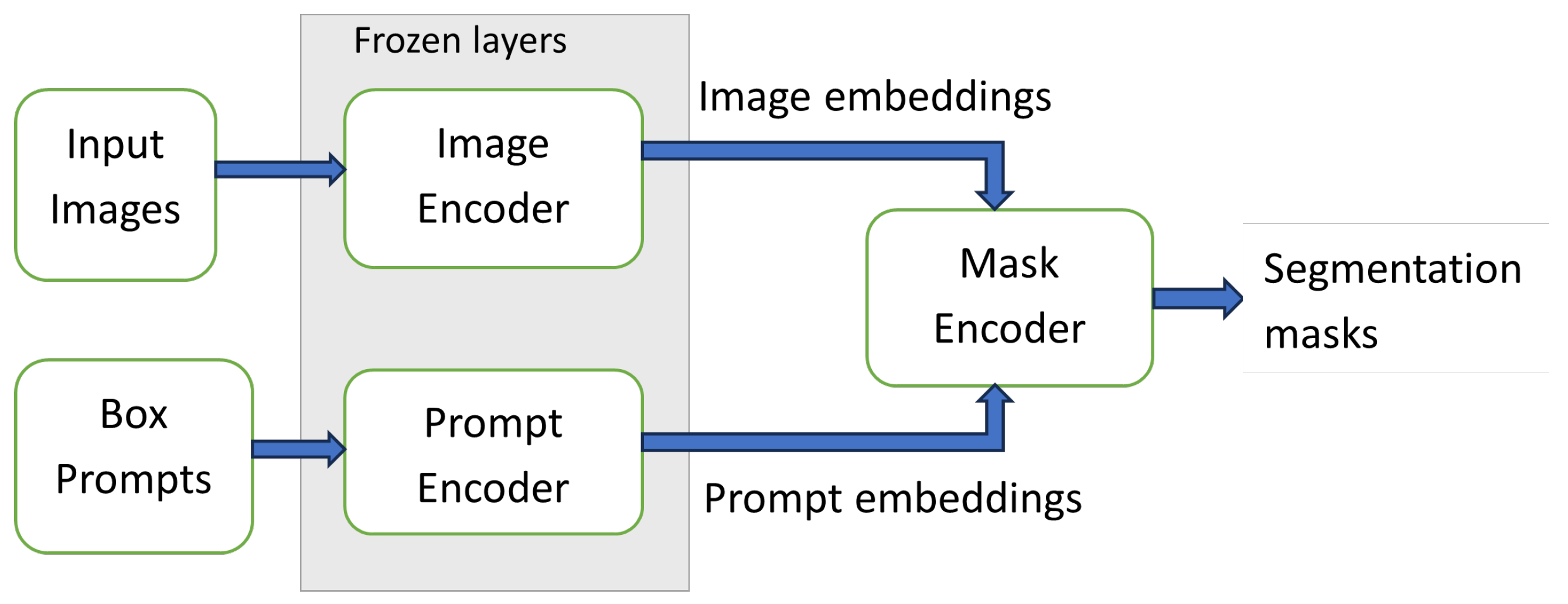
2.2. Selected Segmentation Models
2.3. Experiment Environment
2.4. Segmentation Models Training and Fine-Tuning
2.4.1. Data Preprocessing
2.4.2. Training and Validation
2.4.3. Model Testing
3. Results
3.1. Training and Inference on GPU
3.2. Training and Inference on CPU
4. Discussion
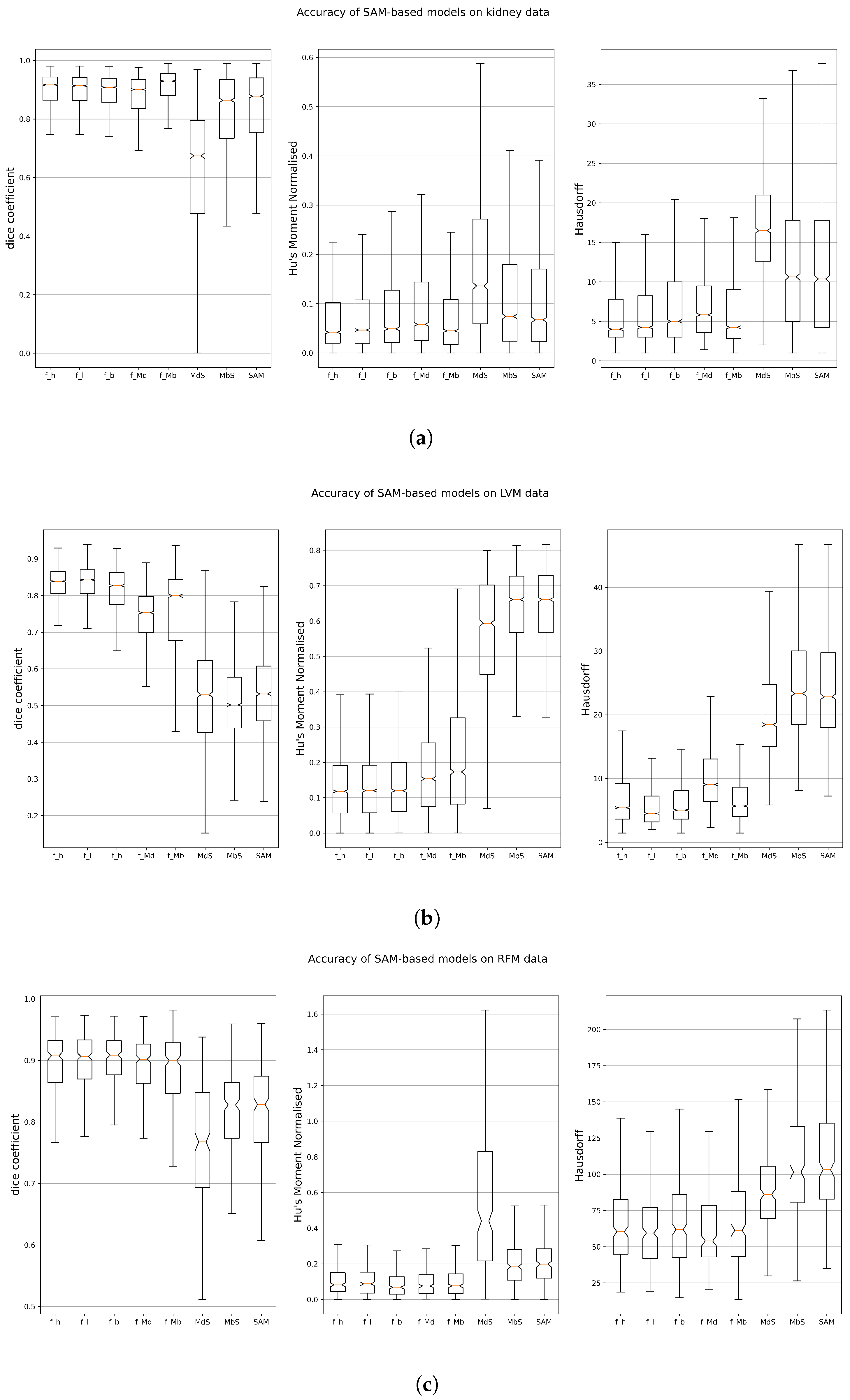
4.1. On Foundation Models
4.1.1. Accuracy
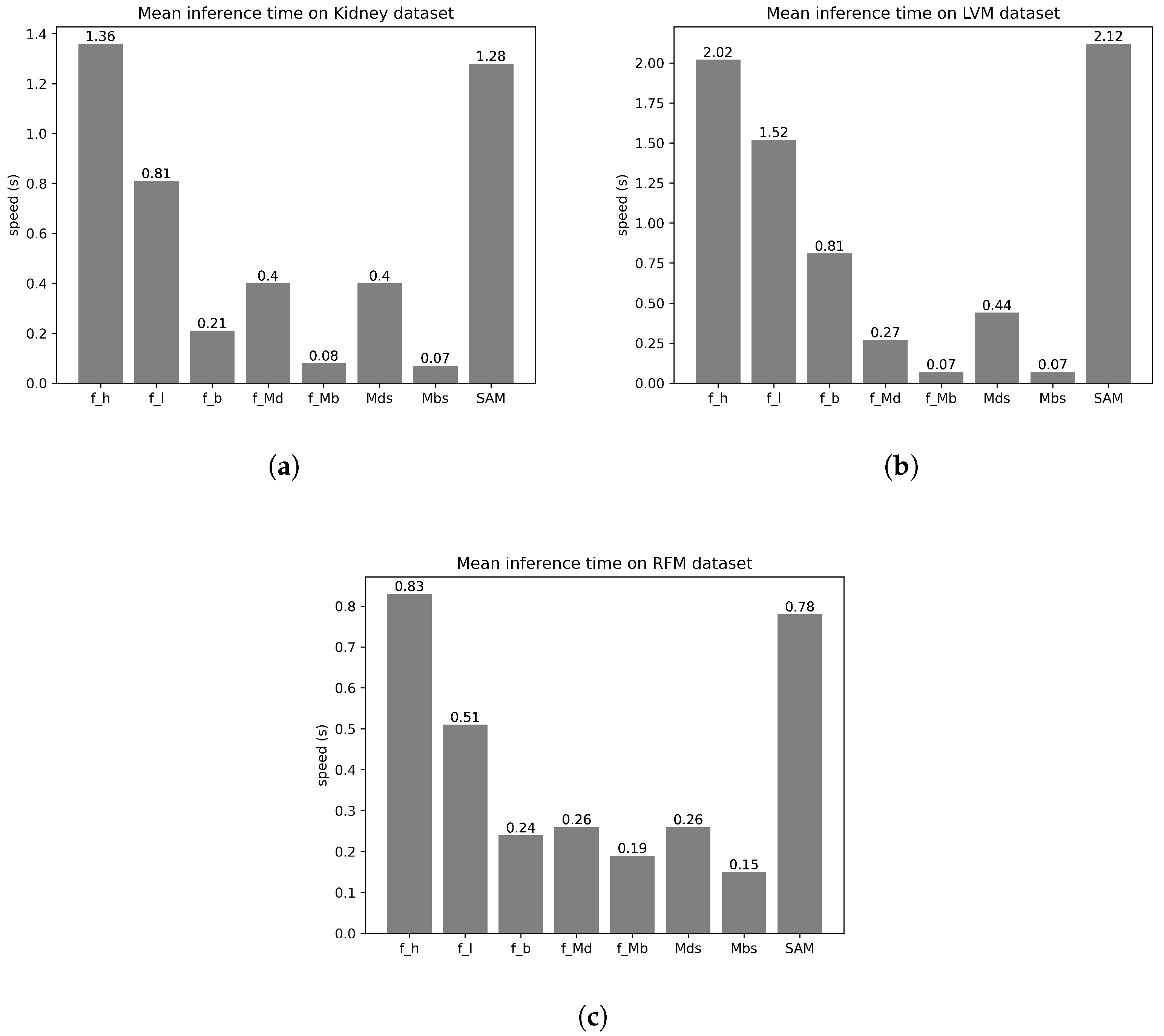
4.1.2. Inference Speed and Model Size
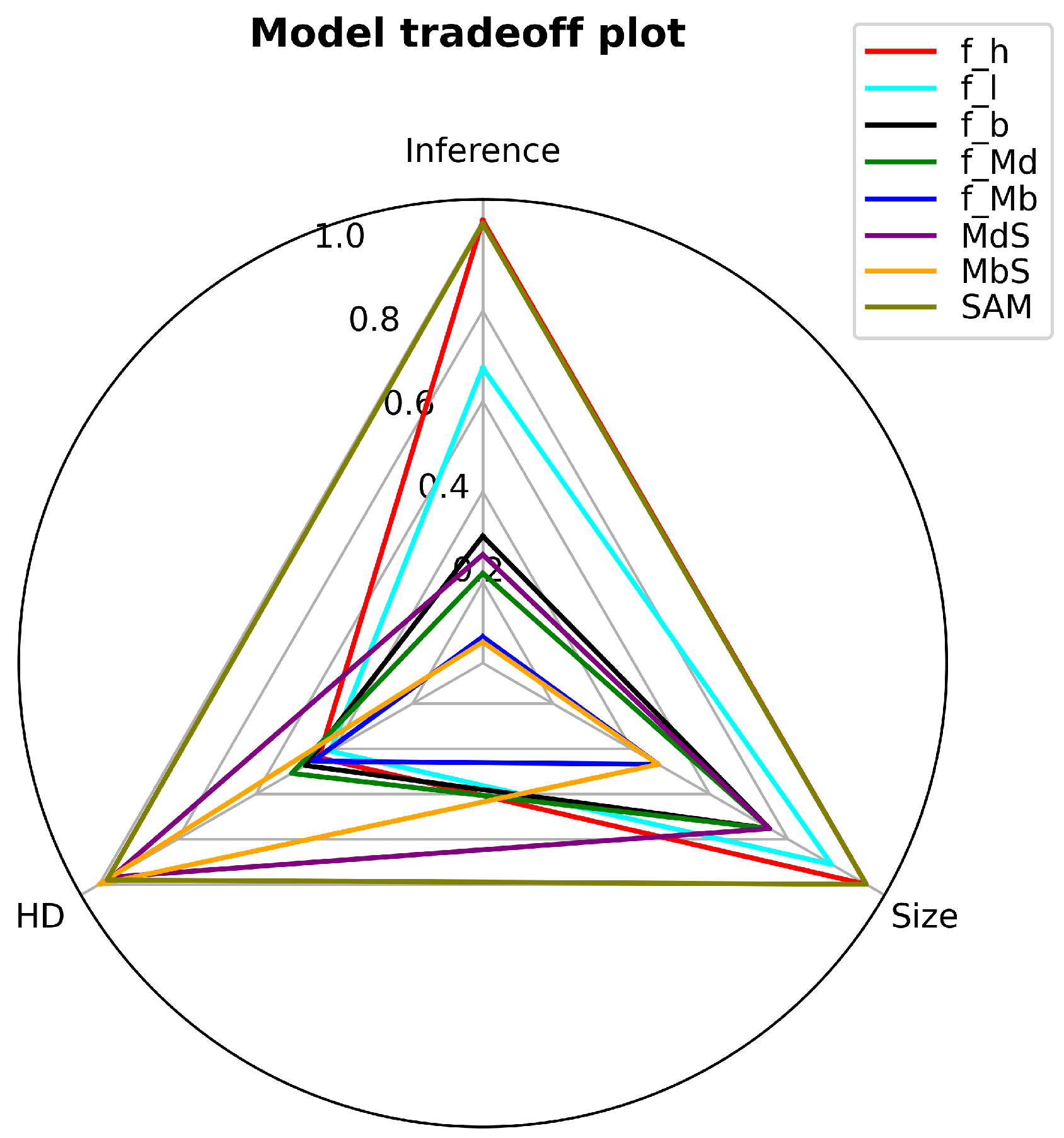
4.1.3. Accuracy-Size-Speed Trade-Off
4.2. MobileSAM vs. nnU-Net on Low-Cost Devices
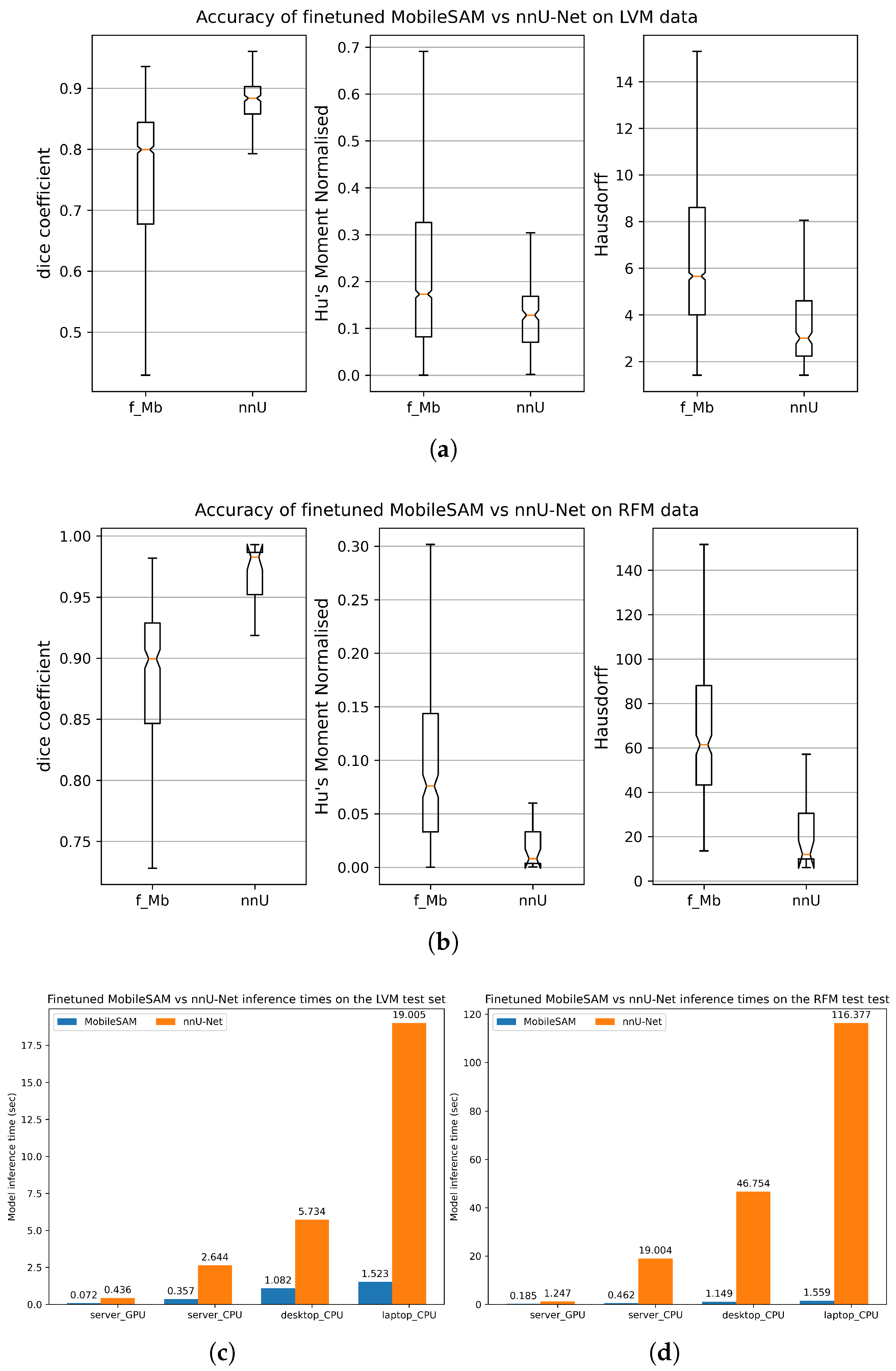
4.2.1. Accuracy
4.2.2. Memory and Computational Intensity
4.2.3. Model Tasks Expansion
4.3. Device Execution Times
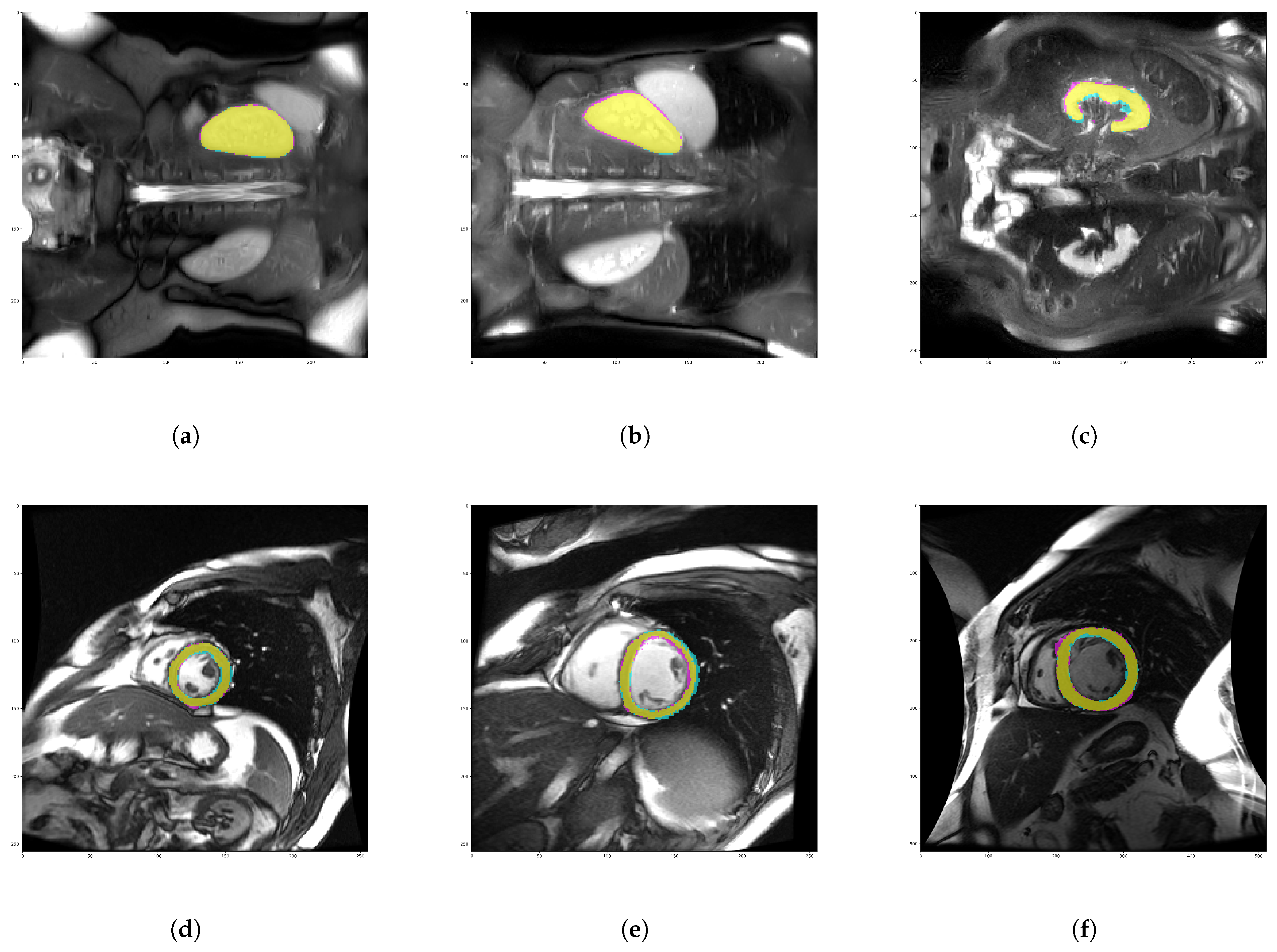
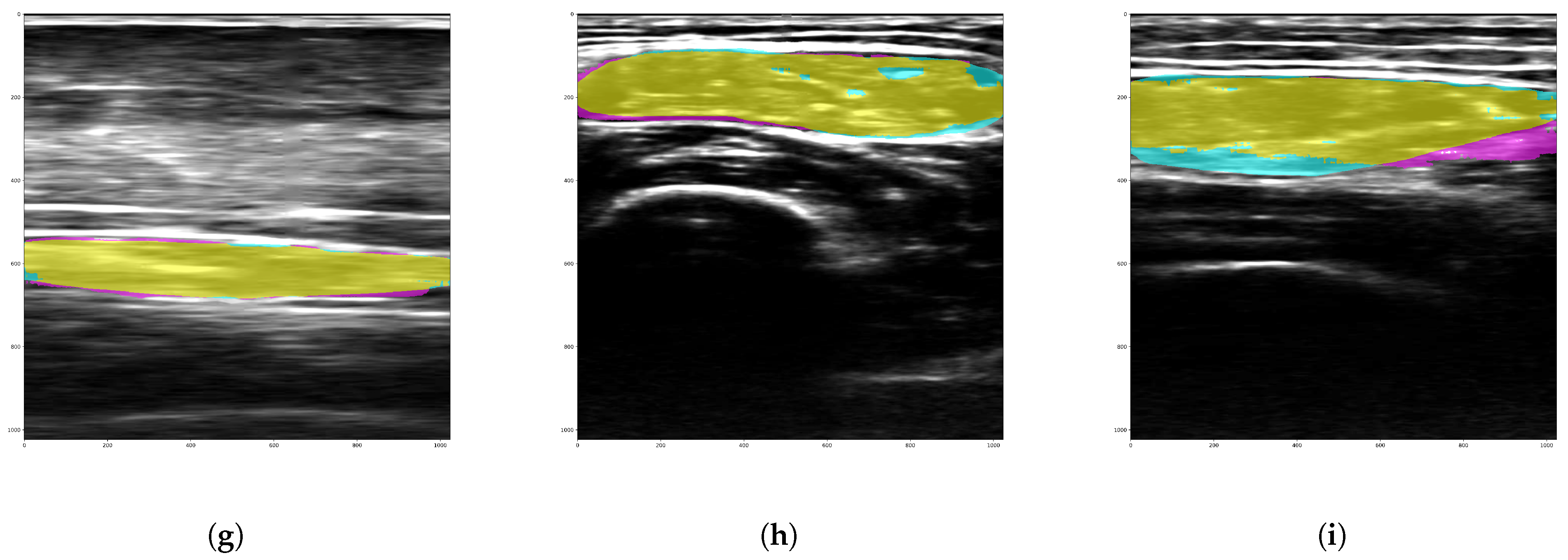
4.4. Case Visualisation
5. Conclusions and Future Work
Author Contributions
Funding
Institutional Review Board Statement
Informed Consent Statement
Data Availability Statement
Conflicts of Interest
Appendix A. Description of Selected Foundation Segmentation Models
Appendix A.1. Segment Anything Model
Appendix A.2. MedSAM
Appendix A.3. MobileSAM
Appendix B. Data Preprocessing and Model Training
References
- Bajwa, J.; Munir, U.; Nori, A.; Williams, B. Artificial intelligence in healthcare: Transforming the practice of medicine. Future Healthc. J. 2021, 8, e188–e194. [Google Scholar] [CrossRef] [Scilit]
- De Fauw, J.; Ledsam, J.R.; Romera-Paredes, B.; Nikolov, S.; Tomasev, N.; Blackwell, S.; Askham, H.; Glorot, X.; O’Donoghue, B.; Visentin, D.; et al. Clinically applicable deep learning for diagnosis and referral in retinal disease. Nat. Med. 2018, 24, 1342–1350. [Google Scholar] [CrossRef] [Scilit]
- Jain, A.K. Fundamentals of Digital Image Processing; Prentice-Hall, Inc.: Englewood Cliffs, NJ, USA, 1989; Available online: https://dl.acm.org/doi/book/10.5555/59921 (accessed on 19 March 2024).
- Yao, W.; Bai, J.; Liao, W.; Chen, Y.; Liu, M.; Xie, Y. From CNN to Transformer: A Review of Medical Image Segmentation Models. J. Imaging Inform. Med. 2024, 37, 1529–1547. [Google Scholar] [CrossRef] [Scilit]
- Antonelli, M.; Reinke, A.; Bakas, S.; Farahani, K.; Kopp-Schneider, A.; Landman, B.A.; Litjens, G.; Menze, B.; Ronneberger, O.; Summers, R.M.; et al. The Medical Segmentation Decathlon. Nat. Commun. 2022, 13, 4128. [Google Scholar] [CrossRef] [Scilit]
- Ronneberger, O.; Fischer, P.; Brox, T. U-Net: Convolutional Networks for Biomedical Image Segmentation. In Proceedings of the Medical Image Computing and Computer-Assisted Intervention—MICCAI 2015; Navab, N., Hornegger, J., Wells, W.M., Frangi, A.F., Eds.; Springer International Publishing: Cham, Switzerland, 2015; pp. 234–241. [Google Scholar]
- Çiçek, Ö.; Abdulkadir, A.; Lienkamp, S.S.; Brox, T.; Ronneberger, O. 3D U-Net: Learning Dense Volumetric Segmentation from Sparse Annotation. In Proceedings of the Medical Image Computing and Computer-Assisted Intervention—MICCAI 2016; Ourselin, S., Joskowicz, L., Sabuncu, M.R., Unal, G., Wells, W., Eds.; Springer International Publishing: Cham, Switzerland, 2016; pp. 424–432. [Google Scholar]
- Zhang, Z.; Fu, H.; Dai, H.; Shen, J.; Pang, Y.; Shao, L. ET-Net: A Generic Edge-aTtention Guidance Network for Medical Image Segmentation. In Proceedings of the Medical Image Computing and Computer Assisted Intervention—MICCAI 2019; Shen, D., Liu, T., Peters, T.M., Staib, L.H., Essert, C., Zhou, S., Yap, P.T., Khan, A., Eds.; Springer International Publishing: Cham, Switzerland, 2019; pp. 442–450. [Google Scholar]
- Schlemper, J.; Oktay, O.; Schaap, M.; Heinrich, M.; Kainz, B.; Glocker, B.; Rueckert, D. Attention gated networks: Learning to leverage salient regions in medical images. Med. Image Anal. 2019, 53, 197–207. [Google Scholar] [CrossRef] [Scilit]
- Chen, L.; Bentley, P.; Mori, K.; Misawa, K.; Fujiwara, M.; Rueckert, D. DRINet for Medical Image Segmentation. IEEE Trans. Med. Imaging 2018, 37, 2453–2462. [Google Scholar] [CrossRef] [Scilit] [PubMed]
- Alom, M.Z.; Yakopcic, C.; Taha, T.M.; Asari, V.K. Nuclei Segmentation with Recurrent Residual Convolutional Neural Networks based U-Net (R2U-Net). In Proceedings of the NAECON 2018—IEEE National Aerospace and Electronics Conference, Dayton, OH, USA, 23–26 July 2018; IEEE: New York, NY, USA, 2018; pp. 228–233. [Google Scholar] [CrossRef] [Scilit]
- Ibtehaz, N.; Rahman, M.S. MultiResUNet: Rethinking the U-Net architecture for multimodal biomedical image segmentation. Neural Netw. 2020, 121, 74–87. [Google Scholar] [CrossRef] [Scilit]
- Zhang, Z.; Wu, C.; Coleman, S.; Kerr, D. DENSE-INception U-Net for medical image segmentation. Comput. Methods Programs Biomed. 2020, 192, 105395. [Google Scholar] [CrossRef] [Scilit]
- Wang, Z.H.; Liu, Z.; Song, Y.Q.; Zhu, Y. Densely connected deep U-Net for abdominal multi-organ segmentation. In Proceedings of the 2019 IEEE International Conference on Image Processing (ICIP), Taipei, Taiwan, 22–25 September 2019; IEEE: New York, NY, USA, 2019; pp. 1415–1419. [Google Scholar] [CrossRef] [Scilit]
- Rahman, H.; Ben Aoun, N.; Bukht, T.F.N.; Ahmad, S.; Tadeusiewicz, R.; Pławiak, P.; Hammad, M. Automatic liver tumor segmentation of CT and MRI volumes using ensemble ResUNet-InceptionV4 model. Inf. Sci. 2025, 704, 121966. [Google Scholar] [CrossRef] [Scilit]
- Xiao, B.; Xu, B.; Bi, X.; Li, W. Global-Feature Encoding U-Net (GEU-Net) for Multi-Focus Image Fusion. IEEE Trans. Image Process. 2021, 30, 163–175. [Google Scholar] [CrossRef] [Scilit] [PubMed]
- Chen, J.; Mei, J.; Li, X.; Lu, Y.; Yu, Q.; Wei, Q.; Luo, X.; Xie, Y.; Adeli, E.; Wang, Y.; et al. TransUNet: Rethinking the U-Net architecture design for medical image segmentation through the lens of transformers. Med. Image Anal. 2024, 97, 103280. [Google Scholar] [CrossRef] [Scilit]
- Cao, H.; Wang, Y.; Chen, J.; Jiang, D.; Zhang, X.; Tian, Q.; Wang, M. Swin-Unet: Unet-Like Pure Transformer for Medical Image Segmentation. In Proceedings of the Computer Vision—ECCV 2022 Workshops: Tel Aviv, Israel, 23–27 October 2022; Proceedings, Part III; Springer: Berlin/Heidelberg, Germany, 2022; pp. 205–218. [Google Scholar] [CrossRef] [Scilit]
- Ma, J.; He, Y.; Li, F.; Han, L.; You, C.; Wang, B. Segment anything in medical images. Nat. Commun. 2024, 15, 654. [Google Scholar] [CrossRef] [Scilit]
- Gu, J.; Wang, Z.; Kuen, J.; Ma, L.; Shahroudy, A.; Shuai, B.; Liu, T.; Wang, X.; Wang, G.; Cai, J.; et al. Recent advances in convolutional neural networks. Pattern Recognit. 2018, 77, 354–377. [Google Scholar] [CrossRef] [Scilit]
- Zhou, X.; Takayama, R.; Wang, S.; Hara, T.; Fujita, H. Deep learning of the sectional appearances of 3D CT images for anatomical structure segmentation based on an FCN voting method. Med. Phys. 2017, 44, 5221–5233. [Google Scholar] [CrossRef] [Scilit]
- Milletari, F.; Navab, N.; Ahmadi, S.A. V-Net: Fully Convolutional Neural Networks for Volumetric Medical Image Segmentation. In Proceedings of the 2016 Fourth International Conference on 3D Vision (3DV), Stanford, CA, USA, 25–28 October 2016; IEEE: New York, NY, USA, 2016; pp. 565–571. [Google Scholar] [CrossRef] [Scilit]
- Türk, F.; Lüy, M.; Barışçı, N. Kidney and Renal Tumor Segmentation Using a Hybrid V-Net-Based Model. Mathematics 2020, 8, 1772. [Google Scholar] [CrossRef] [Scilit]
- Pereira, S.; Pinto, A.; Alves, V.; Silva, C.A. Brain Tumor Segmentation Using Convolutional Neural Networks in MRI Images. IEEE Trans. Med. Imaging 2016, 35, 1240–1251. [Google Scholar] [CrossRef] [Scilit] [PubMed]
- Ghaffari, M.; Sowmya, A.; Oliver, R. Automated Brain Tumour Segmentation Using Cascaded 3D Densely-Connected U-Net. In Proceedings of the Brainlesion: Glioma, Multiple Sclerosis, Stroke and Traumatic Brain Injuries; Crimi, A., Bakas, S., Eds.; Springer International Publishing: Cham, Switzerland, 2021; pp. 481–491. [Google Scholar]
- Wang, G.; Li, W.; Ourselin, S.; Vercauteren, T. Automatic Brain Tumor Segmentation Using Cascaded Anisotropic Convolutional Neural Networks. In Proceedings of the Brainlesion: Glioma, Multiple Sclerosis, Stroke and Traumatic Brain Injuries; Crimi, A., Bakas, S., Kuijf, H., Menze, B., Reyes, M., Eds.; Springer International Publishing: Cham, Switzerland, 2018; pp. 178–190. [Google Scholar]
- Dolz, J.; Ben Ayed, I.; Desrosiers, C. Dense Multi-path U-Net for Ischemic Stroke Lesion Segmentation in Multiple Image Modalities. In Proceedings of the Brainlesion: Glioma, Multiple Sclerosis, Stroke and Traumatic Brain Injuries; Crimi, A., Bakas, S., Kuijf, H., Keyvan, F., Reyes, M., van Walsum, T., Eds.; Springer International Publishing: Cham, Switzerland, 2019; pp. 271–282. [Google Scholar]
- Tureckova, A.; Rodríguez-Sánchez, A.J. ISLES Challenge: U-Shaped Convolution Neural Network with Dilated Convolution for 3D Stroke Lesion Segmentation. In Proceedings of the Brainlesion: Glioma, Multiple Sclerosis, Stroke and Traumatic Brain Injuries; Crimi, A., Bakas, S., Kuijf, H., Keyvan, F., Reyes, M., van Walsum, T., Eds.; Springer International Publishing: Cham, Switzerland, 2019; pp. 319–327. [Google Scholar]
- Yuan, Y.; Chao, M.; Lo, Y.C. Automatic Skin Lesion Segmentation Using Deep Fully Convolutional Networks With Jaccard Distance. IEEE Trans. Med. Imaging 2017, 36, 1876–1886. [Google Scholar] [CrossRef] [Scilit]
- Isensee, F.; Jaeger, P.F.; Kohl, S.A.A.; Petersen, J.; Maier-Hein, K.H. nnU-Net: A self-configuring method for deep learning-based biomedical image segmentation. Nat. Methods 2021, 18, 203–211. [Google Scholar] [CrossRef] [Scilit] [PubMed]
- Kirillov, A.; Mintun, E.; Ravi, N.; Mao, H.; Rolland, C.; Gustafson, L.; Xiao, T.; Whitehead, S.; Berg, A.C.; Lo, W.Y.; et al. Segment Anything. arXiv 2023, arXiv:2304.02643. [Google Scholar] [CrossRef] [Scilit]
- Zhang, C.; Han, D.; Qiao, Y.; Kim, J.U.; Bae, S.H.; Lee, S.; Hong, C.S. Faster Segment Anything: Towards Lightweight SAM for Mobile Applications. arXiv 2023, arXiv:2306.14289. [Google Scholar] [CrossRef] [Scilit]
- Mattjie, C.; De Moura, L.V.; Ravazio, R.; Kupssinskü, L.; Parraga, O.; Delucis, M.M.; Barros, R.C. Zero-Shot Performance of the Segment Anything Model (SAM) in 2D Medical Imaging: A Comprehensive Evaluation and Practical Guidelines. In Proceedings of the 2023 IEEE 23rd International Conference on Bioinformatics and Bioengineering (BIBE); IEEE: New York, NY, USA, 2023; pp. 108–112. [Google Scholar] [CrossRef] [Scilit]
- Mazurowski, M.A.; Dong, H.; Gu, H.; Yang, J.; Konz, N.; Zhang, Y. Segment anything model for medical image analysis: An experimental study. Med. Image Anal. 2023, 89, 102918. [Google Scholar] [CrossRef] [Scilit]
- Huang, Y.; Yang, X.; Liu, L.; Zhou, H.; Chang, A.; Zhou, X.; Chen, R.; Yu, J.; Chen, J.; Chen, C.; et al. Segment anything model for medical images? Med. Image Anal. 2024, 92, 103061. [Google Scholar] [CrossRef] [Scilit] [PubMed]
- Chen, F.; Chen, L.; Han, H.; Zhang, S.; Zhang, D.; Liao, H. The ability of Segmenting Anything Model (SAM) to segment ultrasound images. Biosci. Trends 2023, 17, 2023.01128. [Google Scholar] [CrossRef] [Scilit]
- Zhang, J.; Ma, K.; Kapse, S.; Saltz, J.; Vakalopoulou, M.; Prasanna, P.; Samaras, D. SAM-Path: A Segment Anything Model for Semantic Segmentation in Digital Pathology. In Proceedings of the Medical Image Computing and Computer Assisted Intervention—MICCAI 2023 Workshops; Celebi, M.E., Salekin, M.S., Kim, H., Albarqouni, S., Barata, C., Halpern, A., Tschandl, P., Combalia, M., Liu, Y., Zamzmi, G., et al., Eds.; Springer International Publishing: Cham, Switzerland, 2023; pp. 161–170. [Google Scholar] [CrossRef] [Scilit]
- Dice, L.R. Measures of the amount of ecologic association between species. Ecology 1945, 26, 297–302. [Google Scholar] [CrossRef] [Scilit]
- Zhang, S.; Metaxas, D. On the challenges and perspectives of foundation models for medical image analysis. Med. Image Anal. 2024, 91, 102996. [Google Scholar] [CrossRef] [Scilit]
- Zhang, Y.; Shen, Z.; Jiao, R. Segment anything model for medical image segmentation: Current applications and future directions. Comput. Biol. Med. 2024, 171, 108238. [Google Scholar] [CrossRef] [Scilit]
- Theriault-Lauzier, P.; Cobin, D.; Tastet, O.; Langlais, E.L.; Taji, B.; Kang, G.; Chong, A.Y.; So, D.; Tang, A.; Gichoya, J.W.; et al. A Responsible Framework for Applying Artificial Intelligence on Medical Images and Signals at the Point of Care: The PACS-AI Platform. Can. J. Cardiol. 2024, 40, 1828–1840. [Google Scholar] [CrossRef] [Scilit]
- Szilágyi, L.; Kovács, L. Special Issue: Artificial Intelligence Technology in Medical Image Analysis. Appl. Sci. 2024, 14, 2180. [Google Scholar] [CrossRef] [Scilit]
- Zettinig, O.; Salehi, M.; Prevost, R.; Wein, W. Recent Advances in Point-of-Care Ultrasound Using the ImFusion Suite for Real-Time Image Analysis. In Proceedings of the Simulation, Image Processing, and Ultrasound Systems for Assisted Diagnosis and Navigation: International Workshops, POCUS 2018, BIVPCS 2018, CuRIOUS 2018, and CPM 2018, Held in Conjunction with MICCAI 2018, Granada, Spain, 16–20 September 2018; Springer: Berlin/Heidelberg, Germany, 2018; pp. 47–55. [Google Scholar] [CrossRef] [Scilit]
- Yushkevich, P.A.; Piven, J.; Cody Hazlett, H.; Gimpel Smith, R.; Ho, S.; Gee, J.C.; Gerig, G. User-Guided 3D Active Contour Segmentation of Anatomical Structures: Significantly Improved Efficiency and Reliability. Neuroimage 2006, 31, 1116–1128. [Google Scholar] [CrossRef] [Scilit] [PubMed]
- Fedorov, A.; Beichel, R.; Kalpathy-Cramer, J.; Finet, J.; Fillion-Robin, J.C.; Pujol, S.; Bauer, C.; Jennings, D.; Fennessy, F.; Sonka, M.; et al. 3D Slicer as an image computing platform for the Quantitative Imaging Network. Magn. Reson. Imaging 2012, 30, 1323–1341. [Google Scholar] [CrossRef] [Scilit] [PubMed]
- Anastasopoulos, C.; Reisert, M.; Kellner, E. “Nora Imaging”: A Web-Based Platform for Medical Imaging. Neuropediatrics 2017, 48, S1–S45. [Google Scholar] [CrossRef] [Scilit]
- Rayed, M.E.; Islam, S.S.; Niha, S.I.; Jim, J.R.; Kabir, M.M.; Mridha, M. Deep learning for medical image segmentation: State-of-the-art advancements and challenges. Inform. Med. Unlocked 2024, 47, 101504. [Google Scholar] [CrossRef] [Scilit]
- Ekman, T.; Barakat, A.; Heiberg, E. Generalizable deep learning framework for 3D medical image segmentation using limited training data. 3D Print. Med. 2025, 11, 9. [Google Scholar] [CrossRef] [Scilit]
- Li, Z.; Li, H.; Meng, L. Model Compression for Deep Neural Networks: A Survey. Computers 2023, 12, 60. [Google Scholar] [CrossRef] [Scilit]
- Dai, D.; Dong, C.; Yang, X.; Li, Z.; Xu, S. Striking a better balance between segmentation performance and computational costs with a minimalistic network design. Appl. Soft Comput. 2025, 182, 113549. [Google Scholar] [CrossRef] [Scilit]
- Zhou, C.; Li, X.; Loy, C.C.; Dai, B. EdgeSAM: Prompt-In-the-Loop Distillation for SAM. Int. J. Comput. Vis. 2025, 133, 8452–8468. [Google Scholar] [CrossRef] [Scilit]
- Zhou, C.; Zhu, C.; Xiong, Y.; Suri, S.; Xiao, F.; Wu, L.; Krishnamoorthi, R.; Dai, B.; Loy, C.C.; Chandra, V.; et al. EdgeTAM: On-Device Track Anything Model. In Proceedings of the 2025 IEEE/CVF Conference on Computer Vision and Pattern Recognition (CVPR), Nashville, TN, USA, 10–17 June 2025; IEEE: New York, NY, USA, 2025; pp. 13832–13842. [Google Scholar] [CrossRef] [Scilit]
- Li, X.; Zhu, W.; Dong, X.; Dumitrascu, O.M.; Wang, Y. EViT-UNET: U-Net Like Efficient Vision Transformer for Medical Image Segmentation on Mobile and Edge Devices. In Proceedings of the 2025 IEEE 22nd International Symposium on Biomedical Imaging (ISBI), Houston, TX, USA, 14–17 April 2025; IEEE: New York, NY, USA, 2025; pp. 1–5. [Google Scholar] [CrossRef] [Scilit]
- Iqbal, S.; Khan, T.M.; Naqvi, S.S.; Naveed, A.; Usman, M.; Khan, H.A.; Razzak, I. LDMRes-Net: A Lightweight Neural Network for Efficient Medical Image Segmentation on IoT and Edge Devices. IEEE J. Biomed. Health Inform. 2024, 28, 3860–3871. [Google Scholar] [CrossRef] [Scilit] [PubMed]
- Zagitov, A.; Chebotareva, E.; Toschev, A.; Magid, E. Comparative analysis of neural network models performance on low-power devices for a real-time object detection task. Comput. Opt. 2024, 48, 242–252. [Google Scholar] [CrossRef] [Scilit]
- Cantero, D.; Esnaola-Gonzalez, I.; Miguel-Alonso, J.; Jauregi, E. Benchmarking Object Detection Deep Learning Models in Embedded Devices. Sensors 2022, 22, 4205. [Google Scholar] [CrossRef] [Scilit] [PubMed]
- Daniel, A.J.; Buchanan, C.E.; Allcock, T.; Scerri, D.; Cox, E.F.; Prestwich, B.L.; Francis, S.T. T2-Weighted Kidney MRI Segmentation [Dataset]. 2021. Available online: https://zenodo.org/records/5153568 (accessed on 19 March 2024).
- Xue, W.; Brahm, G.; Pandey, S.; Leung, S.; Li, S. Full left ventricle quantification via deep multitask relationships learning. Med. Image Anal. 2018, 43, 54–65. [Google Scholar] [CrossRef] [Scilit]
- García-Herreros, S.; López Gómez, J.J.; Cebria, A.; Izaola, O.; Salvador Coloma, P.; Nozal, S.; Cano, J.; Primo, D.; Godoy, E.J.; de Luis, D. Validation of an Artificial Intelligence-Based Ultrasound Imaging System for Quantifying Muscle Architecture Parameters of the Rectus Femoris in Disease-Related Malnutrition (DRM). Nutrients 2024, 16, 1806. [Google Scholar] [CrossRef] [Scilit] [PubMed]
- Daniel, A.J.; Buchanan, C.E.; Allcock, T.; Scerri, D.; Cox, E.F.; Prestwich, B.L.; Francis, S.T. Automated renal segmentation in healthy and chronic kidney disease subjects using a convolutional neural network. Magn. Reson. Med. 2021, 86, 1125–1136. [Google Scholar] [CrossRef] [Scilit] [PubMed]
- Schwaiger, J.P.; Reinstadler, S.J.; Tiller, C.; Holzknecht, M.; Reindl, M.; Mayr, A.; Graziadei, I.; Müller, S.; Metzler, B.; Klug, G. Baseline LV ejection fraction by cardiac magnetic resonance and 2D echocardiography after ST-elevation myocardial infarction—influence of infarct location and prognostic impact. Eur. Radiol. 2020, 30, 663–671. [Google Scholar] [CrossRef] [Scilit]
- López-Gómez, J.J.; Primo-Martín, D.; Cebria, A.; Izaola-Jauregui, O.; Godoy, E.J.; Pérez-López, P.; Jiménez Sahagún, R.; Ramos Bachiller, B.; González Gutiérrez, J.; De Luis Román, D.A. Effectiveness of High-Protein Energy-Dense Oral Supplements on Patients with Malnutrition Using Morphofunctional Assessment with AI-Assisted Muscle Ultrasonography: A Real-World One-Arm Study. Nutrients 2024, 16, 3136. [Google Scholar] [CrossRef] [Scilit]
- de Luis, D.; Cebria, A.; Primo, D.; Nozal, S.; Izaola, O.; Godoy, E.J.; Lopez-Gomez, J.J. Impact of Hydroxy-Methyl-Butyrate Supplementation on Malnourished Patients Assessed Using AI-Enhanced Ultrasound Imaging. J. Cachexia Sarcopenia Muscle 2025, 16, e13700. [Google Scholar] [CrossRef] [Scilit]
- Zhang, Y.; Wang, T.; Xue, L.; Lian, W.; Tao, R. ORSI Salient Object Detection via Progressive Interaction and Saliency-Guided Enhancement. IEEE Geosci. Remote Sens. Lett. 2026, 23, 1–5. [Google Scholar] [CrossRef] [Scilit]
- Gu, Y.; Wu, Q.; Tang, H.; Mai, X.; Shu, H.; Li, B.; Chen, Y. LeSAM: Adapt Segment Anything Model for Medical Lesion Segmentation. IEEE J. Biomed. Health Inform. 2024, 28, 6031–6041. [Google Scholar] [CrossRef] [Scilit]
- Zhang, Y.; Song, Y.; Liu, J.; Li, M. An automatic laryngoscopic image segmentation system based on SAM prompt engineering: From glottis annotation to vocal fold segmentation. Front. Mol. Biosci. 2025, 12, 1616271. [Google Scholar] [CrossRef] [Scilit]
- Tang, S.; Wang, S.; Xiang, G.; Zhao, J.; Wang, Y. TA-MedSAM: Text-augmented improved MedSAM for pulmonary lesion segmentation. Comput. Med. Imaging Graph. 2026, 128, 102698. [Google Scholar] [CrossRef] [Scilit]
- Gu, H.; Dong, H.; Yang, J.; Mazurowski, M.A. How to build the best medical image segmentation algorithm using foundation models: A comprehensive empirical study with Segment Anything Model. Mach. Learn. Biomed. Imaging 2025, 3, 88–120. [Google Scholar] [CrossRef] [Scilit]
- Asokan, M.; Benjamin, J.G.; Yaqub, M.; Nandakumar, K. A Federated Learning-Friendly Approach for Parameter-Efficient Fine-Tuning of SAM in 3D Segmentation. In Proceedings of the Medical Image Computing and Computer Assisted Intervention—MICCAI 2024 Workshops; Celebi, M.E., Reyes, M., Chen, Z., Li, X., Eds.; Springer Nature: Cham, Switzerland, 2025; pp. 226–235. [Google Scholar]
- Müller, D.; Soto-Rey, I.; Kramer, F. Towards a guideline for evaluation metrics in medical image segmentation. BMC Res. Notes 2022, 15, 210. [Google Scholar] [CrossRef] [Scilit] [PubMed]
- Zhong, Y.; Liu, Y.; Liu, K.; Zhan, T.; Liu, S.; Liang, Y.; Hu, Y.; Li, M.; Lei, G.; Zhou, S.; et al. WC electron microscopy image segmentation based on improved watershed and Hu-moment edge matching algorithms. Comput. Mater. Sci. 2025, 246, 113401. [Google Scholar] [CrossRef] [Scilit]
- Anghelache Nastase, I.N.; Moldovanu, S.; Moraru, L. Image Moment-Based Features for Mass Detection in Breast US Images via Machine Learning and Neural Network Classification Models. Inventions 2022, 7, 42. [Google Scholar] [CrossRef] [Scilit]
- Damian, F.A.; Moldovanu, S.; Dey, N.; Ashour, A.S.; Moraru, L. Feature Selection of Non-Dermoscopic Skin Lesion Images for Nevus and Melanoma Classification. Computation 2020, 8, 41. [Google Scholar] [CrossRef] [Scilit]
- Kim, T.; On, S.; Gwon, J.G.; Kim, N. Computed tomography-based automated measurement of abdominal aortic aneurysm using semantic segmentation with active learning. Sci. Rep. 2024, 14, 8924. [Google Scholar] [CrossRef] [Scilit]
- Wu, B.; Zhang, F.; Xu, L.; Shen, S.; Shao, P.; Sun, M.; Liu, P.; Yao, P.; Xu, R.X. Modality preserving U-Net for segmentation of multimodal medical images. Quant. Imaging Med. Surg. 2023, 13, 5242–5257. [Google Scholar] [CrossRef] [Scilit]
- Linardos, A.; Pati, S.; Baid, U.; Edwards, B.; Foley, P.; Ta, K.; Chung, V.; Sheller, M.; Khan, M.I.; Jafaritadi, M.; et al. The MICCAI Federated Tumor Segmentation (FeTS) Challenge 2024: Efficient and Robust Aggregation Methods. Mach. Learn. Biomed. Imaging 2025, 3, 757–774. [Google Scholar] [CrossRef] [Scilit]
- Peiris, H.; Chen, Z.; Egan, G.; Harandi, M. Reciprocal Adversarial Learning for Brain Tumor Segmentation: A Solution to BraTS Challenge 2021 Segmentation Task. In Proceedings of the Brainlesion: Glioma, Multiple Sclerosis, Stroke and Traumatic Brain Injuries; Crimi, A., Bakas, S., Eds.; Springer International Publishing: Cham, Switzerland, 2022; pp. 171–181. [Google Scholar]
- Deng, G.; Zou, K.; Ren, K.; Wang, M.; Yuan, X.; Ying, S.; Fu, H. SAM-U: Multi-box Prompts Triggered Uncertainty Estimation for Reliable SAM in Medical Image. In Proceedings of the Medical Image Computing and Computer Assisted Intervention—MICCAI 2023 Workshops; Woo, J., Hering, A., Silva, W., Li, X., Fu, H., Liu, X., Xing, F., Purushotham, S., Mathai, T.S., Mukherjee, P., et al., Eds.; Springer International Publishing: Cham, Switzerland, 2023; pp. 368–377. [Google Scholar]
- Zhang, Y.; Hu, S.; Xue, L.; Ren, S.; Hu, Z.; Cheng, Y.; Qi, Y. Enhancing the Reliability of Auto-Prompting SAM for Medical Image Segmentation with Uncertainty Estimation and Rectification. In Proceedings of the 2025 IEEE/CVF International Conference on Computer Vision Workshops (ICCVW), Honolulu, HI, USA, 19–20 October 2025; IEEE: New York, NY, USA, 2025; pp. 1293–1302. [Google Scholar] [CrossRef] [Scilit]



| Dataset | Content | Train (%) | Val (%) | Test (%) |
|---|---|---|---|---|
| Kidney | 60 vols (9–13 slices/vol) | 60 | 20 | 20 |
| Left ventricle myocardium | 56 patients (20 frames/patient) | 60 | 20 | 20 |
| Rectus femoris muscle | 269 images | 80 | 10 | 10 |
| Model | Alias | Model Size |
|---|---|---|
| Fine-tuned SAM vit-h | f_h | 2.4 GB |
| Fine-tuned SAM vit-l | f_l | 1.2 GB |
| Fine-tuned SAM vit-b | f_b | 358 MB |
| Fine-tuned MedSAM | f_Md | 358 MB |
| Fine-tuned MobileSAM | f_Mb | 39 MB |
| Original MedSAM | MdS | 358 MB |
| Original MobileSAM | MbS | 39 MB |
| Original SAM vit-h | SAM | 2.4 GB |
| Trained nnU-Net | nnU | 1.6 GB |
| Model | GPU (s) | Server (s) | Desktop (s) | Laptop (s) | FLOPS (G) | Parameters (M) |
|---|---|---|---|---|---|---|
| Finetuned MobileSAM | 2.16 | 12.30 | 39.04 | 66.30 | 40.94 | 10.13 |
| nnU-Net | 92.69 | 11,173.00 | — | — | 130.68 | 140.02 |
| Constraint | MobileSAM | nnU-Net | Remarks |
|---|---|---|---|
| Accuracy | 2 | 1 | Both model accuracies are acceptable; only slight manual corrections needed when segmentation is not fully successful |
| Memory | 1 | 2 | |
| Task expansion | 1 | 2 | |
| Real-time inference | 1 | 2 | |
| Data localisation | Yes | Yes | |
| Interactive | Yes | No | MobileSAM supports prompting to manually correct segmentations when needed |
Disclaimer/Publisher’s Note: The statements, opinions and data contained in all publications are solely those of the individual author(s) and contributor(s) and not of MDPI and/or the editor(s). MDPI and/or the editor(s) disclaim responsibility for any injury to people or property resulting from any ideas, methods, instructions or products referred to in the content. |
© 2026 by the authors. Licensee MDPI, Basel, Switzerland. This article is an open access article distributed under the terms and conditions of the Creative Commons Attribution (CC BY) license.
Share and Cite
Nnadozie, E.C.; Merino-Caviedes, S.; de Luis-Román, D.A.; Martín-Fernández, M.; Alberola-López, C. Towards Improved Clinical Adoption of AI Segmentation Models: Benchmarking High-Performance Models for Resource-Constrained Settings. Big Data Cogn. Comput. 2026, 10, 142. https://doi.org/10.3390/bdcc10050142
Nnadozie EC, Merino-Caviedes S, de Luis-Román DA, Martín-Fernández M, Alberola-López C. Towards Improved Clinical Adoption of AI Segmentation Models: Benchmarking High-Performance Models for Resource-Constrained Settings. Big Data and Cognitive Computing. 2026; 10(5):142. https://doi.org/10.3390/bdcc10050142
Chicago/Turabian StyleNnadozie, Emmanuel Chibuikem, Susana Merino-Caviedes, Daniel A. de Luis-Román, Marcos Martín-Fernández, and Carlos Alberola-López. 2026. "Towards Improved Clinical Adoption of AI Segmentation Models: Benchmarking High-Performance Models for Resource-Constrained Settings" Big Data and Cognitive Computing 10, no. 5: 142. https://doi.org/10.3390/bdcc10050142
APA StyleNnadozie, E. C., Merino-Caviedes, S., de Luis-Román, D. A., Martín-Fernández, M., & Alberola-López, C. (2026). Towards Improved Clinical Adoption of AI Segmentation Models: Benchmarking High-Performance Models for Resource-Constrained Settings. Big Data and Cognitive Computing, 10(5), 142. https://doi.org/10.3390/bdcc10050142