

H2Avatar: Expressive Whole-Body Avatars from Monocular Video via Hierarchical Geometry and Hybrid Rendering

Abstract
1. Introduction
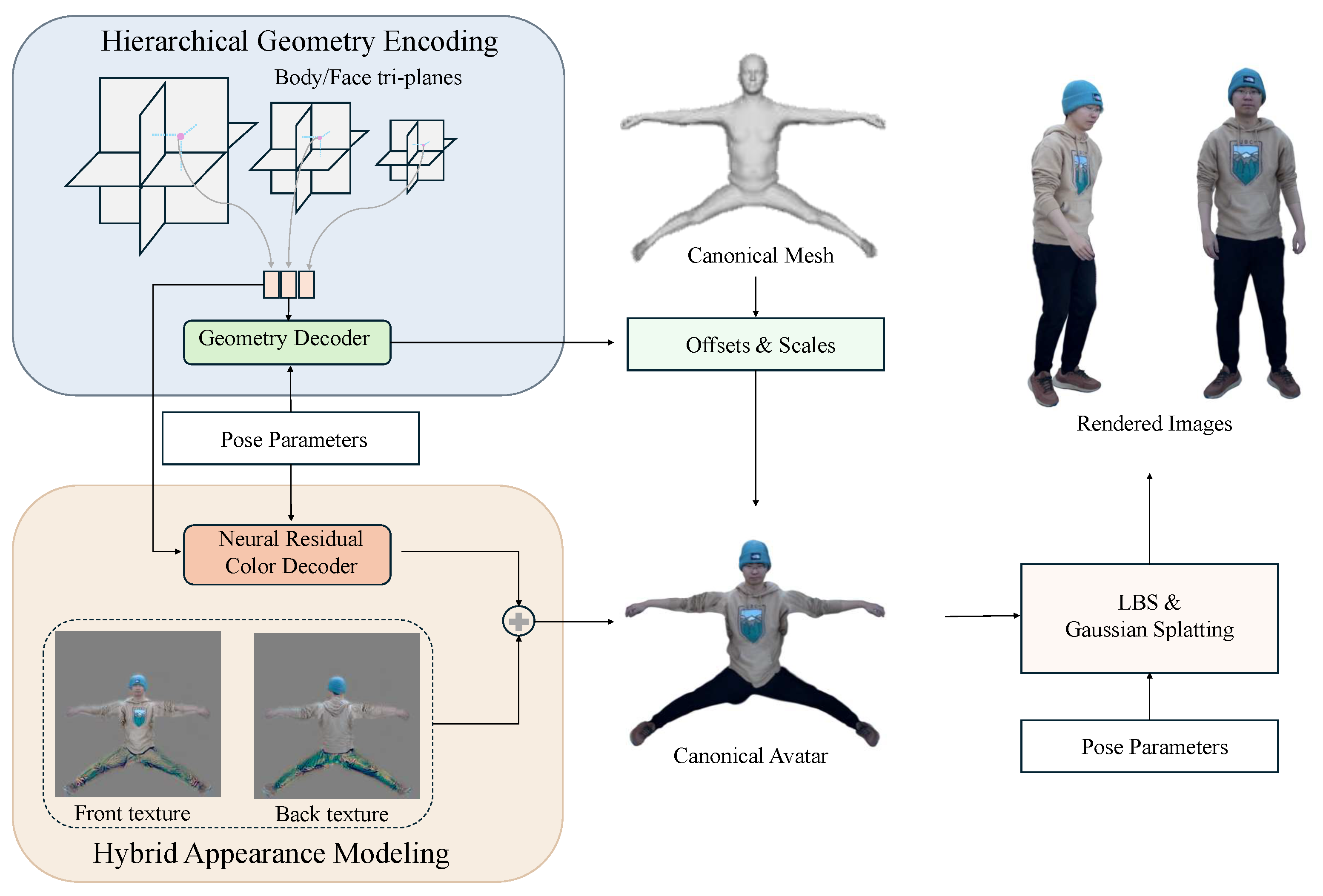
- We propose a hierarchical geometry encoding that mitigates geometric smoothing and enables the reconstruction of intricate surface details from monocular video.
- We design a hybrid appearance modeling scheme that combines an explicit UV texture anchor with a neural residual color branch, improving temporal stability and photorealistic rendering under complex motions.
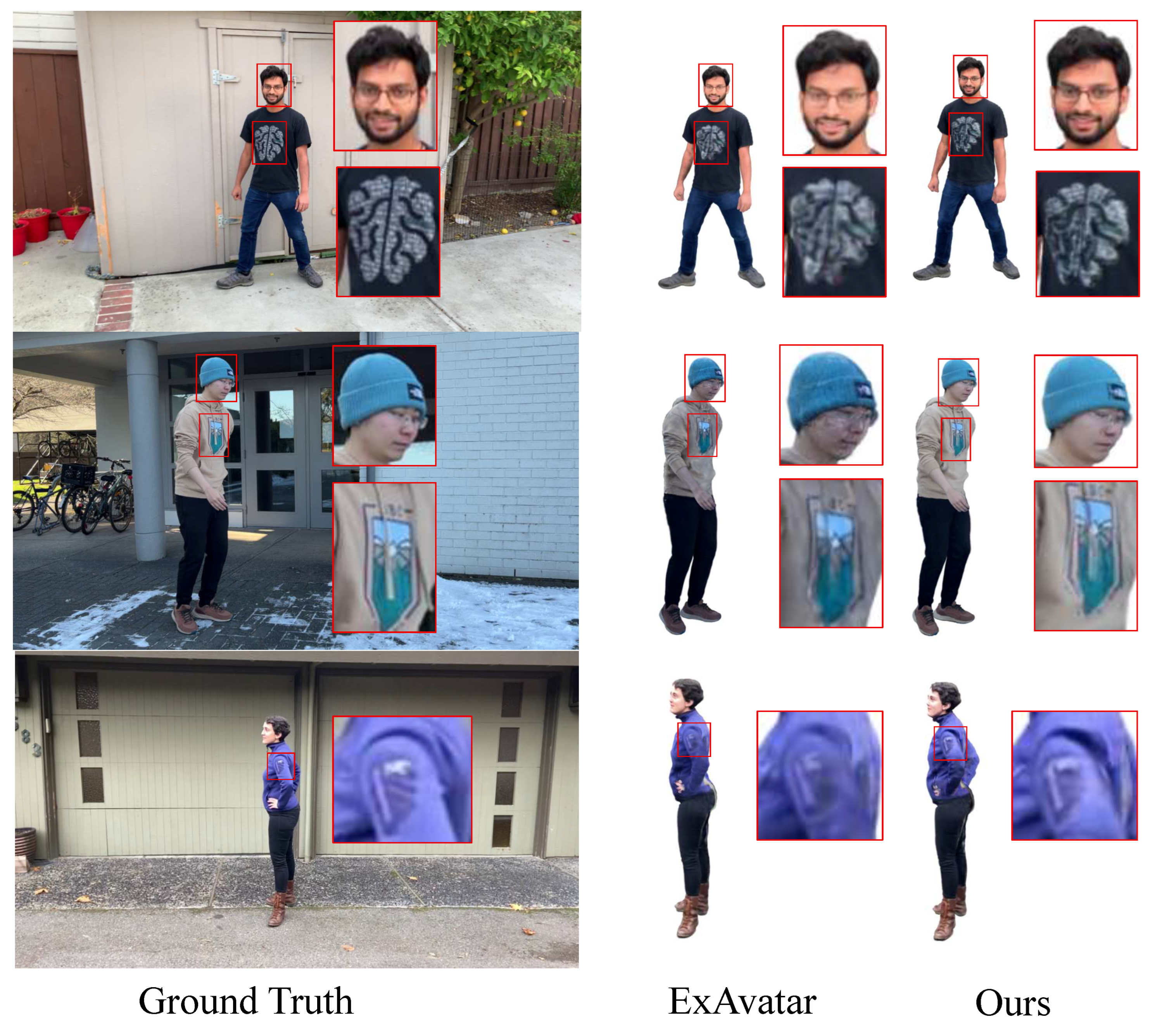
- Our H2Avatar achieves superior performance on human reconstruction tasks in both quantitative and qualitative comparisons, compared to existing baselines.
2. Related Works
2.1. Monocular Animatable Human Avatar Reconstruction
2.2. Neural Implicit Representations for Animatable Avatars
2.3. 3D Gaussian Splatting Based Avatars
3. Method
3.1. Notation and Definitions
3.2. Canonical Representation
3.3. Semantic-Aware Hierarchical Geometry Encoding
3.4. Pose-Conditioned Refinement
3.5. Hybrid Appearance Modeling
3.6. Animation and Rendering
3.7. Loss Functions
3.8. Implementation Details
4. Experimental Results
4.1. Evaluation Setting
- PSNR: We adopt Peak Signal-to-Noise Ratio to measure the similarity between the rendered image and the ground truth.
- SSIM: We also adopt Structural Similarity Index evaluates the perceptual similarity by considering luminance, contrast, and structure.
- LPIPS: To measure the perceptual similarity that better align with human perception, we use Learned Perceptual Image Patch Similarity as the evaluation metric.
- NeuMan [10] introduces a dual-NeRF framework to reconstruct a human and scene from a single video by warping the human to a canonical space via SMPL estimates.
- iHuman [20] represents the human avatar as a mesh-embedded 3DGS framework.
- ExAvatar [17] represents the human avatar as a mesh-embedded tri-plane feature field, which is deformed by SMPL-based LBS and rendered by 3D Gaussian splatting.
- NEGSAvatar [32] introduces surface normal to 3DGS and proposes a locality-aware density control strategy.
4.2. Comparison Results
4.3. Ablation Study
4.4. Limitations and Future Work
5. Conclusions
Author Contributions
Funding
Institutional Review Board Statement
Informed Consent Statement
Data Availability Statement
Conflicts of Interest
References
- Partarakis, N.; Zabulis, X. A review of immersive technologies, knowledge representation, and AI for human-centered digital experiences. Electronics 2024, 13, 269. [Google Scholar] [CrossRef]
- da Silva, A.G.; Mendes Gomes, M.V.; Winkler, I. Virtual reality and digital human modeling for ergonomic assessment in industrial product development: A patent and literature review. Appl. Sci. 2022, 12, 1084. [Google Scholar] [CrossRef]
- Burghardt, A.; Szybicki, D.; Gierlak, P.; Kurc, K.; Pietruś, P.; Cygan, R. Programming of industrial robots using virtual reality and digital twins. Appl. Sci. 2020, 10, 486. [Google Scholar] [CrossRef]
- Kim, M.; Hwang, T.; So, J. Real-Time Live Streaming Framework for Cultural Heritage Using Multi-Camera 3D Motion Capture and Virtual Avatars. Appl. Sci. 2025, 15, 12208. [Google Scholar] [CrossRef]
- Loper, M.; Mahmood, N.; Romero, J.; Pons-Moll, G.; Black, M.J. SMPL: A skinned multi-person linear model. In Seminal Graphics Papers: Pushing the Boundaries, Volume 2; Association for Computing Machinery: New York, NY, USA, 2023; pp. 851–866. [Google Scholar]
- Pavlakos, G.; Choutas, V.; Ghorbani, N.; Bolkart, T.; Osman, A.A.A.; Tzionas, D.; Black, M.J. Expressive Body Capture: 3D Hands, Face, and Body from a Single Image. In 2019 IEEE/CVF Conference on Computer Vision and Pattern Recognition (CVPR); IEEE: New York, NY, USA, 2019. [Google Scholar]
- Alldieck, T.; Magnor, M.; Xu, W.; Theobalt, C.; Pons-Moll, G. Detailed human avatars from monocular video. In 2018 International Conference on 3D Vision (3DV); IEEE: New York, NY, USA, 2018; pp. 98–109. [Google Scholar]
- Zhao, H.; Zhang, J.; Lai, Y.K.; Zheng, Z.; Xie, Y.; Liu, Y.; Li, K. High-fidelity human avatars from a single rgb camera. In 2022 IEEE/CVF Conference on Computer Vision and Pattern Recognition; IEEE: New York, NY, USA, 2022; pp. 15904–15913. [Google Scholar]
- Mildenhall, B.; Srinivasan, P.P.; Tancik, M.; Barron, J.T.; Ramamoorthi, R.; Ng, R. Nerf: Representing scenes as neural radiance fields for view synthesis. Commun. ACM 2021, 65, 99–106. [Google Scholar] [CrossRef]
- Jiang, W.; Yi, K.M.; Samei, G.; Tuzel, O.; Ranjan, A. Neuman: Neural human radiance field from a single video. In Computer Vision—ECCV 2022: 17th European Conference; Springer: Cham, Switzerland, 2022; pp. 402–418. [Google Scholar]
- Chen, J.; Zhang, Y.; Kang, D.; Zhe, X.; Bao, L.; Jia, X.; Lu, H. Animatable neural radiance fields from monocular rgb videos. arXiv 2021, arXiv:2106.13629. [Google Scholar] [CrossRef]
- Peng, S.; Zhang, Y.; Xu, Y.; Wang, Q.; Shuai, Q.; Bao, H.; Zhou, X. Neural body: Implicit neural representations with structured latent codes for novel view synthesis of dynamic humans. In 2021 IEEE/CVF Conference on Computer Vision and Pattern Recognition; IEEE: New York, NY, USA, 2021; pp. 9054–9063. [Google Scholar]
- Jiang, T.; Chen, X.; Song, J.; Hilliges, O. Instantavatar: Learning avatars from monocular video in 60 seconds. In 2023 IEEE/CVF Conference on Computer Vision and Pattern Recognition; IEEE: New York, NY, USA, 2023; pp. 16922–16932. [Google Scholar]
- Lei, J.; Wang, Y.; Pavlakos, G.; Liu, L.; Daniilidis, K. Gart: Gaussian articulated template models. In 2024 IEEE/CVF Conference on Computer Vision and Pattern Recognition; IEEE: New York, NY, USA, 2024; pp. 19876–19887. [Google Scholar]
- Li, Z.; Zheng, Z.; Wang, L.; Liu, Y. Animatable gaussians: Learning pose-dependent gaussian maps for high-fidelity human avatar modeling. In 2024 IEEE/CVF Conference on Computer Vision and Pattern Recognition; IEEE: New York, NY, USA, 2024; pp. 19711–19722. [Google Scholar]
- Kerbl, B.; Kopanas, G.; Leimkühler, T.; Drettakis, G. 3D gaussian splatting for real-time radiance field rendering. ACM Trans. Graph. 2023, 42, 139. [Google Scholar] [CrossRef]
- Moon, G.; Shiratori, T.; Saito, S. Expressive whole-body 3D gaussian avatar. In Computer Vision—ECCV 2024: 18th European Conference; Springer: Cham, Switaerland, 2024; pp. 19–35. [Google Scholar]
- Zhang, J.; Li, X.; Jia, H.; Li, J.; Su, Z.; Wang, G.; Li, K. LoGAvatar: Local Gaussian Splatting for human avatar modeling from monocular video. Comput.-Aided Des. 2025, 190, 103973. [Google Scholar] [CrossRef]
- Zhang, J.; Shen, I.C.; Sakamiya, J.; Lai, Y.K.; Igarashi, T.; Li, K. DualAvatar: Robust Gaussian splatting avatar with dual representation. In SIGGRAPH Asia 2024 Posters; Association for Computing Machinery: New York, NY, USA, 2024; pp. 1–3. [Google Scholar]
- Paudel, P.; Khanal, A.; Paudel, D.P.; Tandukar, J.; Chhatkuli, A. ihuman: Instant animatable digital humans from monocular videos. In Computer Vision—ECCV 2024: 18th European Conference; Springer: Cham, Switaerland, 2024; pp. 304–323. [Google Scholar]
- Zhou, X.; Peng, S.; Xu, Z.; Dong, J.; Wang, Q.; Zhang, S.; Shuai, Q.; Bao, H. Animatable implicit neural representations for creating realistic avatars from videos. IEEE Trans. Pattern Anal. Mach. Intell. 2024, 46, 4147–4159. [Google Scholar] [CrossRef] [PubMed]
- Peng, S.; Dong, J.; Wang, Q.; Zhang, S.; Shuai, Q.; Zhou, X.; Bao, H. Animatable neural radiance fields for modeling dynamic human bodies. In 2021 IEEE/CVF International Conference on Computer Vision; IEEE: New York, NY, USA, 2021; pp. 14314–14323. [Google Scholar]
- Zheng, Z.; Huang, H.; Yu, T.; Zhang, H.; Guo, Y.; Liu, Y. Structured local radiance fields for human avatar modeling. In 2022 IEEE/CVF Conference on Computer Vision and Pattern Recognition; IEEE: New York, NY, USA, 2022; pp. 15893–15903. [Google Scholar]
- Guo, C.; Jiang, T.; Chen, X.; Song, J.; Hilliges, O. Vid2avatar: 3D avatar reconstruction from videos in the wild via self-supervised scene decomposition. In 2023 IEEE/CVF Conference on Computer Vision and Pattern Recognition; IEEE: New York, NY, USA, 2023; pp. 12858–12868. [Google Scholar]
- Pan, J.; Li, X.; Bai, J.; Dai, J. LiteNeRFAvatar: A lightweight NeRF with local feature learning for dynamic human avatar. Pattern Recognit. 2026, 170, 112008. [Google Scholar] [CrossRef]
- Zheng, Z.; Zhao, X.; Zhang, H.; Liu, B.; Liu, Y. Avatarrex: Real-time expressive full-body avatars. ACM Trans. Graph. (TOG) 2023, 42, 1–19. [Google Scholar] [CrossRef]
- Hu, L.; Zhang, H.; Zhang, Y.; Zhou, B.; Liu, B.; Zhang, S.; Nie, L. Gaussianavatar: Towards realistic human avatar modeling from a single video via animatable 3D gaussians. In 2024 IEEE/CVF Conference on Computer Vision and Pattern Recognition; IEEE: New York, NY, USA, 2024; pp. 634–644. [Google Scholar]
- Yang, H.; Zhang, Z.; Tang, H.; Qian, J.; Yang, J. Consistentavatar: Learning to diffuse fully consistent talking head avatar with temporal guidance. In Proceedings of the 32nd ACM International Conference on Multimedia; Association for Computing Machinery: New York, NY, USA, 2024; pp. 3964–3973. [Google Scholar]
- Zhan, Y.; Xu, W.; Zhu, Q.; Niu, M.; Ma, M.; Liu, Y.; Zhong, Z.; Sun, X.; Zheng, Y. R3-avatar: Record and retrieve temporal codebook for reconstructing photorealistic human avatars. arXiv 2025, arXiv:2503.12751. [Google Scholar] [CrossRef]
- Sun, Y.; Bao, Q.; Liu, W.; Mei, T.; Black, M.J. Trace: 5D temporal regression of avatars with dynamic cameras in 3D environments. In 2023 IEEE/CVF Conference on Computer Vision and Pattern Recognition; IEEE: New York, NY, USA, 2023; pp. 8856–8866. [Google Scholar]
- Hong, G.; Lu, M.; Tian, S.; Chen, X.; Zhang, H. FAST: Facial Avatar Animation via Spatial-Temporal Aggregation. In 2025 IEEE International Conference on Multimedia and Expo (ICME); IEEE: New York, NY, USA, 2025; pp. 1–6. [Google Scholar]
- Zheng, Z.; Tan, Y.; Su, Z.; Zhou, F.; Zhao, B. NEGS-Avatar: Normal Embedded Gaussians for 2D avatar from monocular video. Comput. Graph. 2026, 135, 104538. [Google Scholar] [CrossRef]
- Paszke, A.; Gross, S.; Massa, F.; Lerer, A.; Bradbury, J.; Chanan, G.; Killeen, T.; Lin, Z.; Gimelshein, N.; Antiga, L.; et al. Pytorch: An imperative style, high-performance deep learning library. Adv. Neural Inf. Process. Syst. 2019, 32, 8026–8037. [Google Scholar]
- Kingma, D.P.; Ba, J. Adam: A method for stochastic optimization. arXiv 2014, arXiv:1412.6980. [Google Scholar]


| Method | Geometry | Appearance | Hierarchical | Hybrid | Key Limitations |
|---|---|---|---|---|---|
| LoGAvarar [18] | 3DGS | Explicit (UV Texture) | No | No | Single-scale geometry, limited details |
| NeuMan [10] | NeRF | Implicit (MLP) | No | No | Slow rendering, limited details |
| iHuman [20] | Mesh+GS | Implicit (MLP) | No | No | Single-scale geometry, unstable texture |
| ExAvatar [17] | Mesh+GS+Tri-plane | Implicit (Tri-plane+MLP) | No | No | Single-scale geometry, implicit color only |
| NEGSAvatar [32] | Mesh+GS | Implicit (MLP) | No | No | No multi-scale structure |
| H2Avatar (Ours) | Mesh+GS+Multi-scale Tri-plane | Explicit + Implicit | Yes | Yes | Addresses above limitations |
| Component | Setting |
|---|---|
| Tri-plane levels L | 3 |
| Per-level resolution | {(64, 64), (128, 128), (256, 256)} |
| Per-level channels | {32, 32, 32} |
| Fusion MLP | 2 layers, 192 |
| Texture resolution | (512, 512) |
| Optimizer | Adam |
| Learning rate | |
| LR schedule | at 75% and 90% iters |
| Training iterations | 25 epochs |
| Subject | Seattle | Citron | ||||
| Method | PSNR | SSIM | LPIPS | PSNR | SSIM | LPIPS |
| NeuMan [10] | 29.34 | 0.9794 | 0.0142 | 27.15 | 0.9727 | 0.0193 |
| iHuman [20] | 29.64 | 0.9820 | 0.0174 | 28.90 | 0.9761 | 0.0232 |
| ExAvatar [17] | 36.77 | 0.9918 | 0.0054 | 35.18 | 0.9873 | 0.0078 |
| NEGSAvatar [32] | 33.07 | 0.9842 | 0.0095 | 32.38 | 0.9760 | 0.0163 |
| Ours | 37.02 | 0.9923 | 0.0051 | 35.64 | 0.9874 | 0.0070 |
| Subject | Bike | Jogging | ||||
| Method | PSNR | SSIM | LPIPS | PSNR | SSIM | LPIPS |
| NeuMan [10] | 26.24 | 0.9637 | 0.0304 | 26.56 | 0.9646 | 0.0255 |
| iHuman [20] | 27.62 | 0.9660 | 0.0347 | 26.86 | 0.9638 | 0.0291 |
| ExAvatar [17] | 32.71 | 0.9816 | 0.0115 | 32.88 | 0.9778 | 0.0135 |
| NEGSAvatar [32] | 30.63 | 0.9606 | 0.0263 | 30.10 | 0.9638 | 0.0217 |
| Ours | 33.37 | 0.9831 | 0.0101 | 32.61 | 0.9779 | 0.0129 |
| Subject | Seattle | Citron | ||||
| Method | PSNR | SSIM | LPIPS | PSNR | SSIM | LPIPS |
| w/o Hierarchy | 36.10 | 0.9910 | 0.0063 | 34.70 | 0.9858 | 0.0085 |
| w/o Color Residual | 36.60 | 0.9917 | 0.0058 | 35.10 | 0.9866 | 0.0078 |
| w/o UV Texture | 36.77 | 0.9918 | 0.0054 | 35.18 | 0.9870 | 0.0078 |
| Full | 37.02 | 0.9923 | 0.0051 | 35.64 | 0.9874 | 0.0070 |
| Subject | Bike | Jogging | ||||
| Method | PSNR | SSIM | LPIPS | PSNR | SSIM | LPIPS |
| w/o Hierarchy | 32.20 | 0.9805 | 0.0126 | 31.55 | 0.9754 | 0.0158 |
| w/o Color Residual | 32.90 | 0.9821 | 0.0111 | 32.18 | 0.9769 | 0.0140 |
| w/o UV Texture | 32.71 | 0.9816 | 0.0115 | 32.32 | 0.9772 | 0.0135 |
| Full | 33.37 | 0.9831 | 0.0101 | 32.61 | 0.9779 | 0.0129 |
Disclaimer/Publisher’s Note: The statements, opinions and data contained in all publications are solely those of the individual author(s) and contributor(s) and not of MDPI and/or the editor(s). MDPI and/or the editor(s) disclaim responsibility for any injury to people or property resulting from any ideas, methods, instructions or products referred to in the content. |
© 2026 by the authors. Licensee MDPI, Basel, Switzerland. This article is an open access article distributed under the terms and conditions of the Creative Commons Attribution (CC BY) license.
Share and Cite
Zhang, J.; Guan, C.; Lin, Z.; Lin, Y. H2Avatar: Expressive Whole-Body Avatars from Monocular Video via Hierarchical Geometry and Hybrid Rendering. Big Data Cogn. Comput. 2026, 10, 105. https://doi.org/10.3390/bdcc10040105
Zhang J, Guan C, Lin Z, Lin Y. H2Avatar: Expressive Whole-Body Avatars from Monocular Video via Hierarchical Geometry and Hybrid Rendering. Big Data and Cognitive Computing. 2026; 10(4):105. https://doi.org/10.3390/bdcc10040105
Chicago/Turabian StyleZhang, Jinsong, Cheng Guan, Zhihua Lin, and Yuqin Lin. 2026. "H2Avatar: Expressive Whole-Body Avatars from Monocular Video via Hierarchical Geometry and Hybrid Rendering" Big Data and Cognitive Computing 10, no. 4: 105. https://doi.org/10.3390/bdcc10040105
APA StyleZhang, J., Guan, C., Lin, Z., & Lin, Y. (2026). H2Avatar: Expressive Whole-Body Avatars from Monocular Video via Hierarchical Geometry and Hybrid Rendering. Big Data and Cognitive Computing, 10(4), 105. https://doi.org/10.3390/bdcc10040105