Predicting Mortality and Readmission in Obstructive Sleep Apnea via LLM-Expanded Clinical Concepts

 and
and
Abstract
1. Introduction
2. Related Work
2.1. LLMs in Health Care
2.2. Predicting Mortality and Hospital Readmission Through NLP Techniques
3. Materials and Methods
3.1. Dataset
3.2. Software and Platform
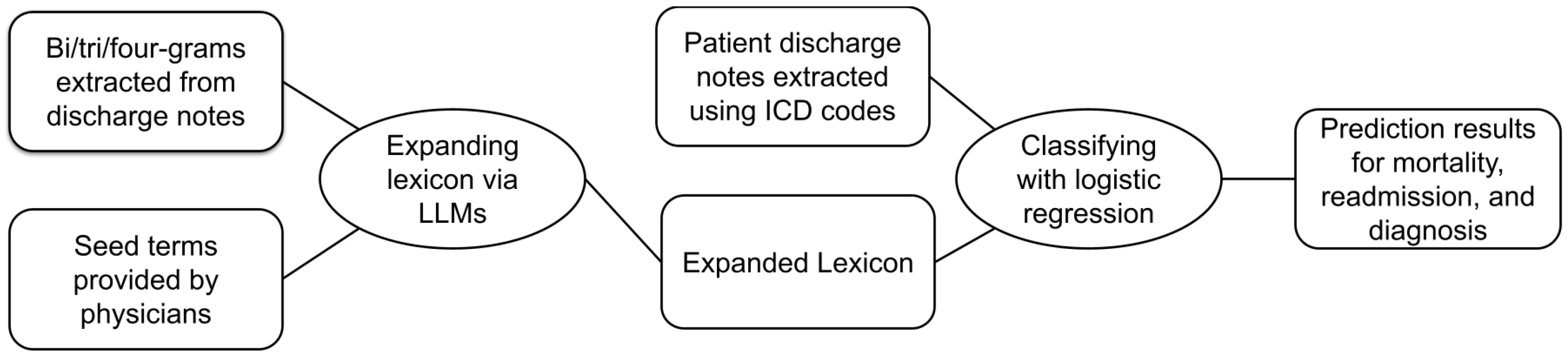
3.3. Process Flow
3.3.1. Bi/Tri/Four-Grams Extracted from Discharge Notes
3.3.2. Seed Terms Provided by Physicians
3.3.3. Expanding Lexicon via LLMs
3.3.4. Expanded Lexicon
3.3.5. Patient Discharge Notes Extracted Using ICD Codes
3.3.6. Classifying with Logistic Regression
3.3.7. Prediction Results
3.4. Model Training and Evaluation
4. Results and Discussion
4.1. Overview
4.2. Mortality Prediction
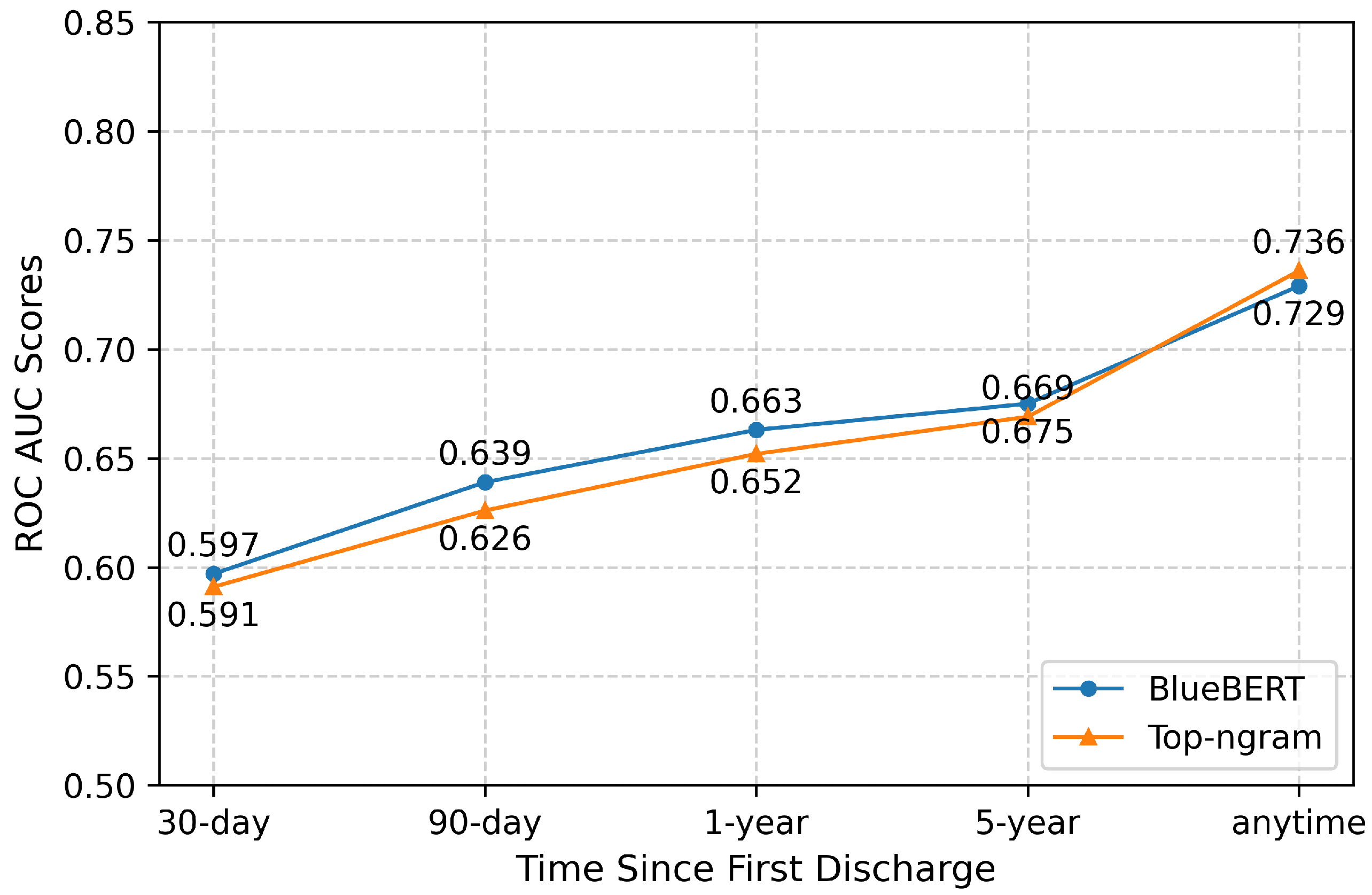
4.3. Hospital Readmission Prediction
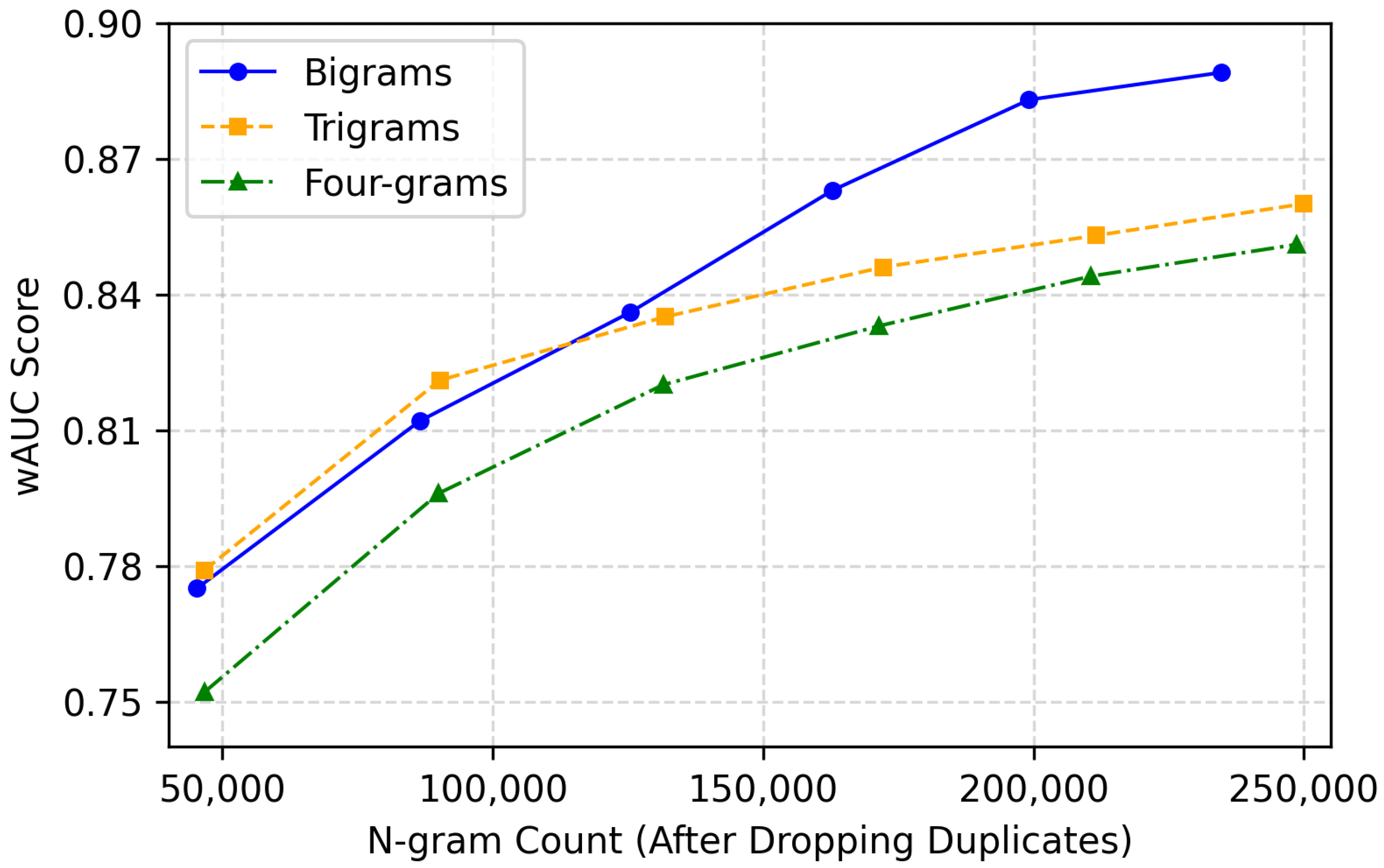
4.4. Comparing the Impact of N-Gram Size
5. Conclusions
5.1. Major Findings
5.2. Limitations and Future Work
Supplementary Materials
Author Contributions
Funding
Institutional Review Board Statement
Informed Consent Statement
Data Availability Statement
Acknowledgments
Conflicts of Interest
Abbreviations
| AI | Artificial Intelligence |
| AF | Atrial Fibrillation |
| AHI | Apnea-Hypopnea Index |
| CV | Cardiovascular |
| EDS | Excessive Daytime Sleepiness |
| EHR | Electronic Health Records |
| FM | Foundation Model |
| HF | Heart Failure |
| HTN | Hypertension |
| ICD | International Classification of Diseases |
| ICU | Intensive Care Unit |
| LLM | Large Language Model |
| LR | Logistic Regression |
| MIMIC | Medical Information Mart for Intensive Care |
| NERSC | National Energy Research Scientific Computing Center |
| NLP | Natural Language Processing |
| OHS | Obesity Hypoventilation Syndrome |
| OSA | Obstructive Sleep Apnea |
| T2DM | Type 2 Diabetes Mellitus |
| wAUC | Weighted Area Under the Curve |
References
- Sönmez, I.; Dupuy, A.V.; Kristina, S.Y.; Cronin, J.; Yee, J.; Azarbarzin, A. Unmasking obstructive sleep apnea: Estimated prevalence and impact in the United States. Respir. Med. 2025, 248, 108348. [Google Scholar] [CrossRef] [PubMed]
- Benjafield, A.V.; Ayas, N.T.; Eastwood, P.R.; Heinzer, R.; Ip, M.S.; Morrell, M.J.; Nunez, C.M.; Patel, S.R.; Penzel, T.; Pépin, J.L.; et al. Estimation of the global prevalence and burden of obstructive sleep apnoea: A literature-based analysis. Lancet Respir. Med. 2019, 7, 687–698. [Google Scholar] [CrossRef] [PubMed]
- Loke, Y.K.; Brown, J.W.L.; Kwok, C.S.; Niruban, A.; Myint, P.K. Association of obstructive sleep apnea with risk of serious cardiovascular events: A systematic review and meta-analysis. Circ. Cardiovasc. Qual. Outcomes 2012, 5, 720–728. [Google Scholar] [CrossRef] [PubMed]
- Seiler, A.; Camilo, M.; Korostovtseva, L.; Haynes, A.G.; Brill, A.K.; Horvath, T.; Egger, M.; Bassetti, C.L. Prevalence of sleep-disordered breathing after stroke and TIA: A meta-analysis. Neurology 2019, 92, e648–e654. [Google Scholar] [CrossRef]
- Sulit, L.; Storfer-Isser, A.; Kirchner, H.L.; Redline, S. Differences in polysomnography predictors for hypertension and impaired glucose tolerance. Sleep 2006, 29, 777–783. [Google Scholar] [CrossRef]
- Xia, W.; Huang, Y.; Peng, B.; Zhang, X.; Wu, Q.; Sang, Y.; Luo, Y.; Liu, X.; Chen, Q.; Tian, K. Relationship between obstructive sleep apnoea syndrome and essential hypertension: A dose-response meta-analysis. Sleep Med. 2018, 47, 11–18. [Google Scholar] [CrossRef] [PubMed]
- Olaithe, M.; Bucks, R.S.; Hillman, D.R.; Eastwood, P.R. Cognitive deficits in obstructive sleep apnea: Insights from a meta-review and comparison with deficits observed in COPD, insomnia, and sleep deprivation. Sleep Med. Rev. 2018, 38, 39–49. [Google Scholar] [CrossRef]
- Yaffe, K.; Laffan, A.M.; Harrison, S.L.; Redline, S.; Spira, A.P.; Ensrud, K.E.; Ancoli-Israel, S.; Stone, K.L. Sleep-Disordered Breathing, Hypoxia, and Risk of Mild Cognitive Impairment and Dementia in Older Women. JAMA 2011, 306, 613–619. [Google Scholar] [CrossRef]
- Chung, F.; Yegneswaran, B.; Liao, P.; Chung, S.A.; Vairavanathan, S.; Islam, S.; Khajehdehi, A.; Shapiro, C.M. STOP questionnaire: A tool to screen patients for obstructive sleep apnea. Anesthesiology 2008, 108, 812–821. [Google Scholar] [CrossRef]
- Marti-Soler, H.; Hirotsu, C.; Marques-Vidal, P.; Vollenweider, P.; Waeber, G.; Preisig, M.; Tafti, M.; Tufik, S.B.; Bittencourt, L.; Tufik, S.; et al. The NoSAS score for screening of sleep-disordered breathing: A derivation and validation study. Lancet Respir. Med. 2016, 4, 742–748. [Google Scholar] [CrossRef]
- Weiskopf, N.G.; Weng, C. Methods and dimensions of electronic health record data quality assessment: Enabling reuse for clinical research. J. Am. Med. Inform. Assoc. 2013, 20, 144–151. [Google Scholar] [CrossRef]
- Chiu, C.C.; Wu, C.M.; Chien, T.N.; Kao, L.J.; Li, C.; Chu, C.M. Integrating structured and unstructured EHR data for predicting mortality by machine learning and latent Dirichlet allocation method. Int. J. Environ. Res. Public Health 2023, 20, 4340. [Google Scholar] [CrossRef] [PubMed]
- Zhang, D.; Yin, C.; Zeng, J.; Yuan, X.; Zhang, P. Combining structured and unstructured data for predictive models: A deep learning approach. BMC Med. Inform. Decis. Mak. 2020, 20, 280. [Google Scholar] [CrossRef]
- Rajkomar, A.; Oren, E.; Chen, K.; Dai, A.M.; Hajaj, N.; Hardt, M.; Liu, P.J.; Liu, X.; Marcus, J.; Sun, M.; et al. Scalable and accurate deep learning with electronic health records. NPJ Digit. Med. 2018, 1, 18. [Google Scholar] [CrossRef] [PubMed]
- Fensore, C.; Carrillo-Larco, R.M.; Patel, S.A.; Morris, A.A.; Ho, J.C. Large Language Models for Integrating Social Determinant of Health Data: A Case Study on Heart Failure 30-Day Readmission Prediction. arXiv 2024, arXiv:2407.09688. [Google Scholar] [CrossRef]
- Park, S.; Wee, C.W.; Choi, S.H.; Kim, K.H.; Chang, J.S.; Yoon, H.I.; Lee, I.J.; Kim, Y.B.; Cho, J.; Keum, K.C.; et al. RT-Surv: Improving Mortality Prediction After Radiotherapy with Large Language Model Structuring of Large-Scale Unstructured Electronic Health Records. arXiv 2024, arXiv:2408.05074. [Google Scholar]
- Devlin, J.; Chang, M.W.; Lee, K.; Toutanova, K. BERT: Pre-training of Deep Bidirectional Transformers for Language Understanding. In Proceedings of the 2019 Conference of the North American Chapter of the Association for Computational Linguistics: Human Language Technologies, Minneapolis, MN, USA, 2–7 June 2019; pp. 4171–4186. [Google Scholar]
- Alsentzer, E.; Murphy, J.R.; Boag, W.; Weng, W.H.; Jin, D.; Naumann, T.; McDermott, M. Publicly available clinical BERT embeddings. arXiv 2019, arXiv:1904.03323. [Google Scholar] [CrossRef]
- Lee, J.; Yoon, W.; Kim, S.; Kim, D.; Kim, S.; So, C.H.; Kang, J. BioBERT: A pre-trained biomedical language representation model for biomedical text mining. Bioinformatics 2020, 36, 1234–1240. [Google Scholar] [CrossRef]
- Yang, X.; Chen, A.; PourNejatian, N.; Shin, H.C.; Smith, K.E.; Parisien, C.; Compas, C.; Martin, C.; Costa, A.B.; Flores, M.G.; et al. A large language model for electronic health records. NPJ Digit. Med. 2022, 5, 194. [Google Scholar] [CrossRef]
- Singhal, K.; Azizi, S.; Tu, T.; Mahdavi, S.S.; Wei, J.; Chung, H.W.; Scales, N.; Tanwani, A.; Cole-Lewis, H.; Pfohl, S.; et al. Large language models encode clinical knowledge. Nature 2023, 620, 172–180. [Google Scholar] [CrossRef]
- Nori, H.; King, N.; McKinney, S.M.; Carignan, D.; Horvitz, E. Capabilities of GPT-4 on medical challenge problems. arXiv 2023, arXiv:2303.13375. [Google Scholar] [CrossRef]
- Ahltorp, M.; Skeppstedt, M.; Kitajima, S.; Henriksson, A.; Rzepka, R.; Araki, K. Expansion of medical vocabularies using distributional semantics on Japanese patient blogs. J. Biomed. Semant. 2016, 7, 58. [Google Scholar] [CrossRef] [PubMed]
- Fan, Y.; Pakhomov, S.; McEwan, R.; Zhao, W.; Lindemann, E.; Zhang, R. Using word embeddings to expand terminology of dietary supplements using clinical notes. JAMIA Open 2019, 2, 246–253. [Google Scholar] [CrossRef]
- Kugic, A.; Pfeifer, B.; Schulz, S.; Kreuzthaler, M. Embedding-based terminology expansion via secondary data sources. J. Biomed. Inform. 2023, 147, 104497. [Google Scholar] [CrossRef]
- Bommasani, R.; Hudson, D.A.; Adeli, E.; Altman, R.; Arora, S.; von Arx, S.; Bernstein, M.S.; Bohg, J.; Bosselut, A.; Brunskill, E.; et al. On the opportunities and risks of foundation models. arXiv 2021, arXiv:2108.07258. [Google Scholar] [CrossRef]
- Le Scao, T.; Fan, A.; Akiki, C.; Pavlick, E.; Ilić, S.; Hesslow, D.; Castagné, R.; Luccioni, A.S.; Yvon, F.; Gallé, M.; et al. Bloom: A 176b-parameter open-access multilingual language model. arXiv 2022, arXiv:2211.05100. [Google Scholar]
- Peng, Y.; Yan, S.; Lu, Z. Transfer learning in biomedical natural language processing: An evaluation of BERT and ELMo on ten benchmarking datasets. arXiv 2019, arXiv:1906.05474. [Google Scholar] [CrossRef]
- Patel, S.B.; Lam, K. ChatGPT: The future of discharge summaries? Lancet Digit. Health 2023, 5, e107–e108. [Google Scholar] [CrossRef]
- Luo, R.; Sun, L.; Xia, Y.; Qin, T.; Zhang, S.; Poon, H.; Liu, T.Y. BioGPT: Generative pre-trained transformer for biomedical text generation and mining. Briefings Bioinform. 2022, 23, bbac409. [Google Scholar] [CrossRef] [PubMed]
- Kumar, V.; Rajawat, P.S.; Ntoutsi, E. Mitigating Semantic Drift: Evaluating LLMs’ Efficacy in Psychotherapy through MI Dialogue Summarization Leveraging MITI Code. In Proceedings of the International Joint Conference on Neural Networks (IJCNN); IEEE: New York, NY, USA, 2025; pp. 1–8. [Google Scholar] [CrossRef]
- Yang, X.; Li, T.; Su, Q.; Liu, Y.; Kang, C.; Lyu, Y.; Zhao, L.; Nie, Y.; Pan, Y. Application of Large Language Models in Disease Diagnosis and Treatment. Chin. Med. J. 2025, 138, 130–142. [Google Scholar] [CrossRef] [PubMed]
- Zhang, K.; Meng, X.; Yan, X.; Ji, J.; Liu, J.; Xu, H.; Zhang, H.; Liu, D.; Wang, J.; Wang, X.; et al. Revolutionizing Health Care: The Transformative Impact of Large Language Models in Medicine. J. Med. Internet Res. 2025, 27, e59069. [Google Scholar] [CrossRef]
- Qadrud-Din, J.; Rabiou, A.B.; Walker, R.; Soni, R.; Gajek, M.; Pack, G.; Rangaraj, A. Transformer based language models for similar text retrieval and ranking. arXiv 2020, arXiv:2005.04588. [Google Scholar] [CrossRef]
- Chae, Y.; Davidson, T. Large Language Models for Text Classification: From Zero-Shot Learning to Fine-Tuning; Open Science Foundation: Charlottesville, VA, USA, 2023. [Google Scholar]
- Savelka, J.; Ashley, K.D. The unreasonable effectiveness of large language models in zero-shot semantic annotation of legal texts. Front. Artif. Intell. 2023, 6, 1279794. [Google Scholar] [CrossRef]
- Si, Y.; Wang, J.; Xu, H.; Roberts, K. Enhancing clinical concept extraction with contextual embeddings. J. Am. Med. Inform. Assoc. 2019, 26, 1297–1304. [Google Scholar] [CrossRef]
- Hernandez, B.; Stiff, O.; Ming, D.K.; Ho Quang, C.; Nguyen Lam, V.; Nguyen Minh, T.; Nguyen Van Vinh, C.; Nguyen Minh, N.; Nguyen Quang, H.; Phung Khanh, L.; et al. Learning meaningful latent space representations for patient risk stratification: Model development and validation for dengue and other acute febrile illness. Front. Digit. Health 2023, 5, 1057467. [Google Scholar] [CrossRef]
- Morrow, E.; Zamora-Resendiz, R.; Beckham, J.C.; Kimbrel, N.A.; McMahon, B.H.; Crivelli, S. Life events extraction from healthcare notes for veteran acute suicide risk prediction. J. Am. Med. Inform. Assoc. (JAMIA) 2026, ocaf197. [Google Scholar] [CrossRef] [PubMed]
- Boag, W.; Doss, D.; Naumann, T.; Szolovits, P. What’s in a note? Unpacking predictive value in clinical note representations. AMIA Summits Transl. Sci. Proc. 2018, 2018, 26. [Google Scholar]
- Huang, K.; Altosaar, J.; Ranganath, R. Clinicalbert: Modeling clinical notes and predicting hospital readmission. arXiv 2019, arXiv:1904.05342. [Google Scholar]
- Wu, J.; Ye, X.; Mou, C.; Dai, W. Fineehr: Refine clinical note representations to improve mortality prediction. In Proceedings of the 2023 11th International Symposium on Digital Forensics and Security (ISDFS); IEEE: New York, NY, USA, 2023; pp. 1–6. [Google Scholar]
- Ye, J.; Yao, L.; Shen, J.; Janarthanam, R.; Luo, Y. Predicting mortality in critically ill patients with diabetes using machine learning and clinical notes. BMC Med. Inform. Decis. Mak. 2020, 20, 295. [Google Scholar] [CrossRef]
- Ashfaq, A.; Sant’Anna, A.; Lingman, M.; Nowaczyk, S. Readmission prediction using deep learning on electronic health records. J. Biomed. Inform. 2019, 97, 103256. [Google Scholar] [CrossRef]
- Chen, P.F.; Chen, L.; Lin, Y.K.; Li, G.H.; Lai, F.; Lu, C.W.; Yang, C.Y.; Chen, K.C.; Tzu-Yu, L. Predicting postoperative mortality with deep neural networks and natural language processing: Model development and validation. JMIR Med. Inform. 2022, 10, e38241. [Google Scholar] [CrossRef]
- Jin, M.; Bahadori, M.T.; Colak, A.; Bhatia, P.; Celikkaya, B.; Bhakta, R.; Senthivel, S.; Khalilia, M.; Navarro, D.; Zhang, B.; et al. Improving hospital mortality prediction with medical named entities and multimodal learning. arXiv 2018, arXiv:1811.12276. [Google Scholar] [CrossRef]
- Khadanga, S.; Aggarwal, K.; Joty, S.; Srivastava, J. Using clinical notes with time series data for ICU management. arXiv 2019, arXiv:1909.09702. [Google Scholar]
- Parreco, J.; Hidalgo, A.; Kozol, R.; Namias, N.; Rattan, R. Predicting mortality in the surgical intensive care unit using artificial intelligence and natural language processing of physician documentation. Am. Surg. 2018, 84, 1190–1194. [Google Scholar] [CrossRef]
- Nazih, W.; Abuhmed, T.; Alharbi, M.; El-Sappagh, S. Mortality Prediction for ICU Patients with Mental Disorders Using Large Language Models Ensemble and Unstructured Medical Notes. PLoS ONE 2025, 20, e0332134. [Google Scholar] [CrossRef]
- Johnson, A.; Bulgarelli, L.; Pollard, T.; Horng, S.; Celi, L.A.; Mark, R. MIMIC-IV (version 2.2). PhysioNet 2023. [Google Scholar] [CrossRef]
- Ahmed, A.; Rispoli, A.; Wasieloski, C.; Khurram, I.; Zamora-Resendiz, R.; Morrow, D.; Dong, A.; Crivelli, S. Deep Phenotyping of Obstructive Sleep Apnea and Comorbidities with Large Language Models. In Proceedings of the AIME24, Salt Lake City, UT, USA, 9–12 July 2024. [Google Scholar]
- Keenan, B.T.; Kirchner, H.L.; Veatch, O.J.; Borthwick, K.M.; Davenport, V.A.; Feemster, J.C.; Gendy, M.; Gossard, T.R.; Pack, F.M.; Sirikulvadhana, L.; et al. Multisite validation of a simple electronic health record algorithm for identifying diagnosed obstructive sleep apnea. J. Clin. Sleep Med. 2020, 16, 175–183. [Google Scholar] [CrossRef] [PubMed]
- Cade, B.E.; Hassan, S.M.; Dashti, H.S.; Kiernan, M.; Pavlova, M.K.; Redline, S.; Karlson, E.W. Sleep apnea phenotyping and relationship to disease in a large clinical biobank. JAMIA Open 2022, 5, ooab117. [Google Scholar] [CrossRef] [PubMed]



| Condition | ICD Codes, N | Seed Terms, N |
|---|---|---|
| OSA | 9 | 38 |
| T2DM | 157 | 13 |
| HTN | 68 | 10 |
| HF | 61 | 15 |
| AF | 16 | 12 |
| Total | 311 | 88 |
| Characteristic | OSA | T2DM | HTN | HF | AF |
|---|---|---|---|---|---|
| Patients, N | 13,942 | 21,666 | 74,080 | 21,076 | 25,743 |
| Discharge Notes, N | 29,892 | 53,446 | 161,245 | 49,479 | 55,418 |
| Women, N (%) | 5628 (40.4) | 10,088 (46.6) | 36,486 (49.3) | 9944 (47.2) | 11,215 (44.0) |
| White, N (%) | 9895 (71.0) | 13,802 (63.7) | 51,238 (69.2) | 15,269 (72.4) | 19,980 (77.6) |
| Black, N (%) | 1966 (14.1) | 3688 (17.0) | 9959 (13.4) | 2476 (11.7) | 1776 (6.9) |
| Other, N (%) | 2081 (14.9) | 4176 (19.3) | 12,883 (17.4) | 3331 (15.9) | 3967 (15.5) |
| Group | Patients (N) | Hospital Admissions (N) |
|---|---|---|
| OSA Only (w/o T2DM and HTN) | 6392 | 11,266 |
| T2DM Only (w/o OSA and HTN) | 5561 | 9372 |
| HTN Only (w/o OSA and T2DM) | 56,111 | 107,081 |
| OSA & T2DM & HTN | 2828 | 6000 |
| Other + | 23,809 | 49,432 |
| Total | 81,096 * | 183,151 |
| Status | 6-Month Post-Discharge | 1-Year Post-Discharge |
|---|---|---|
| Alive | 66,813 | 61,623 |
| Deceased | 9606 | 14,796 |
| Approach | 6-Month Post-Discharge | 1-Year Post-Discharge | ||||
|---|---|---|---|---|---|---|
| AUC | Total Trigrams | Non-Zero N (%) | AUC | Total Trigrams | Non-Zero N (%) | |
| Top-ngram | 0.899 | 200,000 | 199,936 (99.97) | 0.871 | 200,000 | 199,939 (99.97) |
| GatorTron Medium | 0.844 | 206,858 | 163,867 (79.22) | 0.817 | 206,858 | 164,123 (79.34) |
| BlueBERT | 0.821 | 204,003 | 159,980 (78.42) | 0.803 | 204,003 | 159,763 (78.31) |
| Outcome | Approach | Accuracy | Precision | Recall |
|---|---|---|---|---|
| 6-month Post-discharge | Top-ngram | 0.881 ± 0.003 | 0.520 ± 0.007 | 0.696 ± 0.010 |
| GatorTron | 0.846 ± 0.002 | 0.421 ± 0.006 | 0.611 ± 0.013 | |
| BlueBERT | 0.834 ± 0.003 | 0.390 ± 0.008 | 0.574 ± 0.012 | |
| 1-year Post-discharge | Top-ngram | 0.808 ± 0.003 | 0.502 ± 0.008 | 0.760 ± 0.008 |
| GatorTron | 0.786 ± 0.004 | 0.463 ± 0.008 | 0.656 ± 0.009 | |
| BlueBERT | 0.776 ± 0.003 | 0.446 ± 0.008 | 0.639 ± 0.009 | |
| Outcome | Approach | Specificity | F1-Score | |
| 6-month Post-discharge | Top-ngram | 0.907 ± 0.003 | 0.595 ± 0.007 | |
| GatorTron | 0.879 ± 0.002 | 0.499 ± 0.007 | ||
| BlueBERT | 0.871 ± 0.003 | 0.465 ± 0.008 | ||
| 1-year Post-discharge | Top-ngram | 0.819 ± 0.004 | 0.605 ± 0.007 | |
| GatorTron | 0.817 ± 0.004 | 0.543 ± 0.008 | ||
| BlueBERT | 0.809 ± 0.003 | 0.525 ± 0.009 |
| Group | Patients (N) | Discharge Notes (N) |
|---|---|---|
| OSA Only (w/o AF) | 11,287 | 22,698 |
| AF Only (w/o OSA) | 23,539 | 48,224 |
| OSA & AF | 3405 | 7194 |
| Total | 38,231 | 78,116 |
| Readmitted | Not Readmitted | Total |
|---|---|---|
| 42,124 | 25,037 | 67,161 |
| Approach | AUC | Total Four-Grams, N | Non-Zero, N (%) |
|---|---|---|---|
| Top-ngram | 0.736 | 200,000 | 199,629 (99.81) |
| BlueBERT | 0.729 | 208,455 | 150,376 (72.13) |
| Approach | Accuracy | Precision | Recall | Specificity |
|---|---|---|---|---|
| Top-ngram | 0.684 ± 0.004 | 0.763 ± 0.006 | 0.719 ± 0.006 | 0.624 ± 0.008 |
| BlueBERT | 0.673 ± 0.003 | 0.767 ± 0.005 | 0.687 ± 0.006 | 0.649 ± 0.007 |
| Approach | F1-Score | |||
| Top-ngram | 0.741 ± 0.004 | |||
| BlueBERT | 0.725 ± 0.004 | |||
| Diagnosis Label | Discharge Notes (N) |
|---|---|
| OSA Only (w/o HF) | 21,929 |
| HF Only (w/o OSA) | 41,516 |
| OSA & HF | 7963 |
| Total | 71,408 |
| N-Gram | wAUC a | mAUC b | Accuracy | Precision c | Recall c |
|---|---|---|---|---|---|
| Bigrams | 0.863 ± 0.004 | 0.836 ± 0.004 | 0.751 ± 0.004 | 0.645 ± 0.008 | 0.644 ± 0.005 |
| Trigrams | 0.820 ± 0.005 | 0.793 ± 0.005 | 0.699 ± 0.007 | 0.579 ± 0.010 | 0.582 ± 0.007 |
| Four-grams | 0.803 ± 0.005 | 0.775 ± 0.005 | 0.688 ± 0.006 | 0.566 ± 0.006 | 0.565 ± 0.004 |
| N-Gram | F1 c | Precision d | Recall d | F1 d | |
| Bigrams | 0.642 ± 0.006 | 0.746 ± 0.005 | 0.751 ± 0.004 | 0.747 ± 0.004 | |
| Trigrams | 0.579 ± 0.008 | 0.695 ± 0.007 | 0.699 ± 0.007 | 0.696 ± 0.007 | |
| Four-grams | 0.563 ± 0.005 | 0.680 ± 0.008 | 0.688 ± 0.006 | 0.683 ± 0.007 |
Disclaimer/Publisher’s Note: The statements, opinions and data contained in all publications are solely those of the individual author(s) and contributor(s) and not of MDPI and/or the editor(s). MDPI and/or the editor(s) disclaim responsibility for any injury to people or property resulting from any ideas, methods, instructions or products referred to in the content. |
© 2026 by the authors. Licensee MDPI, Basel, Switzerland. This article is an open access article distributed under the terms and conditions of the Creative Commons Attribution (CC BY) license.
Share and Cite
Ahmed, A.; Rispoli, A.; Wasieloski, C.; Khurram, I.; Zamora-Resendiz, R.; Morrow, D.; Dong, A.; Crivelli, S. Predicting Mortality and Readmission in Obstructive Sleep Apnea via LLM-Expanded Clinical Concepts. Big Data Cogn. Comput. 2026, 10, 97. https://doi.org/10.3390/bdcc10030097
Ahmed A, Rispoli A, Wasieloski C, Khurram I, Zamora-Resendiz R, Morrow D, Dong A, Crivelli S. Predicting Mortality and Readmission in Obstructive Sleep Apnea via LLM-Expanded Clinical Concepts. Big Data and Cognitive Computing. 2026; 10(3):97. https://doi.org/10.3390/bdcc10030097
Chicago/Turabian StyleAhmed, Awwal, Anthony Rispoli, Carrie Wasieloski, Ifrah Khurram, Rafael Zamora-Resendiz, Destinee Morrow, Aijuan Dong, and Silvia Crivelli. 2026. "Predicting Mortality and Readmission in Obstructive Sleep Apnea via LLM-Expanded Clinical Concepts" Big Data and Cognitive Computing 10, no. 3: 97. https://doi.org/10.3390/bdcc10030097
APA StyleAhmed, A., Rispoli, A., Wasieloski, C., Khurram, I., Zamora-Resendiz, R., Morrow, D., Dong, A., & Crivelli, S. (2026). Predicting Mortality and Readmission in Obstructive Sleep Apnea via LLM-Expanded Clinical Concepts. Big Data and Cognitive Computing, 10(3), 97. https://doi.org/10.3390/bdcc10030097