1. Introduction
Closed-loop human–autonomy system ensemble refers to a human operator that supervises or collaborates with a multi-robot swarm (or a single robot acting as a proxy for swarm behavior), while the autonomy continuously adapts its coordination policy using real-time estimates of the operator’s cognitive/physiological state and task context. Concretely, they couple three streams, including decentralized multi-agent control and communication, human sensing (e.g., workload, fatigue, posture/effort proxies), and an adaptation layer (gain scheduling, shared-control arbitration, or constraint enforcement)—so that safety and ergonomic risk are regulated online without requiring the operator to explicitly command every adjustment.
A useful way to approach these systems is to treat the coupled human–swarm ensemble as a negotiated order: a field of local rules that seeks coherence while being continuously perturbed by an operator whose attention, effort, and intent are neither stationary nor fully observable. In that lens, the central design problem is not merely to inject more feedback, but to decide what variables are admissible as a state, what transformations make them decision-relevant, and which parts of the closed loop should be entrusted to the human versus to distributed autonomy. This perspective aligns with shared-control and control-sharing accounts that analyze the human, interface, and autonomy as co-determining the loop’s effective dynamics, rather than as separable modules [
1]. Within human–swarm interaction (HSI), the same stance motivates adaptive autonomy: the autonomy is not fixed, but reallocated as operator capacity and environmental volatility vary [
2]. The epistemic challenge is then to maintain the interpretability of the loop while tolerating uncertainty in human internal state, which has led to taxonomies of human models and feedback interconnections in the HITL control literature [
3] and to distributed-control perspectives that emphasize robustness under partial information and non-ideal communication [
4].
From an implementation standpoint, physiological feedback typically enters as a structured proxy for latent operator variables (workload, vigilance, fatigue, stress) and is fused with task/performance observables (coverage, error rate, response time) and biomechanical/kinematic observables (posture, joint angles, repetition) [
5]. The sensing categories are commonly organized by bandwidth and intrusiveness: neurophysiology (e.g., EEG) and ocular metrics (eye tracking, pupil dilation) for cognitive/attentional load; myoelectric signals (EMG) for muscular effort and local fatigue and inertial/vision-based pose tracking for posture-derived ergonomic scores [
6]. Ergonomic-risk actuation often uses standardized scoring surrogates such as RULA, whether in its original form or via instrumented, real-time approximations [
7,
8], and has been operationalized in industrial contexts through IMU-driven feedback that demonstrably shifts working postures toward lower-risk regimes [
9]. In parallel, subjective workload instruments such as NASA-TLX are frequently used for calibration/ground truthing or for hybrid identification strategies when physiological proxies drift [
10]. A pragmatic benefit of this multi-layer architecture is redundancy: if one modality saturates or becomes noisy (e.g., motion artifacts in EEG), others can preserve observability of operator capacity at the control timescale [
2].
The modeling step determines what kinds of stability claims are even meaningful. One common family treats human internal state as a latent mode that switches the loop’s effective gains and delays, motivating stochastic or hybrid representations and synthesis conditions that survive mode uncertainty [
11]. In this family, linear-matrix-inequality (LMI) approaches and related robust-control tools are attractive because they provide constructive sufficient conditions for stability under bounded uncertainty, and they can accommodate input/output feedback designs when full-state access is unrealistic [
12]. A second family emphasizes distributed estimation and decentralized coordination, in which the human influences high-level objectives or constraints while the swarm maintains local autonomy through consensus, formation, or coverage controllers [
4]. In practice, these families are often combined: the swarm is stabilized by distributed control, while a slower supervisory loop adapts parameters based on estimated operator state and task phase, with explicit attention to intention estimation and safe trajectory tracking in collaborative settings [
13]. The principal limitation is epistemic: guarantees tend to be model-conditional, and mis-specification of how physiology maps to latent state can shift the loop from stabilizing compensation to destabilizing overreaction.
Within that structure, gain scheduling and adaptive assistance can be interpreted as an allocation policy over autonomy, not merely as a difficult tuning. Closed-loop teaming studies illustrate a canonical mechanism: build an individualized mapping from multi-modal physiology to workload, then modulate robotic assistance so that performance improves without requiring explicit commands at each decision point [
14]. In HSI, related ideas appear as adaptive autonomy and interface-level interventions that shape attention and control, including frameworks that explicitly model attention trajectories and their coupling to multi-agent decision cadence [
15] and structured experimental frameworks that connect situation awareness measures to swarm-task performance [
16]. A third, ergonomics-forward class schedules gains to maintain biomechanical safety margins (e.g., reducing required exertion, modifying motion profiles, or reallocating tasks) while attempting to preserve swarm-level objectives; this is where real-time ergonomic monitoring frameworks and risk-score feedback are operationally leveraged [
5]. The major advantage of scheduling is responsiveness to nonstationarity; the major risk is chattering or oscillation when physiological estimates are noisy or delayed, which is why safety-oriented hybrid and cloud/edge control approaches increasingly emphasize bounded adaptation and explicit constraint handling [
17,
18].
Across these categories, the trade space can be summarized as follows. Model-based synthesis (e.g., LMI-driven designs, jump/hybrid representations) offers analyzable sufficient conditions and clearer failure modes, but it can be brittle to sensor drift, individualized physiology, and context-dependent meaning of workload [
11,
12]. Data-driven and learning-augmented approaches can absorb heterogeneity and may exploit a richer physiological structure, yet they raise identification and safety questions: the loop may appear stable in-distribution while behaving unexpectedly under rare stressors or altered task demands [
19]. Ergonomics-first controllers can reduce musculoskeletal risk and improve sustainability of operation, but they may trade away short-horizon task efficiency or introduce operator frustration if the intervention is not well aligned with perceived intent [
6,
9]. Finally, the HSI literature highlights an additional confound: interacting with swarms can itself shift psychophysiological state as a function of group size, realism, and interface modality, implying that the sensing-and-control design changes the very state it seeks to regulate [
20,
21]. An epistemically cautious stance is, therefore, to view stability and ergonomic risk not as single numbers but as regime claims supported by multi-modal evidence, benchmarked against standardized workload/ergonomics instruments and interpreted through explicit assumptions about human adaptation and co-regulation [
2,
3].
Recent work on ergonomic assessment increasingly operationalizes risk estimation as a perception problem, where non-contact sensing and learning-based inference replace manual scoring and enable continuous monitoring in collaborative settings. Menanno et al. propose an ergonomic risk assessment system that combines 3D human pose estimation with a collaborative robot to infer posture-dependent risk in real time, illustrating how vision pipelines can make ergonomics observable at control-relevant rates [
22]. Complementary AI-based ergonomics modeling has also moved beyond purely kinematic proxies toward discomfort-centric targets: Haj Mahmoud et al. use neural networks to identify factors associated with self-reported discomfort in picking tasks, highlighting that learned mappings can capture subjective strain patterns that traditional observational scores may miss and can serve as supervision signals when direct biomechanical ground truth is unavailable [
23]. More broadly, industrial ergonomic HRC surveys consolidate the sensing stack (vision, IMUs, EMG) and learning/decision layers used to close the loop between assessment and assistance, emphasizing that real deployments typically require sensor fusion, robust inference, and explicit integration with robot behaviors rather than isolated scoring modules [
24].
In human–robot collaboration, post-2024 contributions increasingly couple AI perception (pose, action, object/context recognition) to online decision logic that reallocates tasks or modulates robot behavior to manage ergonomic exposure. Iodice et al. present an intelligent HRC framework where vision-based 3D pose tracking and recognition feed an ergonomics assessment and drive adaptive decisions through structured autonomy logic, exemplifying an end-to-end sensing–AI–adaptation pipeline oriented to low-latency collaboration [
25]. Related sensing-driven architectures extend beyond the shopfloor by integrating immersive evaluation and wearable signals: VR-based cooperative workplace assessment with wearable sensors provides a template for combining physiological/effort measurements with AI models for prediction and proactive adaptation, particularly for design-time validation of HRC workcells [
26]. On the allocation side, ergonomic role-assignment methods derived from motion data formalize how risk metrics can be embedded into task distribution between human and robot, creating a direct bridge from sensed kinematics to AI-guided planning under ergonomic constraints [
27]. Finally, recent HRC perception-and-planning reviews synthesize how computer vision and AI pipelines are being combined to deliver human-aware, safety- and comfort-oriented robot behavior, reinforcing ergonomics as a primary driver for multimodal sensing and explainable decision-making in collaborative robotics [
28].
Despite substantial progress in human state estimation and adaptive autonomy, the literature still lacks a unified, auditable framework that makes ergonomic load a control-relevant state with explicit requirements on estimation quality, timing, and closed-loop robustness, rather than a static score or post hoc safety audit. This work fills that gap by modeling ergonomic load as a dissipative dynamical state inferred online from effort-proximal multimodal signals and task context, and by embedding the estimate into a bounded gain moderation and compliance shaping mechanism whose stability implications are stated through reviewable sufficient conditions. Compared with prior ergonomic assessment pipelines that report risk scores without linking them to loop behavior, and compared with adaptive autonomy schemes that modulate assistance without calibration and delay margins, the proposed approach explicitly couples calibration, rare-event precision, and latency to the effective loop gain and to regime transitions under realistic impairments. The theoretical contributions are an explicit coupled human–autonomy load model, a small-gain and delay-aware sufficient-condition bridge that ties estimator properties to overload-attractor avoidance, and a fixed rule-based regime mapping that prevents circular interpretation. The practical contributions are a reproducible evaluation protocol on public datasets that stress-tests delay, downsampling, packet loss, and channel ablations, and concrete deployment constraints in which the method is expected to be safe and beneficial, including calibration targets, latency budgets, and sensing priorities for robust human–robot collaboration and ergonomic monitoring in real environments.
Furthermore,
Table 1 summarizes the representative strands in ergonomics monitoring, human–robot collaboration (HRC), adaptive autonomy, and physiological workload estimation, and highlights the gap we address: most studies either estimate risk/workload without making it a control-relevant state with explicit timing and calibration requirements, or adapt autonomy without auditable bounds that tie estimator uncertainty and delay to closed-loop regime behavior.
The literature increasingly demonstrates that ergonomics monitoring can be made continuous and control-adjacent via non-contact sensing and learning-based inference, yet it remains fragmented across perception-centric risk estimation pipelines that report posture or discomfort surrogates without explicit feedback semantics, human–robot collaboration frameworks that close the loop heuristically without stating auditable bounds linking estimator uncertainty and delay to stability-relevant behavior, and adaptive autonomy approaches that modulate assistance using workload proxies but rarely operationalize calibration, rare-event precision, and latency as design constraints; consequently, there is still no unified, reviewable framework that treats ergonomic load as a control-relevant dynamical state with fixed regime semantics and explicit requirements on estimation quality and end-to-end timing. In this manuscript, we consolidate these strands by defining ergonomic load as a control-sufficient latent state inferred online from effort-proximal multimodal signals and task context, and by embedding it into bounded gain moderation and compliance shaping whose implications are stated through auditable sufficient conditions and fixed regime-labeling rules. This coupling makes the contribution falsifiable under realistic impairments (delay injection, downsampling, packet loss, channel ablation) and shifts the evidentiary standard from nominal prediction accuracy to demonstrable, interpretable changes in overload incidence and oscillatory redistribution under timing and sensing constraints, thereby providing both a theoretical bridge from estimator properties to closed-loop regime behavior and a reproducible deployment-oriented protocol with calibration targets, latency budgets, and fail-safe reversion logic when assumptions are violated.
This work contributes a unified control-theoretic framing in which ergonomic load is treated as a dynamical state that is jointly regulated with collective coordination, rather than as an external audit variable appended after the fact. The core hypothesis is that a control-sufficient ergonomic-load estimate can be inferred online from multimodal effort proxies and then embedded as a feedback channel that modulates decentralized interaction rules, thereby enlarging the closed-loop stability region and reducing overload incidence without collapsing coordination performance, even under latency and nonstationary task demand. On that basis, the paper contributes (i) an explicit coupled model of human recovery/accumulation dynamics and distributed swarm control, (ii) a synthesis principle for load-aware gain moderation and compliance shaping that makes the adaptation layer analyzable rather than ad hoc, and (iii) an interpretable regime mapping that distinguishes equilibrated, oscillatory, and overload-prone behaviors as qualitative outcomes of delay, aggressive adaptation, and partial observability, with emphasis on failure boundaries that are actionable as design constraints rather than descriptive postures.
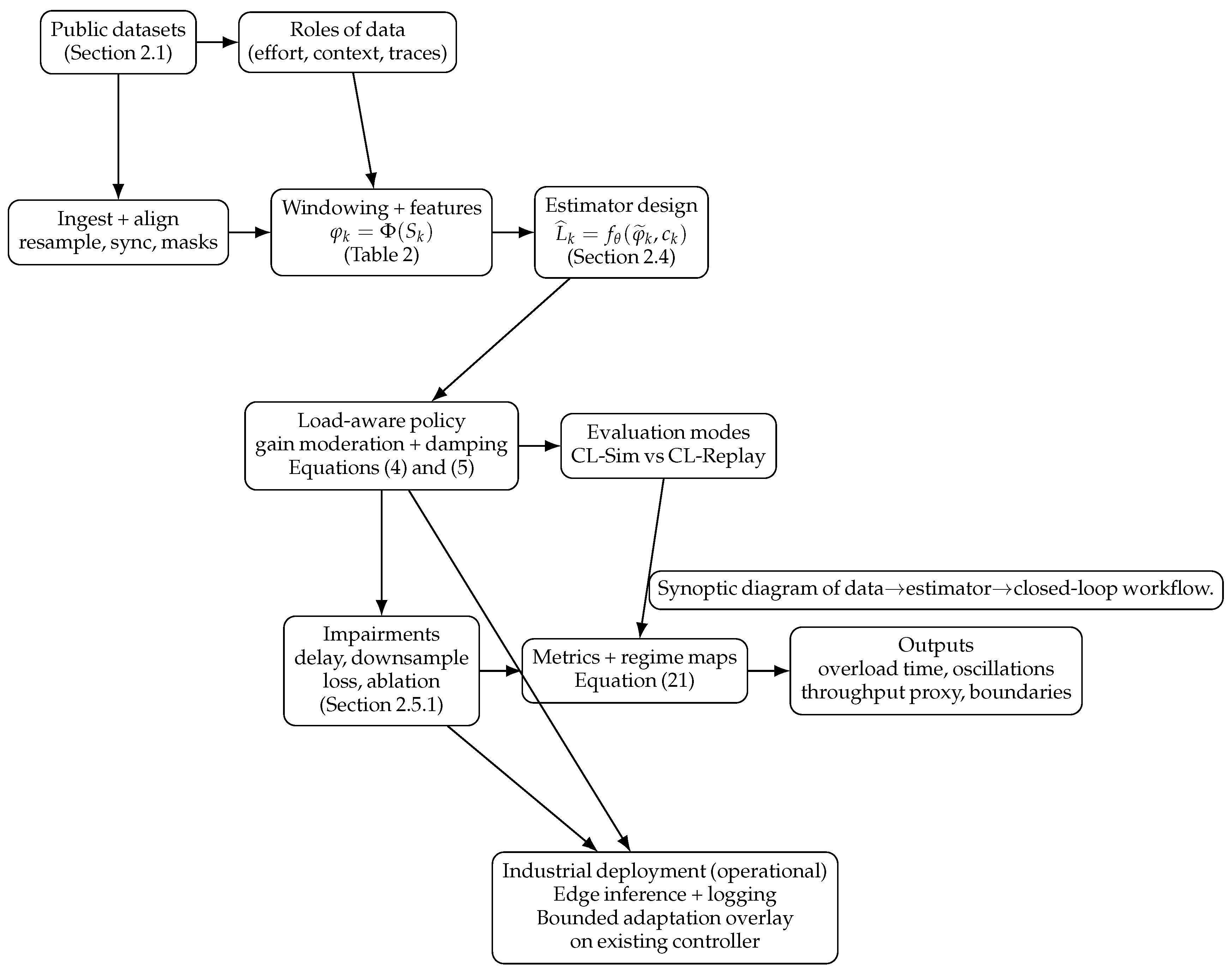
Empirically, the contribution is operationalized through a reproducible evaluation protocol that uses public data at a high level in complementary roles: multimodal wearable stress/strain recordings to identify and validate the ergonomic-load estimator and to characterize recovery time constants; task-structured physiological datasets with phase labels or workload annotations to test sensitivity to demand shifts; physical human–robot interaction effort-proxy datasets (e.g., myography/force-myography or interaction-force surrogates) to anchor load estimation in signals proximal to exertion and interaction/coordination traces from industrial human–robot collaboration and human–swarm supervision to evaluate whether load-aware decentralization preserves task-relevant performance while suppressing overload proxies. Robustness is assessed by controlled impairment of the sensing–communication loop (delay injection, downsampling, packet-loss emulation, and channel ablation), turning otherwise qualitative claims about real-time feedback into falsifiable tests of stability degradation, hysteresis, and oscillatory redistribution under realistic constraints, while keeping the experimental design portable across heterogeneous datasets, as described in
Section 2.1.
In this manuscript, ergonomic load is defined as a control-sufficient latent state constructed to be decision-relevant for closed-loop regulation, not as a direct or exhaustive measurement of classical human factors constructs such as fatigue, stress, or cognitive workload at the signal or biomarker level. While it is inferred from effort-proximal physiological and interaction observables, the variable is intentionally calibrated and bounded to support stability-oriented analysis and enforceable gain/compliance moderation under delay and uncertainty, rather than to claim physiological identifiability or diagnostic specificity. Accordingly, interpretability is asserted at the operating-regime level: the load state is used to distinguish equilibrated, oscillatory, and overload-prone behaviors and to define auditable conditions under which adaptation remains stable and non-chattering. This choice allows the paper to connect estimator properties (including calibration, rare-event precision, and latency sensitivity) to closed-loop behavior through reviewable sufficient conditions, while avoiding over-interpretation of the latent state as a precise surrogate for any single underlying physiological mechanism.
4. Discussion
4.1. Interpretation of Results
The results in
Section 3.1 show that discrimination alone is not the bottleneck for load-aware control; calibration and rare-event precision are the limiting factors once the estimate is injected into a gain schedule. In particular, the best-performing high-load detector at
achieved AUROC
and AUPRC
with low ECE (
), whereas a similarly strong discriminative model exhibited substantially worse calibration (ECE
) despite comparable AUROC (
Table 9). This distinction is not cosmetic: under Equation (
4) and the logistic slope bound in Equation (
A14), a modest probability-scale bias or miscalibration around the operating point
changes
, and therefore, the effective loop gain in Theorem 1. In practice, the observed
–
calibration spread between models of similar AUROC is the difference between a schedule that attenuates early enough to prevent overload escalation versus one that reacts late and amplifies oscillatory redistribution under delay. The regression results (
Table 10) reinforce this interpretation: the top regressor (
,
) preserves the monotonic structure that supports consistent thresholding and regime labeling, while weaker regressors (
,
) are likely to produce regime-map artifacts driven by estimator noise rather than genuine demand transitions.
These findings answer the first research question by establishing which estimator properties are control relevant under the proposed coupling. The results indicate that an estimator is suitable for feedback not when it maximizes AUROC, but when it preserves probability meaning near
so that the schedule in Equation (
4) changes smoothly and at the intended operating point. This directly links the estimation stage to the design objective of reducing time in
without inducing regime switching driven by threshold noise.
The rare-event setting at clarifies why AUPRC and calibration are more diagnostic than global discrimination. High-load windows are sparse, so false positives translate into chronic gain attenuation, while false negatives translate into delayed moderation and longer residence above . The observed performance spread, therefore, maps to an operational trade between unnecessary suppression and missed overload prevention, which is exactly the trade that the loop must resolve at the window cadence.
Relative to existing literature that treats workload or ergonomic scores as static annotations or post hoc summaries, the measurable progress here is that estimator quality is evaluated through its downstream consequences under explicit impairment operators. The robustness sweeps demonstrate that the estimator is not only accurate in nominal conditions but also exposes a predictable degradation pattern under delay and channel loss, which is a prerequisite for making any closed-loop claim auditable. This connects the results to the second research question by showing that the estimation interface can be stressed in a way that preserves interpretability of failure modes, rather than relying on in-distribution accuracy alone.
4.2. Closed-Loop
The core result is stability improvement from load-aware closed-loop regulation. This effect holds across delay, noise, downsampling, and ablation sweeps. Model-to-model leaderboard gaps are secondary to regime-level outcomes. Overload incidence drops when moderation contracts the high-load dynamics. Oscillation energy decreases under bounded gain and added damping. Throughput remains near baseline under admissible timing and calibration. Delay knees still appear, but failure modes become more interpretable. Robustness is expressed by shifted regime occupancy, not architecture rankings. The schedule stabilizes by reducing effective loop gain in . The key evidence is cross-condition persistence of overload suppression. These findings emphasize the mechanism, not a preferred learner family. The analysis ties estimator calibration and latency to stability margins. Across settings, the regulator improves resilience of the coupled loop.
On the other hand, the main claim is regime shift toward equilibrated operating conditions. Load-aware feedback reduces time above under nominal timing. It limits chattering by enforcing bounded, monotone adaptation. It preserves coordination proxies while suppressing overload attractors. This pattern repeats across heterogeneous operating disturbances. Stability benefits arise from closed-loop structure, not model identity. The decisive variable is control-relevant calibration near . Latency budgets govern when moderation remains stabilizing. AUPRC and ECE matter because they shape threshold crossing dynamics. Architecture comparisons should not be read as a contribution claim. The contribution is robust stabilization with explicit operating constraints. Regime maps summarize this effect more faithfully than leaderboards.
The central contribution is not that a load estimate can be computed from multimodal data; rather, it is that embedding that estimate into a bounded gain moderation and compliance shaping mechanism yields measurable reductions in overload incidence while preserving coordination proxies, and that these effects align with auditable sufficient conditions. In CL-Sim, load-aware scheduling reduced overload incidence from
to
at
while maintaining throughput at
(
Table 12), and simultaneously reduced oscillation power from
to
. These numerical changes are consistent with the mechanism captured by Equation (
17): moderation reduces
(Equation (
A17)), and thereby contracts the high-load dynamics so that persistent residence in
becomes unsustainable except under dominant disturbances. However, the same table also clarifies the limits of the claim: at
, overload reduction persists but weakens (
) and oscillatory behavior rebounds (
). This is precisely the regime in which delay must be incorporated into the sufficient condition, which is why Equation (
19) and the fixed oscillation-band definition in
Appendix A.4 bridge the theory and the observed delay knee.
These outcomes answer the third research question by isolating what the closed-loop mechanism changes and how it changes it. The reduction in overload incidence co-occurs with reduced oscillation energy, indicating that moderation is not simply lowering the reported load but reshaping the interaction between gain, delay, and demand transitions. The results, therefore, support a mechanistic interpretation where stability improvement is achieved through bounded adaptation in the high-load region rather than through increased authority or more aggressive control.
Compared with existing adaptive autonomy approaches that modulate assistance based on workload proxies without explicit bounds, the progress here is the explicit linkage between estimator calibration, schedule slope, and observed chattering or oscillation. The best configurations align with moderate slopes and low ECE, while poor configurations show either throughput loss or oscillatory switching, which provides a concrete explanation for why naive load gating can degrade teaming quality. This shifts the discussion from whether adaptation helps to when it helps and under which measurable conditions it remains interpretable.
For practical human robot collaboration, the loop should be interpreted as a safety-oriented allocator rather than a performance maximizer. When load rises, the schedule moderates adaptation and increases damping, which reduces the probability of rapid policy changes that force the operator to continually re-plan or re-correct. This implies that the expected benefit in real deployments is not only fewer overload excursions but also more predictable autonomy behavior during high-demand episodes, which is a key prerequisite for trust and sustained collaboration.
The distinction between CL-Sim and CL-Replay also has a practical implication for deployment planning. CL-Replay indicates that the estimator and policy interface produces bounded actions and reduces an overload proxy under impairment, but only CL-Sim supports the claim that the loop reshapes trajectories through feedback. A real system evaluation should, therefore, replicate the CL-Sim semantics by instrumenting actuation and measuring whether the same reductions persist when the human adapts to the intervention, because that adaptation can be the dominant source of nonstationarity in collaborative settings.
Finally, the results suggest a concrete operational interpretation of the delay knee for fielded systems. When latency approaches the knee region, moderation can become phase-lagged relative to demand changes, which increases oscillatory redistribution and degrades the interpretability of regime labels. In real environments, this translates into a requirement that sensing, inference, and actuation be co-designed to maintain a stable timing budget at the chosen window stride, rather than optimizing the estimator in isolation.
4.3. Limitations
A primary limitation is that the closed-loop evidence is established on an identified surrogate interconnection in CL-Sim rather than on a physical human robot system with measured bidirectional adaptation, so the reported regime shifts and overload suppression remain model-conditional even when the sufficient conditions are auditable. In addition, the estimator semantics depend on proxy construction and fixed thresholds, which can drift across individuals and contexts despite subject-wise splitting, and this drift can change where the gain schedule transitions relative to true operator strain. Finally, delay and channel reliability are not incidental nuisances but coupled failure drivers, because timing jitter and effort-proxy dropouts primarily degrade calibration and rare-event precision, which are the exact properties that determine whether the loop moderates smoothly or chatters near the operating point.
5. Conclusions
This study advances a control-relevant treatment of ergonomic load by providing an auditable estimator to the policy interface and demonstrating, under controlled impairments, when feedback improves closed-loop behavior rather than destabilizing it. The scientific contribution is a unified pipeline that links estimator calibration and latency directly to regime transitions, enabling reproducible stress testing and interpretable operating boundaries across heterogeneous public datasets.
Practically, the results define deployment-relevant acceptance criteria for real-time load-aware adaptation, including timing and calibration budgets that can be verified before field use. The evidence indicates that when these criteria are met, bounded gain moderation and compliance shaping can reduce overload exposure while retaining coordination proxies, whereas violations primarily manifest as oscillatory redistribution and unstable regime switching.
The study is limited by its reliance on public datasets with heterogeneous semantics and by the use of an identified surrogate for closed-loop simulation, which cannot capture all strategic and nonstationary effects present in real operators and real autonomy stacks. In addition, proxy targets and fixed regime thresholds constrain how directly the reported load scale can be interpreted as subjective or biomechanical strain, and performance under long-term sensor drift or systematic domain shift was not validated in longitudinal deployments.
Theorem 1 holds only under stated assumptions and bounds. Overload attractor elimination is, therefore, a regime claim, not a promise. Parameter choices outside
Table 6 can violate the contraction. Delay margins depend on
,
, and estimator variation. Increased
or miscalibration changes
materially. CL-Replay cannot substantiate stability, because
there. The small-gain inequalities summarize implementable design constraints for deployment. They guide tuning, monitoring, and fail-safe reversion under sensor drift. They do not certify unconditional safety across all teaming contexts.
Interpret conclusions through operating regimes, not universal guarantees. The reported reductions apply within validated latency and calibration budgets. If latency exceeds the knee, oscillatory redistribution can reappear. If effort-proximal sensing drops out, overload detection becomes systematically biased. Regime maps should be recalculated when the window stride or instrumentation changes. Field use requires auditing , , and channel availability online. Outside admissible regions, the policy should downshift to conservative damping. These constraints are intended to support implementation and certification workflows. They complement, rather than replace, system-level hazard analysis and testing.
5.1. Future Work
Future work should move from surrogate-closed-loop evidence to hardware- and interface-level validation with explicit actuation and measured operator responses, including end-to-end latency measurements and dropout patterns under real wireless conditions. Methodologically, two extensions are high priority: (i) a multi-objective formulation that reports Pareto fronts over overload reduction, oscillation suppression, and throughput rather than ranking single schedules, and (ii) a delay-robust synthesis step (e.g., LMI- or Lyapunov–Krasovskii-based conditions) that produces certified parameter regions for under bounded and bounded estimator error. On the learning side, the estimator should incorporate explicit drift detection and recalibration triggers to maintain ECE below the control-relevant threshold in longitudinal deployments, and should quantify uncertainty in so that the policy can reduce aggressiveness when the estimate is unreliable rather than reacting to noise.
Also, the future research should validate the full loop in hardware with measured actuation and operator response, using instrumented end-to-end timing and dropout characterization under realistic networking conditions. It should also extend the synthesis step to explicitly certify delay and estimation error tolerance over controller parameters, and integrate uncertainty-aware adaptation so that the policy downshifts when the estimate becomes unreliable. Finally, the evaluation should expand to longitudinal and cross-context studies that quantify recalibration frequency, drift detection accuracy, and human acceptance outcomes under sustained operation, while preserving the same auditability commitments for threshold selection and subject-level reporting.
Moreover, further developments should explicitly connect the proposed estimator policy interface to deployment constraints that are not represented by public traces or surrogate plants. A practical next step is an edge-oriented real-time implementation that reports measured end-to-end latency and jitter under realistic wireless conditions and computes load and control updates within a fixed time budget aligned to the chosen window cadence. Experimental validation should then be conducted with physical human autonomy teaming tasks where the adaptation policy has authority over measurable autonomy parameters and where operator response is captured through synchronized effort proximal sensing and task outcome logs, enabling causal attribution of overload reduction rather than counterfactual inference. Finally, integration with industrial systems should address interoperability with existing control stacks and safety workflows by defining a minimal interface for load conditioned gain limits, logging and audit requirements, and fail safe behavior under dropout and sensor drift, so that the method can be evaluated within production-grade monitoring and change management processes.
5.2. Take-Home Messages
The main takeaway is that ergonomics becomes control-relevant only when the load estimate is both calibrated and timely, because it directly shapes the effective loop gain, and therefore, the regime of the coupled human autonomy dynamics. When those conditions hold, moderate load-aware scheduling can deliver large reductions in overload incidence with throughput preserved, whereas aggressive schedules under delay or miscalibration are the dominant failure mode and can degrade throughput or increase switching and oscillation. Practically, the results translate into concrete design constraints for real deployments: maintain end-to-end latency below roughly at the operating window cadence, maintain estimator calibration at ECE under subject-wise evaluation, and prioritize reliable effort-proximal sensing because rare high-load detection is, otherwise, substantially impaired.