
Article

Numerical Analysis of the IRiS Device for Swirling-Flow Instability Mitigation in the Hydraulic Turbines Diffuser †

by
Constantin Tanasa
1,*,
Adrian-Ciprian Stuparu
2 and
Alin-Ilie Bosioc
2
1
Research Institute for Renewable Energies, Politehnica University Timisoara, Victoriei Sq., No. 1, 300006 Timișoara, Romania
2
Department of Hydraulic Machinery, Politehnica University Timisoara, Victoriei Sq., No. 1, 300006 Timișoara, Romania
*
Author to whom correspondence should be addressed.
This manuscript is an extended version of the CMFF’25 paper published in the Proceedings of the International Conference on Fluid Flow Technologies, Budapest, Hungary, 26–29 August 2025.
Int. J. Turbomach. Propuls. Power 2026, 11(3), 31; https://doi.org/10.3390/ijtpp11030031
Submission received: 18 December 2025 / Revised: 16 March 2026 / Accepted: 12 May 2026 / Published: 1 July 2026

Abstract

Swirling-flow instabilities in hydraulic turbine diffusers constitute a major operational challenge, particularly when Francis turbines operate under part-load conditions. Over the past decades, numerous control strategies have been proposed to mitigate the instabilities associated with swirling flows. This study presents a comprehensive numerical analysis of a passive flow-control technique based on an adjustable diaphragm device, referred to as IRiS. The primary objectives are to attenuate swirling-flow instabilities and to enhance energy recovery within the draft tube. Three-dimensional unsteady flow simulations were performed for multiple IRiS configurations, characterized by different shutter area ratios. The results indicate that the IRiS device can reduce pressure pulsation amplitudes by up to 60% while simultaneously improving pressure recovery. However, the simulations also show that hydraulic losses may increase at part-load operation, depending on the selected IRiS shutter opening. Overall, the findings support the applicability of this passive control concept for both new and rehabilitated Francis turbines operating under off-design conditions, far from the best efficiency point.

1. Introduction

Modern energy systems are increasingly affected by the variability of renewable energy sources, such as wind and solar power, which require the hydraulic turbines to operate over an extended range of off-design regimes [1,2]. Under part-load operating conditions, Francis turbines, for example, exhibit self-excited flow instabilities in the draft tube cone (diffuser), manifested as helical vortex ropes associated with high-amplitude pressure pulsations and high values of hydraulic losses [3]. These flow phenomena induce unwanted effects on turbine components, including increased vibration levels and acoustic emissions. A wide spectrum of active and passive flow control strategies has been proposed to attenuate helical vortex instabilities, such as air admission, guide fins, and axial water injection [4,5,6,7,8,9]. Nevertheless, many of these approaches provide only partial mitigation or introduce adverse side effects. A particularly promising passive measure consists of installing an adjustable diaphragm at the outlet of the conical diffuser.
Previous investigations have shown that such a diaphragm can effectively reduce swirling-flow instabilities, but at the cost of increased hydraulic losses.
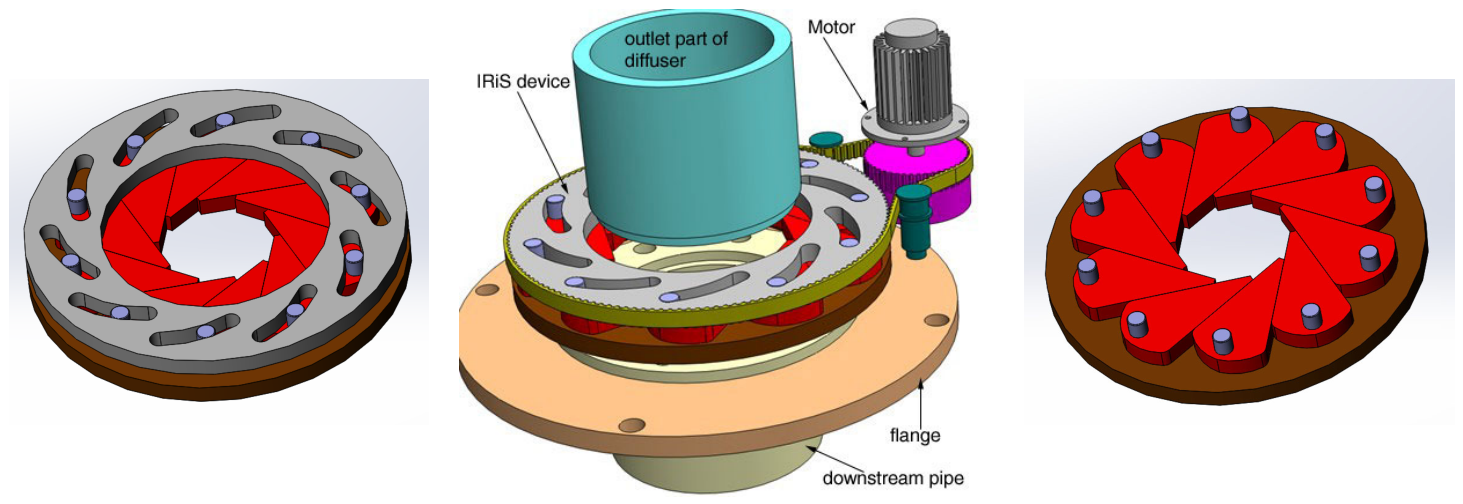
The present study extends this concept by systematically comparing conventional diaphragm configurations with a redesigned IRiS device, with the objective of optimizing the compromise between pressure pulsation attenuation and energy recovery [10,11]. This work presents a three-dimensional numerical analysis of the pressure field from both dynamic and energetic behavior, employing a redesigned adjustable diaphragm referred to as the IRiS device (Figure 1) [12]. In Section 2, the details on the numerical setup are given, including the definition of the computational domain and the specification of boundary conditions. In Section 3, the flow field is analyzed, quantifying hydraulic losses and characterizing the unsteady pressure field for configurations with and without the IRiS device. The principal conclusions are summarized in the final section.

2. Computational Domain and Boundary Conditions

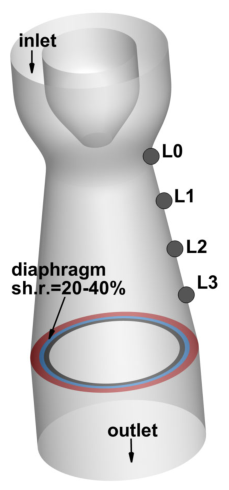
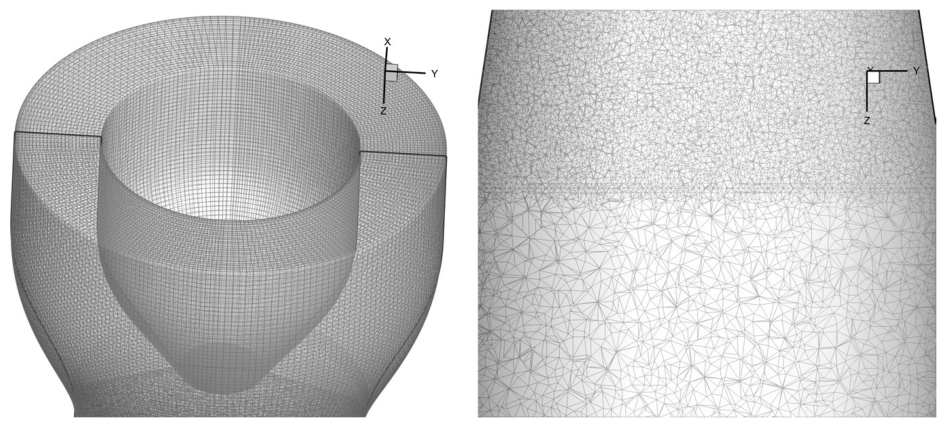
The computational domain reproduces the convergent–divergent test section of the swirling-flow apparatus developed at Politehnica University Timișoara (UPT) [13]. The convergent section is delimited upstream by the annular inlet and downstream by the throat (Figure 2). The annular inlet is located immediately downstream of the free-runner blades. The divergent section consists of a discharge cone with a semi-angle of 8.5°, consistent with the configuration employed in the FLINDT project [14], followed by a straight pipe. The flow was modeled as an incompressible turbulent flow of water with constant physical properties. The governing equations are the three-dimensional unsteady Reynolds-Averaged Navier–Stokes (URANS) equations, solved using the finite volume method implemented in ANSYS Fluent R2. The k–ω GEKO turbulence model was adopted for the numerical setup. The simulations were performed in a transient regime in order to capture the unsteady behavior associated with swirling-flow instabilities occurring in the draft tube. In the present numerical study, three values of the internal diameter of the IRiS device are analyzed, namely d = 0.143, 0.134, and 0.124 m. As shown in Figure 2, the IRiS device is positioned at the outlet of the conical diffuser. Table 1 reports the area ratios between the internal cross-sectional area of the IRiS device and the outlet cross-sectional area of the test section. The computational domain presented in [12] is shown in Figure 2. For each case, with and without IRiS, a hybrid mesh of about 2.8 million cells was generated (Figure 3).
A prescribed velocity profile is imposed at the inlet, while an outflow boundary condition available in ANSYS Fluent is applied at the outlet, for all cases. The imposed velocity profile at the inlet corresponds to a volumetric flow rate of Q = 0.03 m3/s. The inflow is taken from upstream flow computations in our previous work. Thus, at the annular inlet, the axial, radial, and circumferential velocity components, along with turbulent kinetic energy and dissipation rate for a runner speed of 920 rpm, are imposed.
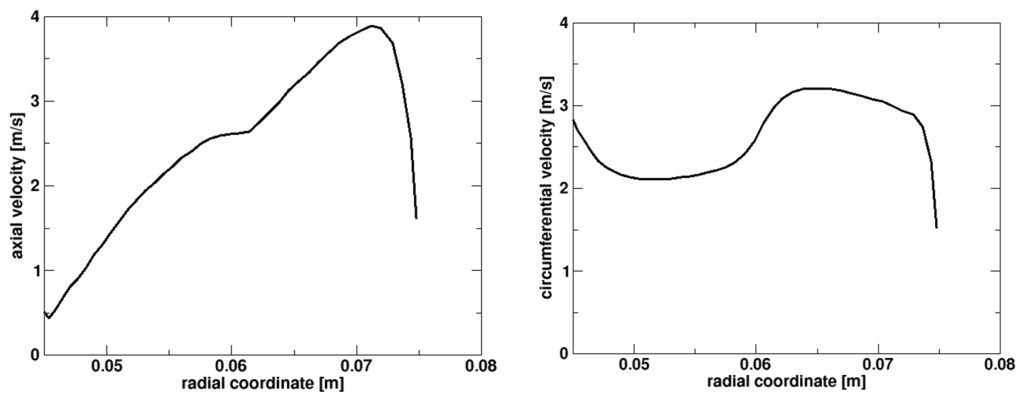
To obtain good accuracy on the convergence of the numerical solution, the analysis domain was extended by a value equal to the diameter of the test section, Dout = 0.160 m [15]. Figure 4 shows the velocity profiles obtained in the inlet test section [12]. Three-dimensional, unsteady numerical simulations, both with and without IRiS, were carried out using Ansys FLUENT 2023 R2 to assess the proposed methodology. The recent model k–ω GEKO turbulence model, implemented in Ansys FLUENT, has been shown to capture with higher fidelity the flow characteristics typical of hydraulic machinery [16]. Its main advantage lies in its flexibility and broad applicability, as it provides adjustable free parameters that can be tuned for specific classes of flows without adversely affecting the baseline calibration of the model. However, its effective use presupposes a rigorous understanding of the influence of the associated coefficients in order to prevent improper parameterization. It should be emphasized that the model is equipped with robust default settings, allowing its application without any additional fine-tuning. Any modification of these defaults should be substantiated by high-quality experimental data. Anyway, this model is a generalized two-equation eddy-viscosity formulation derived from the k–ω approach, which introduces additional calibration parameters that allow improved control of turbulent transport and separation behavior. Due to its flexibility and improved capability to represent complex flow structures, the model is suitable for the prediction of swirling and separated flows typically encountered in hydraulic turbine draft tubes.
For all investigated cases, the unsteady simulations were conducted using a constant time step t = 0.002 s.
A total of 5000 time steps was used for each case, corresponding to a flow time of 10 s, in order to obtain a stable flow field. All numerical solutions were iterated until the scaled residuals were reduced to values on the order of 10−4, using a second-order time-discretization scheme. Pressure monitors, denoted L0–L3, were installed at four axial locations. The axial spacing between two consecutive pressure taps located on the cone surface was 50 mm.

3. Results

3.1. Unsteady Pressure Analysis

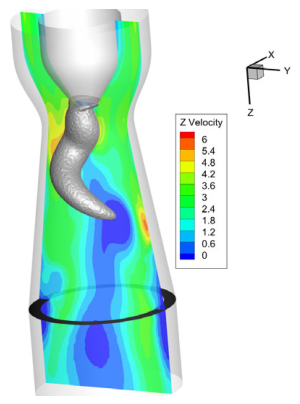
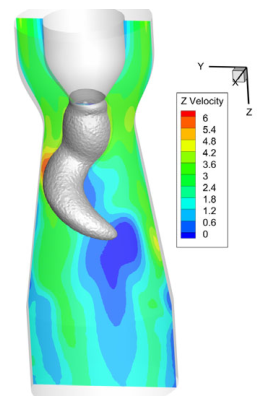
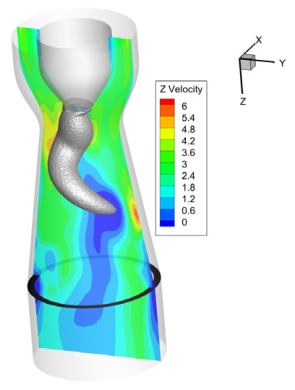
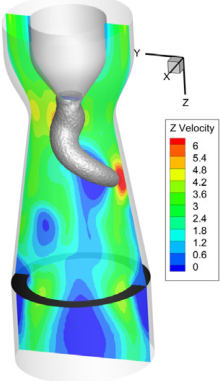
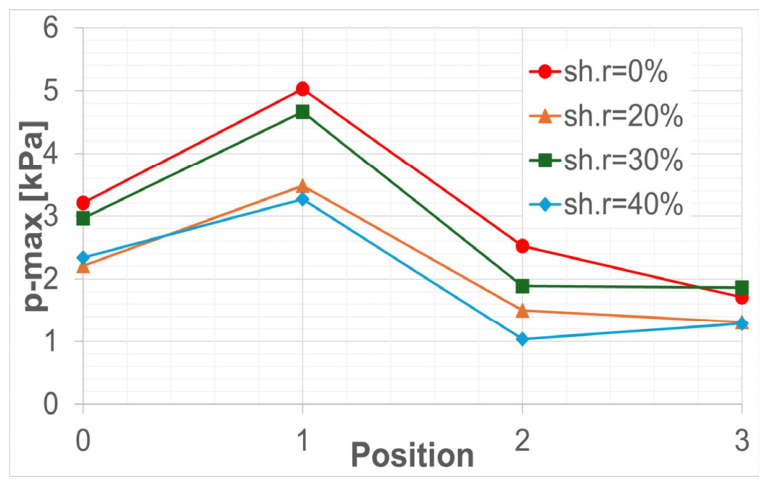
Numerical simulations of turbulent swirling flow in the UPT test section were carried out for three IRiS operating configurations, as well as for a reference configuration without the IRiS device. Figure 5, Figure 6, Figure 7 and Figure 8 present the numerical results in the form of pressure iso-surfaces for each configuration. These qualitative results indicate that the helical vortex structure persists and continues to develop during IRiS shutter operation for all investigated cases; however, the associated pressure pulsations are attenuated, which can be attributed to the substantial reduction in flow eccentricity. This observation is corroborated by an unsteady analysis of the pressure signals recorded by the pressure monitors within the computational domain (Figure 9).
For the technique investigated in this study, the results clearly demonstrate that the IRiS device induces a substantial reduction in amplitude, while the frequency remains approximately constant (f ≈ 14 Hz) across all examined cases.
The shutter ratio, shr = 20% and 40%, provides the largest amplitude decrease (up to 60%), compared to the case without the IRiS device. The IRiS case with shr = 30% shows a smaller decrease in pressure fluctuation amplitude (up to 32%) compared with the shr = 20% and shr = 40% cases. The current results do not exactly show that the flow behaves differently in the case of shr = 30% compared to the other cases; this is an analysis that will be debated in a future paper. We conclude that the IRiS device can effectively mitigate pressure fluctuations in decelerated swirling flow with a precessing helical vortex.

3.2. Mean Pressure Analysis

The main function of the draft tube is to reduce the pressure at the runner outlet and thereby to increase the efficiency of the turbine.
As a consequence, the energy conversion along the draft tube occurs. This energy conversion is quantified by the wall pressure recovery coefficient cp, which is expressed in dimensionless form by
c p = p ¯ p ¯ L 0 ρ V t 2 2   w h e r e   V t = Q π D t 2 4
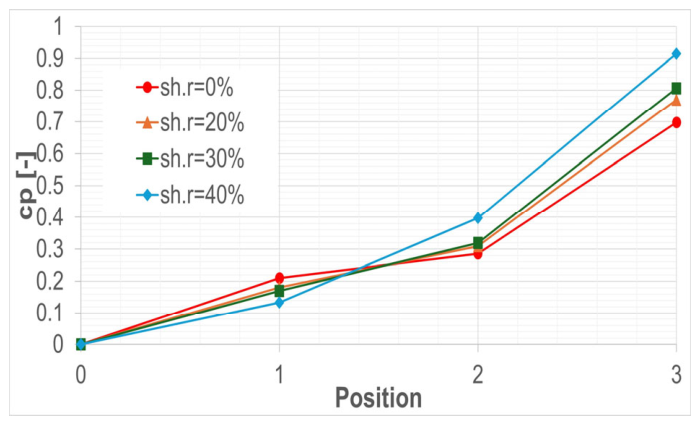
where p ¯ L 0 is the mean wall pressure at level L0, p ¯ is the mean pressure measured downstream on the cone wall, ρ = 998 kg/m3 is the water density, V t is the bulk velocity in the throat, Dt = 2Rt = 0.1 [m] is the throat diameter at level L0, and Q = 0.03 m3/s is the volumetric flow rate. The pressure coefficient cp [-] distribution along the cone wall is shown in Figure 10.
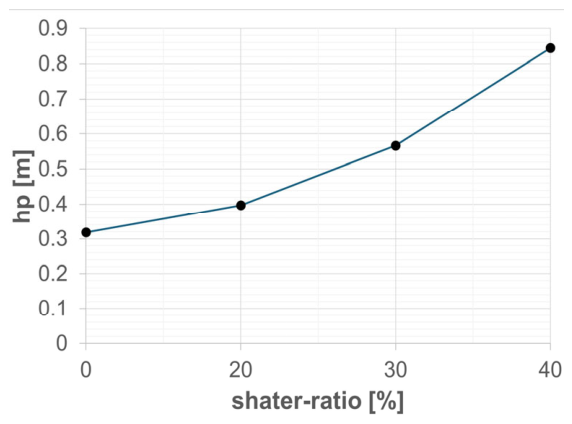
When the diaphragm is installed, the pressure recovery increases progressively along the diffuser. A moderate increase in the wall pressure recovery coefficient is observed between levels L0 and L1, while a further gradual increase occurs downstream of L1 toward level L2. This behavior indicates an improvement in the pressure recovery in the downstream part of the conical diffuser. In real turbines, such an improvement of the pressure recovery in the discharge cone may contribute to increased overall efficiency when operating away from the best efficiency point, especially in low-head hydraulic turbines, where most hydraulic losses at such conditions are due to swirl in the draft tube cone. Improved pressure recovery on the cone wall is also expected to reduce additional hydraulic losses associated with the vortex rope. However, hydraulic losses on the cone increase as the diaphragm further obstructs the flow, as shown in Figure 11. This behavior is associated with the progressive reduction in effective flow area at the cone outlet as the shutter ratio increases, which strengthens the throttling effect of the IRiS device and leads to additional local energy dissipation. Consequently, the highest shutter ratio produces the largest hydraulic losses, although it also enhances pressure recovery upstream in the cone.
Tănasă et al. [17] also reported that hydraulic losses increase with diaphragm closure, which is qualitatively consistent with the numerical results obtained in the present study and shown in Figure 11. Both studies indicate that stronger outlet obstruction reduces flow instabilities with higher hydraulic losses.
Figure 11 shows the loss coefficient defined as
h p = p i n p o u t ρ g [ m ]
The variation in hydraulic losses as a function of the diaphragm shutter ratio is analyzed. As shown in Figure 11, the hydraulic losses attain their maximum values for the highest shutter ratio of 40%. The distribution of the losses within the cone highlights a rapid increase in hydraulic losses when vortex rope occurs. This behavior is concurrently associated with an improvement in the overall hydraulic performance of the cone, as evidenced by the corresponding variation in the wall pressure recovery coefficient. It is clearly shown that throttling the flow at the cone outlet by means of the IRiS device leads to an increase in hydraulic losses while simultaneously enhancing pressure recovery.

4. Conclusions

The present study re-examines the adjustable-diaphragm concept, implemented as the IRiS device, for the mitigation of swirling-flow instabilities in the conical diffuser of hydraulic turbines operating under part-load conditions. Fully three-dimensional, unsteady numerical simulations, with and without the IRiS device, were carried out to assess the dynamic flow behavior and energy-recovery performance associated with this concept. The numerical results demonstrate that the helical vortex can be mitigated by the IRiS device. As a consequence, the amplitude of the unsteady pressure fluctuations associated with the helical vortex is reduced by up to 60%, while the characteristic frequency remains essentially unchanged for all investigated operating conditions.
The analysis of the loss evolution in the cone reveals a pronounced increase in hydraulic losses at part load. This behavior is accompanied by an improvement in the overall diffuser performance, as evidenced by the evolution of the wall pressure-recovery coefficient. When the flow is throttled at the cone outlet by means of the IRiS device, hydraulic losses increase; however, pressure recovery is concurrently enhanced.
On the basis of these findings, it is advisable to operate the IRiS device when the turbine is required to function over an extended operating range away from the best efficiency point (BEP), in order to maintain hydraulic losses at acceptable levels while achieving high energy recovery and reduced pressure pulsations. Accordingly, the present results support the consideration of the IRiS device for both new and refurbished hydraulic turbines to enhance efficiency and operational safety under off-design conditions far from the BEP.

Author Contributions

Conceptualization, C.T. and A.-C.S.; methodology, A.-I.B.; investigation, C.T. and A.-I.B.; software, data curation, C.T. and A.-C.S.; writing—original draft preparation, C.T.; writ-ing—review and editing, C.T. and A.-C.S. All authors have read and agreed to the published version of the manuscript.

Funding

This work was supported by a grant from the Ministry of Research, Innovation and Digitization, Romania, CCCDI-UEFISCDI, project number PN-IV-P7-7.1-PED-2024-1209, within PNCDI IV.

Data Availability Statement

Data is contained within the article.

Conflicts of Interest

The authors declare no conflict of interest.

References

  1. U.S. Department of Energy. Renewable Systems Integration. Available online: https://www.energy.gov/ (accessed on 20 November 2025).
  2. Rekioua, D. Energy Storage Systems for Photovoltaic and Wind Systems: A Review. Energies 2023, 16, 3893. [Google Scholar] [CrossRef]
  3. Nishi, M.; Matsunaga, S.; Kubota, T.; Senoo, Y. Flow regimes in an elbow-type draft tube. In Proceedings of the 11th IAHR Symposium on Hydraulic Machinery and Systems, Amsterdam, The Netherlands, 13–17 September 1982; p. 38. [Google Scholar]
  4. Thike, R.H. Practical solutions for draft tube insatbility. Water Power Dam Constr. 1981, 33, 31–37. [Google Scholar]
  5. Pappilon, B.; Sabourin, M.; Couston, M.; Deschenes, C. Methods for air admission in hydro turbines. In Proceedings of the 21st IAHR Symposium on Hydraulic Machinery and Systems, Lausanne, Switzerland, 9–12 September 2002; pp. 1–6. [Google Scholar]
  6. Kjeldsen, M.; Olsen, K.; Nielsen, T.; Dahlhaug, O. Water injection for the mitigation of draft tube pressure pulsations. In Proceedings of the IAHR International Meeting of W.G. on Cavitation and Dynamic Problems in Hydraulic Machinery and Systems, Barcelona, Spain, 28–30 June 2006. [Google Scholar]
  7. Nishi, M.; Wang, X.M.; Yoshida, K.; Takahashi, T.; Tsukamoto, T. An Experimental Study on Fins, Their Role in Control of the Draft Tube Surging. In Hydraulic Machinery and Cavitation; Springer: Dordrecht, The Netherlands, 1996; pp. 905–914. [Google Scholar]
  8. Bosioc, A.; Susan-Resiga, R.; Muntean, S.; Tanasa, C. Unsteady Pressure Analysis of a Swirling Flow with Vortex Rope and Axial Water Injection in a Discharge Cone. J. Fluids Eng.–Trans. ASME 2012, 134, 081104. [Google Scholar] [CrossRef]
  9. Tanasa, C.; Susan-Resiga, R.F.; Muntean, S.; Bosioc, A.I. Flow-Feedback Method for Mitigating the Vortex Rope in Decelerated Swirling Flows. J. Fluids Eng. 2013, 135, 061304. [Google Scholar] [CrossRef]
  10. Tanasa, C.; Bosioc, A.; Stuparu, A.; Muntean, S.; Susan-Resiga, R. A Perspective Review of Passive Techniques Applied to Control the Swirling Flow Instabilities from the Conical Diffuser of Hydraulic Turbines. Appl. Mech. Rev. 2024, 76, 010801. [Google Scholar] [CrossRef]
  11. Tanasa, C.; Susan-Resiga, R.; Muntean, S.; Stuparu, A.; Bosioc, A.; Ciocan, T. Numerical Assessment of A New Passive Control Method for Mitigating the Precessing Helical Vortex in A Conical Diffuser. In Proceedings of the Conference on Modelling Fluid Flow (CMFF’15), the 16th International Conference on Fluid Flow Technologies, Budapest, Hungary, 1–4 September 2015. [Google Scholar]
  12. Tănasă, C.; Bosioc, A.; Muntean, S.; Susan-Resiga, R. A novel passive method to control the swirling flow with vortex rope from conical diffuser of hydraulic turbines with fixed blades. Appl. Sci. 2019, 9, 4910. [Google Scholar] [CrossRef]
  13. Susan-Resiga, R.; Muntean, S.; Hasmatuchi, V.; Anton, I.; Avellan, F. Analysis and Prevention of Vortex Breakdown in the Simplified Discharge Cone of a Francis Turbine. J. Fluids Eng.–Trans. ASME 2010, 132, 051102. [Google Scholar] [CrossRef]
  14. Avellan, F. Flow Investigation in a Francis Draft Tube: The FLINDT Project. In Proceedings of the 20th IAHR Symposium on Hydraulic Machinery and Systems, Charlotte, NC, USA, 6–9 August 2000. [Google Scholar]
  15. Muntean, S.; Tănasă, C.; Susan-Resiga, R.; Bosioc, A. Influence of the Adverse Pressure Gradient on the Swirling Flow, Conference on Modelling Fluid Flow (CMFF’15). In Proceedings of the 16th International Conference on Fluid Flow Technologies, Budapest, Hungary, 1–4 September 2015. [Google Scholar]
  16. ANSYS Fluent User Guide 2024. Available online: https://ansyshelp.ansys.com/public/account/secured?returnurl=/Views/Secured/prod_page.html?pn=Fluent&prodver=24.2&lang=en (accessed on 20 November 2025).
  17. Tănasă, C.; Muntean, S.; Ciocan, T.; Susan-Resiga, R.F. 3D Numerical Simulation versus Experimental Assessment of Pressure Pulsations Using a Passive Method for Swirling Flow Control in Conical Diffusers of Hydraulic Turbines. IOP Conf. Ser. Earth Environ. Sci. 2016, 49, 082018. [Google Scholar] [CrossRef]
Figure 1. CAD of the IRiS device.
Ijtpp 11 00031 g001
Figure 2. The D computational domain of the case with diaphragm.
Ijtpp 11 00031 g002
Figure 3. Details of mesh domain. Inlet of the domain (left) and outlet (right).
Ijtpp 11 00031 g003
Figure 4. Velocity profiles (axial profile—right and circumferential profile—left) from the inlet test section [12].
Ijtpp 11 00031 g004
Figure 5. Pressure iso-surface for the case without diaphragm at t = 10 s and p = 37.700 Pa.
Ijtpp 11 00031 g005
Figure 6. Pressure iso-surface for the case with diaphragm diameter of d = 0. 143 m, t = 10 s, and p = 37.700 Pa.
Ijtpp 11 00031 g006
Figure 7. Pressure iso-surface for the case with diaphragm diameter of d = 0.134 m, t = 10 s, and p = 37.700 Pa.
Ijtpp 11 00031 g007
Figure 8. Pressure iso-surface for the case with diaphragm diameter of d = 0.124 m, t = 10 s, and p = 37.700 Pa.
Ijtpp 11 00031 g008
Figure 9. Pressure amplitudes corresponding to pressure taps from the test section domain.
Ijtpp 11 00031 g009
Figure 10. Pressure recovery coefficients vs. axial coordinate.
Ijtpp 11 00031 g010
Figure 11. Hydraulic losses versus shutter ratio.
Ijtpp 11 00031 g011
Table 1. The area ratios between the internal cross-sectional area of the IRiS device and the outlet cross-sectional area of the test section.
IRiS Interior Diameter
d [m]
IRiS Interior Area
Ad [m2]
Test Section Outlet Area
Ao [m2]
Shutter Ratio
shr[%]
0.1430.0160.0220
0.1340.0140.0230
0.1240.0120.0240
Disclaimer/Publisher’s Note: The statements, opinions and data contained in all publications are solely those of the individual author(s) and contributor(s) and not of MDPI and/or the editor(s). MDPI and/or the editor(s) disclaim responsibility for any injury to people or property resulting from any ideas, methods, instructions or products referred to in the content.