


Heart Failure and Sarcopenia: An Integrated Rehabilitation Approach Combining Exercise and Nutrition

 , ,
, ,  and
and
Abstract
1. Background and Rationale
2. Sarcopenia and Its Clinical Relevance in Heart Failure
3. Exercise Training in Patients with Heart Failure and Sarcopenia
4. Nutritional Treatment in Patients with Heart Failure and Sarcopenia
4.1. Nutritional Assessment Tools
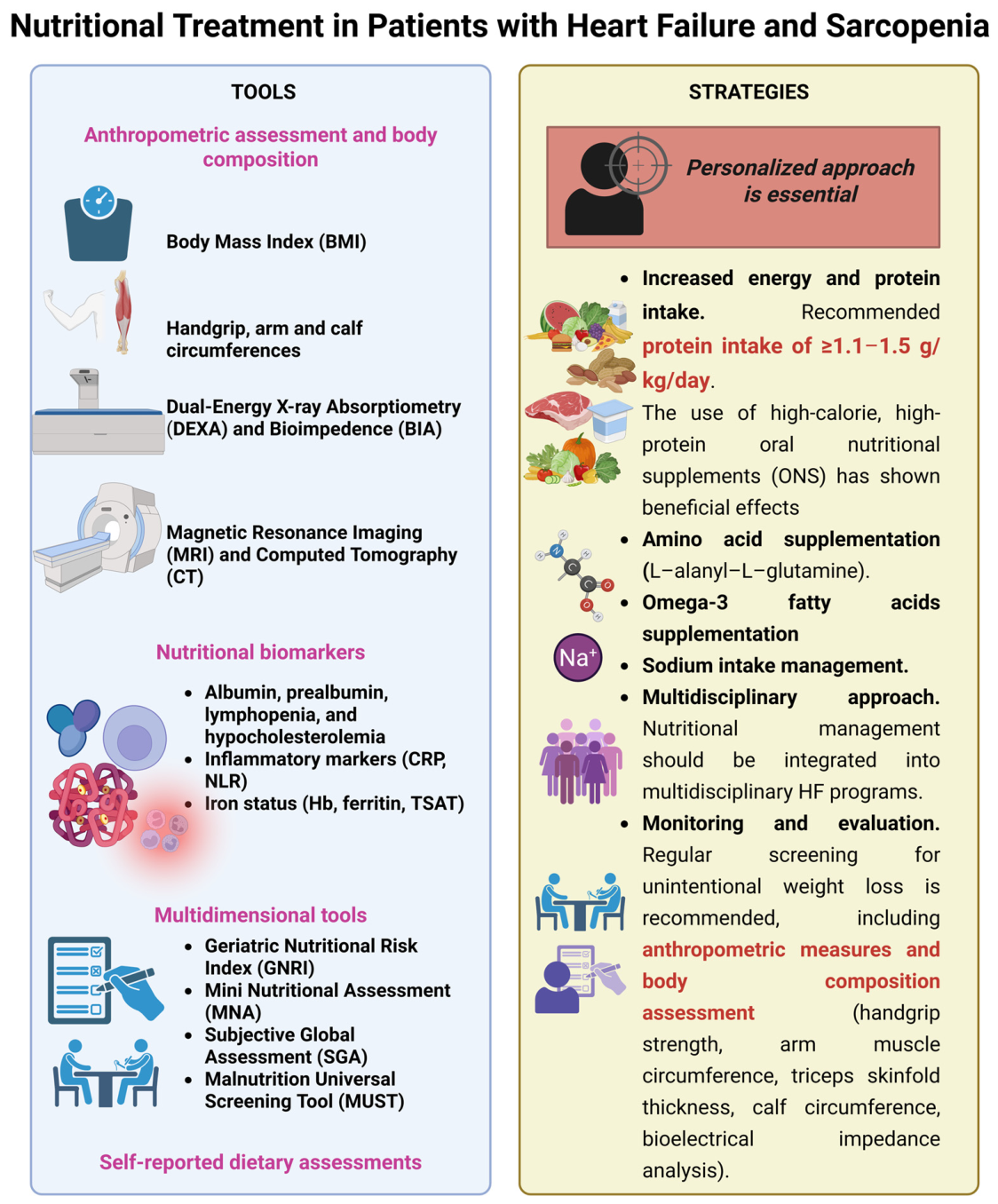
- Anthropometry and body composition: Body Mass Index (BMI) is widely used but has significant limitations in HF, as it cannot distinguish between lean mass, fat mass, and fluid retention. More accurate techniques include DEXA, MRI, and CT, although their feasibility in routine practice is limited. Bioelectrical impedance analysis (BIA), particularly with vector analysis (BIVA), appears promising, while muscle ultrasound is under evaluation. Simple measures such as handgrip strength, arm or calf circumference, and monitoring unintentional weight loss remain practical and cost-effective [40,41,42].
- Biomarkers: Albumin, prealbumin, lymphopenia, and hypocholesterolemia are negative prognostic indicators, though they lack sensitivity as markers of nutritional intervention response. Inflammatory indices (CRP, NLR) and iron metabolism parameters (Hb, ferritin, TSAT) provide complementary information, especially when considering supplementation [40,41,42].
- Multidimensional tools: Instruments such as the Geriatric Nutritional Risk Index (GNRI), Mini Nutritional Assessment (MNA), Subjective Global Assessment (SGA), and Malnutrition Universal Screening Tool (MUST) have been proposed. The GNRI shows the strongest association with mortality, while SGA offers higher specificity. However, none have been validated exclusively in HF, and scores may be confounded by disease severity [40,41,42].
4.2. Nutritional Strategies
5. From Evidence to Practice: Toward Integrated Management
6. Conclusions
Author Contributions
Funding
Data Availability Statement
Conflicts of Interest
References
- Cruz-Jentoft, A.J.; Bahat, G.; Bauer, J.; Boirie, Y.; Bruyère, O.; Cederholm, T.; Cooper, C.; Landi, F.; Rolland, Y.; Sayer, A.A.; et al. Sarcopenia: Revised European consensus on definition and diagnosis. Age Ageing 2019, 48, 16–31. [Google Scholar] [CrossRef] [Scilit]
- Sayer, A.A.; Cooper, R.; Arai, H.; Cawthon, P.M.; Ntsama Essomba, M.-J.; Fielding, R.A.; Grounds, M.D.; Witham, M.D.; Cruz-Jentoft, A.J. Sarcopenia. Nat. Rev. Dis. Primers 2024, 10, 68. [Google Scholar] [CrossRef] [Scilit] [PubMed]
- Jung, H.N.; Jung, C.H.; Hwang, Y.-C. Sarcopenia in youth. Metabolism 2023, 144, 155557. [Google Scholar] [CrossRef] [Scilit]
- Dodds, R.M.; Syddall, H.E.; Cooper, R.; Benzeval, M.; Deary, I.J.; Dennison, E.M.; Der, G.; Gale, C.R.; Inskip, H.M.; Jagger, C.; et al. Grip strength across the life course: Normative data from twelve British studies. PLoS ONE 2014, 9, e113637. [Google Scholar] [CrossRef] [Scilit]
- Narici, M.; McPhee, J.; Conte, M.; Franchi, M.V.; Mitchell, K.; Tagliaferri, S.; Monti, E.; Marcolin, G.; Atherton, P.J.; Smith, K.; et al. Age-related alterations in muscle architecture are a signature of sarcopenia: The ultrasound sarcopenia index. J. Cachexia Sarcopenia Muscle 2021, 12, 973–982. [Google Scholar] [CrossRef] [Scilit]
- Antuña, E.; Cachán-Vega, C.; Bermejo-Millo, J.C.; Potes, Y.; Caballero, B.; Vega-Naredo, I.; Coto-Montes, A.; Garcia-Gonzalez, C. Inflammaging: Implications in Sarcopenia. Int. J. Mol. Sci. 2022, 23, 15039. [Google Scholar] [CrossRef] [Scilit] [PubMed]
- Damanti, S.; Senini, E.; De Lorenzo, R.; Merolla, A.; Santoro, S.; Festorazzi, C.; Messina, M.; Vitali, G.; Sciorati, C.; Rovere-Querini, P. Acute Sarcopenia: Mechanisms and Management. Nutrients 2024, 16, 3428. [Google Scholar] [CrossRef] [Scilit]
- Argilés, J.M.; Campos, N.; Lopez-Pedrosa, J.M.; Rueda, R.; Rodriguez-Mañas, L. Skeletal Muscle Regulates Metabolism via Interorgan Crosstalk: Roles in Health and Disease. J. Am. Med. Dir. Assoc. 2016, 17, 789–796. [Google Scholar] [CrossRef] [Scilit] [PubMed]
- Cawthon, P.M.; Manini, T.; Patel, S.M.; Newman, A.; Travison, T.; Kiel, D.P.; Santanasto, A.J.; Ensrud, K.E.; Xue, Q.L.; Shardell, M.; et al. Putative Cut-Points in Sarcopenia Components and Incident Adverse Health Outcomes: An SDOC Analysis. J. Am. Geriatr. Soc. 2020, 68, 1429–1437. [Google Scholar] [CrossRef] [Scilit]
- Guralnik, J.M.; Simonsick, E.M.; Ferrucci, L.; Glynn, R.J.; Berkman, L.F.; Blazer, D.G.; Scherr, P.A.; Wallace, R.B. A short physical performance battery assessing lower extremity function: Association with self-reported disability and prediction of mortality and nursing home admission. J. Gerontol. 1994, 49, M85–M94. [Google Scholar] [CrossRef] [Scilit]
- Beaudart, C.; Zaaria, M.; Pasleau, F.; Reginster, J.-Y.; Bruyère, O. Health Outcomes of Sarcopenia: A Systematic Review and Meta-Analysis. PLoS ONE 2017, 12, e0169548. [Google Scholar] [CrossRef] [Scilit]
- Yuan, S.; Larsson, S.C. Epidemiology of sarcopenia: Prevalence, risk factors, and consequences. Metabolism 2023, 144, 155533. [Google Scholar] [CrossRef] [Scilit] [PubMed]
- Sato, R.; Vatic, M.; Peixoto da Fonseca, G.W.; Anker, S.D.; von Haehling, S. Biological basis and treatment of frailty and sarcopenia. Cardiovasc Res. 2024, 120, 982–998. [Google Scholar] [CrossRef] [Scilit]
- Montero-Errasquín, B.; Cruz-Jentoft, A.J. Acute Sarcopenia. Gerontology 2023, 69, 519–525. [Google Scholar] [CrossRef] [Scilit]
- Lieffers, J.R.; Bathe, O.F.; Fassbender, K.; Winget, M.; Baracos, V.E. Sarcopenia is associated with postoperative infection and delayed recovery from colorectal cancer resection surgery. Br. J. Cancer 2012, 107, 931–936. [Google Scholar] [CrossRef] [Scilit] [PubMed]
- Luo, K.; Yang, L.; Li, Y. Sarcopenia as a predictor of outcome after transcatheter aortic valve implantation: Protocol for systematic review and meta-analysis. BMJ Open 2022, 12, e067461. [Google Scholar] [CrossRef] [Scilit]
- Hong, S.; Chang, Y.; Jung, H.-S.; Yun, K.E.; Shin, H.; Ryu, S. Relative muscle mass and the risk of incident type 2 diabetes: A cohort study. PLoS ONE 2017, 12, e0188650. [Google Scholar] [CrossRef] [Scilit]
- Fülster, S.; Tacke, M.; Sandek, A.; Ebner, N.; Tschöpe, C.; Doehner, W.; Anker, S.D.; von Haehling, S. Muscle wasting in patients with chronic heart failure: Results from the studies investigating co-morbidities aggravating heart failure (SICA-HF). Eur. Heart J. 2013, 34, 512–519. [Google Scholar] [CrossRef] [Scilit] [PubMed]
- Rutledge, C.A. Molecular mechanisms underlying sarcopenia in heart failure. J. Cardiovasc. Aging 2024, 4, 7. [Google Scholar] [CrossRef] [Scilit]
- Thanapholsart, J.; Khan, E.; Ismail, T.F.; Lee, G.A. The complex pathophysiology of cardiac cachexia: A review of current pathophysiology and implications for clinical practice. Am. J. Med. Sci. 2023, 365, 9–18. [Google Scholar] [CrossRef] [Scilit]
- Prokopidis, K.; Isanejad, M.; Akpan, A.; Stefil, M.; Tajik, B.; Giannos, P.; Venturelli, M.; Sankaranarayanan, R. Exercise and nutritional interventions on sarcopenia and frailty in heart failure: A narrative review of systematic reviews and meta-analyses. ESC. Heart Fail. 2022, 9, 2787–2799. [Google Scholar] [CrossRef] [Scilit]
- Lena, A.; Ebner, N.; Anker, M.S. Cardiac cachexia. Eur. Heart J. Suppl. J. Eur. Soc. Cardiol. 2019, 21, L24–L27. [Google Scholar] [CrossRef] [Scilit]
- von Haehling, S.; Anker, S.D. Cachexia as a major underestimated and unmet medical need: Facts and numbers. J. Cachexia Sarcopenia Muscle 2010, 1, 1–5. [Google Scholar] [CrossRef] [Scilit] [PubMed]
- Anderson, K.M.; Schroeder, S.E.; DiDomenico, R.J.; Carbone, S.; Barsness, C.; Denfeld, Q.E.; McPherson, A.L.; Bergeron, A.; Alonso, W.W.; Hallman, C.M.; et al. Cardiac cachexia: A scientific statement from the American Association of Heart Failure Nurses (AAHFN). Heart Lung 2026, 76, 174–189. [Google Scholar] [CrossRef] [Scilit]
- Billingsley, H.E.; Del Buono, M.G.; Canada, J.M.; Kim, Y.; Damonte, J.I.; Trankle, C.R.; Halasz, G.; Mihalick, V.; Vecchié, A.; Markley, R.R.; et al. Sarcopenic Obesity Is Associated with Reduced Cardiorespiratory Fitness Compared with Nonsarcopenic Obesity in Patients with Heart Failure with Reduced Ejection Fraction. Circ. Heart Fail. 2022, 15, e009518. [Google Scholar] [CrossRef] [Scilit] [PubMed]
- Mirzai, S.; Carbone, S.; Batsis, J.A.; Kritchevsky, S.B.; Kitzman, D.W.; Shapiro, M.D. Sarcopenic Obesity and Cardiovascular Disease: An Overlooked but High-Risk Syndrome. Curr. Obes. Rep. 2024, 13, 532–544. [Google Scholar] [CrossRef] [Scilit]
- McDonagh, T.A.; Blue, L.; Clark, A.L.; Dahlström, U.; Ekman, I.; Lainscak, M.; McDonald, K.; Ryder, M.; Strömberg, A.; Jaarsma, T.; et al. European Society of Cardiology Heart Failure Association Standards for delivering heart failure care. Eur. J. Heart Fail. 2011, 13, 235–241. [Google Scholar] [CrossRef] [Scilit]
- Golwala, H.; Pandey, A.; Ju, C.; Butler, J.; Yancy, C.; Bhatt, D.L.; Hernandez, A.F.; Fonarow, G.C. Temporal Trends and Factors Associated with Cardiac Rehabilitation Referral Among Patients Hospitalized with Heart Failure: Findings from Get with The Guidelines-Heart Failure Registry. J. Am. Coll. Cardiol. 2015, 66, 917–926. [Google Scholar] [CrossRef] [Scilit] [PubMed]
- Bozkurt, B.; Fonarow, G.C.; Goldberg, L.R.; Guglin, M.; Josephson, R.A.; Forman, D.E.; Lin, G.; Lindenfeld, J.; O’Connor, C.; Panjrath, G.; et al. Cardiac Rehabilitation for Patients with Heart Failure: JACC Expert Panel. J. Am. Coll. Cardiol. 2021, 77, 1454–1469. [Google Scholar] [CrossRef] [Scilit]
- Landi, F.; Marzetti, E.; Martone, A.M.; Bernabei, R.; Onder, G. Exercise as a remedy for sarcopenia. Curr. Opin. Clin. Nutr. Metab. Care 2014, 17, 25–31. [Google Scholar] [CrossRef] [Scilit]
- Ambrosetti, M.; Abreu, A.; Corrà, U.; Davos, C.H.; Hansen, D.; Frederix, I.; Iliou, M.C.; Pedretti, R.F.E.; Schmid, J.P.; Vigorito, C.; et al. Secondary prevention through comprehensive cardiovascular rehabilitation: From knowledge to implementation. 2020 update. A position paper from the Secondary Prevention and Rehabilitation Section of the European Association of Preventive Cardiology. Eur. J. Prev. Cardiol. 2021, 28, 460–495. [Google Scholar] [CrossRef] [Scilit]
- Pandey, A.; Keshvani, N.; Wang, T.J. Should Polypills Be Used for Heart Failure with Reduced Ejection Fraction? Circulation 2022, 146, 276–278. [Google Scholar] [CrossRef] [Scilit] [PubMed]
- Kirkman, D.L.; Lee, D.; Carbone, S. Resistance exercise for cardiac rehabilitation. Prog. Cardiovasc Dis. 2022, 70, 66–72. [Google Scholar] [CrossRef] [Scilit] [PubMed]
- Shakuta, S.; Noda, T.; Kamiya, K.; Hamazaki, N.; Nozaki, K.; Yamashita, M.; Uchida, S.; Ueno, K.; Maekawa, E.; Yamaoka-Tojo, M.; et al. Clinical Impact of Improvement in Sarcopenia through Cardiac Rehabilitation in Patients with Heart Failure. J. Am. Med. Dir. Assoc. 2024, 25, 514–520.e2. [Google Scholar] [CrossRef] [Scilit] [PubMed]
- O’Connor, C.M.; Whellan, D.J.; Lee, K.L.; Keteyian, S.J.; Cooper, L.S.; Ellis, S.J.; Leifer, E.S.; Kraus, W.E.; Kitzman, D.W.; Blumenthal, J.A.; et al. Efficacy and safety of exercise training in patients with chronic heart failure: HF-ACTION randomized controlled trial. JAMA 2009, 301, 1439–1450. [Google Scholar] [CrossRef] [Scilit]
- Kitzman, D.W.; Whellan, D.J.; Duncan, P.; Pastva, A.M.; Mentz, R.J.; Reeves, G.R.; Nelson, M.B.; Chen, H.; Upadhya, B.; Reed, S.D.; et al. Physical Rehabilitation for Older Patients Hospitalized for Heart Failure. N. Engl. J. Med. 2021, 385, 203–216. [Google Scholar] [CrossRef] [Scilit]
- Curcio, F.; Testa, G.; Liguori, I.; Papillo, M.; Flocco, V.; Panicara, V.; Galizia, G.; Della-Morte, D.; Gargiulo, G.; Cacciatore, F.; et al. Sarcopenia and Heart Failure. Nutrients 2020, 12, 211. [Google Scholar] [CrossRef] [Scilit]
- Yuan, D.; Xue, Y.; Zhou, Y. Improving Nutritional Status in Chronic Heart Failure Patients: Effectiveness of a Transtheoretical Model-Based Stepwise Nutritional Management Program. Risk Manag. Healthc. Policy 2025, 18, 1683–1695. [Google Scholar] [CrossRef] [Scilit]
- Kida, K.; Miyajima, I.; Suzuki, N.; Greenberg, B.H.; Akashi, Y.J. Nutritional management of heart failure. J. Cardiol. 2023, 81, 283–291. [Google Scholar] [CrossRef] [Scilit]
- Habaybeh, D.; de Moraes, M.B.; Slee, A.; Avgerinou, C. Nutritional interventions for heart failure patients who are malnourished or at risk of malnutrition or cachexia: A systematic review and meta-analysis. Heart Fail Rev. 2021, 26, 1103–1118. [Google Scholar] [CrossRef] [Scilit]
- McDonagh, T.A.; Metra, M.; Adamo, M.; Gardner, R.S.; Baumbach, A.; Böhm, M.; Burri, H.; Butler, J.; Čelutkienė, J.; Chioncel, O.; et al. 2021 ESC Guidelines for the diagnosis and treatment of acute and chronic heart failure. Eur. Heart J. 2021, 42, 3599–3726. [Google Scholar] [CrossRef] [Scilit]
- Heidenreich, P.A.; Bozkurt, B.; Aguilar, D.; Allen, L.A.; Byun, J.J.; Colvin, M.M.; Deswal, A.; Drazner, M.H.; Dunlay, S.M.; Evers, L.R.; et al. 2022 AHA/ACC/HFSA Guideline for the Management of Heart Failure: A Report of the American College of Cardiology/American Heart Association Joint Committee on Clinical Practice Guidelines. J. Am. Coll. Cardiol. 2022, 79, e263–e421. [Google Scholar] [CrossRef] [Scilit]
- Driggin, E.; Cohen, L.P.; Gallagher, D.; Karmally, W.; Maddox, T.; Hummel, S.L.; Carbone, S.; Maurer, M.S. Nutrition Assessment and Dietary Interventions in Heart Failure: JACC Review Topic of the Week. J. Am. Coll. Cardiol. 2022, 79, 1623–1635. [Google Scholar] [CrossRef] [Scilit]
- Vest, A.R.; Chan, M.; Deswal, A.; Givertz, M.M.; Lekavich, C.; Lennie, T.; Litwin, S.E.; Parsly, L.; Rodgers, J.E.; Rich, M.W.; et al. Nutrition, Obesity, and Cachexia in Patients with Heart Failure: A Consensus Statement from the Heart Failure Society of America Scientific Statements Committee. J. Card. Fail. 2019, 25, 380–400. [Google Scholar] [CrossRef] [Scilit] [PubMed]
- Liao, L.P.; Pant, A.; Marschner, S.; Talbot, P.; Zaman, S. A Focus on Heart Failure Management through Diet and Nutrition: A Comprehensive Review. Hearts 2024, 5, 293–307. [Google Scholar] [CrossRef] [Scilit]
- Ezekowitz, J.A.; Colin-Ramirez, E.; Ross, H.; Escobedo, J.; Macdonald, P.; Troughton, R.; Saldarriaga, C.; Alemayehu, W.; McAlister, F.A.; Arcand, J.; et al. Reduction of dietary sodium to less than 100 mmol in heart failure (SODIUM-HF): An international, open-label, randomised, controlled trial. Lancet 2022, 399, 1391–1400. [Google Scholar] [CrossRef] [Scilit]
- Arends, J.; Bachmann, P.; Baracos, V.; Barthelemy, N.; Bertz, H.; Bozzetti, F.; Fearon, K.; Hütterer, E.; Isenring, E.; Kaasa, S.; et al. ESPEN guidelines on nutrition in cancer patients. Clin. Nutr. 2017, 36, 11–48. [Google Scholar] [CrossRef] [Scilit]
- von Haehling, S.; Doehner, W.; Anker, S.D. Nutrition, metabolism, and the complex pathophysiology of cachexia in chronic heart failure. Cardiovasc Res. 2007, 73, 298–309. [Google Scholar] [CrossRef] [Scilit] [PubMed]
- Rozentryt, P.; von Haehling, S.; Lainscak, M.; Nowak, J.U.; Kalantar-Zadeh, K.; Polonski, L.; Anker, S.D. The effects of a high-caloric protein-rich oral nutritional supplement in patients with chronic heart failure and cachexia on quality of life, body composition, and inflammation markers: A randomized, double-blind pilot study. J. Cachexia Sarcopenia Muscle 2010, 1, 35–42. [Google Scholar] [CrossRef] [Scilit]
- Baggs, G.E.; Middleton, C.; Nelson, J.L.; Pereira, S.L.; Hegazi, R.M.; Matarese, L.; Matheson, E.; Ziegler, T.R.; Tappenden, K.A.; Deutz, N. Impact of a specialized oral nutritional supplement on quality of life in older adults following hospitalization: Post-hoc analysis of the NOURISH trial. Clin. Nutr. 2023, 42, 2116–2123. [Google Scholar] [CrossRef] [Scilit]
- Wu, C.; Kato, T.S.; Ji, R.; Zizola, C.; Brunjes, D.L.; Deng, Y.; Akashi, H.; Armstrong, H.F.; Kennel, P.J.; Thomas, T.; et al. Supplementation of l-Alanyl-l-Glutamine and Fish Oil Improves Body Composition and Quality of Life in Patients with Chronic Heart Failure. Circ. Heart Fail. 2015, 8, 1077–1087. [Google Scholar] [CrossRef] [Scilit]
- Evans, W.J.; Morley, J.E.; Argilés, J.; Bales, C.; Baracos, V.; Guttridge, D.; Jatoi, A.; Kalantar-Zadeh, K.; Lochs, H.; Mantovani, G.; et al. Cachexia: A new definition. Clin. Nutr. 2008, 27, 793–799. [Google Scholar] [CrossRef] [Scilit]
- Bauer, J.; Biolo, G.; Cederholm, T.; Cesari, M.; Cruz-Jentoft, A.J.; Morley, J.E.; Phillips, S.; Sieber, C.; Stehle, P.; Teta, D.; et al. Evidence-based recommendations for optimal dietary protein intake in older people: A position paper from the PROT-AGE Study Group. J. Am. Med. Dir. Assoc. 2013, 14, 542–559. [Google Scholar] [CrossRef] [Scilit]
- Volkert, D.; Beck, A.M.; Cederholm, T.; Cruz-Jentoft, A.; Hooper, L.; Kiesswetter, E.; Maggio, M.; Raynaud-Simon, A.; Sieber, C.; Sobotka, L.; et al. ESPEN practical guideline: Clinical nutrition and hydration in geriatrics. Clin. Nutr. 2022, 41, 958–989. [Google Scholar] [CrossRef] [Scilit]
- Chen, R.; Xu, J.; Wang, Y.; Jiang, B.; Xu, X.; Lan, Y.; Wang, J.; Lin, X. Prevalence of sarcopenia and its association with clinical outcomes in heart failure: An updated meta-analysis and systematic review. Clin. Cardiol. 2023, 46, 260–268. [Google Scholar] [CrossRef] [Scilit]
- Zhang, Y.; Zhang, J.; Ni, W.; Yuan, X.; Zhang, H.; Li, P.; Xu, J.; Zhao, Z. Sarcopenia in heart failure: A systematic review and meta-analysis. ESC. Heart Fail 2021, 8, 1007–1017. [Google Scholar] [CrossRef] [Scilit]
- Morley, J.E.; Argiles, J.M.; Evans, W.J.; Bhasin, S.; Cella, D.; Deutz, N.E.; Doehner, W.; Fearon, K.C.; Ferrucci, L.; Hellerstein, M.K.; et al. Nutritional recommendations for the management of sarcopenia. J. Am. Med. Dir. Assoc. 2010, 11, 391–396. [Google Scholar] [CrossRef] [Scilit]
- Jyrkkä, J.; Mursu, J.; Enlund, H.; Lönnroos, E. Polypharmacy and nutritional status in elderly people. Curr. Opin. Clin. Nutr. Metab. Care 2012, 15, 1–6. [Google Scholar] [CrossRef] [Scilit]
- Mirzai, S.; Eck, B.L.; Chen, P.-H.; Estep, J.D.; Tang, W.H.W. Current Approach to the Diagnosis of Sarcopenia in Heart Failure: A Narrative Review on the Role of Clinical and Imaging Assessments. Circ. Heart Fail. 2022, 15, e009322. [Google Scholar] [CrossRef] [Scilit]
- Koontalay, A.; Botti, M.; Hutchinson, A. Development of a User-Centred Chronic Care Model for Patients with Heart Failure in a Limited-Resource Setting: A Codesign Study. Health Expect. 2025, 28, e70142. [Google Scholar] [CrossRef] [Scilit]
- Cesari, M.; Nobili, A.; Vitale, G. Frailty and sarcopenia: From theory to clinical implementation and public health relevance. Eur. J. Intern. Med. 2016, 35, 1–9. [Google Scholar] [CrossRef] [Scilit]
- Kidney Disease: Improving Global Outcomes (KDIGO) CKD Work Group. KDIGO 2024 Clinical Practice Guideline for the Evaluation and Management of Chronic Kidney Disease. Kidney Int. 2024, 105, S117–S314. [Google Scholar] [CrossRef] [Scilit]
- Tamura, B.K.; Bell, C.L.; Masaki, K.H.; Amella, E.J. Factors associated with weight loss, low BMI, and malnutrition among nursing home patients: A systematic review of the literature. J. Am. Med. Dir. Assoc. 2013, 14, 649–655. [Google Scholar] [CrossRef] [Scilit]
- Lelli, D.; Antonelli-Incalzi, R.; Bandinelli, S.; Ferrucci, L.; Pedone, C. Association Between Sodium Excretion and Cardiovascular Disease and Mortality in the Elderly: A Cohort Study. J. Am. Med. Dir. Assoc. 2018, 19, 229–234. [Google Scholar] [CrossRef] [Scilit]
- Cornelissen, V.; Hanssen, H.; Hurst, C.; Knaier, R.; Marques-Sule, E.; Moholdt, T.; Neunhaeuserer, D.; Norman, K.; Pedretti, R.; Salzwedel, A.; et al. Influence of exercise and nutrition on sarcopenia in cardiovascular disease: A Scientific Statement of the European Association of Preventive Cardiology of the ESC. Eur. J. Prev. Cardiol. 2025, zwaf432. [Google Scholar] [CrossRef] [Scilit]

| Modality | Frequency | Intensity Target | Session Structure/Volume | Progression | HF-Specific Precautions | Outcome Measures | Patient-Specific Tailoring |
|---|---|---|---|---|---|---|---|
| Aerobic (walking, cycling, step, treadmill) | 3–5 days/week | Moderate: 40–70% HRR or RPE 12–14/20 | 20–40 min/session; interval format if low tolerance; warm-up/cool-down 5–10 min | Increase duration first (5–10%/week), then intensity | Start when euvolemic; stop for angina, dyspnea at rest, dizziness, SBP drop > 10 mmHg, SpO2 < 90% | 6MWD, peak VO2, HR/RPE | Severe HF or frailty → shorter, interval-based sessions; deconditioned → start low intensity |
| Resistance (multi-joint exercises) | 2–3 non-consecutive days/week | 50–70% 1RM (frail: 30–40%) | 1–3 sets × 8–12 reps × 6–8 exercises; controlled tempo | “2-for-2 rule”; increase load 2–10%; periodize | Avoid Valsalva; monitor BP/arrhythmias; device precautions | HGS, chair stand, SPPB | Sarcopenia → prioritize resistance; frail → start low load, focus on function |
| Combined aerobic + resistance | 3 days/week | As above | 45–60 min/session; sequence based on deficit | Alternate endurance/strength blocks | Monitor orthostatic symptoms; coordinate meals/diuretics | HGS + 6MWD | Sarcopenic obesity → combined training preferred |
| Inspiratory muscle training | 5–7 days/week | ≥30% MIP → 50–60% | 15–30 min/day | Increase load gradually (~5%/week) | Stop if symptoms; caution in COPD | MIP, dyspnea, 6MWD | Dyspnea-predominant patients → particularly useful |
| Balance and flexibility | 2–3 days/week | Light | 10–15 min add-on | Increase complexity (dual-task) | Ensure safe environment | TUG, falls | Frailty/high fall risk → emphasize balance training |
| Factor | Description |
|---|---|
| Physical disability and functional limitations | Difficulties in food acquisition and preparation; sarcopenia contributes to reduced physical performance, creating a vicious cycle. |
| Social and economic factors | Food insecurity due to financial constraints, need for assistance with shopping/cooking; social isolation may reduce food intake. |
| Oral frailty and dysphagia | Dental loss, reduced tongue pressure, swallowing difficulties; associated with impaired recovery and increased 1-year mortality. |
| Medication use | Drugs (e.g., digoxin, ACE inhibitors, beta-blockers, diuretics) may reduce appetite, alter taste, or cause nutrient loss. |
| Anorexia and metabolic alterations | Frequent in advanced HF; gastrointestinal dysfunction and malabsorption lead to catabolism and protein-energy malnutrition. |
| Depression and psychological factors | Depressive symptoms, apathy, and reduced motivation may impair appetite, food intake, and adherence to nutritional and rehabilitation interventions; highly prevalent in HF and associated with worse outcomes. |
| Systemic inflammation | Chronic low-grade inflammation (e.g., elevated CRP, IL-6, TNF-α) promotes anorexia, increases resting energy expenditure, and accelerates muscle protein breakdown, contributing to anabolic resistance. |
| Strategy | Target/Dose | When to Use (Phenotype) | Practical Implementation | Safety/Interactions | Evidence Signal * |
|---|---|---|---|---|---|
| Energy repletion | 25–30 kcal/kg/day (use adjusted BW if BMI ≥ 30; 30–35 if underweight or post-acute) | Low intake, weight loss, high catabolic state | 3 meals + 1–3 snacks; energy-dense foods; fortify meals (oils, nut butters, milk powder). Review after 2–4 weeks. | Monitor weight, edema, and glycemia; avoid unnecessary fluid restriction that limits intake. | Moderate (older adults and HF subsets). |
| Protein optimization | ≥1.1–1.5 g/kg/day, split across the day; aim ~0.4 g/kg/meal (≈20–35 g/meal) with 2–3 g leucine | Probable/confirmed sarcopenia; anabolic resistance | Prioritize high-quality proteins (dairy, eggs, fish, lean meats, legumes); protein at breakfast and post-exercise; consider bedtime casein. | In CKD eGFR < 30 not on dialysis, individualize (often 0.8–1.0 g/kg/day); monitor urea/K+. | Moderate (strong in older adults; supportive in HF). |
| High-protein oral nutritional supplements (ONS) | 1–2 servings/day between meals; typical 18–22 g protein and 1.5–2.0 kcal/mL | Intake below targets; early satiety; poor appetite; post-hospital | Choose high-protein, energy-dense formulas; sip slowly; consider lactose-free or fiber-enriched variants. | Watch for fullness, hyperglycemia; coordinate with diuretics to avoid nocturia. | Moderate (improves intake/weight; variable functional gains). |
| Leucine-rich proteins/Essential amino acids (EAA) | Leucine 2–3 g/meal (via whey or EAA); EAA 9–15 g/day | Marked anabolic resistance despite adequate protein | Add to breakfast and after training to potentiate MPS; whey preferred for convenience. | GI tolerance; rare interactions. | Emerging–moderate (strength/function signals). |
| β-hydroxy-β-methylbutyrate (HMB) | 1.5–3 g/day (often 8–12-week cycles) | Severe sarcopenia, recent weight loss, post-hospital | Use as add-on to adequate energy–protein and exercise; monitor response at 8–12 weeks. | Consider renal function with arginine/glutamine combos; GI upset. | Emerging (small RCTs/meta-analyses). |
| Omega-3 fatty acids (EPA + DHA) | 1–2 g/day | Inflammation/anabolic signaling support; appetite benefit in some | Take with meals to reduce reflux; capsules or liquid. | Bleeding risk is low but review with anticoagulants/antiplatelets. | Emerging (mixed RCTs; mechanistic support). |
| Vitamin D repletion | Per 25(OH)D level (standard loading/maintenance) | Deficiency/insufficiency; falls risk | Check baseline and recheck after 8–12 weeks; combine with calcium as appropriate. | Hypercalcemia with high doses or CKD; avoid megadoses. | Strong for falls; neutral for HF hard outcomes. |
| Iron repletion (HF with iron deficiency) | Guideline-based i.v. iron when ferritin < 100 μg/L, or 100–299 μg/L with TSAT < 20% | HF + iron deficiency with symptoms/exercise intolerance | Coordinate with cardiology; treat i.v.; recheck iron indices at 3 months. | Infusion reactions rare; avoid oral iron if poorly tolerated. | Strong for symptoms/QoL and exercise capacity in HF. |
| Sodium and fluid management | Individualize; avoid blanket Na+ ≤ 2 g/day unless specific indication; consider fluid 1–1.5 L/day only with hyponatremia or refractory congestion | Poor intake due to strict restrictions; recurrent decompensation | Educate on “smart sodium”: prioritize nutrient-dense foods; season with herbs/spices; align with diuretic plan. | Over-restriction worsens appetite and hyponatremia; monitor Na+ and weight. | Consensus-based (implementation studies). |
Disclaimer/Publisher’s Note: The statements, opinions and data contained in all publications are solely those of the individual author(s) and contributor(s) and not of MDPI and/or the editor(s). MDPI and/or the editor(s) disclaim responsibility for any injury to people or property resulting from any ideas, methods, instructions or products referred to in the content. |
© 2026 by the authors. Published by MDPI on behalf of the Italian Society of Gerontology and Geriatrics (SIGG). Licensee MDPI, Basel, Switzerland. This article is an open access article distributed under the terms and conditions of the Creative Commons Attribution (CC BY) license.
Share and Cite
Ceolin, C.; Zampollo, M.; Lelli, D.; Nicolaio, G.; De Rui, M.; Perone, F.; Bencivenga, L.; Loguercio, M.S. Heart Failure and Sarcopenia: An Integrated Rehabilitation Approach Combining Exercise and Nutrition. J. Gerontol. Geriatr. 2026, 74, 14. https://doi.org/10.3390/jgg74020014
Ceolin C, Zampollo M, Lelli D, Nicolaio G, De Rui M, Perone F, Bencivenga L, Loguercio MS. Heart Failure and Sarcopenia: An Integrated Rehabilitation Approach Combining Exercise and Nutrition. Journal of Gerontology and Geriatrics. 2026; 74(2):14. https://doi.org/10.3390/jgg74020014
Chicago/Turabian StyleCeolin, Chiara, Mariele Zampollo, Diana Lelli, Giulia Nicolaio, Marina De Rui, Francesco Perone, Leonardo Bencivenga, and Monica Sonia Loguercio. 2026. "Heart Failure and Sarcopenia: An Integrated Rehabilitation Approach Combining Exercise and Nutrition" Journal of Gerontology and Geriatrics 74, no. 2: 14. https://doi.org/10.3390/jgg74020014
APA StyleCeolin, C., Zampollo, M., Lelli, D., Nicolaio, G., De Rui, M., Perone, F., Bencivenga, L., & Loguercio, M. S. (2026). Heart Failure and Sarcopenia: An Integrated Rehabilitation Approach Combining Exercise and Nutrition. Journal of Gerontology and Geriatrics, 74(2), 14. https://doi.org/10.3390/jgg74020014

