1. Introduction
Cardiovascular diseases (CVD) are the leading cause of death in Italy, accounting for 44% of all national deaths, while the prevalence of citizens suffering from cardiovascular disability is 4.4 per thousand inhabitants [
1]. Cardiovascular disease-related morbidity has a significant socio-economic impact on healthcare systems. For example, cardiovascular conditions are among the most frequent discharge diagnoses in hospital records, accounting for 645.6 hospitalizations per 100,000 men and 205.8 hospitalizations per 100,000 women for ischemic heart diseases alone [
2]. The setting of care for patients with CVD plays an important role in designing optimal care pathways. In particular, end-of-life care and place of death (POD) are key elements to consider when planning care, with home generally reported as the preferred place of death [
3,
4]. In this context, a consensus paper from the European Society of Cardiology (ESC) highlights the importance of tailoring interventions in patients with CVD, according to their prognosis [
5]. These interventions should include a palliative care assessment, and a shared care planning that can help with the timely identification of the preferred place of death, emphasizing the need for health and social policies to incorporate considerations of death, dying, and grieving into care [
6,
7]. The COVID-19 pandemic may also have influenced patterns of healthcare utilization and place of death, due to healthcare system reorganization and limitations in hospital access. It also highlighted that the quality and place of death are a crucial public health and social concern [
7,
8]. However, data on the settings of CVD deaths are limited.
We aimed to conduct a descriptive study to assess the settings in which deaths from cardiovascular diseases have occurred in Italy. To account for the possible impact of the COVID-19 pandemic, data from 2021 and 2020 were compared with those of 2015–2019. These data are important not only to understand the places where CVD deaths occur, but also to plan the development of end-of-life care support and targeted interventions in these settings.
2. Methods
Deaths in the Italian resident population that occurred in 2015–2022 were analyzed. Causes of death were derived from the national Cause of Death registry, managed by the Italian National Institute of Statistics, which collects death certificates completed by the medical certifiers for all deaths occurring in Italy. All causes reported on the death certificate are classified according to the International Classification of Diseases, 10th Revision (ICD10) [
9], using the semi-automated coding system IRIS (accessed on 21 April 2024), which assigns ICD codes for approximately 80% of cases; the remaining 20% are reviewed by expert personnel. Deaths due to cardiovascular diseases were identified by an ICD-10 code I00 to I99. Only cases in which cardiovascular diseases were the underlying cause of death, defined by World Health Organization as “the condition that initiated the train of morbid events leading to death”, were selected for the present study and analyzed according to the different settings in which they occurred. In addition, to assess the impact of the COVID-19 pandemic on the setting of death, we analyzed and compared number of deaths due to cardiovascular causes occurring in 2020 and 2021 with those occurring in the previous five years (2015–2019), calculated in terms of the mean number of deaths per year.
Data were reported as absolute numbers and percentages. To evaluate potential changes associated with the COVID-19 pandemic, differences in the distribution of place of death between the pre-pandemic period (2015–2019) and the pandemic years (2020–2021) were assessed using Chi-square tests. For the statistical comparison, counts from the pre-pandemic period were derived from the mean annual number of deaths (2015–2019) multiplied by five. Given the large sample size of the national registry, this test was considered appropriate to detect differences in the distribution of categorical variables across periods. Proportions are presented with 95% confidence intervals where appropriate. Statistical significance was defined as p < 0.05. The year 2022 was included as a post-pandemic descriptive reference year to explore whether the patterns observed during the pandemic persisted after the acute phase of the health emergency, and was not included in formal statistical comparisons.
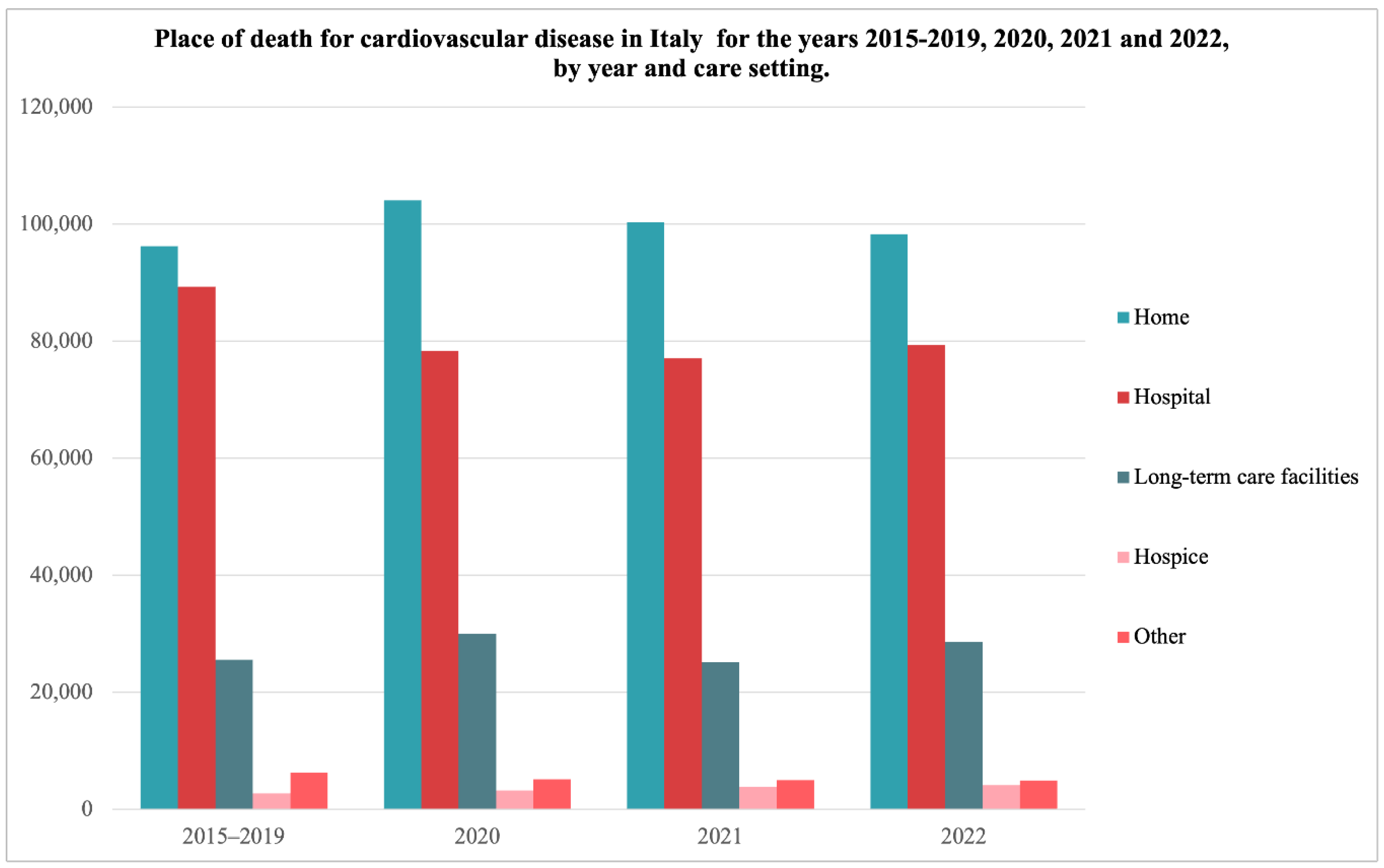
The distribution of place of death among patients dying from cardiovascular diseases in Italy across study periods was determined (
Figure 1). The categories include home, hospital, long-term care facilities, hospice, and other locations. The period 2015–2019 represents the mean annual number of deaths before the COVID-19 pandemic, while data for 2020, 2021, and 2022 represent yearly counts.
Settings
Hospice—In Italy, hospice care is provided by palliative care units which provide advanced home care, hospice residential care and counseling services variously based on regional differences [
10]. For the purpose of this study, only hospice residential care was considered.
Long-Term Care Facilities—Long-term care facilities include care homes and nursing homes. Care homes (“Case di Riposo”) are assisted-living facilities for older adults who are partially self-sufficient and can fulfil basic social needs. Nursing homes assist patients with dementia and/or disabilities, providing residential healthcare, social support, and various services, such as occupational therapy and speech–language therapy [
11].
Hospital—Hospital care is provided through a network of public and private hospitals. Requests for hospital admissions can be formulated by a GP, a pediatrician, or an emergency department doctor.
The category “missing” included deaths for which the place of death was not recorded in the death certificate. Percentages were calculated including cases where place of death was not recorded, which are presented as a separate category.
3. Results
Table 1 presents the number of deaths due to cardiovascular diseases in Italy in 2022, 2021 and 2020, together with the mean annual number of deaths during the pre-pandemic period (2015–2019). A total of 221,653 deaths from CVDs were recorded in 2022, compared to 217,523 in 2021, 227,350 in 2020, and the five-year average of 227,468 between 2015 and 2019.
Overall, comparisons between the pre-pandemic period (2015–2019) and the pandemic years (2020–2021) showed significant differences in the distribution of place of death (Chi-square test, p < 0.001), indicating a shift in the relative proportion of deaths occurring across different care settings. The inclusion of 2022 as a post-pandemic reference year suggests that some of the changes observed during the pandemic period persisted beyond the acute phase of the public health emergency.
In relation to the different settings, a consistent pattern emerges over time. Home was the predominant place of death, accounting for 44.3% of deaths in 2022, compared with 46.1% in 2021, 45.8% in 2020, and 42.3% in the 2015–2019 period.
Conversely, the proportion of deaths occurring in hospitals has declined compared with the pre-pandemic average. In 2022, 35.8% of CVD deaths took place in hospitals, compared to 35.4% in 2021, 34.5% in 2020, and 39.3% during 2015–2019.
Long-term care facilities accounted for 12.9% of deaths in 2022, showing a modest increase compared to 11.5% in 2021, 13.2% in 2020, and 11.2% during the pre-pandemic years.
Lastly, although still limited in absolute numbers, deaths occurring in hospice settings have shown a gradual rise, from 1.2% in 2015–2019 to 1.4% in 2020, 1.8% in 2021, and 1.9% in 2022.
4. Discussion
Utilizing data extracted from the Italian Register of Causes of Death, we conducted a brief descriptive study to assess cardiovascular mortality among the Italian population during the years 2020 and 2021 in comparison to the preceding five-year period (2015–2019). Home represented the predominant place of death for individuals with CVDs in 2020 and 2021. This pattern was consistent across the 2015–2019 timeframe. Nonetheless, we revealed a noteworthy trend showing that, in 2020 and 2021, there was also an increased number of CVD patients dying in hospice facilities. Overall, our findings suggest a shift toward community-based settings of care, with a higher proportion of deaths occurring outside hospitals during the pandemic years. From a public health perspective, understanding the distribution of place of death is essential for planning healthcare services and allocating resources across hospital and community-based care settings. In aging populations such as Italy, where cardiovascular diseases represent a major cause of mortality, strengthening territorial healthcare services and integrating palliative care pathways may play a key role in ensuring appropriate end-of-life care.
Our investigation identified that an increased proportion of CVD-related deaths occurred in “out-of-hospital” settings (i.e., homes, long-term care facilities, and hospices), while a decline was observed in the proportion of deaths occurring in acute hospitals. These changes were observed during the COVID-19 pandemic period and may be associated with healthcare system reorganization and changes in access to hospital care. Nevertheless, patients with advanced CVDs require multidimensional interventions that reflect the heterogeneous clinical presentations and complex health trajectories of these conditions. The pandemic contributed to the renewed attention toward advance care planning in patients with cardiovascular diseases [
12,
13,
14,
15]. During the COVID-19 pandemic, patients with advanced conditions may have accessed alternative territorial care settings during this period which may have influenced decision-making related to preferred places of care and death [
16,
17]. People living with CVDs, particularly those living with advanced chronic heart failure, have a foreseeable disease trajectory and their comprehensive management should consider a timely referral to territorial palliative resources and include discussion about end-of-life planning to ensure patients are provided with the opportunity to plan care in accordance with their personal needs, preferences and beliefs. However, despite the lessons learned during the pandemic, end-stage non-cancer patients often have unresolved needs in the last months of their life and do not receive the required care [
18]. In some cases, this could be due to late referral to hospice facilities for patients that cannot be transferred because of unstable clinical conditions or ethical concerns that oblige physicians to provide end-of-life care inside the hospital. In other cases, this could be due to unconscious bias or negative perceptions associated with palliative and hospice care, especially when an advance discussion has not taken place [
19,
20].
In 2020, Bakitas et al. [
21] conducted a randomized clinical trial to assess the impact of a telehealth palliative care program on patients with advanced heart failure. Although primary endpoints related to overall quality of life and mood were not improved by the intervention, important secondary outcomes, such as pain relief and a reduction in resource utilization, were achieved despite low compliance among participants and considerable loss to follow-up [
21]. Nevertheless, the study raises important questions about “
the right palliative care dose, for the right patient, at the right time” and represents an important step in palliative care research by focusing on the need to develop models that ensure appropriate referral to palliative care services for patients affected by advanced CVDs [
22,
23,
24]. In this sense, home might be an essential setting of care for patients with advanced CVDs, especially for people who wish to avoid hospitalization. Advance palliative home care could be beneficial in terms of addressing clinical needs and ensuring optimal symptom management towards the end of life, as well as in terms of cost-effectiveness. It may also facilitate the transition to hospice care for patients when needed.
In the near future, more patients with advanced CVDs will need palliative support and, consequently, interventions should focus on advanced care planning and improving care and quality of end-of-life. In this scenario, further research is required to improve models of home palliative care for people with CVDs and to influence policymakers to facilitate the allocation of more resources to ensure timely and efficient person-centered care that includes appropriate symptom control, psychosocial support, and continuity of care [
25].
Study Limitations
This study has several limitations. First, the analysis relied on routinely collected registry data and was therefore limited to the information available in death certificates. Second, age-standardized rates could not be calculated because population denominators stratified by place of death were not available. Third, the descriptive design of the study does not allow causal inference regarding the impact of the COVID-19 pandemic on place of death, and no adjustment for potential confounders was performed. Further studies using more advanced analytical approaches and incorporating individual-level clinical and sociodemographic variables are needed to better understand the determinants of place of death among patients with cardiovascular diseases.
5. Conclusions
We conducted a descriptive study to assess the distribution of place of death among patients with cardiovascular diseases in Italy. Home remained the main place of death across all study periods, while a modest increase in deaths occurring in hospice settings was observed over time. These findings highlight the importance of strengthening community-based services and palliative care pathways to support patients with advanced cardiovascular diseases at the end of life.
Further research is needed to better understand the determinants of place of death and to inform the development of appropriate care models.
Author Contributions
A.I., E.V. and G.O. designed the study while Maria Beatrice Zazzara supervised the study. A.I. and E.V. carried out the literature search and data analysis. E.M. contributed to literature search for the background. A.I., E.V. and M.B.Z. worked on the interpretation of results and the writing of the manuscript. G.O. critically revised the manuscript. E.V. submitted the article and acted as the corresponding author. All authors have read and agreed to the published version of the manuscript.
Funding
This research received no external funding.
Institutional Review Board Statement
Ethical review and approval were not required for the study on human participants in accordance with national regulations on personal data protection (Legislative Decree No. 196/2003, as amended by Legislative Decree No. 101/2018, implementing Regulation (EU) 2016/679—GDPR), which state that ethical approval is not required for studies that do not involve identifiable human subjects.
Informed Consent Statement
Patient consent was waived due to the use of fully anonymized and aggregated data from the Italian National Cause of Death Registry (ISTAT), which do not allow identification of individual subjects.
Data Availability Statement
The data used for this work are public and available from the website of the Italian National Institute of Statistics (ISTAT).
Conflicts of Interest
The authors declare no conflicts of interest.
References
- Istituto Superiore di Sanità. Malattie Cardiovascolari. Available online: https://www.epicentro.iss.it/cardiovascolare (accessed on 5 March 2021).
- Epicentro, “Ricoveri Ospedalieri in Italia: Il Rapporto SDO 2020”. Available online: https://www.epicentro.iss.it/sdo/rapporto-sdo-2020 (accessed on 17 June 2021).
- Cross, S.H.; Kaufman, B.G.; Mentz, R.J.; Kamal, A.H.; Taylor, D.H., Jr.; Warraich, H.J. Trends in Place of Death for Individuals with Cardiovascular Disease in the United States. J. Am. Coll. Cardiol. 2019, 74, 1943–1946. [Google Scholar] [CrossRef] [Scilit] [PubMed] [PubMed Central]
- Shih, C.Y.; Hu, W.Y.; Cheng, S.Y.; Yao, C.A.; Chen, C.Y.; Lin, Y.C.; Chiu, T.Y. Patient Preferences versus Family Physicians’ Perceptions Regarding the Place of End-of-Life Care and Death: A Nationwide Study in Taiwan. J. Palliat. Med. 2015, 18, 625–630. [Google Scholar] [CrossRef] [Scilit] [PubMed] [PubMed Central]
- McDonagh, T.A.; Metra, M.; Adamo, M.; Gardner, R.S.; Baumbach, A.; Böhm, M.; Burri, H.; Butler, J.; Čelutkienė, J.; Chioncel, O.; et al. 2023 Focused Update of the 2021 ESC Guidelines for the diagnosis and treatment of acute and chronic heart failure: Developed by the task force for the diagnosis and treatment of acute and chronic heart failure of the European Society of Cardiology (ESC) With the special contribution of the Heart Failure Association (HFA) of the ESC. Eur. Heart J. 2023, 44, 3627–3639. [Google Scholar] [CrossRef] [Scilit]
- McFarlane, P.; Sleeman, K.E.; Bunce, C.; Koffman, J.; Orlovic, M.; Rosling, J.; Bearne, A.; Powell, M.; Riley, J.; Droney, J. Advance Care Planning and Place of Death During the COVID-19 Pandemic: A Retrospective Analysis of Routinely Collected Data. J. Patient Exp. 2023, 10, 23743735231188826. [Google Scholar] [CrossRef] [Scilit] [PubMed] [PubMed Central]
- Sallnow, L.; Smith, R.; Ahmedzai, S.H.; Bhadelia, A.; Chamberlain, C.; Cong, Y.; Doble, B.; Dullie, L.; Durie, R.; Finkelstein, E.A.; et al. Report of the Lancet Commission on the Value of Death: Bringing death back into life. Lancet 2022, 399, 837–884. [Google Scholar] [CrossRef] [Scilit] [PubMed] [PubMed Central]
- Finkelstein, E.A.; Bhadelia, A.; Goh, C.; Baid, D.; Singh, R.; Bhatnagar, S.; Connor, S.R. Cross Country Comparison of Expert Assessments of the Quality of Death and Dying 2021. J. Pain Symptom Manag. 2022, 63, e419–e429. [Google Scholar] [CrossRef] [Scilit] [PubMed]
- International Classification of Diseases, Tenth Revision (ICD-10). Available online: https://www.cdc.gov/nchs/icd/icd-10/index.html (accessed on 30 April 2024).
- Scaccabarozzi, G.; Lovaglio, P.G.; Limonta, F.; Floriani, M.; Pellegrini, G. Quality assessment of palliative home care in Italy. J. Eval. Clin. Pract. 2017, 23, 725–733. [Google Scholar] [CrossRef] [Scilit] [PubMed]
- “Le Strutture Residenziali Socio-Assistenziali e Socio-Sanitarie al 31 Dicembre 2020”. Istat—22 November 2022. Italian Ministry of Health. Annuario Statistico del Servizio Sanitario Nazionale Assetto Organizzativo, Attività e Fattori Produttivi del SSN. Years 2016, 2017, 2018, 2019, 2020. Available online: https://www.istat.it/it/files//2022/11/REPORT_PRESIDI_SOCIO-ASSISTENZIALI_2020.pdf (accessed on 30 April 2024).
- Howlett, J.G. Palliative care in heart failure: Addressing the largest care gap. Curr. Opin. Cardiol. 2011, 26, 144–148. [Google Scholar] [CrossRef] [Scilit] [PubMed]
- Reddy, A.; González, J.B.; Rizvi, A.; Nortje, N.; Dalal, S.; Haider, A.; Amaram-Davila, J.S.; Bramati, P.; Chen, M.; Hui, D.; et al. Impact of an Institution-Wide Goals of Care Program on the Timing of Referrals to Outpatient Palliative Care. J. Pain Symptom Manag. 2023, 66, e666–e671. [Google Scholar] [CrossRef] [Scilit] [PubMed]
- Islam, I.; Nelson, A.; Longo, M.; Byrne, A. Before the 2020 Pandemic: An observational study exploring public knowledge, attitudes, plans, and preferences towards death and end of life care in Wales. BMC Palliat. Care 2021, 20, 116. [Google Scholar] [CrossRef] [Scilit] [PubMed] [PubMed Central]
- Gregg, S.; Cunningham, E.; O’Leary, M.J. An Overview of the Impact of the COVID-19 Pandemic on the Provision of Palliative Care. Ir. Med. J. 2023, 116, 3. [Google Scholar] [PubMed]
- Aldea-Ramos, N.; Le Strat, Y.; Fouillet, A. Place of death in France: Impact of the first wave (March–May 2020) of the COVID-19 epidemic. BMC Public Health 2023, 23, 776. [Google Scholar] [CrossRef] [Scilit] [PubMed]
- O’Donnell, S.B.; Bone, A.E.; Finucane, A.M.; McAleese, J.; Higginson, I.J.; Barclay, S.; Sleeman, K.E.; Murtagh, F.E. Changes in mortality patterns and place of death during the COVID-19 pandemic: A descriptive analysis of mortality data across four nations. Palliat. Med. 2021, 35, 1975–1984. [Google Scholar] [CrossRef] [Scilit] [PubMed] [PubMed Central]
- Hamano, J.; Shinjo, T.; Fukumoto, K.; Kodama, M.; Kim, H.; Otomo, S.; Masumoto, S.; Hashimoto, K.; Matsuki, T.; Hisajima, K.; et al. Unresolved Palliative Care Needs of Elderly Non-Cancer Patients at Home: A Multicenter Prospective Study. J. Prim. Care Community Health 2023, 14, 21501319231221431. [Google Scholar] [CrossRef] [Scilit] [PubMed] [PubMed Central]
- Beasley, A.; Bakitas, M.A.; Edwards, R.; Kavalieratos, D. Models of non-hospice palliative care: A review. Ann. Palliat. Med. 2019, 8, S15–S21. [Google Scholar] [CrossRef] [Scilit] [PubMed]
- Hentsch, L.; Sobanski, P.Z.; Escher, M.; Pautex, S.; Meyer, P. Palliative care provision for people living with heart failure: The Geneva model. Front. Cardiovasc. Med. 2022, 9, 933977, Erratum in Front. Cardiovasc. Med. 2023, 10, 1176640. [Google Scholar] [CrossRef] [Scilit] [PubMed] [PubMed Central]
- Bakitas, M.A.; Dionne-Odom, J.N.; Ejem, D.B.; Wells, R.; Azuero, A.; Stockdill, M.L.; Keebler, K.; Sockwell, E.; Tims, S.; Engler, S.; et al. Effect of an Early Palliative Care Telehealth Intervention vs Usual Care on Patients with Heart Failure: The ENABLE CHF-PC Randomized Clinical Trial. JAMA Intern. Med. 2020, 180, 1203–1213. [Google Scholar] [CrossRef] [Scilit] [PubMed] [PubMed Central]
- Clark, J.; Gardiner, C.; Barnes, A. International palliative care research in the context of global development: A systematic mapping review. BMJ Support. Palliat Care 2018, 8, 7–18. [Google Scholar] [CrossRef] [Scilit] [PubMed]
- Goldstein, N.E. Improving the Integration of Palliative Care in Heart Failure—It’s Hard to Hit a Moving Target. JAMA Intern. Med. 2020, 180, 1213–1214. [Google Scholar] [CrossRef] [Scilit]
- Brian Cassel, J.; Kerr, K.M.; McClish, D.K.; Skoro, N.; Johnson, S.; Wanke, C.; Hoefer, D. Effect of a Home-Based Palliative Care Program on Healthcare Use and Costs. J. Am. Geriatr. Soc. 2016, 64, 2288–2295. [Google Scholar] [CrossRef] [Scilit] [PubMed] [PubMed Central]
- Cassel, J.B.; Kerr, K.M.; Kalman, N.S.; Smith, T.J. The Business Case for Palliative Care: Translating Research into Program Development in the U.S. J. Pain Symptom Manag. 2015, 50, 741–749. [Google Scholar] [CrossRef] [Scilit] [PubMed] [PubMed Central]
| Disclaimer/Publisher’s Note: The statements, opinions and data contained in all publications are solely those of the individual author(s) and contributor(s) and not of MDPI and/or the editor(s). MDPI and/or the editor(s) disclaim responsibility for any injury to people or property resulting from any ideas, methods, instructions or products referred to in the content. |
© 2026 by the authors. Published by MDPI on behalf of the Italian Society of Gerontology and Geriatrics (SIGG). Licensee MDPI, Basel, Switzerland. This article is an open access article distributed under the terms and conditions of the Creative Commons Attribution (CC BY) license.



 ,
,